As-salaam-alaykum- Hello!

On the one hand Morocco is steeped in history and tradition and on the other it is raucous and new- new building everywhere; on one hand there are women dressed for work in suits and on the other, women with long caftans and covered faces; on one hand there is apparent money and success and on the other there is antiquated manual labour like plowing fields with donkeys and hand plows and making argan oil with a stone wheel. Riding camels and staying in a tent on the desert were certainly highlights as were the dramatic landscapes.
We had a fabulous trip to a very exotic country. Tara Anderson gave us specific directions on where to go, how long to spend there and we followed her instructions in every detail. Thanks, Tara! We had a car and driver from Planet Tours whom Tara recommended but when we were in places for 2-3 days, we went on our own, with the exception of Fes where we had one day and Alex at Riad La Calife arranged a guide for a medina tour.
October 27. Marrakesh
We arrived late in the day on the street near Les Trois Mages in the taxi arranged for us by Aziz the manager in the pouring rain and Aziz met us with umbrellas and walked us to the Riad, down a narrow street in the Medina (old city). We had a delicious lamb tagine (stew cooked in a Tagine) dinner with a bottle of wine that Tara arranged for us.


The weather is much colder than we expected-it ranges from 5-17 C the first few days. We had a very good dinner but eating at 8:00 pm is hard on the digestion.


Djemaa el-Fna Square Goats’ Heads Dinner
October 28. Marrakesh.
After a fabulous breakfast prepared just for us, we walked in the rain) through the souqs – tradesmen’s small working spaces and shops usually organized by trade or product, such as dyers, carpenters and coppersmiths; into the big Djemaa el-Fna square-famous for its energy and life; and finished at the minaret of the Koutoubia Mosque.


Koutoubia Mosque Mamounia Hotel Foyer
It is the oldest and best preserved of the three most famous minarets-we are familiar with the Giralda in Seville and there is one other in Rabat. One of the differences here (as opposed to our visit to Turkey) is that non-Muslims are not allowed to enter mosques.
While there are some porous coverings over the paths in the souks, the rain also collects in the corners and comes down in a flood at times. We also visited the Mamounia Hotel (at my friend, Val’s request), rated as one of the top hotels in the world in the pouring rain; we looked around but didn’t stay – can’t let the weather stop you! It did make it easier the next two days that we had been sufficiently lost in the labyrinthe of streets that we were getting our bearings. While they are persistent salesmen, they can’t touch the aggressiveness of the ones in Istanbul!
Oct 29. Marrakech
We walked the souks, the big square, the tombs and a ruined palace today. It was sunny all day: warm in the sun and cooler in the shade but a great day altogether. We sat on a rooftop restaurant for lunch.
Bill got new leather slippers and I bought some pure Argan oil- great for your hair and skin. They have banned plastic bags here so you get your purchase in a recyclable cloth bag.
After a short rest and we revisited the big Djemaa el-Fna square- crazy place with lots of people selling everything from henna to goats’ heads dinners. Also snake charmers, story-tellers, dancers and acrobats.
Oct 30 7:13 pm Ouarzazate




Oct 31.
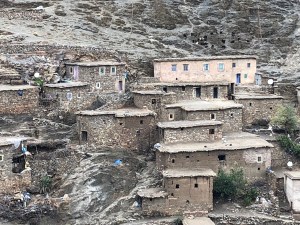
We had to be ready for 8:00 am as we needed to get to the tent before sunset. The weather continues to much colder than we expected. It was a long day with 3 stops: 1 at Abdel’s parents’ house where we met his parents and had tea with his Mom ( a lovely surprise); 2 at the Dades Gorge; 3 at a carpet shop in Tinghil where Abdel knew the locals-we bought a red and blue Berber knotted rug for the TV room that was shipped and arrived just after we arrived home – it looks fabulous.


Top left: the entry way; top right: exterior of Abdel’s parents home; bottom right: having tea and corn soup with Abdel and his Mom.
Bottom left: rest stop on highway where locals sell scarves for the desert; bottom middle left: Dades Gorge; bottom middle right: the carpet shop; bottom: our new carpet.
We had a fantastic time on the Sahara! It was a sunny cool day but we still had several layers of clothing and bought 2 pashminas in case the wind came up- it didn’t so we were very lucky. We arrived about 4:30, got on our dromedaries (one hump) and rode off with a guide and a young woman, Claudia, from Italy over the sand dunes.


At sunset we climbed a dune and watched the setting sun. Awesome!

Then we carried on to the tent encampment with about 12 tents in a circle with red rugs for sidewalks and lanterns to show the way. Our tent was large with one queen and 2 singles, toilet and shower. Dinner was at 8 and was very good; there was music at a bonfire but it was cold and we were tired.


It was cool at night and cold in the morning so we just jumped into our clothes! We got up to see the sunrise at 7:15 – quite spectacular. The breakfast was fine even though the coffee was weak.


sunrise camp in the morning
Nov 1. Fes.
We left the Sahara (Mergoza) at 8:30 and, except for a very good lunch, drove until 6:00 pm through rain, fog, and bits of sunshine, mostly in the morning.
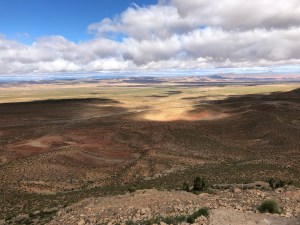
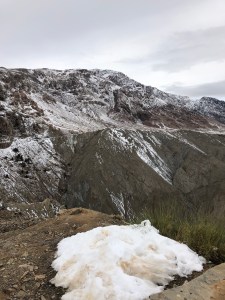
It was another trip through mountains, many covered in snow and sweeping valleys.
We arrived near the Medina in Fes and a staff member from Riad Le Calife came to the square to meet us and take our luggage as no cars can pass through the old streets. The is an awesome Riad- beautiful rooms and terraces and elegant decor. The owners, Alex who is from Paris and his wife Yasmine who is from Fes, can’t do enough for us. They shared with us that the Riad had been in rough shape and it took 14 months to repair it, partly because the rubble and the new materials had to be brought in by donkey.and cart, motorcycle and cart or man-pulled carts:

Honestly, we’ve never seen so many donkeys: they are everywhere-in the cities, in the rural areas. In the cities the streets are full of cars, motorbikes, scooters, donkeys and carts. In the souks, you have to get into a doorway so that the donkeys and carts (and motor scooters) don’t run you over.
We had an excellent dinner at Le Calife (Tagine again) as we didn’t have the strength to go out😴-who’d think that sitting all day in a car would be tiring! And Tara recommenced having a dinner here. The breakfasts were awesome, too.


Walking the souks Coppersmith souk
Medersa dyers souk
We had lunch on a rooftop restaurant-20 degrees and sunny. Yes, we bought a (another) rug! I don’t know about the right place for buying rugs and sometimes I think I have lost my mind but they are beautiful.
view of large mosque from door, restaurant, medina
Aziz, our Fes guide who gave Prime Minister Paul Martin a tour, says that there are some improvements in the lives of women with more freedom in the big cities and more women in government. He also said that women in Mosques would be too distracting!
We had dinner at a restaurant in which Alex and his father-in-law are partners and he provided transportation.We had a very good dinner but eating at 8:00 is hard on the digestion.
Yasmine talked about renovating the Riad which took 14 months with craftsman working full time to repair the tile work by hand. Also the Riad is inside the Medina where only carts and donkeys can pass so getting materials in and out was a challenge. She says that when people are disappointed in the Riad (not like a real hotel) she feels badly as she and Alex have poured their souls into it.
Nov 3. Chefchouen
We had another long day today, driving from Fes to Chefchouen with a stop at a 2 AD Roman city called Volubilis, that is has been unearthed since 1932 and is still being excavated – some really amazing mosaics, columns and basic frameworks of houses- a huge site. Our guide was very knowledgeable.

Volubilis
Abdel taught us to say Let’s go – Yalela! We arrived in Chefchoen at 5:00 pm, walked the Medina and square (everything is painted blue here) and were so tired we took a taxi back (20 dirhams- $2.30).


We had a light dinner at the riad and met a couple from Colona, BC. They have been to India and recommend a Grapefruit seed extract called Nutribiotics that you take at the first sign of infection- we will get it!


The Blue City: Chefchoen, women washing in the stream by hand, blue door, local colourful hats for sale.
Nov 4. Rabat
We arrived in Rabat after another long drive and went to the 44 metre tower that we was intended to be 86 but the king died and so the highest tower is in Casablanca and we will see it tomorrow. We visited the tomb of the last king and his father in a very beautiful building.


Unfinished tower Tomb of last king
We walked the Medina and looked out on the beach and the Atlantic. Then we visited the Kasba and its gardens.


We arrived at the Riad Kalaa2 around 5:00, looked out on the city from the rooftop terrace. The Riad is in the Moorish style but appears to be new and our room is on two floors with the bathroom and sitting room downstairs and the bedroom upstairs- makes nighttime visits to the bathroom a challenge!
We walked through the streets and shops- more of the same- leather, carpets, clothing, ceramics, jewellery, lanterns and lights. We had dinner at a very opulent Moroccan restaurant- the manager walked us there and back through the backstreets of the Medina. The walls and floors were covered in deep red and gold coverings.


The meal- A variety of 6 Moroccan cooked salads, 3 Brioches each (cheese, beef, chicken), 1 beef tagine and one chicken Pastille, crisp layered pastry with cream, mint tea and cookies. It was too much to eat and quite expensive (our most expensive meal in Morocco- 500 dhs- $70 without wine or alcohol) but it was delicious. I washed my hands in rose water from a silver teapot!
Nov 5. Casablanca and Essaoira
Today we drove to Casablanca in the rain, arrived at 10:55 just in time for the 11:00 tour of the Hassan II Mosque, situated on the Atlantic Ocean with the waves crashing on the shore. The mosque, the 3rd largest religious monument in the world after Abu Dhabi and Mecca, was completed in 1993 after 5 years. It can hold 25,000 worshippers and up to 80,000 can join in in the esplanades around it. At the time, it was the highest minaret at 210 metres. It was built with Moroccan materials and by 6000 Moroccan craftsmen. Entry is with a guide and costed 120 dhs.


Hassan II Mosque
Another long drive (4 hours) to Essaoira (esaweeria), still drizzling and then cloudy. We were met by Sandra at the gate and said goodbye to Abdel-the end of the tour. He was a great guide and driver and hopes one day to start his own tour company with his brother. He knows a lot more than he shares but when you ask him a question, he has the information. We wish him well.
The worry that I had about getting from Essaoira to Marrakech on Thursday (seem to have missed this and the tour company wanted 200 Euros) is now solved by Sandra for 700 dhs ($98.00). These three days were planned for a slower pace and no car trips. Most tours do not come to Essaoira because it is quieter and easier to navigate.


Bill and Sandra Main floor living room at Remmy Riad
This is a traditional Riad like Marrakech plus they have a cover over the open air courtyard which makes it warmer.


Alleyway to the Riad showing low and narrow the streets and doors, our floor in the Riad
We walked the Medina and got some cash at the ATM. We had dinner at Le Patio, a good French restaurant, candlelit and with the menu on a big chalkboard- the fish was delicious and a good change from tagine.
Nov 6. Essaoira
We’ve had a lovely day in Essaoira: nice breakfast with Sandra- she is managing the Riad for her friend and her husband. The three of them came to Essaoira 10 years ago and loved it and the friends looked for a place to buy, bought the Riad, totally renovated the place which took 4 years. All the stuff in and out, all had to come on carts and donkeys.
We started out at the active fishing port.


We also walked the Medina today and it’s a different experience here as the streets are almost a grid so it’s easier to find places and harder to get lost; the pace is slower and the pressures to buy gone. We bought a hand of Fatima (patron of strong women) on a chain and a door knocker of her hand, as well – yes, bargaining was part of the process. In this part of the world the symbol is called The Hand of Fatima, and links back beyond ancient Egypt; its meaning represents both power and protection, on the temporal plane as well as the spiritual. The hand works, it creates, it guides, it protects. The symbol is also known as khamsa and the Eye of Fatima in Islamic tradition. The Hand of Fatima is made in the form of talisman, amulets, jewellery and architectural details. Although predating Islam, the symbol has been widely assimilated into Islamic art and popular culture.


In the streets are sellers of mint (for Berber whiskey), bread and vegetables
The medina is also the source of ceramics (we bought two small tagines for salt holders) and fresh chickens are available to take as is or de-feathered and cleaned before your eyes.

Then we walked the paseo on the beach which is huge and today included a few stalwart sunbathers but mostly wind surfers. Essaoira calls itself “Africa’s Windy City”. Bill was dying for a beer but we couldn’t find a place that sold it and came back for a glass of wine.


We had a rest and then a chat with Sandra who, despite being a single woman in a patriarchal society, has had no problems here. She has a friend in Murcia so is aware of our part of Spain. She told us where to find beer tomorrow.


We had a great dinner at Sirocco- a lamb tagine (stew made in a tagine) and a vegetable couscous – we’ve learned that we can’t eat 2 dinners or even lunches.
Nov 7. Essaoira
Lovely sunny day here-we walked the beach, had lunch at Bab Lachour cafe overlooking the port and square. We had a very good lunch with beer and wine. We walked the Medina and around the corner from the Riad, Sandra took us to a spice/herb store where we bought a litre of Argan oil for 400dhs- $60.

herb and spices store cafe on waterfront
We went to Le Dauphin (appropriate given the name of our sailboat) tonight where Sandra recommenced a special slow-cooked lamb dish and we can take a bottle of wine. We had a very good dinner and our German friends at the table were envious of our wine!
We packed the blue smaller rug that we bought in Fes and it pretty much fills one suitcase!
Nov 8. Marrakech
We arrived in Marrakech at 12:45 after a terrifying taxi ride – the driver passed everything and everyone in sight, even an ambulance, all the while honking his horn. Bill said he had a sore neck when he got there; I kept my eyes out the side windows. He stopped too soon and Aziz from Les Trois Mages came and got us.
Aziz helped me get our boarding passes and I paid for the one checked bag- 15 Euros instead of 30 when you get to the airport-another lesson.


We walked through the souks, had lunch at Le Jardin,-lovely very French garden restaurant, to the Marrakech Museum which is a restored Sultan’s palace. The photos above give you a sense of the extremes-hanging meat at the butcher’s souk on the path to a haven behind the walls.


On the way back we visited The Secret Garden another restored patio/garden.


Nov 9. Last day in Marrakesh
We went for an hour walk on our last morning in the souks, got picked up by the taxi, got through the passport control and customs after a very long wait. Sad to leave Morocco; glad to be back home.
Some observations
We talked today about what was memorable about Morocco. The list is :
1. The dramatic landscape: we went through desert, snow- capped mountains, rocks and rubble, massive valleys with various crops and many, many sheep and goat herds with a shepherd. In many regions, the deep red earth was stunning.
2. The souks are an assault on the senses with the colourful goods n the stores, the throngs of people; in Marrakech the motorcycles are a real risk to your safety, especially in the souks.
3. The dominance of manual labor is staggering with fields being prowess by donkey and hand plot. Actually donkeys are everywhere being used to haul everything from farm produce to building materials. Or you can pull a cart full of goods by yourself.
Washing clothes to making almond butter is done manually, not to mention making carpets, usually by women.
4. All of the women we saw in rural areas and in cities wore head scarves; most wore caftans. A few wore the face covering as well. Many men wore the long caftans with the pointed hoods.
5. Like Turkey, the other Muslim country we visited, the call to prayer (men only) comes over the loudspeakers from the aman 5 times a day. And they don’t drink alcohol at all so it has been a challenge to find a drink.
6. According to Azziz, the tour guide in Fes, women are making progress ( more women in the government) but not in the mosque because they would be distracting!
7. The camel ride, watching the sunset over the sand dunes, the night in the tent in the desert, the sunrise across the dunes- all very memorable.
8. All of the accommodations were very good. Our favourites were the ones we booked with Tara’s advice: Les Trois Mages, Le Caliphe, Riad Remmy. We liked them best because they were small, warm and friendly. The owners/managers went out of their way to help us and make sure we had a good time. Riad Le Caliphe was the most elegant.

 Site Title