Namaste “I bow to you.”
Note: For many of the photos, the caption is visible when you click the cursor is over it.
An invitation to nephew, Ian, and his fiancee, Shalaka’s wedding in Vadadora, India was an opportunity to see India that brother Steve, sister-in-law Deirdre, Bill and I, had not anticipated. Not only would we participate in a completely new experience at a traditional Indian wedding, we would get to know the customs from the family: the parents, Rashmi and Girish, and daughters, Shalaka and Prachi. Then we went on an extended tour of India.
We left Toronto on December 2nd, arrived in Delhi on December 3rd (direct flight from Toronto to Delhi, arriving at 9:40 pm with very quick passage through immigration but a long 7 hour wait for our flight at 5:05 am to Vadadora). December 4th we were met in Vadadora (old name is Baroda) by a taxi and arrived at the airbnb family-size apartment with 4 large bedrooms with ensuites at around 8:00 am.


December 5th we spent Indian wedding and related dress shopping which included selection, ordering, and fitting sessions for alterations for both men and women. It took the whole day but all of us picked out our outfits.
December 6. With Prachi’s help, I actually went back to the wedding store. The day before when I was trying the ones they brought for me, they were sample sizes (4-6) and trying to stuff me into them was very uncomfortable to say the least. I finally had had enough and just bought something but I was not satisfied. When we went back, they brought dresses that fit and I found one – no problem and at half the cost!
One of the events was a family dinner at Girish’s cousin’s house which is also the home of the other wedding – Radhika’s arranged marriage to Neil who lives in the USA where they will go after the marriage. It was great to meet some of the family members.
Ian applied for and got the permission of the owner and the licensing office to drink in the Airbnb.
December 7. One of the traditions is that the husband-to-be’s family buys the bride a wedding necklace so we all went to the jewellery store to buy the marriage necklace and Bill bought me 22 karat bangles as it was our 13th wedding anniversary.
In order for us to get all the jobs done, the Shahs had two cars and drivers available all day for the jobs and to get to dinners. The cost of a driver, car and gas was $40.00 Canadian a day.
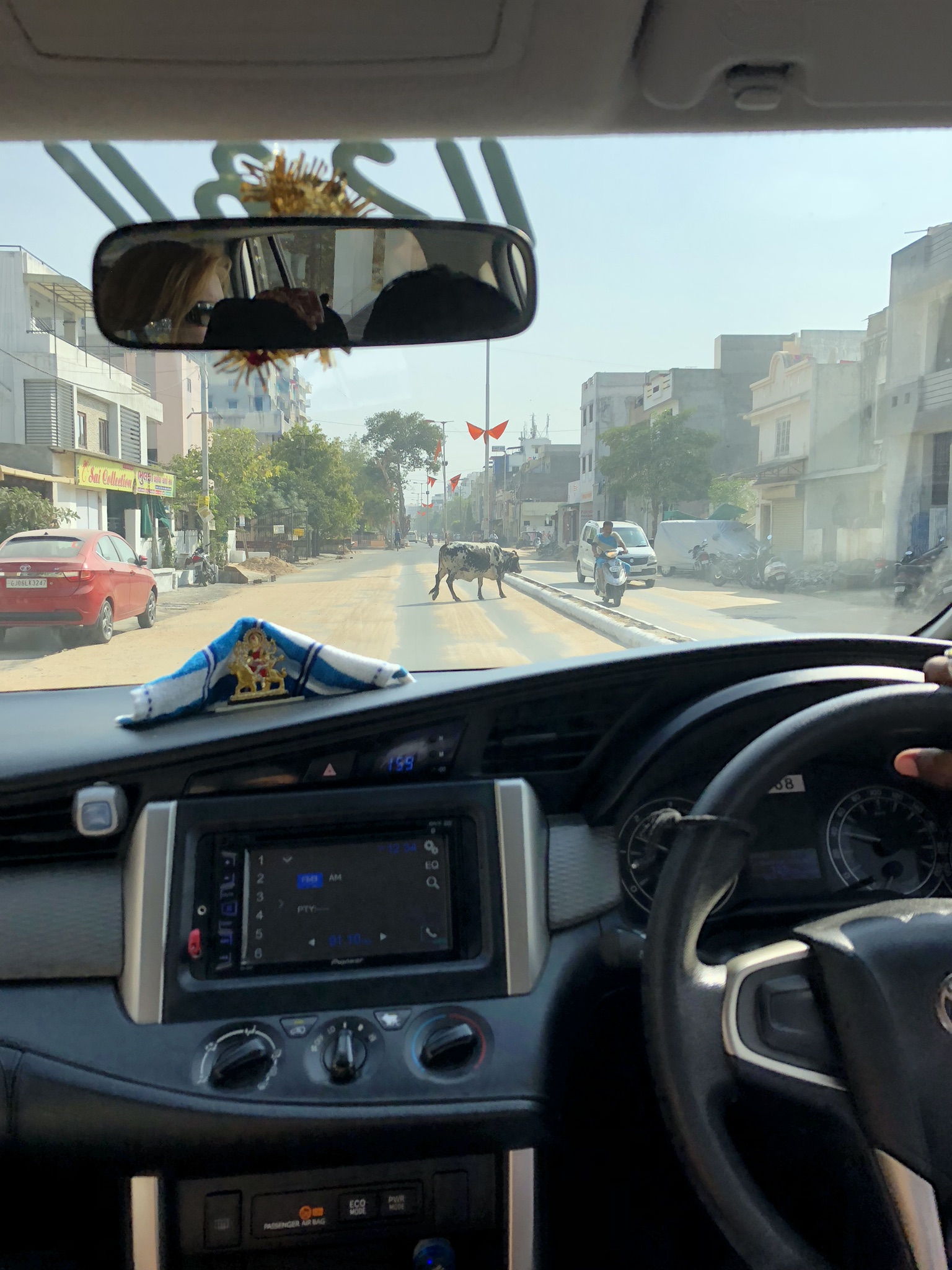
This city, Vadodara (old name Baroda), hometown of Girish, the father and current home of family members has a small town feeling and is easy to get around even though there are over a million people. The roads are paved but once the pavement stops, it is dirt pathways with no boundaries between paths and road: it is dangerous for walking and very dusty. While there are expensive buildings in the city, many are rundown and in need of repair and paint with many people living on the street and in basic shacks. Cows roam freely and are fed in the streets: they amble down the middle of the road, hanging out in dumps and backyards.
December 8. All the women in the apartment had facials and other beauty treatments. Unfortunately, I started to have intestinal problems that lasted 2 days. I took all the supplements that my Naturopath, Dr. Storjohann, gave me and am not sure which worked or if it was a combination but recovered with a somewhat sensitive stomach and ate lightly. That evening the group went out for dinner at the home of old friends of the family and the next day the wedding group went to their temple and fed the poor. I missed both because of debilitating digestion issues.
During the afternoon of December 9th, two ladies came to apply henna (a dark paste in a tube) designs on all the group of ladies in the apartment with Shalaka getting it on her hands, arms, lower legs and feet with the rest of the group getting hands and forearms. All of the designs were different with Shalaka’s being the most ornate. It took over two hours to dry and we sat or walked around with our arms in the air. Over the next two days, it moved from an orange colour to more red and lasted about 2 weeks.


In the evening, there was the Mehndi party at a large hall where all the ladies got smaller versions of the henna on their hands or one hand. In attendance were about 40-60 mehndi-associated ladies accompanied by their partners and other friends. Shalaka danced a beautiful traditional dance for the group.


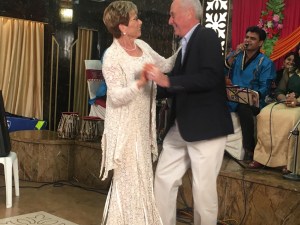
There was a band playing Indian music and each couple in the family had to go to the front and dance:
Also, each family was responsible for a song so the Shalaka’s family (and others) sang ‘La Vie En Rose’ and the Delongs sang Abbas ‘Dancing Queen’:

Shalaka, Ian, Rashmi, Jackie, Alyson, Prachi, Girish, Umesh
December 10, is the haldi ceremony, one in which a paste of haldi is applied to bride and the groom’s body before their wedding. The paste is a mix of turmeric and other ingredients. A bit of a deviation from the usual, this ceremony was held in our apartment the day before the wedding day. Here I am applying the paste:


That evening we went for a short time to the Mendi Ceremony of cousin, Radhika and bridegroom-to-be, Neil.
December 11: The Big Day.
By 9 am we had reached the marriage venue followed by one hour for a pre-marriage photoshoot of the couple and family.


Ian and Shalaka
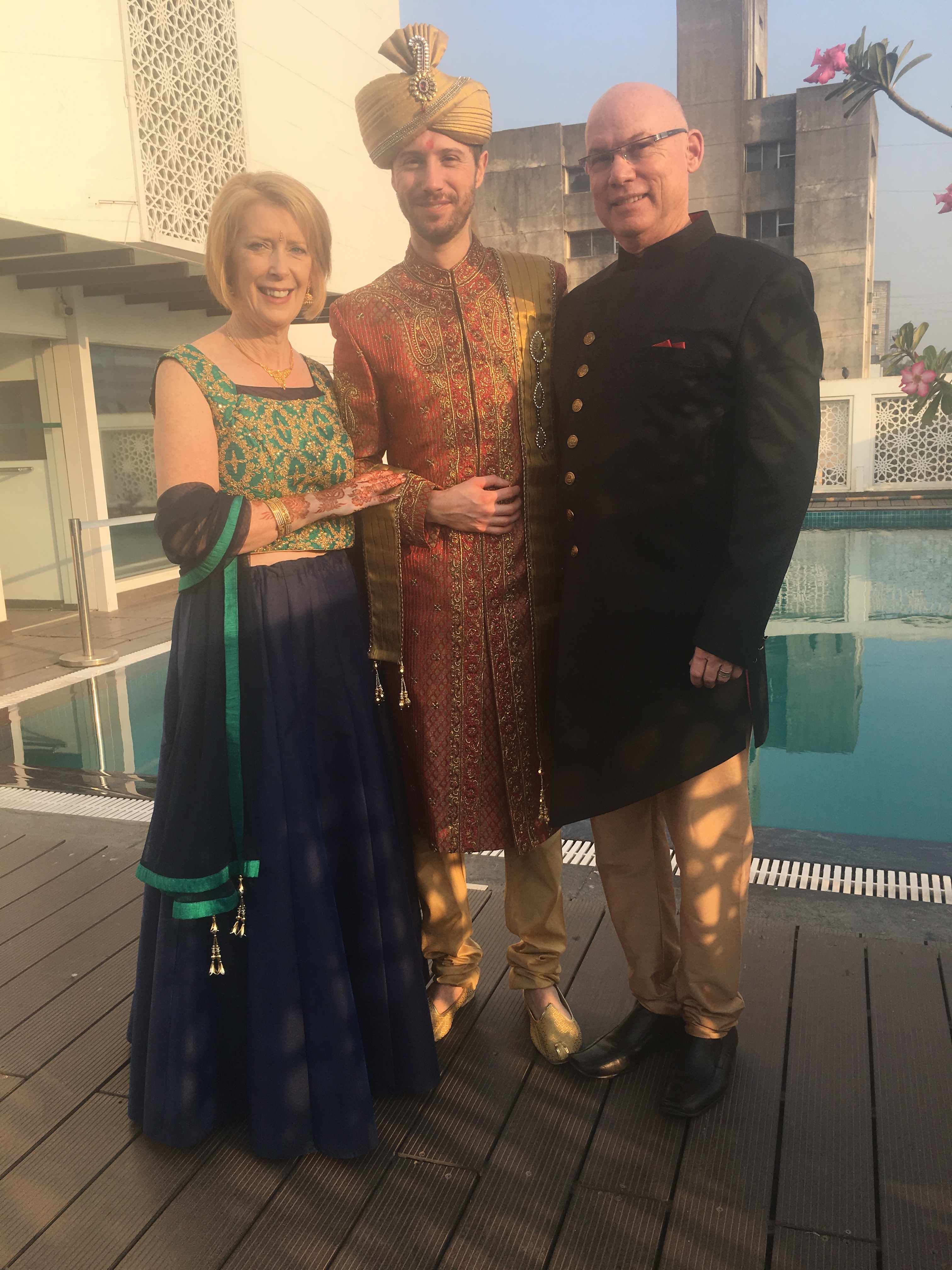
De, Ian, Steve


10 –1 pm:
The 200 guests attended the wedding by sitting or standing on all four sides of the madap (chairs). The four key marriage ceremonies were performed by a priest in Sanskrit with a second priest-“lite” to translate it in English. I’m not sure I have the words to describe the series of events. It was an overwhelming fusion of colour, sound and ritual. We started at 8:00 am and we got back at 4:00 pm. It was non-stop for the the Shalaka’s family and Ian.


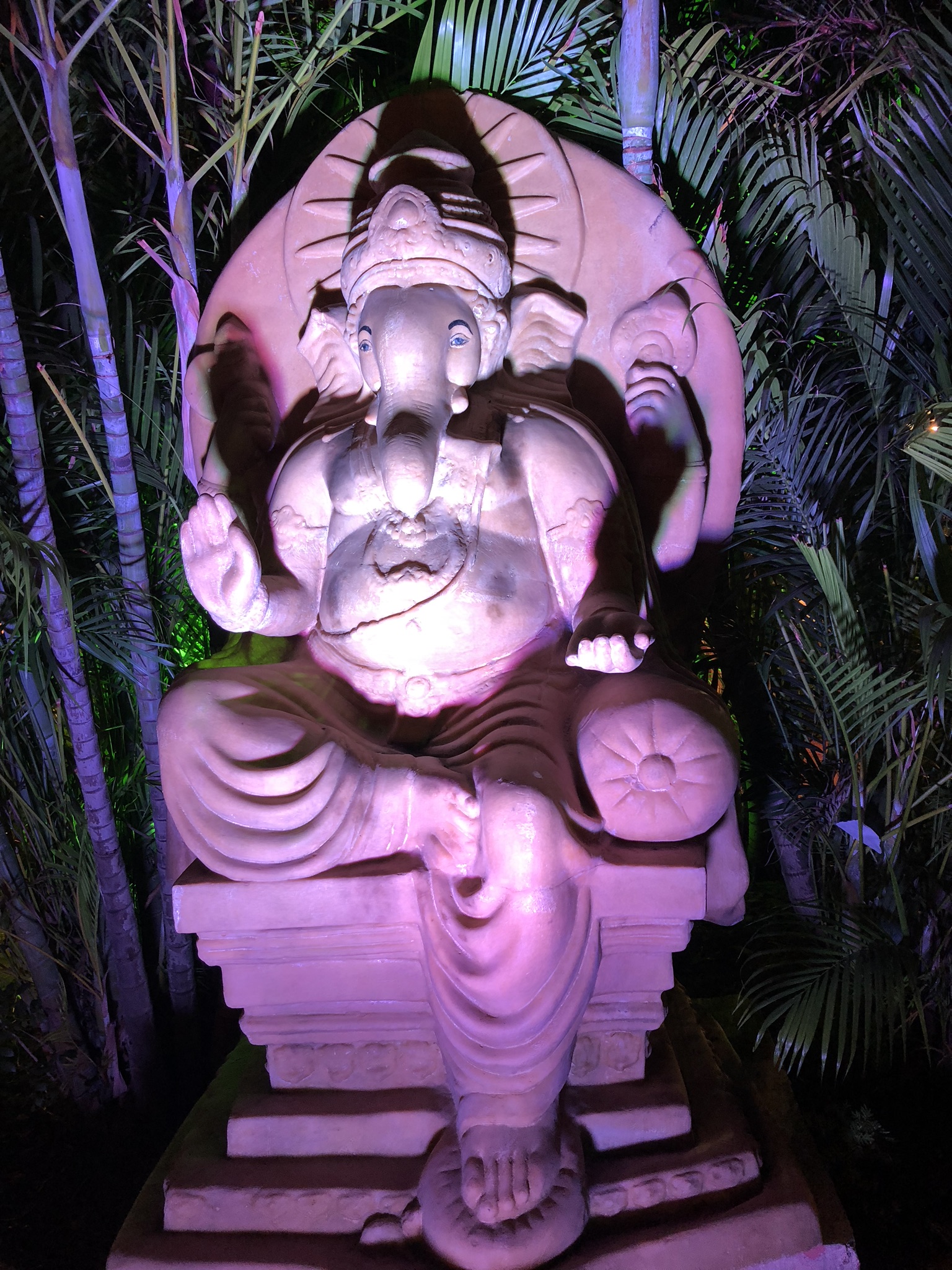
When we arrived to the wedding location, the site (Madwo or Mandap) where the marriage was to be solemnized was set up with a canopy supported by 4 corner-posts over a decorated stage. The ceremony was already underway with Rashmi and Girish going through a sequence of rituals with the priests in the Mandap covered in flowers The ceremony was about the giving away of a daughter, aligning the planets and welcoming Ian to the family. It included Ganesh-pooja: prayer to Lord Ganesh to eliminate the hurdles and smooth the passage of the couple heading to their wedding by the parents of the bride. Lord Ganesh is one of the most revered gods in Hinduism, has an elephant head and human body and is the lord of success and destroyer of evil and obstacles. He is also worshipped as the God of Knowledge and Wisdom. Traditionally, Ganesh is the first god to be worshipped before the announcement of an auspicious occasion, like weddings.
Then we went outside for the parade. I, as ‘elder sister’, accompanied Ian in the car covered in roses where my job was to shake a rattle to keep him awake and ward off negative spirits- the rest of the group went in front of the car dancing down the street with a very noisy band.
Then the ceremony centred on Ian and the priests. At the end of the series of rituals with Ian including washing his feet, a large cloth was held up so Ian could not see Shalaka come in under a bower of flowers with her uncle, Amish, as we threw rice. (Ian said afterward he hoped that this was the person that he came to marry).
While some of the events in the mandap are going on, the men of the family get turbaned, quite a skill.


In the hast-milap, they ceremoniously join the hands and dresses of the couple, exchange garlands and the marriage event is declared open to the public (all in the form of prayers in Sanskrit). Finally the marriage proper is performed in front of “fire” as an eternal witness done by chanting of songs and prayers by the priests and actions carried out by the couple as directed by the priest. Saptapadi is the most vital ritual of the marriage as the couple takes seven rounds around the fire and they recite the seven vows of marriage together: to nourish each other; to grow together in strength; to preserve our wealth; to share our joys and sorrows; to care for our children and parents; to be together forever; to remain friends, lifelong.


Shalaka and Ian then received guests who lined up to meet and wish them well, inside the mandap, where the fire and other marriage ceremony accessories were cleared away and chairs are put in place for bride, groom, and accompanying parents and close family members on each side to help the couple.
Food was served throughout as a buffet in another corner of the hall and available from noon onwards along with music from the live band. There were 5 photographers, including a videographer, on site all day so the record is extensive. Late afternoon we retreated the the apartment to review the events of the day – with alcoholic drinks!
December 13: We had a slow start and in the afternoon we visited The Motibaug, The Luxmi Villas Palace Estate and the Majaraja Fateh Singh Museum on the same site. Monkeys are a common sight.


In the evening we attended Radika’s wedding to Neal. This was a more elaborate and larger Indian wedding with the groom arriving on a white horse. It was fun for all of us to relax and enjoy the wedding.


The wedding was definitely a highlight of the trip and we are grateful to the family for their kindness and supportive introduction to life in India. We look forward to seeing them in Montreal in September.
The Great Indian Road Trip: December 14 to January 21
Carvan Tours started our itinerary with the following:
“To other countries, I may go as a tourist, but to India, I come as a pilgrim. ~Martin Luther King, Jr.
India has been a source of inspiration for soul searchers, artists, intellects and philosophers alike. With so much diversity and deep-rooted culture, the country tends to be both overwhelming and awe inspiring at the same time.
This epic journey will take you across from Kerala’s natural abundance of beautiful golden beaches & lofty mountain ranges to Pondicherry’s culture contrasting perfectly with a modernizing country; from the rich history & architectural heritage of the Pink city Jaipur to Andaman, one of the most awarded travel destinations of India.
And of course, no trip to India is ever complete without a visit to the wonder of the world, the great Taj Mahal. An iconic structure which is the symbol of eternal love, the mighty Taj would leave you in admiration of its grandeur and is assured to arouse the romantic in you!”
It’s important to understand that our tour included hotels with breakfast and dinner, drivers, parking and flights.
Day 01: 14th December Arrival at Cochin & Sightseeing
We started on our tour- left on a 6:15 flight in the morning with a one-hour stopover in Bangalaru, barely arriving in time for the flight because of the slow screening processes (in fact, the gate staff phoned Sharad, the tour manager, to see where we were) and were met in Cochin by Binu, our driver. After check-in, we went for lunch at a seaside restaurant in Willingdon, a man-made island built by the British. We had great fresh fish for lunch and beer and wine! We visited the oldest church in Kerala state built by Vasco de Gama – he was buried there but later his family moved him to Portugal.


We helped pull up the Chinese fishing nets but there were no fish in our catch. We walked the streets but were tired so we went back to the hotel, slept for 2 hours and had dinner.
Day 02: 15th December Cochin – Munnar (150 Km/ 05 Hrs)
This was a long day of driving as we transferred to Munnar which is 1800 metres above sea level and also the home of South India’s highest peak (anamudi-2695 mts).


Day 03: 16th December Munnar Local Sightseeing




Day 04: 17th December Munnar-Thekkady (110km/ 3.5 Hrs)


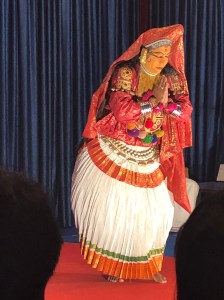
Day 05: 18th December Thekkady


Day 06 – Day 07: 19th December – 20th December Thekkady – Alleppey House boat (140 km/ 04 Hrs)
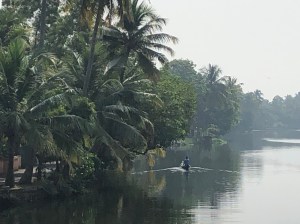
We drove 4 and a half hours west arriving at Alleppey, where we were booked for a 2-day stay on a rustic houseboat, Relax Karela Premium Houseboat. A quintessential part of a Kerala trip, while sailing down a maze of canals, we saw different scenes from the villages, paddy fields, coconut palms, fisherman and local life. We pulled out around 2 went down the canal, out into the lake, stopped for lunch and arrived at our overnight anchorage at 6:00 pm. The houseboat has 3 bedrooms which includes a bathroom with shower (the only catch is there is no hot water so we waited until afternoon when it was hot and showered). The 3-man crew was very helpful and the food very good. However, the boat was in need of a reno.
The canals are busy places with personal long boats used for transportation and fishing, water taxis, work boats transporting building materials and 3500 registered houseboats and a number of others. We saw fishing with nets and traps. Bill managed to get a turn at the wheel.
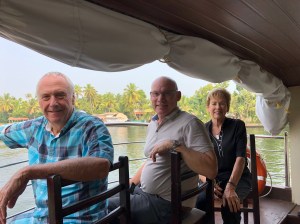
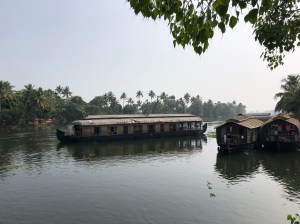

Bill asked the captain and cook to stop at the fish market for Backwater Prawns which cost $44.00, a bit expensive for here. We had heard about them from Binu. They were a delicious addition to the meal.




Kerala – Pondicherry
Day 10: 23rd December Kumarkoram – Cochin (90 km/ 03 Hrs)–Chennai – Pondicherry (140 km/ 3 Hrs)
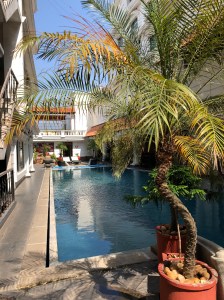
The check-in at the hotel was a bit of a challenge. When I saw the room, I was having no part of a dreary old room in need of an upgrade so I fought with the woman at the desk until we got rooms in the new, renovated wing of the Anandha Inn (i Hotel) especially when we were going to be there 4 nights. The hotel had a very nice pool which we used several times.
We ate snacks, had a drink. After a nap we took a chance on dinner.
Day 11: 24 th December Explore Pondicherry
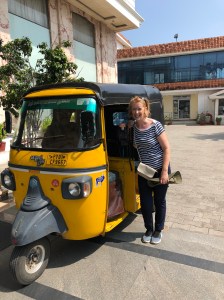
Fondly known as The French Riviera of the East (La Côte d’Azur de l’Est), Pondicherry was the largest French colony in India. We visited the parts of the city with a strong French influence, especially in the old quarters, with Rues and Boulevards lined with Mediterranean style houses and bakeries, although the city remains very much Indian. Today we toured the town of Pondicherry with its French-influenced buildings (the French were in control here until 1957) and walked the beachfront promenade. We bought booze here tax-free. When we got tired of walking, we hailed a rickshaw for 100 rupees ($2).


We asked Ballu, our driver, if he did yoga and he said that his only yoga position is seated at the steering wheel! We have a new reason to drink- empty the weight from the suitcase!
After several failed attempts to get cash at ATMs, we were successful at the State Bank of India (SBI) with Bill’s Royal Bank card but not my TD card-it turned out to be TD’s security and we had to call them. Anyway, we got two lots of 10,000 rupees ($200).
We walked Baker Street which was very busy with many scooters, stores of clothing and ladies making flower garlands.


We walked the Promenade Beach which is more promenade and only a very rocky beach with a large sculpture of Gandhi.


For Christmas Eve we went to the Palais de Mahe Restaurant in the French Quarter and had a very good meal with 5 courses in a lovely outdoor rooftop setting. Santa came for a visit and we had live music from a very good guitarist/singer.


Day 12: 25 th December Pondicherry Sightseeing
We visited the Aurobindo Ashram (in French Quarter) which houses a library, study room and sales emporium. Remainders of Sri Aurobindo are present here and is open to all for meditation. We went to the Aurobindo Ashram in the French Quarter in the morning, Christmas Day. We had to take off our shoes and shut off our phones and be silent. We walked through the Ashram, the gardens and past the people praying at the samadhi, kind of a shrine- a flower-covered table in a pergola.
We visited an ancient Roman trade centre with the ruins of one building still remaining (Arikamedu) near Ballu’s home about 50 metres from the river and a fishermen’s port where the tsunami hit on the same day in 2004 and the locals were reflecting on the loss of lives with a sand sculpture.


Day 13: 26th December Auroville Visit
We drove about 45 minutes to Auroville, an international community dedicated to peace, sustainability and ‘divine consciousness’, created in 1968 by ‘Mother’ from the Sri Aurobindo Asham in Pondicherry. She envisioned a town where unity will be celebrated and all will have a spiritual vocation. Approximately 2200 people from 43 different countries live in the city and work together to build a universal, cash-free, non-religious township.


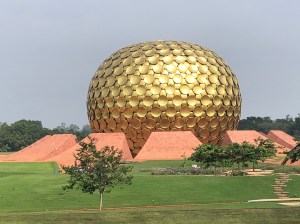
Auroville tends to attract a lot of people interested in sustainable living practices, which for most people has come to be synonymous with farming. We walked through the woods to the Matrimandir – Temple of the Divine Mother (the spiritual centre of Auroville) which was completed in 1979. It stands as a living example of human unity in diversity. The shape is that of a lotus in full bloom with its twelve large petals symbolizing the Diving Consciousness. the flattened sphere is covered with 1400 golden discs to symbolize a radiating golden Supramental Sun and inside a meditation centre. There did seem to be a positive energy about the place..
We came back and had a swim in the pool.
Day 14: 27th December Pondicherry – Chennai (150 km/ 03 Hrs)
We proceeded towards Chennai for an overnight stay. On the way to Chennai we had a guided tour of Mamallapuram , a 7-9th century village built by a Pallava king with several temples at various locations. We saw 5 temples: the first was made with layers of some worn away somewhat by time and the 2004 tsunami; a huge cave temple; a huge rock with 154 sculptures carved out of one piece of rock supposed to be the largest in the world;


Butterball Rock on such an angle that it looks insecure but has not moved since the 9th century despite the English trying to move it with 7 elephants and several tsunamis; and 5 sculptures carved out of one rock.


We drove all morning and arrived at 2:30 in Chennai at the Mount Manor Hotel near the airport- another struggle to get a clean, updated room. We ended up with a renovated room that sat right above the highway where the traffic roared all night.
We received a call from Sharad, the tour operator, to say the Prime Minister was going to Port Blair as an election is in the offing and the shops would be closed (including the liquor store and there is not one on Havelock Island) so we needed to stock up in Chennai.
Chennai – Andaman Islands
Day 15: 28th December Chennai – Port Blair
Airports here are interesting: first, the screen your checked luggage as soon as you enter the airport and put seal on the lock; second, personal screening is separated into male and female- females go into a private room. We have been over-weight for each of our internal flights but have not been charged.
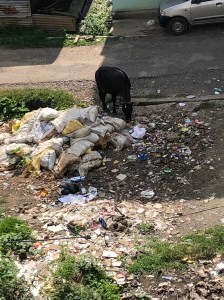
We arrived at 11:00; our room is basic but clean but the view is of a cow eating garbage in an empty lot.
We caught an early morning flight and arrived at Port Blair in the morning to Hotel Blue Marlin. The driver drove us to Corbyn’s Cove where we found a restaurant with a bar for lunch. The beach was dirty but it gradually filled with families on Friday afternoon. Only children were in the water and where young women were in the water, they were fully clothed. There were no beach chairs and so people just stood around. Going out with a driver on jet skis was popular.
The most remarkable sight was a cow sitting on the beach apparently not phased by the visitors. Our driver did not return as promised so the tour company contact sent us another driver to bring us back. Today Bill got cash from the ATM but Steve could not- TD again! Saturday it worked for both Steve and I our TD cards.


Day 16: 29th December Port Blair – Havelock Island (57 km/ 1.30 Hrs)
In the morning we went for breakfast where there was only Indian dishes and we had been surviving on eggs and toast so we bought pastries across the street. Then we were escorted to Phoenix Bay Harbor to board a “luxury ferry” (1 ½ hrs) to Havelock Island.The ferry to Havelock Island was quite an adventure. While we had become accustomed to crowds and line-ups, this was a whole new experience. As soon as the staff indicate that it was time to board, everyone ran towards the luggage screener pushing and shoving.I had to put my arm across the entry to stop women from butting in front of me. The same problem came we were to board and needed help to get through the crowd. It was mad.
Once we got through that gate, hundreds of people and luggage were waiting in the large waiting room. There were two ferries arriving and we could not understand the announcements; just by luck I asked one of the staff about boarding and he ushered us onto the platform and we boarded.
On board, we were separated from Steve and De and on a bench with a whole family who were in a constant program of moving in and out of the seats and bringing new members from other areas of the boat. The windows were dirty so you couldn’t even see out. The first class was upstairs which was a little better. Over 3 hours later we arrived with a driver waiting for us.
We arrived at NK Eco-Resort with our own cabin, a beautiful pool, music but no internet.

Day 17: 30th December Kalapather Beach and Radhanagar Beach
Bill and I headed down to the boat tours location at the Havelock jetty where there were hundreds of people waiting to go to various locations. We filled out the forms to go to Elephanta Beach for snorkelling but could not tell what happened next. Finally a man explained that our names would be called when our boat was ready to proceed to Elephanta beach, the best for doing snorkelling and water sports activities. We waited an hour and a half when we realized that the water was too rough to go out.
The driver took us back to the hotel where Steve and De were having breakfast. In the afternoon we went to to Kalapather Beach which was small and we only stayed a half hour. Then we went to Radhanagar Beach which is a long expanse of white sand and clear, sparkling water in the afternoon. Ahh beach at last! This beach is also one of the most serene beaches of Havelock Island with a combination of sand rock & sea view. We swam and walked the beach.


Day 18: 31st December & NYE Celebrations
We returned to go to snorkelling. Elephant beach offers snorkelers calm blue crystal-clears shallow waters. After snorkeling which consisted of a guide walking beside you through the coral reef which is very close to shore at a depth of 1 meter, we spent the rest of the morning lying on the beach and relaxing.


For lunch we walked to the Seashell Resort.


We enjoyed New Years Eve celebrations at our hotel gala dinner night.
Day 19: 01st January
We returned to Radhanagar Beach on New Years’ Day as it was a hot, sunny day and very beautiful beach. While there were many people there, there are no chairs to sit on. The Indian bathers, men and woman wear all of their clothing which makes you feel exposed even in a very conservative swimsuit. ‘Whities’ stand out in their swimsuits and white skin!
Day 20: 02nd January Havelock Island – Neil Island (01 Hrs)


We took a very nice ferry (large individual seats and lunch) to Neil Island, arrived at Tango Beach Resort, paid a 1000 rupees ($20) a night to upgrade to a cabin with a porch and seaside view.


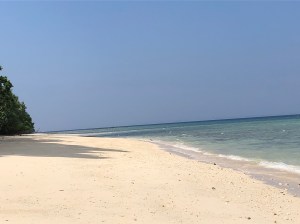
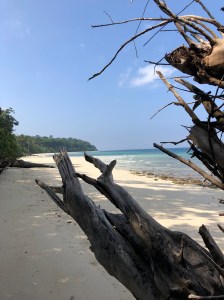
Then we walked the beach in front which is very rocky up to the point where you can swim which is called Sunset Point.
Day 21: 03rd January Neil Island
We had coffee on our porch with Steve and De, breakfast at the hotel and then the driver took us to the other end of the the island, Sunrise Beach, where we walked and dipped in but the waves were too strong for swimming.


We went to Seashell Resort here for lunch (chicken again) and 2 for 1 beers (wine only comes by the bottle) and the waiter miscalculated and brought Steve and Bill another free one. After lunch, we walked to Laxapur Beach just a km north of the hotel. The beaches here are very rocky.
We must be getting used to ineffiencies- the shower was either cold or hot. Tomorrow we are off on the ferry to Port Blair overnight and then north to Gangtok – cooler there!
DAY 22: 04th January Neil Island – Port Blair
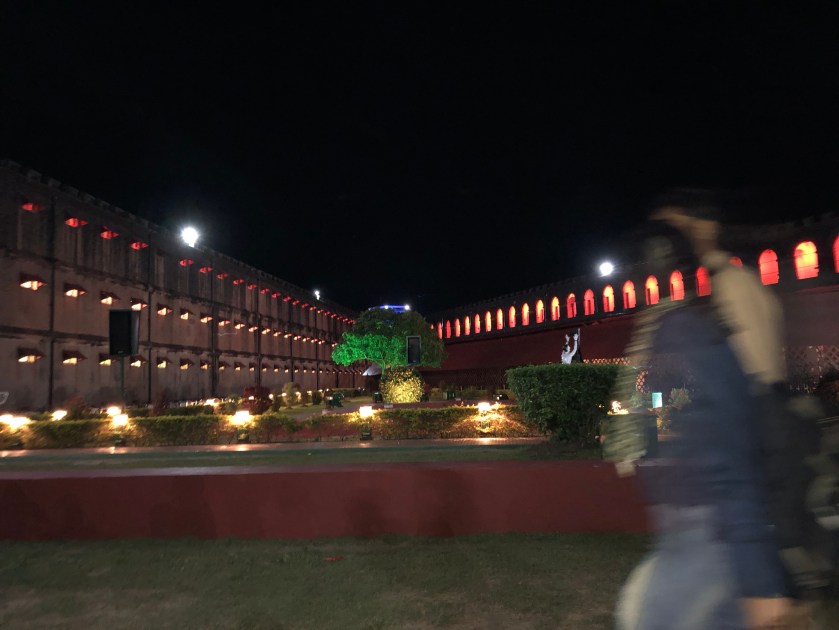
We returned in the morning we were driven back to the ferry to Port Blair where we will stay overnight. We took the ferry to Port Blair in rough weather to the NK hotel. The line-up at the dock was very orderly here. The forecast was for a cyclone to hit south Thailand and the Andaman Islands to hit the next day. We wondered about the safety of those just landing on the Islands.


Port Blair – Gangtok & Darjeeling
DAY 23: 05th January Port Blair – Bagdogra & Transfer to Gangtok (127 km/ 05 Hrs) .
We had a full day of travel flying from Port Blair to Kolkata and then to Bagdogra, arriving at 3:00 pm with a 5-hour drive to Gangtok on rough windy roads. What we didn’t realize is that you need a permit to enter the state of Sikkim so that when we entered late in the evening (did I mention that it was cold), the driver stopped and indicated that we needed an visitor permit so we entered the office and the man there said that we needed copies of our passports and visas. Entry of foreigners is controlled by a visa to enter the state that was an independent kingdom until 1975 when it joined India. This was new to us but he said that for 40 rupees, he could give us copies. Another surprise! Not to mention another gross toilet!
It was quite a shock to arrive to -4 temperatures. It is warmer in the sun during the day around 14 degrees but cooler in the shade so all the warm clothes have come into play. The only heat in the hotel is from space heaters. The hotel is quite nice with views of the Himalayas. We are in the north east of India just east of Kathmandu, Nepal and near the Chinese border.
We arrived around 9:30 pm at the Sterling Resort and had a great meal from the menu- the cook came out and asked us about our preferences.
A well-known Buddhist pilgrimage site, Gangtok is nestled amid the high peaks of the Himalayas. Set at an elevation of 1600m, the place allures tourists from all over the world to explore its untouched beauty: lakes, gardens, monasteries.
Day 24: 06th January Gangtok: Excursion/ sightseeing
The Gangtok Sterling Hotel has a small water heater so whoever showers when it’s first heated gets a warm shower-I was not that fortunate. So I filled a pail with hot water and used it when the shower turned cold, pouring warm water over me from a cup. They do, however, have a very limited bar and very good chef who makes meals just for us. We had a very nice breakfast which set us up for a full day city tour.
We waited an hour and a half for a driver to arrive and were told he was caught in traffic but finally another driver arrived and he was very nice and spoke English- sort of. For three hours we visited viewpoints to see the Himalayas, especially the highest mountain in India, Mount Kanchenjunga, temples and briefly walked the main shopping promenade.
First, we visited the Drul Chorten Stupa, one of the most important Stupas in Sikkim. The stupa features intricate architecture which leaves every visitor mesmerized. Bill is shown turning the Mani Prayer Wheel. As the sign indicated, it is filled with a thousand Avalokiteshvara mantras. By turning the wheel once earns merit equal to the recitation of the mantras filled inside the wheel.


We then visited the Enchey Monastery where a service was underway and we were permitted to enter.


Hanuman Tok Temple which is a highly revered temple located an altitude of 7200 ft and dedicated to Lord Hanuman. It is believed that Lord Hanumantook a moment’s rest here while on his way to Lanka from the Himalyas with the Sanjeevani life-saving herb to cure Lakshman. The temple is known as a wishing fulfilling temple and offers a magnificent view of the Kanchenjunga Peak. The main god in the temple was Hanuman the monkey who helped the God Rama, and thereby he attained the place of God himself.


When we returned we had lunch at the hotel as we trusted the food and it was very good. The chef made our favourite soup again and we went for a walk into the no-traffic mall downtown.


Gangtok is clearly more affluent apparently because they are educated and everyone works “even the single women” according to Pempa, our driver. There are no beggars and no garbage in the streets.
Day 25: 07th January Gangtok: Excursion to Tsomgo Lake
After another good breakfast and a long wait for a driver that did not appear, we left with a pair of giggly young men (really, very irritating) for a day trip to Tsomgo Lake (38.5 km)which is above the tree line so the views were impressive. The local agent had arranged for a visitor pass to enter the area which is quite sensitive because it is very near the border of China. The sensitivity is apparent when you seem the large number of military establishments in the area.


The winding road up the mountains was another ‘rally’ experience up the border road despite the sign on the road that says, “It is not rally enjoy valley.” The guide and driver stop at the roadside shops to encourage our shopping and eating but we are not interested, just having had breakfast. The lake is partly frozen. We declined Yak and aerial car rides as it was quite windy and cold.


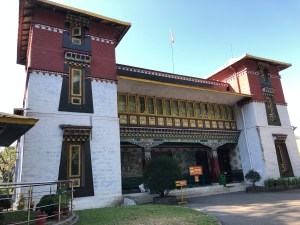
We were still interested in going to the Handicraft Centre and the Institute of Tibetology, part of our tour. The driver wanted another 1000 rupees so De called the agent and the driver backed down and took us there.
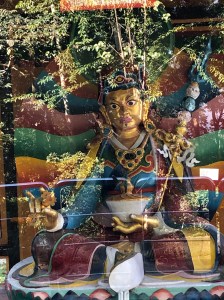
Day 26: 08th January Gangtok – Darjeeling (93 km/ 04 Hrs)
Tuesday the 8th, another full day of driving along picturesque mountain roads and river valleys and we had a very good driver who didn’t take crazy chances or talk on his phone. We left at 10:00 and arrived at 3:30 with short stops at Rumiek Monastery with views of Kanchenjunga


and tea break at Lovers’ Point: Triveni-Confluence of River Teestra and Rangeet and a visit to the Foreigners Reporting Office to inform them that we were leaving the State of Sikkim.


Set at and elevation of 2050 m, Darjeeling is a beautiful hill town in West Bengal, popular for its tea plantations, the Darjeeling Himalayan Railway (a UNESCO World Heritage Site) and its spectacular views of the majestic Himalayas.


The Darjeeling Sterling Resort is impressive with beautiful views of the Himalayas and first class facilities, such as a restaurant with massive windows, natural wood and stone lobby and a cozy bar.


We were unhappy with our rooms without a view so the manager upgraded us to a suite with a view of the sunset.


We had a quick bowl of delicious soup, that we now know is ” Thaku Tibetan Chicken Noodle Soup”, and checked out the Viewpoint just outside our room to see the twin peaks of Mount Kangchenjunga at sunrise the next day. That evening we had a beautiful sunset and very good dinner from the menu.


De and I got up to see the sunrise but it was cloudy and very cold. Bill had contracted what appeared to be bronchitis with low energy and bad cough.
Day 27: 09th January Darjeeling Local Sight Seeing
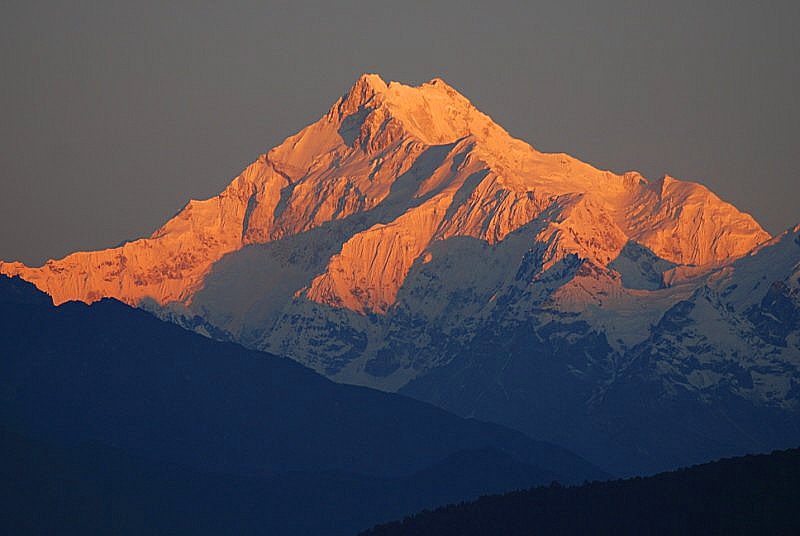
On the tour was an invitation to wake up early in the morning (4:00 am) drive towards the famous Tiger Hill (11 km) to experience a sunrise like never before: “Tiger Hill is famous to offer a panoramic view of Mount Everest and Mount Kanchenjunga together. As the first rays of the sun hit the place, you get to see the twin peaks of Kanchenjunga painted in shades of pink and orange”. After our experience the day before with the cloudy morning and with Bill not feeling well, we decided to sleep in. It shouldn’t be amazing I know but I had a lovely hot rain shower with lots of warm water!
However, here is a borrowed photo of the beauty.
It’s been only the second cloudy, rainy day we’ve had. We had a full day of sightseeing with a visit Ghoom Monastery, Batasia Loop and Padmaja Naidu Zoological Park. An age old monastery, Ghoom Monastery is known for its spiritual ambience, beautiful thangkas (high quality guilded Tibetan pictures printed on canvas and mounted on wood scrolls) and rare Buddhist manuscripts.


Next we visited the Batasia Loop. The Darjeeling Himalayan railway’s Toy Train negotiates the steep angle of descent from Ghum to Darjeeling by making the loop at Batasia, an engineering feat of its time.


We visited the Himalayan Railway station which is a UNESCO World Heritage site and a Tibetan refugee compound for living and working where the US gave them the land where I bought a couple of handmade scarves.


We also visited the Darjeeling Zoo which specializes in breeding Alpine animals, through the successful captive and breeding programs for the snow leopard, the critically endangered Himalayan wolf and the red panda. While captive, the animals have large roaming areas. We saw a tiger but she was asleep.


We arrived back at the hotel just as it started to rain. We had our favourite lunch again- Turpan Soup: chicken broth with noodles, vegetables, chicken, spices and fresh herbs.
Day 28 & 29: 10th – 11th January Toy Train & Tea Estate
JAN 10th We experienced the famous Toy Train of Darjeeling in the morning, waiting for an hour in the cold in Ghum (a very kind storekeeper invited me to come inside) and arriving back in time for breakfast. The storekeeper told us that the railway station had been very impressive but during the 3-month strike in 2018, someone had burned it down so all that was left was debris.


Our driver drove us to the Tumsong Tea Estate which was in the middle of lovely countryside with tea plantations and a challenge for him to find. We were met by William the manager of the Hotel, Royal Heritage Tumsong Bungalow, which was the old homestead of the plantation and full of antiques. It’s very quiet and relaxing here but the cold shower in the morning was not pleasant ( the generator blew fuses and with a shift change no one reset it). Did I mention that it was cold ( 2-3 degrees at night) here?


William was very accommodating, bringing us small heaters for our rooms which were not heated and giving us a tour of the plantation. First we sampled the Tumsong teas with advice on how to make tea. I learned that the water should just come to the boil, not boil, that a cup requires 2.5 grams of tea and that nothing should be added to it.


Then we walked through the factory and around the grounds. We impressed when we saw Fair Trade was practised on the plantation and less impressed when we saw the wages of the workers: 150 =9 rupees per day, which is $3.00, if they picked 40 kilograms of tea and the basic level of housing and schools.


We enjoyed the aroma of freshness in the clear mountain air and the relaxing nature of the plantation. We had home-cooked meals at the plantation as well as high tea. We wore our warm clothes most of the time, even for dinner.


JAN 11th:
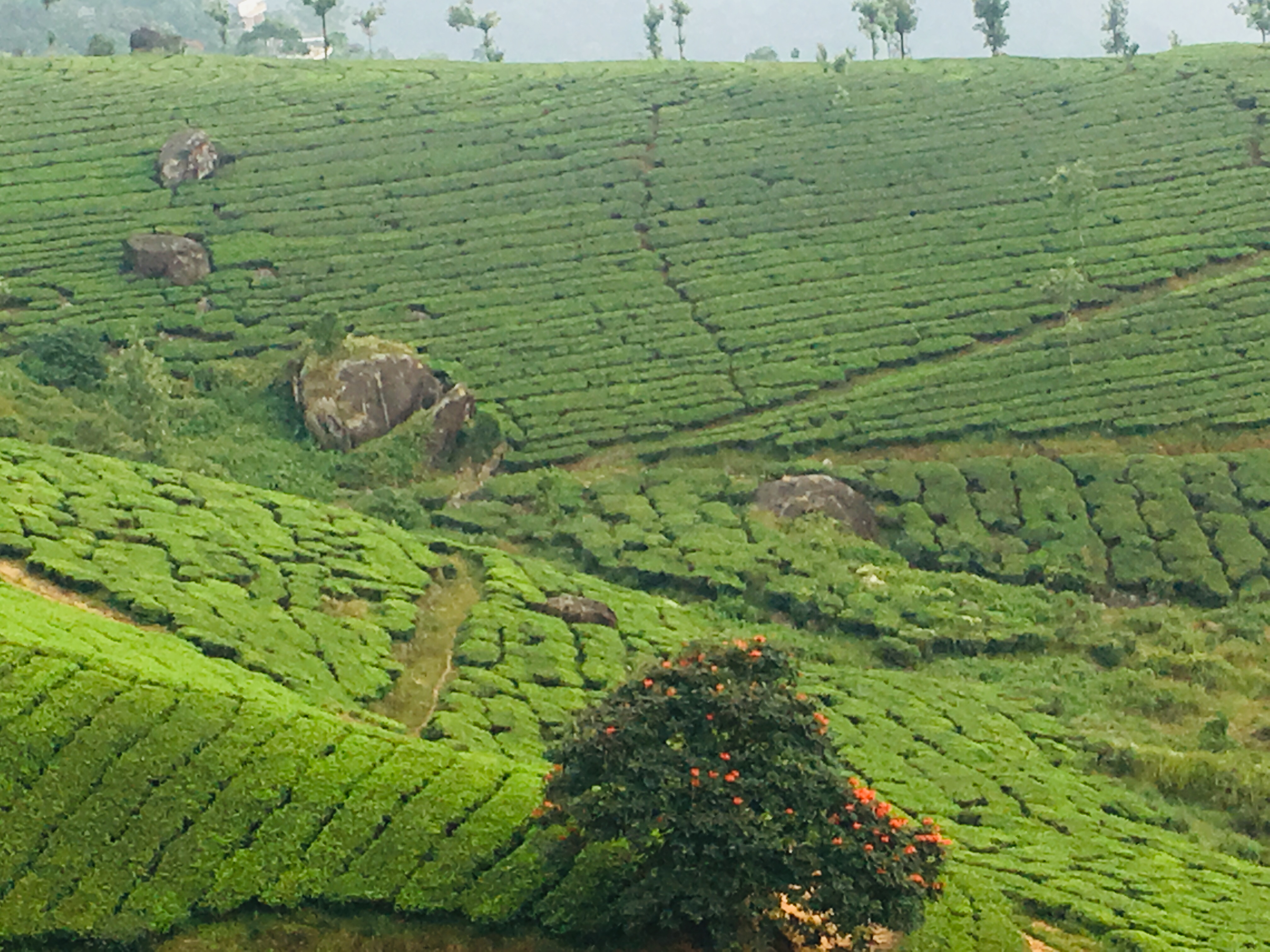
After breakfast , we went for a hike in beautiful Tumsong overlooking the beautiful valley with tea plants some with flowers and the magnificent Kanchenjungawhere. We saw the workers having lunch on outside fires, heading for work, children in very a basic building at school and small houses in the villages.


Darjeeling – Jaipur – Agra – Delhi
Day 30: 12th January Departure – Darjeeling– Bagdogra (65 km/ 2.30 Hrs)– Jaipur
After an early start, we travelled by van to Bagdogra, flew to Jaipar and arrived by car to the land of Maharajas, Rajasthan! The Hotel Sajjan Niwas Haveli was a very impressive structure, originally very impressive, but when we were there, it needed some upgrades, especially the bathroom. The restaurant on the roof provided some great views of the city.


Day 31: 13th January Jaipur Sight Seeing
We had a full-day sightseeing tour of Jaipur, Pink City. Visit Laxmi Narayan Temple, Hawa Mahal, Albert Museum & Jaipur city Palace.
We had a full day of sightseeing with a driver and tour guide on Sunday beginning with a tour of The Old or Pink City. We saw the beautiful Hawa Mahal, Jaipar’s most distinctive landmark, a pink-painted, delicately honeycombed hive rising 5 stories. It was built in 1799 by Majaraja Sawai Pratap Singh to enable ladies of the royal household to watch the life of the city. We also saw snakes performing for snake charmers.


We took a tour with a guide of Jaipar City or Royal Palace (entrance comparatively expensive $70.00 each) where the current 20-year-old King and Royal family still live. Because the former king had no male heir, he adopted the son of his daughter, who succeeded him. When the royal family is in residence it is indicated by the flying of a second flag.


Built originally by Singh in 1758 and enlarged by succeeding kings, it is a very large encampments with lovely grounds, (including a polo pitch for the King’s to practice), dining areas and several palaces: Summer, Winter, Mirror.


We visited the areas where they receive dignitaries and private spaces but not their current living rooms, although in one reception room we pretended to be the royal family.

Part of the complex is an impressive observatory, Jantar Mantar (meaning “instrument of calculation”), built for measuring the heavens by Jai Singh II in 1728. It resembles a collection of bizarre giant sculptures and is one of 5 built by Singh who sent scholars to study what others knew of astronomy. It was added to India’s UNESCO World Heritage sites in 2010.


Being Aquarian, I needed a photo of the Aquarian sculpture:


Day 32: 14th January Jaipur (Shopping Amer fort light n sound show)
We visited the magnificent golden Amber Fort built in 1592 by Maharajah Ma Singh. Financed by war booty it contains a parade grounds where armies shared their conquests, a temple to Siladevi and separate apartments for each of the king’s 12 wives where only he could visit and where they could look out on the parade grounds through latticed windows.


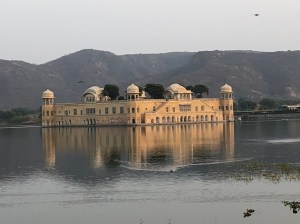
On the way back to the hotel, we stopped to look at Jal Mahal, a dreamlike summer palace situated in the man-made lake Man Sagar and built by Jal Singh II in 1734.
Monday, January 14, Vikram, our driver, took us to his boss’s house where the men and children (the women were below with the babies) were on the rooftop celebrating The Kite Festival. It was awesome up there seeing all the people for miles around flying kites, playing music and eating local food. We all tried our hand at kite flying- it’s harder than it looks. Many kites got tangled in other strings (sometimes people tried to cut off your kite) or broke loose. The paper ones were easier to handle but the plastic ones flew faster. I lost track of how many were lost.


In the late afternoon, we visited Lakshmi Temple (Goddess of money) and saw the sunset there. This spectacular temple is made entirely of marble.


We had to take off our shoes at the temple, as usual, and when we came out someone had stolen mine. So Vikram took me to the Sketchers shoe store and I bought new ones- you know how narrow my feet are so I got lucky to find ones that fit. I hope that my shoes are hurting the feet of whoever stole them!
The Albert looked amazing all lit up. In addition, the Kite Festival continued with fireworks and lit lanterns floating in the night sky.


Day 33: 15th January Jaipur
We visited the museum at Albert Hall, the one that was lit up last night.


I now had a sinus infection, mostly sinus pain, so we went to a pharmacy for meds. I think the dust and pollution were the main culprits.
Both De and I bought real pashminas today- 80% pashmina wool, 10% silk and 10% wool. They were $160.00: De’s Is glittery black and grey and mine is a mountain and tree design in blue and black.
We all loved Jaipar. The kite-flying was one of the highlights of the trip.
Day 34: 16th January Jaipur – Bhangarh Fort- chandbaori- Agra (650 km/ 11 Hrs)
On the way from Jaipar to Agra, we stopped at the Cow Temple, at Bhangarh, the ruins of a walled town and at Chand Baori, home of Rajasthan’s spectacular step-wells with 11 visible zigzagging steps. Nearby is a crumbling palace, where royals used to picnic and bathe. Batman-The Dark Knight Rises was filmed here.
The Cow Temple would have been spectacular in its day but was rundown and dirty with garbage, cow dung and monkey dirt. I visited the small temple at the top and received a blessing from the Brahmin monk. I’m learning some of the Hindu theology: Brahma, the creator; Vishnu, the protector and Shiva, the destroyer.


We also visited Bhangarh, the ruins of a walled town with temples, a 7-story palace and shops where cows and monkeys now live. This ancient site founded in the late 16th Century by Raja Bhagwant Das, is a lovely place to walk on a sunny day.


At Chand Baori, we were amazed by the 11 zigzag steps of the baori well and the size of it.


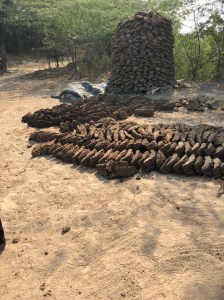
Observations: The attitude to women is evident everywhere. Vikram, our driver who is a very nice man, has two motorbikes;. When asked if his wife rides the motorbikes, he said, “No. For men’s only.” As we drive along the highway in the medians and in the yards, cow dung patties used as fuel for heat and for cooking lined the road for drying.
It was a long day of driving but we are in a clean modern hotel with rooftop restaurants and a view of the Taj Majal. The Taj Resorts Hotel is very good: clean with a hot shower; good food and service; 700 metres from the Taj Mahal. We had a good dinner in the rooftop restaurant but it was a little cool.


Day 35: 17th January Agra Sightseeing
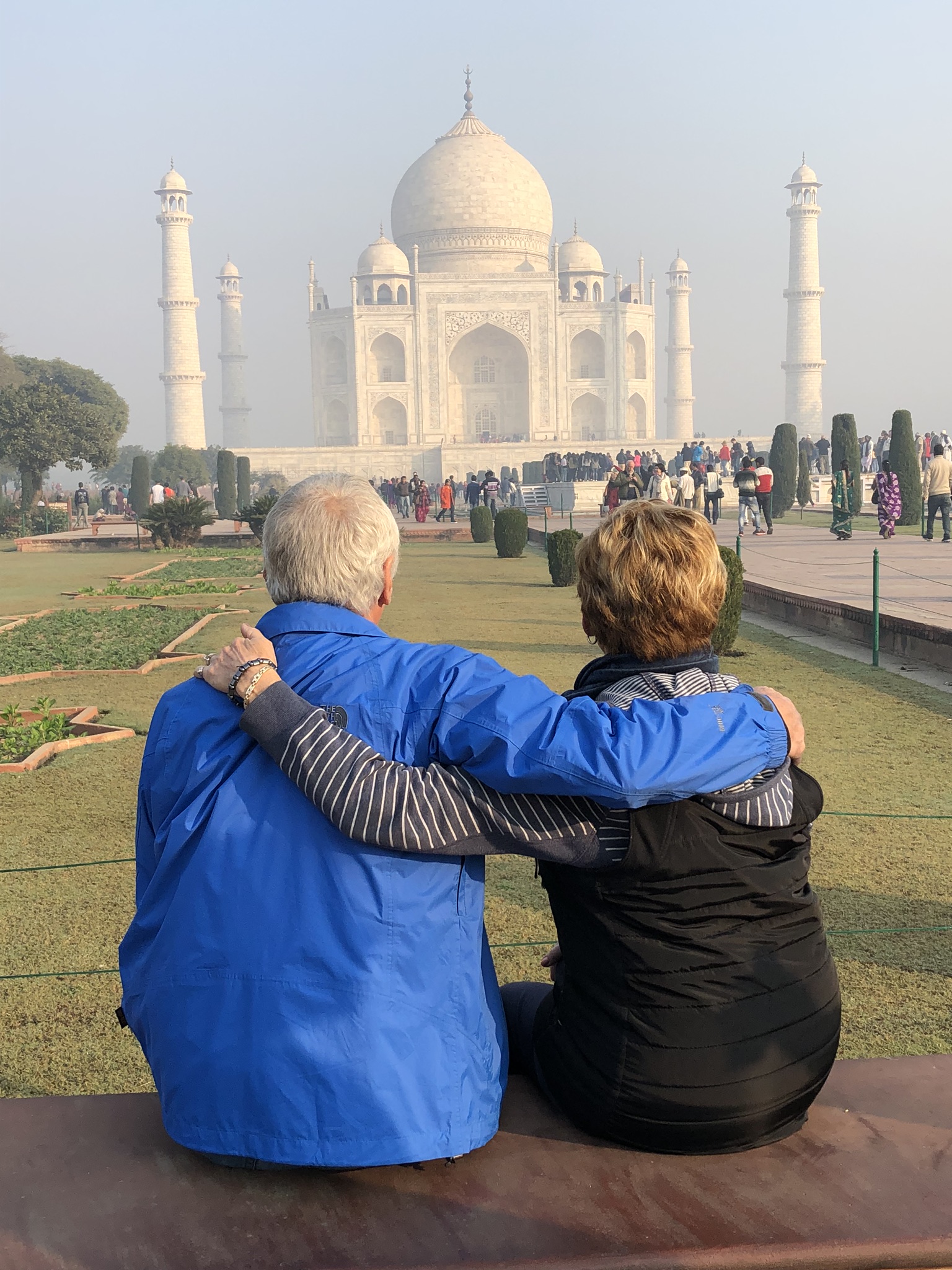
We walked to the Taj Mahal with a guide in the misty morning- what an incredible experience- never would have believed how inspirational a building could be.


The entry fee was $27.00 which included a bottle of water and cloth shoe covers. Our guide gave us a very good history of the only building in the world built for love-Shah Javan built it as a memorial for his wife, Mumtaz, who died in childbirth (her 14th child) in 1631. After it was completed in 1663, his son overthrew and imprisoned him for the remaining 8 years of his life in Agra Fort where he could only see his creation from a window. Shah Javan was buried in the centre of the mausoleum with his wife.


The Taj Mahal is absolutely stunning! It may be the most beautiful building in the world. It still reverberates in my brain. Because no buildings can be built within 500 metres of the perimeter and it backs on the River, it looks like it is floating.


About 20,000 Indian and Asian workers and specialists in marble inlay from Europe and other countries produced the marble inlaid with semi-precious stones’ structure.


The buildings and on the grounds are perfectly symmetrical.
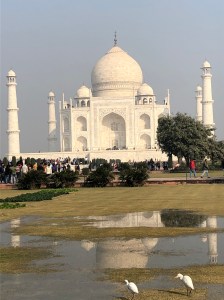
I hated to leave and despite there being many people there, I was entranced.
In the afternoon, Vikram took us to his home about 30 minutes outside Agra in the farmlands. This is a rural area around Agra and the crops Vikram’s family grew were mustard and potatoes.


His family members- Mom, Dad, brothers, wife and young son-were very inviting, gave us a tour, and served us masala tea, samosas and sweets (and beer for Bill and Steve). We briefly met his wife in a doorway. He showed us around the farm with cows and goats.


He also took us to his school and we met teachers and students-it was a big event!


On the way back to Agra, we stopped at the 50 Temples site.


Day 36: 18th January Agra – Delhi (225 km/ 3.30 Hrs)
In the morning we visited Agra Fort which is a massive red sandstone and marble fortress built by Emperor Akbar in 1565 with palaces added by Shah Jahan. The double walls rise over 20 m and measure 2.5 km in circumference with moat that had crocodiles in it.


On the eastern edge of the fort is the white marble octagonal tower and palace where Shah Jahan was imprisoned for 8 years and later buried beside his wife in the Taj Mahal.


Then we proceeded towards Delhi. On arrival, we checked in at the Hotel Godwin Deluxe. It was fine except that a few room changes were necessary (our TV didn’t work and De and Steve’s room was noisy) but the surroundings were a bit dodgy.
Day 36: 18th January Delhi
We visited the Red Fort, another of Shah Jahan’s buildings and a World Heritage Monument. It took 10 years to construct (1638-48), had the decapitated bodies of prisoners built into the foundations for luck and is surrounded by a 18 m-high wall. While impressive in size, it was not in as good a shape as the one in Agra.


The manager arranged for a doctor to make a home visit. The doctor said that Bill had a bronchial infection but not pneumonia and gave Bill some mild antibiotics and a mask and charged us $30.
Day 37: 19th January Delhi
We then visited Jama Masjid, India’s largest mosque built on a 10 m elevation that can hold 25,000 people and it was Shah Jahan’s final triumph.


Day 38: 20th January Delhi
We were all suffering from the polluted air and needed to get out of there. We left for the airport by noon but the driver took us to a hotel 33 km from the airport. We called the tour agent and he had given us the wrong location for the Red Fox Hotel. He ordered another cab and we arrived at the airport hotel late afternoon.
We stayed with Steve and De until 9:00 pm as our flight went out a 12:45 am and they left at 4:00 am. We left the warm 26 degree weather of Delhi and arrived at 5:00 am in Toronto in minus 21 degree weather. We were happy to be back despite that shock. The air was clean!
India was a marvellous adventure! It is a hard country to visit because of the poverty but we met some wonderful people and saw breath-taking sights. So glad we went!
Observations about India
- Women are not treated well: a survey conducted by the Thomson Reuters Foundation has ranked India as the world’s most dangerous country for women, ahead of Afghanistan, Syria and Saudi Arabia. By the way, the US is 10th.
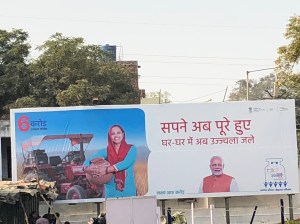
- Many of the billboards are advertising schools because there are so many private schools and politicians, especially Prime Minister Modi.
-
The staffs try to please: in fact, they rarely tell you ‘No’ with that head wobble that means ‘Yes’ and then you expect things will happen but they don’t.
-
Most everything is much less expensive. Bananas cost pennies but wine was either limited or expensive. The only place to buy alcohol was at ‘The Wine Shop’ , a government store on a back street and limited to 2 bottles every 10 days. In Vadodara, we needed a licence requested by a resident and permission of the landlord.
-
Most women that we saw wear saris with younger ones wearing tops and bottoms that cover them from neck to foot. Even in the rural areas, everyone is very colourful and well-dressed.
-
At the beach, only foreigners and some young boys are in swimsuits. The Indians wear their tops and bottoms or saris in the the water.
-
There is litter everywhere: on the beach, in the streets, along the roadside. We did see garbage collection but still piles of garbage in urban and rural areas. We suspect some of the plastic is blown in from mainland Thailand.
-
In the Andaman Islands, especially Neil Island, tourism is very recent (5 years) and the infrastructure is still underway. Even though the roads are roughly paved only the width of 1 car, the drivers drive fast often with one wheel in the ditch and barely missing pedestrians.
-
Indian foods that we are intending to incorporate into our meals at home include Butter Chicken, Tumeric Rice, Turpan Soup. We had some very good Indian meals but not many. Everything is in a sauce and generally hot and spicy. Now because our breakfasts and dinners were included in the package, we were limited to hotel food. Despite our rule of ‘eat only hot cooked food and drink only bottled water that you open yourself’, we all got sick several times.
-
We spent literally hundreds of hours in line-ups. Always waiting. For example, to go to Elephanta Beach for snorkeling, we waited an hour and a half one day and an hour the next. Lining up does not mean taking your turn; it means creating your own line to get to the front first. For example, waiting for the ferry in Port Blair. We were in line for the luggage screening and people just walked to the front past the line and put their luggage on the roller. When I got to the personal screening, women tried to push past me.
-
The hotels seem to get some things right but fall down on other things. In one place the setting was wonderful but the pools were dirty (and we got food poisoning). One resort the view was fabulous but the food poor. It seemed that while there were many staff, no one was overseeing the jobs and there was no expectation of initiative. We asked for 3-4 rated hotels- we may have been happier with 4-5 star.
- The poverty is overwhelming: families living on the street, in hovels, amongst the dirt and the garbage.

 Site Title