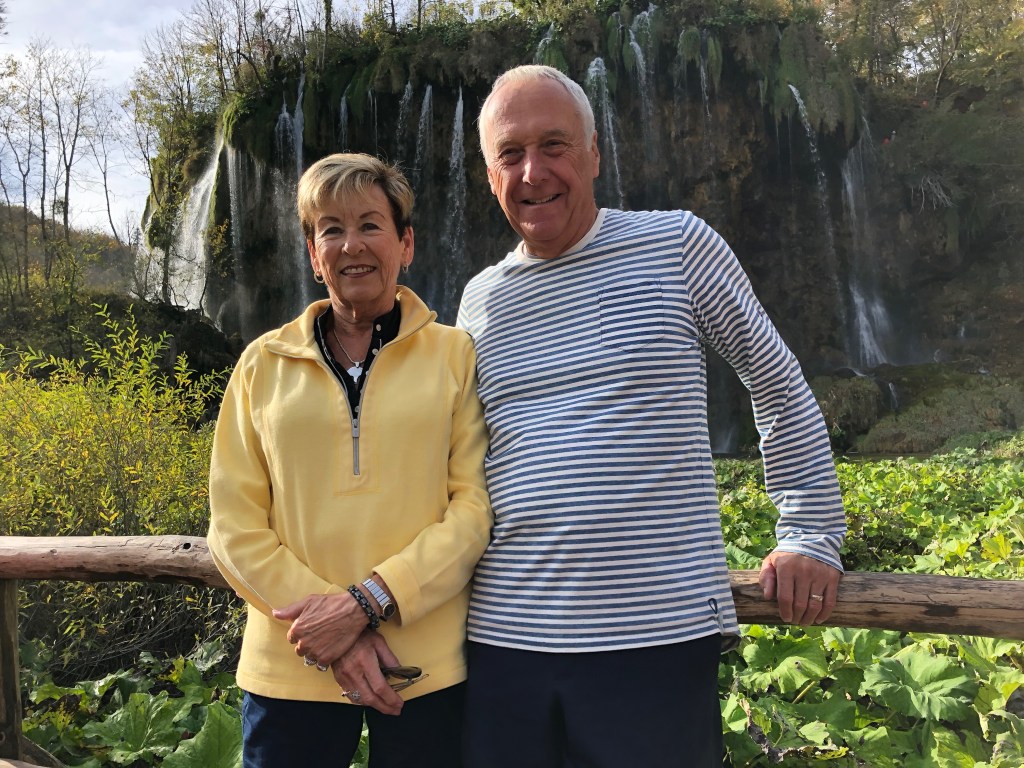
I want to start with a recognition of Rick Steves’ Croatia & Slovenia as a significant resource for our trip – we relied on it heavily. Also, Sue Hilhorst and Kathy Dreyer helped us organize the trip. Except for Split where the conference occurred, we spent two days in most locations. The initial reason for our trip from Spain to Croatia was for Jackie to present at the CARNALARA Conference in Spilt on October 17-19. We decided to take the opportunity to see the country while we were there.
A few photos of the CARNALARA group there:
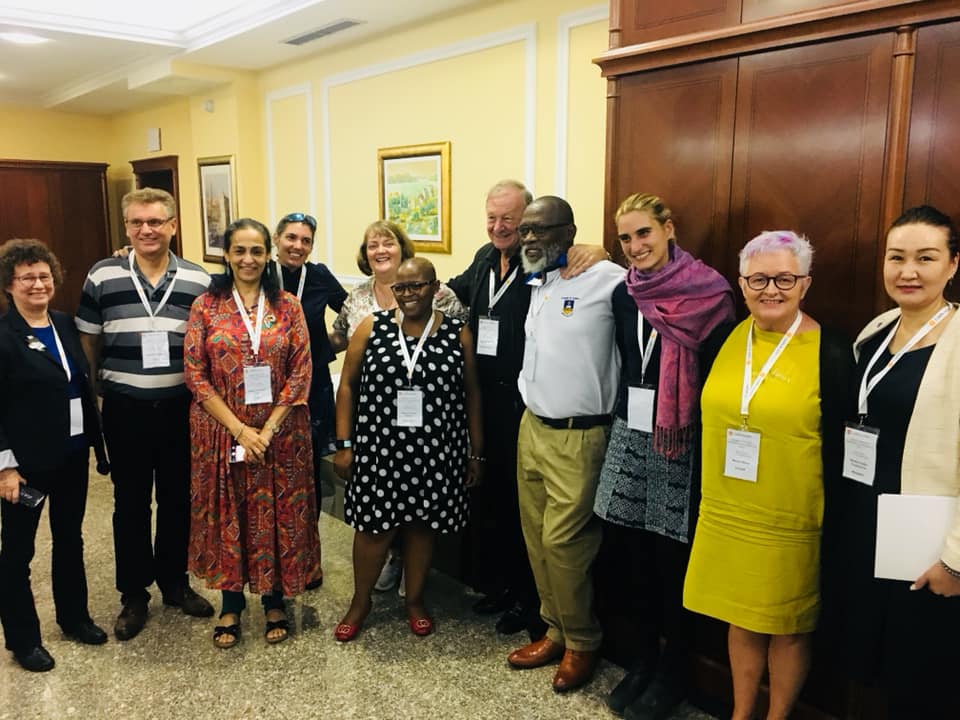

Jackie and Undar 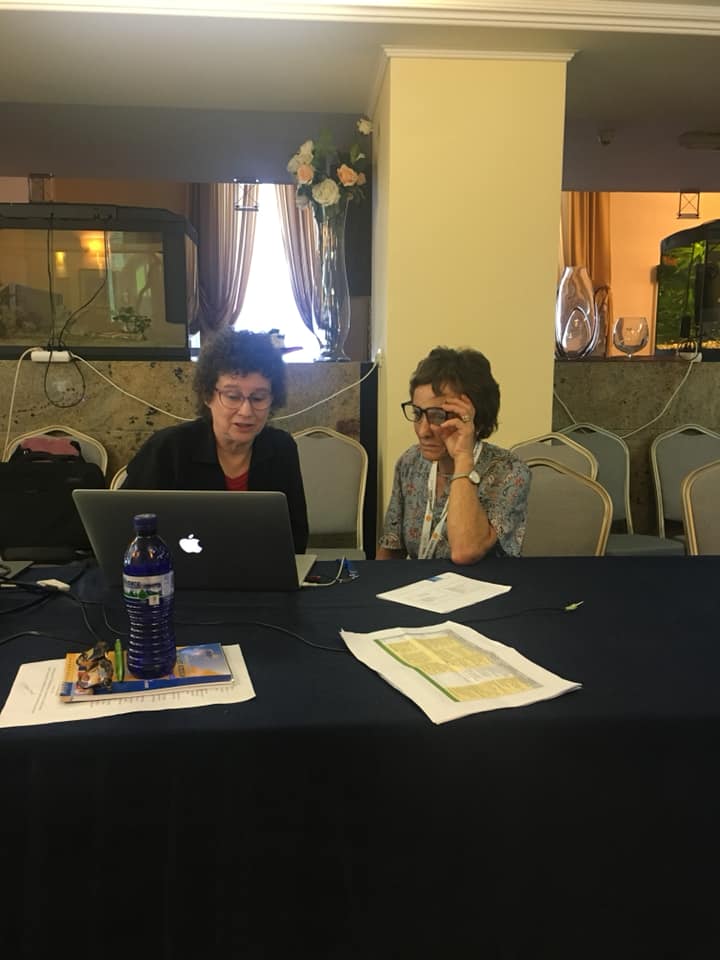
Marie and Lesley 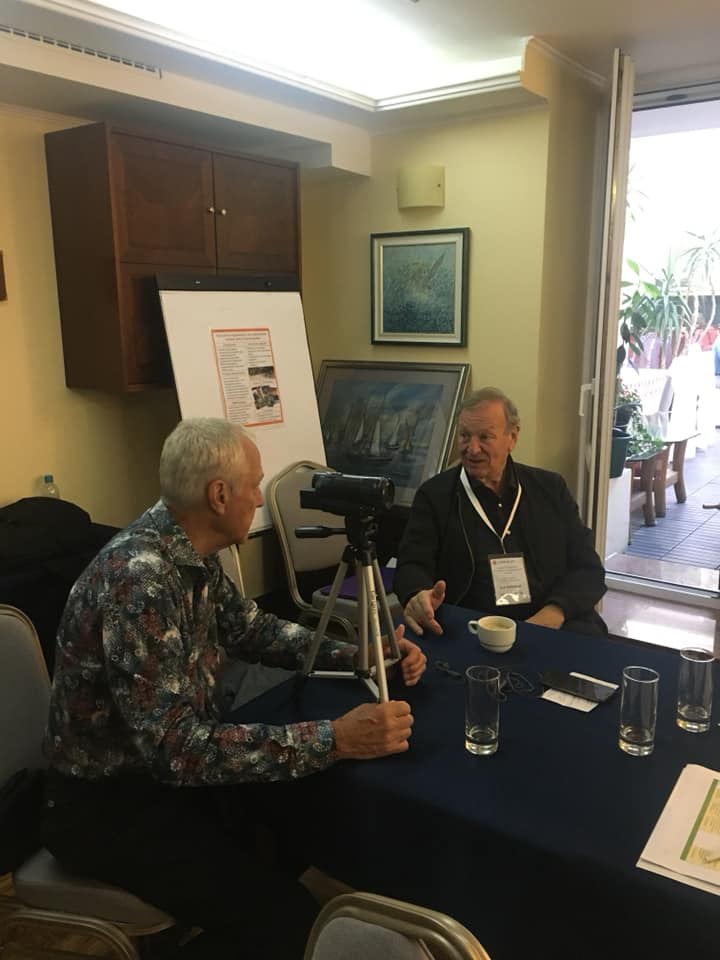
Bill and Jack
October 15 Alicante to Madrid to Munich to Dubrovnik
We left Alicante almost an hour late and, literally, ran through Madrid airport only to watch the plan going to Dubrovnik being pushed off! After a long wait, Iberia provided a chit for our lunch and rerouted us via Munich and we arrived in Dubrovnik at 9:00 pm. We rushed over to the car rental at 9:45 pm to find that they had closed up early.
We took a taxi into Dubrovnik and found our apartment, Art House, which was bit small but right on the main Stradun. We had a great view of the street’s cafes and St Blaise’s Church. Images of St Blaise, the patron saint of Dubrovnik are all over town, always holding a model of the city in his left hand. A local priest, he allegedly warned of a coming Venetian attack and the authorities prepared for war and the prediction came true which is said to cause the resentment of Venice. It was built, like most churches in the city, after the 1667 earthquake and fire and by a Venetian architect in a Venetian style – note the dome.
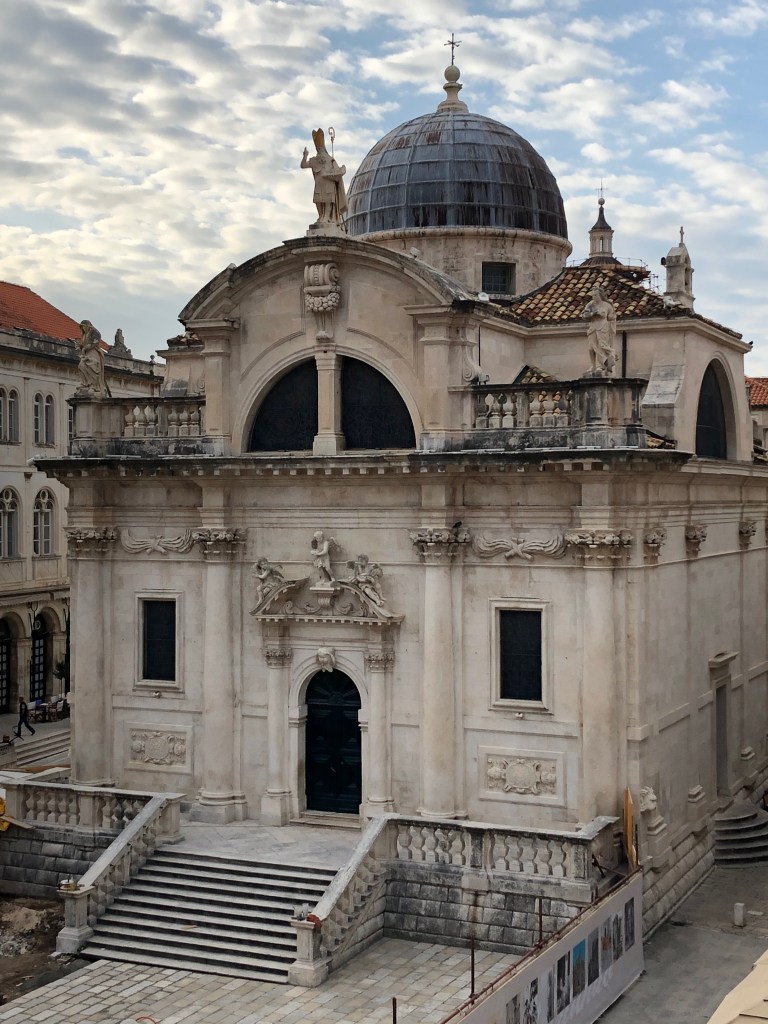
St Blaise Church, 2019 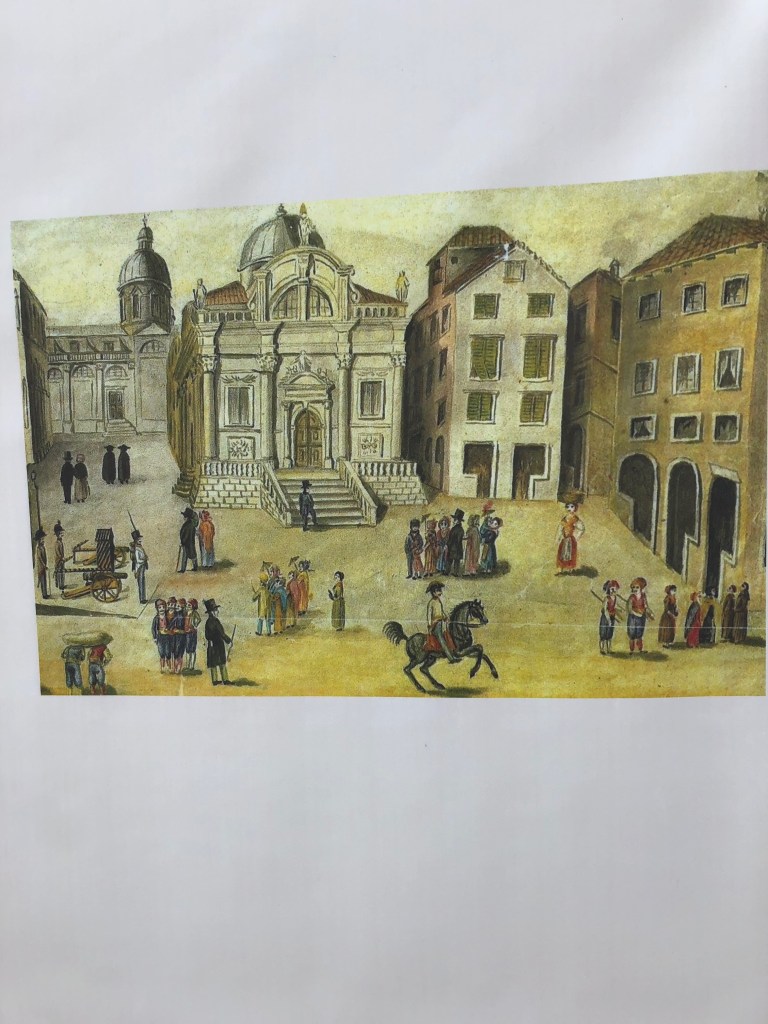
St Blaise Church in 1667
October 16 Dubrovnik
We had breakfast at a square behind St Blaise’s church and I bought some lavender and a new red purse which I used the whole time in Croatia.
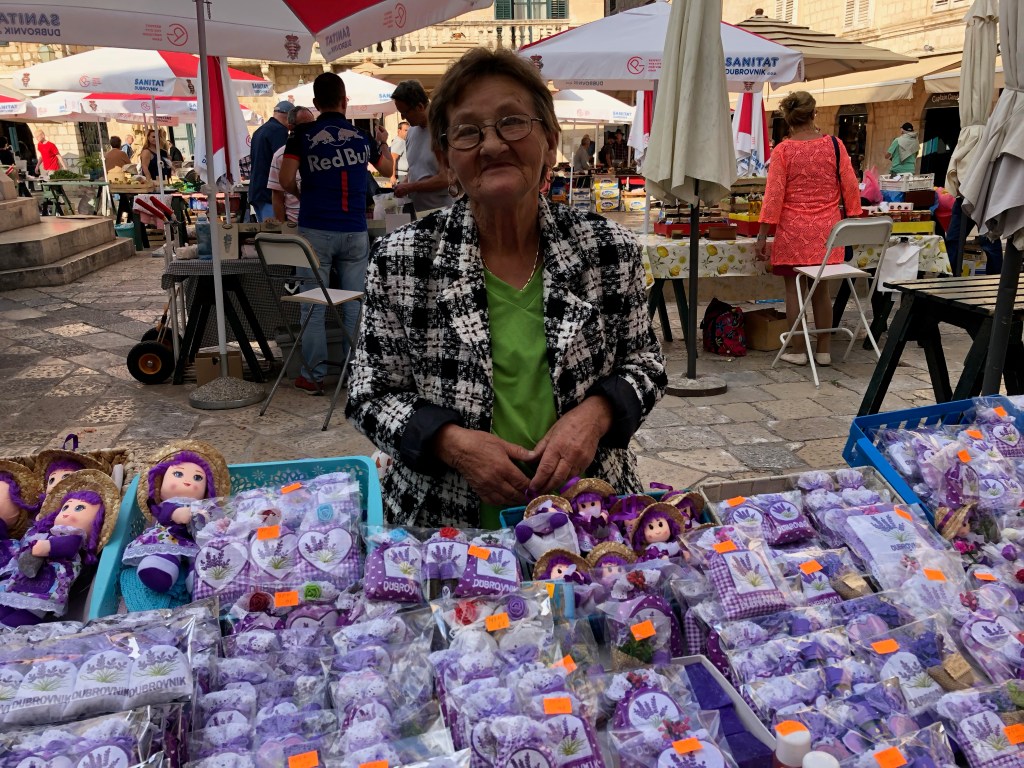
Lavender Lady 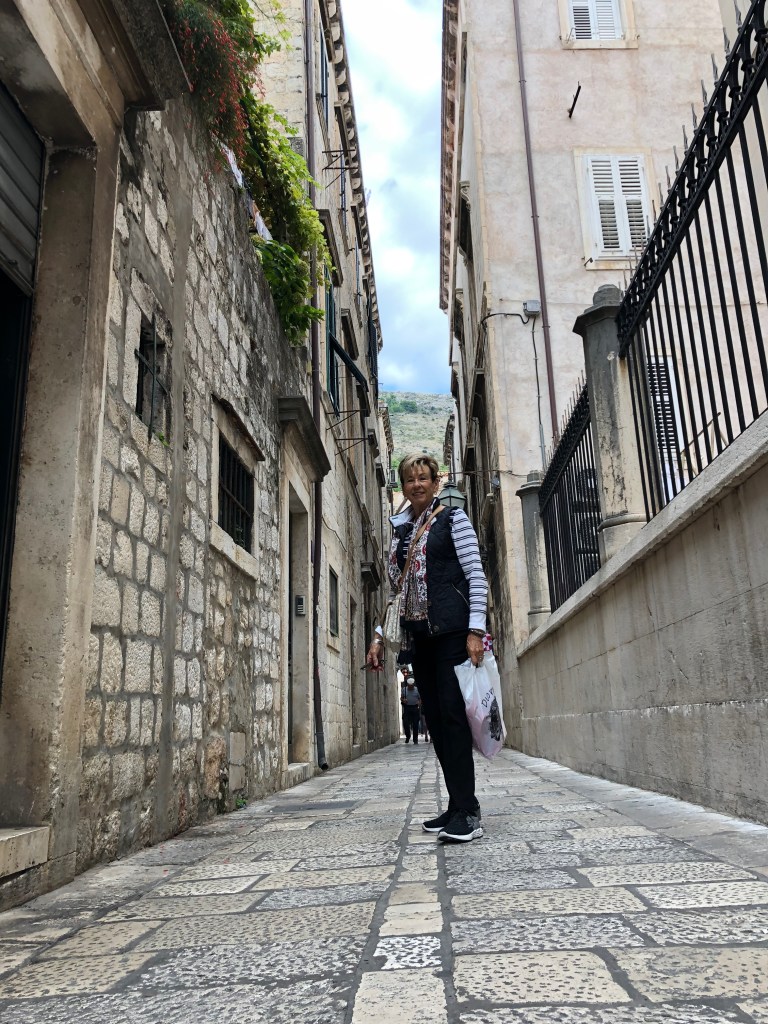
New purse
We walked the downtown streets and the outside of the walls,
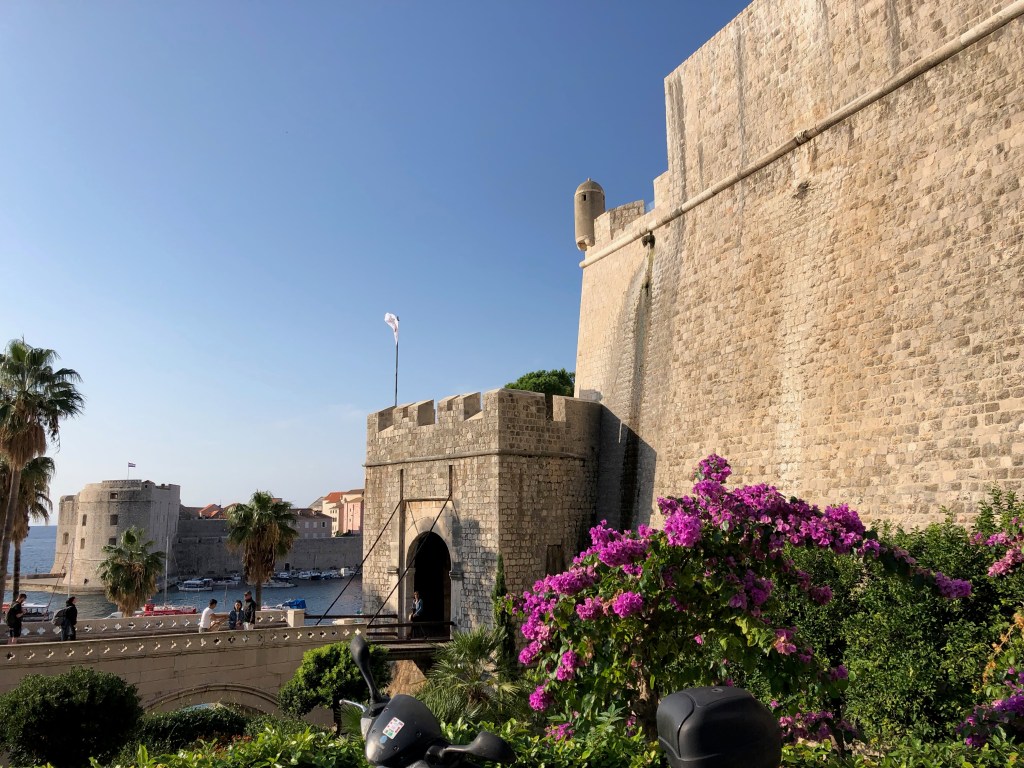
Outside of City Walls 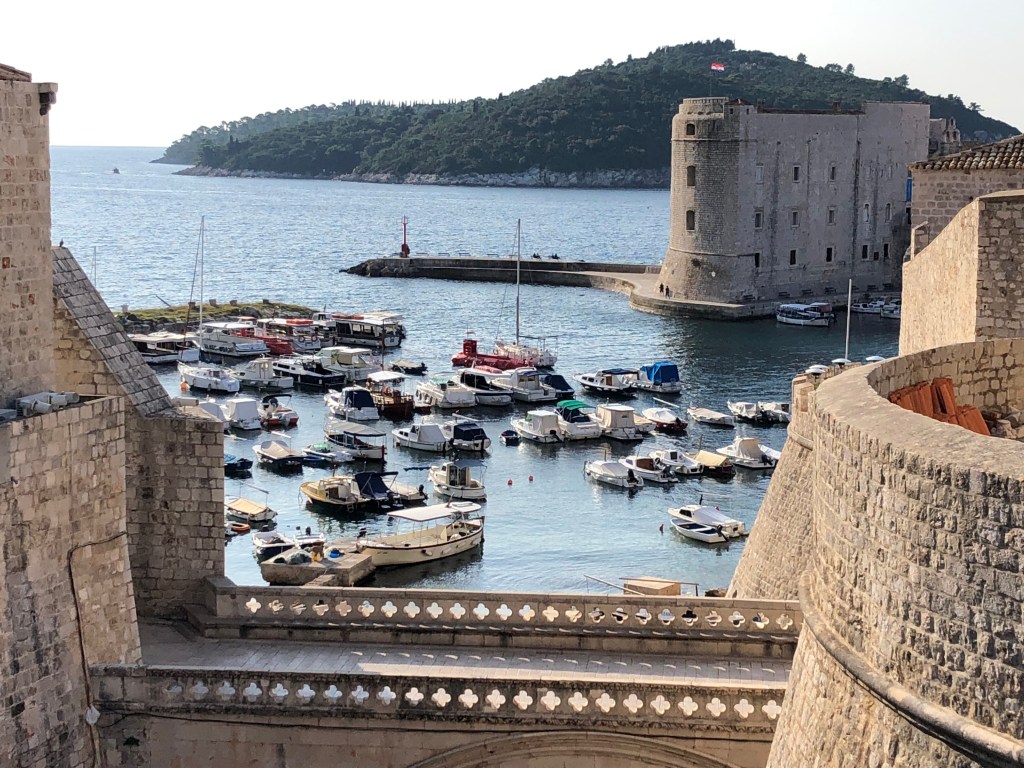
View of port inside gate of City Walls
climbed the stairs to get our bearings on the bus station and then took the bus to the airport to get our car to head for Split.
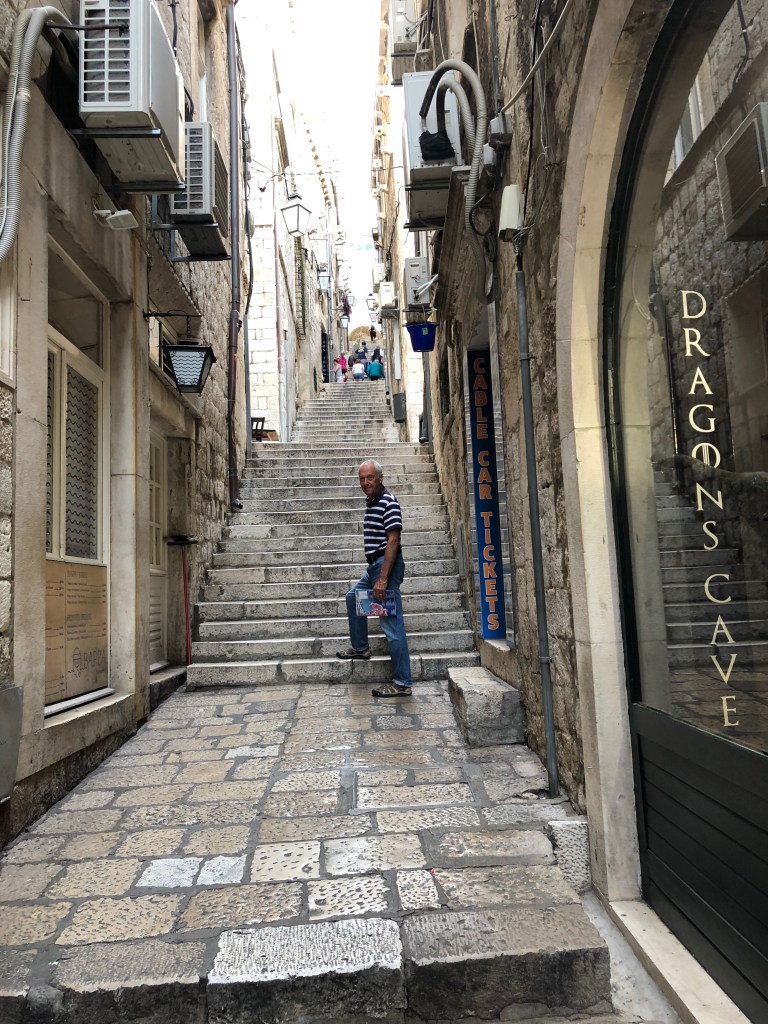
I wish I had a photo of the man who greeted us and who told us that after 2 and a half hours of our not presenting ourselves the day before that the contract was cancelled – the same man who had closed up early the night before! I was too angry to deal with him – we have been hiring cars for a very long time and this was news to us. He condescended to rent us another car at an increased cost, an older black Peugeot car with no hub caps. Imagine!
So we set out on our way. We found that the data in our GPS and two phones did not work and wandered around Split for an hour trying to find the hotel. Finally, we were desperate so we hired a taxi driver to lead us to Hotel Fanat which was 3 km outside of the Old Town. We met the group for dinner and took a taxi back. What a day! In the interim, we contacted eDreams, the car rental agency, to share our displeasure with the car rental and they are looking into a refund.
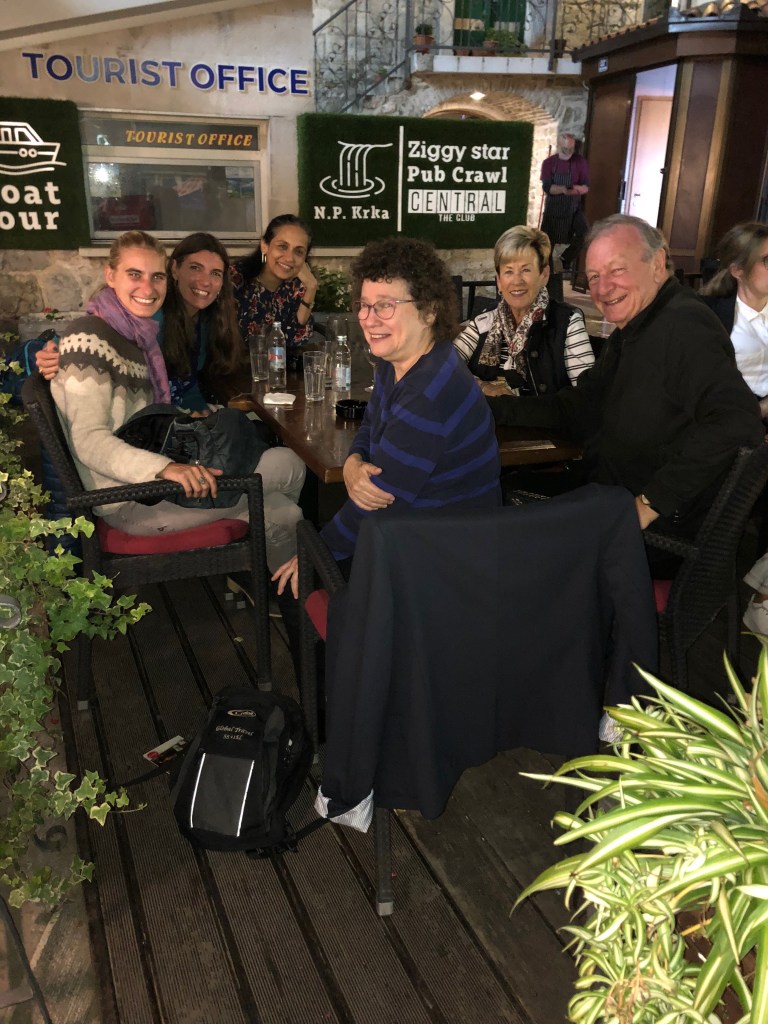
October 17 Split
Hotel Fanat is a very nice hotel despite it being 3 km outside of Split which should have been no problem except that parking is very expensive. We have a large bright new room with a balcony overlooking the beach and waterfront of the Adriatic. There is a pool which Bill used and he also swam in the sea in front of the hotel. The room included a very good breakfast that we ate in the outdoor restaurant.
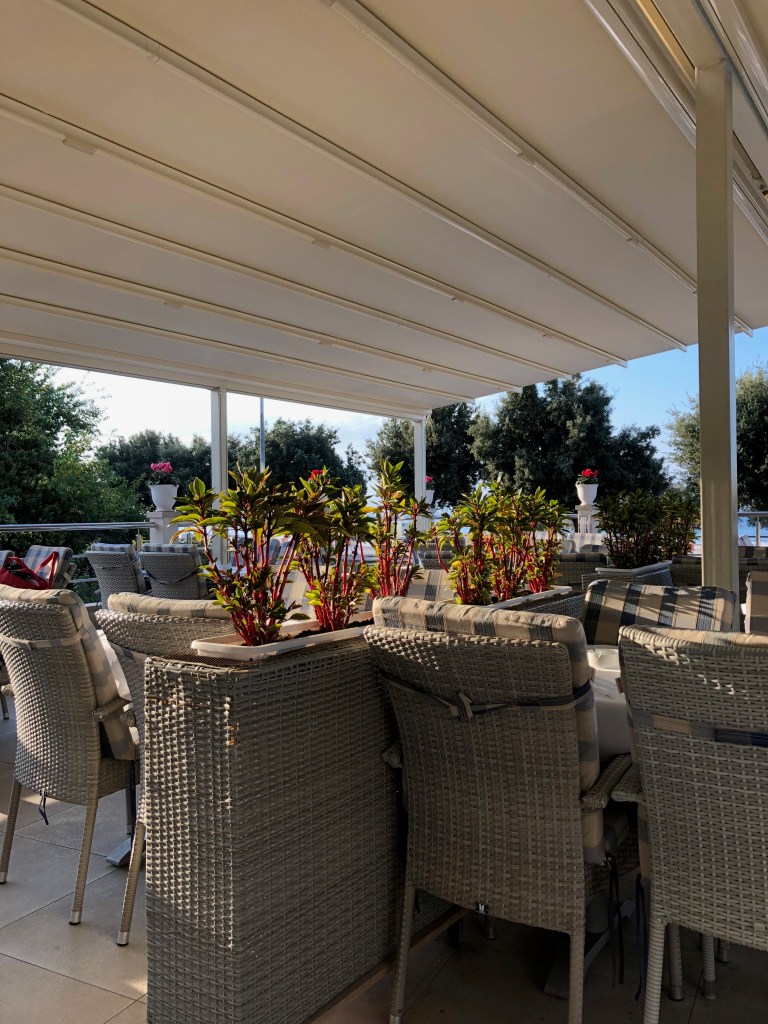
Breakfast Room 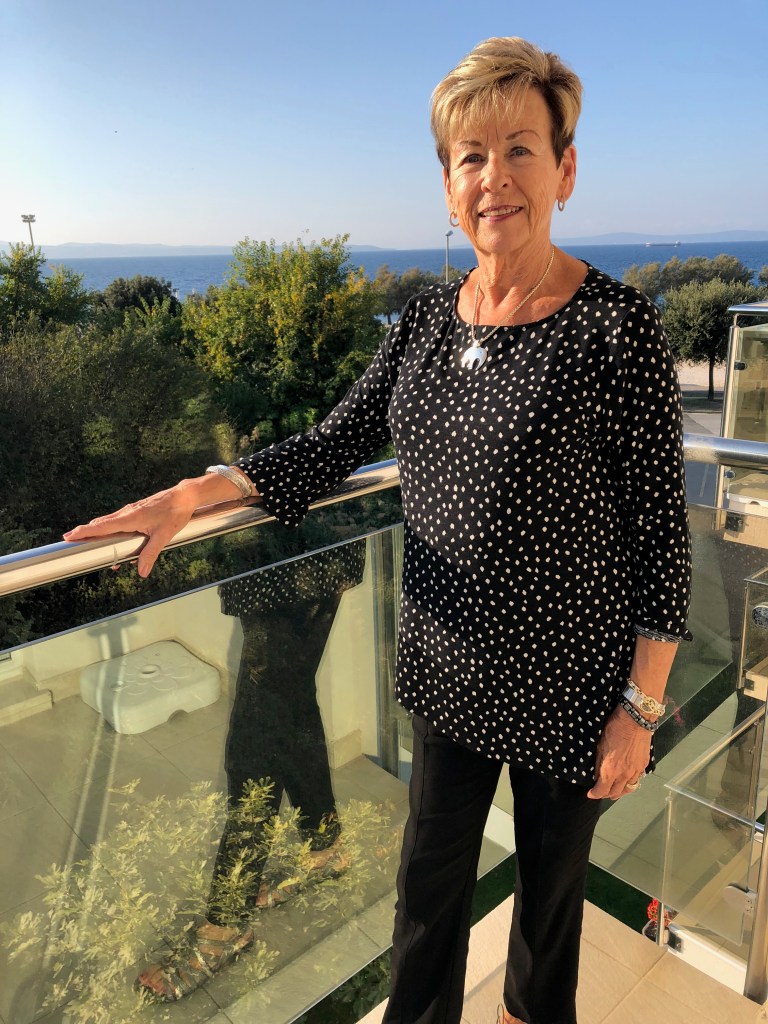
Balcony with sea view
Croatia’s second-largest city is Split, situated on the country’s western coast. A popular tourist destination, Split is known for its stunning beaches, as well as museums and architectural remains that date back to the Roman period. The city is the location of Diocletian’s Palace, a UNESCO World Heritage site and famous Roman monument. Split has a population of around 180,000, although this increases to almost 350,000 for the wider metropolitan area.
Once in downtown Split, our first stop on the main shopping street was a phone store where we bought a Croatian SIM card with data. We were now connected! We walked to the waterfront to Diocletian’s Palace which is tucked behind huge gates and tucked back from the street and hard to find. The stories of Diocletian are legendary for two questionable legacies: dividing the Roman empire that may have led to the empire’s decline and torturing and executing Christians.
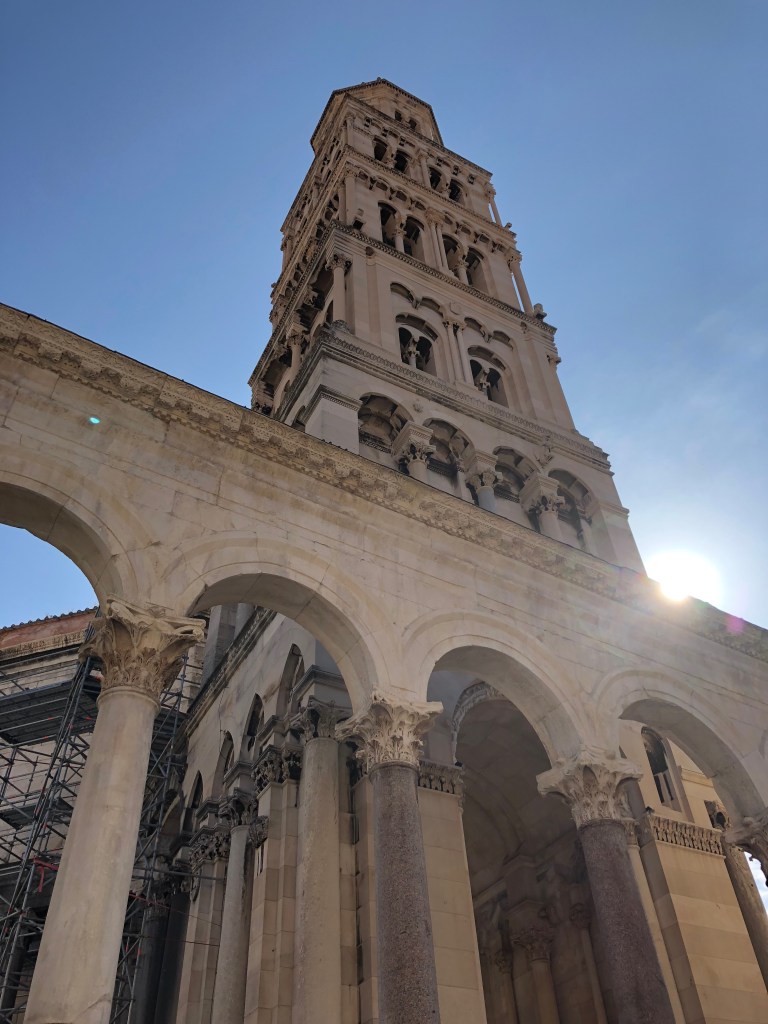
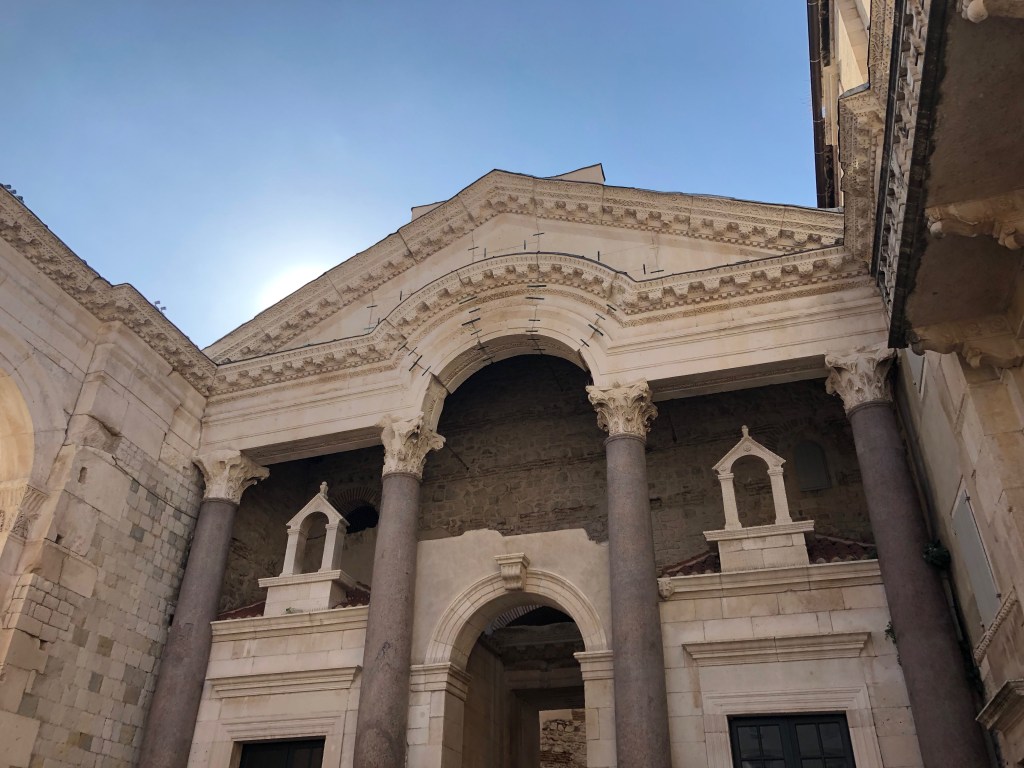
In the 4th century A.D., the Roman Emperor, Diocletian (245-313) built a massive retirement palace in his home area with a luxurious villa and fortified town which serve as the nucleus of the city. The Peristyle was the centrepiece of the palace with the black sphinx (only one of Diocletian’s collection of 13 still intact) and “Roman soldiers” posing for photos.
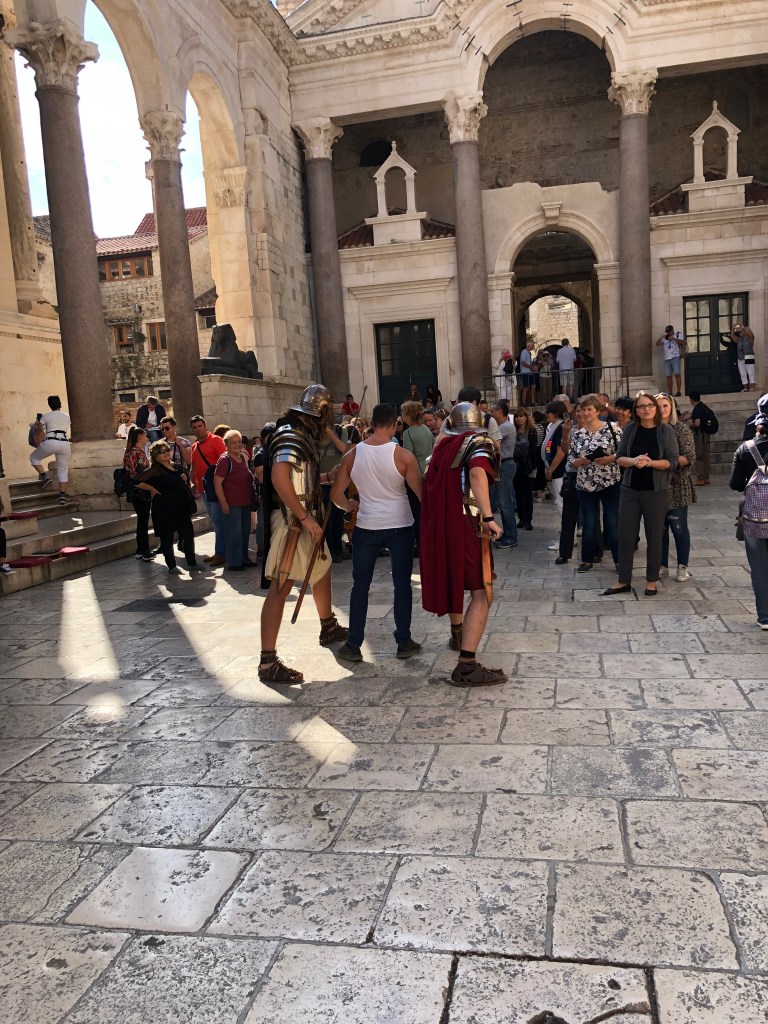
Peristyle 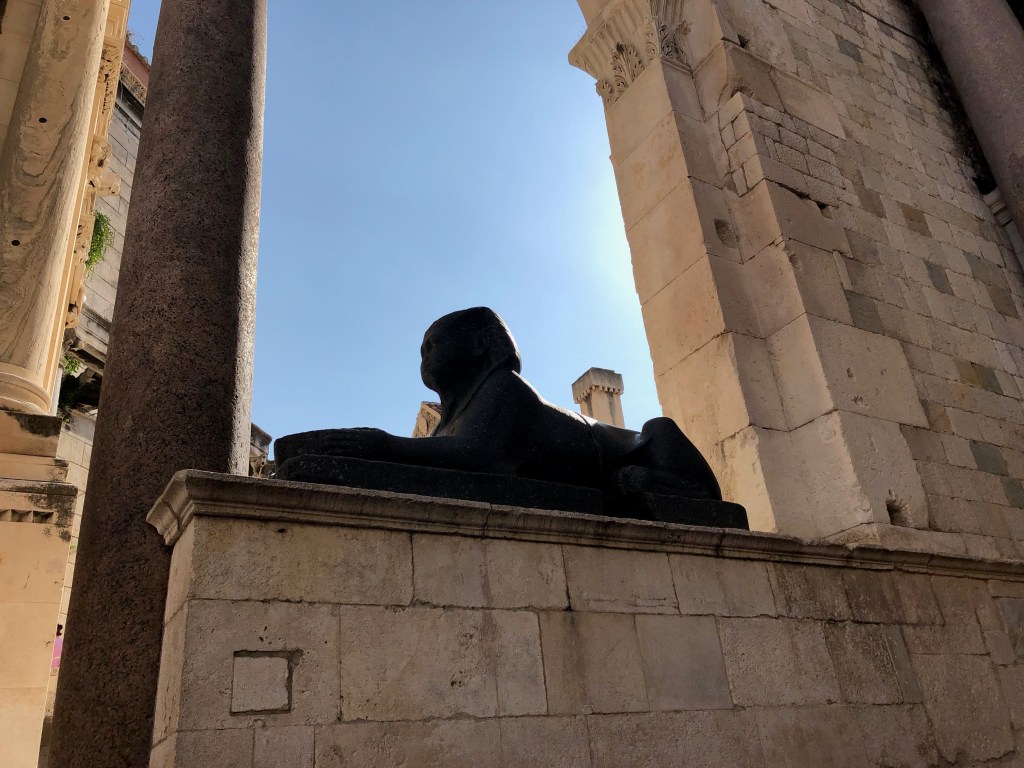
Black Sphinx
In our tour of the palace, we heard an all male band of klapa singers performing traditional a cappella songs in the entry vestibule.
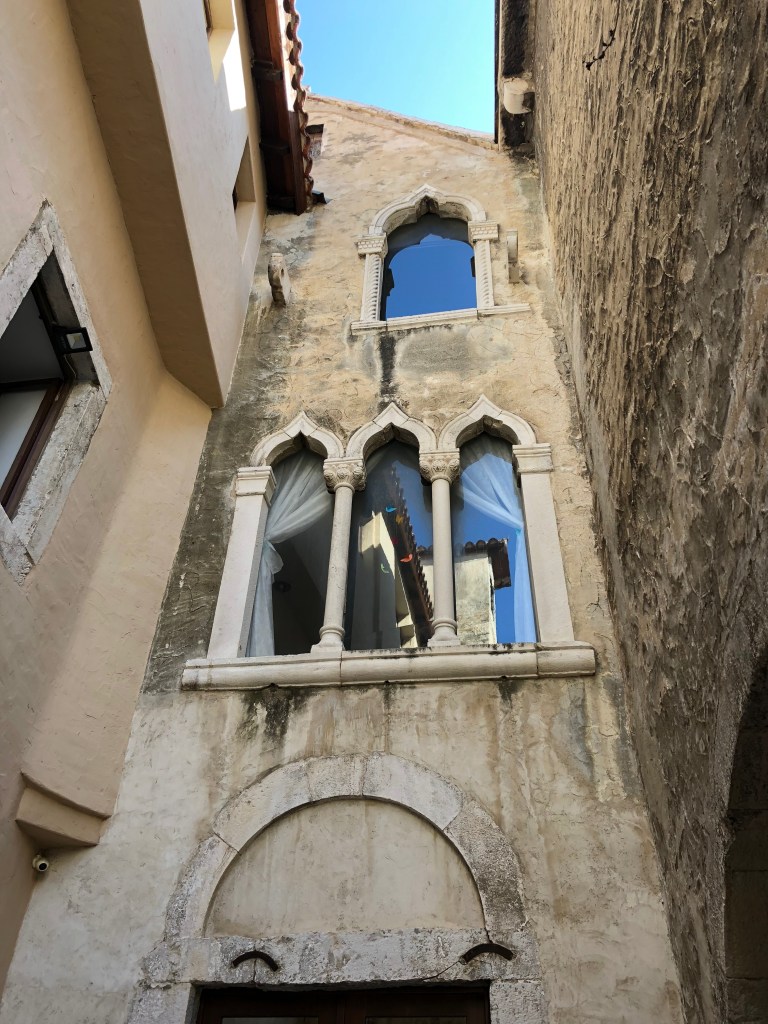
Palace Vestibule 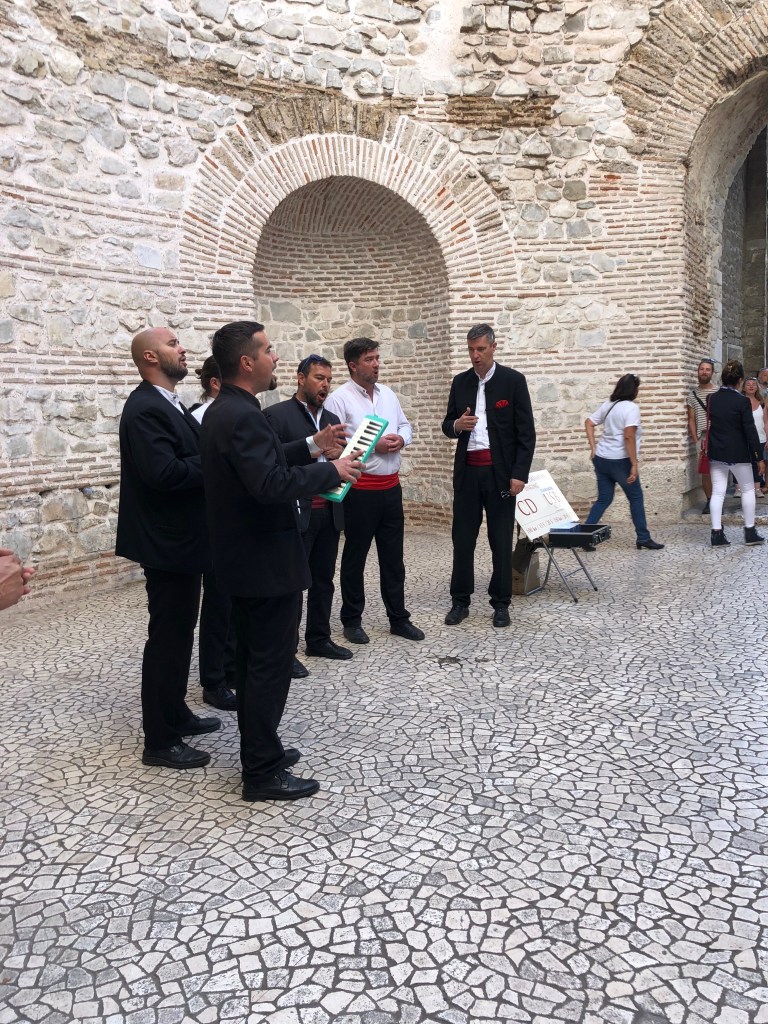
Klapa Singers
We then visited the Cathedral of St. Domnius, originally Diocletian’s mausoleum but after the fall of Rome, converted to the town’s cathedral. Diocletian brutally persecuted his Christian subjects, including St Domnius for whom the cathedral was named and St. Anastasius: in this carving on the altar, he is lying on a millstone that is tied to his neck (On Diocletian’s orders, this Christian martyr was drowned in A.D. 302).
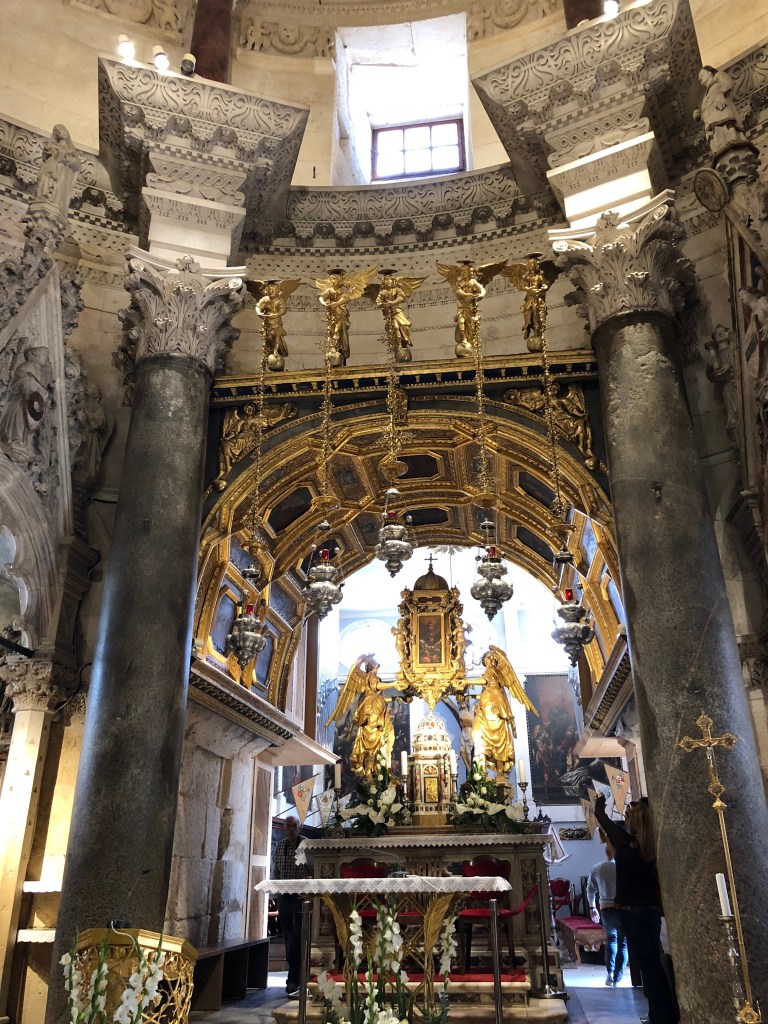
Cathedral of St. Domnius 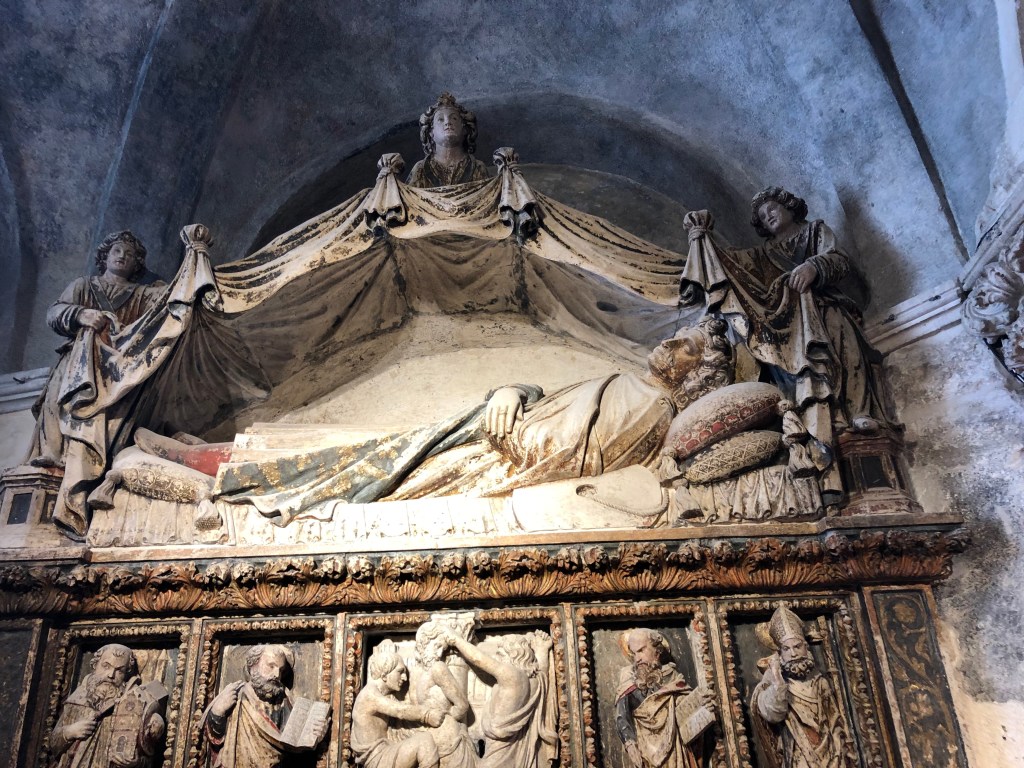
Altar of St. Anastasius
We walked the streets outside of the palace where a Roman village grew through the Old Town “Pjaca” square where we shared a plate of mussels, watched people and continued on our walk.
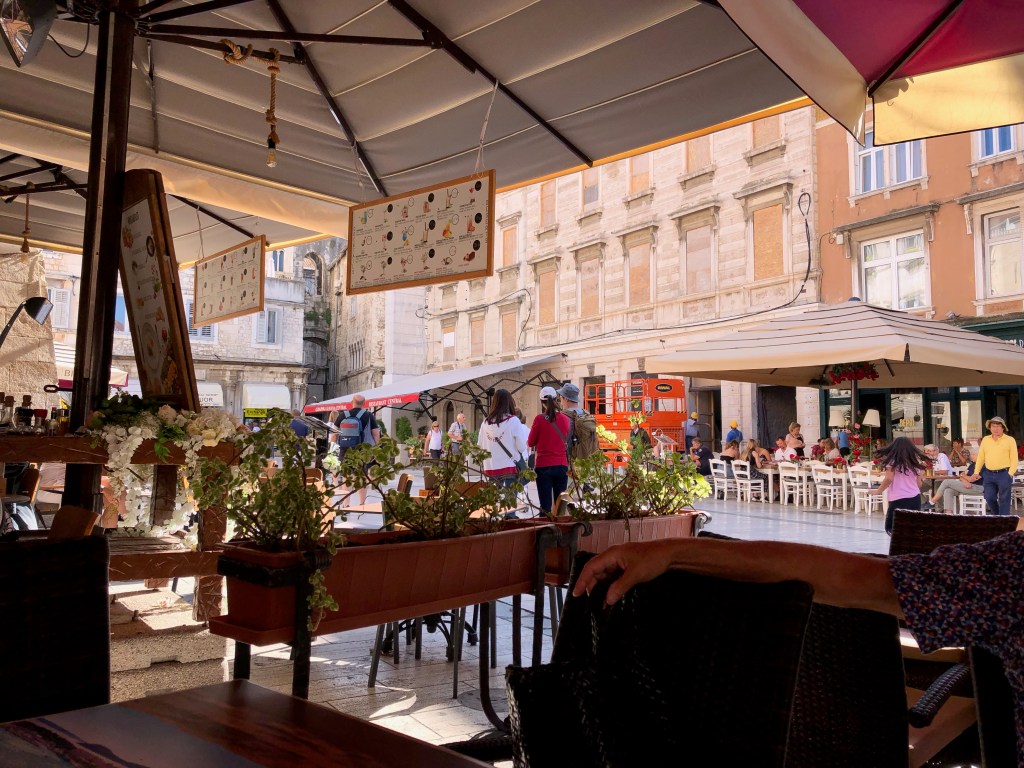
Place – Square 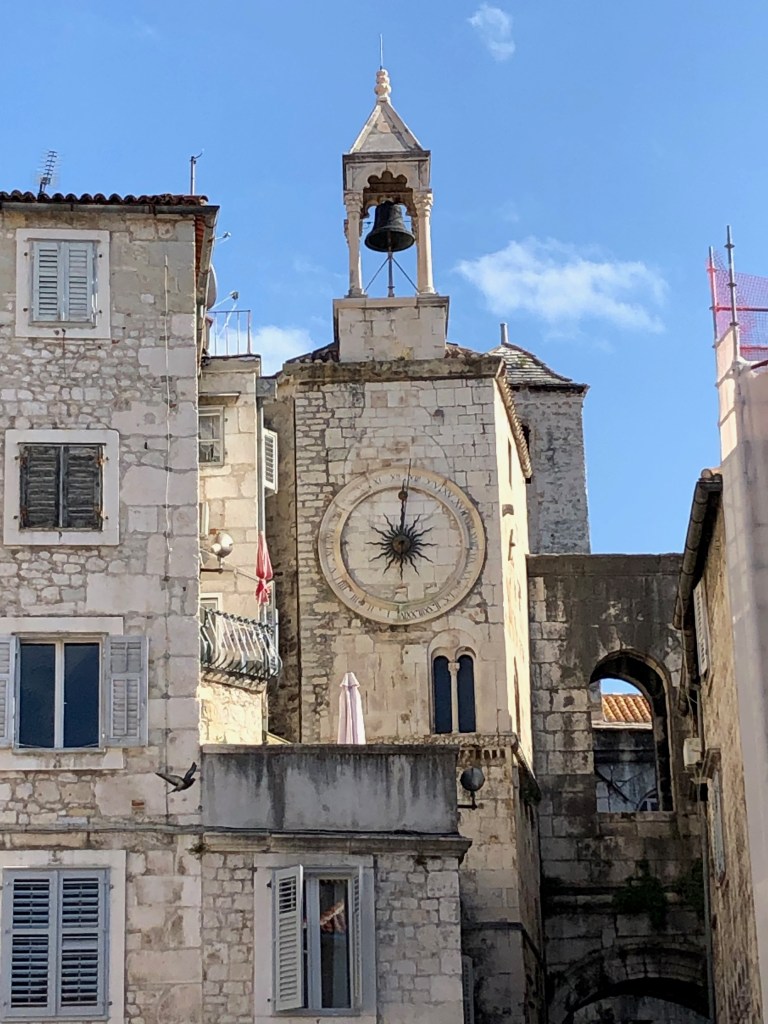
Laneway outside of Palace
On the wall just to the right of the lane leading to the Peristyle, there is a life-size relief of St. Anthony.
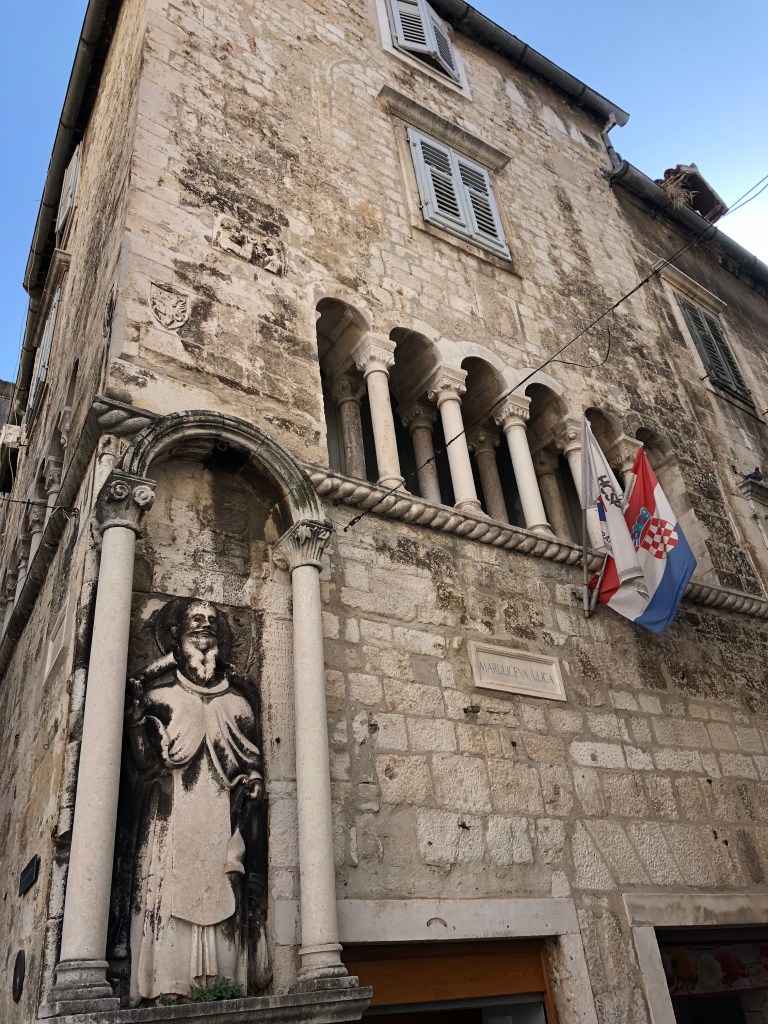
St Anthony 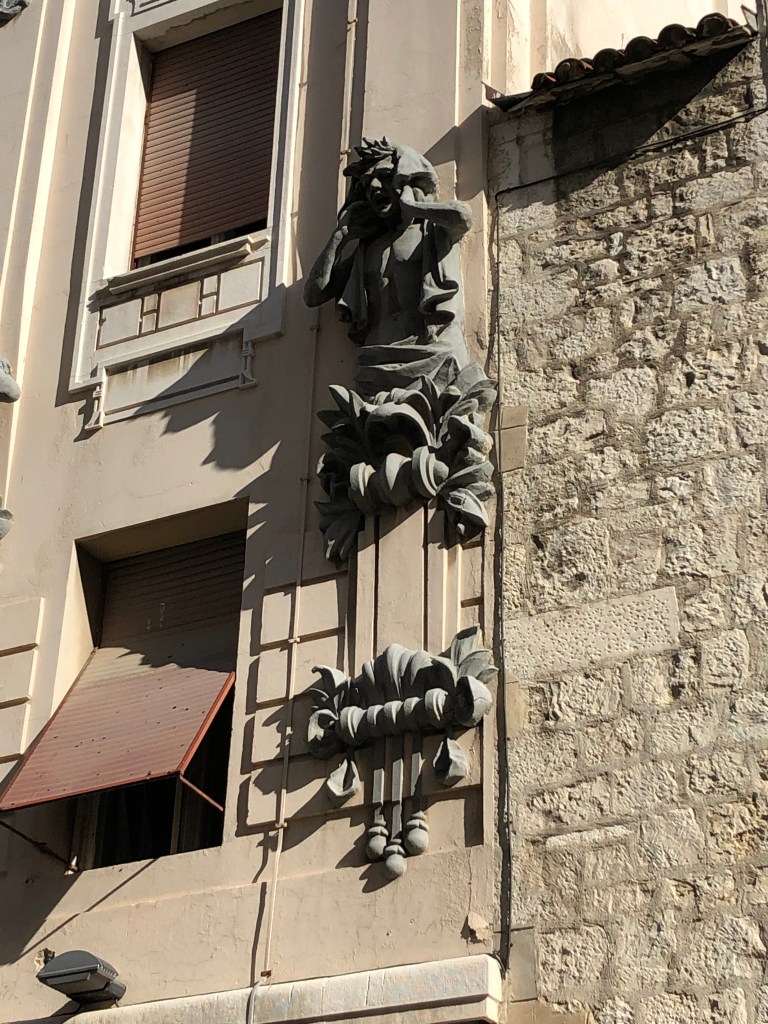
Carvings on Building
We were tired so we returned to the hotel for a rest and returned to meet the group for dinner at a restaurant near Giulia’s room.
October 18 CARNALARA Conference
First we, Jack, Marie, Swaroop and I had an interactive symposium that we worked hard to make “interactive” and to a greater degree than in the past, we seemed to accomplish that (we video-recorded the session that provided evidence for this claim).
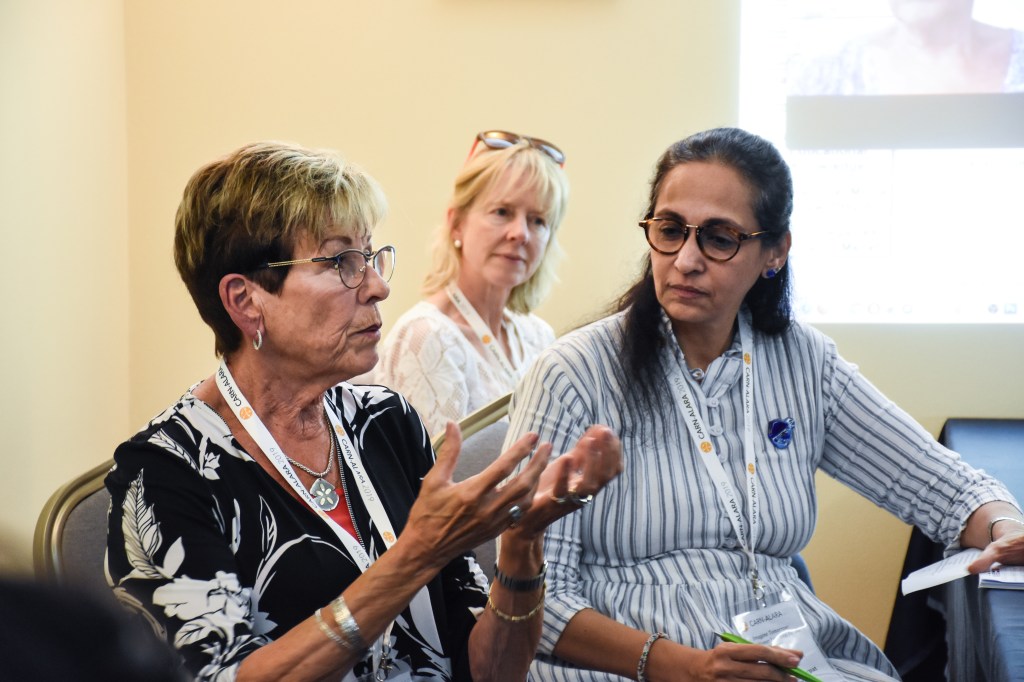
Jackie, Swaroop in symposium 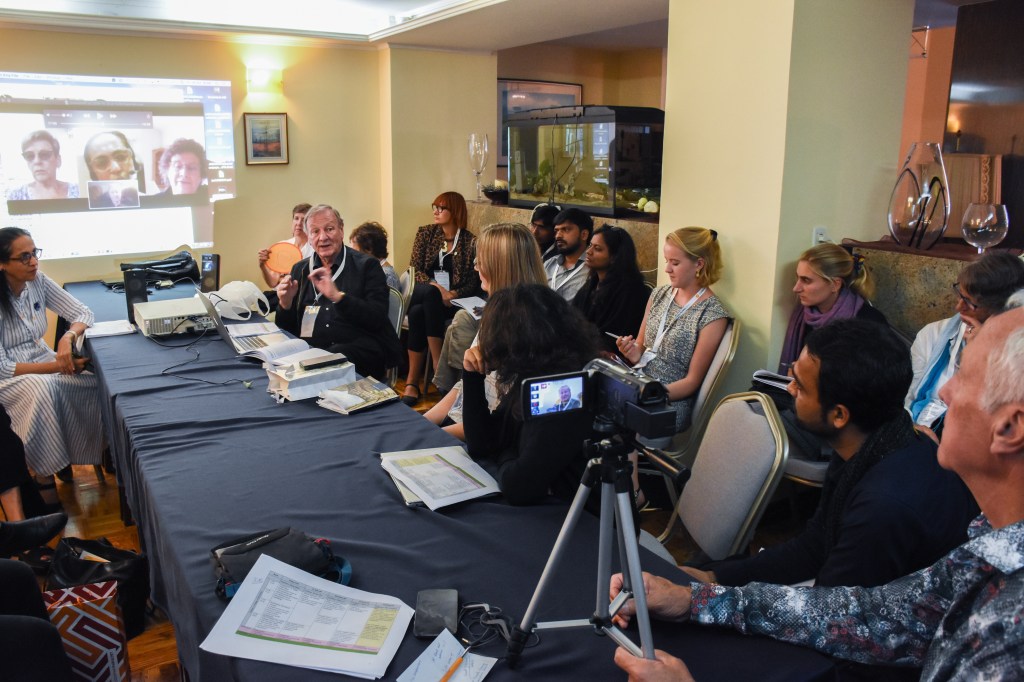
Living Theory Symposium
Second, Jack, Swaroop and I led an interactive paper session which we tried again to make “interactive” and again succeeded to some degree (see video-recording).
After the last session of the day, we walked toward the waterfront and found a street-side restaurant and had a last dinner together.

October 19 CARNALARA Conference
After a hour workshop with Jack and Marie and about 30 people which seemed to be well-received, Bill and I spent our last afternoon walking the streets and promenade, called “Riva”, Italian for “Harbour”, and returned to our room for a walk and dinner in the hotel.
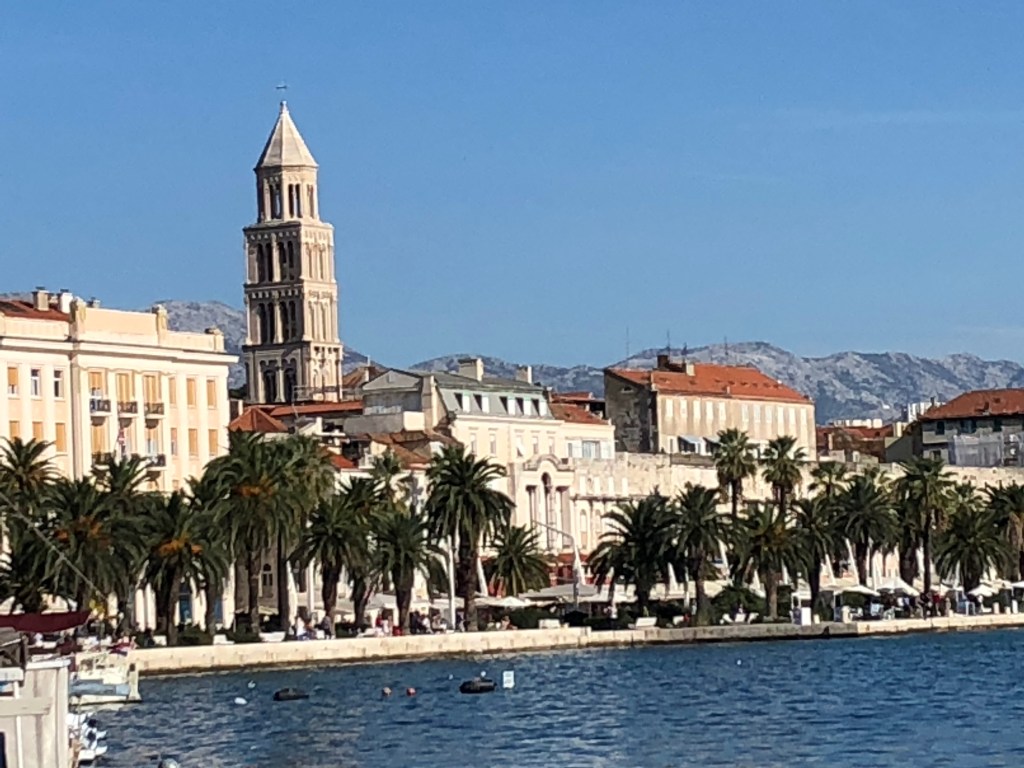
Riva 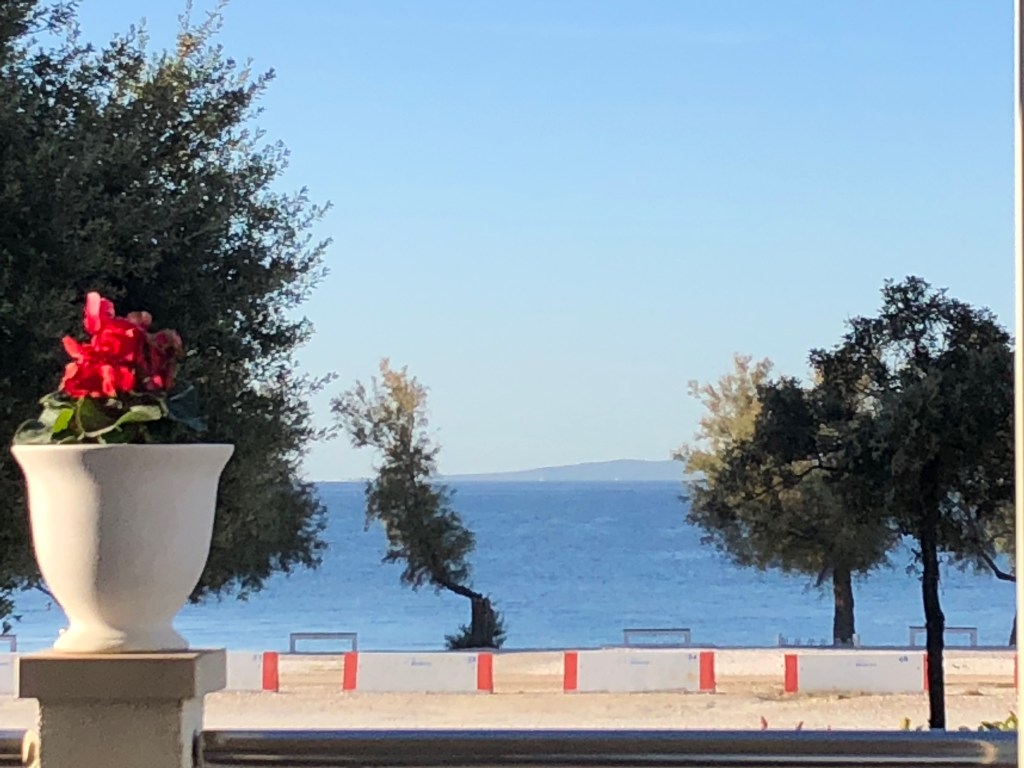
Hotel Fanat Restaurant
October 20 Split to Trogir
We had another great breakfast and headed out of town for Trogir about 30 minutes northwest, parked the car and walked to Hotel Pasike in the old town. When we arrived we found that we should have checked because the parking lot was very expensive and the hotel had its own lot which was much cheaper so we moved the car. We arrived too early to check in so we walked the medieval-packed town, oggled the yachts, had lunch and the waterfront promenade.
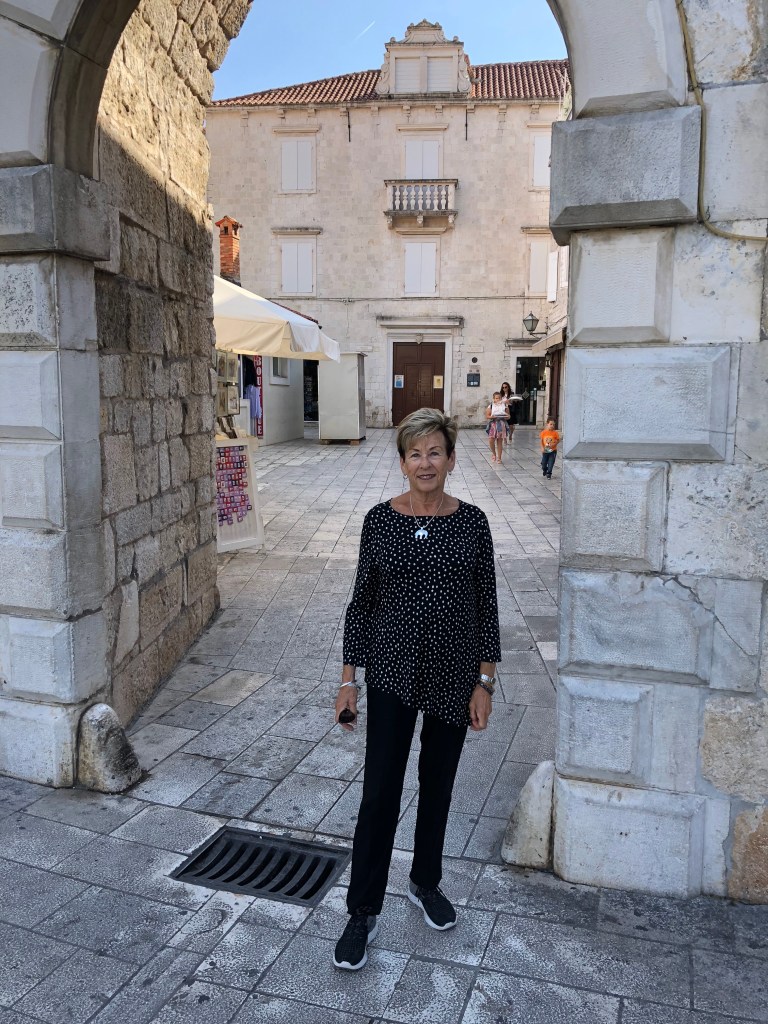
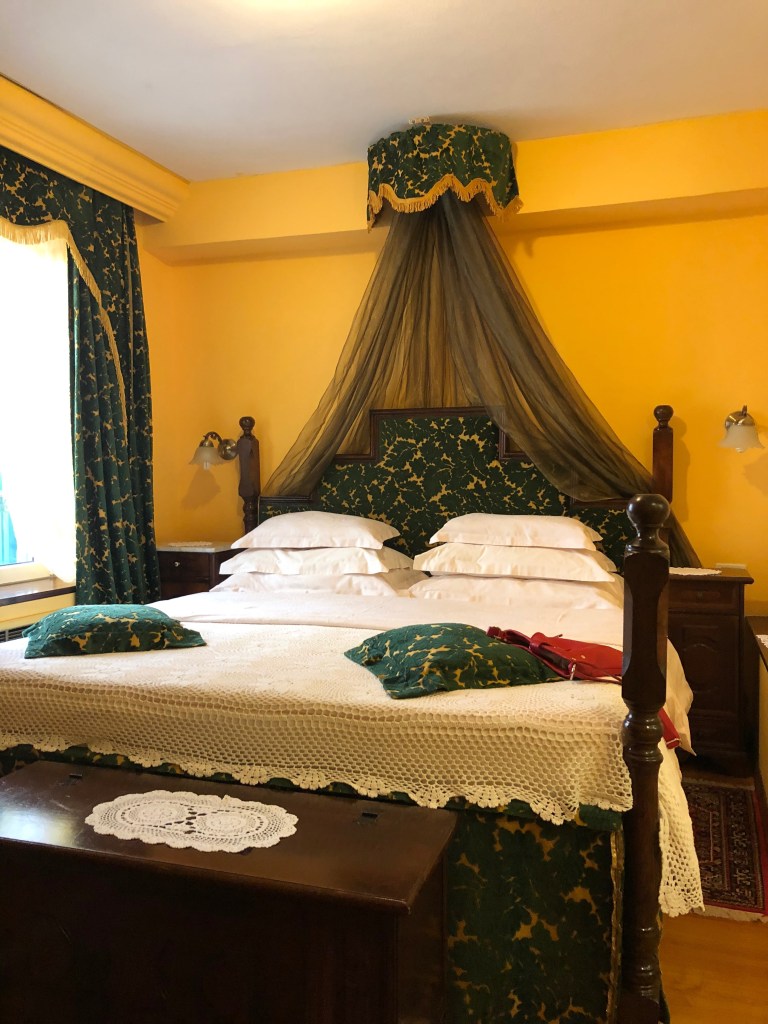
The Hotel Pasike, a family-run hotel is full of formality and antiques.
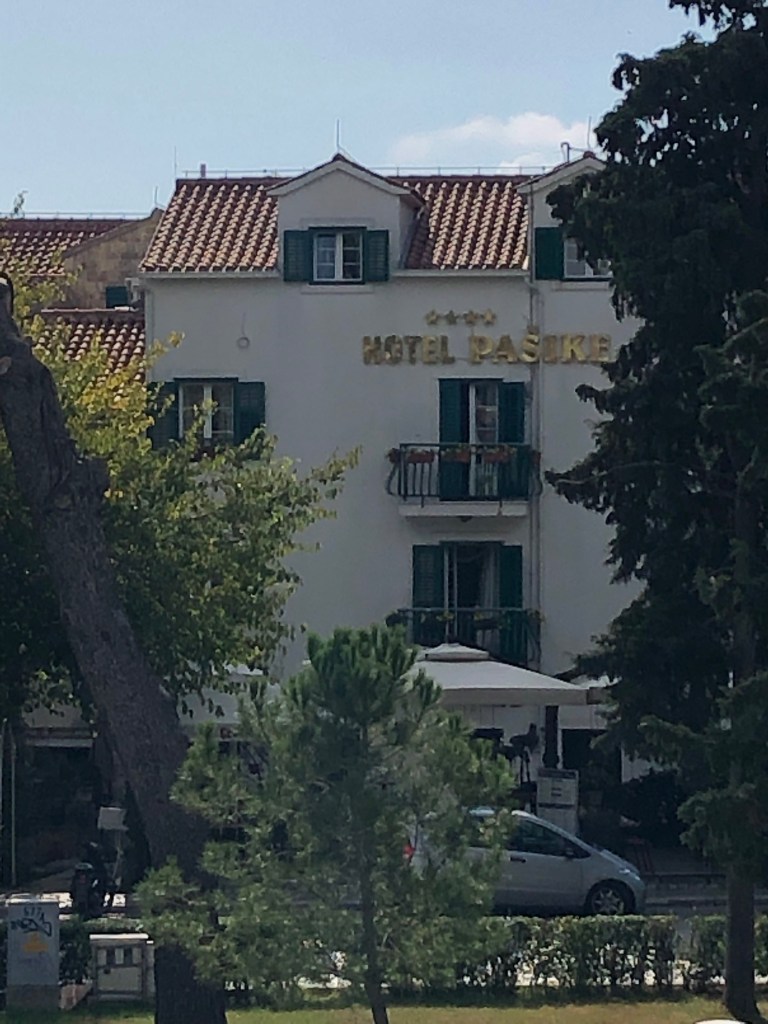
Hotel Pasike 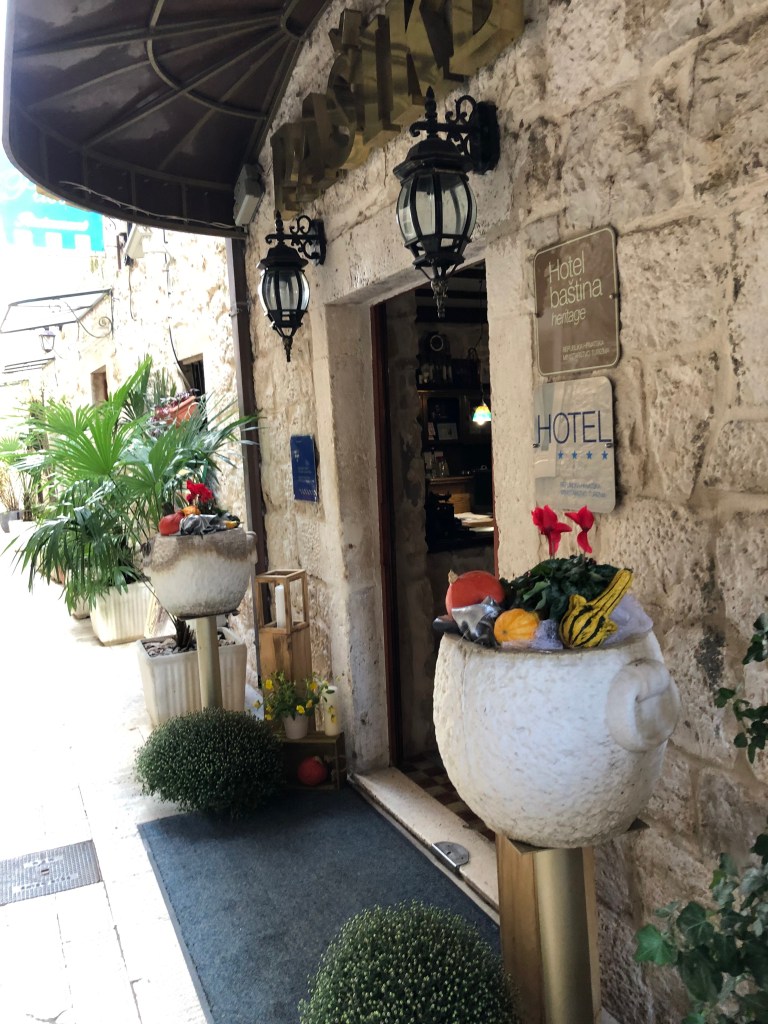
Entrance in laneway
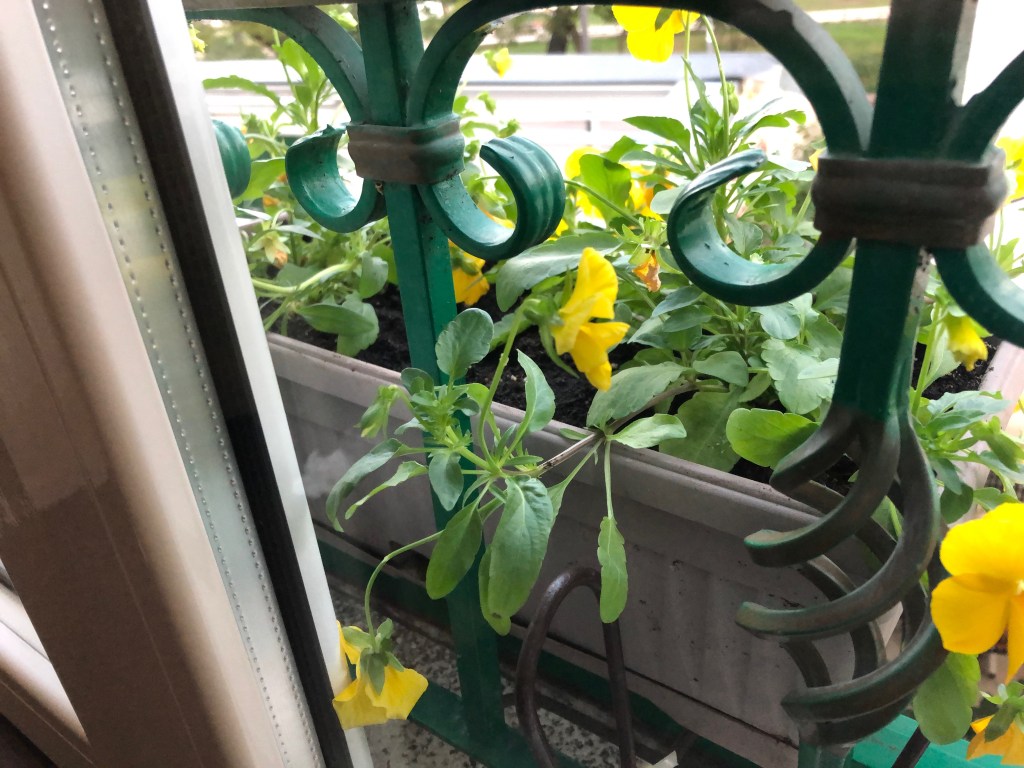
Our room also had a sitting room and flowers in the window.
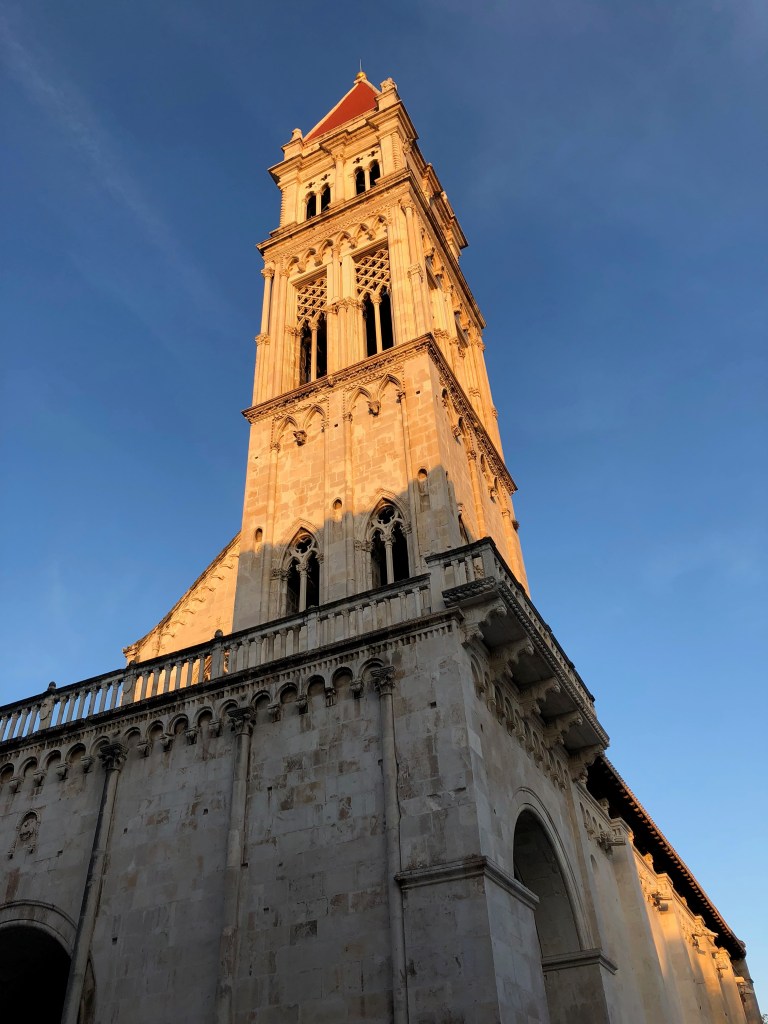
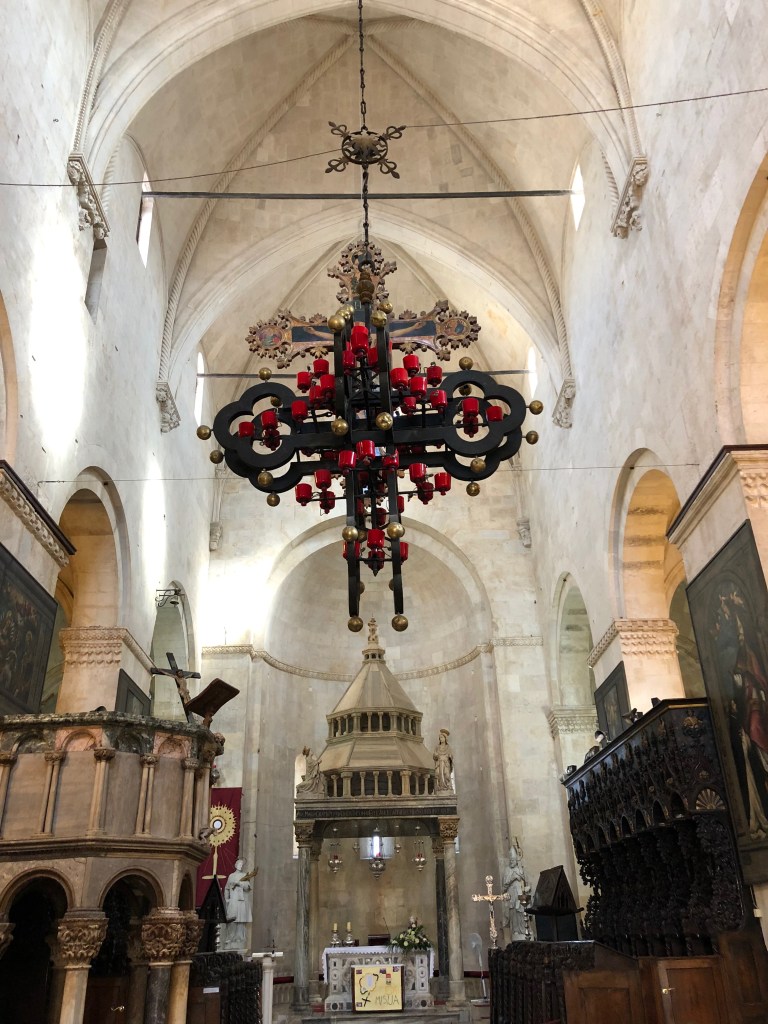
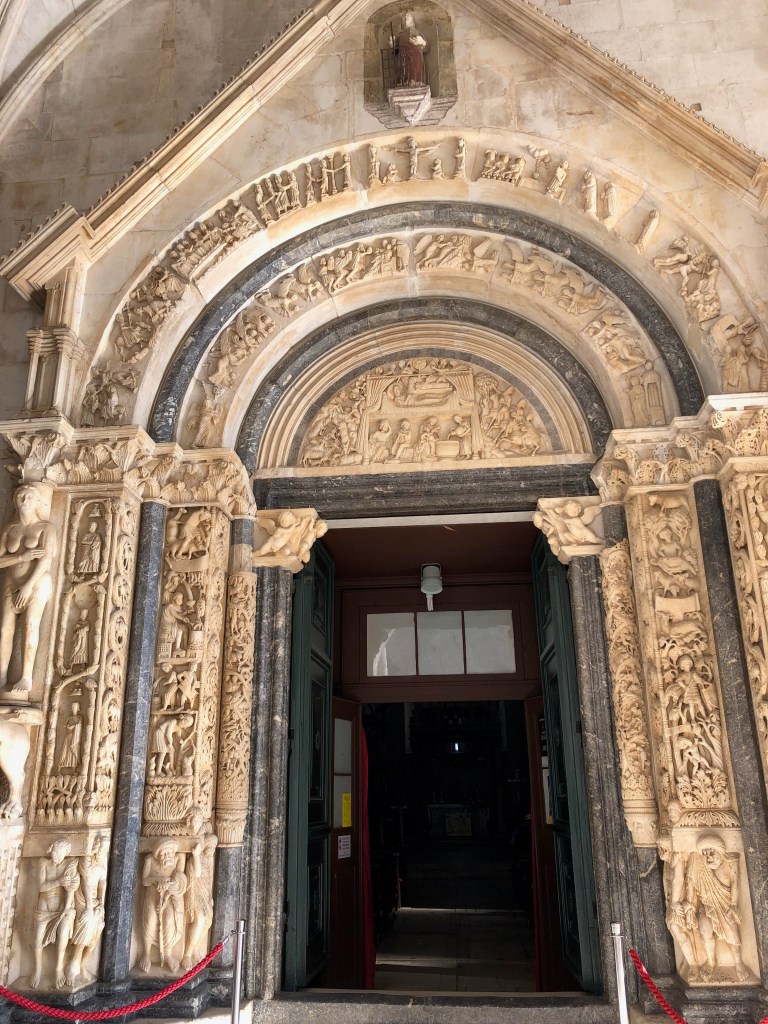
After check-in, we toured the Cathedral of St Lawrence built from the 13th to 17th century. The belltower alone took 200 years to build, a study in Dalmatian architectural styles: Gothic at bottom; Venetian Gothic in middle and Renaissance at top.
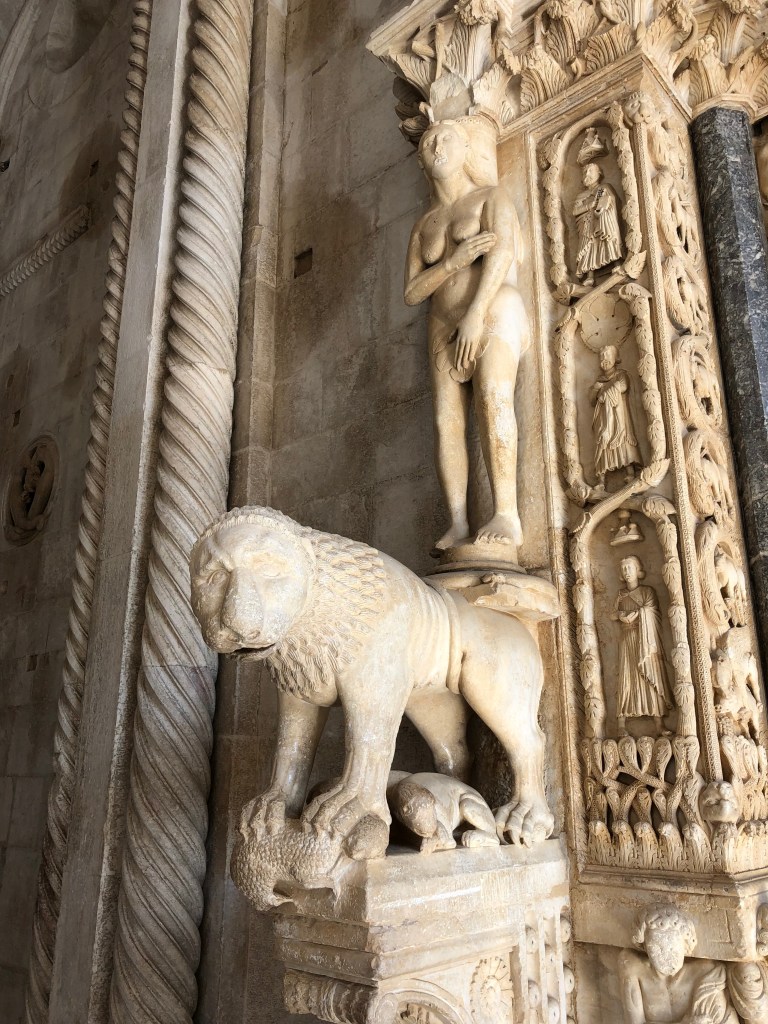
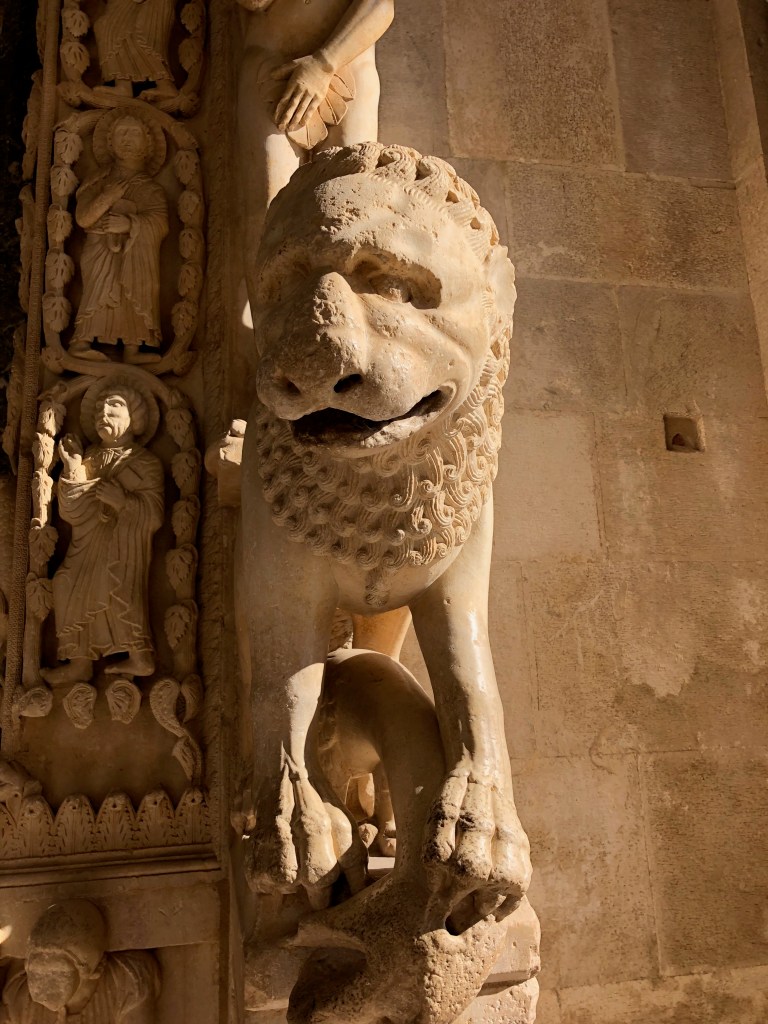
The Cathedral’s entryway, Radovan’s Portal, is ornately decorated.
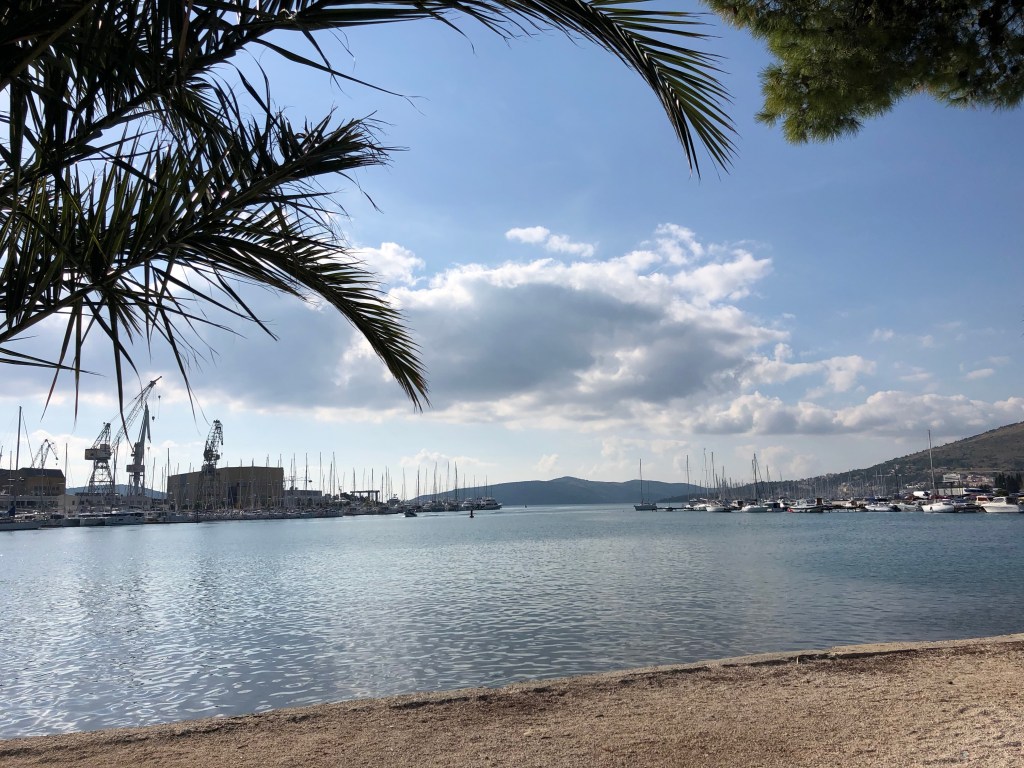
The main draw in Trogir is strolling the harbour front promenade. Huge yachts tie up at the main street and cafes line the promenade.. Croatia is a big destination for cruising sailers and there is a large presence of charter companies….humm….maybe some day?
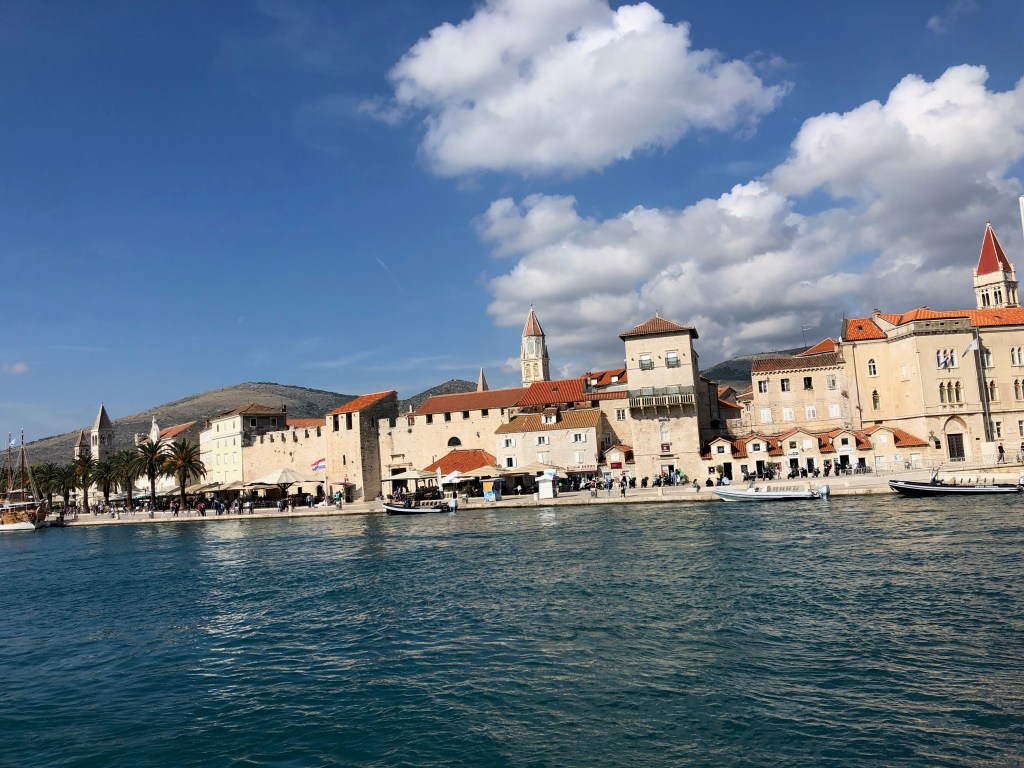
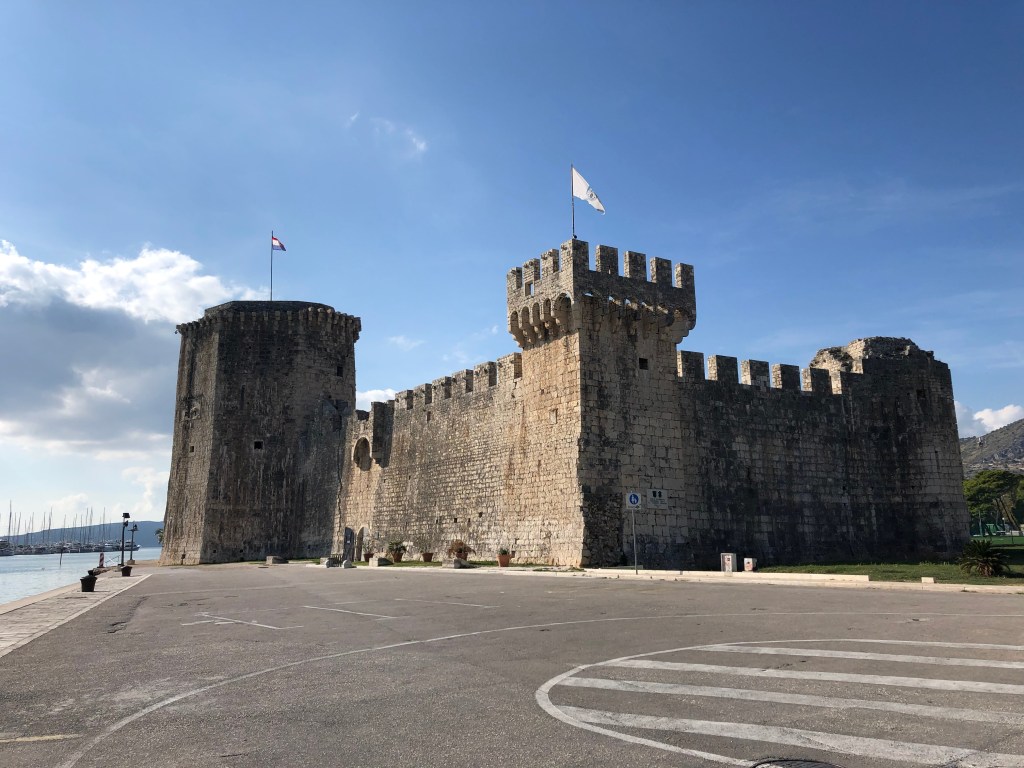
The Kamerlengo Fortress sits at the end of the promenade.
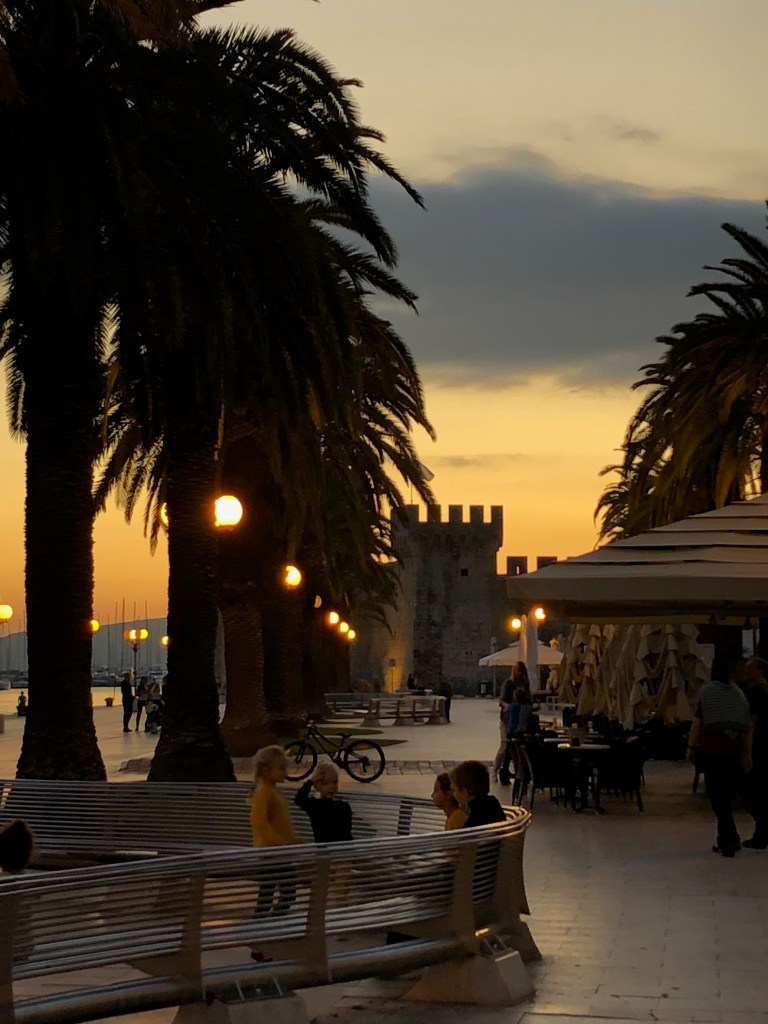
Trogir is a tiny, medieval-architecture town surrounded by water, popular with yachters and tourists.
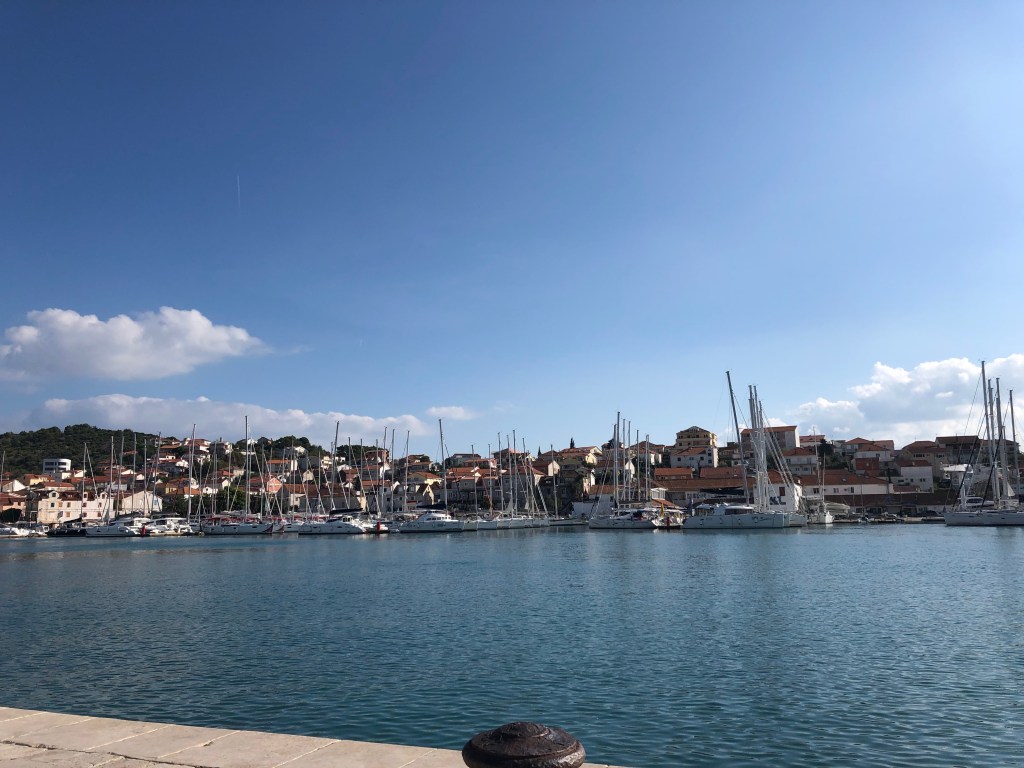
Huge marina 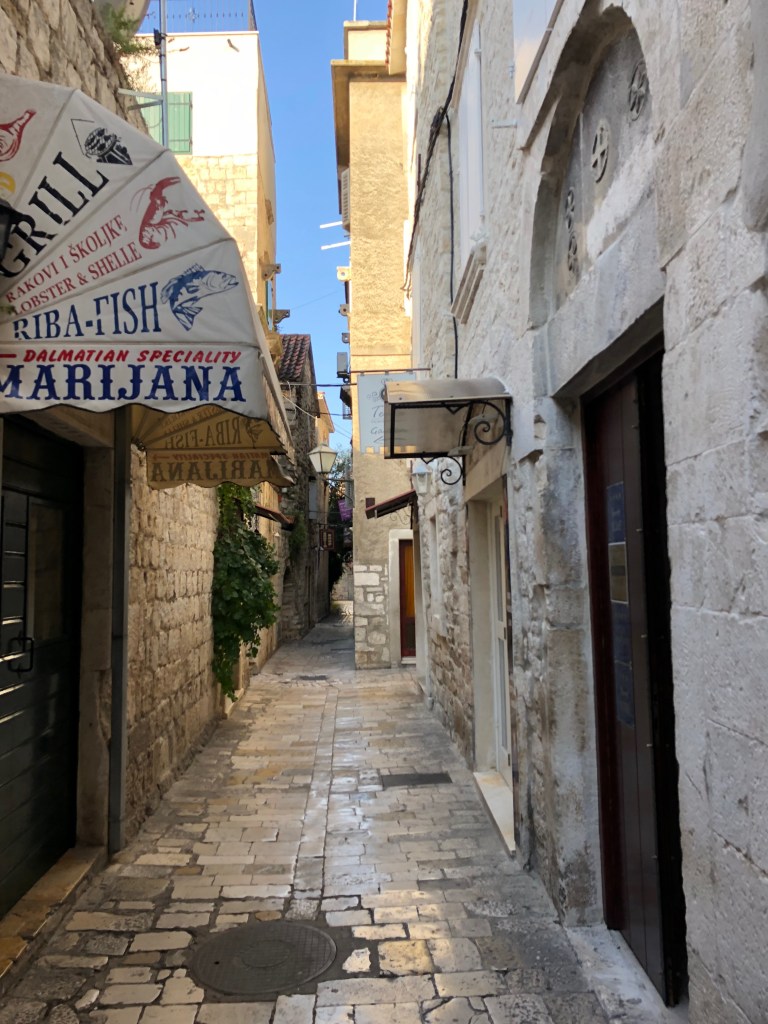
Narrow old streets
October 21 Trogir to Plitvice Lakes
We had breakfast at Hotel Pasike, went for a walk on the lovely waterfront and headed for Plitvice Lakes. The funny little quirk here was that the staff had no change and had to run around to find some!
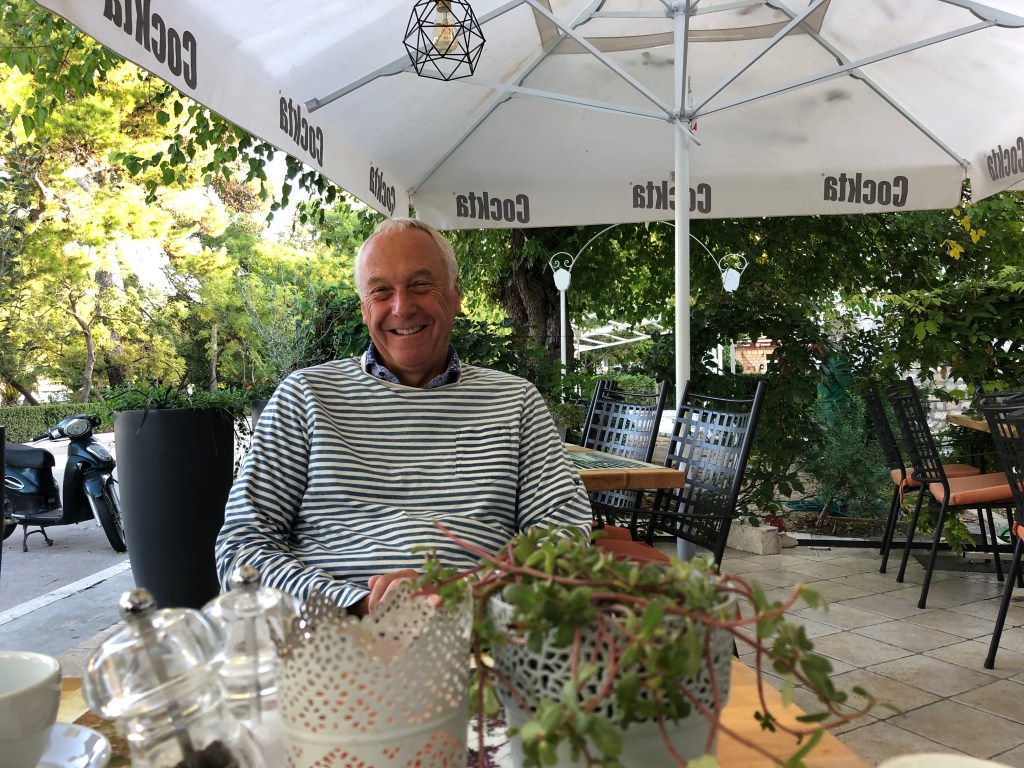
We drove non-stop for 2 and a half hours from Trogir to Jezerce, the small town just outside the park where our guest house, Villa Verde, was located. It is small and new; the family that owns it are very friendly and live on site; the food cooked by Nana, the owner, (a choice of two menus, fish or meat) is excellent.
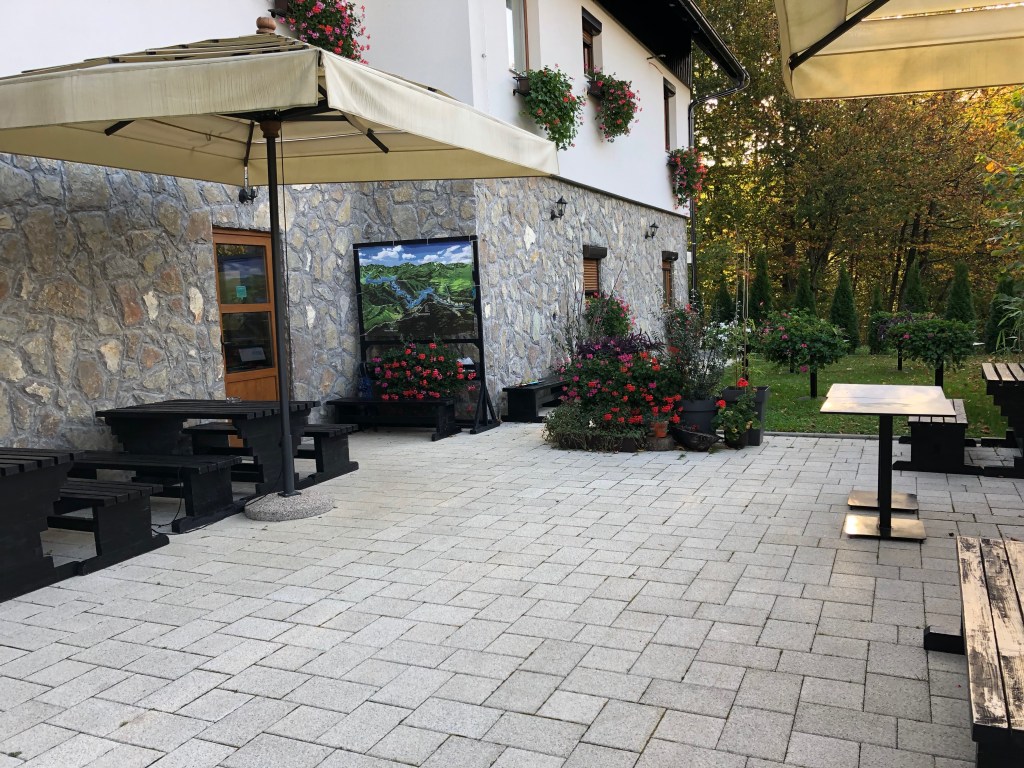
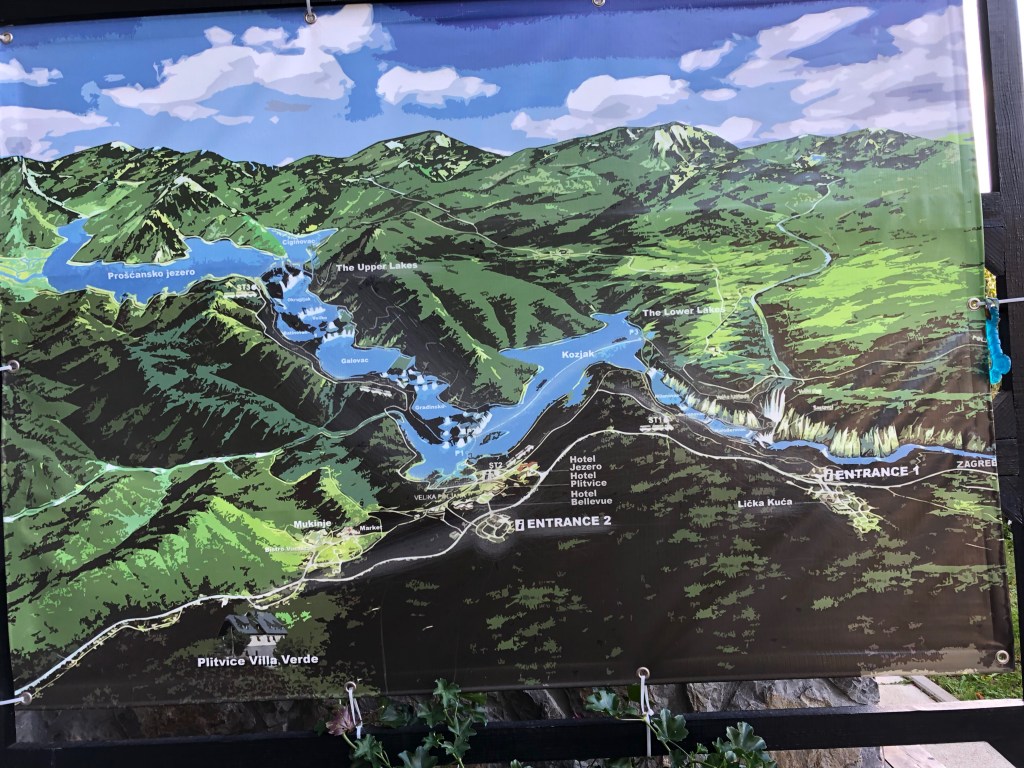
Plitvice Lakes National Park.
Plitvice (PLEET-veet-seh) is a European natural wonder. This huge valley with 16 terraced lakes, separated by natural dams and laced together by waterfalls, boat rides and plank walks is stunning.
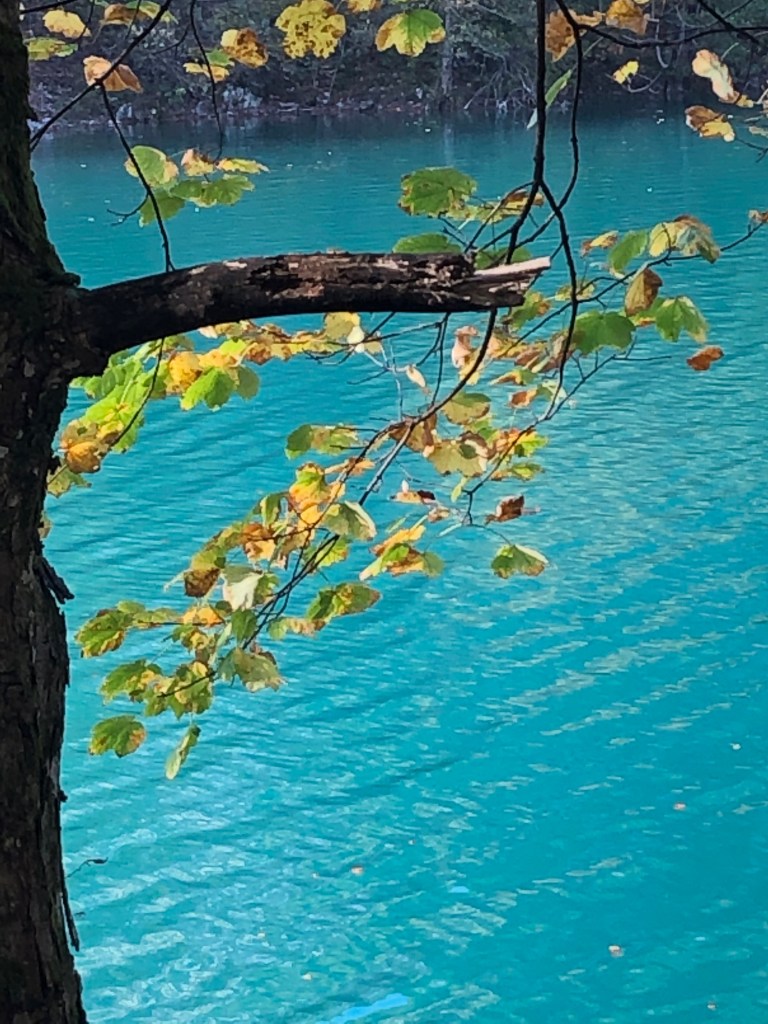
The water is crystal clear and brilliantly coloured by the reflections of the fall colours.
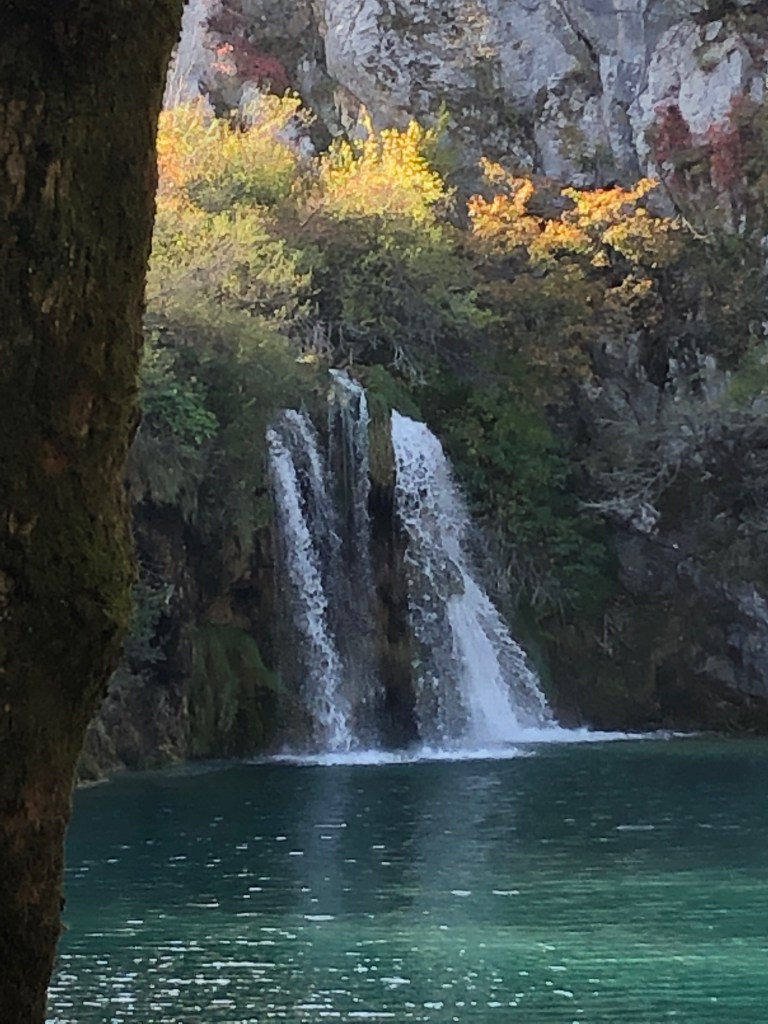
The specific hydrogeological properties of the park’s rocks have enabled the retention of water on the dolomite rocks and resulted in the water cutting canyons in the limestone deposits. It was designated as a UNESCO World Heritage Site in 1979
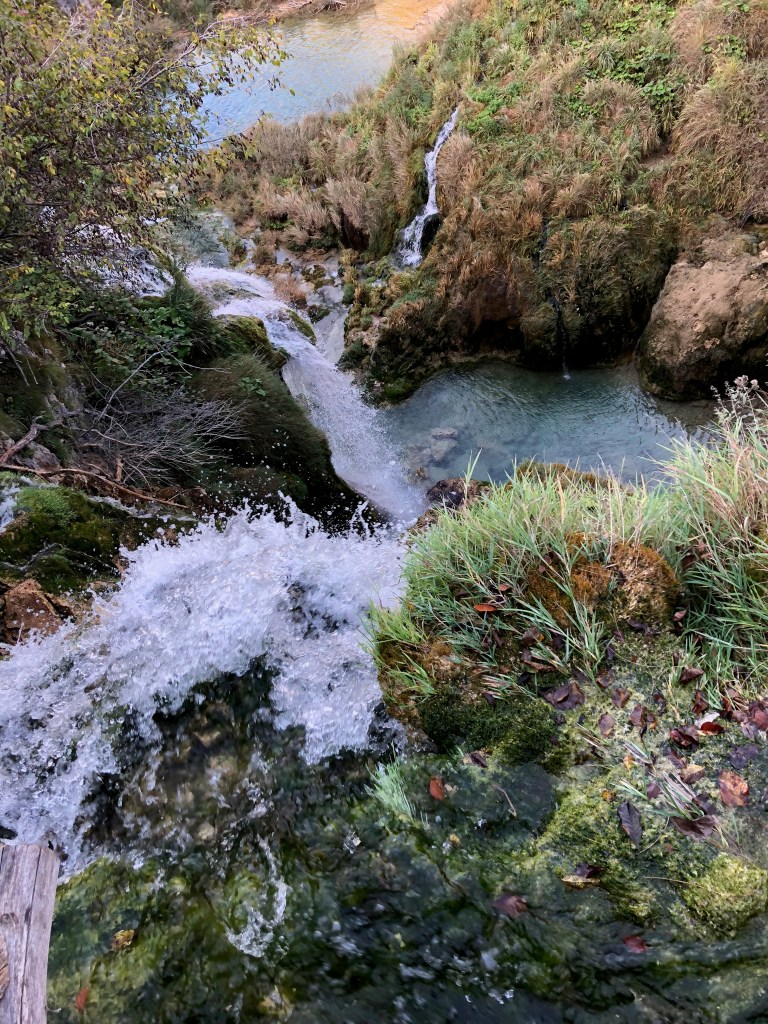
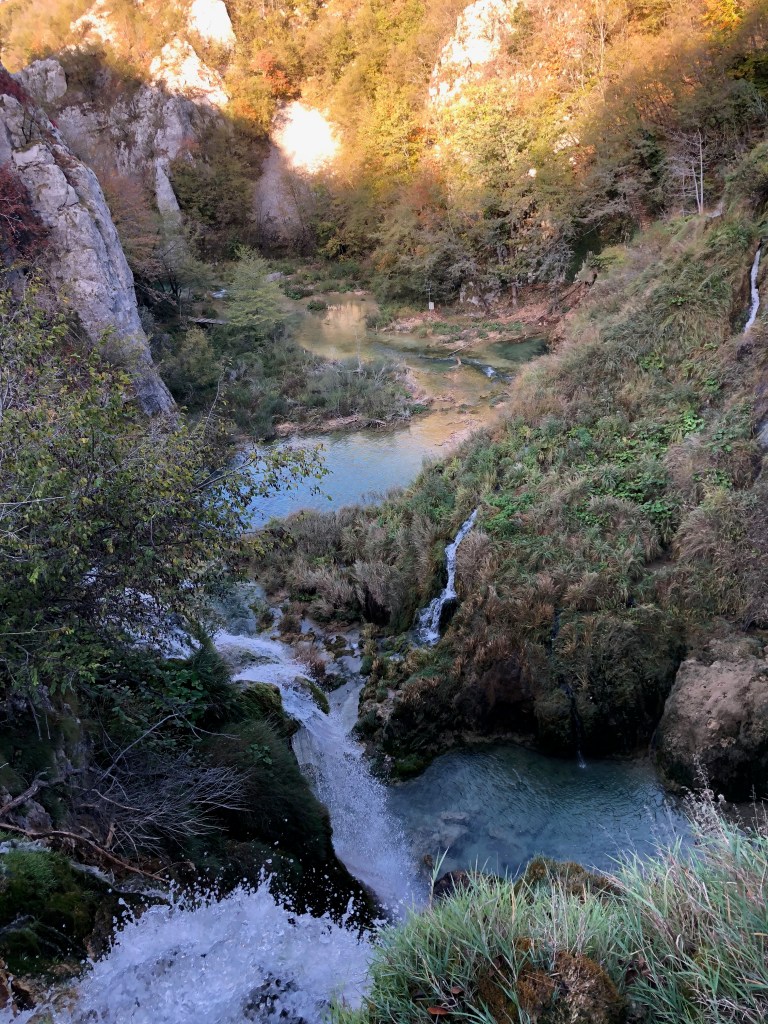
Despite having more than a million visitors a year, we had times when it was actually quiet. We toured the Lower Lakes on the first day with our pre-purchased admission at 3:00 pm, took a boat to the end of the lake and walked up and down the waterfalls and after a bus ride back to the entrance arrived our hotel at 5:30 pm.
Because much of the hiking was uphill, it was very tiring but exquisitely beautiful- our calves hurt for days after. The whole way is either on narrow trails around the lakes or on uneven plank walkways with very few side barriers – this would not be allowed at home, especially over deep canyons.
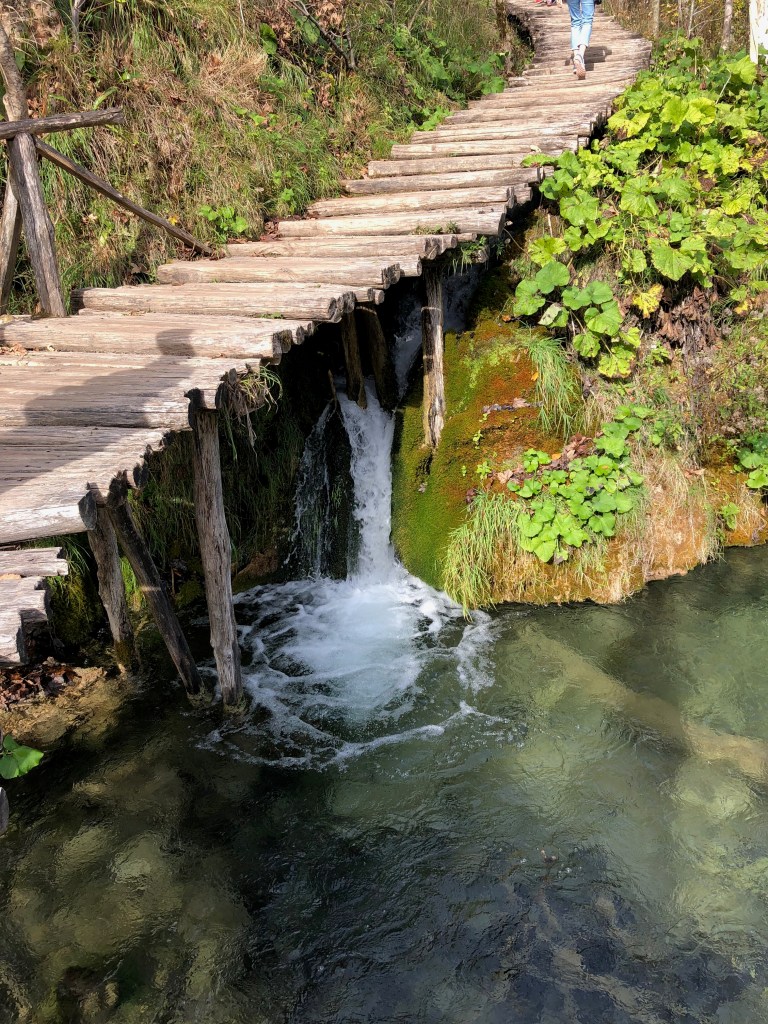
Wooden plank walkway 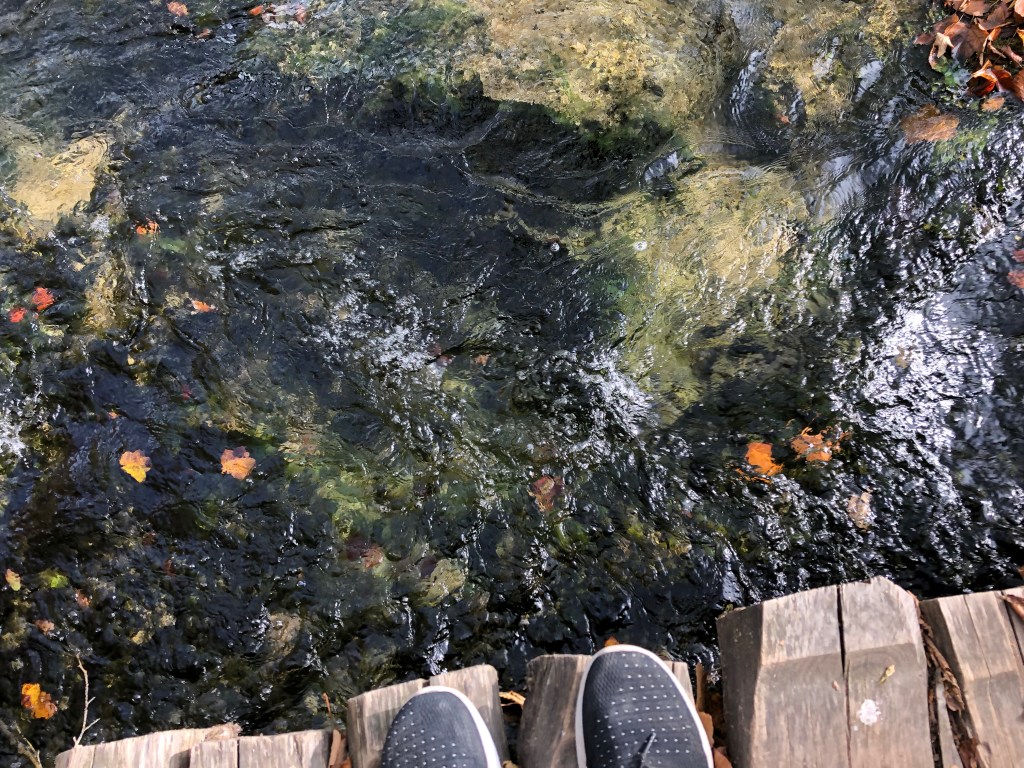
Toes on edge of walkway
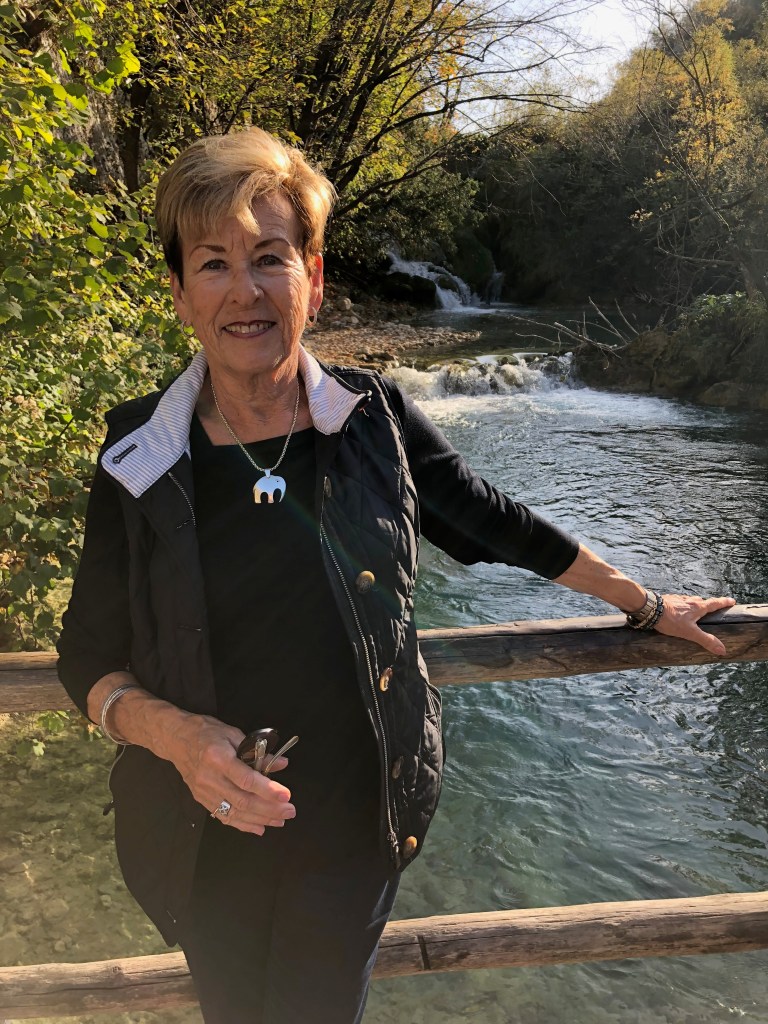
The trail took us along the lake and past several waterfalls to the biggest one, Veliki Slap, the highest waterfall at 78 metres where the Plitvice River plunges 250 feet over the cliff into the valley below. It looked pretty impressive but two photographers told us that because of the shortage of rain, it was not its usual glory.
To get a sense of the depth and beauty of the canyon:

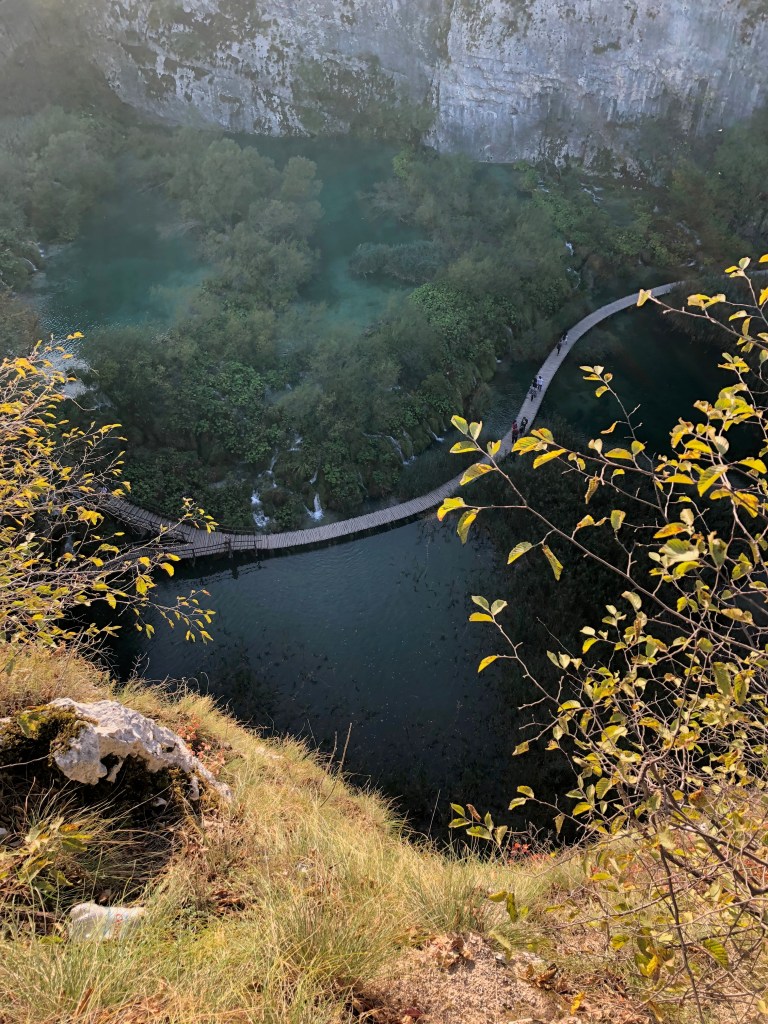
October 22 Plitvice Lakes
After a wonderful breakfast, we arrived at the entrance for 9:00 am, walked to the bus which took us up to the Upper Lakes so that we could walk down.
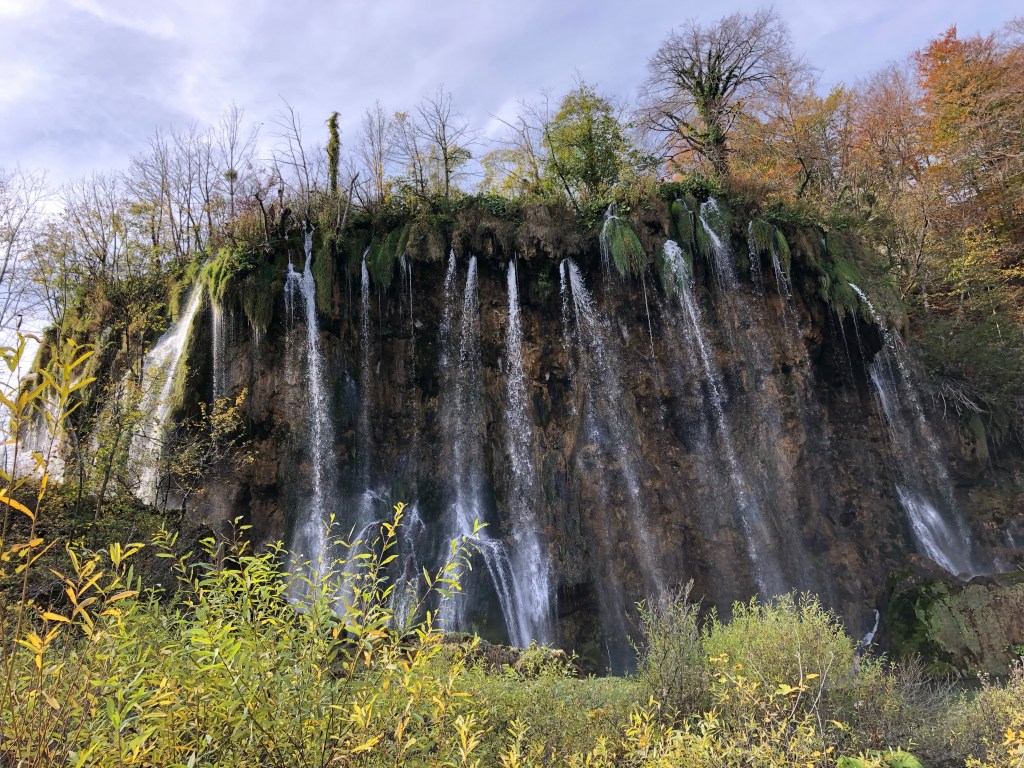
While there are waterfalls in every lake and water cascading under your feet, the finest one is from Lake Galovac to Lake Gradinsko. You hear them before you arrive, then you see thundering Veliki (Big) Prstavac and finally you get sprayed by it.
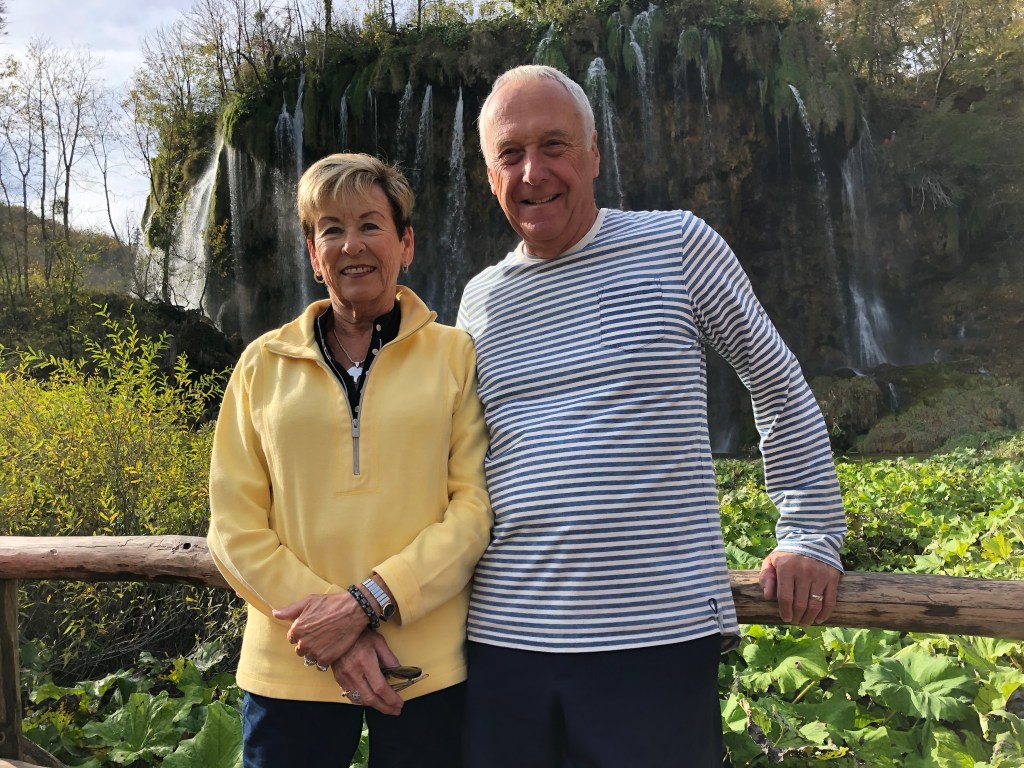
As you circle around you continue to look in awe and continue to be amazed by the Mali (Small) Prstavac, more waterfalls and a view down on the pond of Galovacki Buk.
The rest of the trail follows a stepped boardwalk with gurgling water underneath – a very neat sensation, a downhill walk through the forest and along the lake to the boat docks for a trip across the lake to the parking and hotels.
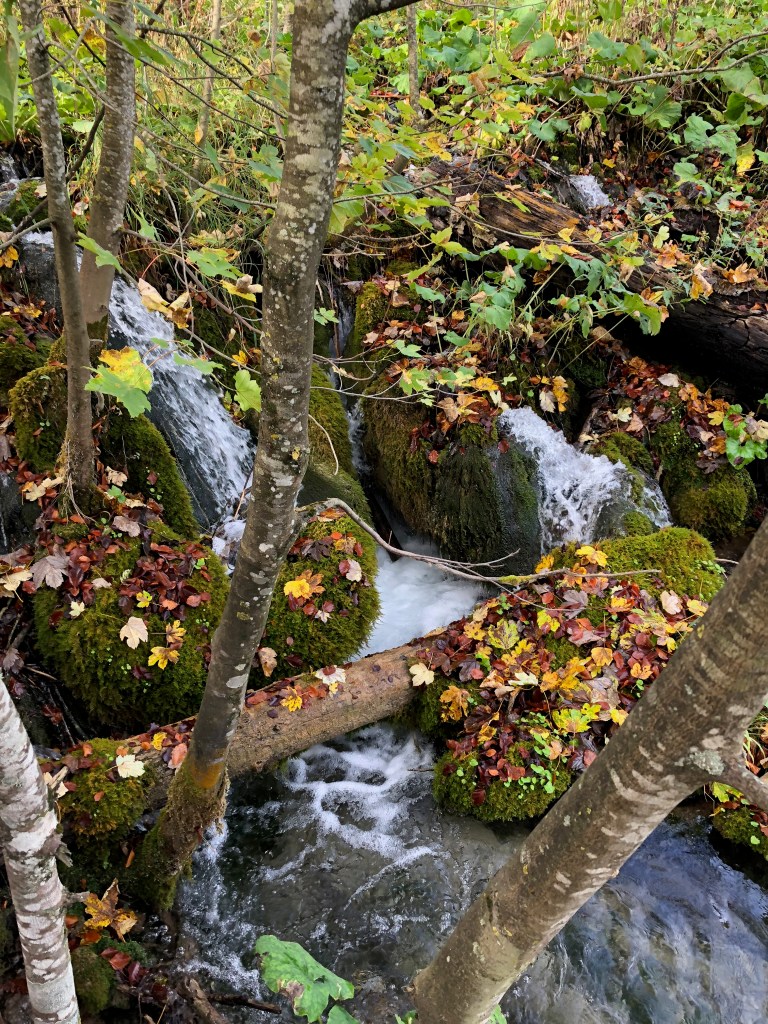
We finished the hike at noon, had soup and salad in the park cafeteria and arrived back at the hotel at 1:30. We did some planning for Rovinj (checked on the parking, the route and the distance, read in the sunny yard, had another fabulous homemade dinner and watched CNN – we have not missed the nonsense in Ottawa, London and Washington!
October 23 Plitvice to Rovinj
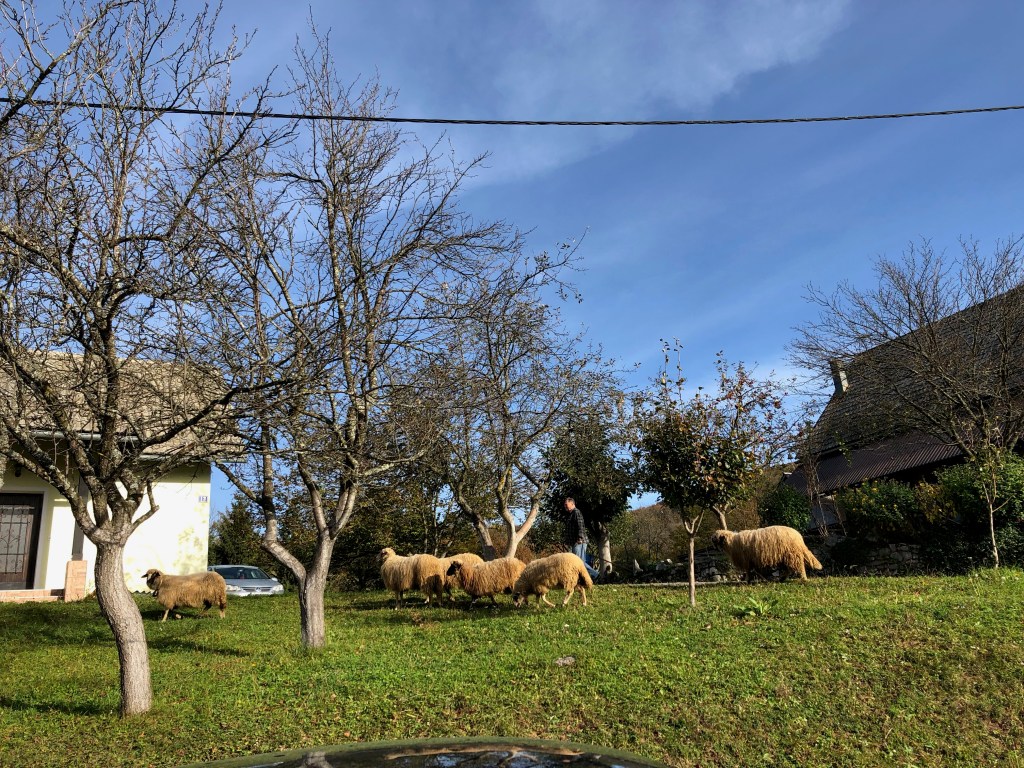
After another great breakfast, we left Villa Verde (very nice hotel) for Rovinj (roh-VEEN) via local roads through small villages, small farms, logging operations in idyllic settings, especially with the fabulous fall colours. These sheep were ambling along the road as we approached.
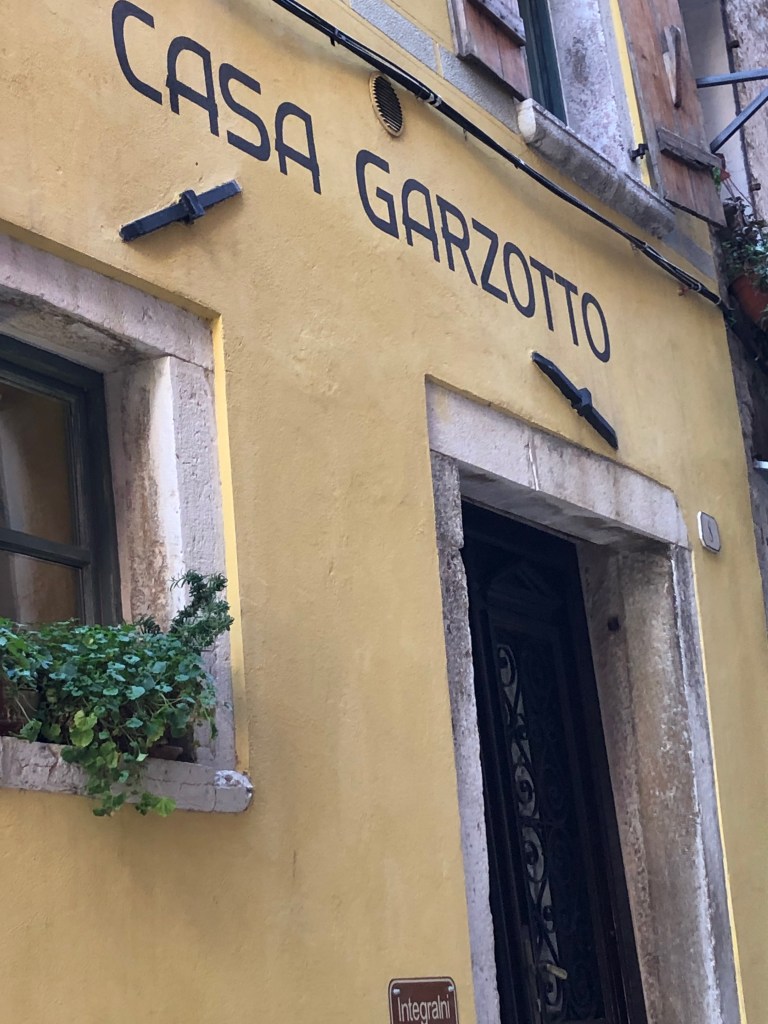
Once we hit the toll road, it was full speed ahead until we got close to Rovinj when Google Maps got lost and were taking us in the opposite direction -we’ve seen this with old towns before. We just headed to the spot on the map via the coastal road until we got to the edge of the Old Town and called Casa Garzotto. Alex met us on his scooter and drove us to the hotel, helped with the bags and parked the car in their parking lot outside of town.

We walked through the town gates to their waterfront and had lunch at El Niro, as recommended, had salad and calamari and walked up the hill to the landmark Baroque church, St. Euphemia, dating from 1754.
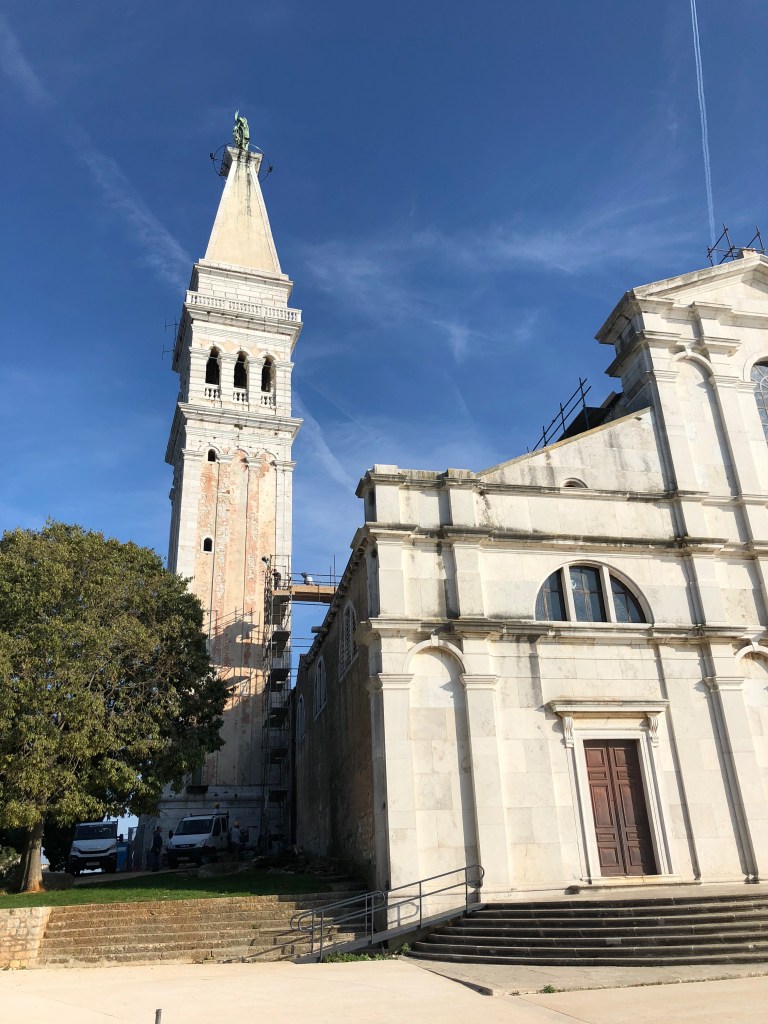
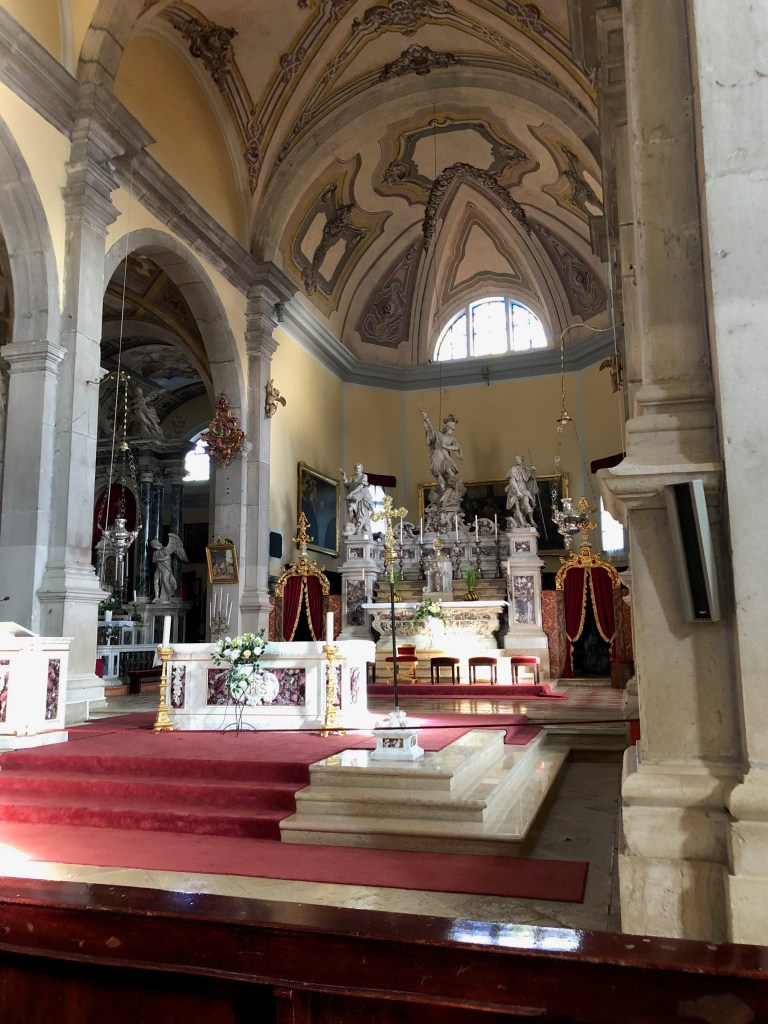


The 190-foot campanile, a replica of the bell tower in St Mark’s Square in Venice, towers over the church and town and predicts the weather. The shape of Rovinj’s patron saint, Euphemia, caps the bell tower: when she looks out to sea, a fresh Bora wind is blowing dry air from the interior but if she is facing land, the humid Jugo wind will bring bad weather from the sea. It was difficult to see her at that height and they were working on the bell tower – I saw a sword being brought down by crane.
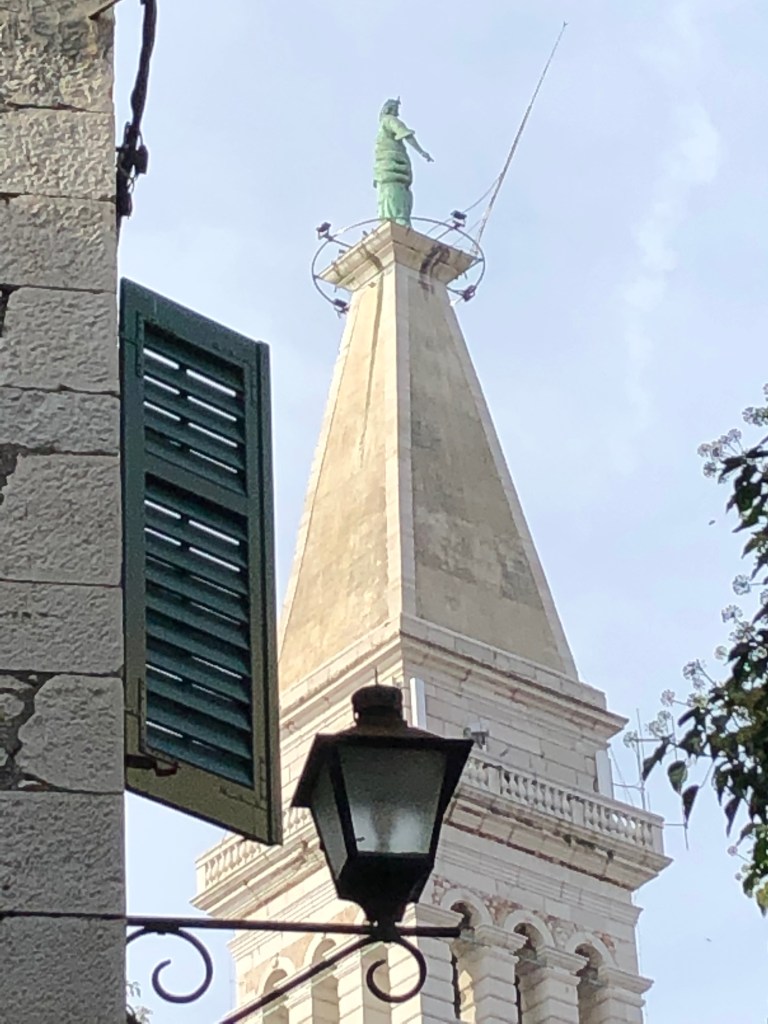
We walked back down through narrow streets, back through the Balbi Arch into Tito Square and along the waterfront for a good view of the town.


We went back to our apartment for a rest and then went to Gianino, a very lovely, if somewhat expensive, restaurant. We weren’t very hungry because we had eaten lunch late so we shared a pasta dish.
October 24 Rovinj
We had a fabulous breakfast in this small old restaurant around the corner from our hotel. The scrambled eggs were particularly good with leeks in them.
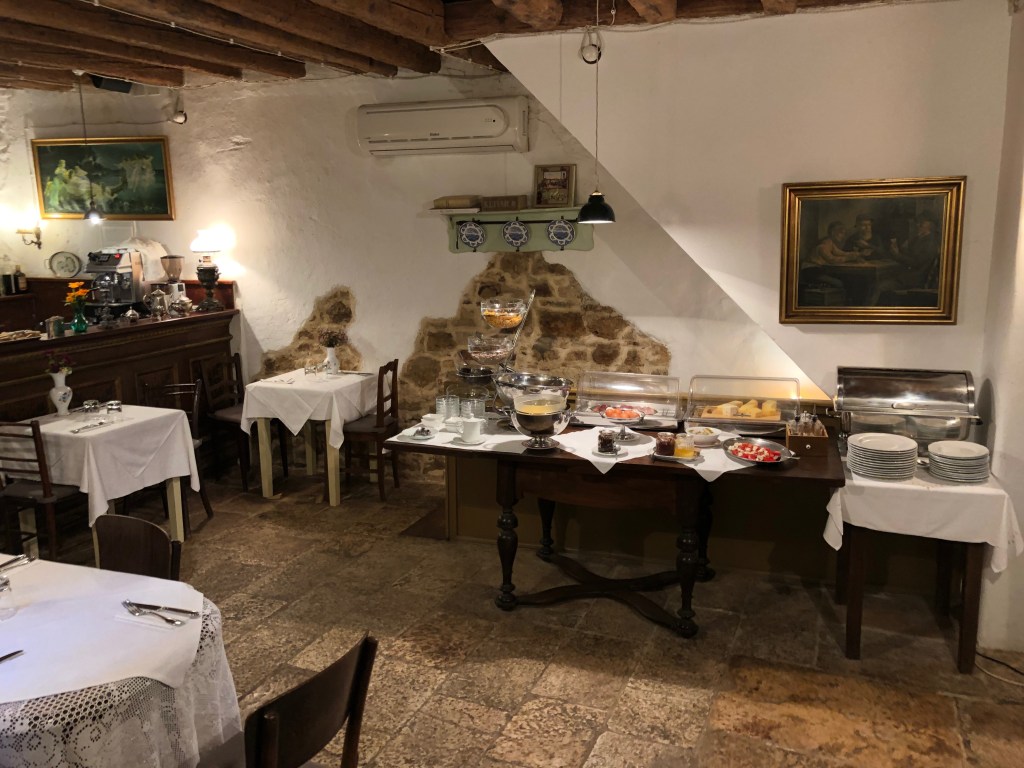
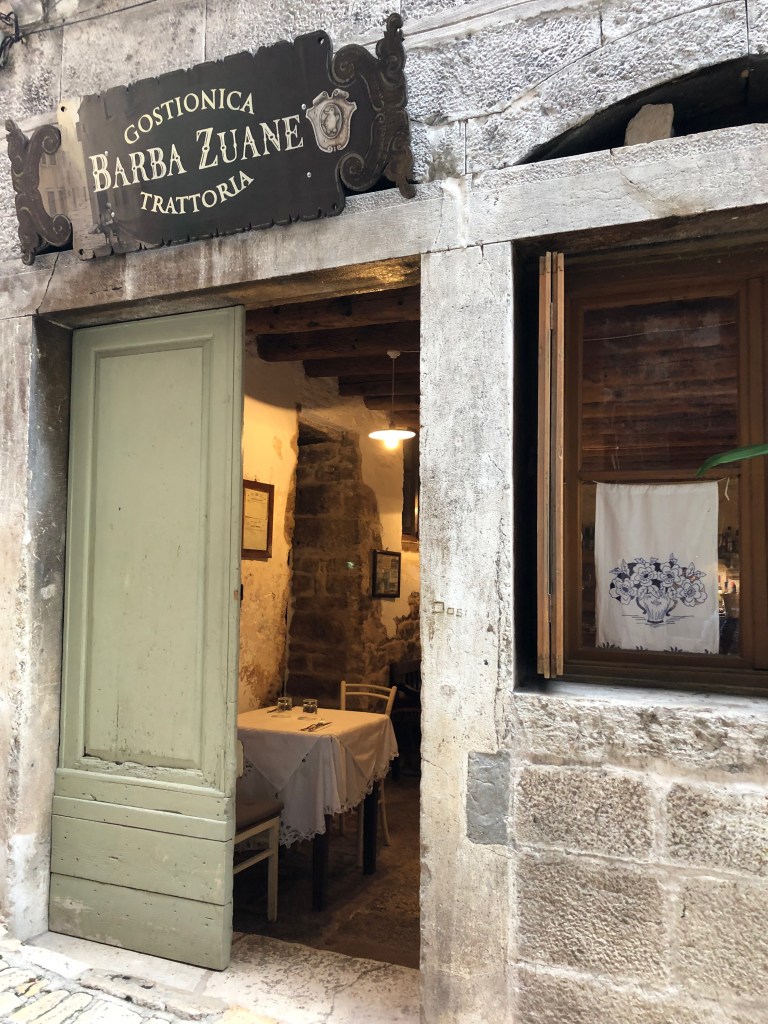
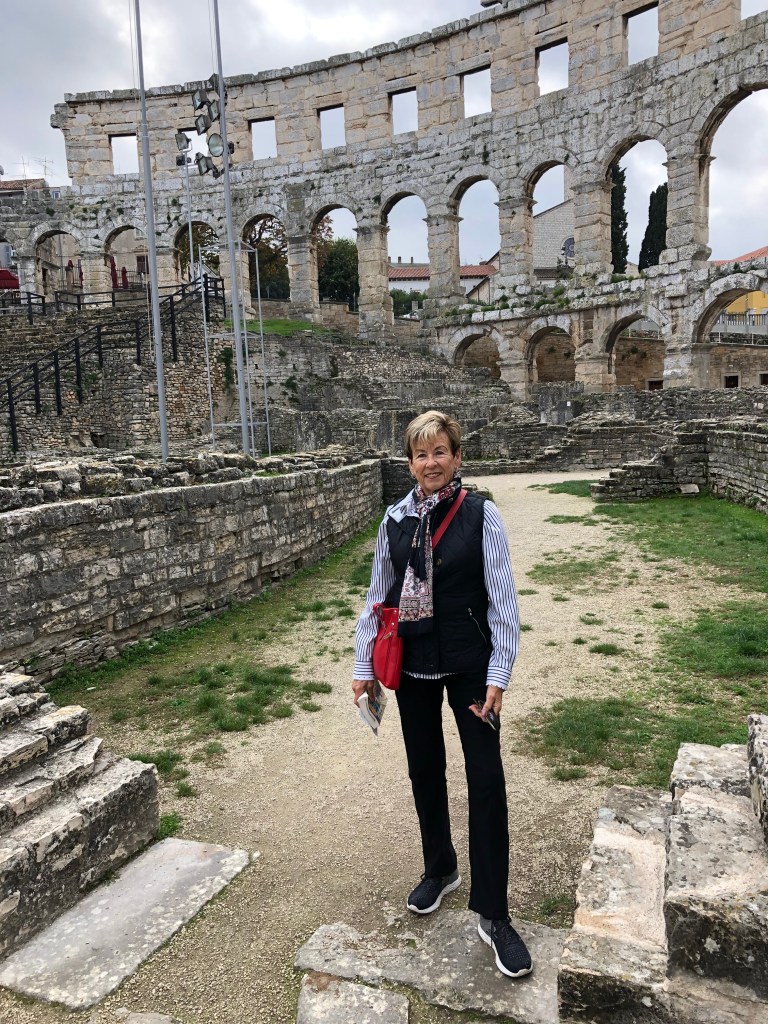
Alex brought our car from the parking lot and we left for Pula a bit after 9 and took the coastal road with the help of Google Maps arriving around 10:00. Parking was just across from the Amphitheatre, a fully intact mini-Colosseum and visible immediately.
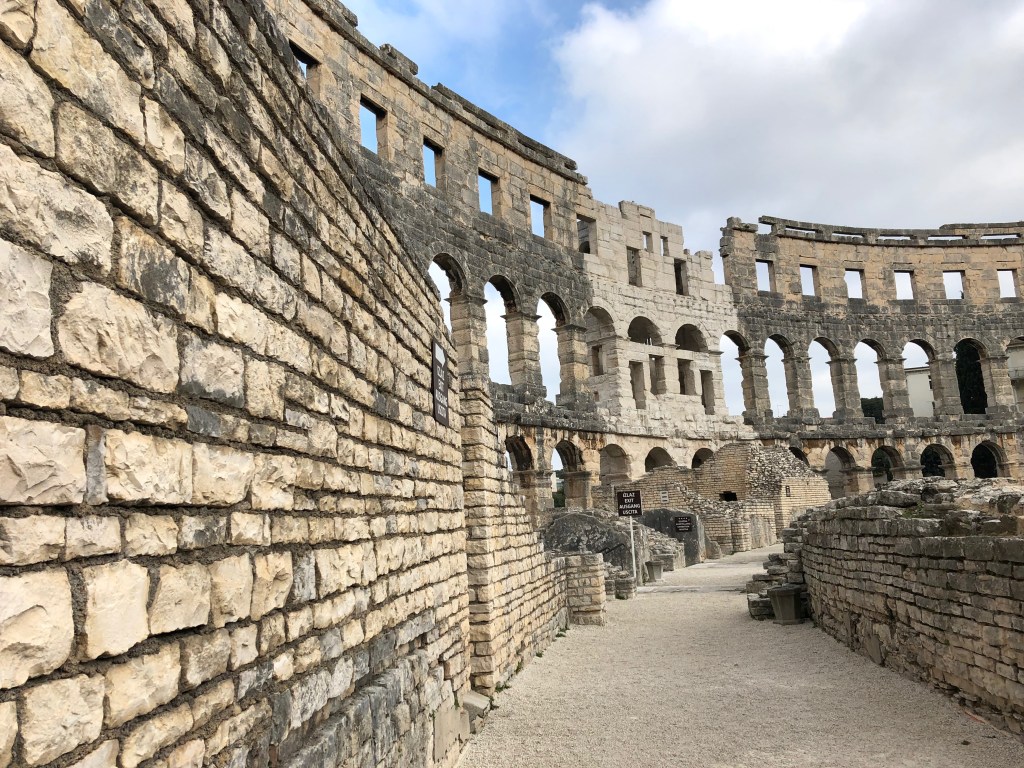
Pula’s amphitheatre is the 6th largest (435 feet long and 345 feet wide) and one of the best preserved. It was built in 1 – 80 AD (about the same time as the Roman Colosseum) under the reign of Roman emperors, Augustus, Claudius and Vespasian and was used for Gladiator battles until the fifth century which were very bloody. We were so fortunate to arrive early before the crowds did and felt almost alone with the Romans and gladiators.

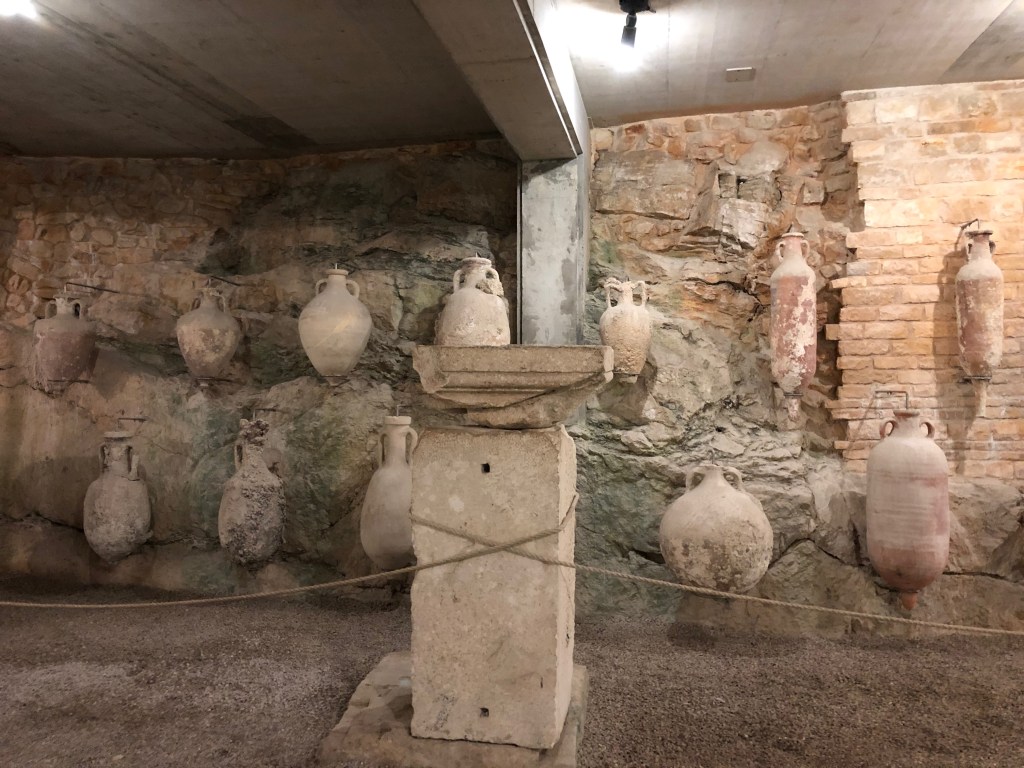
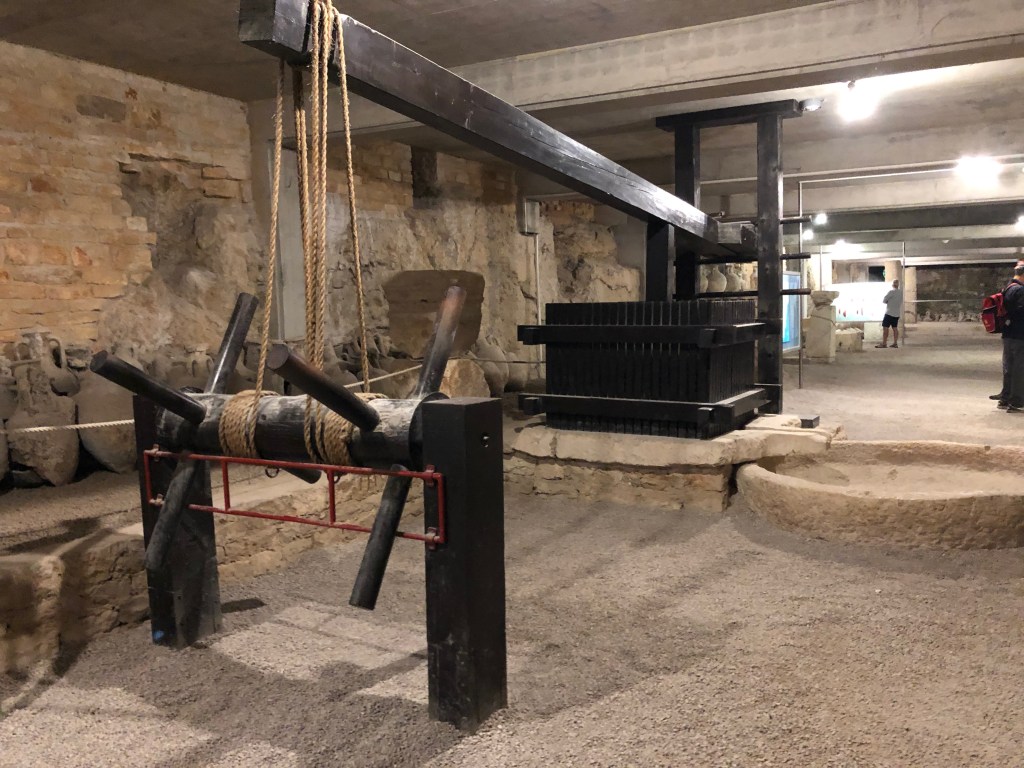
The museum exhibit in the subterranean hall where the animals and gladiators were kept between fights was a massive space. There is also an extensive collection of amphorae, jugs used to transport goods-tall skinny ceramic jugs for carrying oil, wine, and fish. They were stuck in the sand or on a stand to keep them upright.
We walked the mostly deserted streets of Pula to the 16th century Roman-Venetian Cathedral with the bell tower apart from the church.
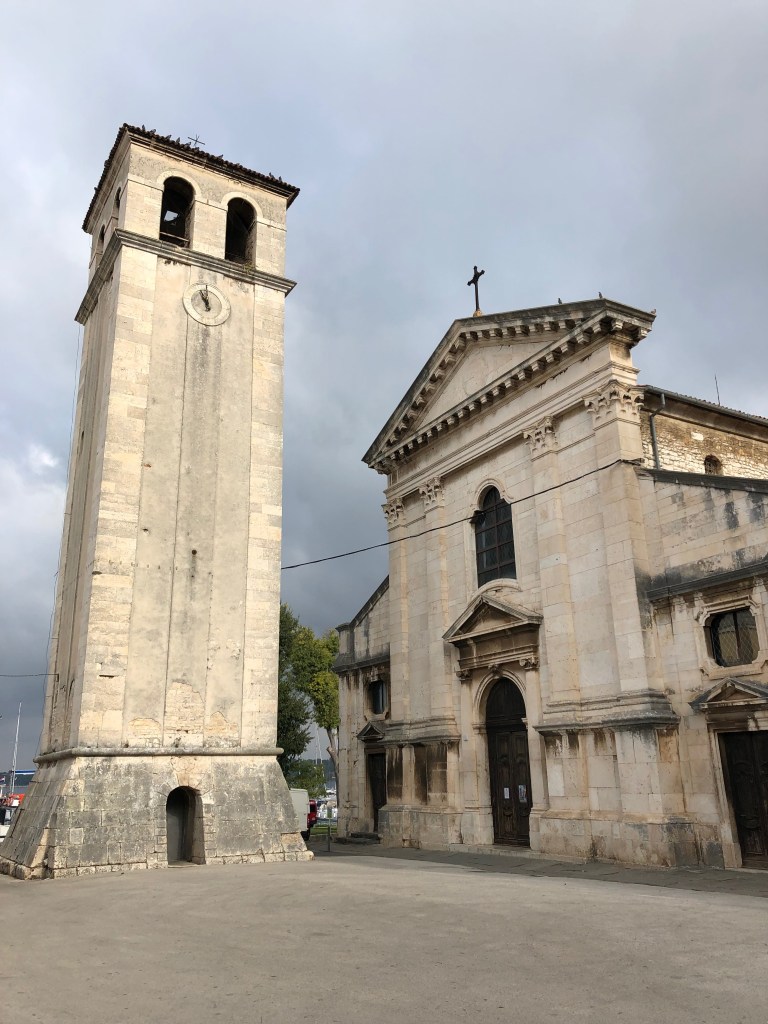
Pula Cathedral 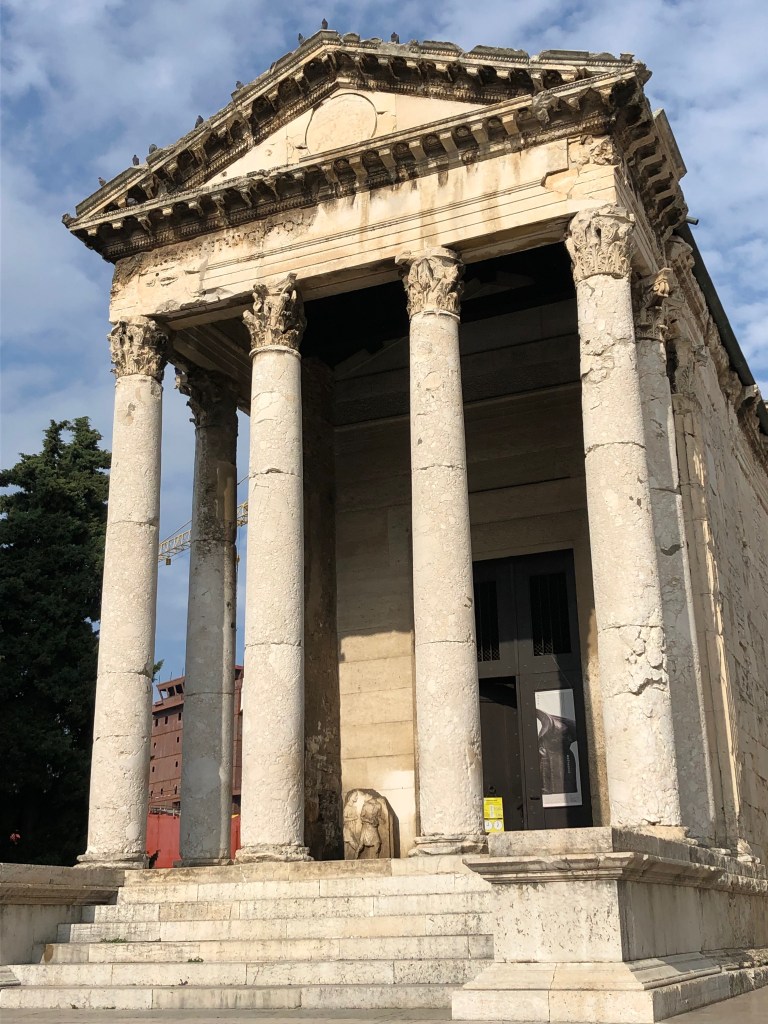
Temple of Augustus
Next we saw the Temple of Augustus (Caesar) in the Forum of Town square which was bombed by the Allies in WWII and rebuilt by them rather poorly. The temple of Augustus is the oldest preserved building in Croatia. It was built during the reign of the first Roman emperor, Augustus, and is one of the most beautiful examples of early imperial Roman temple architecture.
We returned to Rovinj around noon, parked near the entrance to the Old Town, had soup at a waterfront restaurant, walked the streets
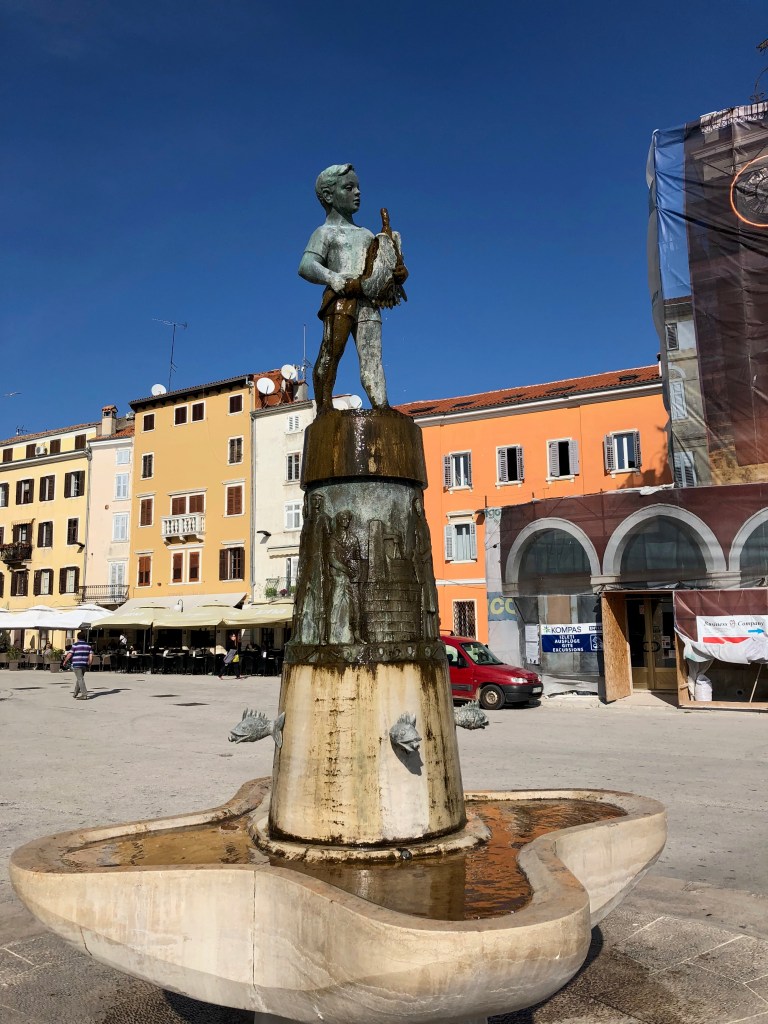
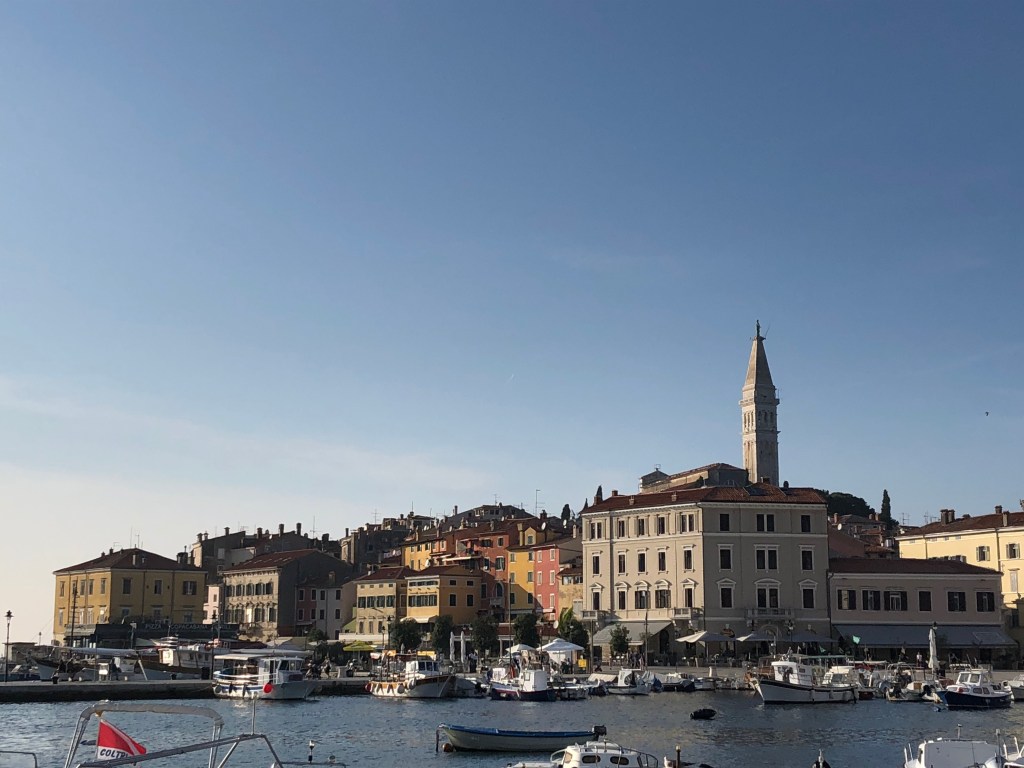
and returned to the rustic hotel:
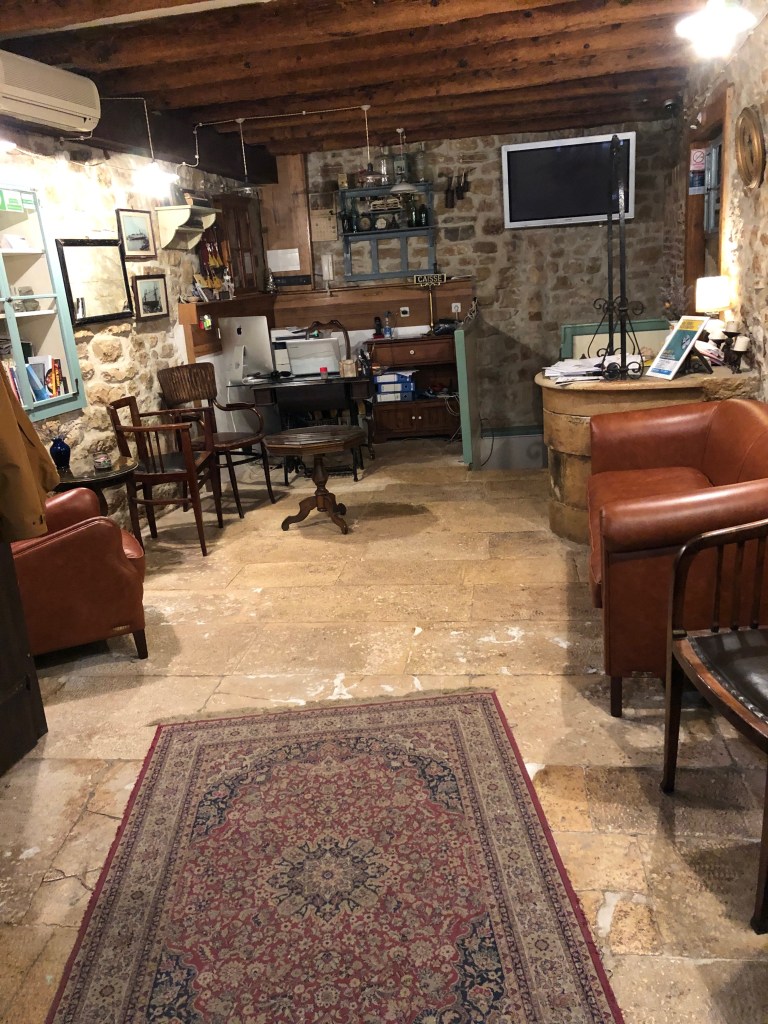
lobby 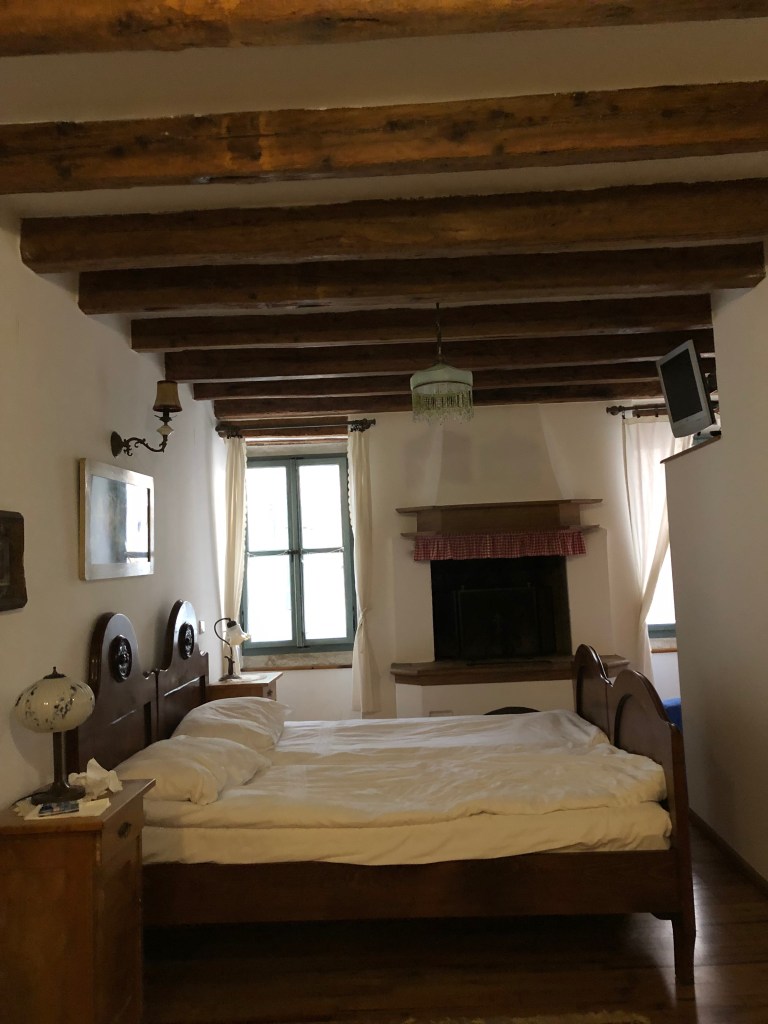
bedroom 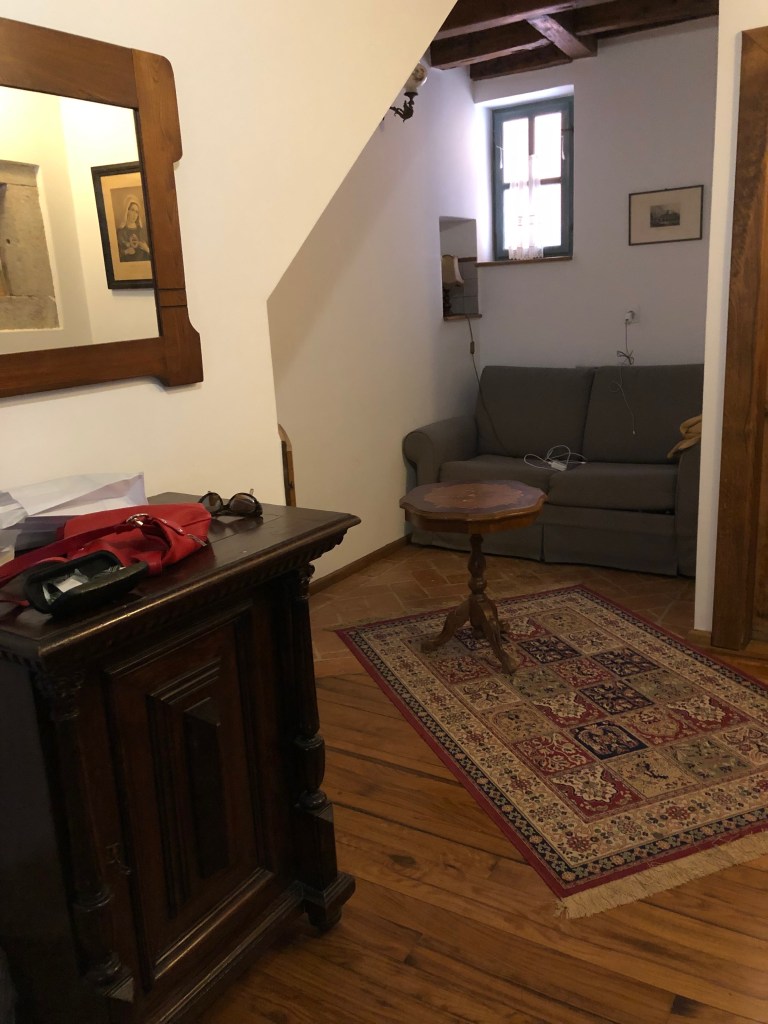
sitting area
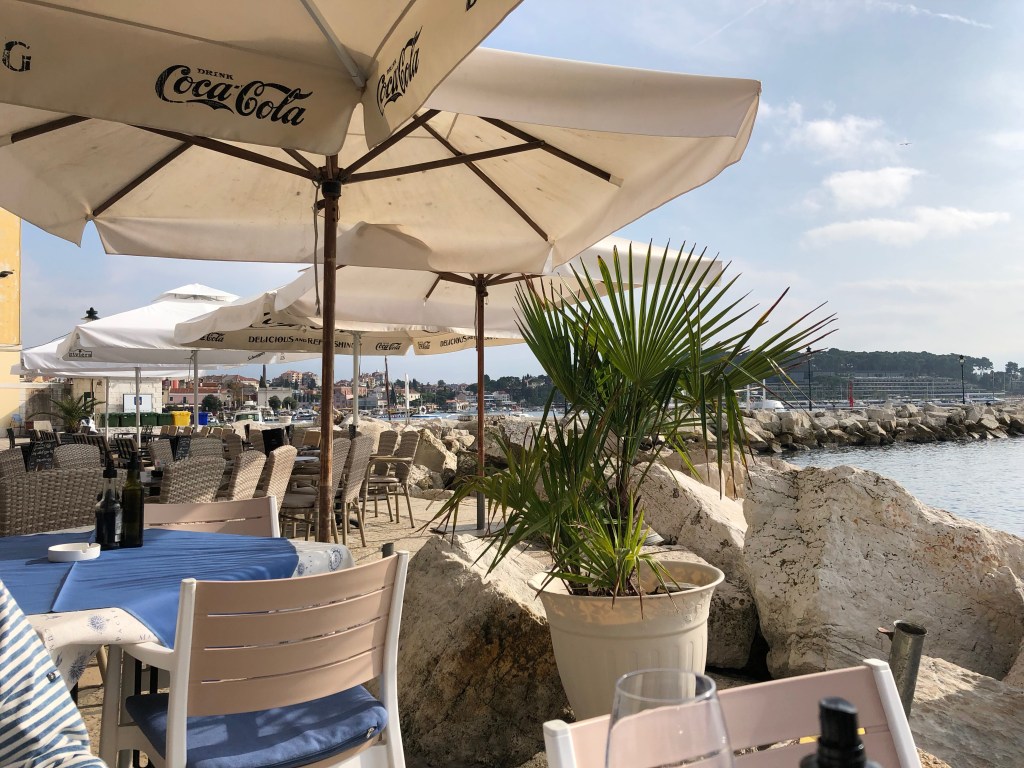
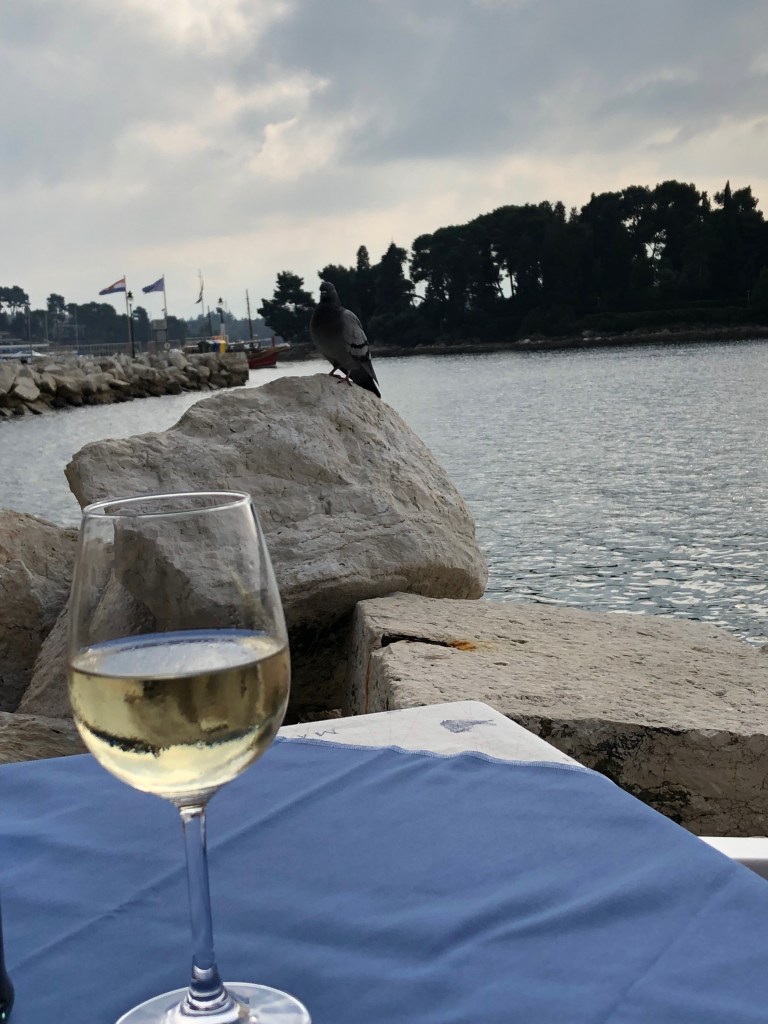
For dinner, we went to Stella Di Mare on the right side of the waterfront and despite recommendations to stay away from the restaurants on the waterfront, we had our second great meal, Seafood Risotto. The sweeping generalisations that waterfront restaurants are overpriced and not good, appears not to be true.
October 25 Rovinj to Zagreb
Another great breakfast in the little restaurant, bill paid, car returned and we were on our way to Zagreb. The driving was without issues except for the challenges of driving in a new large city (790,000) but we arrived at the parking garage by following the signs and then Irena’s email directions. We walked a short distance through a long tunnel and two houses to the left was the Zagreb 17 Sobe, in a courtyard behind large grey doors. Irena met us and gave us lots of directions and suggestions for our two days.
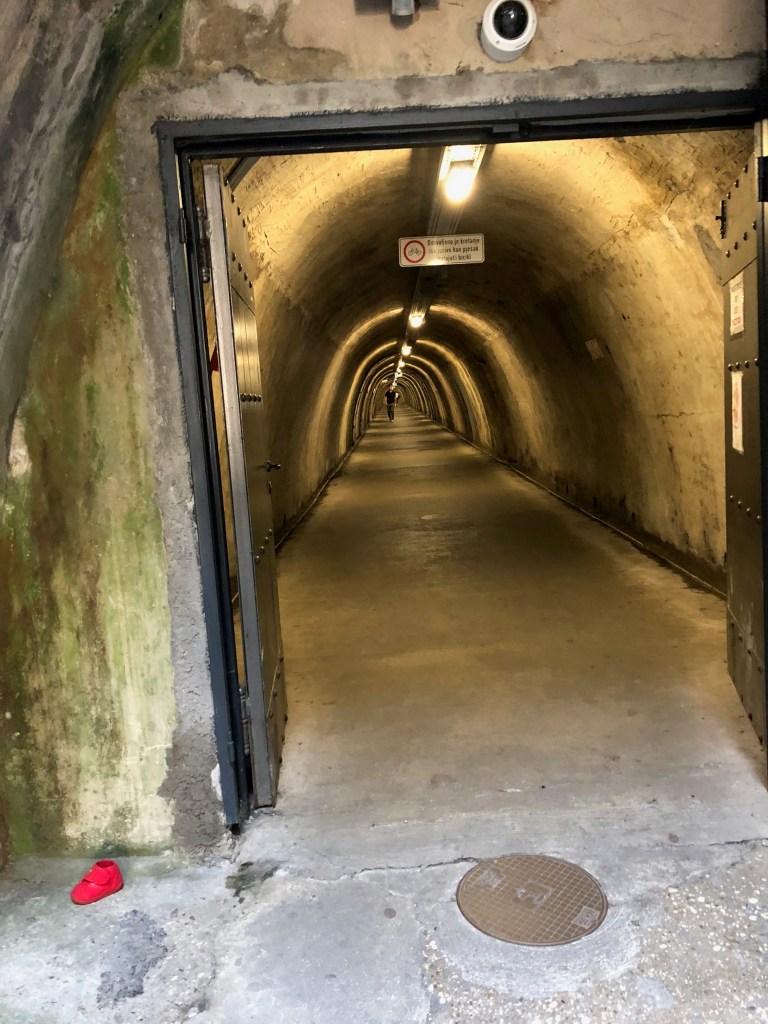
Brac tunnel 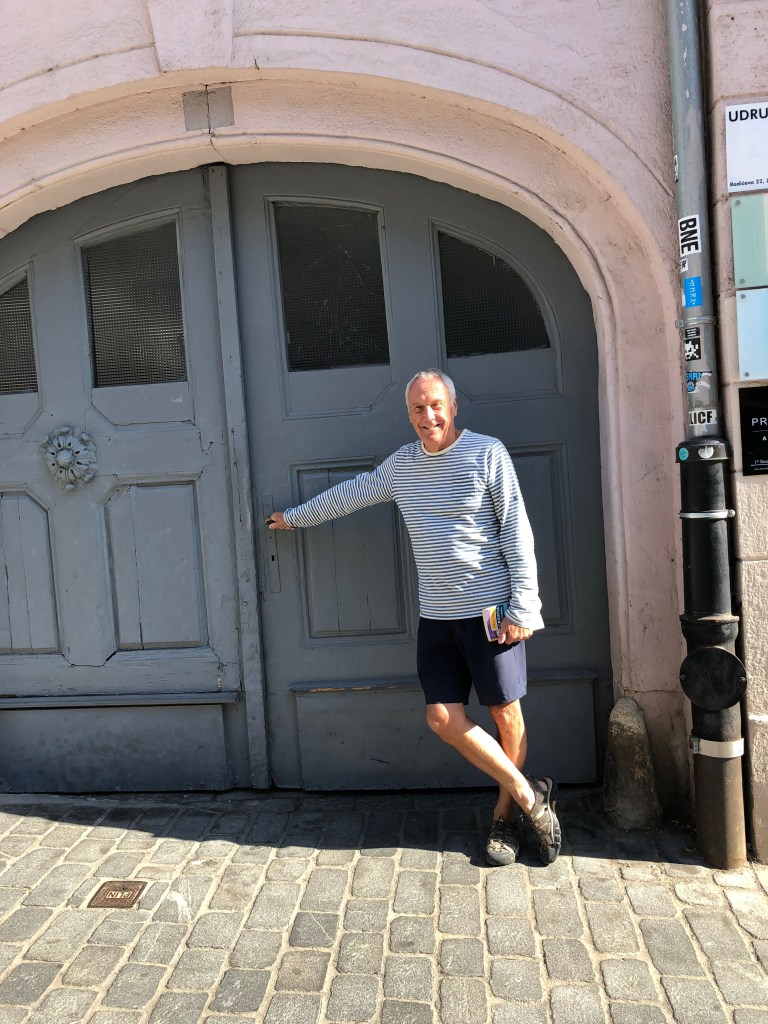
Doors to courtyard of sobe
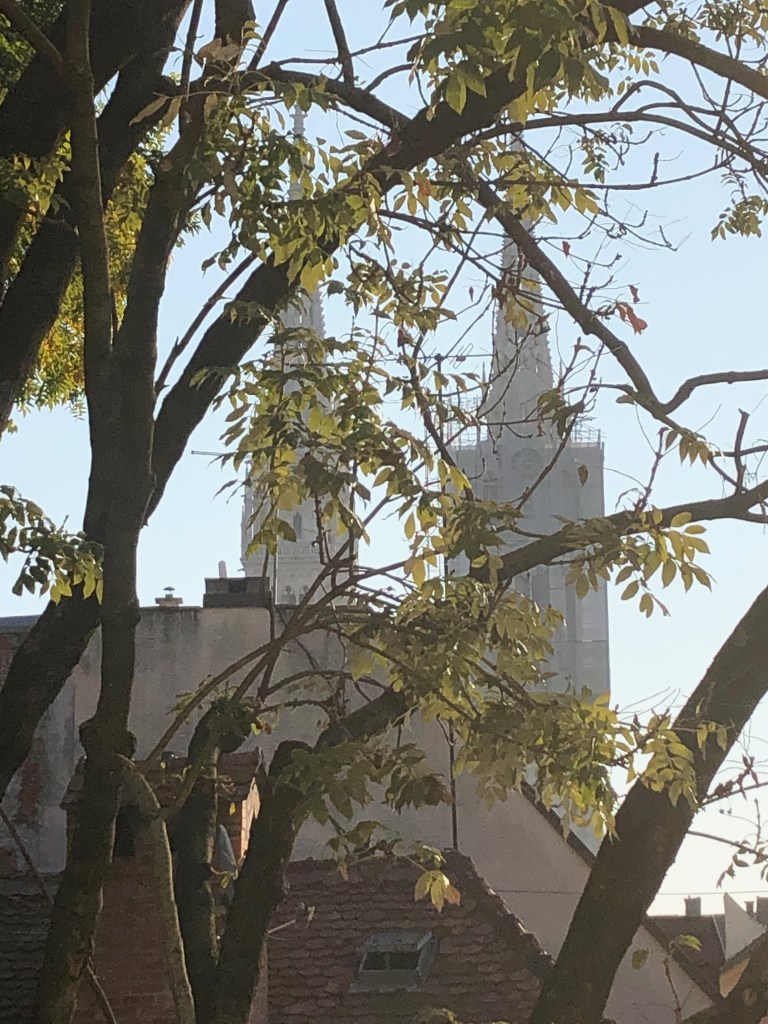
View of cathedral from our room 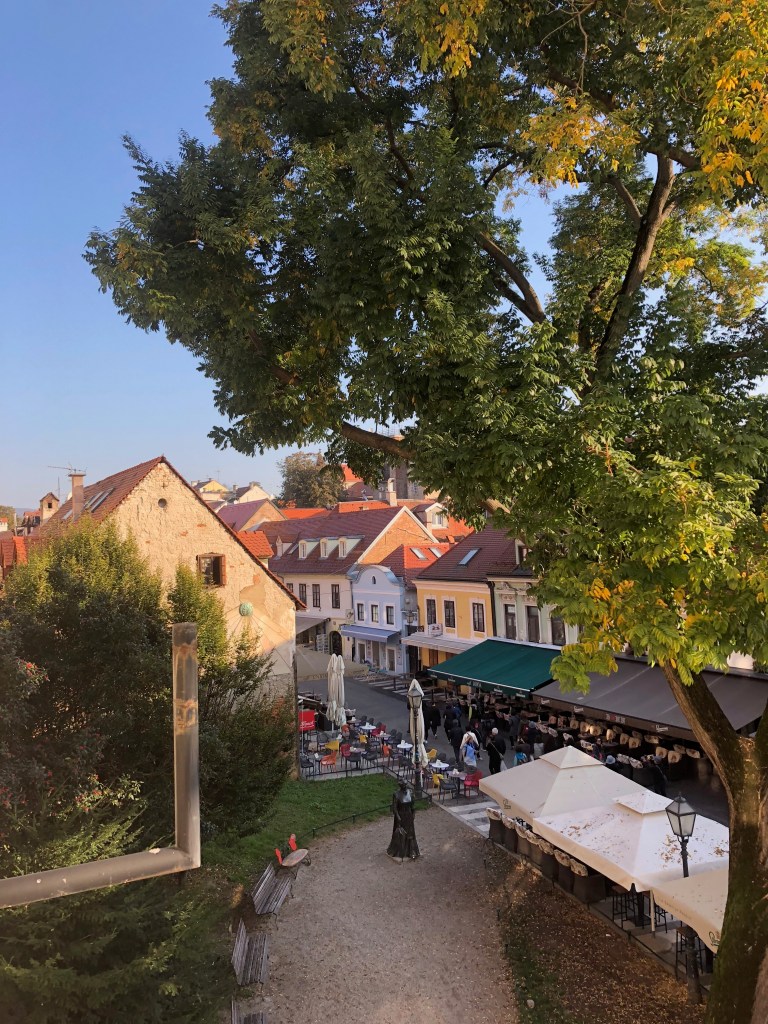
View of main restaurant/bar street
We went from one extreme to another in our accommodation: from very old, antique and dark to modern and light, although in an old building.
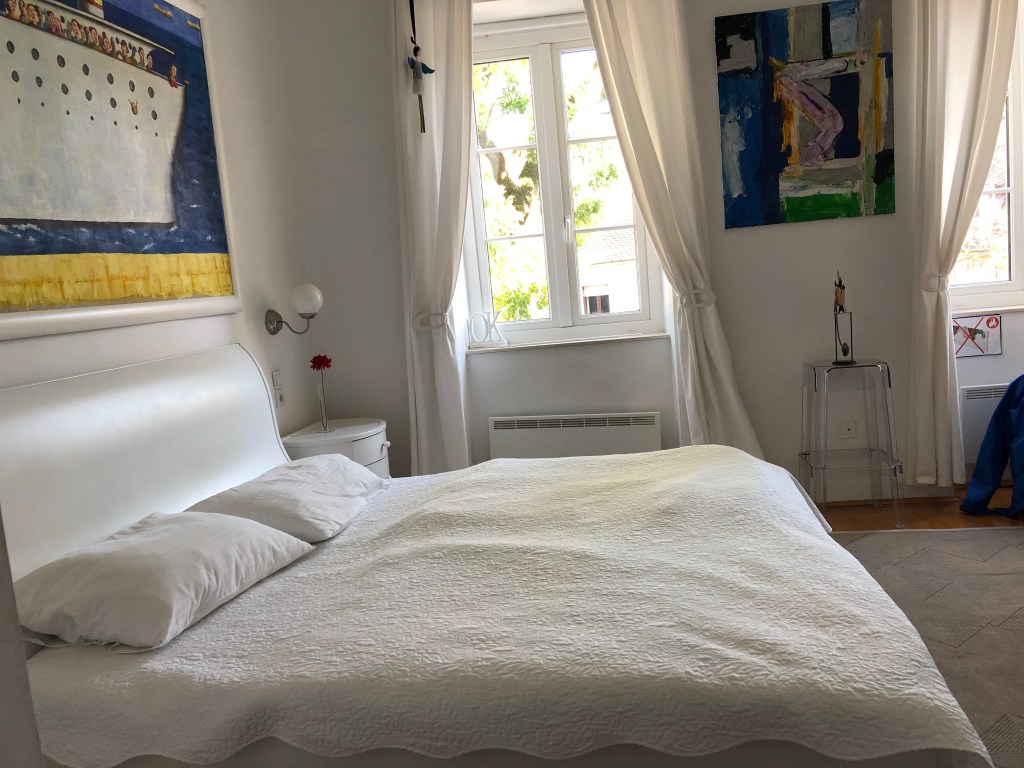
Zagreb 17 Room 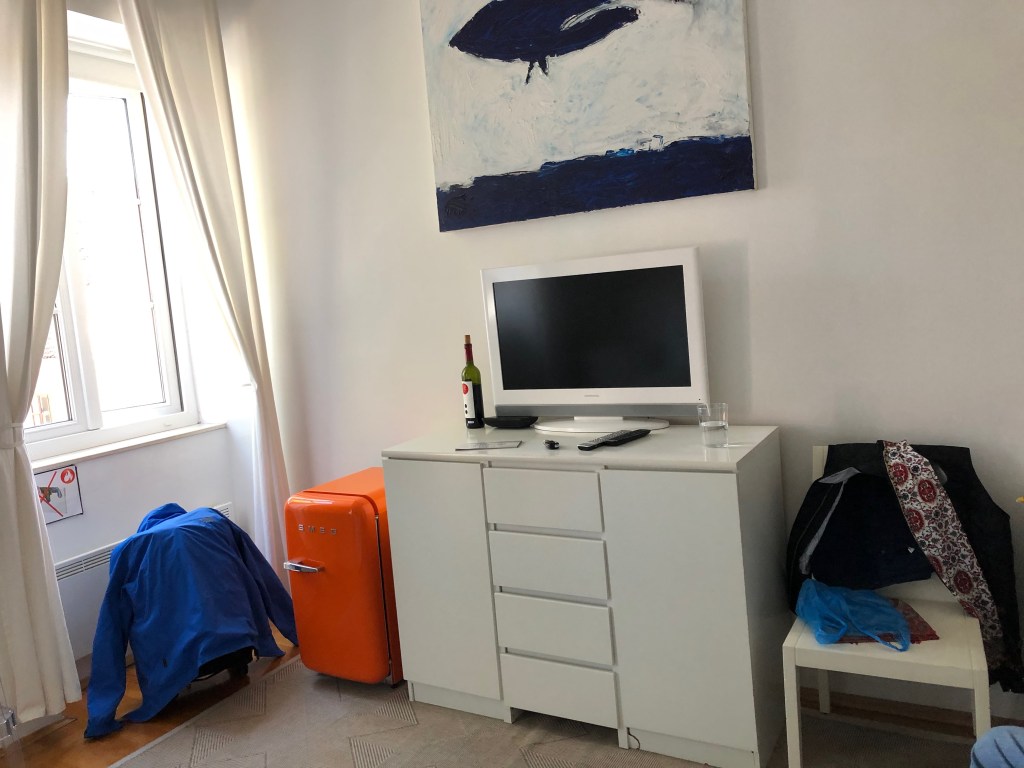
We walked back through the tunnel to Stari Fijaker Restaurant where they have everything but we were looking for cabbage rolls and they were excellent!
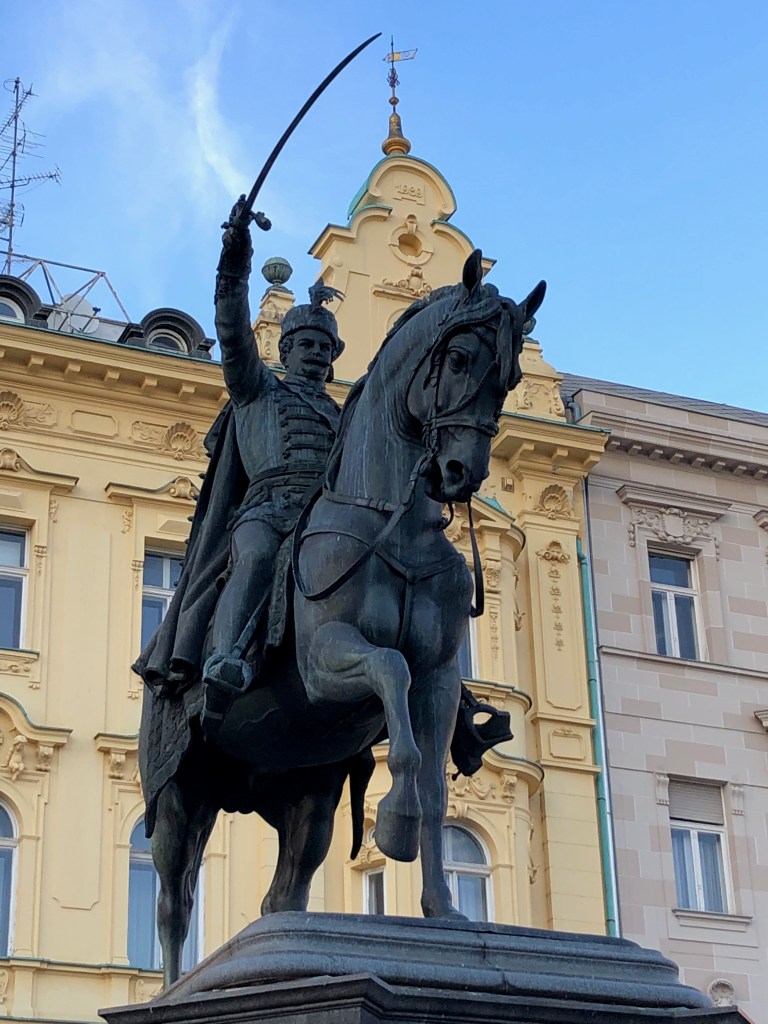
We joined Spirit Tours at 5:00 pm which are free but there is an expectation to pay something. Katarina, our guide, was very informative and had good stories. We started with the main square named for Josip Jelacic (YOH seep YEH-lah-cheech), a 19th Century governor who extended citizens’ rights from feudal times and united the Croats in the Hapsberg Empire in opposition to Hungarian control. This Jelacic square is the centre of all events in Zagreb.
We were led up the hill to Gradec, the one side of the combined city run by the aristocrats, where the houses of parliament and St Mark’s Square are located.
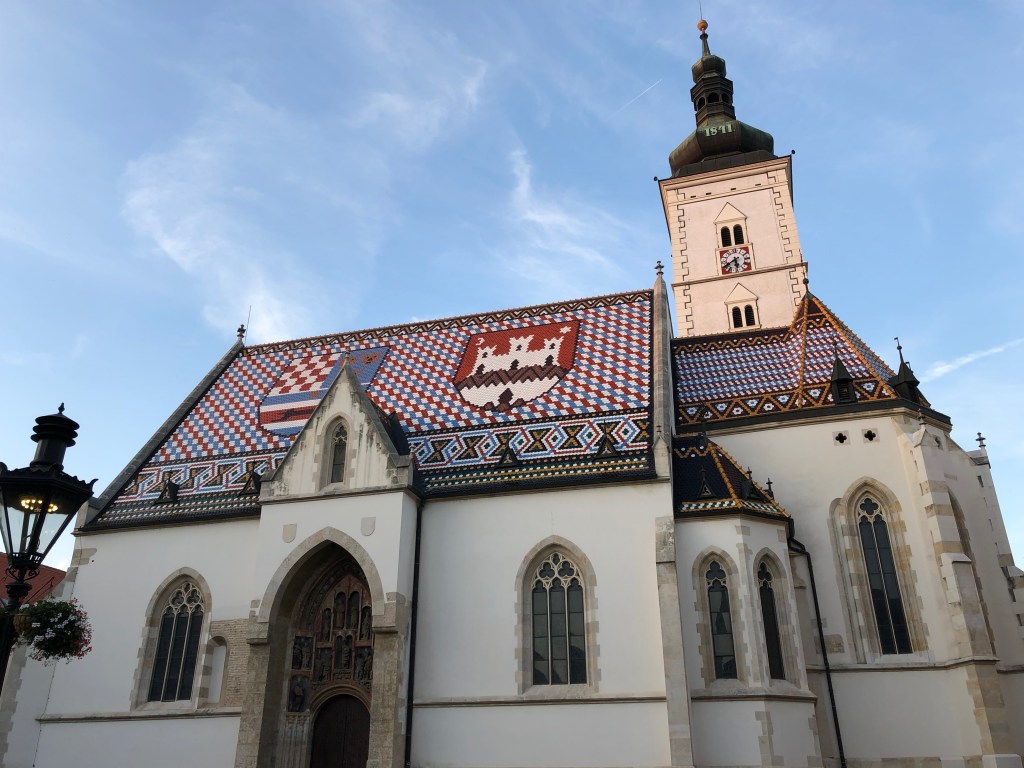
The original St Mark’s was from the 13th century but the colourful tile roof from 1880 depicts two coats of arms: the red-and-white checkerboard symbolizes north-central Croatia; on the right is the seal of Zagreb. A form of it is in the city flag. In this area are gas lamps that are still lighted and snuffed out morning and evening- our guide said that you can tell the lamplighters by their gloomy expressions.
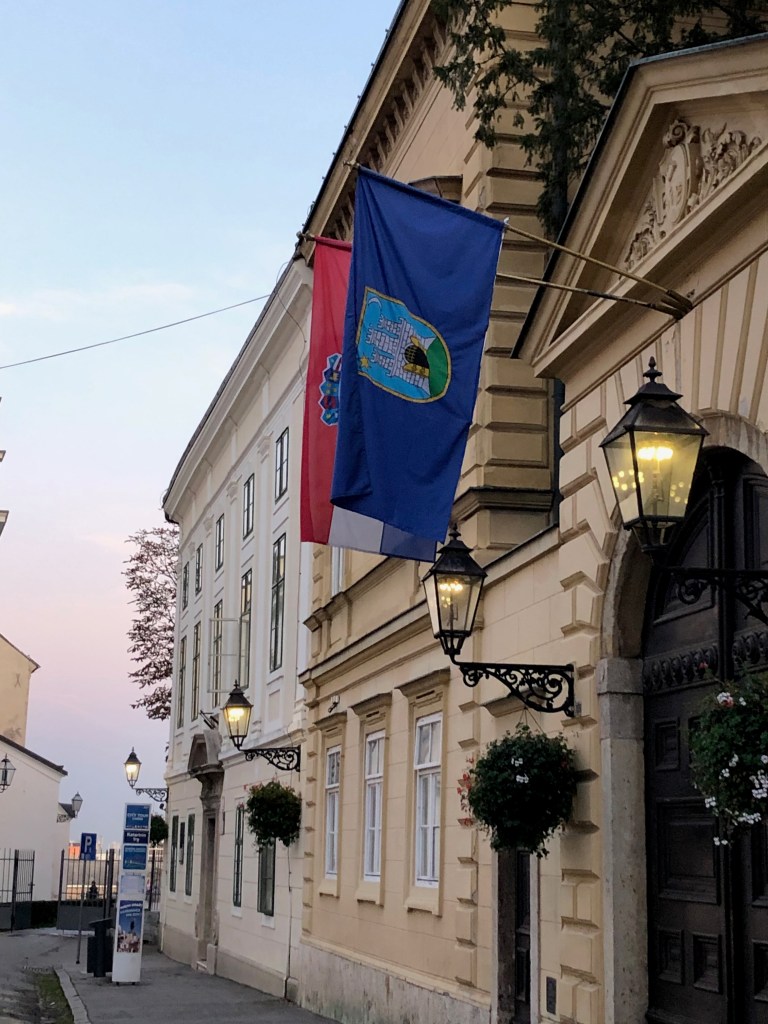
Zagreb Flag 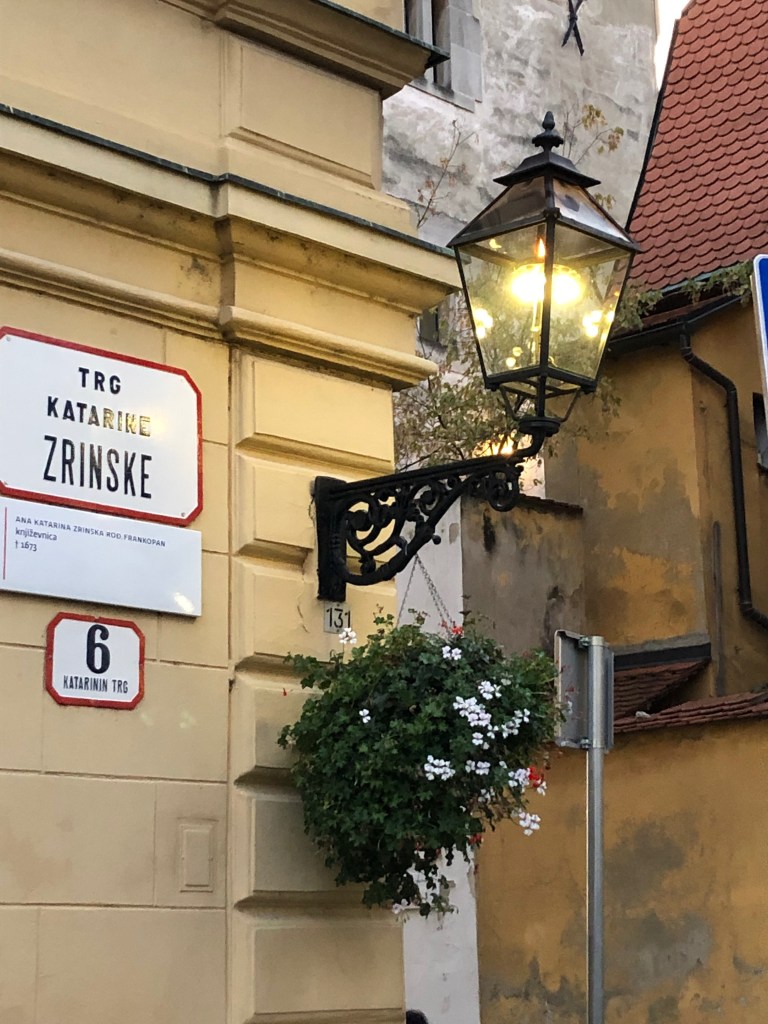
Actual Gas Lights
On our guided walk, we were able to see into the other side of town which was Kaptol, the city run by the religious leaders and therefore, full of various churches. Here we can view the Cathedral from the other hill.
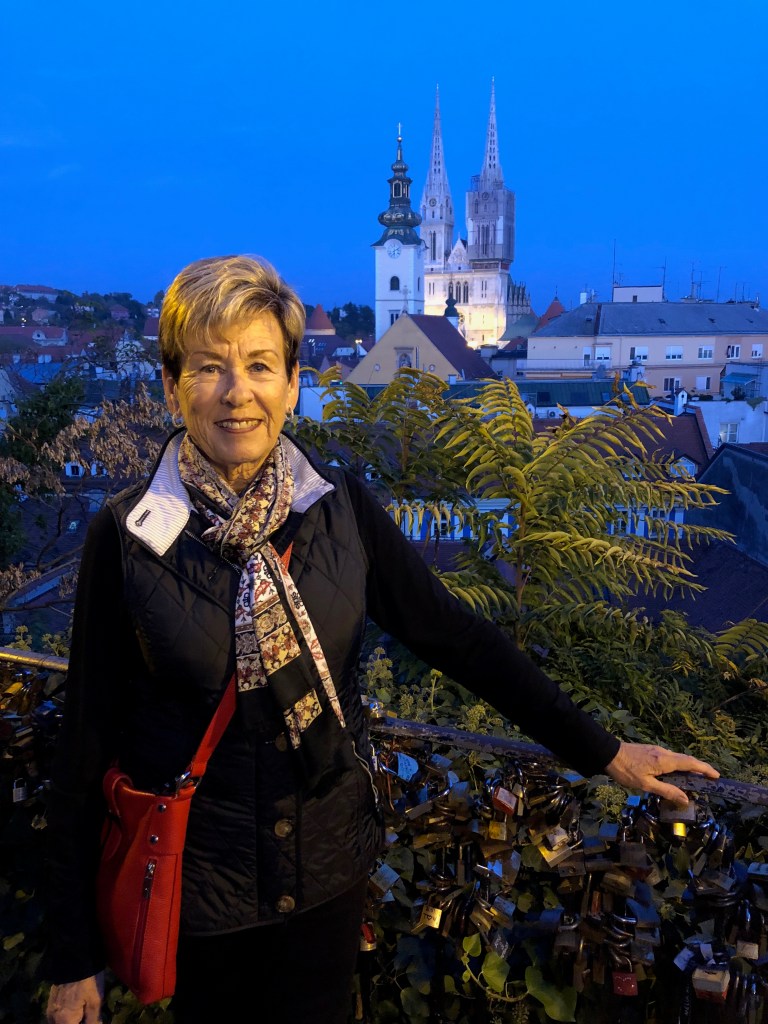
The Cathedral 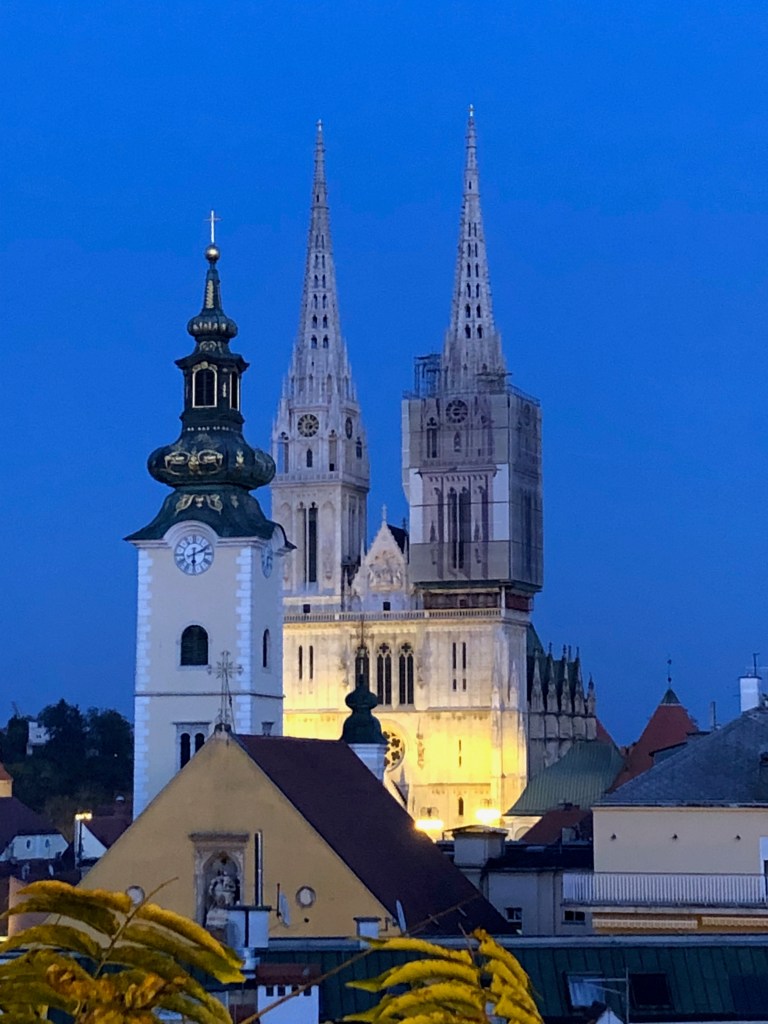
Three church spires in Kaptol
The group then moved down the hill, across the Bloody Bridge where the two cities used to fight and across the street that now covers what was a river and up the hill to the Cathedral. This is the most important cathedral in a very Catholic country and this is the night view of it. Katarina told us that it had been under reconstruction for her whole 30 years. The reason is that it was built of limestone that has gradually disintegrate so it is literally being rebuilt with harder stone.
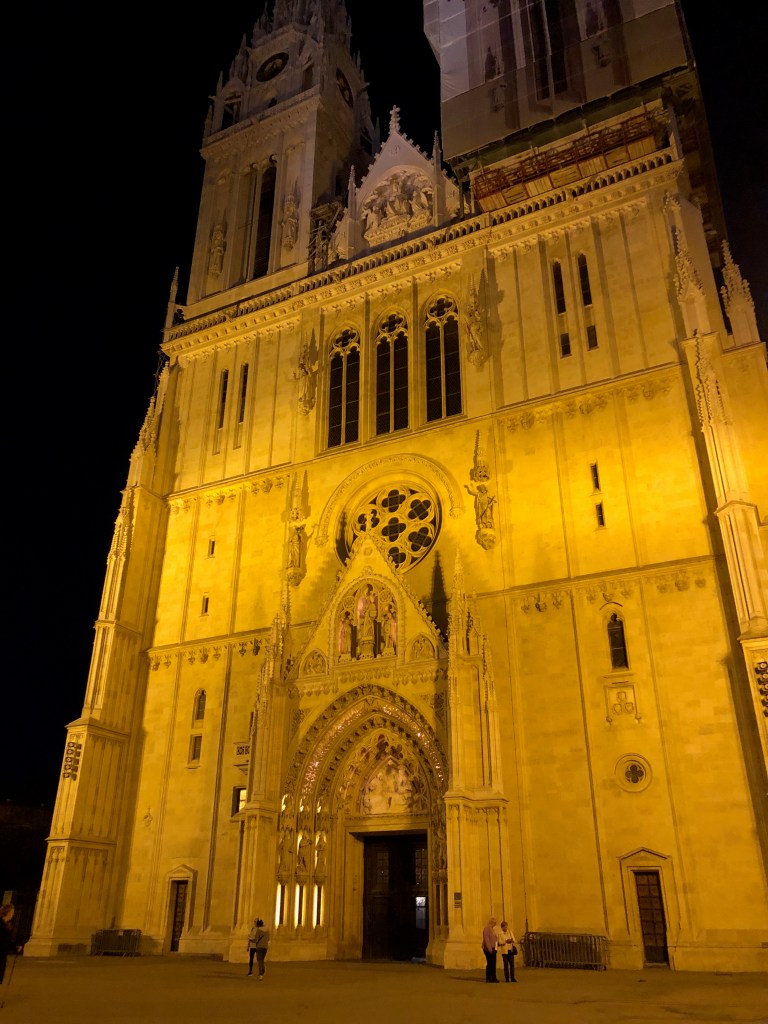
Cathedral at night 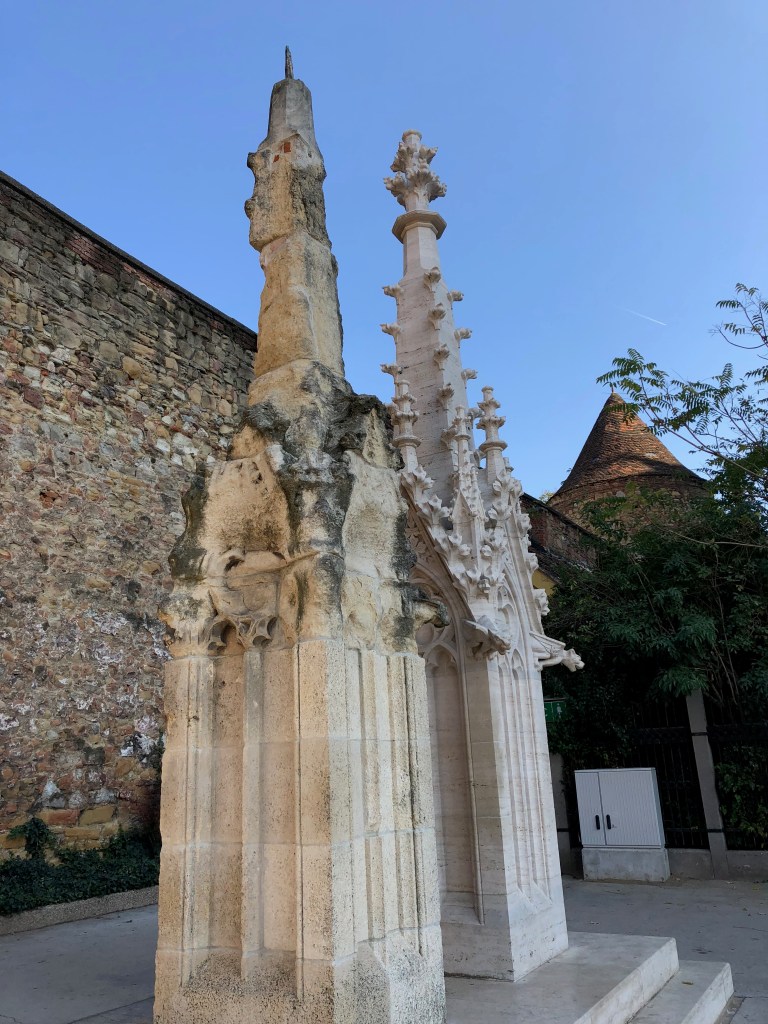
Two towers of different stone showing deterioration over time
October 26 Zagreb
We headed out with Rick Steve’s walking guide to cover some of the same territory but with the intent of going into the museums. We started again in Jelacic Square in Gradec. We started with the market which Bill loves. The fresh vegetables looked really good.
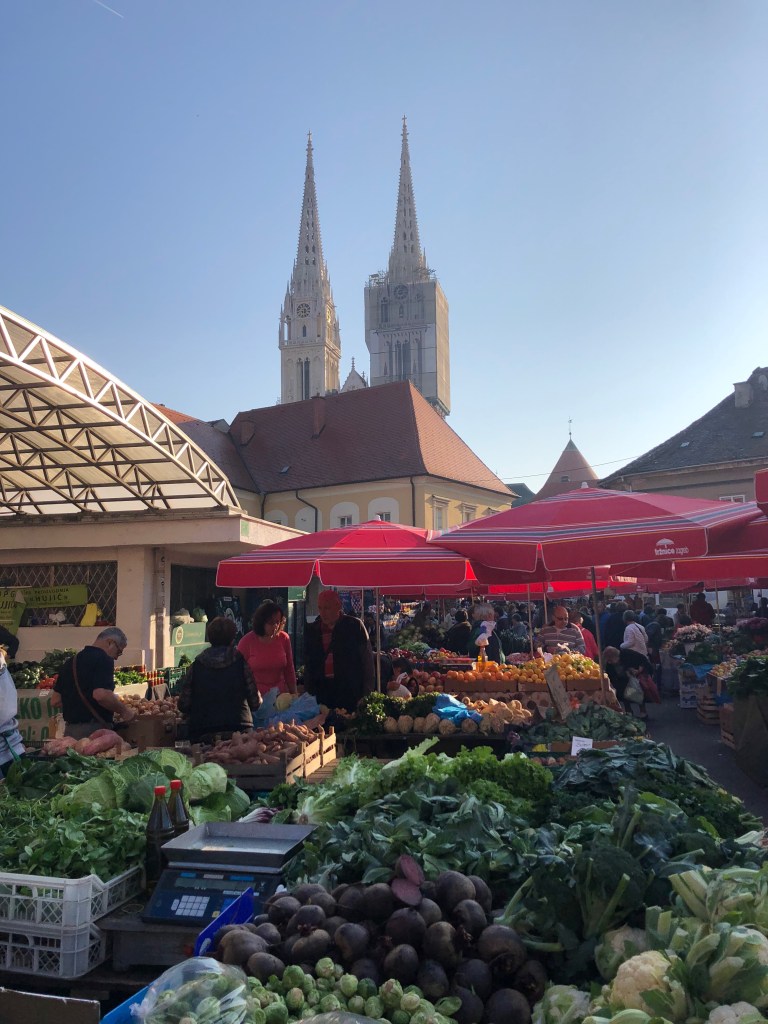
Vegetables at the market under the red umbrellas 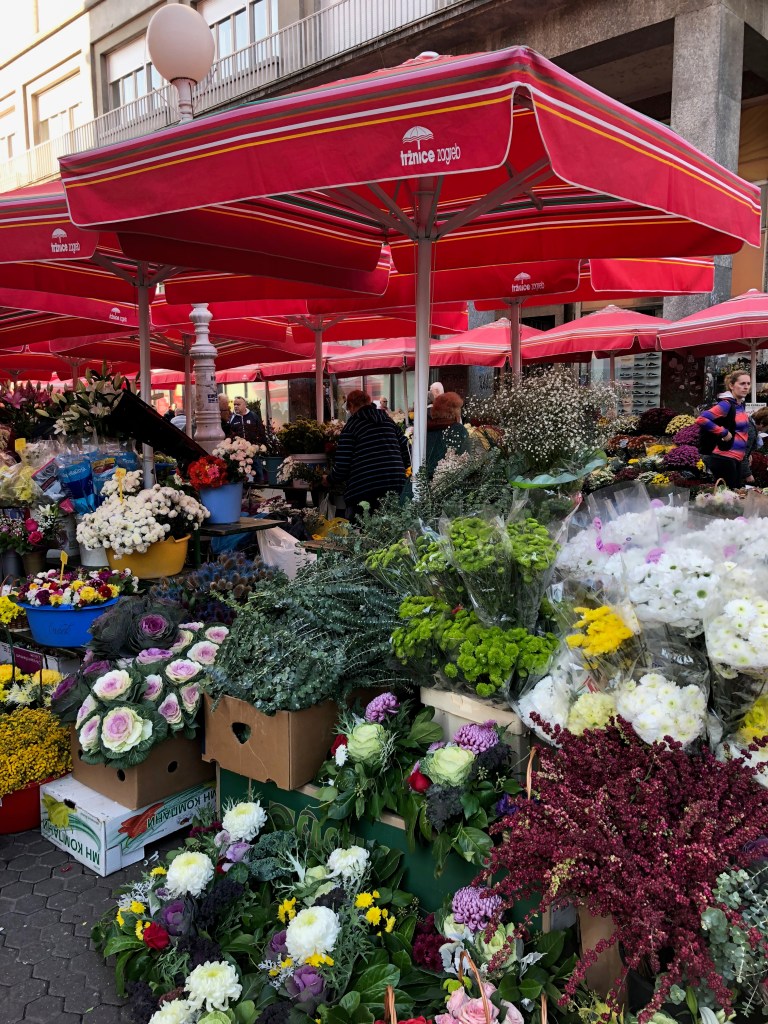
The flowers
After a block of walking past some of the big name stores to the small funicular that takes 55 seconds to get up the hill. Locals claim it as the smallest funicular in the world but that may be debatable. From the top there is a good panorama of Zagreb and we headed back toward St Mark’s Square and visited the Museum of Broken Relationships. The museum was opened in 2010 by a couple who had just broken up and it was so successful collecting true stories of failed relationships around the world with artifacts that they share that they have opened museums in other cities. Some were angry, some relieved and some very sad: a woman’s full wedding dress told the story of a soldier going to Afghanistan and not returning.
Then we enjoyed the Croatian Museum of Naive Art which celebrates the expressionistic art by untrained peasant artists. It’s an interesting observation to see the similarity between the painting in our room and one of the paintings in the museum.
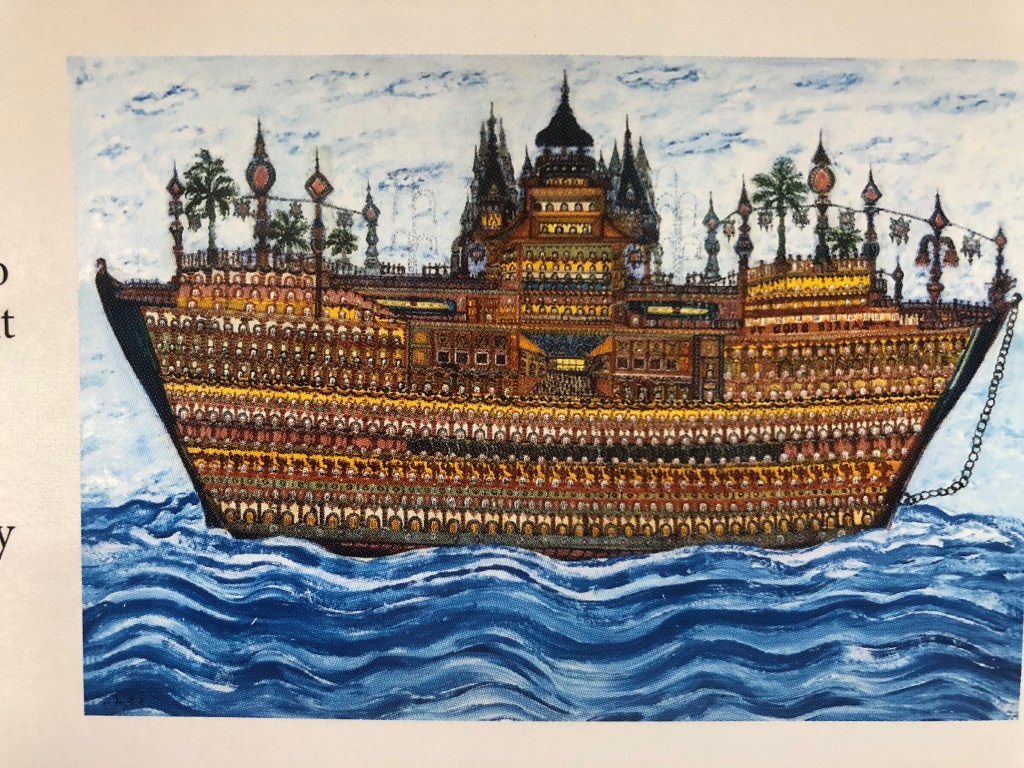
Drago Jurak: Luxury Ship, 1974 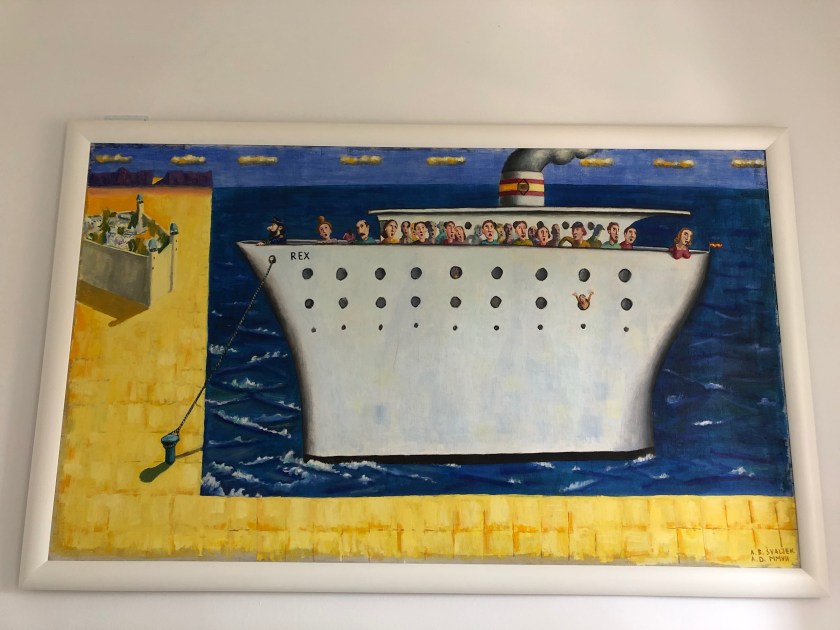
A.B. Svaljek, 2017
We went back to tour the cathedral. The chandeliers were discarded in a renovation of a Las Vegas casino and a worker there convinced the owners to donate them to the cathedral. There was some consternation among the religious leaders but they are beautiful.
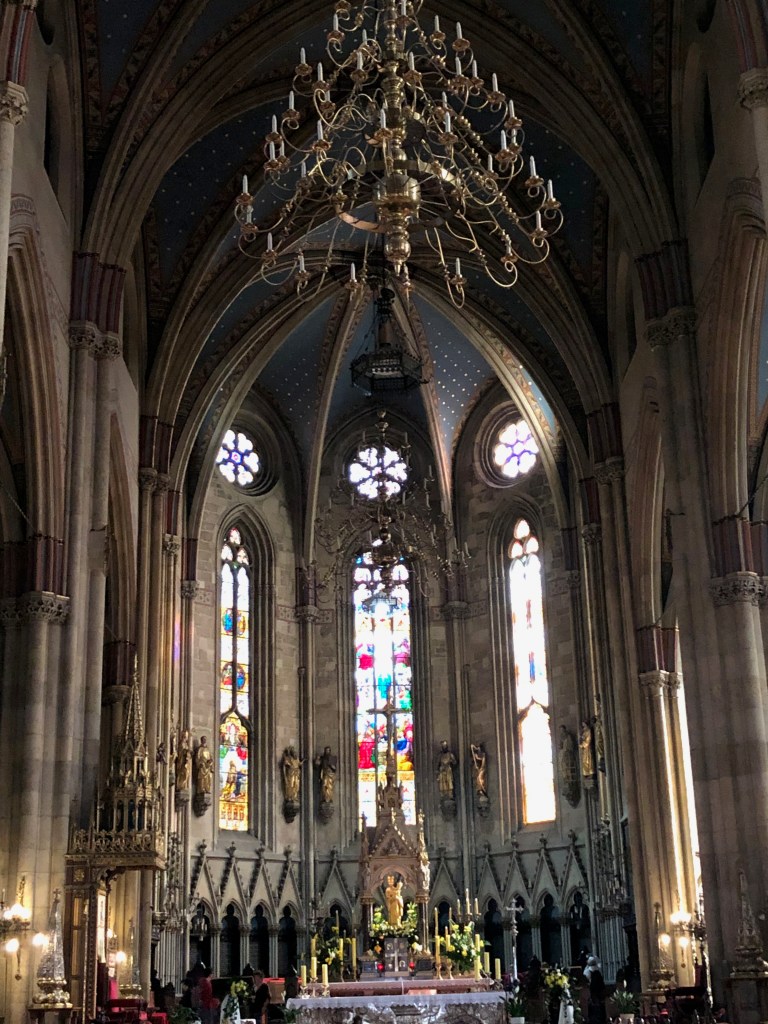
The Cathedral
We had our lunch at Trilogija and the broccoli soup and risotto were excellent. There is only a blackboard menu based on what is fresh that day. It is located right next to the Stone Bridge with the painting of Mary that survived the fire and is surrounded by a wire cage so you can’t see it but many people come here to ask her help.
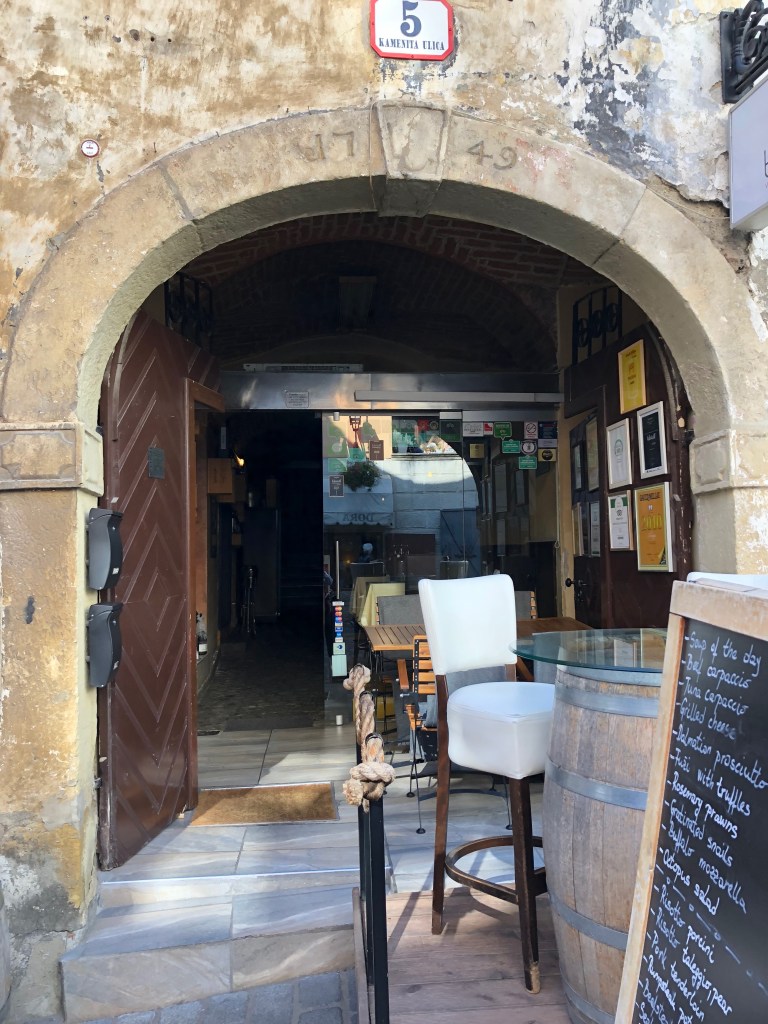
We walked back to “the Square” and around the park “horseshoe” and then headed back to the bar street and had a drink and watched the people.
I purchased some local fig jam and chocolate. The Trilogia was so good that we went back for dinner- we shared an appetizer of shrimp with rosemary and main course of pork tenderloins – we have learned to share the meals because the portions are too large.
October 27 Zagreb to Mostar, Bosnia-Herzegovina
We had to wait in the morning until 9:00 for the tunnel to open and then proceeded to Mostar. Leaving the city was confusing but we got there and with 2 stops at the border arrived in Mostar around 4:30 pm. The gps went flat so we were guessing at where we were and just lucked on seeing the sign for the hotel on the right street. The hotel Shangri La Maison was up a hill next to a ruined building. It is a beautifully restored Austro-Hungarian building.
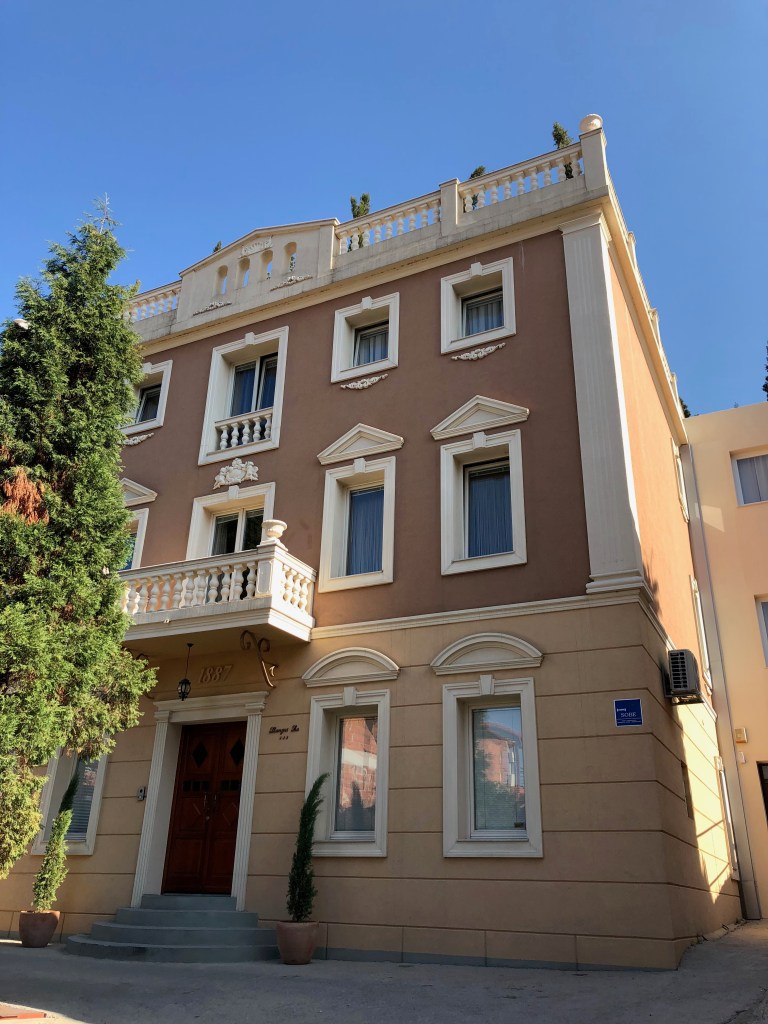
Shangri La Maison Hotel 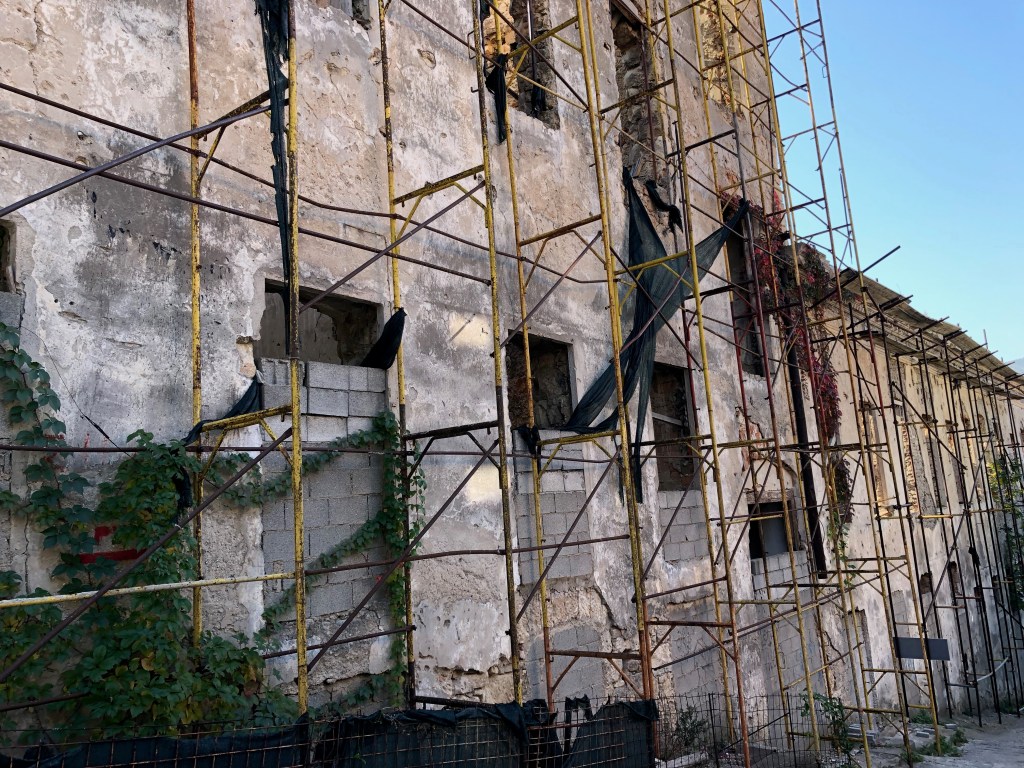
Bombed Building
Nermin (Norman) met us, upgraded our room and gave us the name of a restaurant across the bridge for dinner, Hindin Han. The restaurant on a woody terrace over a rushing stream was great. We shared veal medallions and local wine and both were very good.
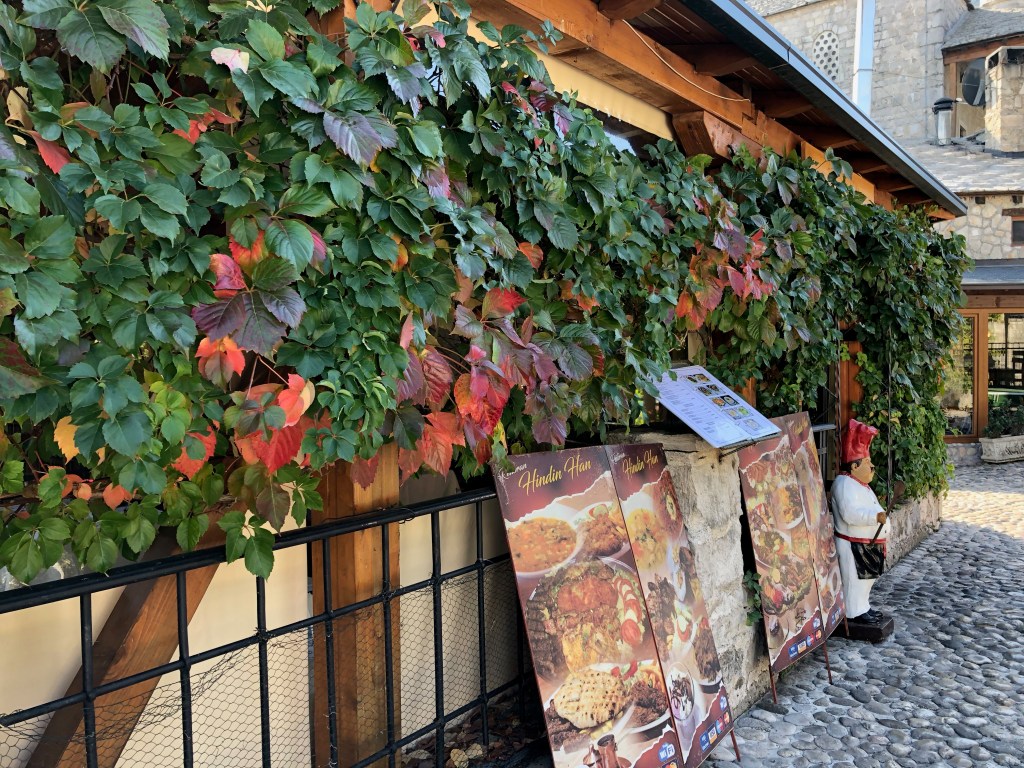
Restoran Hindin Han exterior 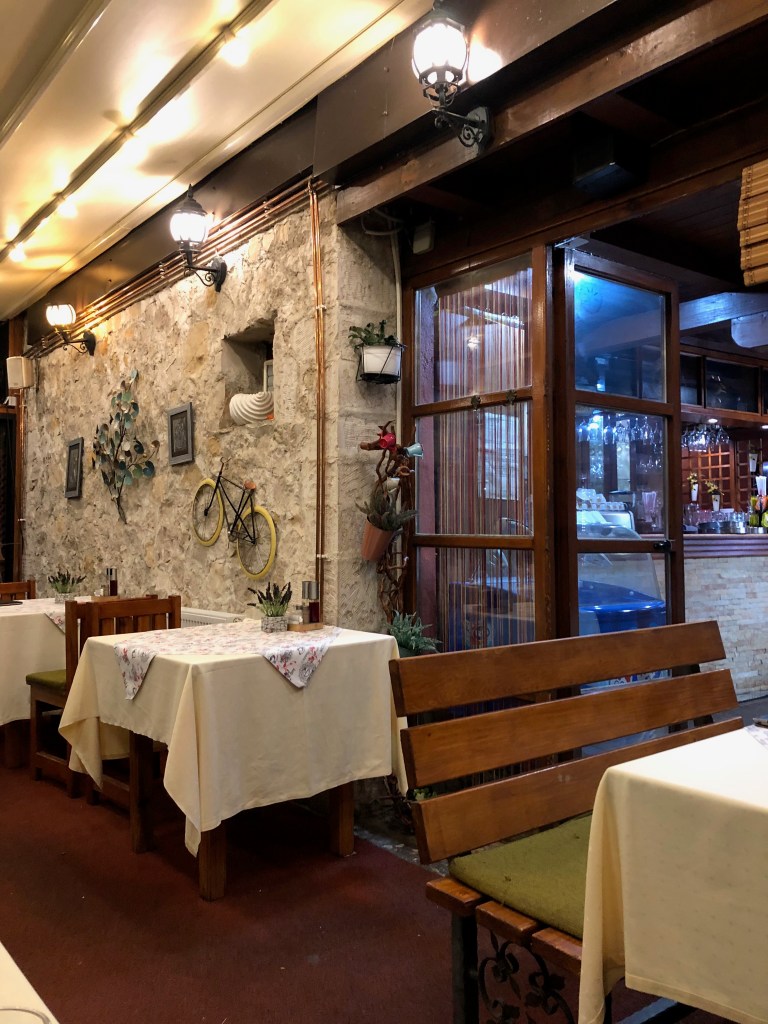
Interior
It was a long, hard day but we are close to our final destination, Dubrovnik and looking forward to a full day in Mostar.
October 28 Mostar, Bosnia-Herzegovina
This hotel at the top of the hill in the midst of bombed out buildings has been beautifully renovated by this family, starting with 3 rooms and adding another 9. The room, the lounge and the breakfast room are light and beautiful and the work on the rooftop garden is going to be impressive.
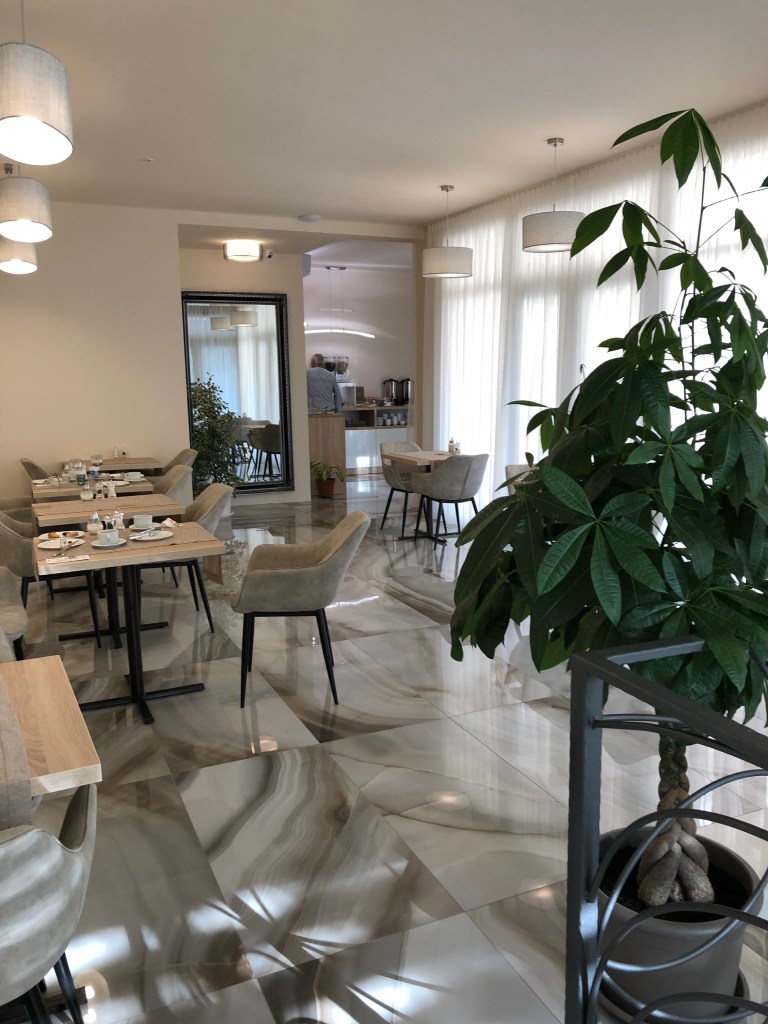
breakfast room 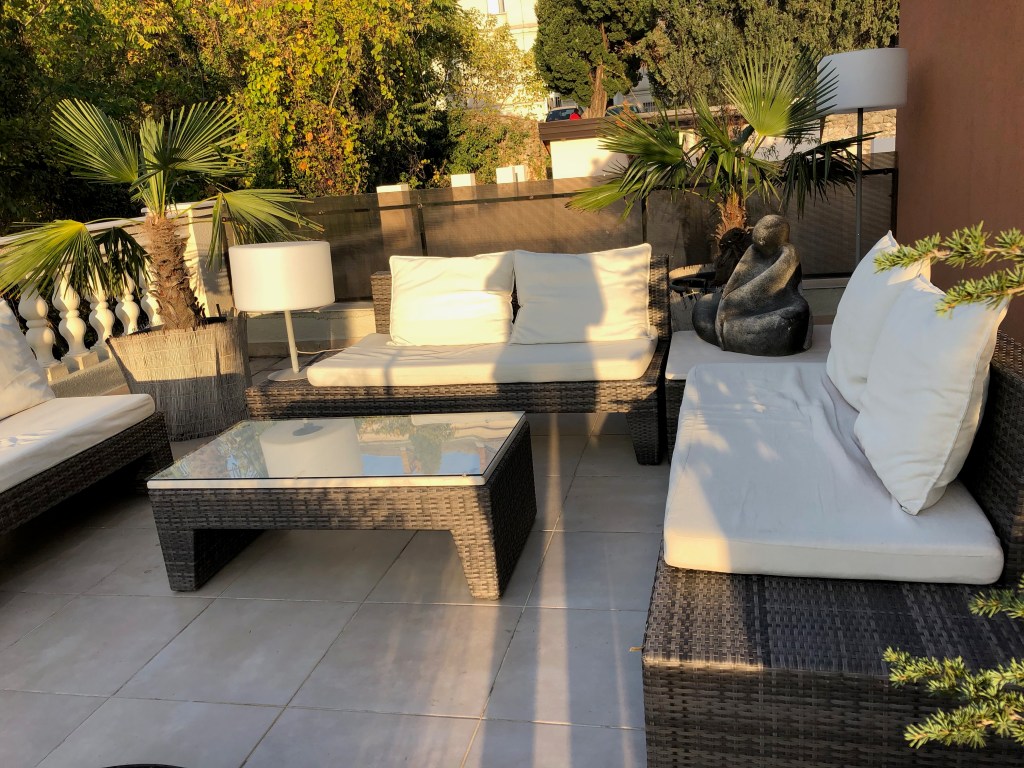
rooftop terrace
After a good breakfast in the newly-renovated breakfast room, we walked through the old town starting with the Franciscan Church of Sts. Peter and Paul, just built in 1997 after the fighting. Although there are 12 minarets in Mostar (we could see 9 from the rooftop), the Franciscan Church has the tallest tower.
The most iconic sight here is the Old Bridge over the Neretva River. Built originally by the Ottoman Sultan between 1557 and 1566 in a keystone design. Beginning in May 1993 with the city engulfed in war, the Old Bridge was blown up by Croats shelling the bridge and on November 9 it fell into pieces in the river.
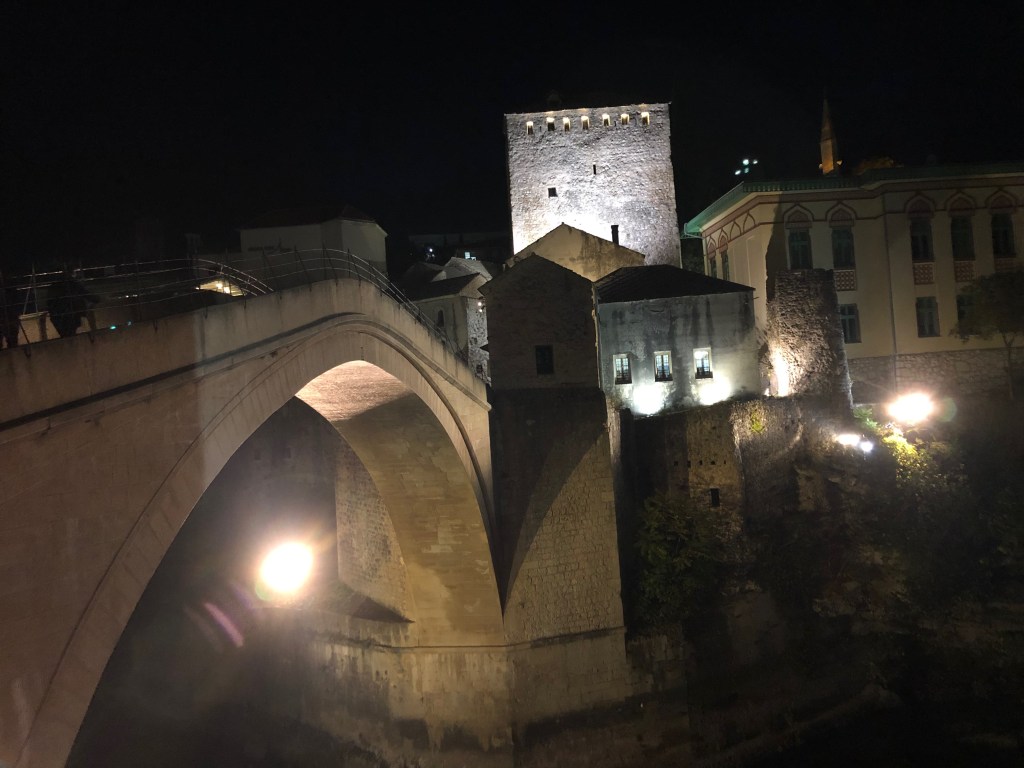
Old Bridge at Night 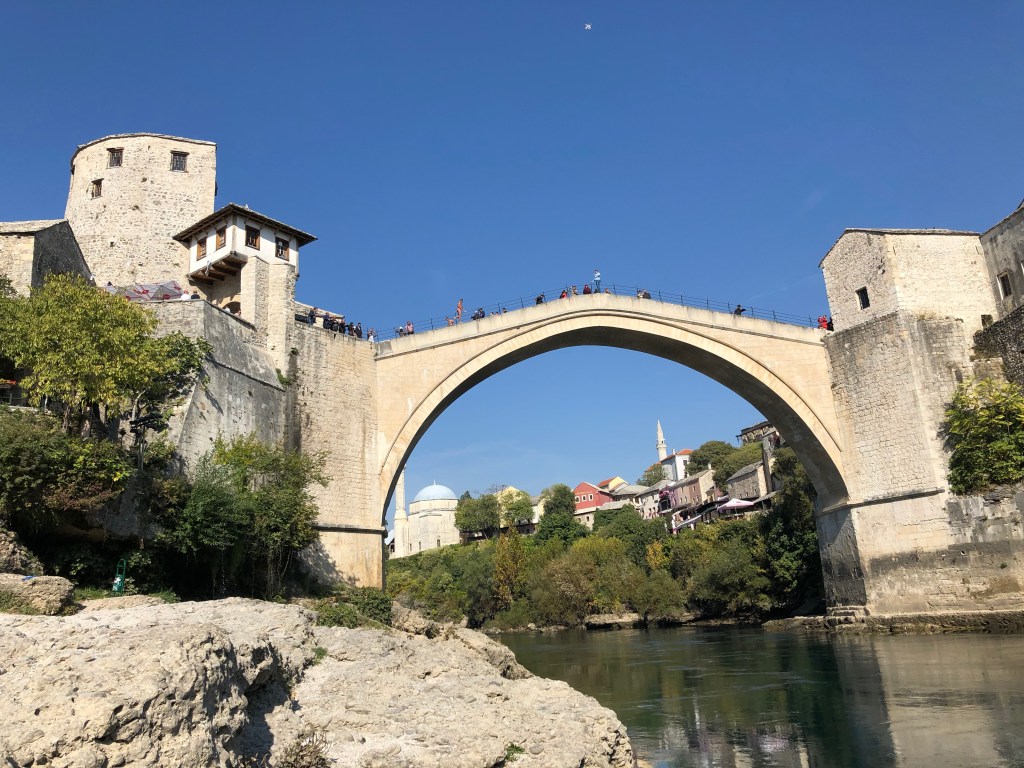
Old Bridge in Day
Inside the Halebija Tower at the end of the bridge, up the stairs, the War Photo Exhibitions is a display of 50 wartime images by photo journalist Wade Goddard.
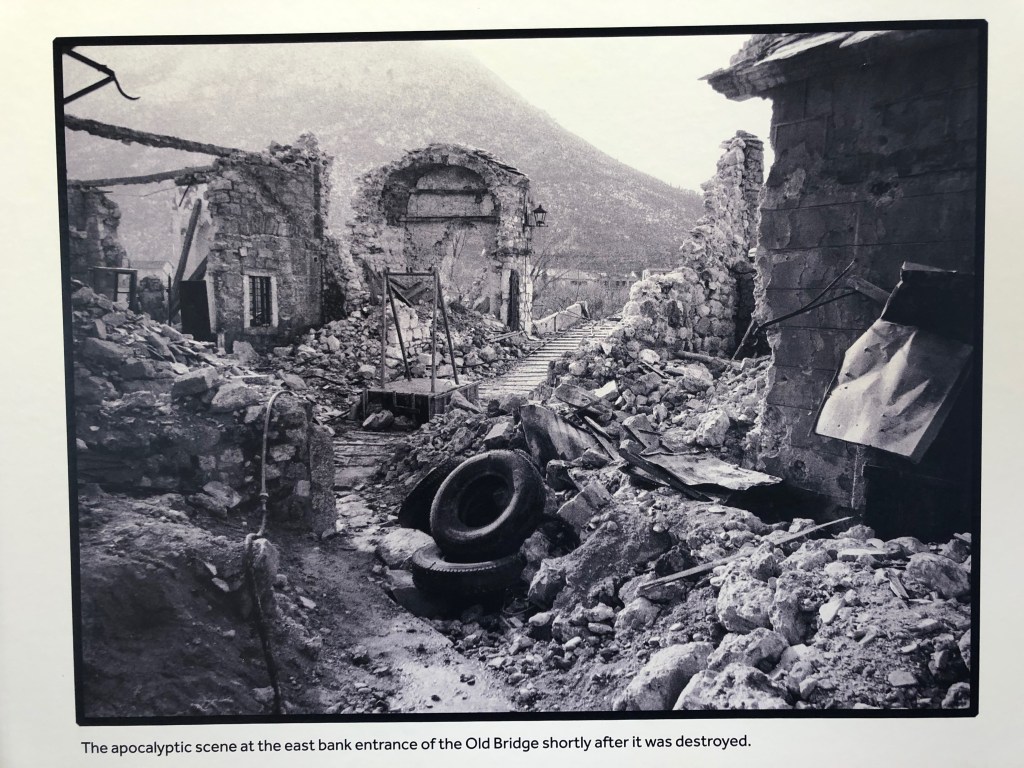
War photos showing rubble at end of bridge 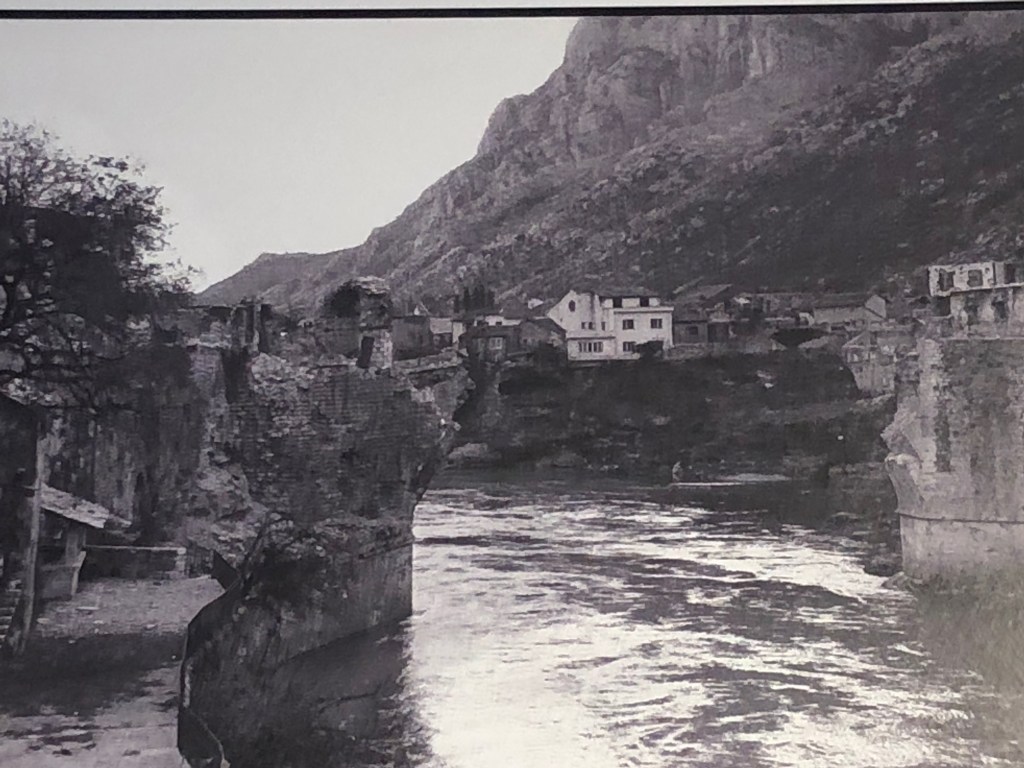
War photos with bridge gone
All day there were men collecting money to jump off the bridge but we always seemed to miss the event. We walked the Bulevar, the front line of the conflict between the Mostar Bosniaks (Muslims) and the Croats (Catholics) where virtually all of the buildings were destroyed. While many of the buildings have been rebuilt, some damage is still evident. Bullet holes are visible in many buildings.
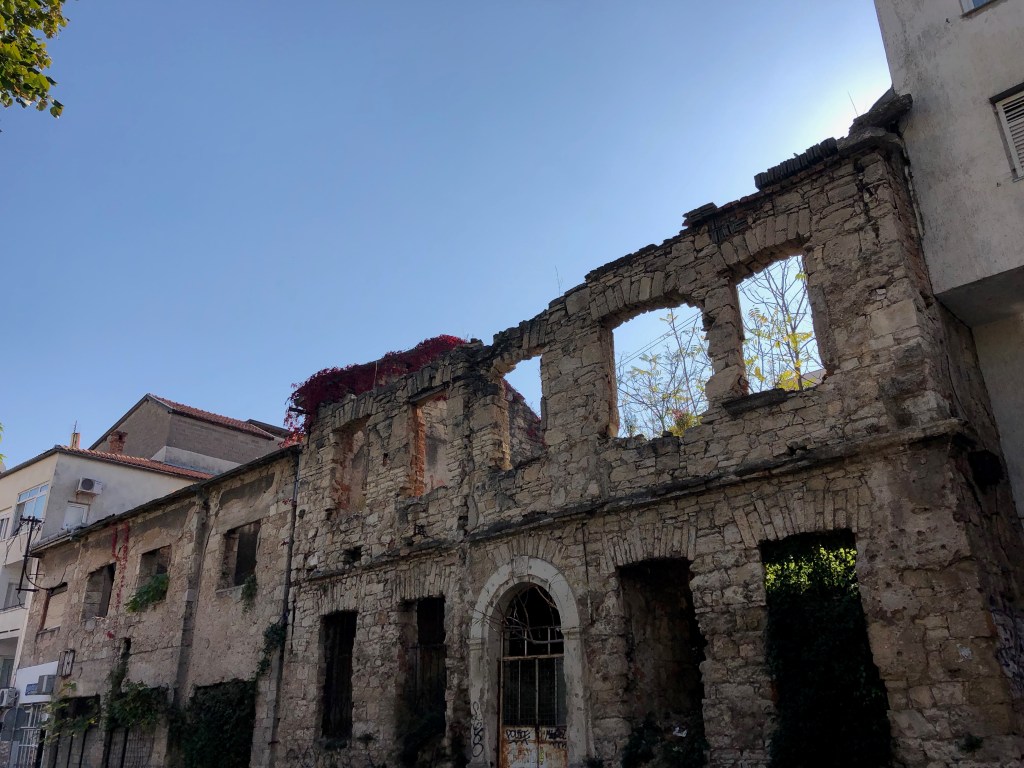
Bombed out houses 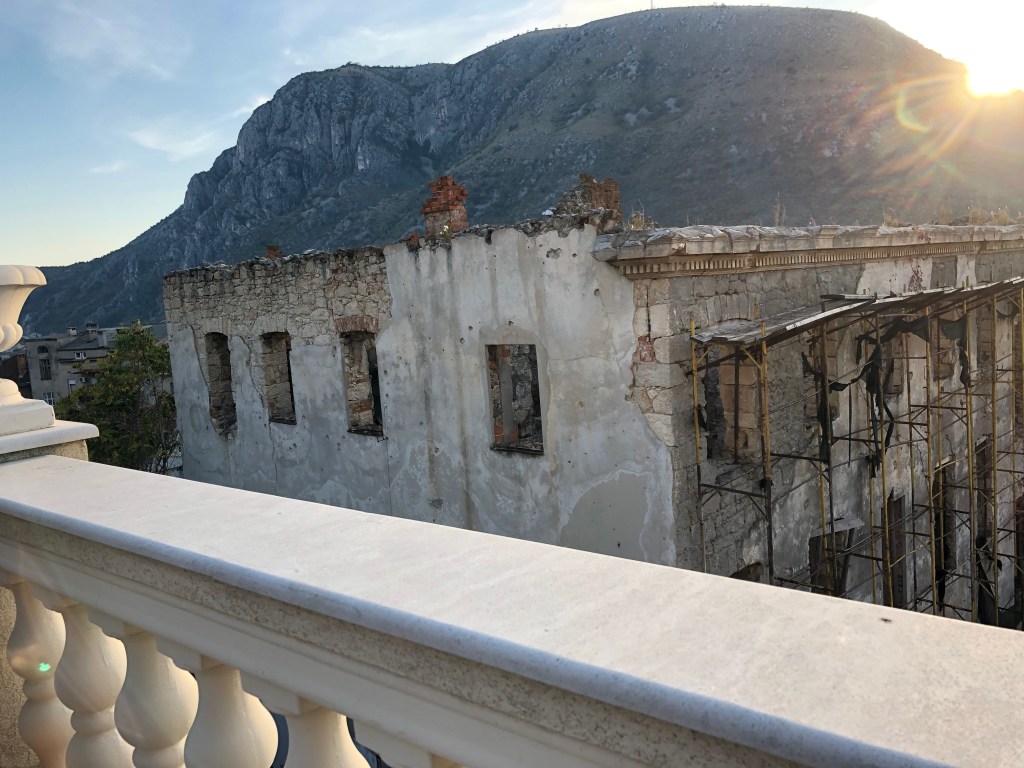
Bullet holes visible 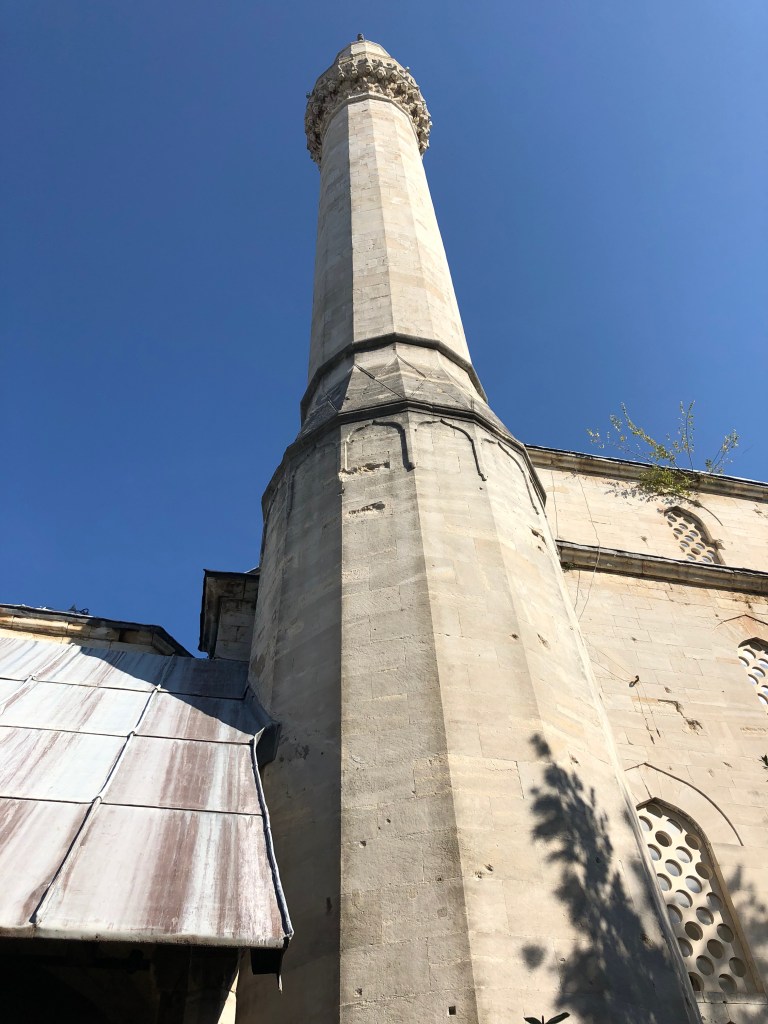
Bullets visible on minaret
Our photos in front of the Old Bridge:
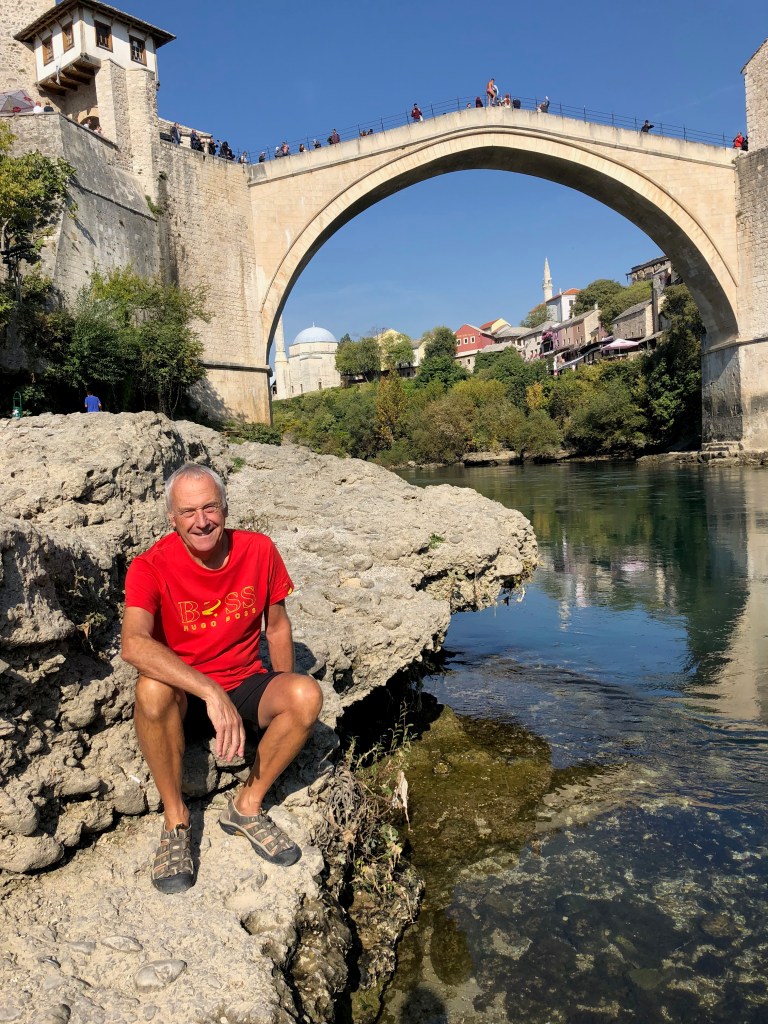
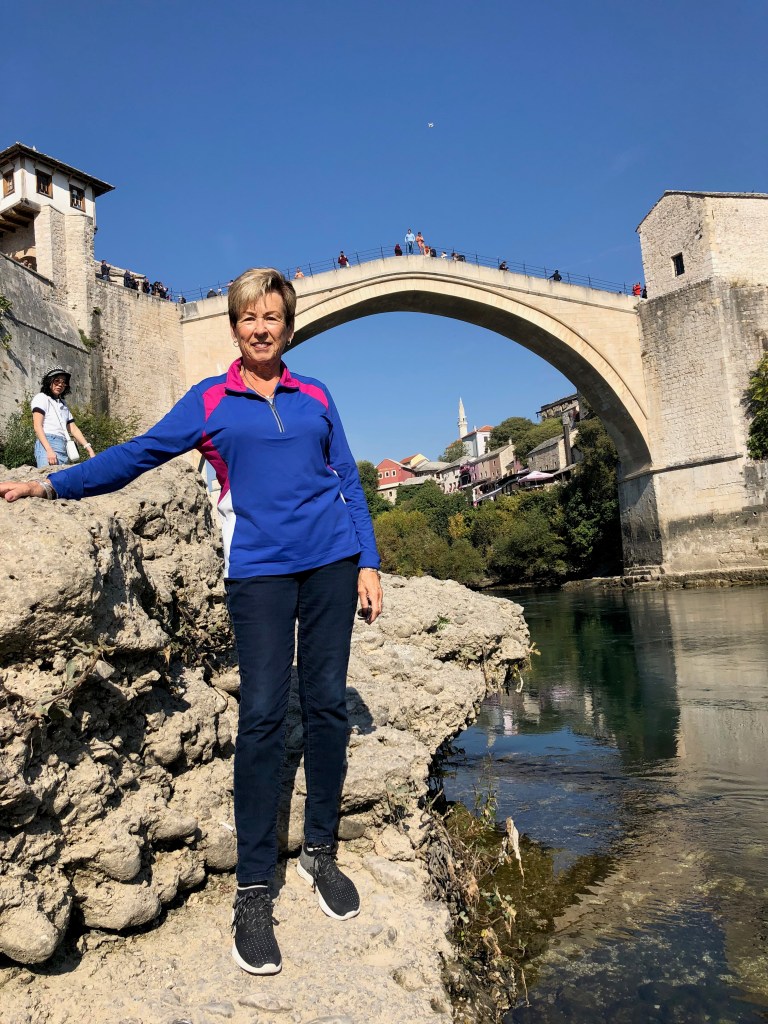
We had drinks on the hotel rooftop on our last evening in Mostar, as the sun went down and it became cooler.
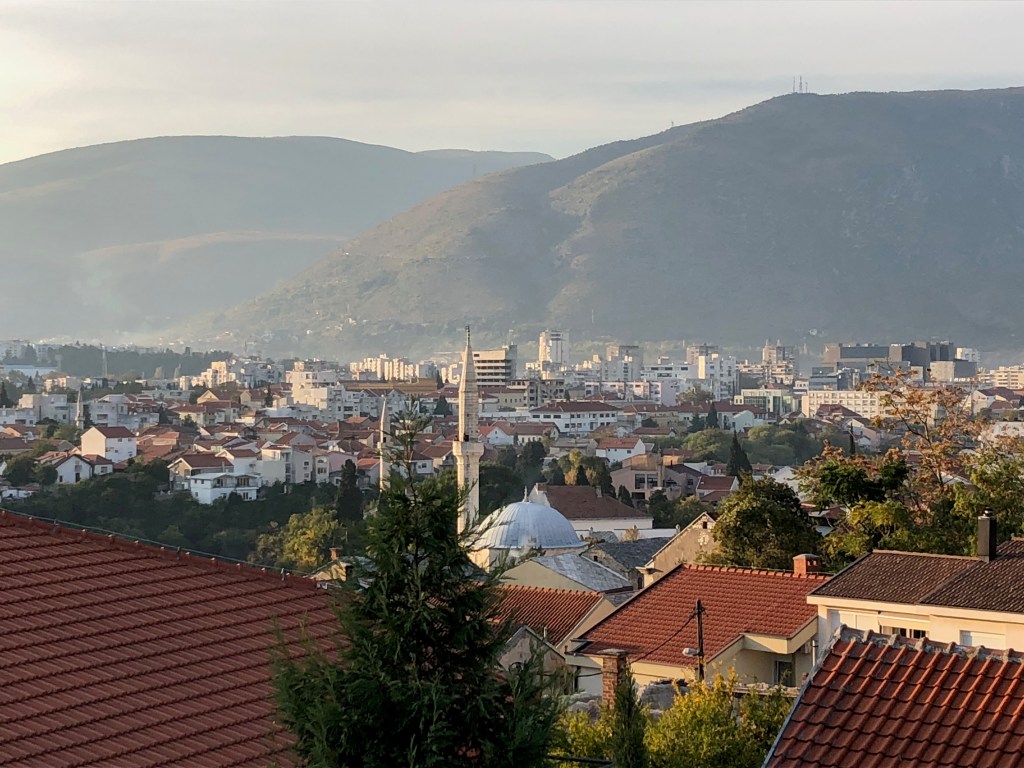
View of Mostar fromShangri La Rooftop
October 29 Mostar to Dubrovnik
Another sunny day in Mostar and Dubrovnik. The rain that is coming doesn’t arrive now until Saturday and the sunny hot weather continues in Dubrovnik with a high of 27 but as soon as the sun goes down it drops dramatically. What fabulous, and according to the locals “unusually hot”, weather we have had.
As we were checking out, Nermin shared some of the history of his hotel. He and his wife bought it as a ruin much like the building next door 12 years earlier and started with their living quarters and 3 rooms for guests. Each year, they enlarged the building. He was born in Mostar but travelled a great deal as a photographer. He shared that there were many problems with the purchase of the property and an additional piece of land. After being owned by a local who built it, it changed hands 2-3 times ultimately being converted to apartments with one even taken away from an owner to give to a poor person by the communists so establishing ownership was a challenge.
Another really circuitous route was necessary to acquire a small adjacent piece of land when the owner, an older woman, moved to Serbia, died there and was buried under another name. He tried to get the birth certificate changed but was advised of conflict of interest so he tracked down the relatives of the woman who got the death certificate accurately amended. That process took two years. I tried to encourage him to write his story and that of his house. I will follow up.
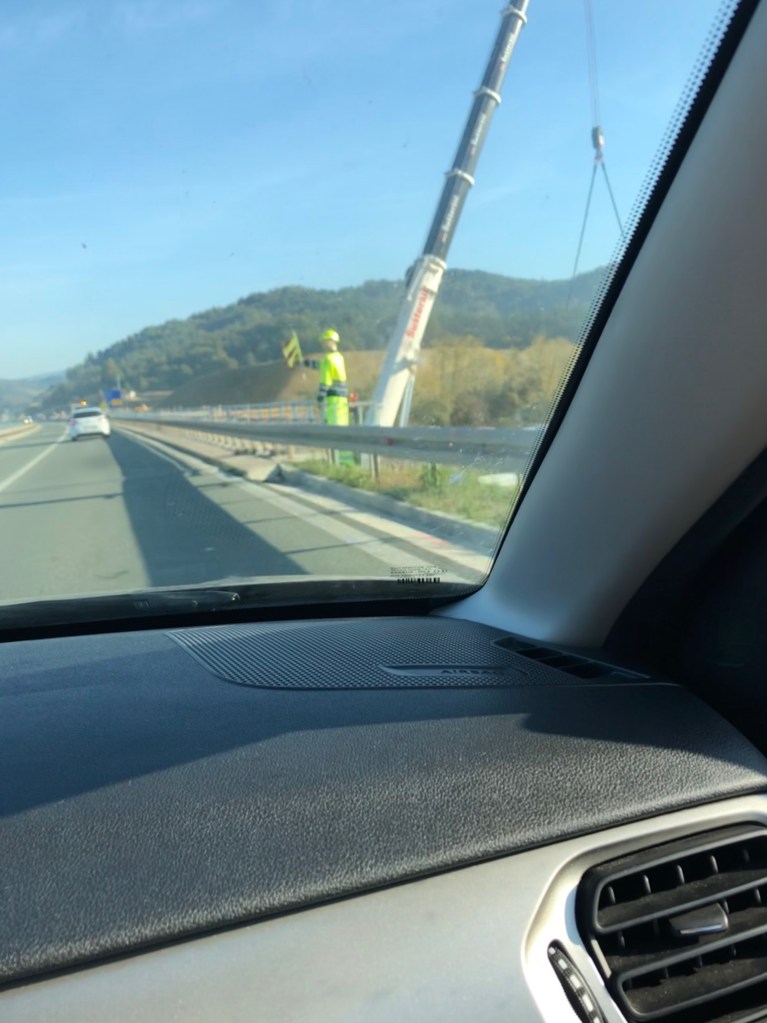
We made it through all the border crossings, 4 in all with little trouble and drove the coastal road most of the way with amazing panoramas of the cliff-side roads, the azure Dalmation coast and many islands. We saw our first robotic flag person in a construction zone.
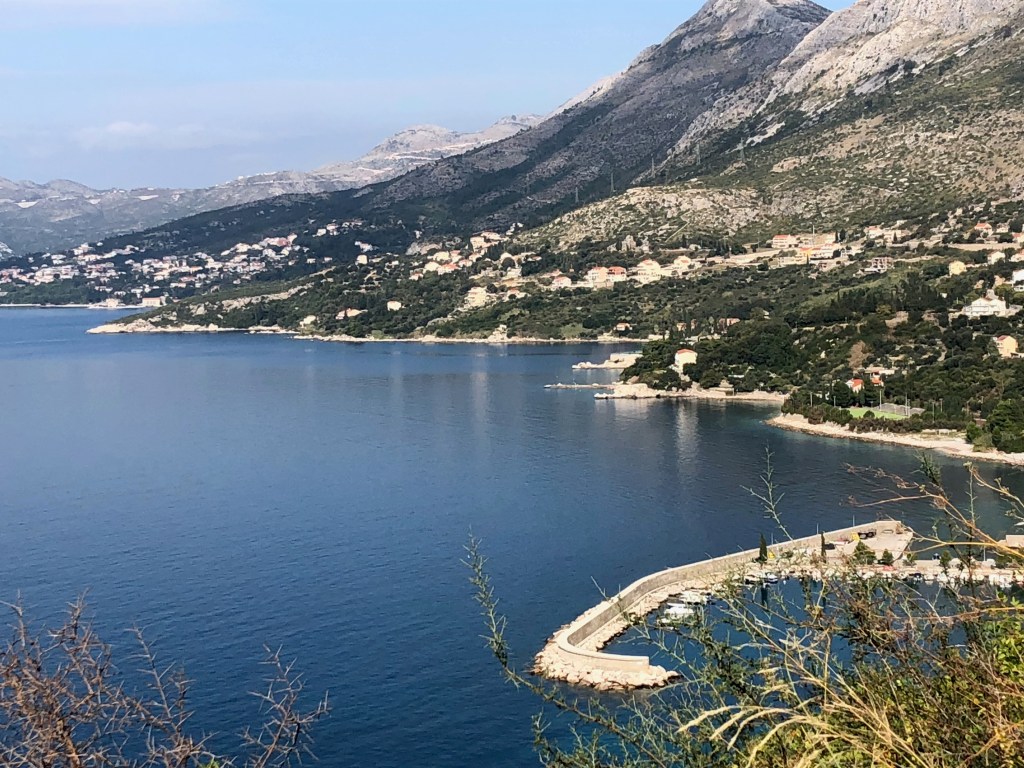
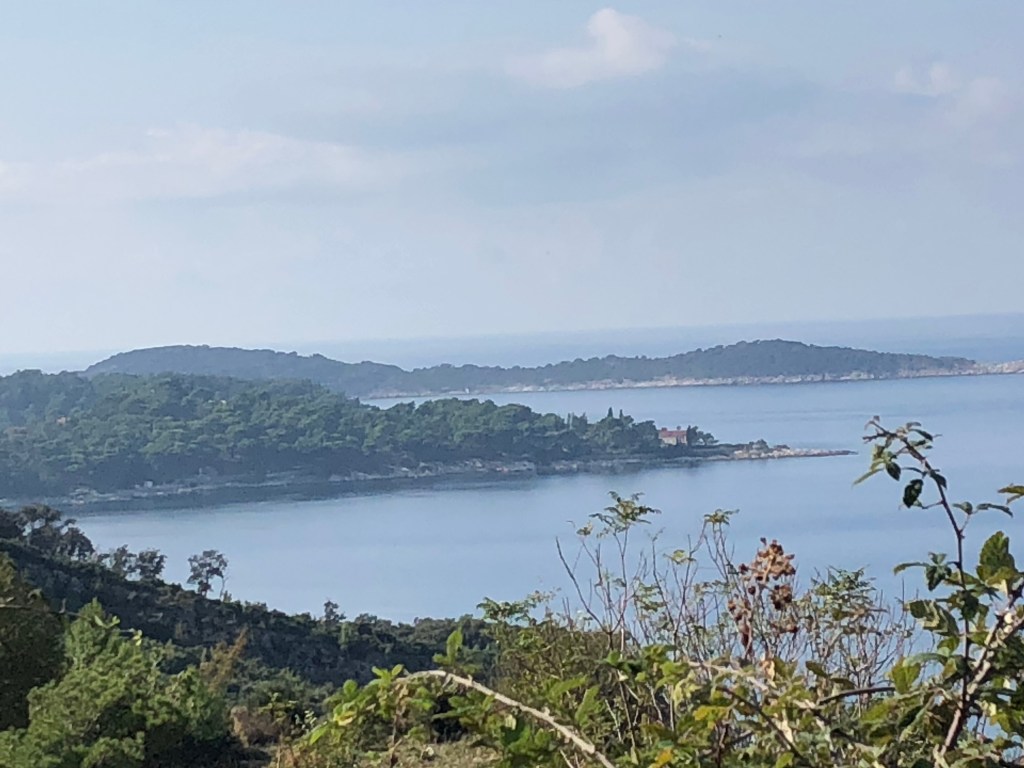
We arrived at Villa Myrta with the help of Waze (although it refused to work while we were in Bosnia-Hertzogovina). The sobe (4 rooms) is up a steep hill (we are getting used to this) with the Pecotic family. Mirjana and son-in-law, Alexander, met us, showed us the room and view of the Mlini Bay (we are 7 km outside of Dubrovnik) from our balcony and explained how to get to the 7 km to Dubrovnik-boat, bus, taxi.
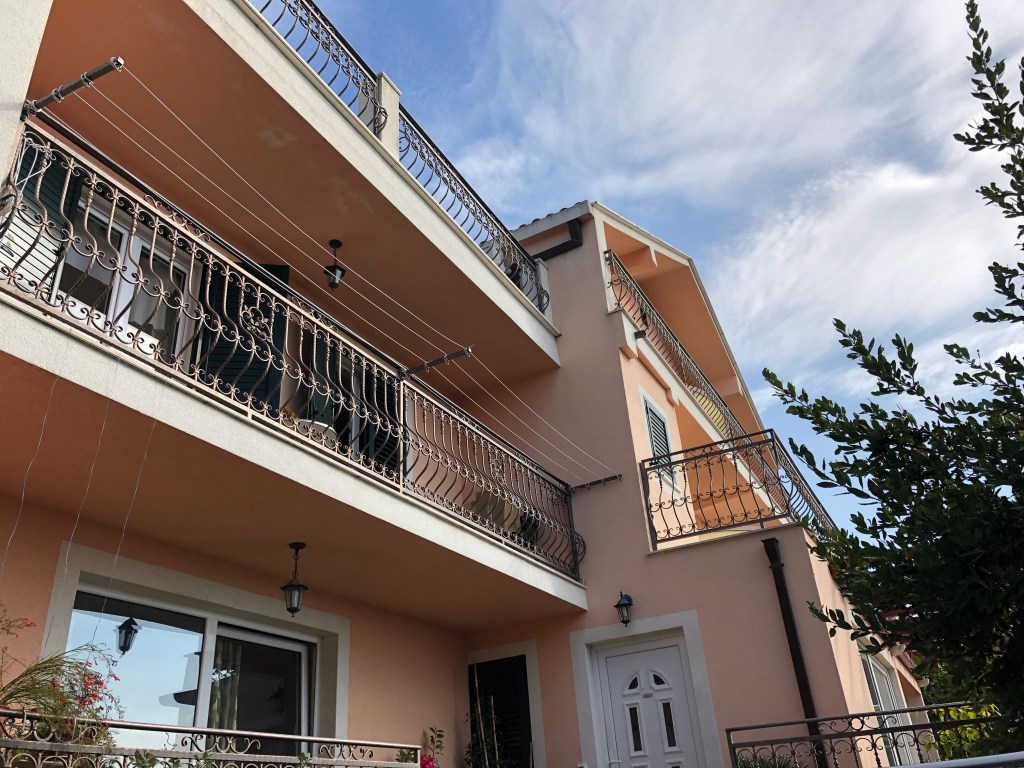
Villa Myrta 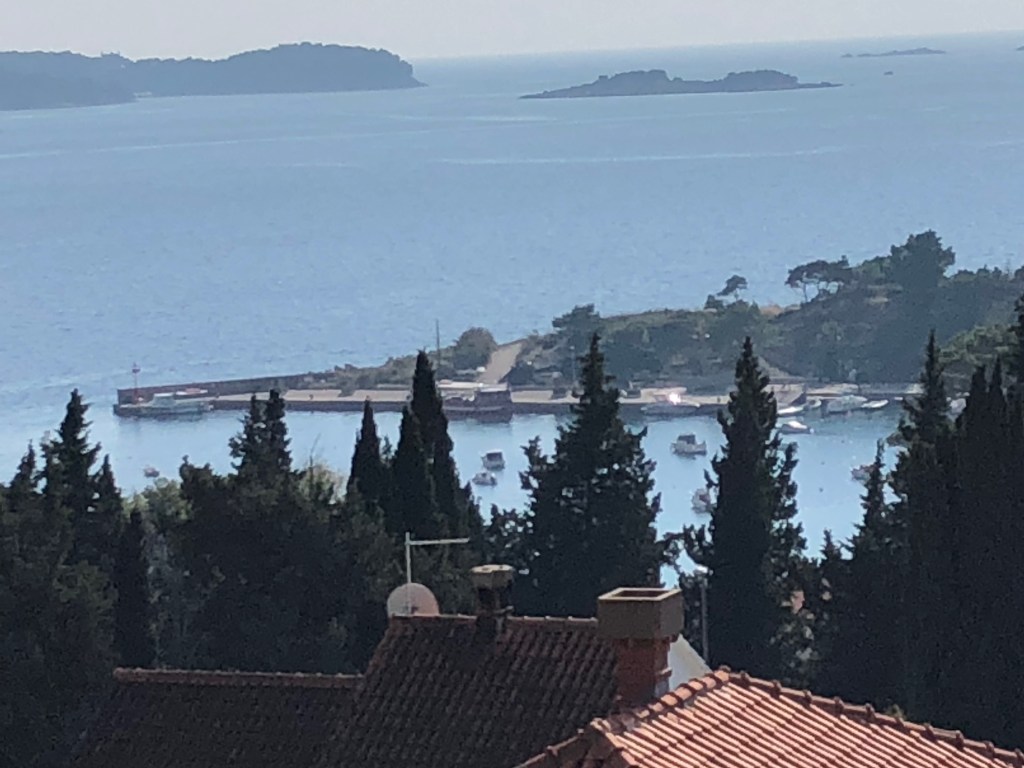
Mlini Harbour from our balcony
We decided to take the bus in and the ferry back and both ways the next day.
We arrived in the Old Town around 1:00 pm and having had no breakfast, looked for a place to eat and found Rick Steve’s-recommended vegetarian-fusion cuisine with Asian flair restaurant, Nishta (Nothing) where I had the salad bar and Bill the falafel wrap and both were excellent.
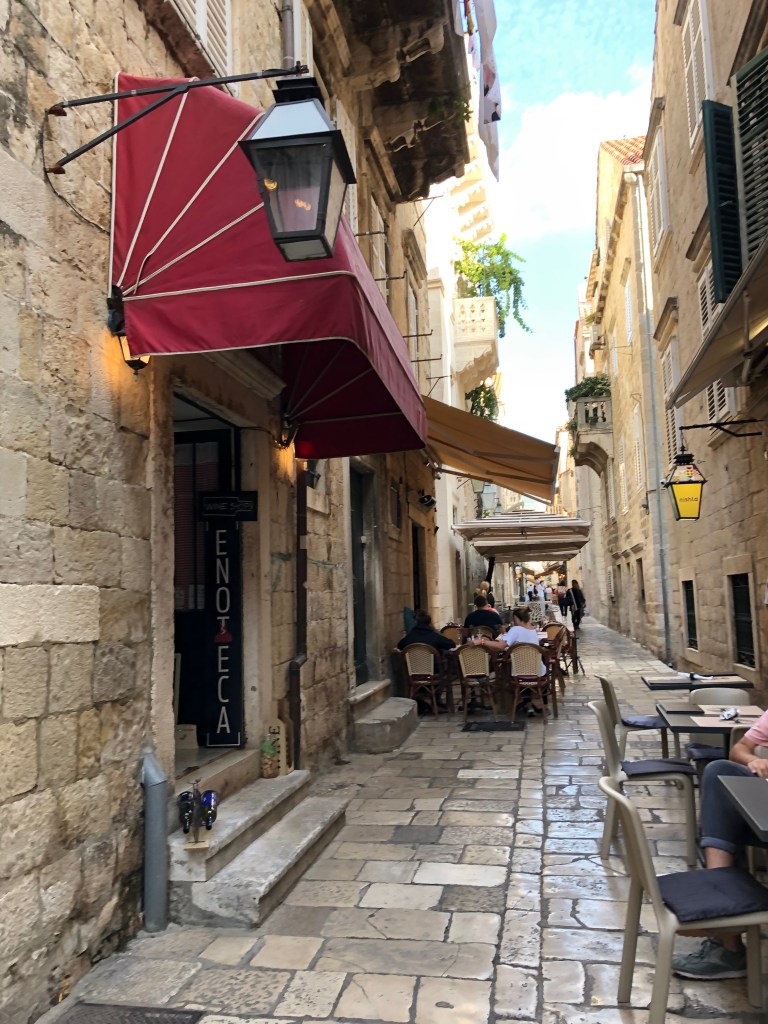
We started our tour with walking the City Walls. While it is just a mile and a quarter, it is up and down stairs the whole way and we were tired when we finished. The views from the walls are spectacular, both of the old town and of the surrounding Dalmation coast.
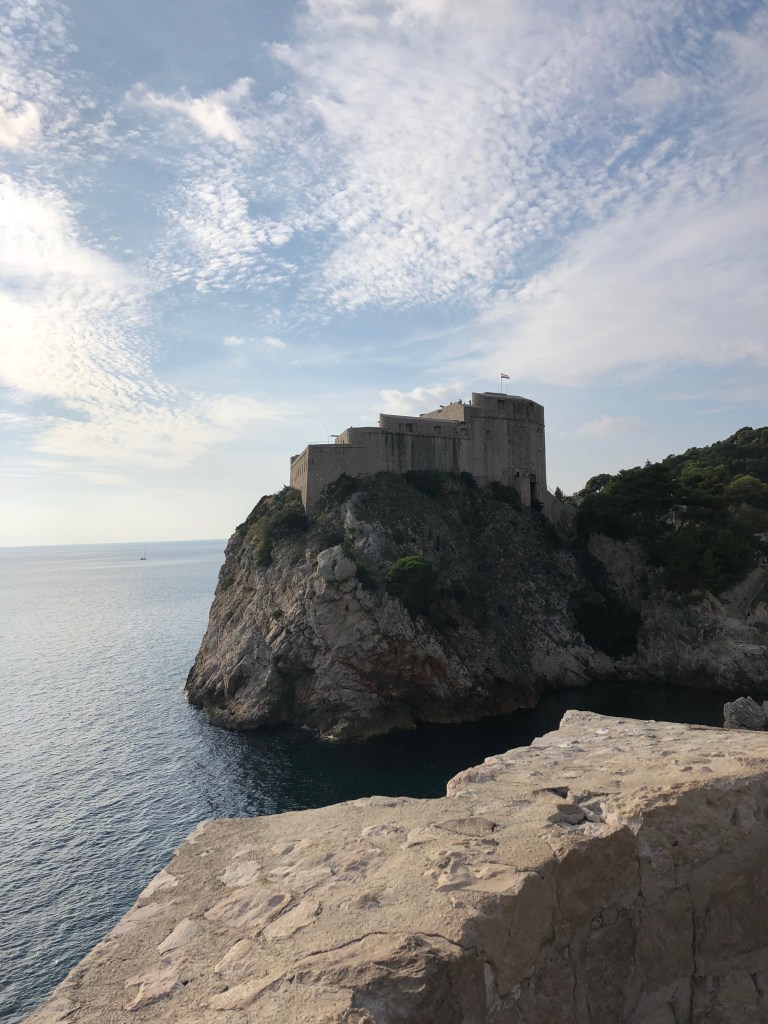
Fortress 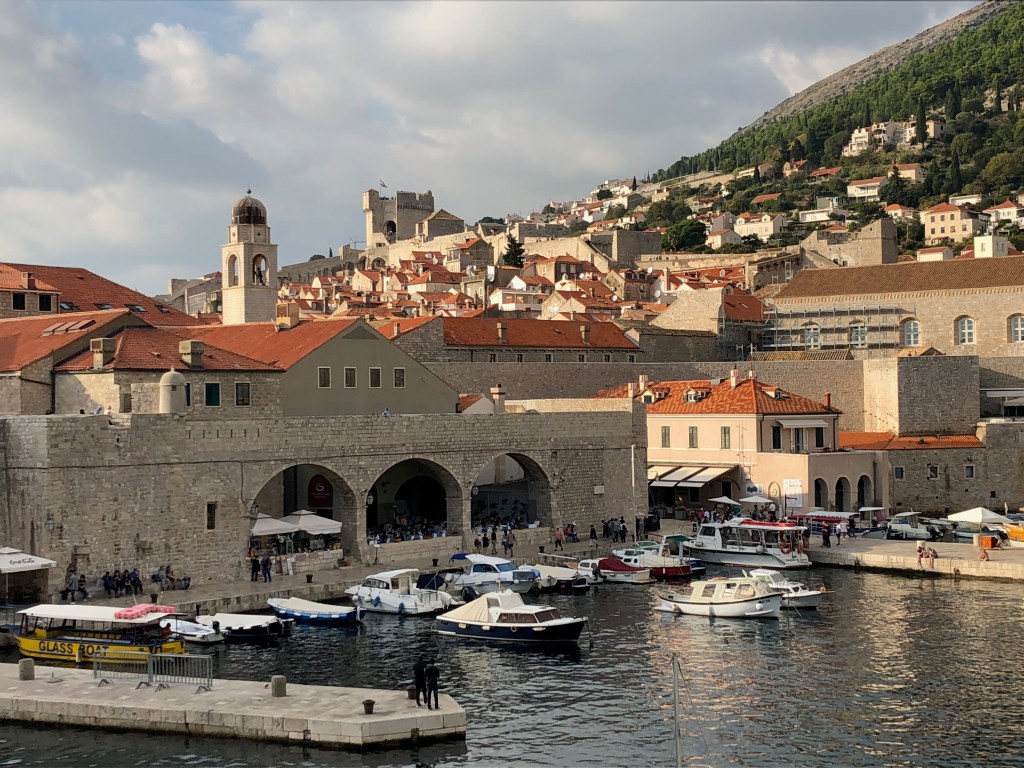
Harbour
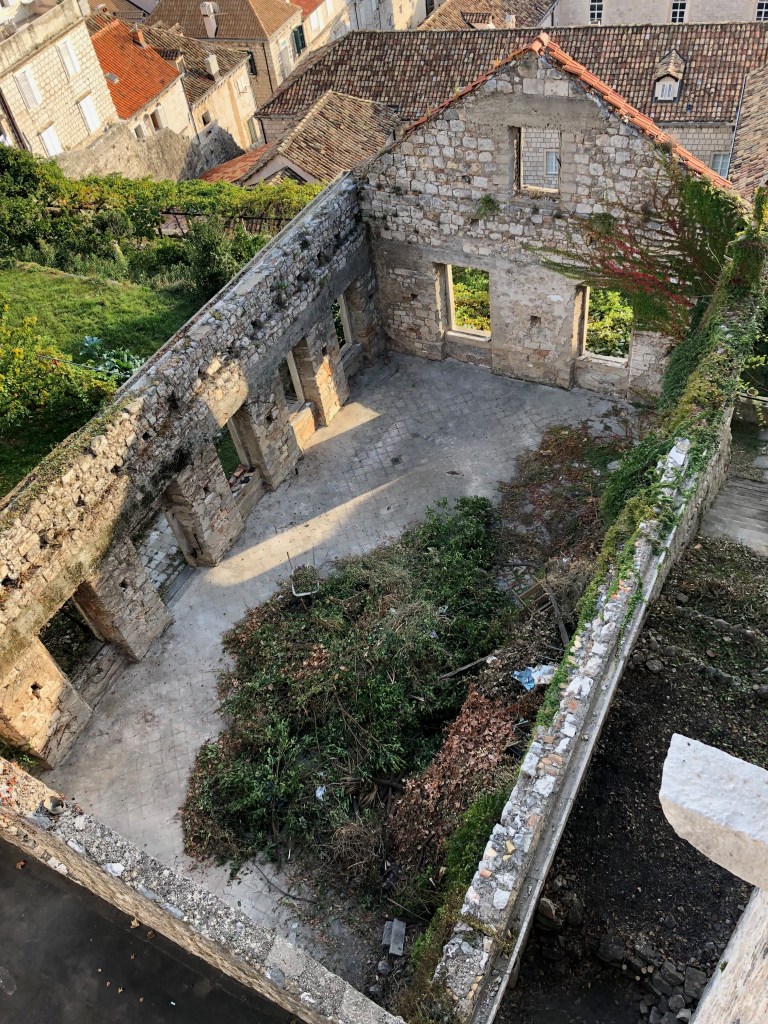
Bombed House 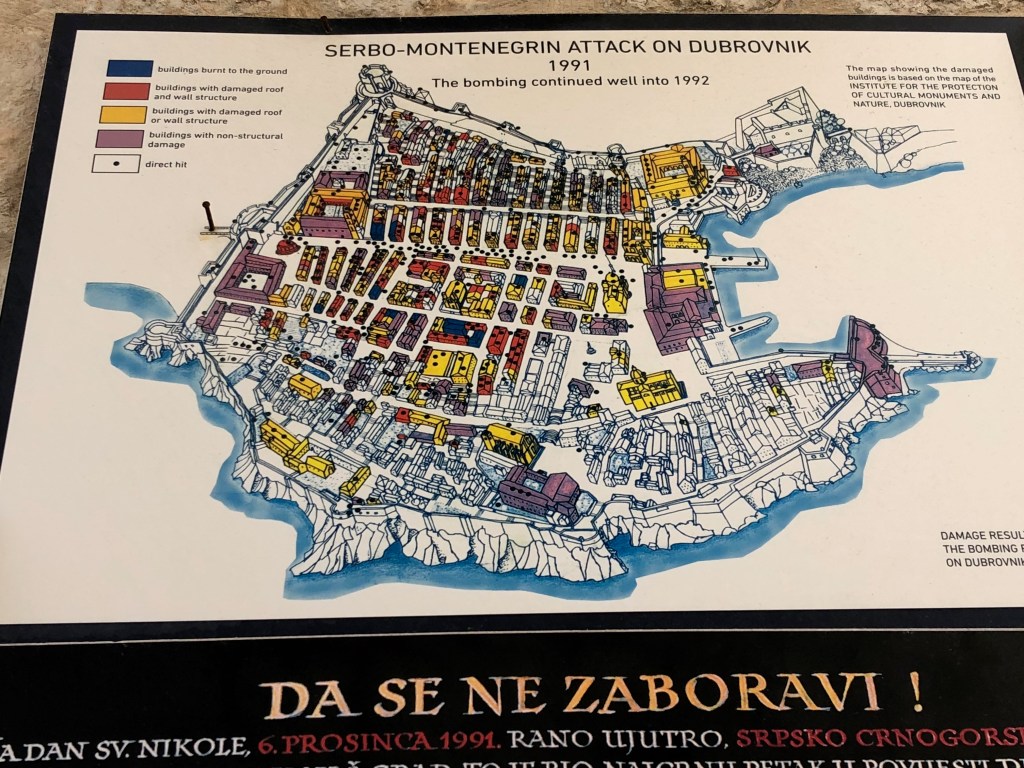
Map of places bombed 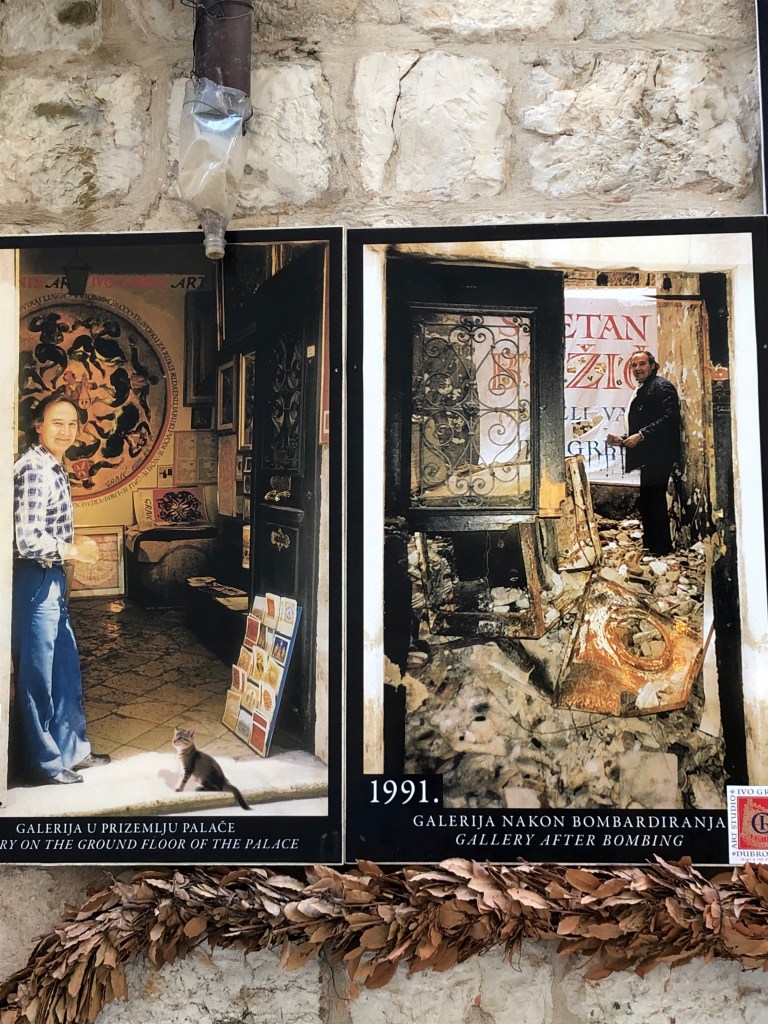
Artist Studio before & after
It was a bit confusing which stop of the ferry to get off but as it turned out, the ferry dropped us right at La Laterna restaurant where we intended to have dinner. The only down side was that it was dark and the way we came back to the hotel was up a million stairs. After the day of walking the City Walls and the streets of Dubrovnik, this was exhausting. Then when we got out on the road, it was hard to determine where we were and where the sobe was but Waze figured it out and a short distance along the highway, we got to climb the hill to the sobe!
October 30 Dubrovnik
We drove our car to Mlini and arrived by ferry to Dubrovnik around 10:00, walked the Stradum visiting the Rector’s Palace which must have been lovely but was entirely empty.
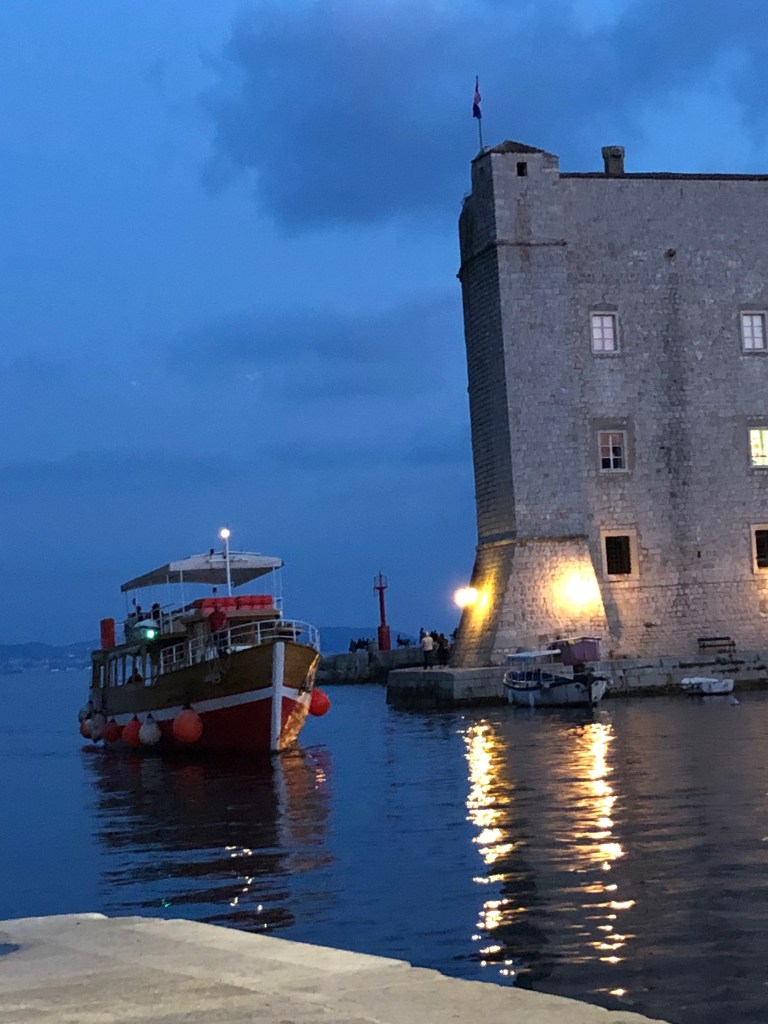
Ferry 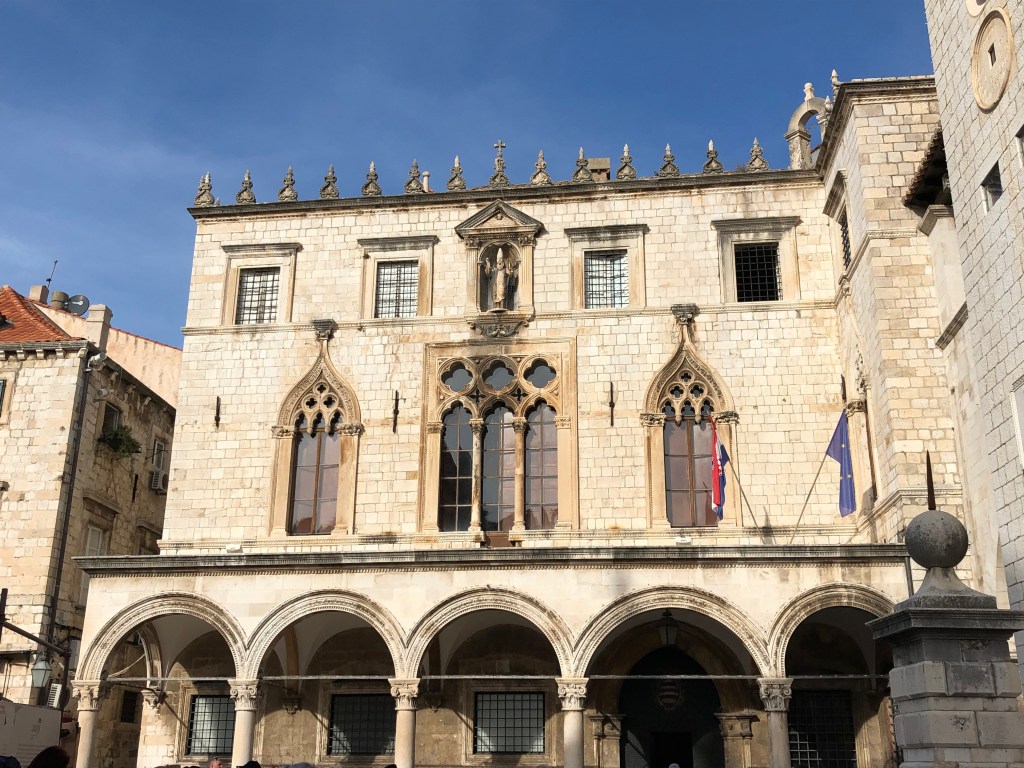
Rector’s Palace
Orlando’s column – a northern European symbol -erected in 1417 was the location that the town crier used for important announcements; it was also the pillory where people were publicly punished. It was under reconstruction when we were there.
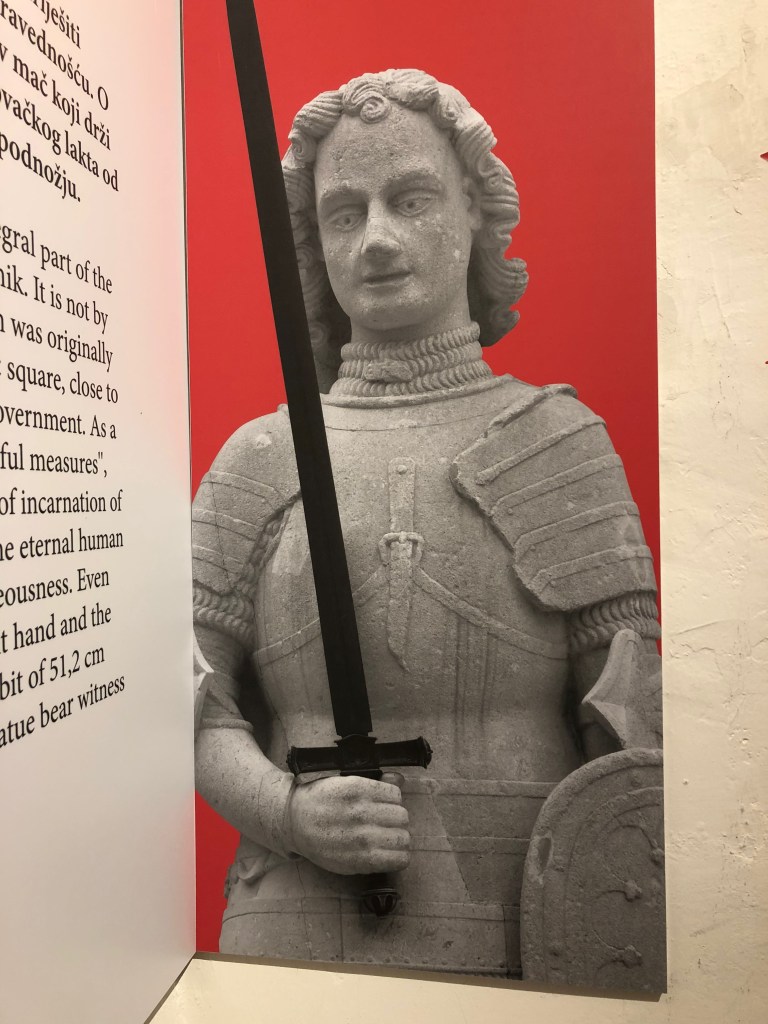
Orlando 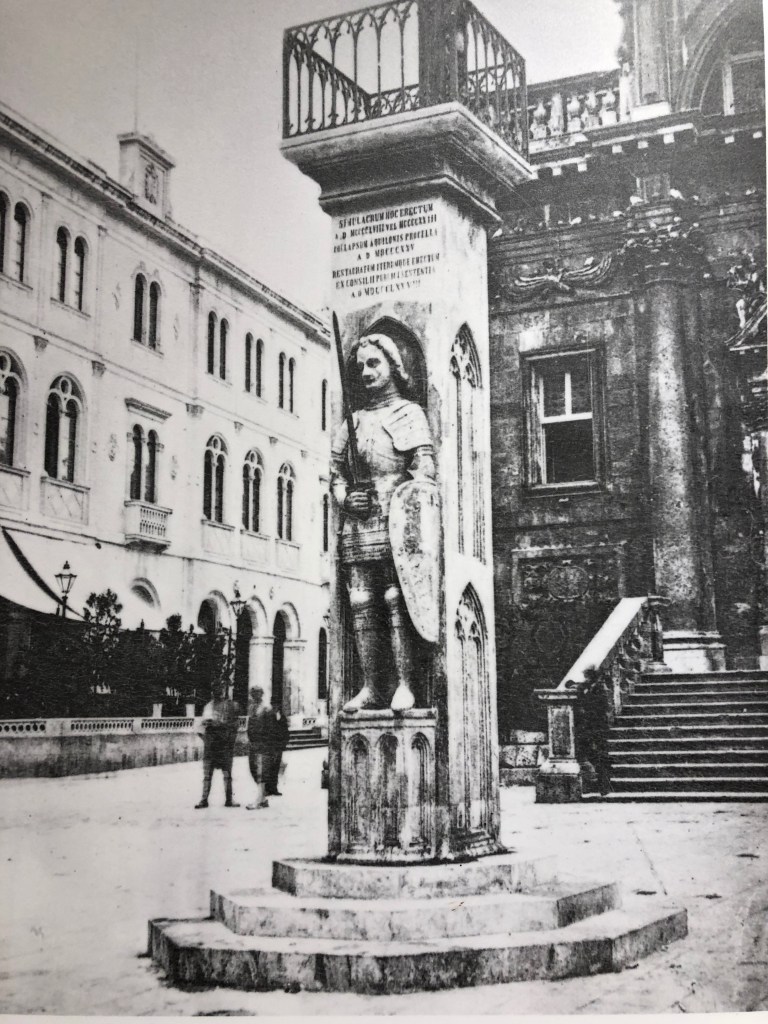
Original Column
Then we walked through the cloister at the Franciscan monastery.
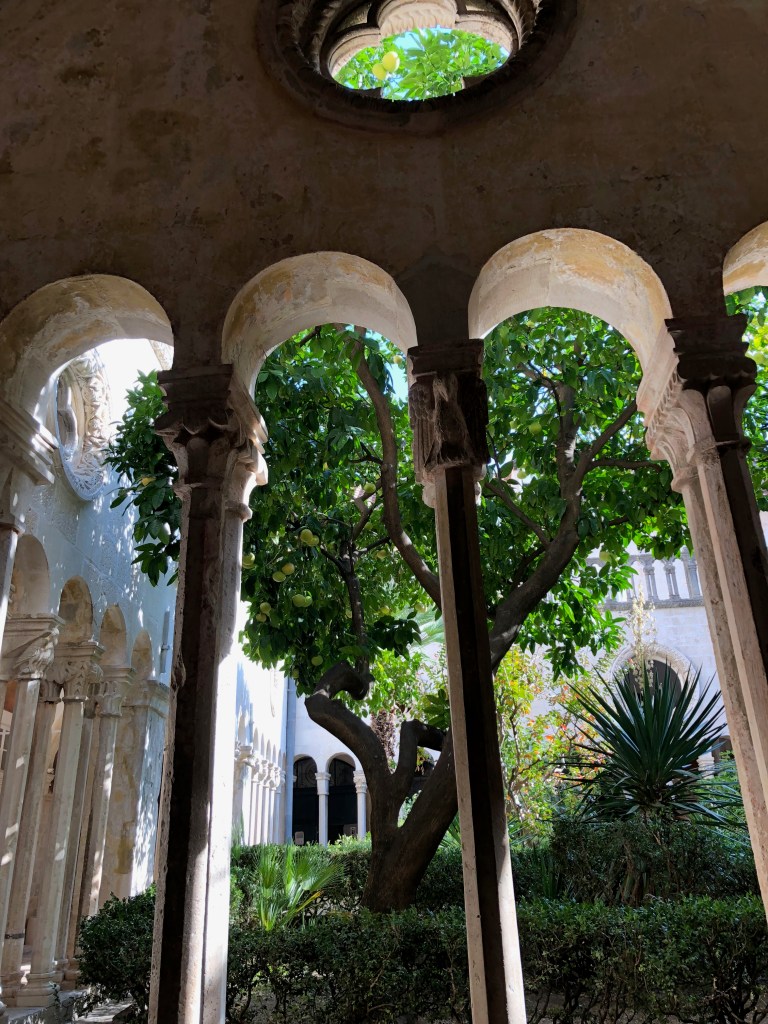
Franciscan Monastery 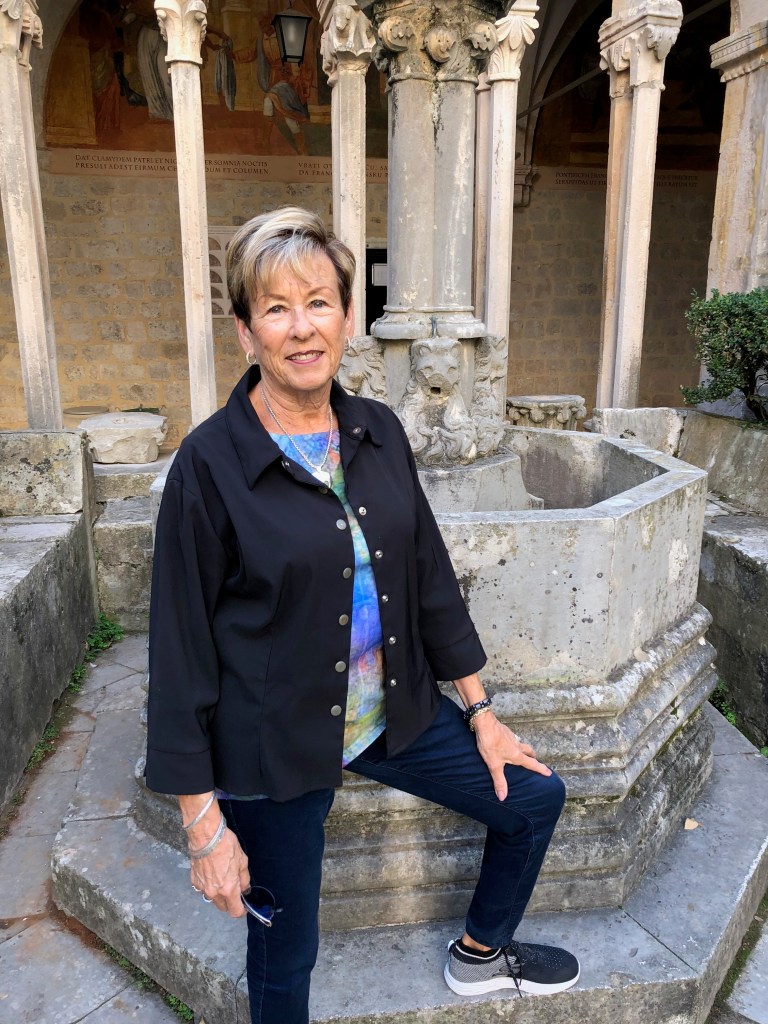
past the water cistern and down a shopping street but found nothing interesting.
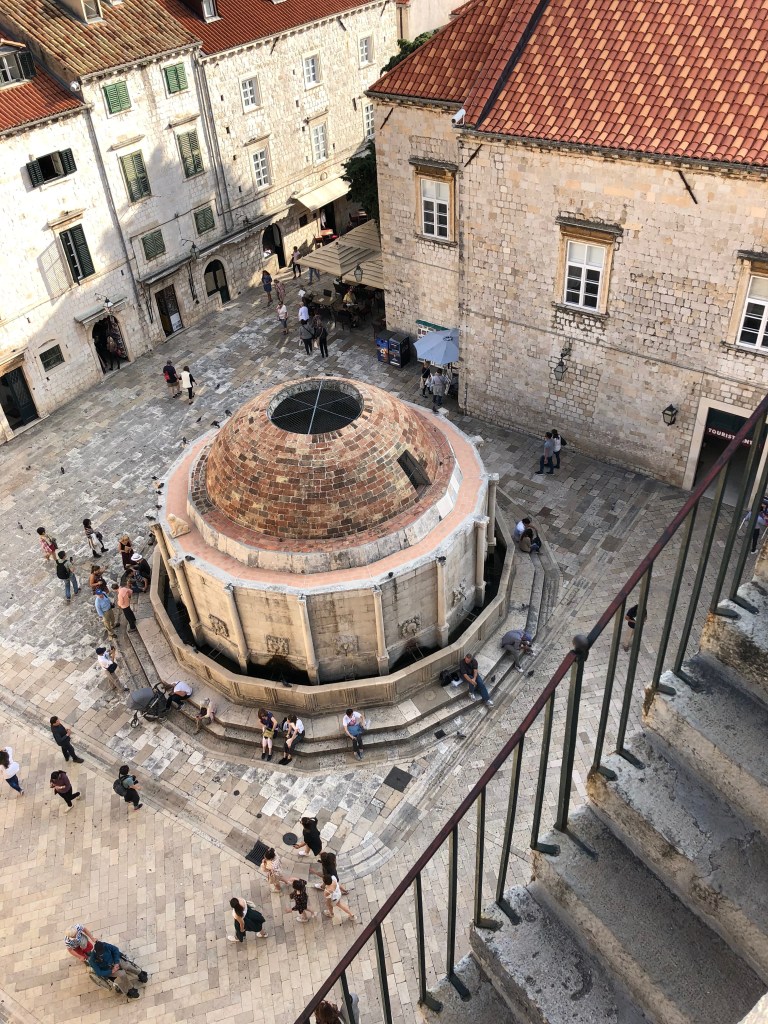
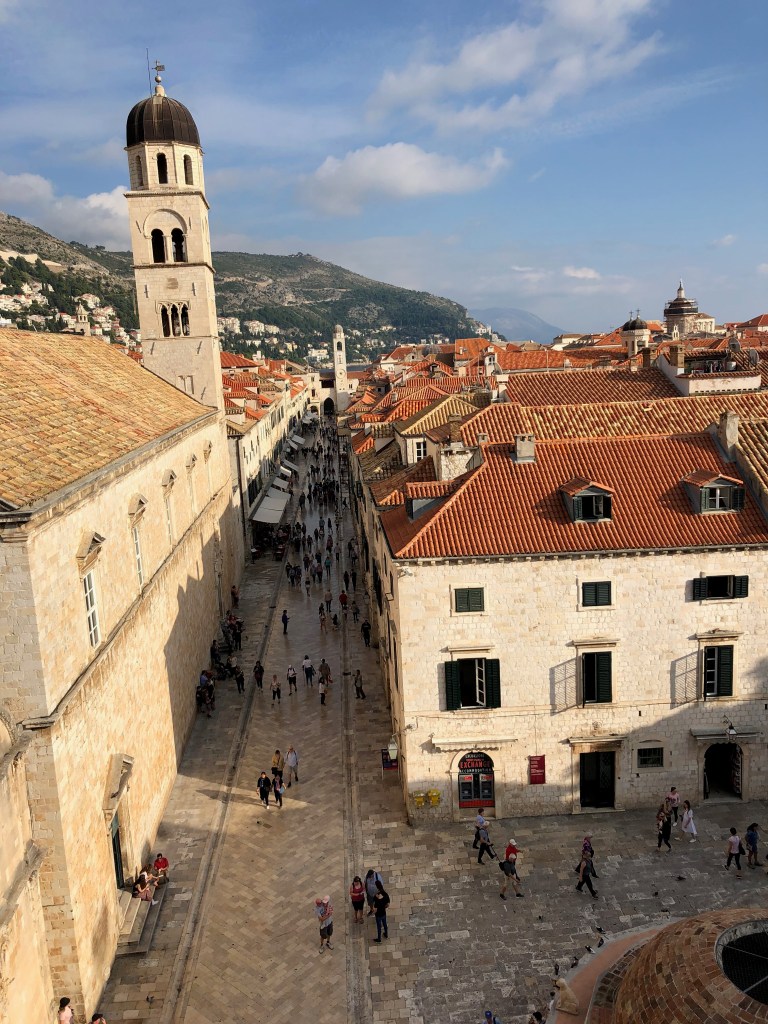
We headed back on the 2:00 ferry with great views of the city and water.
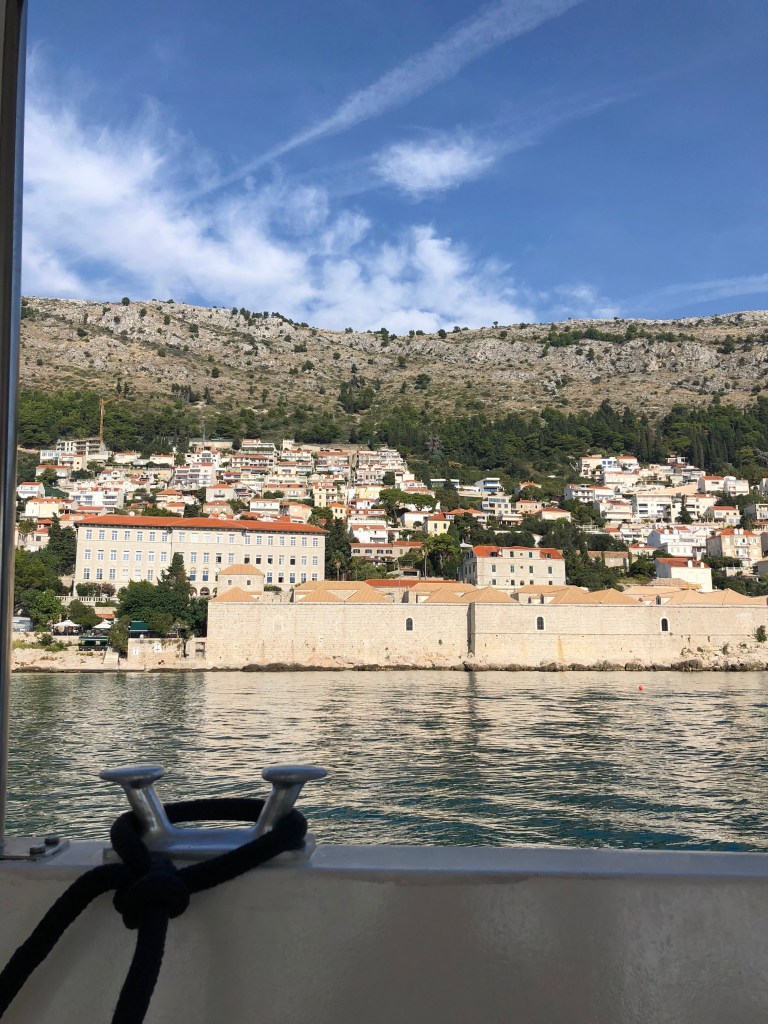
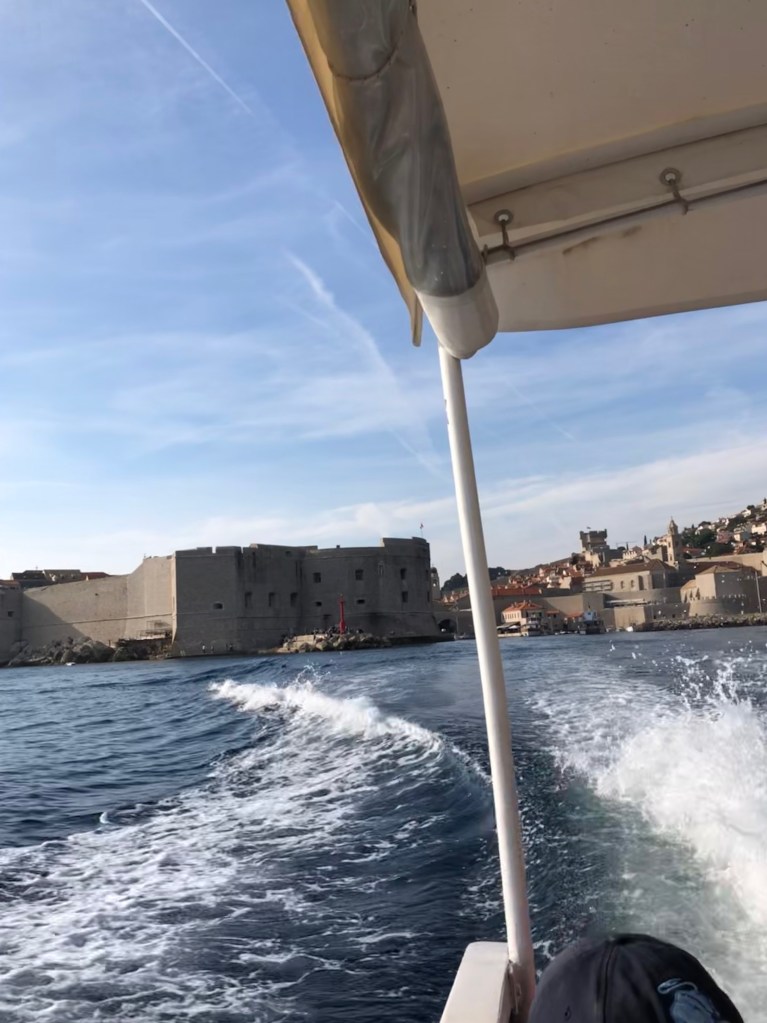
We walked the waterfront promenade in Mlini to find the Puntizela Restaurant recommended by Alexander and made a reservation.
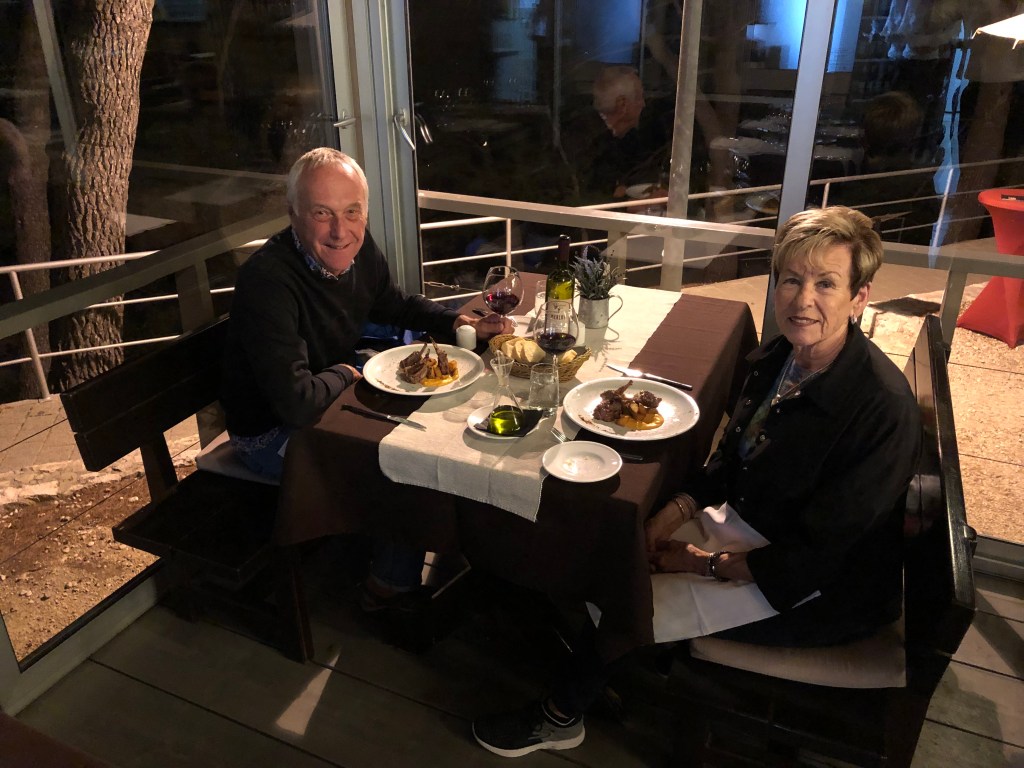
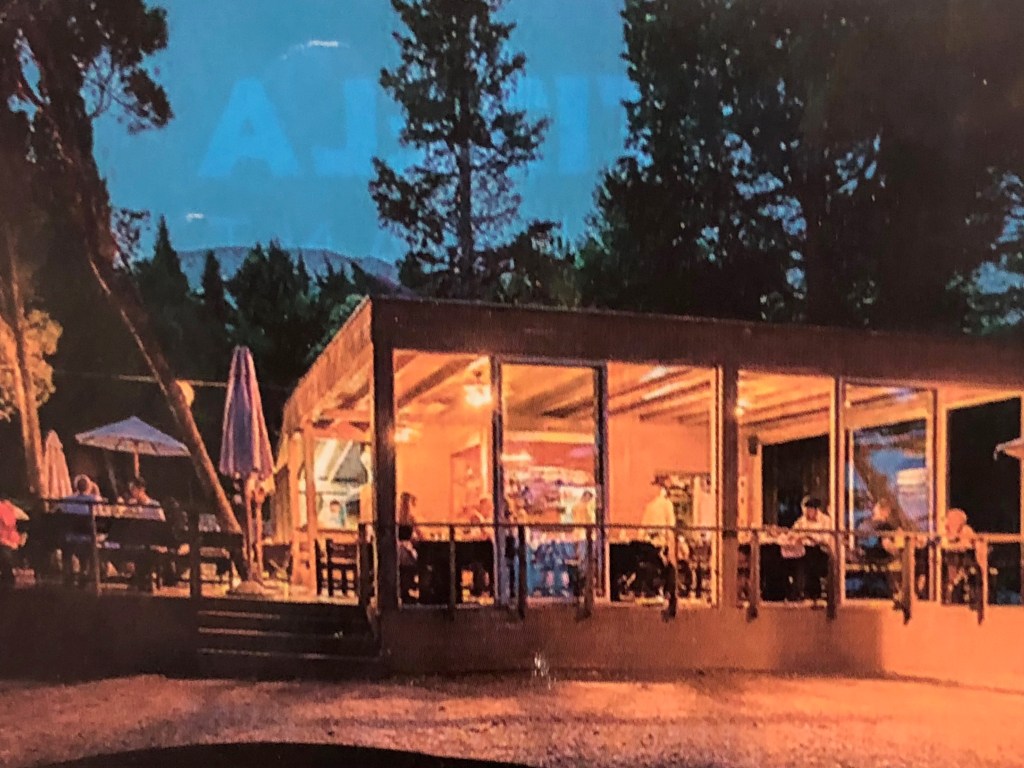
Dinner at Puntizela was excellent; we shared a lamb on pureed yellow carrot dinner and a local bottle of merlot (much heavier than other merlots). We packed for leaving and enjoyed the sun and the view on the balcony.
October 31 Mlini to Cavtet to Alicante
Although rain was in the forecast and there was thunder in the night, we drank our coffee in the sun on the balcony. There were some rain clouds in the distance and slight chance of rain in the forecast, though. Our luck continues: 16 days of heat and sun!
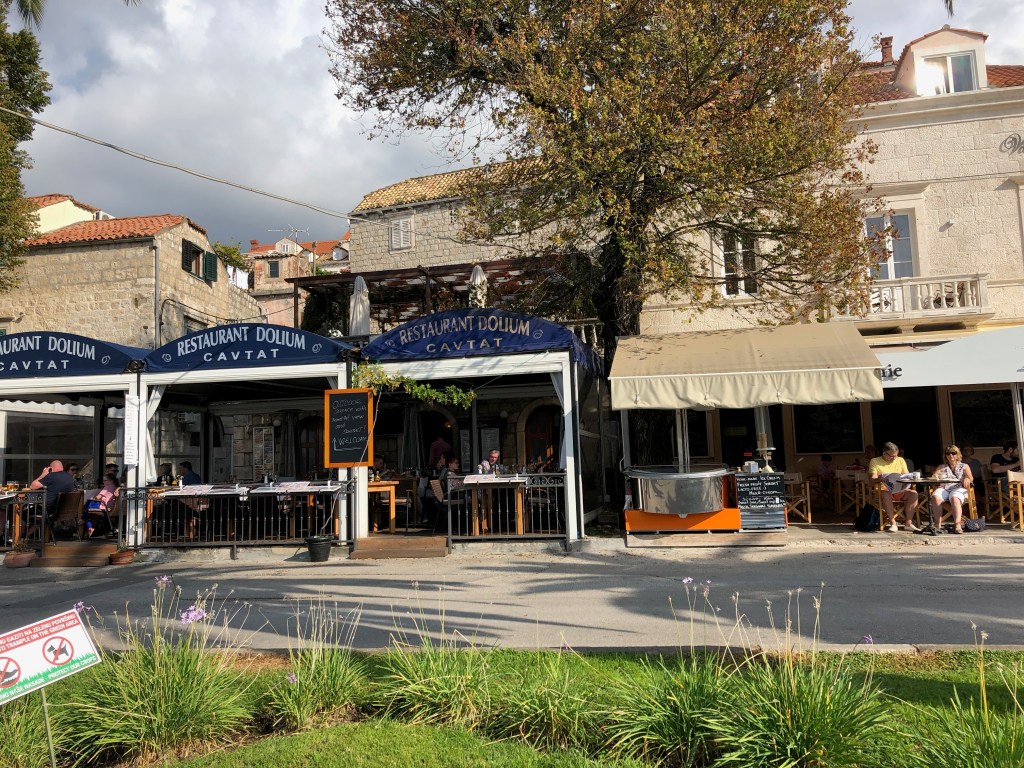
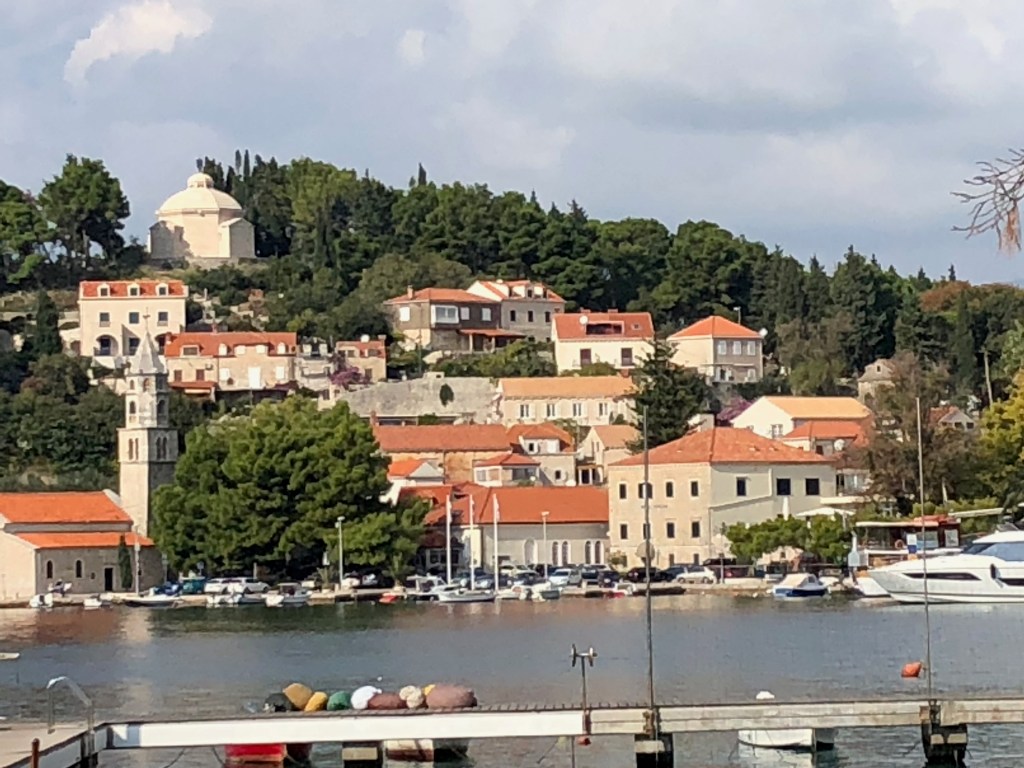
We headed to Cavtet (TSAV-taht) just a few miles south of Mlini on the road to the airport and 12 miles from Dubrovnik, with a 360-degree bay, a settlement that was thriving long before Dubrovnik called Epidaurus by the Greeks. It is home to two gems of Croatian art: a breathtaking hilltop mausoleum by Croatian sculptor, Ivan Mestrovic, and the former-home-turned-museum of the Cavtat-born, early 20th century painter Vlaho Bukovac. His paintings are of familiar subjects, self-portraits, family, friends, local environment.
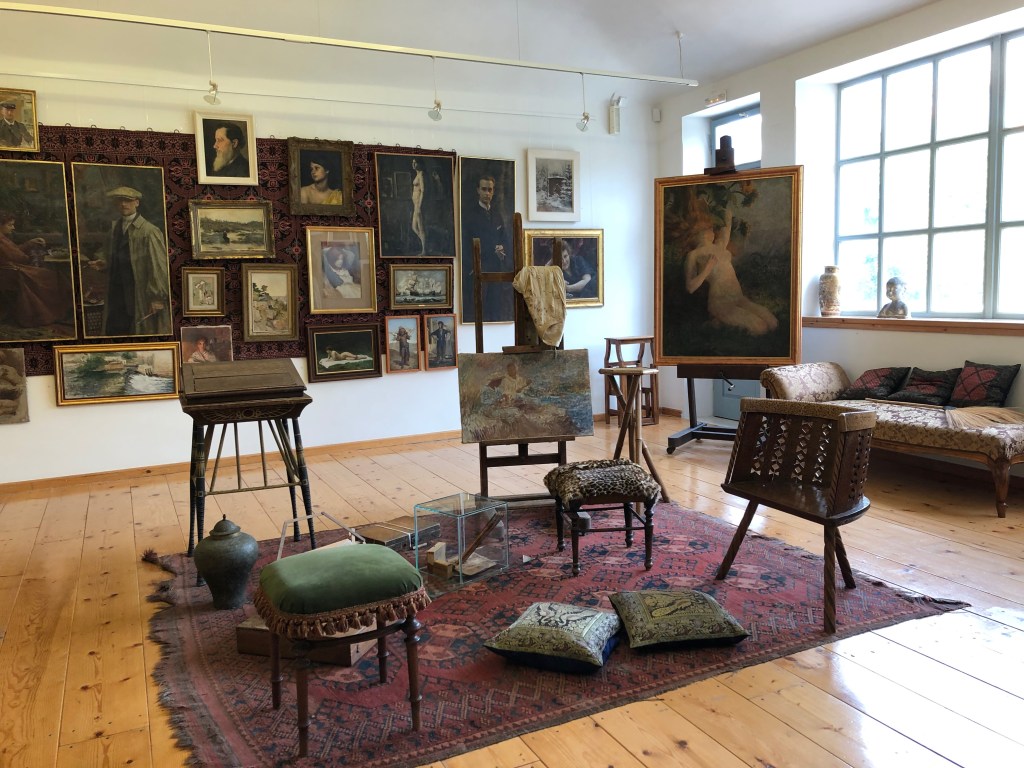
Bukovac’s Studio 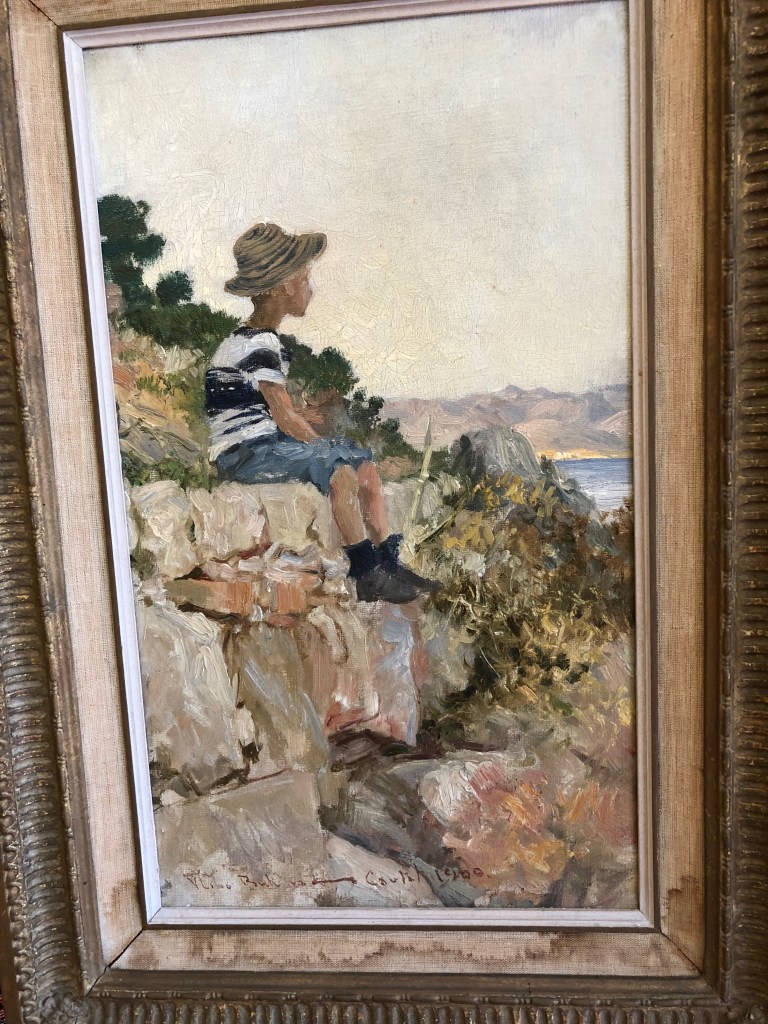
Little Ago On The Rocks, 1900
Vlaho Bukovac’s house/museum has clearly been a lovely place in its day, full of his paintings and some furniture. These bathroom fixtures were charming:
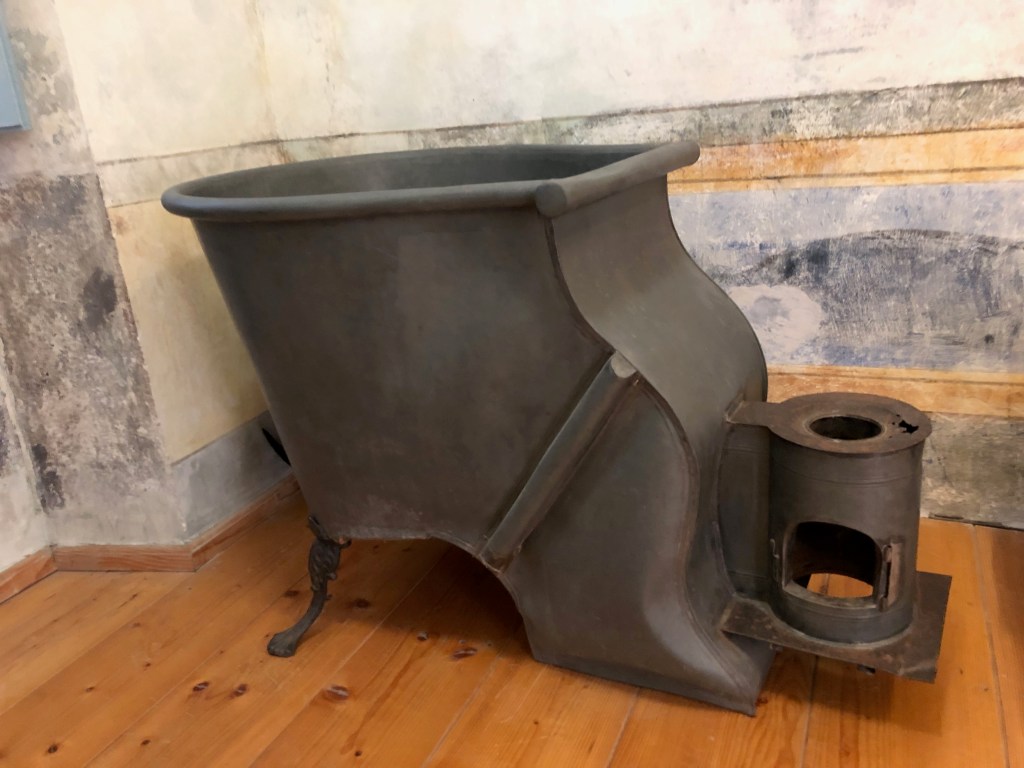
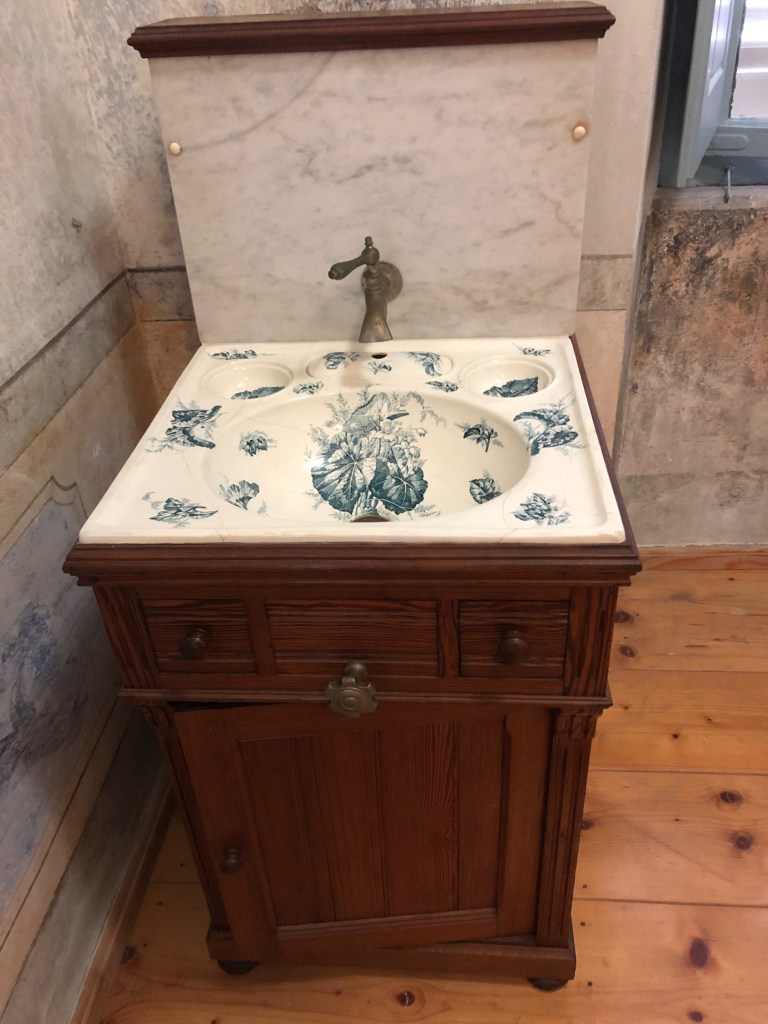
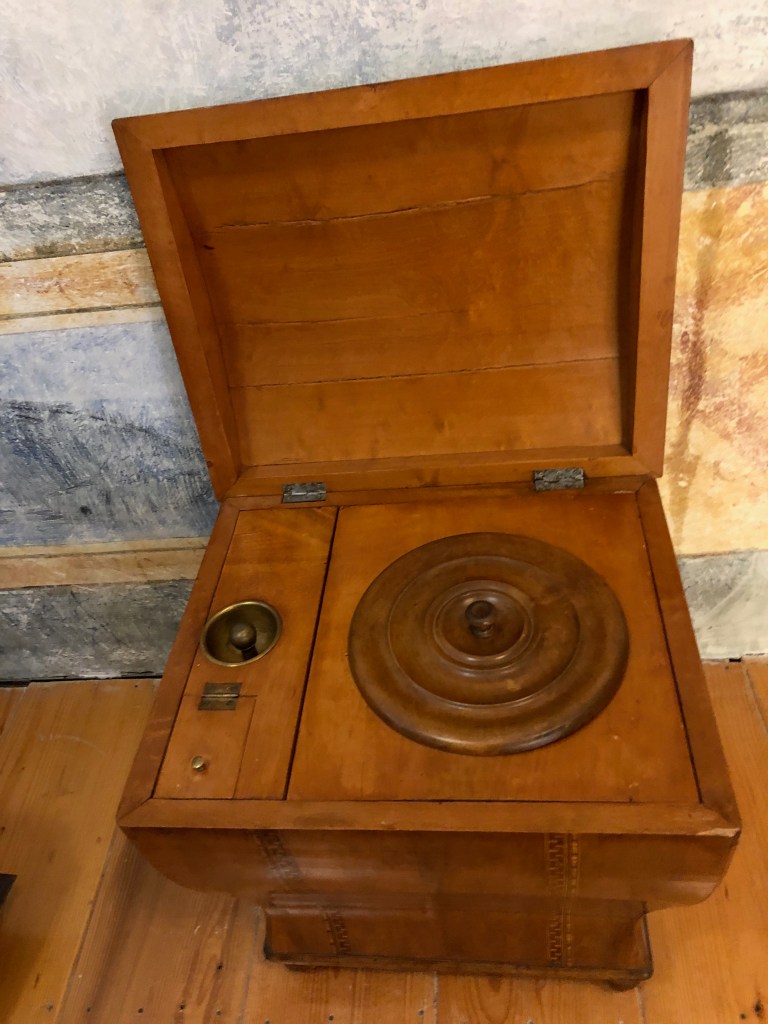
We wandered the waterfront in a wrap-around bay with a big water-polo court roped off (thinking of you, Wyatt) and had lunch in a waterfront restaurant. Cavtat and Dubrovnik produce many of the core players of the national water-polo team.
The hilltop mausoleum by Croatian sculptor, Ivan Mestrovic, was stunning.
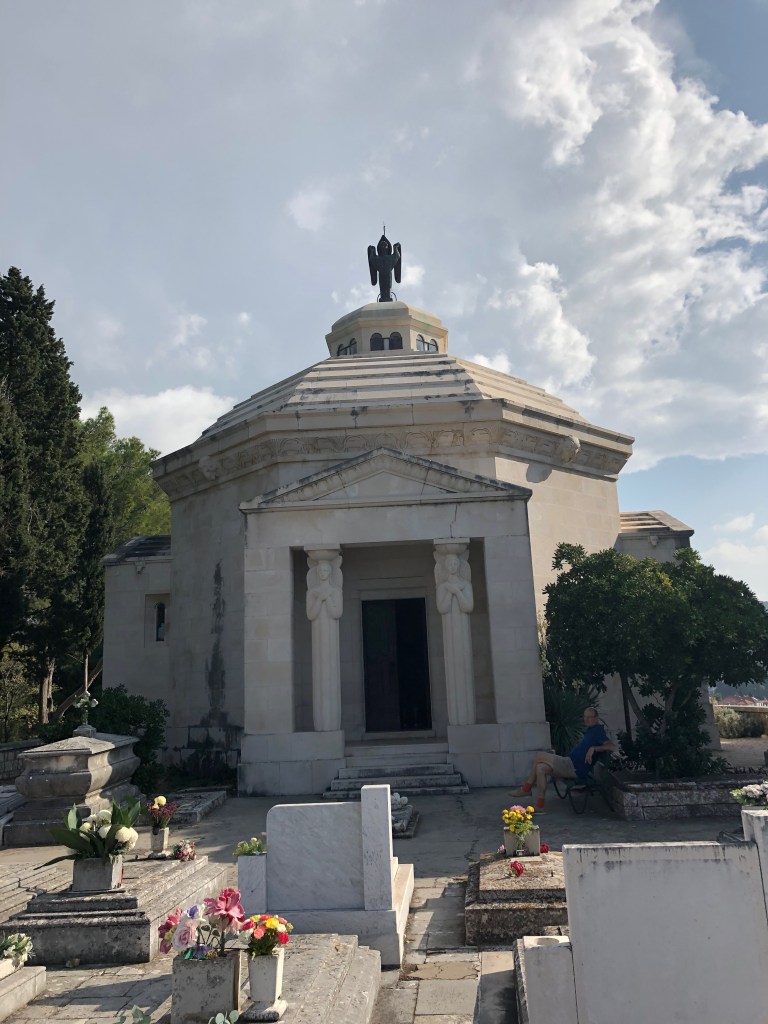
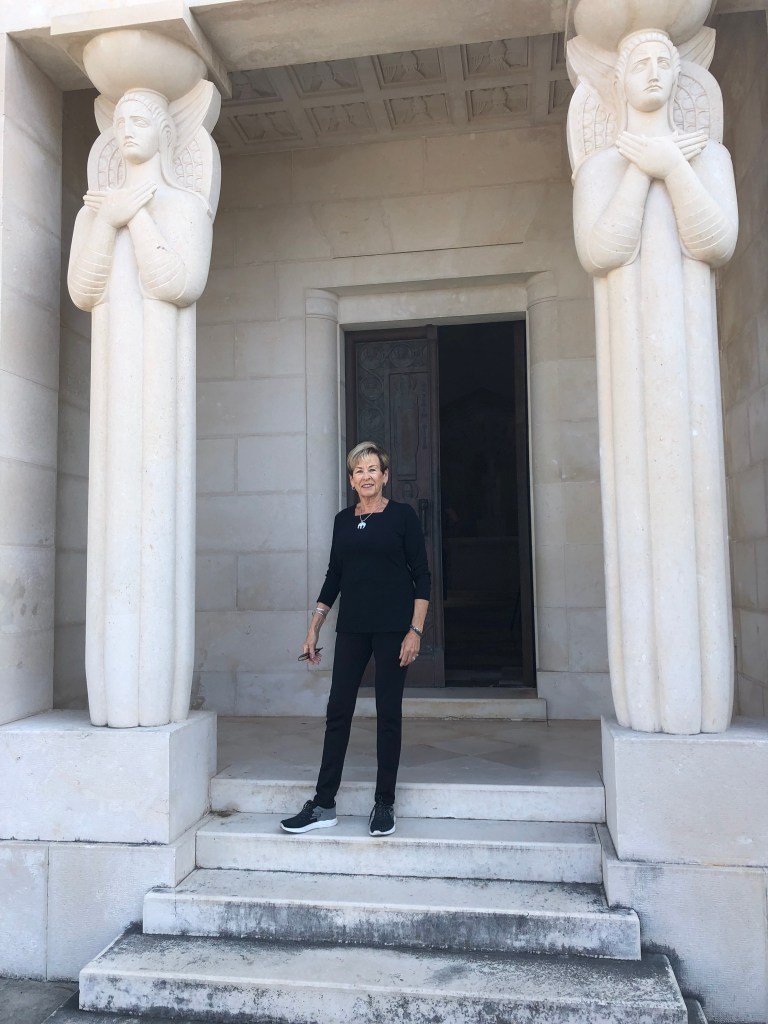
The sculptures for each member of the Racic family who died of the plague were beautiful.
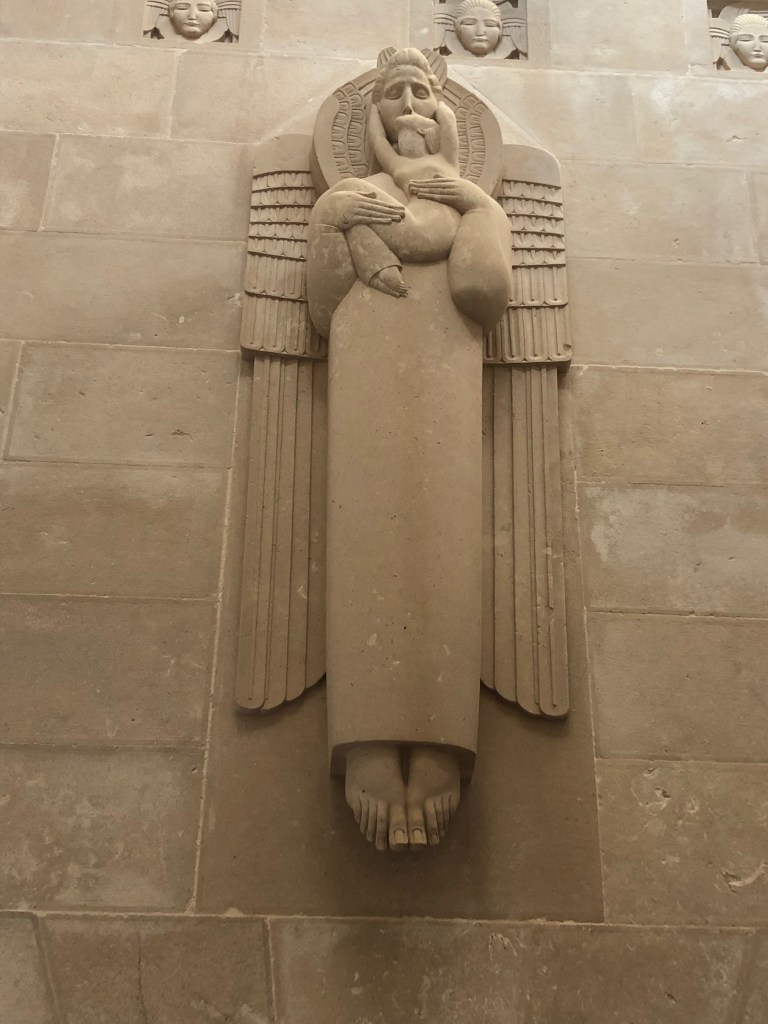
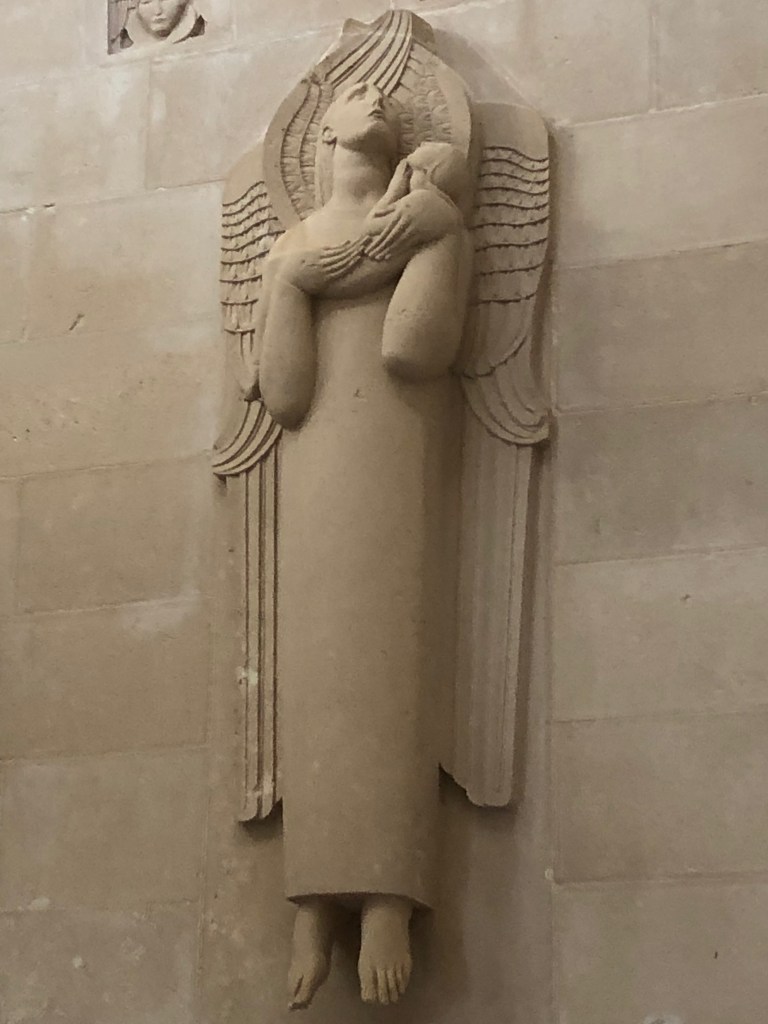
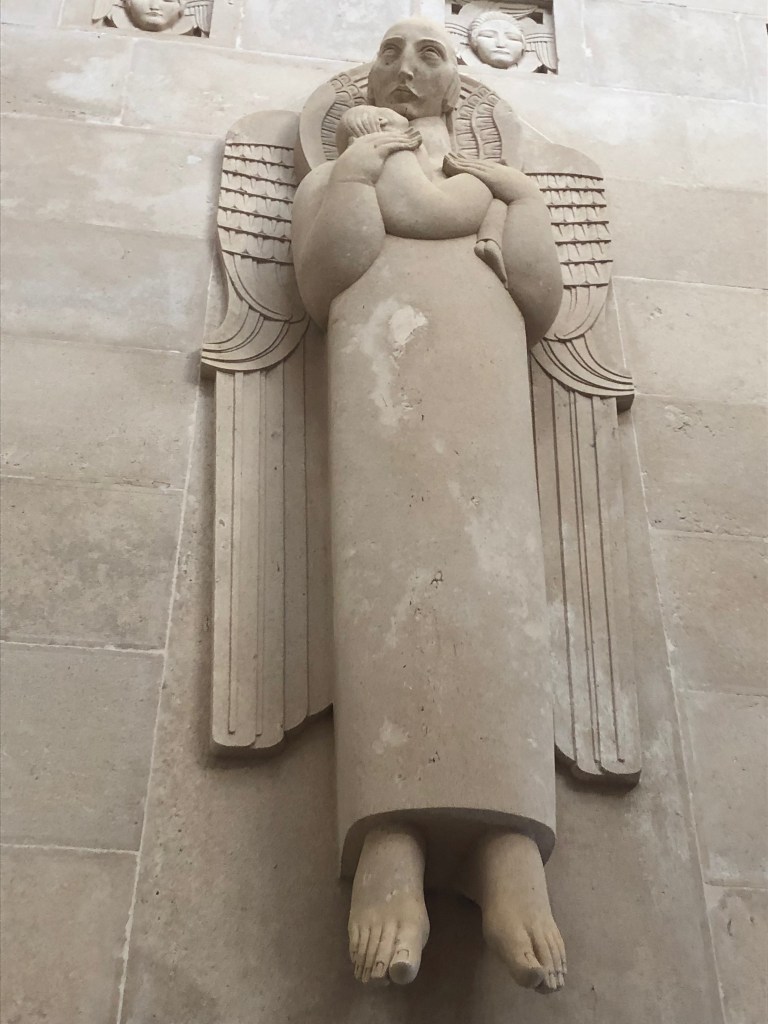
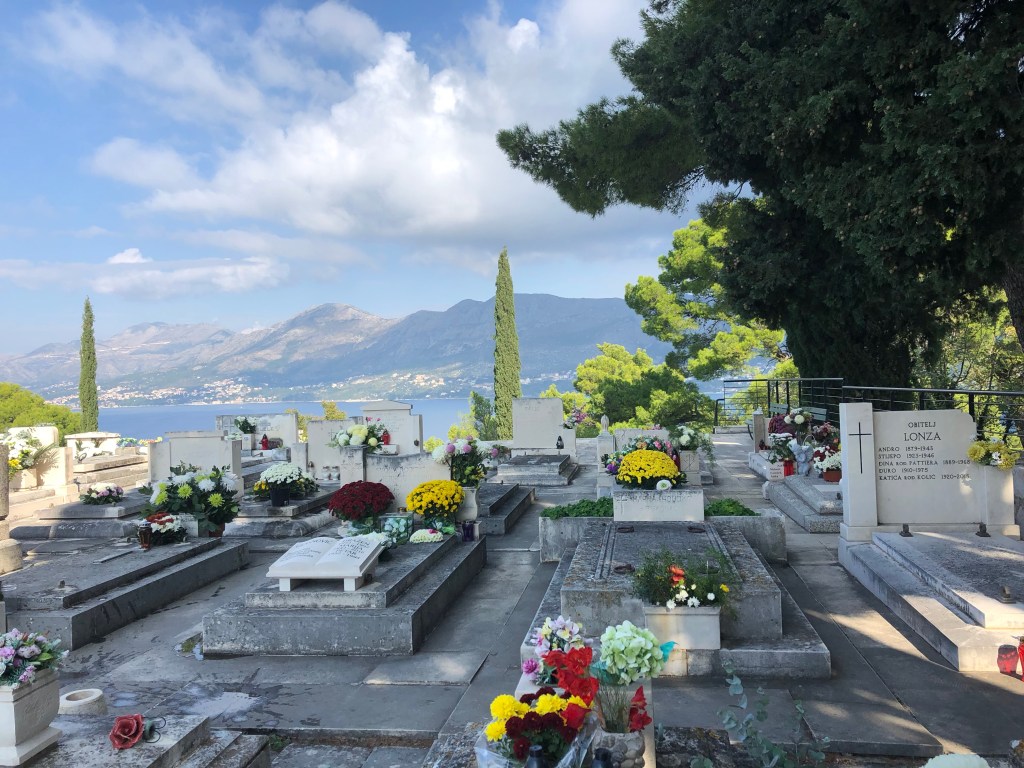
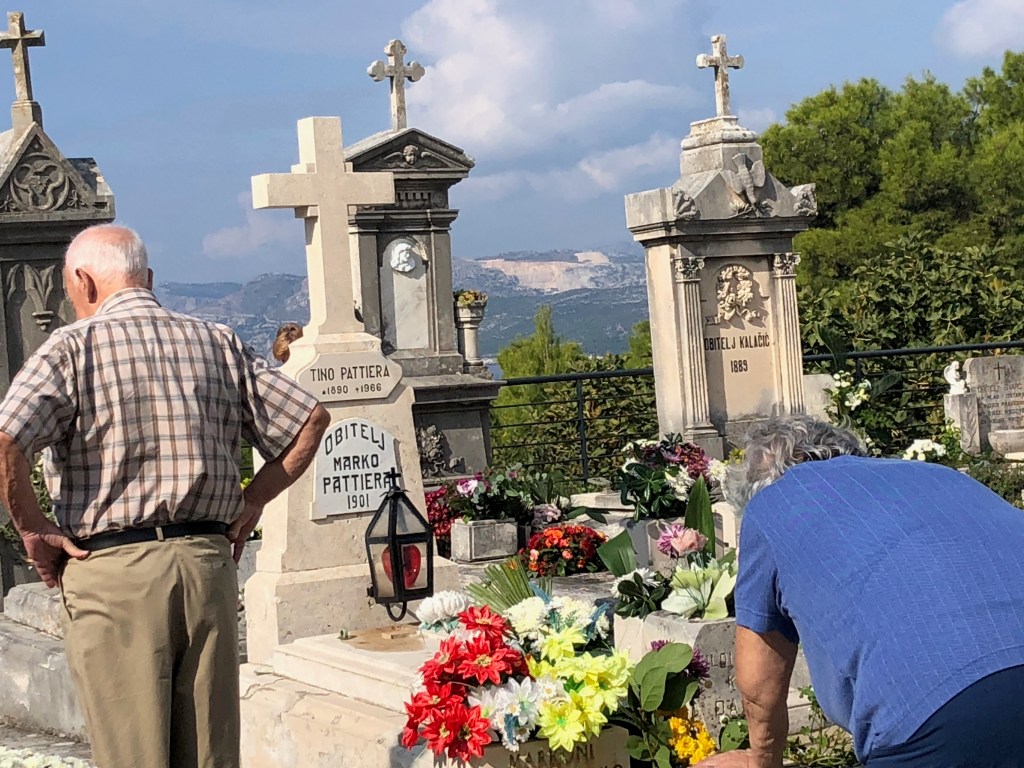
Because we were there just before what is called the Day of the Dead in Spain, the family members were there to put flowers on the graves. We watched one woman walk up the steep hill with canes and then prepare the flowers for the grave. There is a beautiful view of the sea from there.
So, we had a fabulous time in Croatia and Bosnia-Herzegovina. We always have a conversation on the way home about what was the best, most interesting, PMI.
Observations:
- The people were lovely with the exception of some gruff ones like the waiter at La Laterna. Bill asked him a question and he growled.
- The food was generally not the highlight of the trip.
- The wine good, was much better than some of the countries that we have visited in the area.
- The small family-run hotels (sobas) were fabulous. The owners were so kind and helpful.
- There appears to be a lingering tension between the factions that were involved in the war 20 years ago, especially in the south.
- We particularly enjoyed Rovinj, Zagreb, Mostar and Dubrovnik.
- The beds were made with a spread on top and two single-size comforters underneath (so Bill couldn’t hog all the blanket).

 Site Title