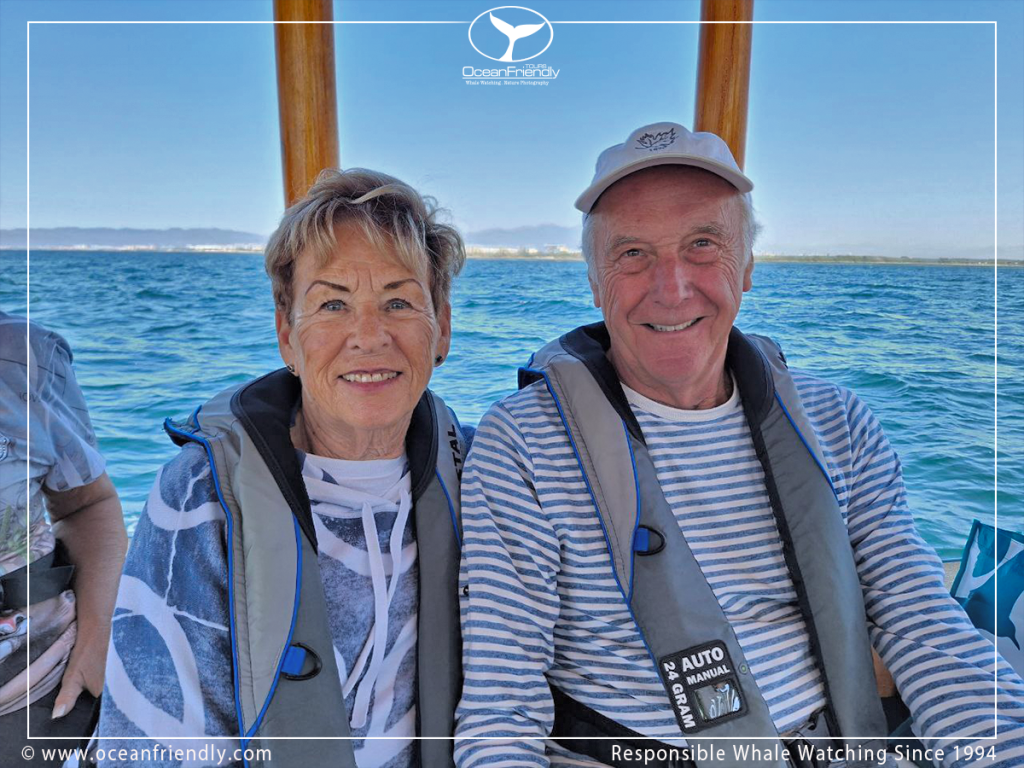
When we were debating where our winter 2025 trip would be, we concluded that we had not been to Central America at all and it seemed the right time. We had always had some concerns about safety especially when the media made much of a Canadian killed or hurt while in Mexico and the violent activities of the drug cartels. Our British Columbia friends, Laurie and Fred, whom we had met both in Turks and Caicos and in Thailand, recommended Mexico as they visited there 2-3 times a year. They gave us their favourite locations and I selected accommodations, flights and airport transportation. I also referenced Lonely Planet’s latest version of “Mexico” and several internet locations.
While we still harboured some concerns based on various divergent opinions from family and friends, we loved Mexico and Mexicans. We made some concessions to safety concerns such as I left my good jewellery at home, tried to stay alert to our surroundings and didn’t go out at night alone in unfamiliar locations – good strategies wherever you travel.
Itinerary Summary
Jan 28 Toronto to Cancun; Cancun to Akumal
January 28 to February 8 (11 nights): Beachfront Condo View Half Moon Bay 72FQLQ, Akumal
Feb 8 Cancun to Puerto Vallarta AeroMexico
Departing At: 08:59 Terminal: TERMINAL 4 Arriving At: 10:35 Terminal: TERMINAL 2
Departing At: 13:45 Terminal: TERMINAL 2 Arriving At: 15:34 Terminal: Not Available
February 8 to 15 (7 nights): Puerto Vallarta: Luxury 1BR Condo – Rooftop Pool – Bay View
Feb 15 to Mar 1 (14 nights) Bucerias: New 1 BR Condo with Amazing Rooftop Pool – Jacuzzi
March 1 Bucerias to Puerto Vallarta flight to Cancun AeroMexico
Mar 1-3 Isla Mujeres: Condo in Isla Mujeres
| Mar 3-5 Cancun: Luxury Design Apartment Suite Tierra with Pool March 5 Cancun to Toronto |
Full Itinerary
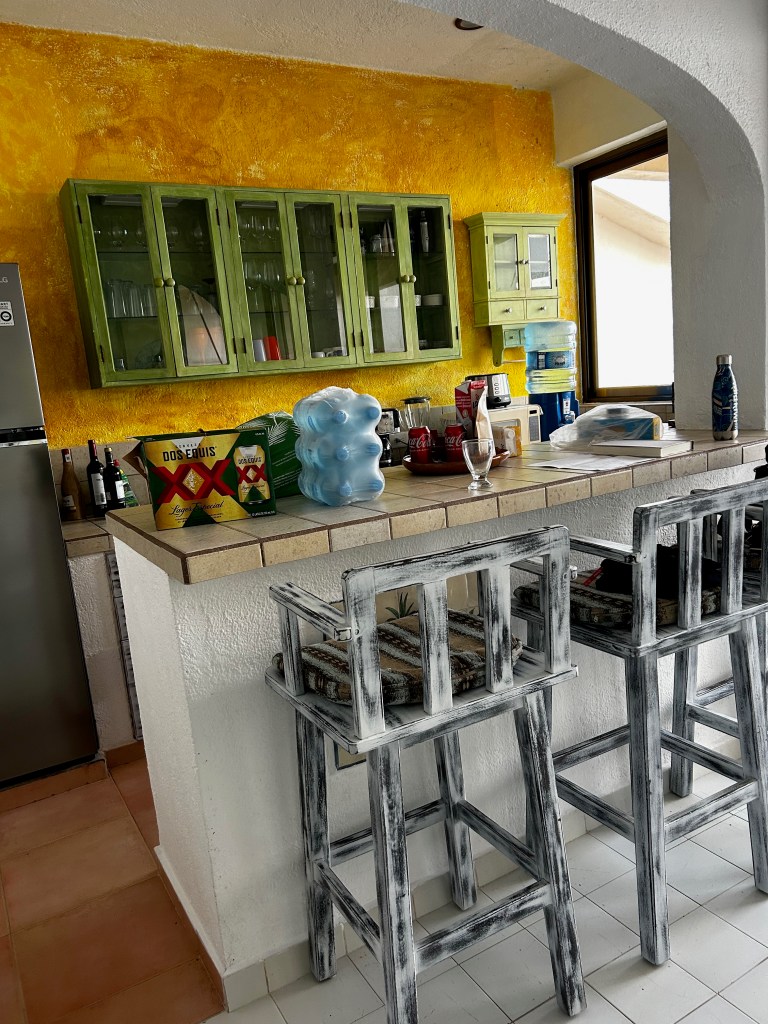
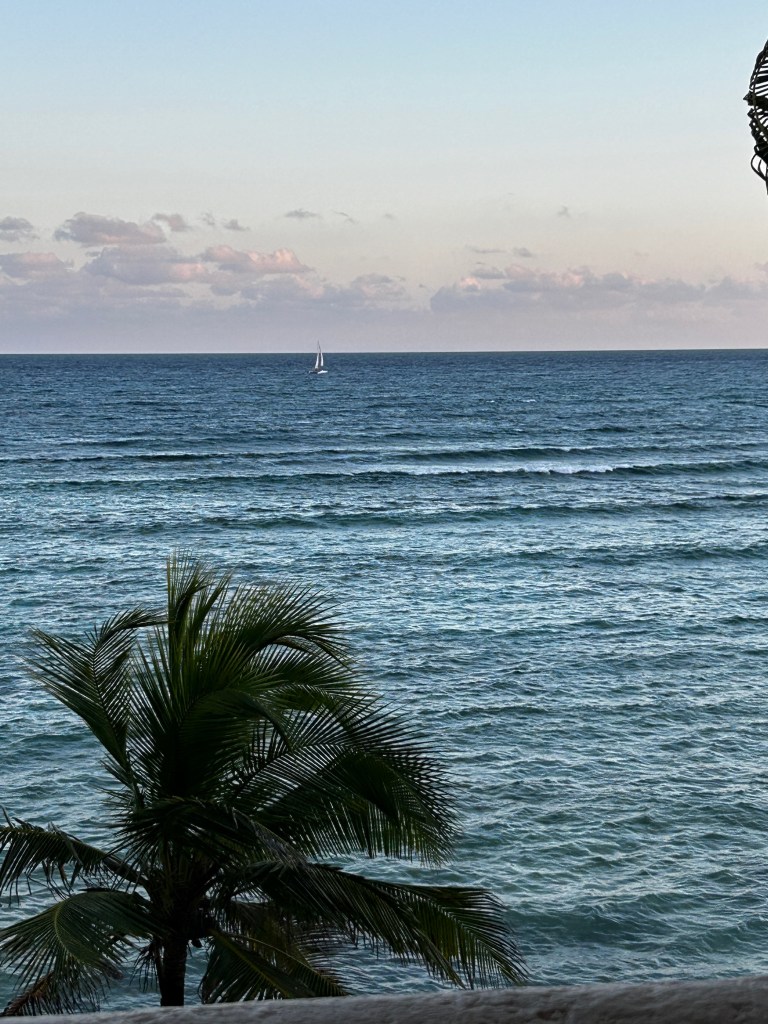
Our flight, Toronto to Cancún – AC 930Jan 28, 2025, 8:40 AM–1:00 PM, departed an hour late because it was a full plane and the need for de-icing but arrived almost on time. Our luggage was the last to arrive so that was an irritant. Then we struggled to find the taxi driver in the crowd of them outside the terminal. Namaste Transportation was the service and Joel was the driver. It was an hour and a half to Akumal and we stopped to get a few groceries. Arriving at dusk (5:30), a man met us with the keys and helped us carry up the luggage to the third floor; we stored the groceries, looked around the condo, saw the view from the balcony and walked down to the beach.
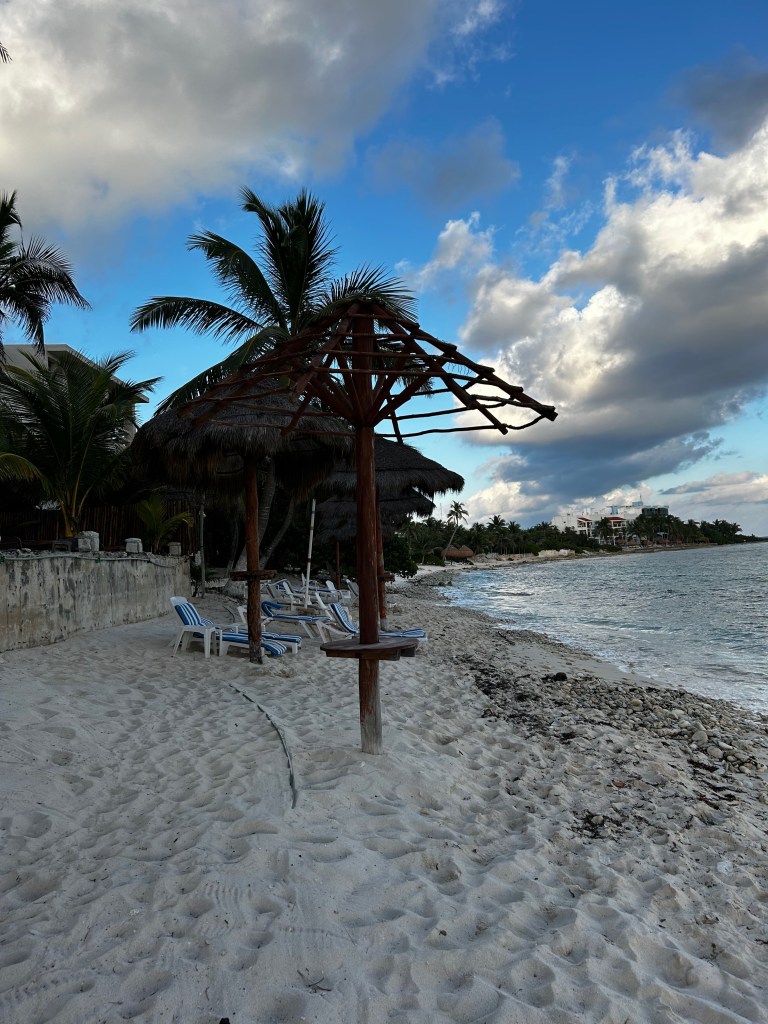
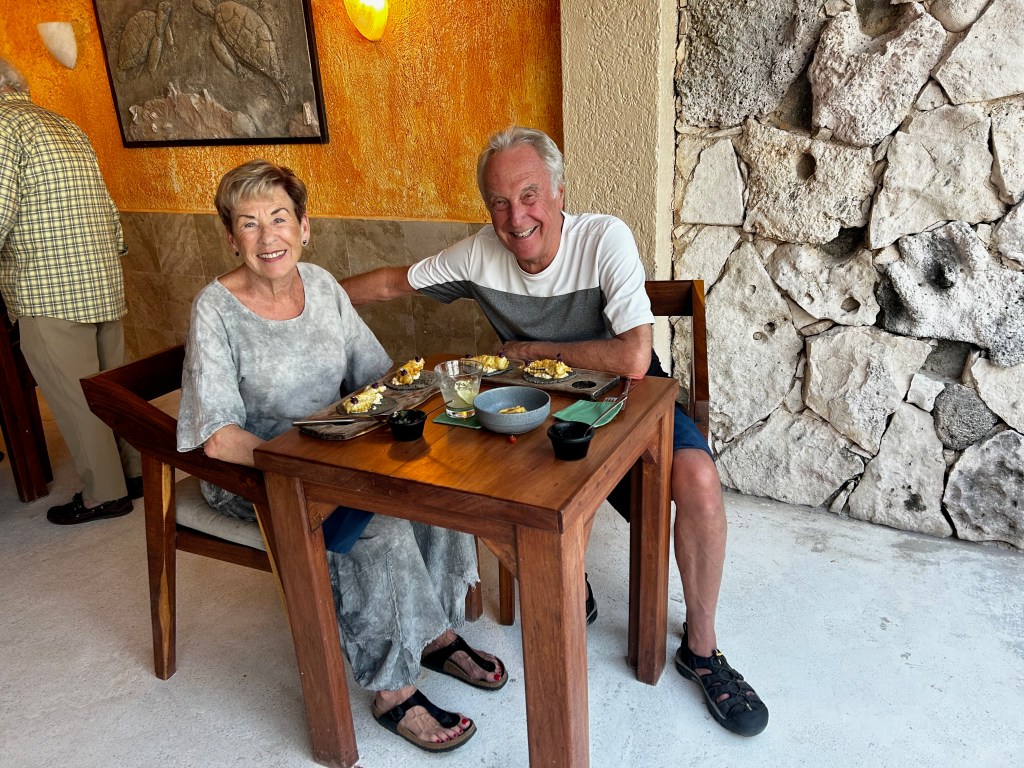
We had dinner at the on-site restaurant, La Lunita. Bill had Pad Thai and I had Hogfish-mine was very good; his: OK.
January 28 to February 8 (11 nights): Vrbo: Beachfront Condo, Direct Ocean View, Half Moon Bay 72FQLQ- Akumal, Quintana Roo, MX
From host, Cherri. Address: Hacienda de la Tortuga, Carretera Cancun Tulum kilometro, 105 Bahía de la media Luna camino a Yalku, Akumal Tulum C.P. 77776 MEXICO Q. ROO .
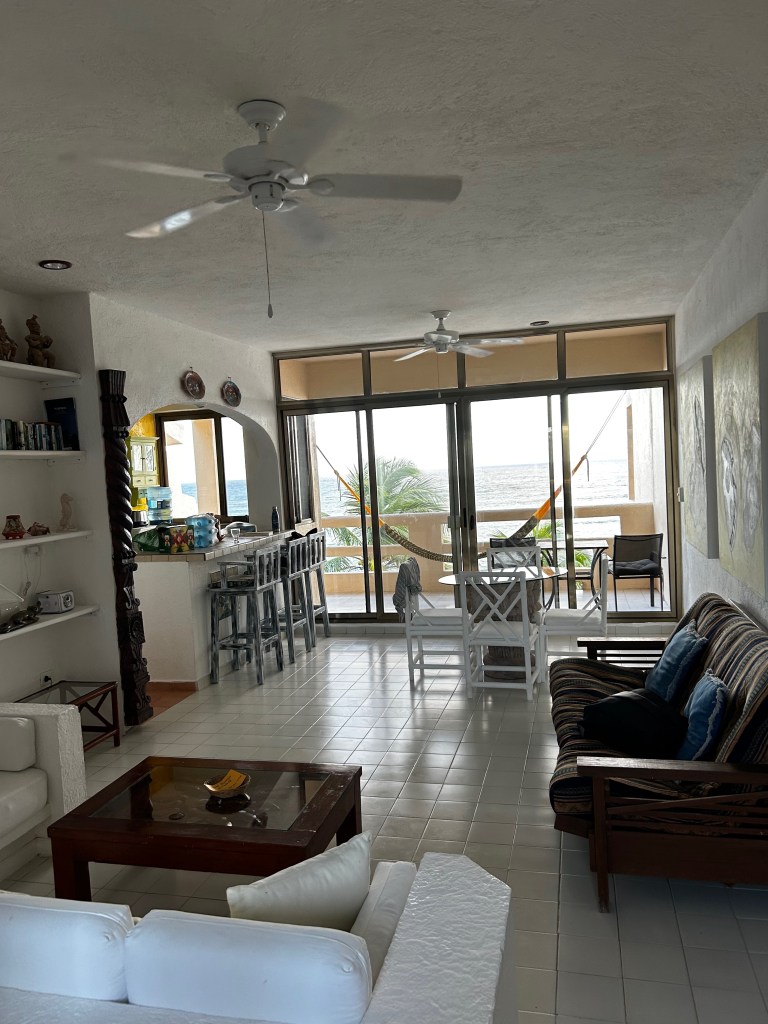
- The condo is right on the beach overlooking Half Moon Bay, 900 sq ft, there is a full master bedroom, bathroom, living room dining area, fully equipped kitchen and balcony with a hammock and outdoor furniture overlooking the sea. A few extras also Included in your stay are daily maid service, purified water delivered free of charge to your condo daily, beach towels, free parking, free WIFI (but no TV service except DVDs and limited snorkelling equipment).
- It’s a beautiful white sand beach in a lovely coral cove with fantastic snorkeling. Note that we found it extremely difficult to get into and out of the water because of the waves and rocky bottom.
- The large balcony was a favorite spot with its amazing ocean view.
Wednesday, January 29
Wednesday was what Bill calls a “low-production day” as we were both tired. It was windy most every day.
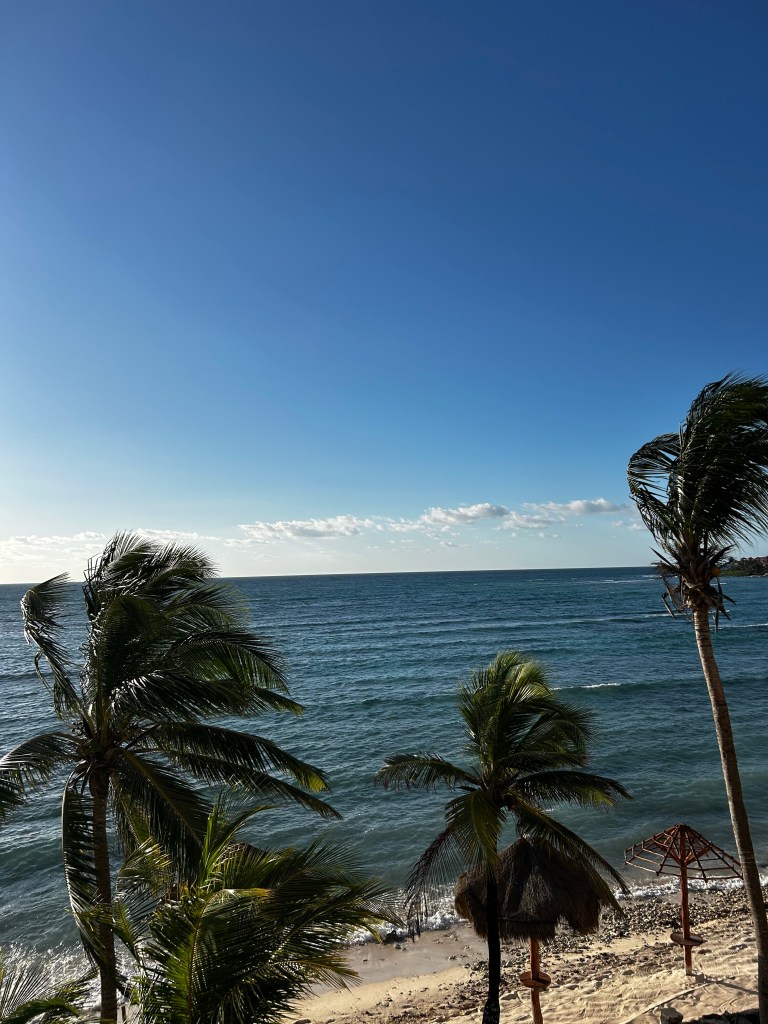
We walked to The Buena Vida Beach Bar, a short walk south on the beach. The view is awesome; the food, pretty good.
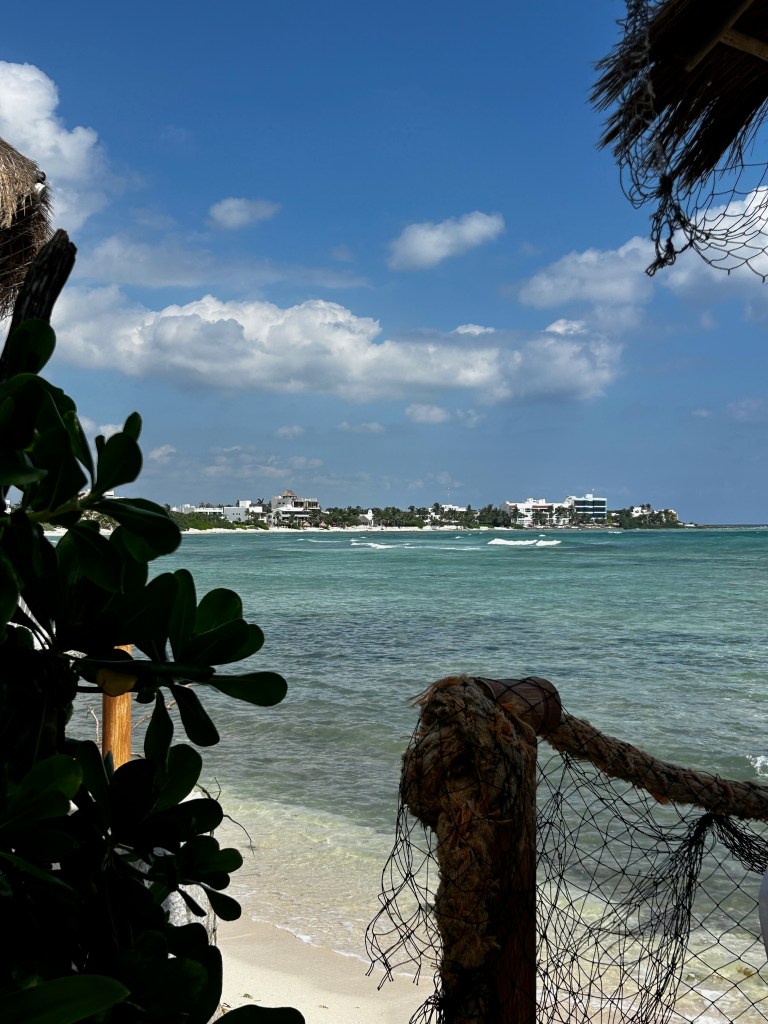
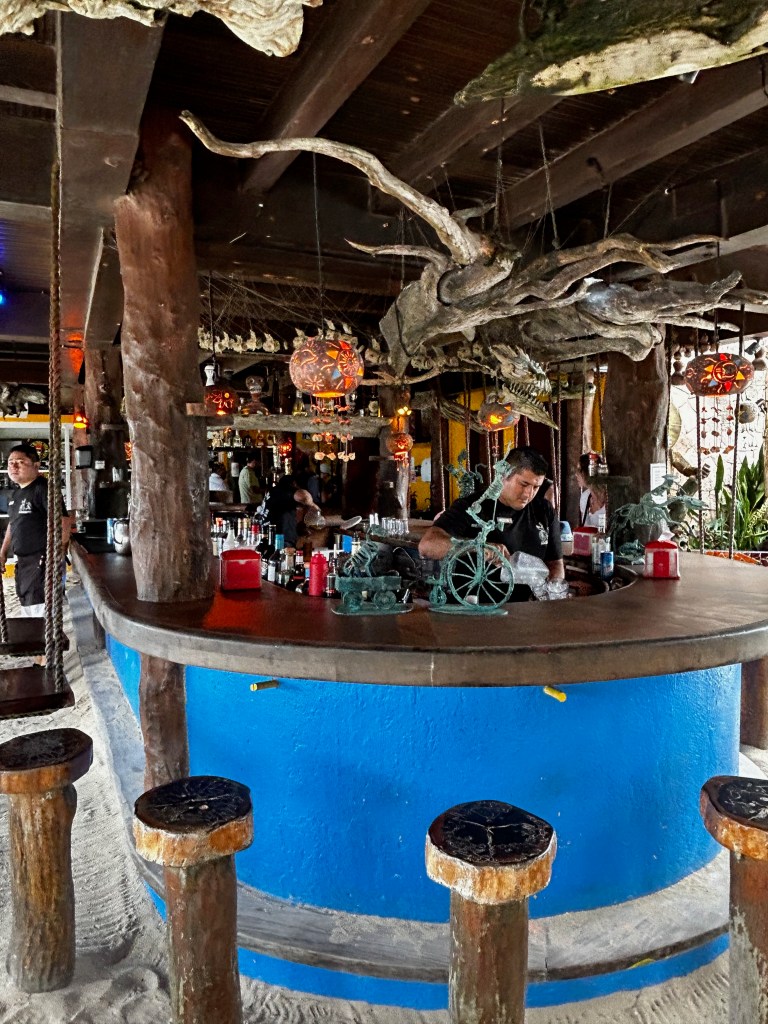
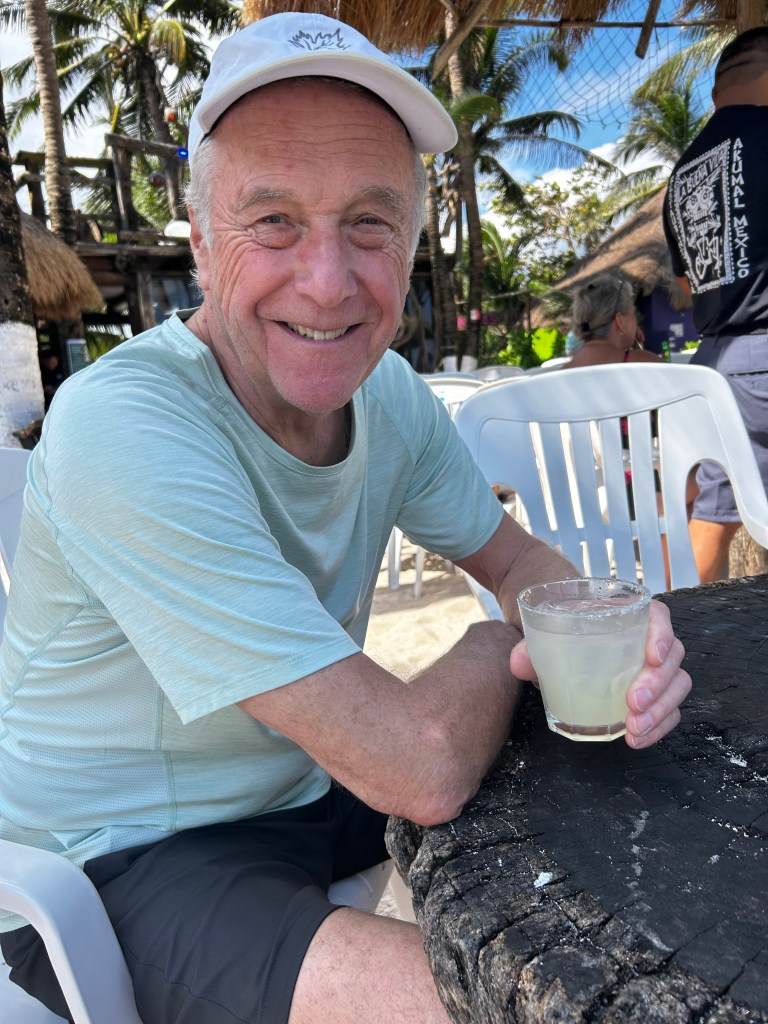
After a warm walk back in the midday sun, we had a dip in the pool.
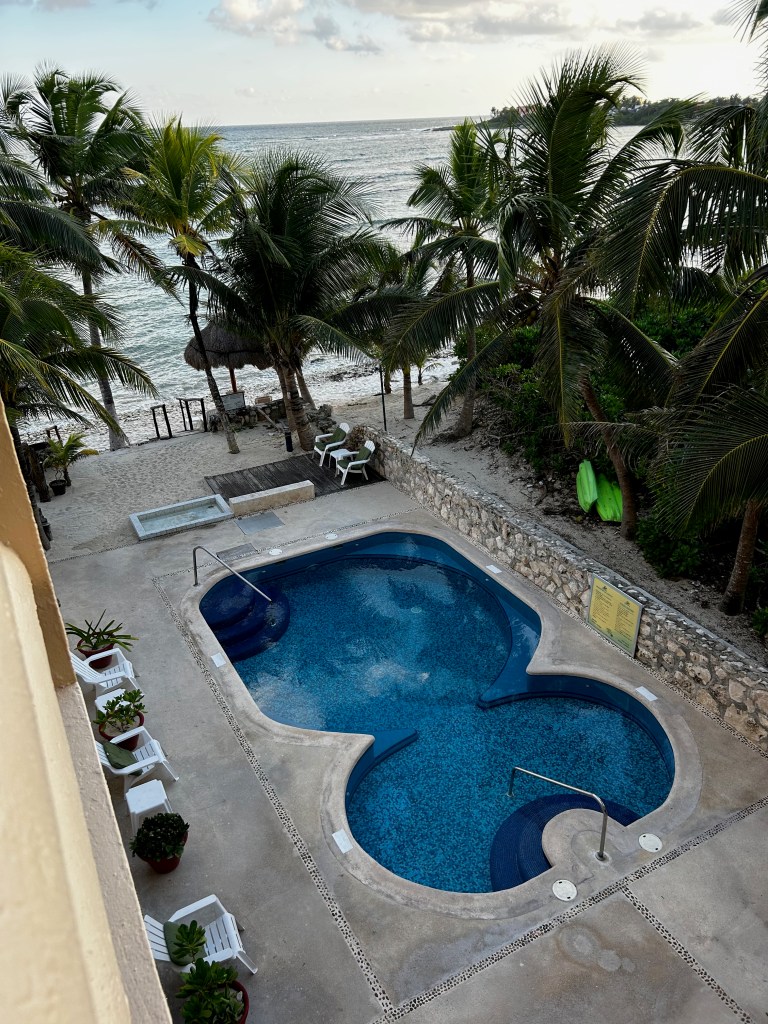
Thursday, January 31
We are picked up by Miguel, owner of Namaste Transportation, at 6:30 am for our trip to Chichen Itza, the best restored Mayan ruins in the Yucatan Peninsula. It was a 2 and a half-hour trip on mostly poor narrow roads except for a short time on a toll road.
The Maya and Chichen Itza
Chichen Itza is one of the main archaeological sites on the Yucatan Peninsula, in Mexico. It was and is still a sacred city and Mayan pilgrimage center founded by the Itza, the so-called water sorcerers, in the 5th century AD. The name Chichen means “mouth of the well” and Itza refers to those who founded it, the Itzaes “witches of the water”, around the year 435.
In Mayan society, the Halach Uinic or ruler of divine and hereditary character, lived in the palaces, along with priests and nobles who performed administrative tasks. Within the elite there were treasurers, scribes, architects and warriors, trades faithfully embodied in the murals, bas-reliefs and ceramics of the place.
For their part, farmers, weavers and artisans lived in surrounding villages and came to the city to go to the market and attend the religious celebrations that populated their precise calendars. The Mayans used two: one solar and the other ritual. The solar calendar, more exact than any other, was divided into 18 months of 20 days, plus 5 dark days, which were called uayeb (no name). The ritual calendar, or Tzolkin, was 260 days, 20 months of 13 days and was used for divination. The conjugation of the two calendars resulted in a period of 52 years, whose western equivalent could be the century.
Religion presided over the daily life of the Mayans, and their bulging pantheon of gods was related to the forces of nature. In fact, one of the most important activities of Chichén Itzá was its role as a sacred city and pilgrimage center, a function that it retained beyond its survival. The Sacred Cenote (well) has witnessed this: it was a place of offerings of gold, jade, shell or wood, as well as human sacrifices.
The evidence of a long-forgotten civilization was everywhere: Beneath a Spanish convent. Underneath a street. Most of it was covered in vines and vegetation, reclaimed by the jungle. But as a pair of British-American explorers combed through the Yucatan Peninsula in the 1830s and 1840s, they soon became convinced the mysterious sites were major archaeological treasures.
The ruins in question were the remnants of the Maya, a towering Mesoamerican civilization that had once covered much of Central America, from northern Belize through Guatemala and southern Mexico. Much more is now known about the group responsible for some of the greatest feats of its kind: Maya people cultivated the region’s first crops and domesticated its wildlife, built its first cities, and either created or refined almost every aspect of modern civilization.
During the Classic period (200-900 A.D.), the Maya civilization reached its peak. So did its architecture: the Maya refined its pyramid-like temples and grand buildings that appear to be palaces, though it’s unclear if they were actually used as elite residences or if they served some other function.
Our visit: We arrived shortly after opening around 8:30 and were met by our guide, Jesus. He spent considerable time explaining the mathematical genius of the Mayans in the construction of their temple structures and of the system of the calendar and seasons based on the sun. Upon entering, the Pyramid of Kukulean (aka El Castillo) rises in front of you. Build on a former temple around 800 CE, the 30 m-high structure has a plumed serpent sculpted along the stairways and Toltec warriors in the doorway carvings at the top of the temple. While we did not see it, the pyramid is lit at night and shows the serpent moving along the stairs as it did at equinoxes for the Maya.
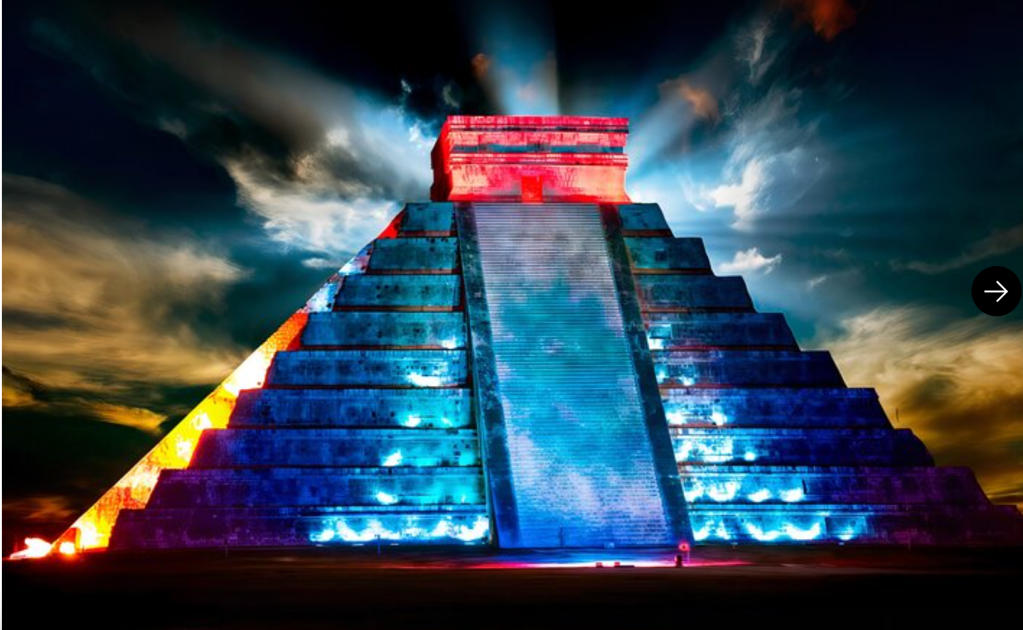
Jesus also explained how the rulers were able to create illusions that controlled the behaviours of the farmers. One example he gave was about the bird that only sang in the spring and fall: the rulers figured out that if you clapped your hands on the ground near the temple that the sound reverberated to sound like the bird so they could make the sound any time they wished and encourage the farmer to work at planting and harvesting all the time.
Following the conquest of the Yucatán a new style blending the Maya and Toltec traditions developed, symbolizing the phenomenon of acculturation. Chichen-Itza is a clear illustration of this fusion. Specific examples are, in the group of buildings such as El Castillo (also known as the Temple of Kukulkan).
Surrounding El Castillo are terraces where the major monumental complexes were built: on the north-west are the Great Ball Court, Tzompantli or the Skull Wall, the temple known as the Jaguar Temple and the House of Eagles; on the north-east are the Temple of the Warriors, the Group of the Thousand Columns, the Market and the Great Ball Court; on the south-west is the Tomb of the High Priest.
After the 13th century no major monuments seem to have been constructed at Chichen-Itza and the city rapidly declined after around 1440 A.D. The ruins were not excavated until 1841 A.D.
The town of Chichen-Itza was established during the Classic period close to two natural cavities (cenotes or chenes), which gave the town its name “At the edge of the well of the Itzaes”. The cenotes facilitated tapping the underground waters of the area. The dates for this settlement vary according to subsequent local accounts: one manuscript gives 415-35 A.D., while others mention 455 A.D.
The second settlement of Chichen-Itza, and the most important for historians, corresponded to the migration of Toltec warriors from the Mexican plateau towards the south during the 10th century. According to the most common version, the King of Tula, Ce Acatl Topiltzin Quetzalcoatl, or Kukulkan as the Maya translated the name, reportedly took the city between 967 A.D. and 987 A.D.
Following the conquest of Yucatán a new style blending the Maya and Toltec traditions developed, symbolizing the phenomenon of acculturation. Chichen-Itza is a clear illustration of this fusion. Surrounding El Castillo are terraces where the major monumental complexes were built: on the north-west are the Great Ball Court, Tzompantli or the Skull Wall, the temple known as the Jaguar Temple, and the House of Eagles; on the north-east are the Temple of the Warriors, the Group of the Thousand Columns, the Market and the Great Ball Court; on the south-west is the Tomb of the High Priest.
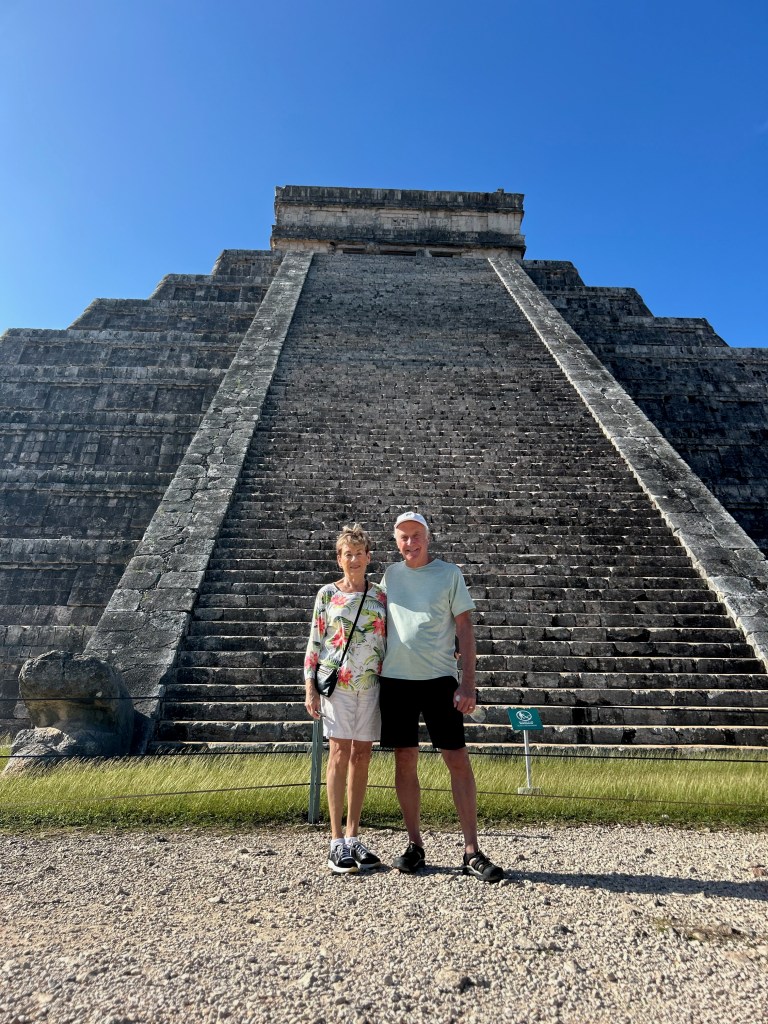

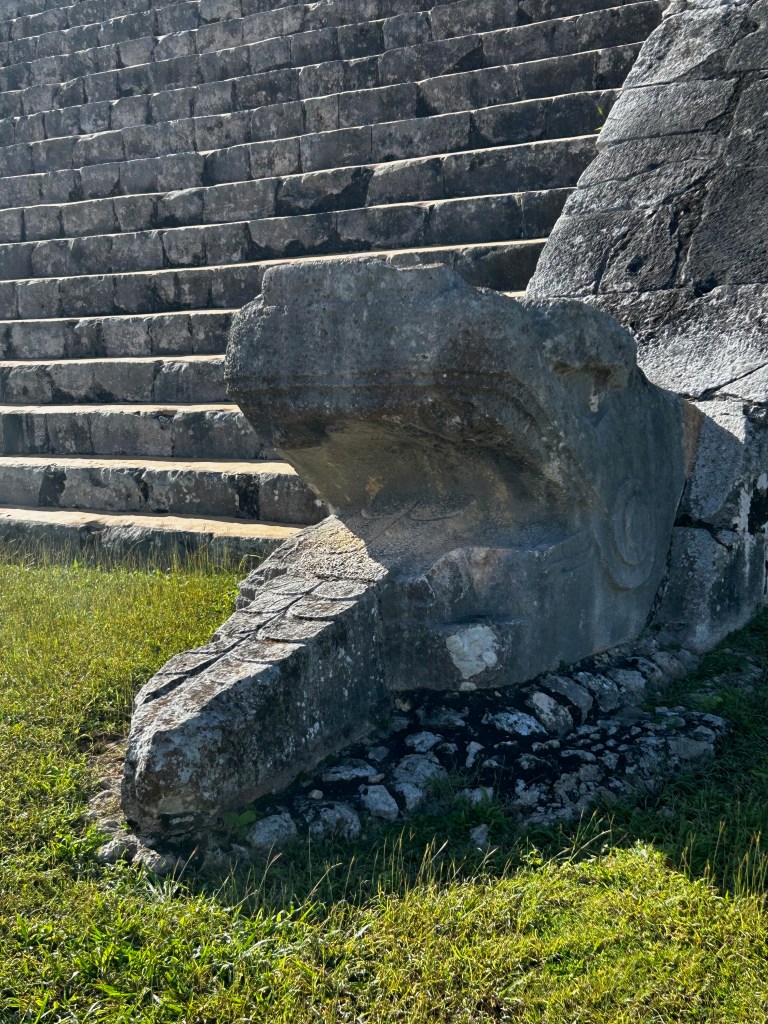
The Mayan city of Chichen Itza was built out of limestone blocks chiseled out of nearby quarries. The blocks were so finely cut that they fit together without mortar. The sheer weight of the limestone stabilizes the structures, some of which are nearly 1,000 years old.
This UNESCO World Heritage Site (2007) has elements of both the Mayan and Toltec architectural styles. One of the most noted structures is El Castillo, the stepped pyramid of Kukulkan. The pyramid is covered with carvings, including the outlines of twin snakes along the staircase, leading to carved serpent heads at the bottom. The structure is actually a massive Maya calendar formed in stone. Each of El Castillo’s nine levels is divided in two by a staircase, making 19 separate terraces that commemorate the 18 20-day months of the Maya Vague Year. The four staircases have 91 steps each; add the top platform and the total is 365,. the number of days in the year. On each facade are 52 flat panels, reminders of the 52 years in the Maya calendar.
Evidence exists that some of the carved walls were painted in bold colours, but today the intricate carvings of battle scenes and various deities are mostly bare stone.
The Plaza de Mil Columnas features a forest of pillars stretching south and east.
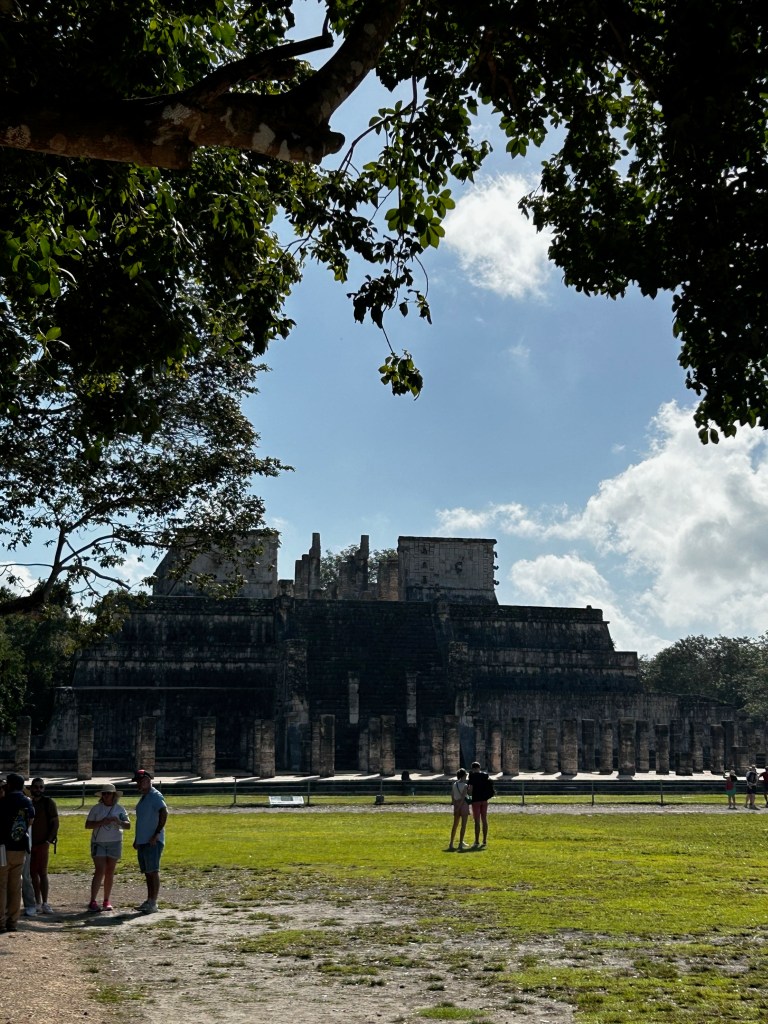
The Platform of Venus has huge ornate and well-preserved plumed serpent heads extending on either side of the staircases. It’s thought that from the top of the platform, the planet Venus would be tracked, an important aspect of the Mayan calendar.
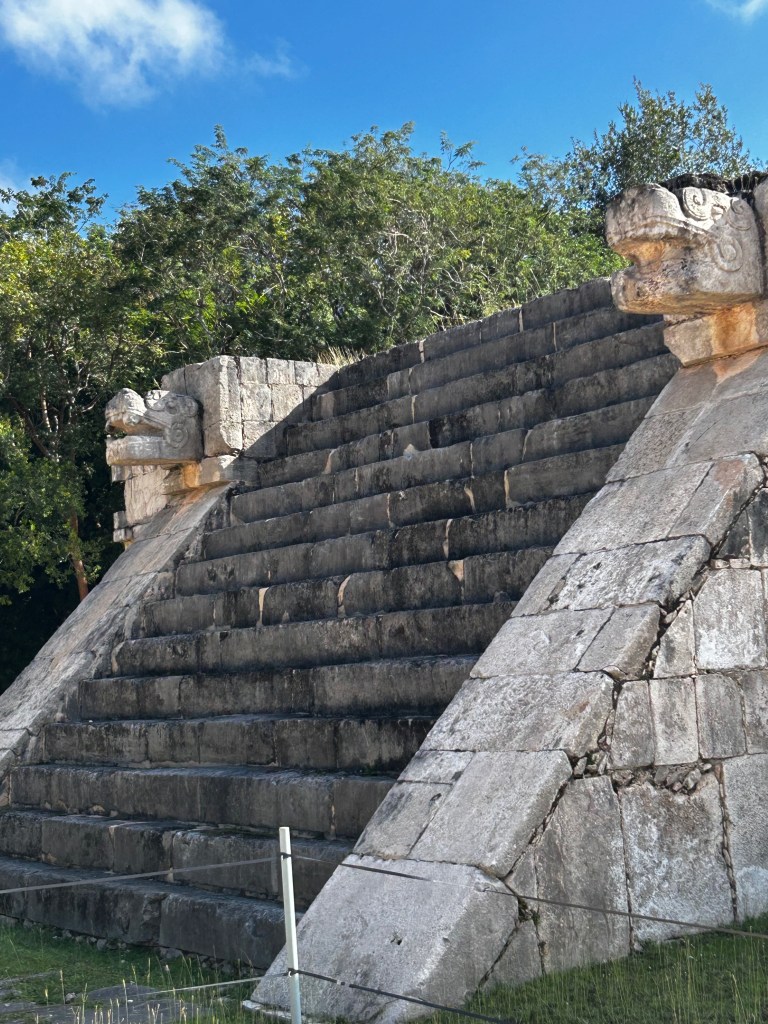
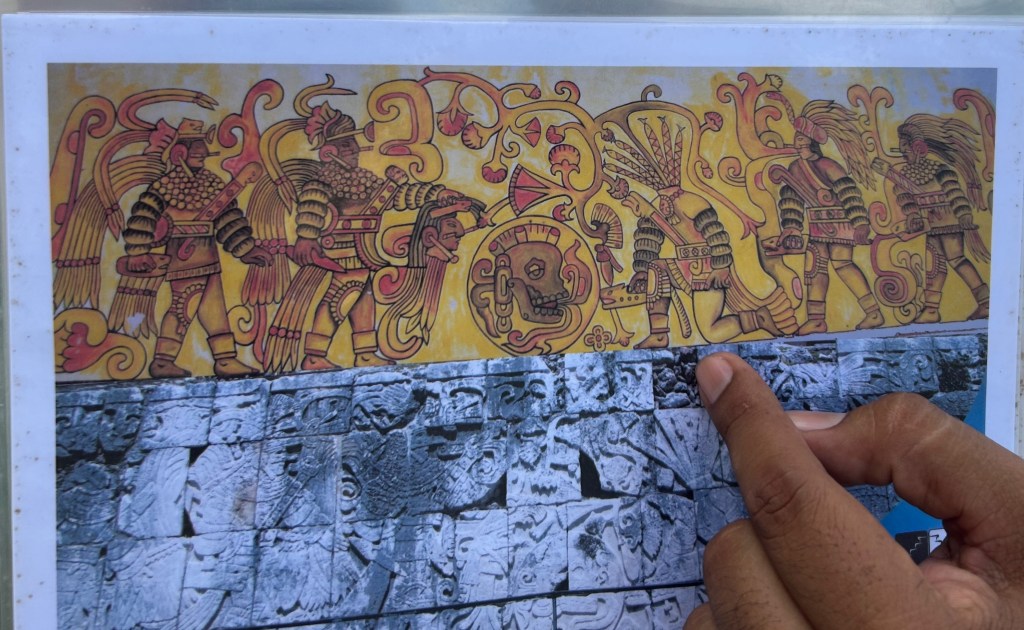
The carvings on the Platform of the Eagles and Jaguars depict those animals gruesomely grabbing human hearts in their claws. It’s thought that this platform was part of a temple dedicated to the military legions responsible for capturing sacrificial victims.
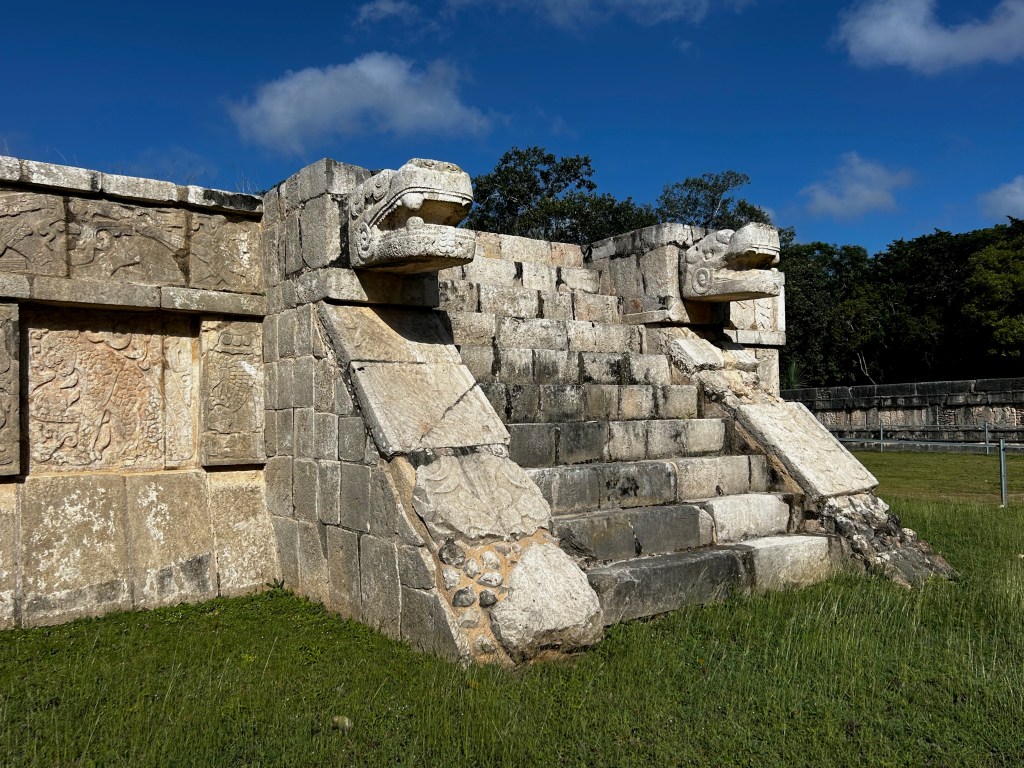
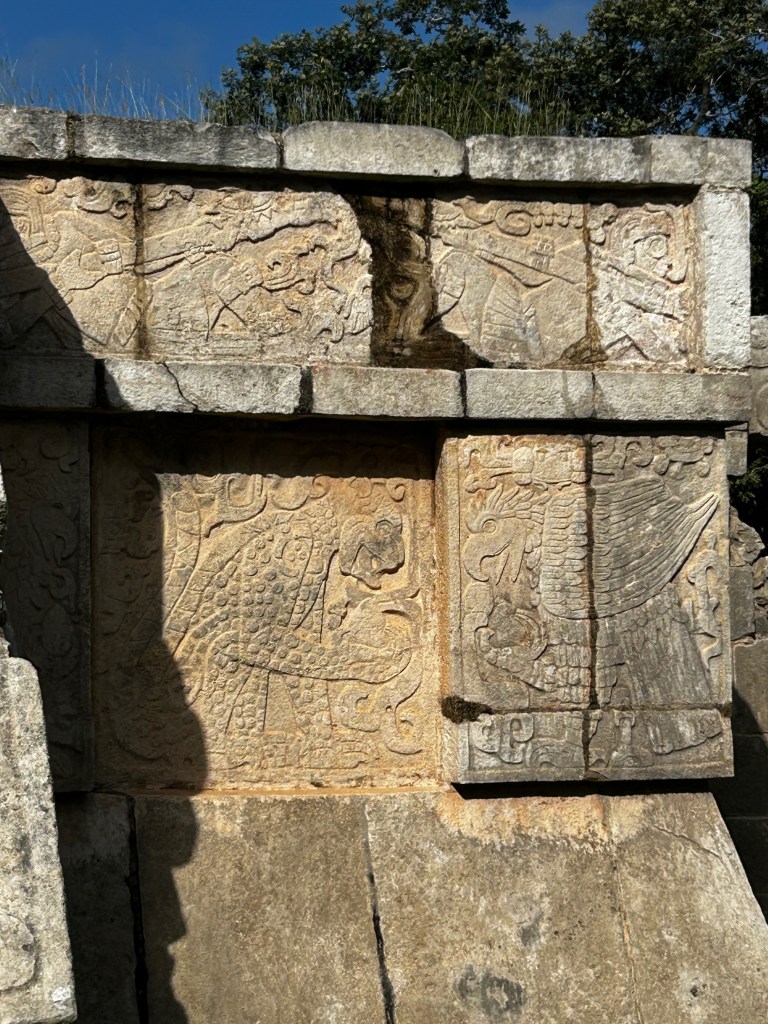
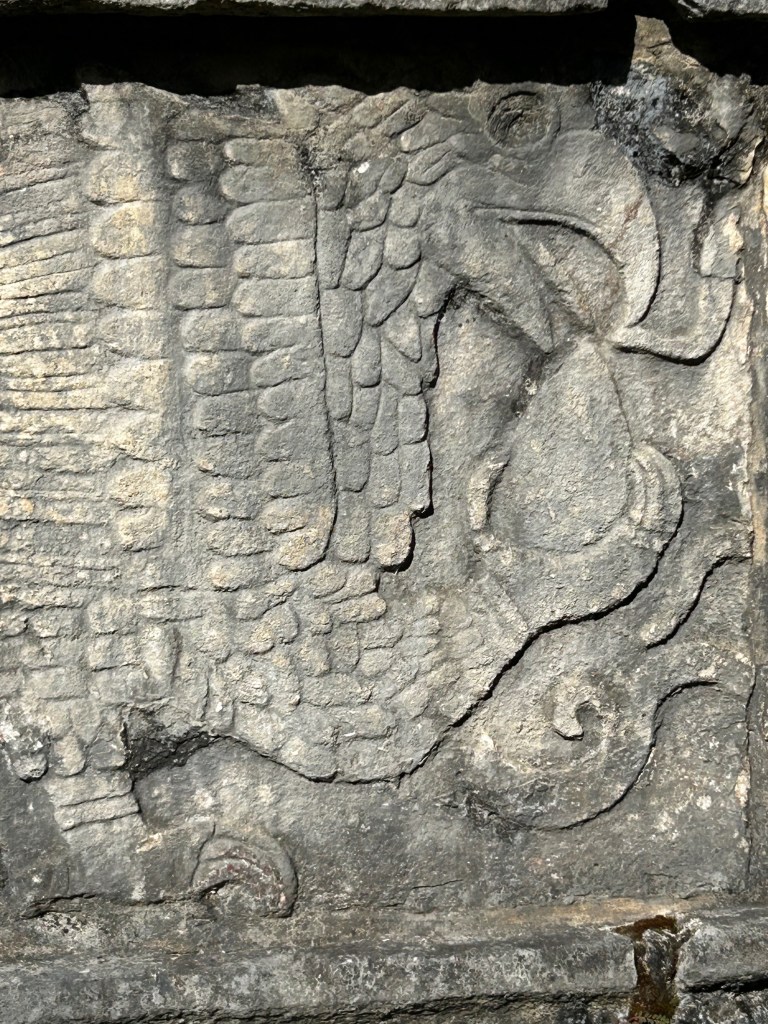
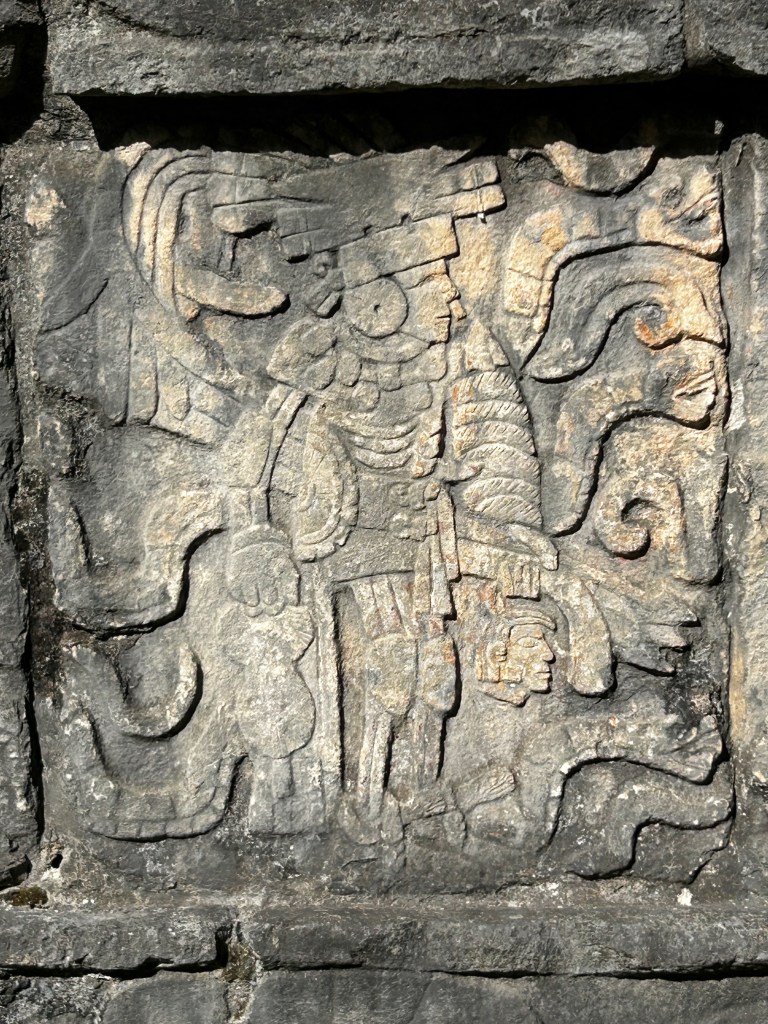
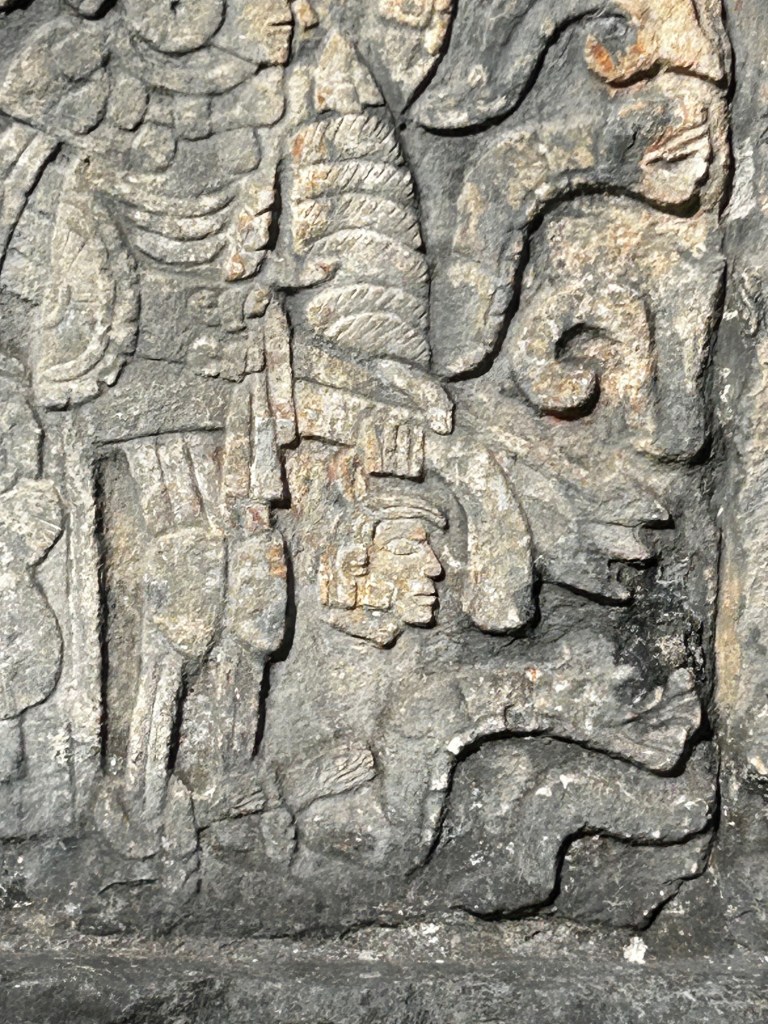
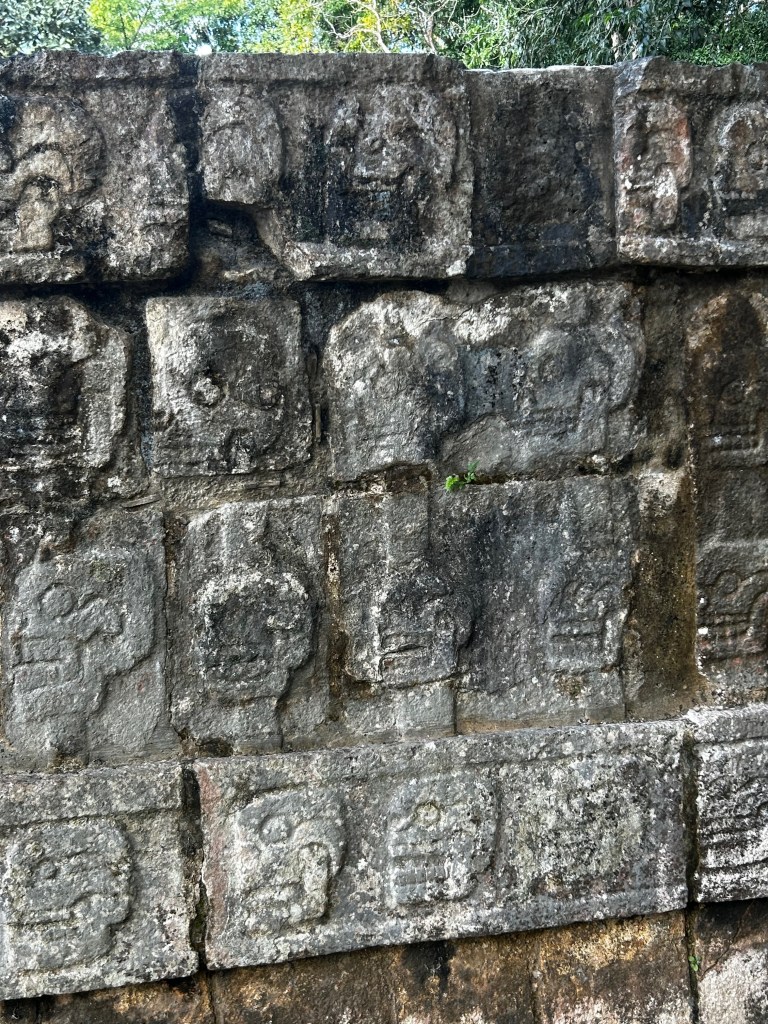
The Platform of Skulls is covered with carved skulls and was used to display the heads of sacrificial victims.
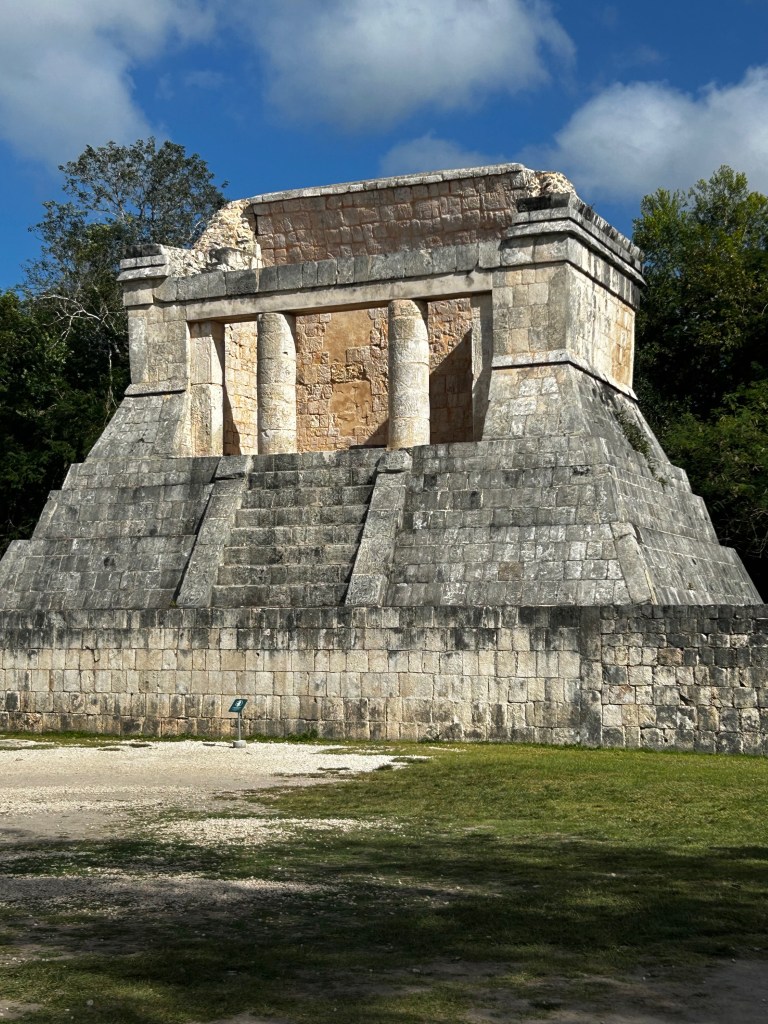
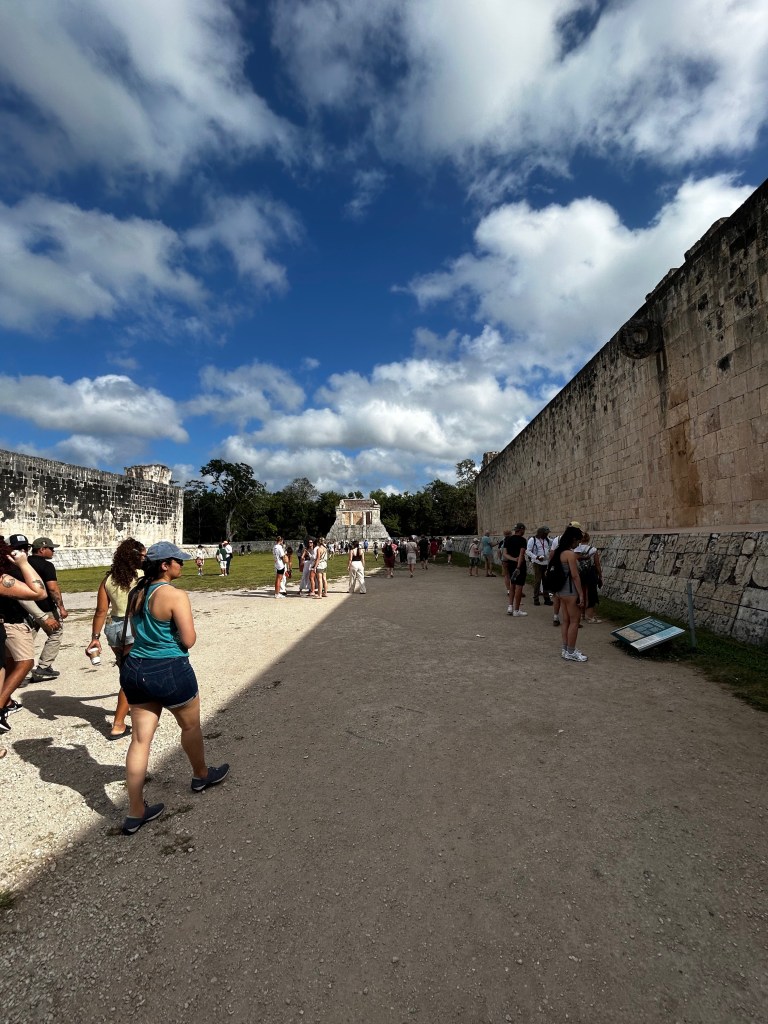
Gran Juego de Pelota is the largest and most impressive ball court in Mexico. Temples flank each end, while the ball courts towering parallel walls are lined with stone reliefs, including scenes of decapitating players.
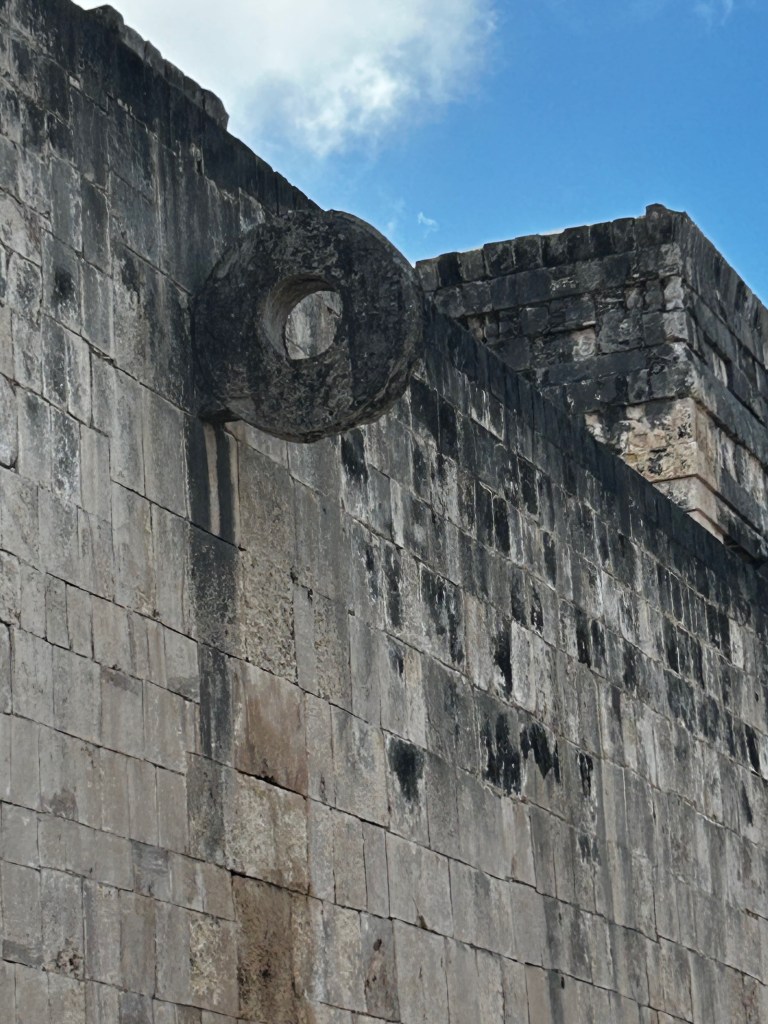
The game was to get the ball through the stone circle on the side via the racket and body part of the player, except hands. The problem was that it was difficult to do and rarely happened: Bill equated it to cricket where games go on for days and nobody scores.
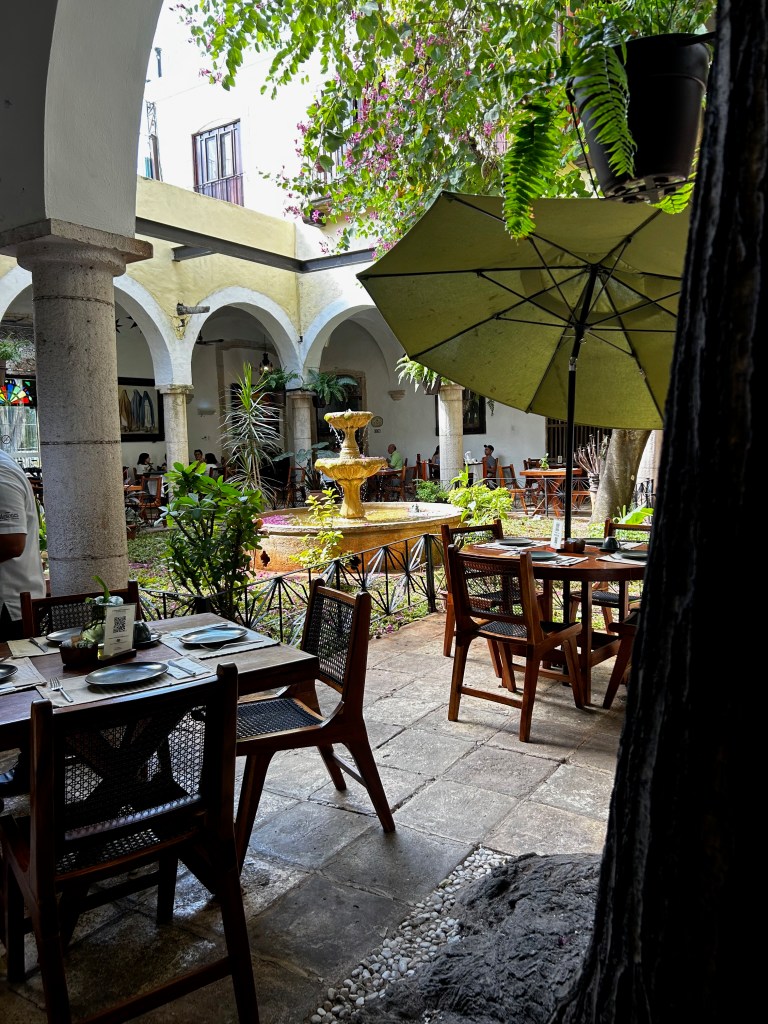
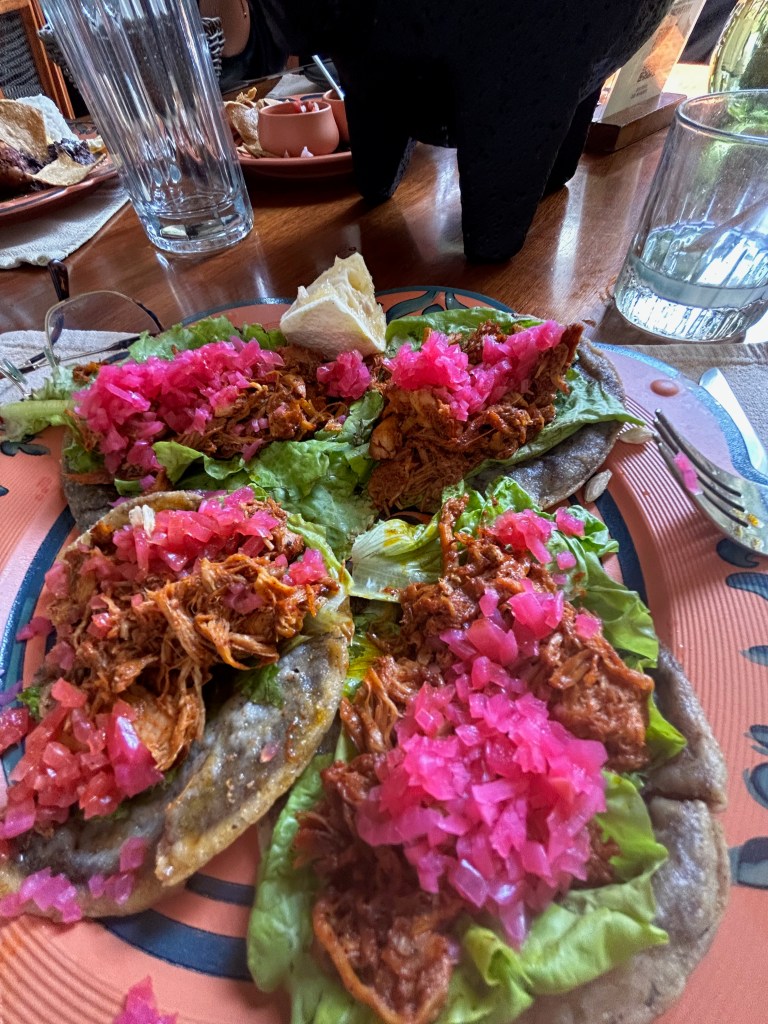
For lunch, Miguel took us to Hosteria Del Marques, a lovely restaurant in Valladolid on the way home.
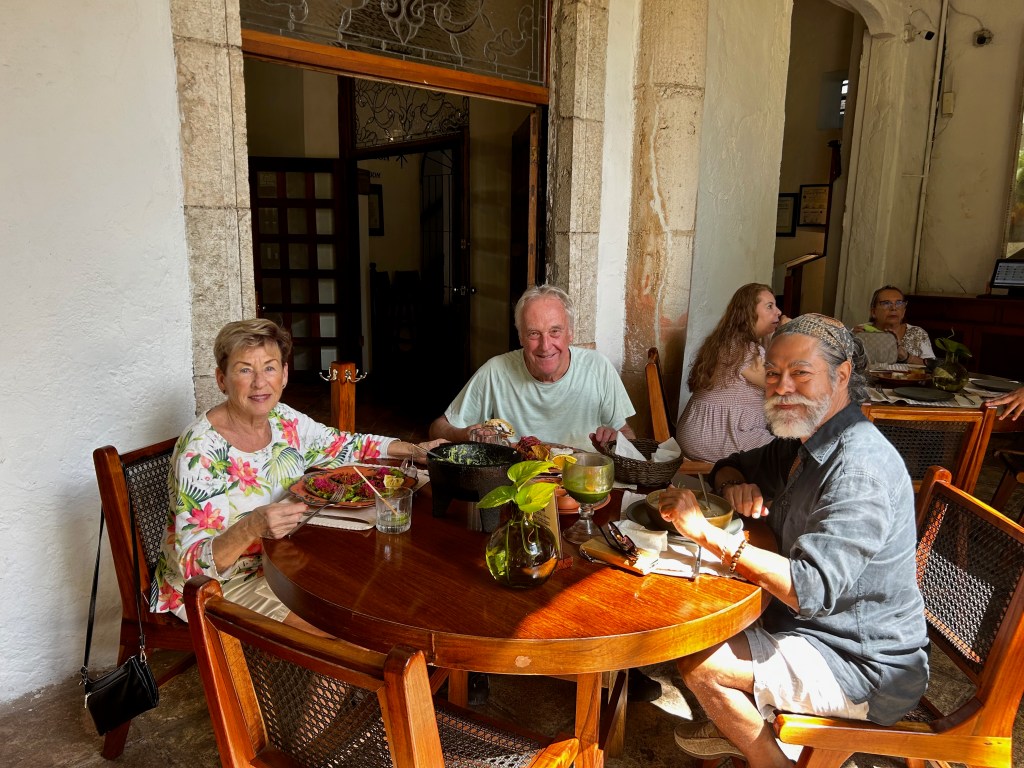
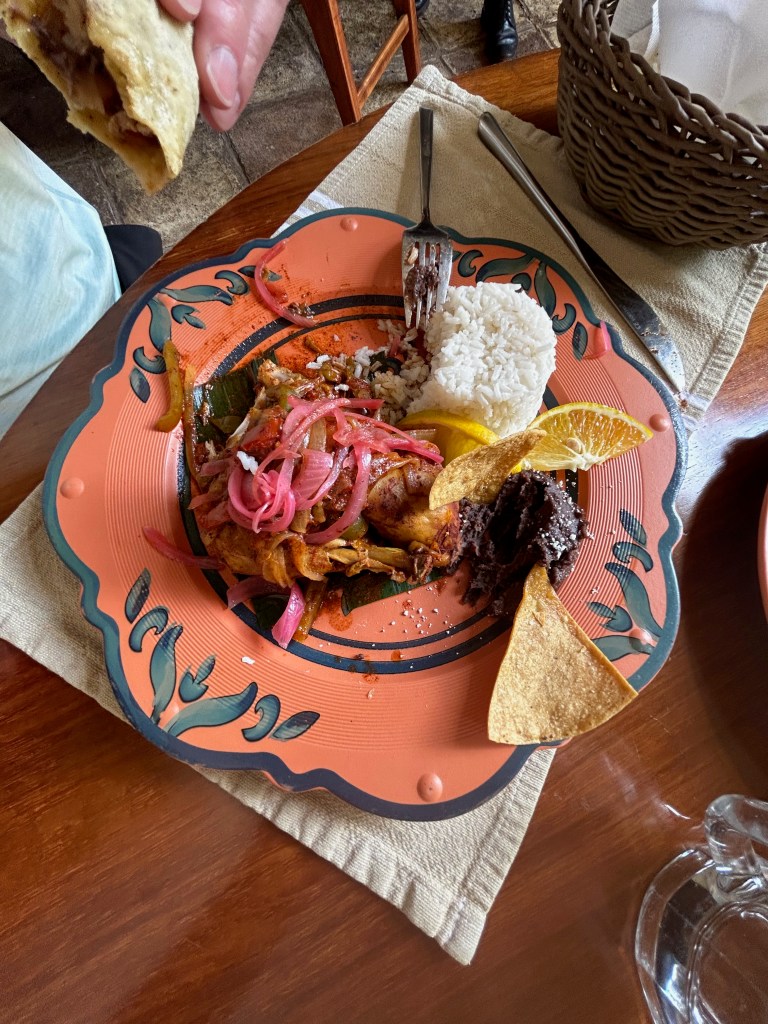

Miguel relayed some of his history of first bartending and then getting into the taxi business on his own. He lives alone now and his son lives in Whistler, Canada: organic farmer and a chef on weekends. We stopped on the way back for groceries after a long but enjoyable day.
Sunday, February 1
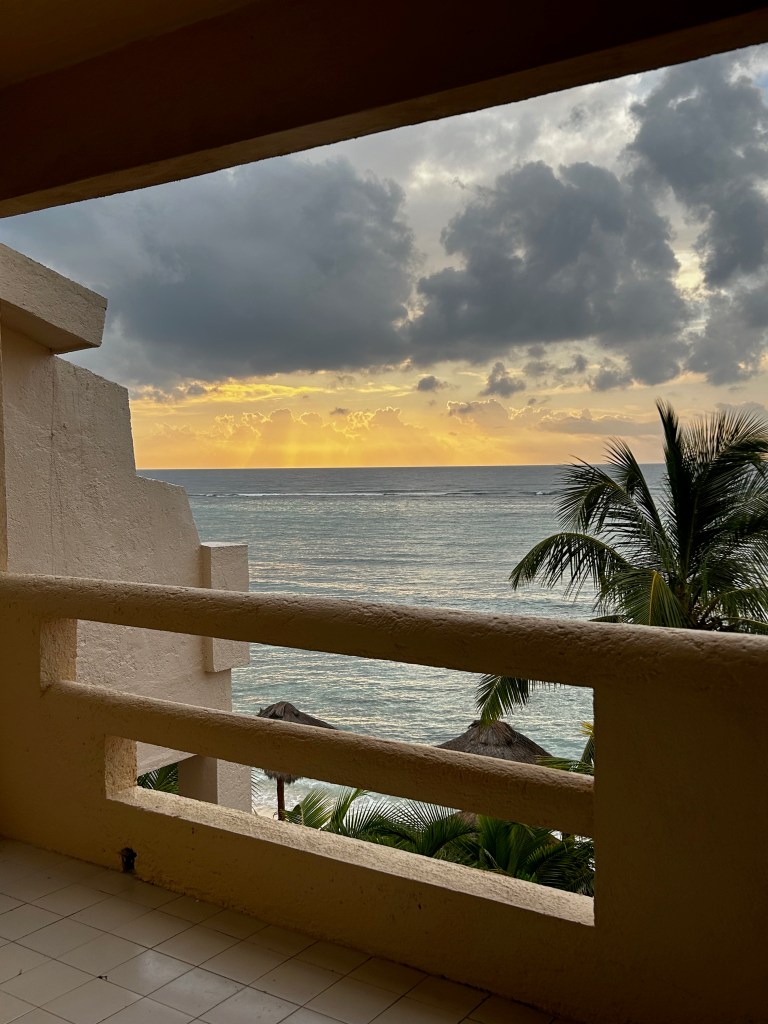
With plans to snorkel we inventoried equipment in the condo and found one full set of fins, snorkel, mask and PFD so we walked to the snorkelling centre just north of us but found that there were only fish to be seen in the laggon so we walked to the entry to Akumal North, found a rental store (no fins for rental) and bought groceries and wine at the General Store. On the way back we stopped at the Tsuuk Akumal Parque Natural, talked with a man selling guided snorkelling tours and arranged for a tour Monday morning at 10 am for 800 Mx dollars each ($56) each which included all equipment and guide for an hour.
Monday, February 3
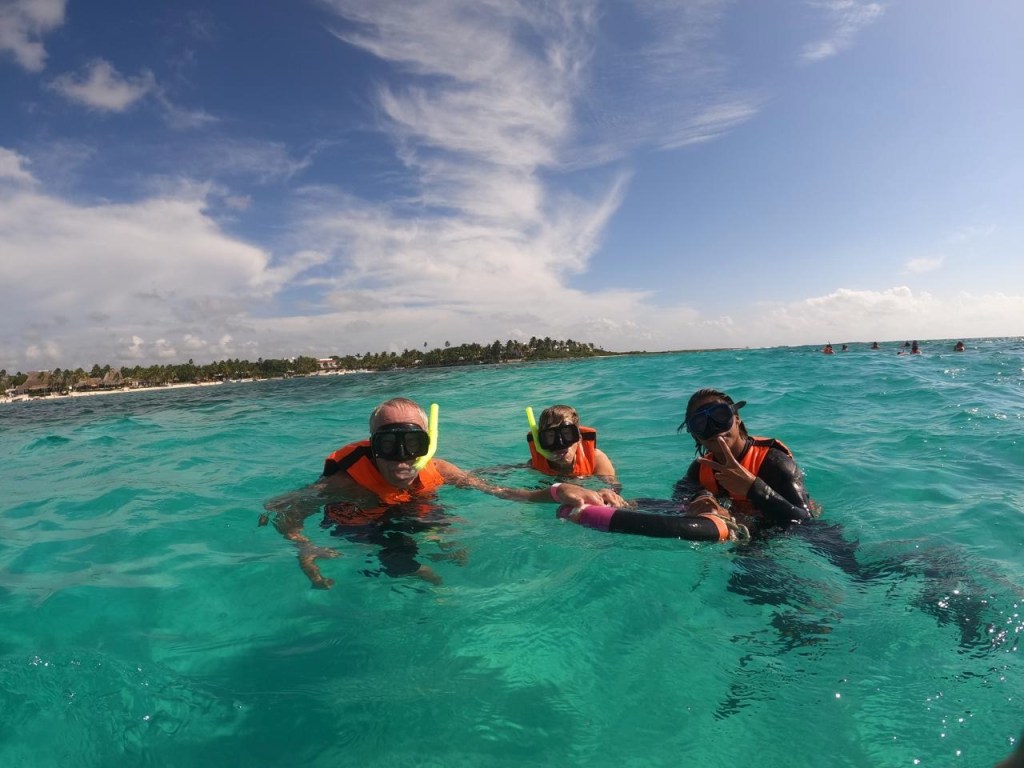
We arrived at the park, were given our gear, stored our towels etc, had a shower and were taken by boat out past the roped off swimming area and made our way back in with our guide, Armando, who sent us the above photo. He pointed out a large group of large blue fish, a large sting ray, several large turtles and a baby that fed, swam, surfaced unconcerned with our presence. We were to stay 2 metres away from them and not touch them. It was awesome.
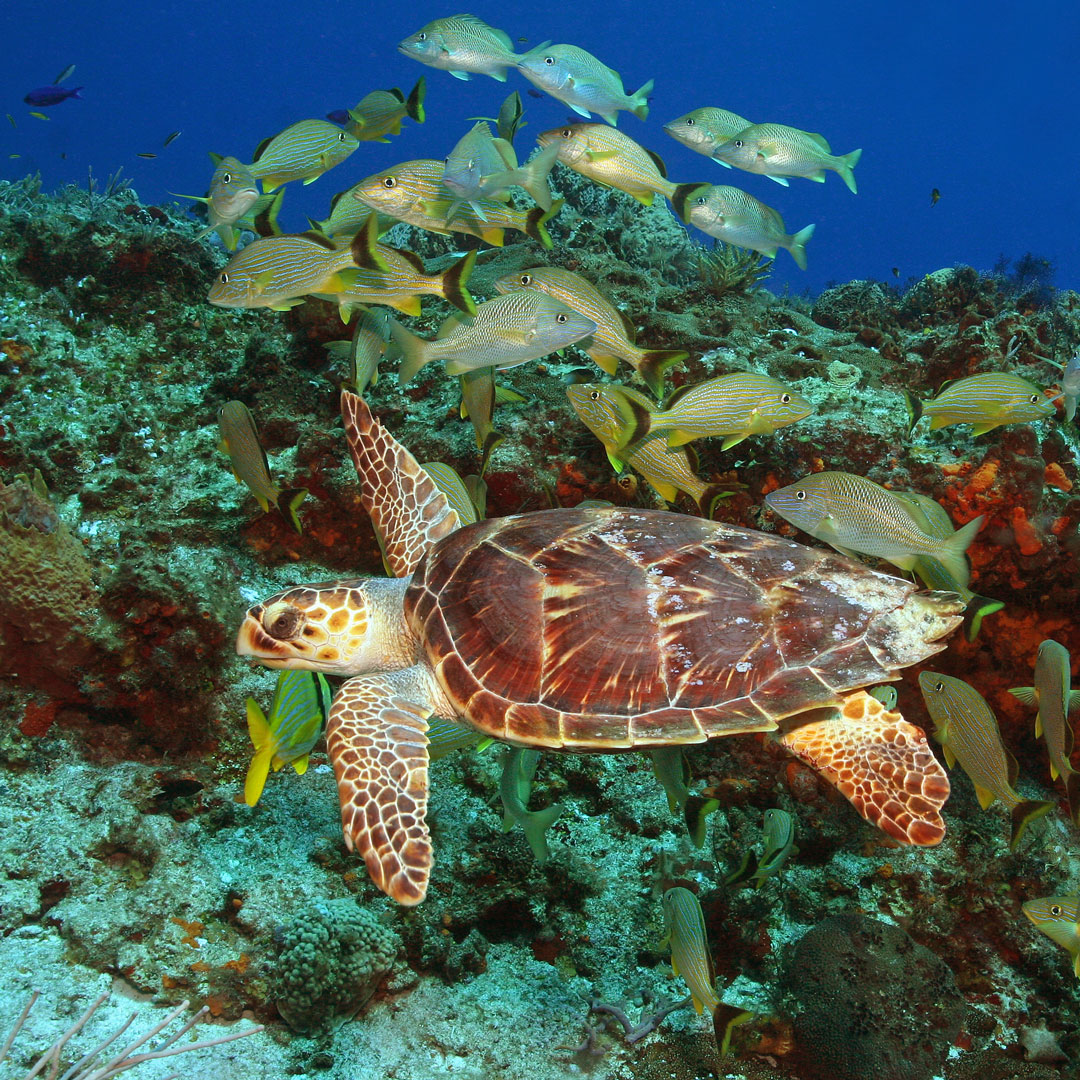
All eight of the world’s sea turtle species are endangered, thanks to a combination of antiquated fishing practices, habitat destruction, and a taste for turtle products. Four turtle species—hawksbill, Kemp’s ridley, green, and loggerhead—nest on the shores of the Yucatán Peninsula.
Akumal (Mayan for “Place of the Turtles”), has a bay well known for the green turtles who feed on the seagrass. We watched several of them: their beautifully patterned orange, brown, and gold shells were clear. The reptiles moved slowly along the seagrass, occasionally rising gently to the surface to fill their lungs before sinking back to the bottom.

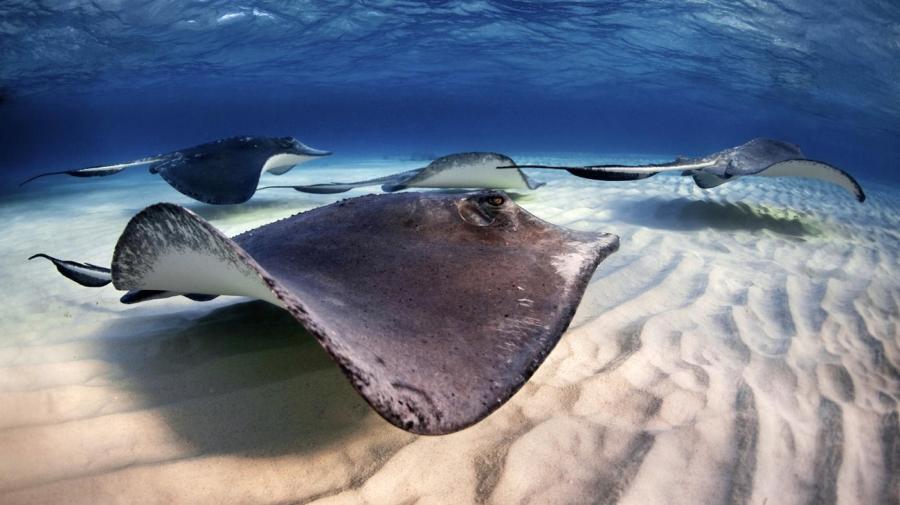
We also saw stingrays. A group of stingrays is called a fever. Stingrays normally travel in groups to hunt but are also known to travel individually and in pairs. Stingrays belong to the superorder Batoidea, which also includes sawfish, skates and electric rays. While it is very different in nature, the closest relative of the batoid is the shark.
One of the most distinctive features of the stingray is its often scary-looking barbed, whip-like tail. Despite their menacing appearance, however, stingrays are docile creatures that only sting to defend themselves. As one we watched was frightened, it covered itself in sand.
Tuesday, February 2-7
We repeated many of the activities: walking to town (about 1.5 km), buying wine and groceries at the small General Store, lunch at Buena Vista, reading on the balcony, swimming in the pool.


Our beach was good for a walk and sitting watching the waves; we tried the sea for snorkelling but found it rough and stony to enter and harder to get out.
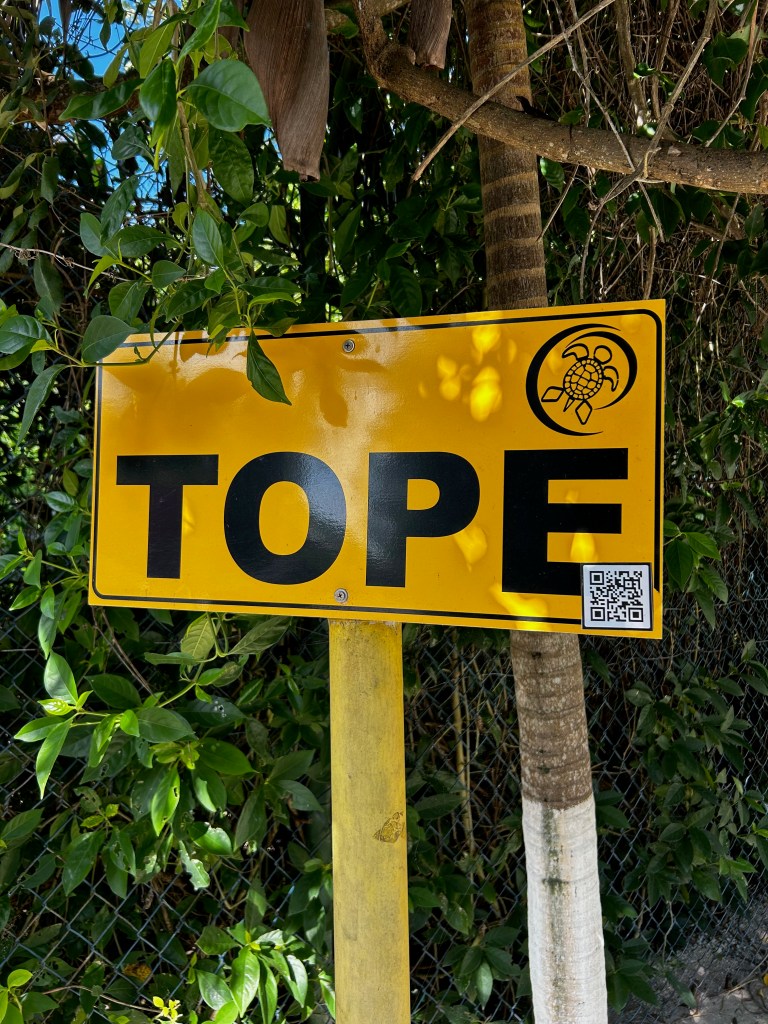
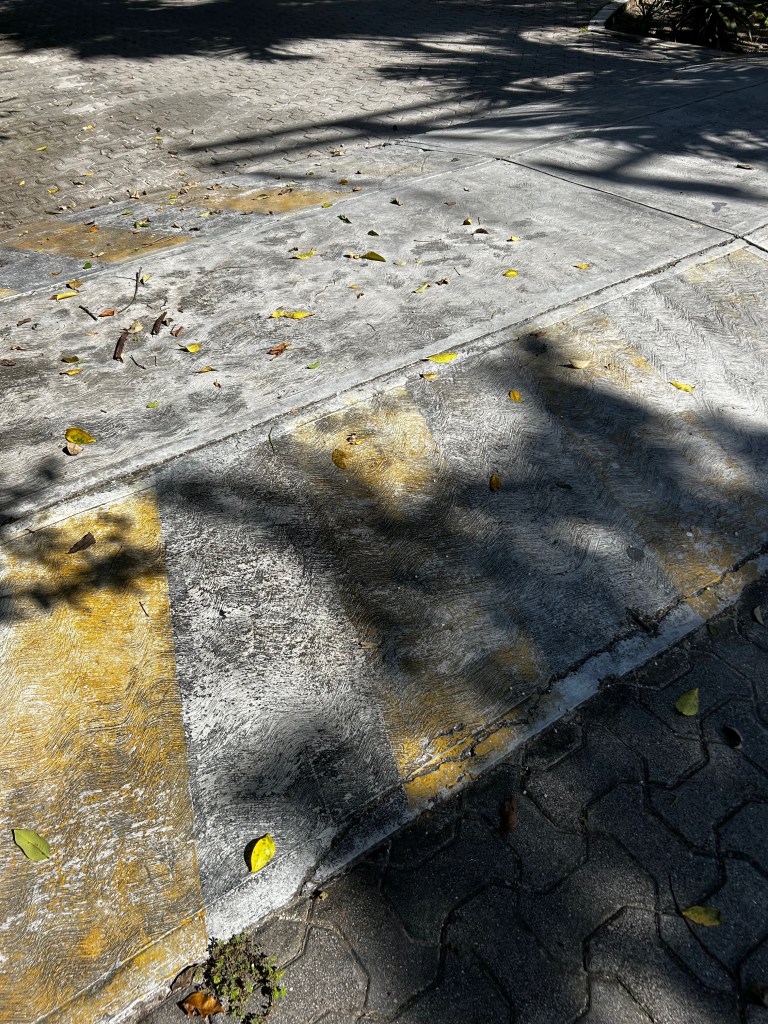
On the roads, there is proficient use of traffic bumps of considerable size, even on the highways.
Friday, February 7
We walked down to the Akumal Beach (admission $US 7) and walked the beach. The snorkelling tours were in full force.
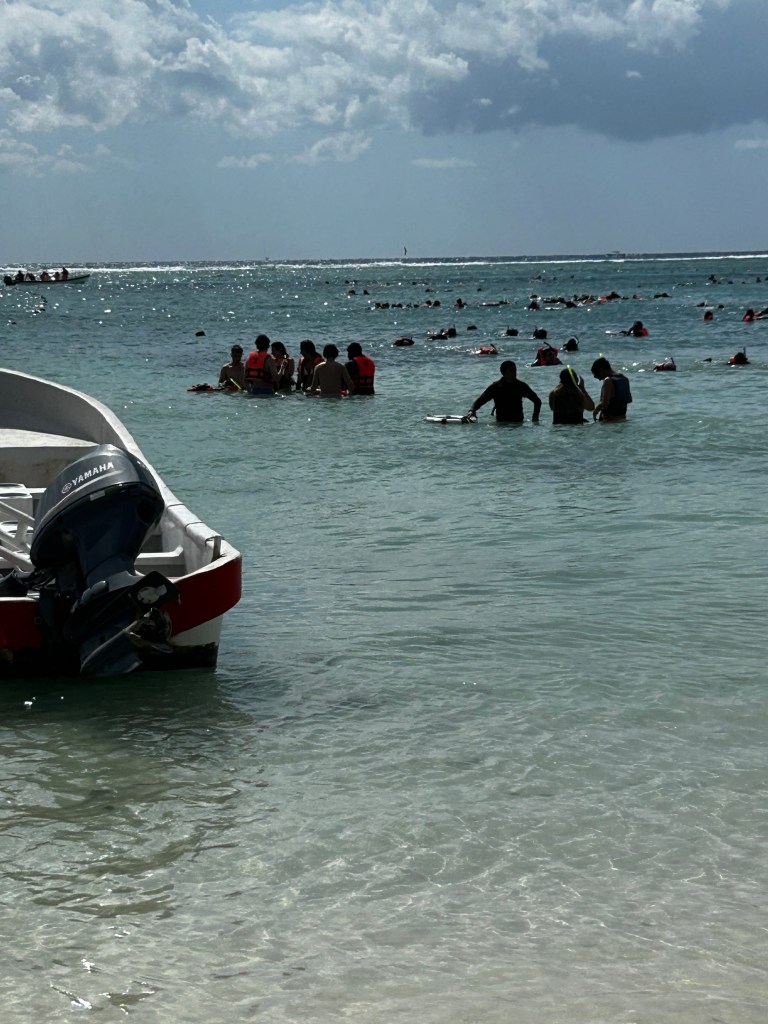
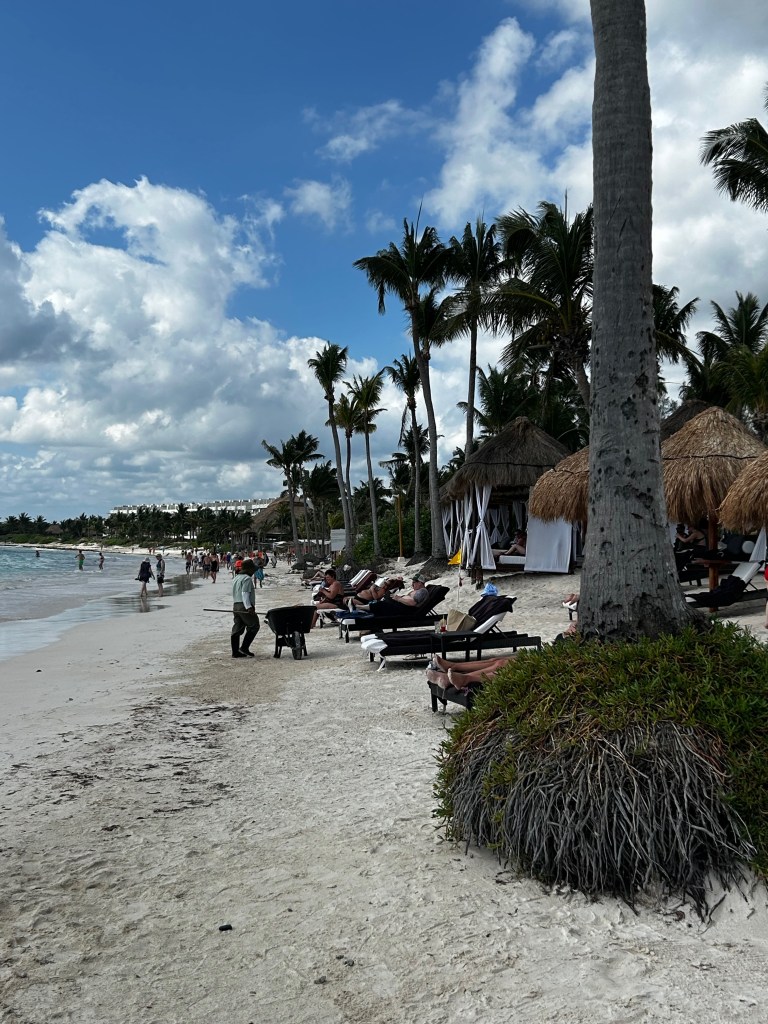
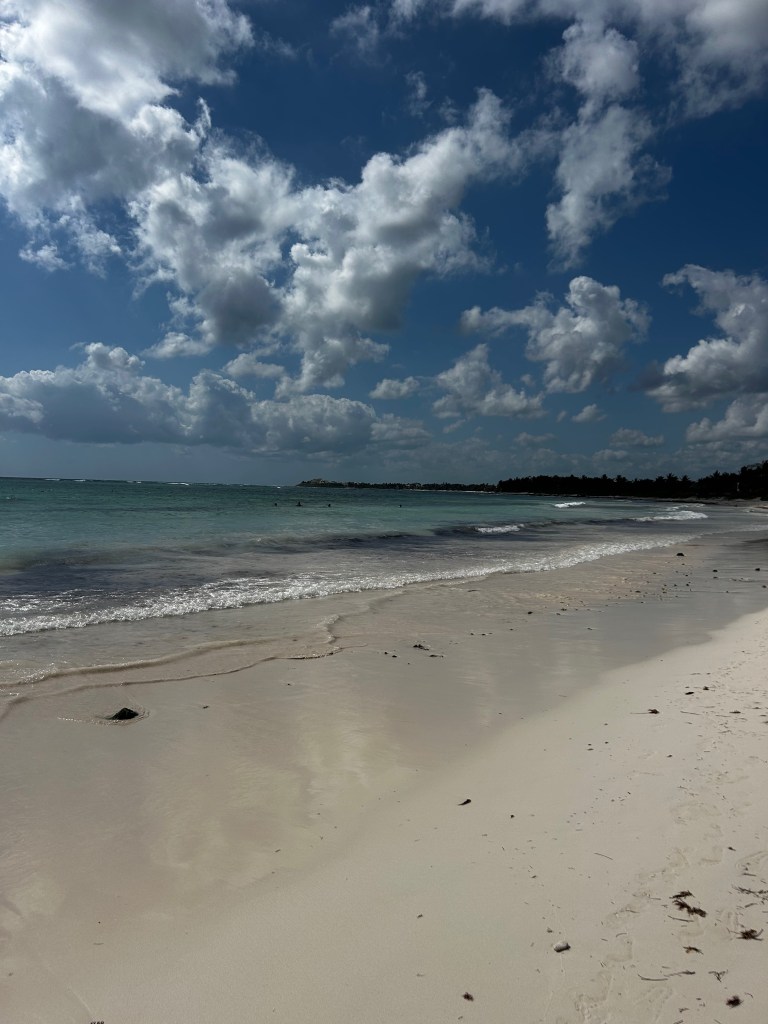
Akumal Beach is a long beautiful beach with white sand and continuous resorts on it.
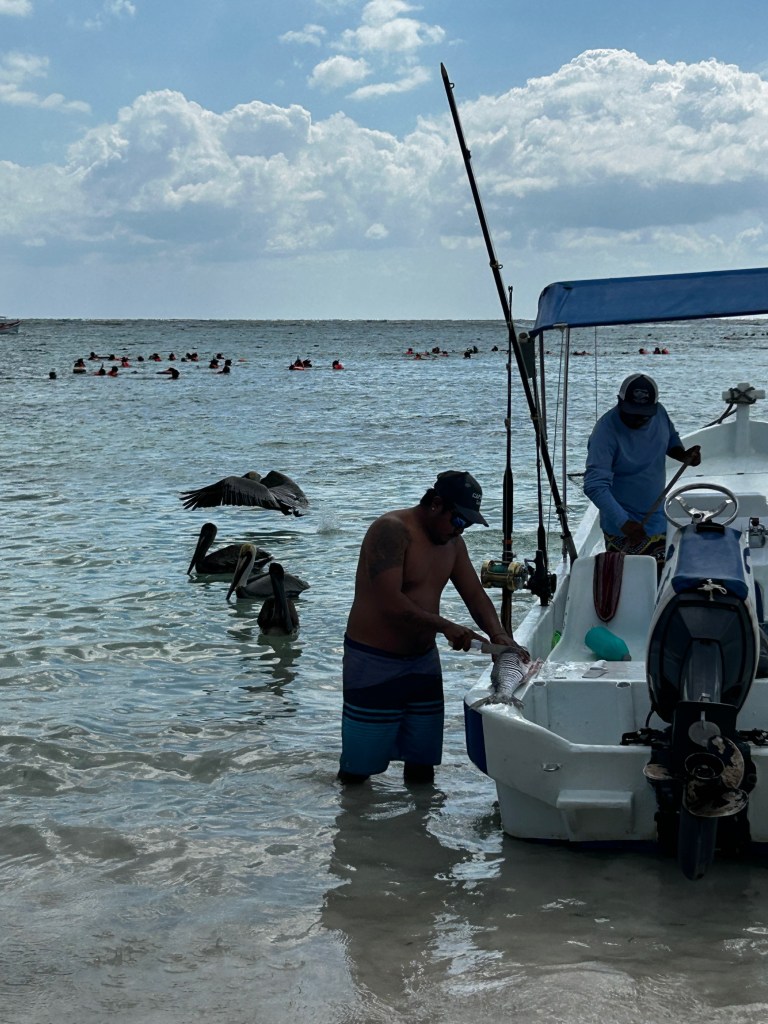
We saw a fisherman carving up a large fish that some women who chartered the boat caught as the pelicans waited for scraps.
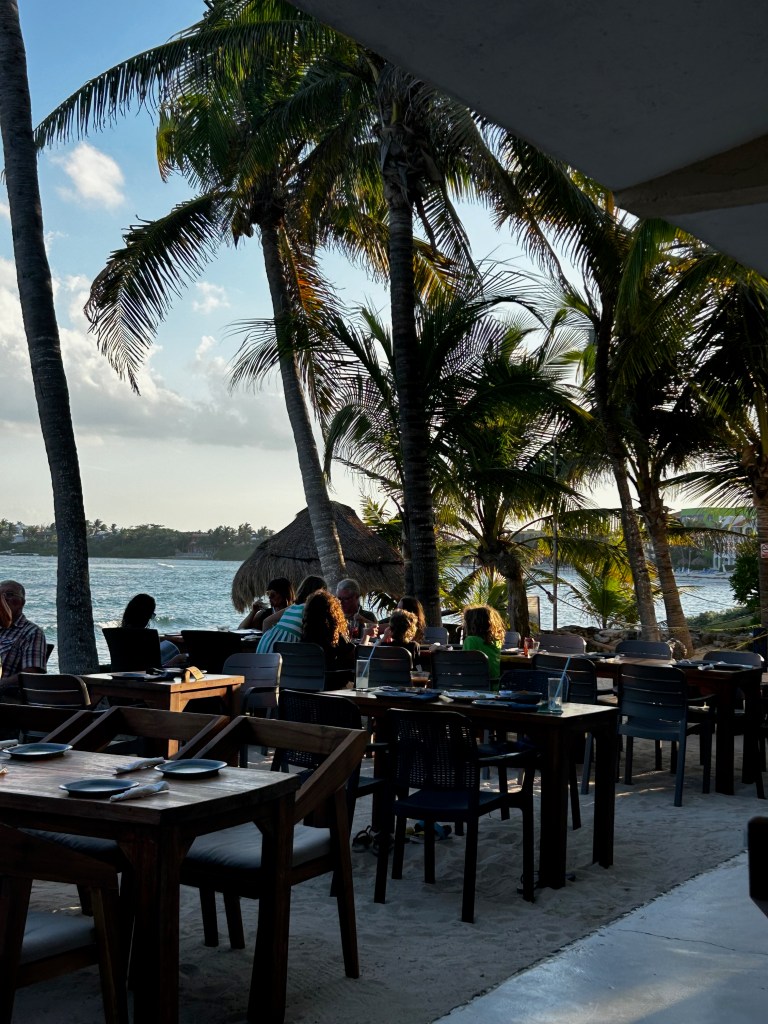
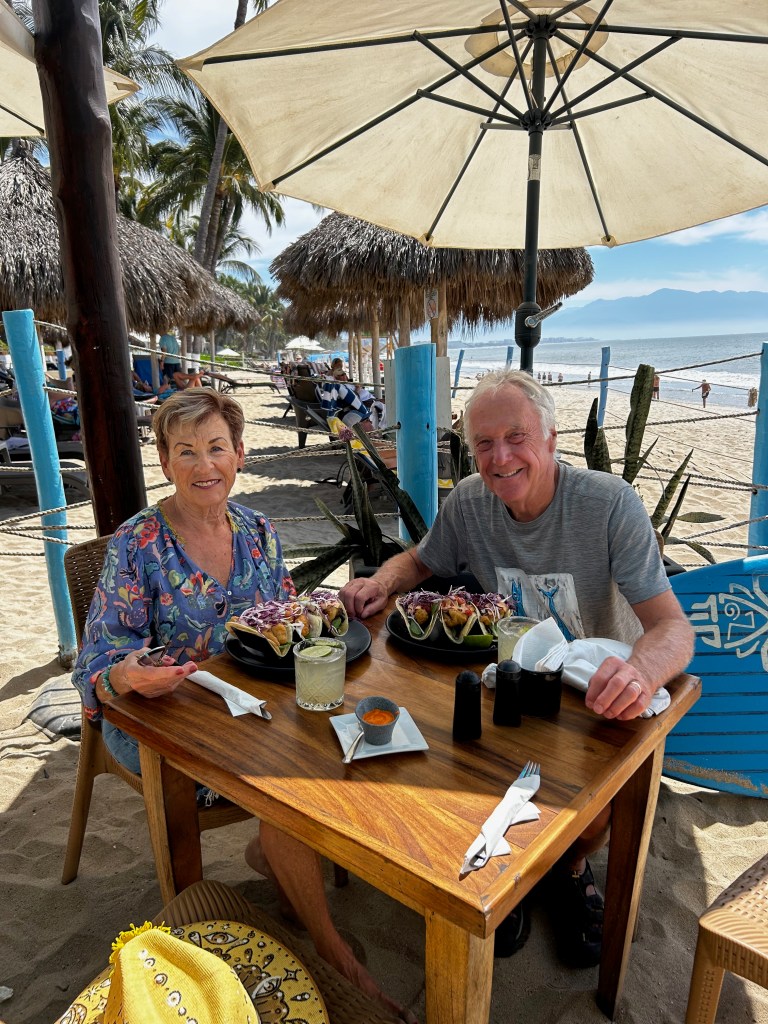
For our last dinner in Akumal, we had our meal at La Lunita: we both had fish tacos with a margarita and they were very good.
February 8 Flight to Puerto Vallarta via Mexico City
Miguel Of Namaste Transportation picked us up at 6:00 am for our 9:00 flight. We arrived at 7:15, checked in AeroMexico very efficiently, took off at 9, had a 4 hour layover in Mexico City, arrived at 3:45 (one hour time change) and were picked up around 4:30 amidst the bedlam of Puerto Vallarta airport. We stopped on the way for groceries, signed forms that we wouldn’t have wild parties and met the concierge who took us via two elevators to our condo – stunning!
February 8 to 15 (7 nights): Puerto Vallarta: Luxury 1BR Condo – Rooftop Pool – Bay View
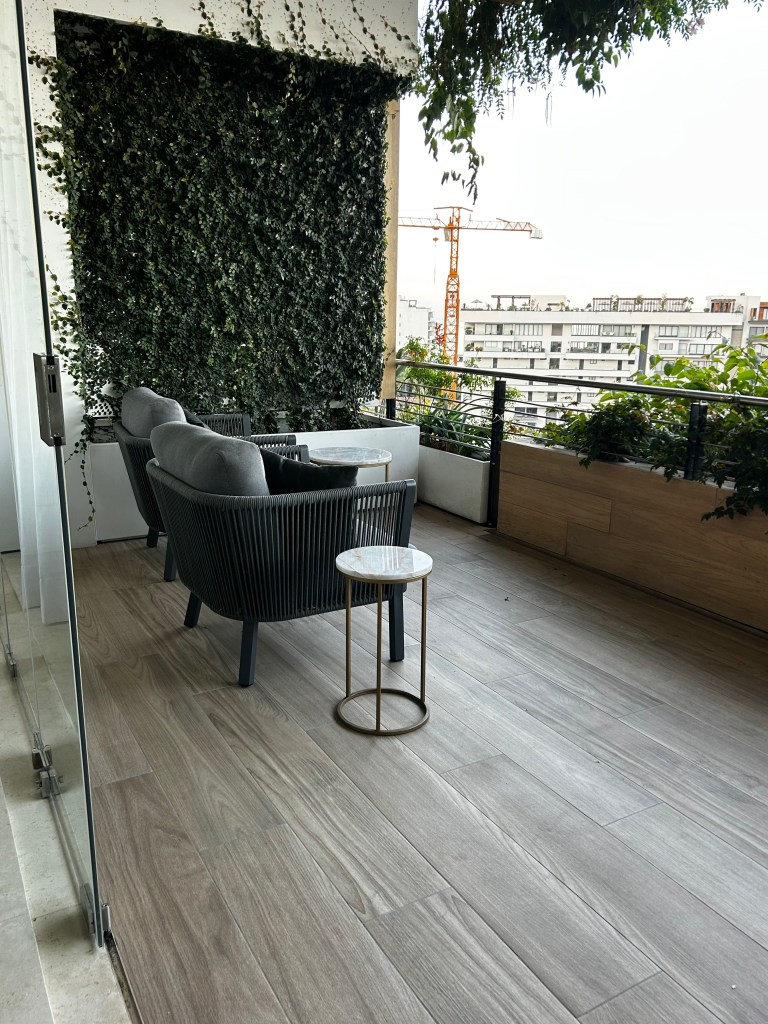
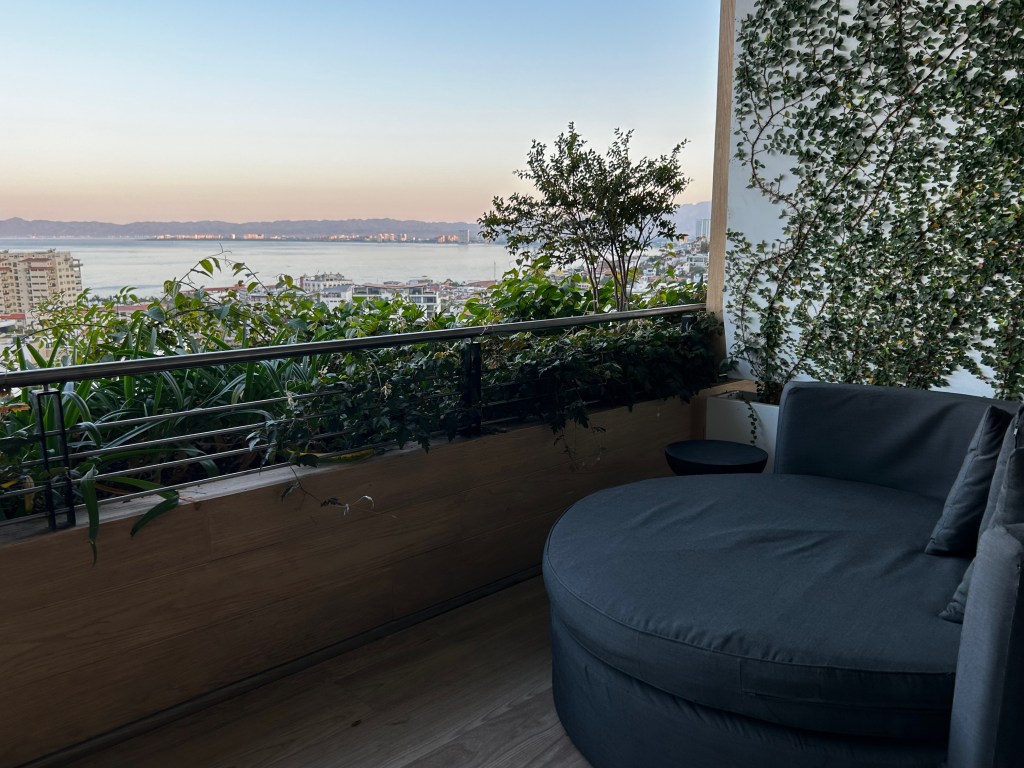
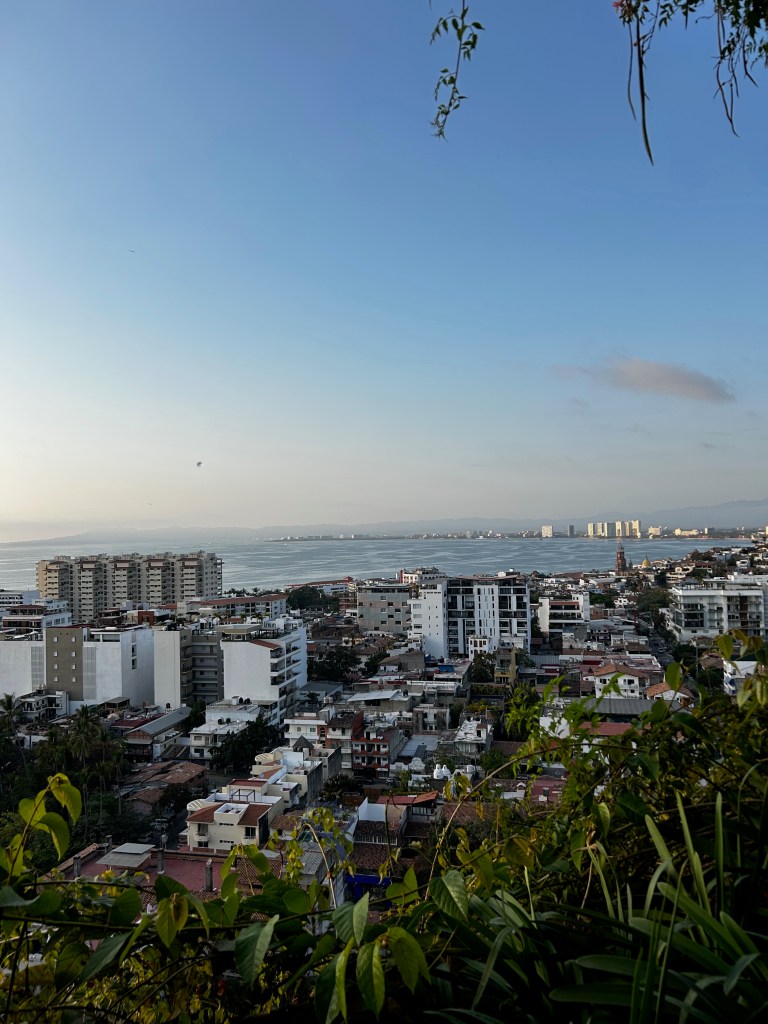
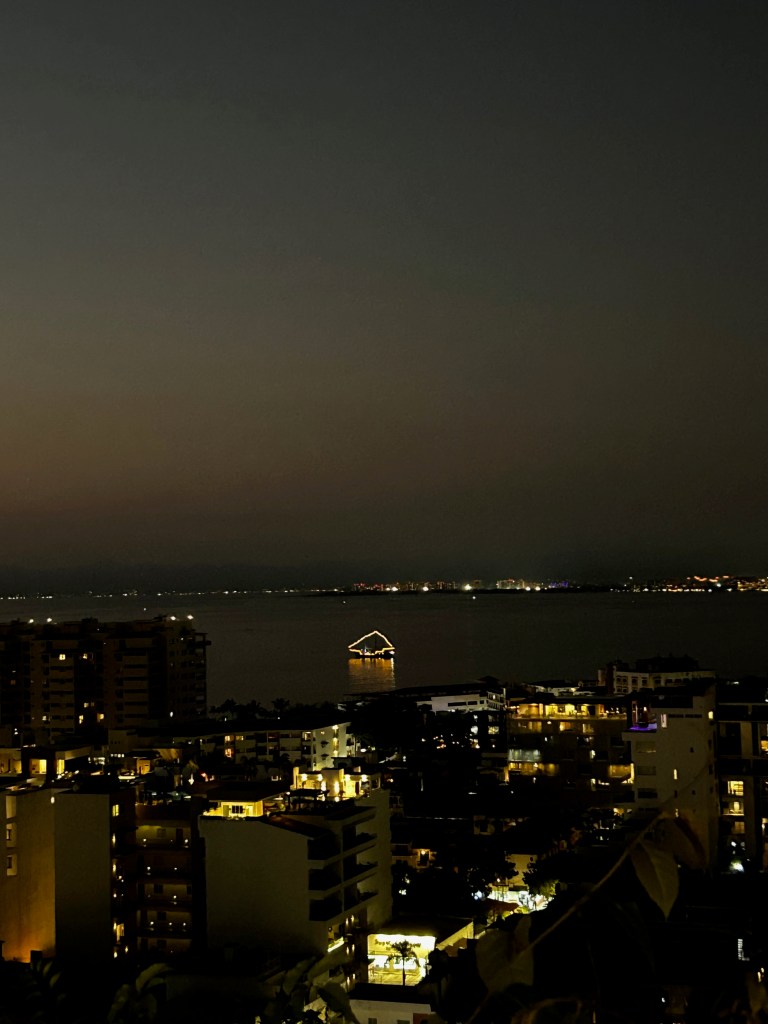
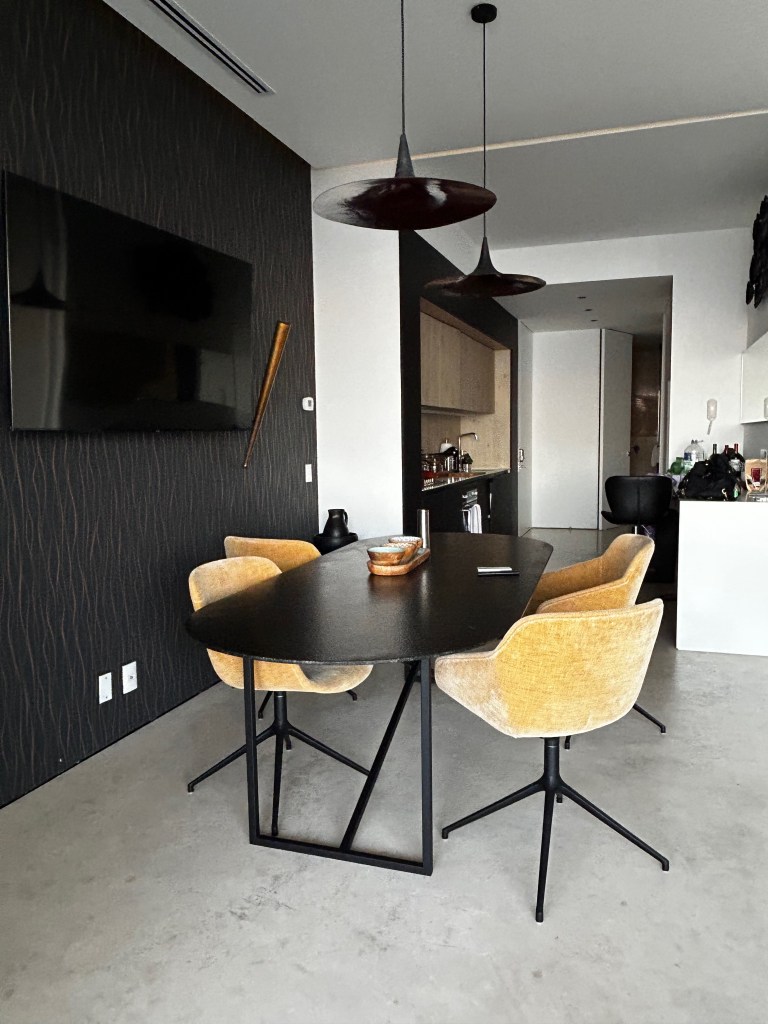
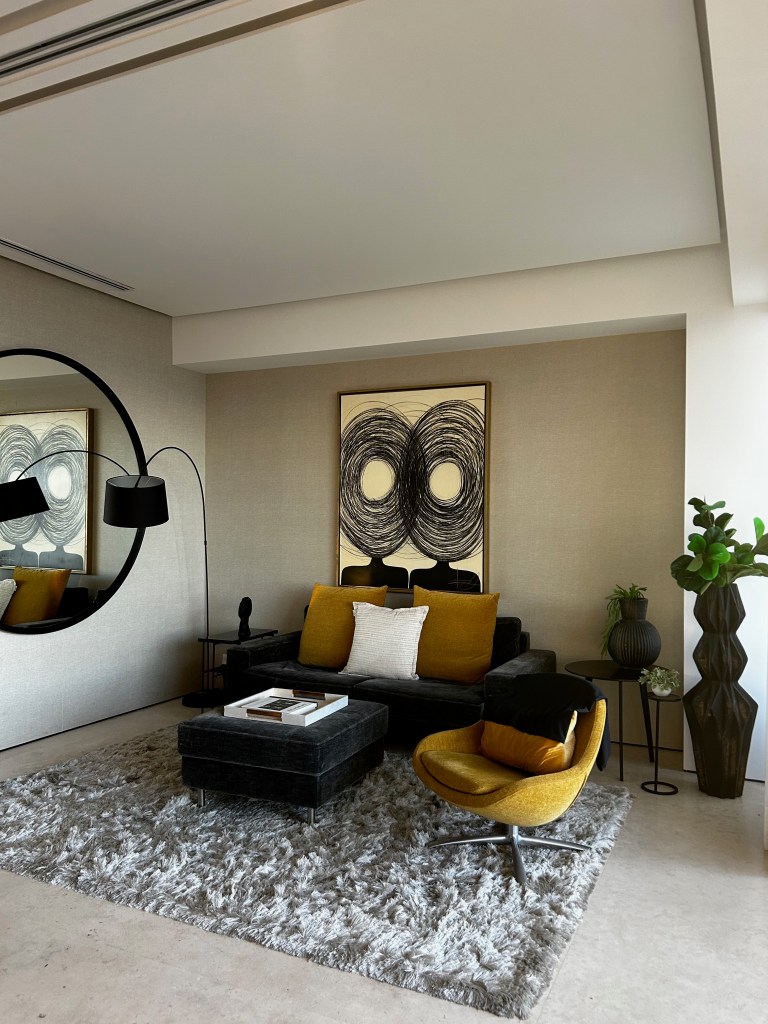
The Apartment is truly lovely and the building has a concierge and security 24-7. It takes two elevators to get from outside to the condo.
Monday, February 10. 2025
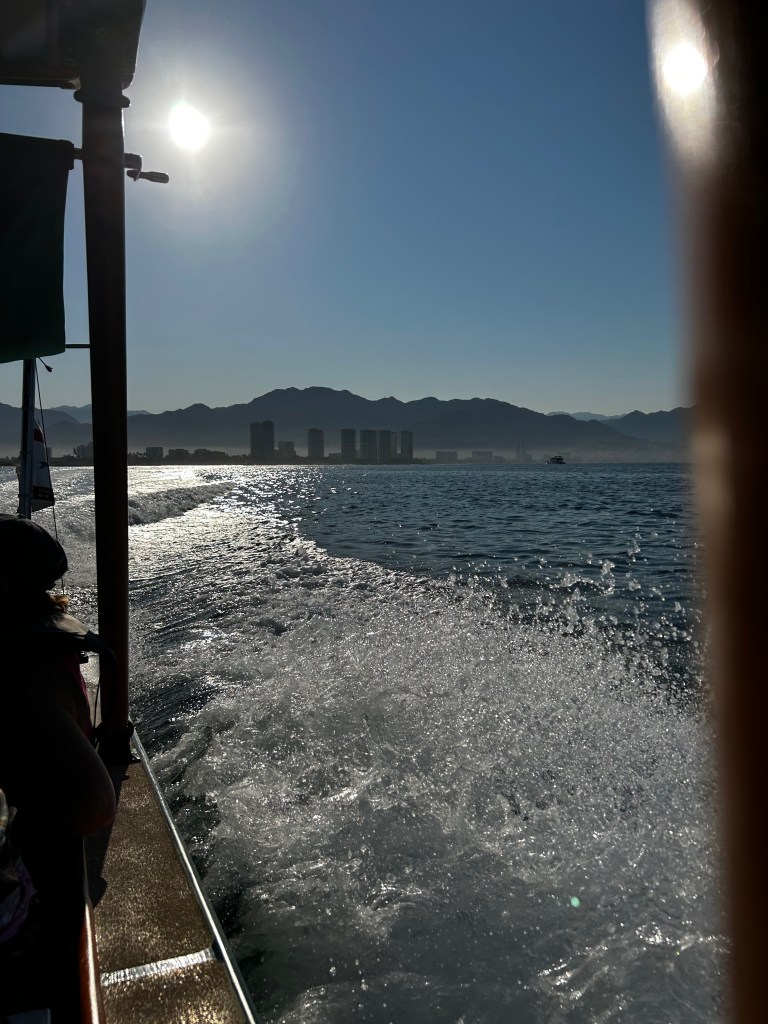
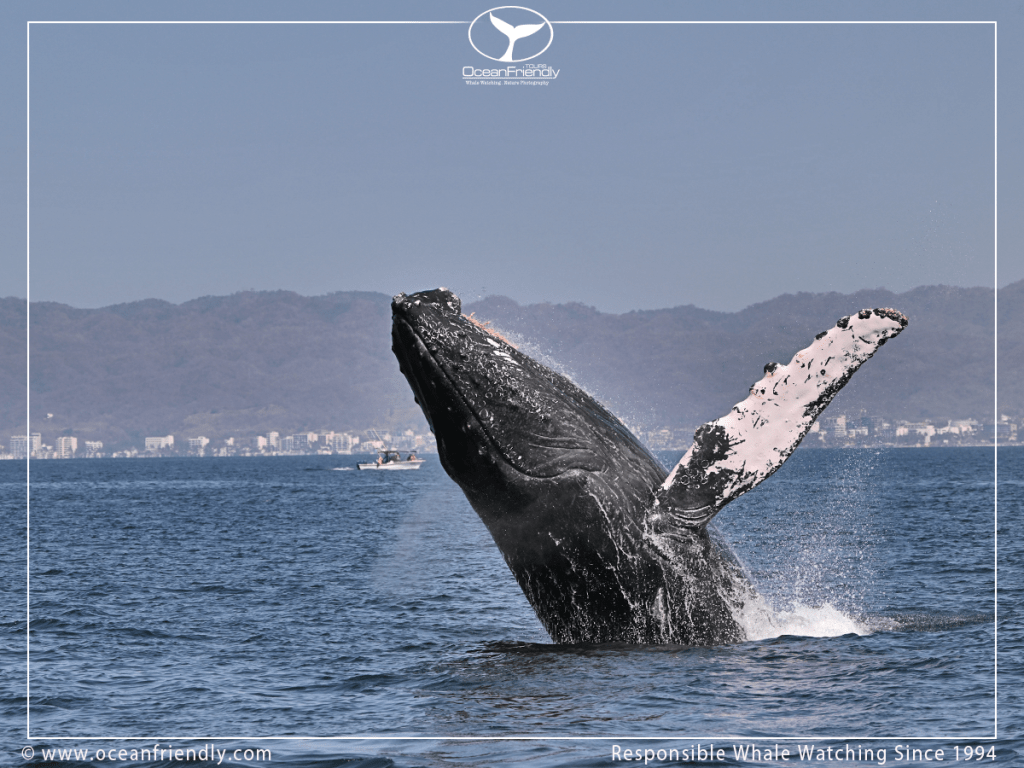
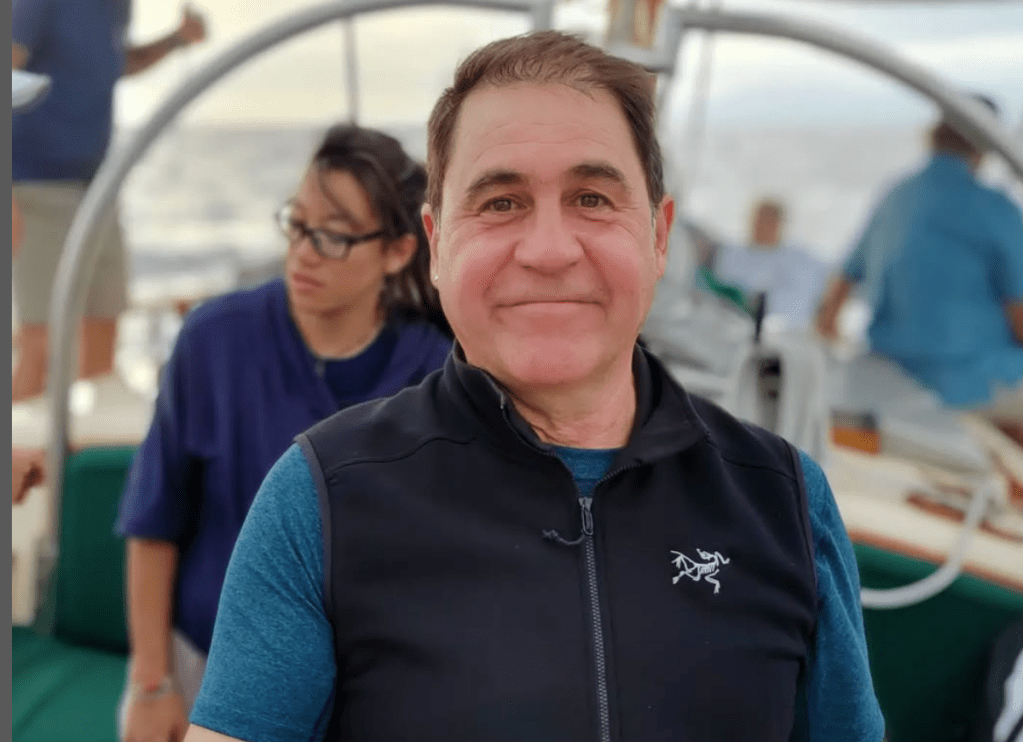
We took a taxi to the Marina for 8:30 meeting with Oskar Frey, Oceanologist, where he gave us background on Humpback Whales based on his research over 30 years. We headed out at 9:00 and it was a slow start but over the next 4 and a half hours, we saw large whales and one year olds who had survived the trip north and back with their mothers. They put on quite a show. Oskar timed the dives so that he could predict when the whales would surface and watched the “footprint” that the whale left as it moved through the water. When he could tell that they were going deep, he would get the boat to another area based on whales surfacing and creating blows or spouts of water.
The secret to the whale’s capability for holding its breath lies in its specially developed breathing system that allows it to absorb up to 90 percent of the oxygen breathed in. By contrast, humans only absorb around 15 percent.
Whales breathe in through blowholes on the tops of their heads. Because the whale only breathes at the surface, it has evolved with the ability to choose when to breathe and cannot breathe underwater.
Ocean Friendly Whale Tours https://oceanfriendly.com/
Humpback Whale source: https://www.acsonline.org/humpback-whale

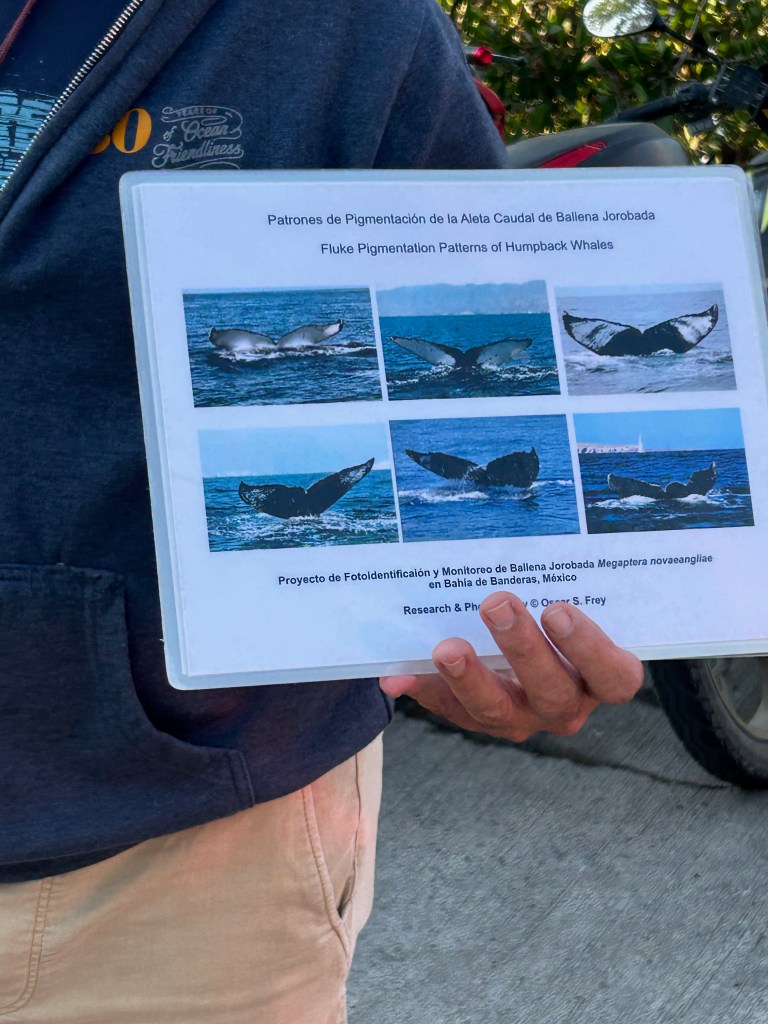
The humpback whale is one of the rorquals, a family that also includes the blue whale, fin whale, Bryde’s whale, sei whale, and minke whale. Rorquals have two characteristics in common: dorsal fins on their backs, and ventral pleats running from the tip of the lower jaw back to the belly area. The shape and colour pattern on the humpback whale’s dorsal fin and flukes (tail) are as individual in each animal as are fingerprints in humans. The discovery of this interesting fact changed the course of cetacean research forever, and the new form of research known as “photo-identification,” in which individuals are identified, catalogued, and monitored, has led to valuable information about such things as humpback whale population sizes, migration, sexual maturity, and behaviour patterns.
Humpback Whale Surface Characteristics
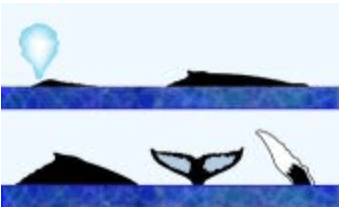
Color
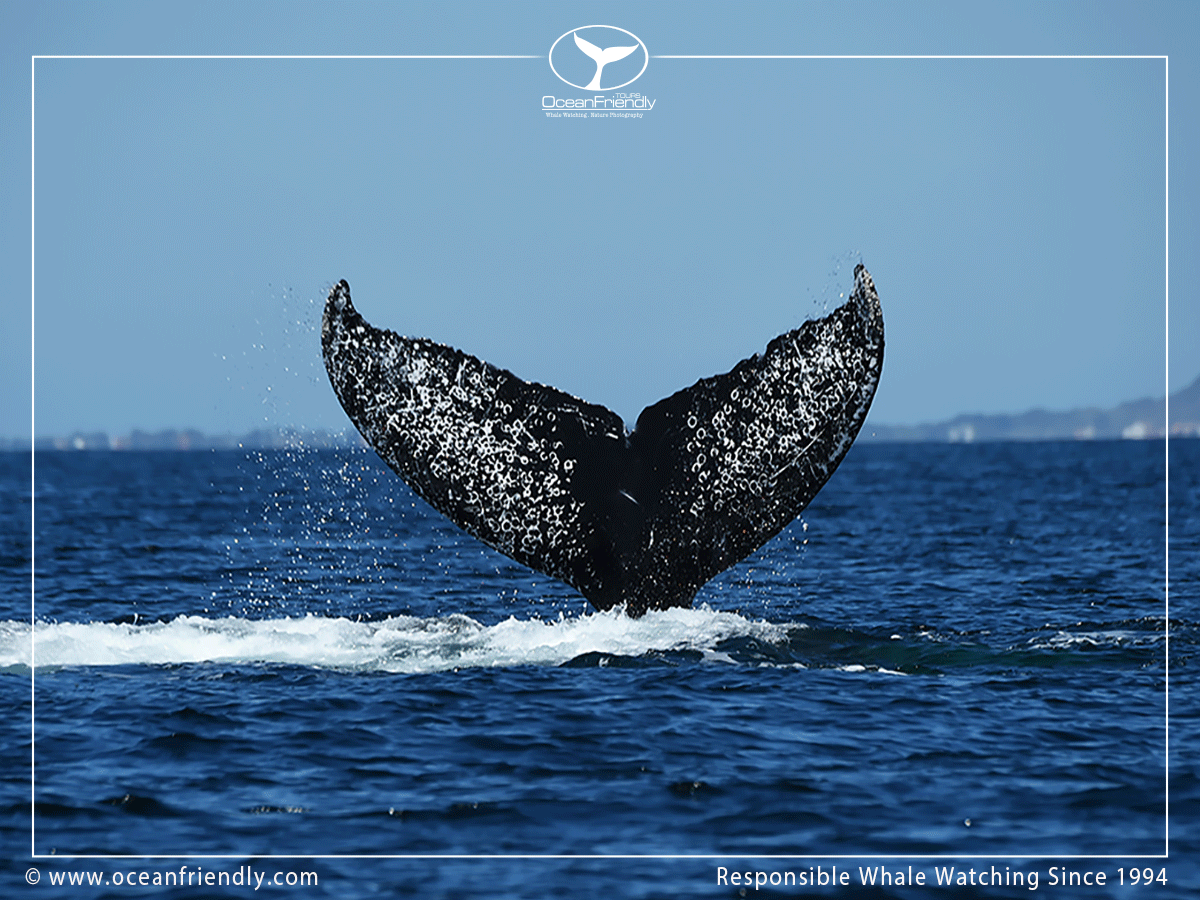
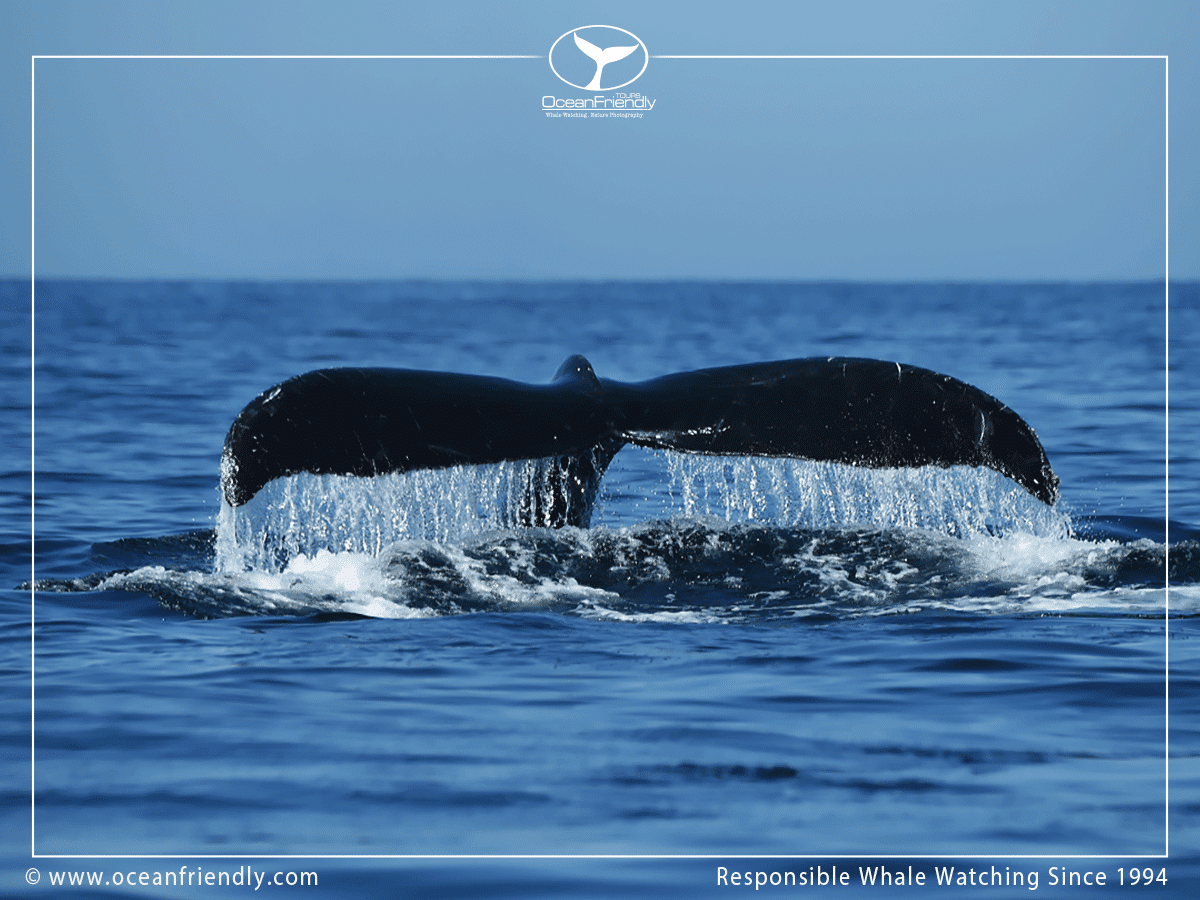
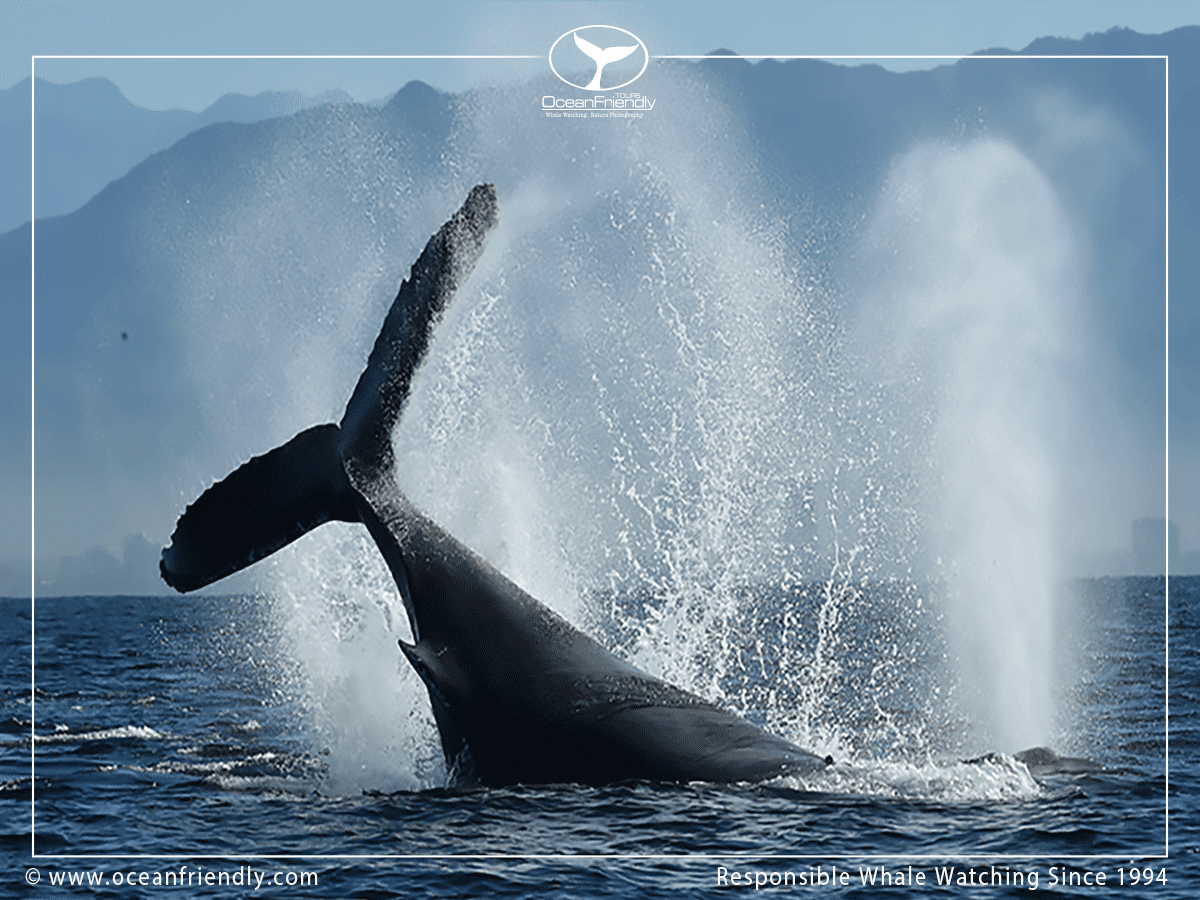
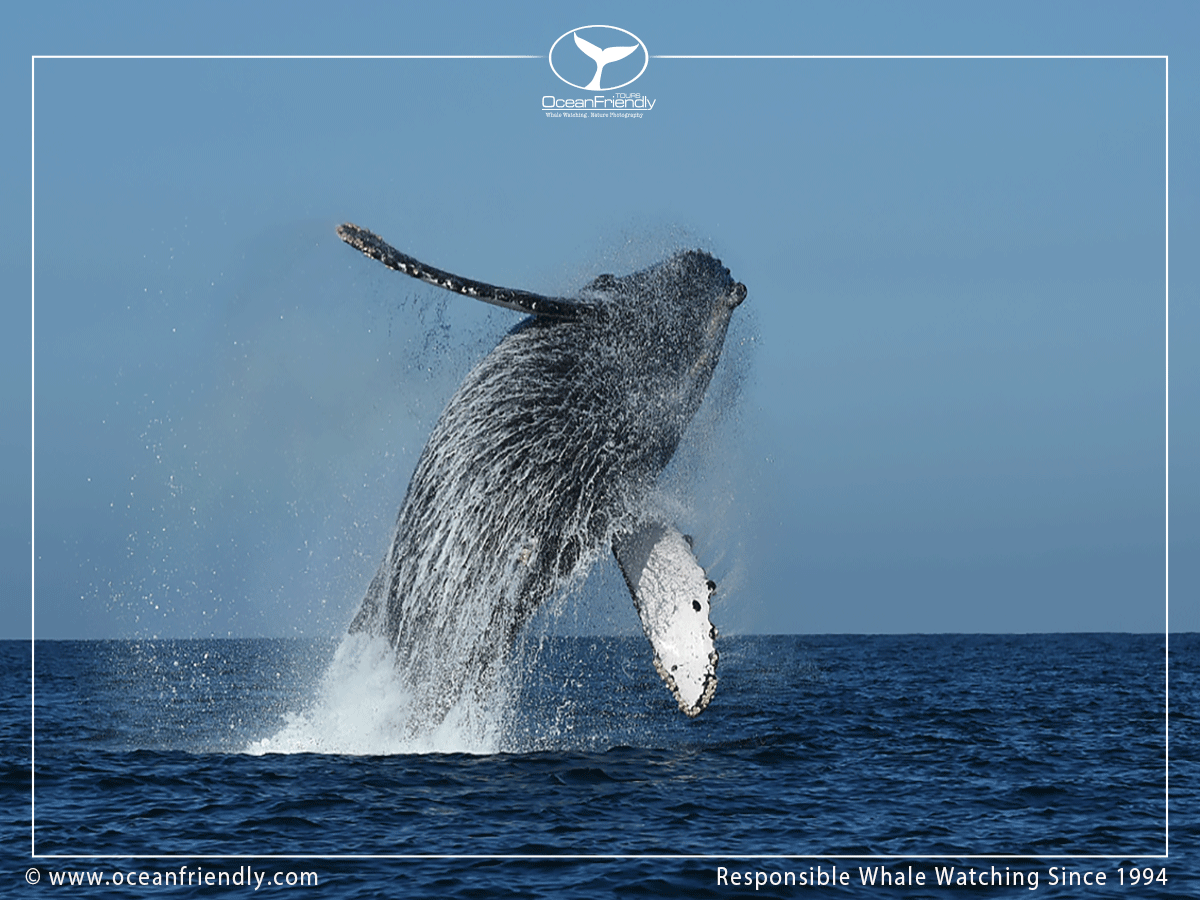
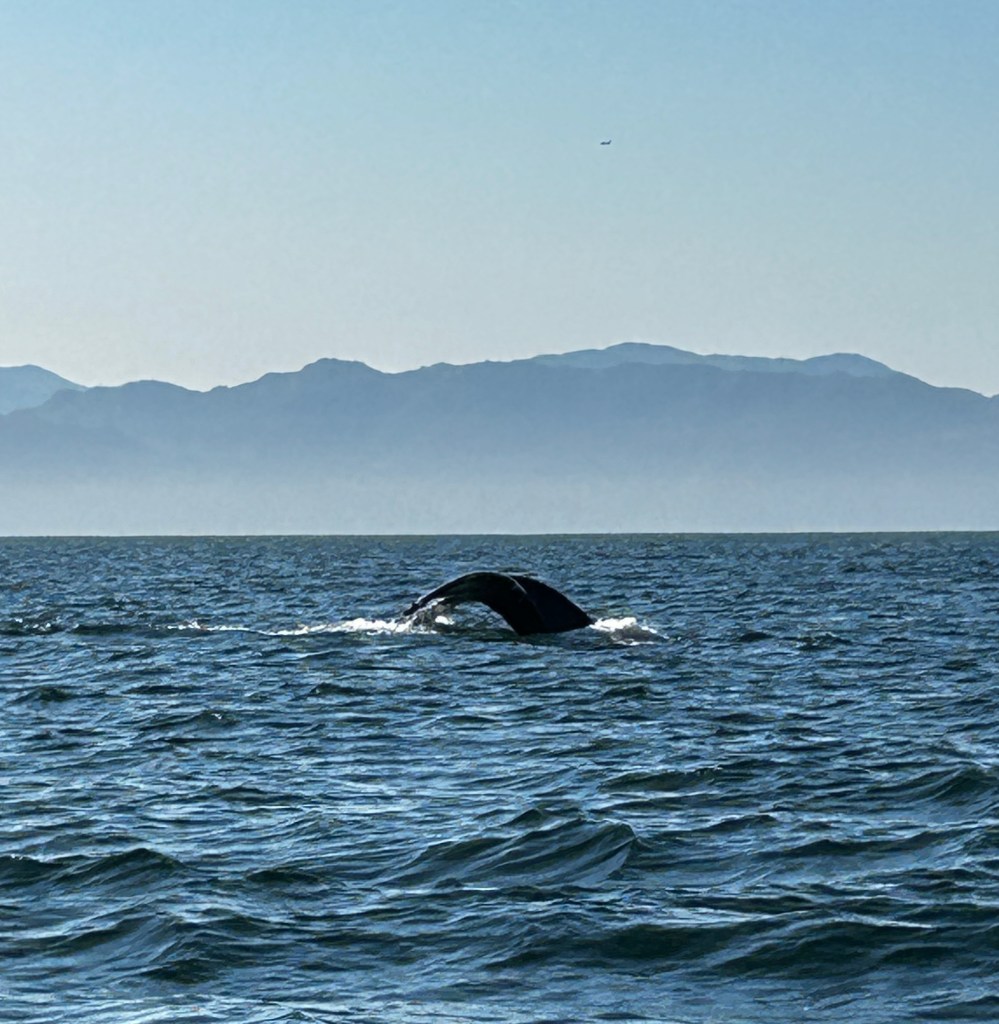
The body is black on the dorsal (upper) side, and mottled black and white on the ventral (under) side. This colour pattern extends to the flukes. When the humpback whale “sounds” (goes into a long or deep dive) it usually throws its flukes upward, exposing the black and white patterned underside. This pattern is distinctive to each whale. The flippers range from all white to all black dorsally, but are usually white ventrally.
Fins and Fluke
About 2/3 of the way back on the body is an irregularly shaped dorsal (top) fin. Its flippers are very long, between 1/4 and 1/3 the length of its body, and have large knobs on the leading edge. The flukes (tail), which can be 18 feet (5.5 m) wide, is serrated and pointed at the tips.
Length and Weight
Adult males measure 40-48 feet (12.2-14.6 m), adult females measure 45-50 feet (13.7-15.2 m). They weigh 25 to 40 tons (22,680-36,287 kg).
Feeding
Humpback whales feed on krill, small shrimp-like crustaceans, and various kinds of small fish. Each whale eats up to 1 and 1/2 tons (1,361 kg) of food a day. . During feeding, large volumes of water and food can be taken into the mouth because the pleated grooves in the throat expand. As the mouth closes water is expelled through the baleen plates, which trap the food on the inside near the tongue to be swallowed.
Mating and Breeding
Humpback whales reach sexual maturity at 6-10 years of age or when males reach the length of 35 feet (11.6 m) and females reach 40 feet (12 m). Each female typically bears a calf every 2-3 years and the gestation period is 12 months. A humpback whale calf is between 10-15 feet (3-4.5 m) long at birth, and weighs up to 1 ton (907 kg). It nurses frequently on the mother’s rich milk, which has a 45% to 60% fat content. The calf is weaned to solid food when it is about a year old. Oskar informed us that of the 72 babies born last year, 46 returned; that is 60 % and a big improvement over the years when it was 36%.
We watched a mother and two juveniles as they watched us and the juveniles practised some of their manoeuvres.
Distribution and Migration
Found in all the world’s oceans, most populations of humpback whales follow a regular migration route, summering in temperate and polar waters for feeding, and wintering in tropical waters for mating and calving. For the ones we saw, Bahia de Banderas is their mating and calfing area and they go as far as Alaska for summer.
Natural History
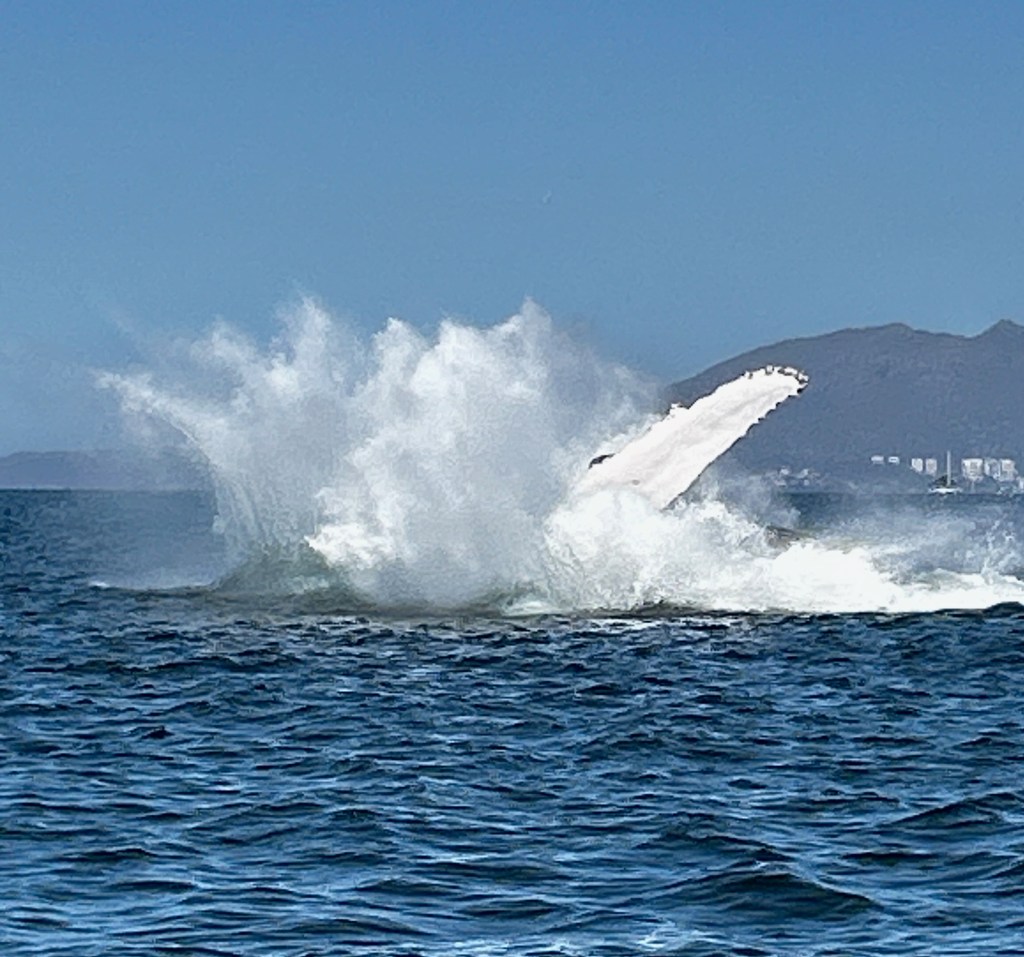
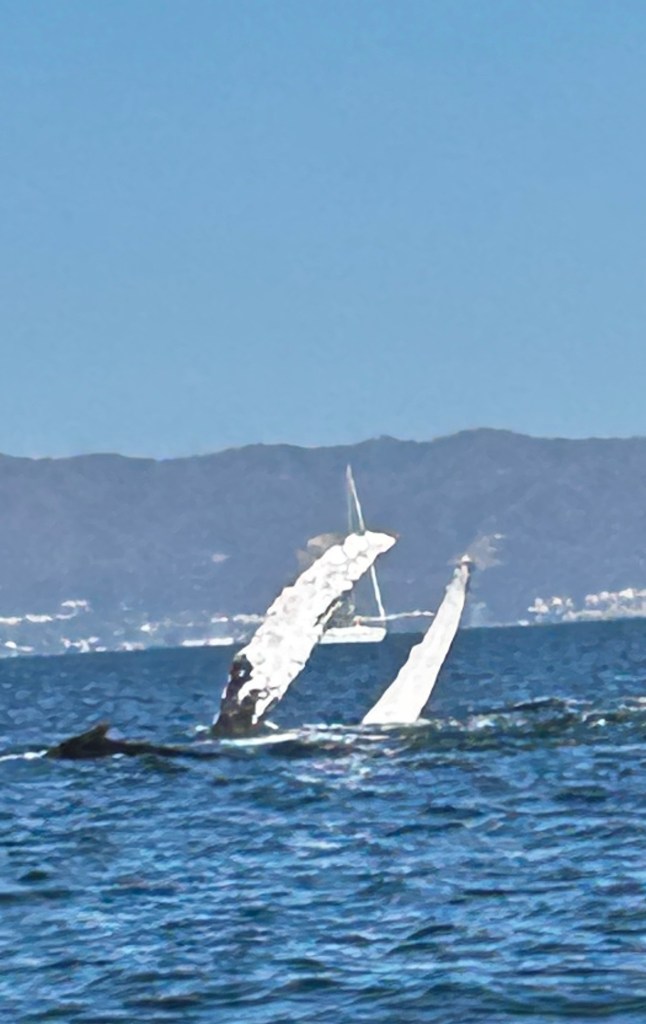
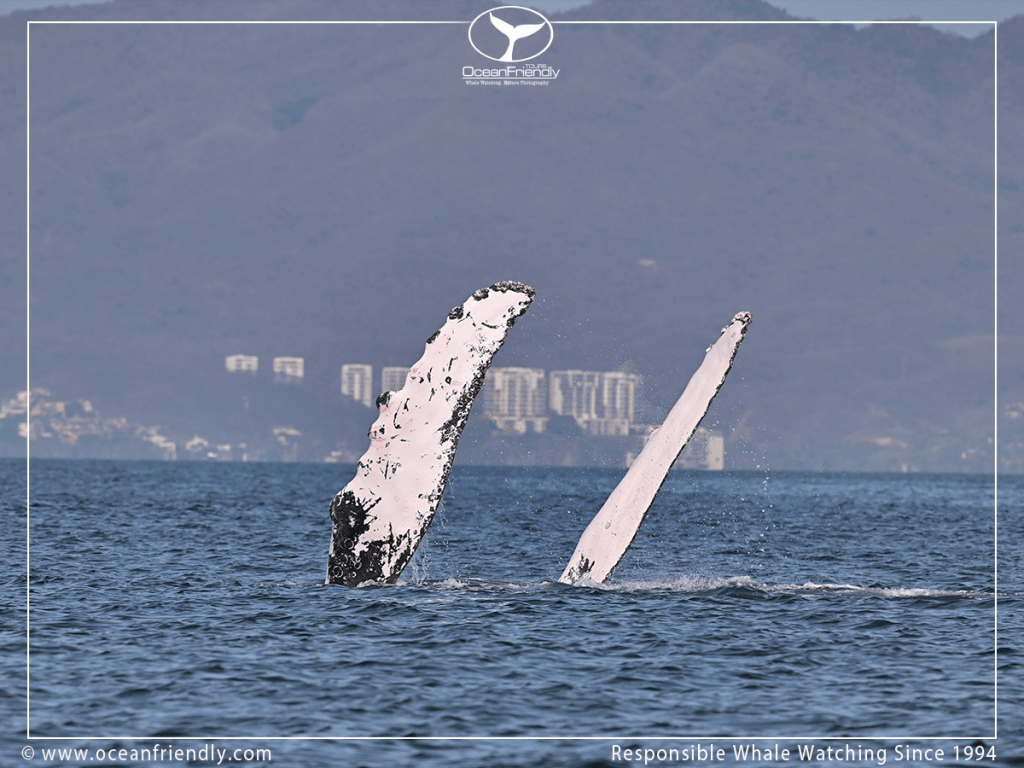
They can throw themselves completely out of the water (breaching), and swim on their backs with both flippers in the air.

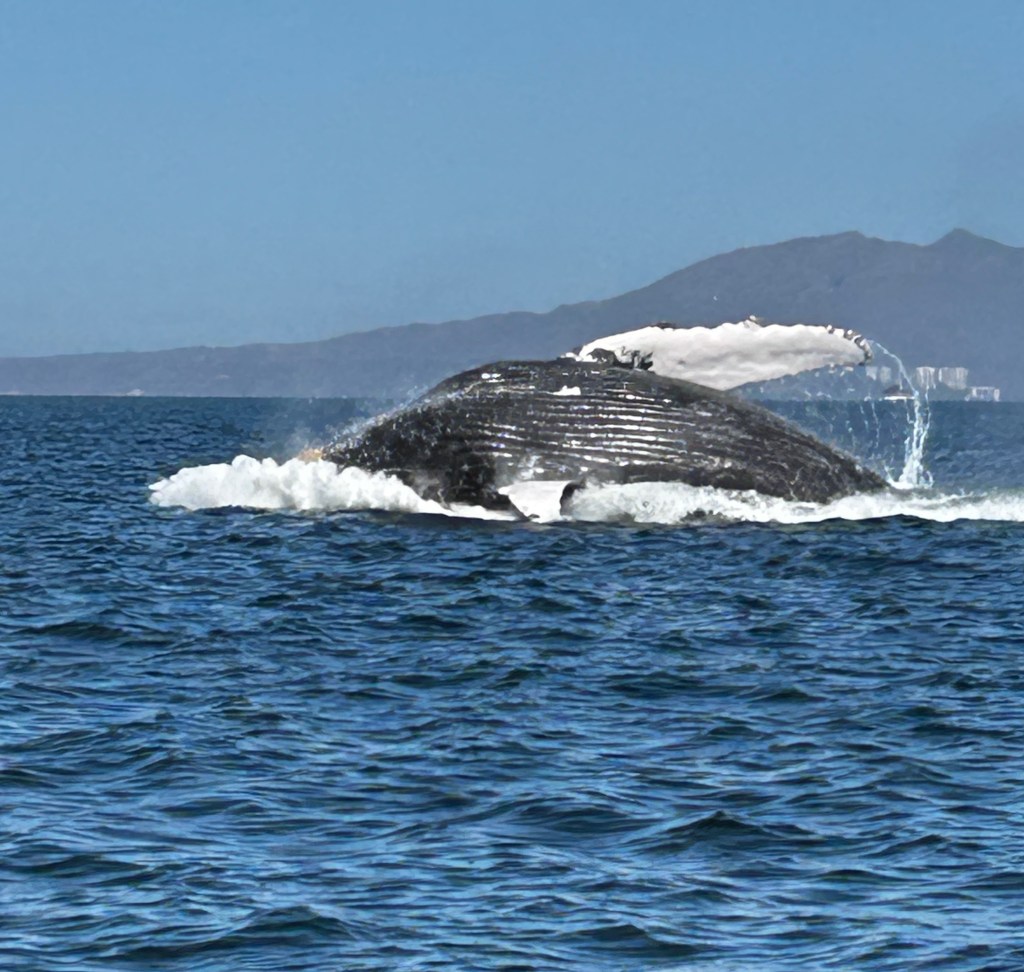
They also engage in “tail lobbing” (raising their huge flukes out of the water and then slapping it on the surface) and “flipper slapping” (using their flippers to slap the water). These behaviors are important in communication between humpbacks.

Perhaps the most interesting behaviour of humpback whales is their “singing.” Scientists have discovered that humpback whales sing long, complex “songs”. Whales in the North American Atlantic population sing the same song, and all the whales in the North American Pacific population sing the same song. However, the songs of each of these populations and of those in other areas of the world are uniquely different. A typical song lasts from 10-20 minutes, is repeated continuously for hours at a time, and changes gradually from year to year. Singing whales are males, and the songs may be a part of mating behavior.
During the tour, a microphone was lowered into the water and we could hear the high-pitched singing sounds. It was very emotional to feel so close to the underwater community communicating in their language.
As we were returning to port, the boat was surrounded by a school of dolphins leaping in the air; the last three in succession included a new born.
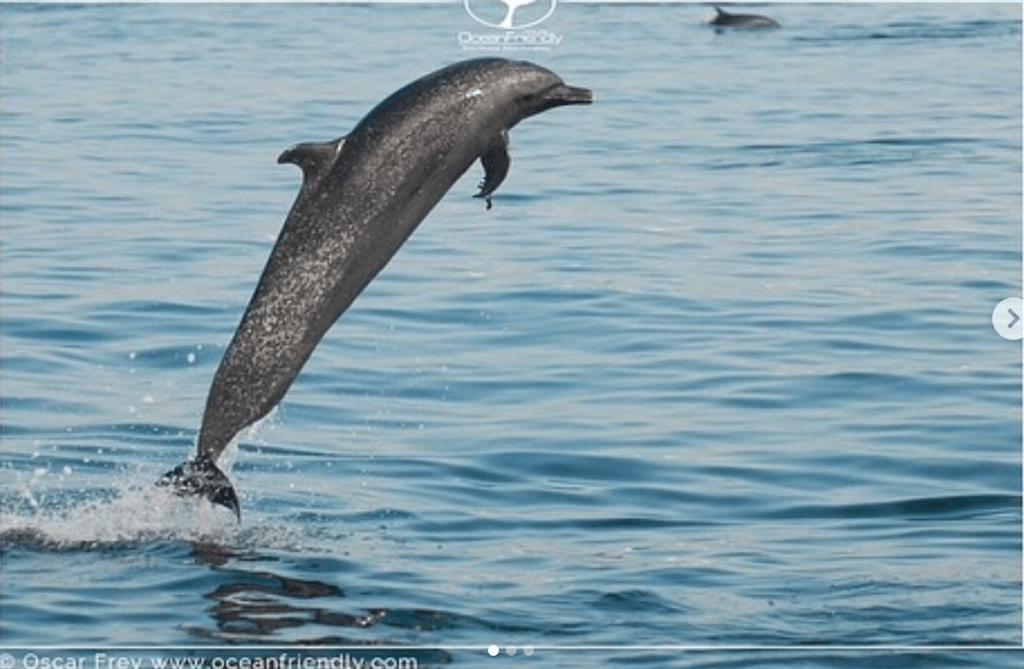
It was a fabulous new experience for us with Oskar and his crew on Ocean’s Friendly Tours. The energy created by these mammoth mammals suddenly emerging from the water, flying through the air and crashing on the water was exhilarating. We were very engaged by Oskar’s passion and knowledge about Humpback Whales and their ways. The experience was a incredible gift to see a good person committed to improving our world for over 30 years: we feel enriched.
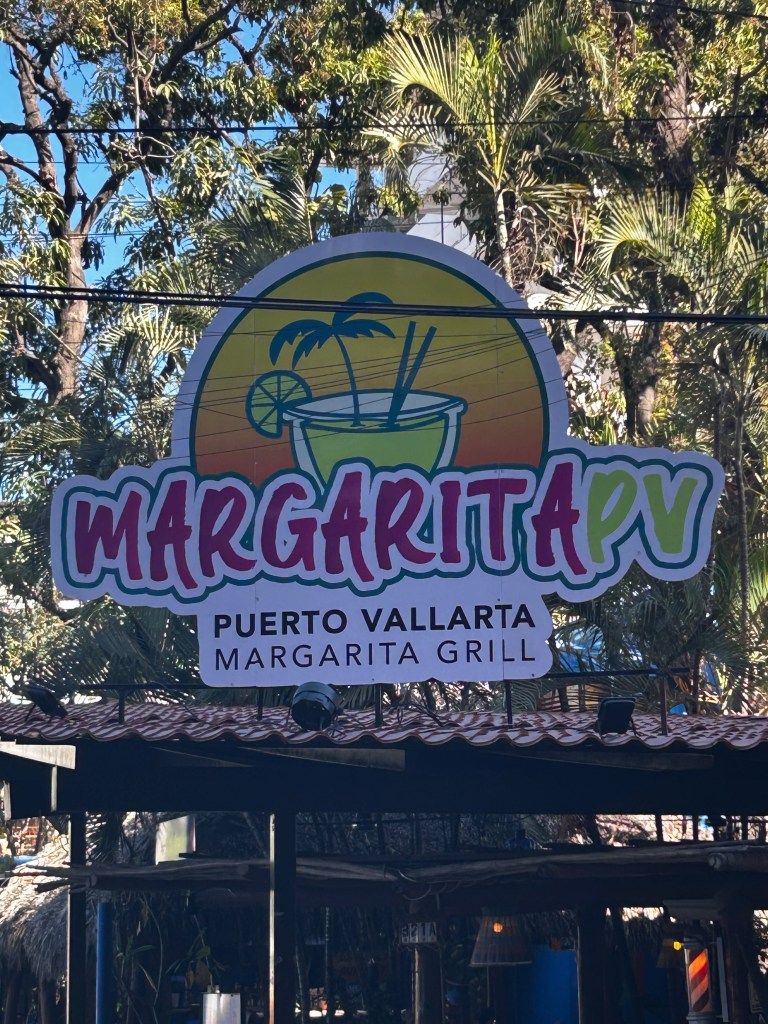
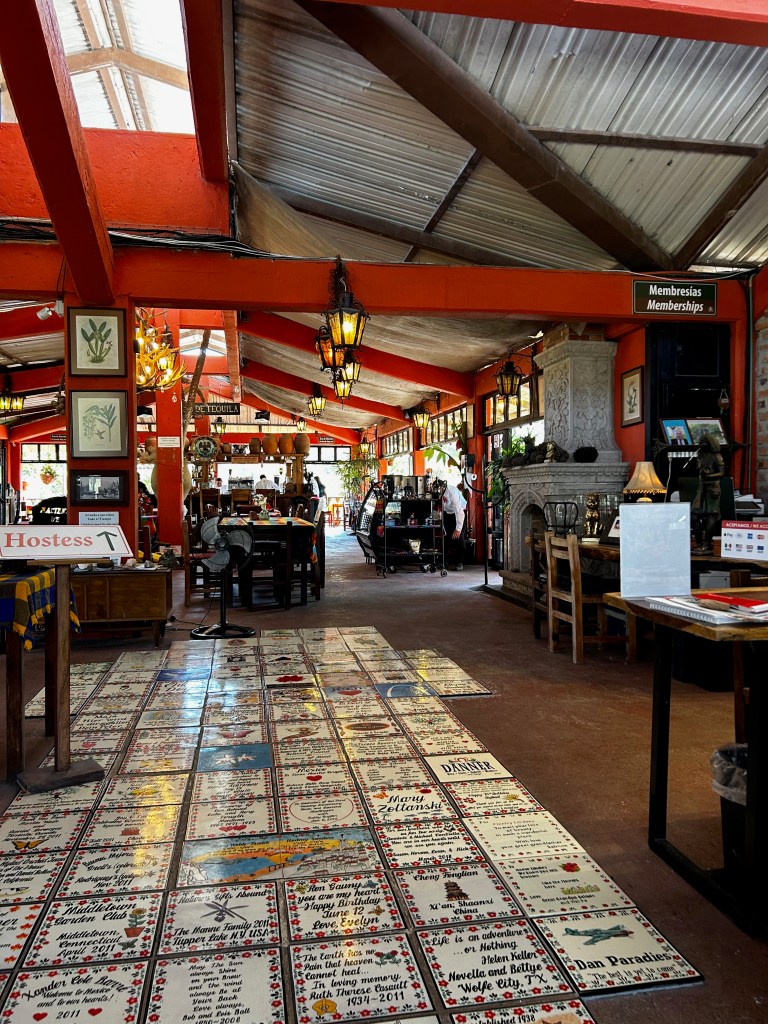
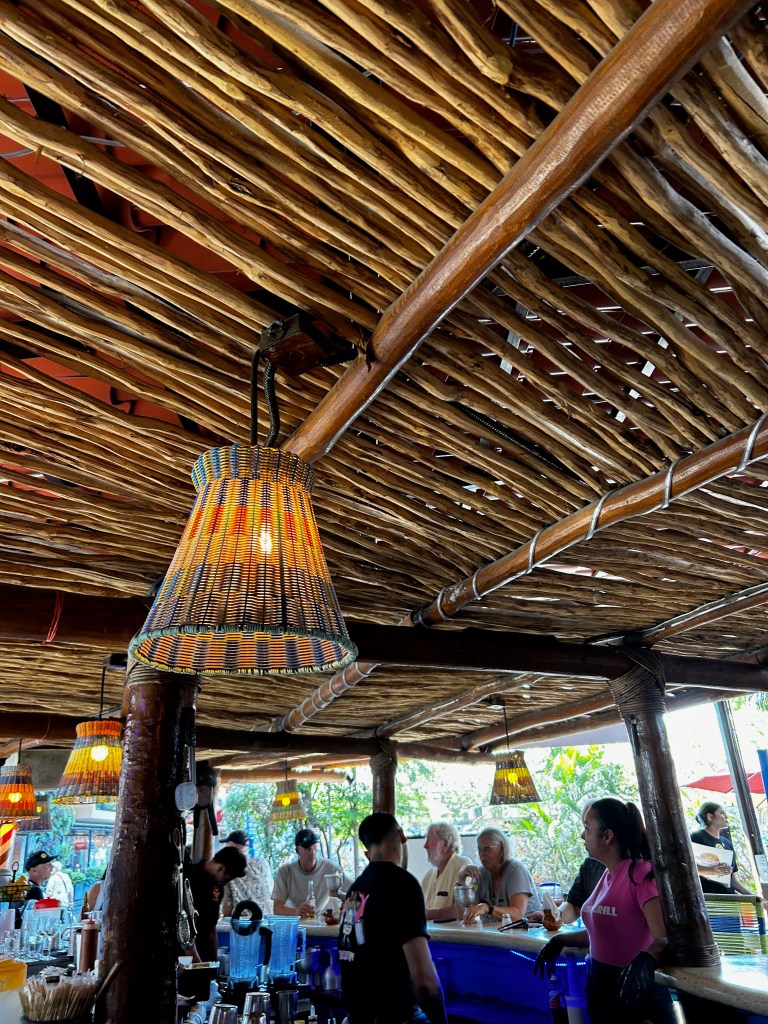
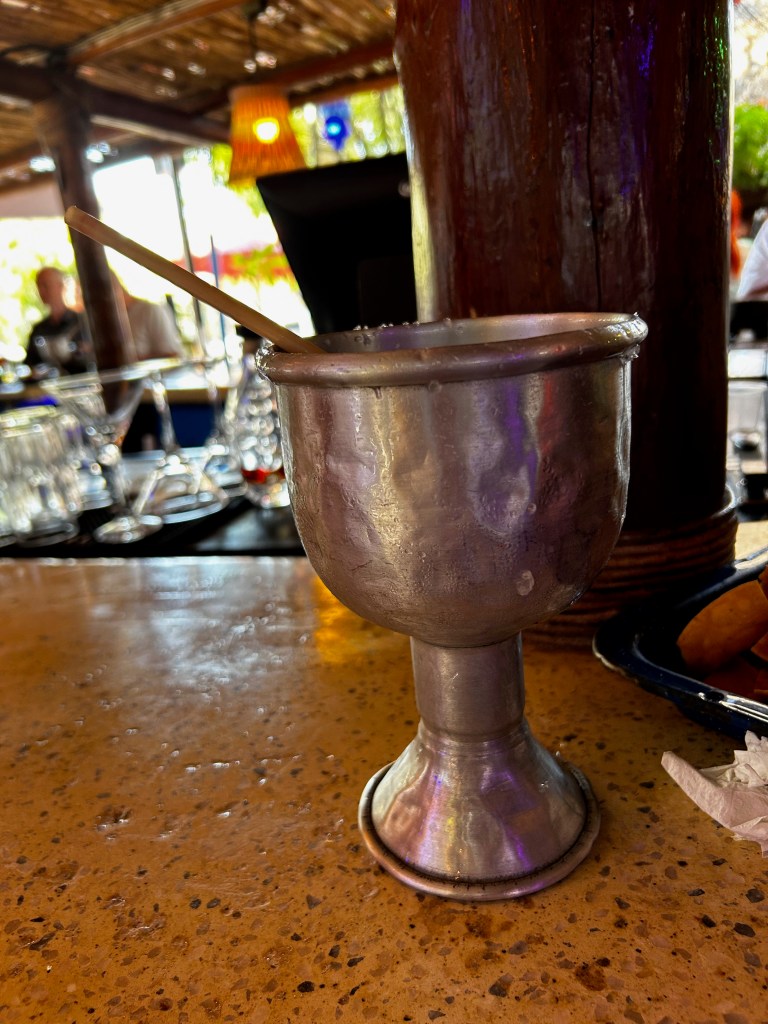
When we returned, we walked down to the waterfront, called Dean on his Birthday and had a Margarita at the Margarita PV Grill.
Tuesday, February 11
The Jungle Trails of the Jardin Botanico de Vallarta
We had the same driver, Alonso, who drove us to the Botanical Gardens, 30 km south of Puerto Vallarta on a twisty, hilly, tope (bump)-ridden narrow road. We arrived at 11:00, walked through the trails until noon and then had lunch over-looking the site.
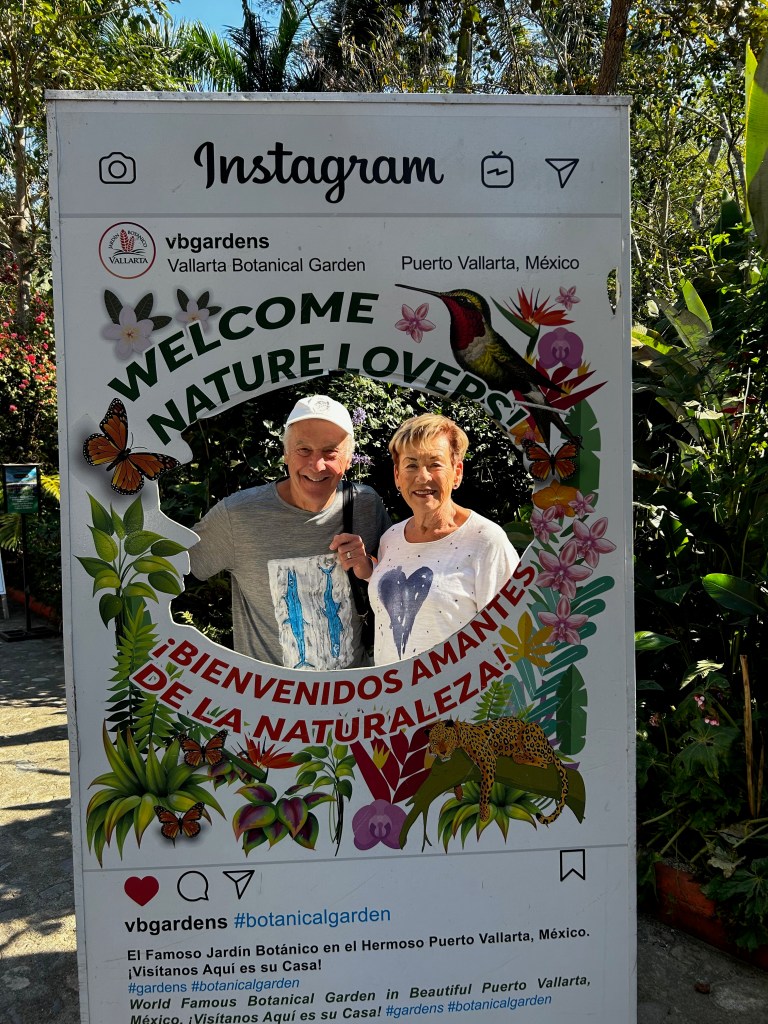
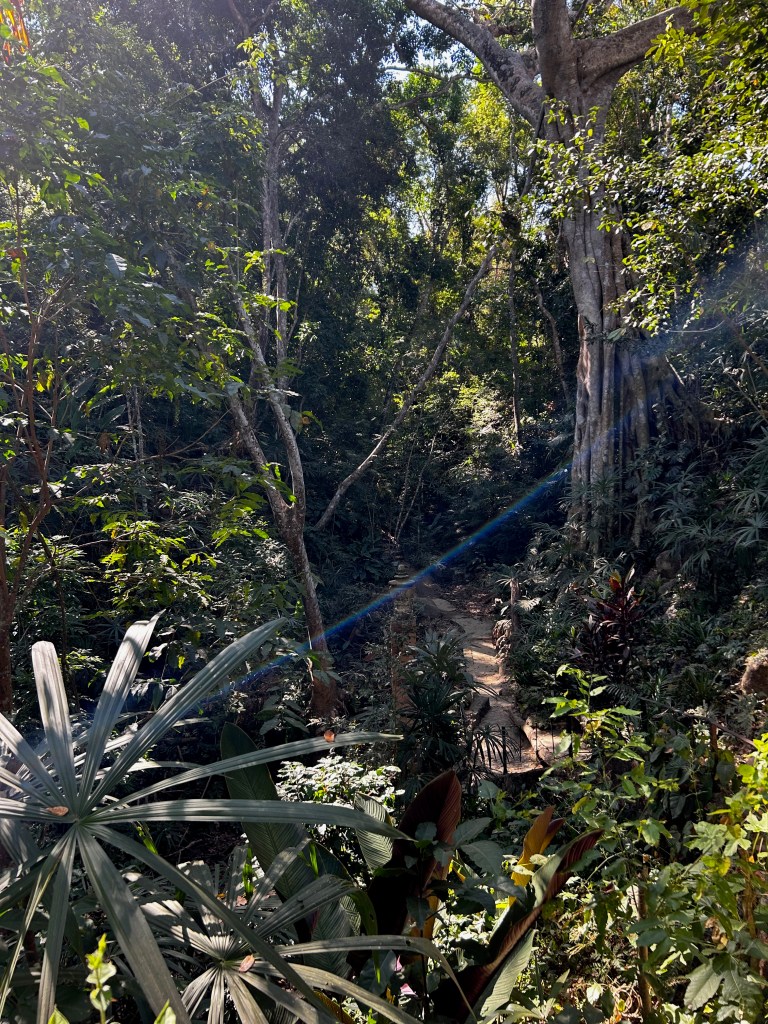
We walked the jungle trails of the gardens, steps up and down until we were tired. We started in the Hacienda de Oro restaurant, climbed down and back the steep steps to the river, Rio Los Horcones, followed the Jaguar trail, through the Vanilla Plantation and finished in the Cactus House.
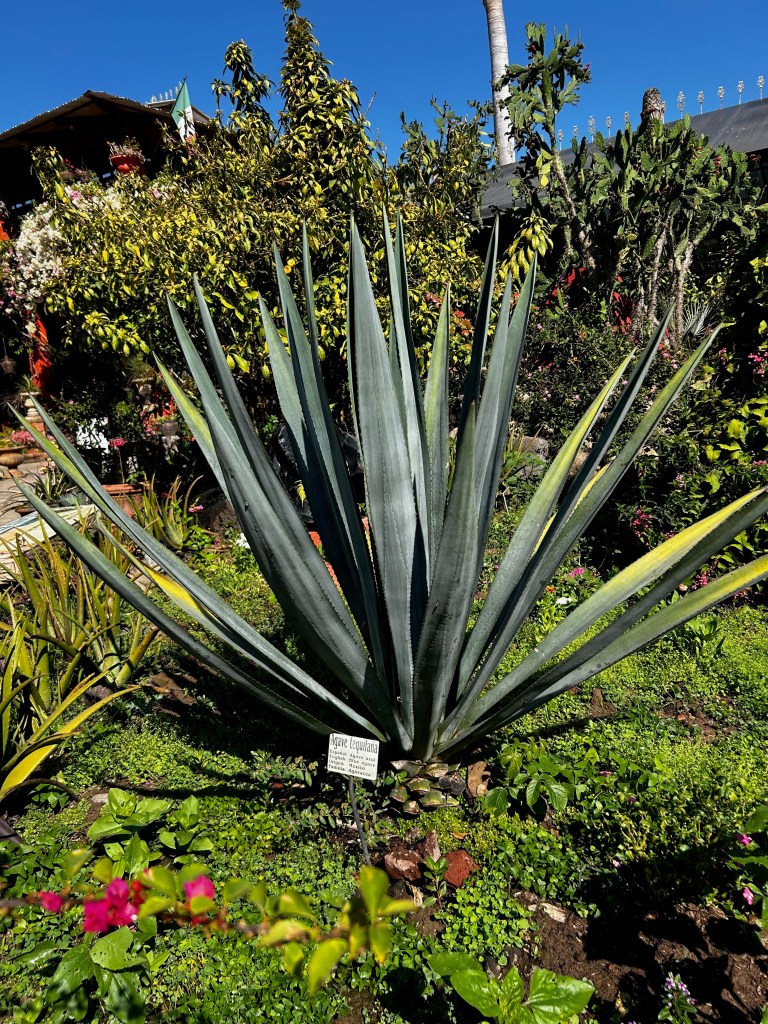
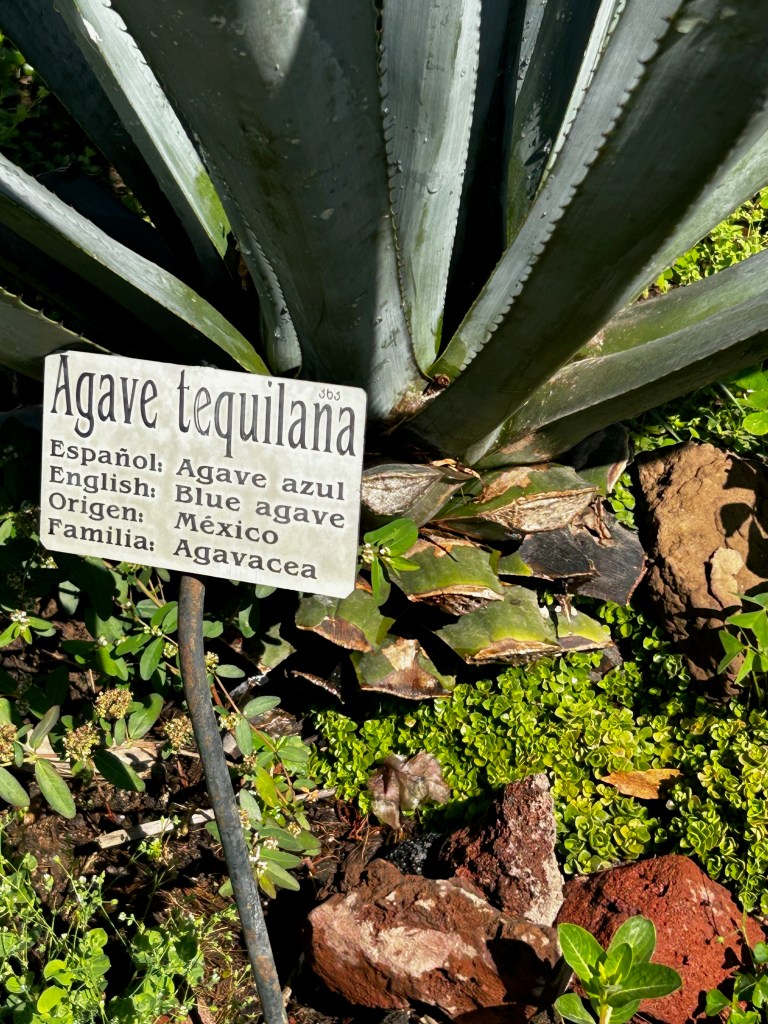
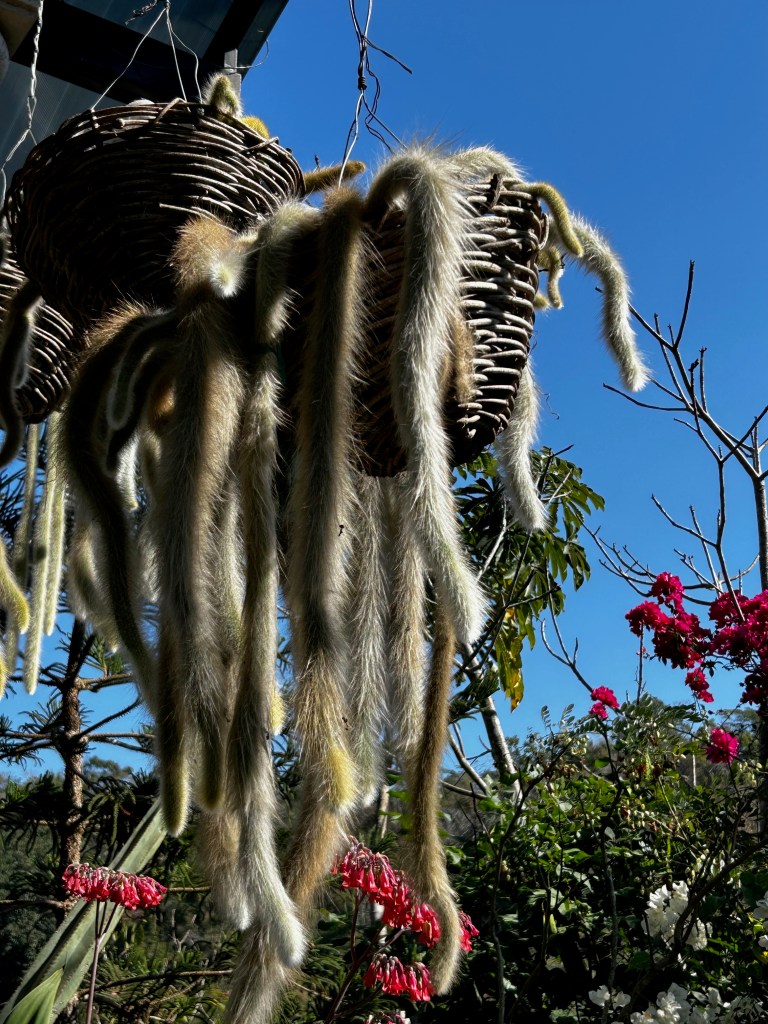
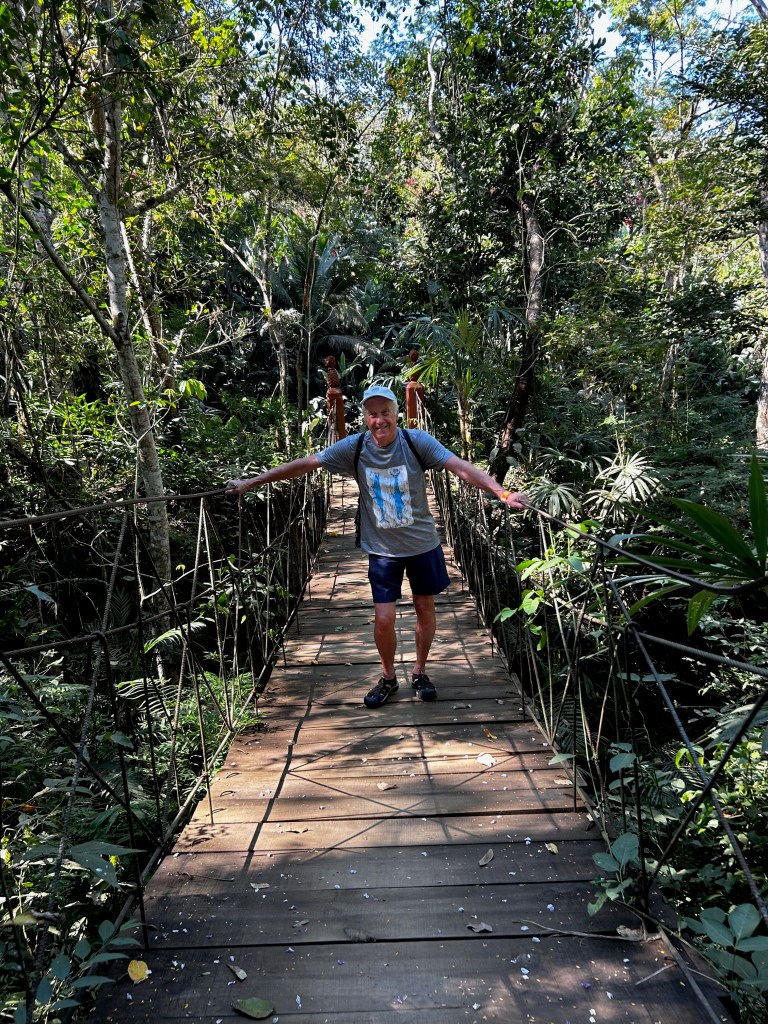

We met a peacock quietly strolling who later converted to a wildly shaking dancer.
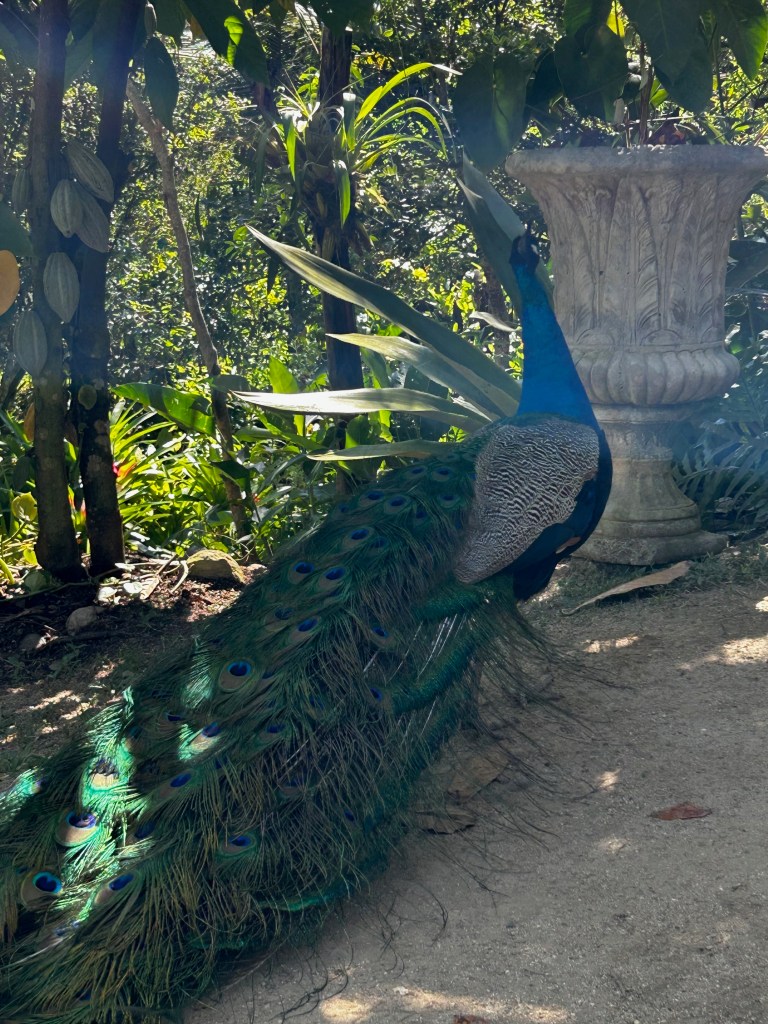
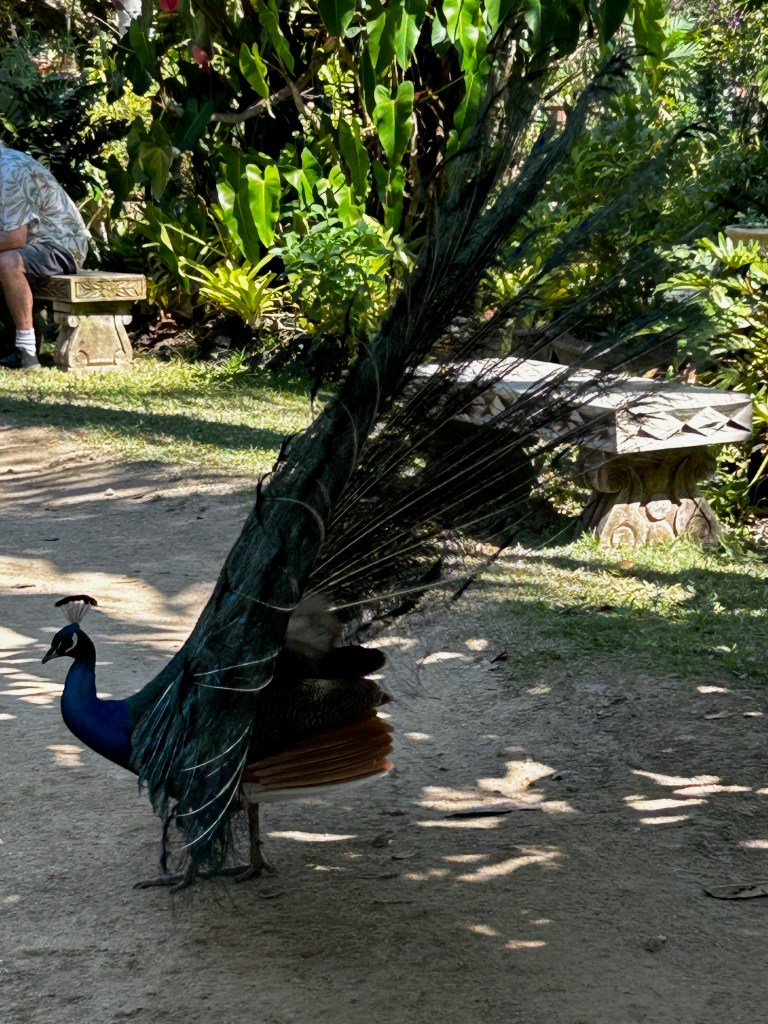
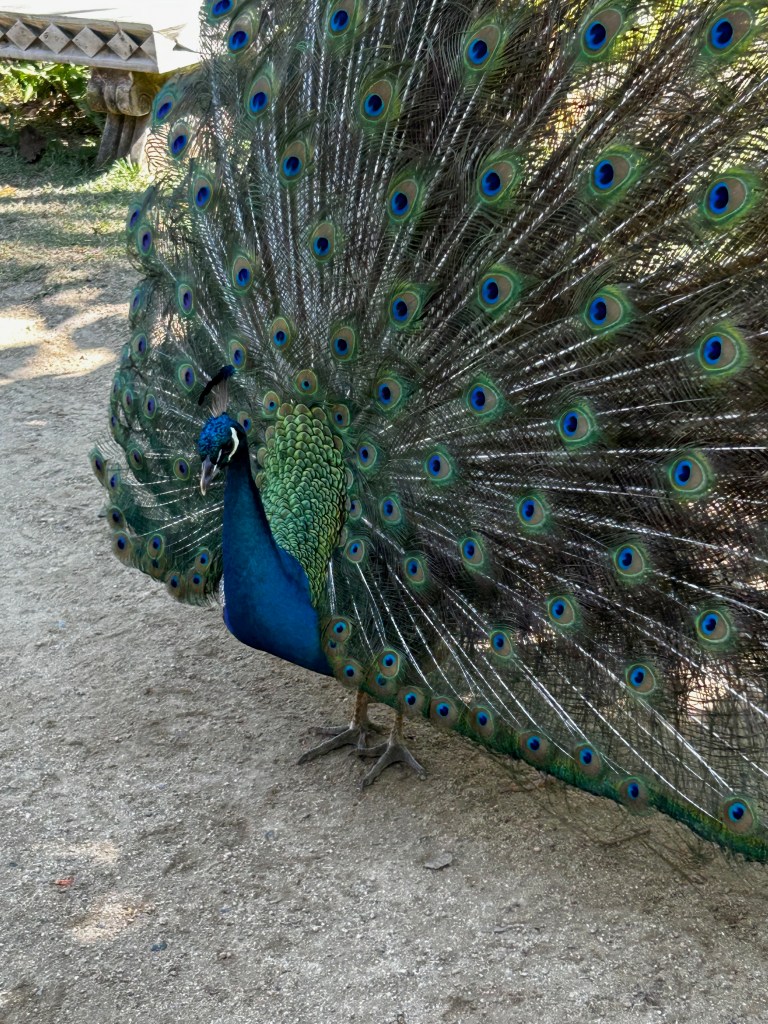
We had lunch in the Hacienda de Oro restaurant.
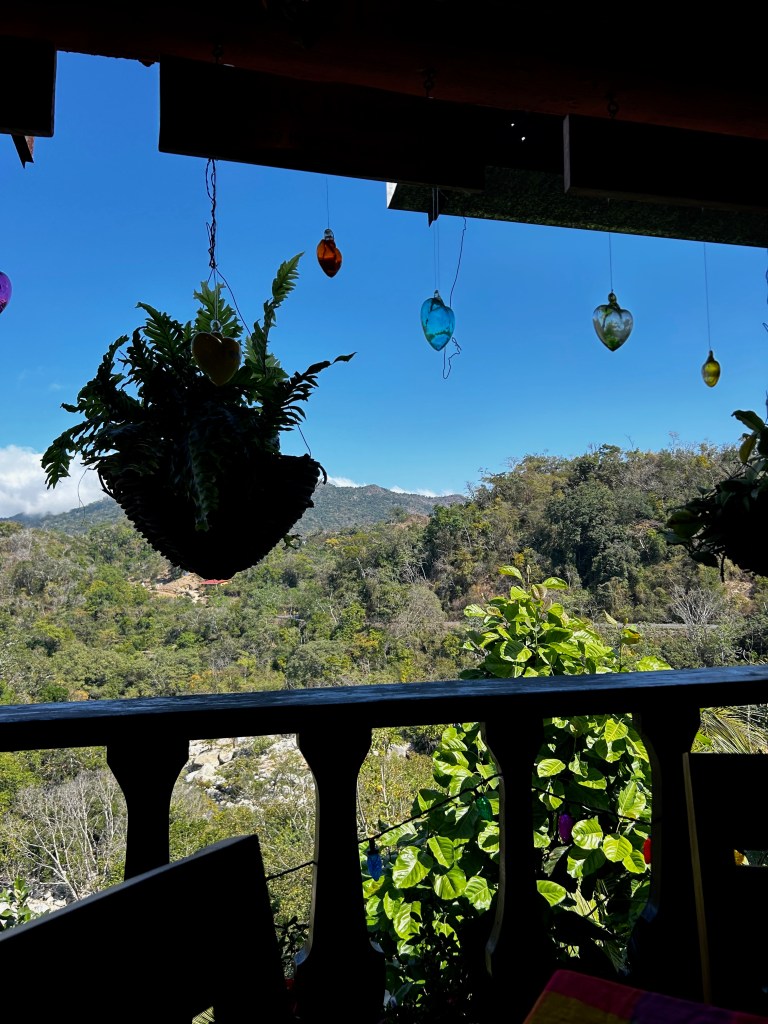
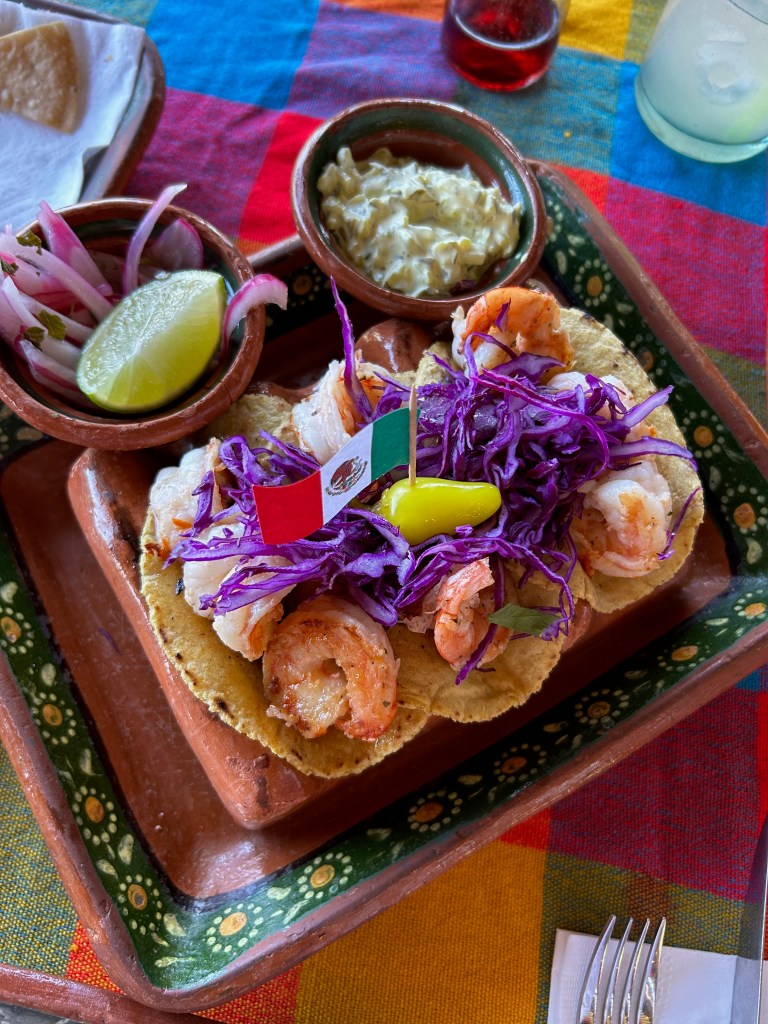
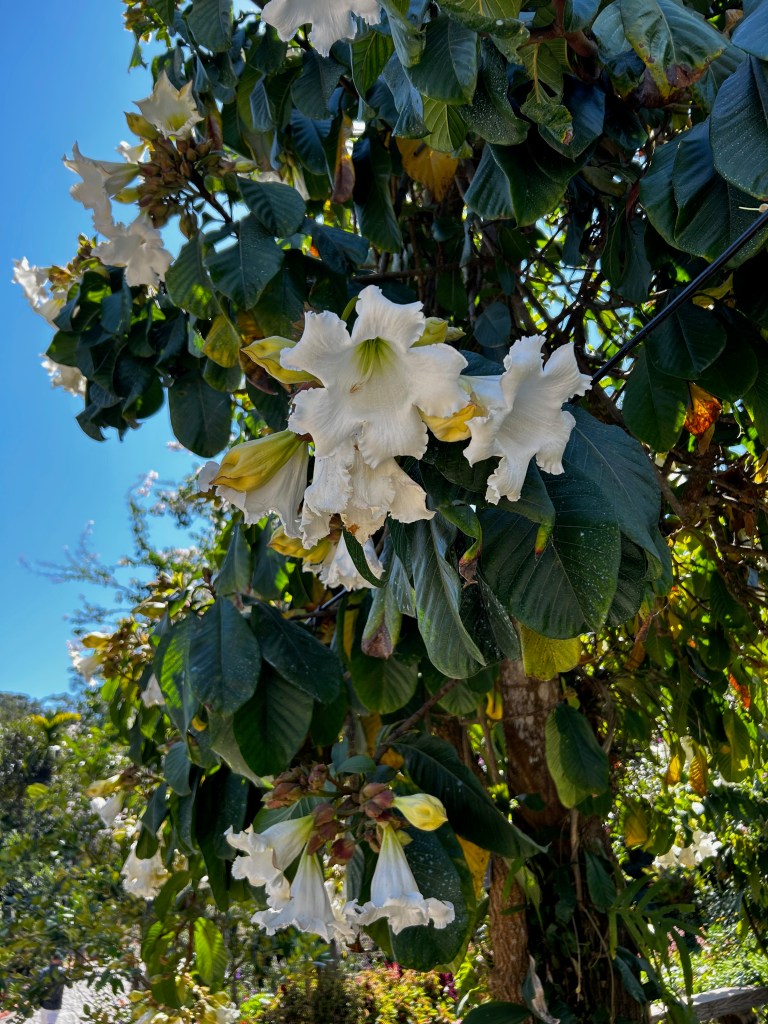
We shopped in the store (blue ceramic dish for salt, cover for tortillas, carved hummingbird feeder) and arrived home around 2:00 pm, just in time for a swim at the massive roof-top pool.
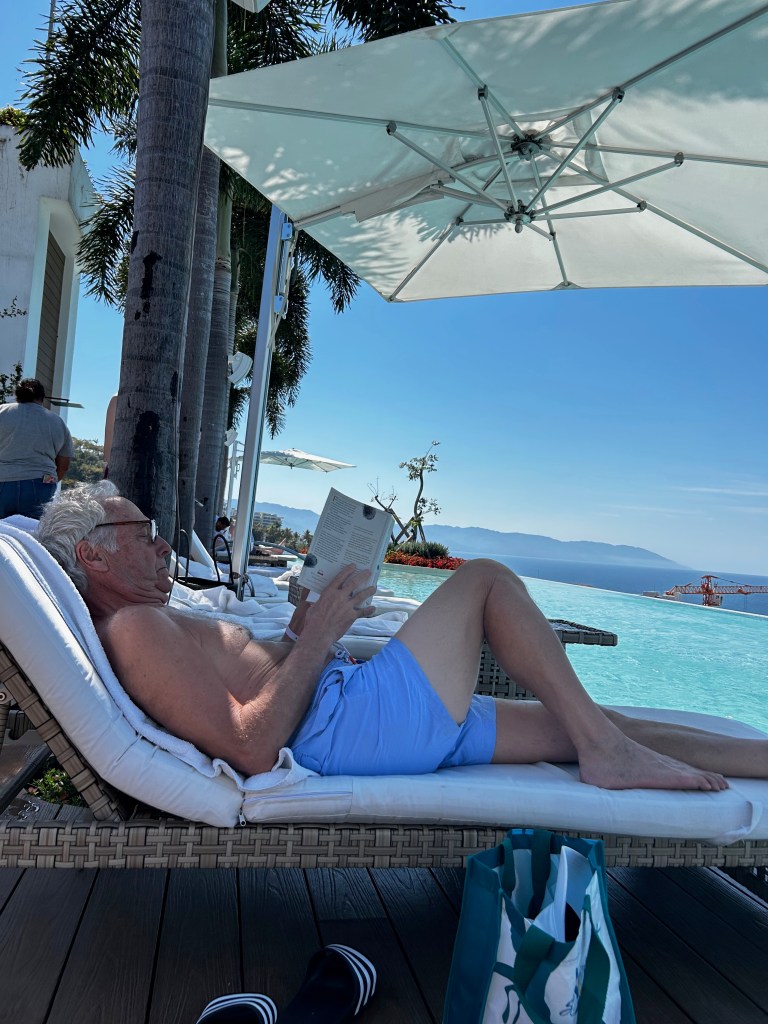
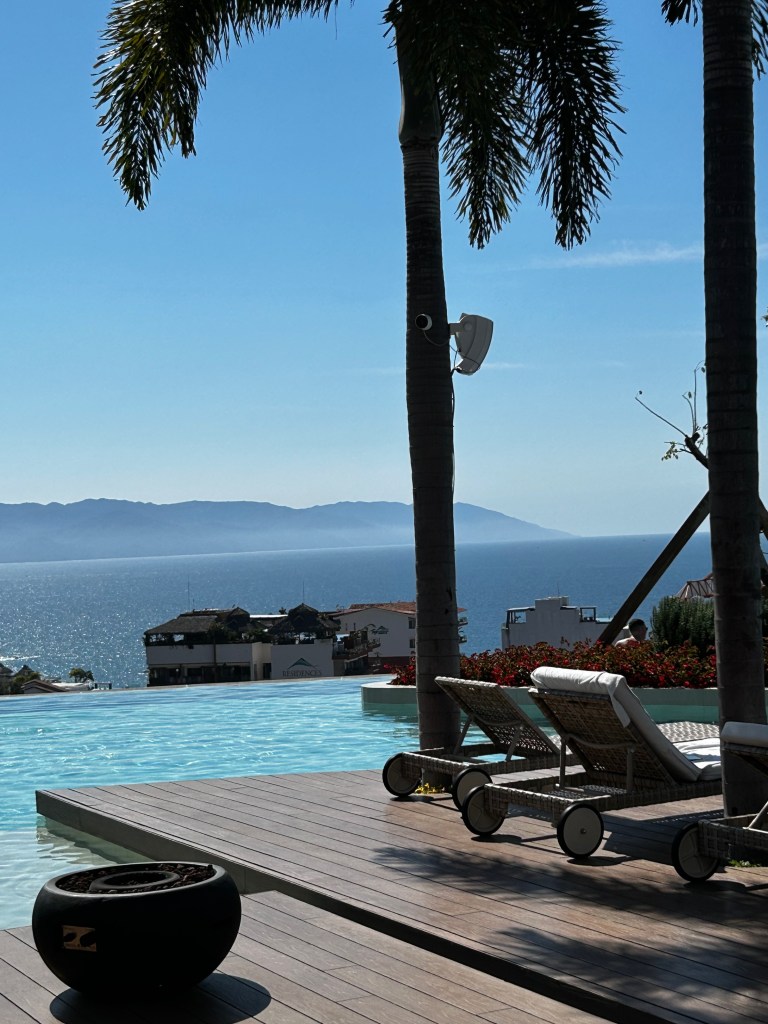
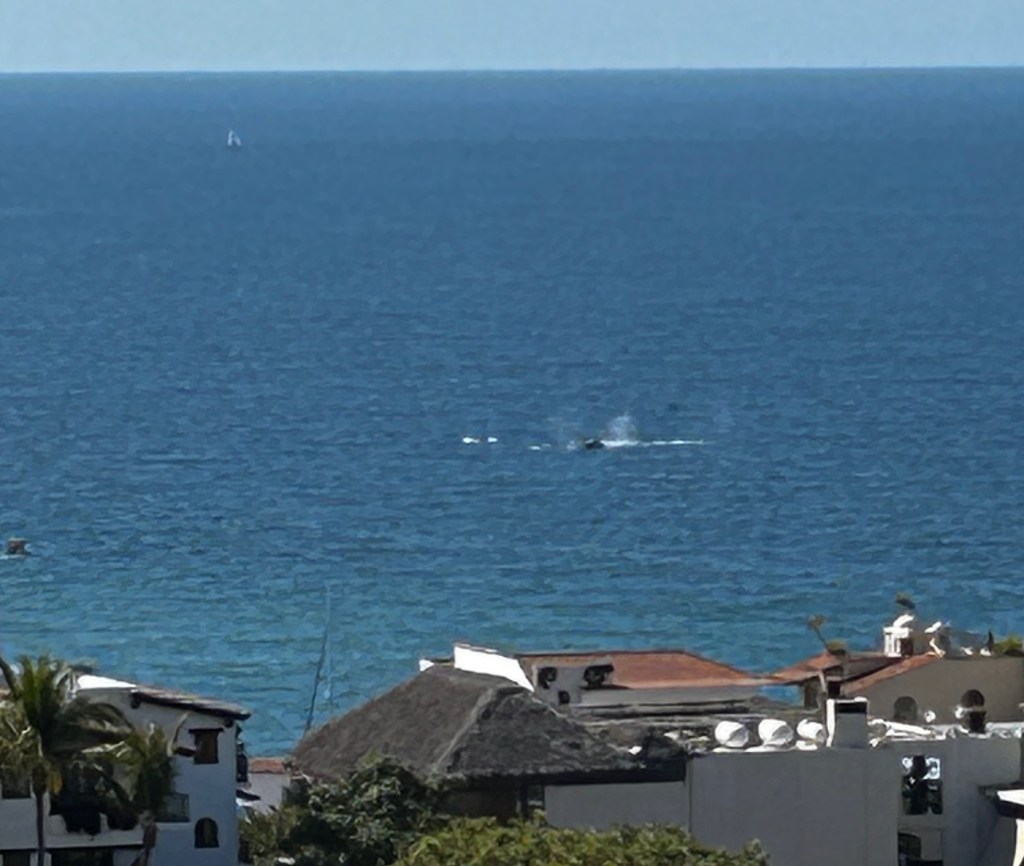
When we arrived back in the condo, we could see whales in the bay.
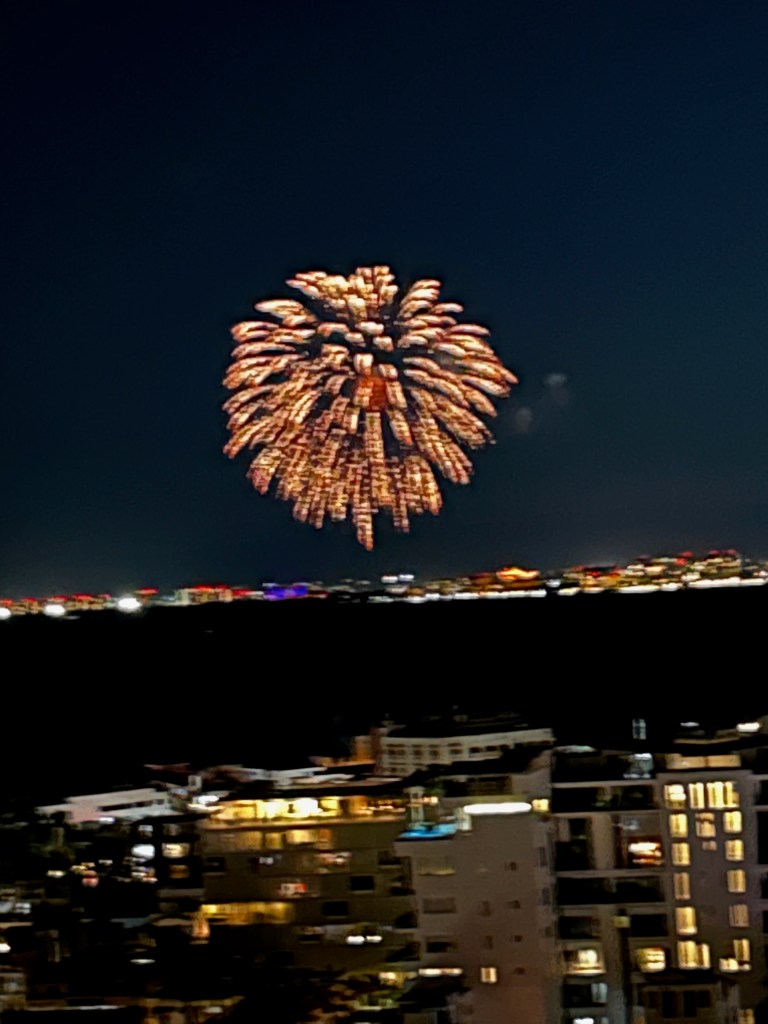
There were often fireworks at night.
Wednesday, February 12
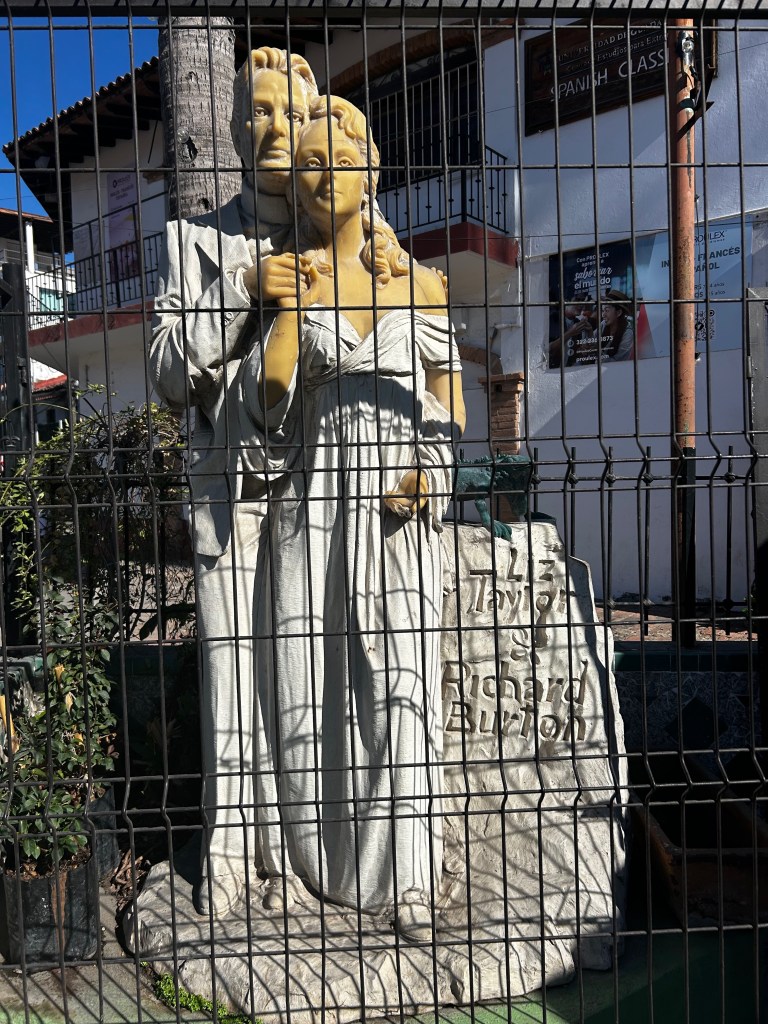
We walked down to the Cathedral and Central Square of Old Town about 20 minutes to the north. The Night of the Iguana movie put Puerto Vallarta on the map so we weren’t surprised to see this sculpture of Liz and Richard.
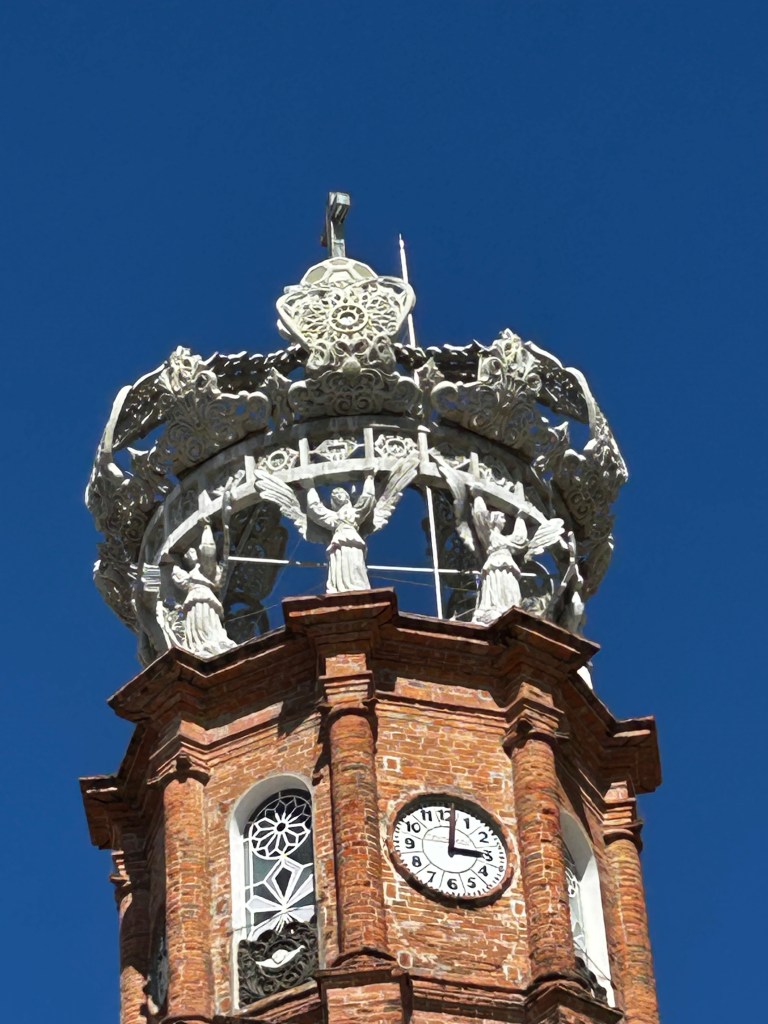
Towering over the skyline of downtown, flanked by kitschy souvenir stores, and fronted by a charming, colourful plaza, the pink-hued Church of Our Lady of Guadalupe – Parroquia de Nuestra Senora de Guadalupe is a highlight of the Centro Puerto Vallarta. The church was laboriously constructed over several decades. The neo-Baroque church is best known for its emblematic and intricate bell tower and is the city’s most important attraction. The interior is lovely but small and modest – the exterior is the real photogenic gem.
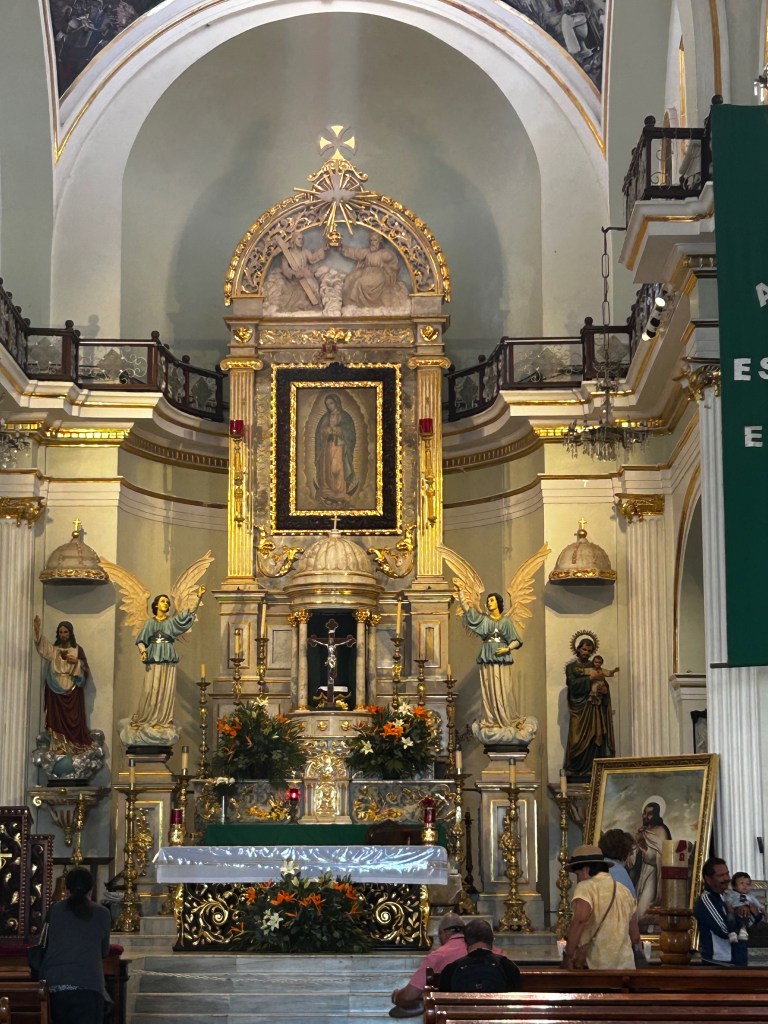

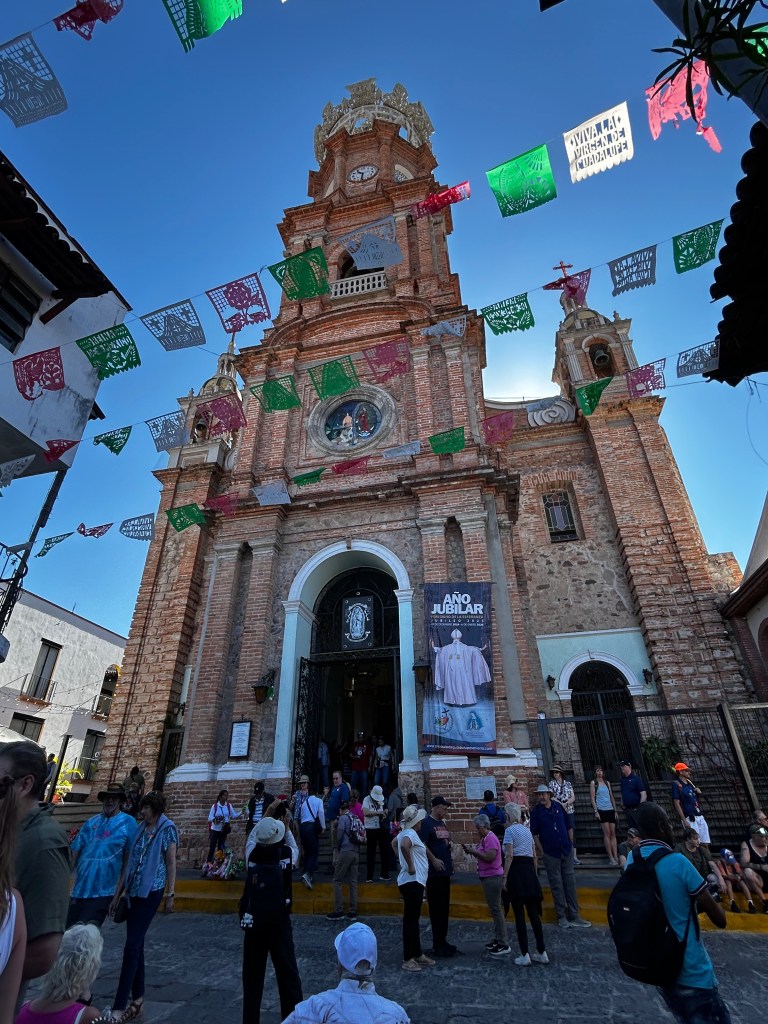
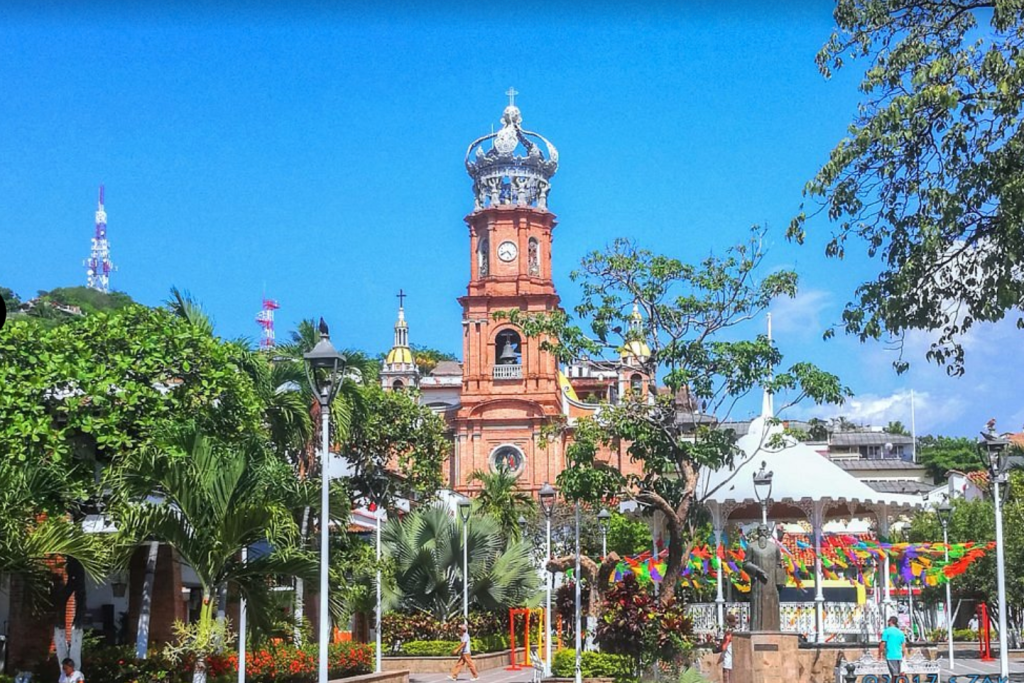
The original crown of angels, fashioned on the crown of the Empress of Mexico, was destroyed during a hurricane and locals picked up pieces thinking that they were sacred and their key to heaven. This is the rebuilt one.
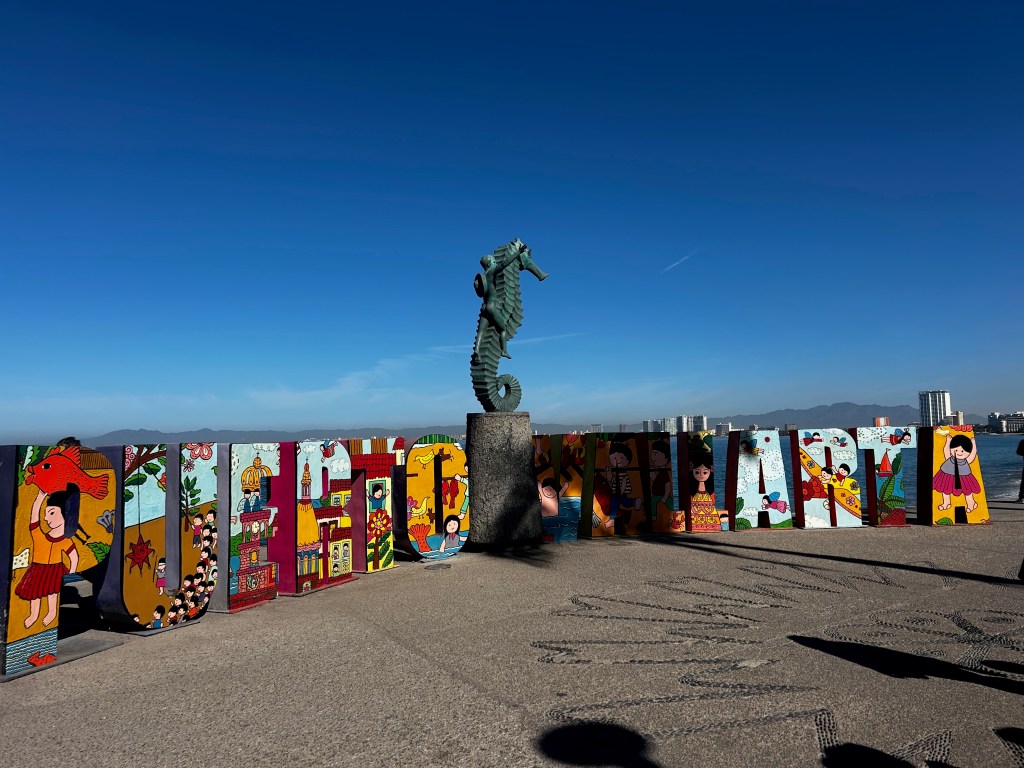
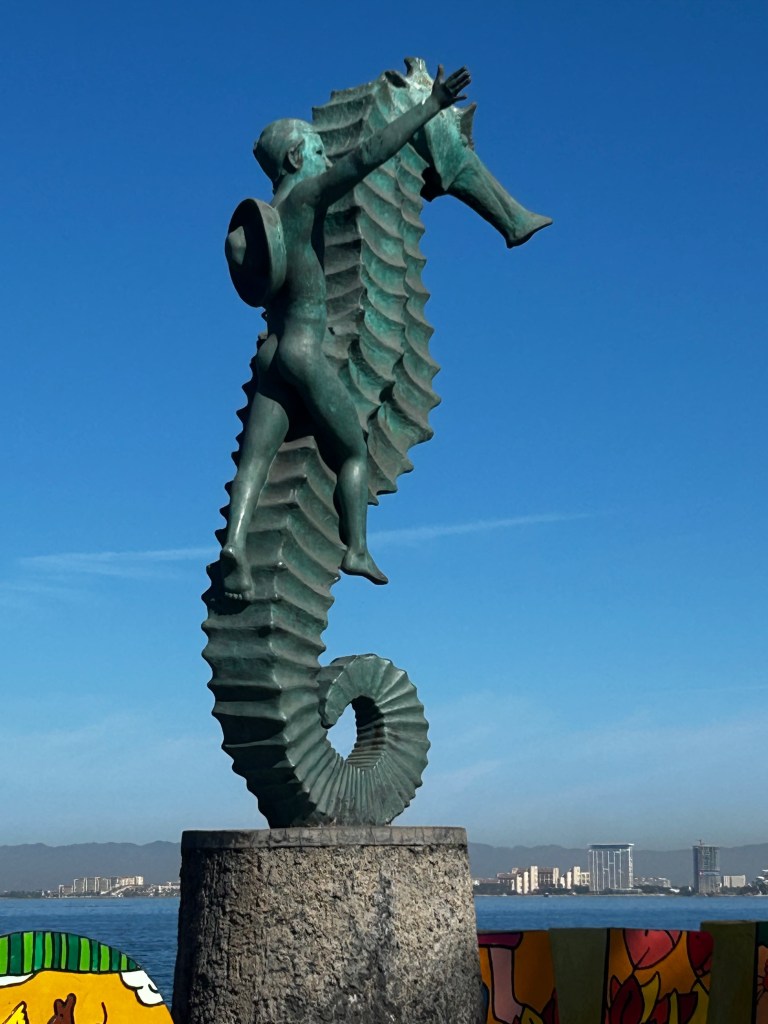

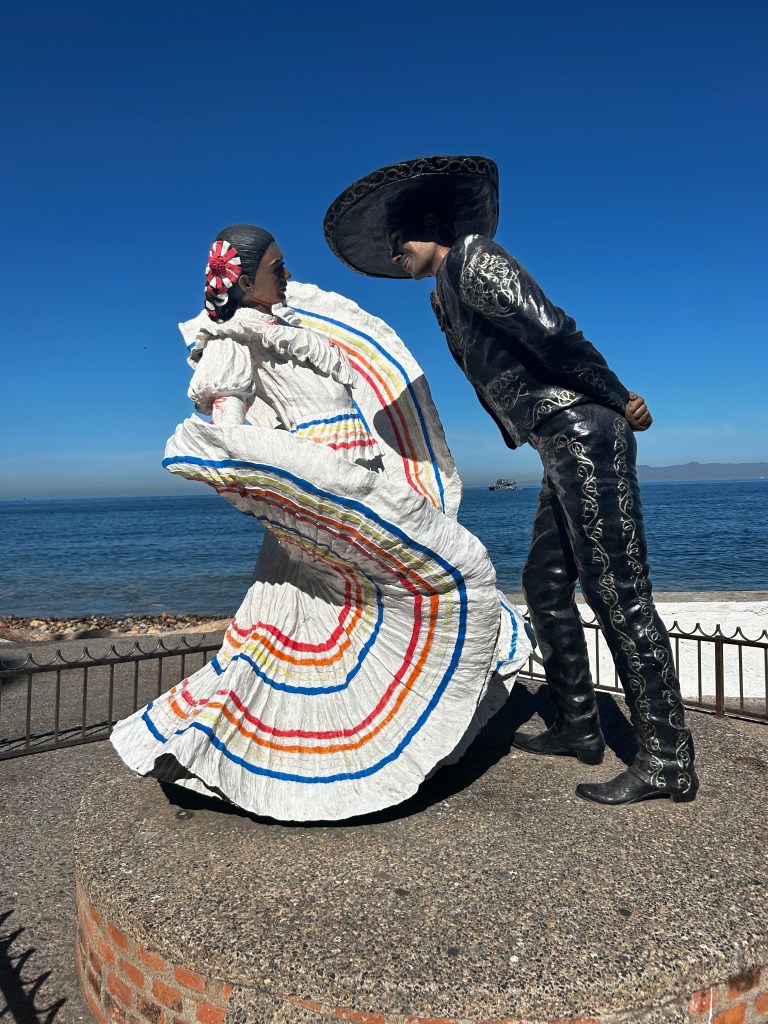
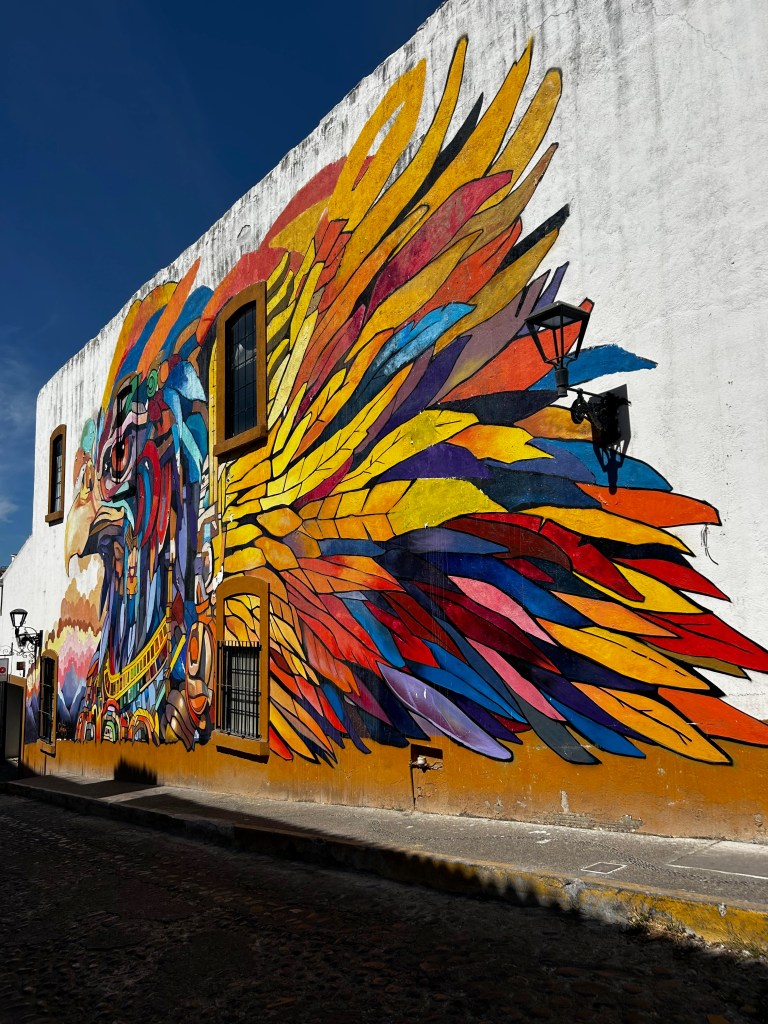
After lunch, we walked to the Art District and visited Galeria Colectika and enjoyed the Huichol beadwork and yarnwork pieces.

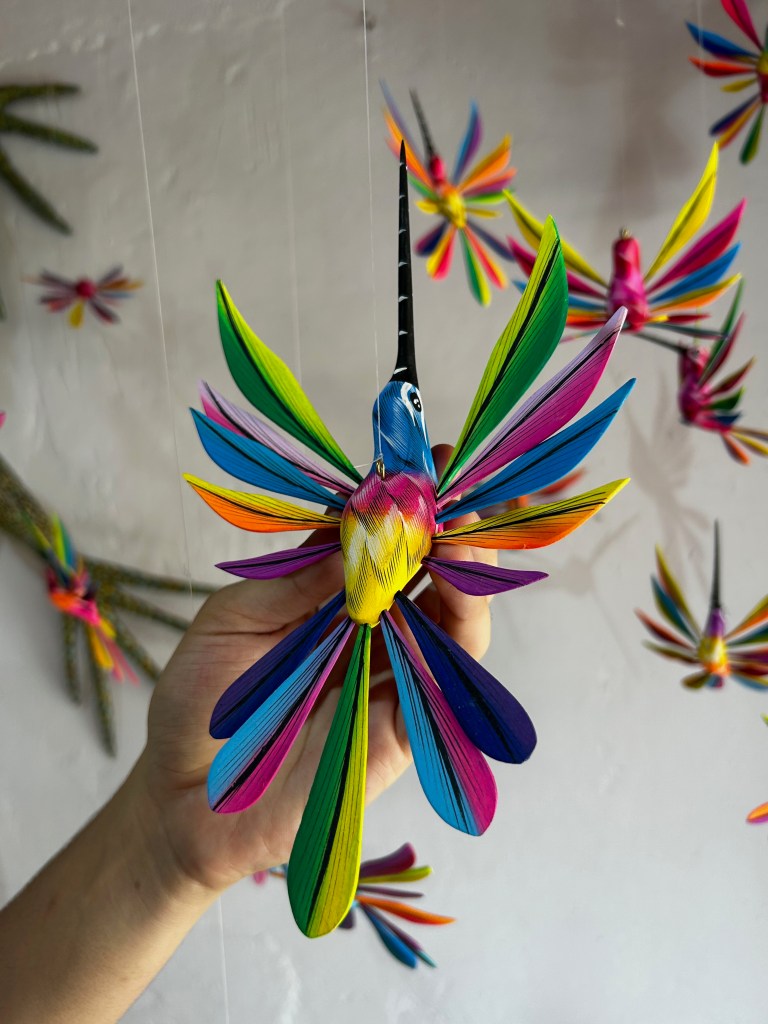
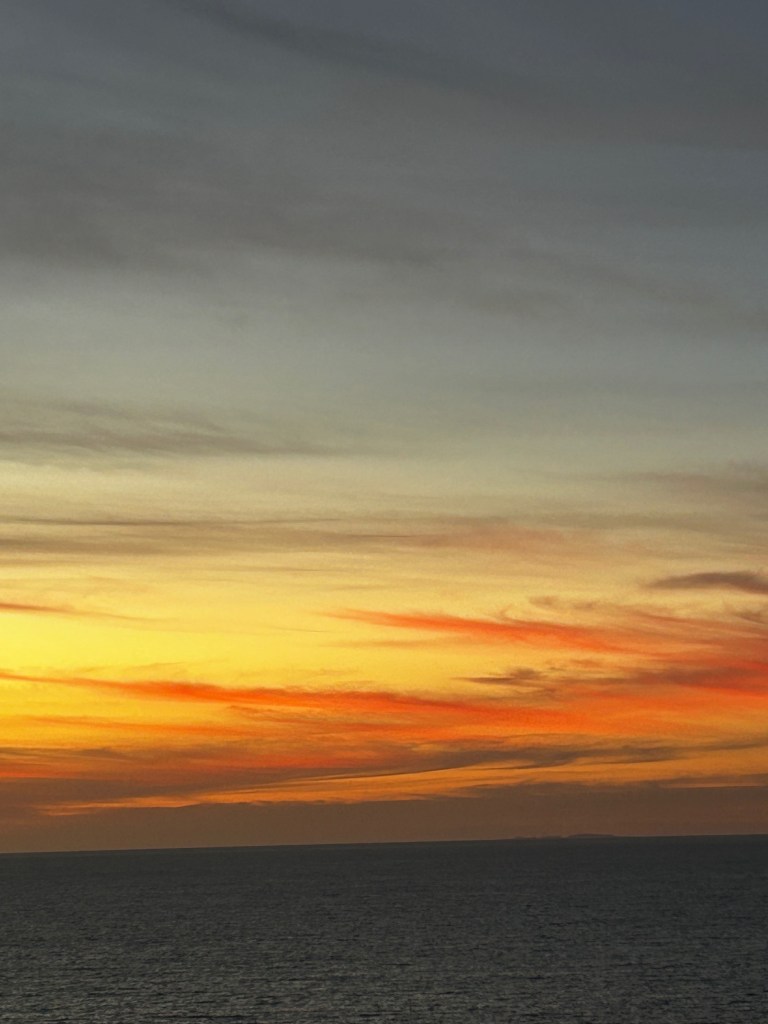
Thursday, February 13
We headed for an early morning swim before our Get the Guide Puerto Vallarta Food Tour.
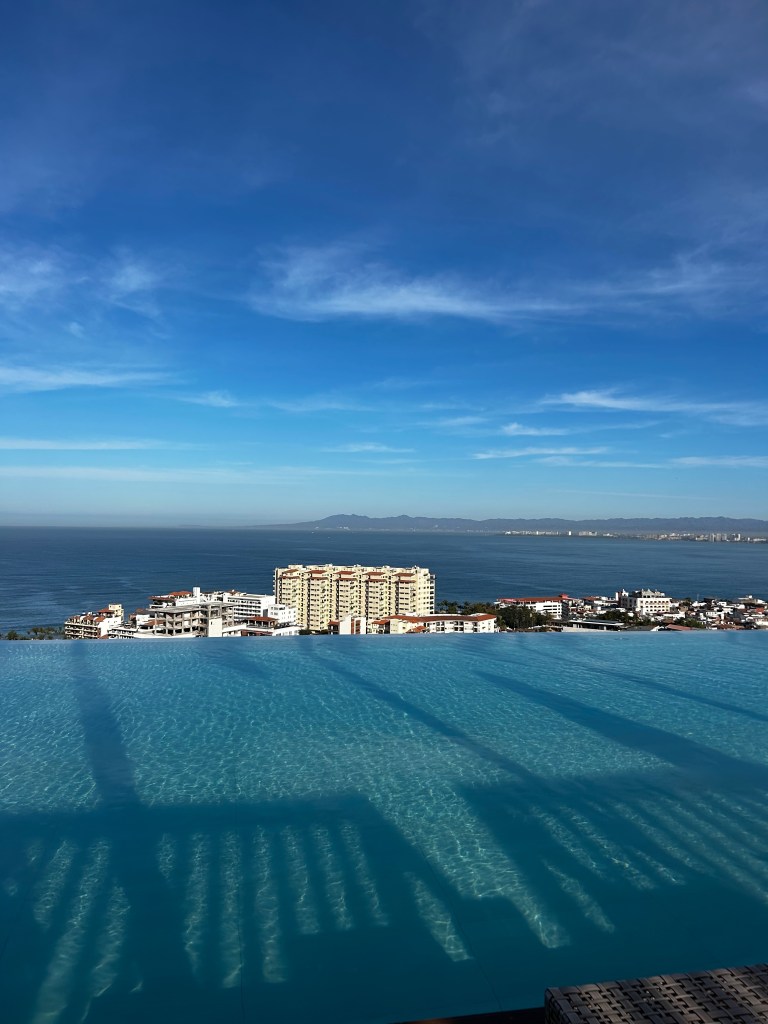
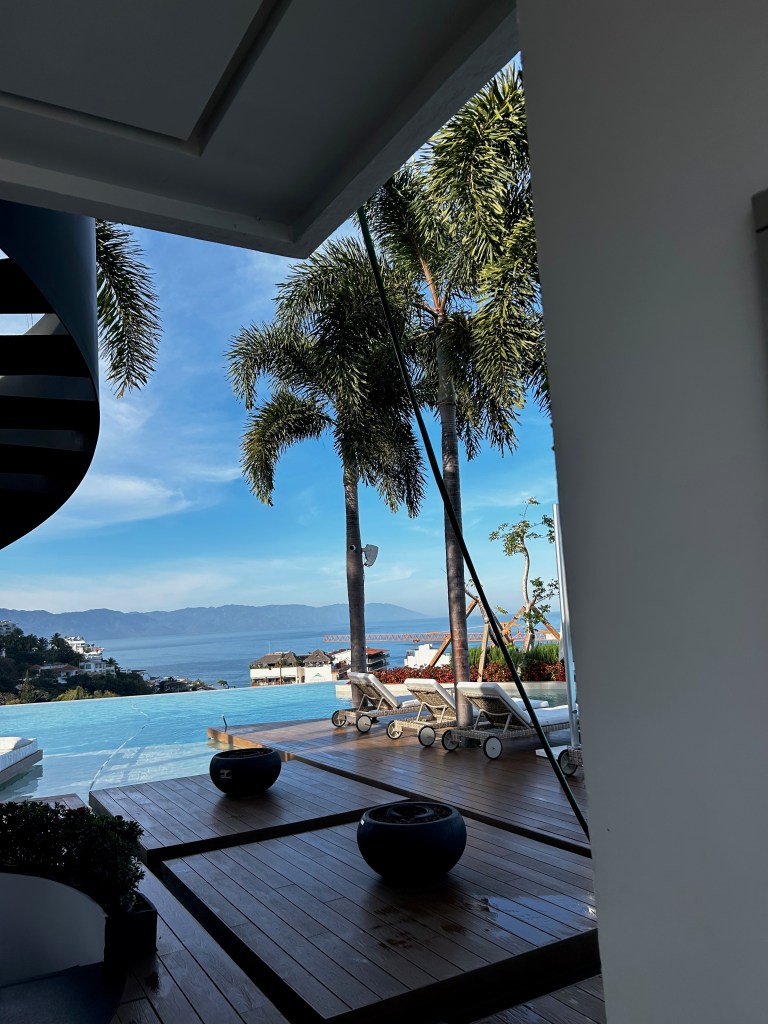
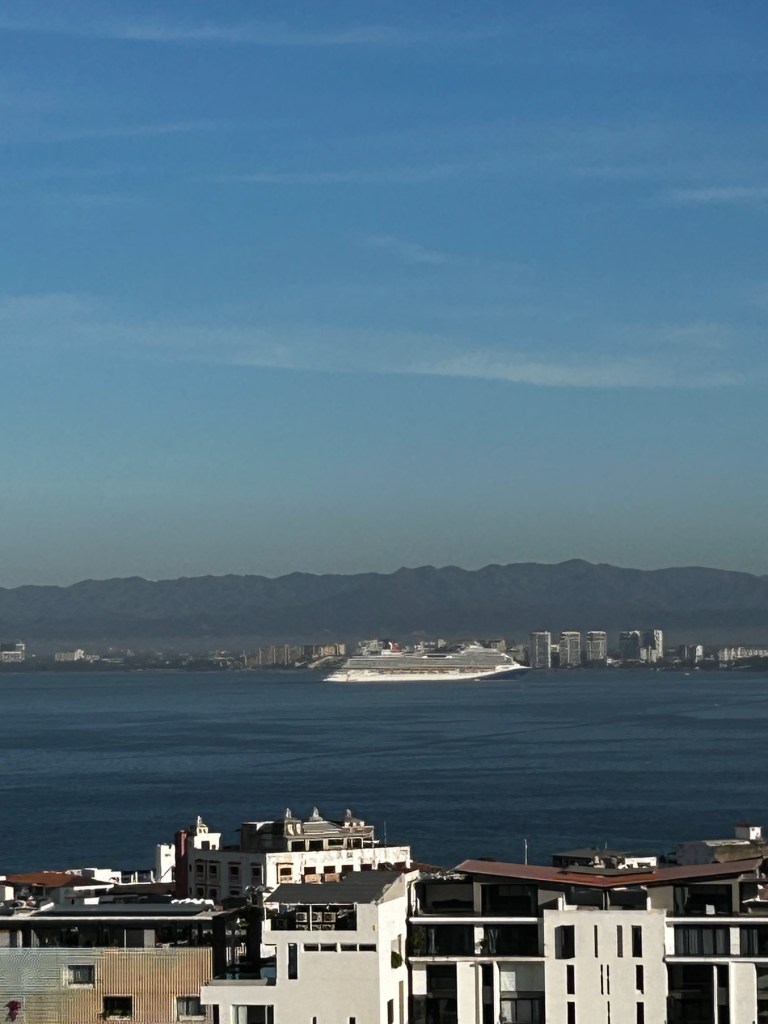
Our balcony is our favourite spot. Several days a week we watch the cruise ships come into the harbour. They manage to scare away the whales and dolphins.
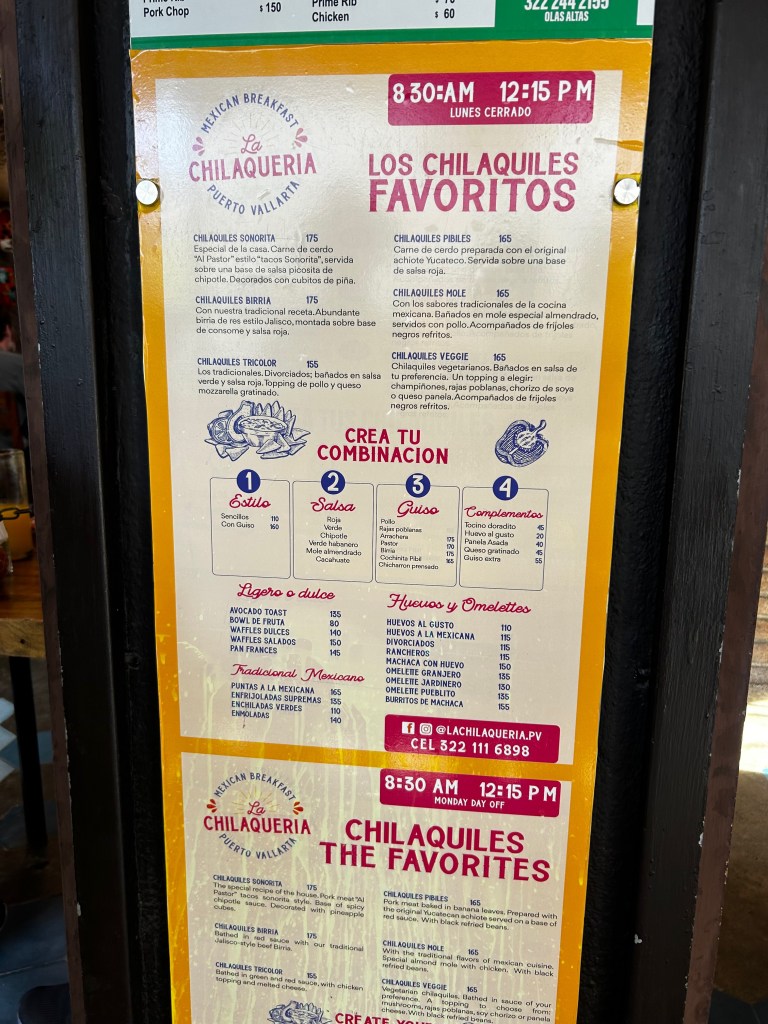
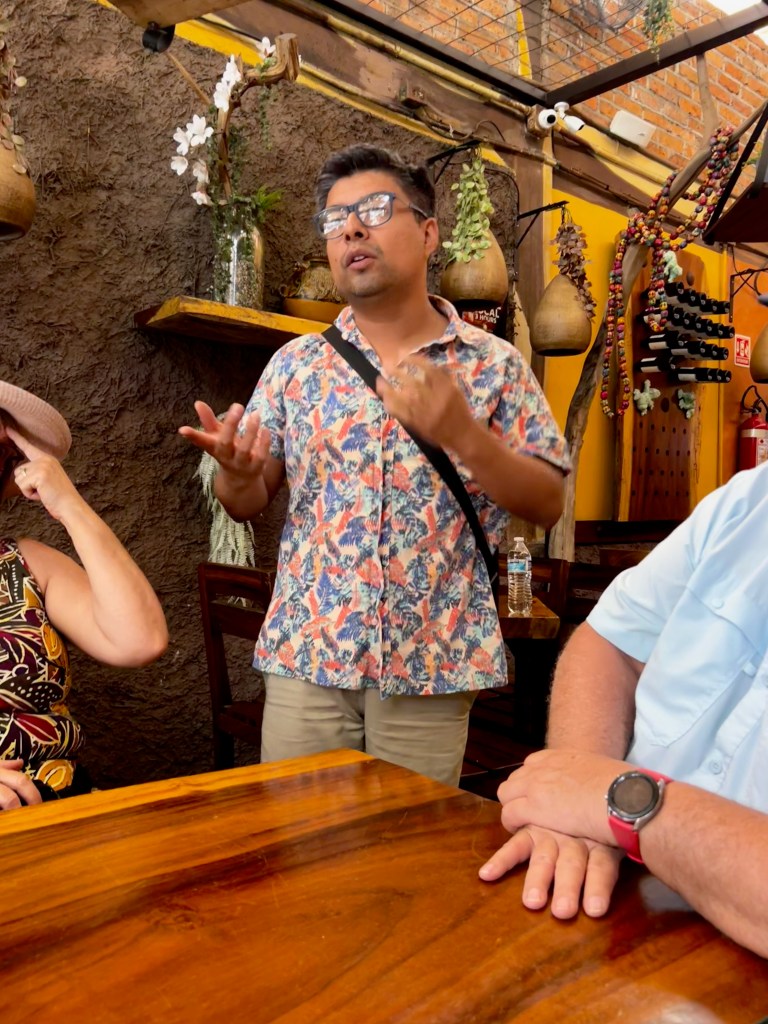
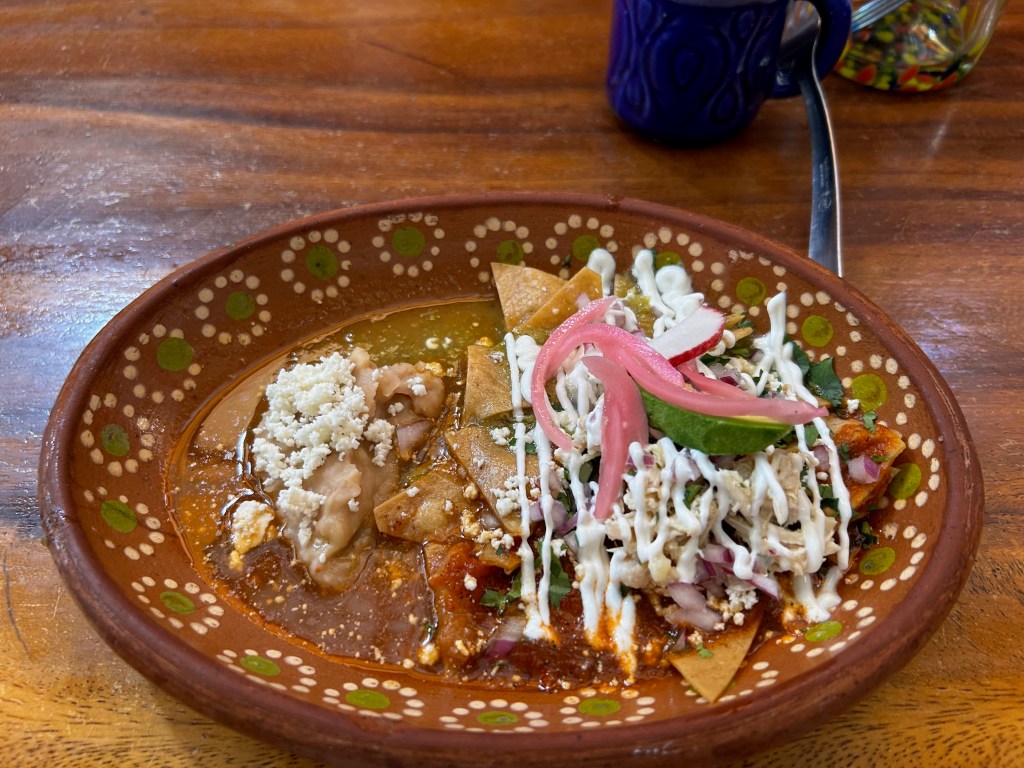
Get Your Guide Puerto Vallarta 3-Hour Food Tour of Authentic Local Cuisine was excellent. It was actually closer to 4 hours and we covered much of Old Town with Maho. He is a teacher, food guide and singer – a hard-working guy. He made the tour interesting and educational with his stories, background to dishes and his love for the city. The food locations were all local, family-owned and run: success stories! Yes, the food was delicious but he made the tour. We started with Chilaquiles, only available in the morning, and ended with tequila and mole, pronounced, MOH-lay. Provecho, Maho!
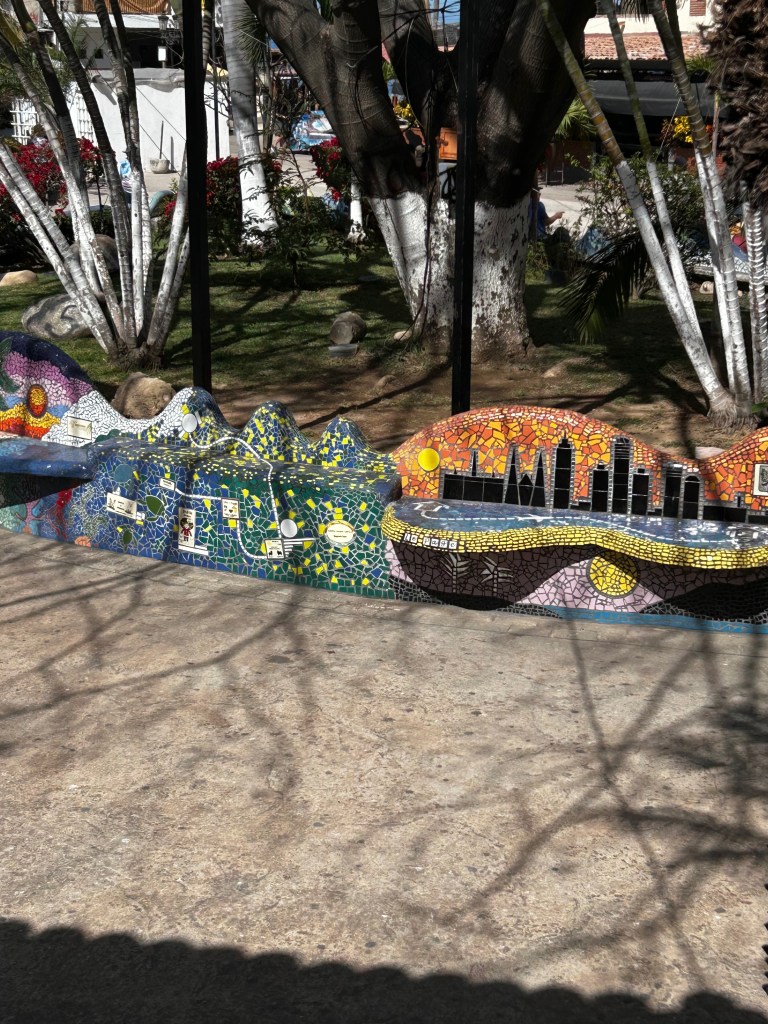
We met in a beautiful park very Gaudiesque in nature. Maho said that it had been pretty ugly until the local artists took it on as a project.
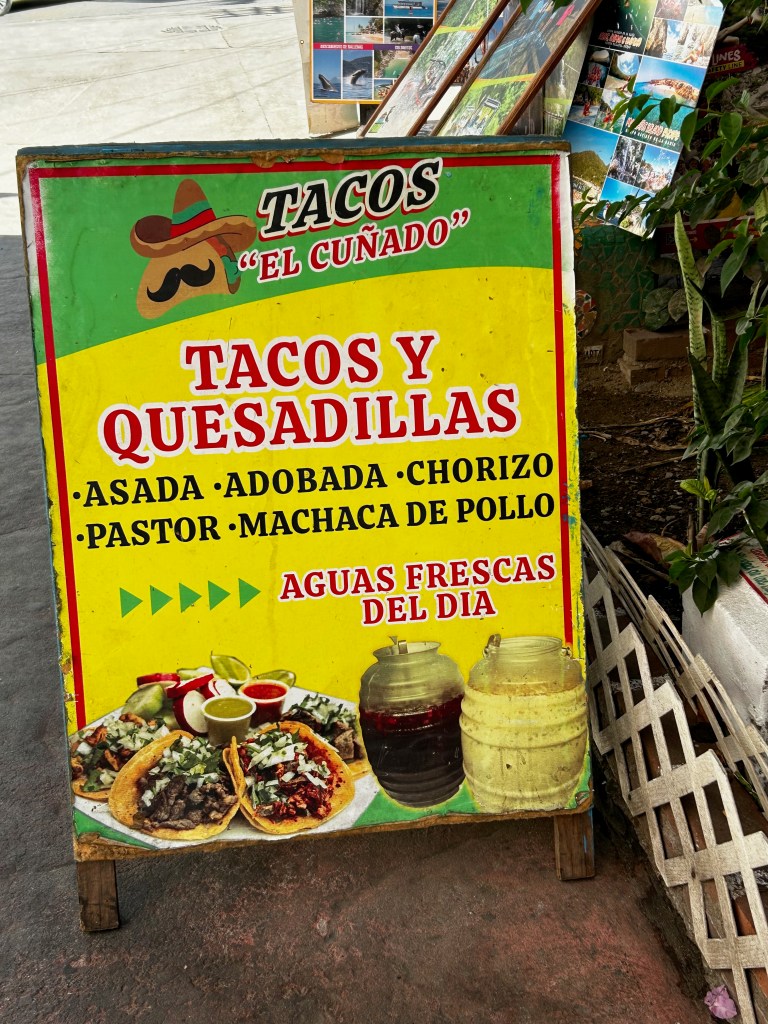
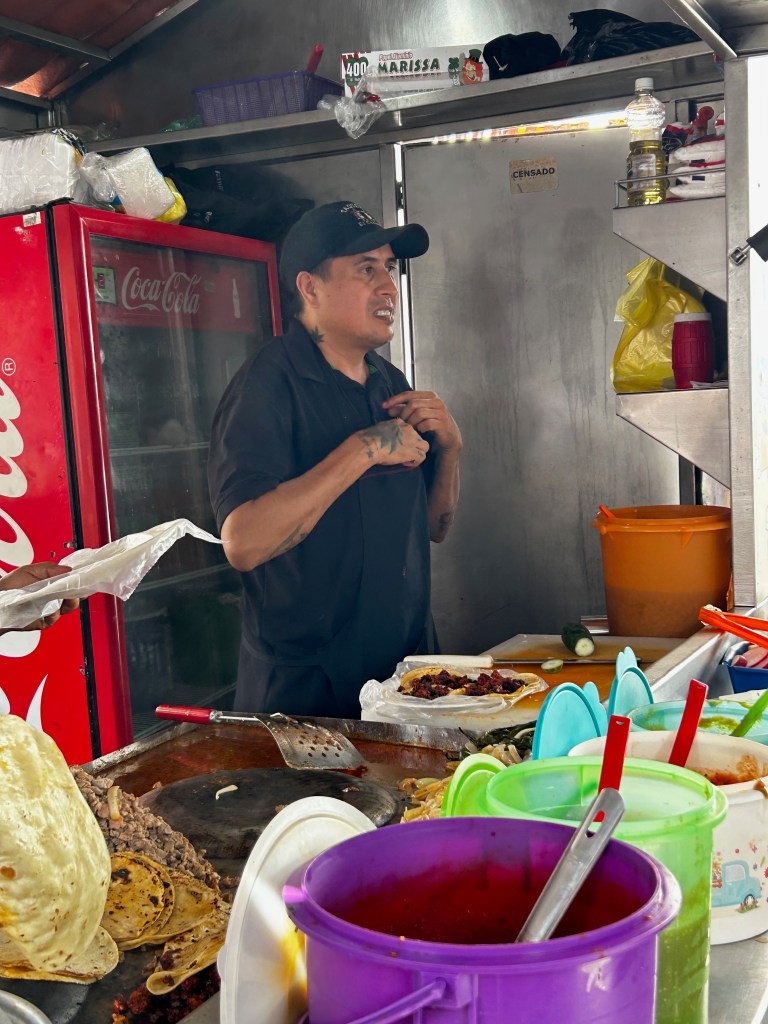
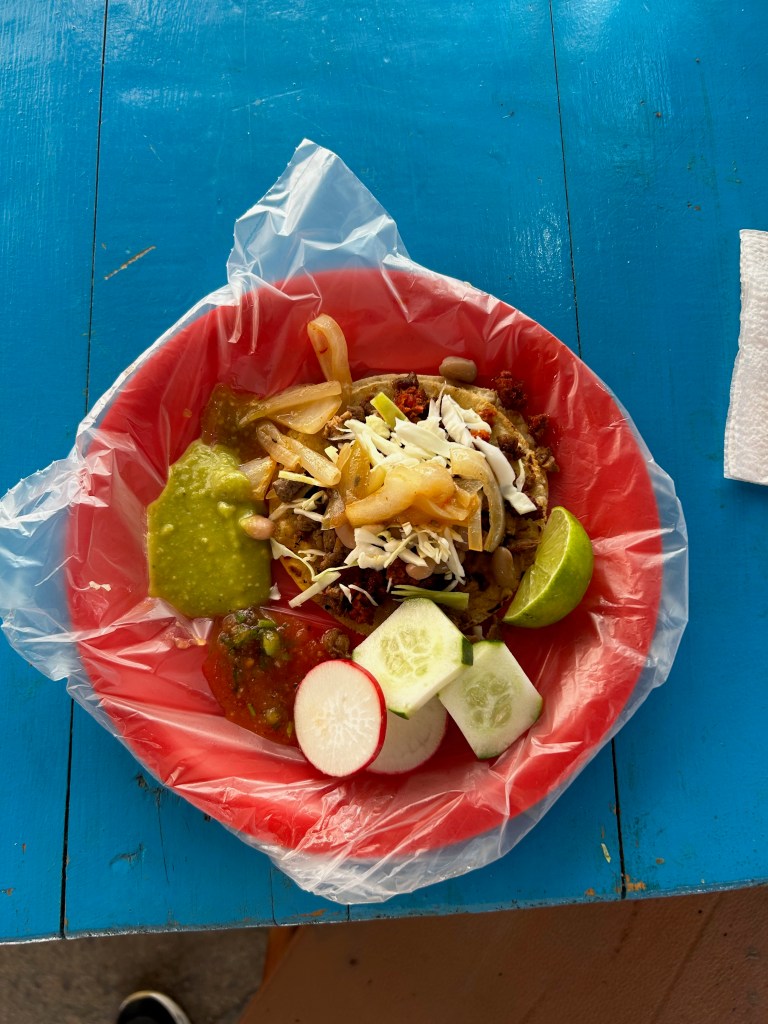
Tacos “El Cunado” (the brother-in-law) place right next to the beach on the main street has been in the family for 40 years. The way you know that the food is very good is that there are many Mexicans eating there and many salsas.
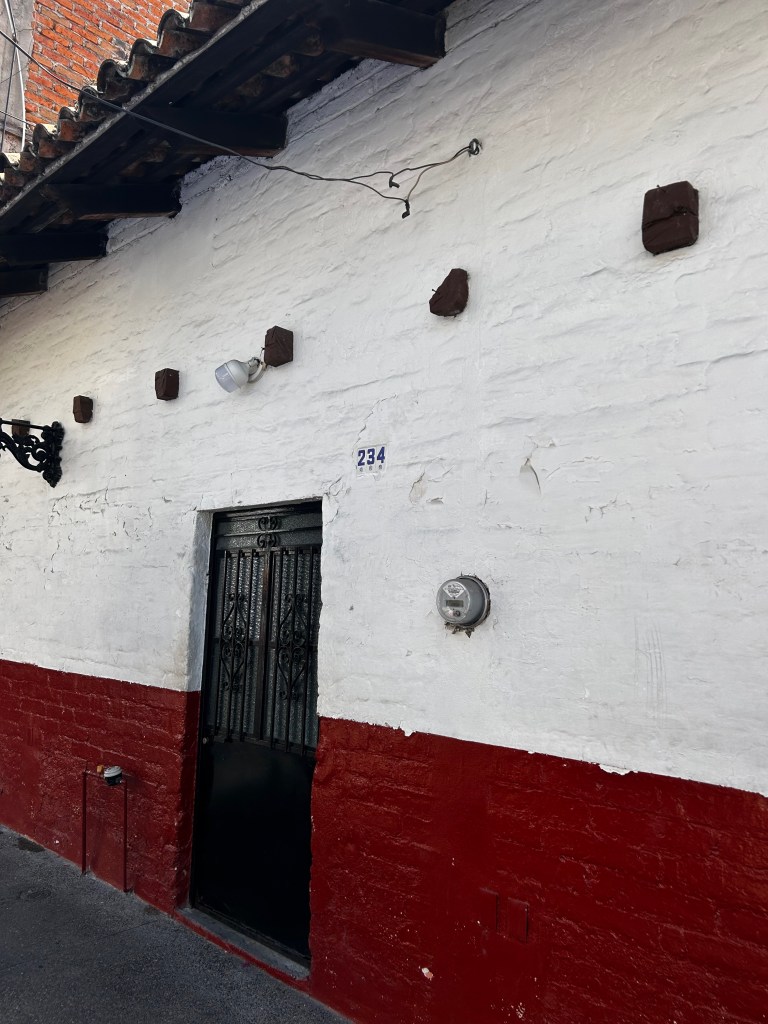
A little bit of history: this was one of the original houses and is still owned by the family: small windows because they were taxed; high walls because the heat rises and red and white because the architect liked the design.
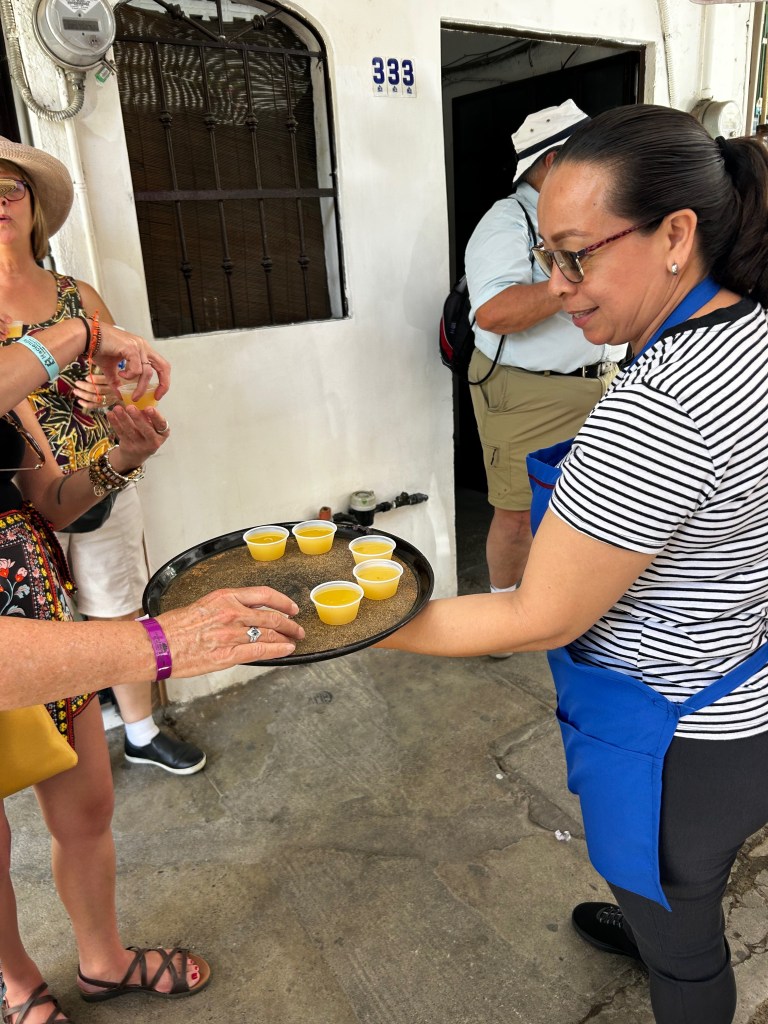
We stopped at a juice stand and sampled 4 different homemade juices and juice combinations from Passion Flower to lime, peppermint and cucumber from Claudia’s stand, Agua de Cebaba, inherited from her mother.
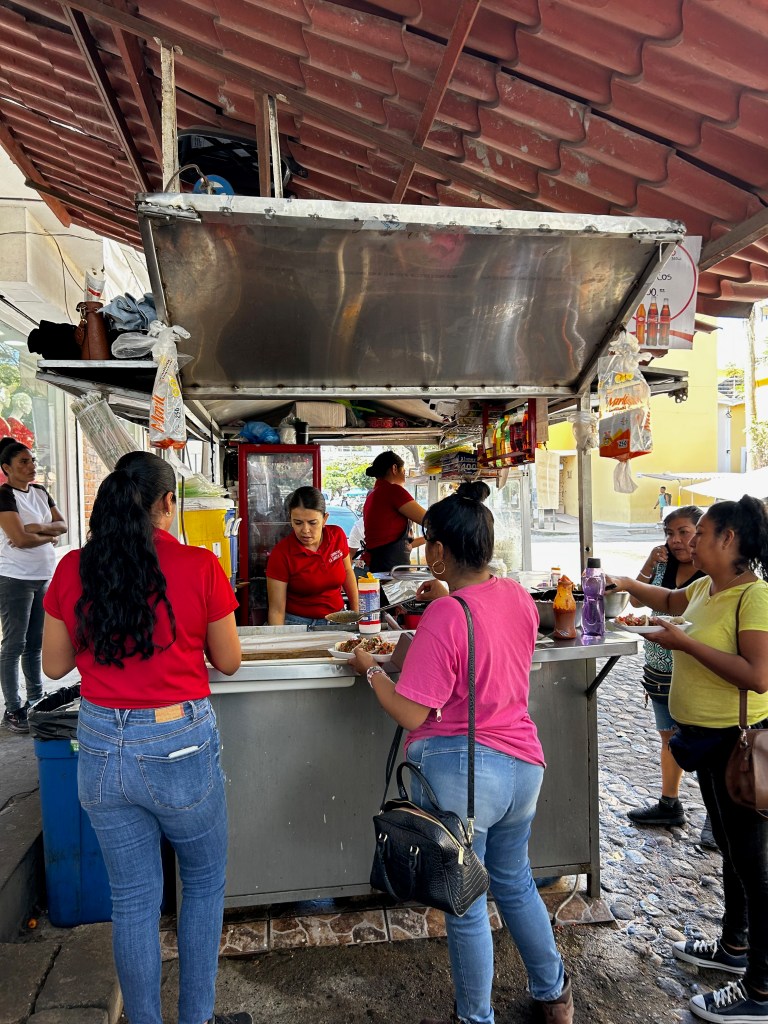
Maho said that Mexicans prefer taco stands to restaurants and that they are mostly good but there are exceptions. Carnita’s is one of the best: family-owned and managed; the cashier is separate from the cook and the ingredients are fresh.

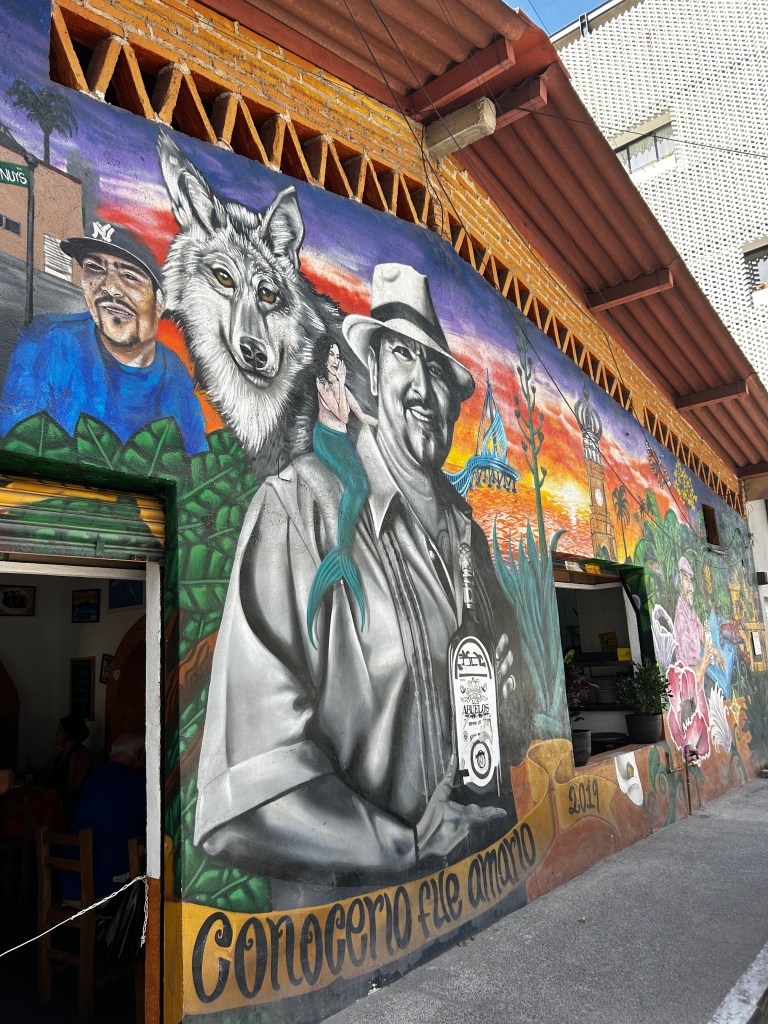
Family business was a common theme. This man started with a taco stand and worked it into a restaurant, buys only fresh fish and still works there every day.

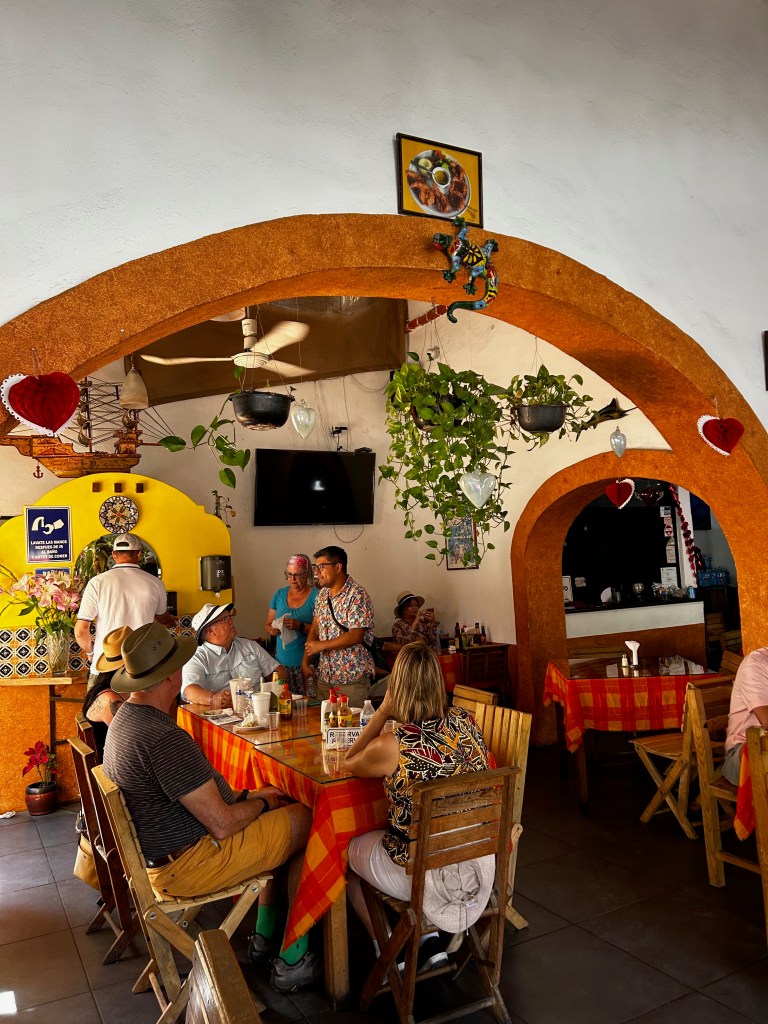
We had mahimahi ceviche on a flat tostado – excellent.
We stopped as well at a candy store where fresh, homemade candy to made as well as tequila. Bill bought candied almonds.
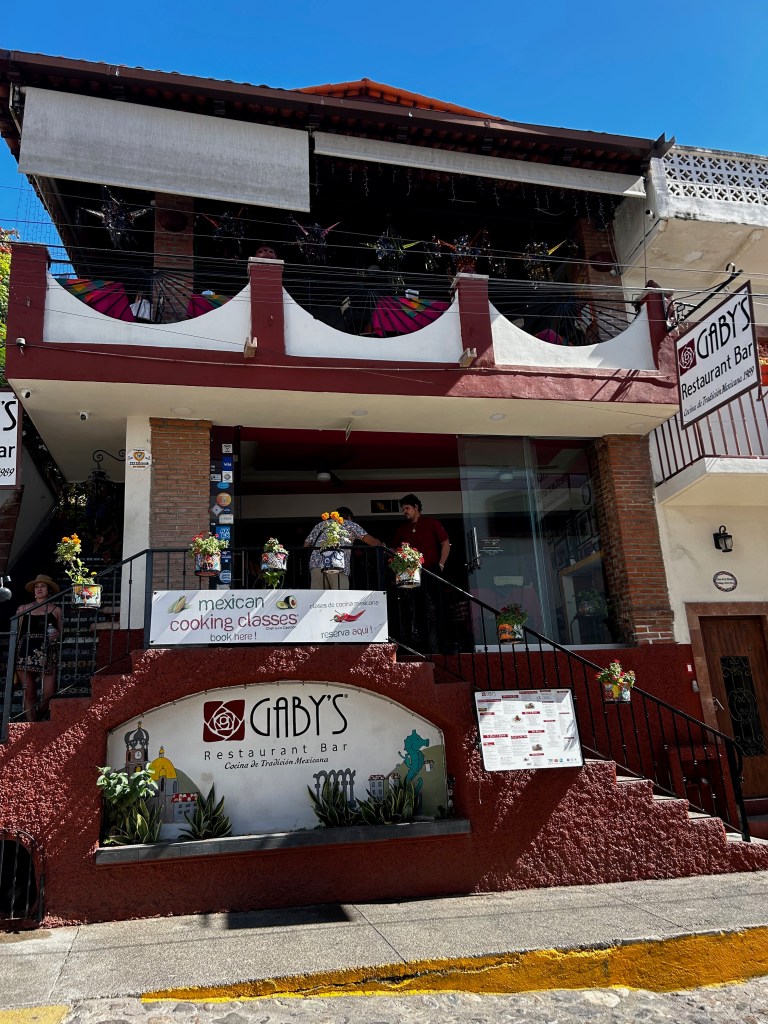
Next stop was Gaby’s, another family-owned and run operation through generations beginning with the mother opening up her house to serve a specialty- mole. First of all, mole is pronounced MOH-lay. Common pronunciation error: saying the last syllable as if it rhymes with bee, or not pronouncing the last syllable at all. The word mole comes from the Aztec Indians’ word molli, which simply means “sauce”.
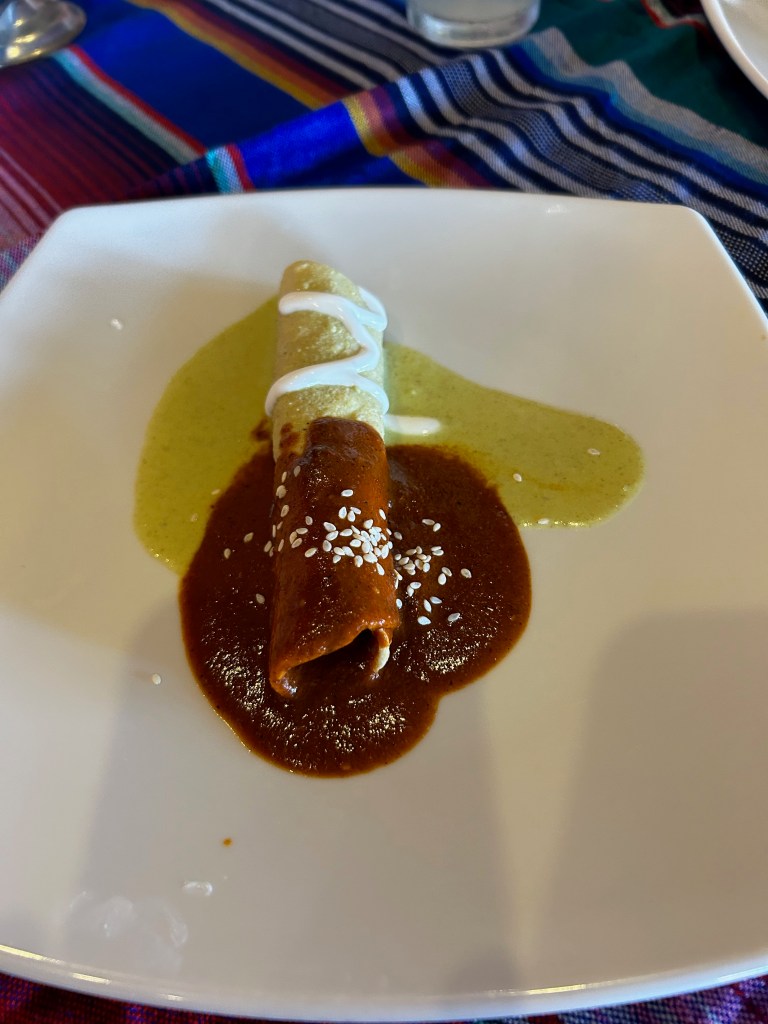

Moles come in various flavors and ingredients, with chili peppers as the common ingredient. The classic mole version is the variety called mole poblano, which is a dark red or brown sauce served over meat. The dish has become a culinary symbol of Mexico’s mixed indigenous and European heritage, both for the types of ingredients it contains and because of the legends surrounding its origin. It is more a technique than a dish.
A proper mole can easily consist of up to 30, even 50 different ingredients and can take several hours – sometimes even days – to make. Ingredients vary but is typically a mixture of chilies, tomatoes, fruits, spices, a starch (bread or tortillas), chocolate, and nuts.
The meal finished with flan – delicious.
Our last stop was the Chocolate Factory where we tasted Mexican chocolate made with cinnamon – a common drink during the day. It was 4:00 and time for a Margarita!
Friday, February 14
Happy Valentine’s Day. We swam in the morning, saw some whales at a distance, and walked the beach.


Our favourite things about Puerto Vallarta:
- This condo, SoHo, with its 180 degree view of the bay and despite the traffic noise, is awesome.
- Ocean Friendly Whale Watching Tour
- PV Food Tour
- MargaritaPV Grill
- Puerto Vallarta is a busy, noisy, high-energy place.
Map of Puerto Vallarta and Bucerias
Saturday, February 15
Alonso picked us up at 11:30 and we drove us to Bucerias, about 50 minutes. Although the cleaner was still cleaning our condo, we were able to leave our bags, take a peak at the beach and go for lunch at Pancakes and Waffles. We each had a loaded plate of Chilaquiles with chicken which was enough for lunch the following day as well.
We then hired a taxi to take us to the large supermarket La Comer where we did a big shop and returned by taxi (Mex$ 100.00 Can$ 7.00 each way). By the time we returned, the cleaner was gone. We were still full from lunch so we had a tortilla with pork for dinner.
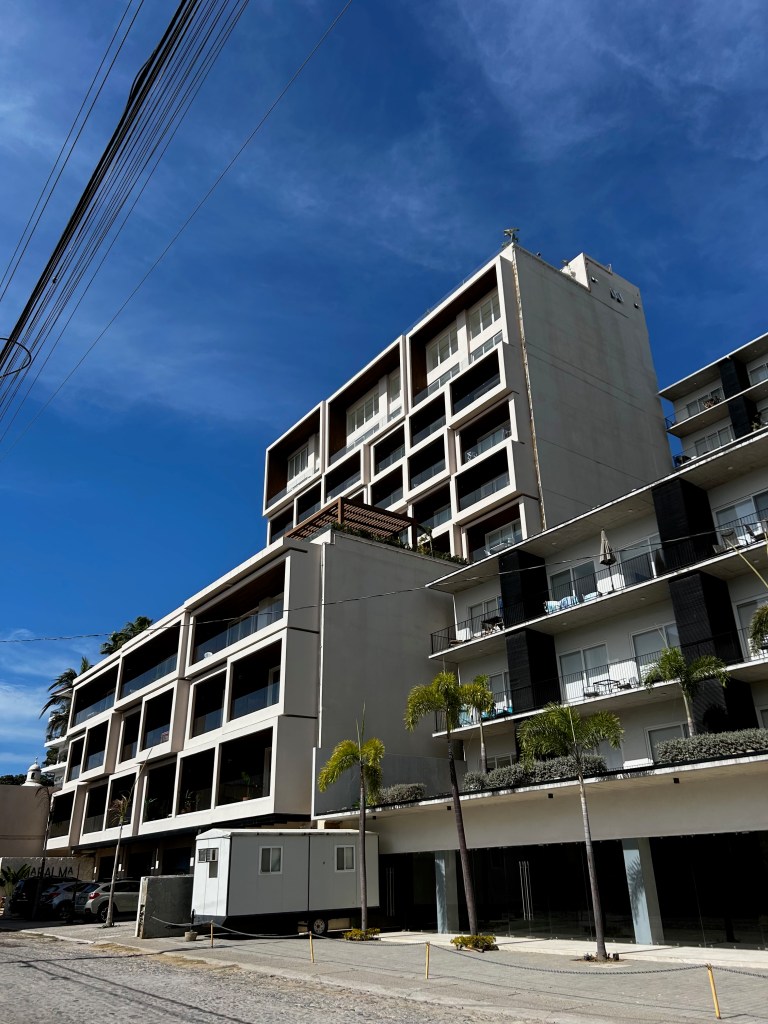
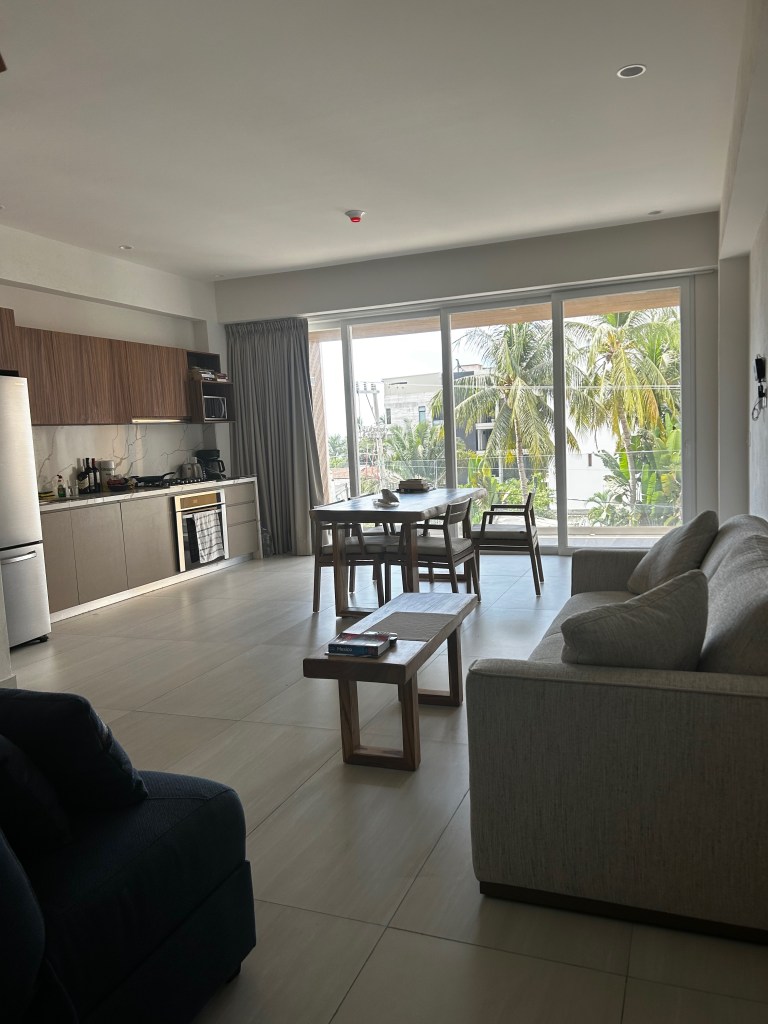
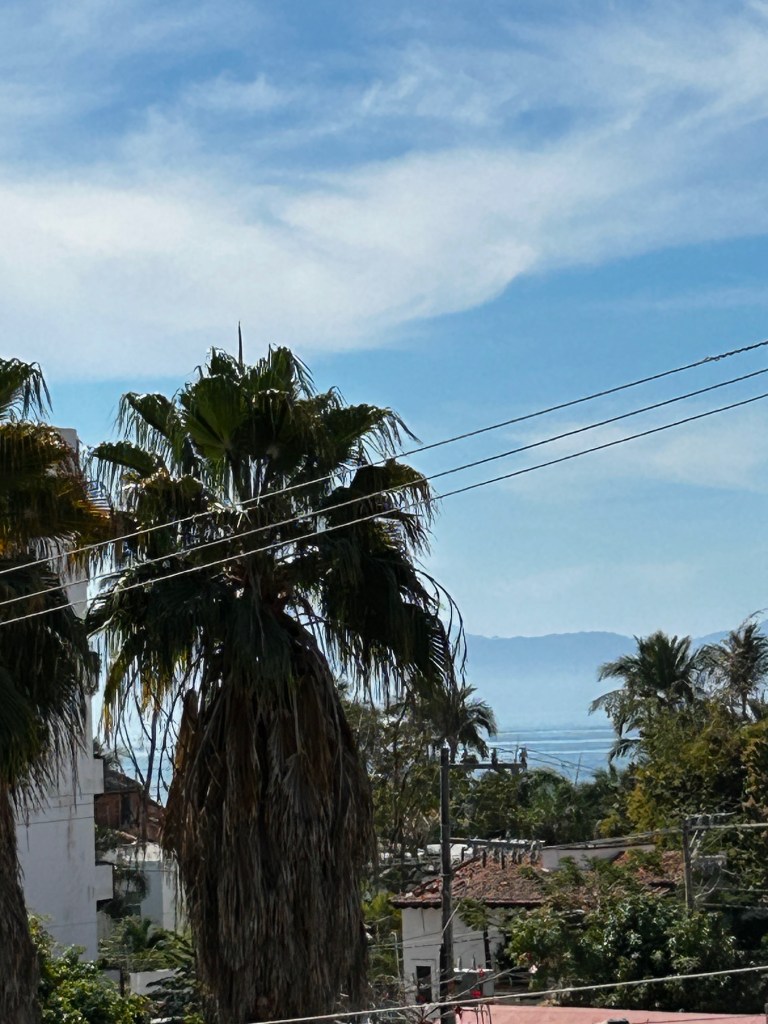
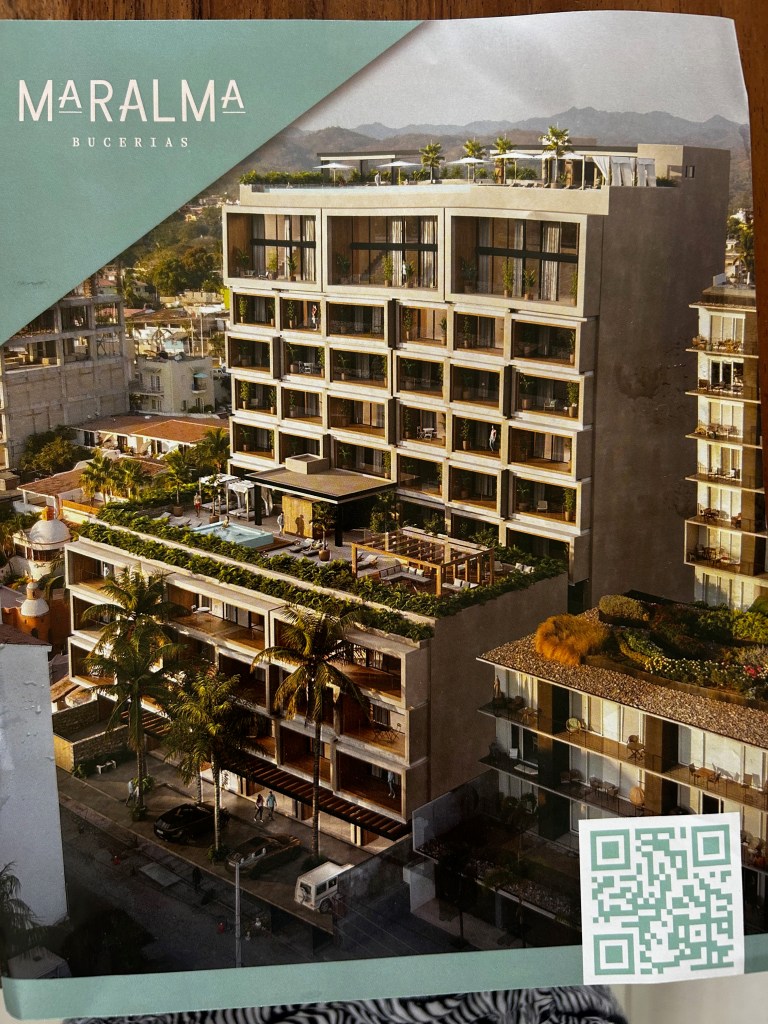
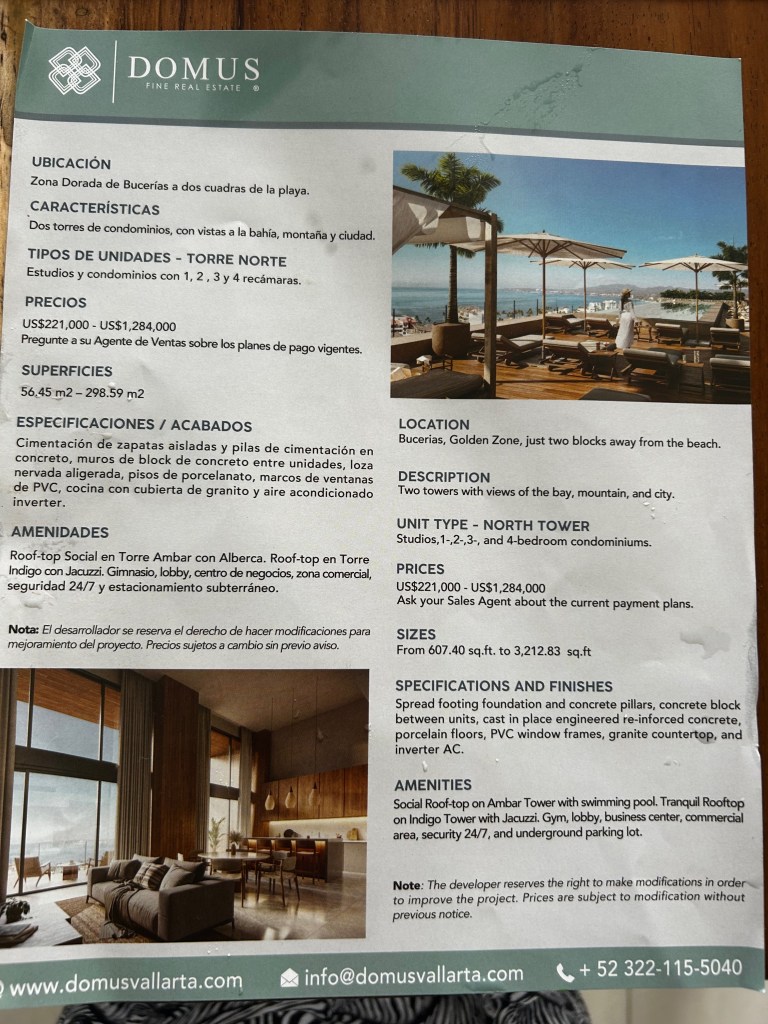
The condo in the Maralma building was just built last year and is two blocks from the beach. There is a security guard and electronic access when he is not there and electronic access to the condo. Owners of one of the condos (Susan and Andrew from BC) said that this was their first winter in their condo. Ours (owned by Canadians) is so new, there is nothing on the walls except a TV. We can see the sea and mountains from the balcony but not much of them.
Sunday, February 16
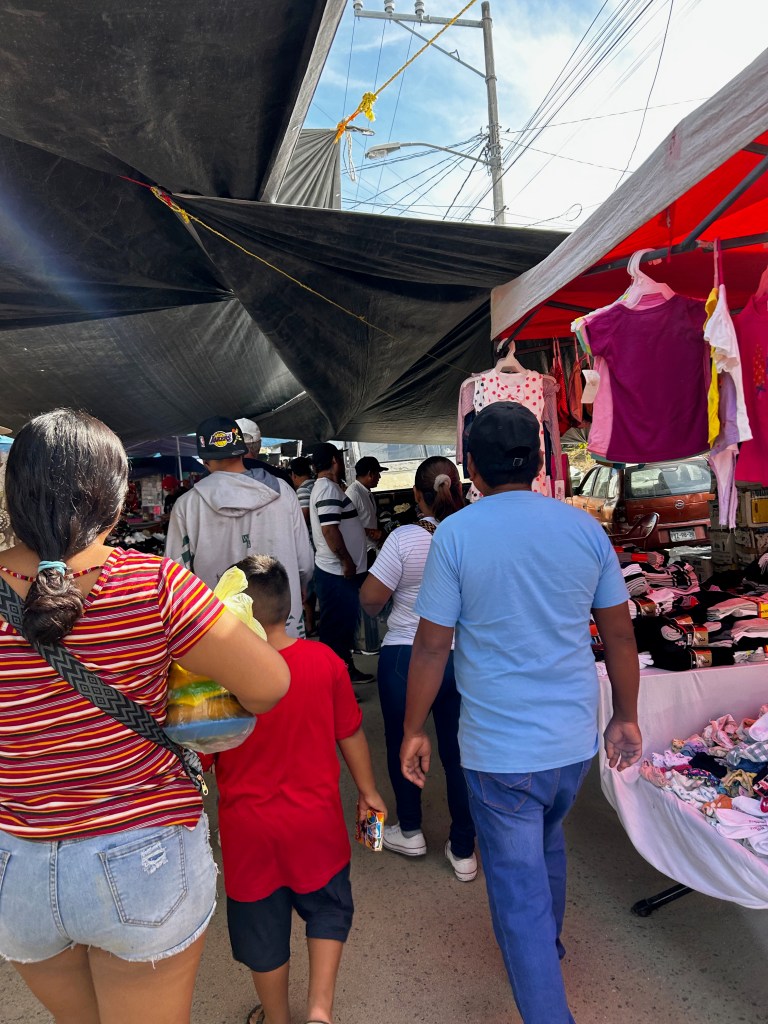
Andrew told us about the Sunday market so we set out before it got too hot for the market – much like Spanish markets, you can buy anything there from underwear to engine parts to food and there were many cafes serving tacos.
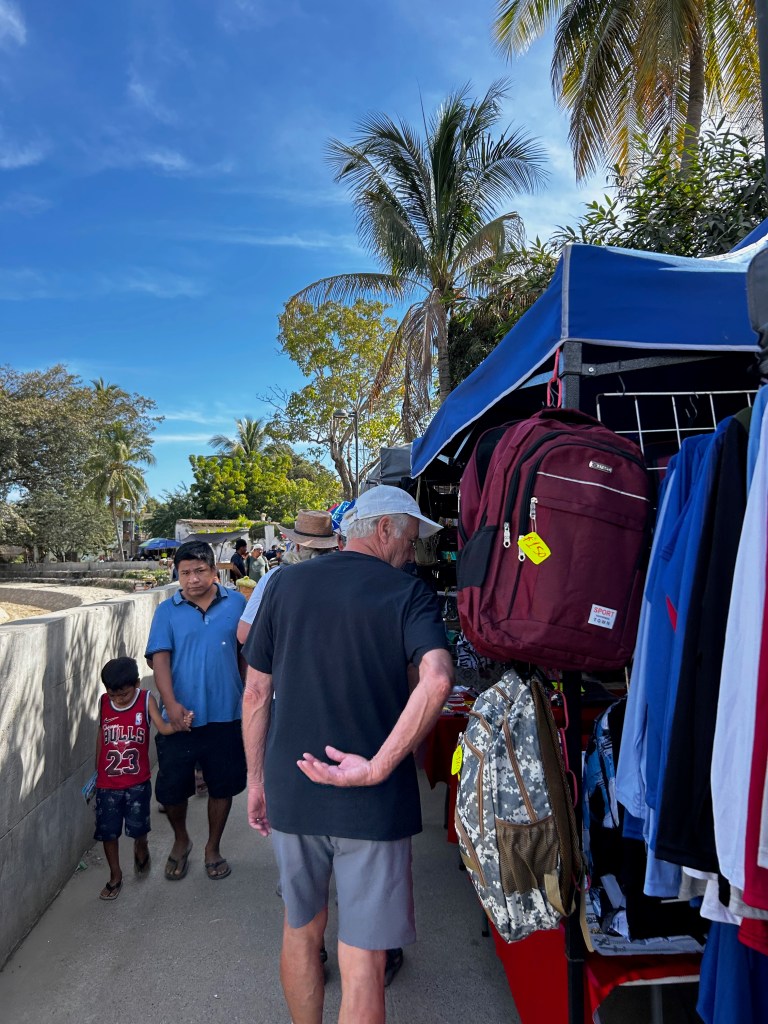
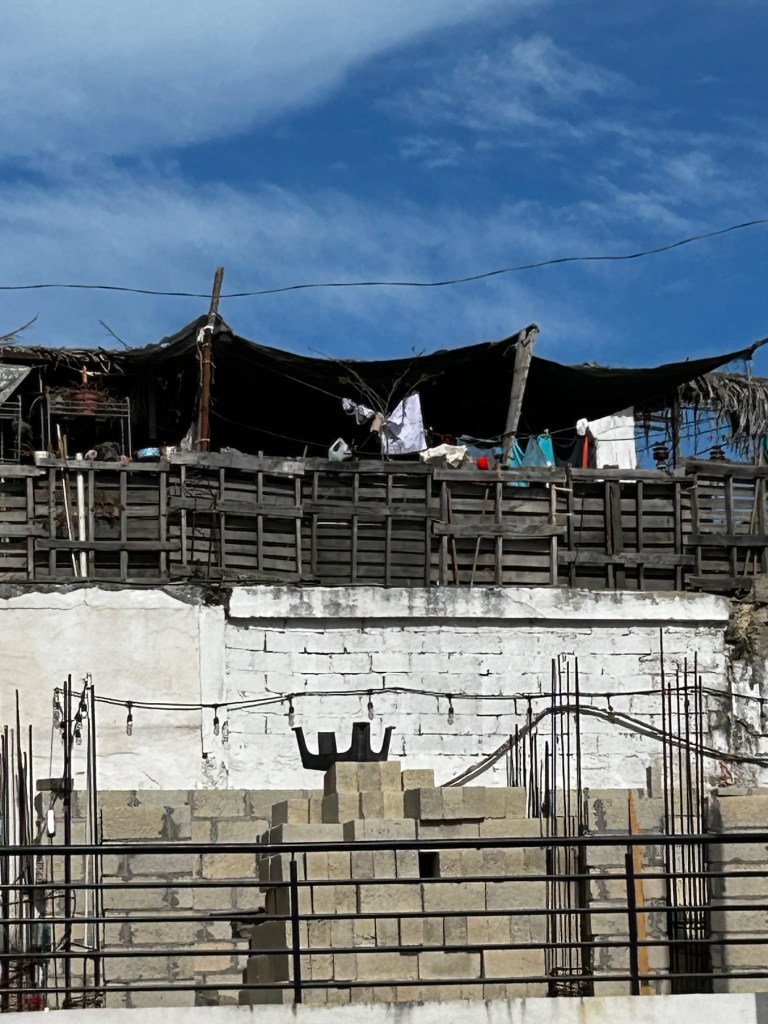
Where the tourists live, there are many low and high rise building with pools and gardens and security. And then there are the accommodations of many locals:
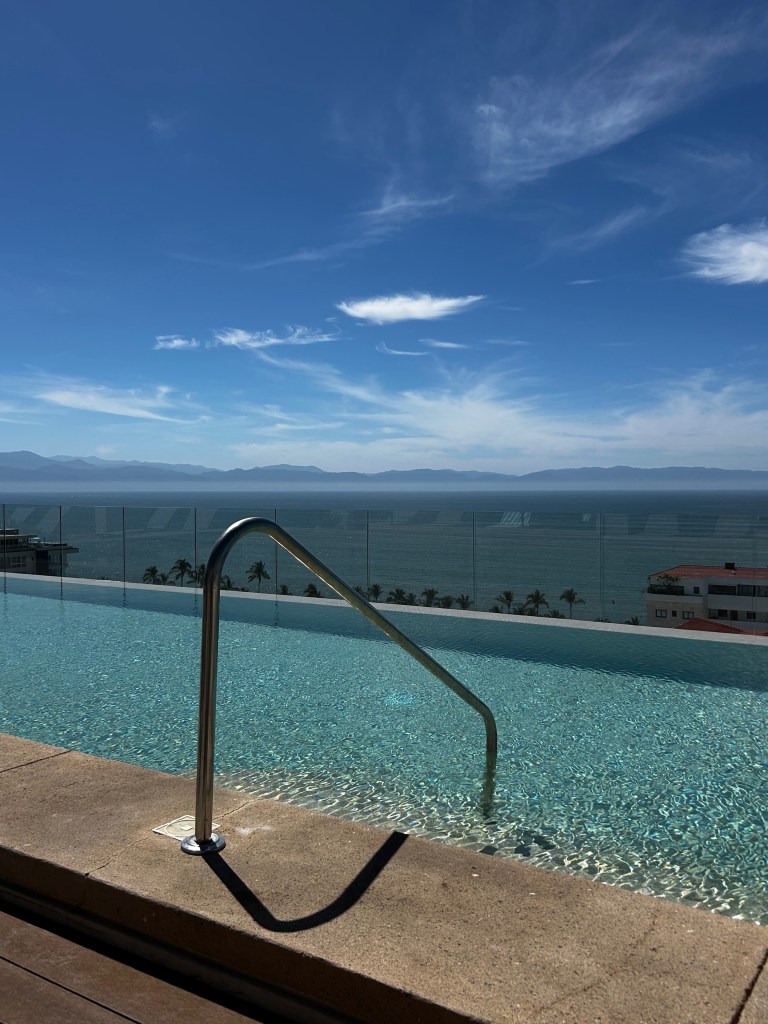
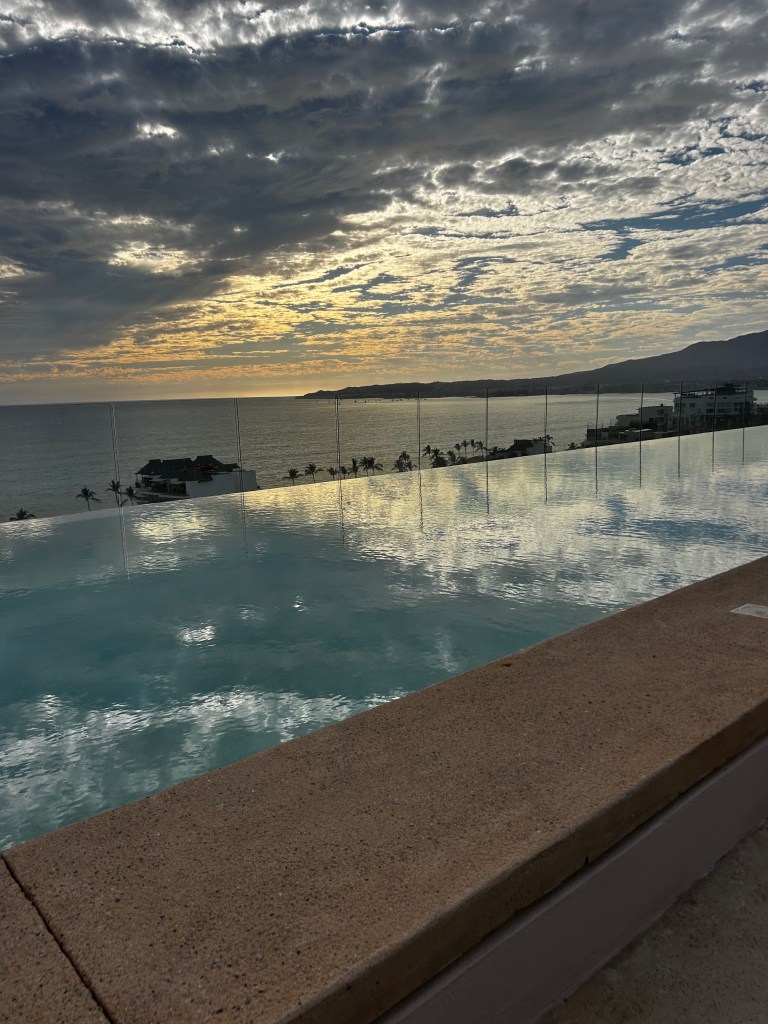
After lunch we went to the stunning rooftop pool.

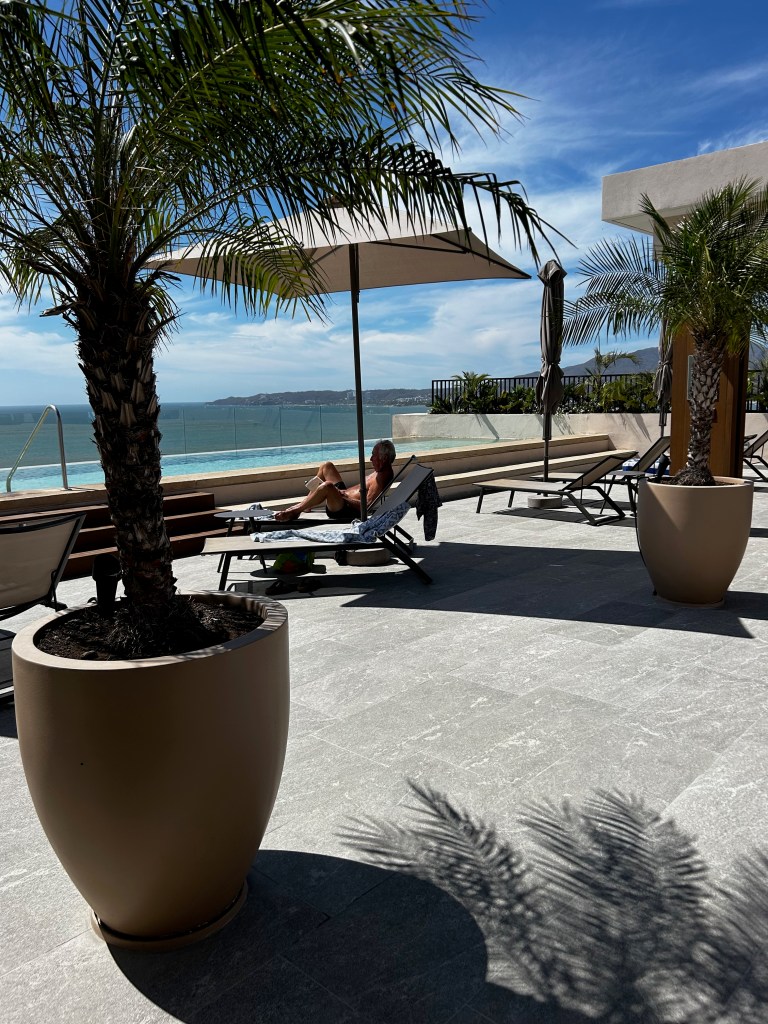
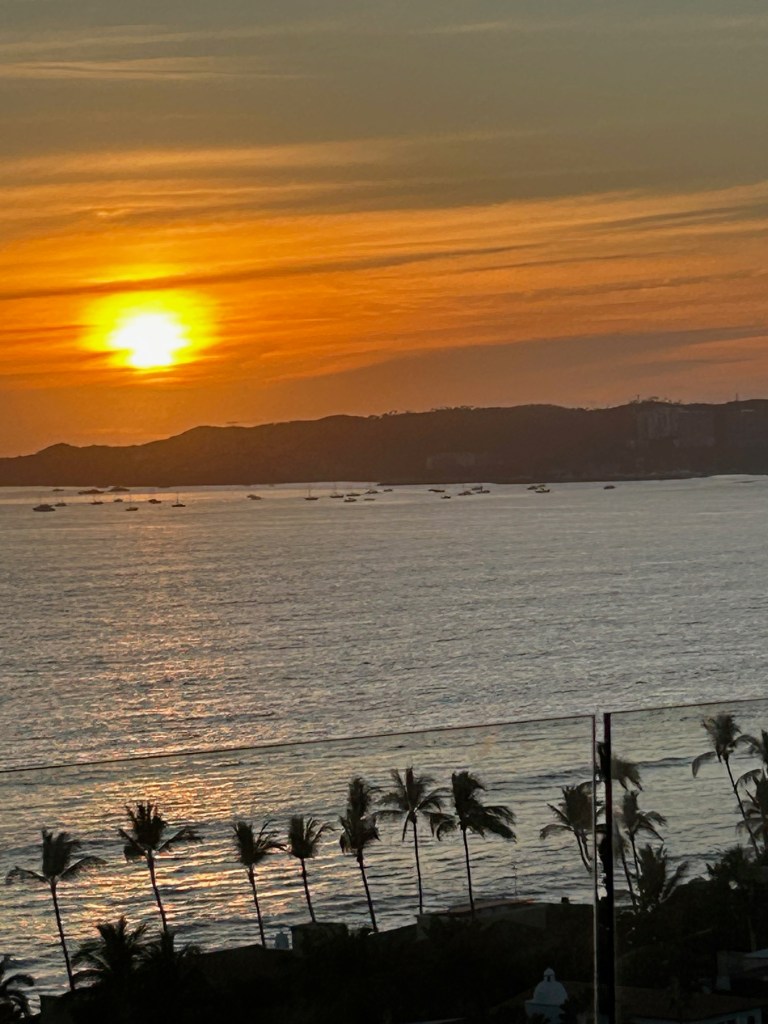
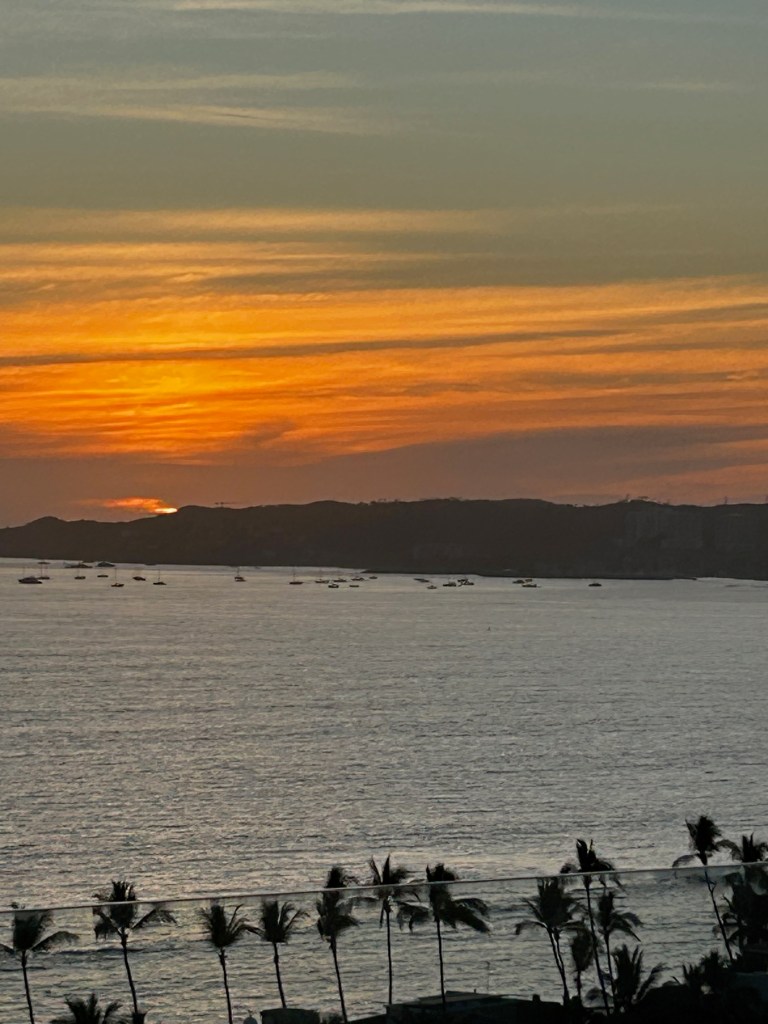
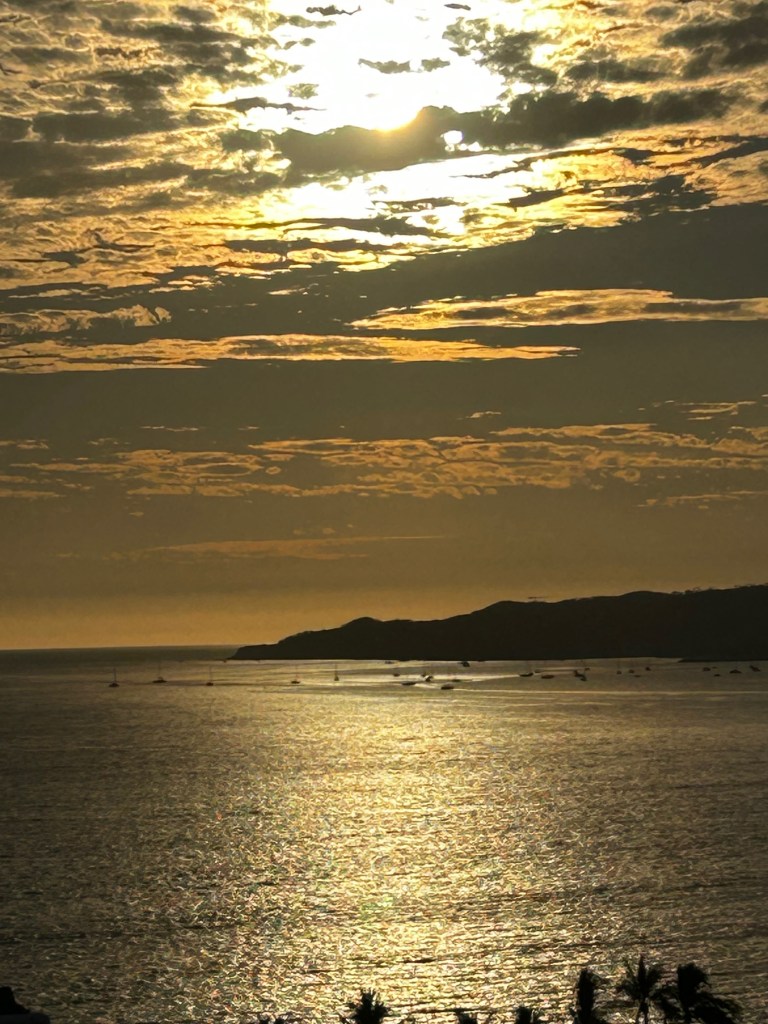
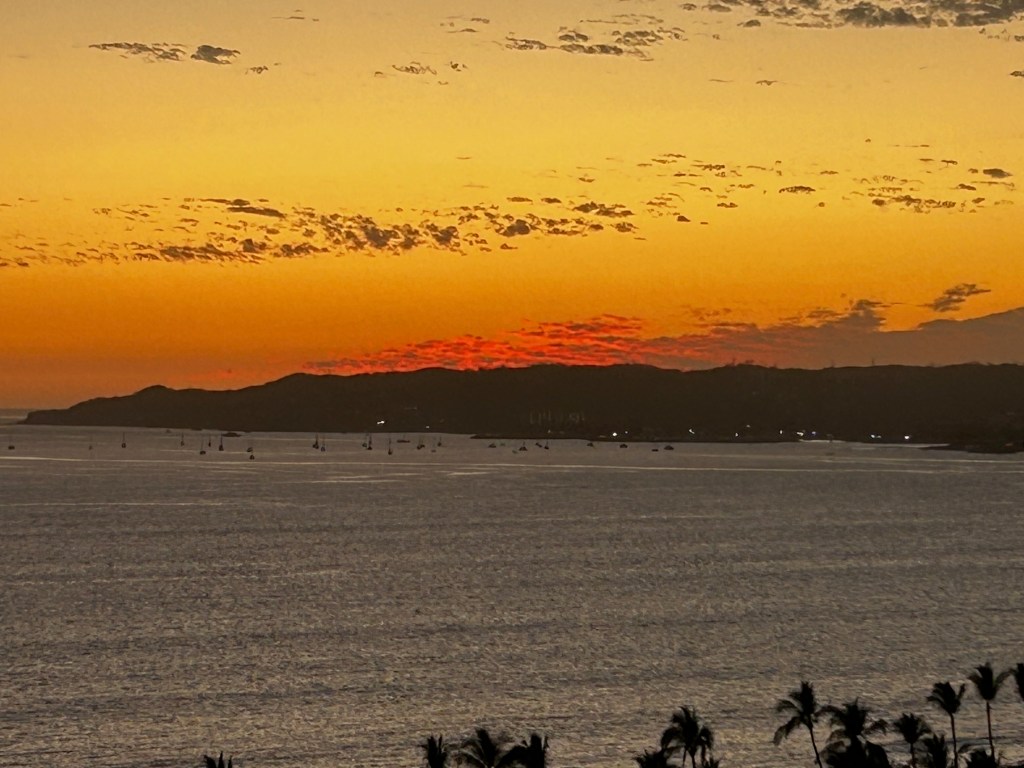
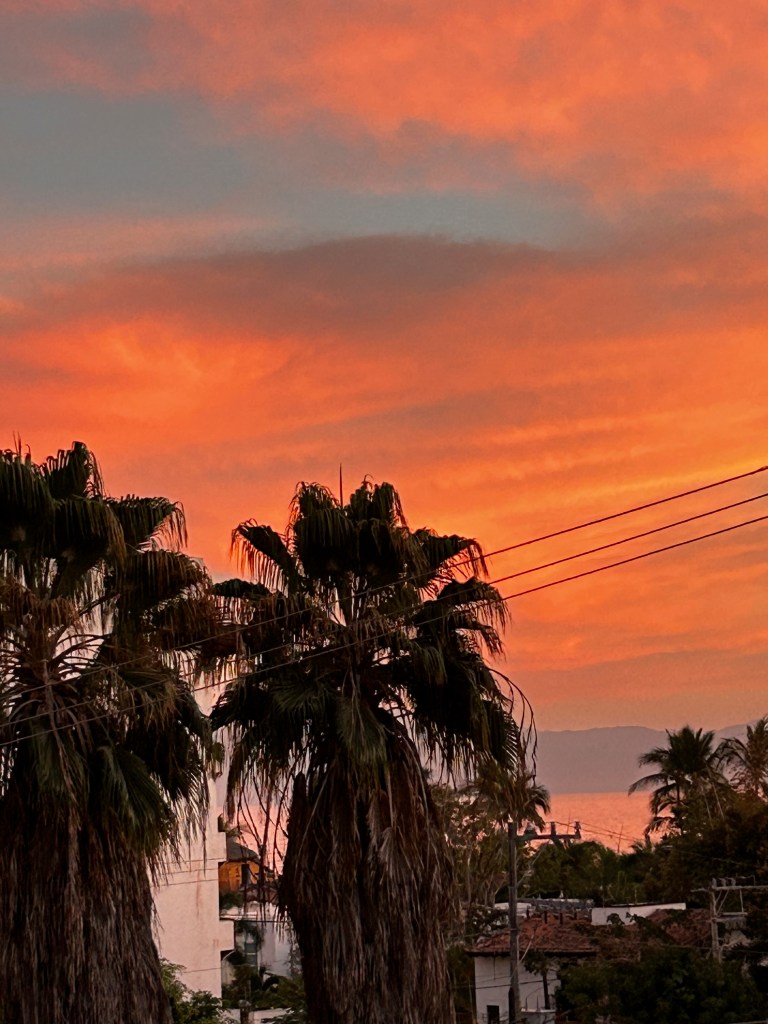
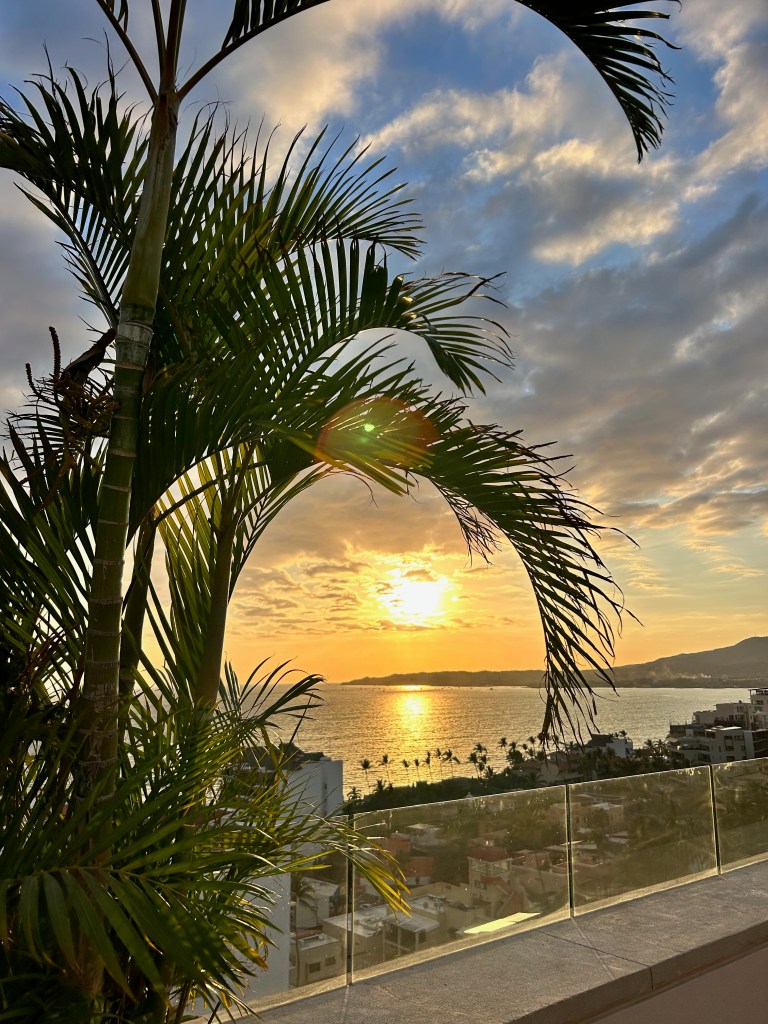
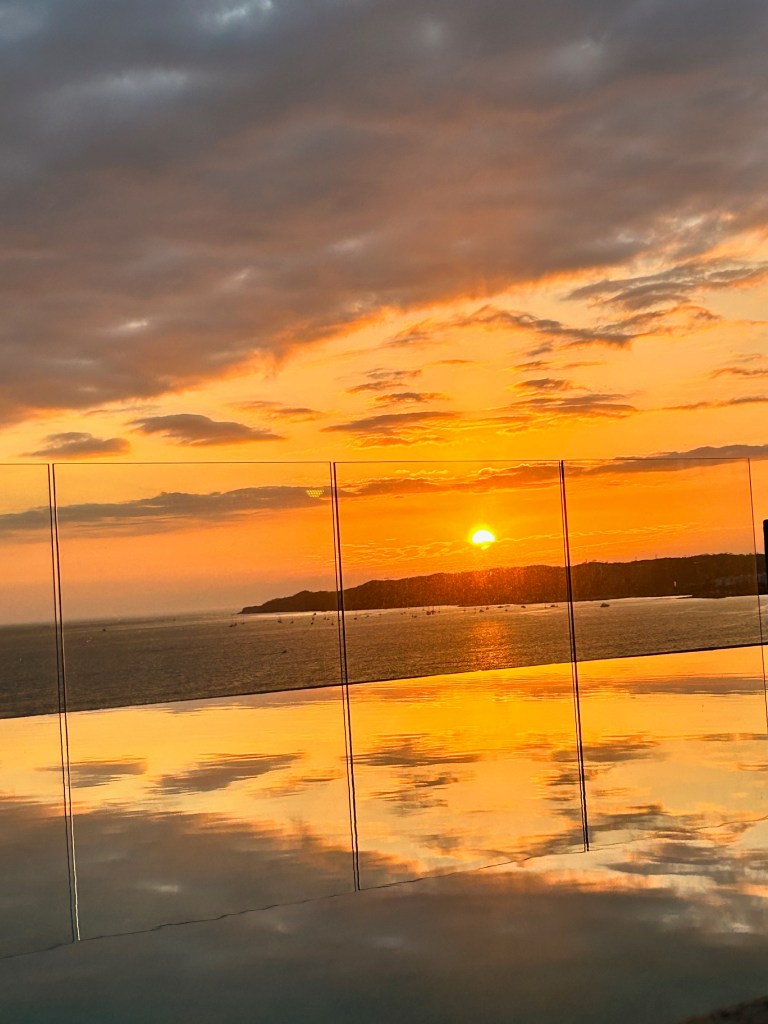
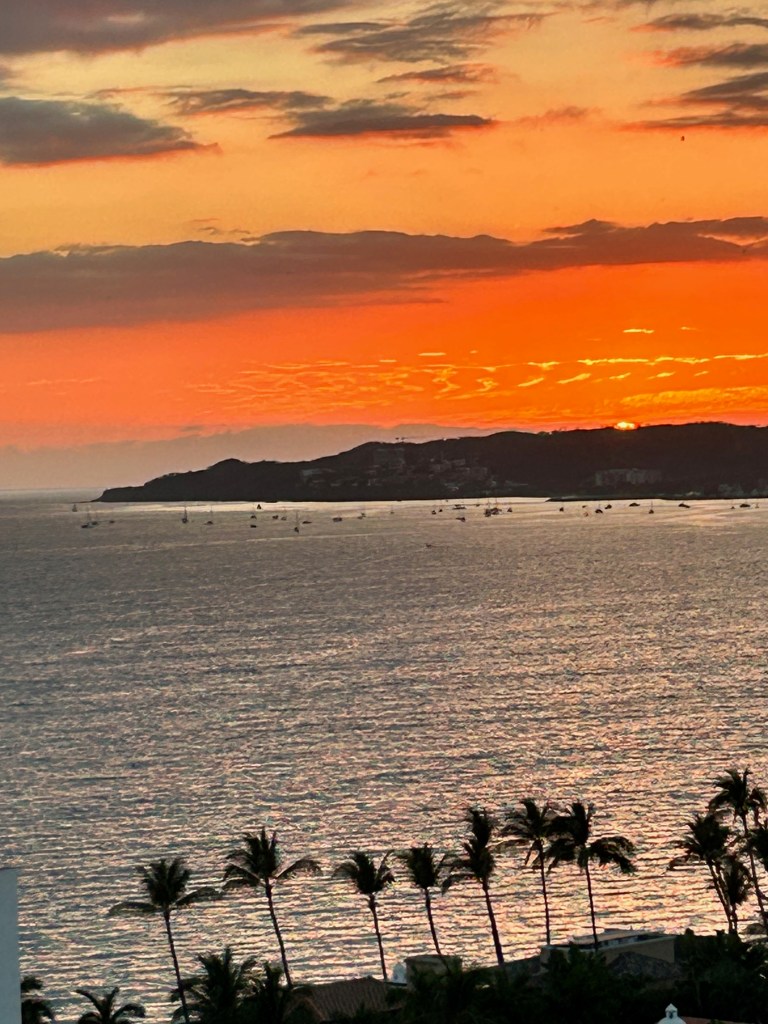
We heard from condo owners that the sunset was awesome and it was.
Monday, February 17
We found a flyer for the new building:
I began the day with my morning meeting with my research colleagues: Jack, Michelle, Mairin and Parbati. Then we went for a walk south on town streets toward the town centre and stopped at a tourist centre and learned about local tours. We walked back, had lunch and then walked south along the beach.
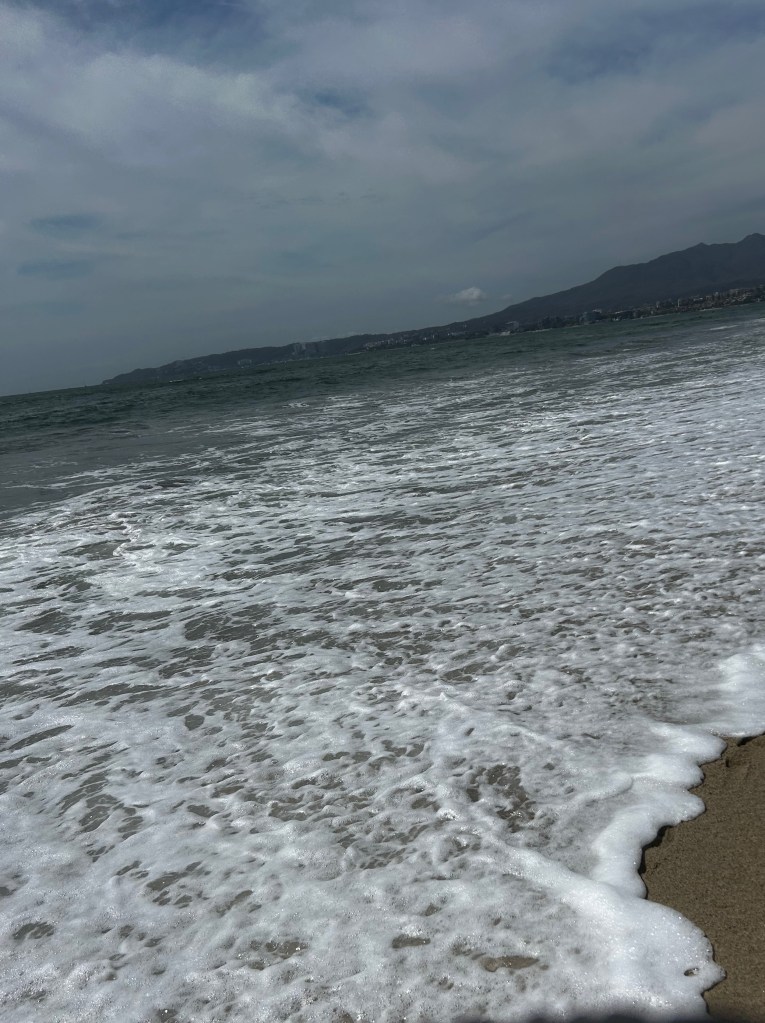
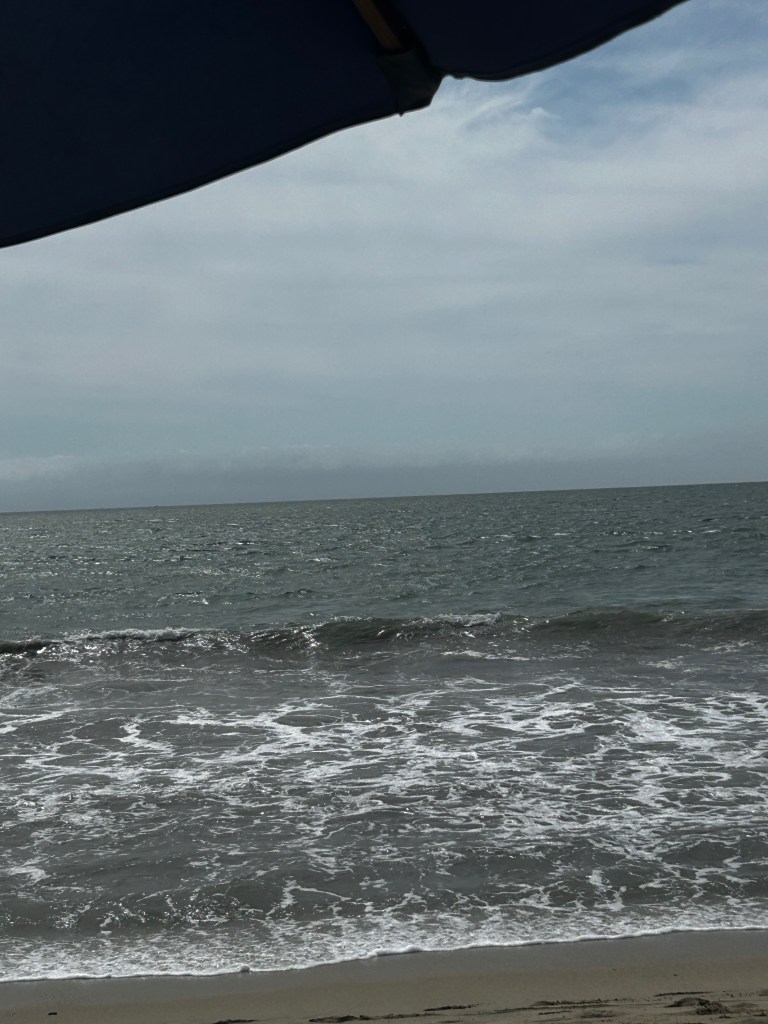
The wind seems to come up in the afternoon here. We stopped at a beach bar, El Chivero, and had a Margarita – OK but not as good as Margarita PV Grill.
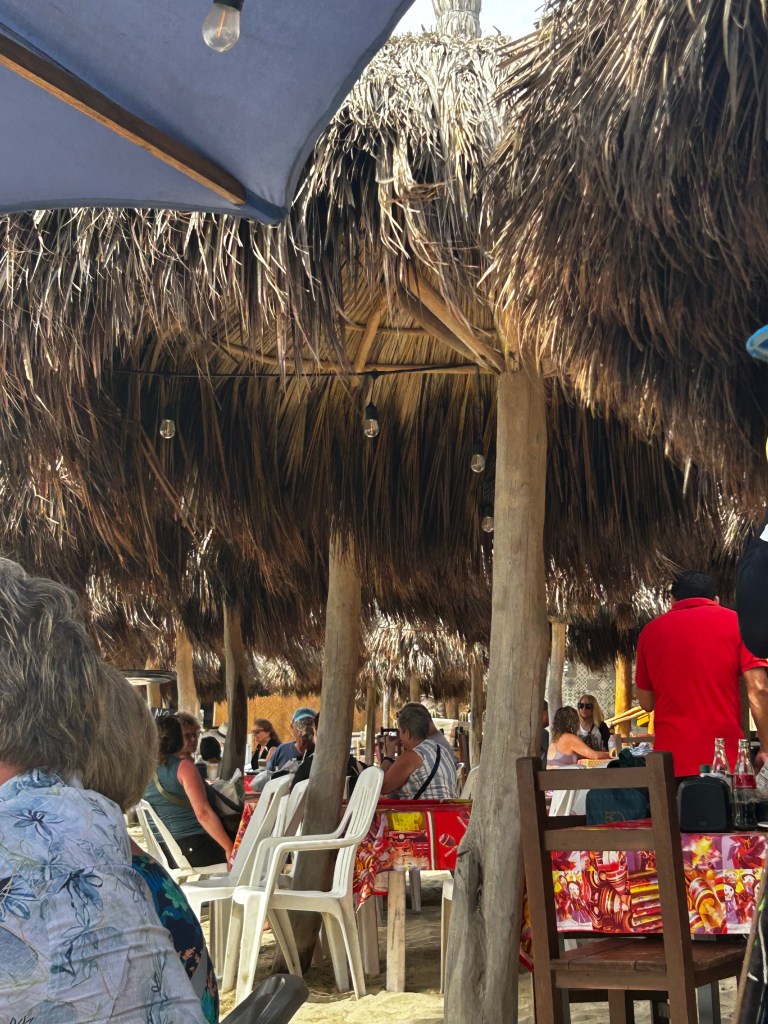
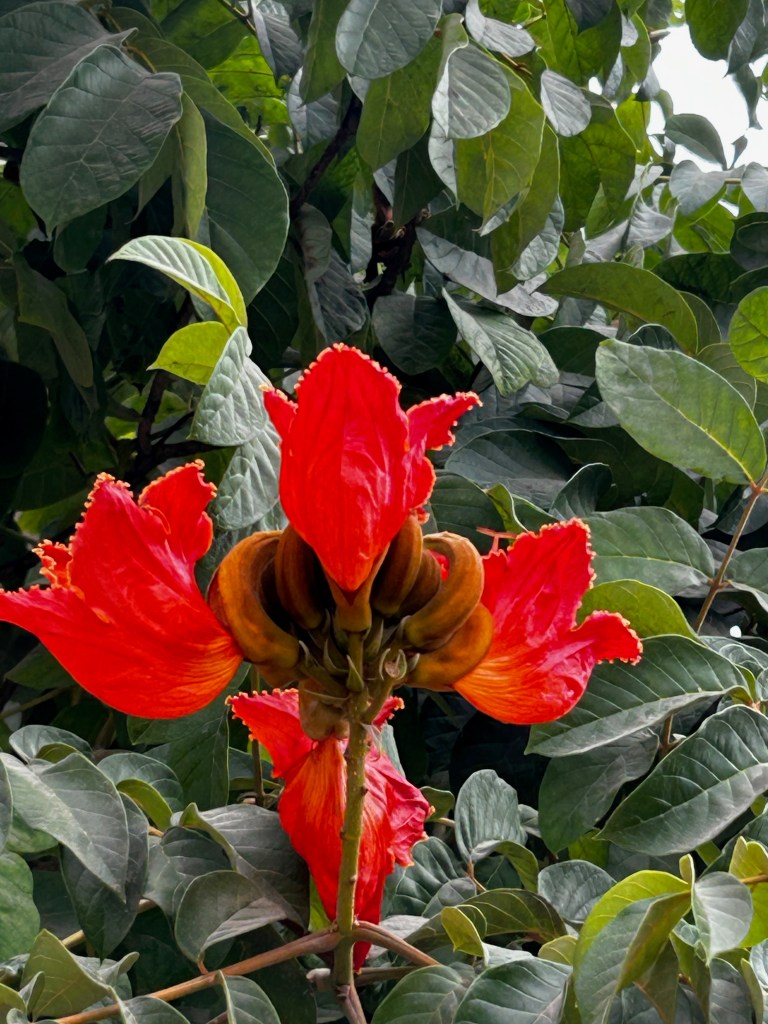
Tuesday, February 18
We started out on our walk to the south intending to book a tour to San Sebastian Del Oeste for the next day.
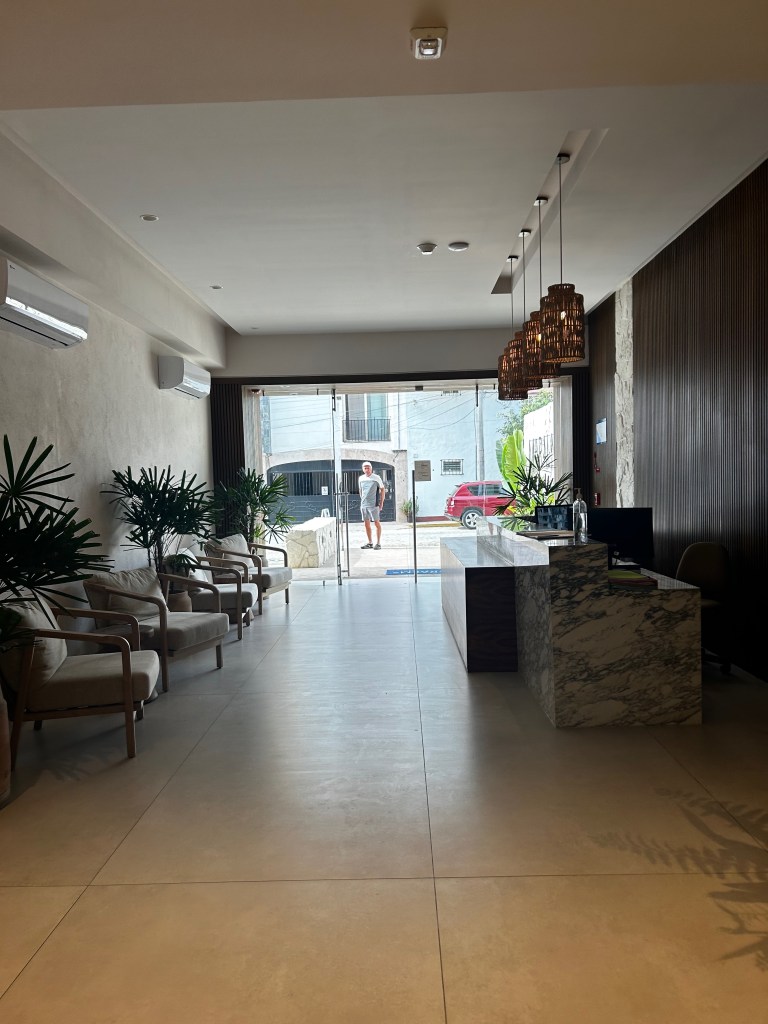
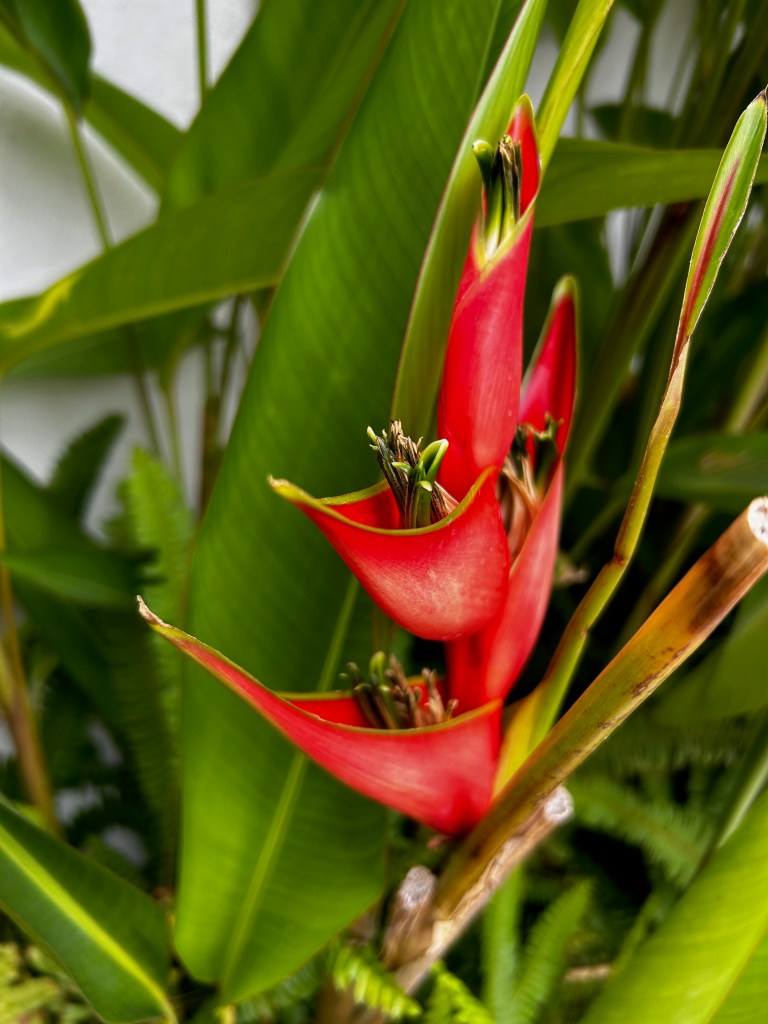
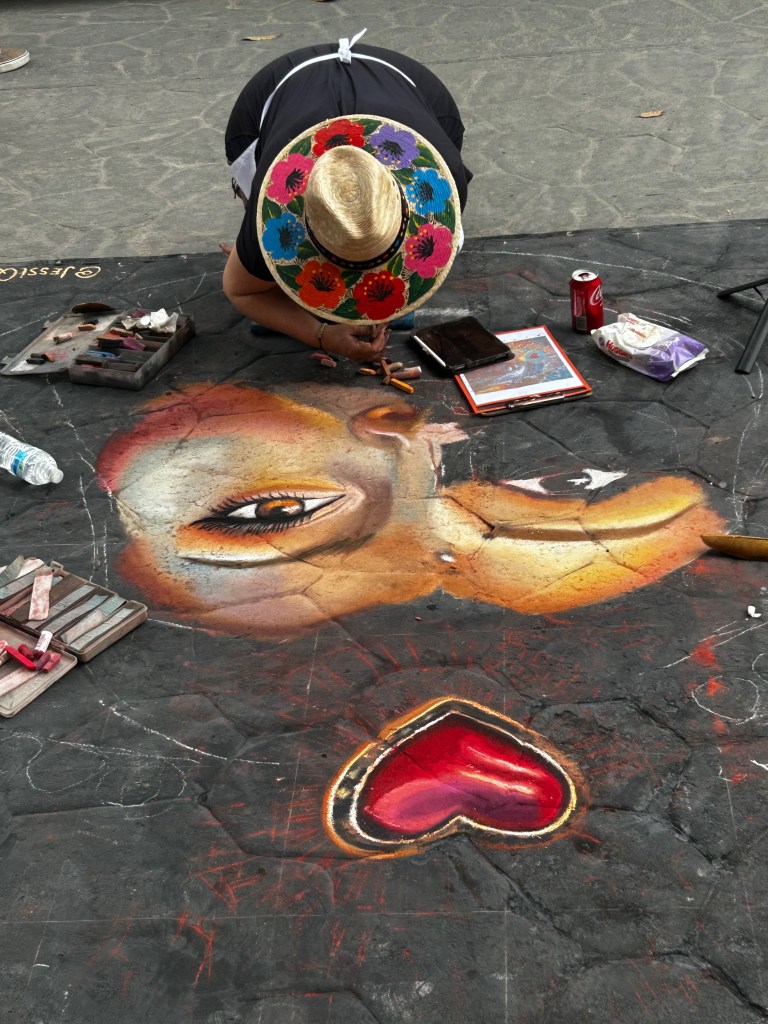
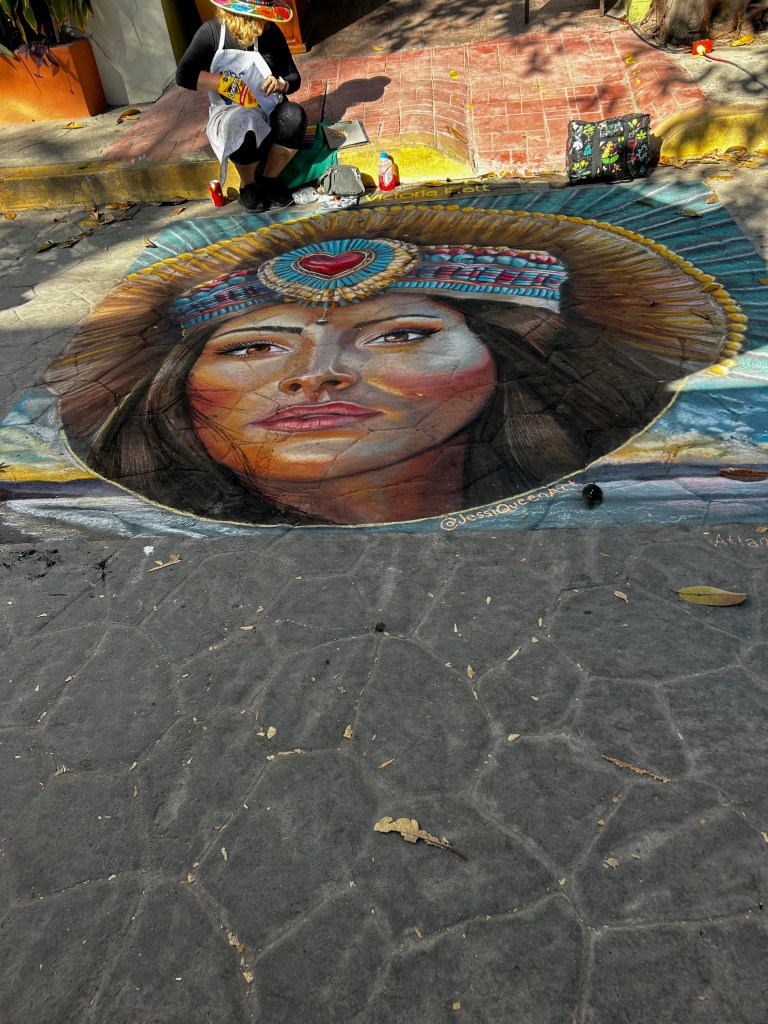
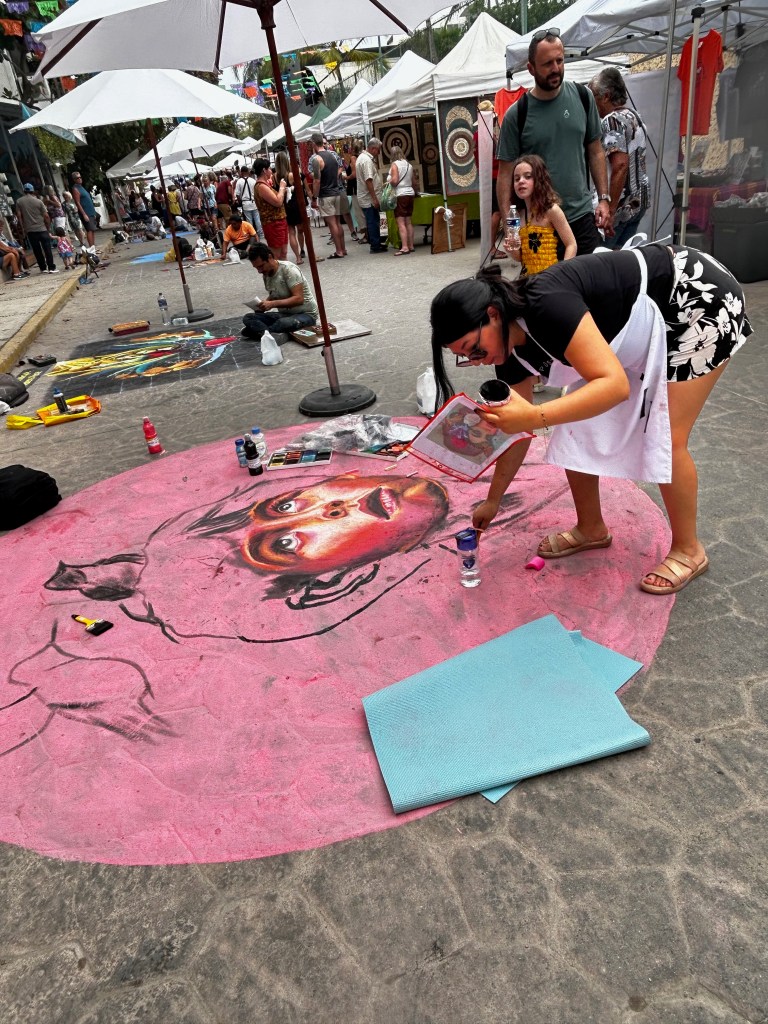
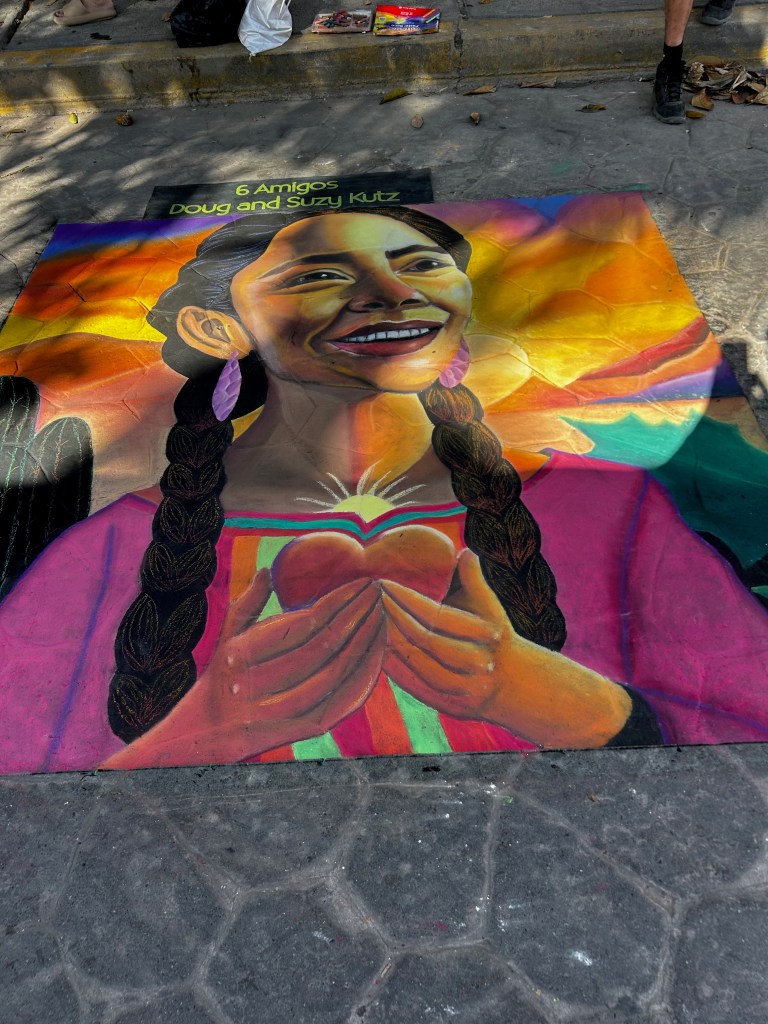
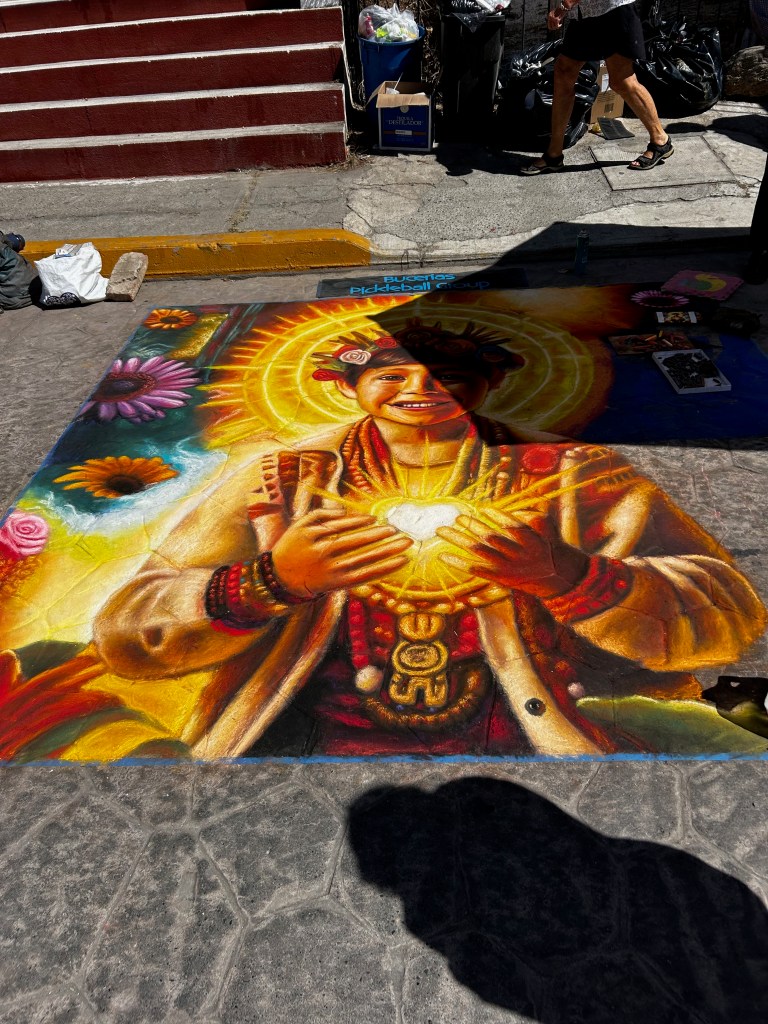
We booked the San Sebastian tour with Roger for the next day; he advised us to save our money for a tour of Sayulito and take the bus on the highway for 42 pesos and spend the money on Tequila. We then walked back and ran into the Chalk Walk Art Event which we had heard about from a woman in Margarita Grill PV in Puerto Vallarta. The artists were just getting started on Tuesday and then were finished on Thursday. See the progression:
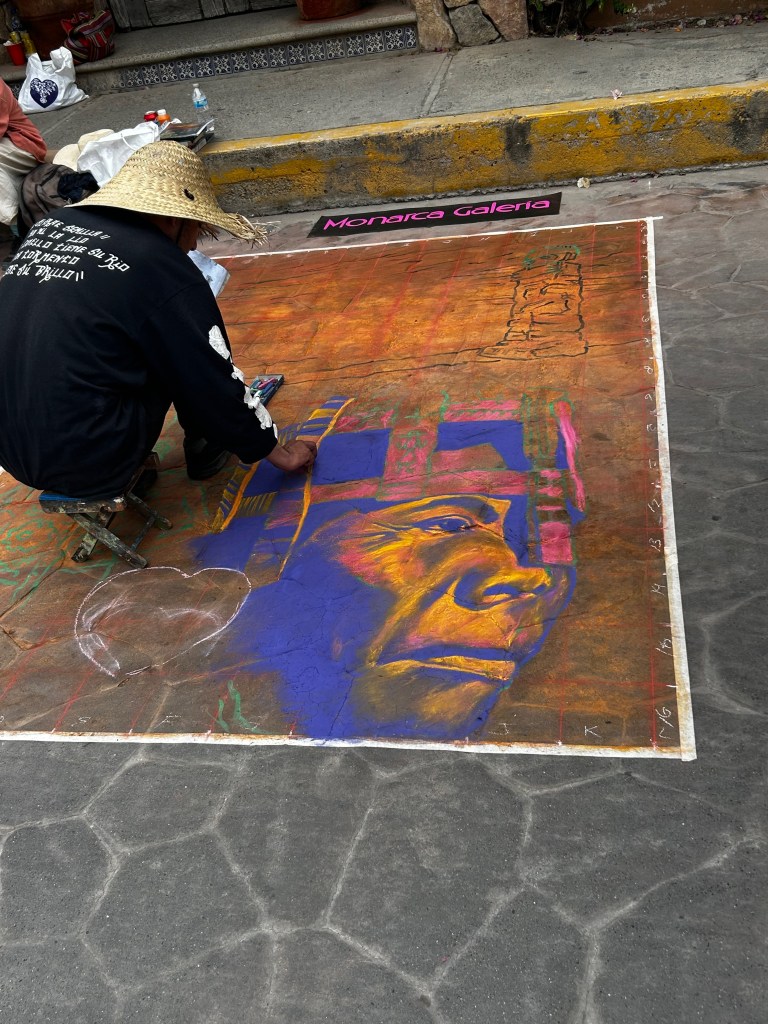
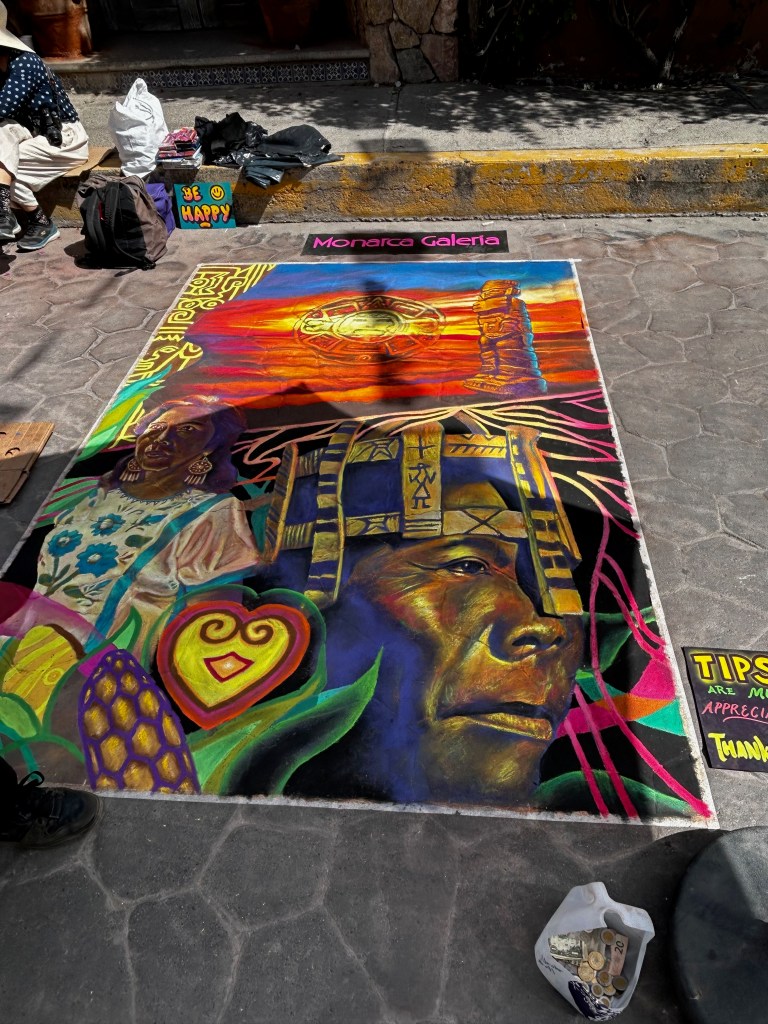
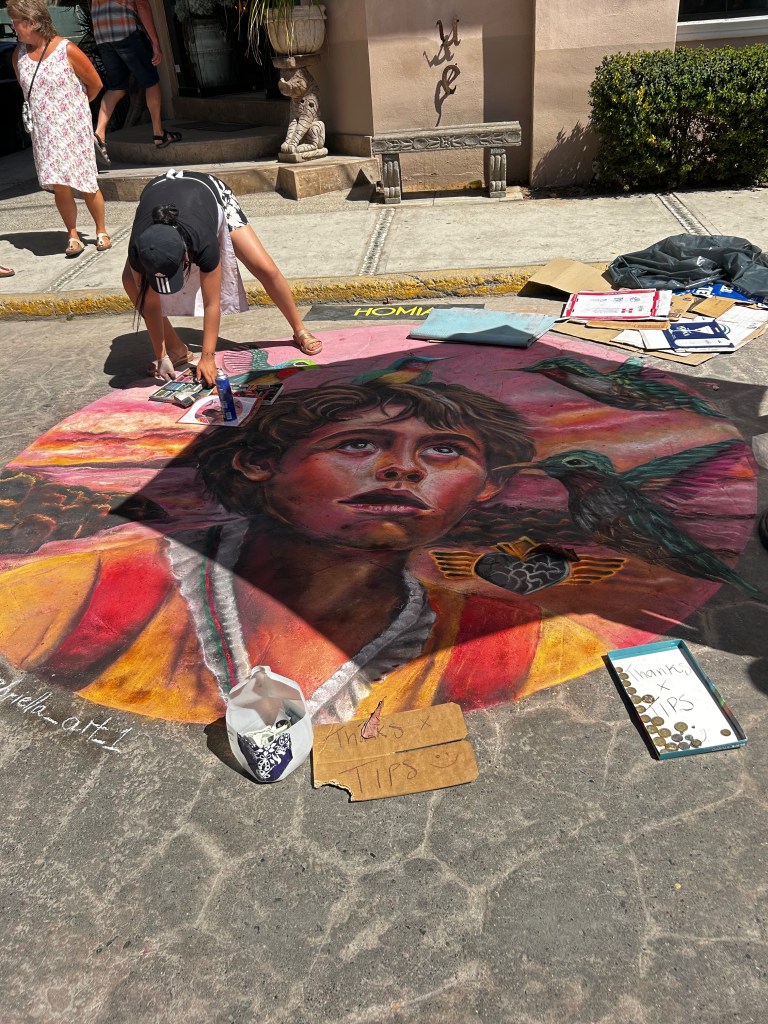
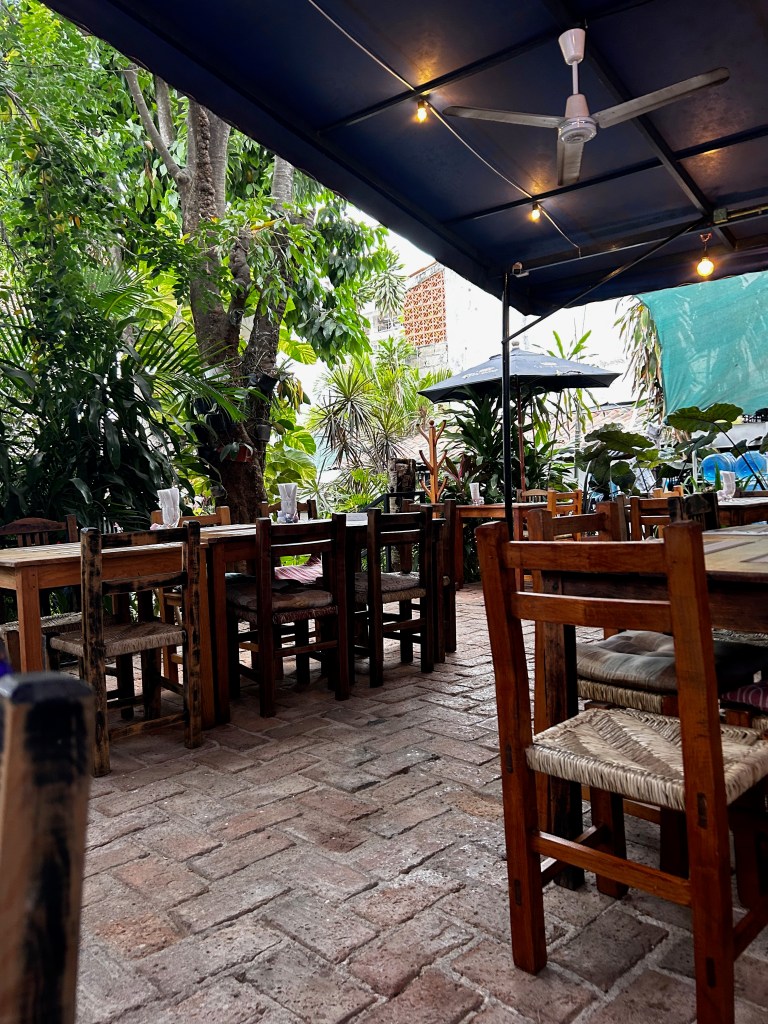
For dinner we went to Delices Mexicana, two blocks up the street that had been recommended by Andrew and Susan. I had beef, rice and vegetables and Bill had Pollo Mole – mine was good and Bill’s OK.
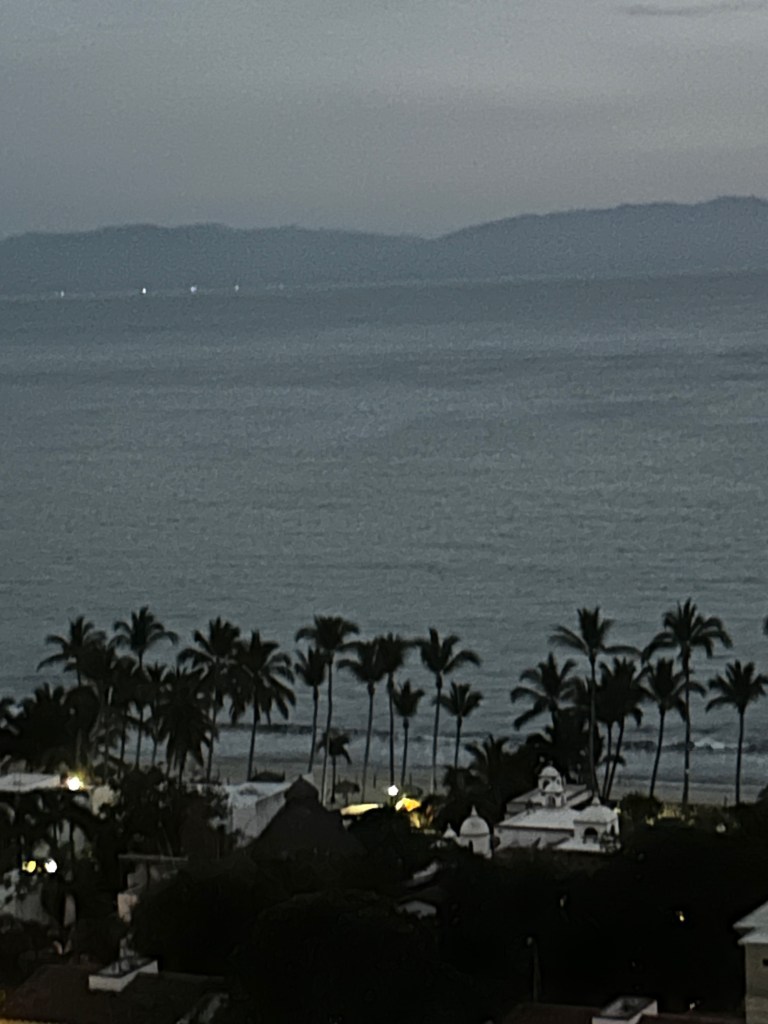
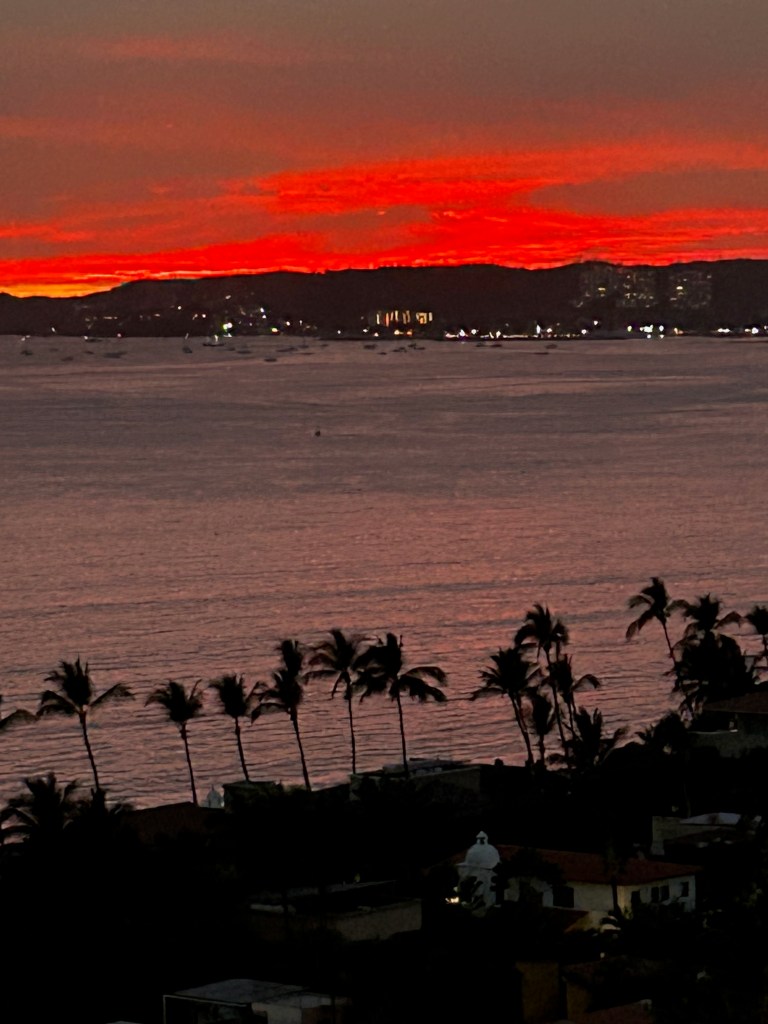
We went to the rooftop to enjoy the sunset.
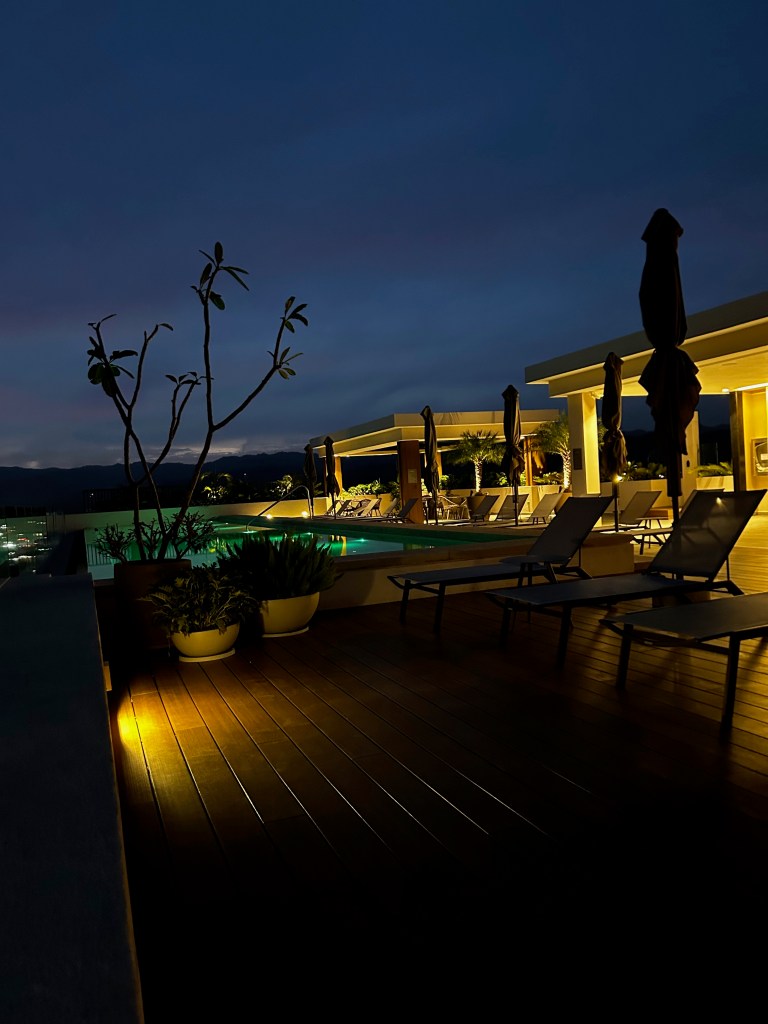
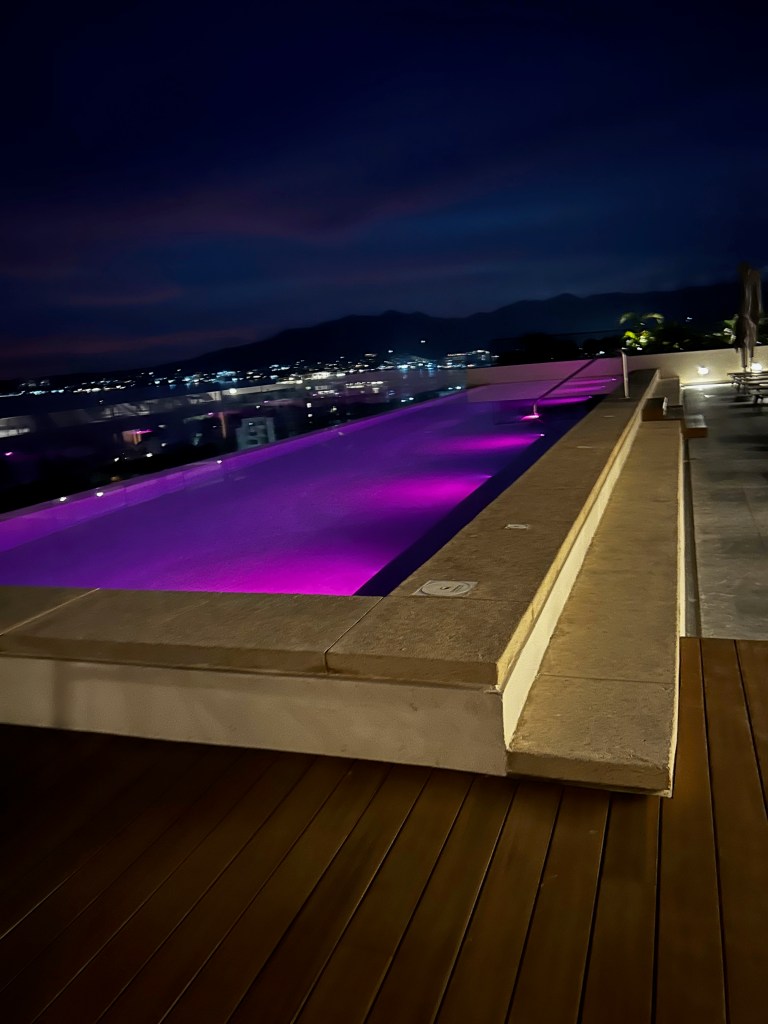
Wednesday, February 19
Our driver, Carlos, and our guide, Gustav, took us to San Sebastian Del Oeste. On the way, Gustav told amusing jokes and provided the history of Mexico (I have refreshed the information through Google searches). It seems to be a history of a major war every 100 years: 1810, 1910, Gustav says we’re late for 2010.
The history of Mexico spans more than three millennia, beginning with the early settlement over 13,000 years ago. Central and southern Mexico, known as Mesoamerica, saw the rise of complex civilizations that developed glyphic writing systems to record political histories and conquests. The Spanish conquest of the Aztec Empire in the early 16th century established New Spain, bringing Spanish rule, Christianity, and European influences.
It’s September 16, 1810, and calls for independence are stirring across Dolores, a small town in the center of Mexico. It’s the start of an 11-year-long fight with Spain, a fight for Mexican independence. In the early 1500s, Spanish soldiers and explorers invaded Mexico and eventually established rule after defeating the Aztec Empire. Many members of the area’s Indigenous populations were captured and forced into slavery, which ultimately lasted for over 300 years. During this time, the territory under Spanish control was known as the Viceroyalty of New Spain.
After living under Spanish subjugation for centuries, Indigenous groups living throughout the territory had been growing increasingly dissatisfied with their political and social circumstances. It was the early 1800s, and Hidalgo was serving as a priest in the village of Dolores. After performing Mass in the early hours of September 16, 1810, Hidalgo was informed by a conspirator that Spanish authorities were aware various groups had been discussing independence — and those authorities were planning a crackdown. Hidalgo was prepared to take action.
A few hours after midnight, Hidalgo began ringing the bells of the Dolores church. Parishioners and workers gathered, lured by the peals ringing out across the small town. As the crowd grew, Hidalgo delivered what would come to be known as the “Grito de Dolores” (“Cry of Dolores”). While the exact words of the speech have been lost to time, the “Grito de Dolores” ultimately served as a call to action for the townspeople to take up arms and begin fighting for their independence from Spanish rule. And they did — Hidalgo’s speech marked the beginning of the Mexican War of Independence, a decade-long series of struggles that continued gaining momentum until Indigenous fighters eventually overthrew the Spanish government in 1821.
One of the most common misconceptions that come along with Mexican Independence Day is that people assume Cinco de Mayo is the holiday that commemorates Mexican independence. However, it’s important to note the difference between the two — they have entirely different meanings despite the fact that they both mark Mexican victories against European colonialism.
Cinco de Mayo took place on May 5, 1862, and commemorates the Mexican army’s victory over France at the Battle of Puebla. This conflict took place during the Franco-Mexican War, during which France attempted to invade the country and establish a sphere of influence that pushed the Mexican government to adopt political policies favouring France.
Cinco de Mayo represented a struggle against imperialism as regional differences kept Mexico divided. The Battle of Puebla was one of many steps in unifying Mexico’s identity as a country. At the time the French army was considered one of the best in the world, and the victory clearly displayed Mexico’s resilience, strength, and pride.
Although it lasted only a day, the Battle of Puebla represents an important victory for Mexico in the face of a foreign power. But it took place 50 years after Mexican Independence Day and differs greatly from September 16. Mexican Independence Day is a vital celebration of self-determination and an enduring reminder to fight for freedom — and it remains an important event that shaped Mexico into the country it is today.
The country faced numerous challenges in the 19th century, including regional conflicts, caudillo power struggles, the Mexican–American War, and foreign interventions like the French invasion. Efforts at modernization during La Reforma included promoting civil liberties and the separation of church and state, but the country was still beset by internal strife and external threats, including the Second Mexican Empire.
The late 19th-century Porfiriato era brought economic growth but also authoritarianism and social inequality, which eventually fuelled the Mexican Revolution in 1910. Throughout the 20th century, Mexico implemented land reforms, nationalized key industries, and expanded social welfare, but these achievements were marred by corruption, violence, and economic crises.
In the 1980s and 1990s, Mexico shifted towards privatization and trade liberalization, culminating in the signing of the North American Free Trade Agreement (NAFTA) in 1994. The 21st century has seen economic disparities, drug-related violence, and corruption. Recent governments have aimed to combat corruption, reduce inequality, and address the violence that has plagued the country for decades with mixed success. https://en.wikipedia.org/wiki/History_of_Mexico
The trip: We were up early to get to the pick up point for the trip to San Sebastian del Oeste at 8:30.
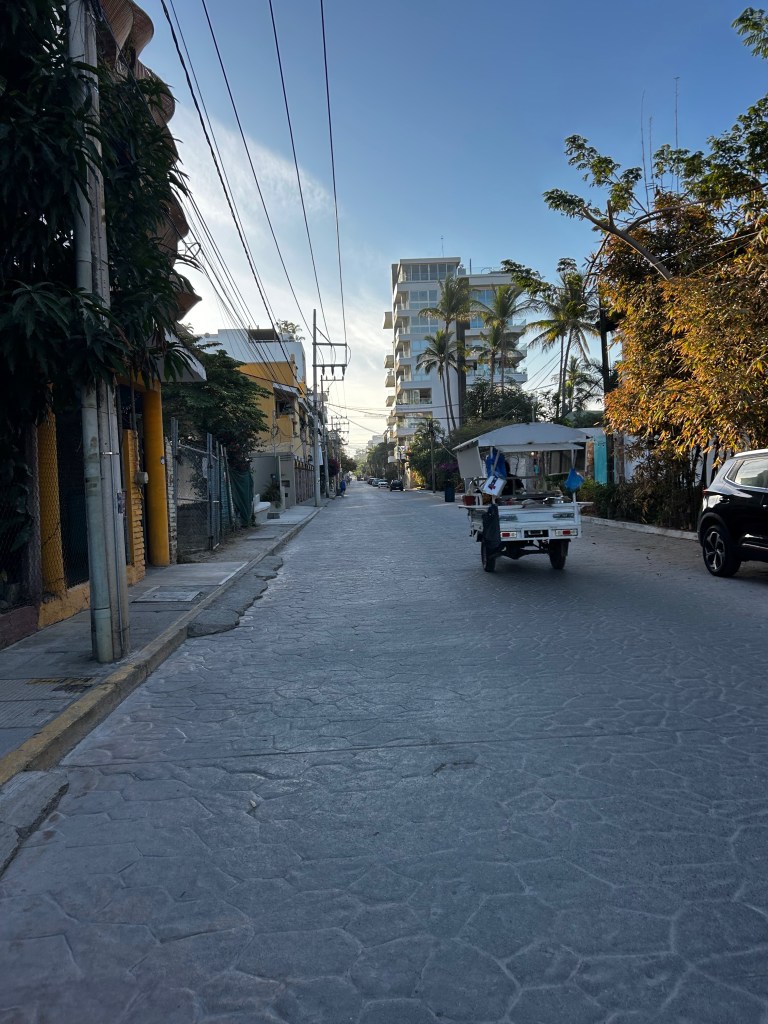
It took a while to pick up all the passengers from the high rises in Vallarta Riviera just south of Bucerias and then headed inland through small villages and countryside up and down narrow roads. In the towns, the roads are cobblestone so driving over them shakes the whole van. Gustav says this is a free Mexican massage.
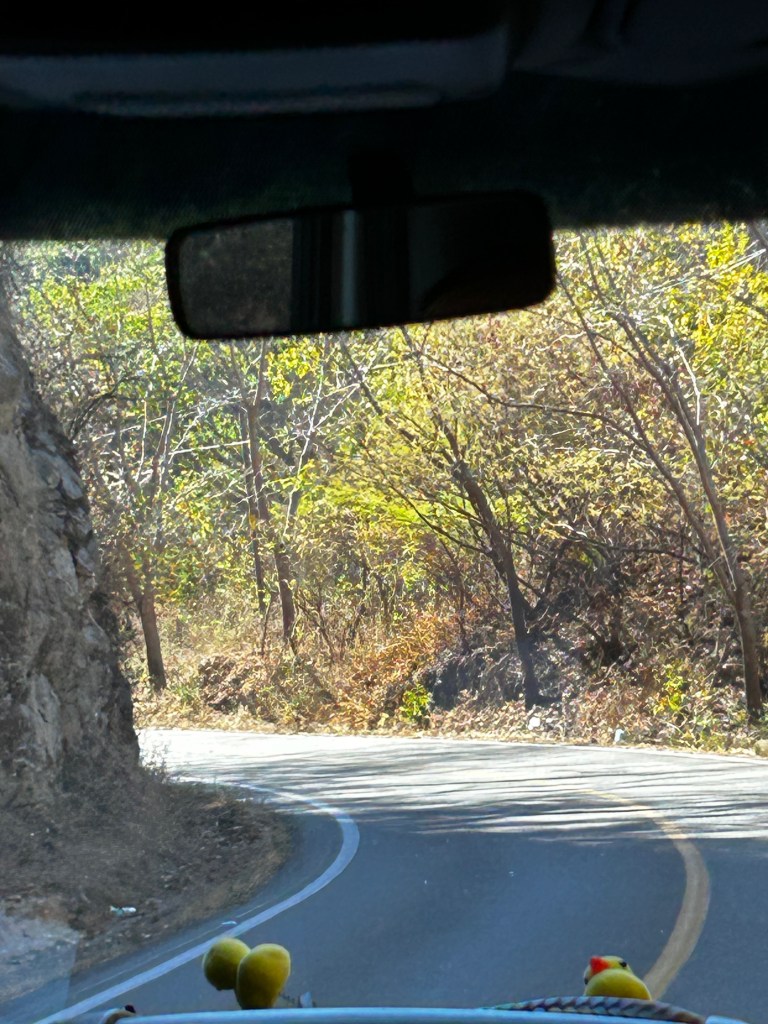
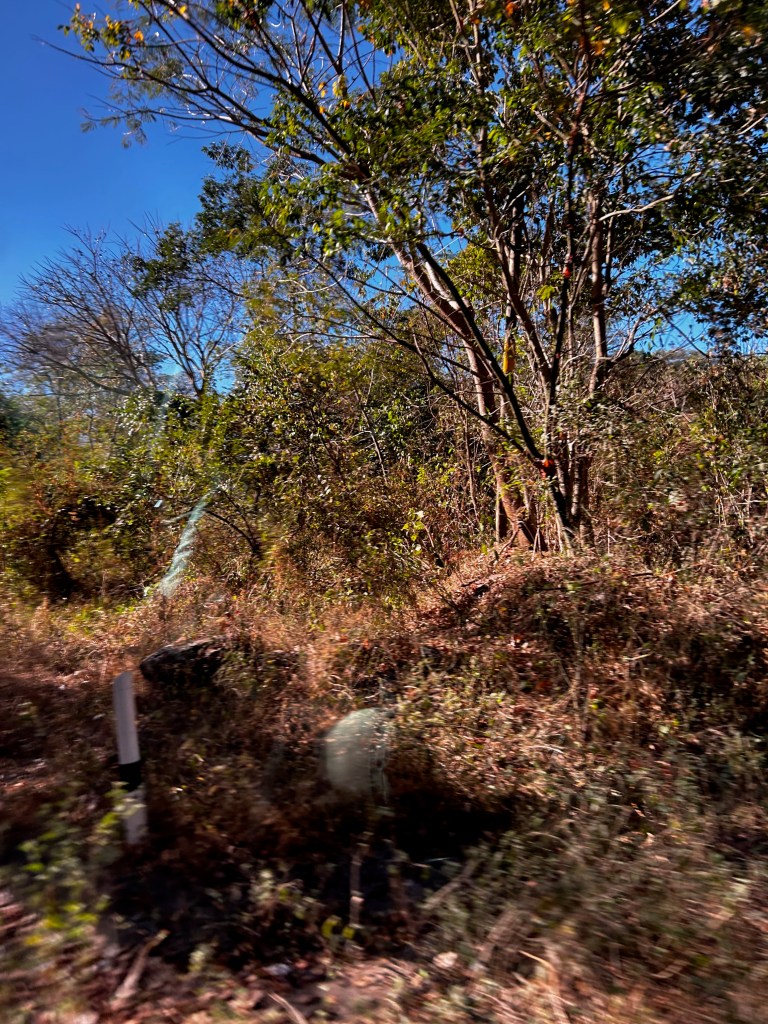
The road meandered through coastal plains and then started its climb into the Sierra Madre mountains. The hills graduated from low brush to pine forests and the air had a gentle coolness you don’t get at the beach. We passed by pastures of livestock, valleys with lush vegetation, fields of nopal cactus and tall stalks of corn.It is only recently that tourists arrived in San Sebastian because the road was only a track and there was no bridge over the canyon.

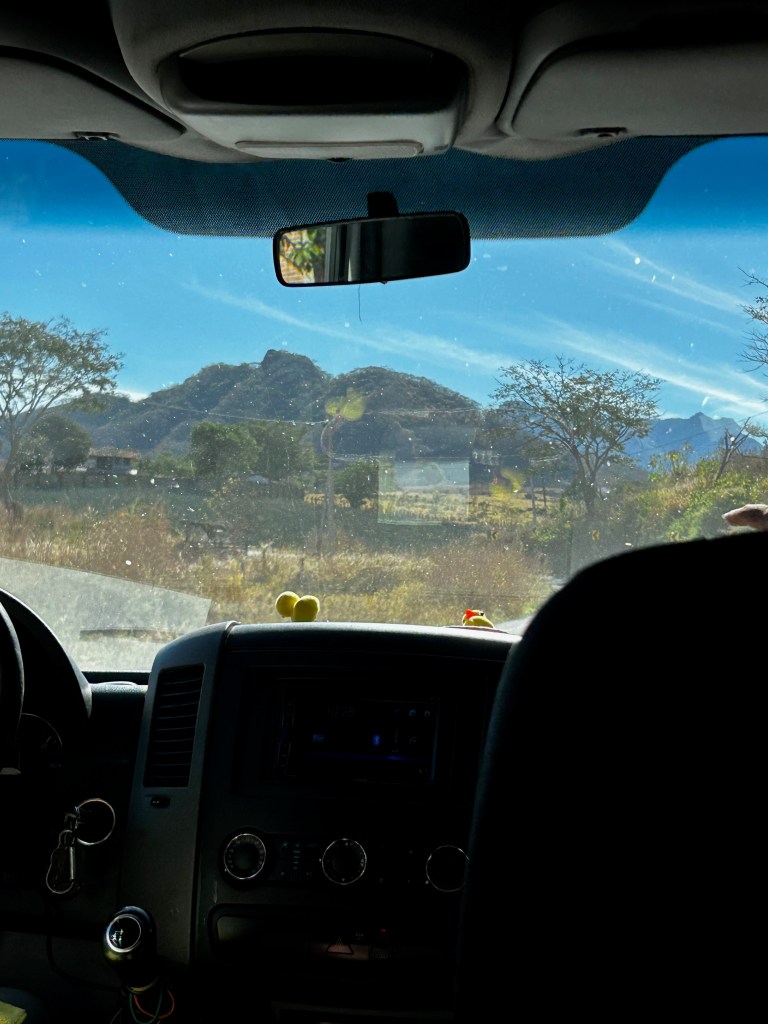
Located in the Sierra Madre mountains inland an hour and a half, San Sebastian is considered an Esmeralda village because of the greenness of its mountains. It felt like the Mexico of the 200 years ago with its cobblestone streets, its church built like a fortress.
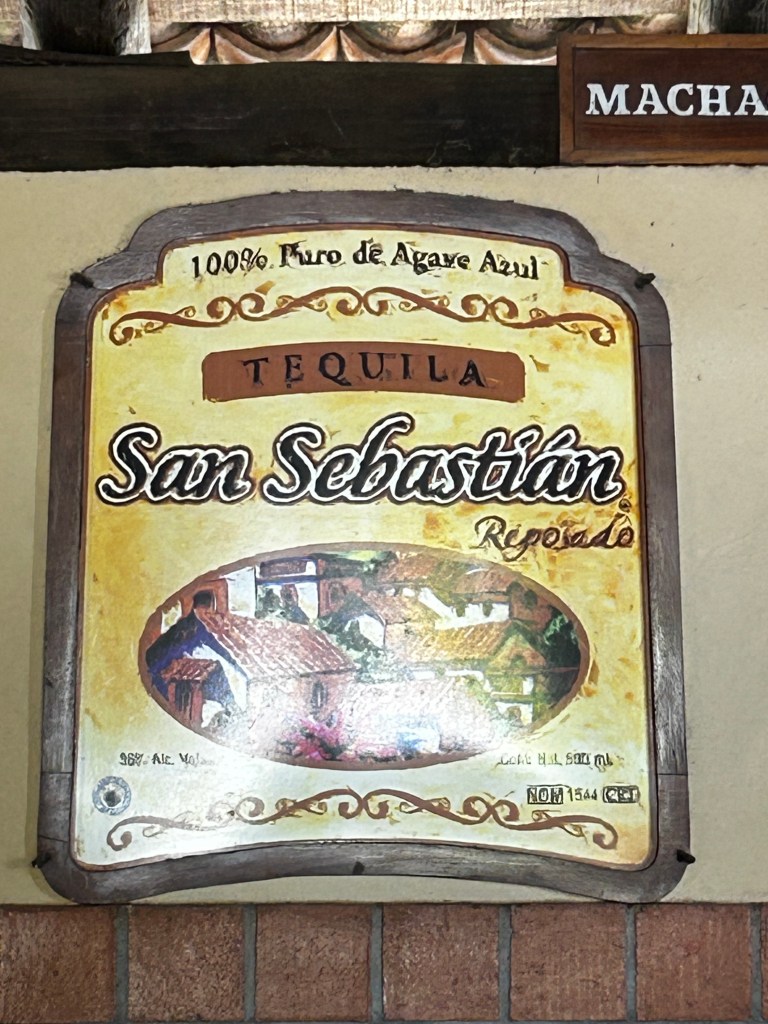
We visited a family-owned Tequila distillery.
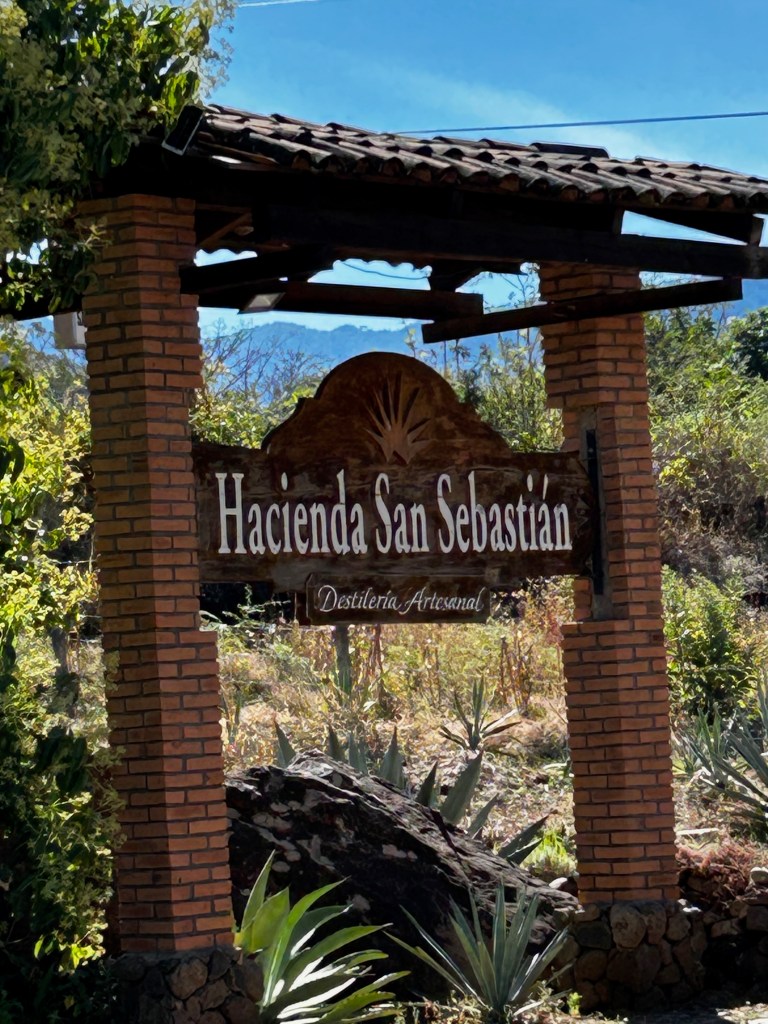
We were guided through the traditional making of Tequila by a young male member of the original distillery family. Tequila production in Jalisco dates back to the pre-Hispanic era when indigenous peoples fermented the sap of the agave plant to create a beverage known as pulque. When the Spanish arrived in the 16th century, they introduced distillation techniques, which transformed the fermented agave into what we now recognize as tequila. Jalisco, with its abundant agave fields (high altitude) and favorable climate (little rain), quickly became the heart of tequila production.

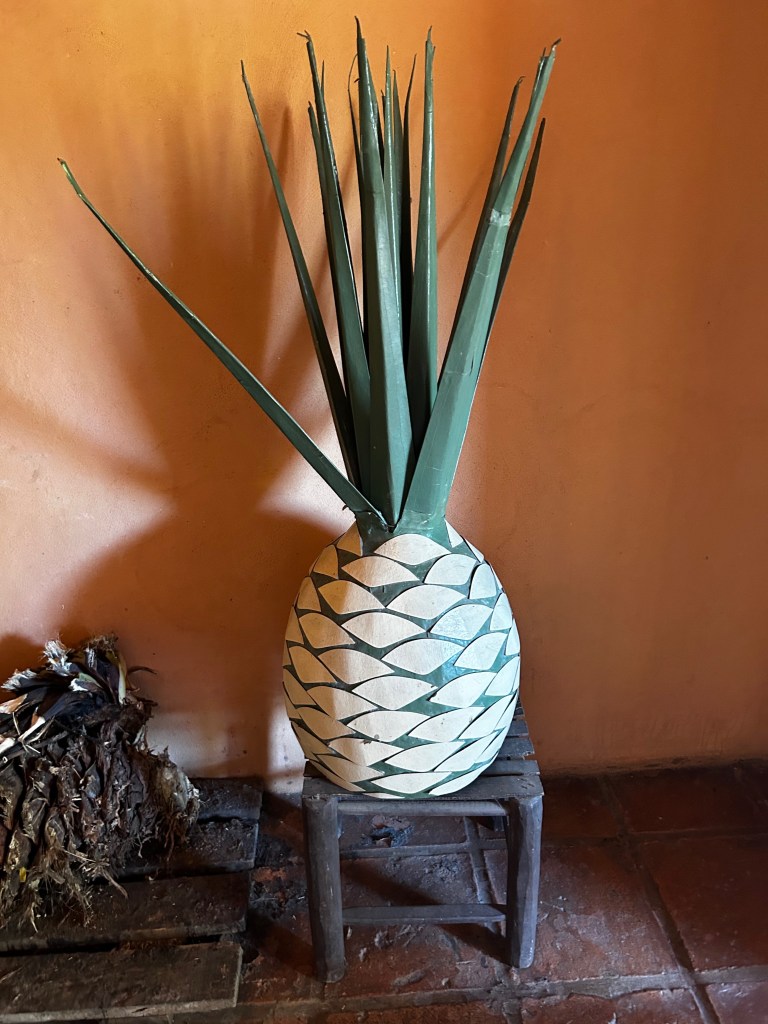
After the agave piñas are harvested, they are cooked to turn their starches into sugars that can be fermented. Traditionally, the piñas are slow-cooked in large ovens or autoclaves for several hours.
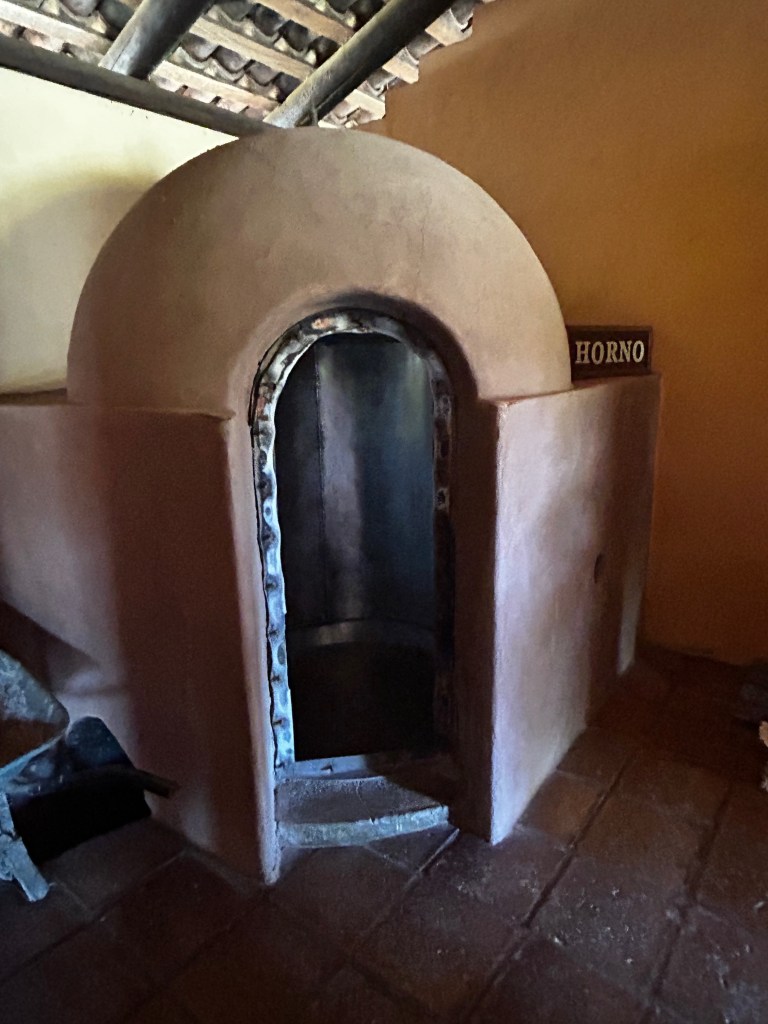
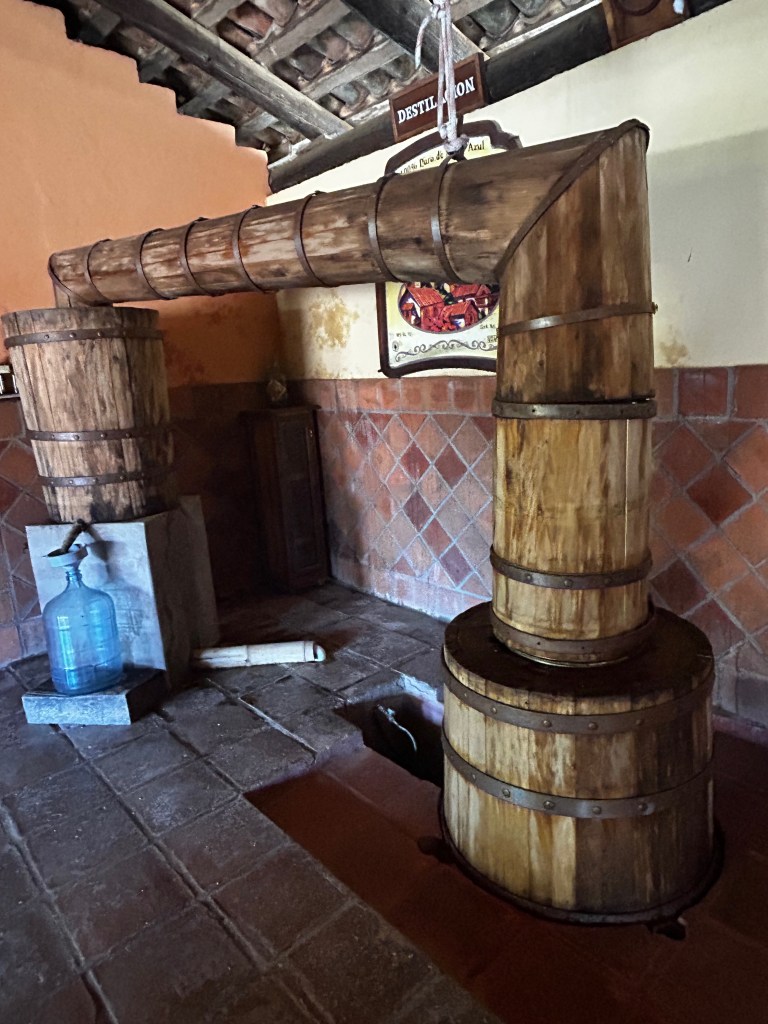
Once cooked, the agave is crushed to extract the juice, which is then placed in large vats for fermentation. This fermentation process is essential because it turns the sugars into alcohol, creating the distinct flavours that tequila is known for.
Distillation is a critical step in tequila production. The fermented agave juice is typically distilled twice to increase the alcohol content and refine the flavor. The first distillation separates the alcohol from water and other impurities. The second distillation further purifies the liquid, resulting in a clear, potent spirit. The skill of the distiller is vital in creating the smooth, balanced flavour that defines quality tequila. For tequilas like Reposado, Añejo, and Extra Añejo, the distilled tequila is aged in oak barrels for several months to several years.
Only Blue agave is used to make tequila. Green agave is used for Mezcla.

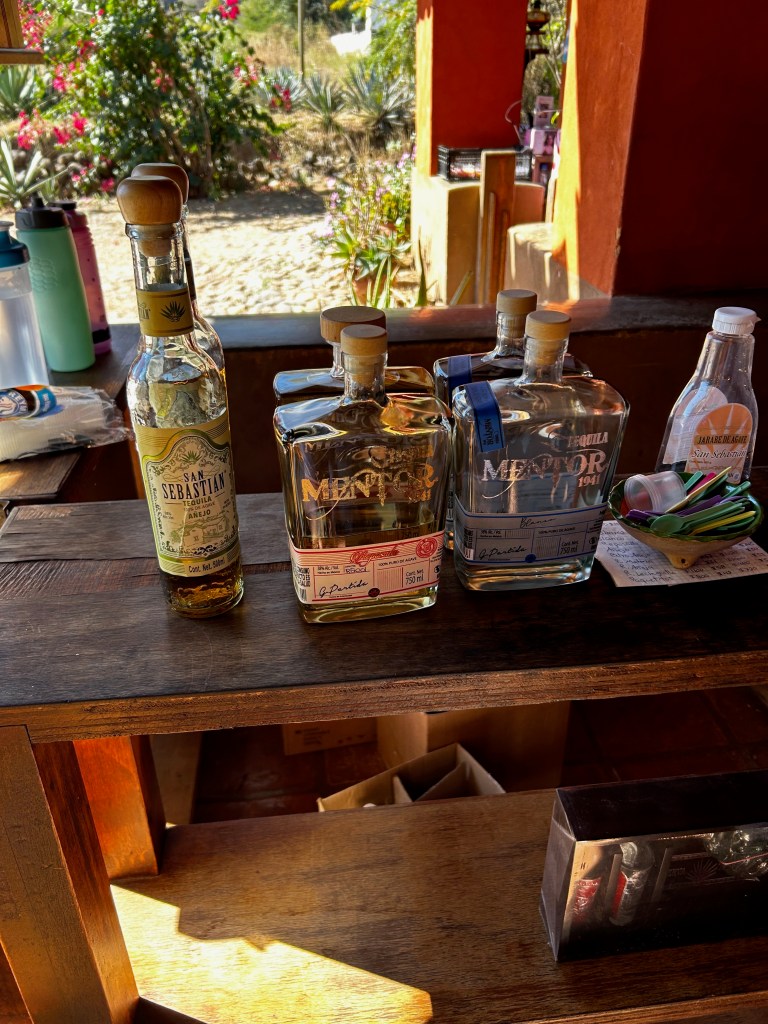
We tasted several tequila sauces for use on desserts and then three types of tequila made by the family, each smoother than the last. The middle one was best for margaritas so we bought it.
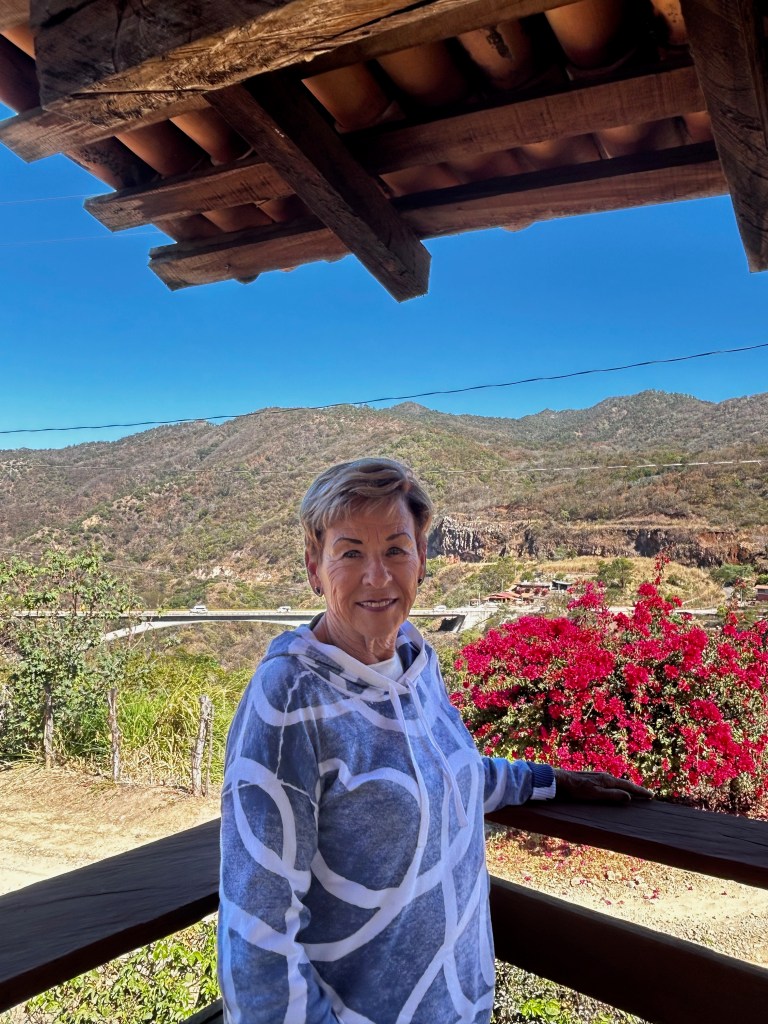
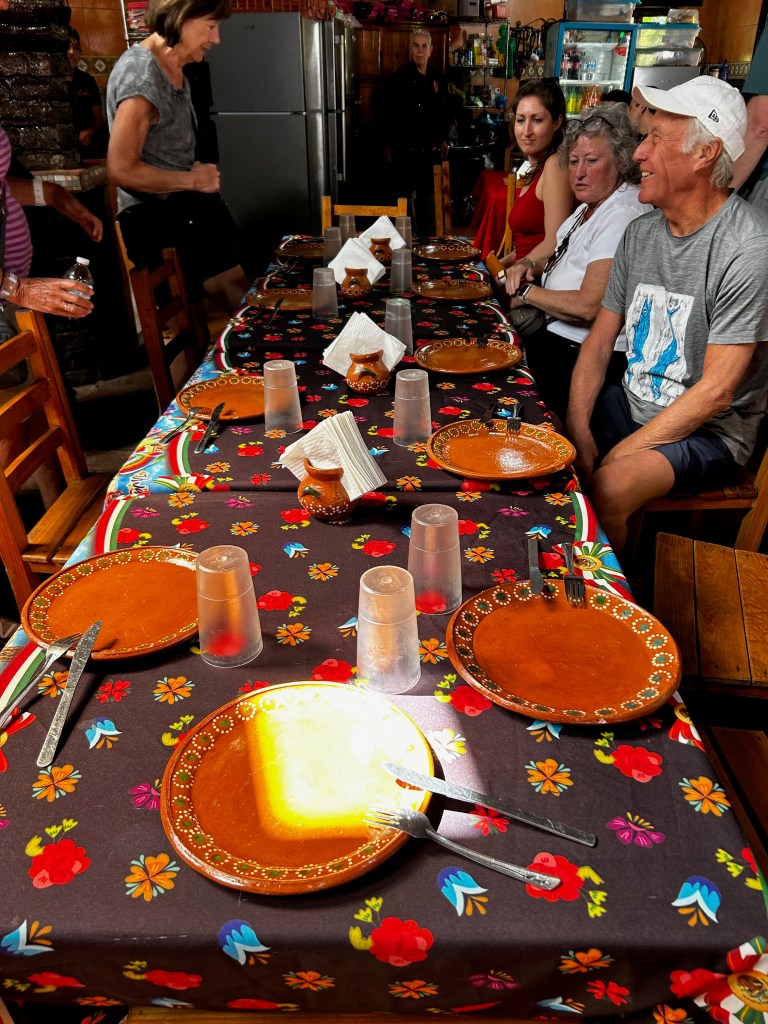
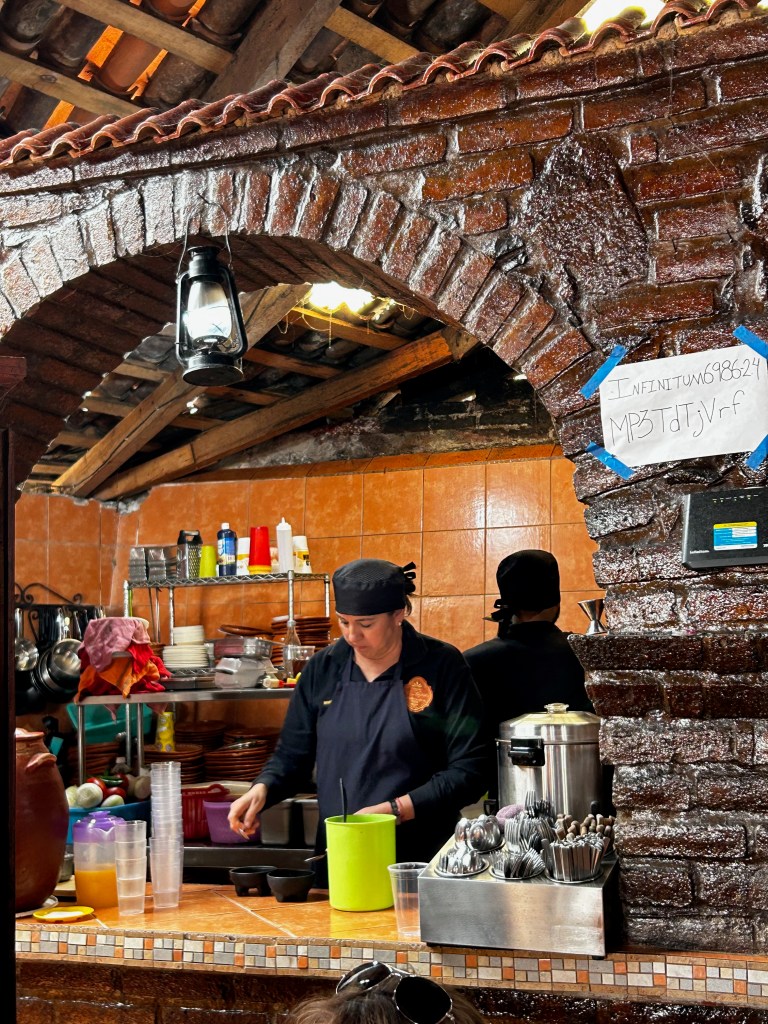
Our next stop was lunch at La Comedor de La Lupita in San Sebastian. We had tortilla with queso (cheese) with tomato spicy sauce and a long-cooked chopped up beef mixture to add to it, chicken mole, refried beans, rice and hibiscus juice.
We stopped at an family-owned Opal Outlet, Jewelry Alvilez, located near the mine. The opal is in this rock.

I bought an large opal with an irregular shape that the Alvilez company set in a silver frame as a pendant that they delivered to our condo.
Gustav had informed us that in its heyday, 20,000 people, mostly miners, had lived in San Sebastian. When the mine was closed during the last revolution, the inhabitants dropped to under a 1000 but it is now growing since the bridge was built and has 6000 inhabitants.
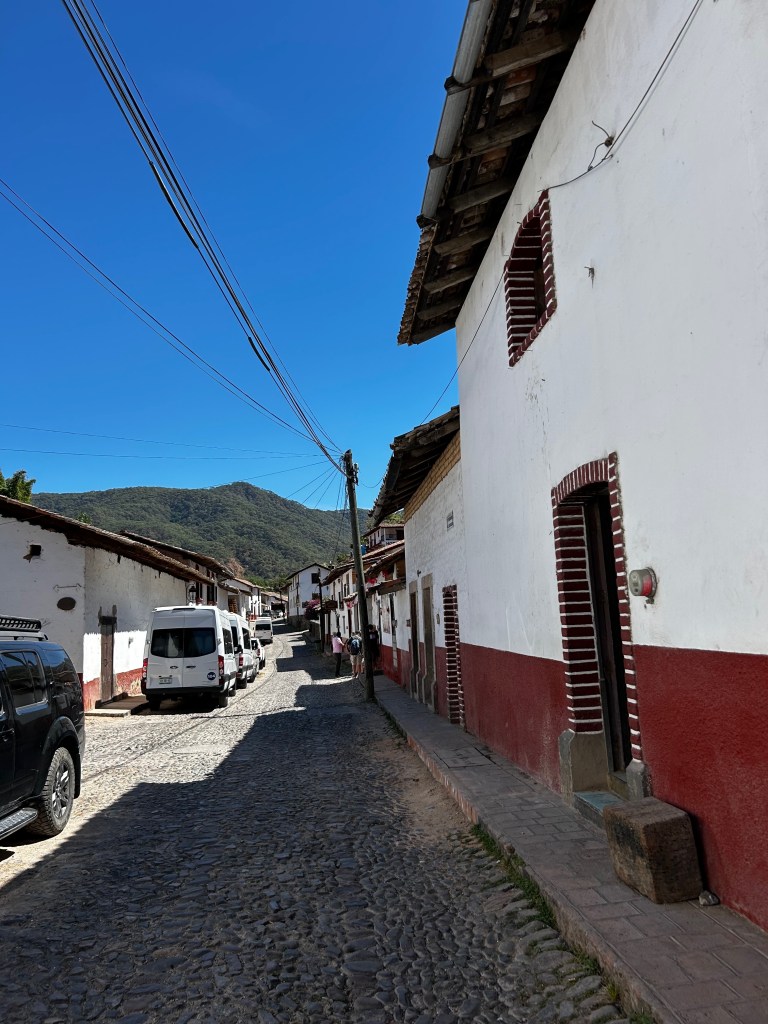
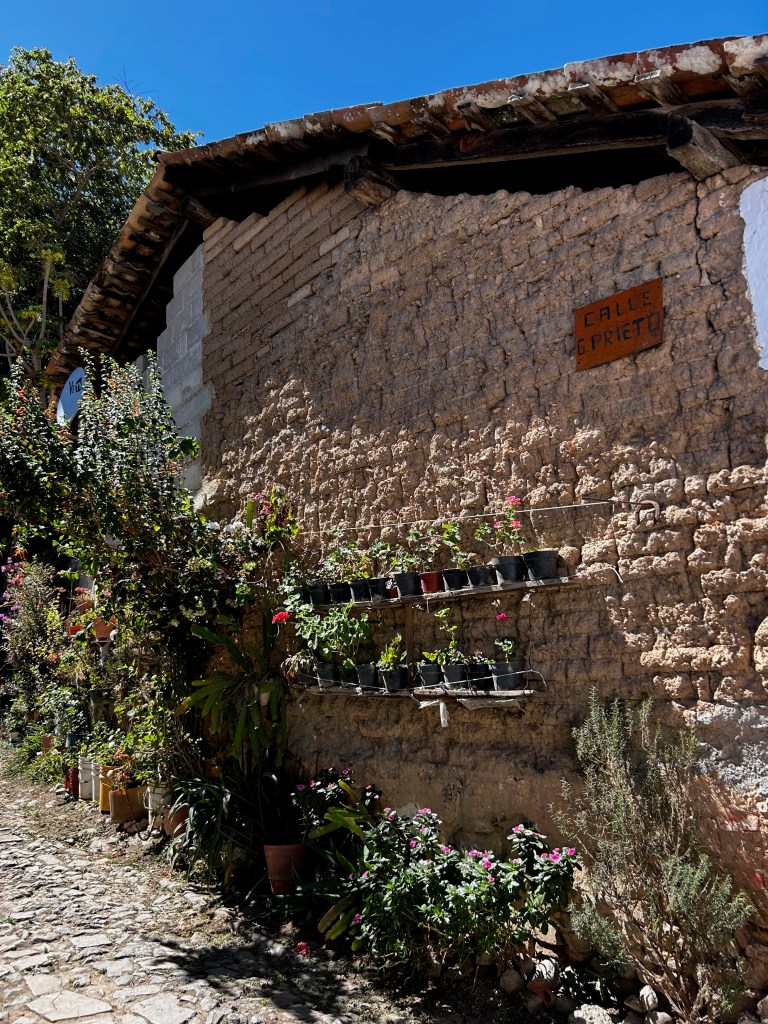
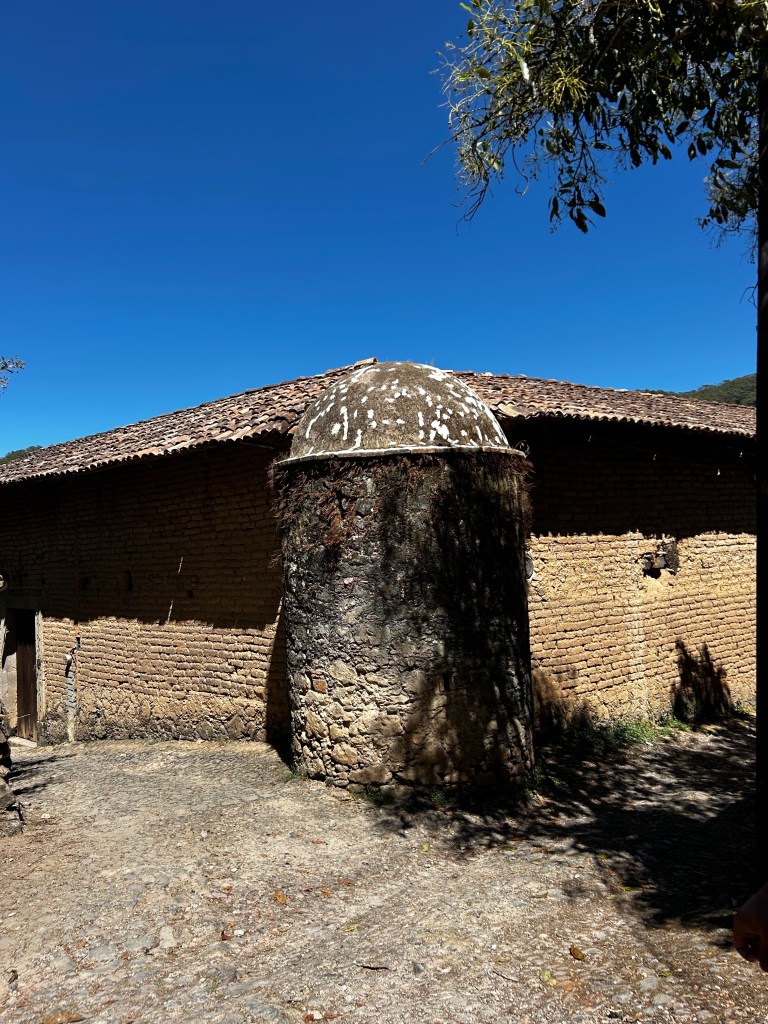
We climbed up the cobblestone street to the building at the top, a tower with bullet holes visible and opening for guns from inside: part of the fortifications to protect the town during the wars.
San Sebastián was founded as a mining town in 1605, during the early Spanish colonial Viceroyalty of New Spain period. Gold, silver and lead were mined in the area. More than 25 mines and a number of foundries were established by 1785.
The town had a population of 20,000 when, at the end of 1888, the miners went on strike. They were led by Felipe Preciado and Francisco Ochoa. Escorted by a cavalry picket led by a second lieutenant, the governor sent a delegate to intervene in talks to reach an agreement with the company manager. All the strikers’ demands were met, but the owner company, based in New York, disapproved of everything done by its representative and ordered an immediate strike at its mining farms. The prosperity of the town declined after the revolution of 1910.
Gustav told us we had an hour to walk through the town on our own. This seemed kind of off hand as there was nothing to see but souvenir places. This was the reason for the trip.
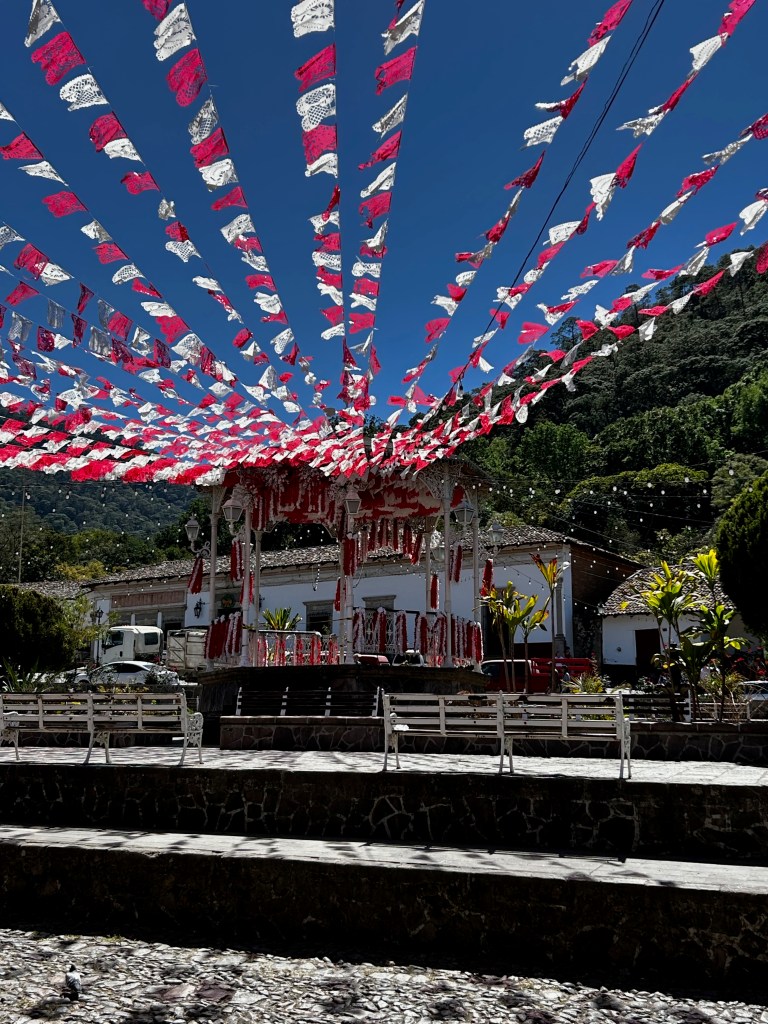
These days the plaza is surrounded by white-washed colonial-style buildings with tile roofs, with modern conversions turning them into hotels, cafes, and gift shops.
The Church of Saint Sebastian, whose original construction was in 1608, was designed in the Colonial Spanish Baroque style but has been rebuilt because of an earthquake. It has notable architectural details, including Corinthian columns and ceiling vault frescos.
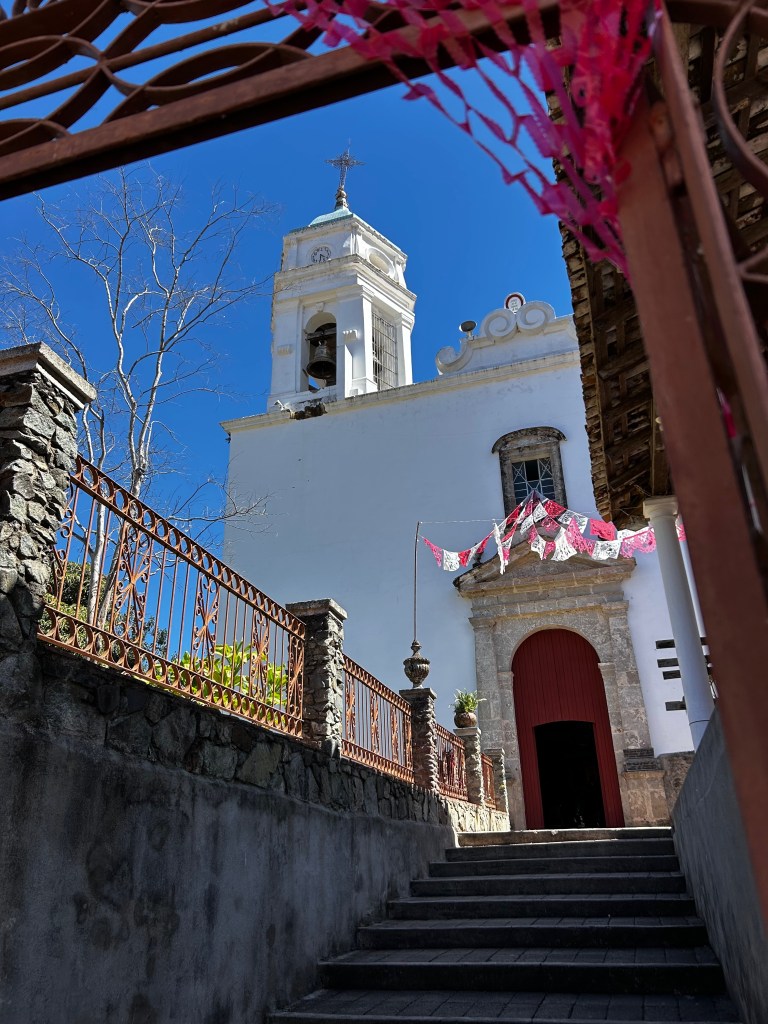
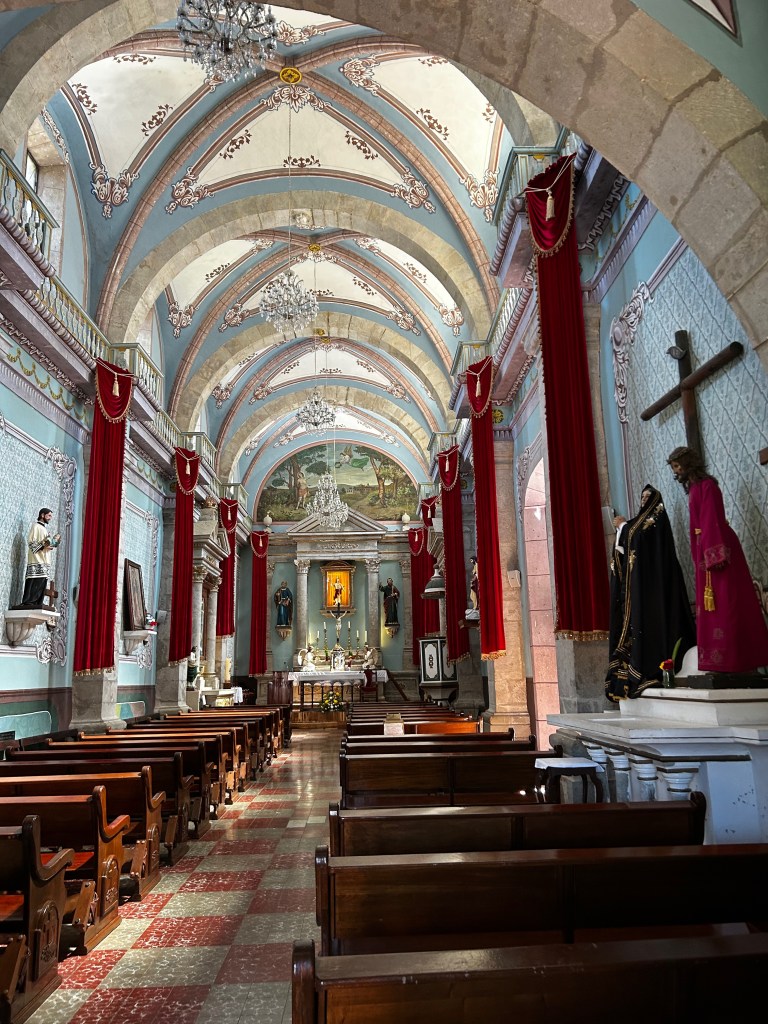
We stopped at a family coffee plantation and organic coffee factory. On the walls were photos of some of the revolutionary heroes. Pancho Villa , Commander of the Division of the North, and Emiliano Zapata, Commander of the Liberation Army of the South, joined forces in the Army of the Convention, which fought the Constitutionalist Army of Venustiano Carranza. The Mexican Revolution was an extended sequence of armed regional conflicts in Mexico from 20 November 1910 to 1 December 1920. It has been called “the defining event of modern Mexican history”. It saw the destruction of the Federal Army, its replacement by a revolutionary army, and the transformation of Mexican culture and government.

We walked back through the Chalk Walk Street Art and I bought a hand-painted hat, a unique wearable art-piece made by Kenia Mireles of Labiosdeojo.
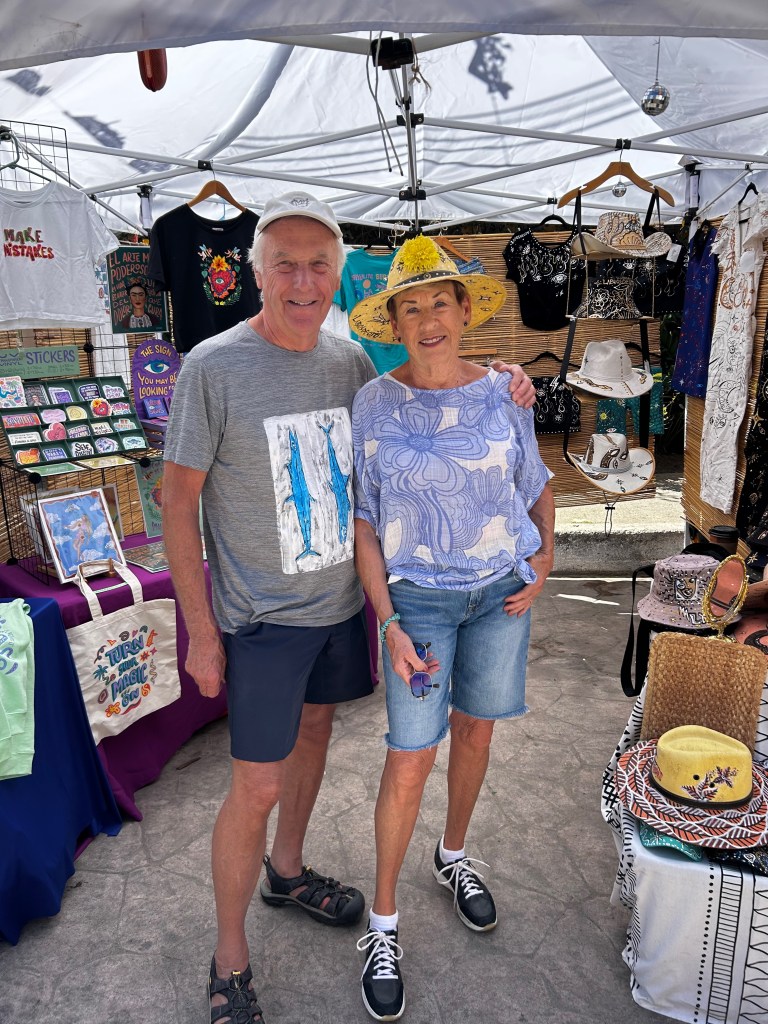
Some more chalk art.
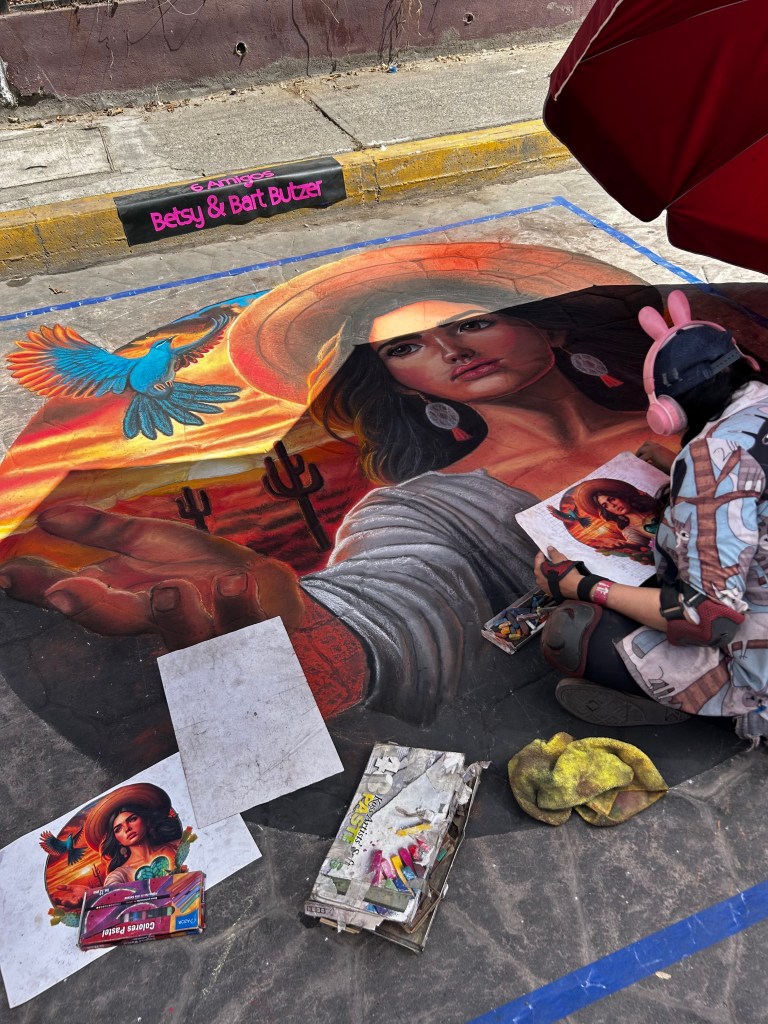
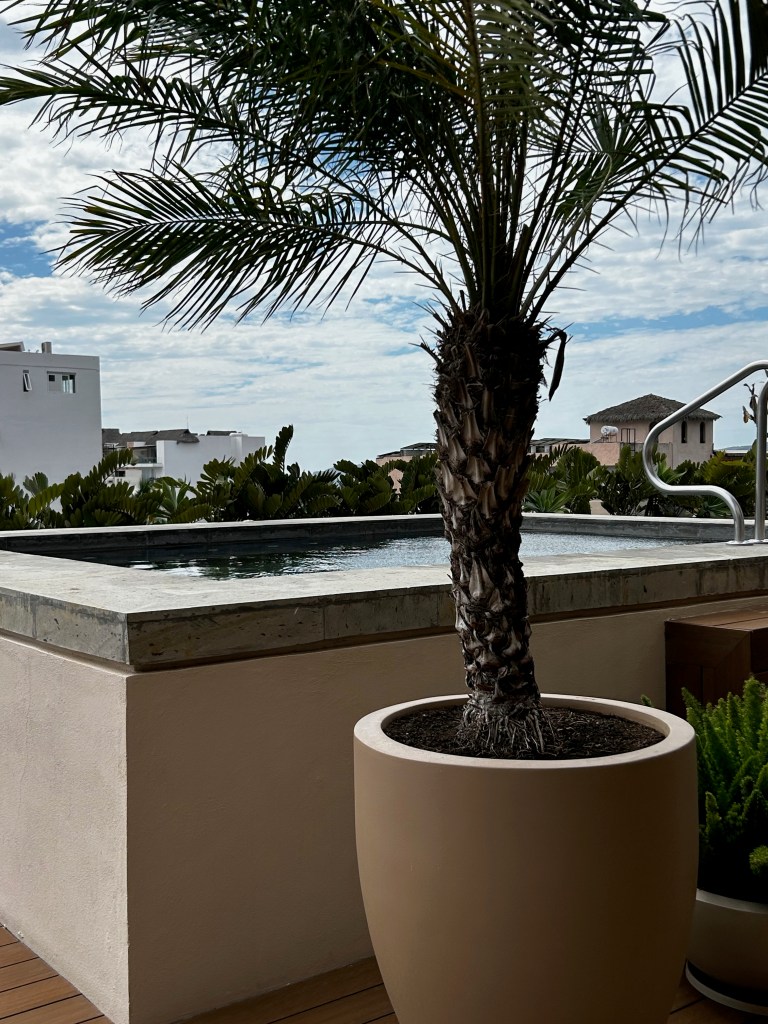
We decided to check out the Jacuzzi on the floor of our building.
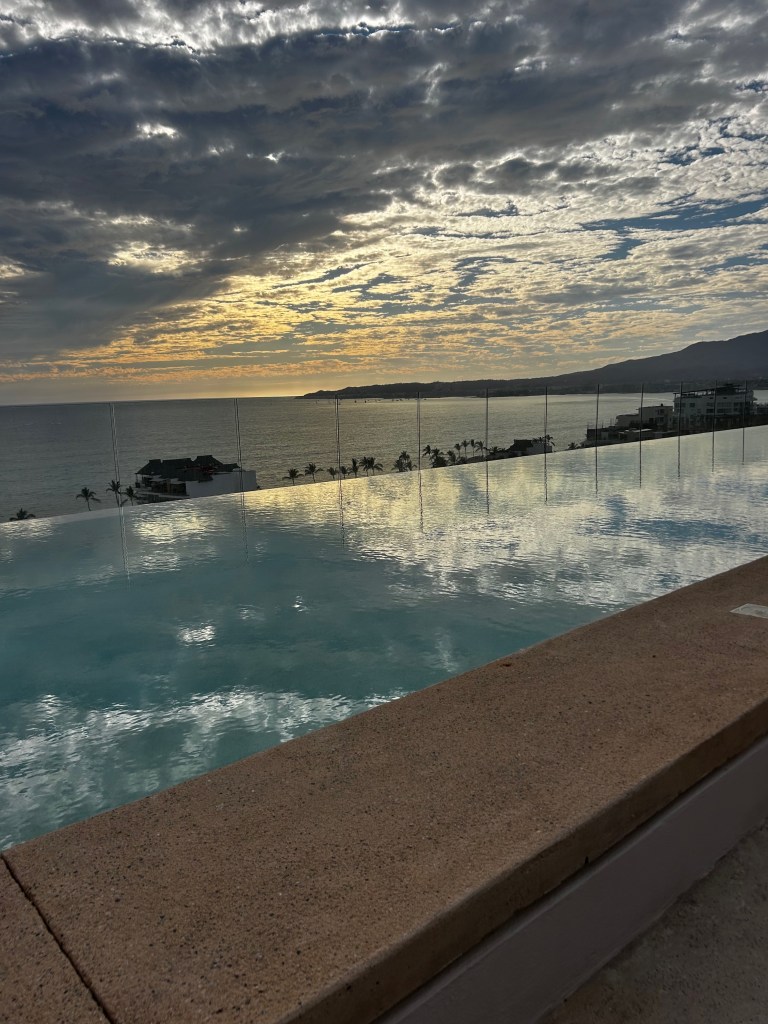
We went up to the barbeque and enjoyed the sunset and conversation with building residents.
Saturday, February 22
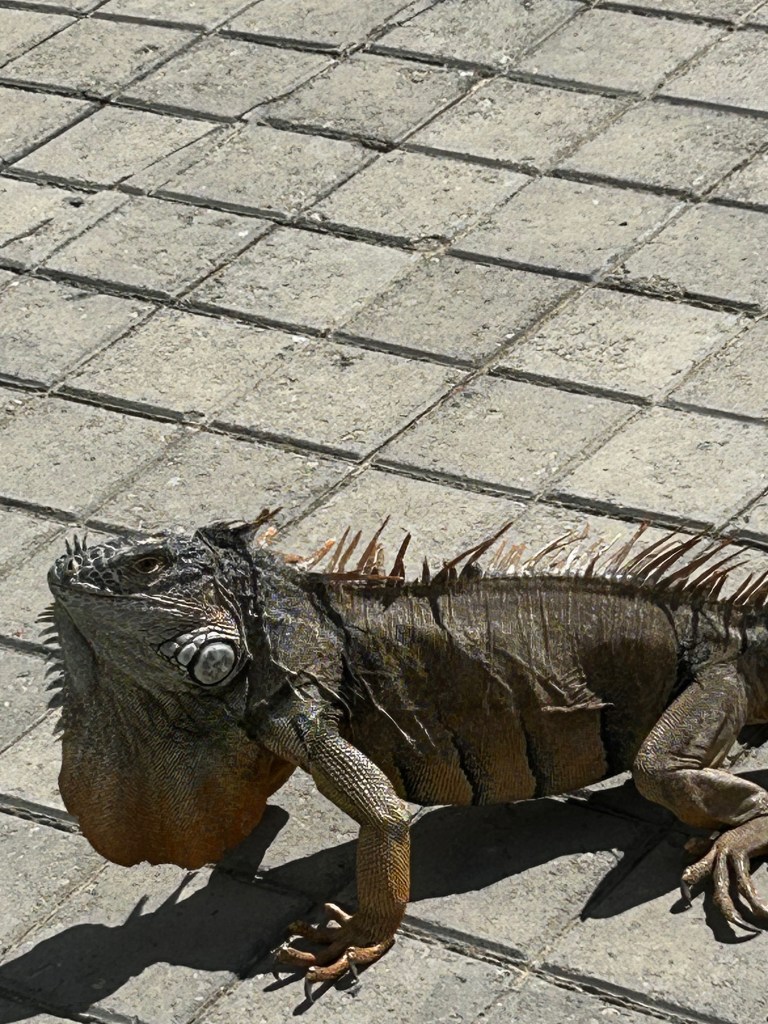
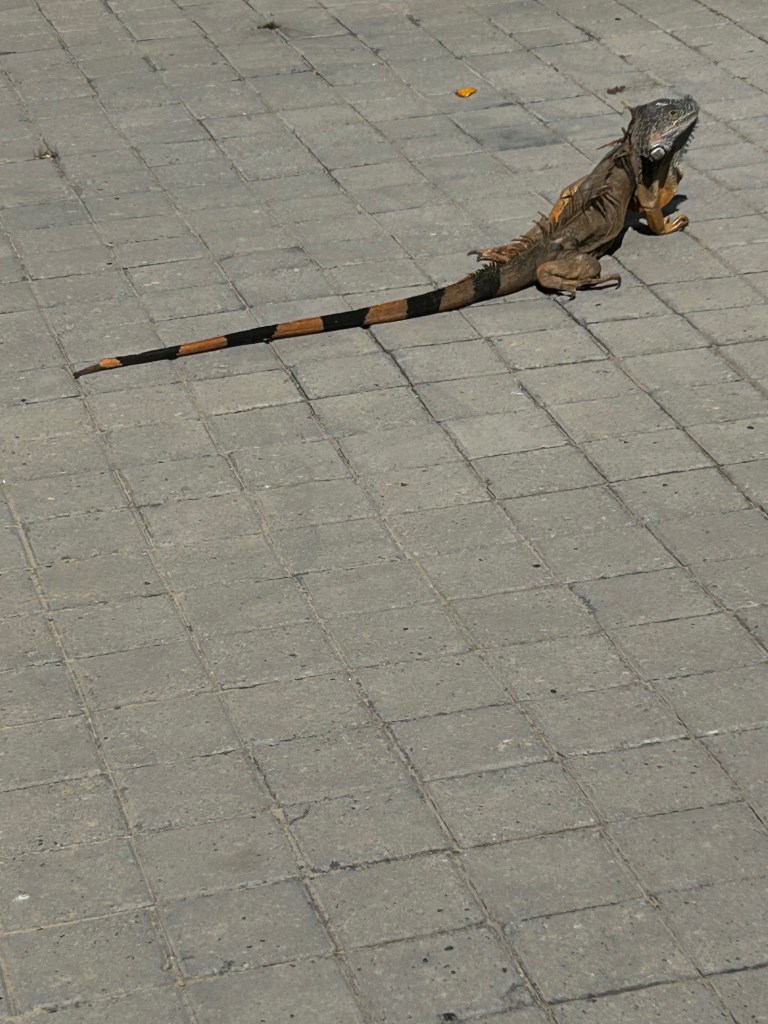
On our way for our beach walk a low tide, we had a visitor in front of our building.
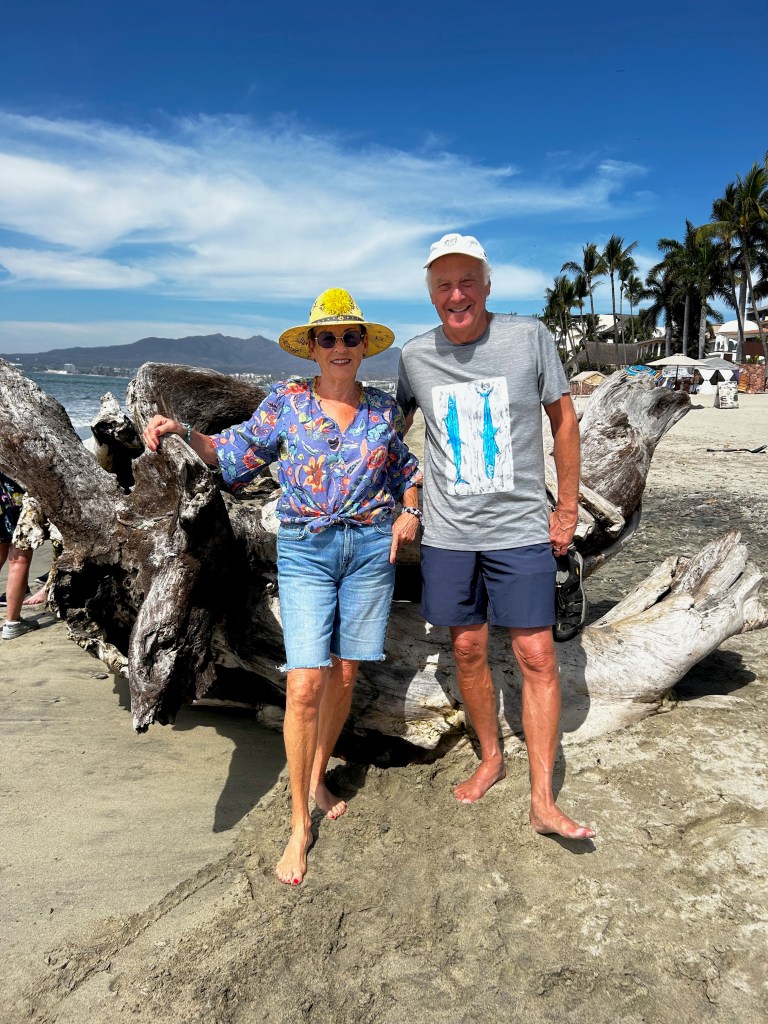
When we reached the beach, some Canadians from Winnipeg took our photo.
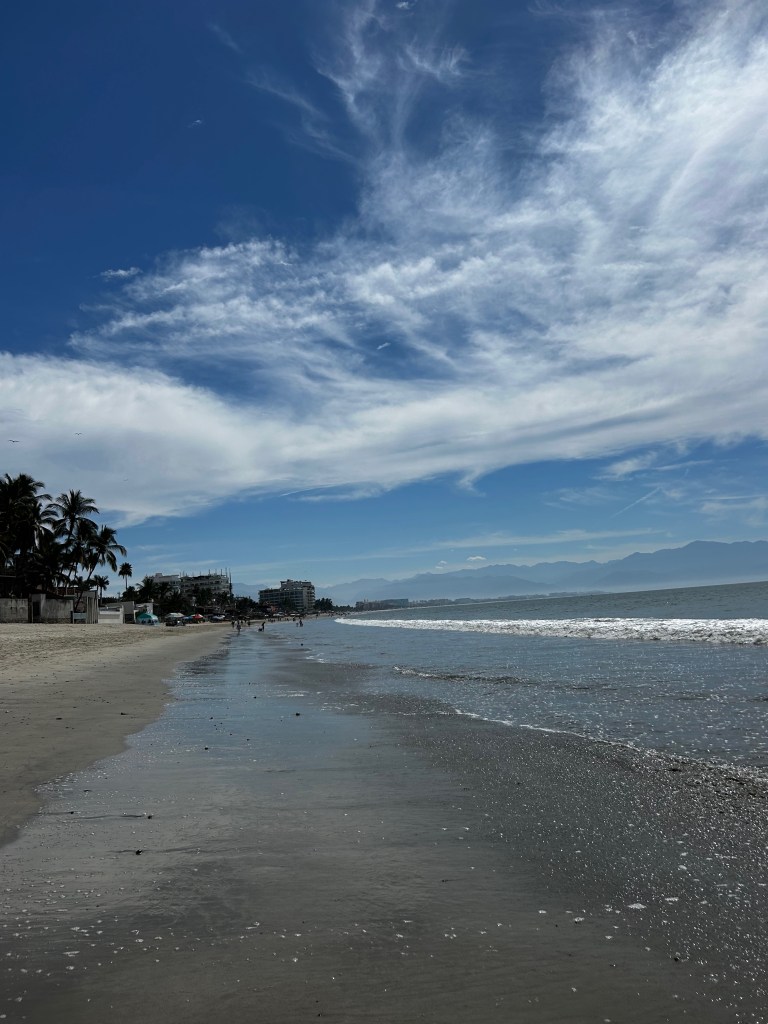
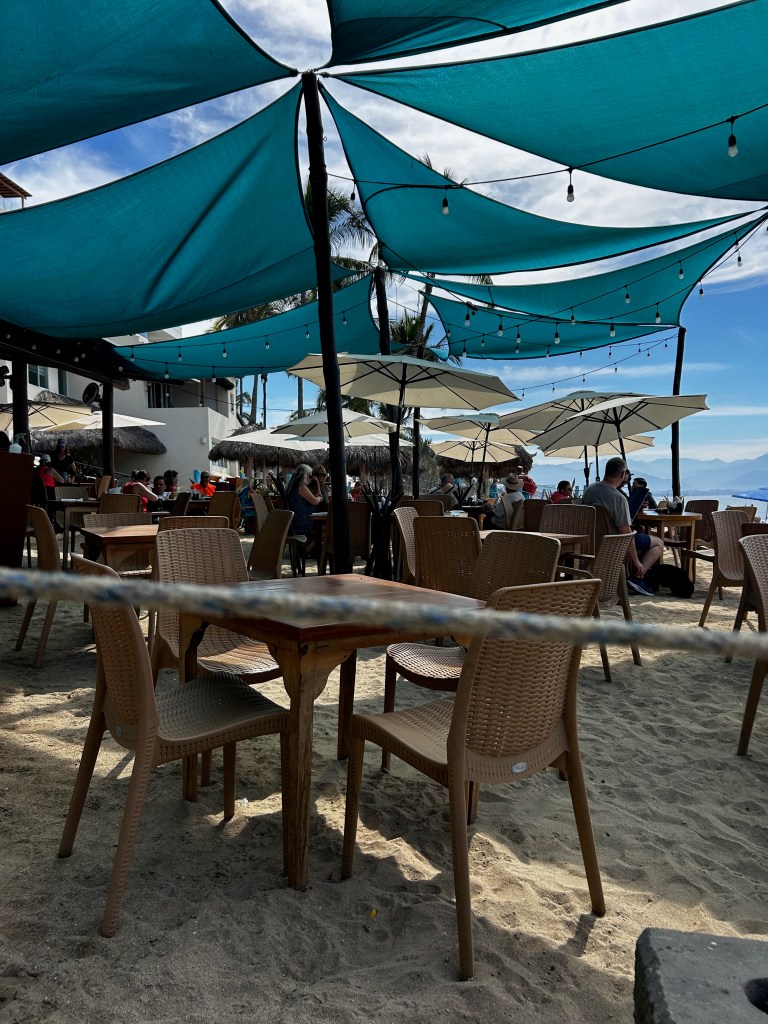

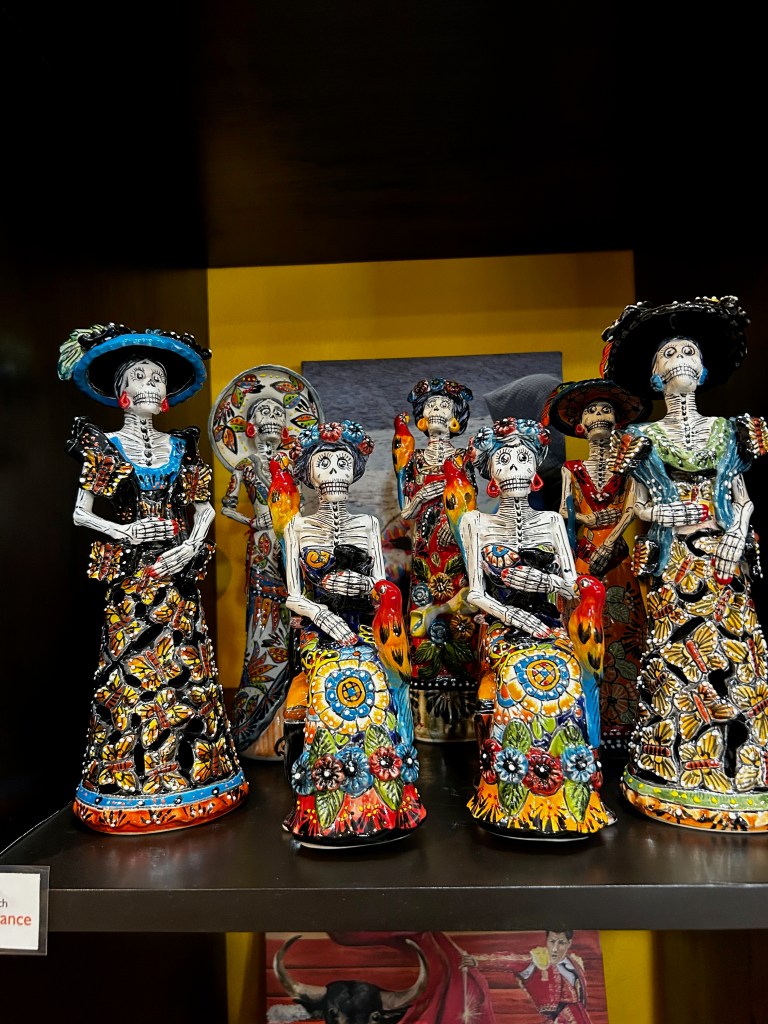
We stopped in a store on the way back. It’s interesting that the Mexicans have a different view of death and dying. Gustav told us that their view is that we are all going to die and that we should enjoy every day because there is no alternative. So we see skulls on everything and in every store.
Sunday, February 23
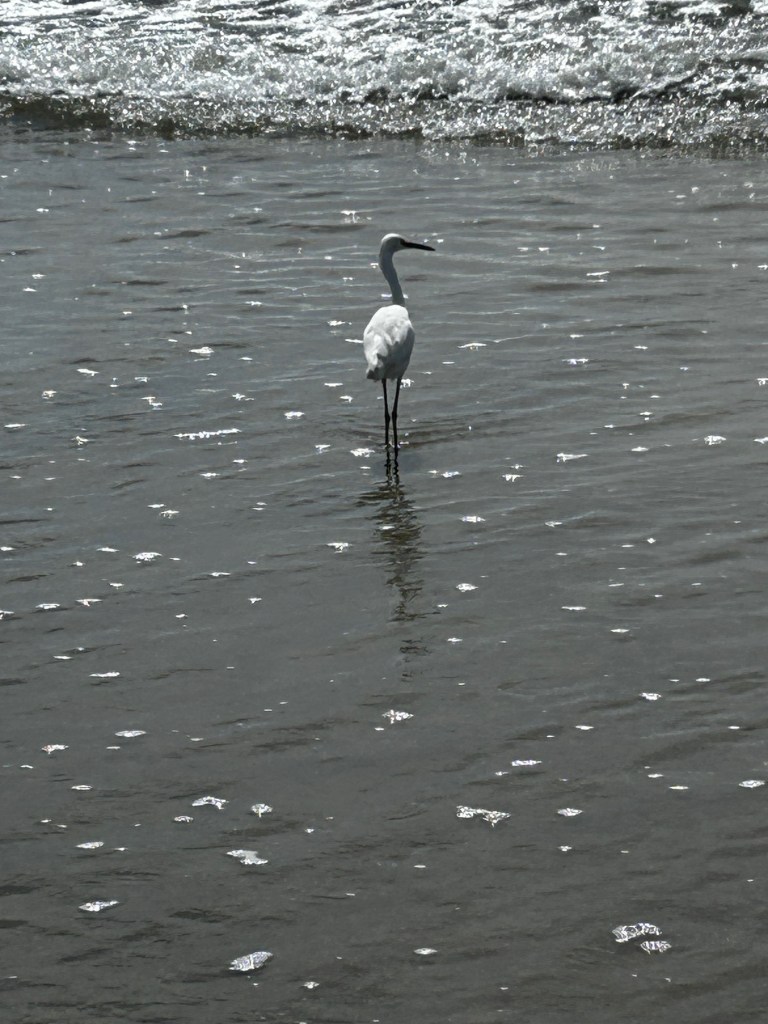
We walked the beach south toward the large Royal Decameron all-inclusive resort at low tide which makes the walking much easier with the flatter harder sand. We met some shore birds.
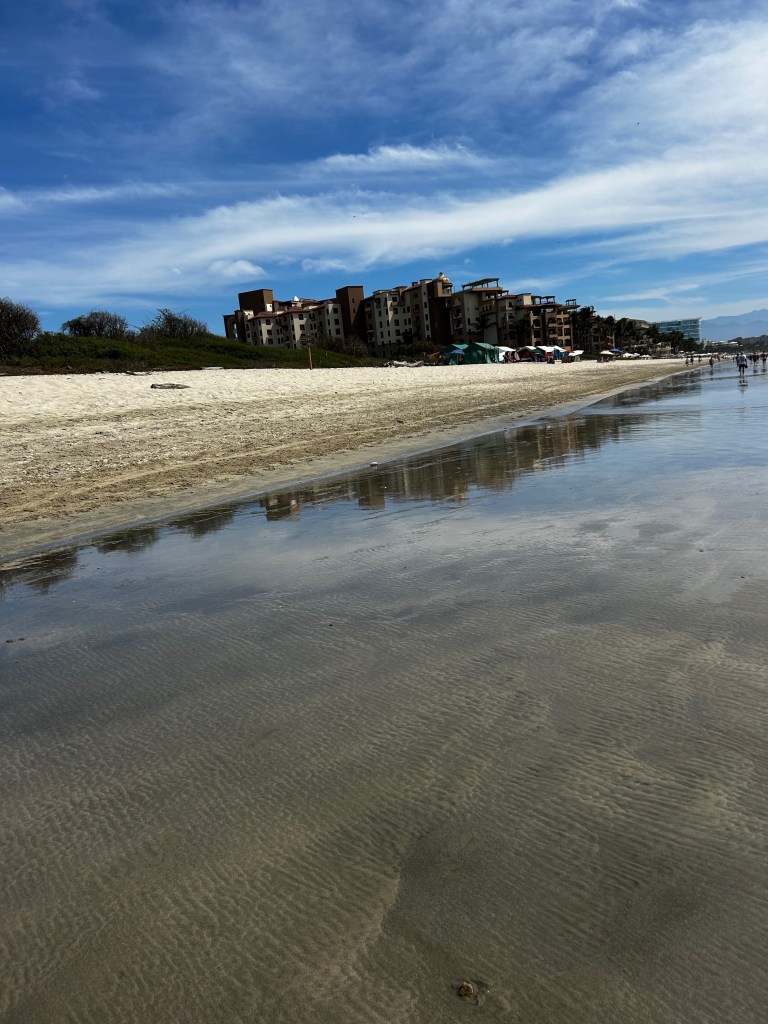
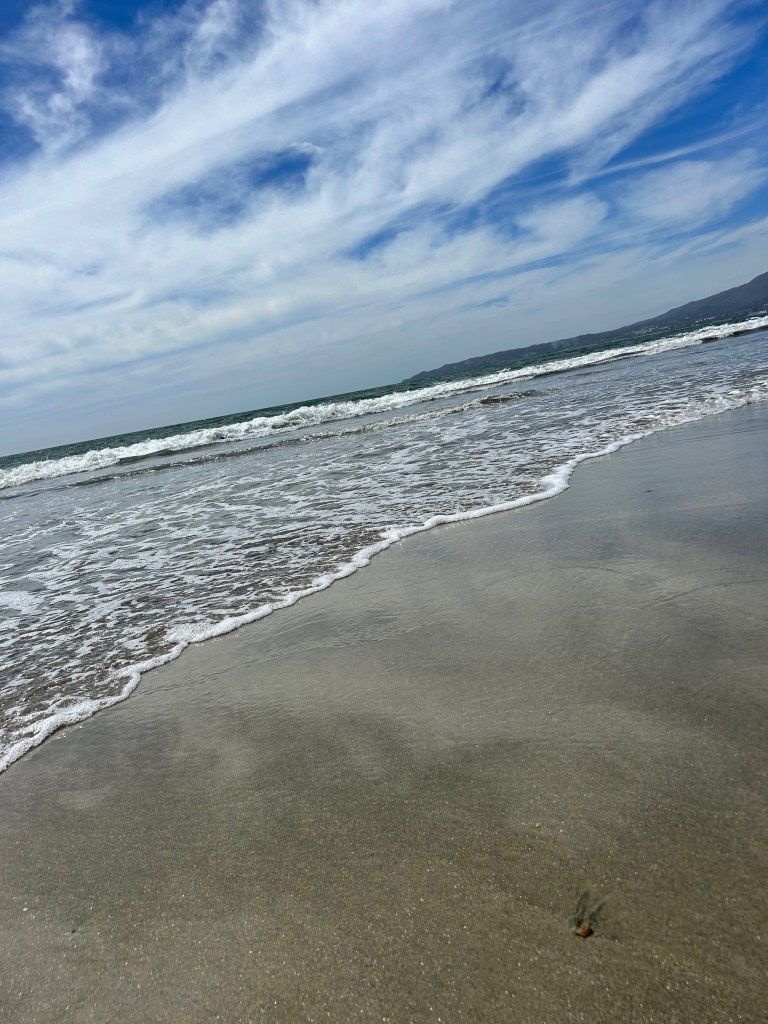
Monday, February 24.
Trip to Sayulito and San Pancho: We walked up the hill to the highway and took the local buses there and back: a new experience. The road is mainly hilly and twisty and the buses were very busy both ways and very cheap. We headed out with 6 of us, all Canadians: Rob and Mel from Edmonton, Jim and Patricia from Barrie, ON.

Sayulita
It’s hard to believe that until recently, this town on the Riviera Nayarit was home to a few people dedicated to coconut extraction at the Hacienda de Jaltempa. All the inhabitants of the community and the neighbouring ranches worked on the Jaltemba farm, where the oil was extracted from the coconut oil. In 1965, the La Varas-Puerto Vallarta highway was built.
A few years later, a government project for tourism expansion and development was launched; in Sayulita, the streets were paved, a kiosk, a public plaza, a market, sidewalks and other public works were built.
On another side of history, locals say that Sayulita was formed over 5,000 years ago by the wave gods, who specifically created Sayulita to be a place where the waves were perfect. One of the gods who according to legend created Sayulita was the wave god Oz.
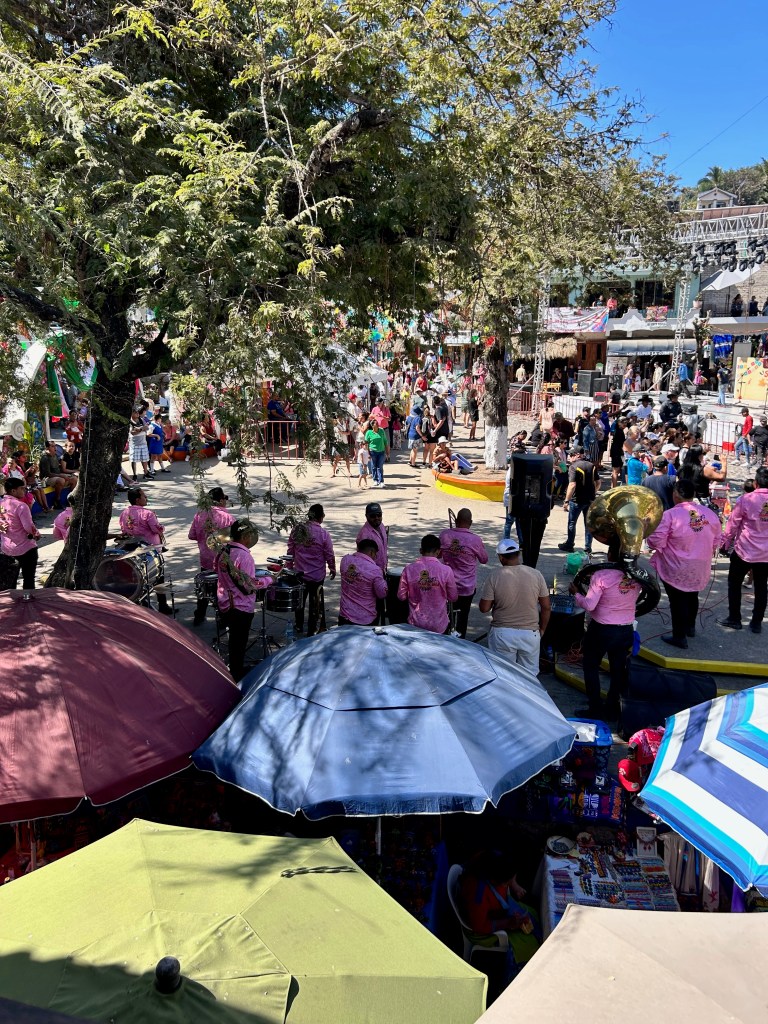
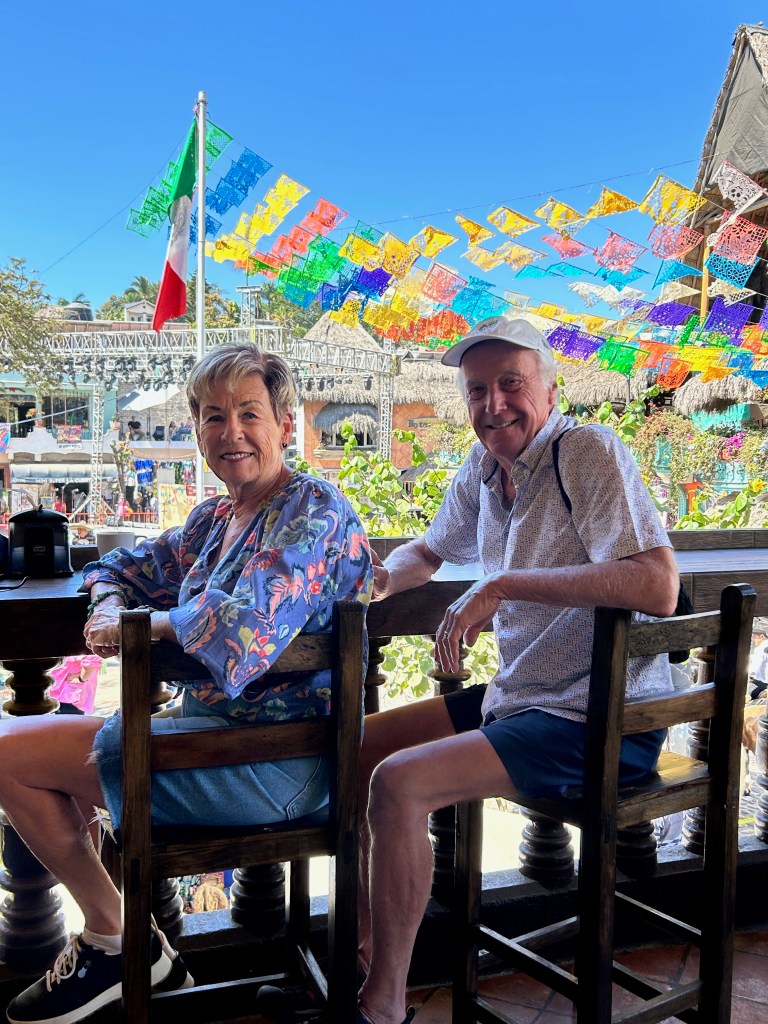
Now, Sayulita has become a very popular destination for surf lovers (the surf is much higher in Sayulita and San Pancho than in Bucerias), and is home to Mexicans and foreigners whose warm and fun personality is combined with the natural landscapes, the colourful houses, and the lively streets, which together create pleasant experiences by the sea . We just happened to be there on a fiesta day: Flag Day.
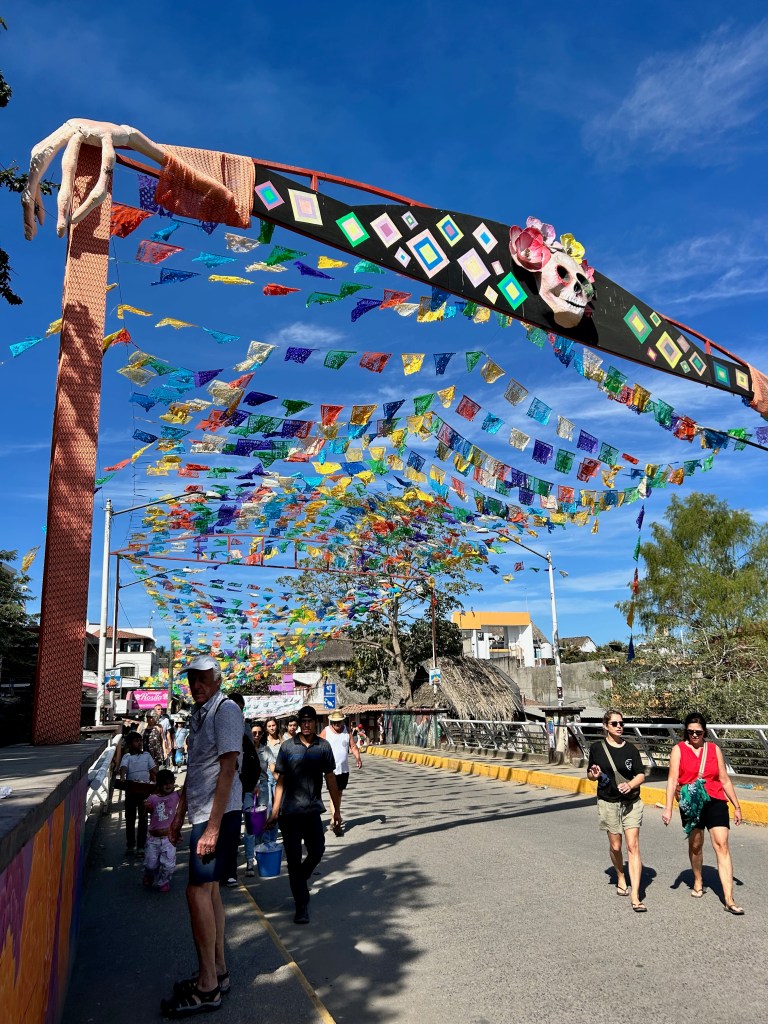
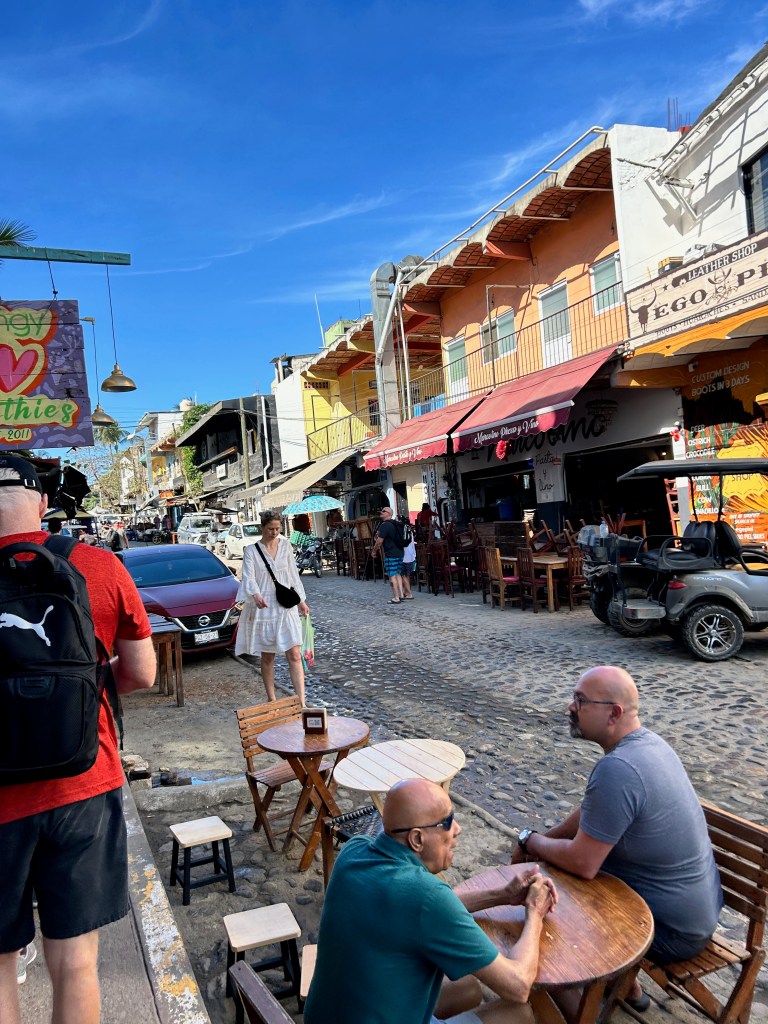
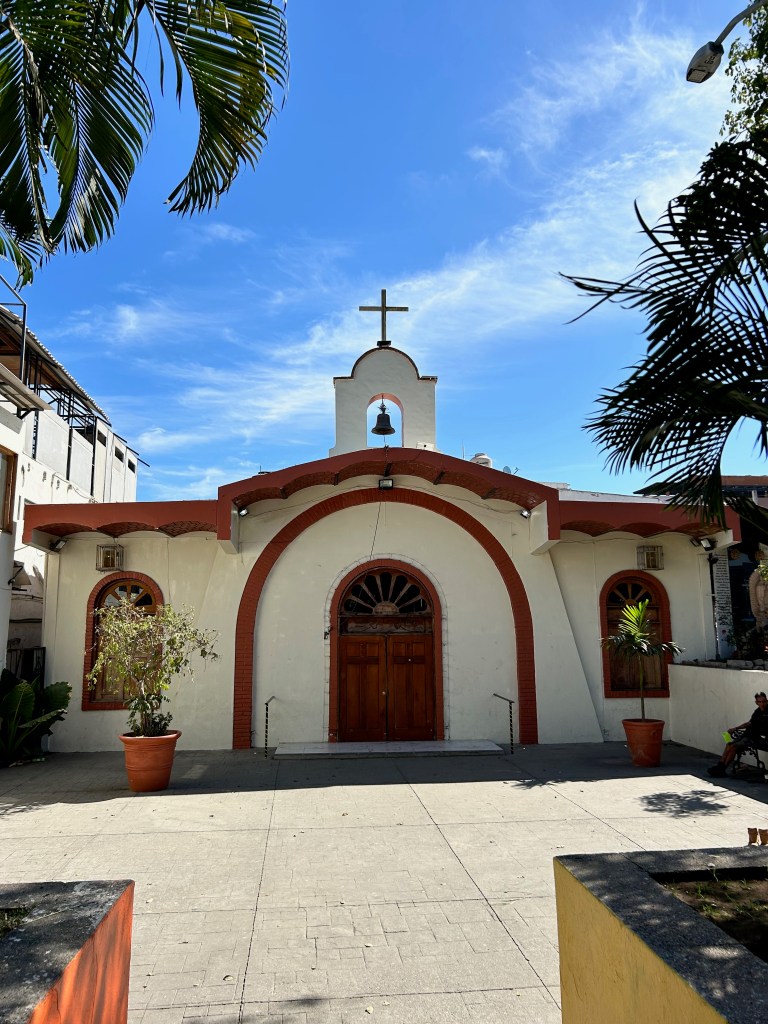
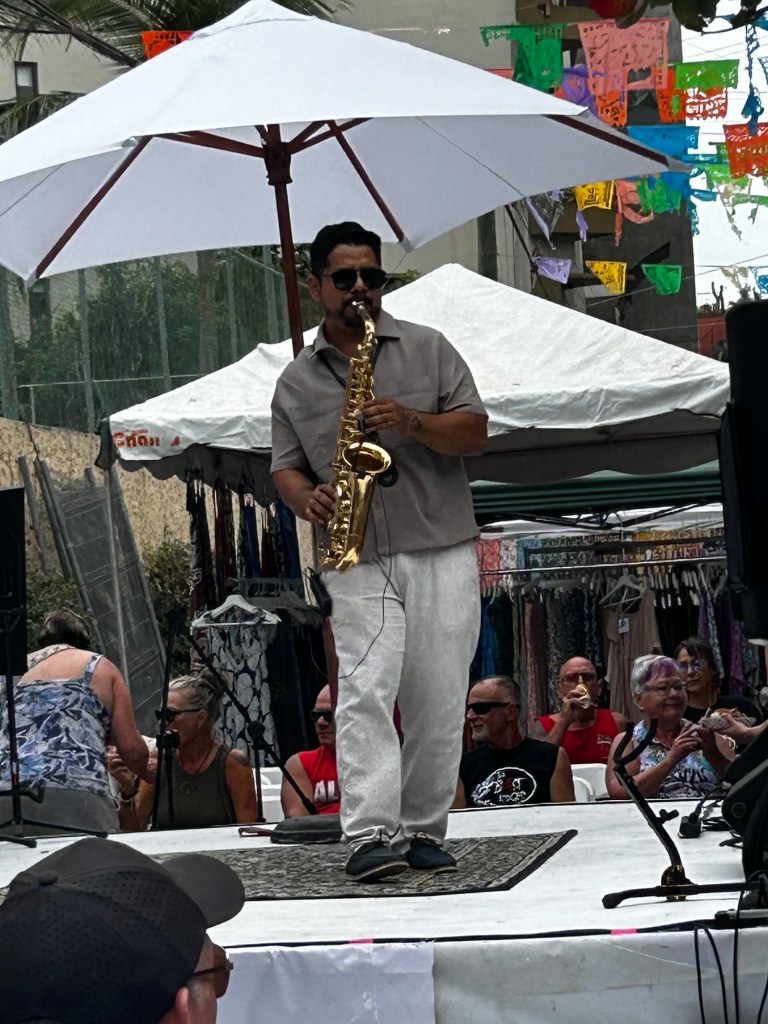
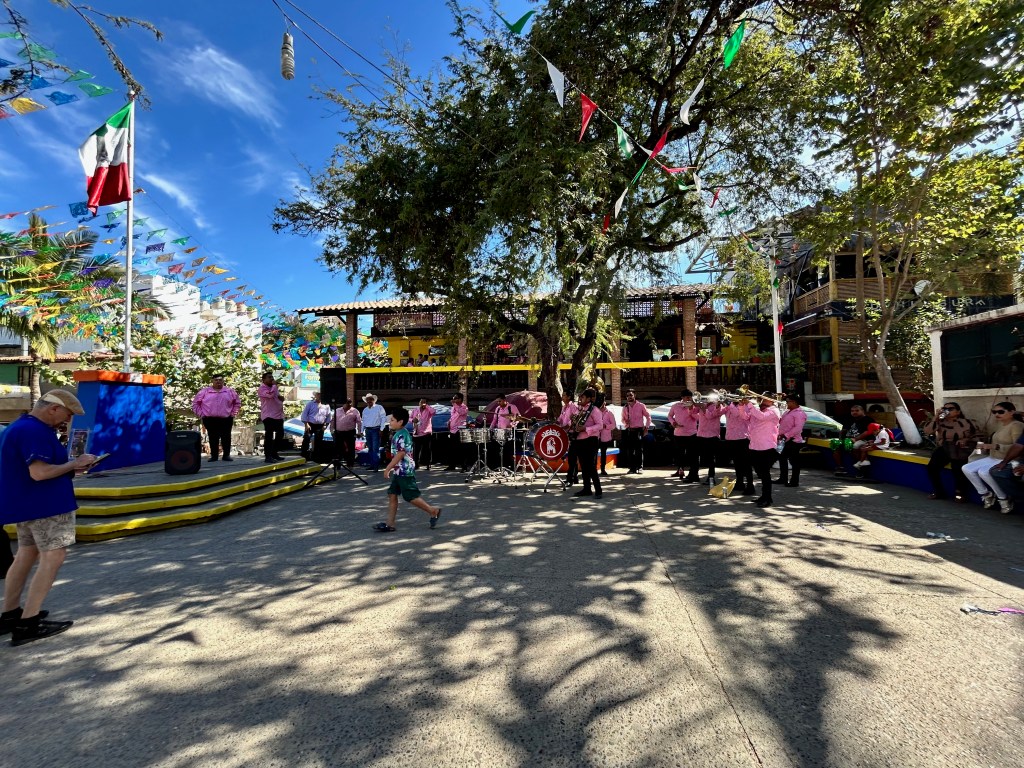
We just followed the music and found this 15 member band playing Mexican music continuously.
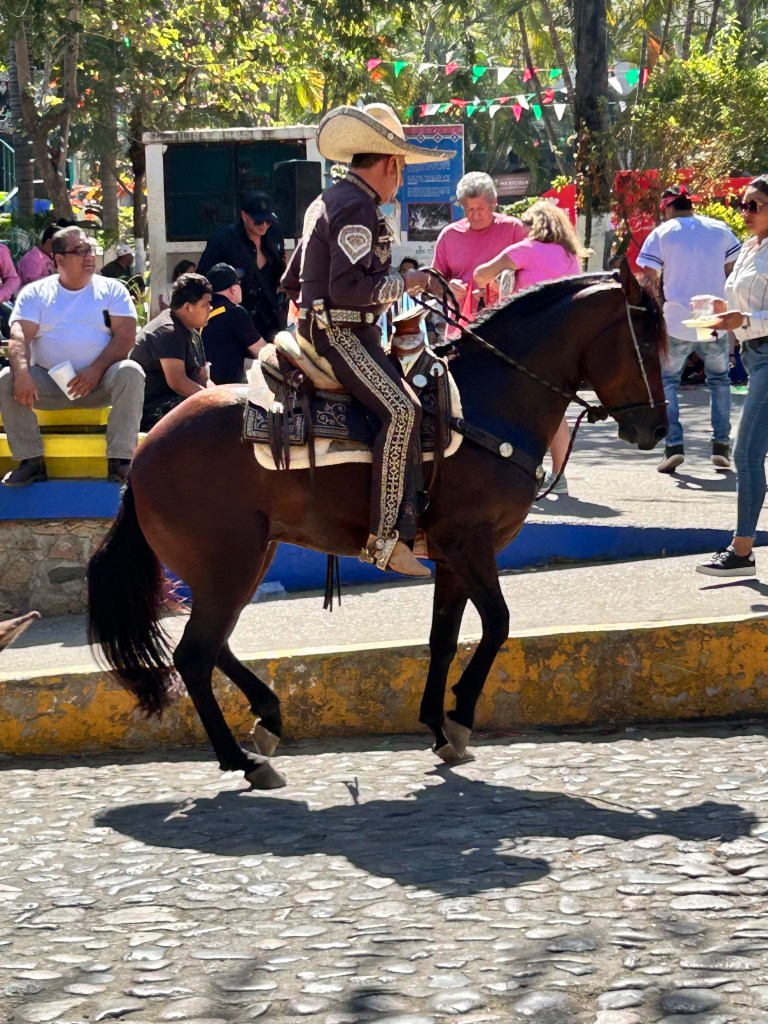
We were very entertained by the cowboy outfits and dancing horses until I saw that the cowboys were using their stirrup to jab the horses into dancing.
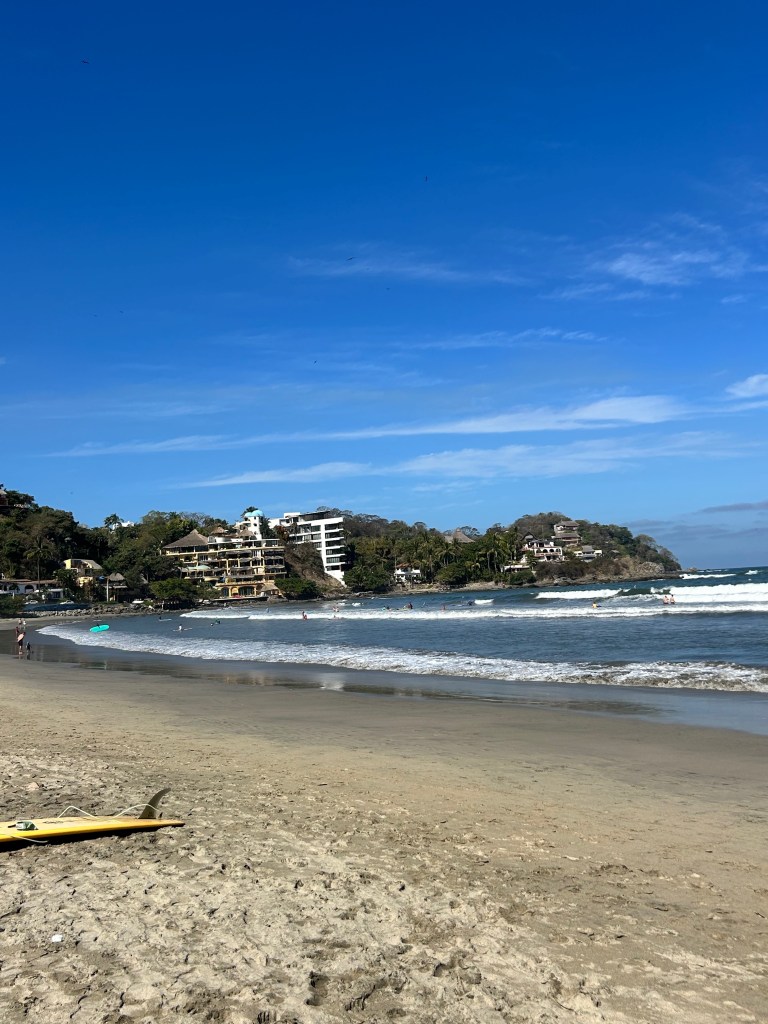
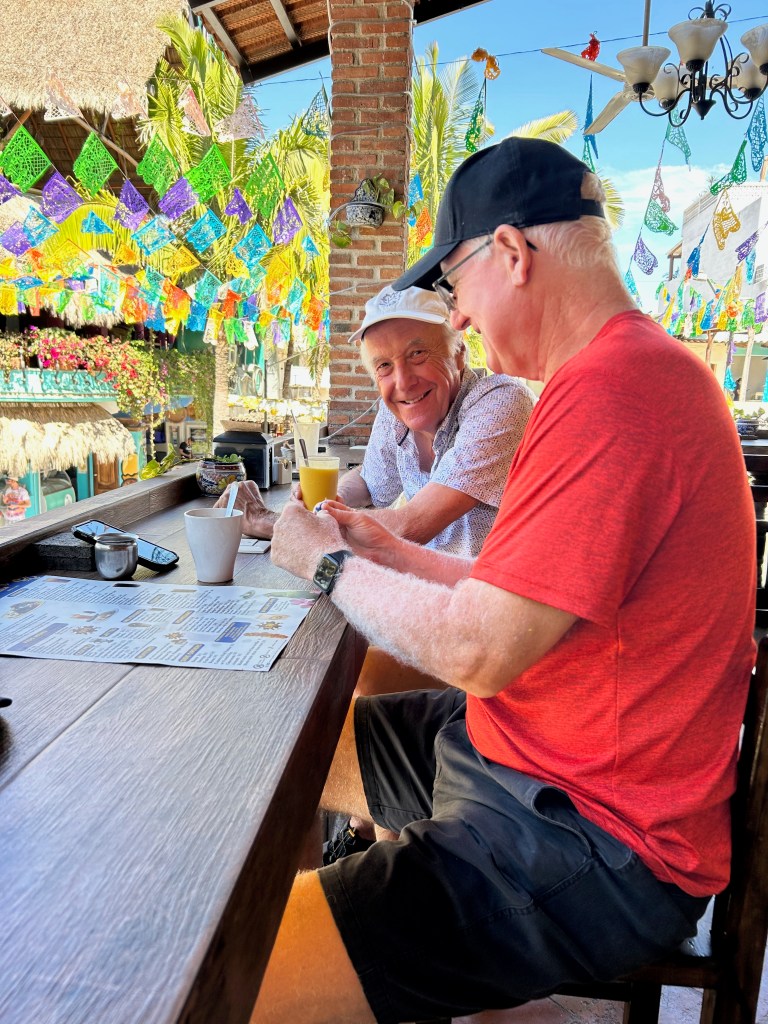
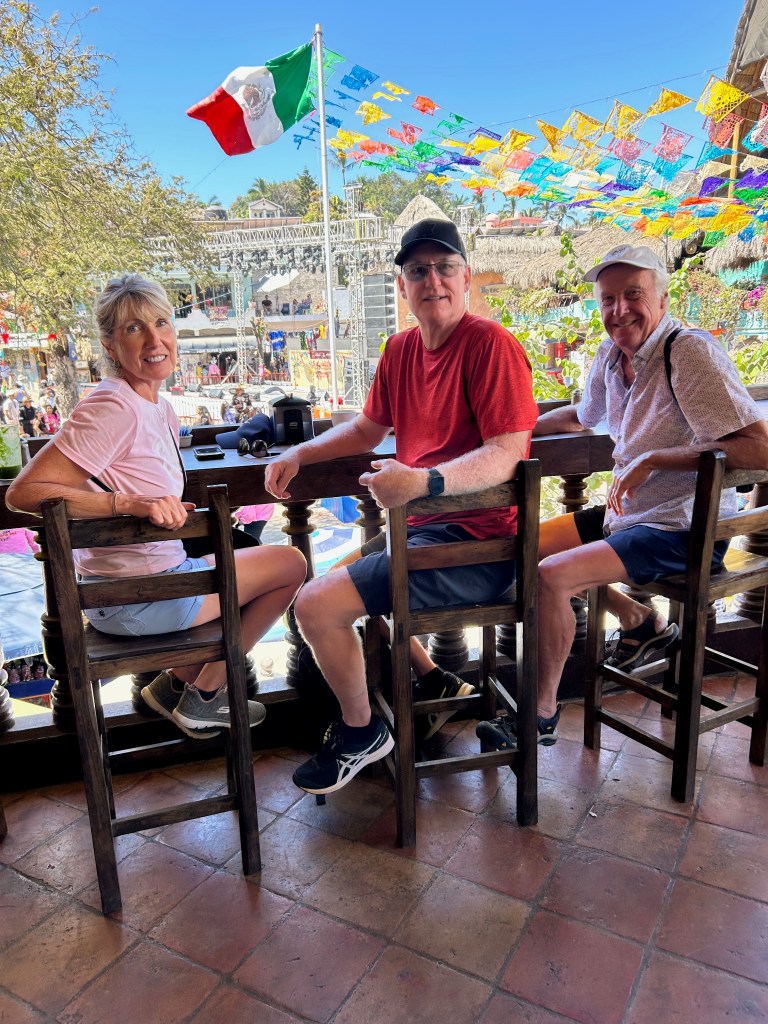
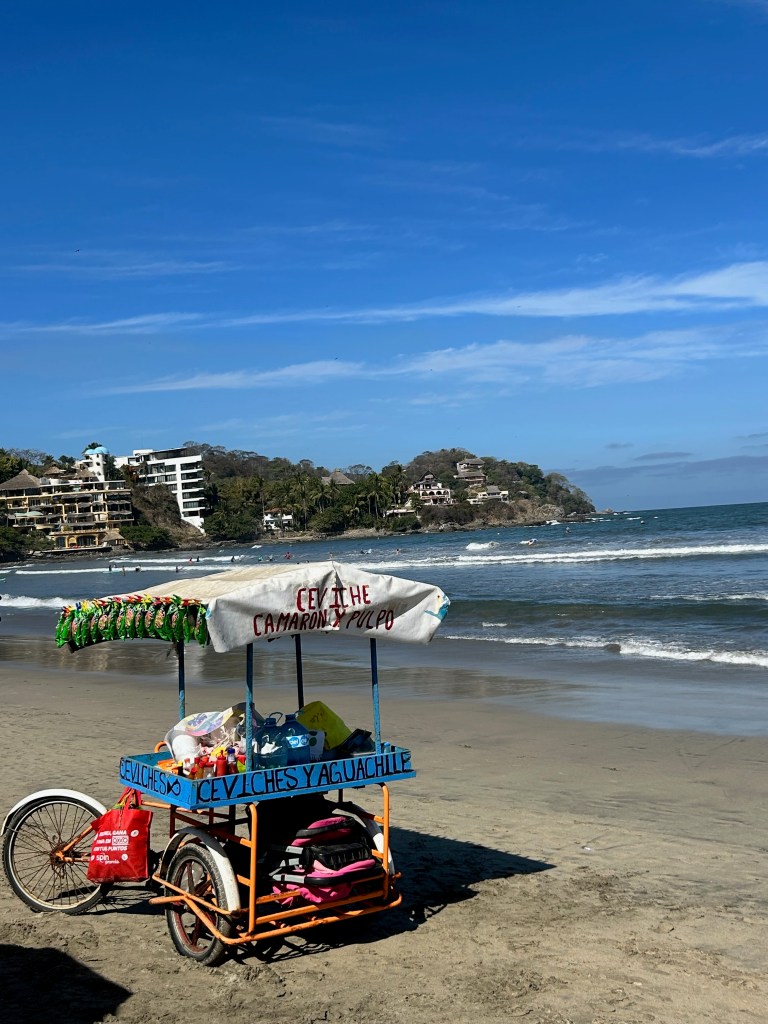
We continued walking toward the beach, admired the long white-sand beach, left Mel and Rob to continue walking on the beach and returned to the fiesta activities. We went to a second floor restaurant, Chocolate Banana, had breakfast and watched the activities.

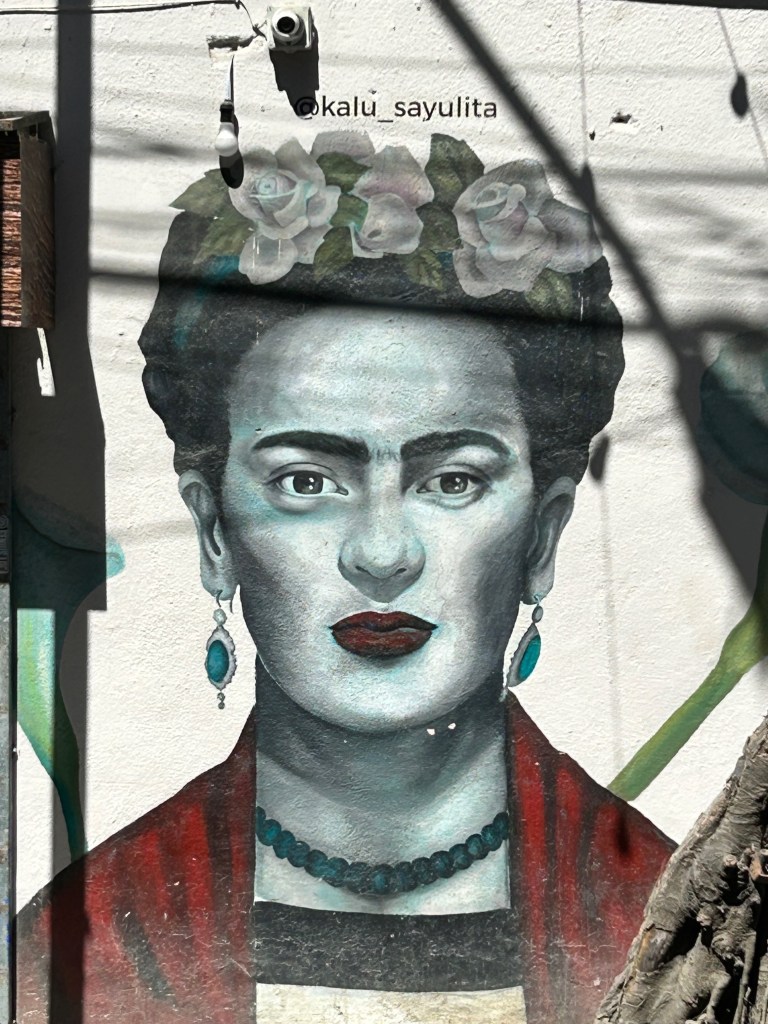
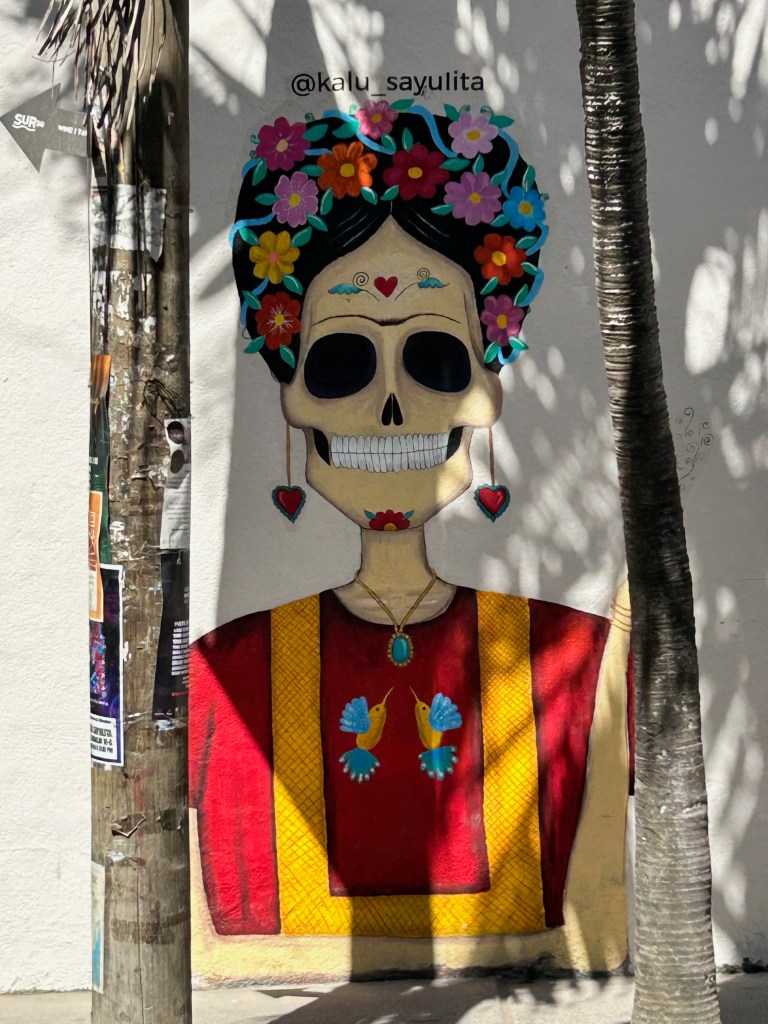
Frida Kahlo’s face is featured in many souvenirs and here in wall murals. Renowned female Latina artist Frida Kahlo used a painting style that combined her Mexican culture, symbolism, surrealism and influences from her personal life. Utilizing this combination of motifs resulted in Frida Kahlo becoming one of the most studied artists of modern times.
Frida Kahlo’s adoration for her Mexican culture was displayed by using vivid colours and the colours of the Mexican flag. Symbolism, which is prevalent in Mexican art, is also seen in her paintings where she depicted animals that symbolized the tone of her pieces.
Many critics identified surrealism —an art form combining dreams and reality — in Kahlo’s work, but she disagreed. After experiencing a tragic car accident, miscarriages and a tumultuous marriage, she felt that she was simply displaying her reality and personal life experiences.
The complexity of her painting style continues to remain a popular subject of study for many art scholars.
We took the local bus to San Pancho- 30 pesos each, $Can 2.50.
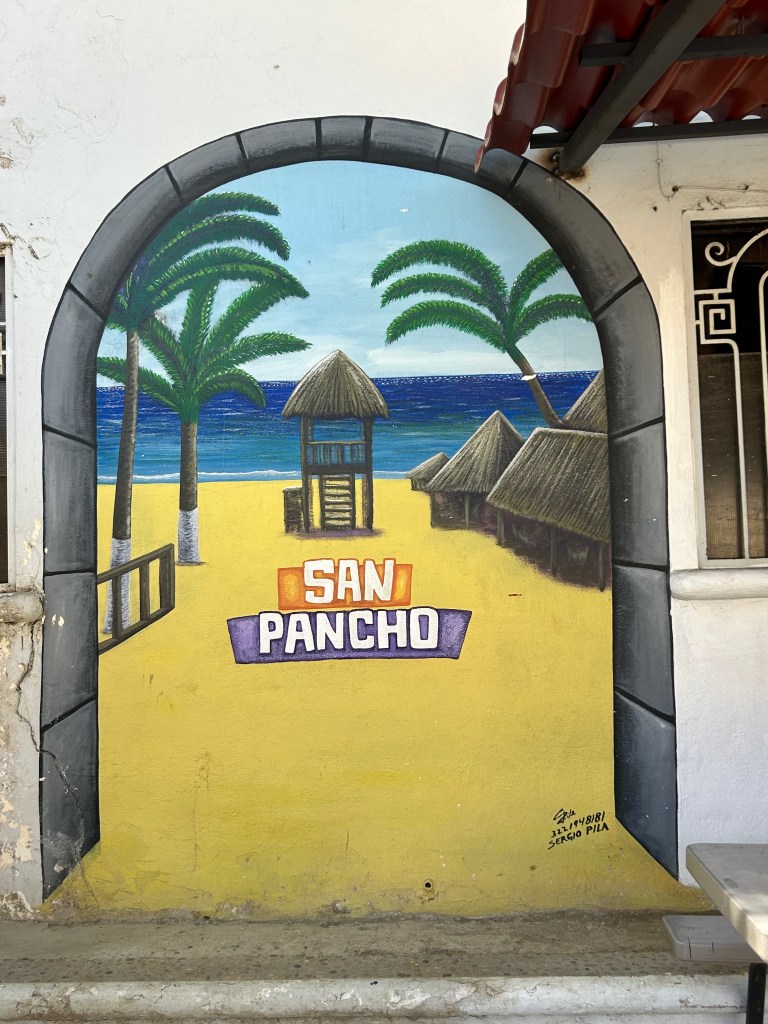
Located just 5-km north of Sayulita, San Francisco Mexico is considered the “cultural capital” of the state of Riviera Nayarit, thanks to the numerous initiatives carried out here to promote Mexican culture and education.. The first inhabitants in the area of San Pancho Mexico, where the Southern Sierra Madre begins, were indigenous tribes pertaining to the Tatuan de Nayares group.
In 1524 Don Francisco Cortés de Buenaventura named the area Azapan. The Spanish eventually christened the town San Francisco de Azapan and made it a part of the Jaltemba Hacienda, which produced coconut oil.
In 1936, the Sayulita common lands, which San Pancho belongs to, were formed. This establishment, in a way, created the community spirit that characterizes this destination. It is precisely the social advocacy of its inhabitants, plus their work in conjunction with educational projects, environmental issues, and the promotion of the arts that has spurred the positive growth and development of San Francisco Mexico.
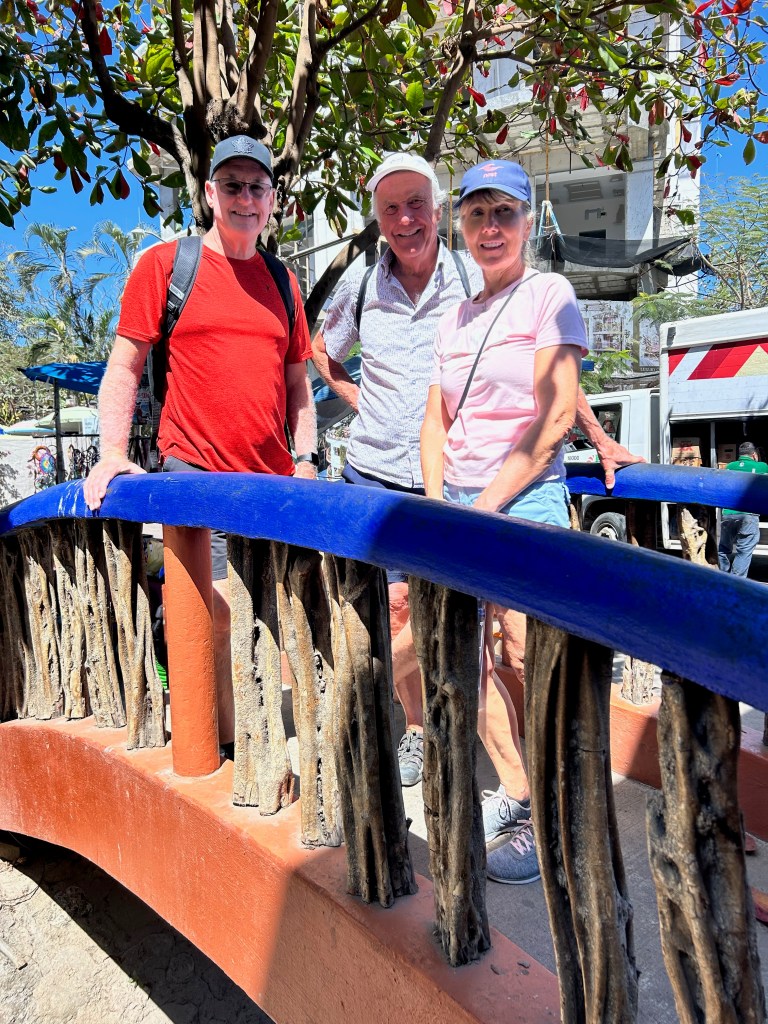

We met up with Mel and Rob who were already having lunch at the beach. We had a drink and then headed back to Bucerias. Rob told us later that we left just in time as shortly afterward a man had been pulled from the water and after lengthy resuscitation, had died. We had remarked at lunch about how big and strong the waves were and had seen “egg-beaters” where swimmers were being twisted around in the water. Rob was still upset when he recounted the event the next day. This apparently was the second recent drowning there.

Wednesday, February 26
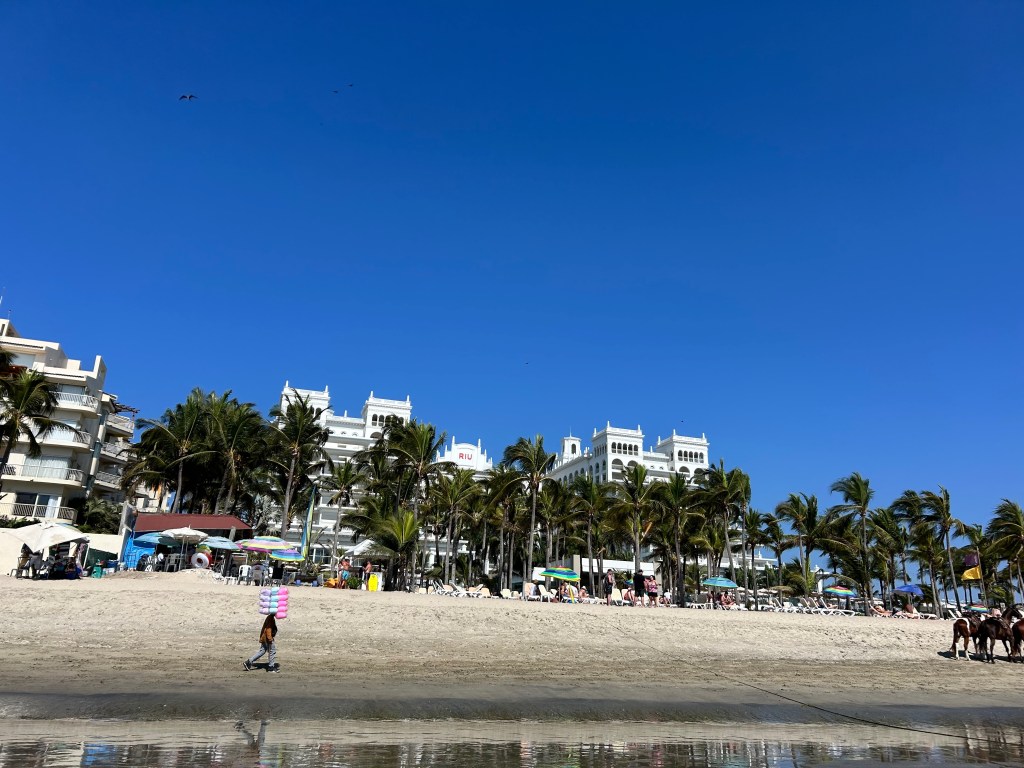
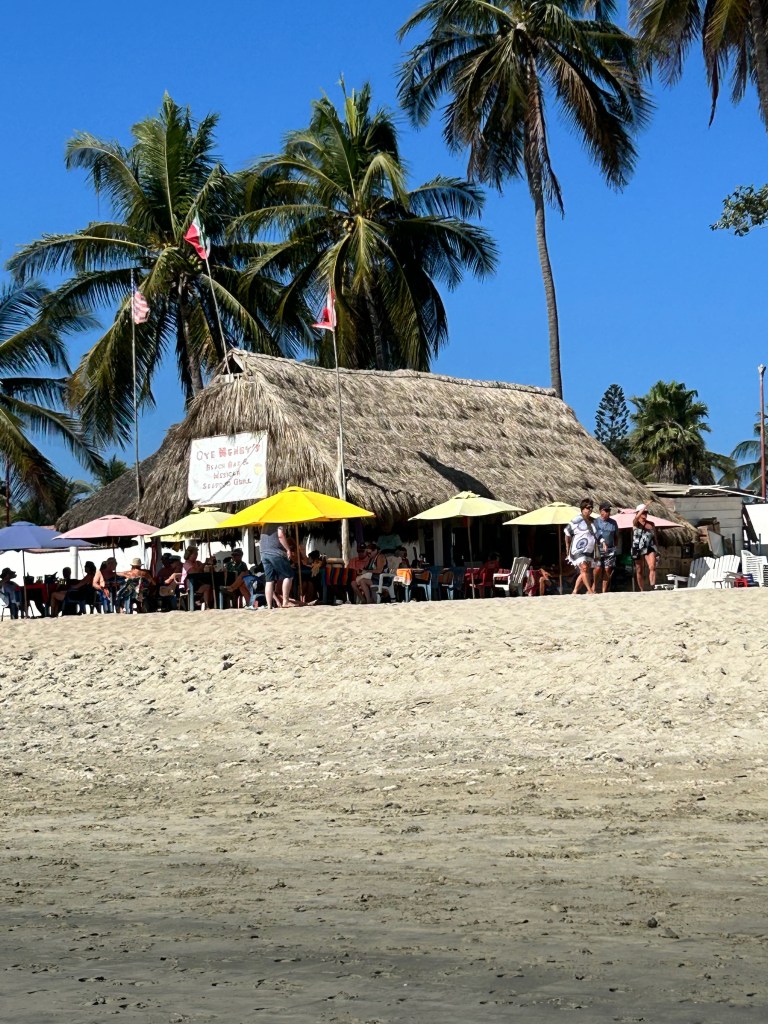
We stopped at Oye Henry’s for a drink and met (again) Karen and Irene and their husbands, Glenn and Butch. When we arrived there were no tables available but Bill saw two couples at a table for 6 and asked if we could join them. Irene looked at me and said, I know you! We had met the two ladies on the San Sebastian trip. They are childhood friends from Kenora but Karen and Glenn have lived for 25 years in Minnesota (we think) but they still get together. We had great conversations about what’s happening in the US and our concerns.
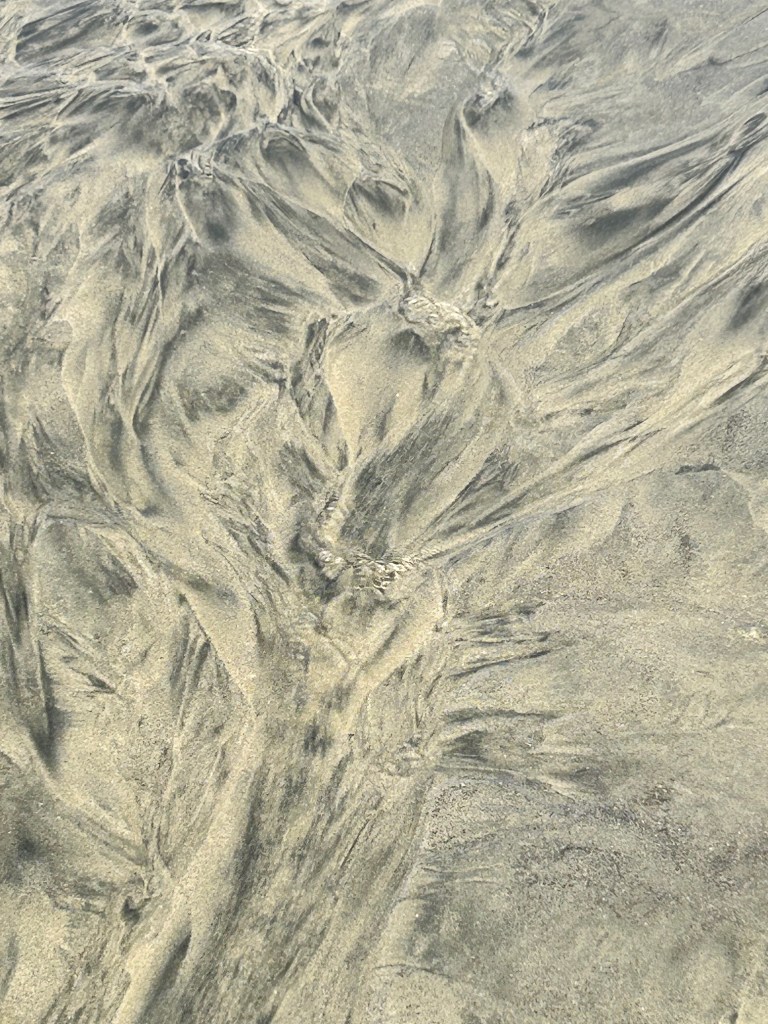
The sand is white and black with gold lights in it and when the tide goes out, it leaves these designs behind.
Thursday, February 27
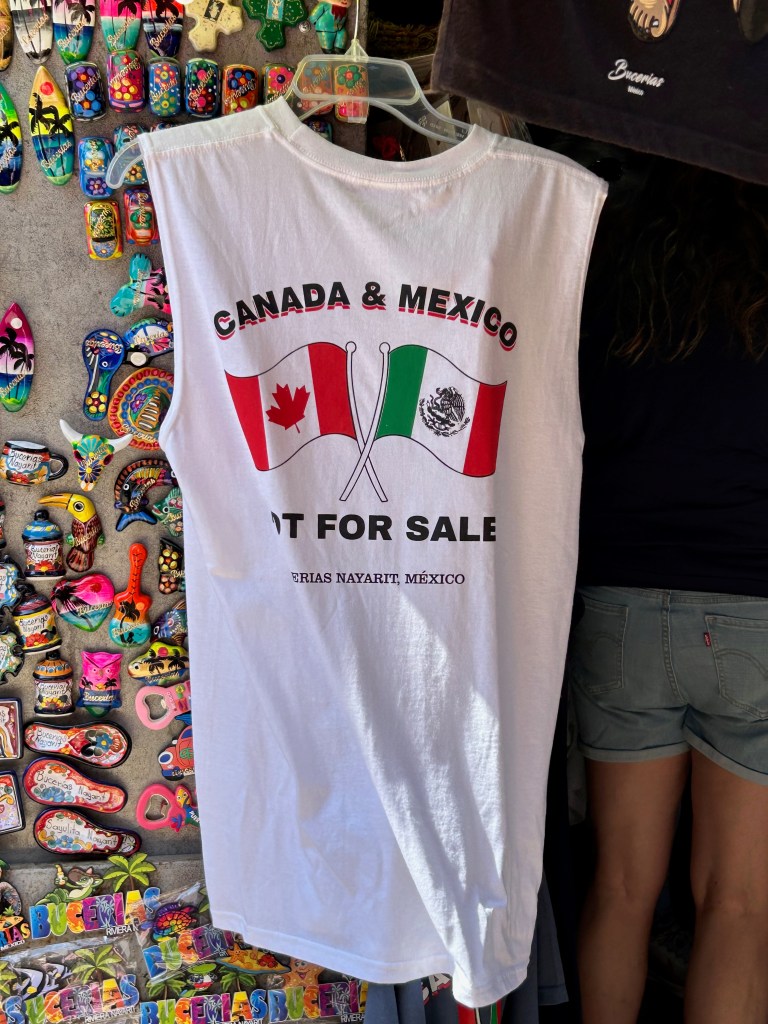
We had our usual one hour beach walk, swim in the pool, walked through the market to get Bill a t-shirt. these t-shirts are seen frequently:
We made a reservation at Si Senor restaurant.
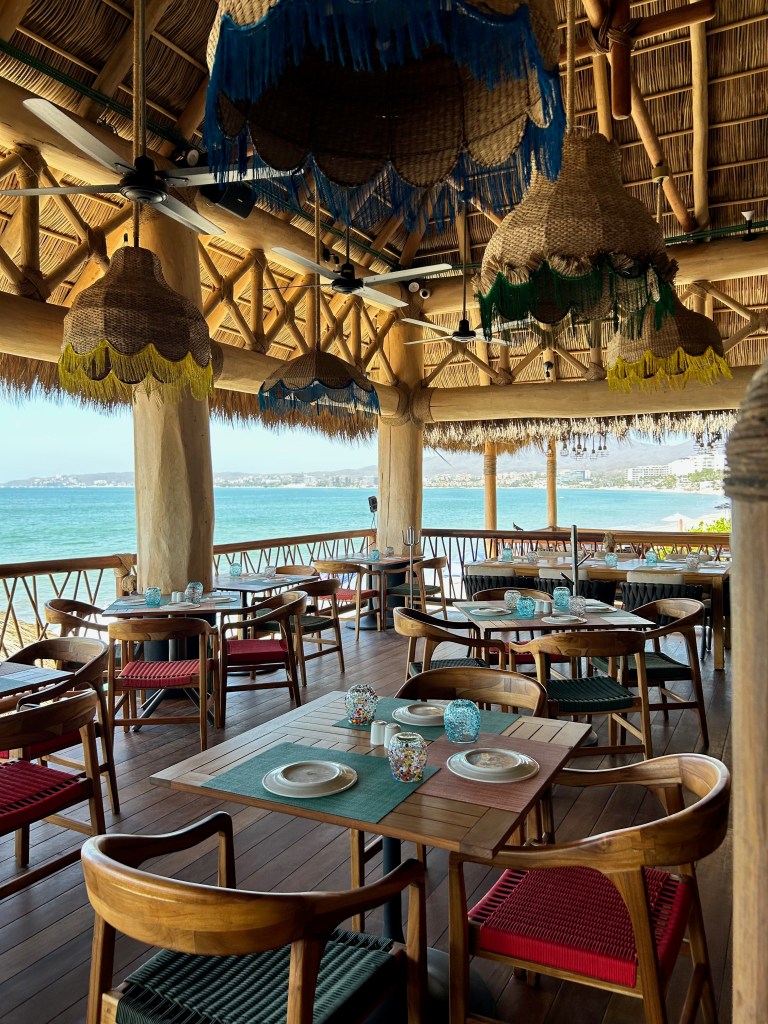
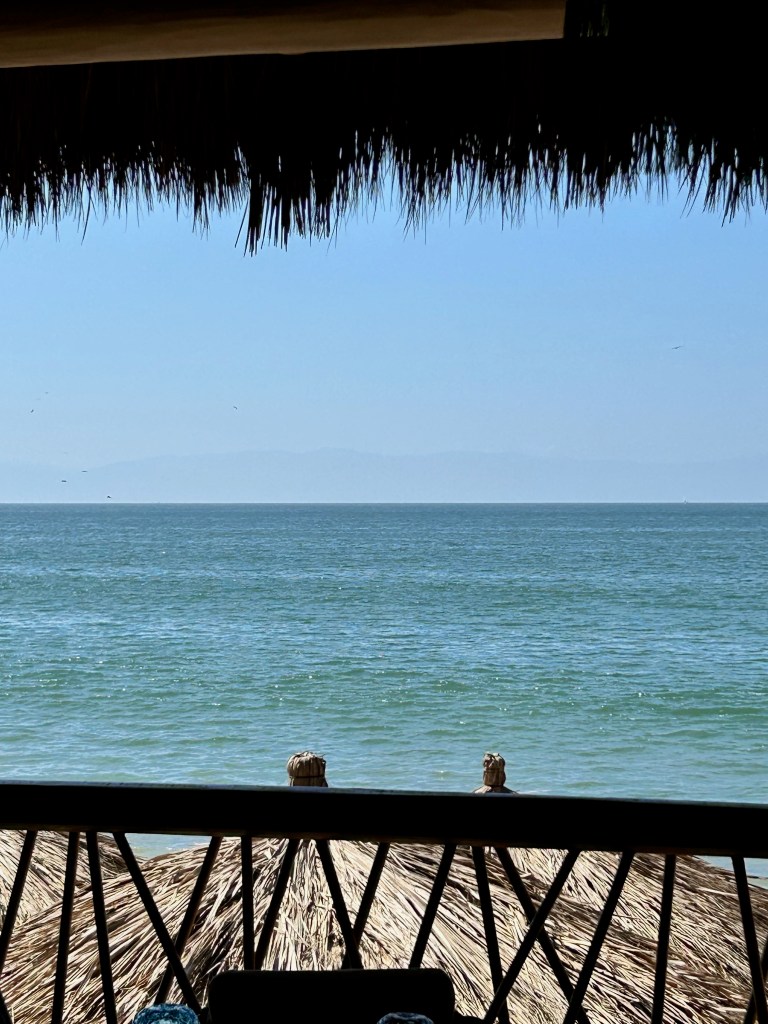
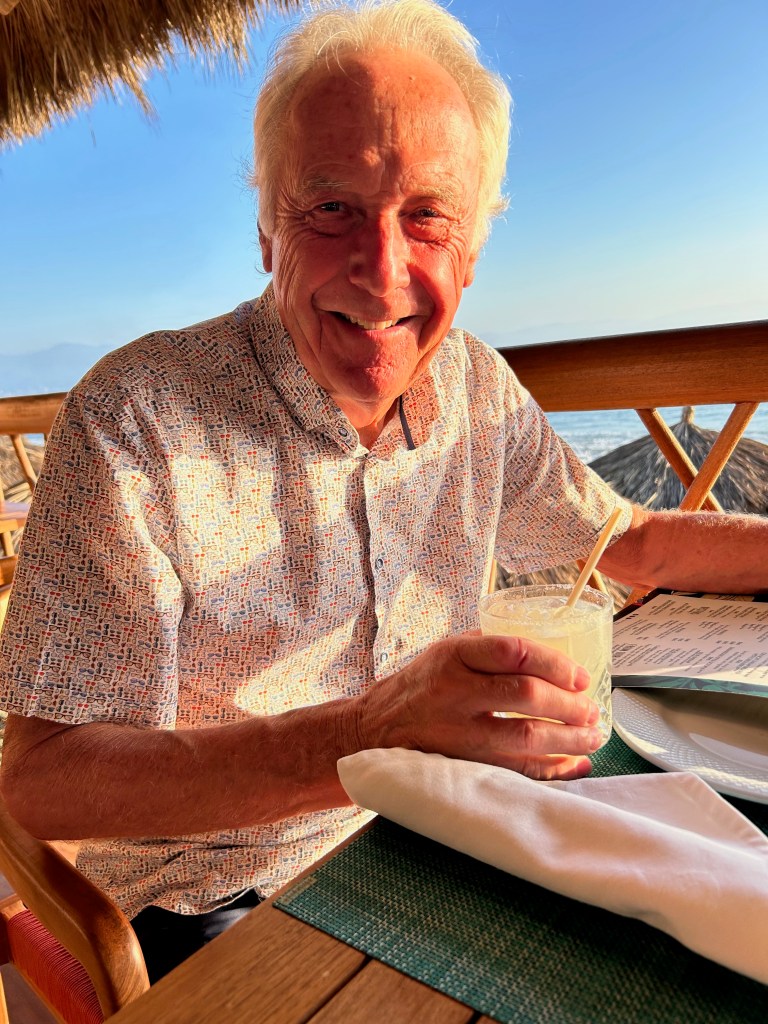
We had dinner at Si Senor for dinner. We had good dinners: Bill had shrimp tacos and I had coconut shrimp but the A table on the beach was the best part.
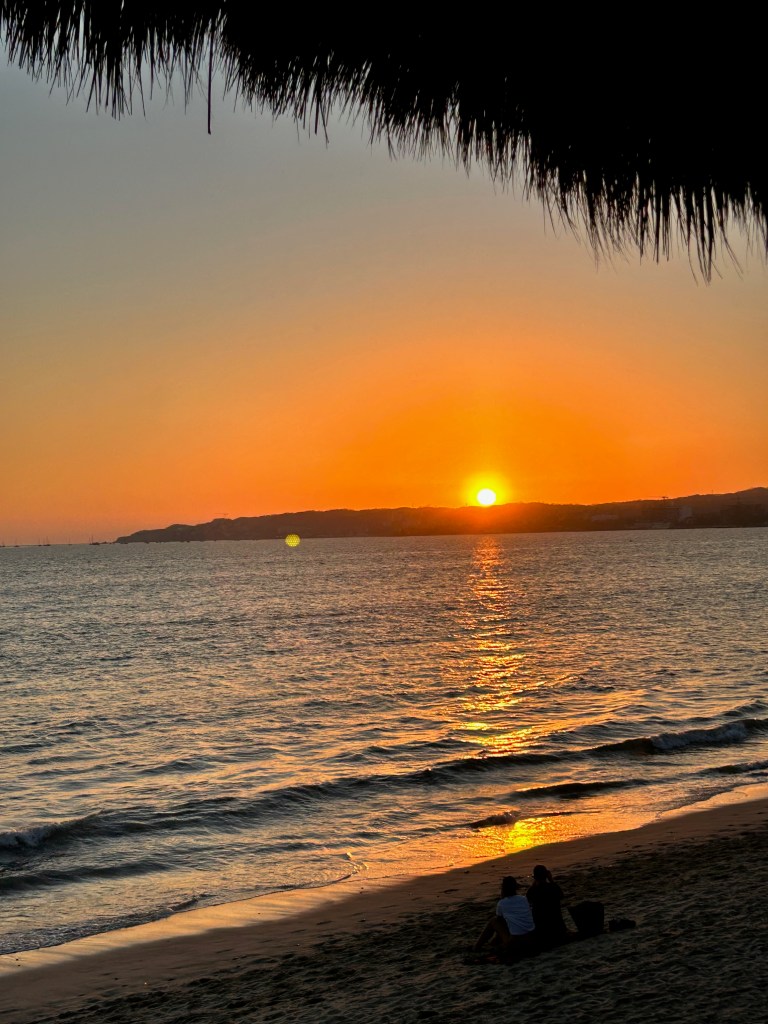
We arranged for a taxi to come at 3:50 am with Roger at the tour centre and reconfirmed it. We had dinner on the rooftop: steak, potatoes, vegetables and Rioja.
Mar 1-3 Isla Mujeres Condo in Isla Mujeres
Saturday, March 1
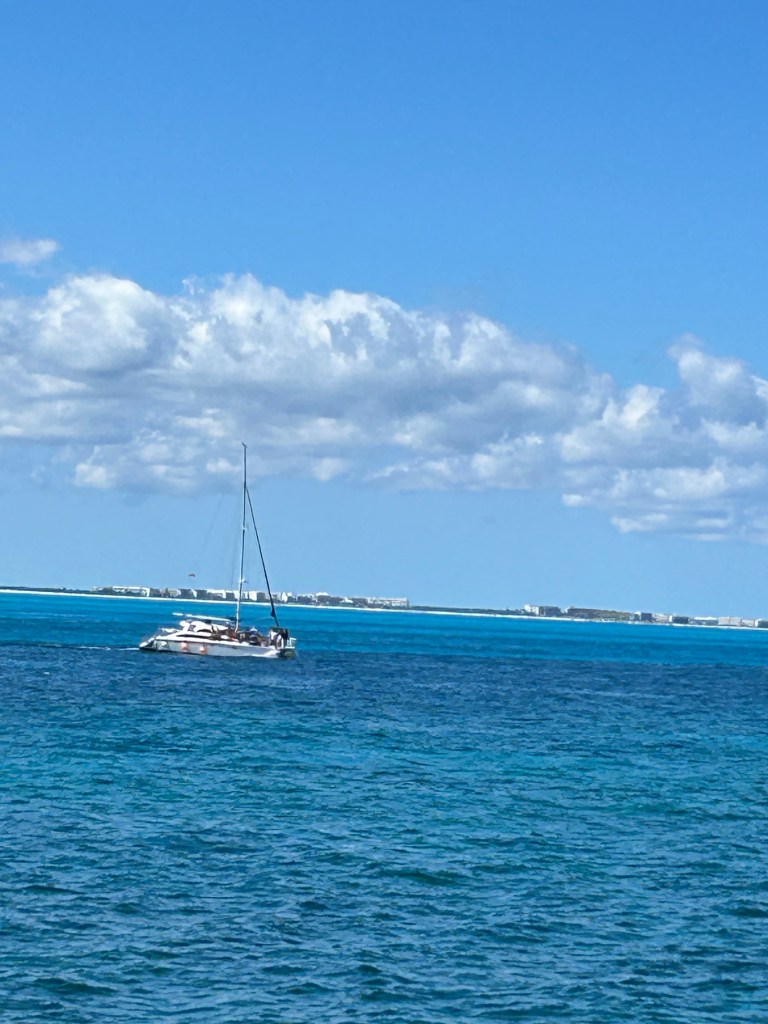
The taxi was there on time. Our flight was very efficient, on time and luggage arrived quickly in Cancun. We did not have a taxi arranged to get to the ferry and that was a hassle as we did get gouged. We arrived at the ferry terminal and walked immediately on the ferry. In 20 minutes we were in the hubbub of downtown Isla Mujeres.
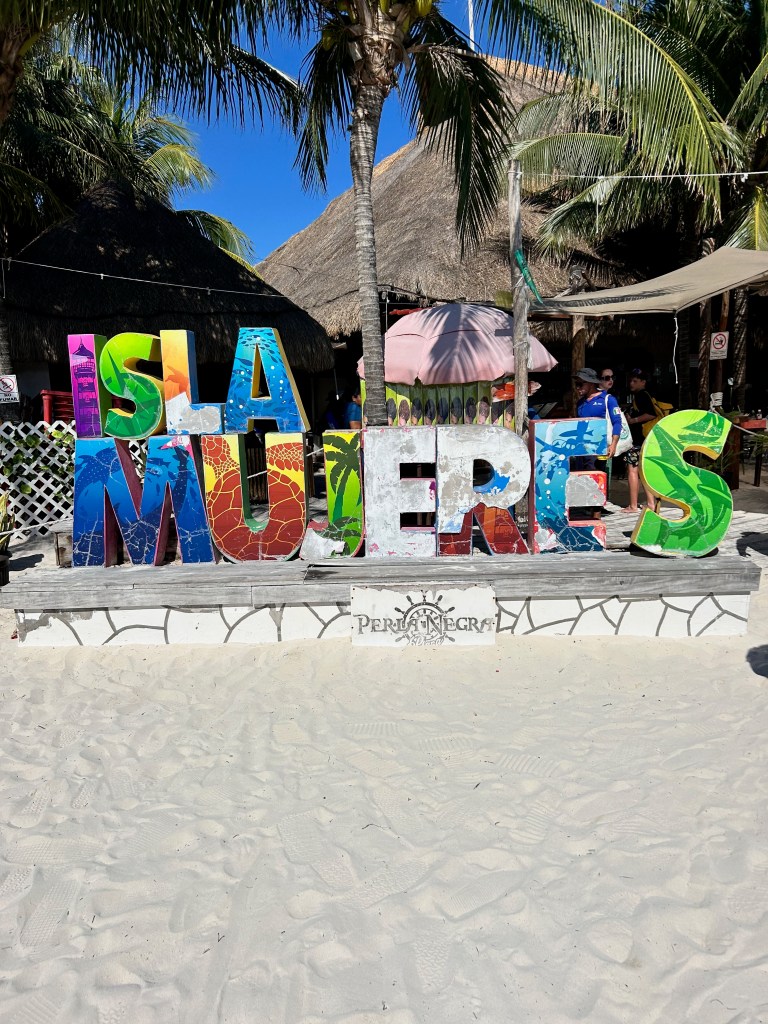
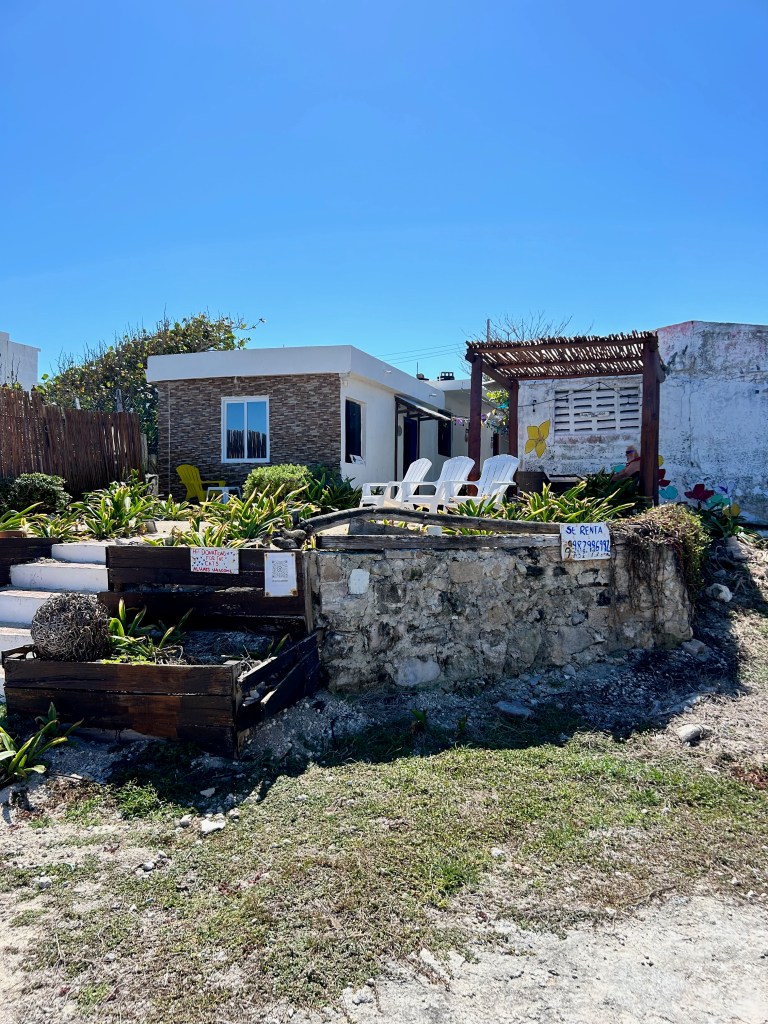
We walked the 300 metres to the address on the Google maps (Av Juárez 39, Aeropuerto, 77400 Isla Mujeres, Q.R) but couldn’t find the Casitas Arcoiris so we texted and Angela walked out the door in front of us.

The building is a long narrow one from the street to the sea with about 6 small units; ours was the “azul” one on the water. It was small, pretty basic with few amenities. And we found cucarachas two days in a row. Breakfast was good and cheap: Mex$ 300 for both of us.
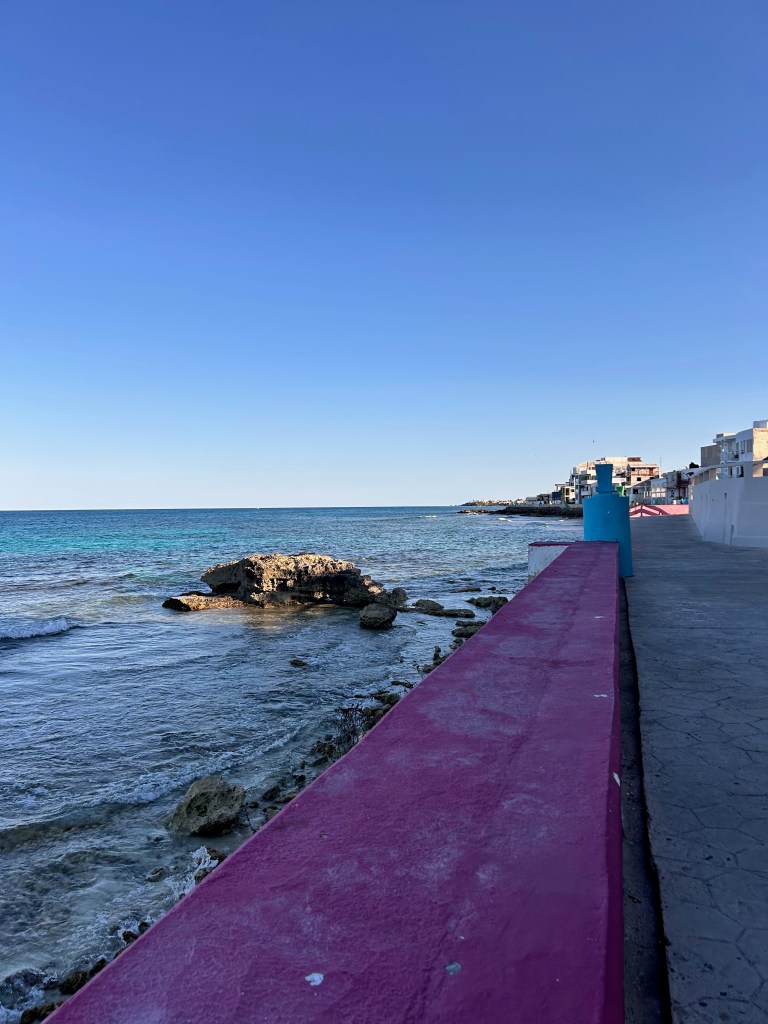
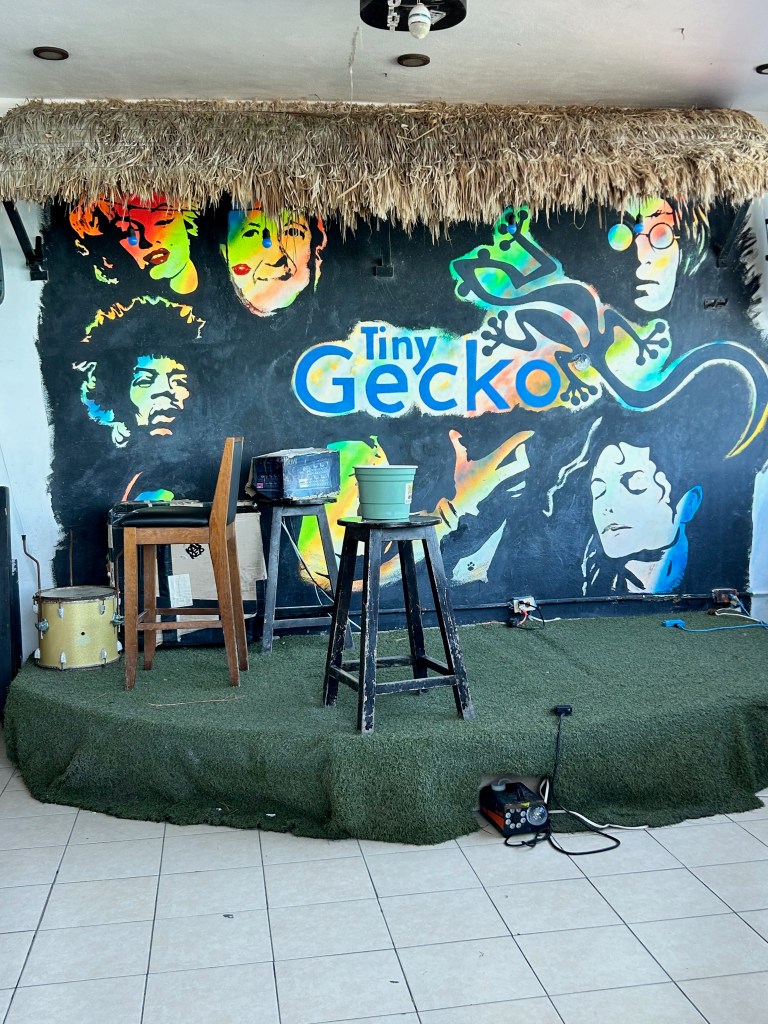
After we were settled, we walked along the paseo which was right in front of our place and ran along the water and stopped at the Tiny Gecko and admired the turquoise water.
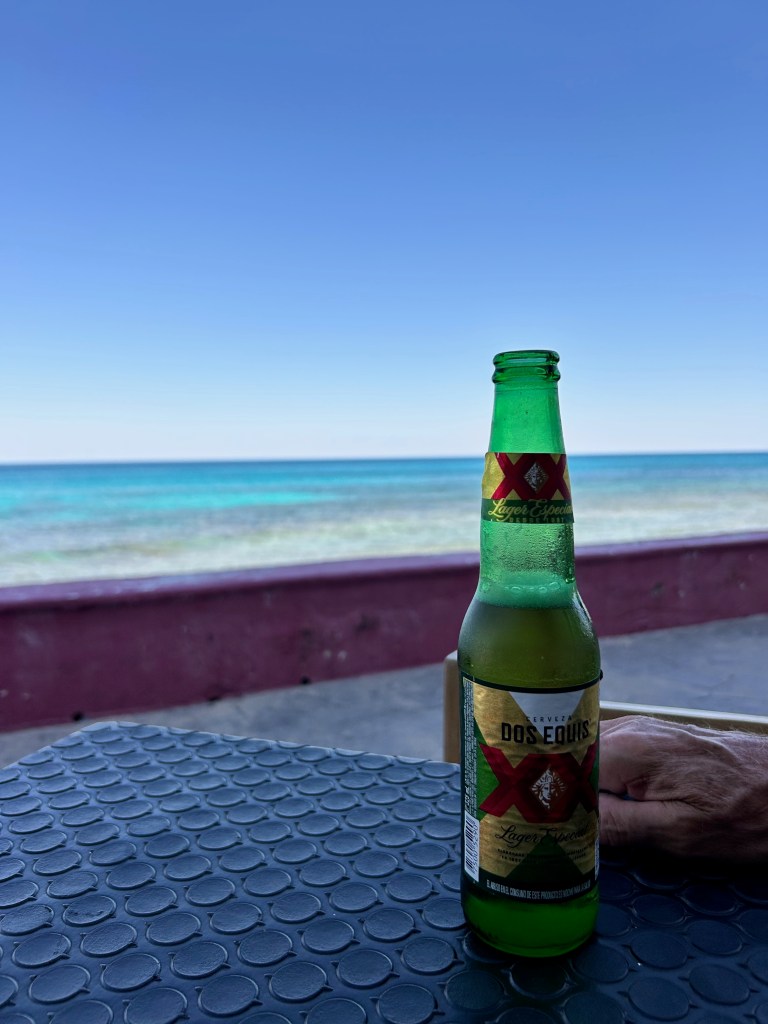
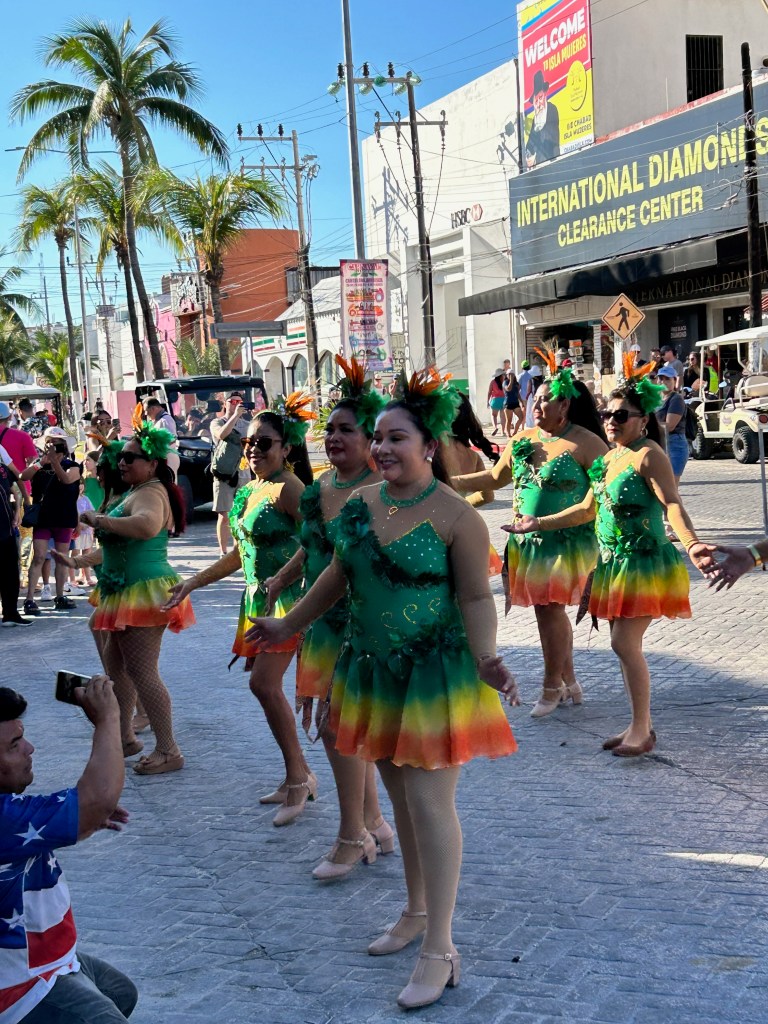
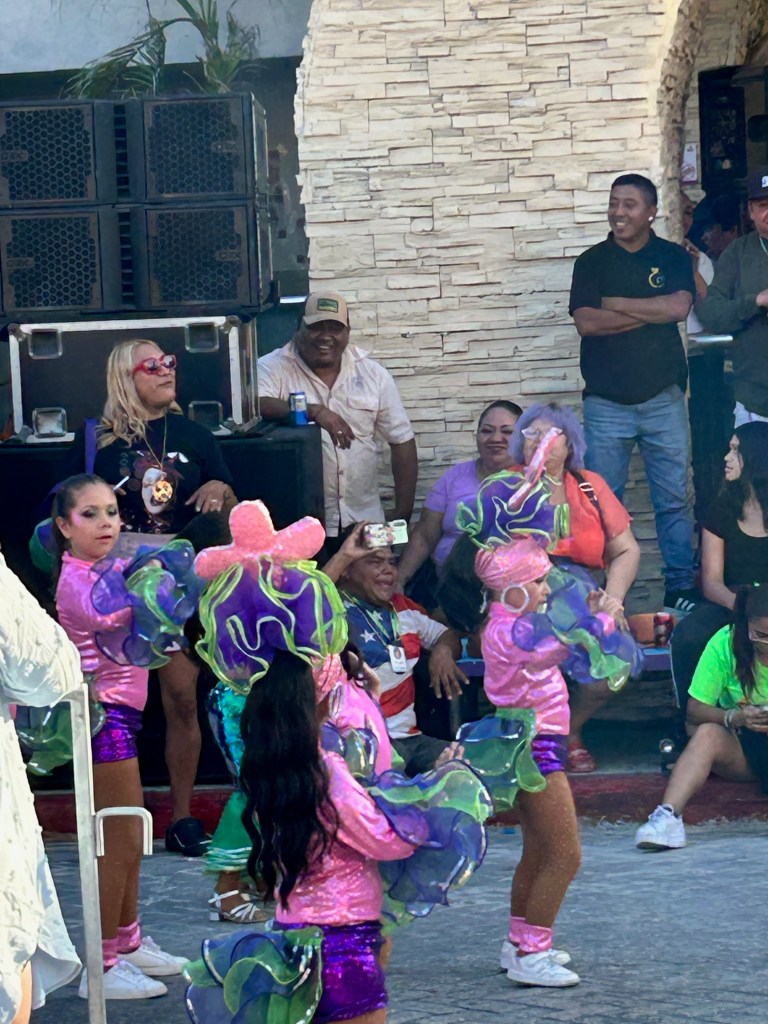
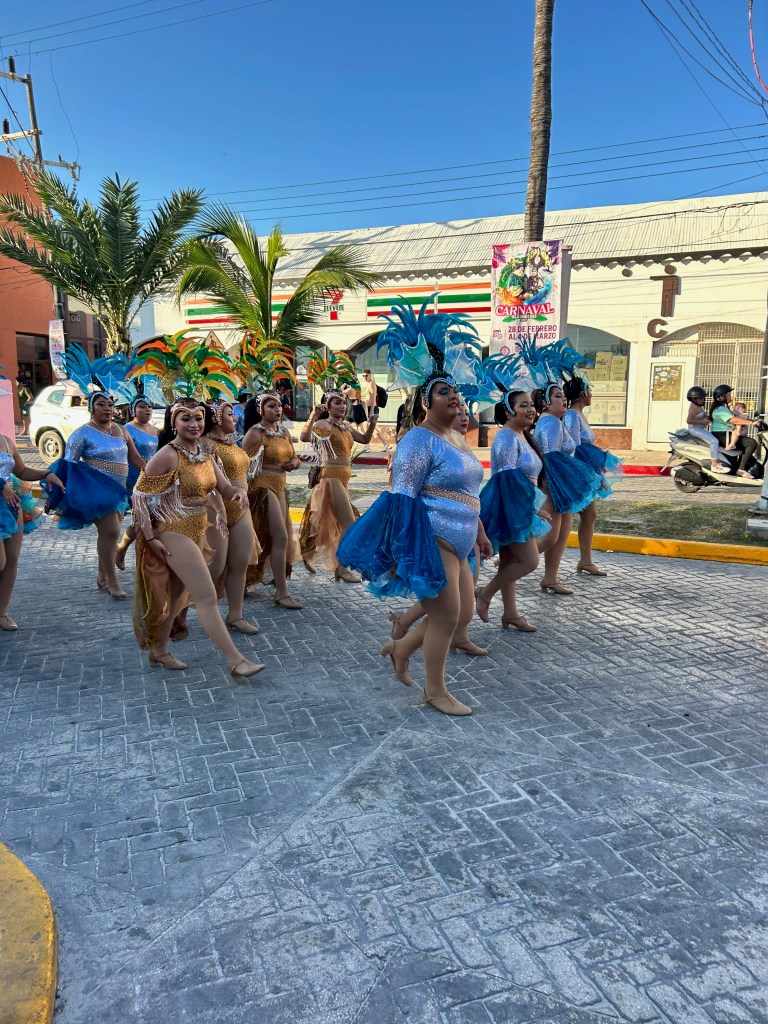
We continued downtown to find we were in the first day of 5-day Carnaval Isla Mujeres 2025. The main street was filled with all ages dance troupes in vibrant costumes performing non-stop and with booming music accompanying them. The dancing was energetic; the costumes Mardi Gras-like; the choreography could have used some work. The activity continued for 5 days.
We walked along the beach but not far as it was very narrow dominated by boat tours coming and going on the docks and bars and restaurants on the beach.
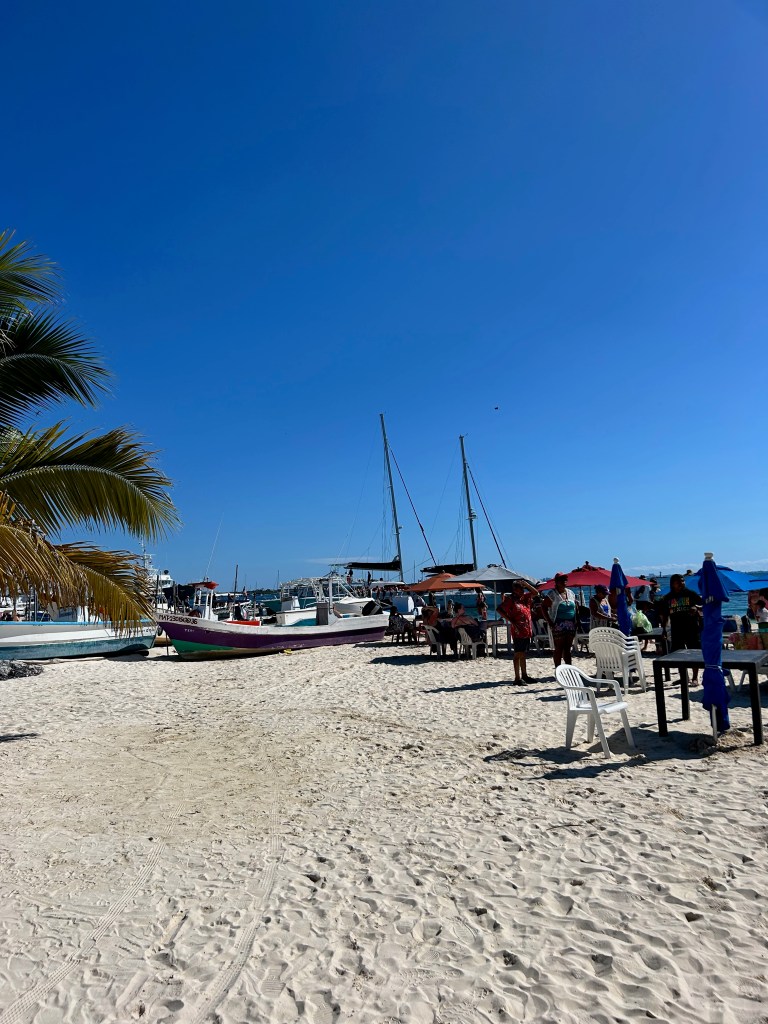
When we stopped, a musical group sang Mexican songs.
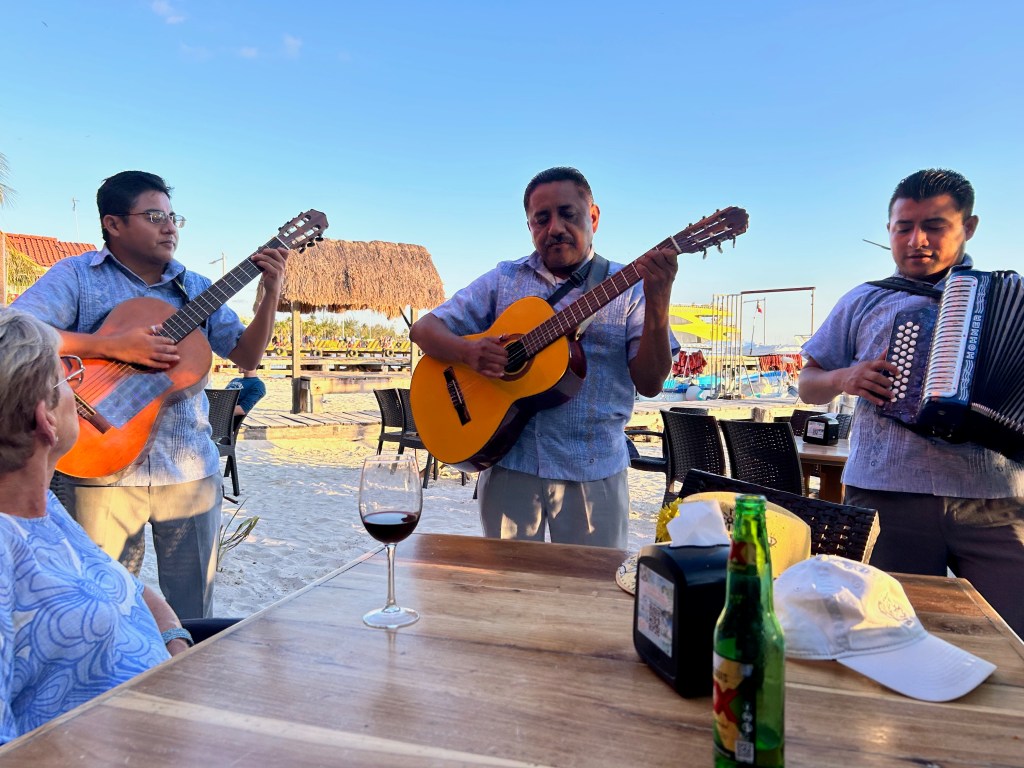
Sunday, March 2
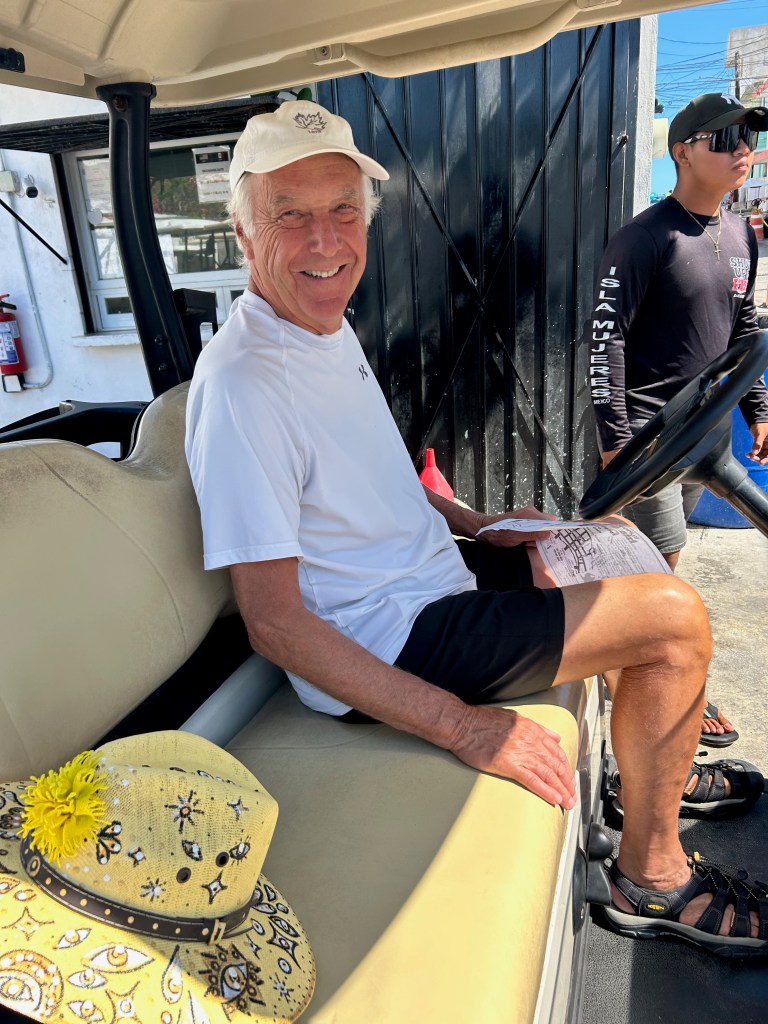
We wanted to do a circumnavigation of the island so we rented a golf cart in the morning (they informed us that there wouldn’t be one available in the afternoon with Carnaval on).
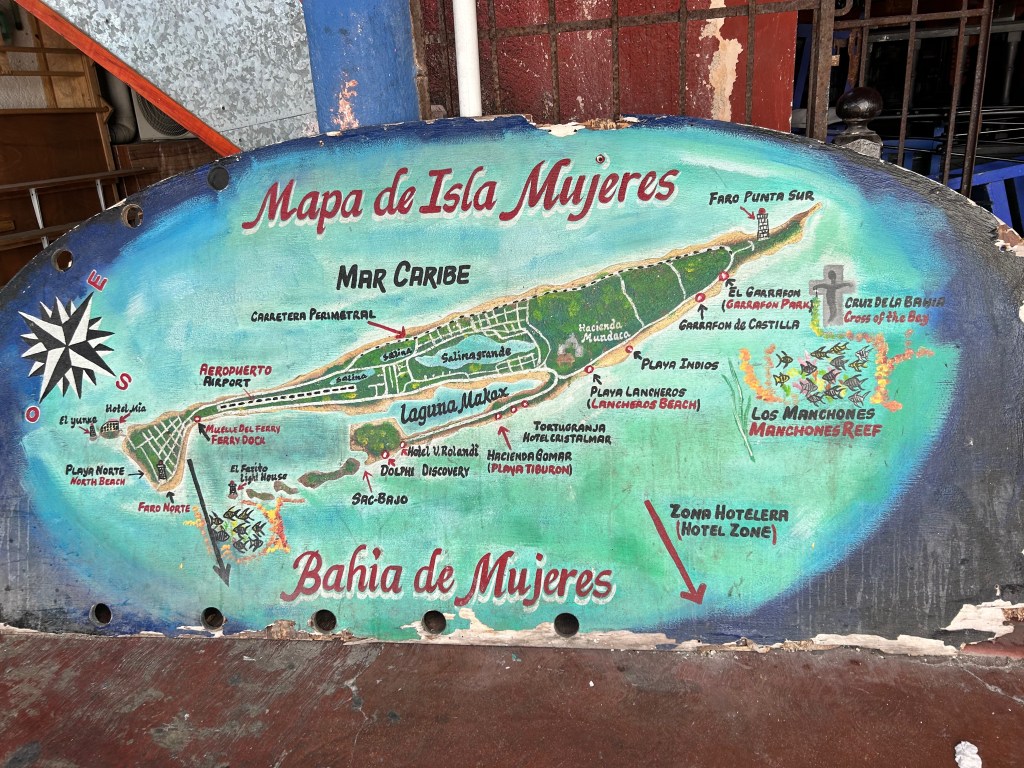
The island was discovered by the expedition of Francisco Hernández de Córdoba in 1517. In pre-Hispanic times, the island was consecrated to Ixchel , the Mayan goddess of the Moon , love and fertility, who received offerings in the form of women that believers deposited on its beaches. When the Spanish conquistadors arrived and observed the figures, they named it Isla Mujeres . Archaeologists know that Isla Mujeres was a sanctuary dedicated to Ixchel, the Mayan goddess of fertility, and that Mayan women had to make a pilgrimage to the island as part of their transition from girl to woman.
The island is part of one of the eleven municipalities of the State of Quintana Roo, the municipality of Isla Mujeres is located thirteen kilometres from the city of Cancun, the main tourist centre of the region. It was founded under the name of Dolores.
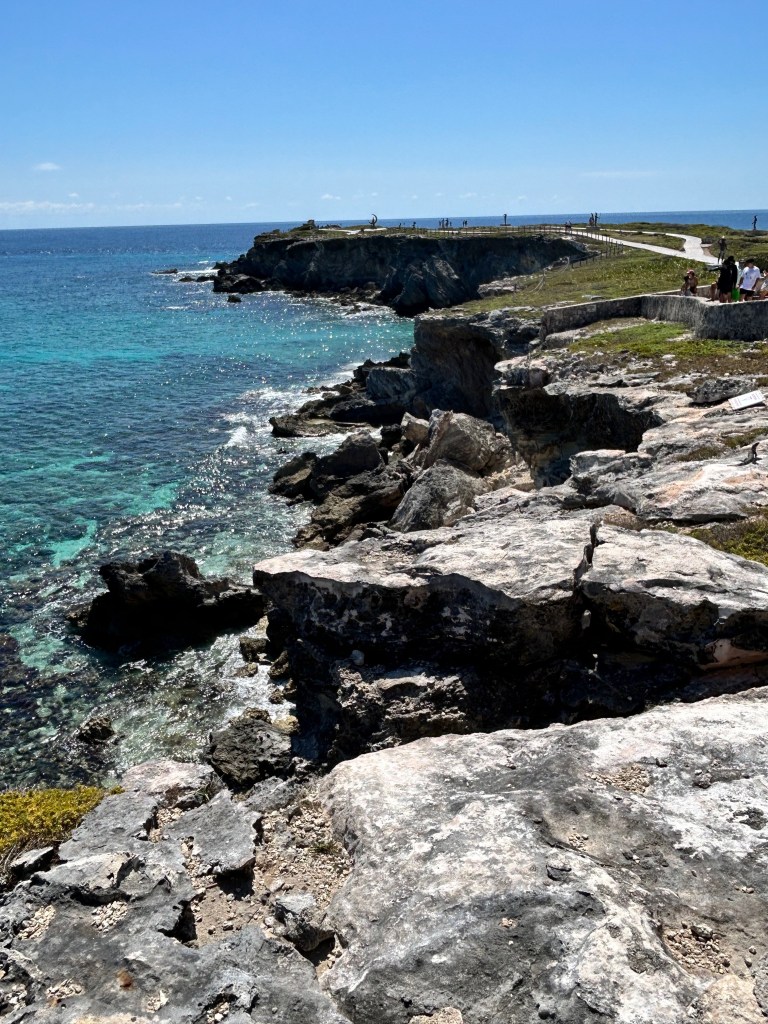
We headed up the north side of the island heading south bumping over the many topas with the jerking motion of the golf cart and eventually we arrived at South Point. Punta Sur is located in the southern part of the island, at the highest point, reaching 20 meters above sea level. It is a natural formation adjacent to the Garrafon reef.
We arrived back after our 2 hour trek and 8 km bumpy roads. We went to Bartolemue’s for lunch. Beautiful view seeing boats coming and going.
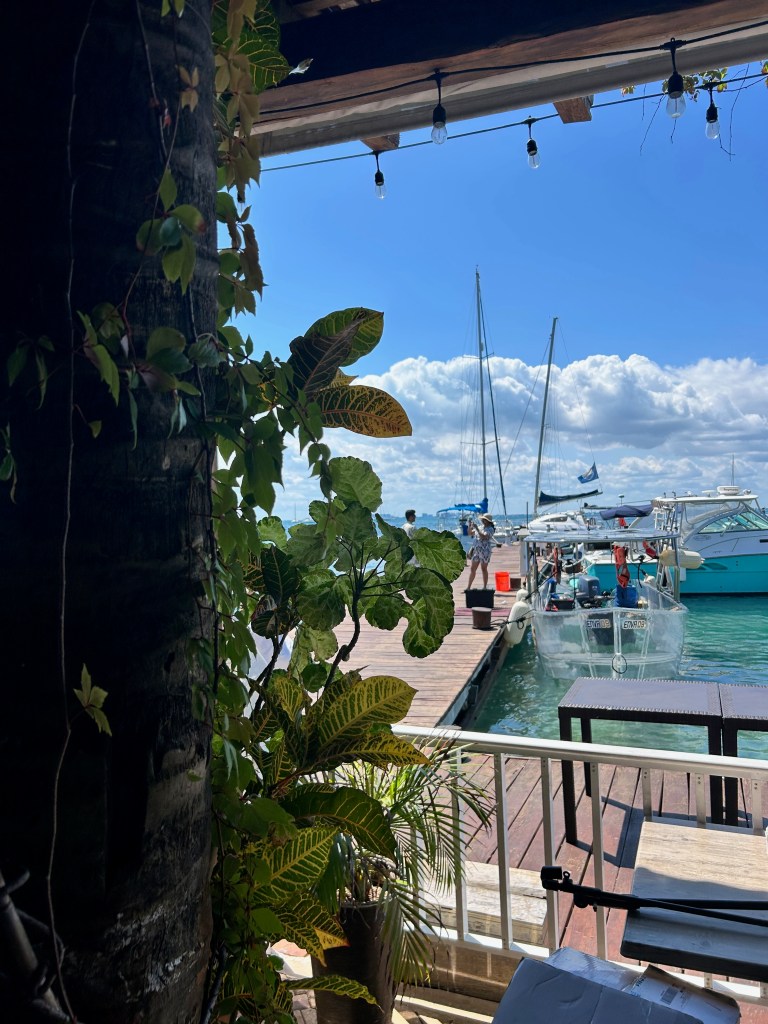
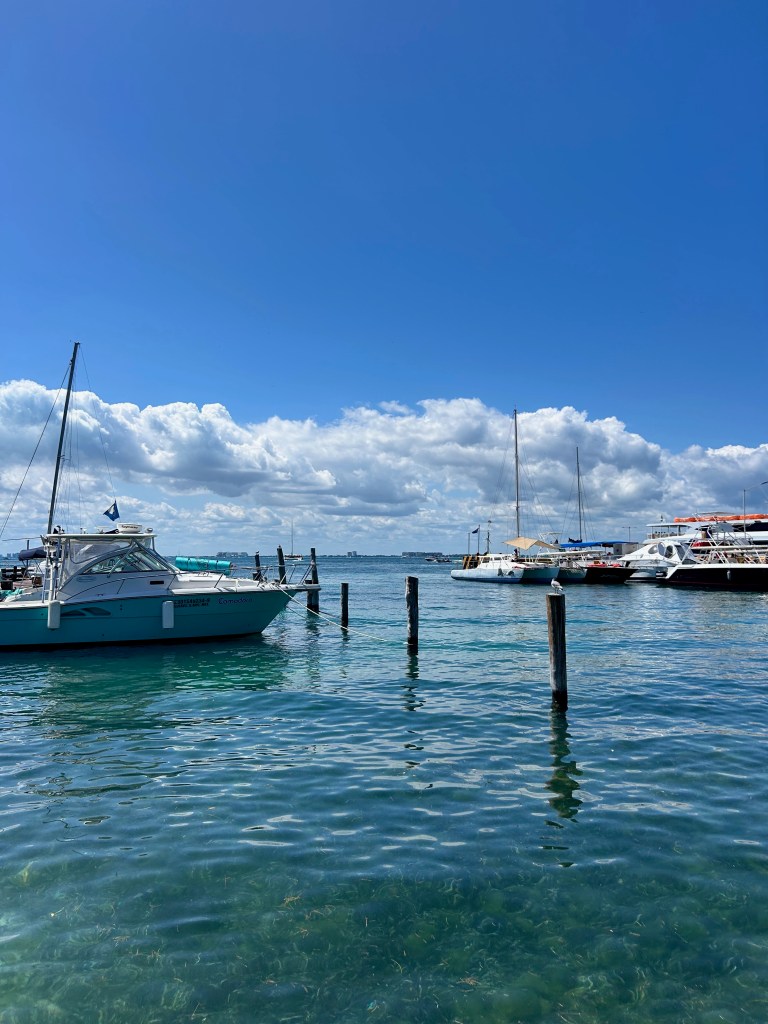
Carnaval started up again in the afternoon with a continuous parade with music and dancers and then buggies, scooters, jeeps (and booming music) making the circles through town.
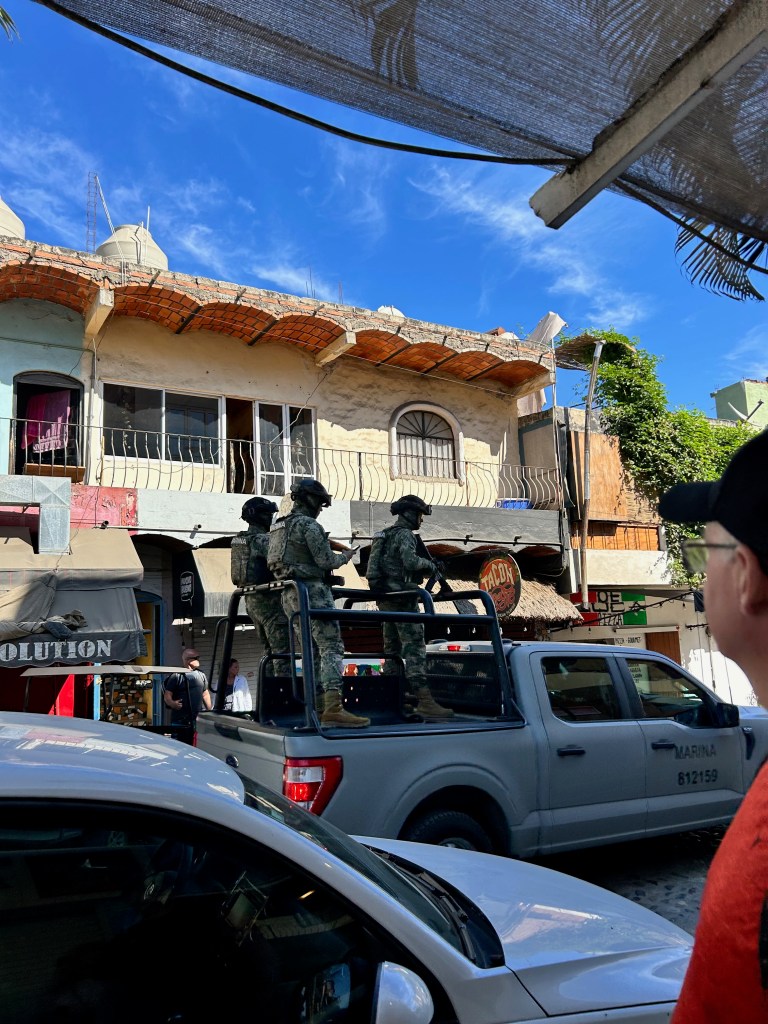
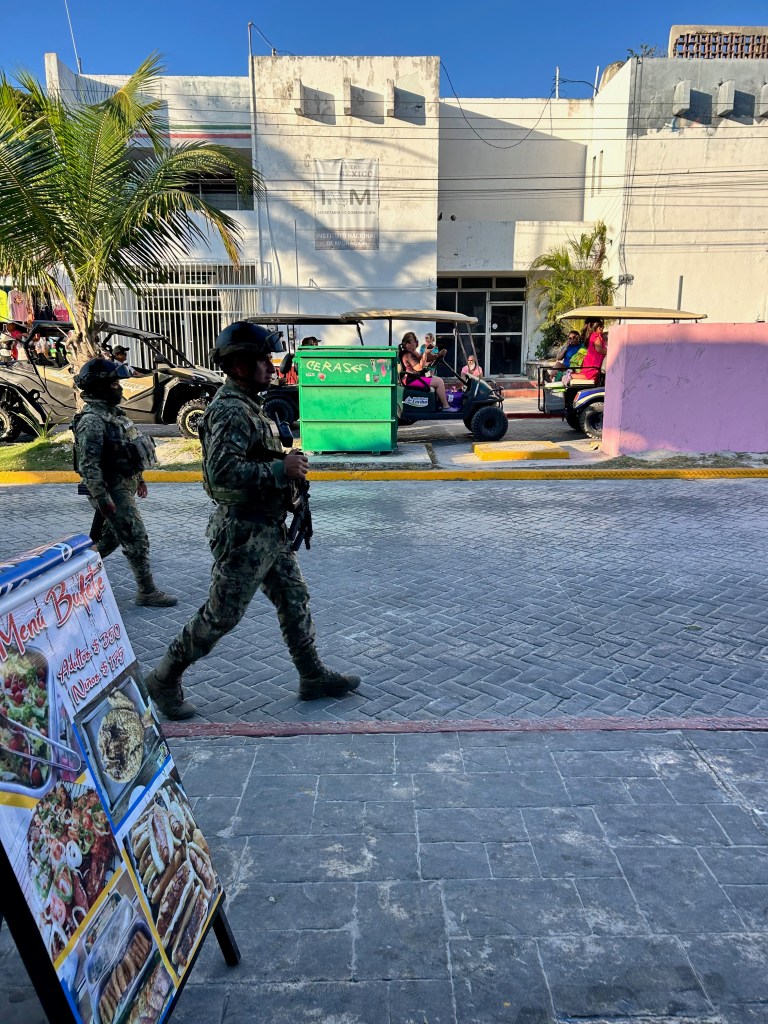
And a strong armed military presence.
We walked back to the room, read next to the water and waves and then had dinner in town: worst ever at Brisa Mexicana on the market street one over from main street: cold sea bream floating in oil, rice and vegetables and shrimp tacos.
Monday, March 3
After a very good and inexpensive breakfast by Angela, we read for an hour by the sea, walked the paseo and back through town, and then walked to the ferry terminal and boarded the 12:00 pm ferry.

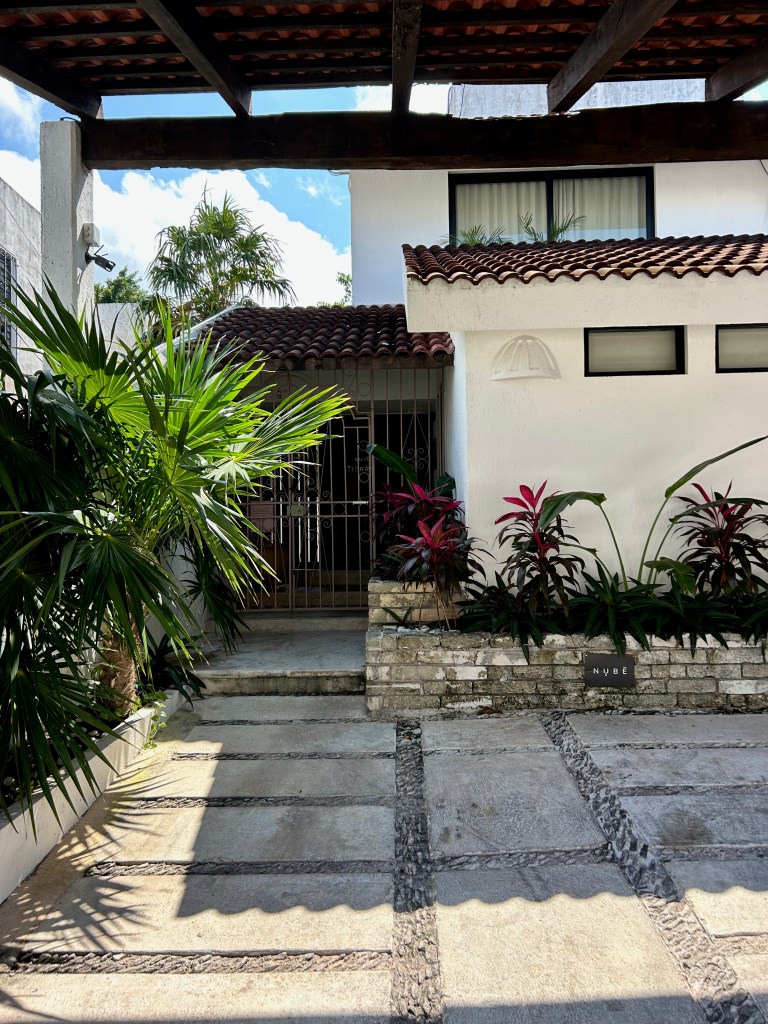
Angela had helped us with a taxi from Uriel (Red Taxi) who only charged us Mex$ 850 for getting us to 46 A Nube from the terminal and then to the airport on Wednesday. He was there promptly, took us to the apartment and helped us to get the access code from the airbnb and through the two locks -very, very helpful!
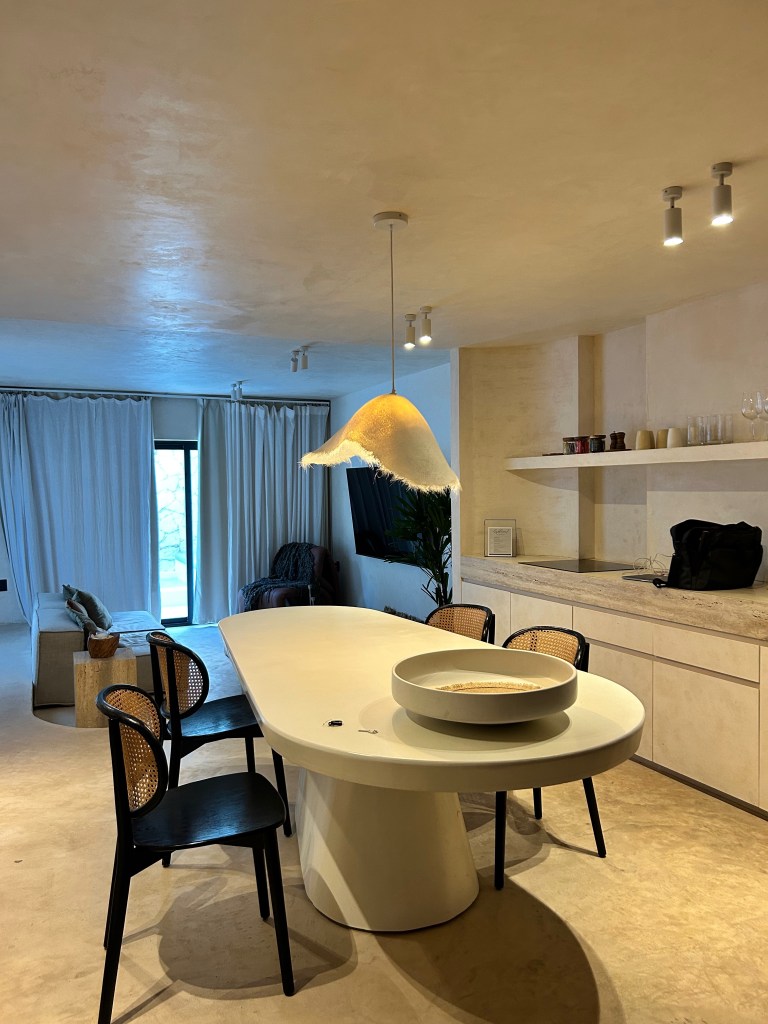
Luxury Design Apartment Suite Tierra with Pool Entire home/apt hosted by Dan
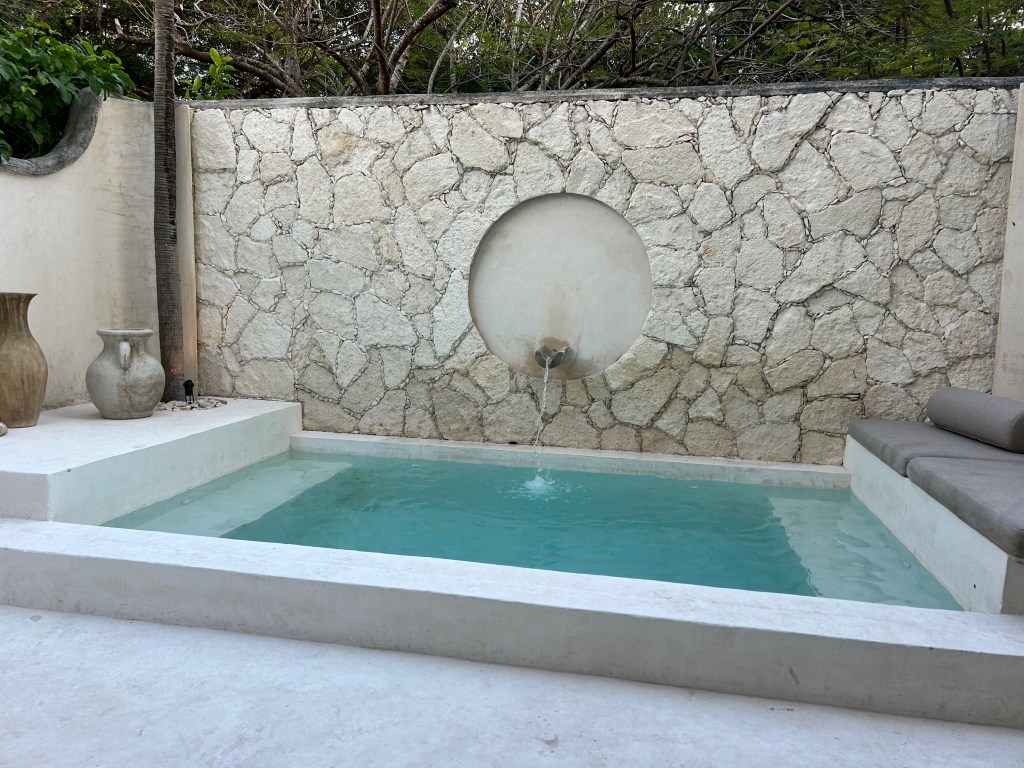
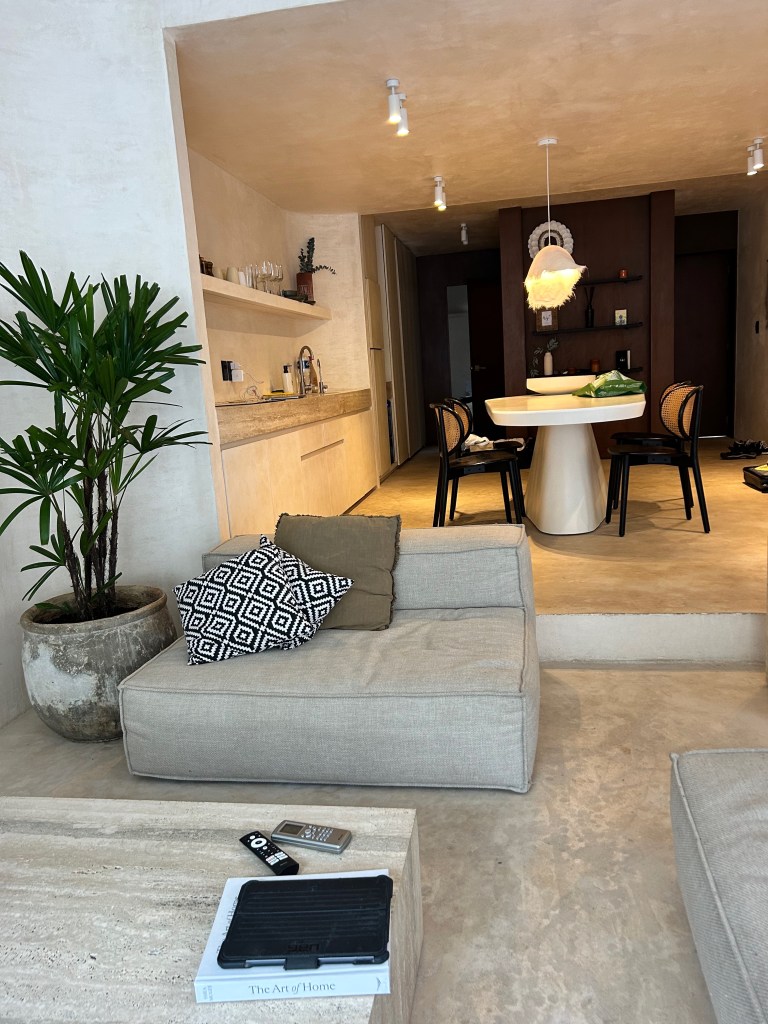
We walked down to the waterfront where the Carnaval festivities had been going on, walked back to the La Fiesta mall and had 2 for 1 hamburgers at DonCarbon. We walked through the mall to Chedraui store and bought the makings for dinner and then were too full to eat it. We had a swim in our little pool and an early night.
March 4, 2025

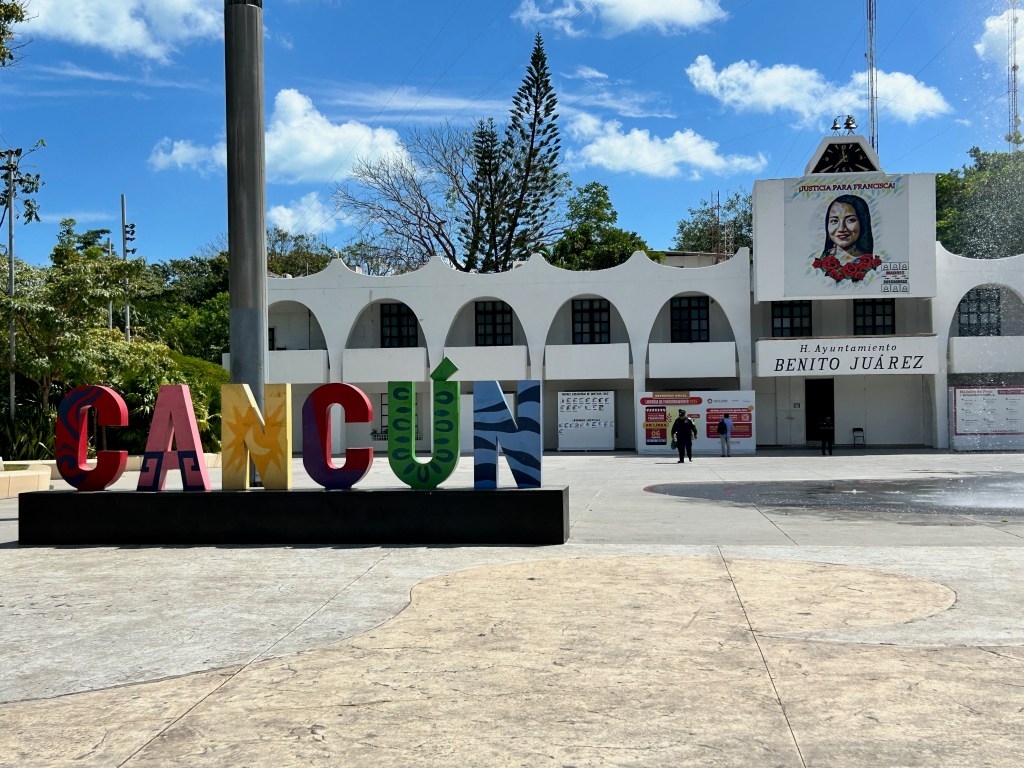
After struggling with where to go to see the highlights of Cancun, we decided on a walk to the Ki Huic market, City hall and Park, about 2 km.
We then headed toward the Puerto-it was a long hot, boring walk. The Marina Puerto turned out to be a mall on the inner waterway.
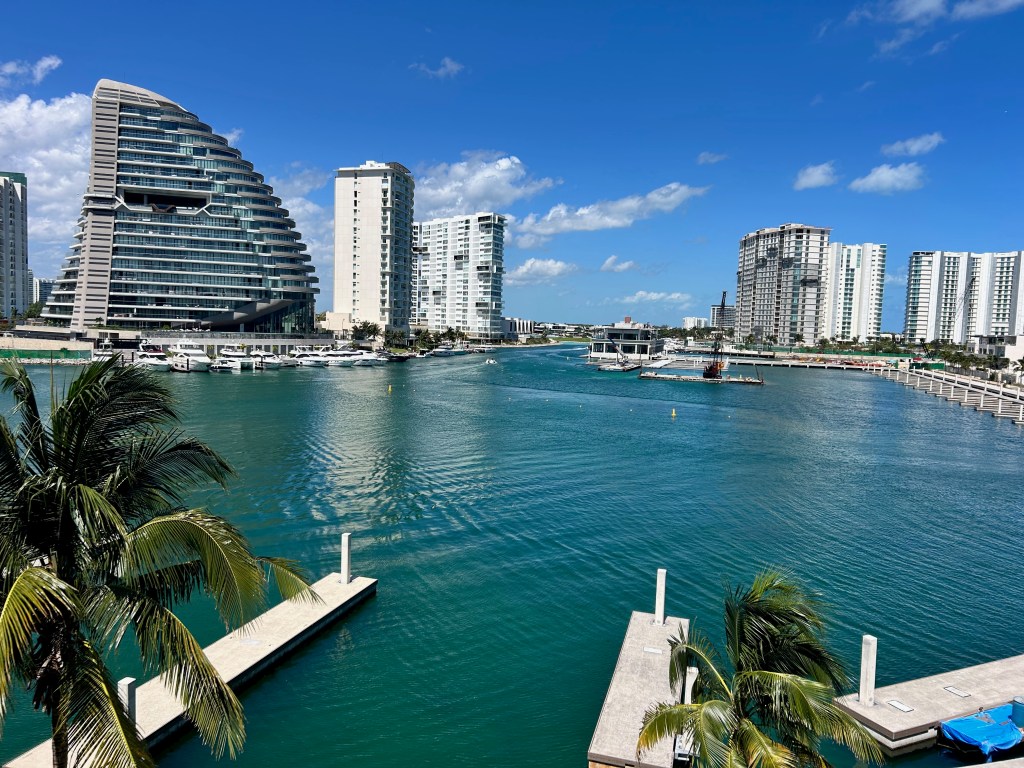
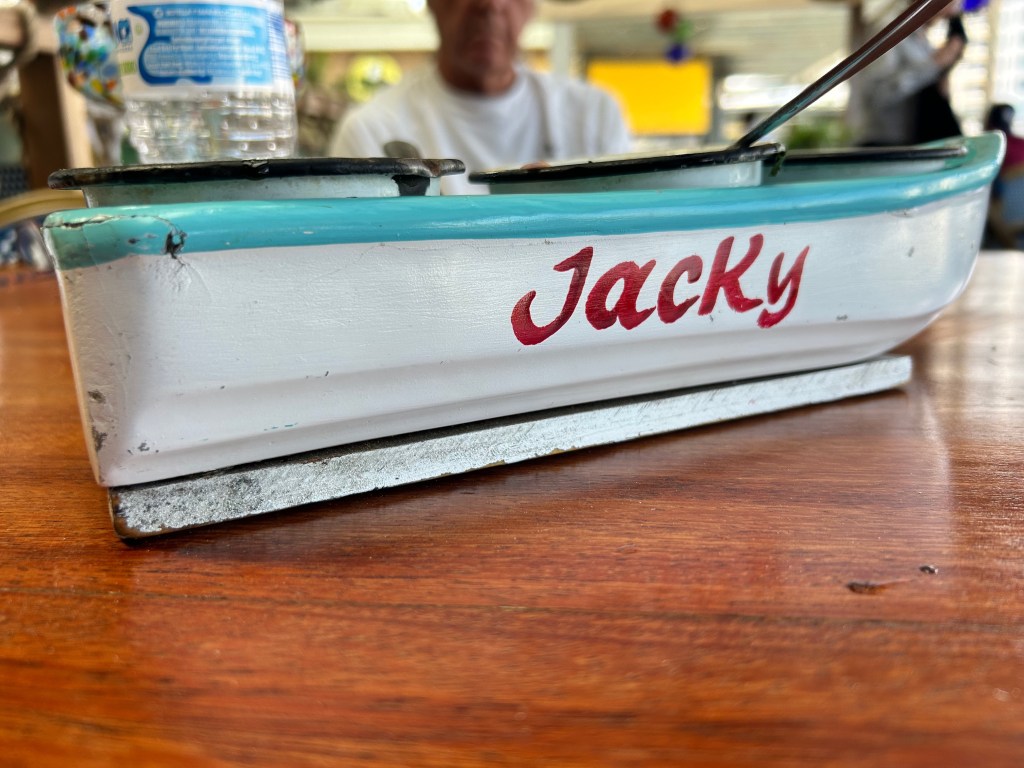
However, we found a lovely spot for lunch, Gran Puerto, and had a really good fresh Sea Bream lunch with fresh vegetables and rice. The appetizers included a small soup and their toasted fried tortilla chips with a selection of three salsas: one hot; one medium and one pico de gallo. The boat that the appetizer was in was called, Jacky. Coincidence?

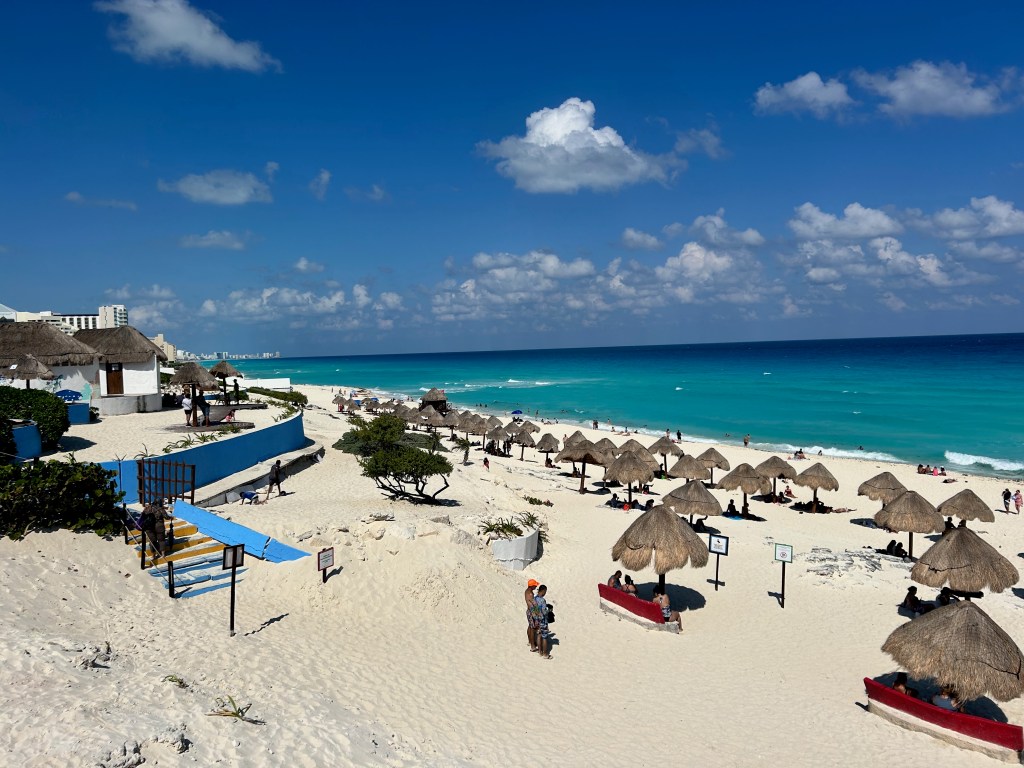
When we were leaving we decided to engage the taxi for a tour of the Hotel district along the 5 km sand spit. It was a long continuous line of hotels of all famous names on both sides with the Lagoon on the inside and the Caribbean on the outside and numerous restaurants and shops. We stopped a Delfines Beach for a photo.
The arrangement was for an hour but the driver dragged it out so that it was an hour and a half and tried unsuccessfully to charge us for 2 hours. We had a dip in the pool, read and had dinner at home.

March 5, 2025
Cancún to Toronto – AC 931 3:00 PM–6:55 PM
Thoughts on Mexico
- Before leaving we had concerns about safety and cleanliness. We found none: we felt safe, had no digestive issues and were treated well.
- The weather was absolutely perfect: 27-30 every day, mostly sunny.
- We enjoyed the food: had many very good tacos. Bill liked the hot sauces more than I did.
- The tours we took were excellent: Whale-watching, Food Tour, San Sebastian.
- We like Bucerias the most: It’s a city and could be considered part of the greater Puerto Vallarta area but it had a small city feel, with a large Canadian presence. The beach was spectacular – wide and long, especially at low tide.
- Those cobble-stone streets and broken uneven sidewalks can be a challenge for walking and really shake up the cars.
- Our accommodations on VRBO and Airbnb, for the most part, were first-rate.
- We still have more places on our bucket list but we may very well return.
When you travel
A new silence
Goes with you
And if you listen,
You will hear
What your heart would
Love to say.
A journey can become a sacred thing
Make sure, before you go,
To bless your going forth,
To free your heart of ballast
So that the compass of your soul
Might direct you towards
The territories of spirit
Where you will discover
More of your hidden life;
And the urgeniceis
Tha deserve to claim you.
JOHN O’DONOHUE
Excerpt from the blessing, “For the Traveler” found in his books: To Bless the Space Between Us (US)/Benedictus (Europe)
 Site Title