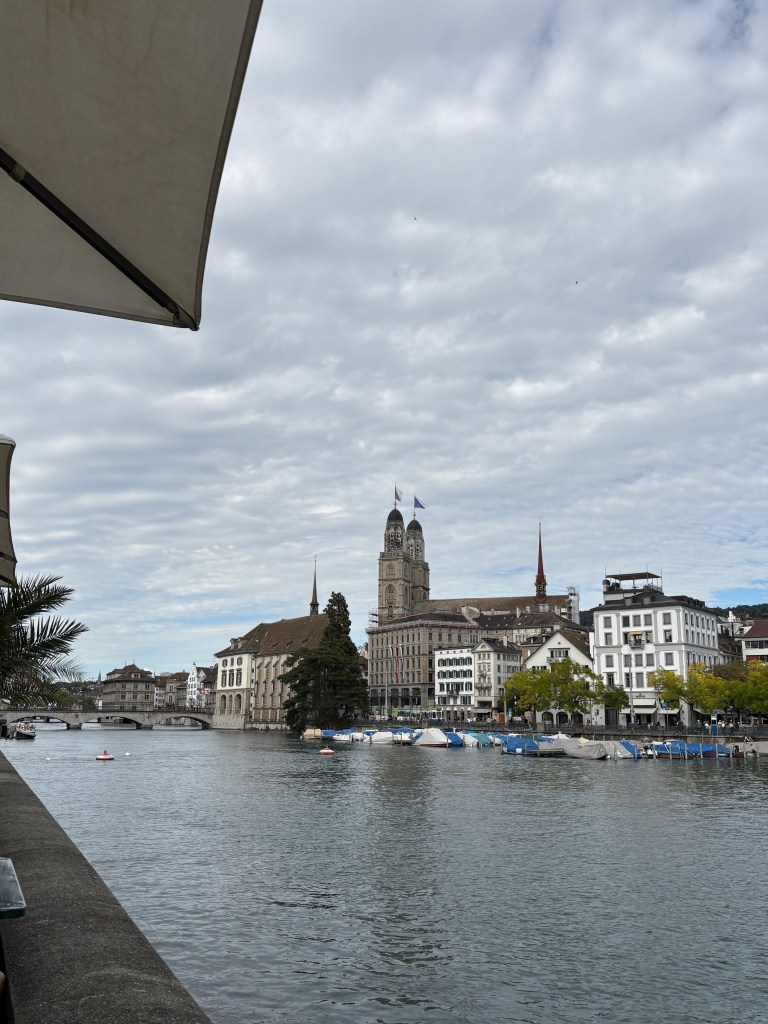
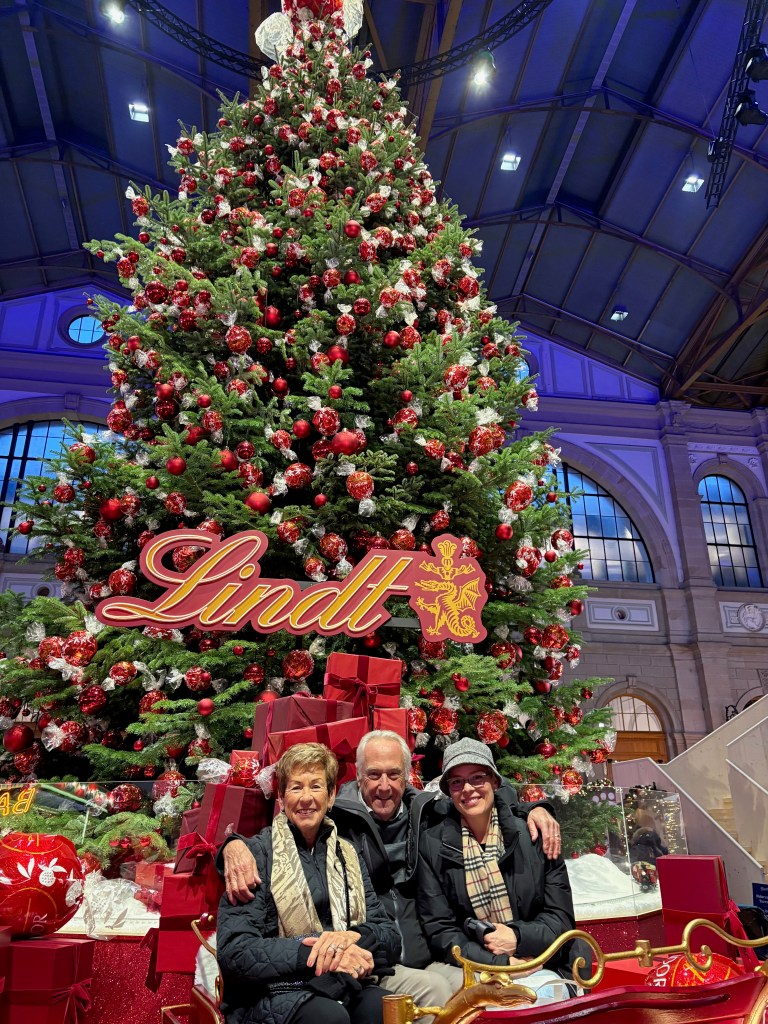
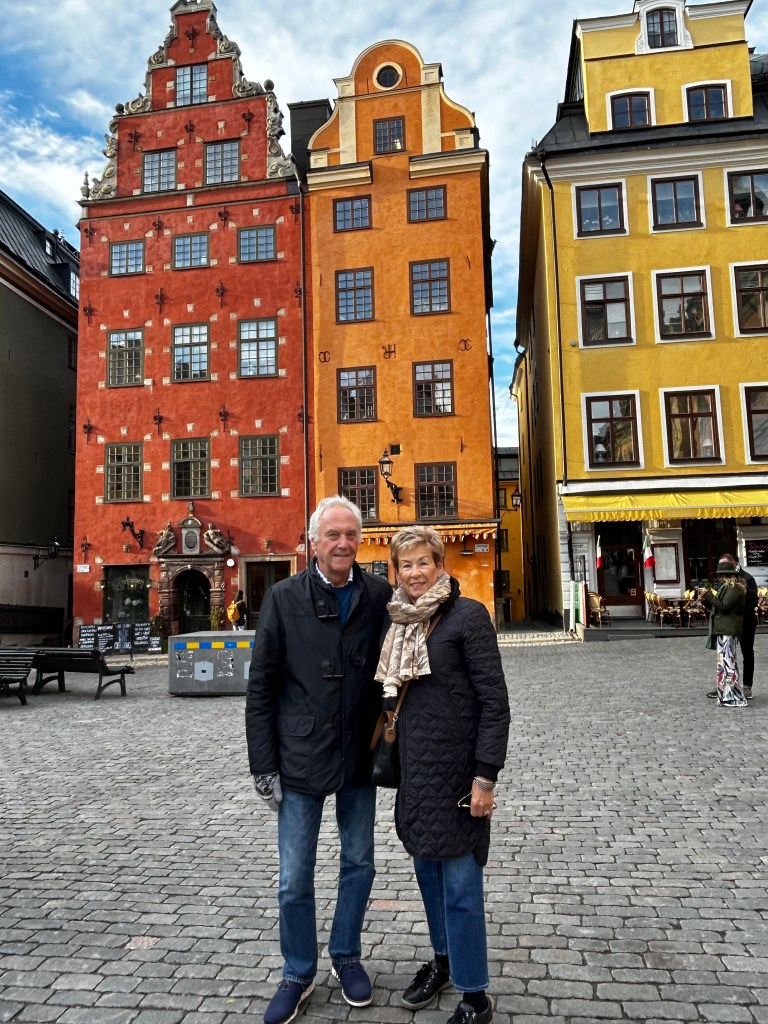
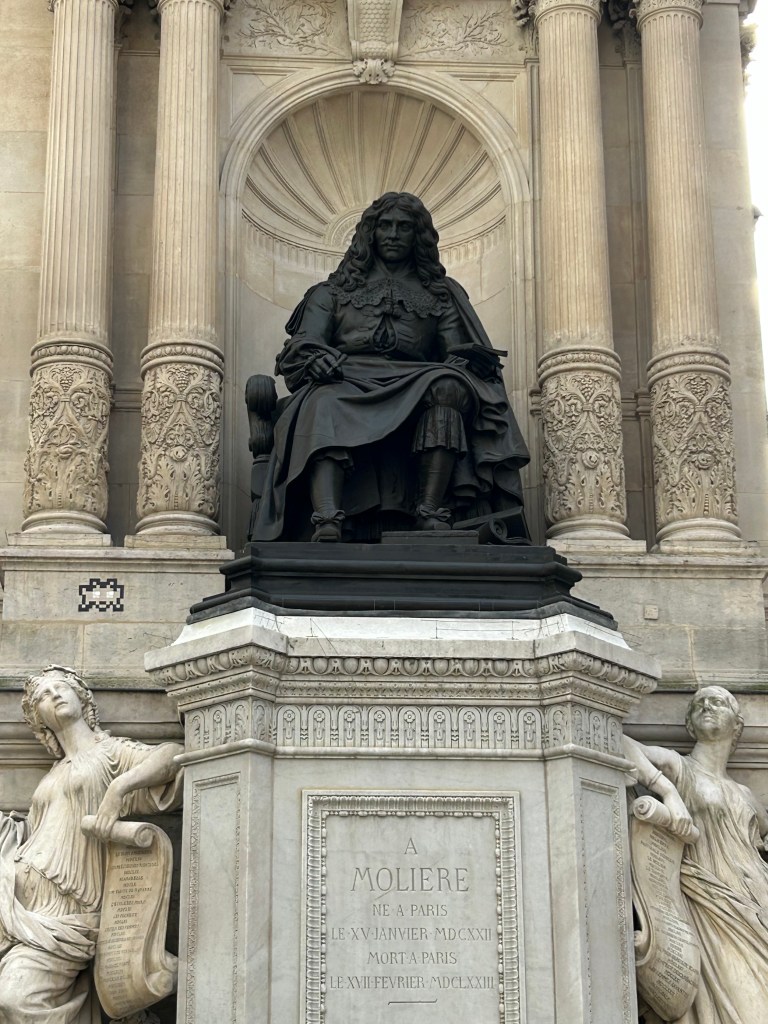
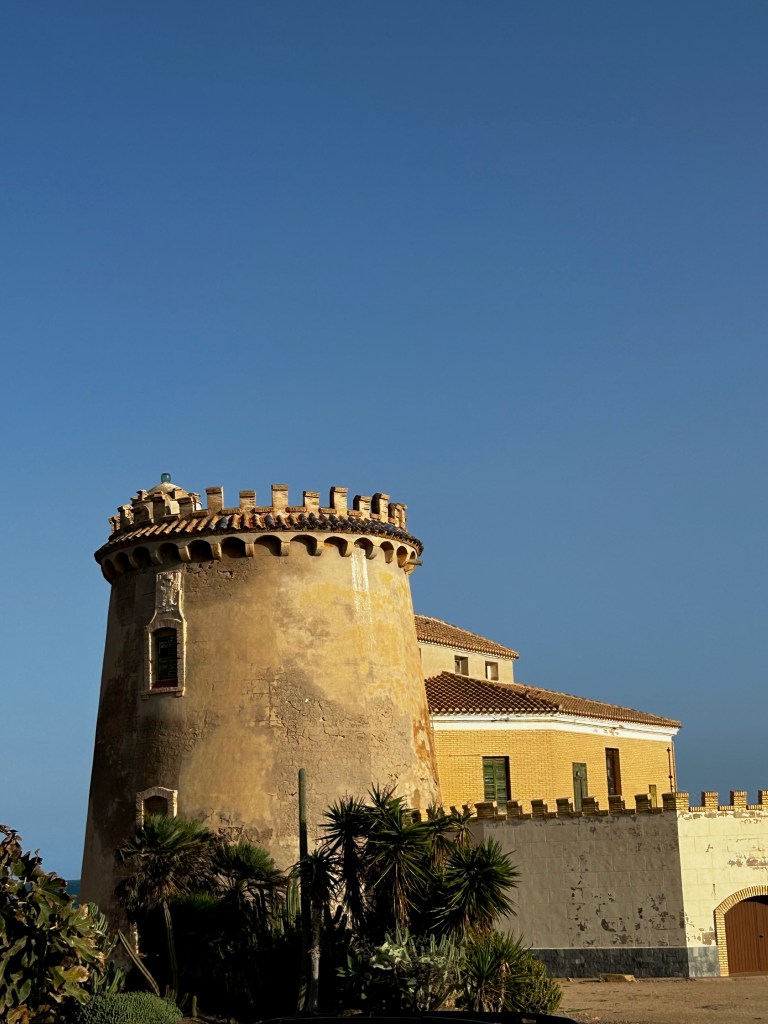
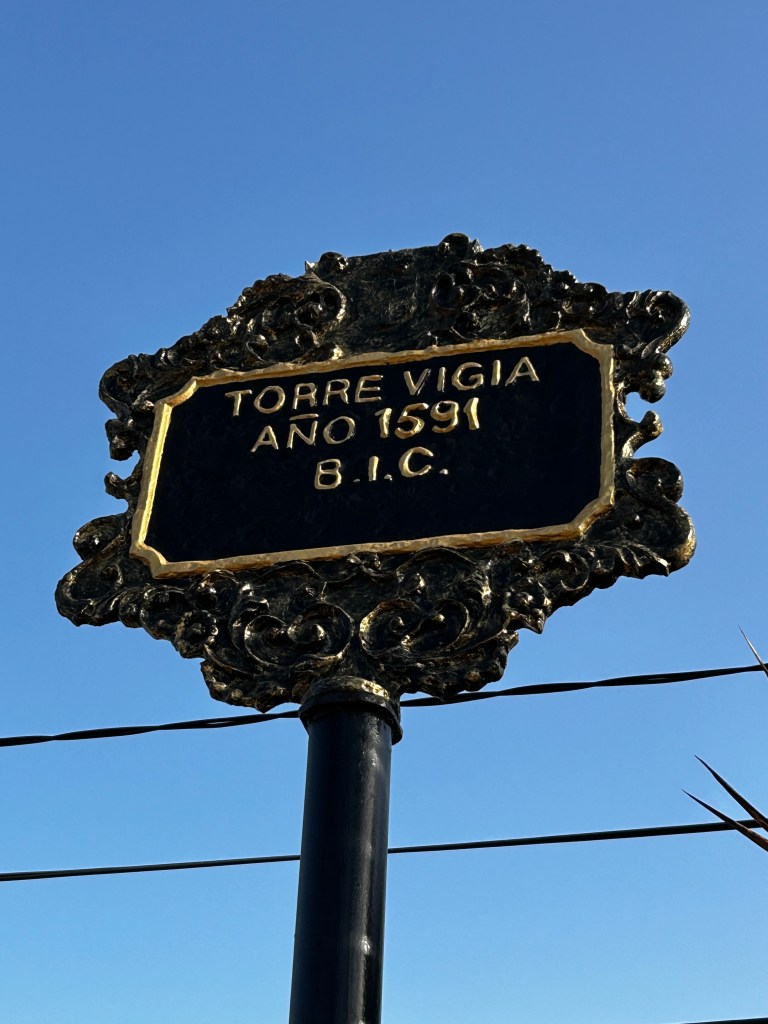
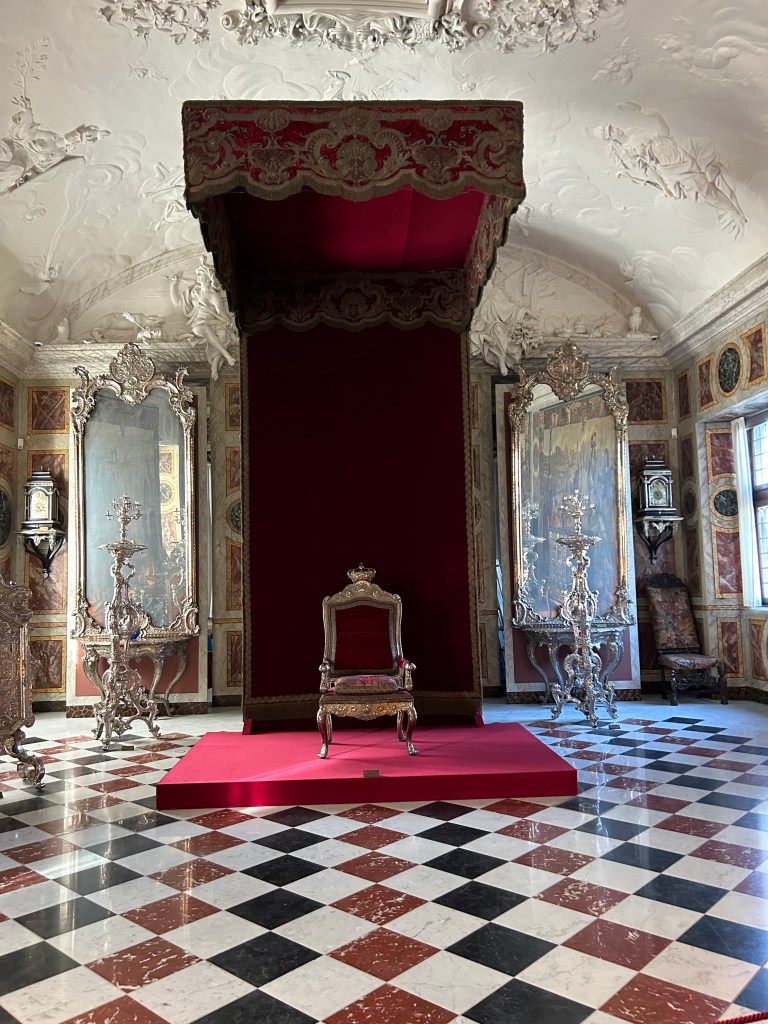
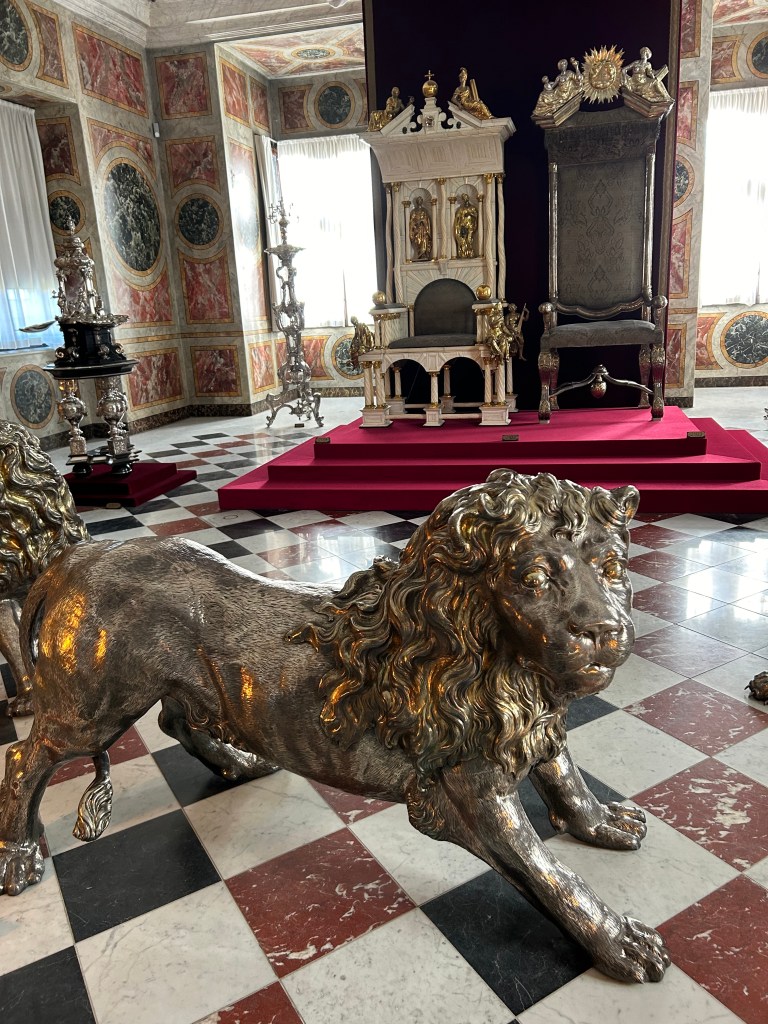
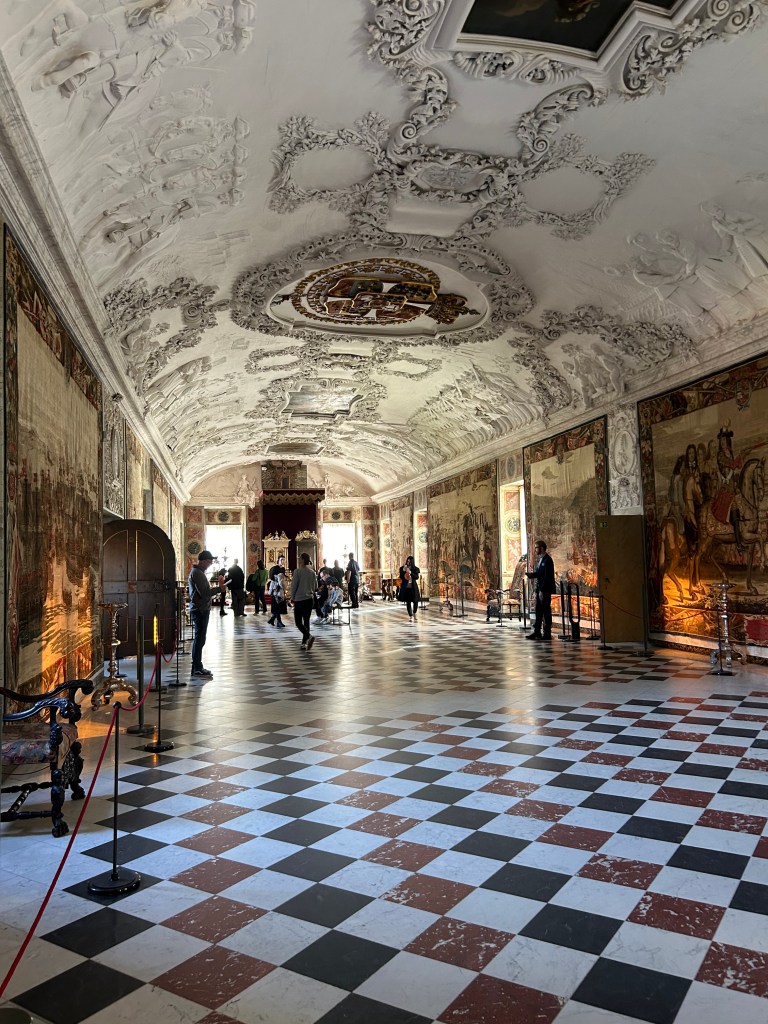
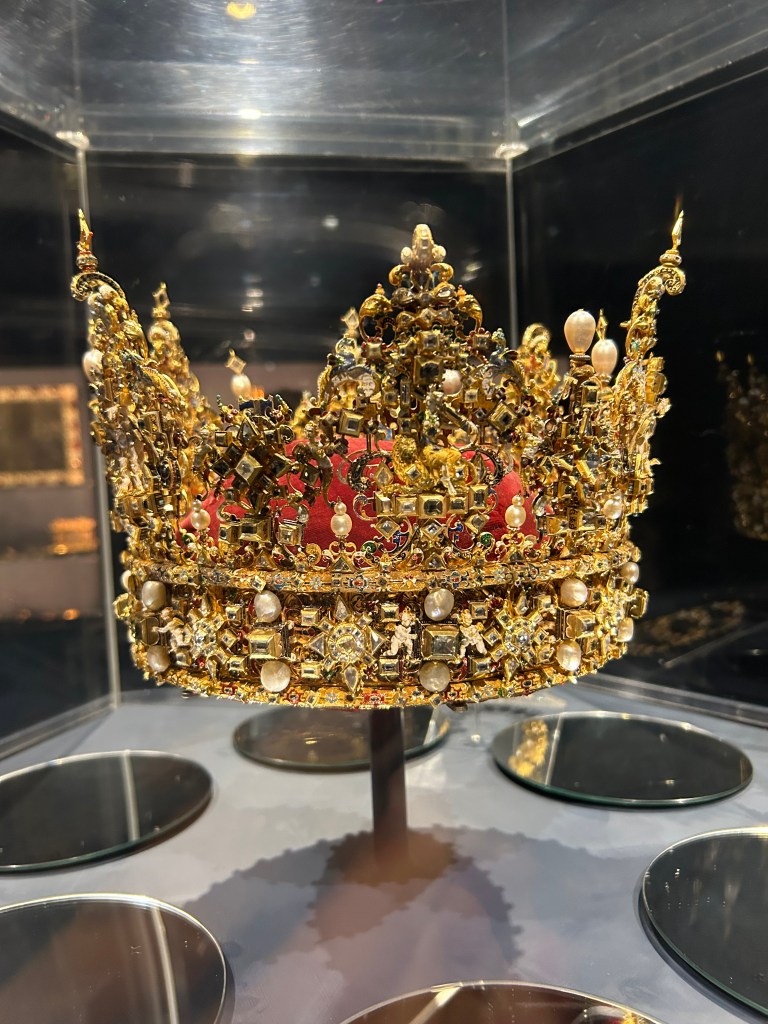
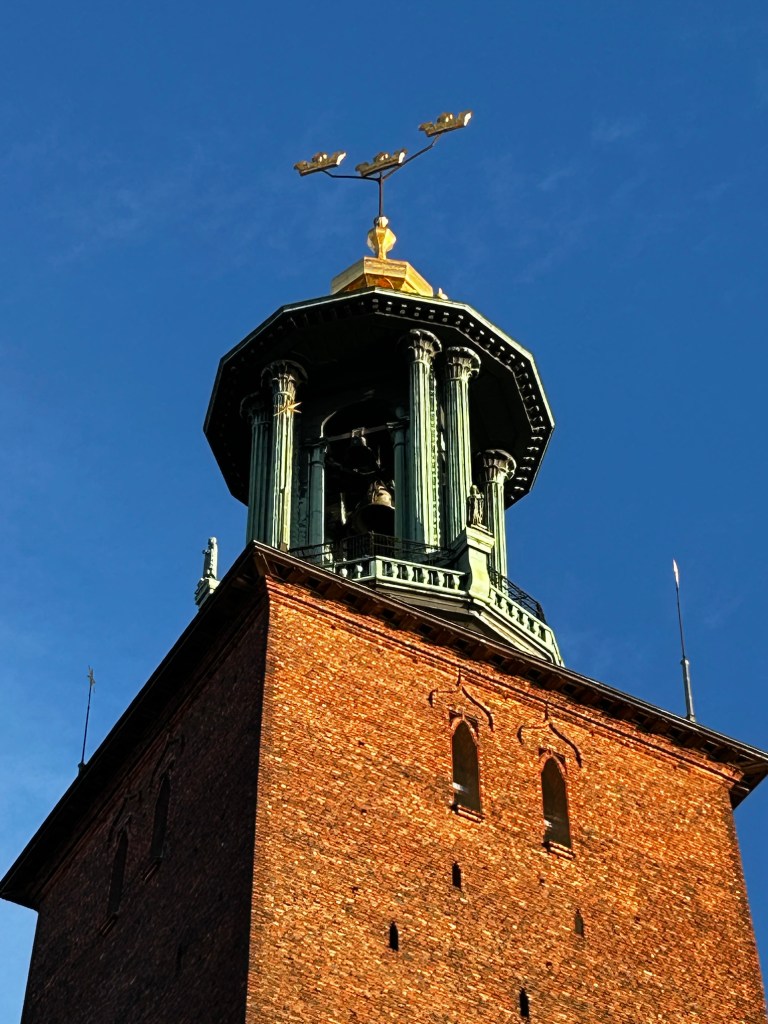
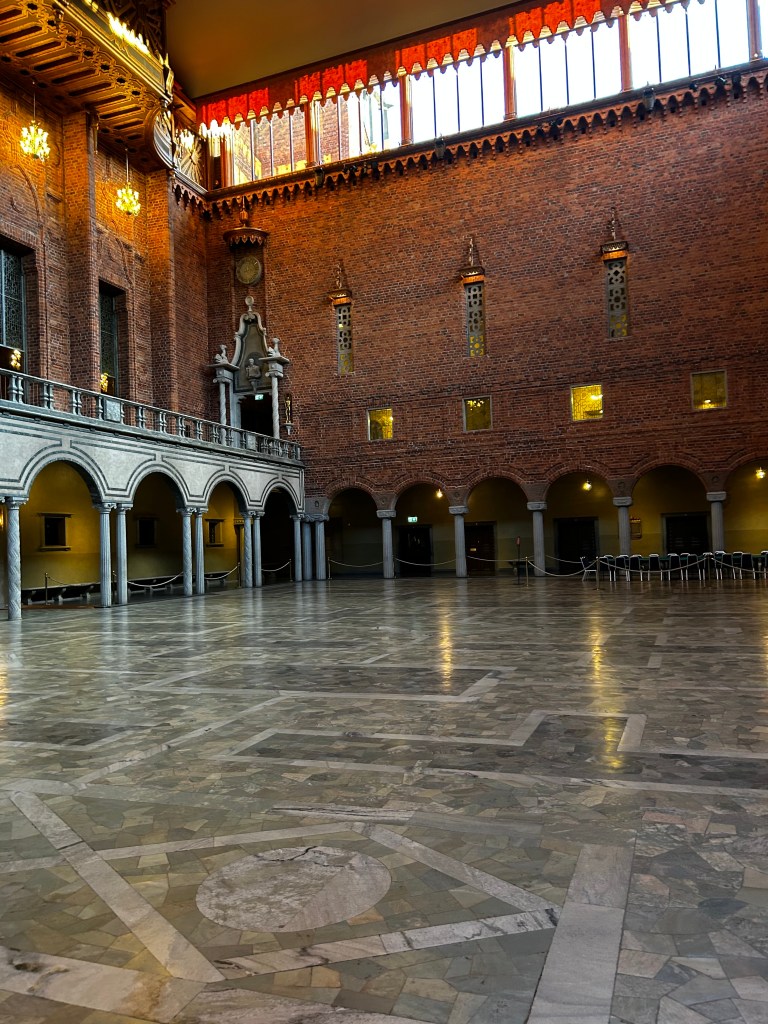
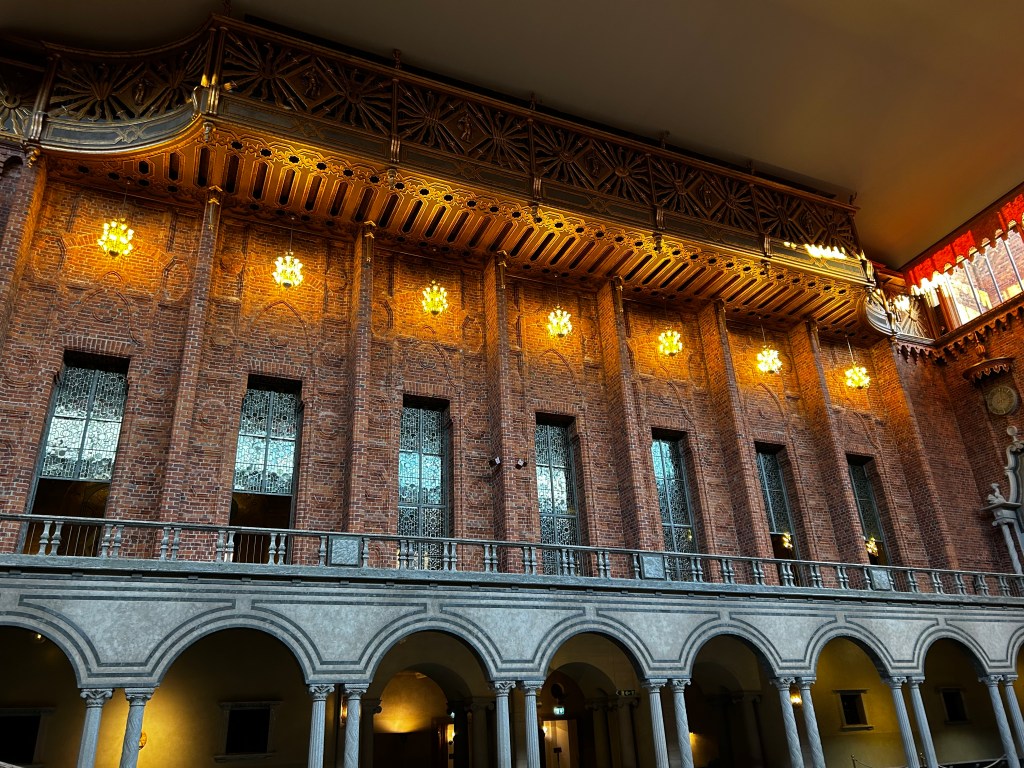
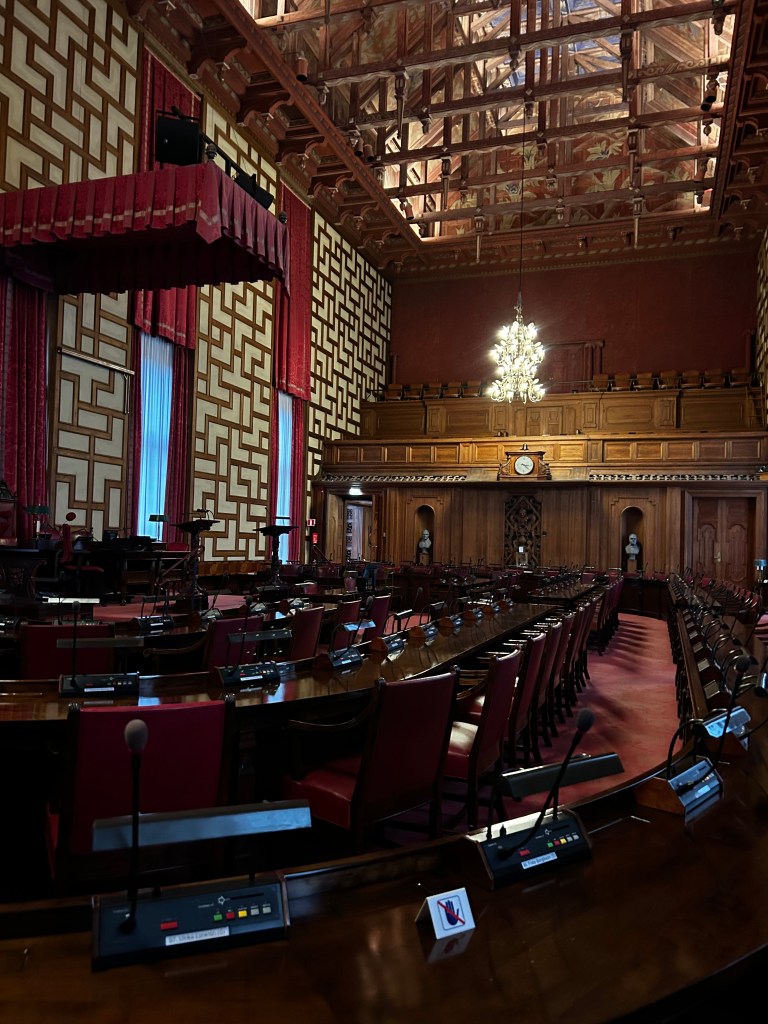
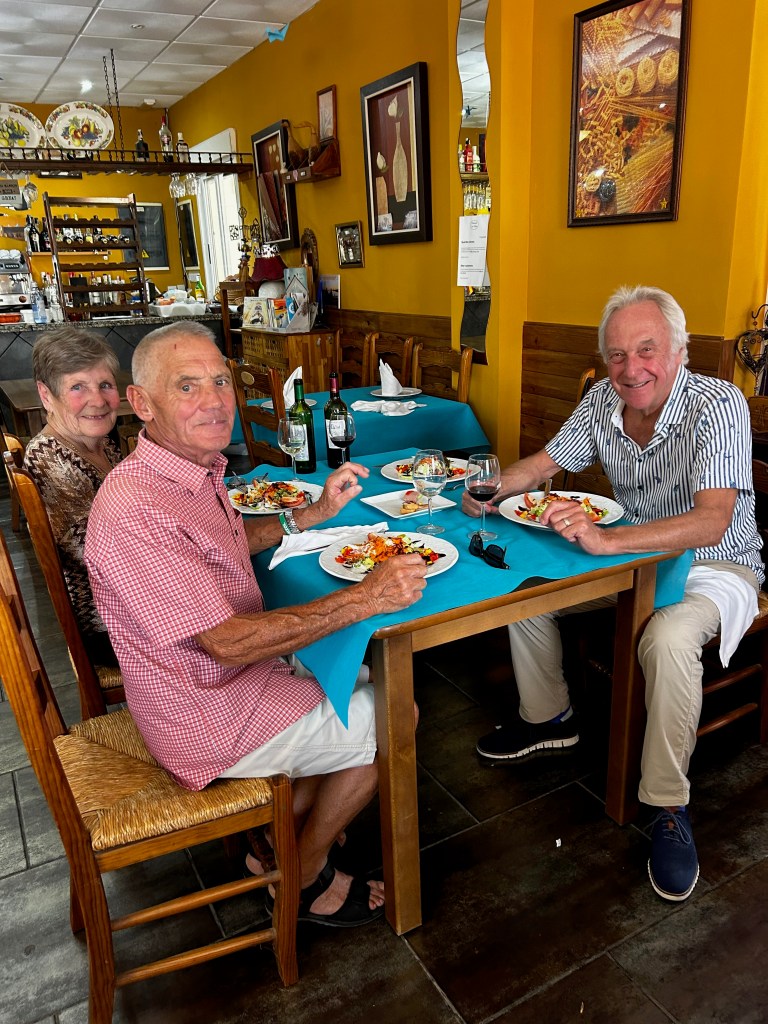
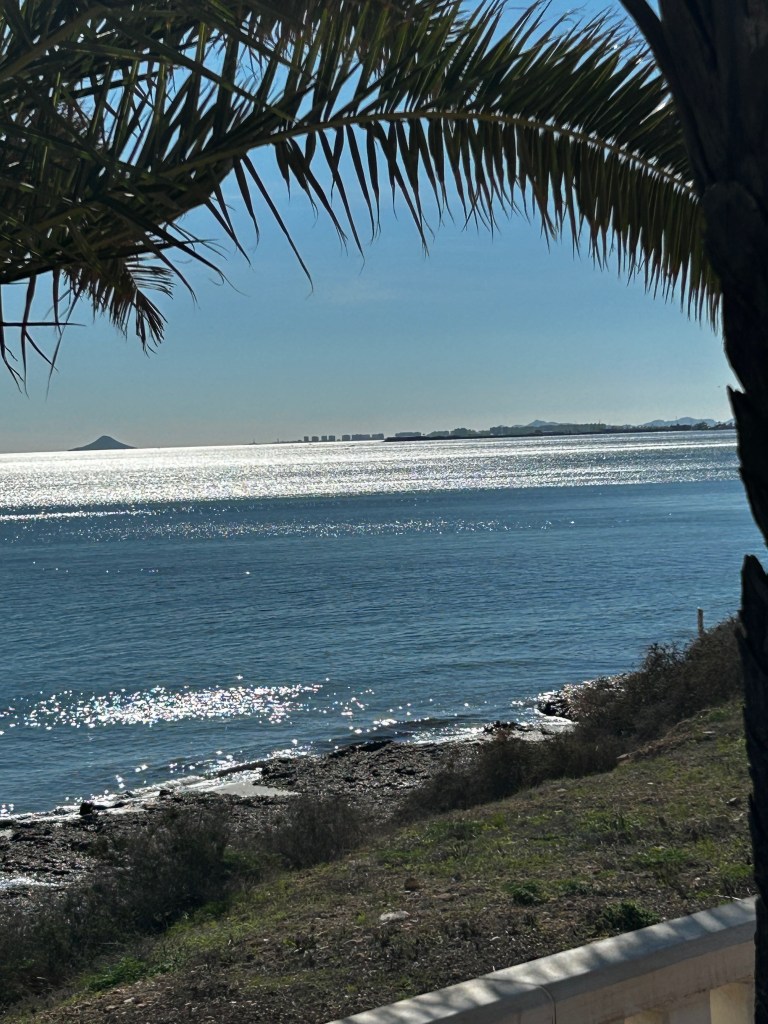
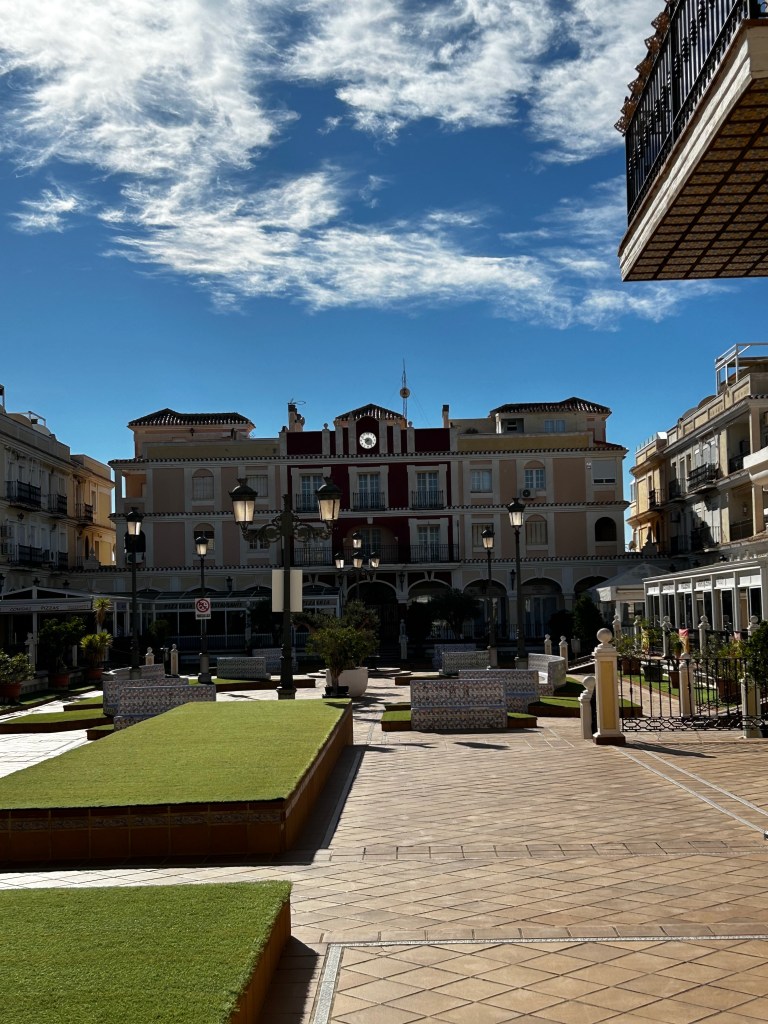
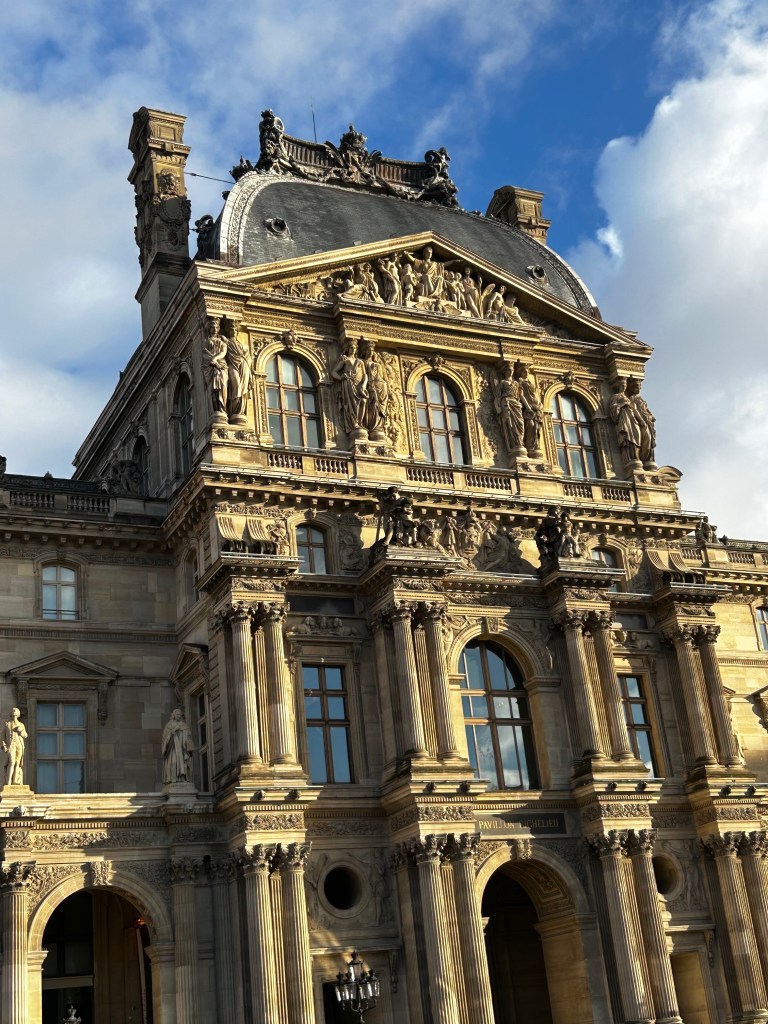
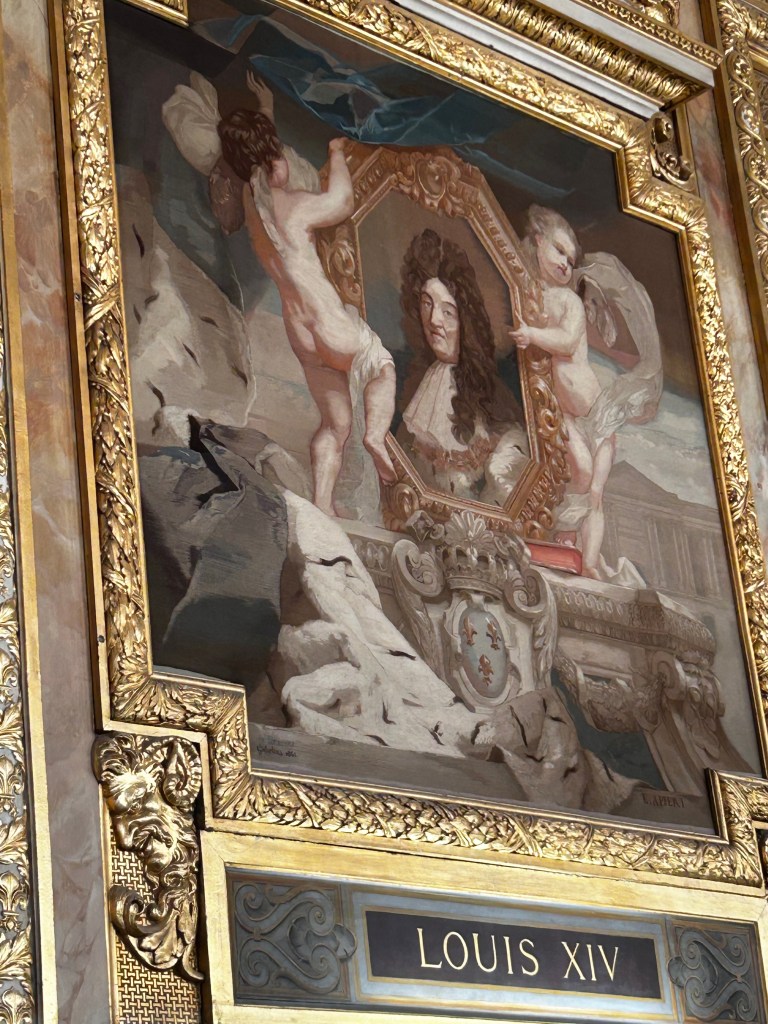
Italy
September 4-5 On our way
We flew on Air Canada from Toronto to Rome on September 4-5 arriving at noon. The flight was uneventful, as was passing through customs and getting our baggage. We got on the express train and were headed to the Rome Terminal when Bill realized that his wallet containing 3 credit cards, a bank client card, drivers licence, Ontario health card, and about 300 Euros, was missing from his pocket. We turned on the tracker that we had just installed at home and could see the wallet in the terminal as we moving further away from it.
Saturday, September 5 (Day before the tour started)
We arrived at Grand Hotel Tiberio around 2:00 after taking a taxi from the main train terminal. As soon as we arrived at the hotel, Bill cancelled his credit cards and disputed 2 small transactions. I emailed the Air Canada office in the airport as the office was closed on Saturday. We may be able to make an insurance claim for the 300 Euros cash. We were both very upset but figured we might as well keep moving and not let the incident ruin our trip so we took two buses to Castel Sant’Angelo, also known as Hadrian’s Mausoleum, one of the most fascinating buildings in Rome and one of the most visited sites.
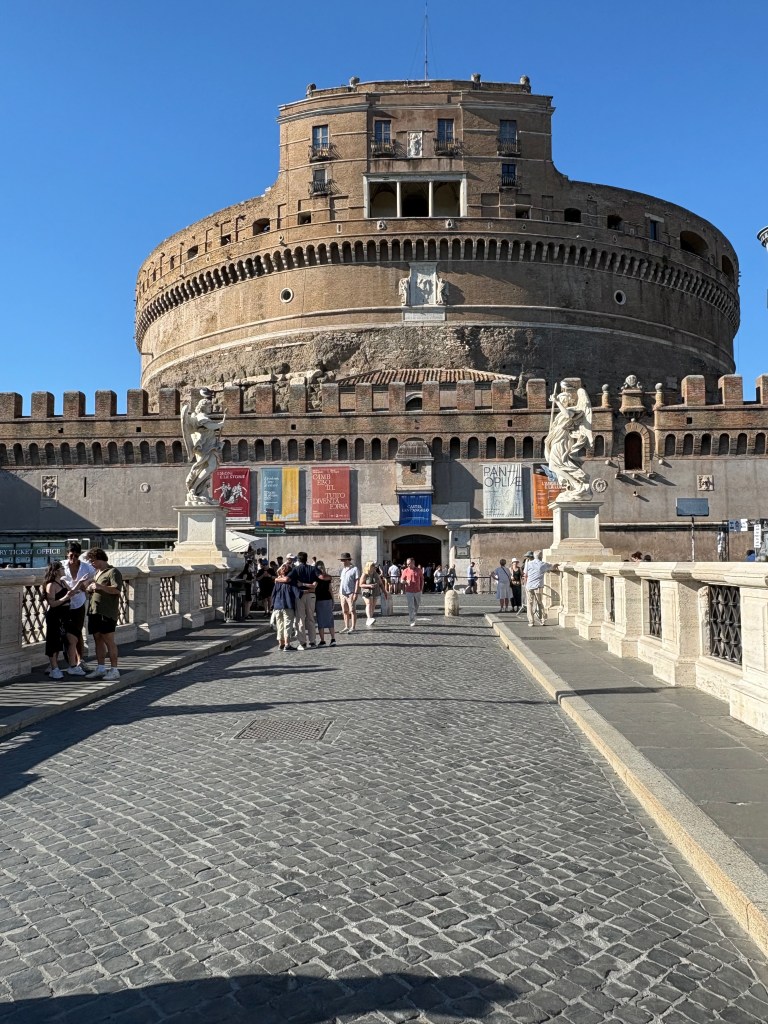
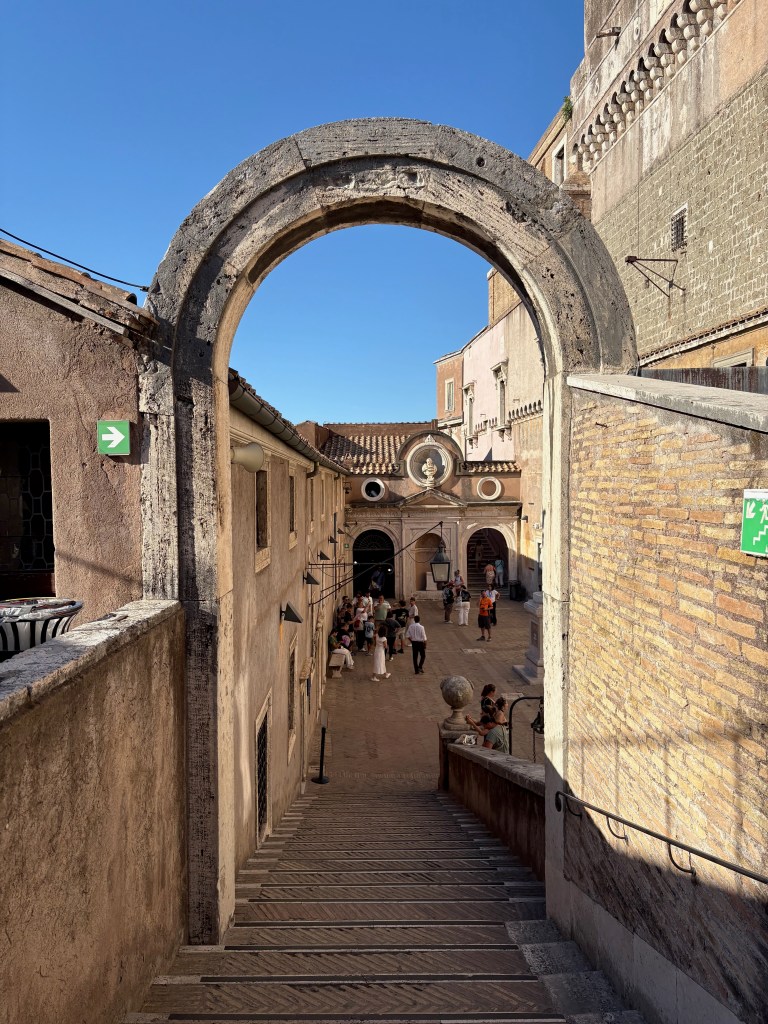
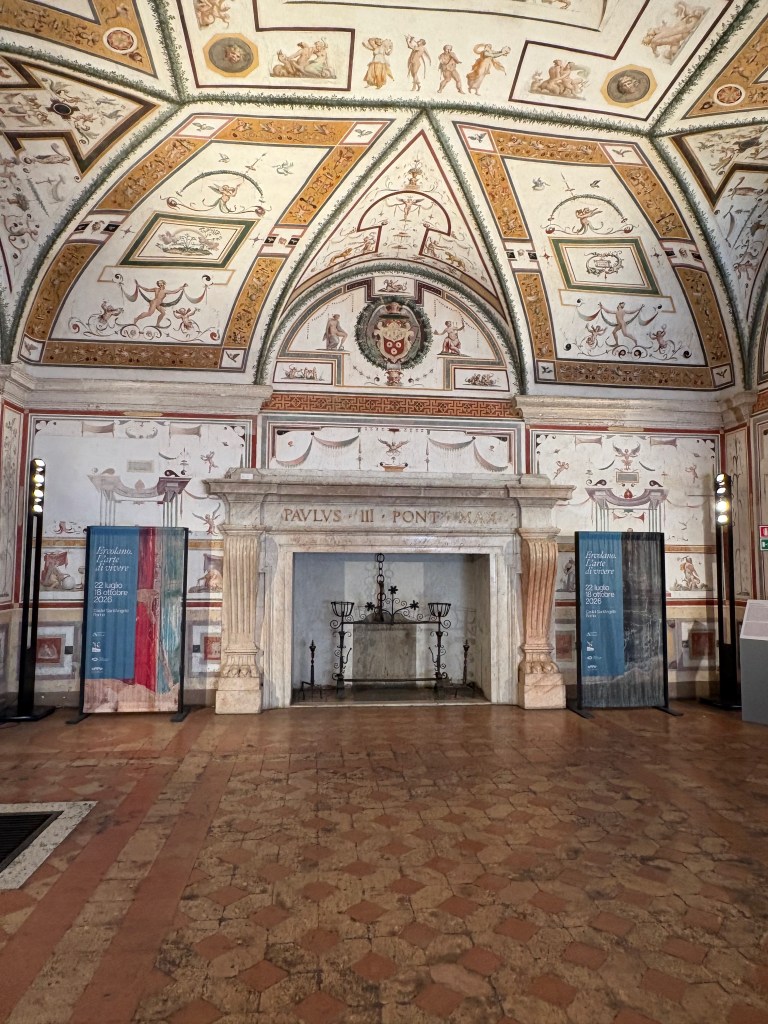
Hadrian’s Mausoleum had many uses in the years including as military station, jail, and palaces.
There were incredible views after many steps up to the top to see Vatican City and Rome.
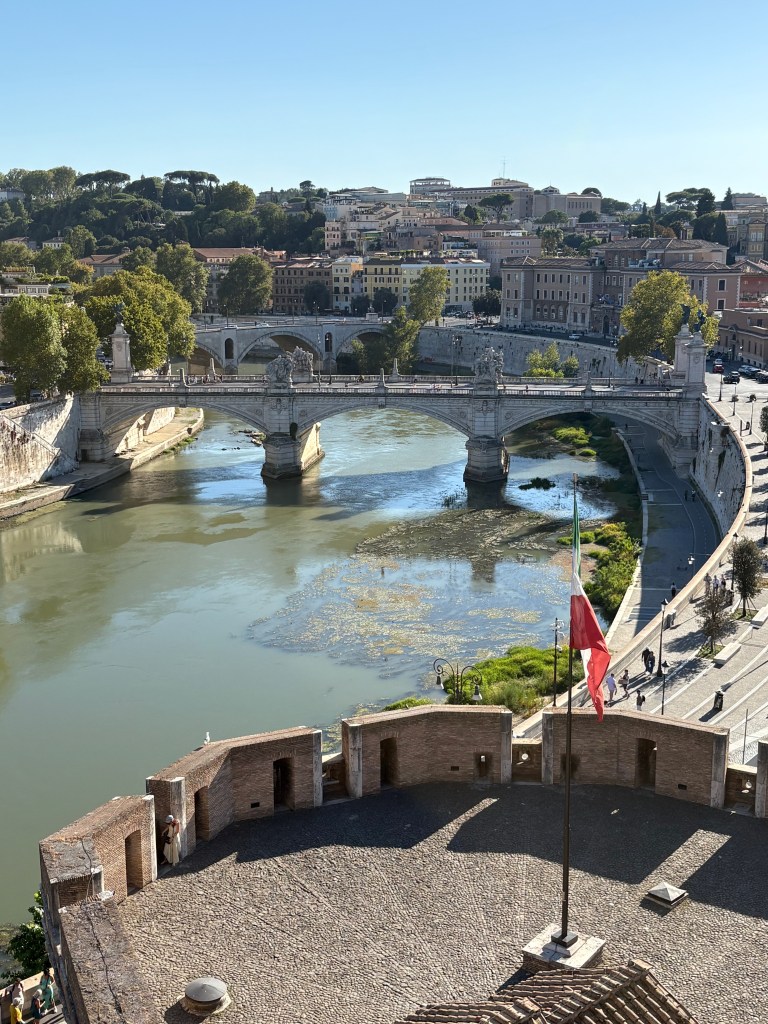
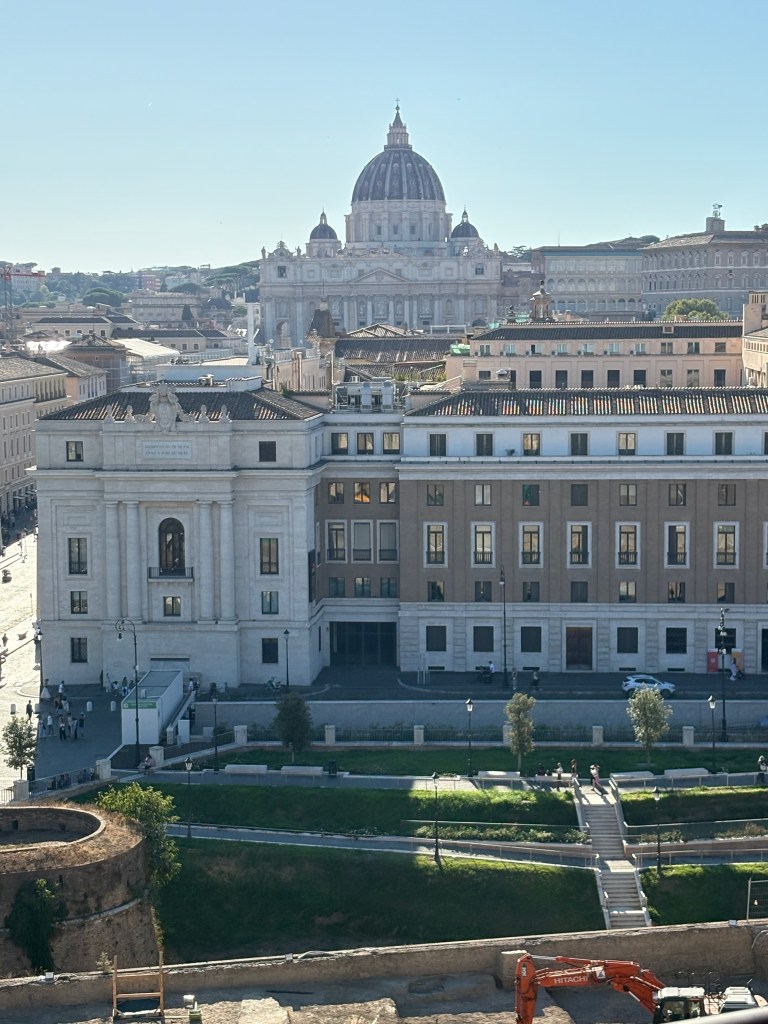
We walked across the bridge with many people, including two weddings, to the pedestrian area across the bridge and since we hadn’t eaten yet, had an early dinner at Ristorante Sant’Angelo. This was a disaster: the waiter got our order wrong twice so we decided to just eat one main: seafood linguini and it was nothing less than awful. We were tired so we walked back to a nearby piazza to get a taxi home. Our internal clocks were out of whack so we didn’t sleep well to start but slept until 11:00 on Sunday morning.
September 6 Day 1 Rome
We decided to report the theft to the police so the manager at the hotel called the main office and let them know that we were coming because it was Sunday and they closed at 2. We arrived by taxi at 1:30, filled out a form and received the stamped form as we might be abled to claim the cash.
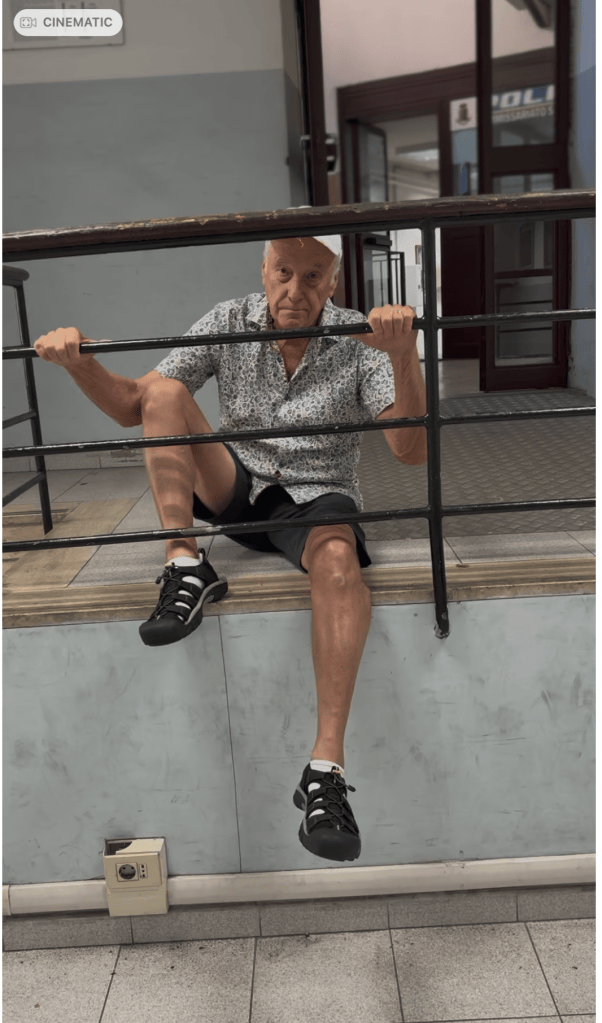
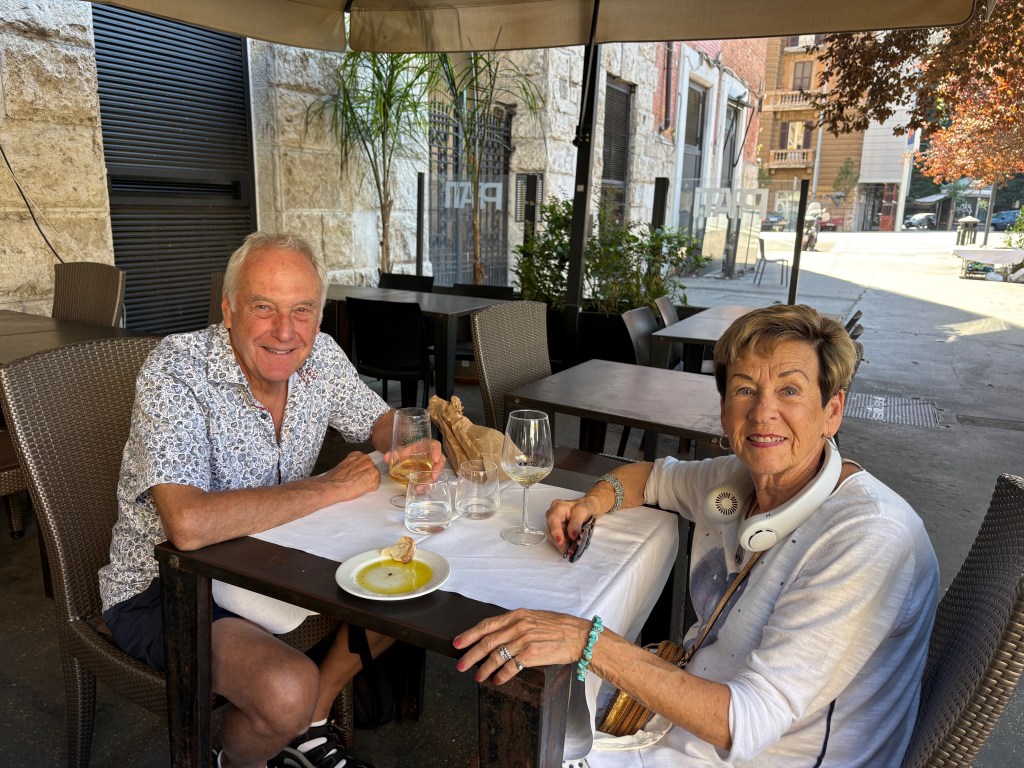
We walked toward the Metro and stopped at a local restaurant (filled with Italians), Prati Rione Gastronimico.
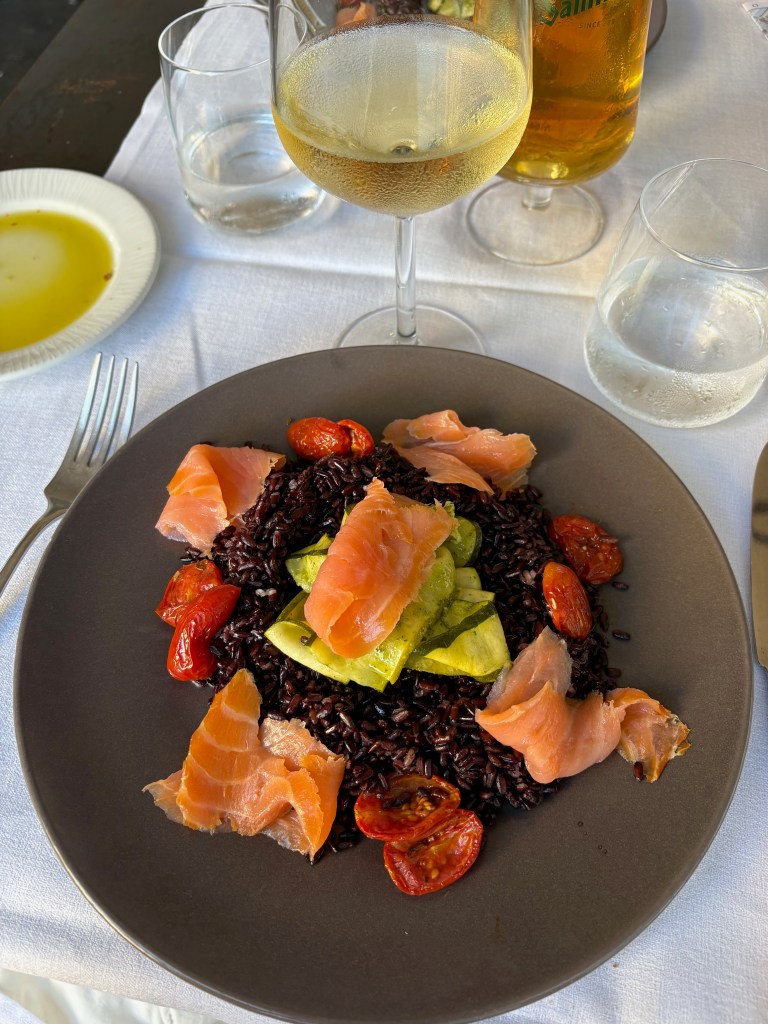
We had a fabulous lunch: black rice, smoked salmon, tomatoes and pickled zucchini with a lovely white wine, Bellone by Poggio Martino, and an Italian beer. The bill was 60 Euros which translates to $98.00.
The Trafalgar tour group met for dinner.
Trafalgar Tour: Italy Bellissimo
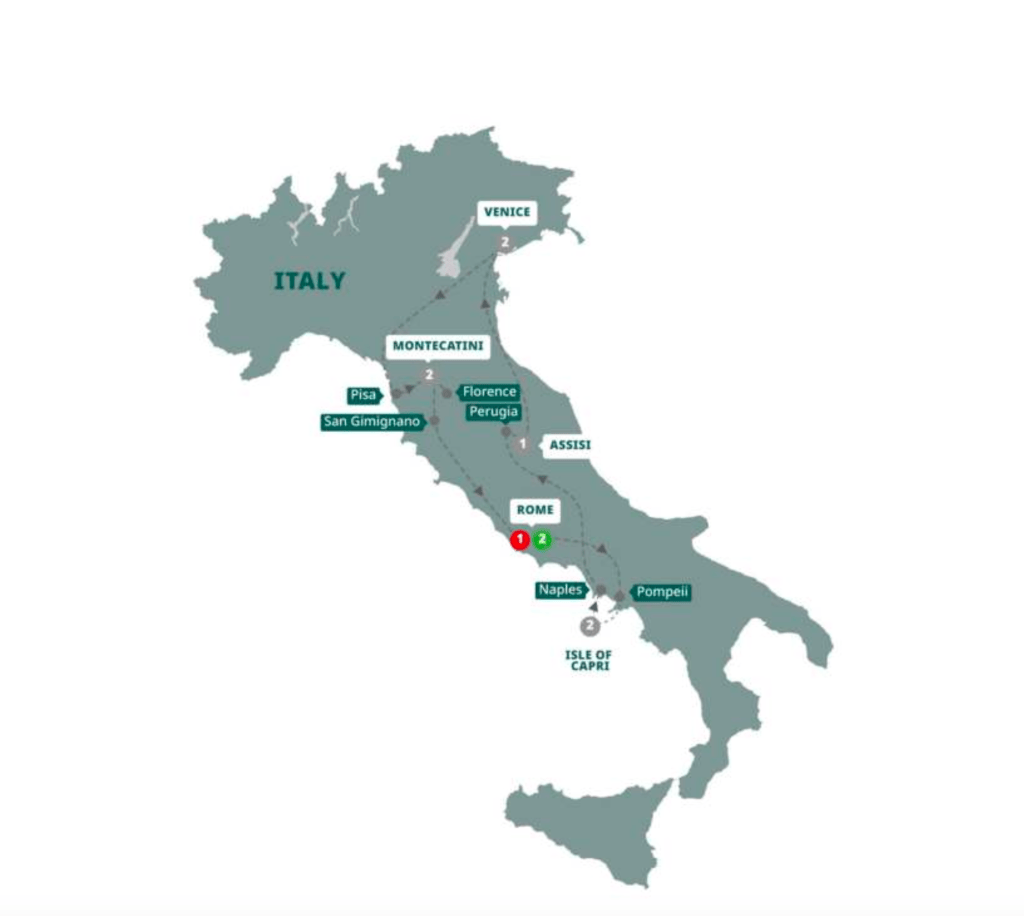
Day 1 | Welcome to Rome
We met our Travel Director, Pamela, and 41 fellow travellers before dinner and she reviewed the itinerary and optional tours. We sat with Perry and Tanya and Patti and had a good, not great dinner.
September 7 Day 2 | Explore Ancient Rome and the Vatican City
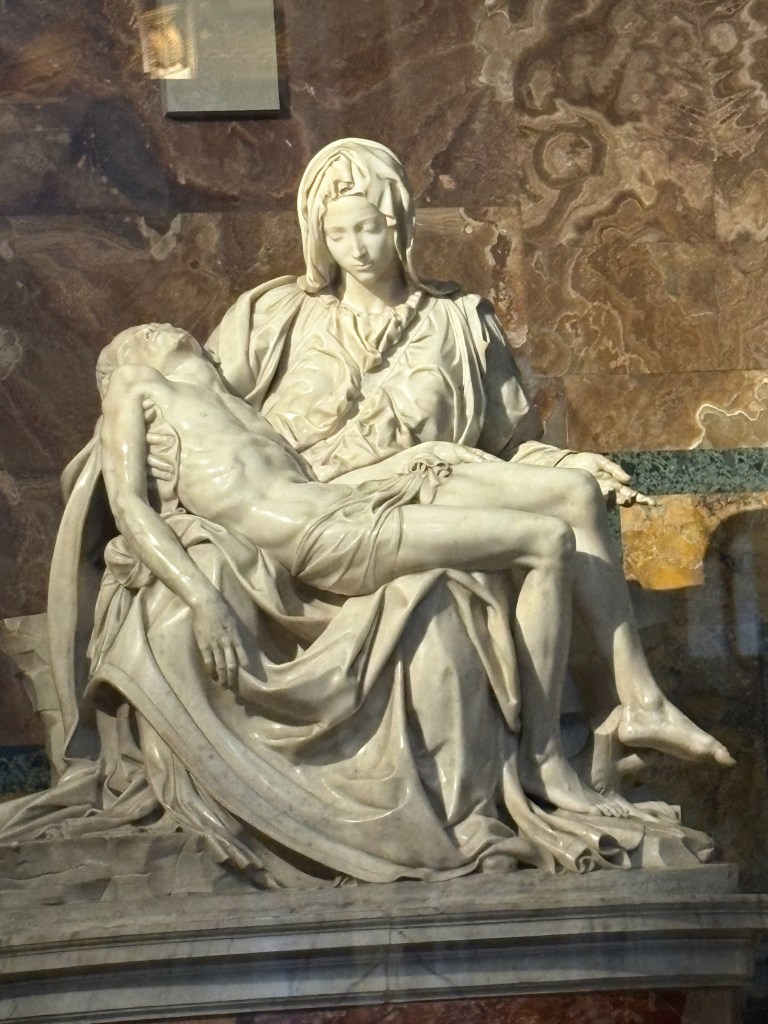
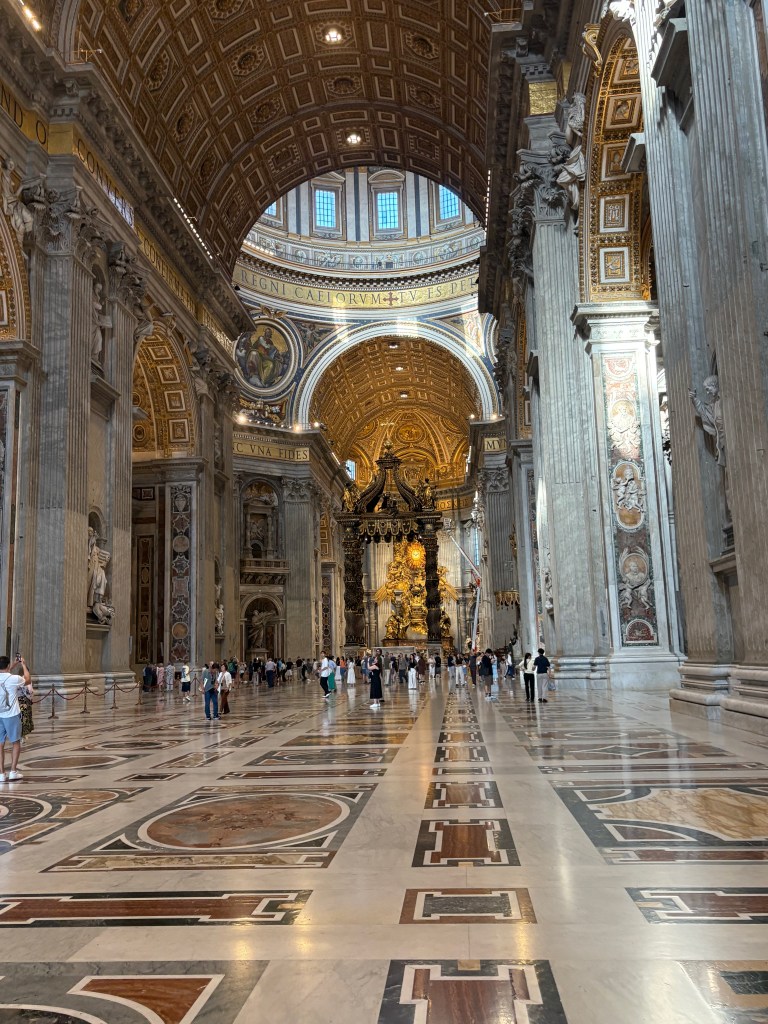
After breakfast, we had a journey through Rome that began at the Vatican , where we joined a Local Guide to admire the architecture and Michelangelo’s sorrowful Pietà in St. Peter’s Basilica.
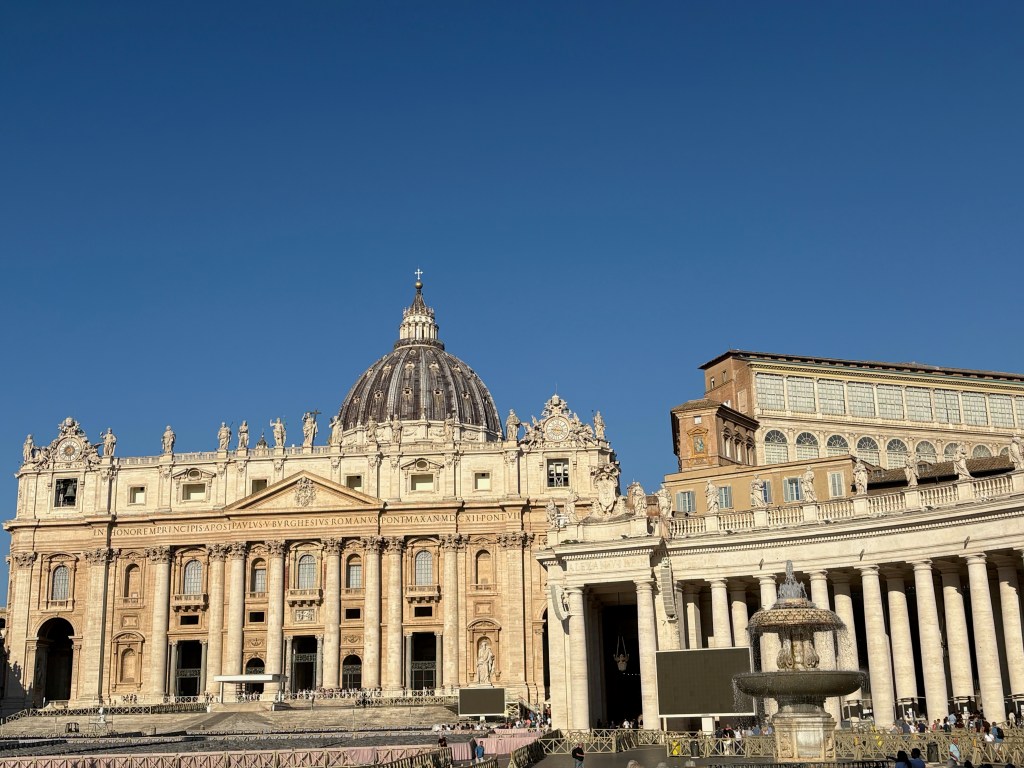
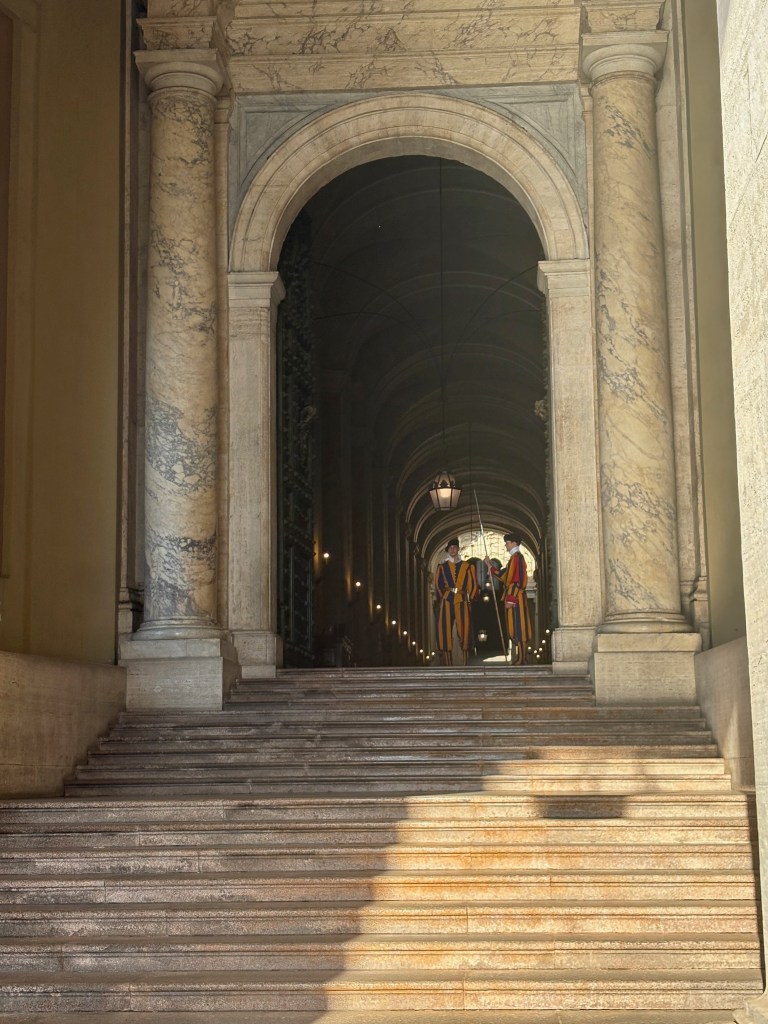
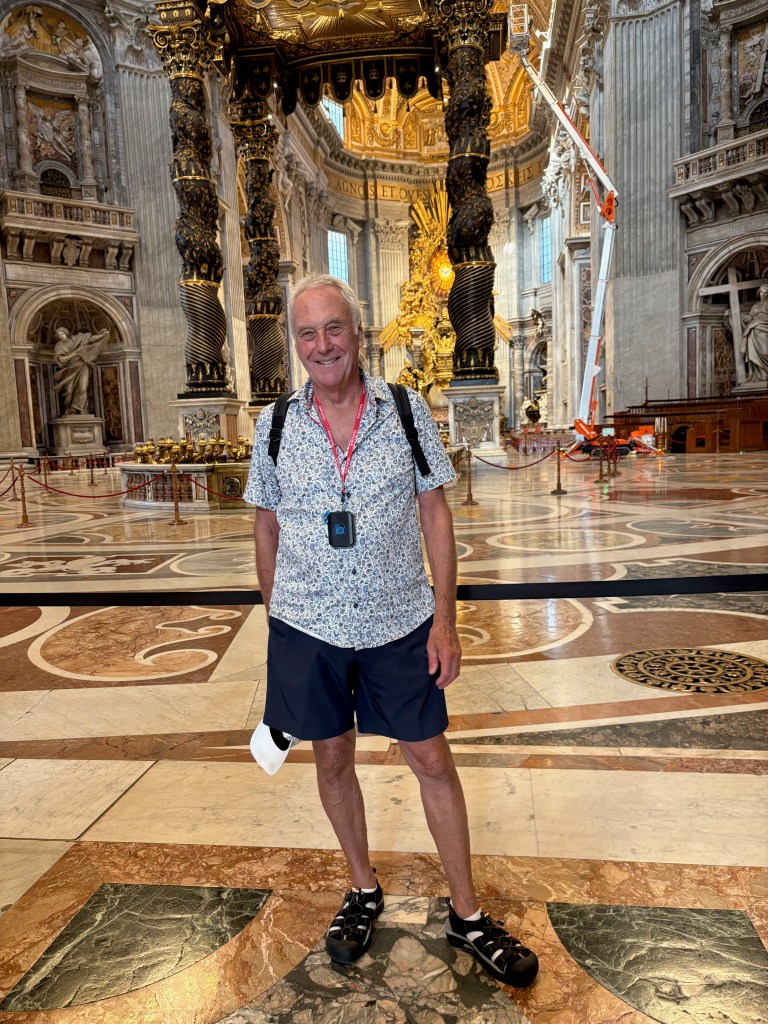
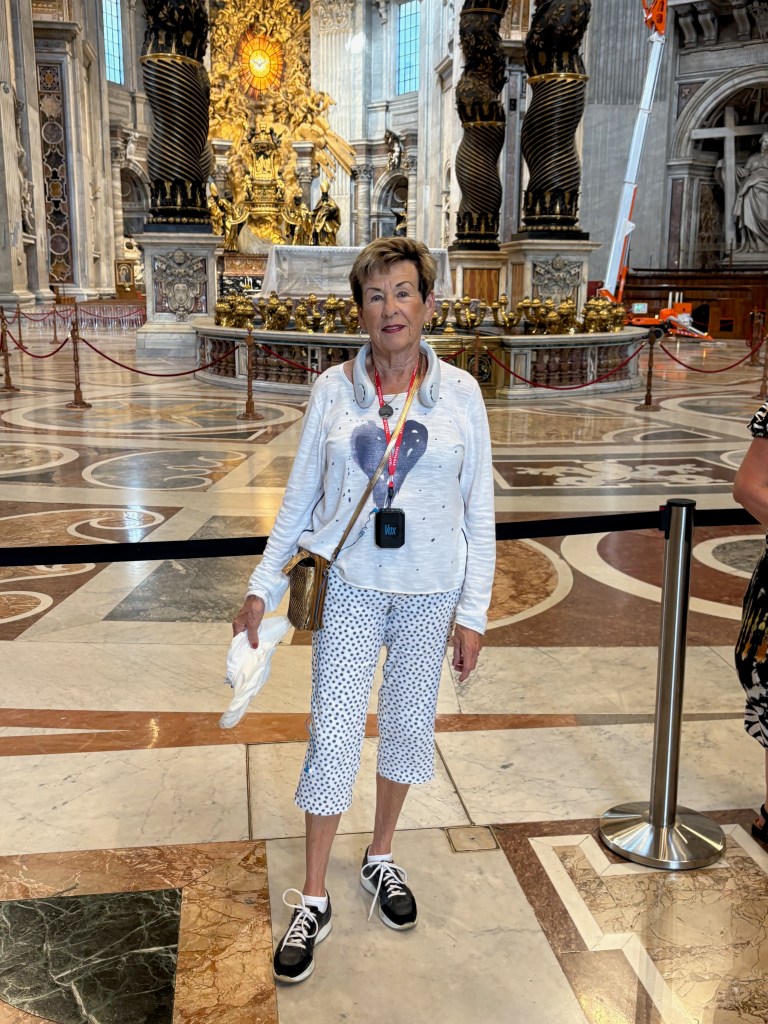
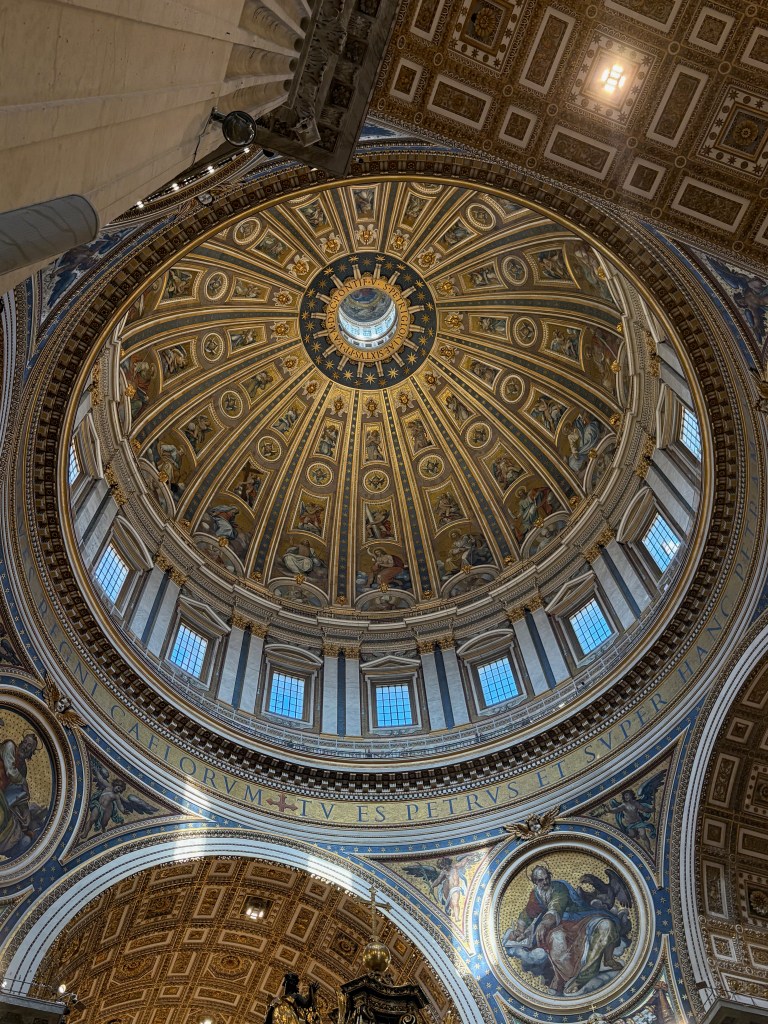
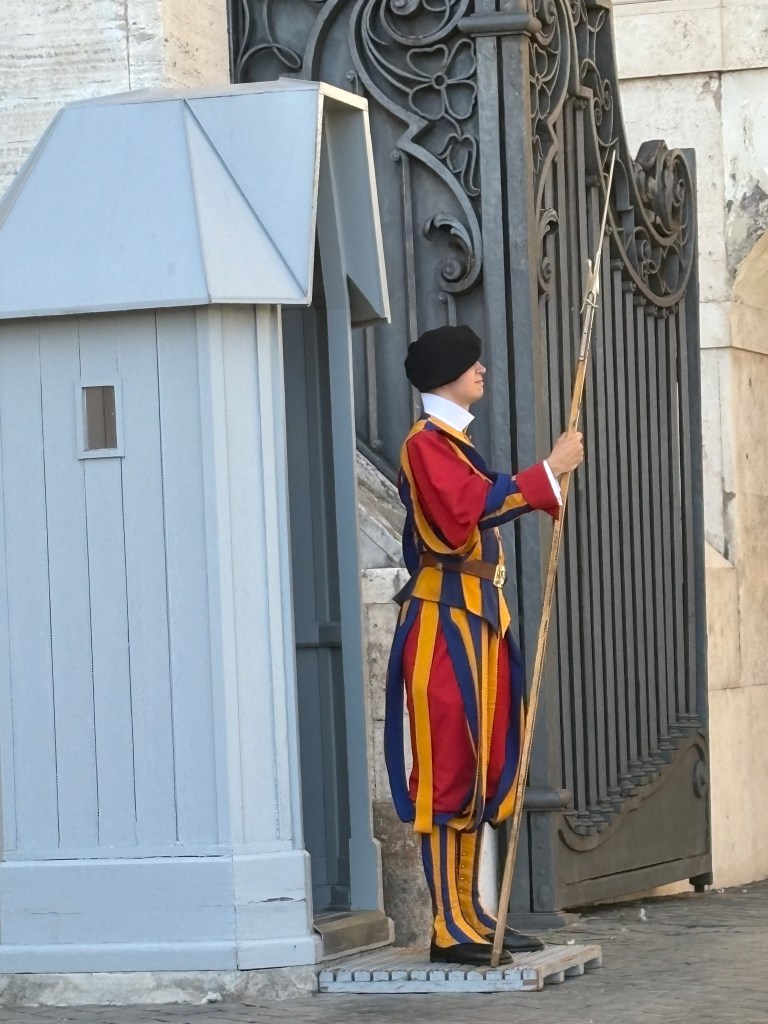
The Pontifical Swiss Guard is a small, elite military force responsible for the safety of the Pope and Vatican City established in 1506 by Pope Julius II. In the Sack of Rome on May 6, 1527, 147 of the 189 guards died defending Pope Clement VII, allowing him to escape. They must be single Swiss male citizens who are practicing Roman Catholics, between 19 and 30 years old, at least 1.74 meters (5 feet 8 inches) tall and must have completed basic training in the Swiss Armed Forces. And, the guide said, must have some high level connections.
When the Pope speaks to the masses in the square, he speaks from one of the two windows at the left.
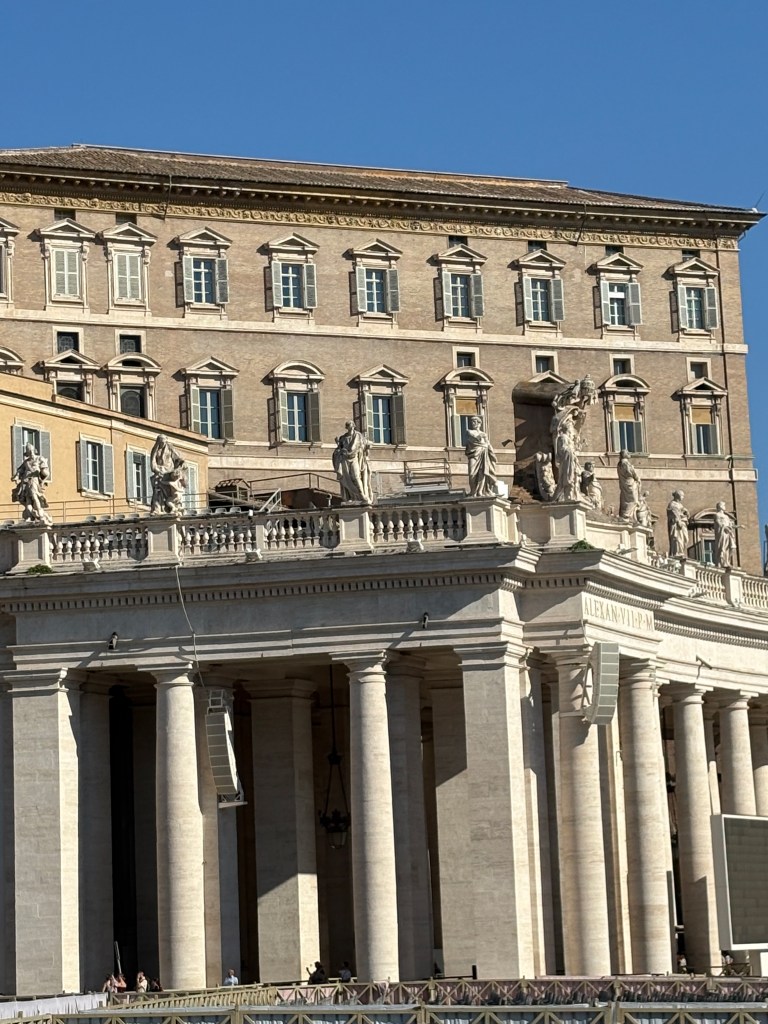
Then we had, with the same guide, a tour of Piazzas and Fountains strolling through the maze of narrow streets and picturesque squares in Rome’s historic centre, uncovering famous landmarks and hidden gems in the Eternal City.
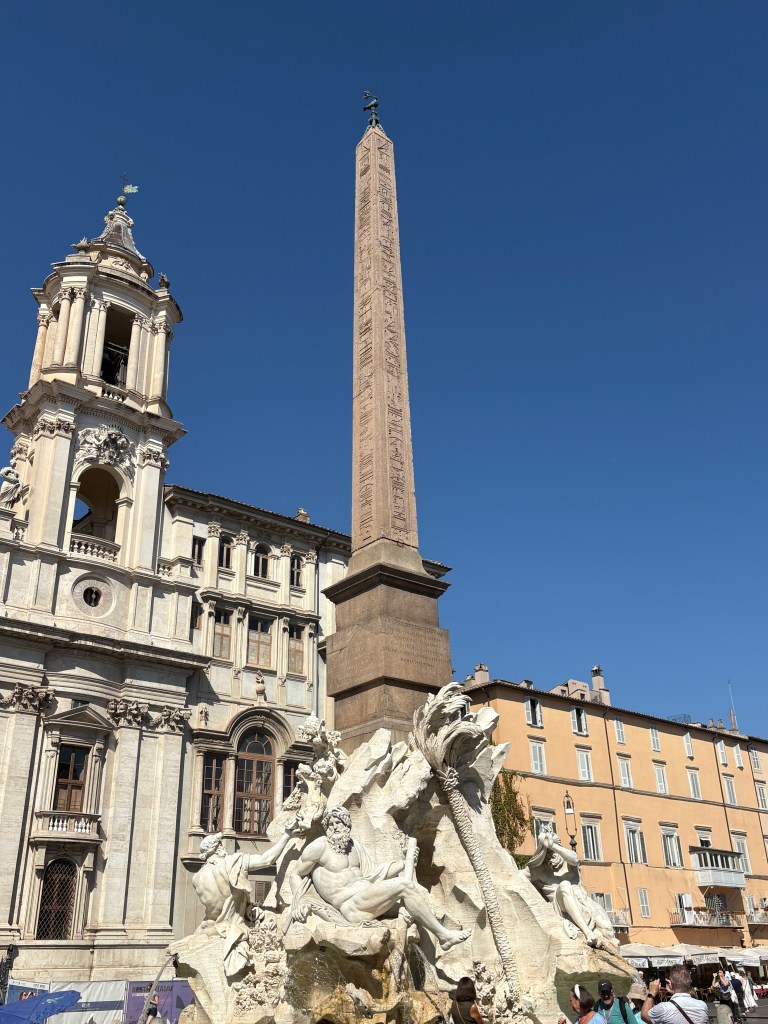
The famous and local favourite square, Navona, the Fountain of the Four Rivers, representing the Danube, the Nile, the Rio de la Plata and the Ganges is less well-known but stunning and the model for the Trevi.
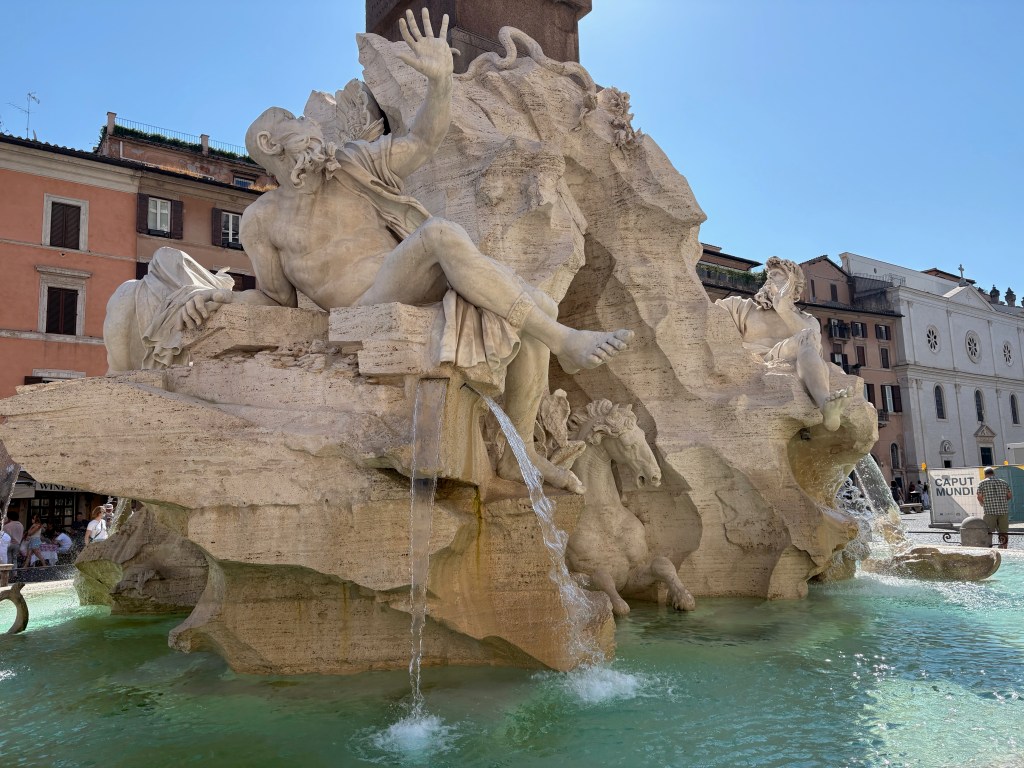
This ancient Roman spire in the sculpture. 16.5 metres high was commissioned by Roman Emperor Domitian in the first century AD, rather than importing it from Egypt.
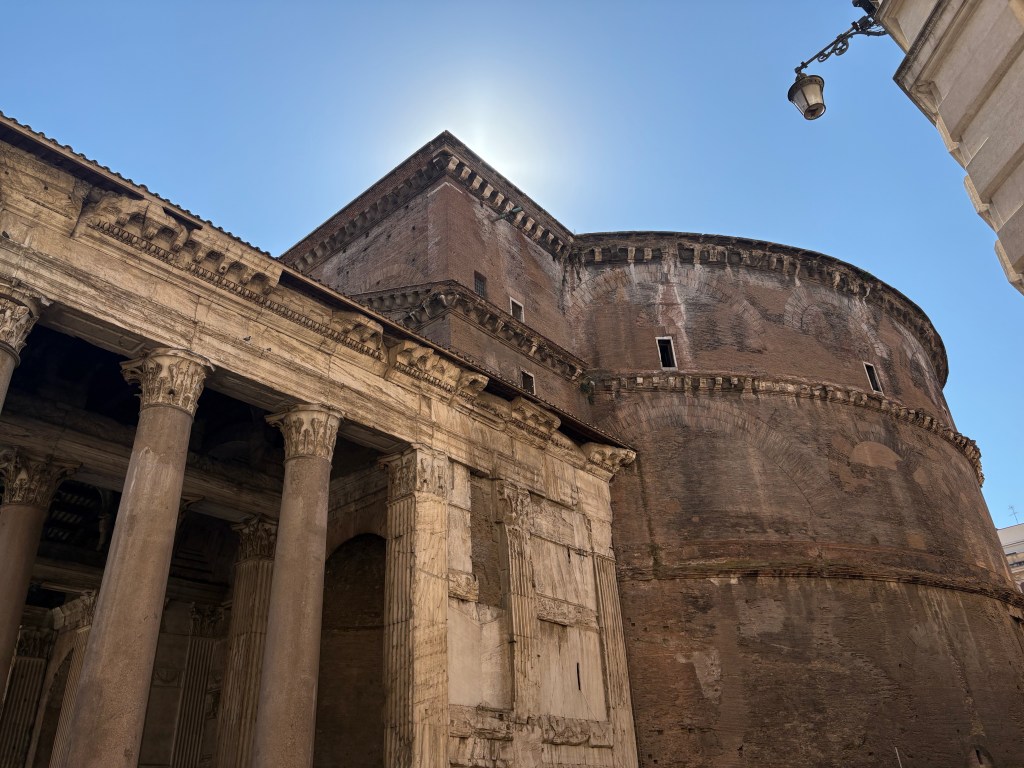
In the afternoon, we visited some of the enduring symbols of Ancient Rome, including the Pantheon and the Colosseum.
The Pantheon is the best-preserved ancient Roman monument famous for its massive unreinforced concrete dome and central opening called the oculus. Originally built by Marcus Agrippa in 27 BC, rebuilt by Emporer Hadrian around 125 CE and consecrated as a Christian Church (Basilica of St Mary and the Martyrs) in the 7th Century.
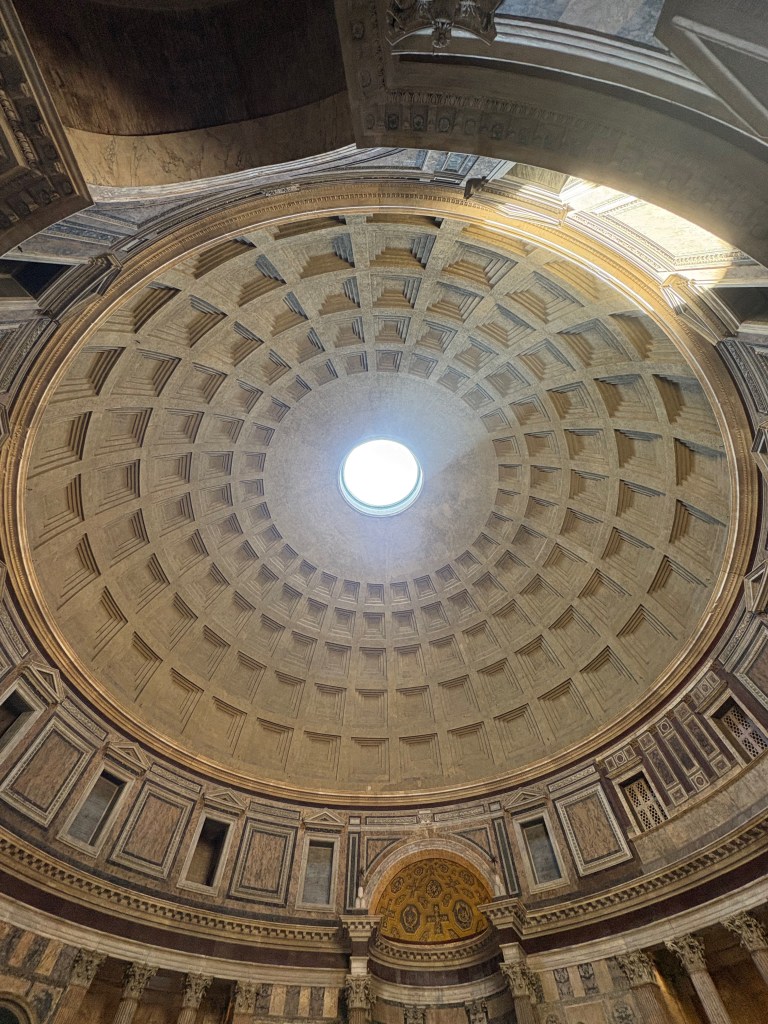
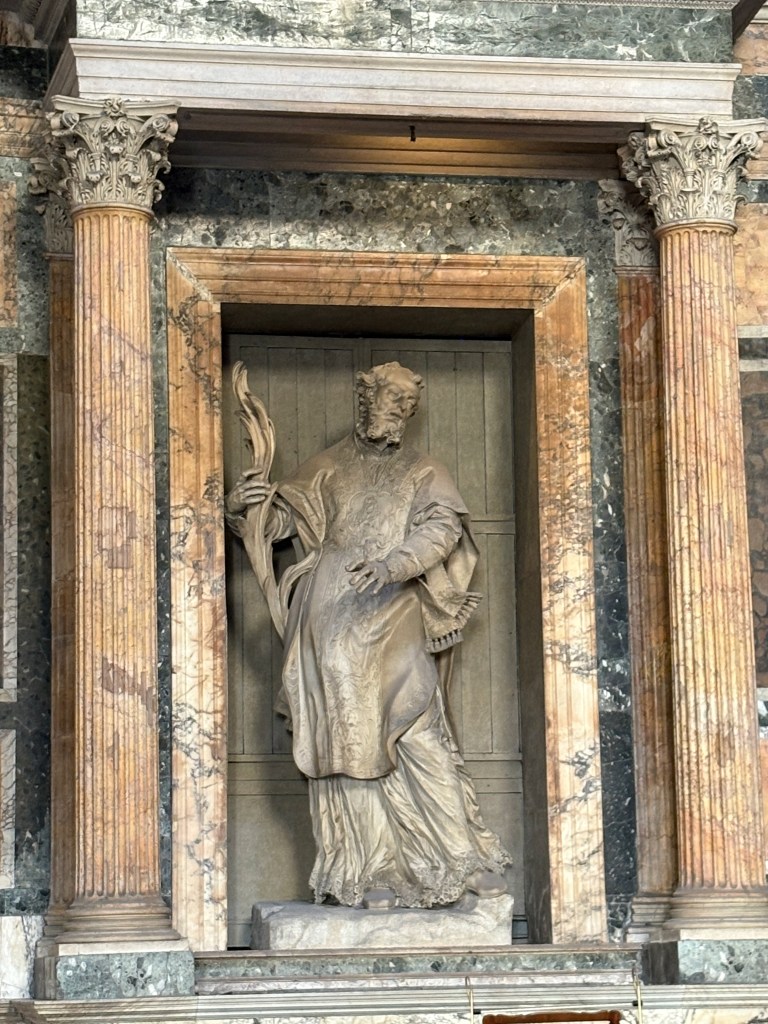
The interior is stunning, made of marble and gold and huge statues.
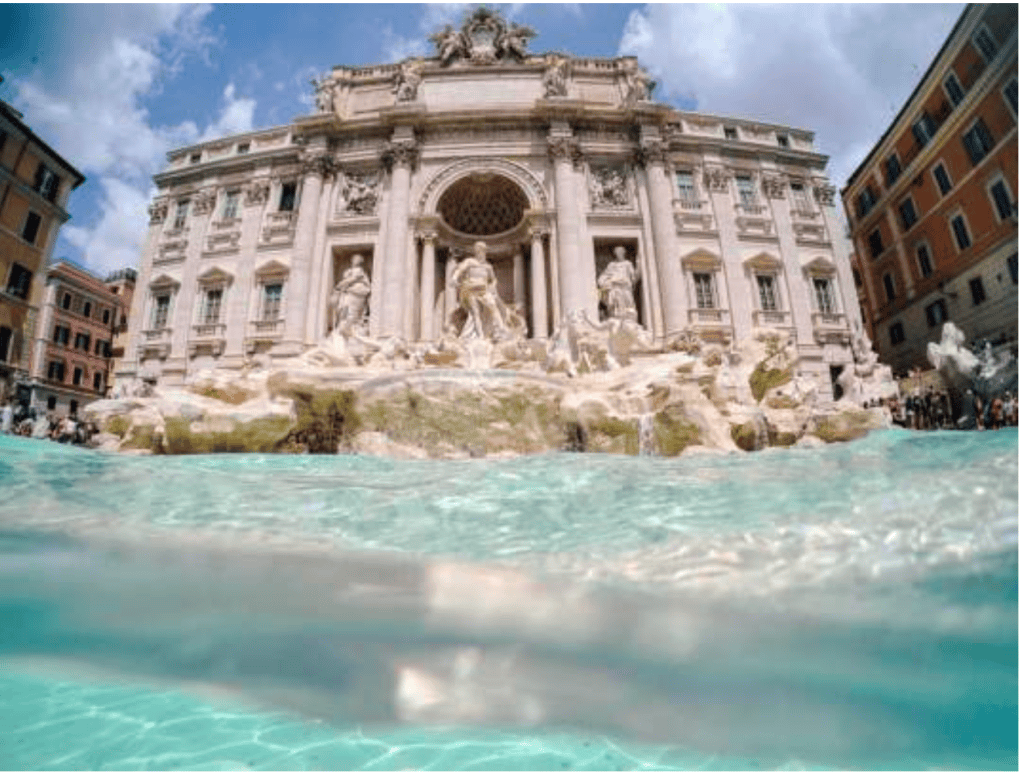
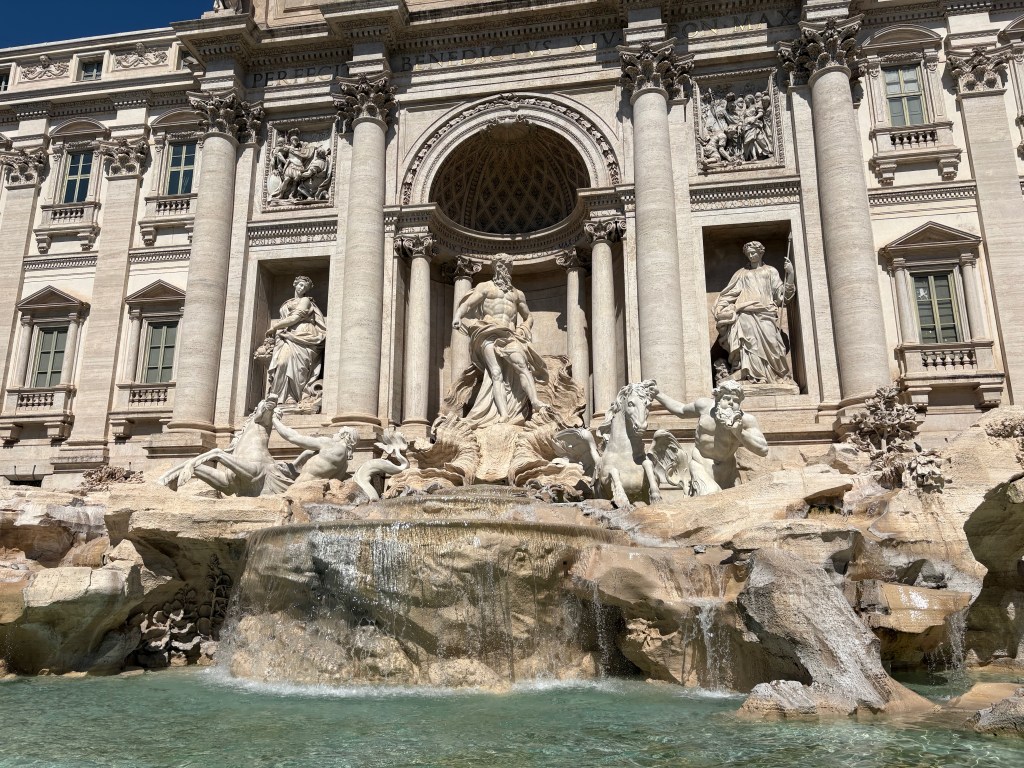
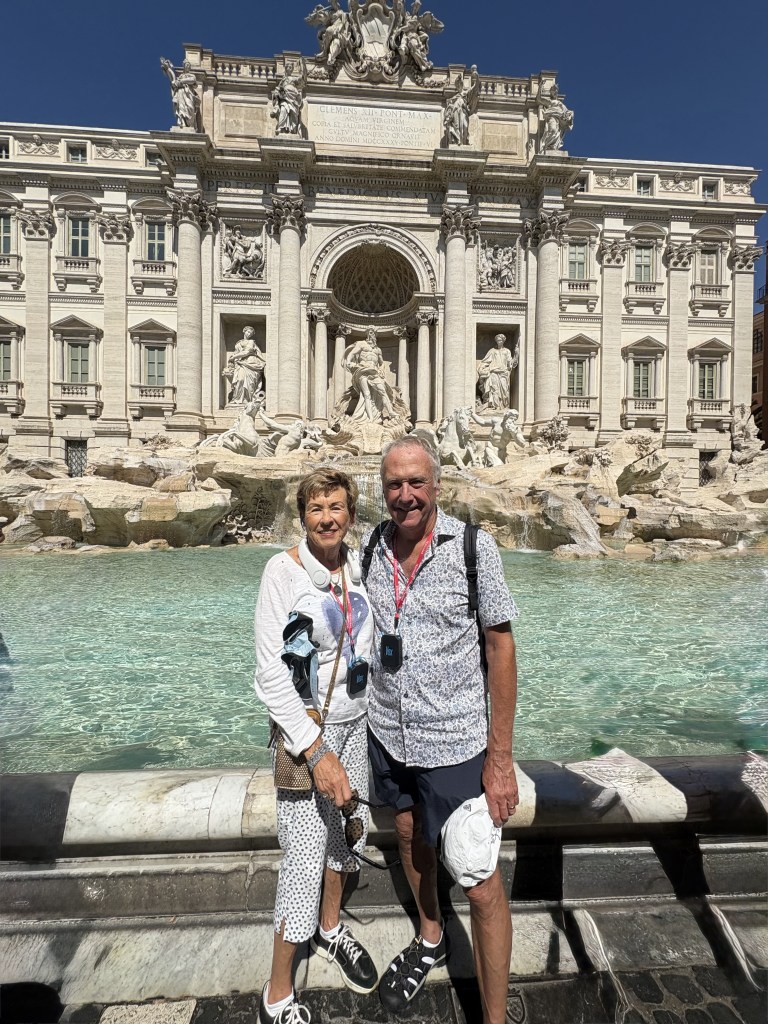
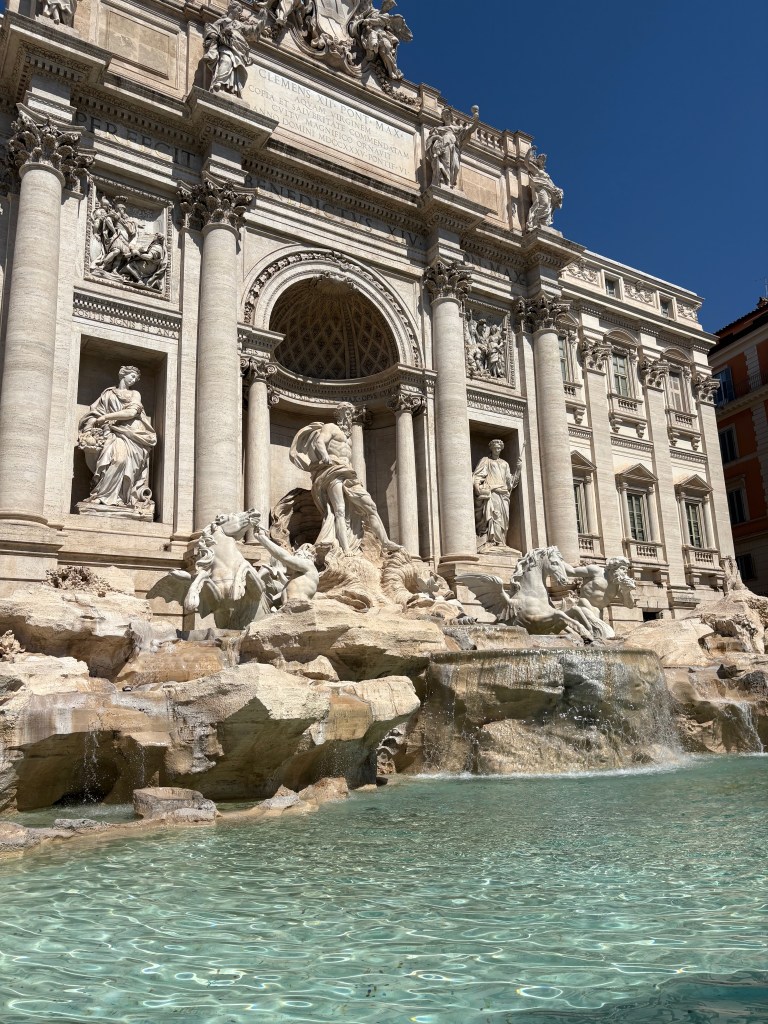
Next stop was the Trevi Fountian. Others in our group had tried to get near it and couldn’t. I’m certain that we would not have got near it either without the guide and tickets down the stairs.
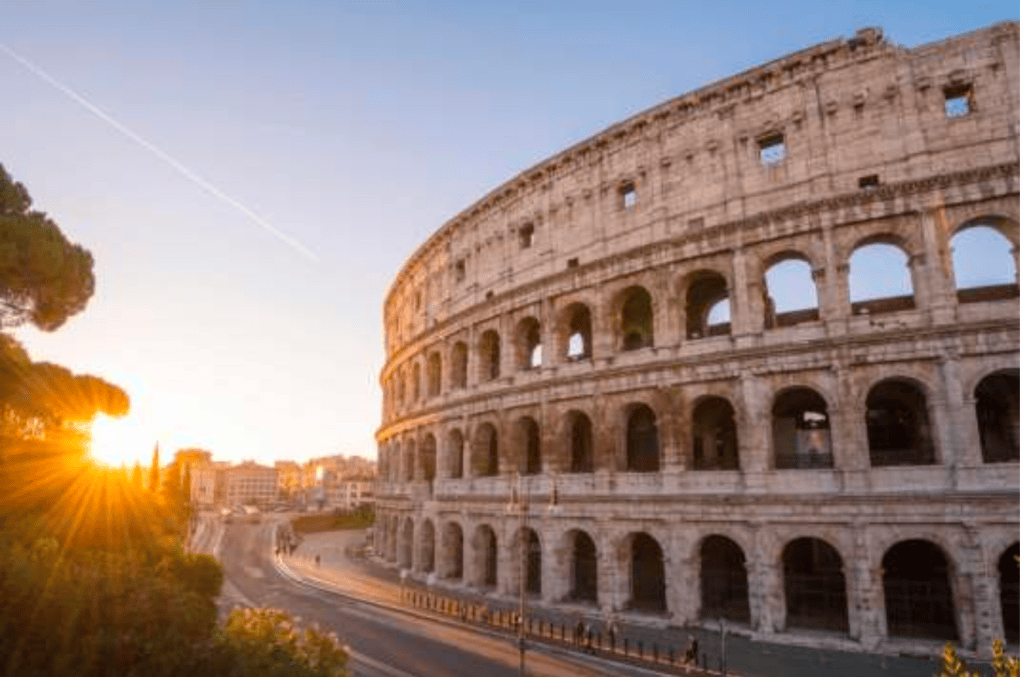
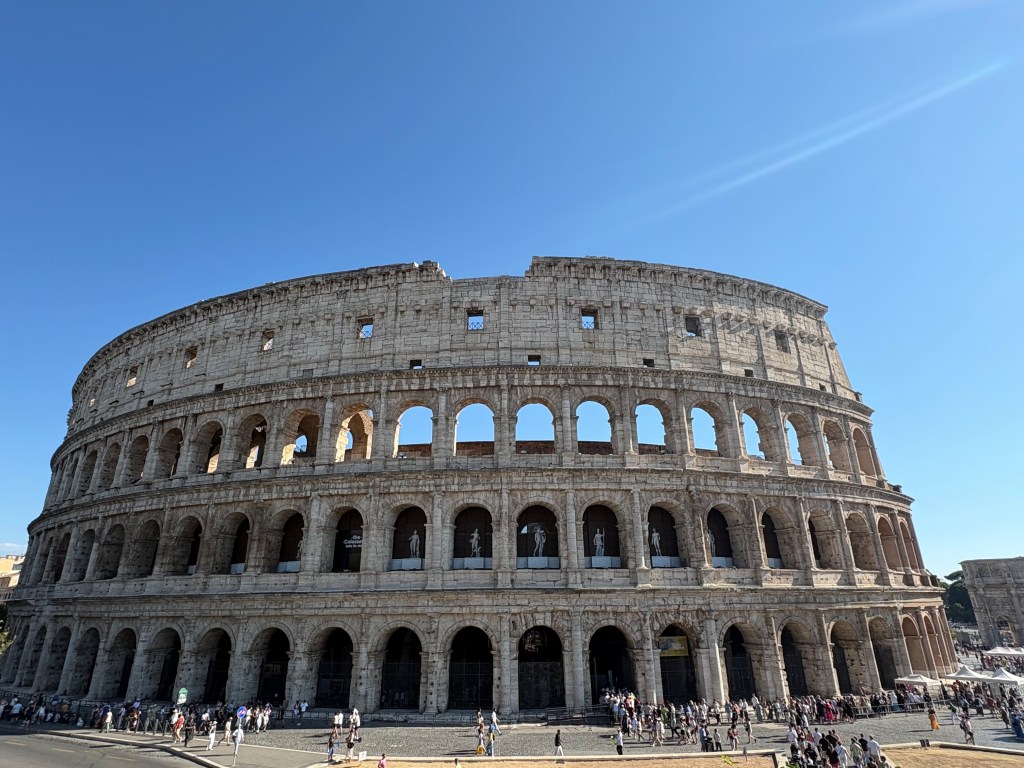
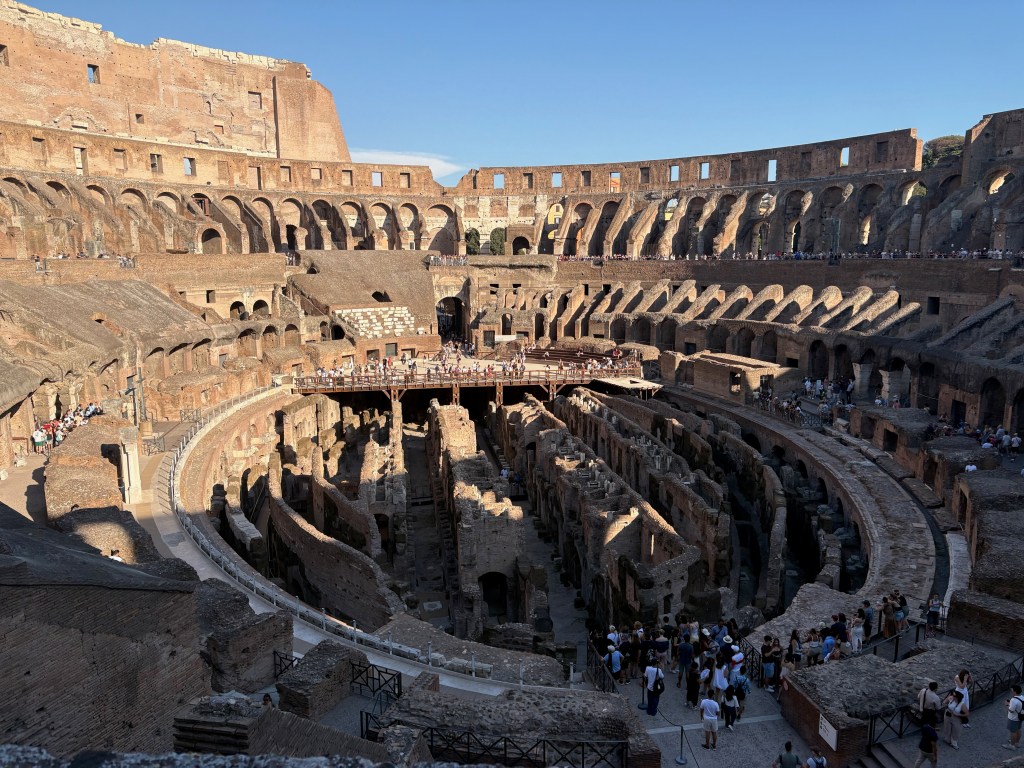
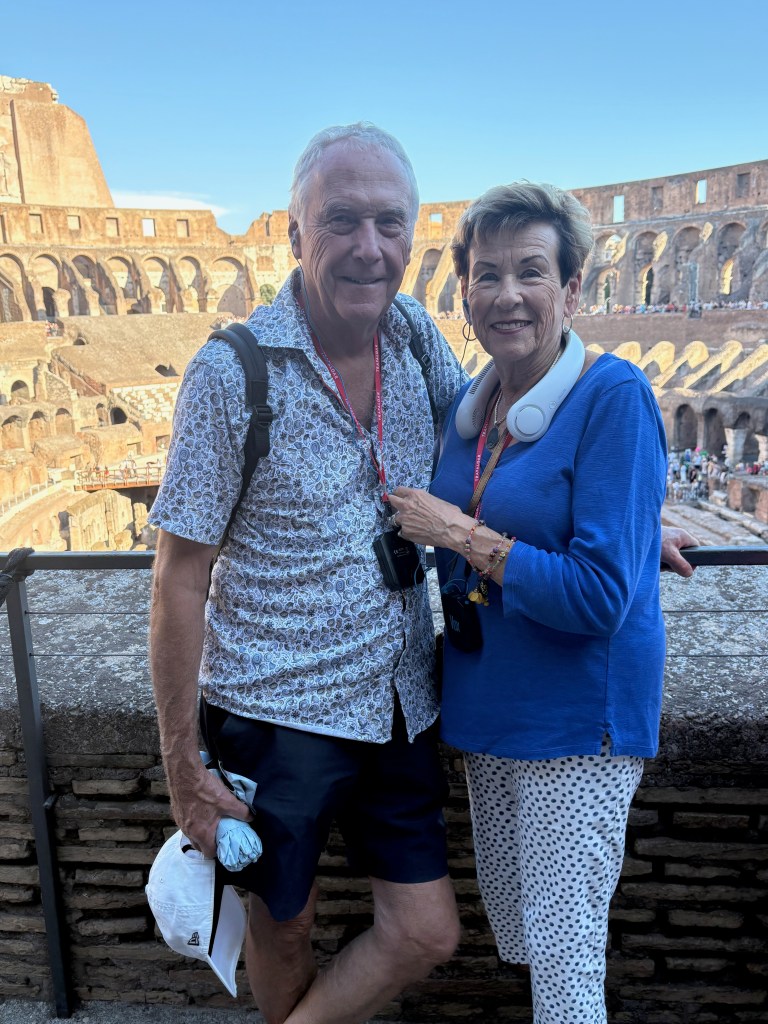
We had a break and then headed to the Colloseum later in the afternoon. There were still crowds but they were smaller. We had Dorian again and he did a masterful job of getting us to various points in the building with descriptions of its various lives from stages for gladiators and theatrical spectacles presented by the Emperors to gain the favour of the people to living quarters in Medieval times.
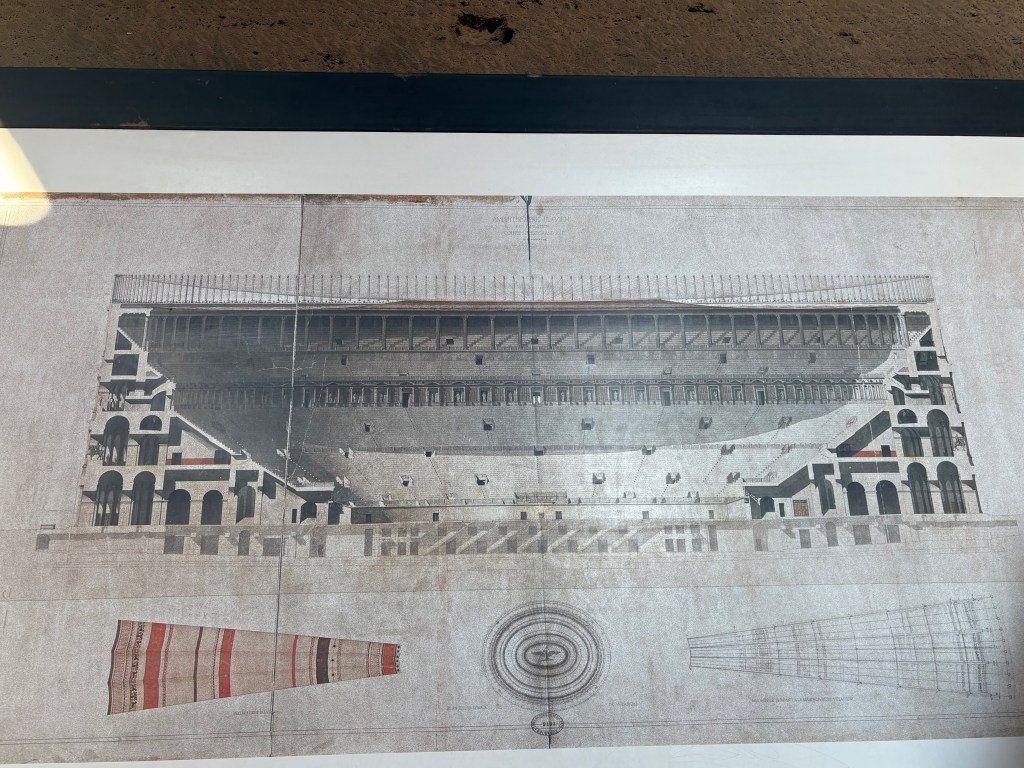
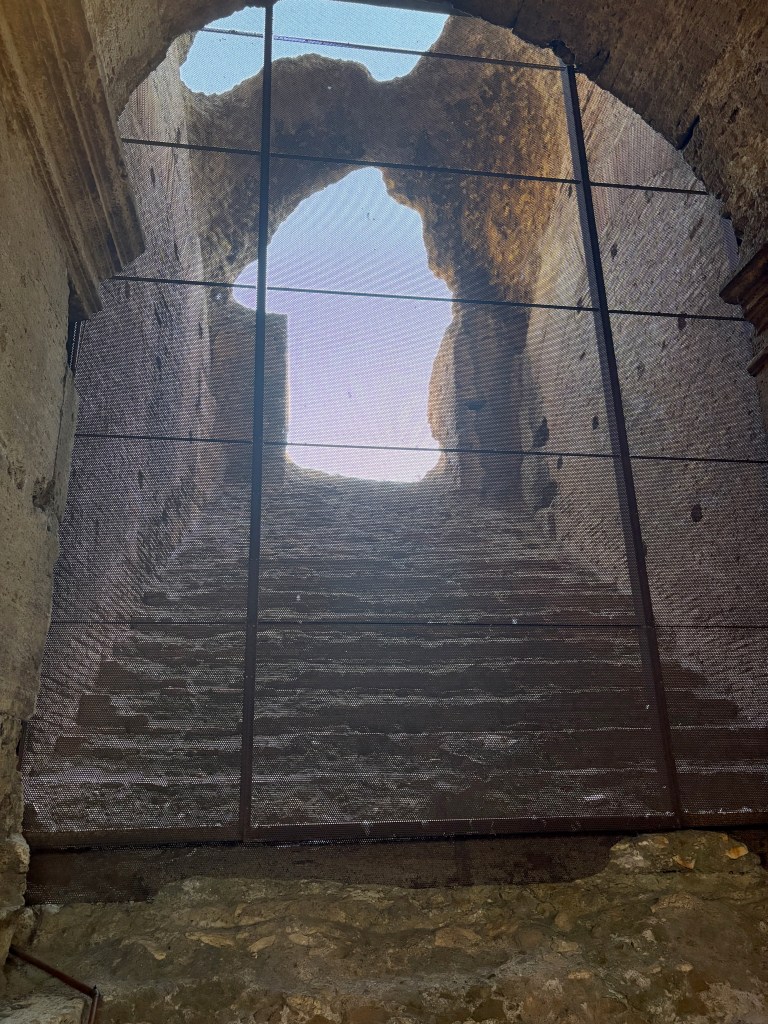
Only the northern part of the Colosseum remains with the area under the floor open except for a small section that has been replaced. This was the stage of the theatrical events presented by the Emperors for the entertainment of the people. The spectacles occurred once a year and took the rest of the year to write and prepare for next year’s event.
The Colosseum is most famous for being the largest ancient amphitheater ever built and serving as the primary venue for brutal gladiatorial combat and public spectacles in ancient Rome.
Inside armed combatants, often enslaved people, prisoners of war, or condemned criminals, fought to the death for public entertainment. Imported exotic animals like lions, tigers, bears, and elephants were hunted or made to fight. Criminals were publicly executed during midday interludes. The arena floor was occasionally flooded to stage realistic ship battles. The Flavian Amphitheatre could hold between 50,000 and 80,000 spectators who were protected from the sun by a giant retractable fabric awning (velarium).
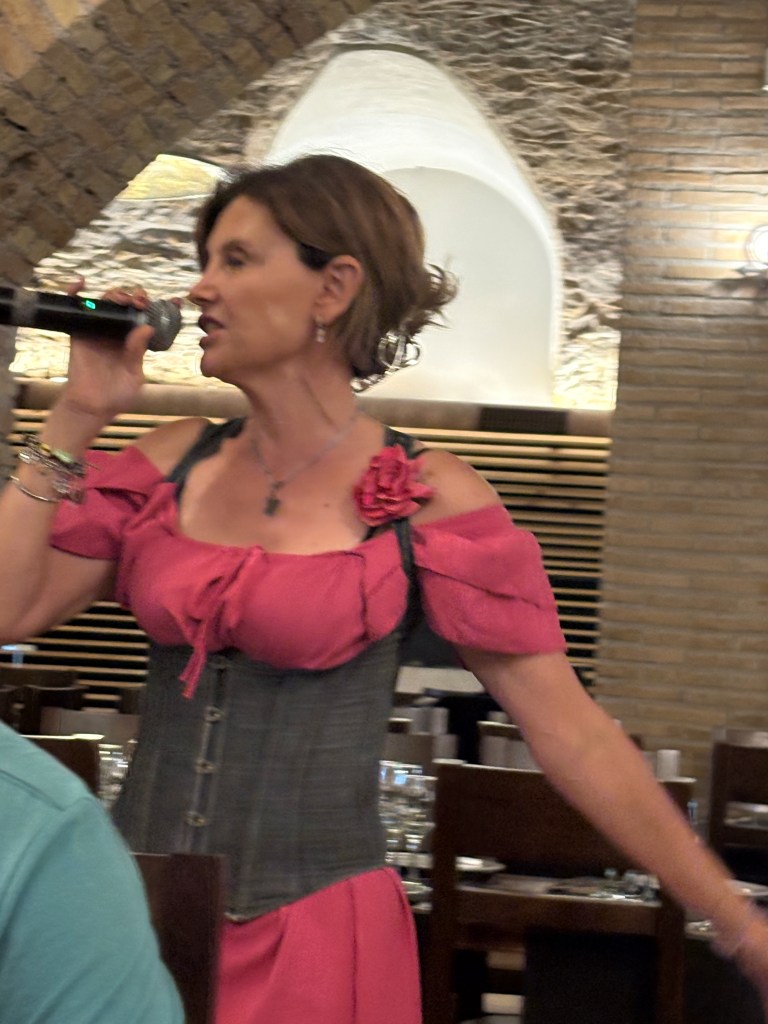
We had a very lively dinner in a rathskeller-type setting with three very operatic singers. It was very noisy!
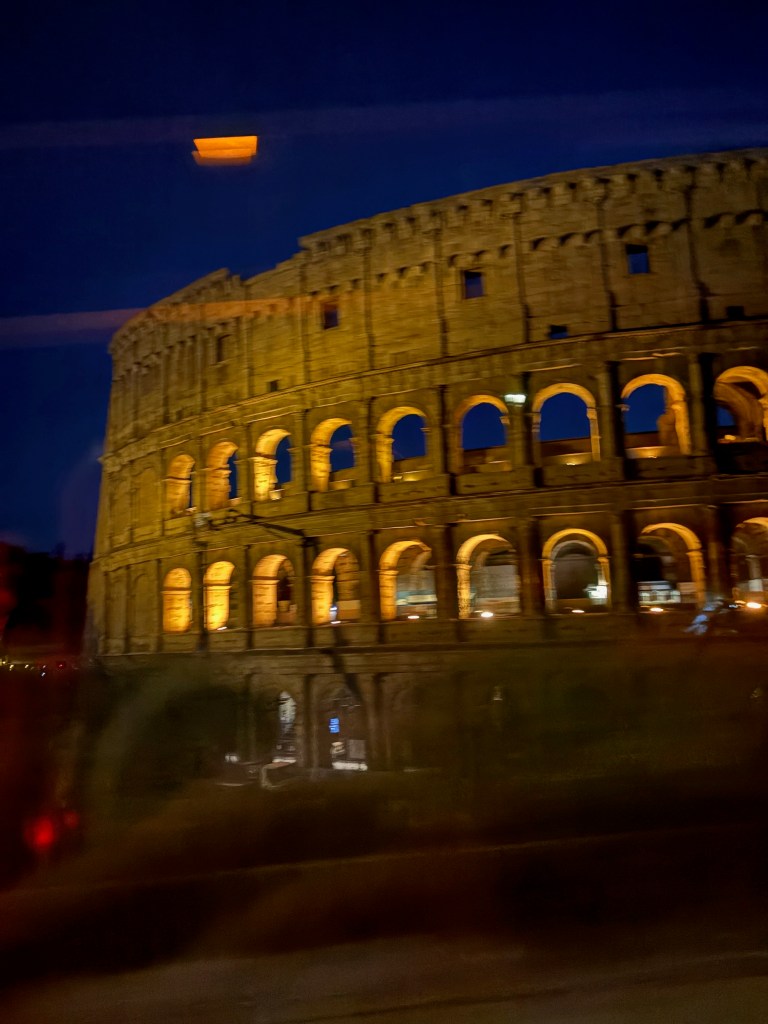
And now it is goodbye to Rome until the end of the tour.
September 8 Day 3 | Admire Pompeii and on to Capri
After a 2 and a half hour bus ride from Rome to Pompeii, we had another ripping hot humid day (36 degrees) to visit Pompeii. Until we arrived in Venice, it was two showers a day. We had a local guide who was very knowledgeable and took us through parts of the city for about 2 hours.
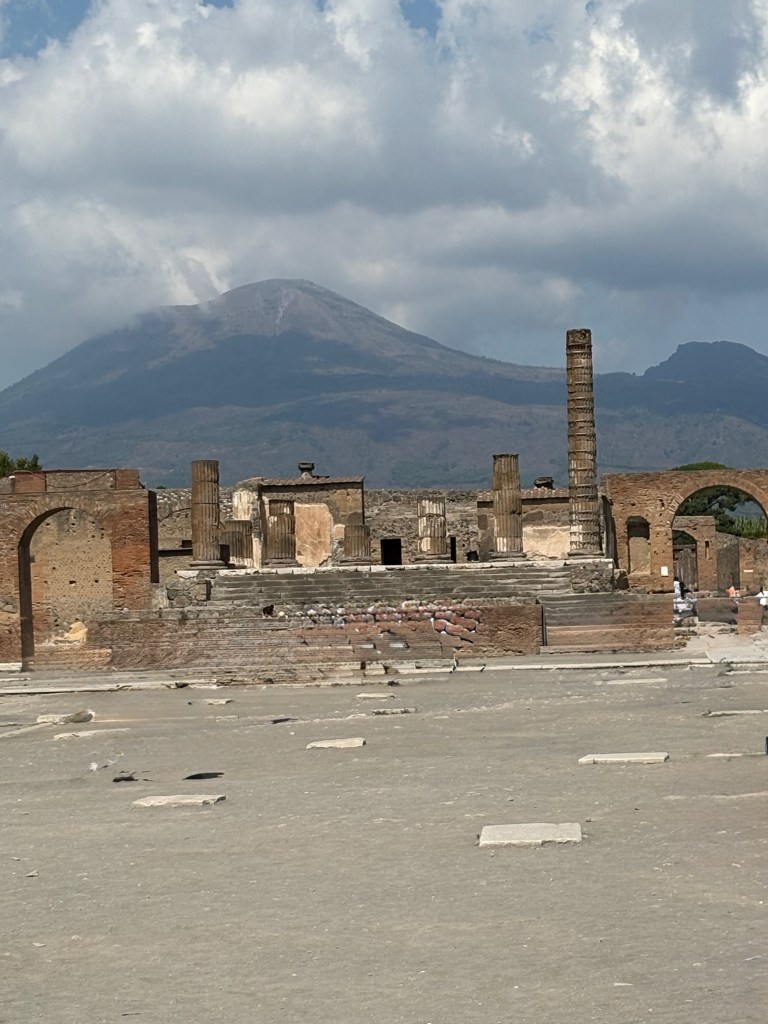
Pompeii was buried under 4 to 6 m (13 to 20 ft) of volcanic ash and pumice in the eruption of Mount Vesuvius in 79 AD. Largely preserved under the ash, Pompeii offers a snapshot of Roman life, frozen at the moment it was buried, as well as insight into ancient urban planning. It was a wealthy town of 10,000 to 20,000 residents at the time it was destroyed. It hosted many fine public buildings and luxurious private houses with lavish decorations, furnishings and artworks, which were the main attractions for early excavators; subsequent excavations have found hundreds of private homes and businesses reflecting various architectural styles and social classes, as well as numerous public buildings. Organic remains, including wooden objects and human bodies, were interred in the ash; their decay allowed archaeologists to create moulds of figures in their final moments of life. The numerous graffiti carved on outside walls and inside rooms provide a wealth of examples of the largely lost Vulgar Latin spoken colloquially at the time, contrasting with the formal language of classical writers.
Pompeii remained largely undisturbed until its rediscovery in the late 16th century. Major excavations did not begin until the mid-18th century, which marked the emergence of modern archaeology. Initial efforts to unearth the city were haphazard or marred by looting, resulting in many items or sites being damaged or destroyed. By 1960, most of Pompeii had been uncovered but left in decay; further major excavations were banned or limited to targeted, prioritised areas. Since 2018, these efforts have led to new discoveries in some previously unexplored areas of the city.
Pompeii is a UNESCO World Heritage Site, owing to its status as “the only archaeological site in the world that provides a complete picture of an ancient Roman city”.
THE LAST DAY
Before eruption, Vesuvius looked like a fertile mountain, its slopes were occupied by rustic villas devoted tổ the production of wine. Convinced that they were in a place protected by the gods, the inhabitants of Pompei lived without considering that they were on the edge of a volcano. On the 24th of August or October of 79 CE, as recent studies and discoveries suggest, Vesuvius pours down a rain of lapilli and stone fragments onto Pompeii: the eruption lasted until the next day, causing roofs to collapse and mowing down its first victims.
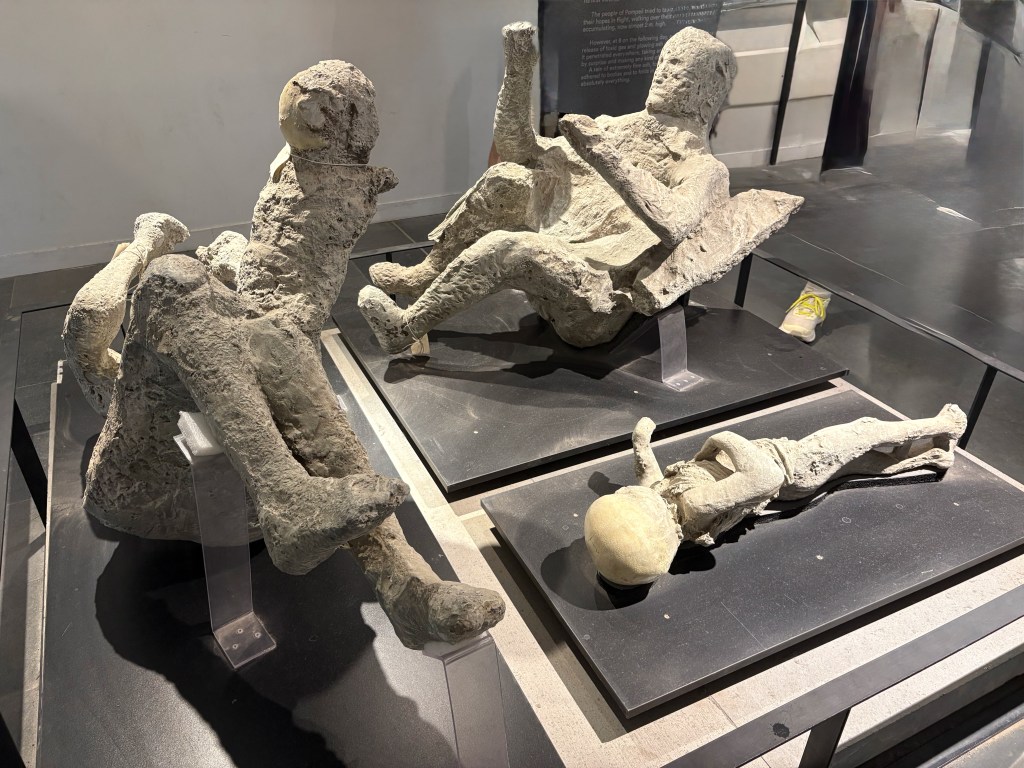
The people of Pompeii tried to take refuge in houses or put their hopes in flight, walking over the bed of pumice that was accumulating, now almost 2 m. high.
However, at 8 on the following day, an extremely violent release of toxic gas and glowing ash devastated the town: it penetrated everywhere, taking anyone attempting to escape by surprise and making any kind of defence useless.
A rain of extremely fine ash, forming a deposit of 6 m, adhered to bodies and to folds in their clothes and blanketed absolutely everything.
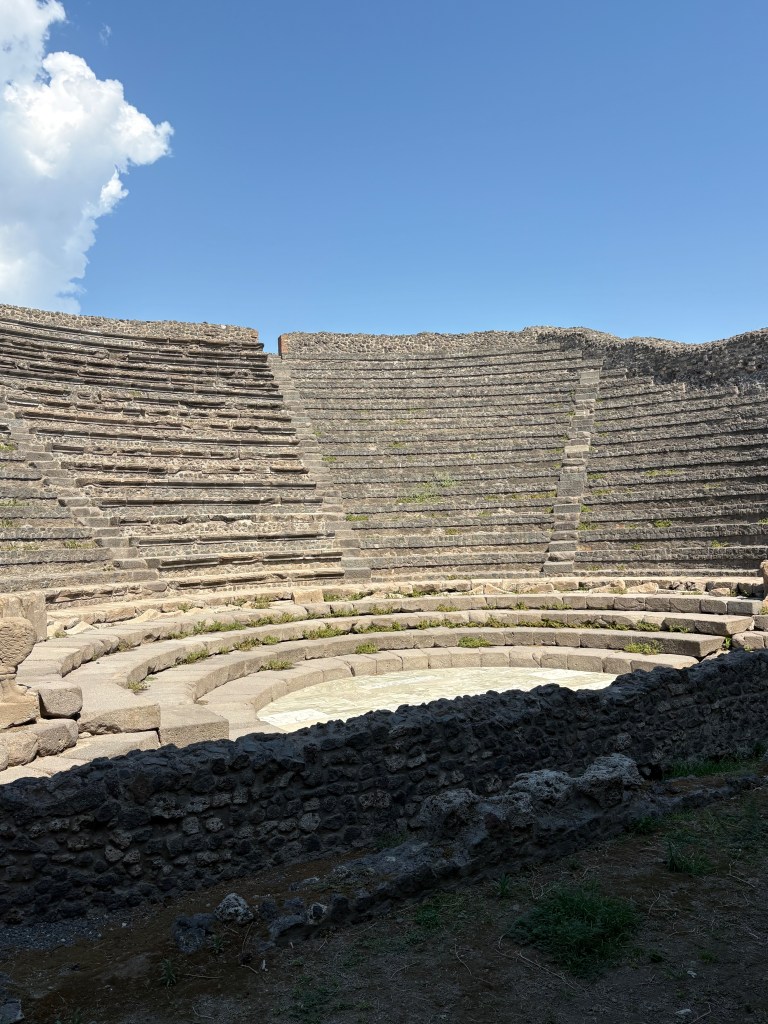
The “model of Rome” was certainly present throughout the streets of the town. Grand houses, sometimes more opulent than those in Rome – where the narrowness of the streets only permitted building dangerously upwards – opened onto streets with high portals.
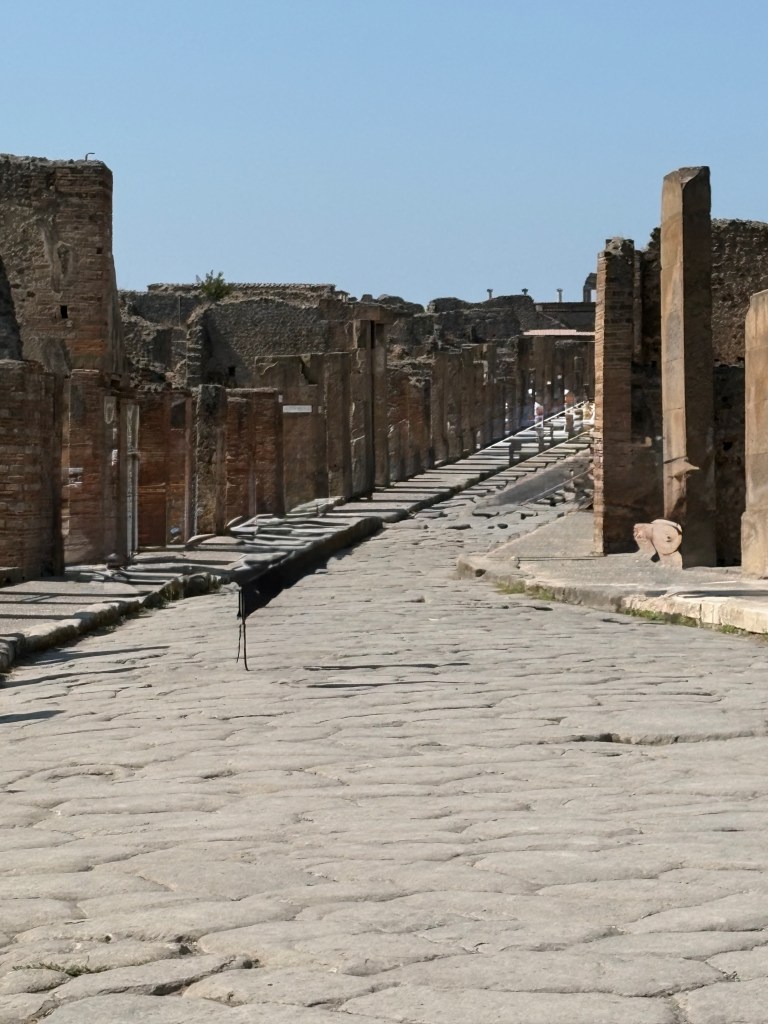
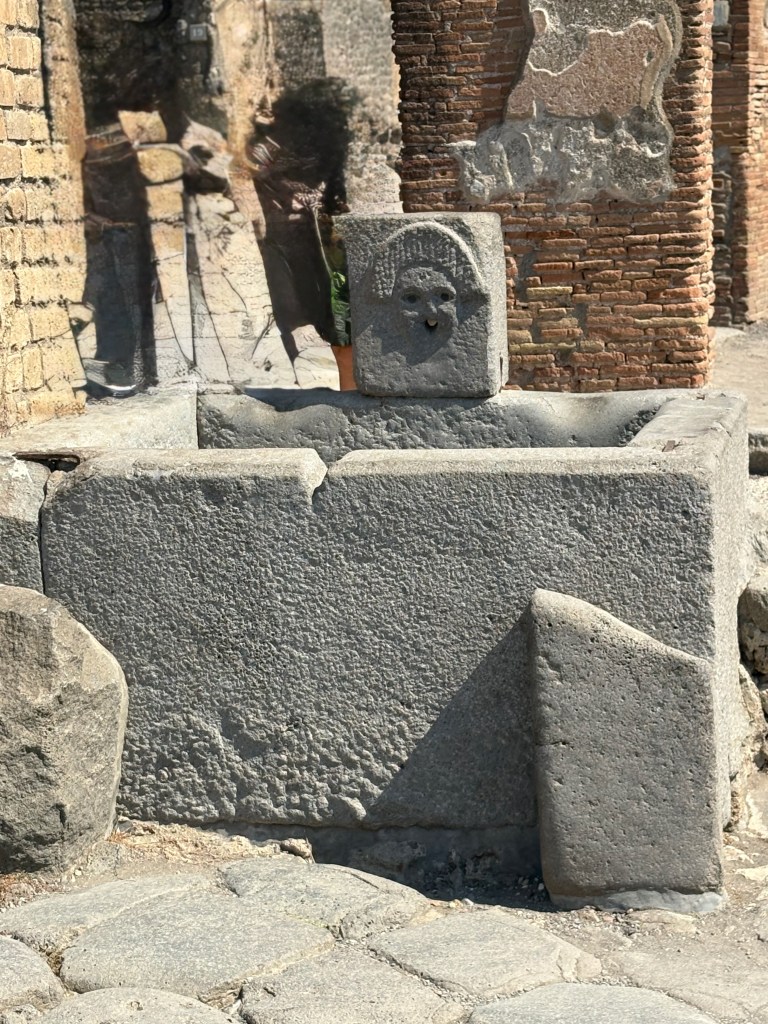
In those grand houses one could admire the vast solemnity of atria (entrance halls) large enough to accommodate dozens of visitors each day for the greeting ceremony (salutatio) and the sumptuous airy peristyles, where guests were welcomed in banqueting rooms reminiscent of magnificent Greek Hellenistic architecture.
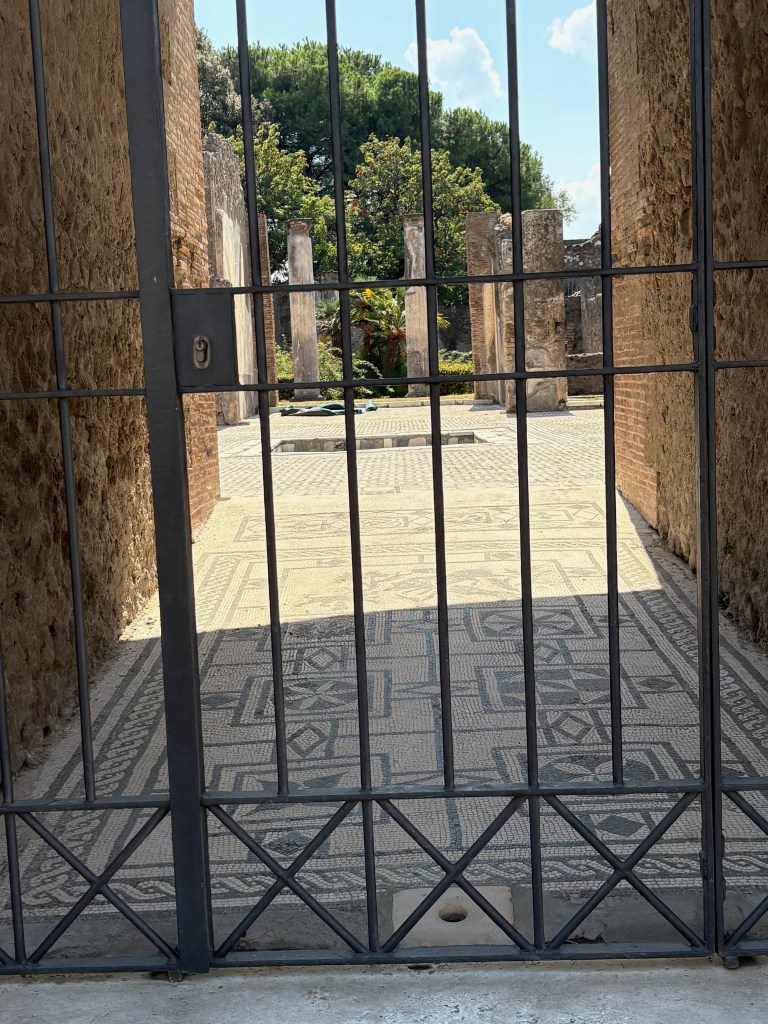
The city was planned with stores and homes interspersed. These two appear to be a restaurant of sorts with foods in the bowls and perhaps a bakery.
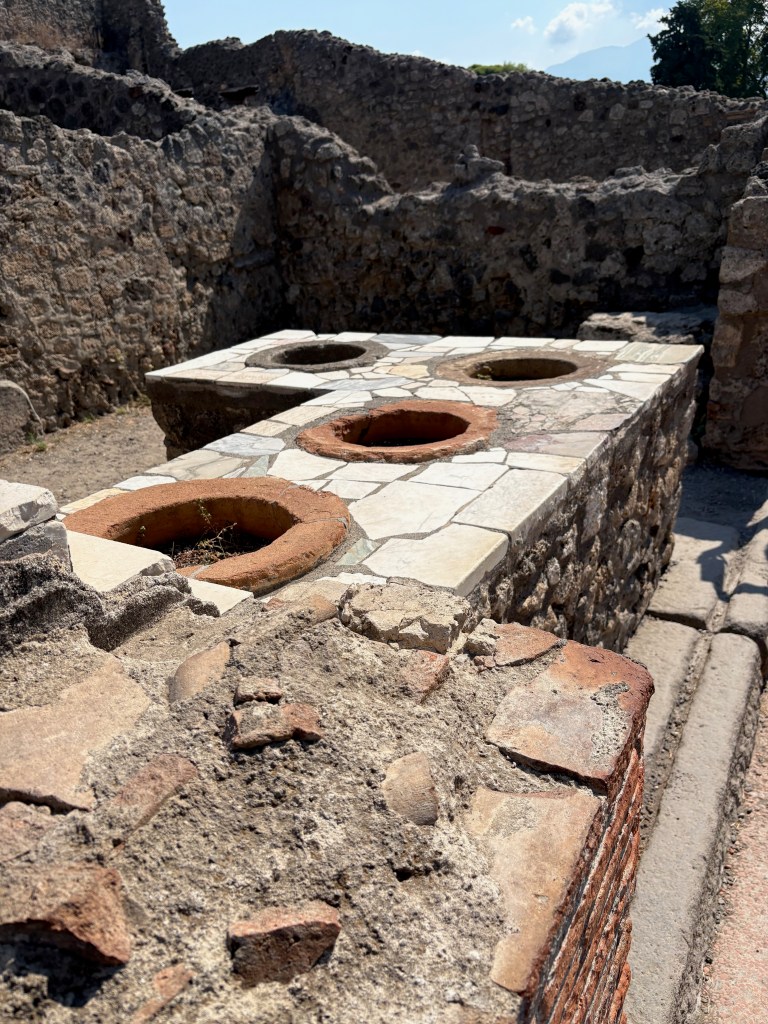
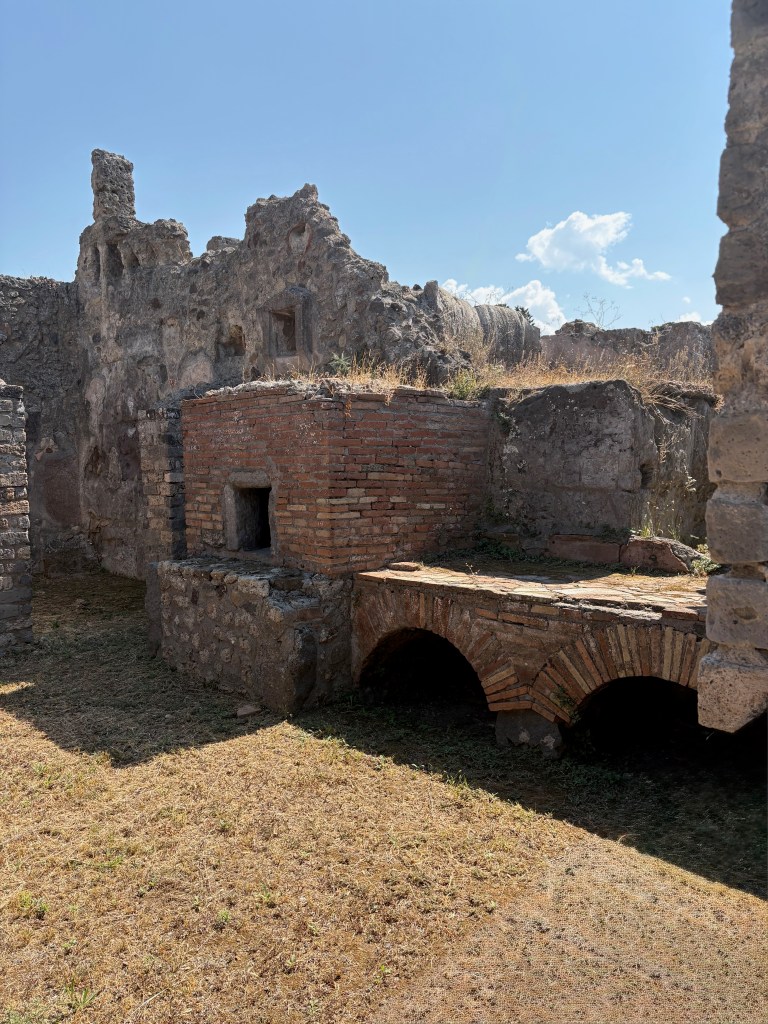
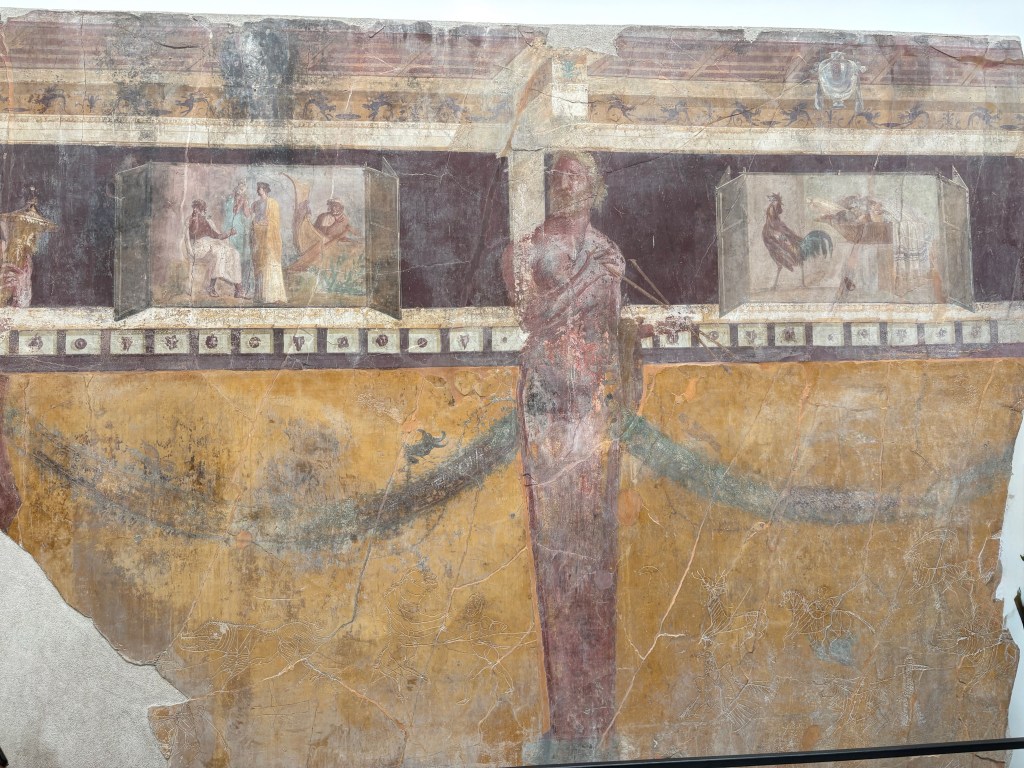
Even the middle classes enjoyed peaceful well-being: their houses were smaller but decorated with refinement and some even had private baths. Some frescoes are displayed in an attached museum.
House of the Cryptoportico (16, 2), south wall of the ocus (dinner room)
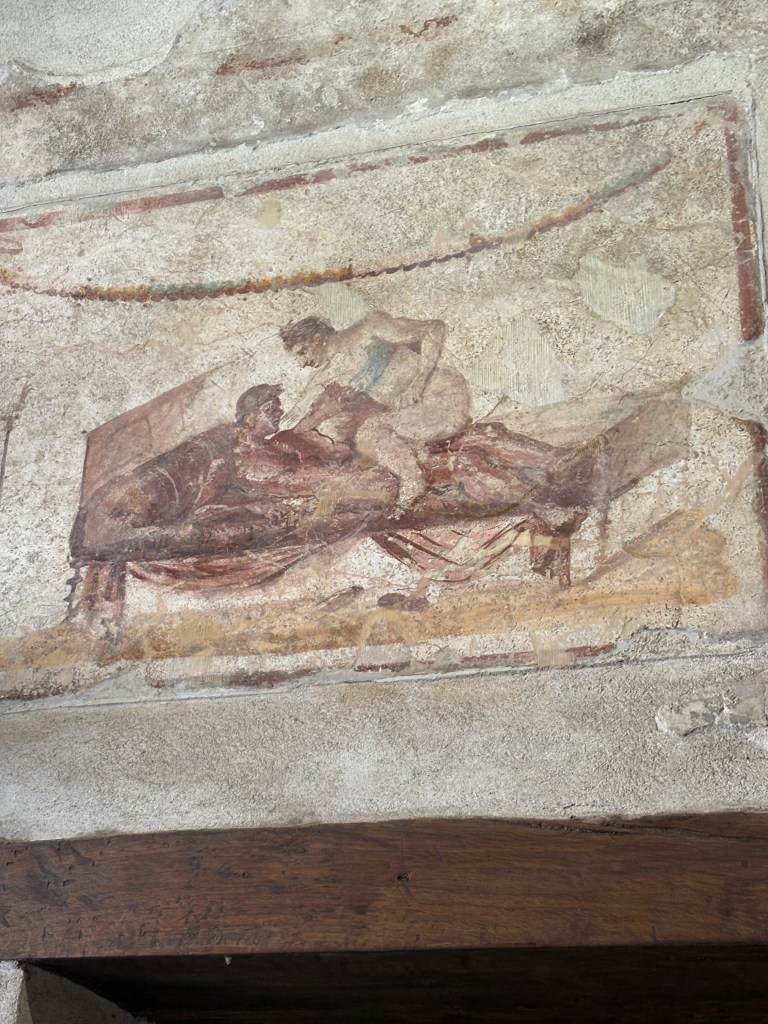
As prostitution was legal, the frescoes in the bordello were very graphic.
The sanctuary of Apollo in the Forum was completely rebuilt and around the square, surrounded by shops, new large constructions appeared, inspired by those in Rome: the Temple of Jupiter, the Basilica and slightly further away the public market (macellum)
Also in the museum were figures of the actual positions of people found in the ashes. A bit morbid.
We had lunch in Sorrento: a delicious meal of local specialties. dessert.
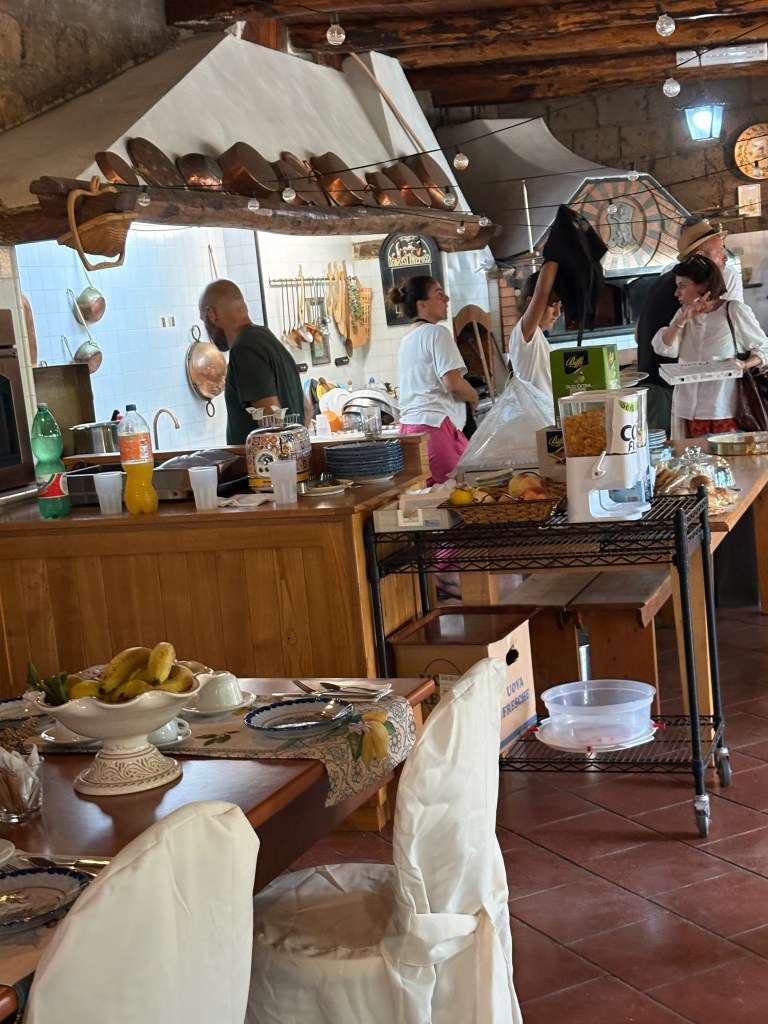
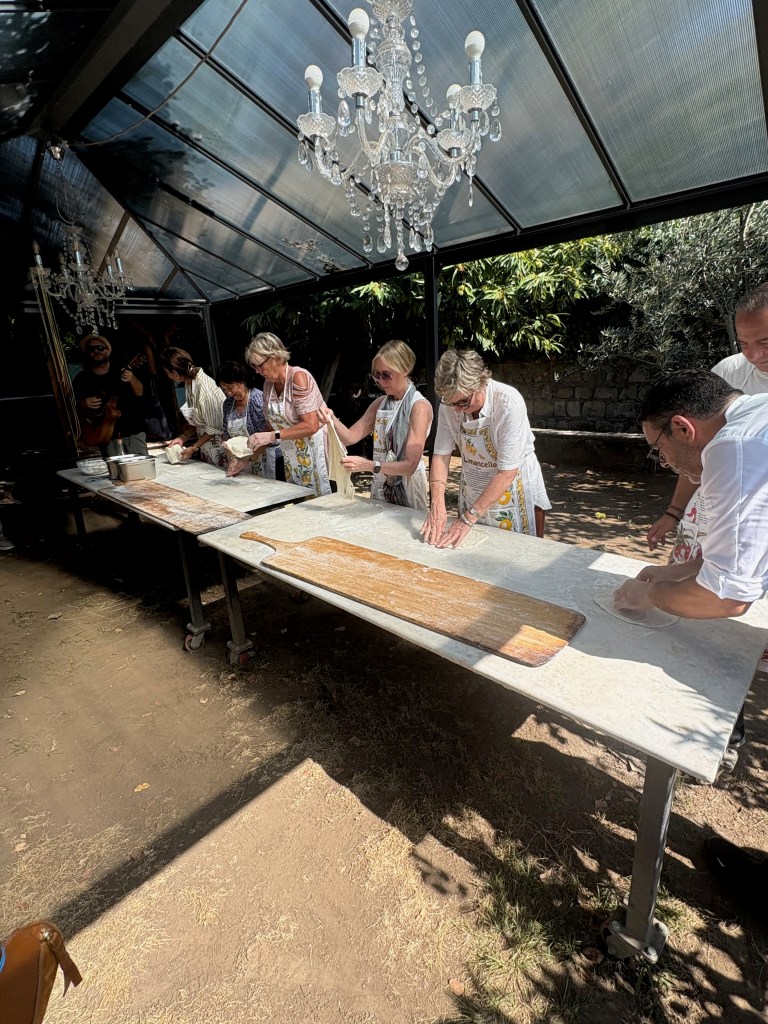
We joined a local family at their farm in the Sorrento countryside. We walked through lemon groves and some experienced pizza-making. We had a spread of home- produced cold cuts, marinated vegetables and fresh pizza, all served with wine made from their own grapes.
Cruising across the Bay of Naples next, we arrived at the Isle of Capri, took the funicular, walked through the streets and spend the next two nights at the Hotel Regina Cristina in picture-perfect surroundings. We arrived late at the hotel, had a small dinner and slept soundly.
Day 4 September 9 A Day on the Isle of Capri
The island of Capri is situated in the Gulf of Naples, between the Italian Peninsula and the islands of Procida and Ischia. Made of limestone, its lowest part is at the centre, while its sides are high and mostly surrounded by steep precipices, which contain numerous caves. Its topography is dominated by the slopes of the Monte Solaro in the west and Monte San Michele in the east.
Tiberius spent the last ten years of his life at Capri and built twelve villas there, the best known being the Villa Jovis whose impressive remains are still visible. The numerous ancient cisterns show that in Roman, as in modern times, rain provided the island’s water since it has no natural springs.
Apparently the main motivation for Tiberius’s move from Rome to Capri was his wariness with the political manoeuvring in Rome and a lingering fear of assassination.
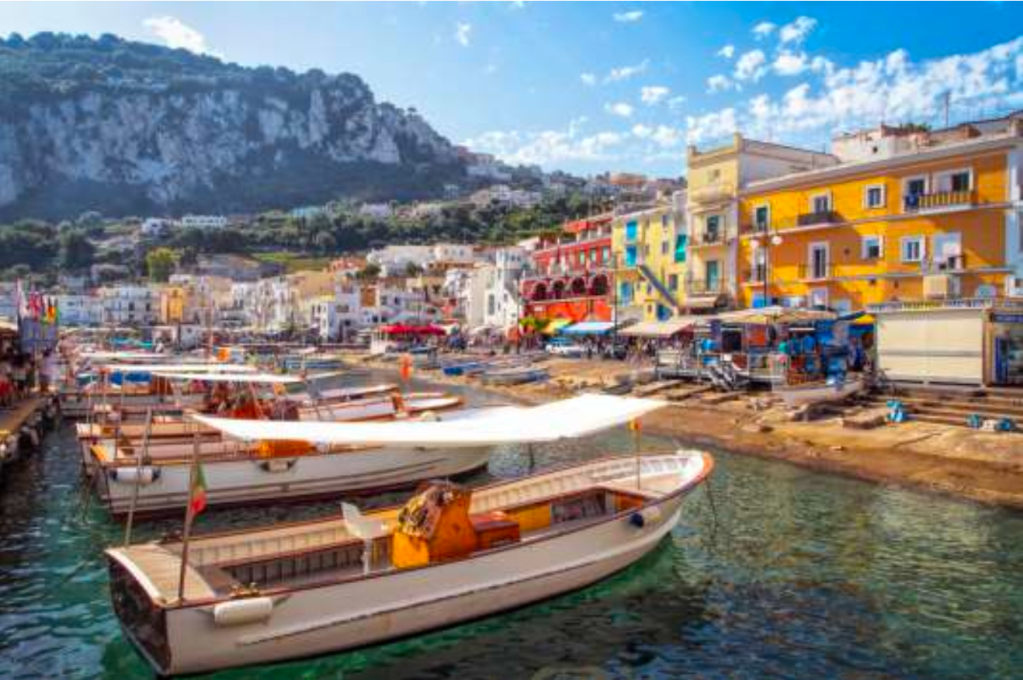
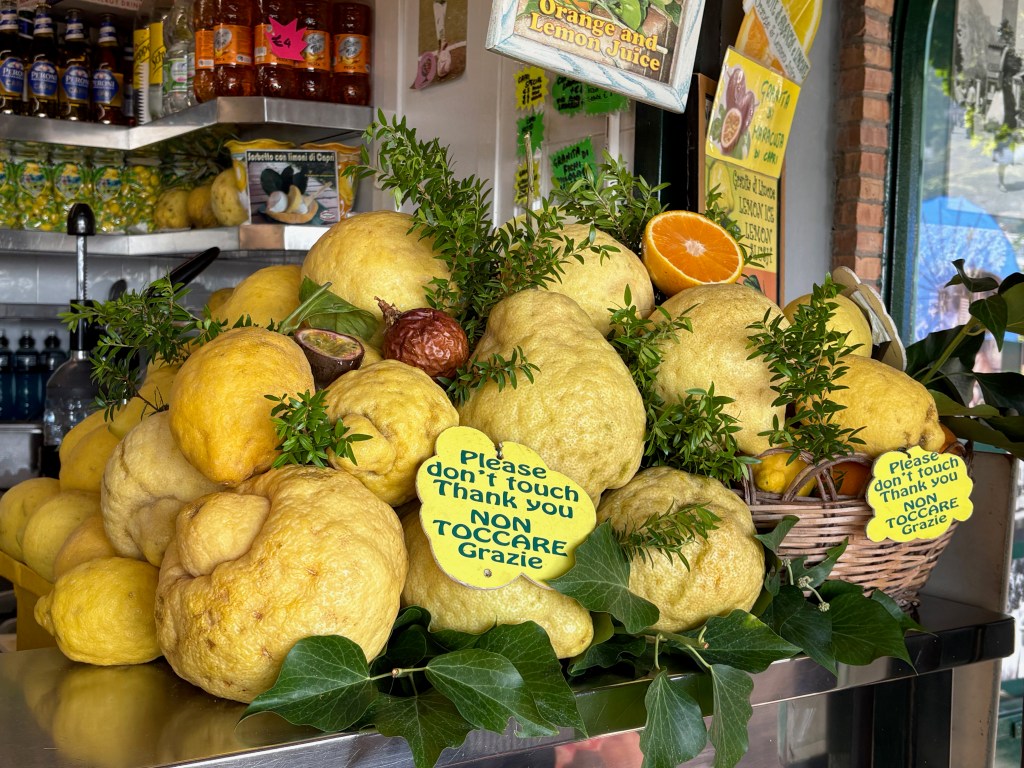
We visited local gardens and saw views of the marina on a walking tour with a Local Specialist.
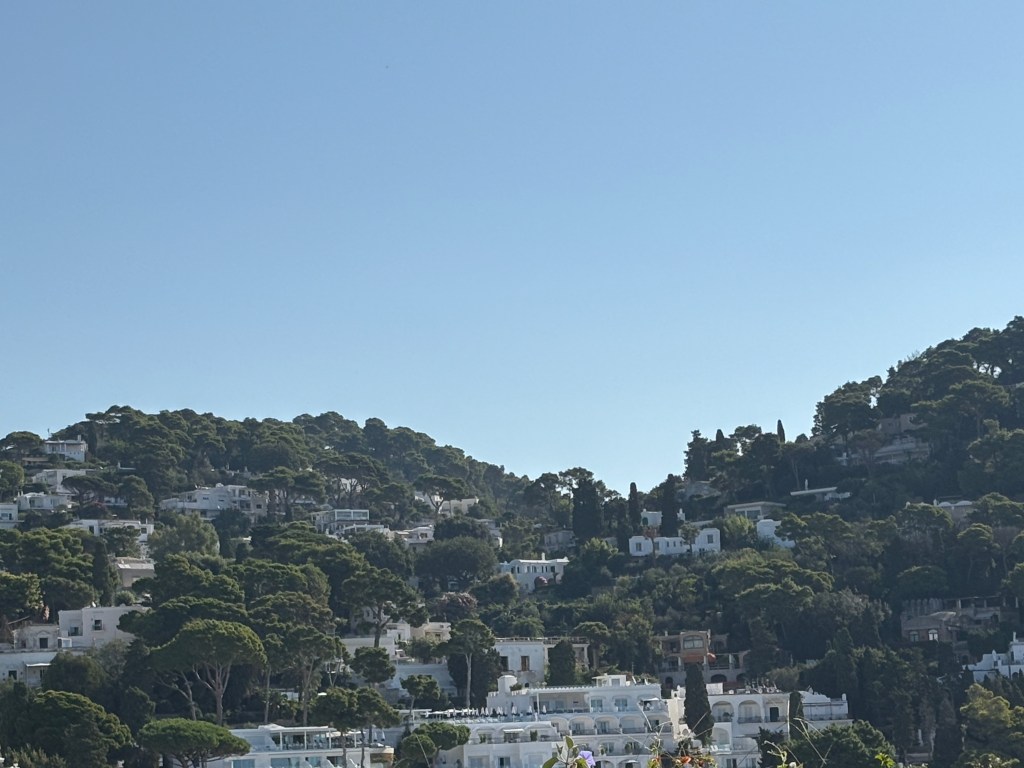
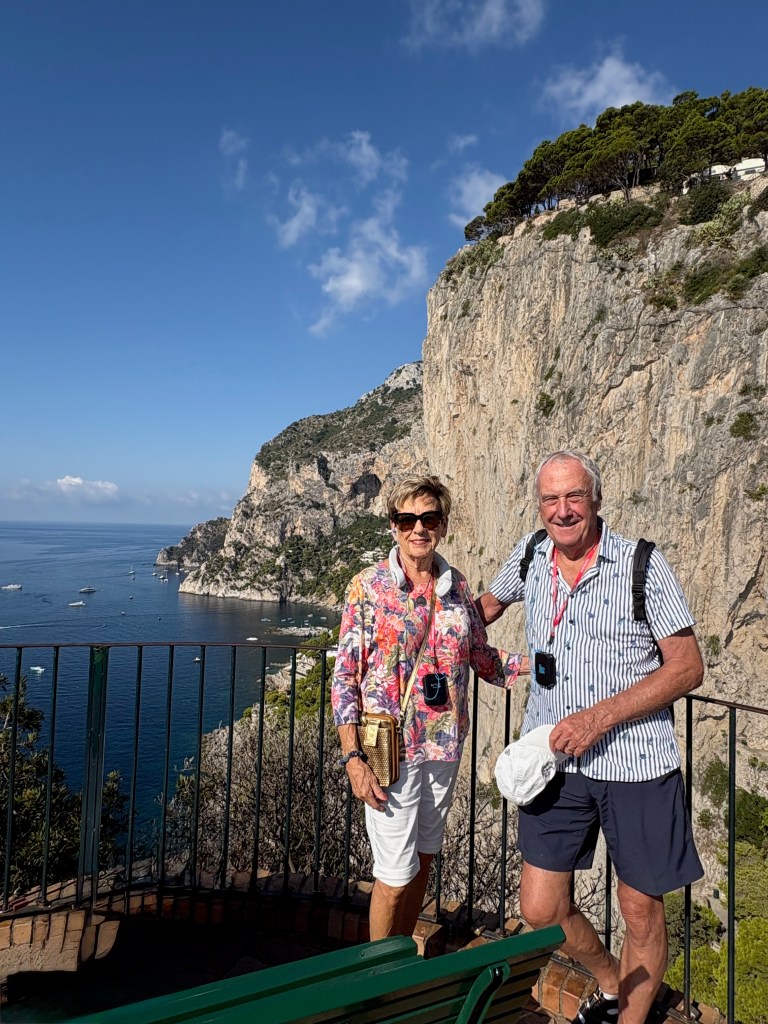
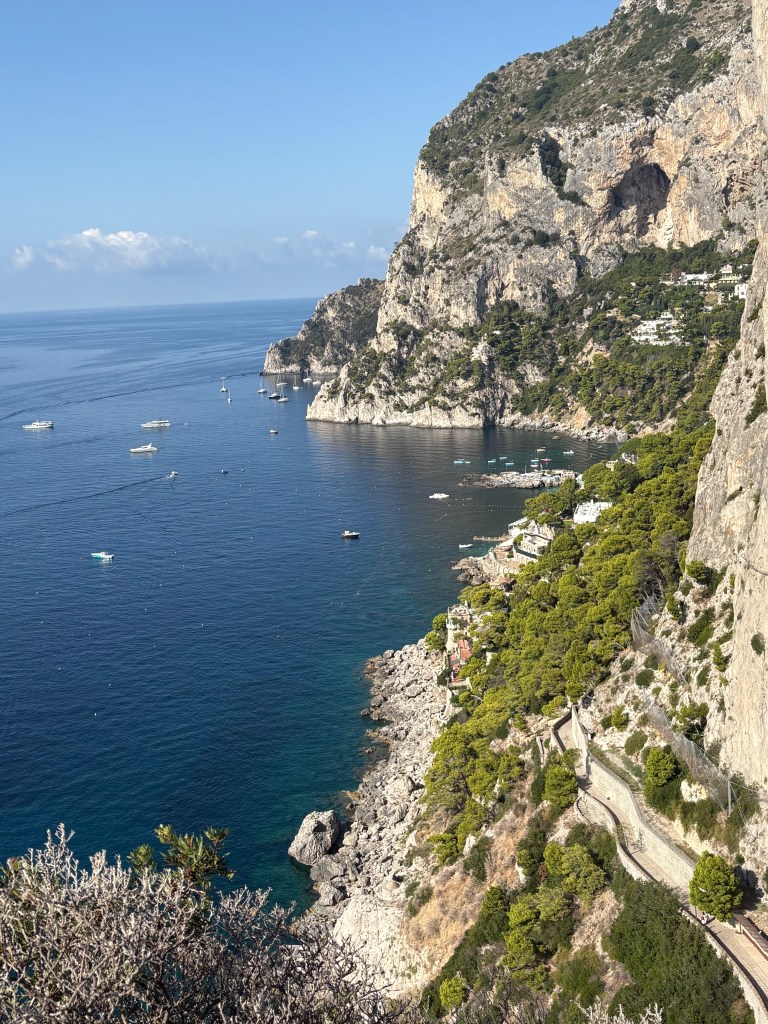
The lemons are seriously big and misshapen.
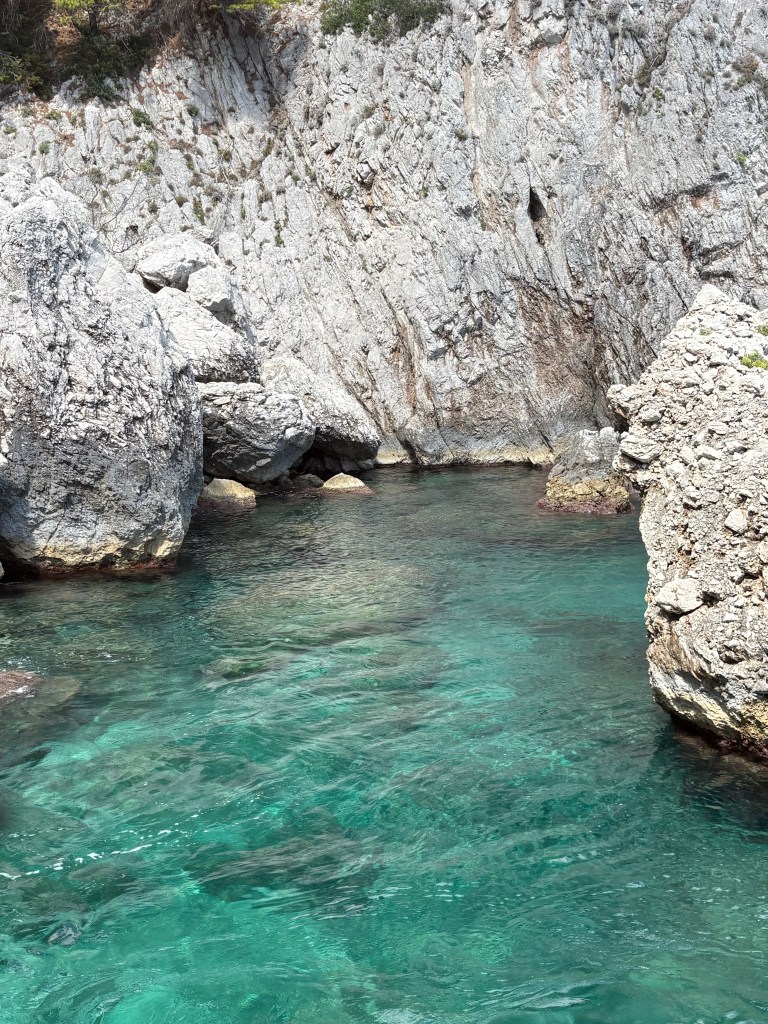
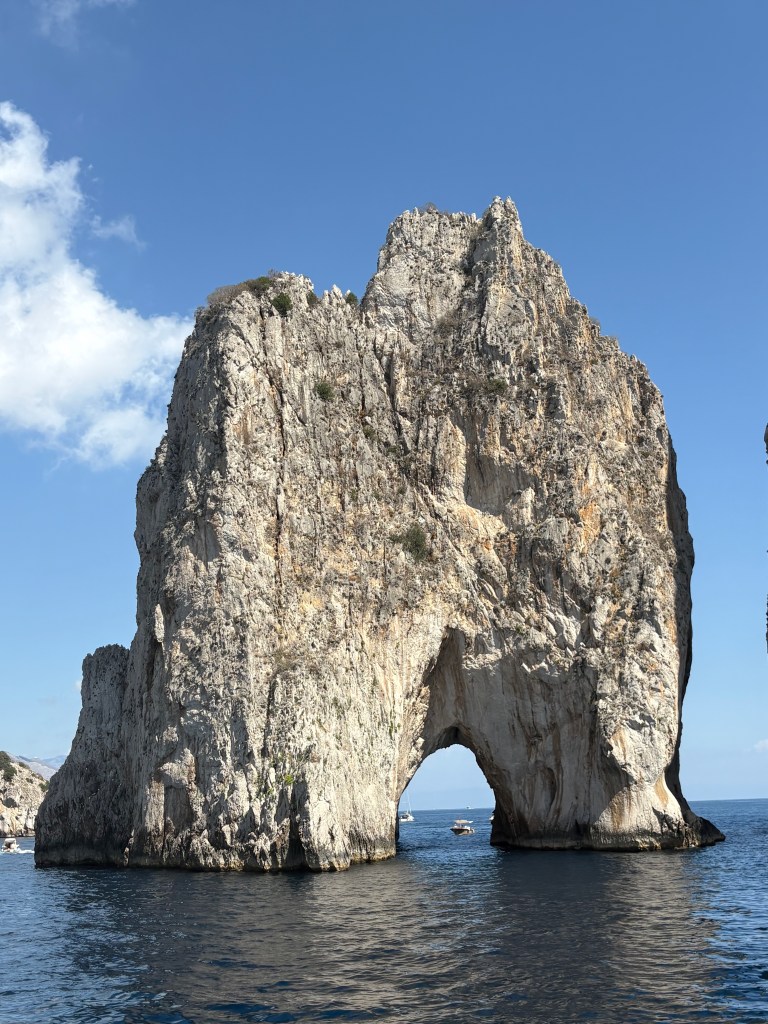
We joined an optional experience to explore the rugged coastline and hidden grottos by private motor launch.
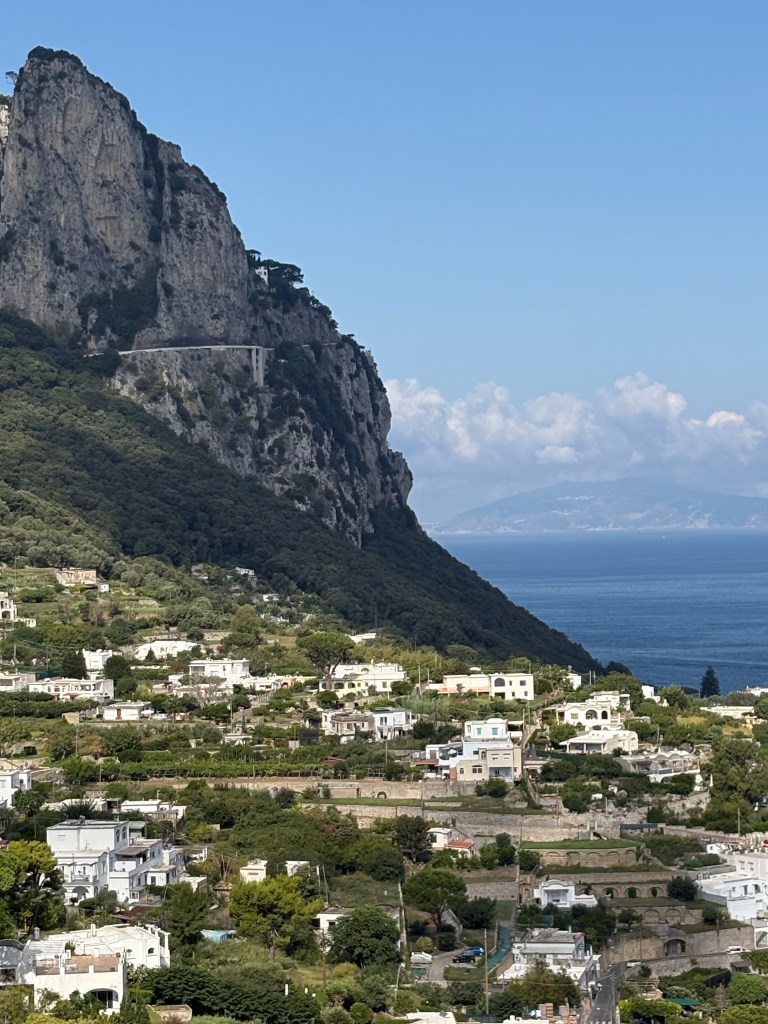
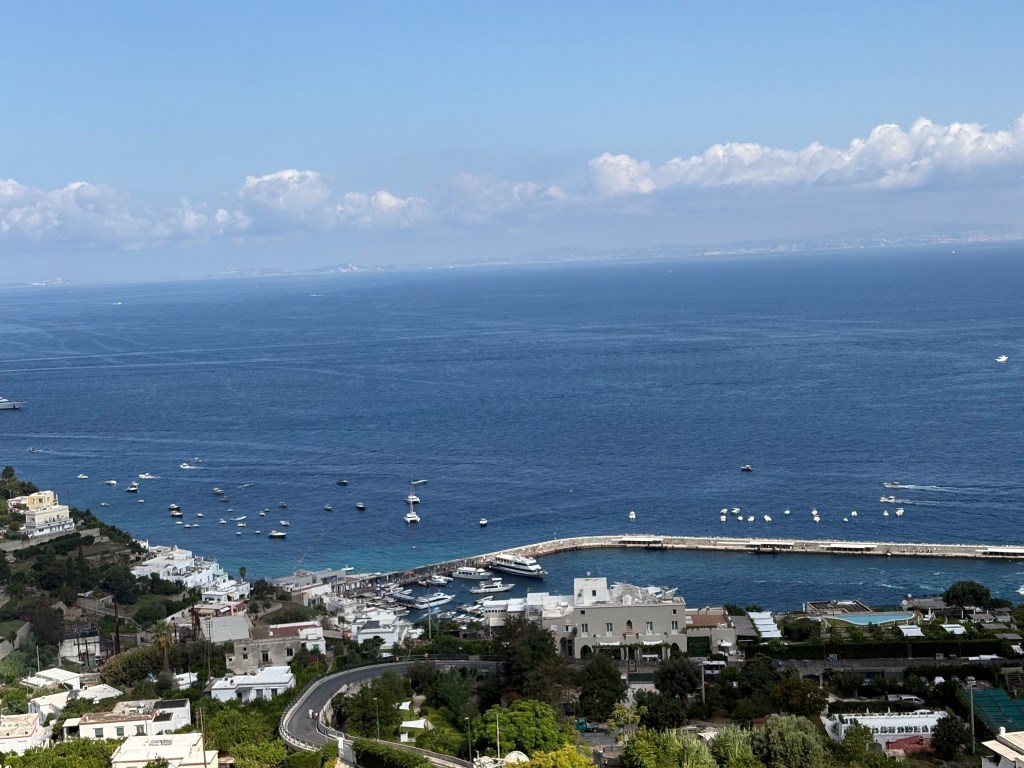
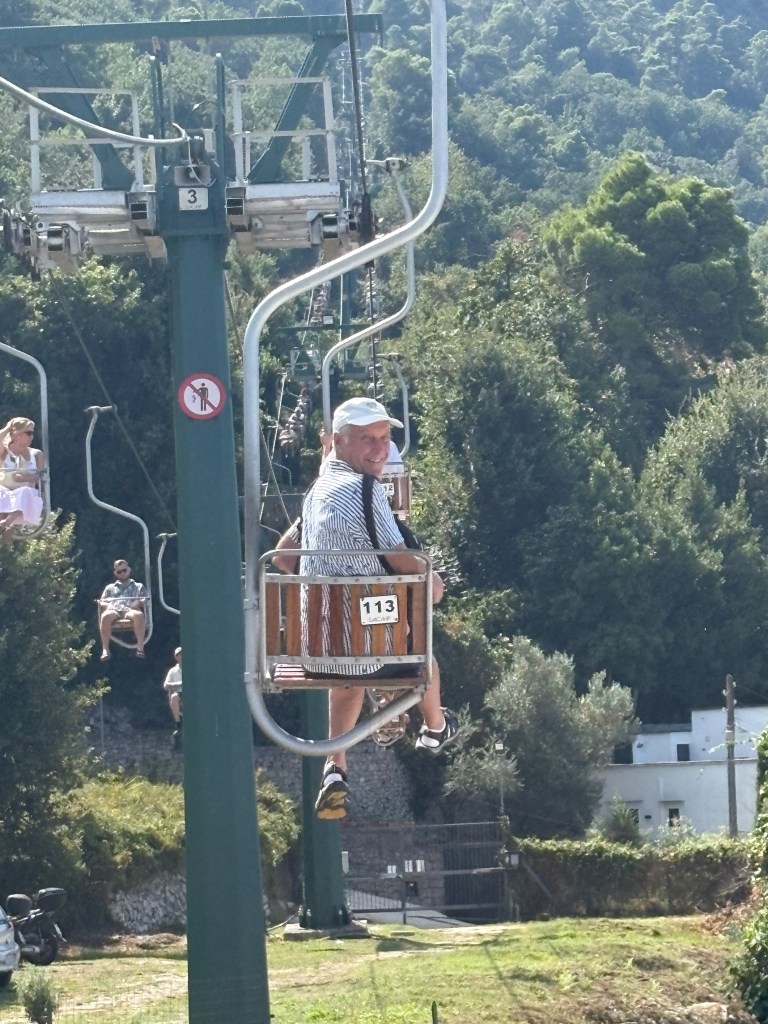
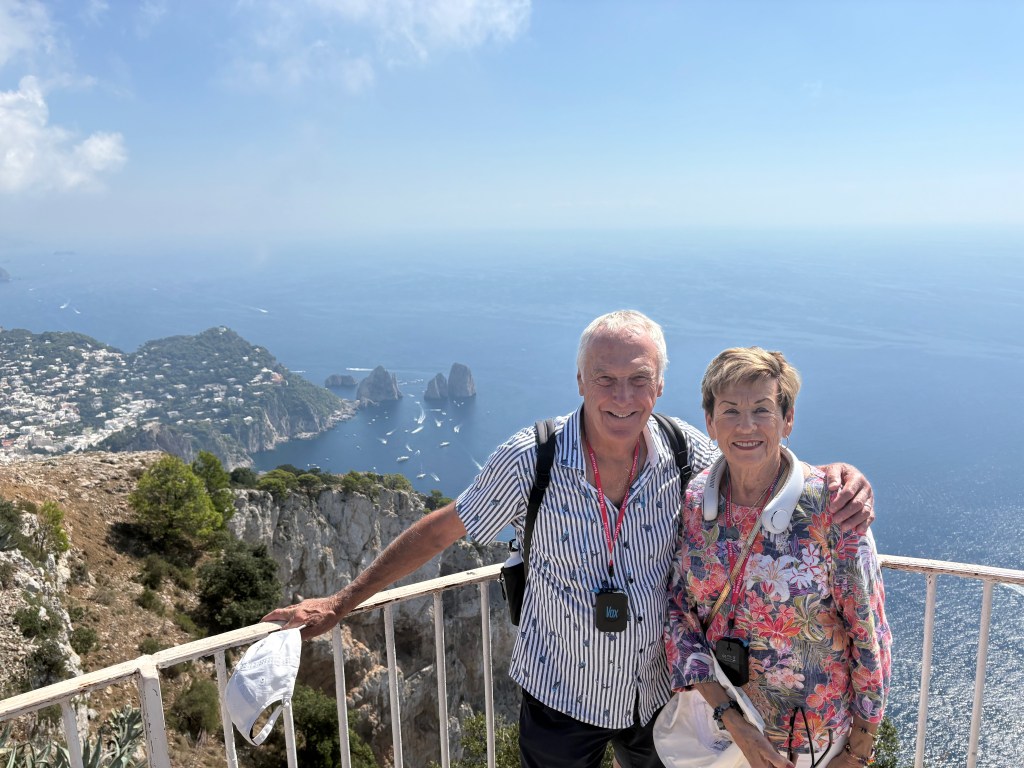
We took a bus to Anacapri, walked through the gardens, enjoyed views of the other coast and then took a type of ski lift up the mountain.
The Blue Grotto was a place of Roman leisure, then a local secret, and finally a symbol of the Grand Tour. Long before it drew tourists, the Blue Grotto was known to the ancient Romans, who prized Capri as an imperial retreat. The luminous cave below was used as a marine nymphaeum — an ornamental grotto by the sea, decorated and set aside for leisure. Roman statues of sea gods, including figures associated with Neptune and his tritons, were recovered from the seabed at the cave in the twentieth century.
After the Roman period the cave slipped from wider memory. To the fishermen and boatmen of Capri it never disappeared; they knew it as the Grotta di Gradola, after the small landing of Gradola nearby. For a long stretch, though, the grotto carried a darker reputation among locals, who associated its dim mouth and echoing interior with spirits and ill fortune, and gave it a wide berth. It remained, in effect, a place known to a few and avoided by many, absent from the itineraries of the travellers who were beginning to explore southern Italy.
That changed on 18 April 1826. The German writer and painter August Kopisch, together with his companion Ernst Fries, had heard the local talk of a blue cave and persuaded a Capri fisherman, Angelo Ferraro, to take them to it. Guided in a small boat through the low entrance, they surfaced inside a chamber flooded with blue light, and recognised at once that the local legend described something extraordinary rather than something to fear.
Kopisch published an account of the experience in 1838, and the timing was perfect. Northern Europeans were travelling south in growing numbers on the Grand Tour, hungry for classical landscapes and natural wonders, and a sea cave glowing an impossible blue was exactly the kind of marvel they had come to find. Writers, painters and eventually ordinary tourists followed. Within a generation the Blue Grotto had become the defining image of Capri, reproduced in prints and paintings and fixed near the top of every visitor’s list.
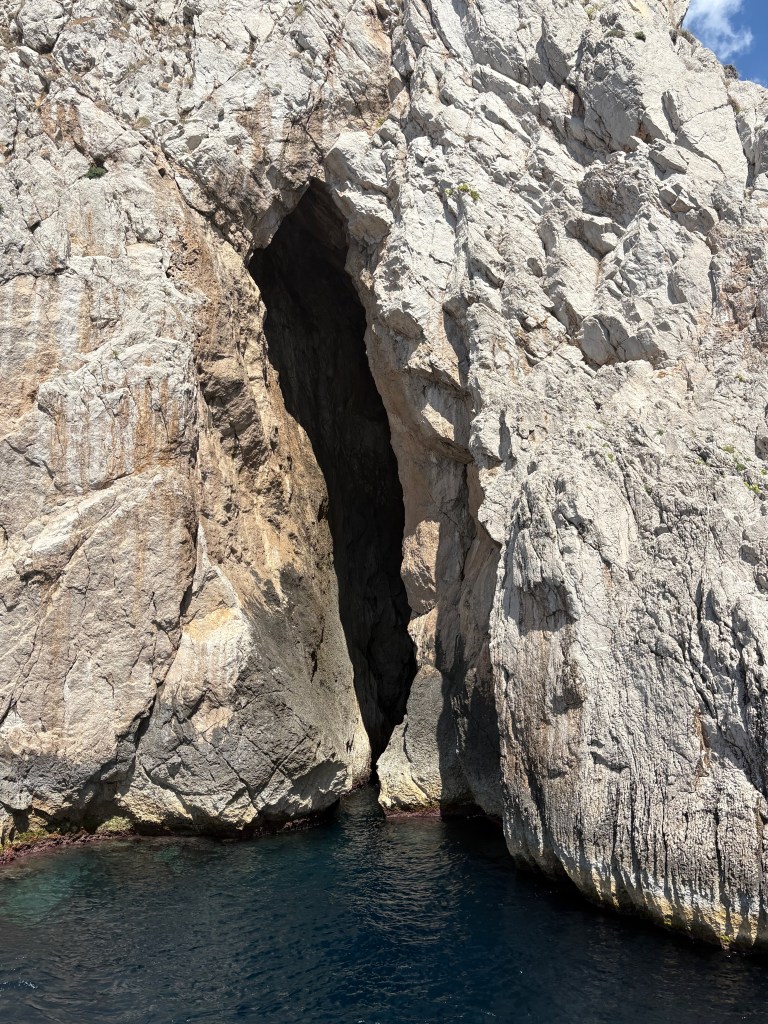
Then we took a guided tour by boat of the grottos and caves.
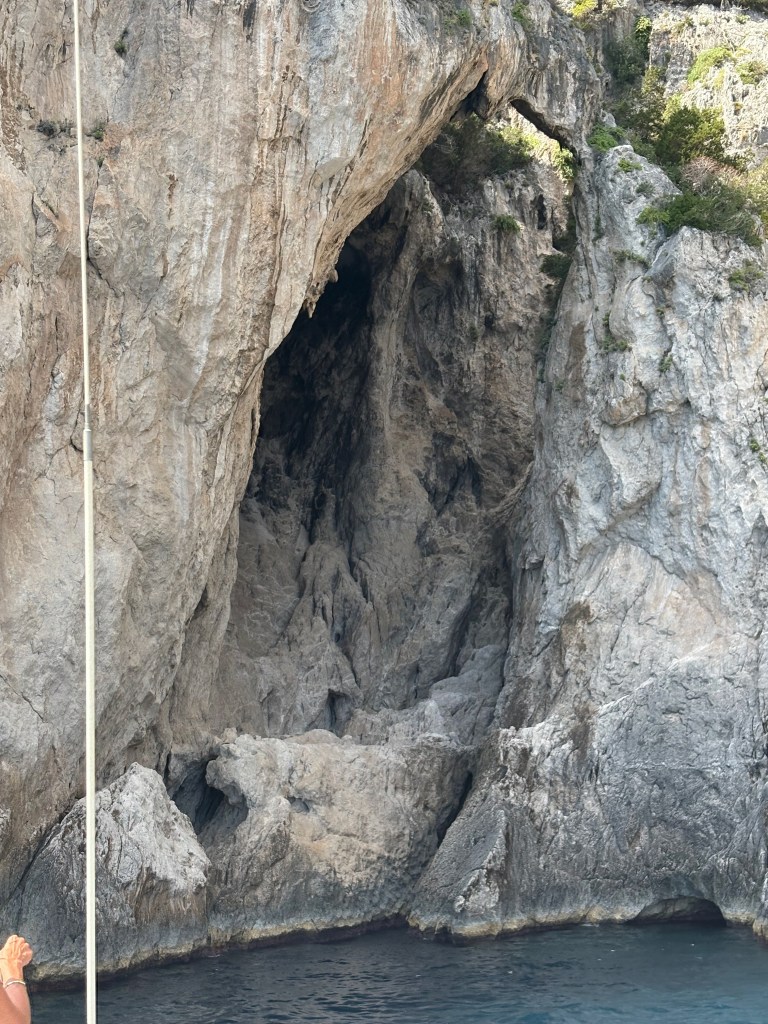
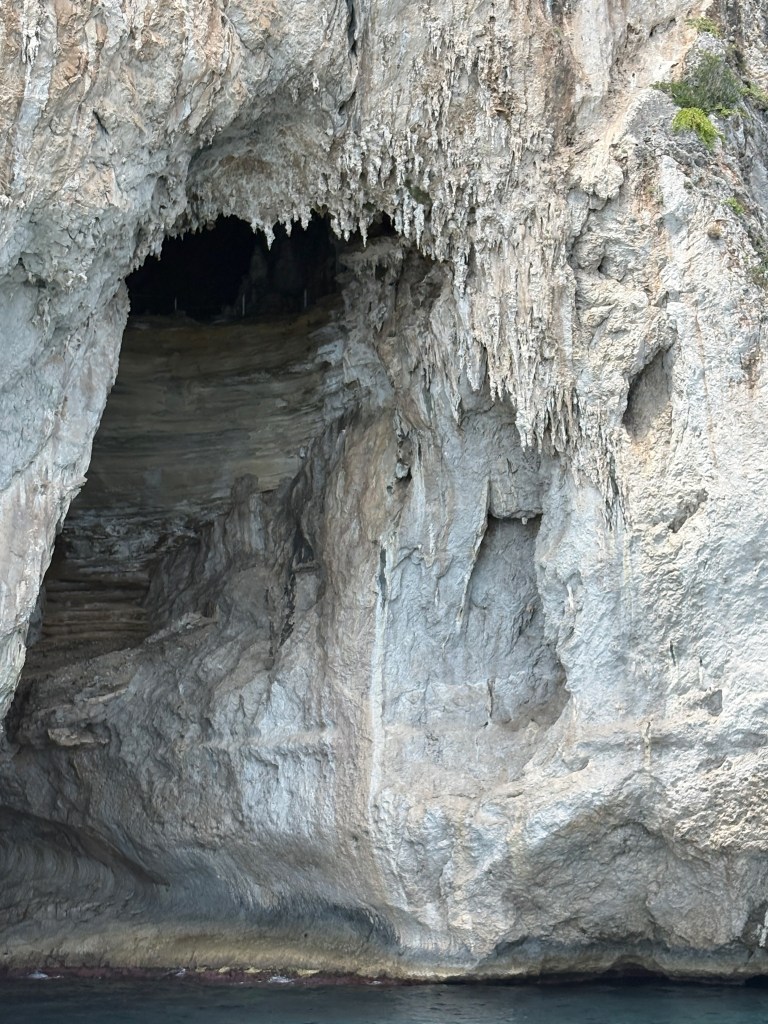
The Blue Grotto (Grotta Azzurra) is one of many caves along Capri’s coast and is accessible only by small boat. Its name comes from the extraordinary blue light within the cave, which is caused by sunlight entering through the water that fills most of its entrance. We were unable to go inside and see the cave but our guide assured it that the blue is distinctive.
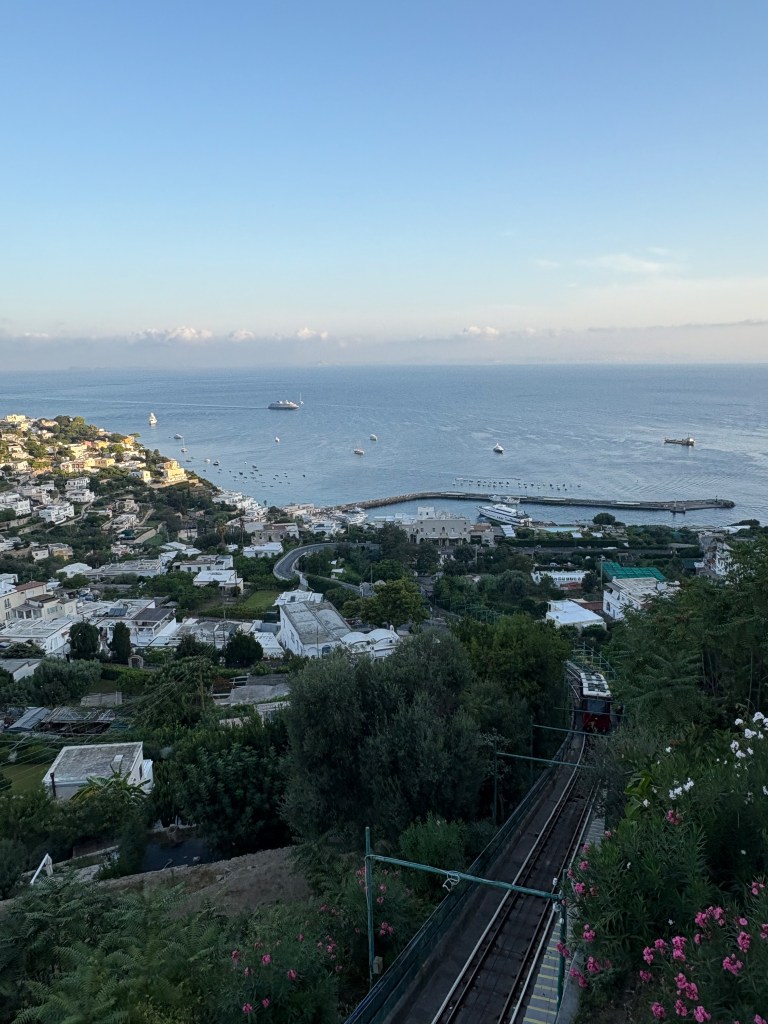
The funicular takes you up and down to the main level of Capri. Here, it is coming to take us down to the ferry to the mainland.
September 10 Day 5 Onwards to Assisi
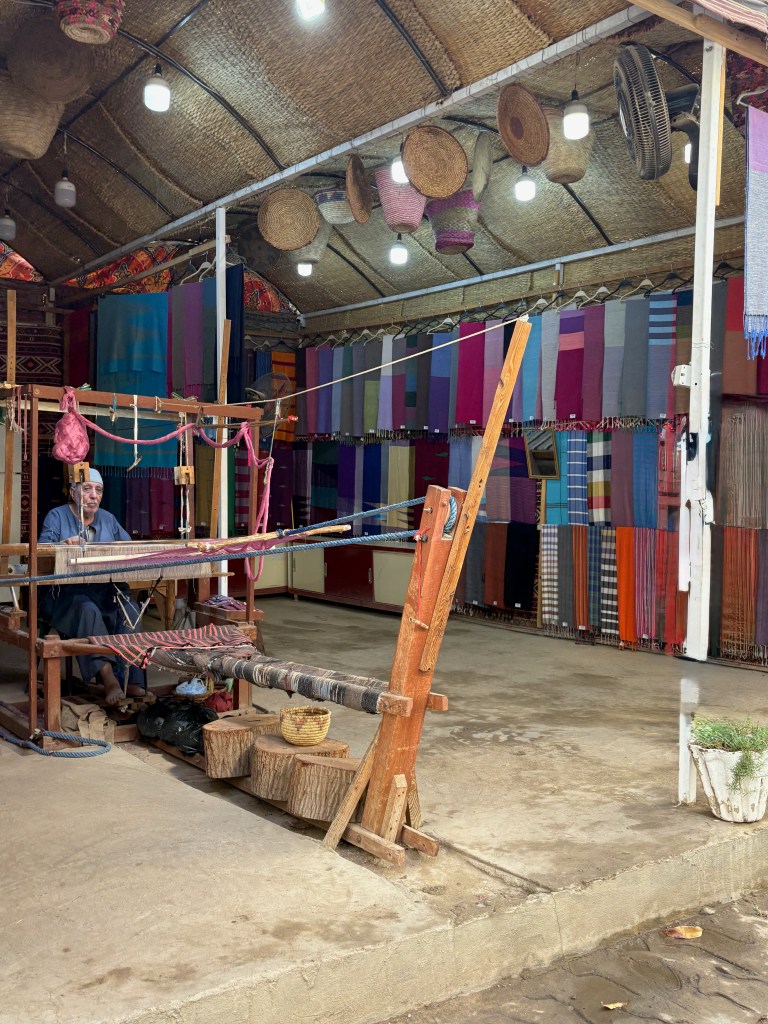
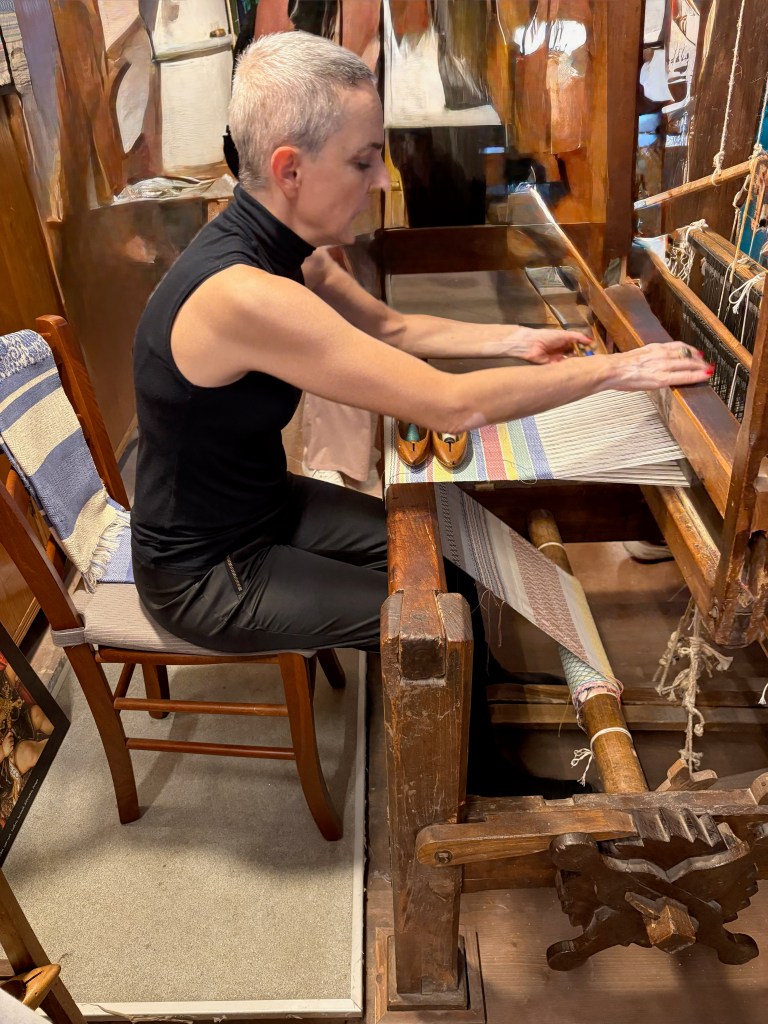
We sailed back across the Mediterranean to Naples and ventured north to the historic city of Perugia. We visited Italy’s weaving tradition during an impressive visit to Laboratorio Giuditta Brozzetti, an enterprise once close to closure that Trafalgar Tours now supports. It is one of the last remaining traditional wooden frame hand-weaving workshops in the country.
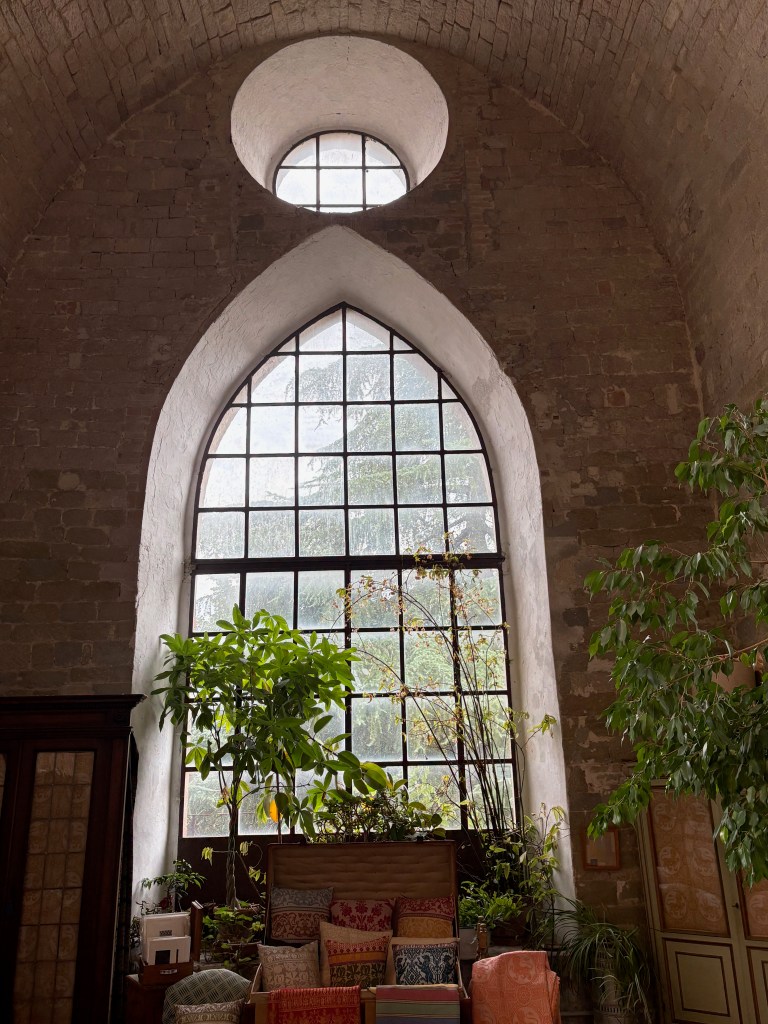
The location of the weaving enterprise is in an old church built in 1212 AD
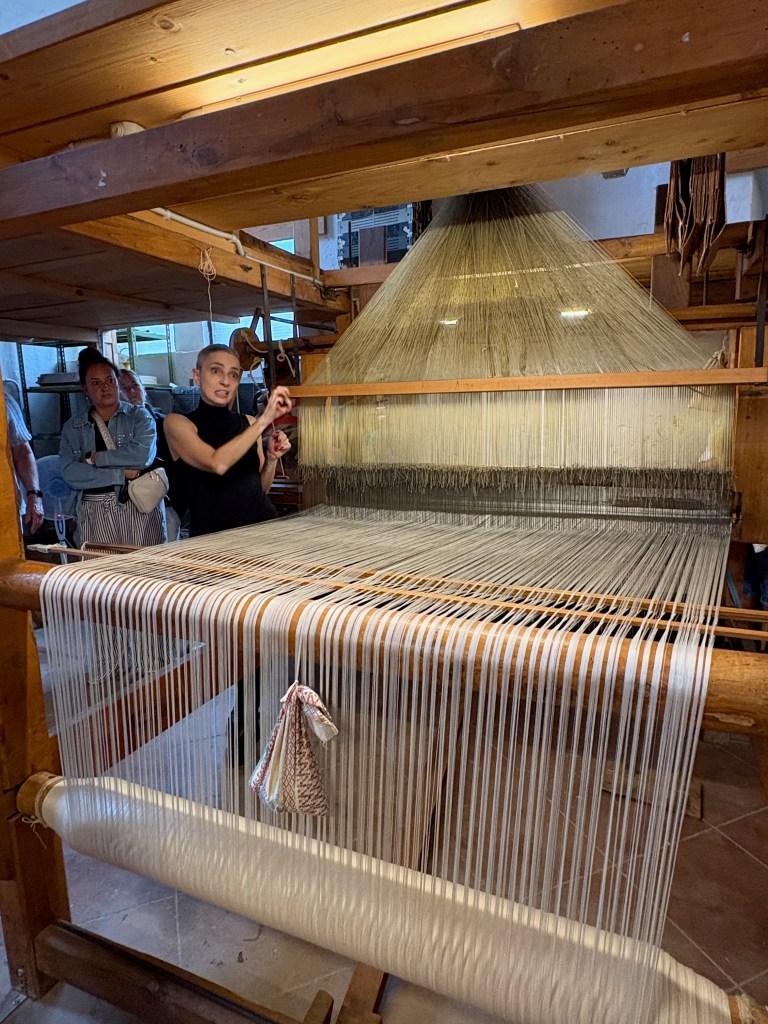
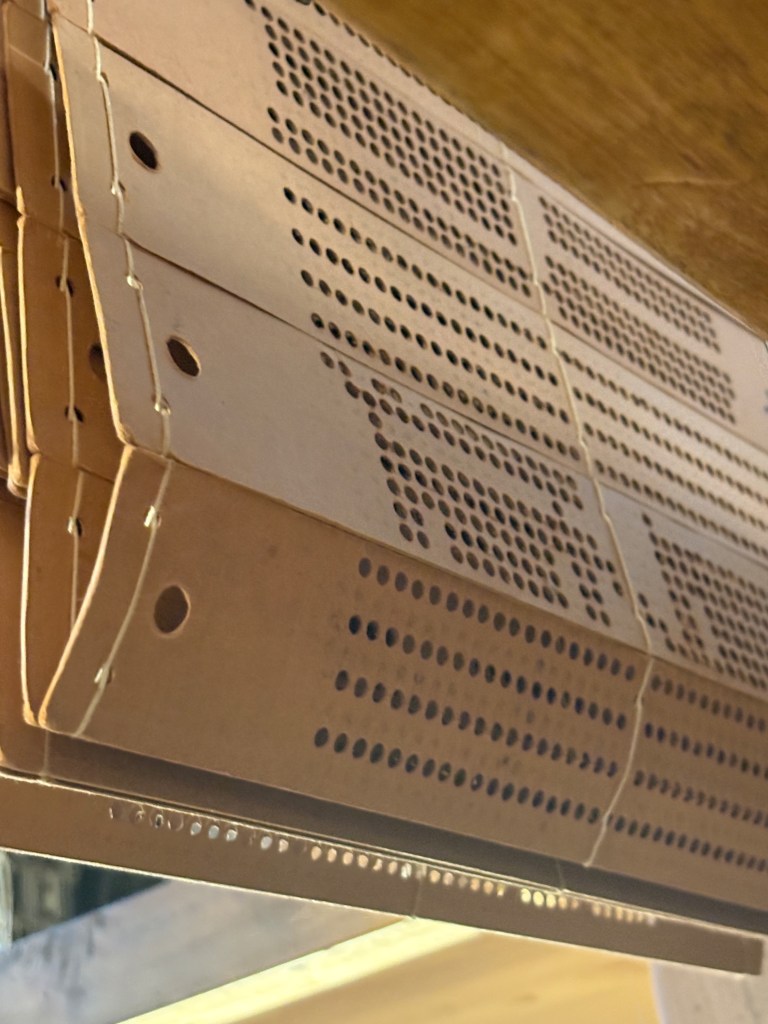
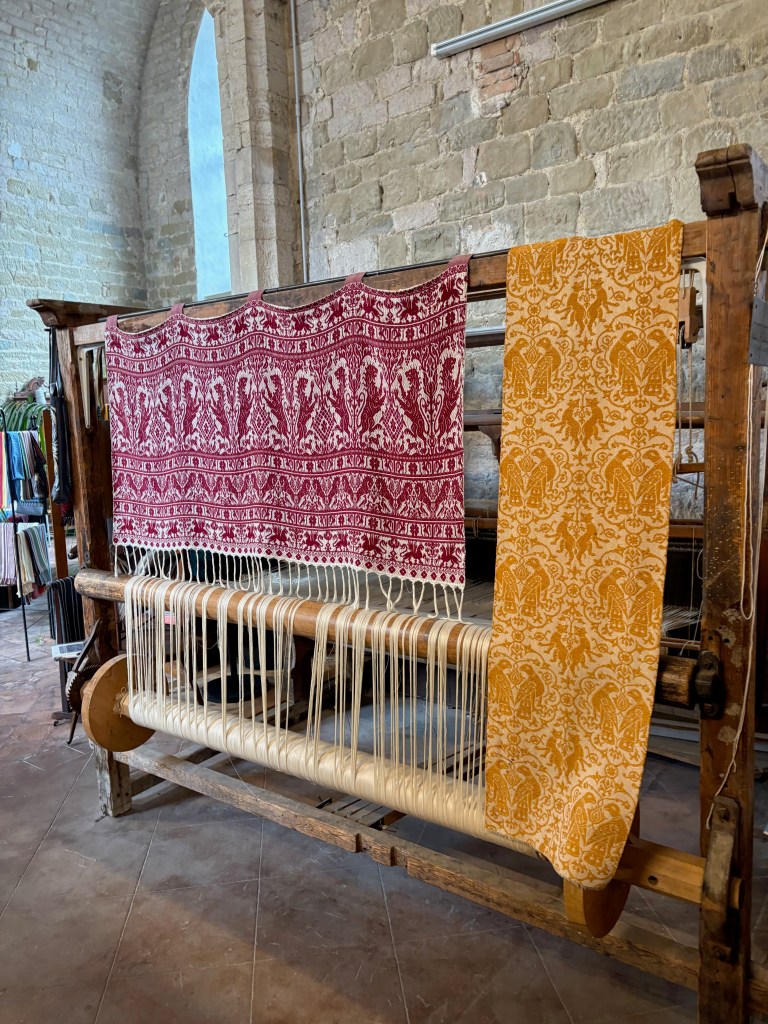
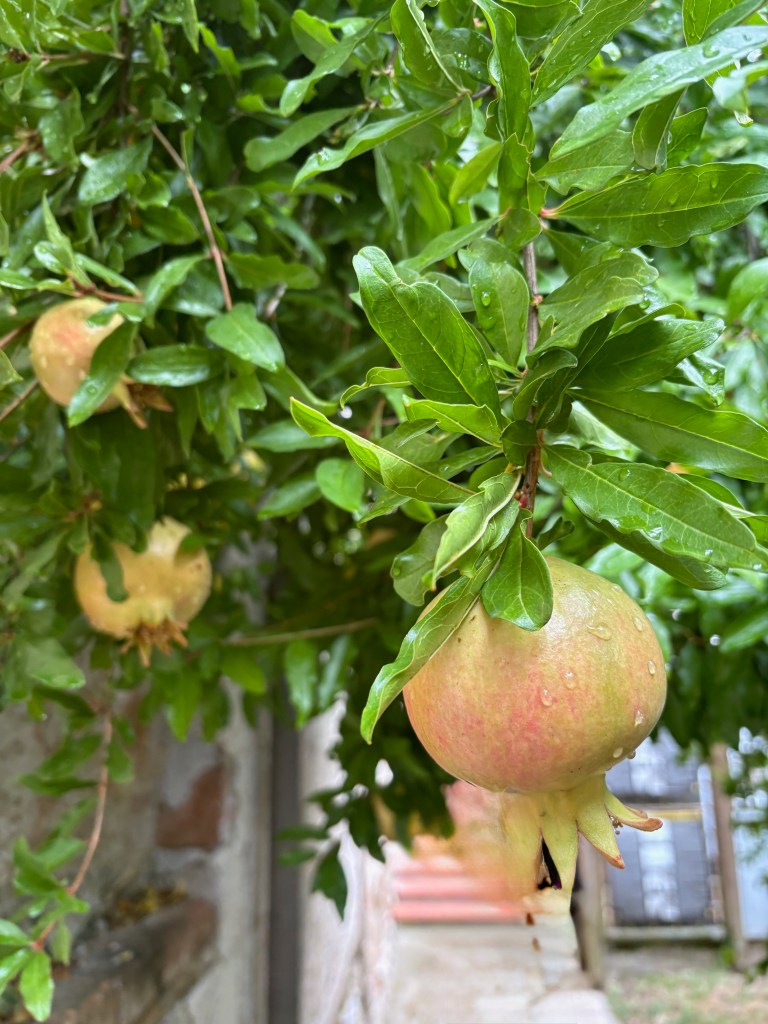
A short drive through the Umbrian Valley took us to a favorite local restaurant, La Locanda del Postiglione, situated in the centre of the village of Spello, a true gem of the region. We savoured a selection of traditional local delicacies for which Umbria is renowned, including the noble truffle and highly-regarded olive oil.
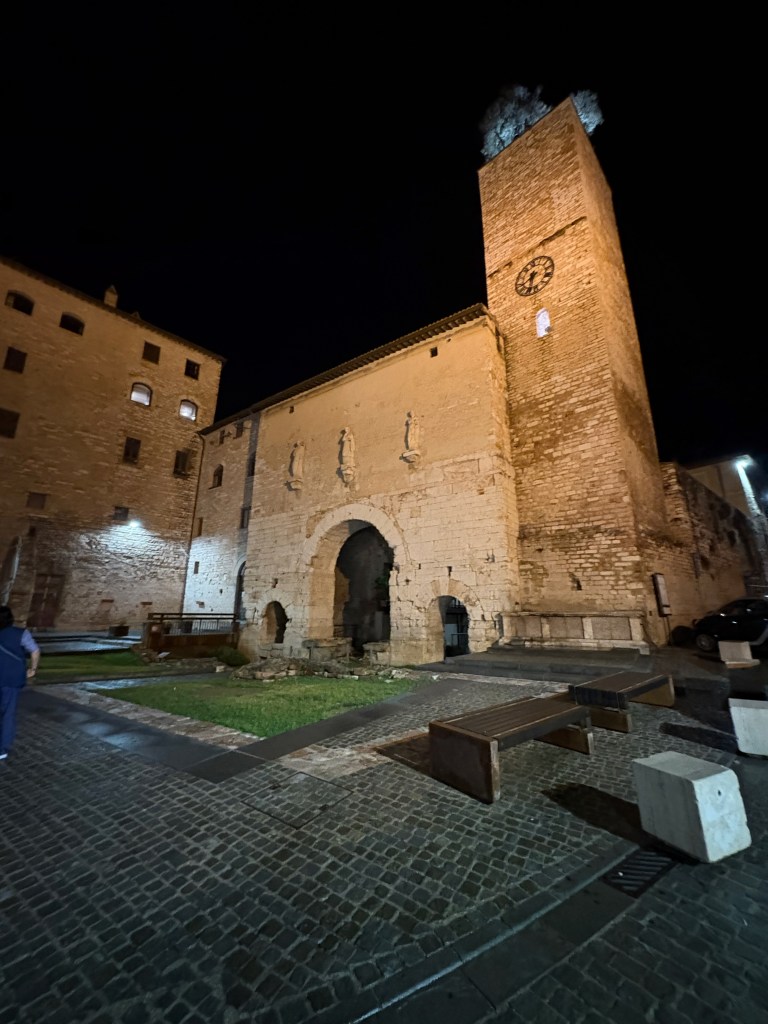
We stayed at a hotel , Valle di Assisi/Hotel Cenacolo Assisi, that overlooked the old town. We could have stayed longer!
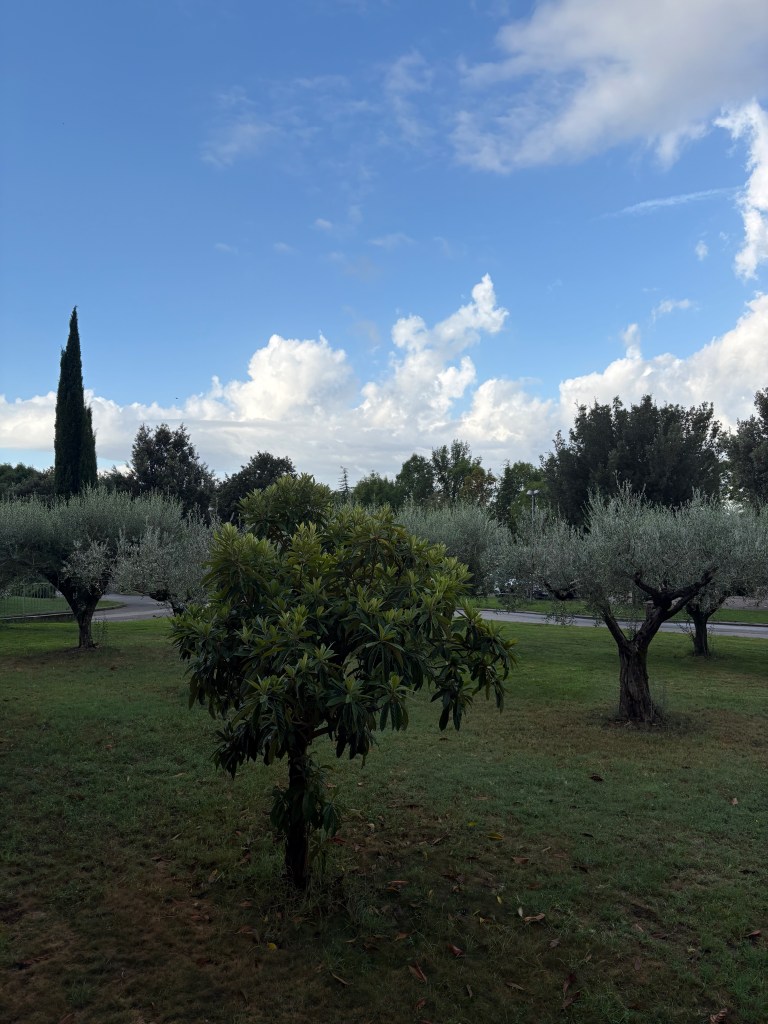
September 11 Day 6 | Assissi and Journey to Venice
We enjoyed stunning views of the countryside.
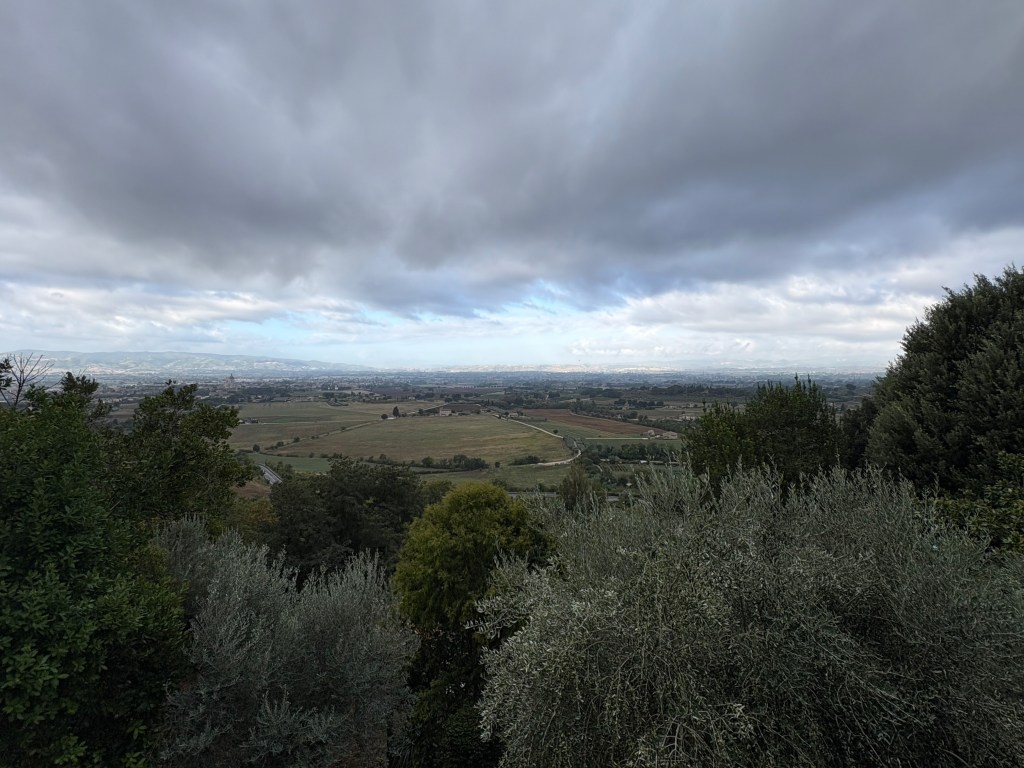
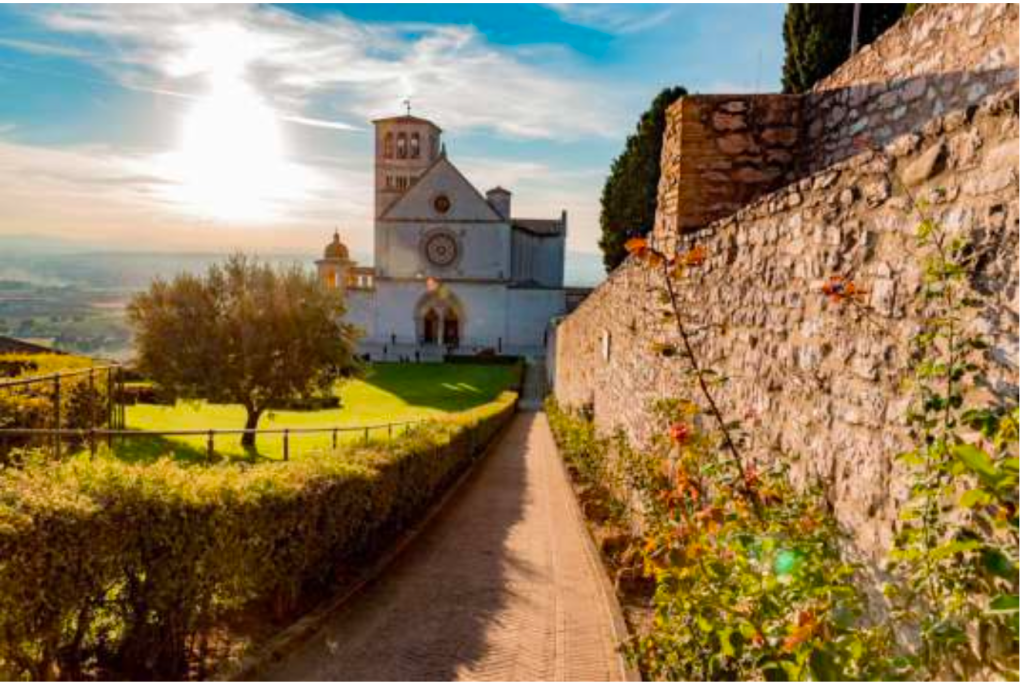
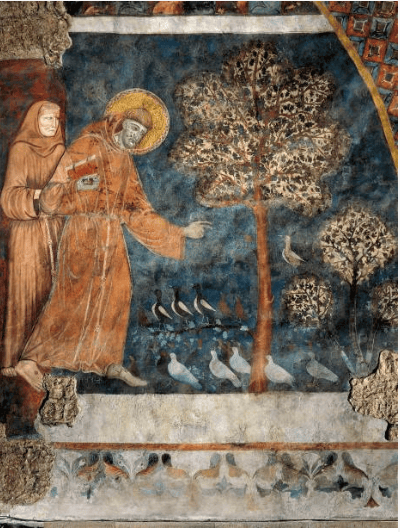
First thing we joined a Local Specialist and visited the Basilica of St. Francis, famous for Giotto’s exquisite frescoes and 13th century stained glass windows. We were limited in taking photos inside the basilica and, therefore, some are from internet sources.
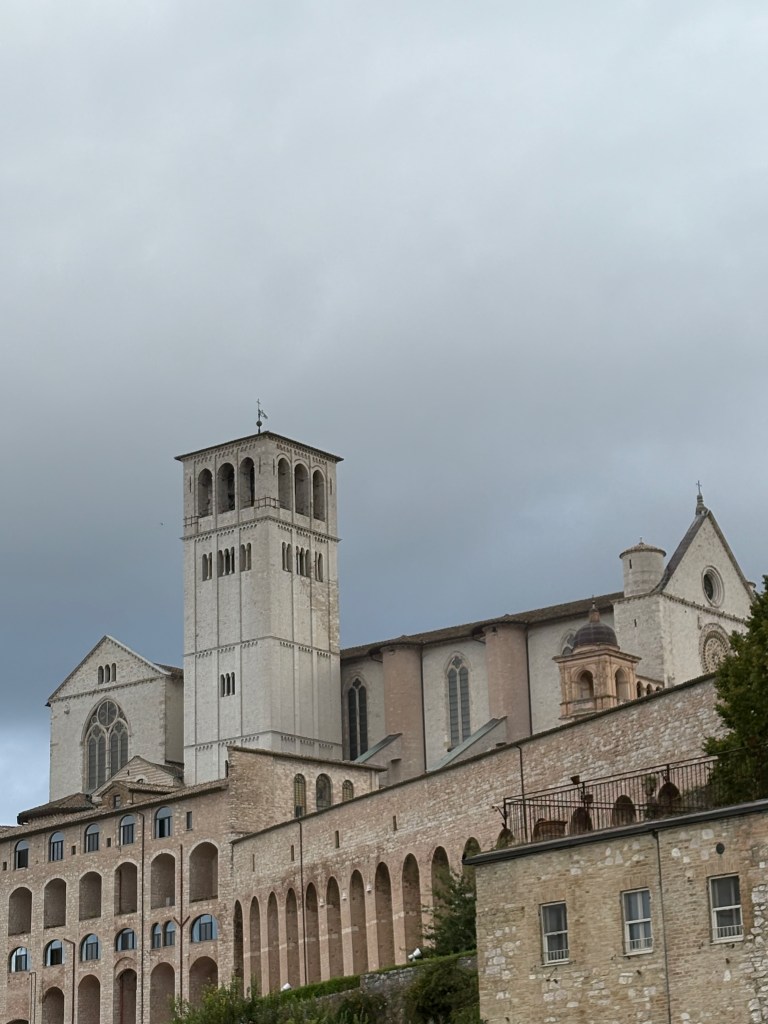
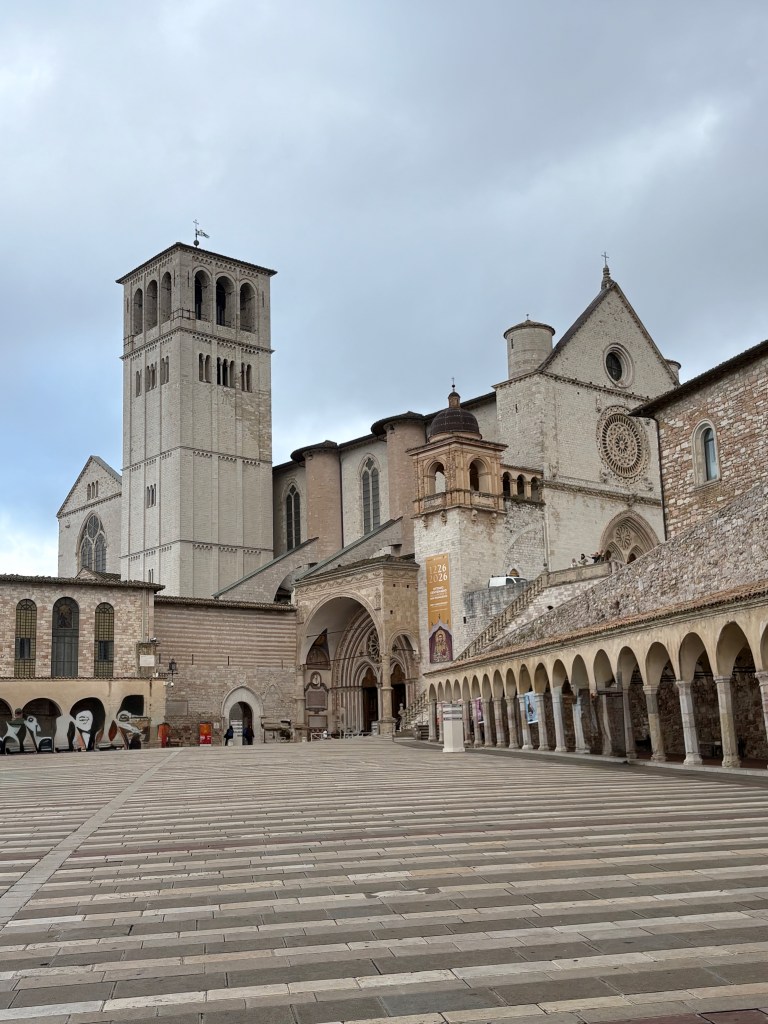
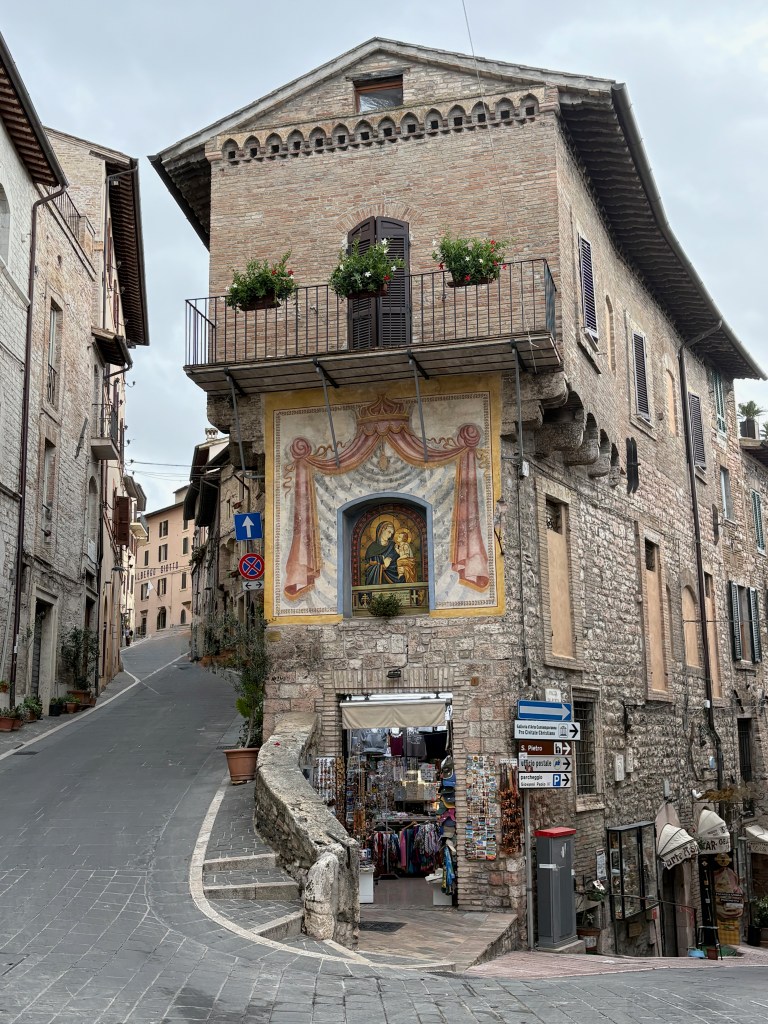
The streets are not busy in the morning but become busier as it got closer to noon. They are very old and lovely.
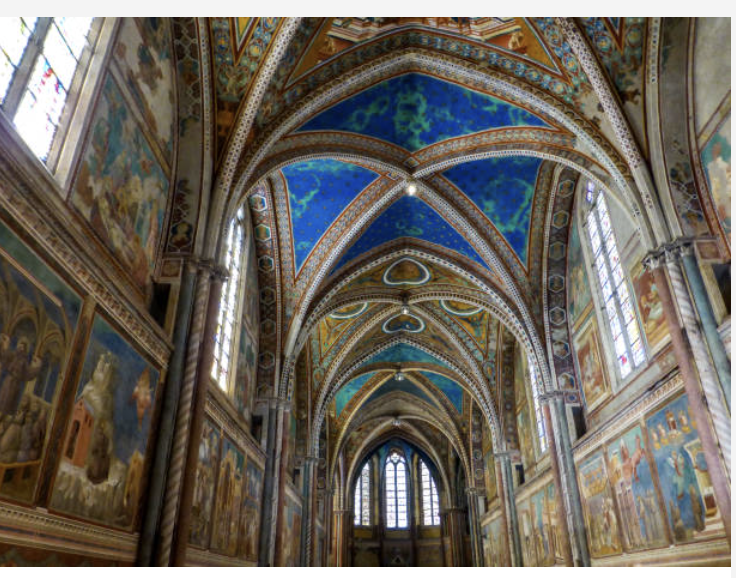
Despite some International Gothic style elements, the Basilica outside is Romanesque; however, its interior is Gothic, characterized by vivid colors and sleek forms. The nave is unique, with a transept and a apse covered by high cross vaults.
The two levels of the Basilica are completely different: the lower is darker and focuses on Jesus’ life while the upper is lighter and focuses on St Francis. Unlike the lower Basilica, the upper church is lit by large windows and a splendid rose window in the façade. The Basilica also boasts the largest collection of Medieval stained glass windows in Italy: the apse glass was the work of German makers and the nave glass was created by French and local artisans during the 18th century.
The upper band of the nave wall was kept simple and totally smooth to receive frescos recounting stories from the Bible to the poor classes (who were illiterate) and exalting Saint Francis. What makes this place famous, unique and precious are the amazing frescos; these masterpieces have made the Basilica one of the most important examples of 13th and 14th century art evolution in Italy and in Europe. Dating the frescos is not easy; they are tied to opposing factions of friars: “conventual Franciscans” and the “Spiritual” ones; the latter were against enriching with works of art Franciscan places of worship because of the lifestyle chosen by Francis.
The Upper Church interior features a single, luminous Gothic nave with high vaulted ceilings and large stained-glass windows.
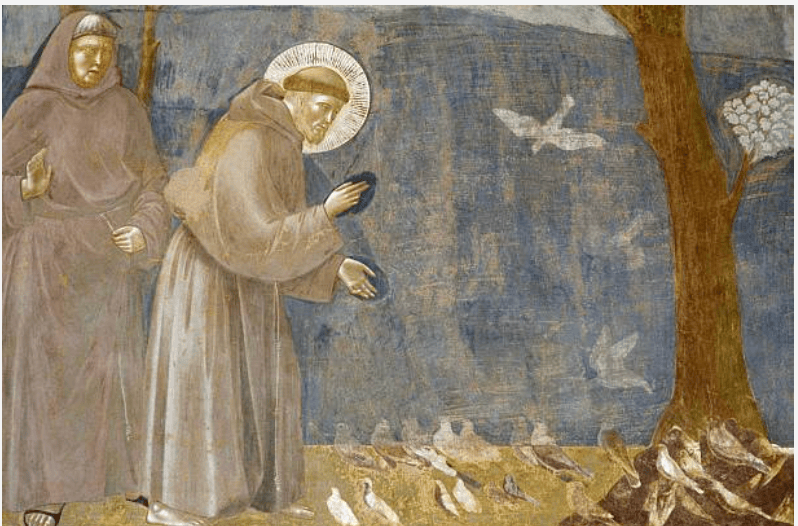
About St. Francis of Assisi: He was an Italian saint born around 1181 or 1182 and died on October 3, 1226. He is famous for founding the Franciscan religious orders. St. Francis was a strong advocate for living a life of evangelical poverty, charity, and devotion to Jesus. His charisma and dedication attracted many followers and significantly influenced medieval spirituality. He is recognized as one of the most revered figures in Roman Catholic history and is the patron saint of Italy, ecology, and animals.
Born Francesco di Pietro di Bernardone, he was the son of a cloth merchant. Francis had a lively youth and even participated in a war between Assisi and Perugia, where he was held prisoner. After falling ill and recovering, he had a spiritual awakening. He renounced his worldly possessions and family ties to embrace a life of poverty and prayer. A pivotal moment was when he heard a crucifix command him to “Go, Francis, and repair my house.” Taking this literally, he began by repairing ruined chapels and refused payment.
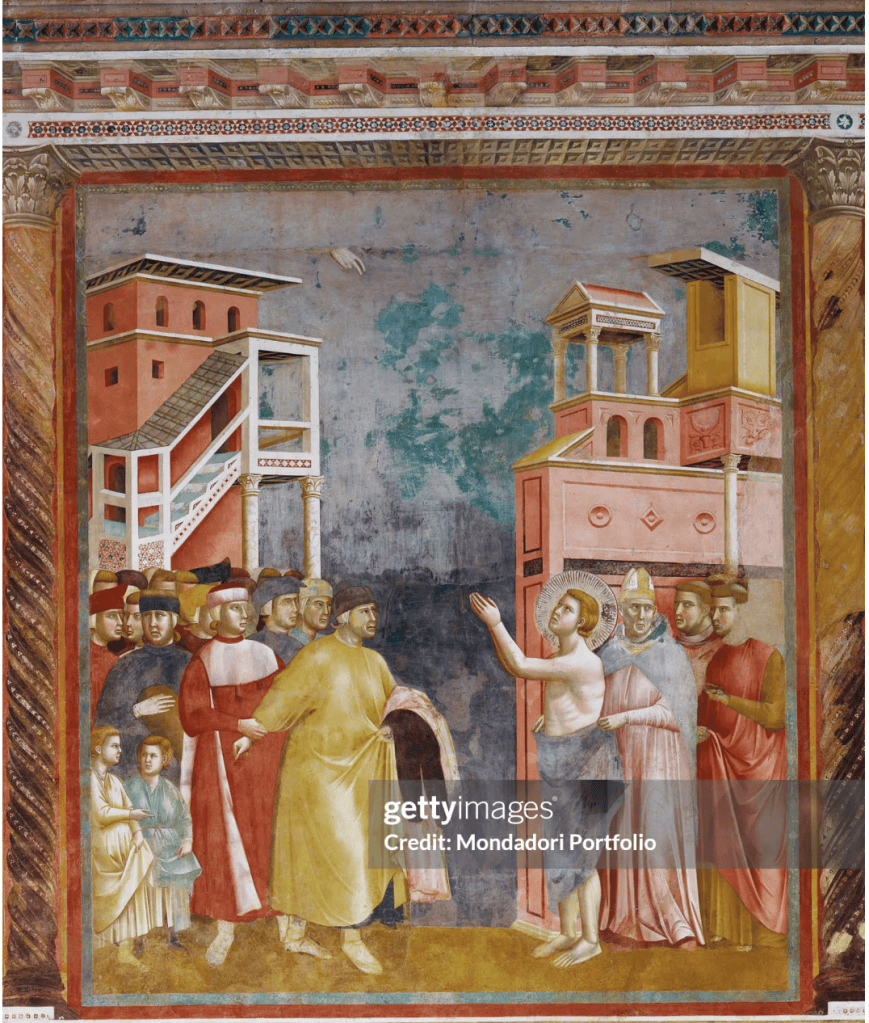
Angered, his father kept him at home and then called him before the bishop of Assisi. Before any accusations were made, Francis “without a word peeled off his garments even removing his breeches and restored them to his father.” Completely naked, he said: “Until now I have called you my father on earth. But henceforth I can truly say: Our Father who art in heaven.” The astonished bishop gave him a cloak, and Francis went off to the woods of Mount Subasio above the city.
The basilica is adorned with famous 13th-century fresco cycles depicting the life of Saint Francis and Jesus, attributed to Giotto and Cimabue.
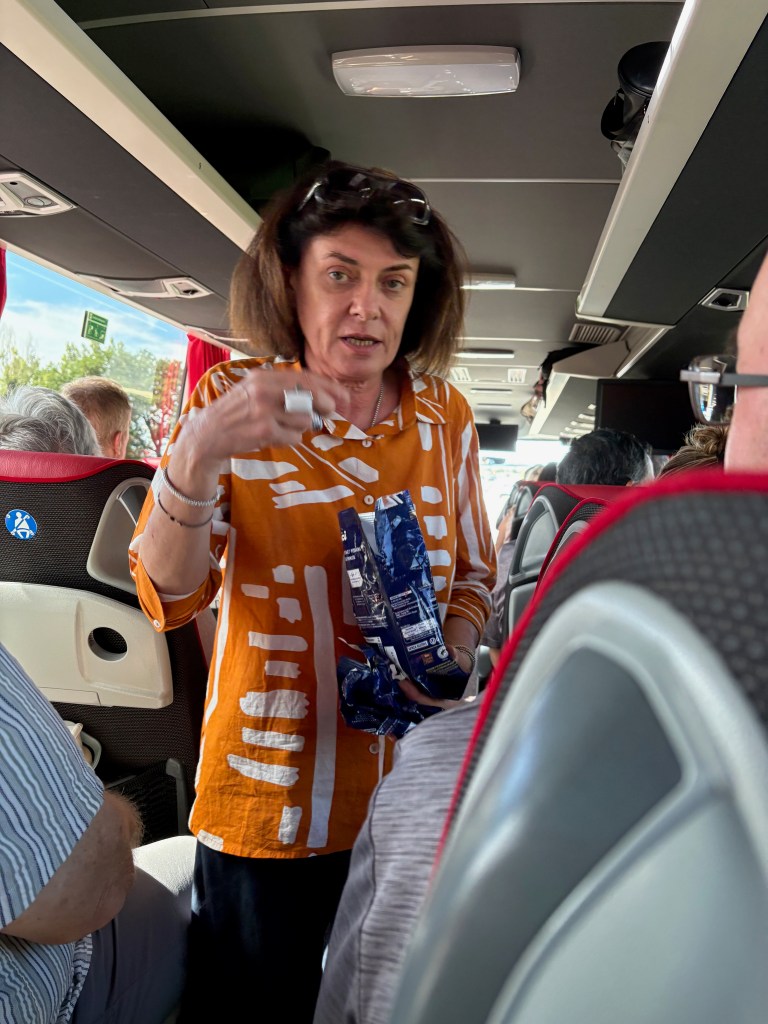
We wandered the streets of this lovely old town.
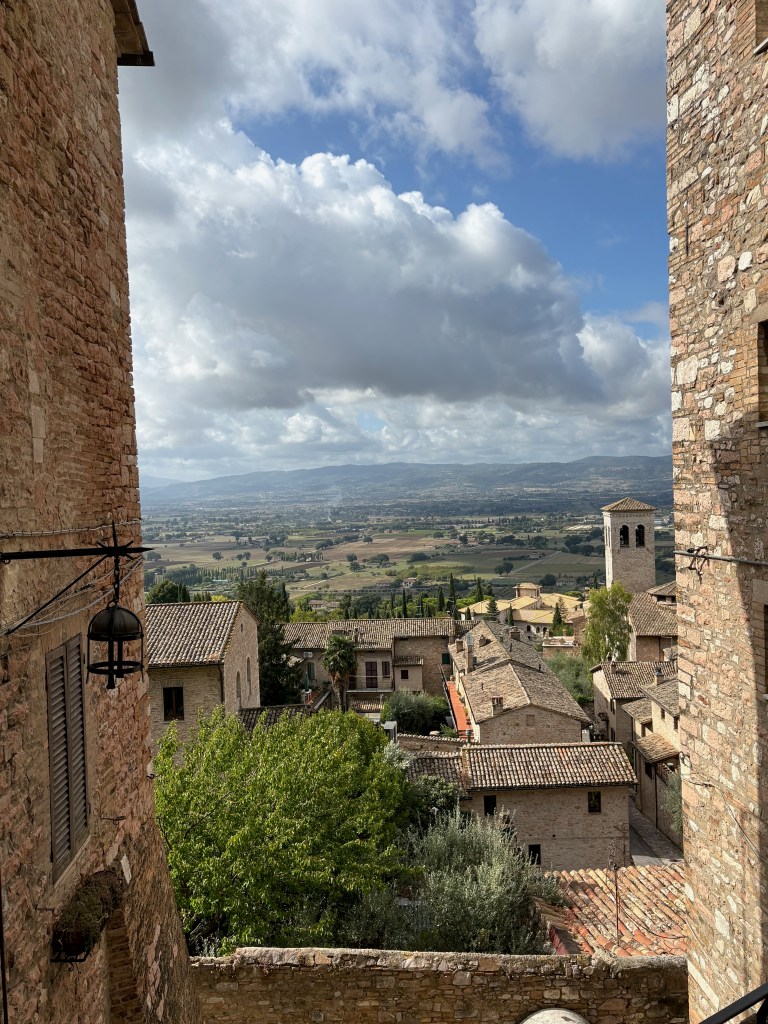
On the bus, our dynamic travel director, Pamela Russo, shared some real Italian chocolate with us (not that terrible Nestle candy). It was a long bus ride.
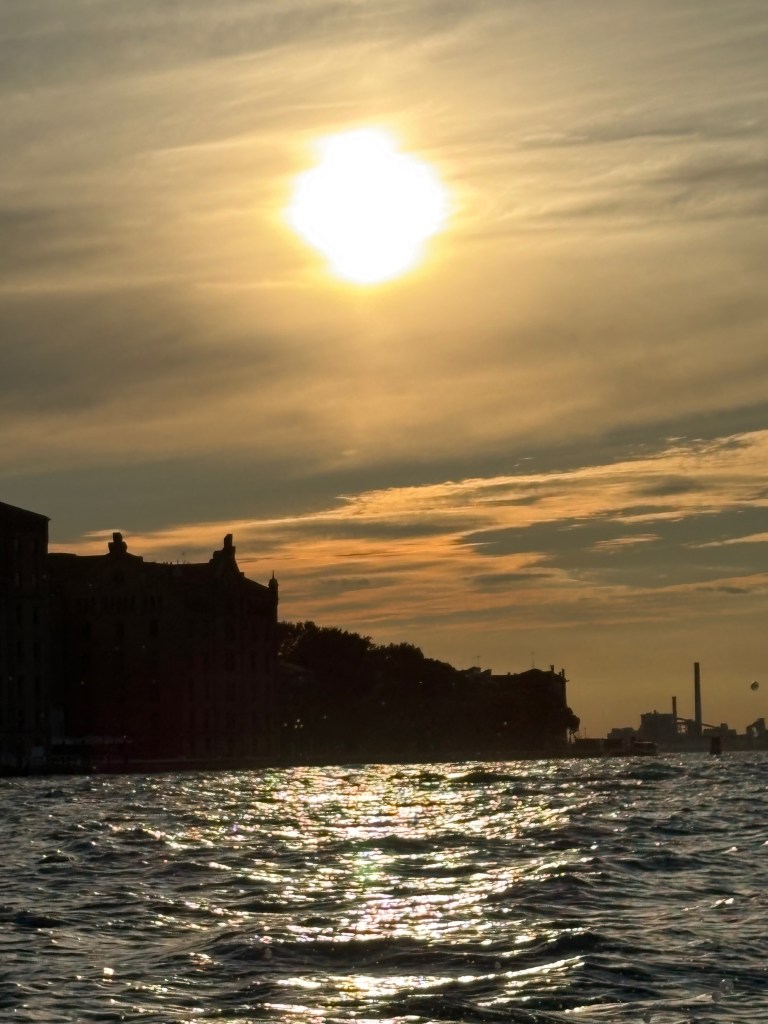
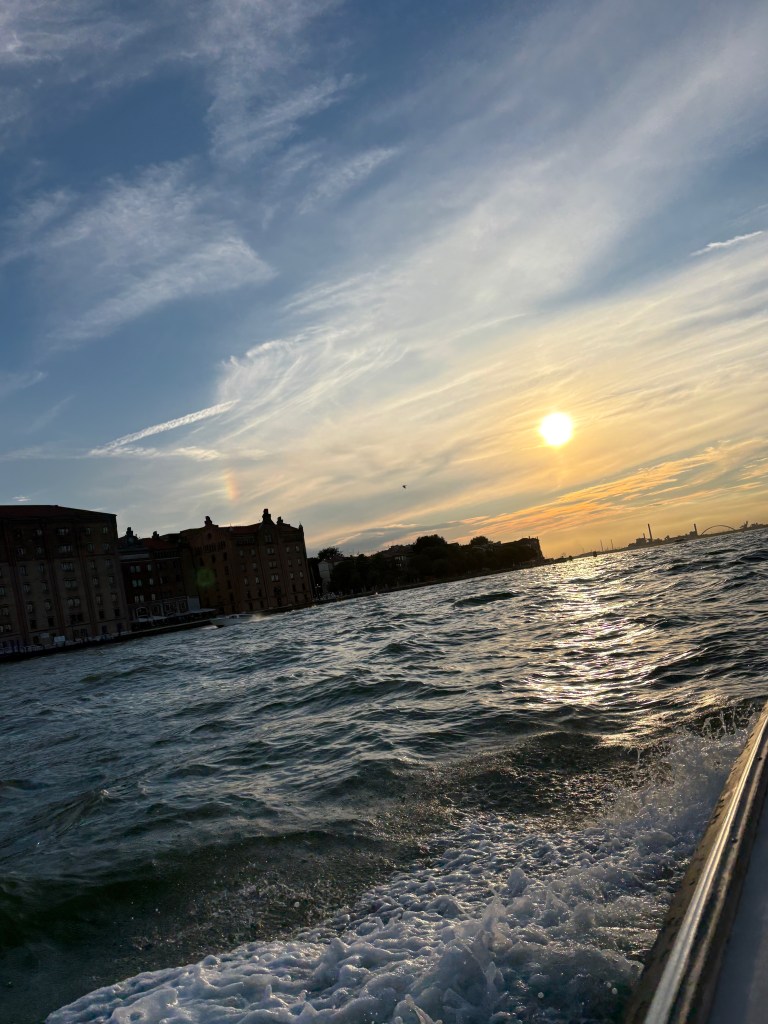
After a long day on the bus, we arrived in Venice for a private water taxi ride along the Grand Canal, passing the city’s iconic palazzi. Venice at last.
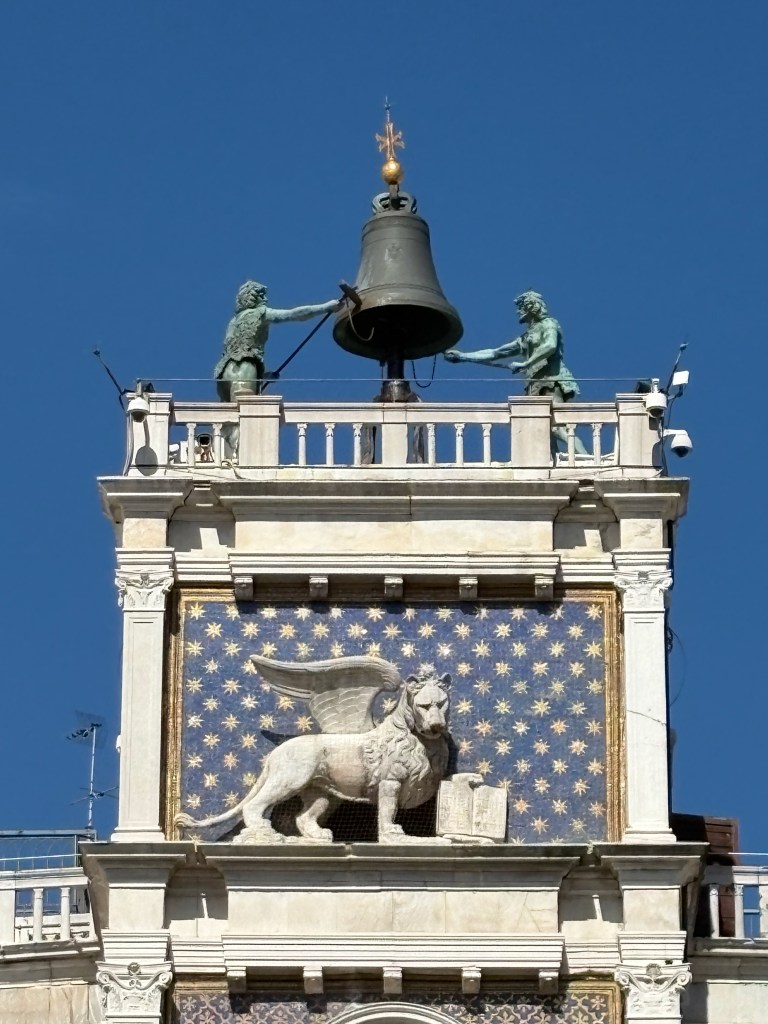
Venice is a unique city in northern Italy, built on over 100 islands in a lagoon. It was once a powerful maritime republic and a major European trading center, connecting Europe with Asia. The city is famous for its canals, bridges, and stunning architecture, with buildings dating back to the Romanesque, Gothic, and Renaissance periods.
Venice’s foundation is a remarkable feat of engineering. Buildings are constructed on millions of wooden piles driven deep into the mud and clay of the lagoon floor. These piles, made from hardwoods like alder, have been preserved by the low-oxygen environment of the brackish water, hardening over time. Buildings were then constructed on top of these piles using brick and stone. The city expanded by connecting these islands with bridges and canals, with the Grand Canal serving as its main artery.
The city’s layout, with its canals and narrow streets, means that automobiles are banned in much of the historic centre, making it a city best explored on foot or by boat. Traditional gondolas are a popular sight for tourists, alongside public water buses (vaporetti) and water taxis. Venice is a UNESCO World Heritage site, and there is a strong focus on preserving its unique architecture and environment. However, the city faces challenges from rising water levels and land subsidence, as well as a declining resident population (from 150,000 to 48,000 now) who often move to the mainland for more modern amenities.
A new island has been created for the operation and maintenance of a complex movable barrier system called MOSE, designed to mitigate storm surges. Although the MOSE project began in the early 2000s and has been partially implemented, concerns remain about its effectiveness in the face of escalating sea-level rise predictions.
The worst recorded flood in the history of Venice occurred on November 4, 1966, when the water level reached an unprecedented 194 cm (6 feet 4 inches) above median sea level. A combination of torrential rain, swollen rivers, and fierce southern sirocco winds trapped high tides in the lagoon for over 22 hours. The surge covered nearly the entire city, left thousands of residents homeless, and ruined countless priceless works of art and historic structures.
The second-highest flood in modern times occurred recently on November 12, 2019, reaching 1.87 meters (6.2 feet), which was just a few inches short of the 1966 record.
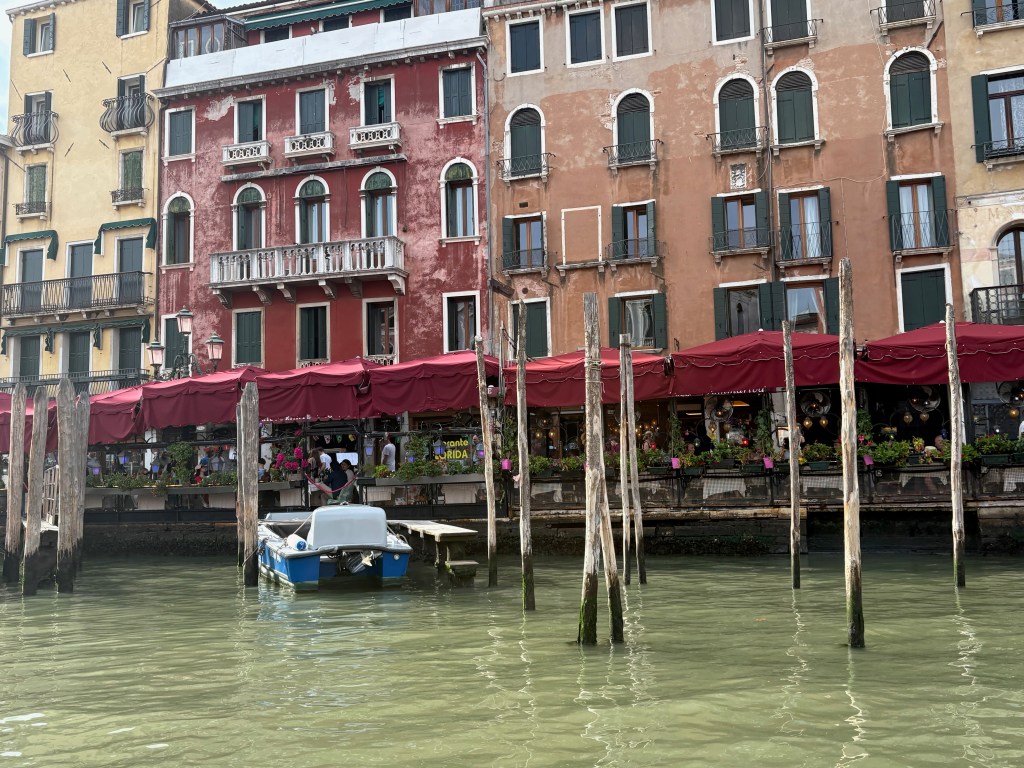
The water taxi ride
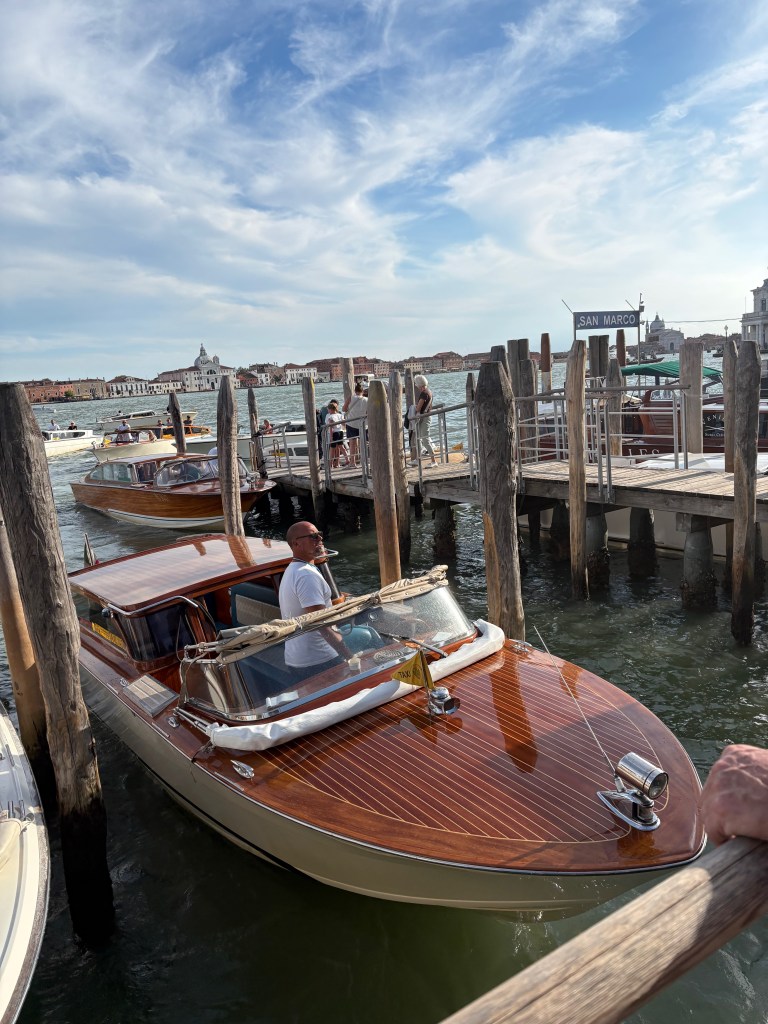
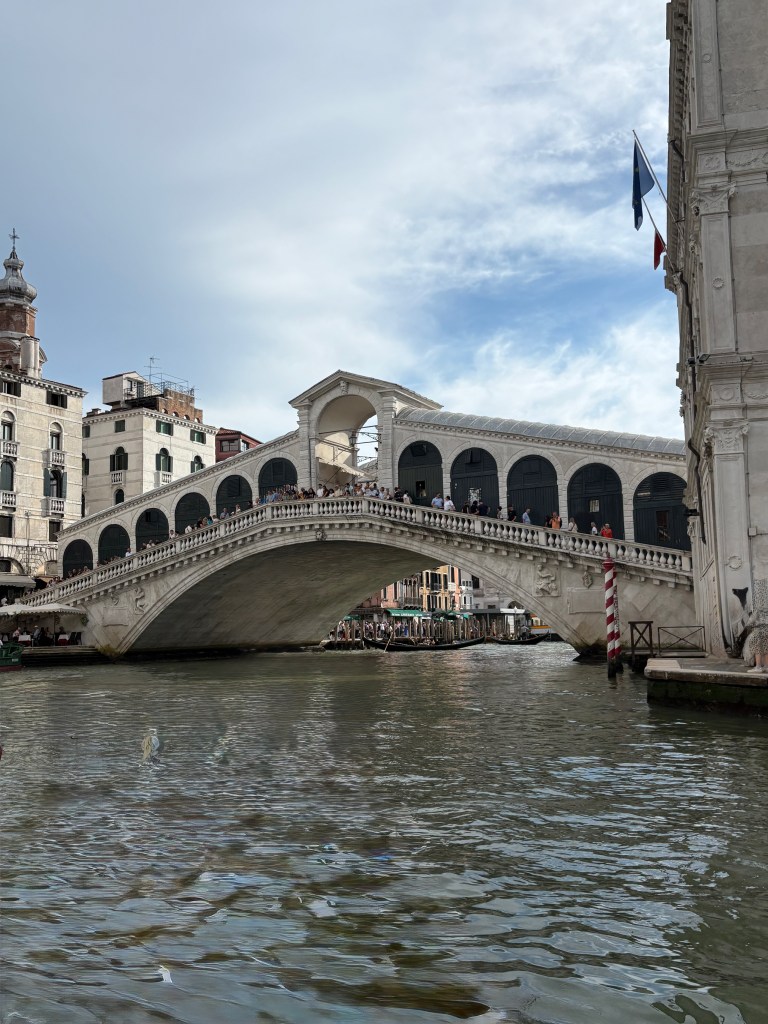
Beautiful buildings line the Grand Canal.
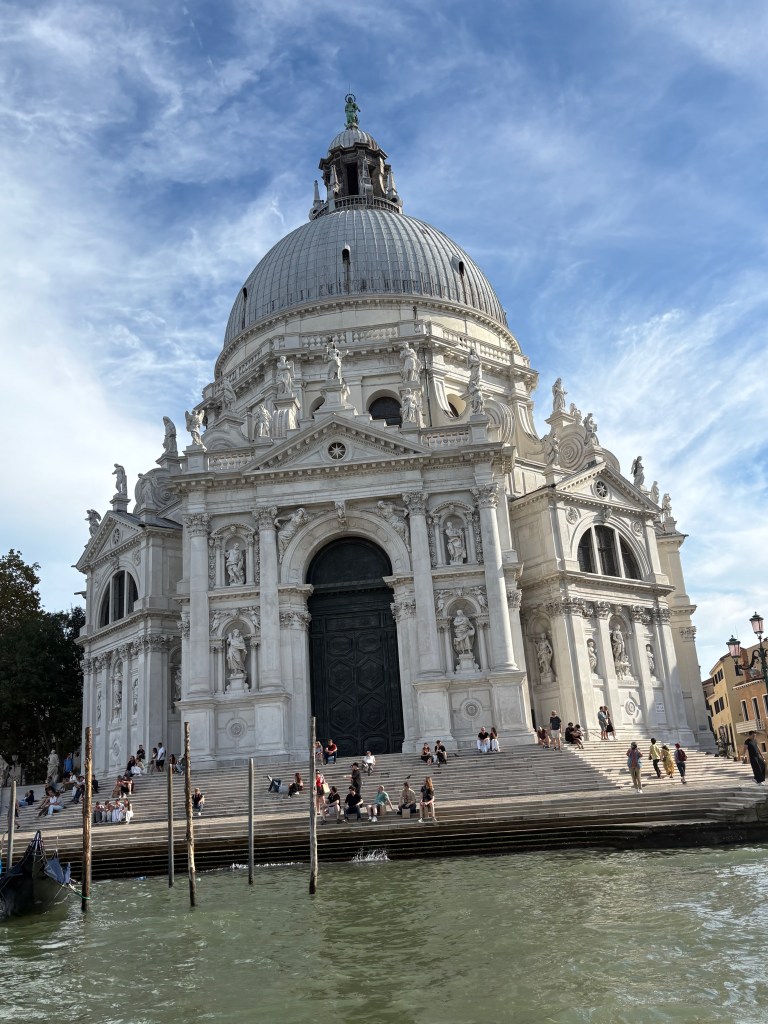
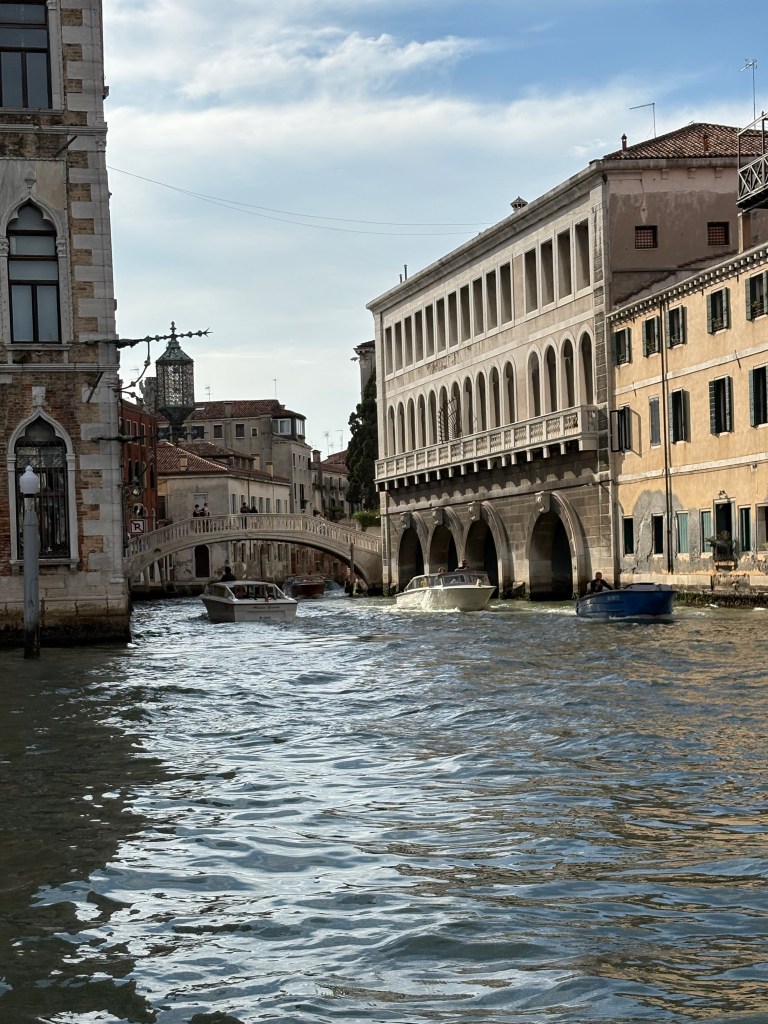
You can just arrive to the building or cafe by water taxi.
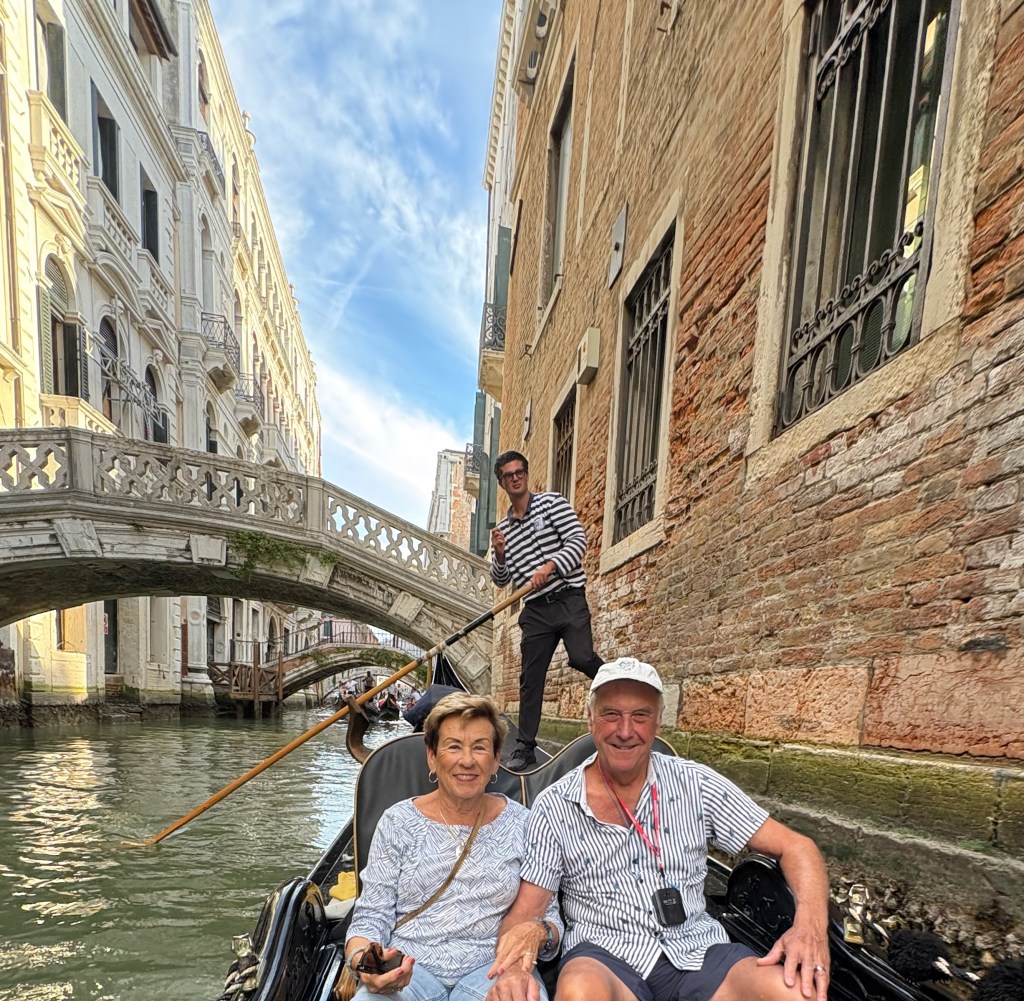
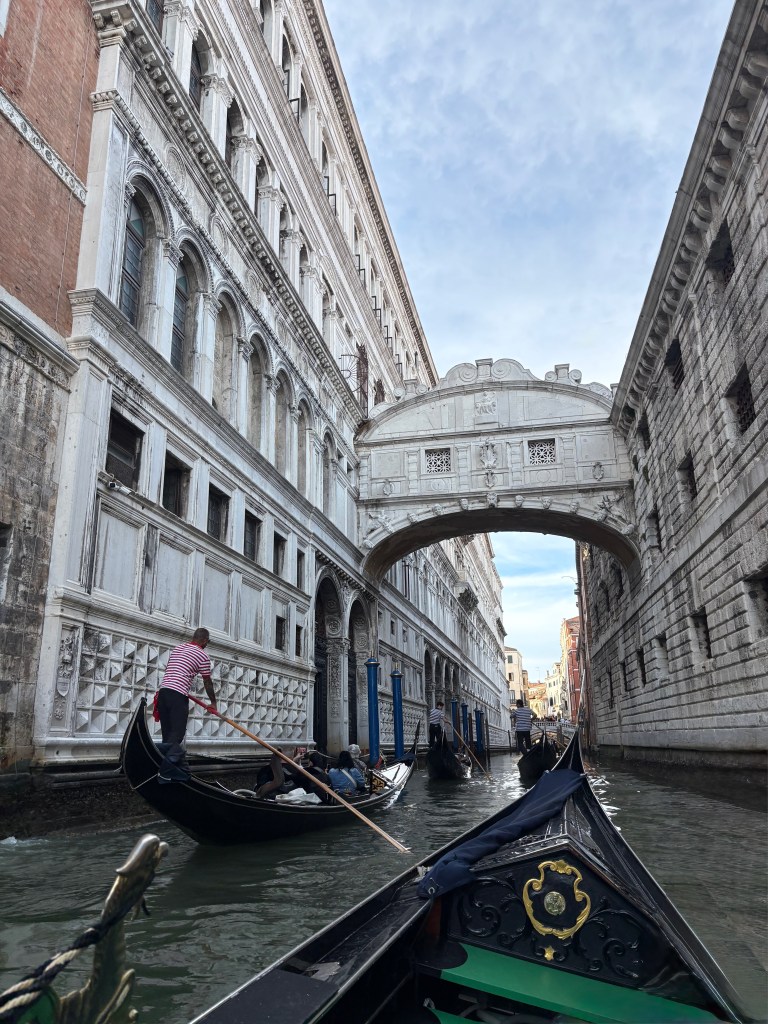
We arrived near St. Mark’s Square before switching pace with a gondola ride through Venice’s quieter canals. Our gondolier sang and whistled as he oared.
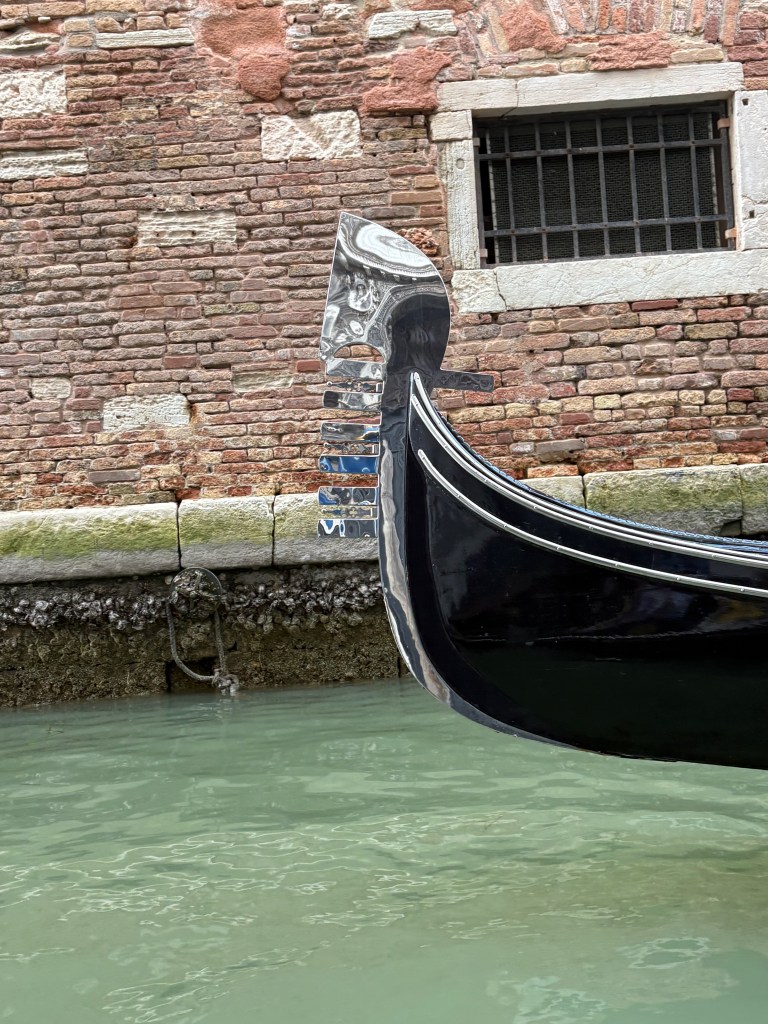
The metal ornament on the front of a Venetian gondola is called the ferro di prua, and it is packed with map-like symbolism representing the layout and landmarks of Venice. The main curved body of the metal piece mimics the winding course of the Grand Canal. The very top arch represents the corno ducale, or the traditional hat worn by the Doge (the ancient ruler of Venice). The small semi-circular opening just under the “hat” stands for the Rialto Bridge. The six teeth pointing forward represent the six historic districts (sestieri) of Venice: San Marco, San Polo, Santa Croce, Cannaregio, Dorsoduro, and Castello.The Backward Prong: The single tooth pointing out the back represents the island of Giudecca.
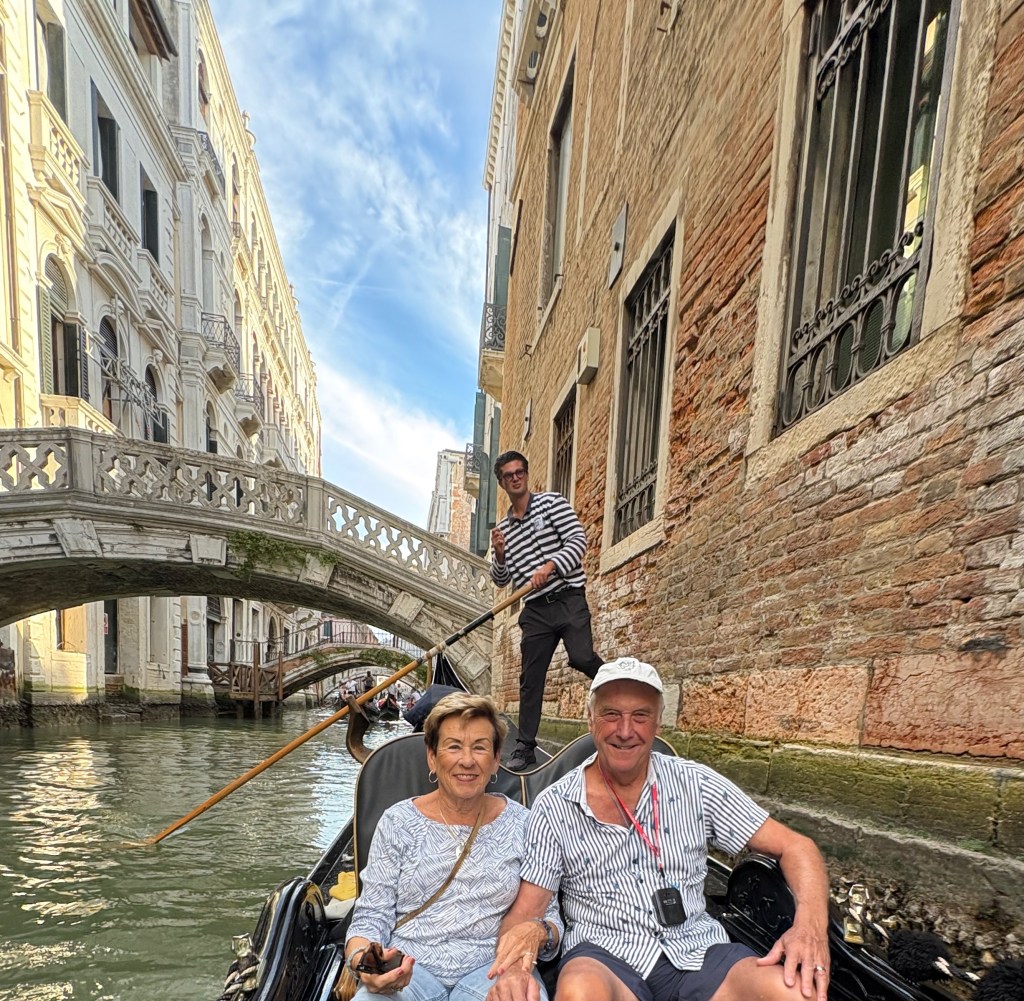
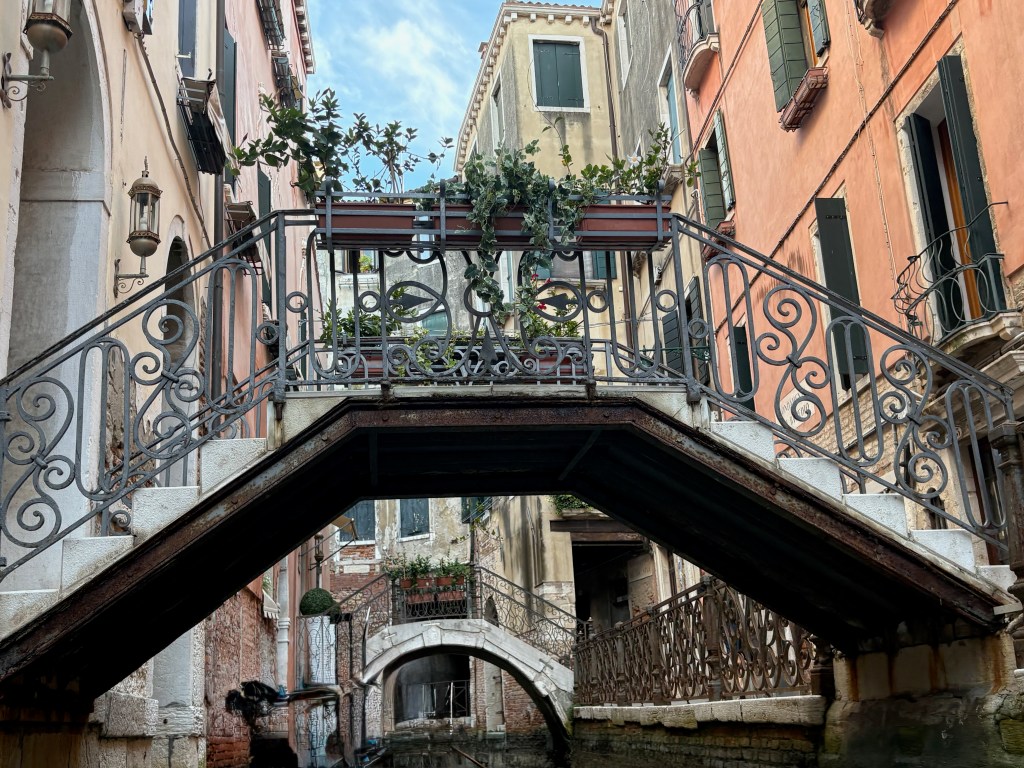
The canals between the islands are narrower and took some skilled maneuvering around the corners and avoiding other gondolas.
Because of the Film Festival, accommodations on the islands were fully booked so we stayed at an airport hotel and travelled by bus back and forth.
September 12 Day 7 | Cruise the Canals of Venice
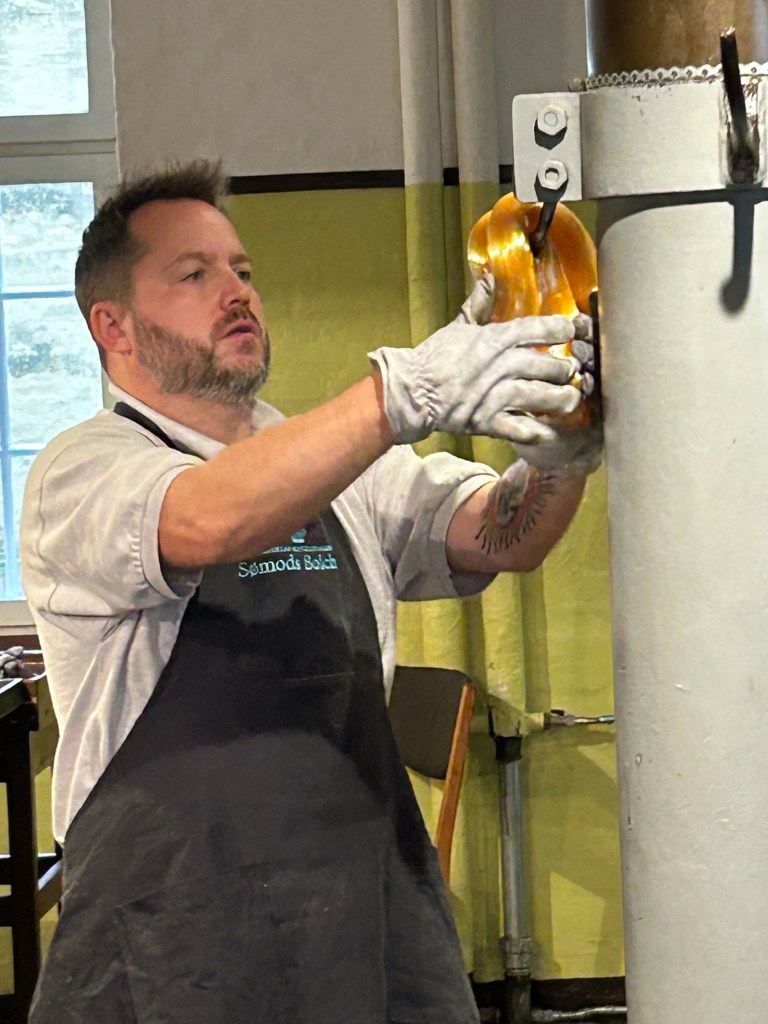
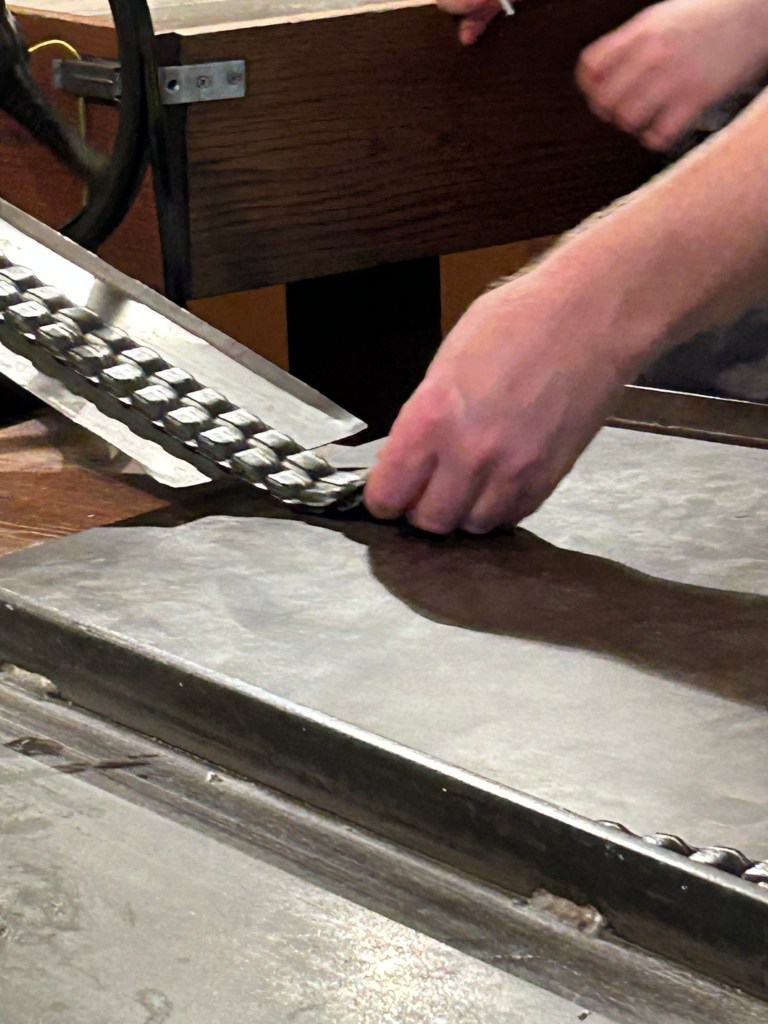
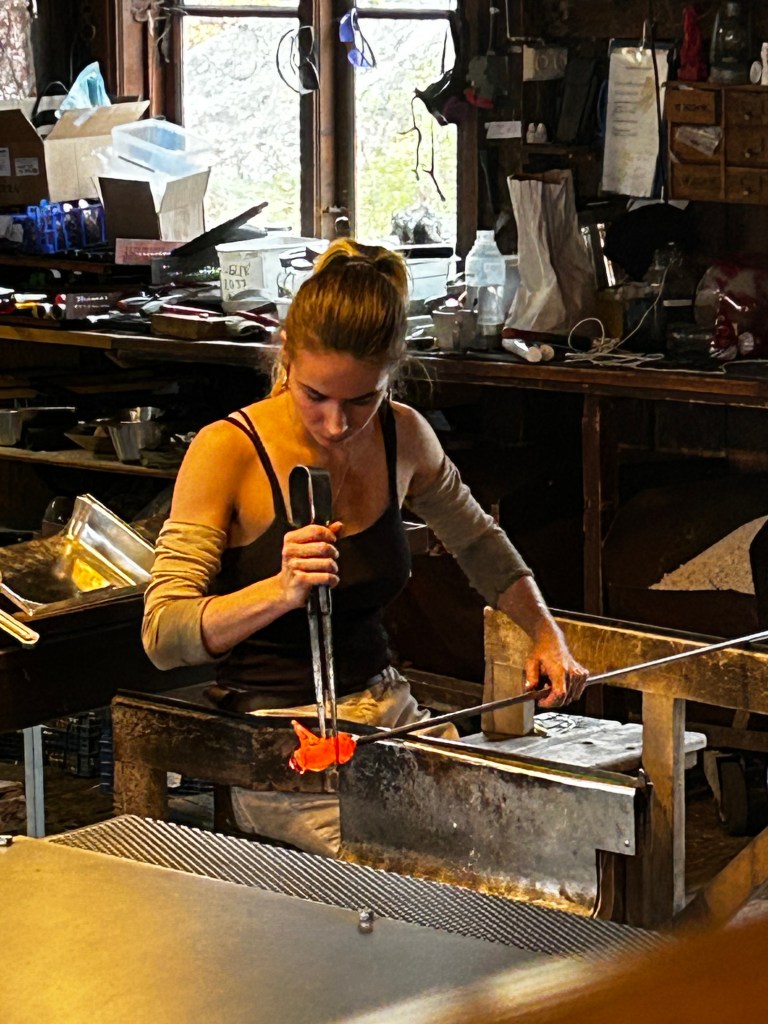
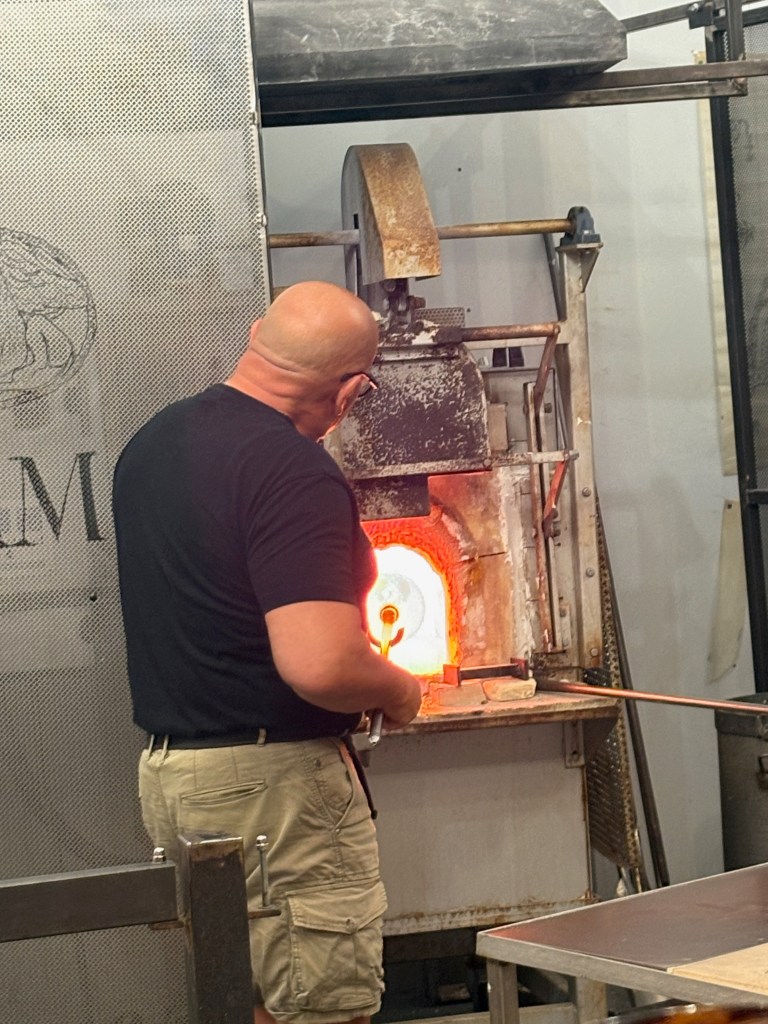
We cruised by private launch to the island of Murano where craftsmen bring to life the 13 – century tradition of Venetian glassblowing. We watched the talented master craftsman use the same techniques that have been passed down through the generations. There are only a few expert craftsmen left in Murano.
Around 30 to 60 active glass-making furnaces and prominent factories operate on the island today. During the 20th century, the island regularly sustained over 300 active furnaces. The remaining glass businesses provide jobs to over a tenth of the island’s total population.
Murano glass is primarily made from a base mixture of 70% silica sand and 30% fluxes (soda and lime), melted together at temperatures around 1,400°C. Silica Sand is the core structural component that provides strength and durability. Soda Ash (Sodium carbonate) acts as a flux to lower the extremely high melting point of silica, making the material workable. Limestone (Calcium carbonate) stabilizes the mixture and prevents the soda from dissolving in water. Rinse Aids / Purifiers like antimony or manganese dioxide are used to clear out impurities and bubbles.
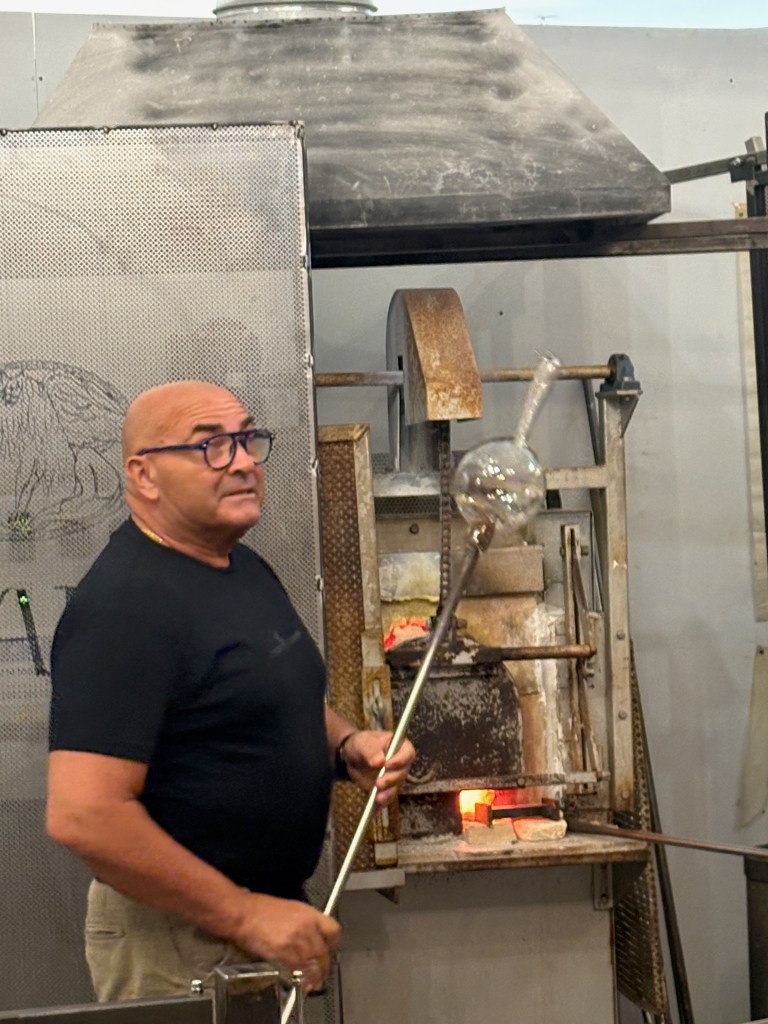
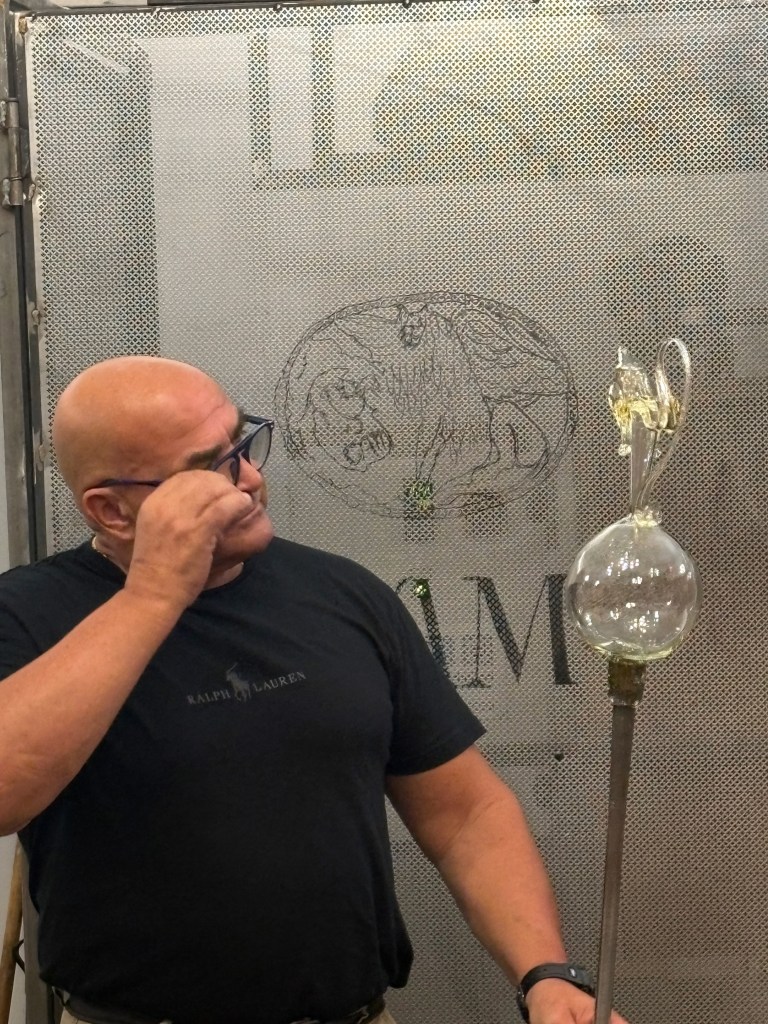
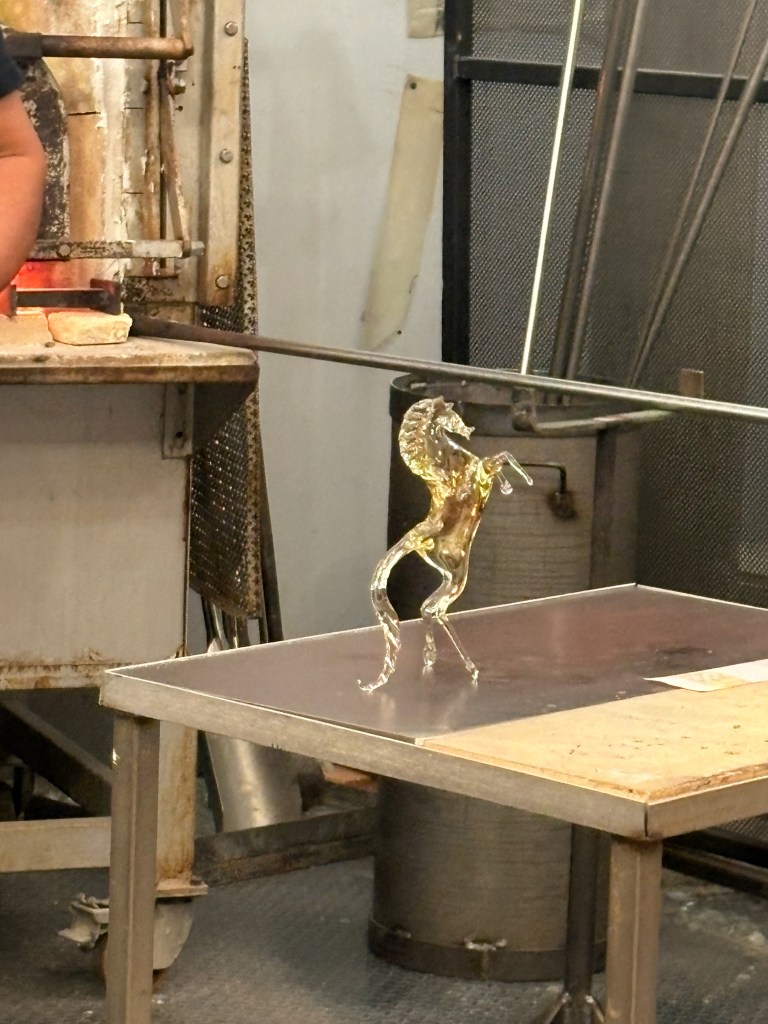
The base glass is completely colourless. Artisans achieve Murano’s signature vibrant palette and special effects by adding precise mineral oxides and metallic compounds:Cobalt: Deep blue Gold and Copper: Ruby red and sparkling flecks (Aventurine)Selenium: Bright redCopper compounds: Greens and turquoiseManganese: Violet or black Tin oxide / Cryolite / Arsenic: Milky white or opaque effects (such as historic lattimo glass).
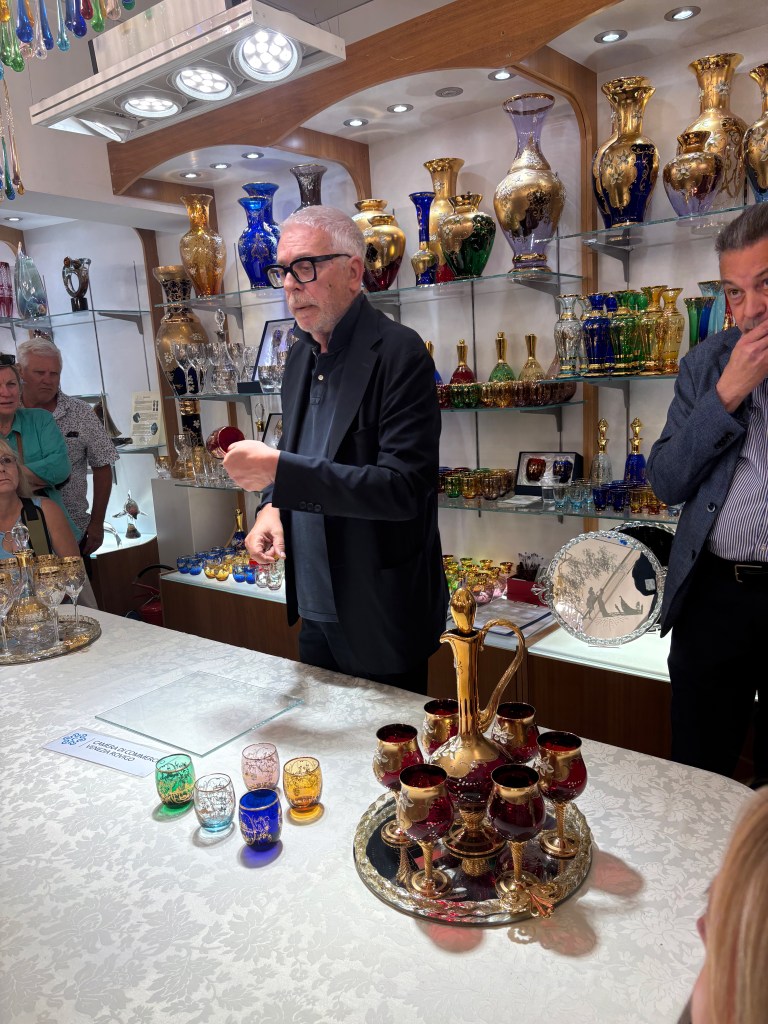
I was inspired to buy a souvenir of a bracelet to remind me of my visit.
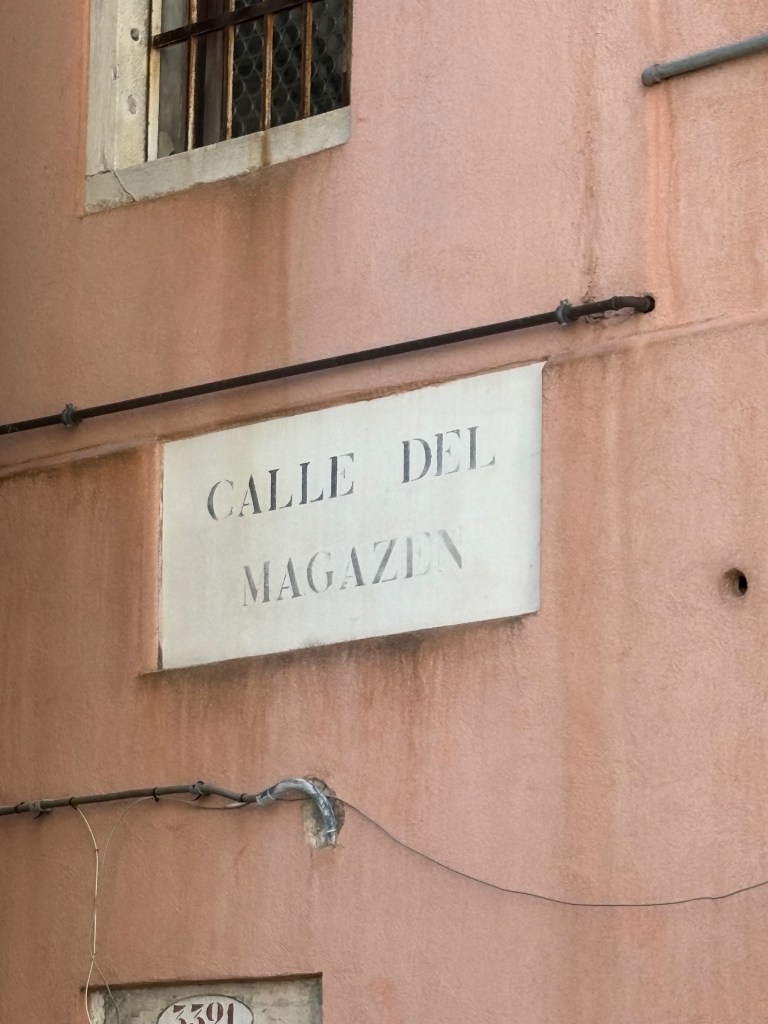
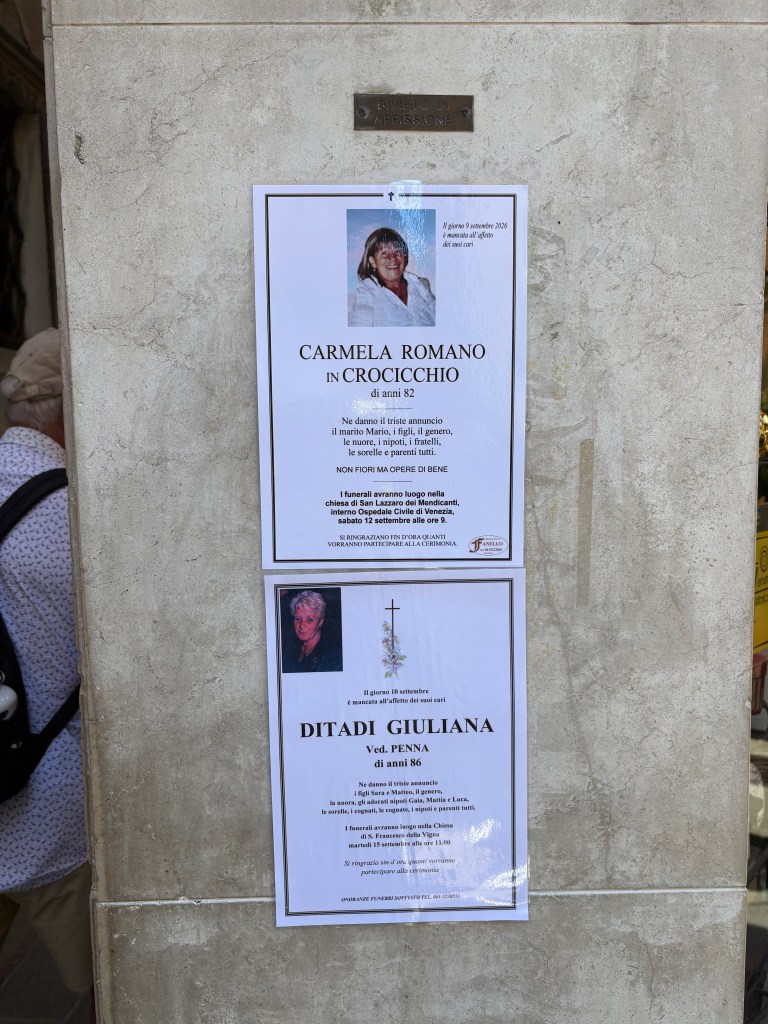
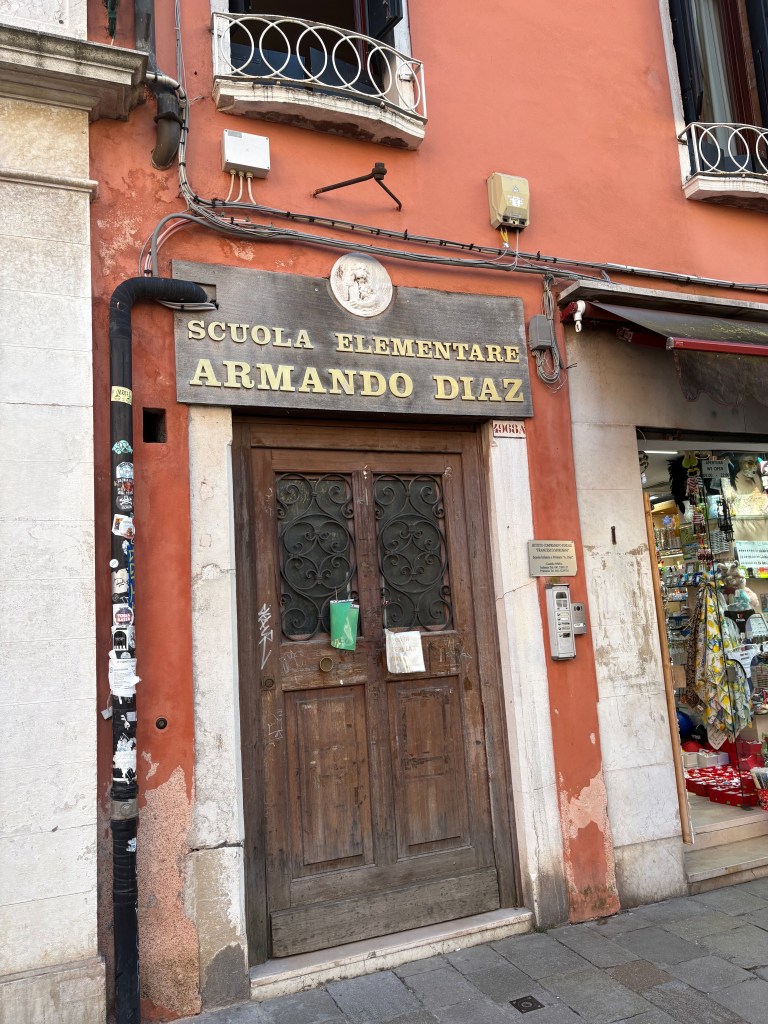
We explored the hidden maze of streets which make up this unique city as our Local Guide gave us a fascinating insight into Venice’s past and present. We walked through tucked away squares and back streets local Venetians use to side-step the tourist throng and got a sense of authentic life on the island of Venice. Our guide explained that Venice is organized around small squares where there is a cistern, a church, stores and a meeting space.
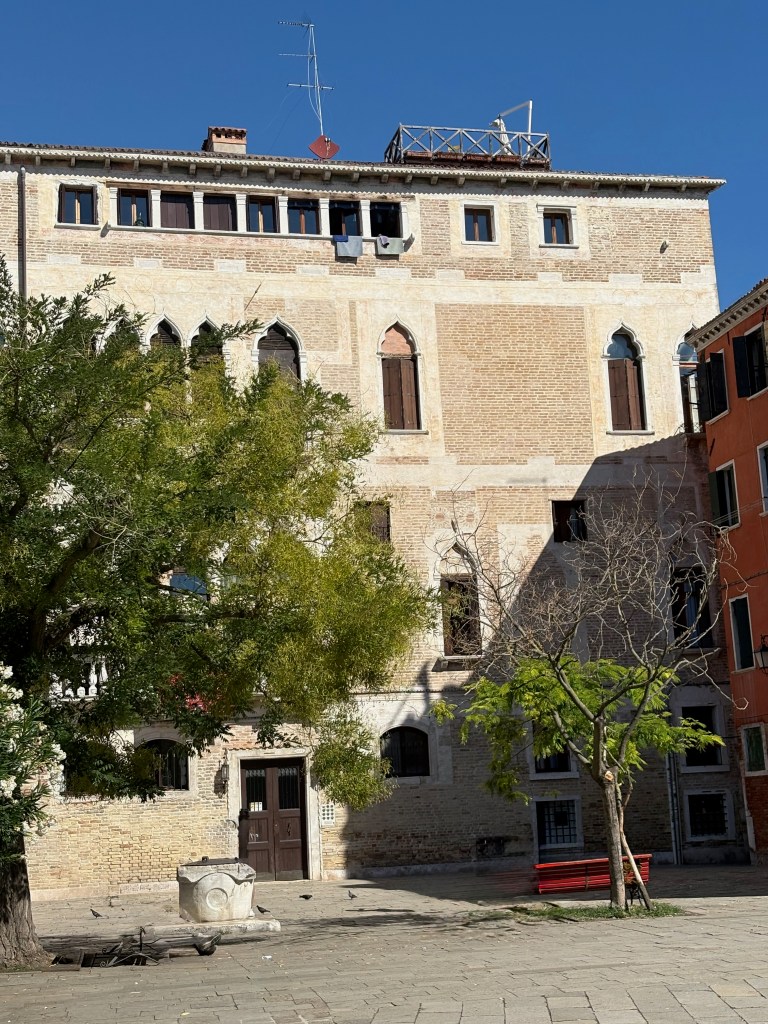
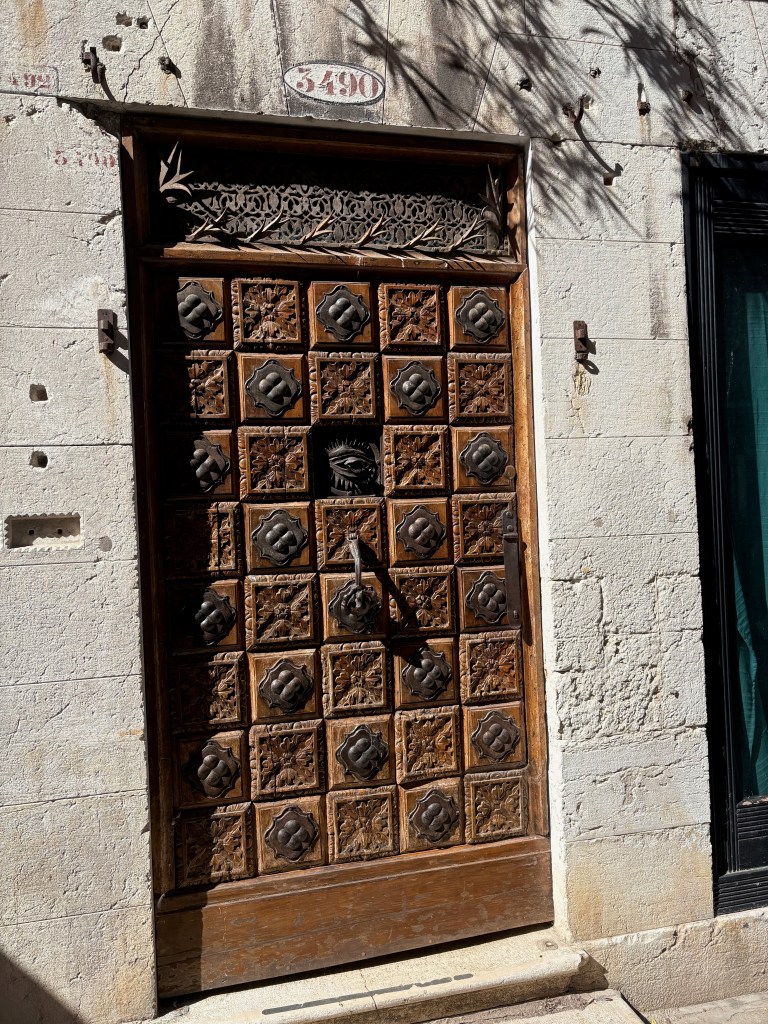
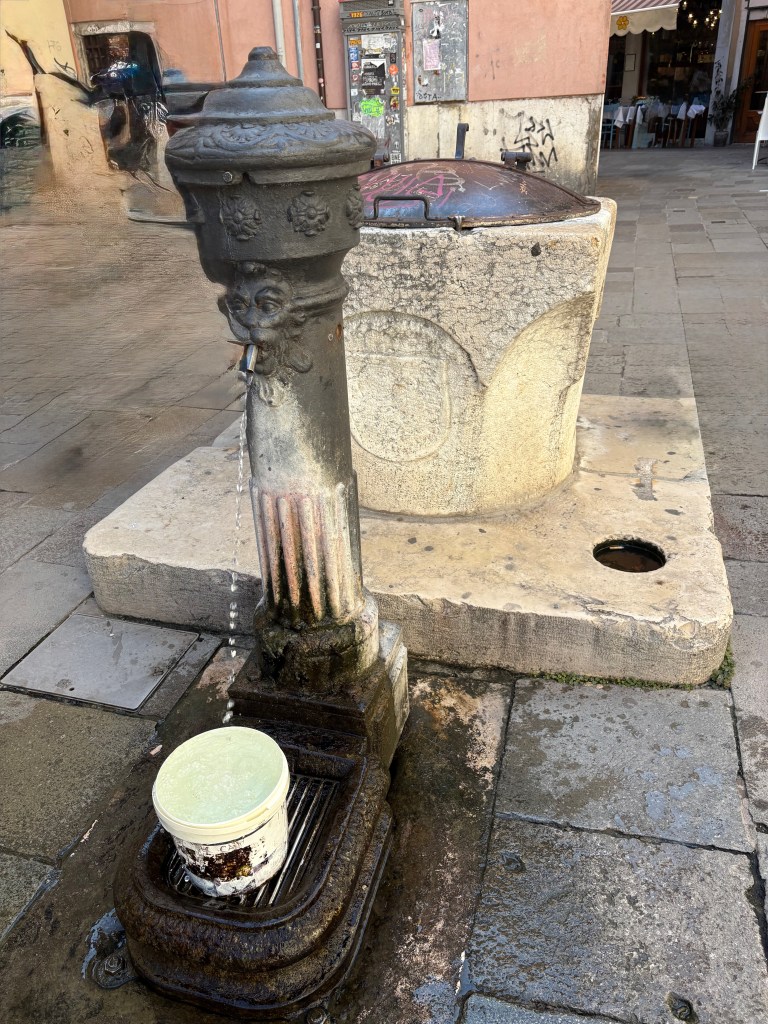
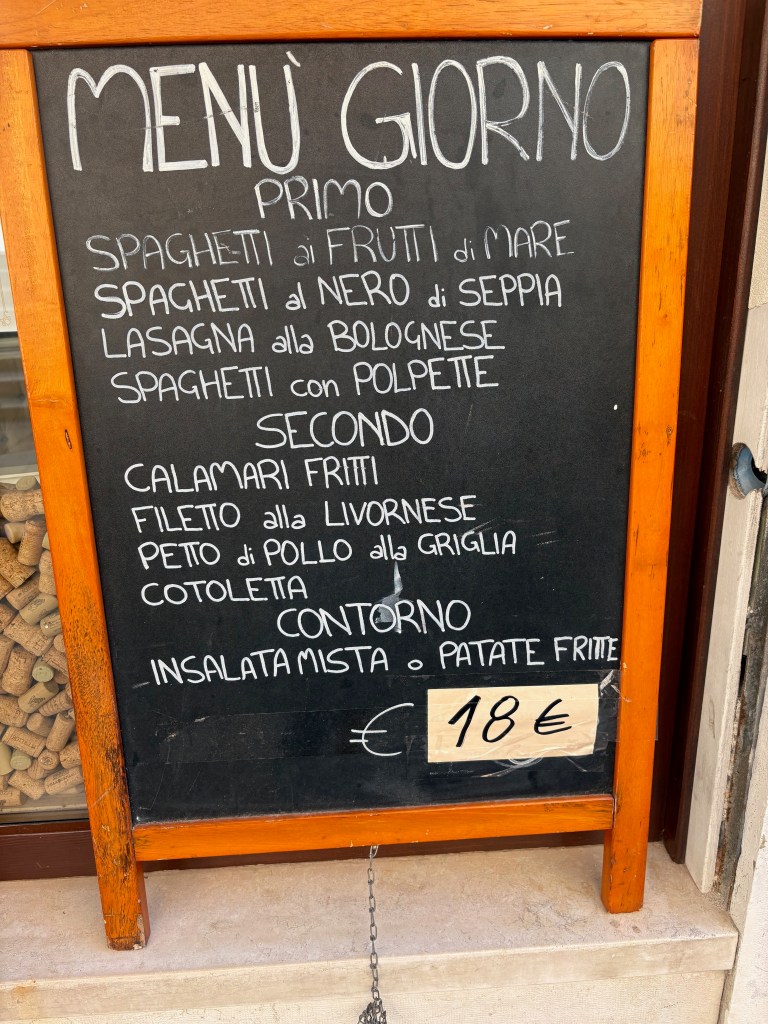
Daily special at local ristorante.
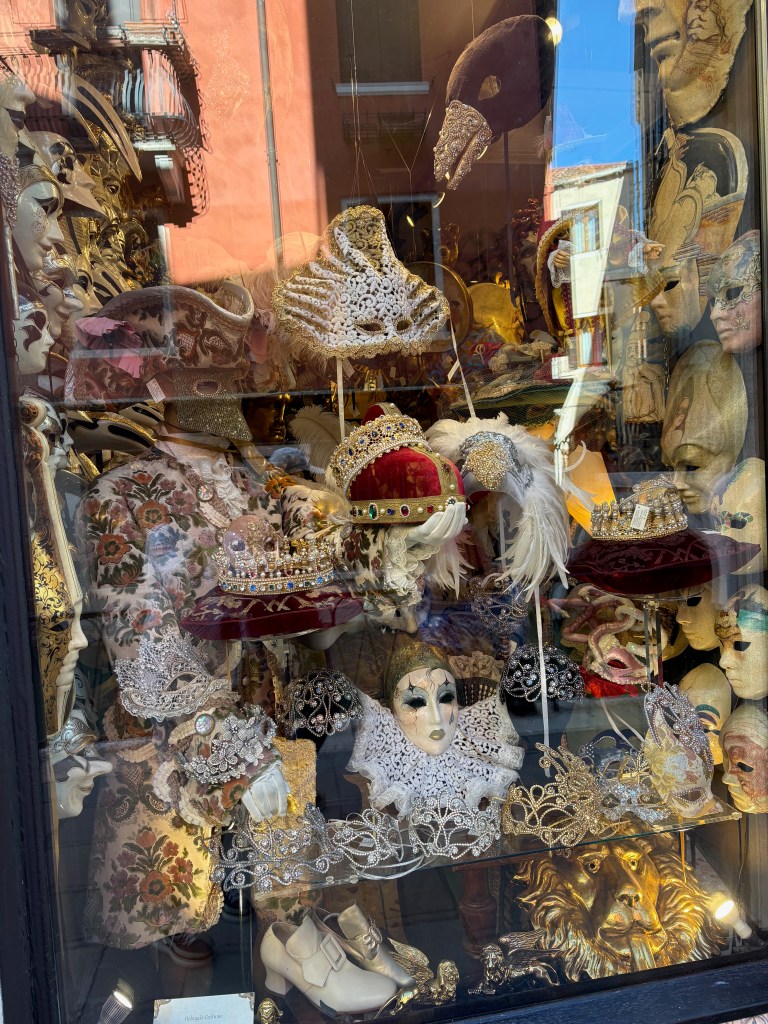
The Venice Carnival (end of January) is famous worldwide for its elaborate 18th-century historical costumes, intricate masks, and enchanting atmosphere rather than traditional marching parades. Piazza San Marco is the central stage for the festivities, costume contests, and the highest concentration of masked participants. The Grand Opening is a stunning procession of decorated boats along the canals, typically kicking off the celebration in the Cannaregio district. There are daily gatherings and formal competitions judging the most creative and beautiful historical attire. The private and public masquerade balls are opulent, ticketed events hosted in historic Venetian palaces (with prices often starting around €500 per person) requiring strict period-correct dress codes.
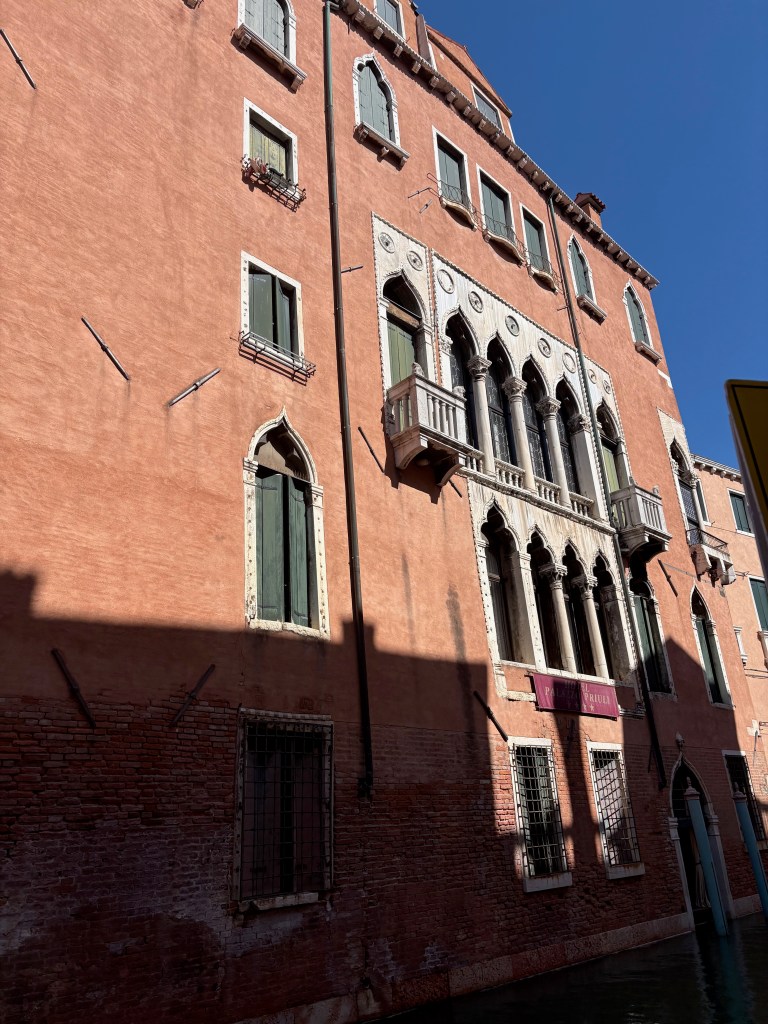
These homes along the canals were arranged for the family to live on the middle levels where it was warmer with the deliveries on lower levels and the servants at the top.
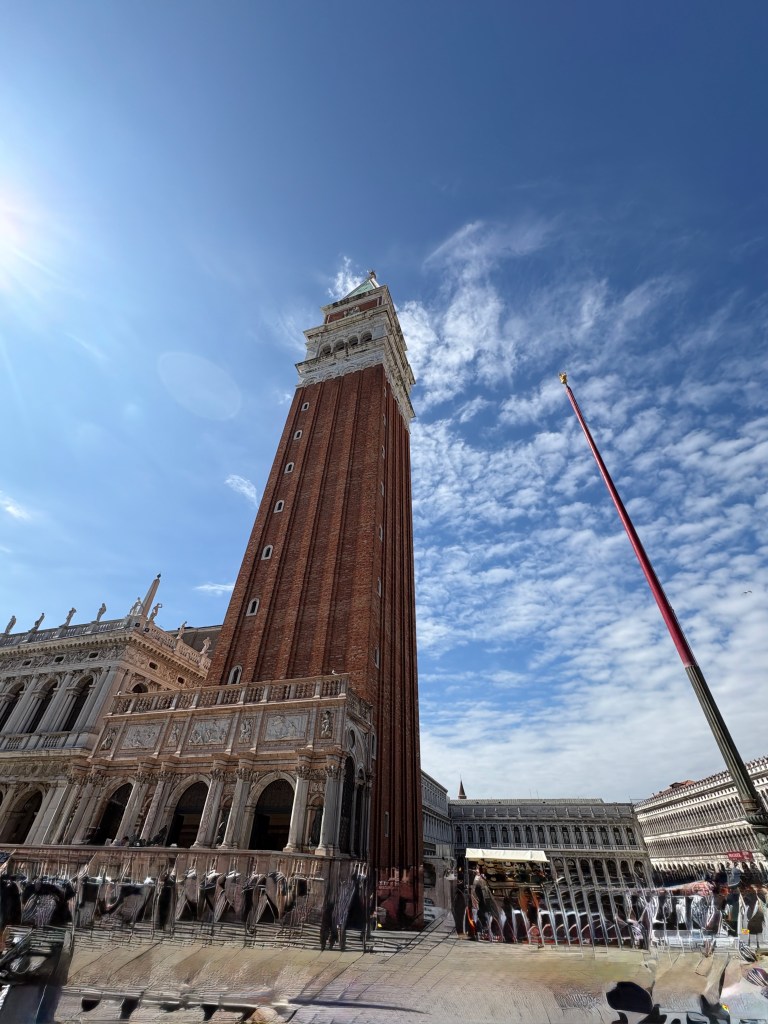
Next, we continued on to St. Mark’s Square where we viewed the Basilica, the Square and the ornate Doge’s Palace.
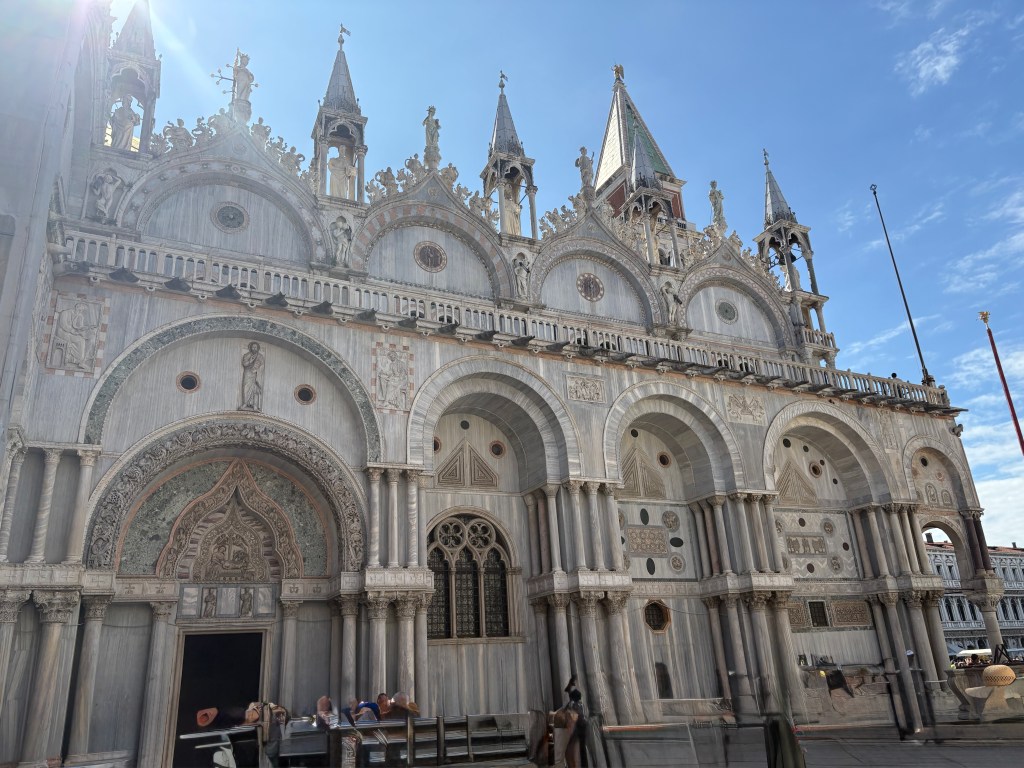
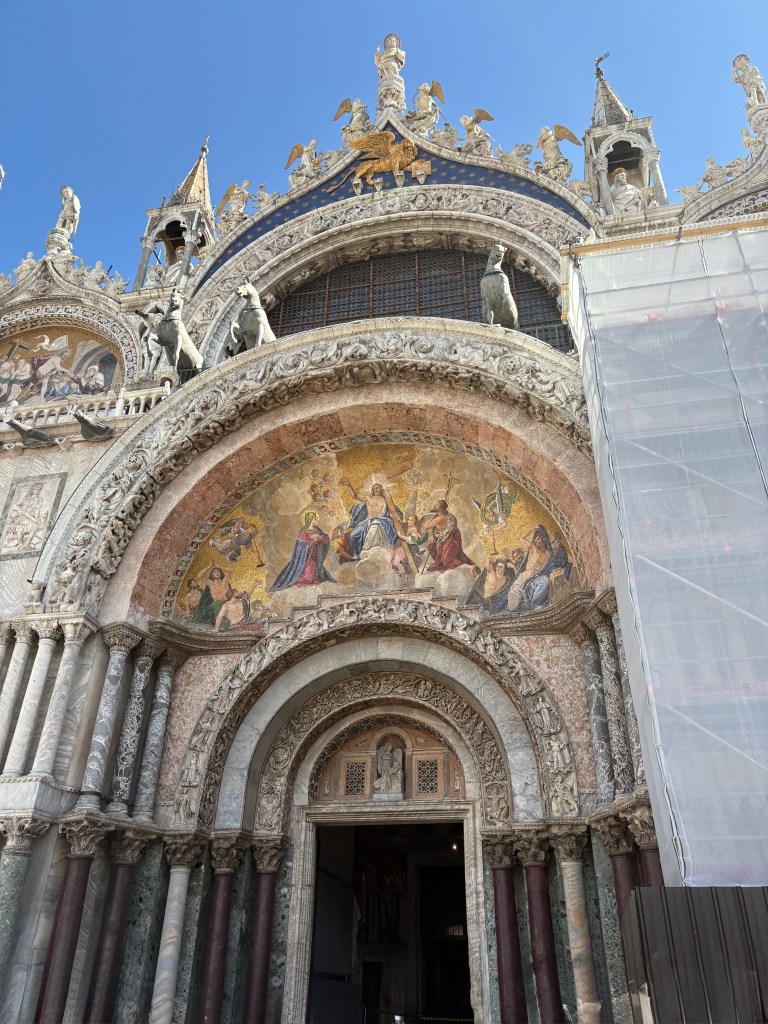
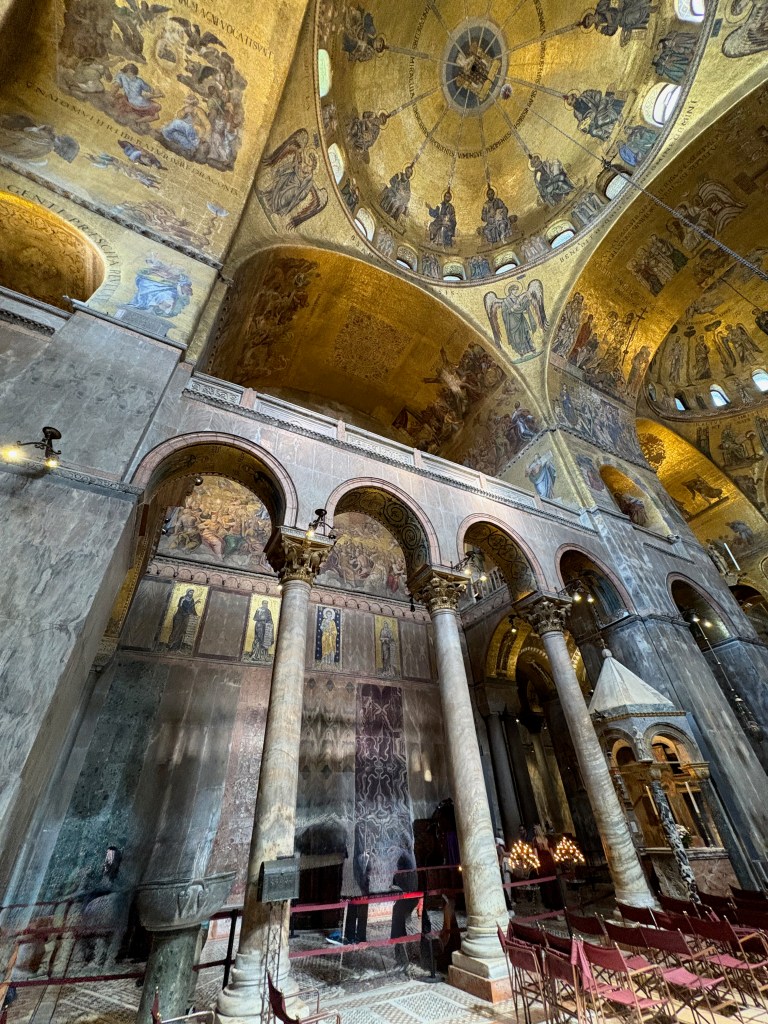
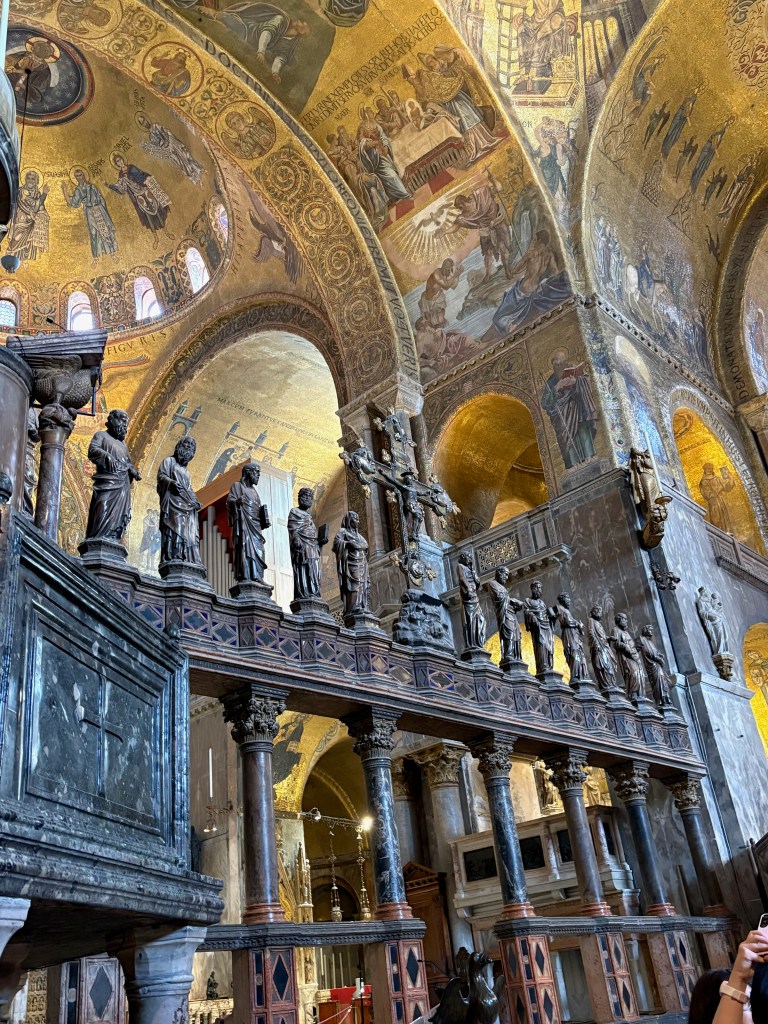
Originally the Basilica building was to be an extension of the Doge’s Palace; however, the construction of the Basilica of St. Mark, which began in 828 and ended in 832, was made to house the body of St. Mark the Apostle brought surreptitiously from Alexandria. This was a fundamental for Venice to be constituted as an independent episcopal seat. St Mark’s Basilica is dedicated to and holds the relics of Saint Mark the Evangelist, the patron saint of the city.
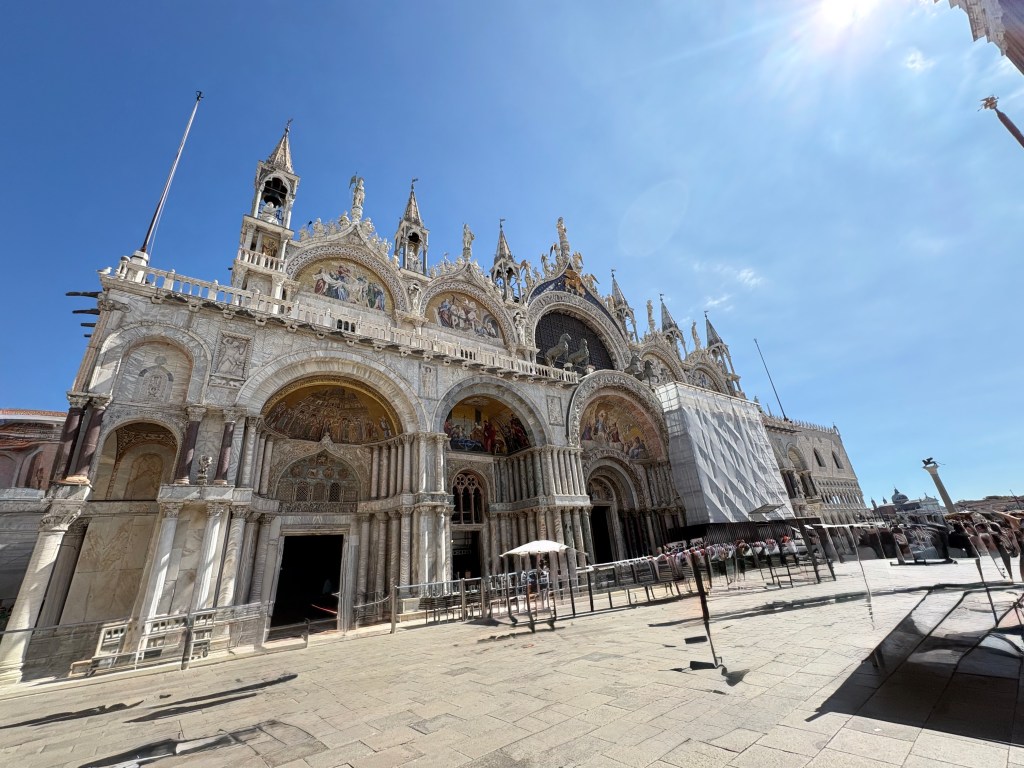
The works of the present basilica began in 1063 in Byzantine style to represent the power of the prosperous Venetian Republic. This basilica was built respecting the model of two basilicas of the ancient imperial city of Byzantium with a central plant in the shape of a Greek cross, with five large domes and a particular mixture of ancient and oriental art. Its main model was the sixth-century Church of the Holy Apostles in Constantinople.
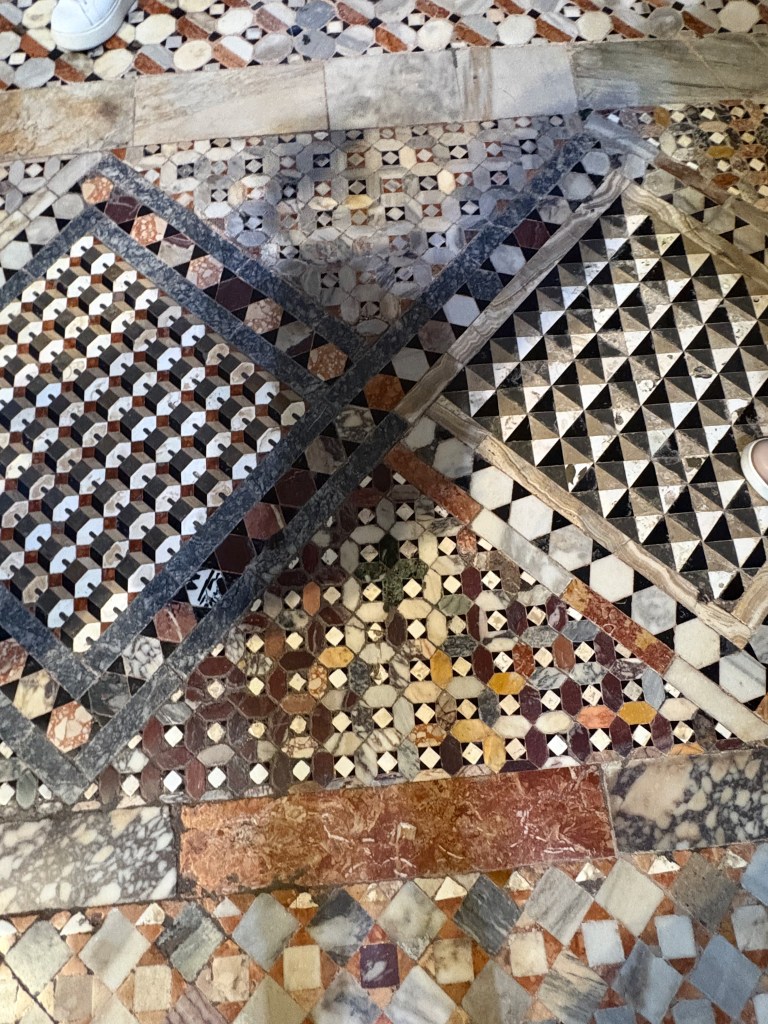
Middle-Byzantine, Romanesque, and Islamic influences are also evident, and Gothic elements were later incorporated. To convey the republic’s wealth and power, the original brick façades and interior walls were embellished over time with precious stones and rare marbles, primarily in the thirteenth century. Many of the columns, reliefs, and sculptures were spoils stripped from the churches, palaces, and public monuments of Constantinople as a result of the Venetian participation in the Fourth Crusade. Among the plundered artefacts brought back to Venice were the four ancient bronze horses that were placed prominently over the entry.
Over time, the Basilica underwent several modifications, especially as regards to decoration, pointed Gothic arches, Sant’Alipio arch, 17th and 18th century sculptures and mosaics of the main façade, bas-reliefs that represent the professions and zodiac signs of the central gate, the marble that came from the East, the porphyry figures of the Tetrarchs and the horses of St. Mark. The result is a stunning and beautiful blend of styles.
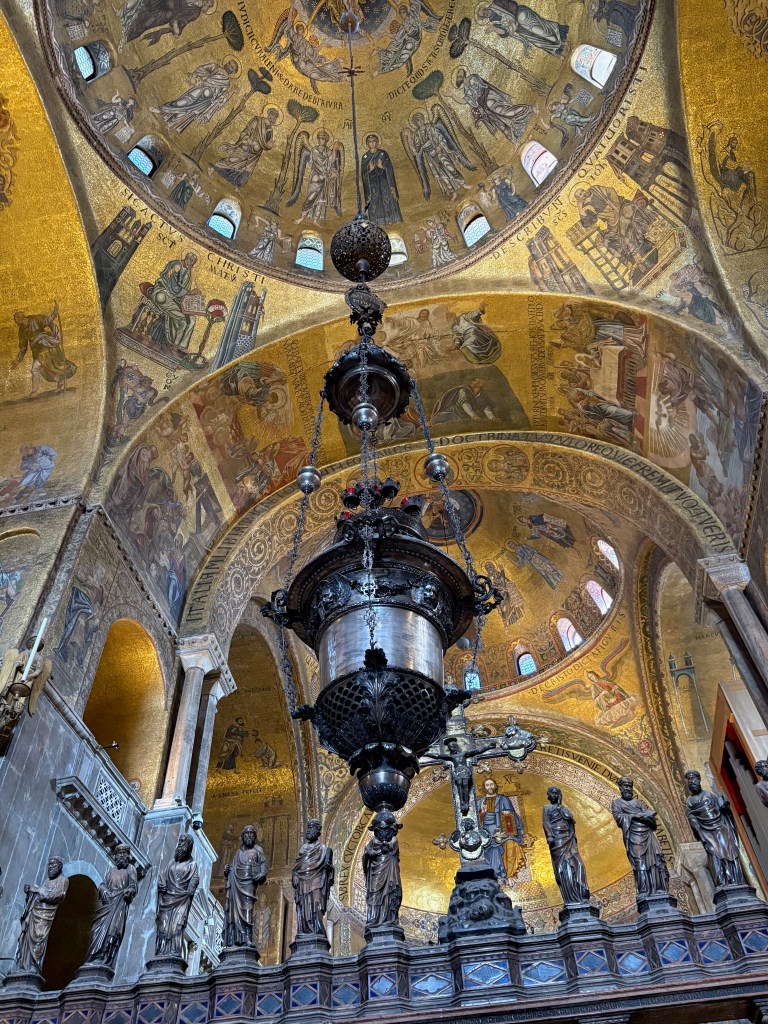
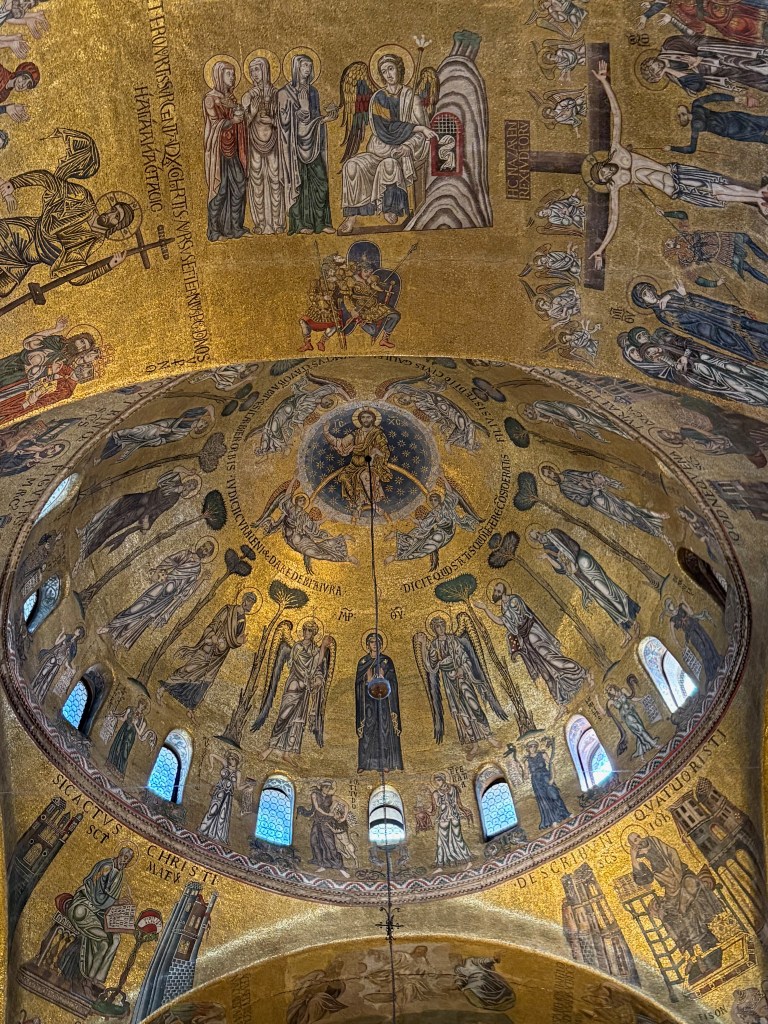
The basilica as we know it today, even though it was modified, has a Greek cross base with five domes. It became the cathedral of the city in 1807 and has more than 4,000 square meters of mosaics, many of them belonging to the 13th century. It also has 500 columns of the 3rd century.
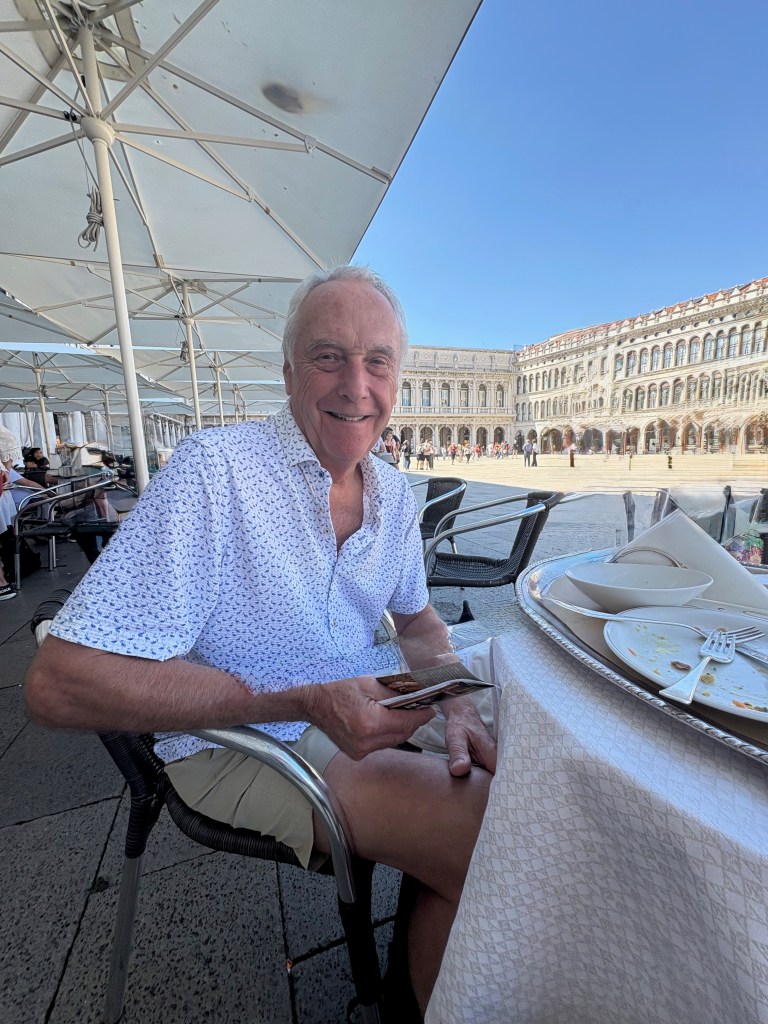
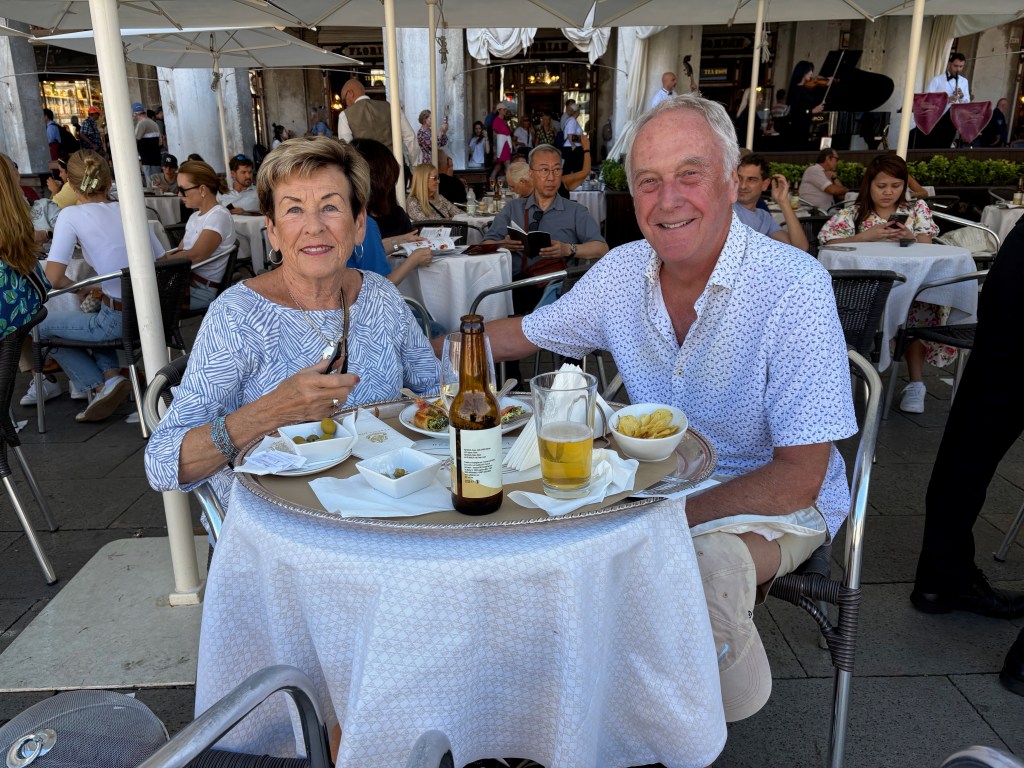
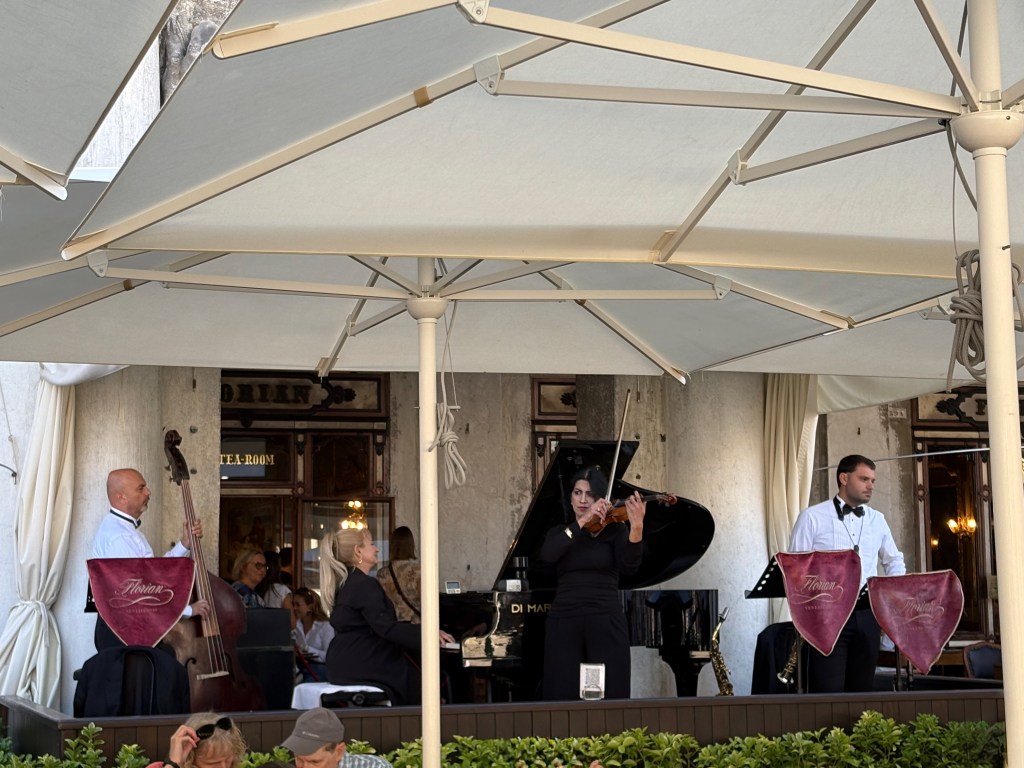
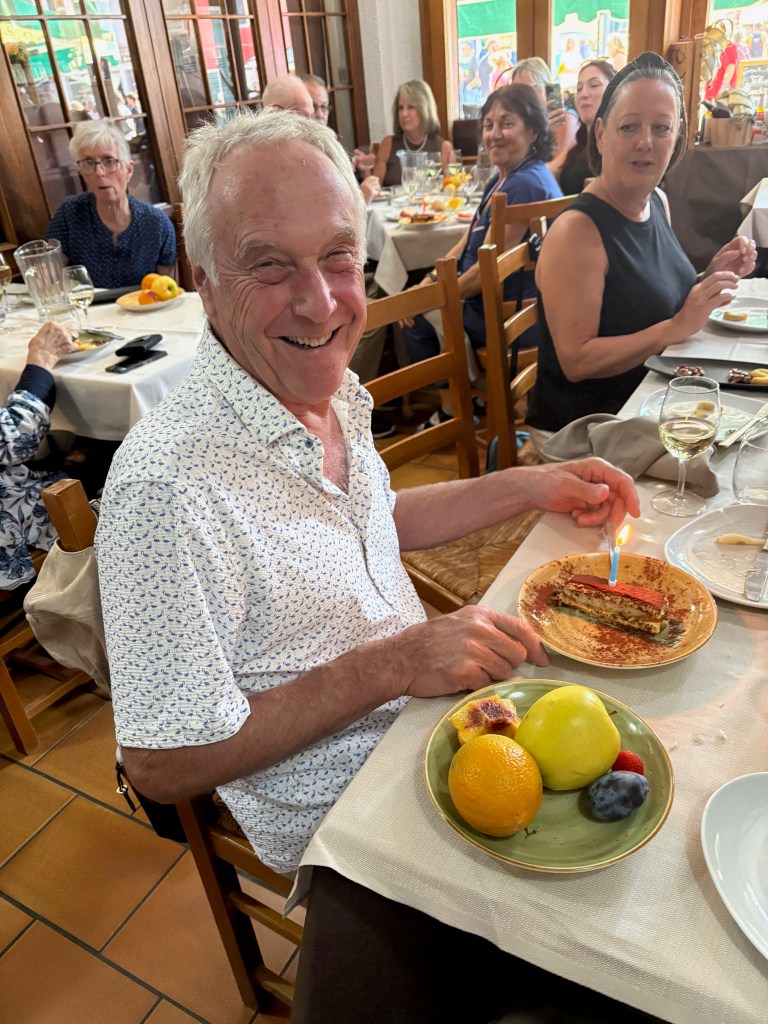
To celebrate Bill’s birthday, we had lunch at the lovely Florian ristorante (1720) with classical music in the background.
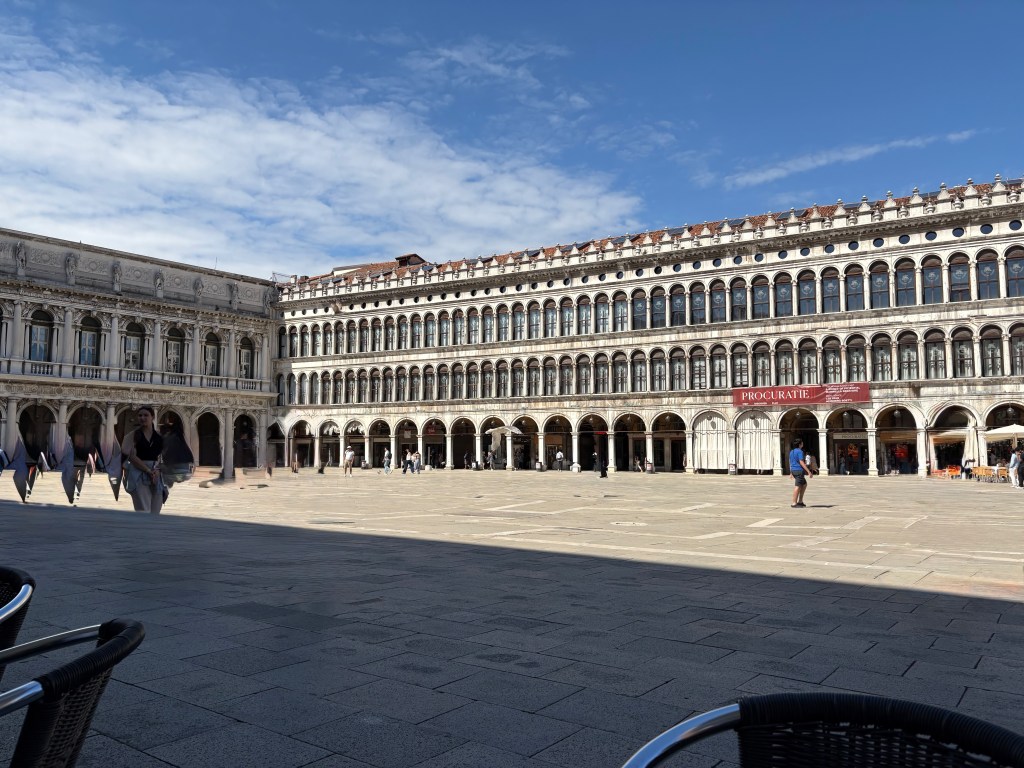
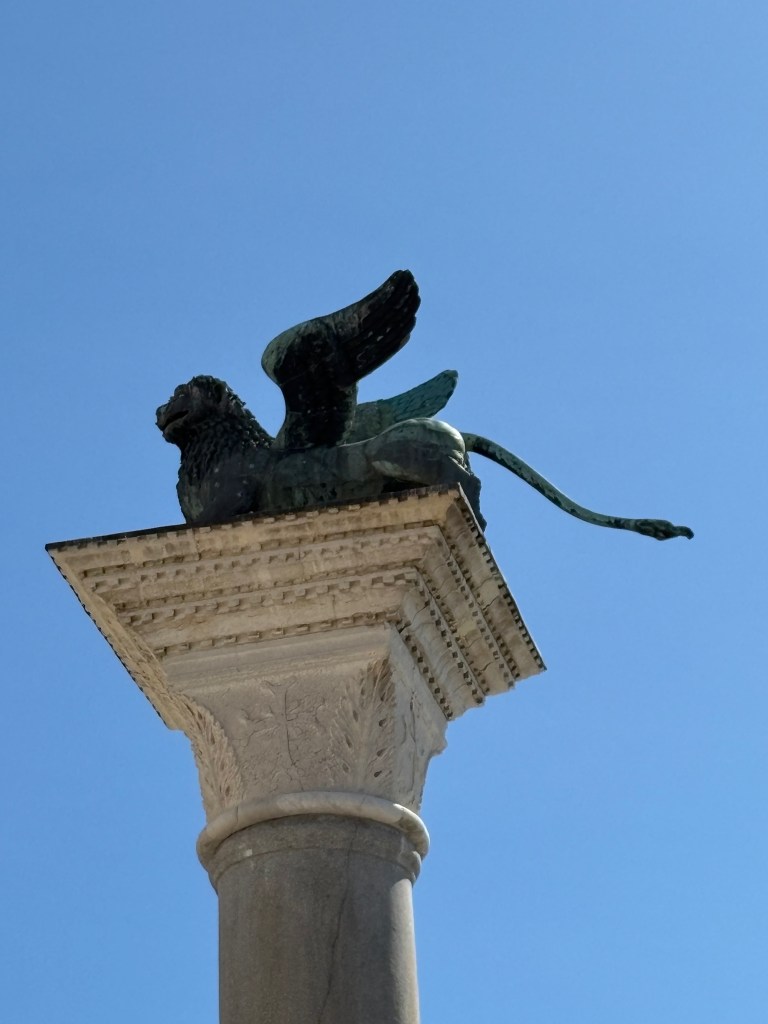
At the open end of the Piazzetta it is marked by two large columns carrying symbols of the two patron saints of Venice. The first is Saint Theodore who was the patron of the city before St Mark, holding a spear and with a crocodile to represent the dragon which he was said to have slain. This is made up of parts of antique statues and is a copy (the original is kept in the Doge’s Palace).
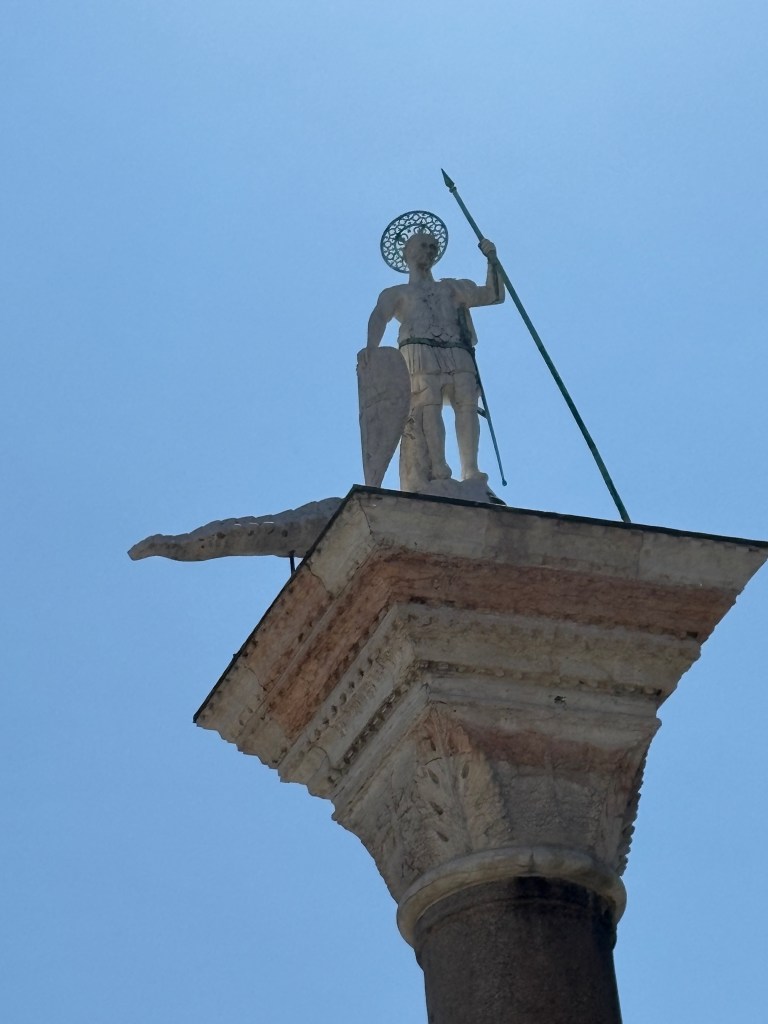
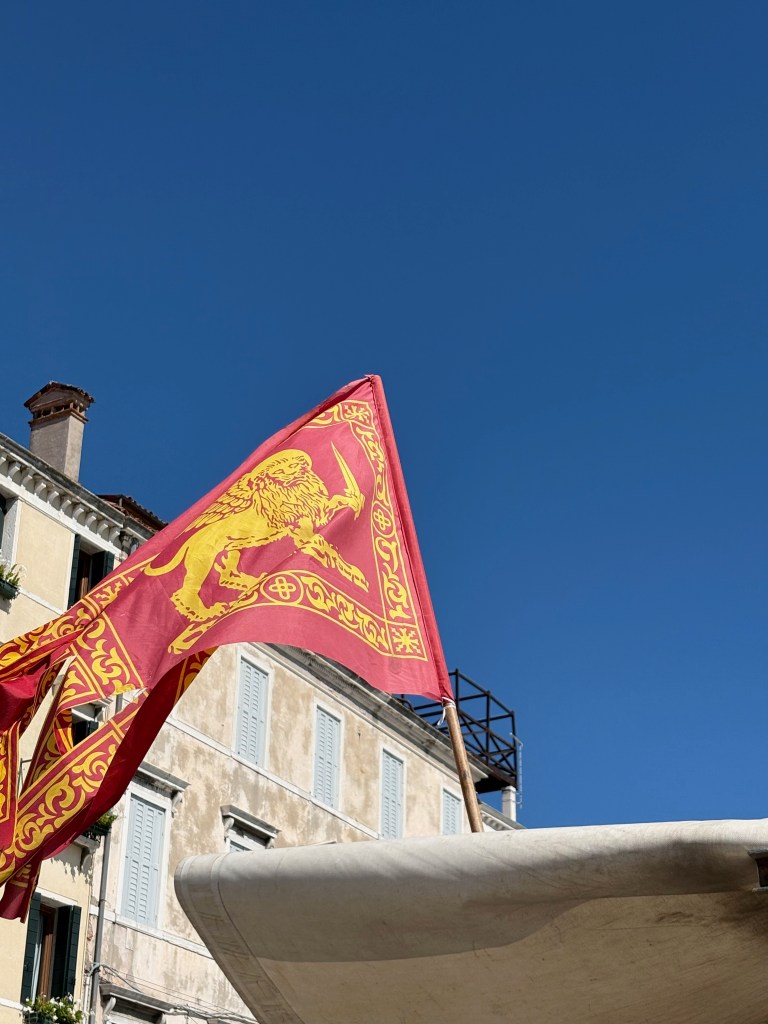
The second (eastern) column has a creature representing a winged lion-the Lion of Venice which is the symbol of St Mark. This has a long history, probably starting as a winged lion-griffin on a monument to the god Sandon at Tarsus in Cilicia (Southern Turkey) about 300 BC. The columns are now thought to have been erected about 1268, when the water was closer and they would have been on the edge of the lagoon, framing the entry to the city from the sea. In 1987 Venice and its lagoon were collectively designated a UNESCO World Heritage site.
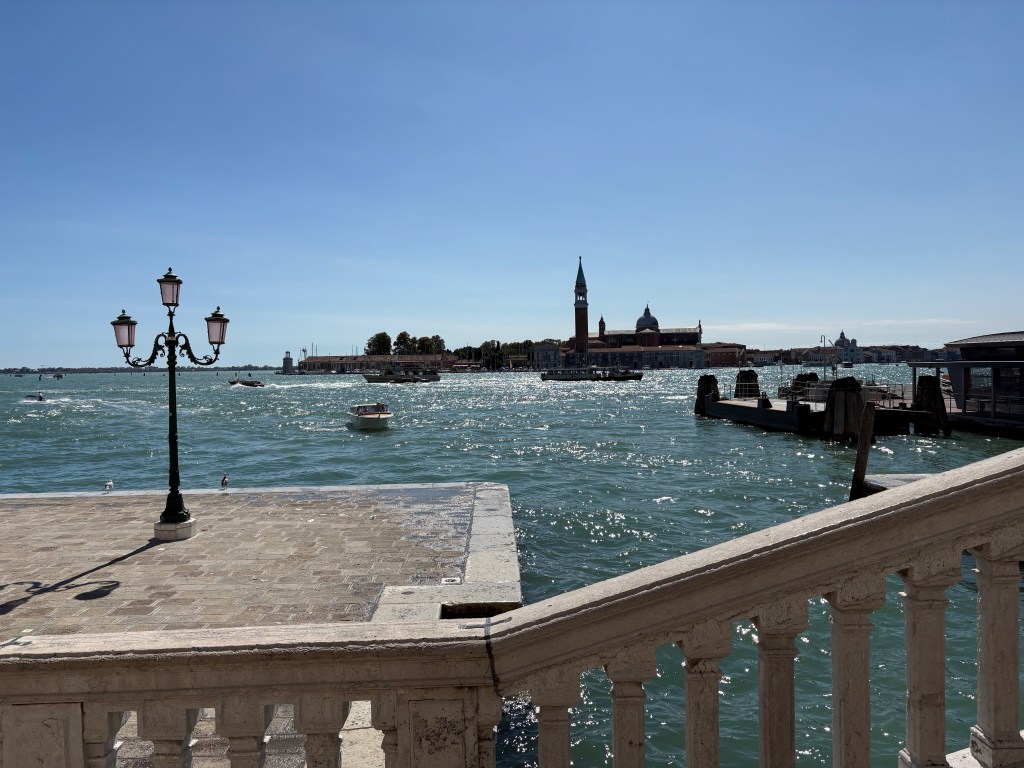
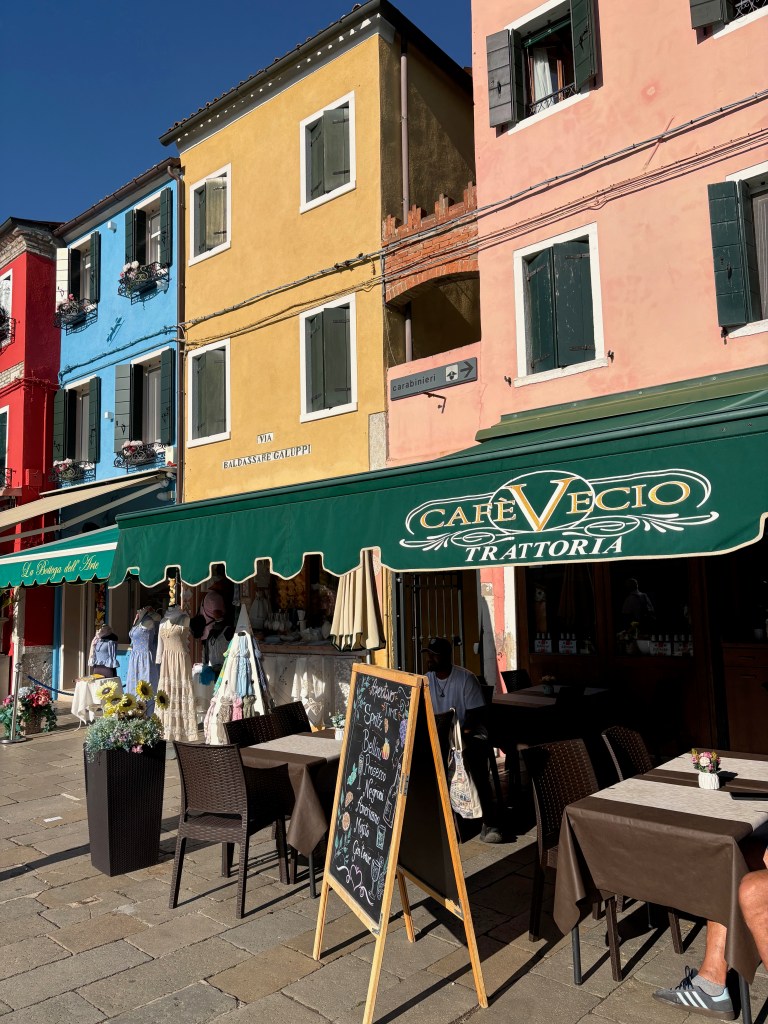
After lunch, we cruised across the Venetian Lagoon to Burano, a small island known for its brightly-coloured houses and strong fishing traditions.
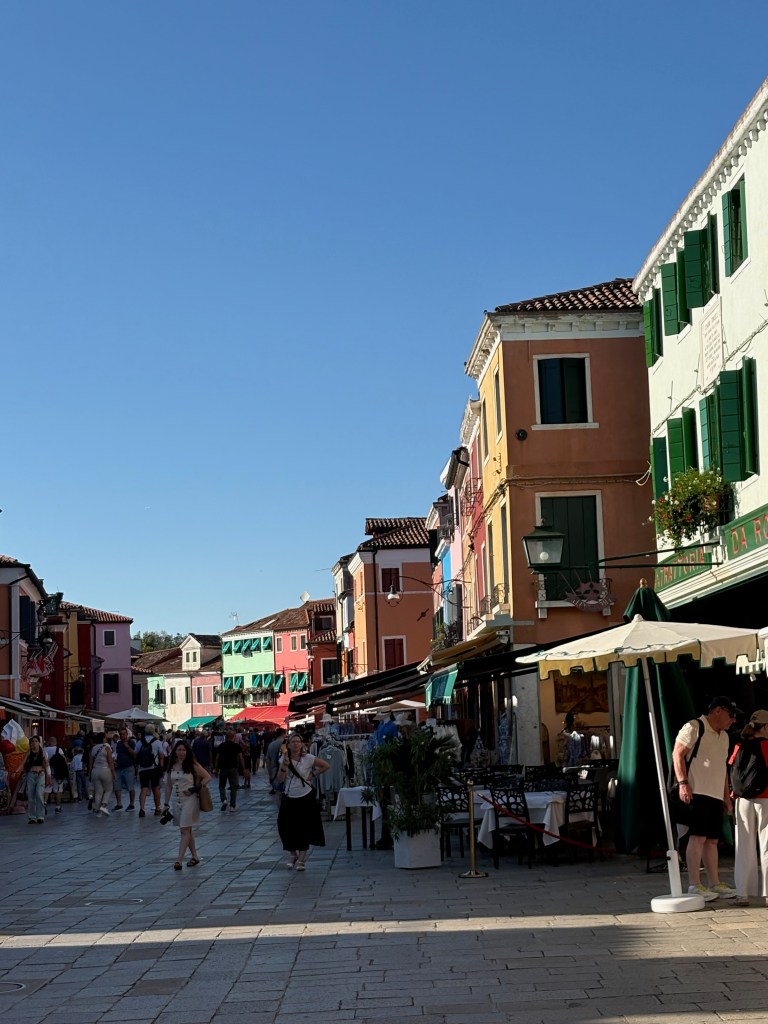
We wandered along the quiet canals and browsed the shops selling handmade lace, a craft passed down through generations.
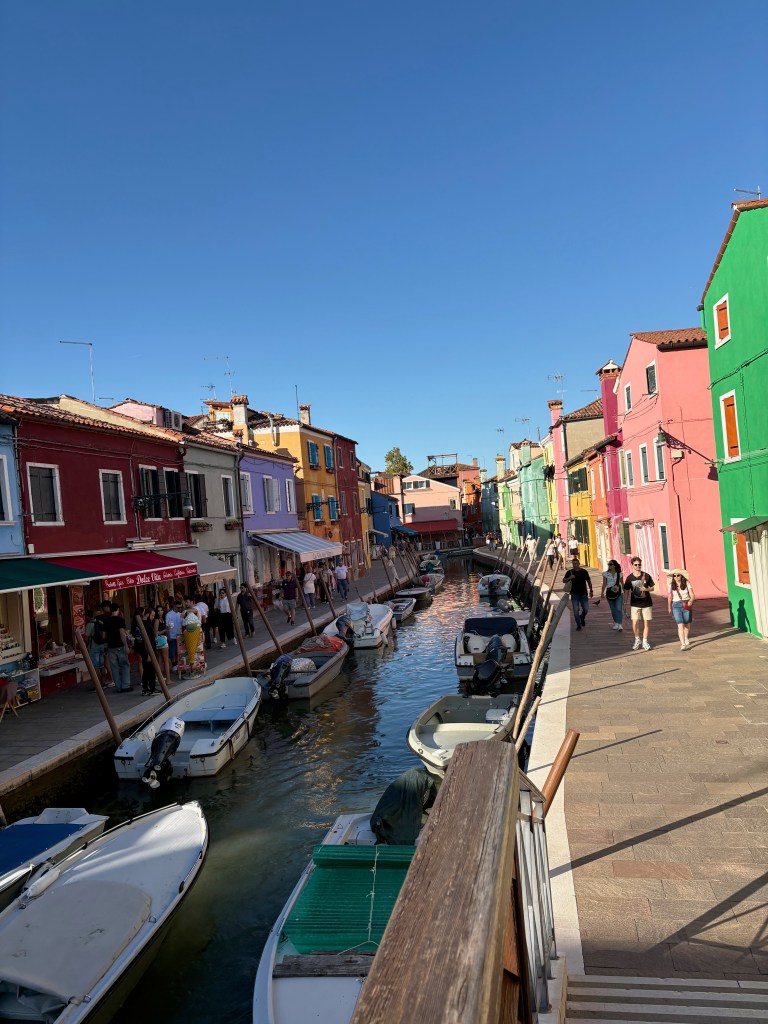
Then we sat down to a relaxed dinner featuring local flavours and regional wine, surrounded by the island’s cheerful character and laid-back charm.
September 13 Day 8 | Discover Pisa and the Tuscan Hills
This panoramic image of the area shows the whole setting of buildings.
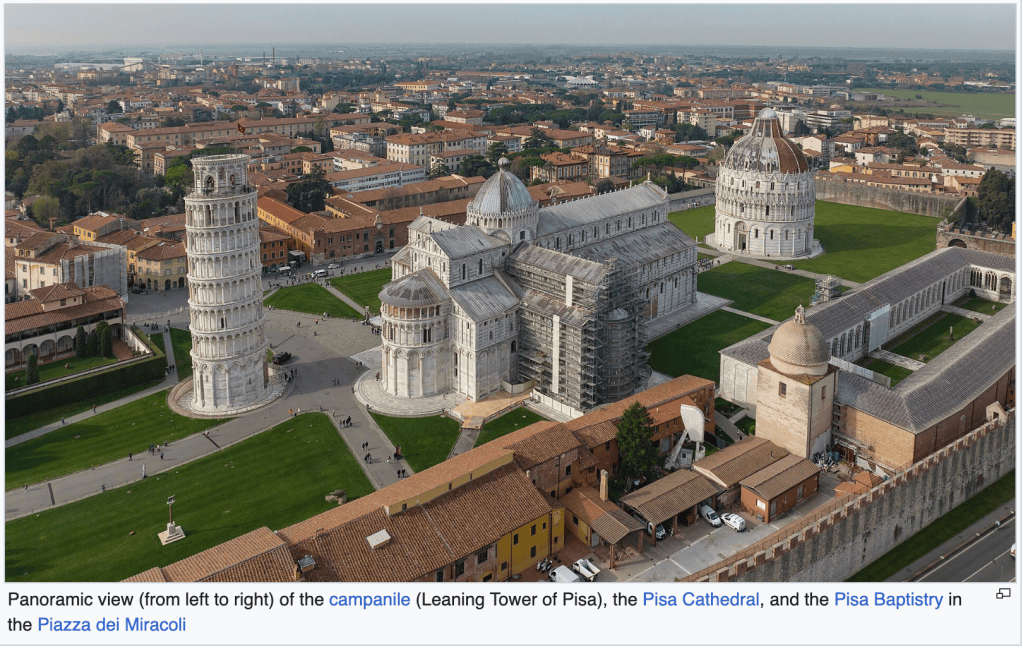
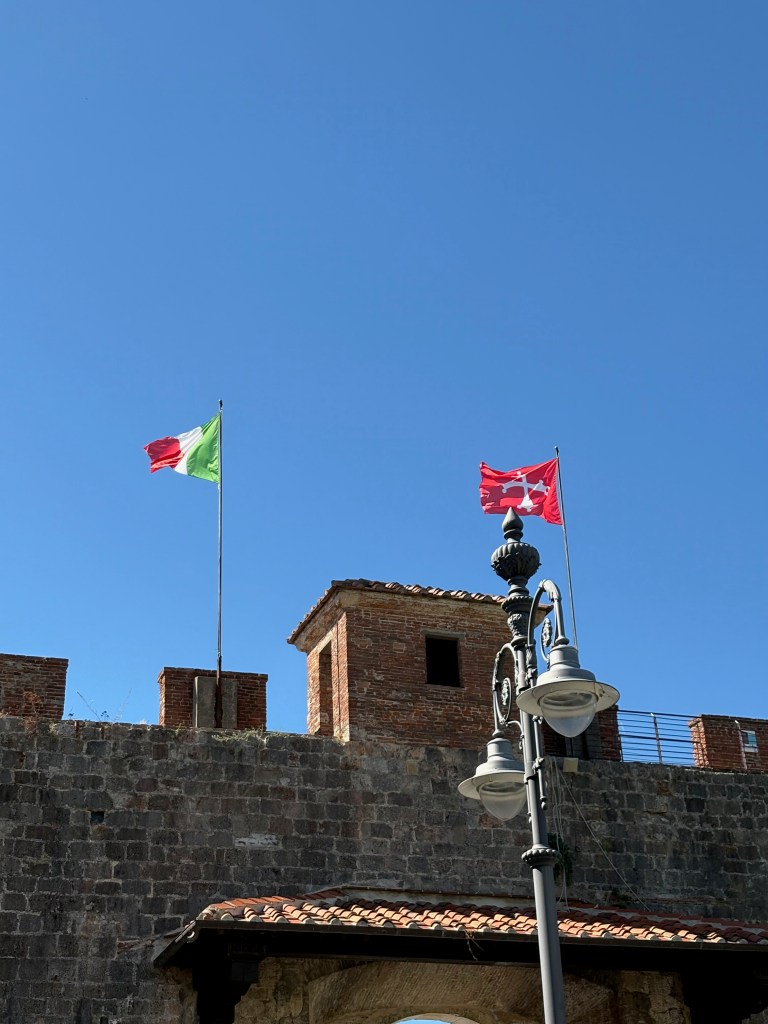
This morning we travelled to Pisa and visited its Field of Miracles to view the famous Leaning Tower before arriving in the spa-resort of Montecatini Terme in Tuscany, our home for the next two nights.
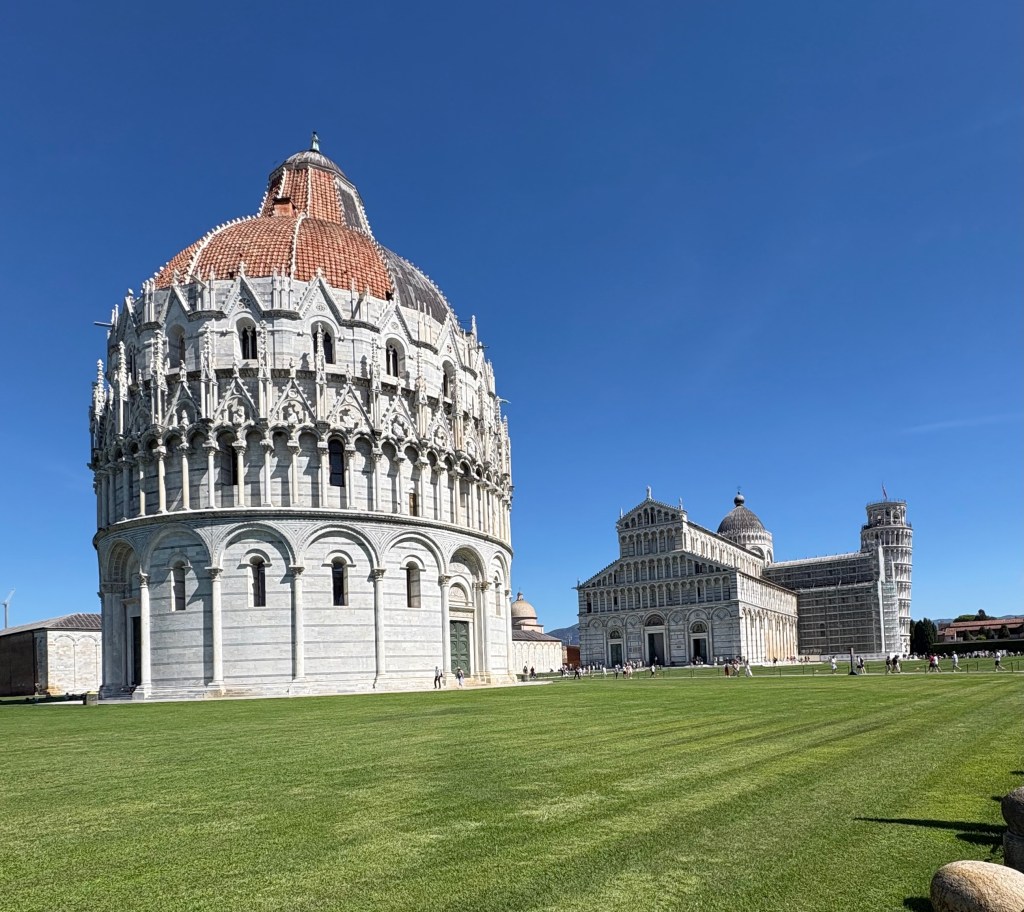
The Leaning Tower of Pisa is the campanile, or freestanding bell tower, of Pisa Cathedral. It is known for its nearly four-degree lean, the result of an unstable foundation. The tower is one of three structures in Pisa’s Cathedral Square (Piazza del Duomo), which includes the cathedral and Pisa Baptistry.
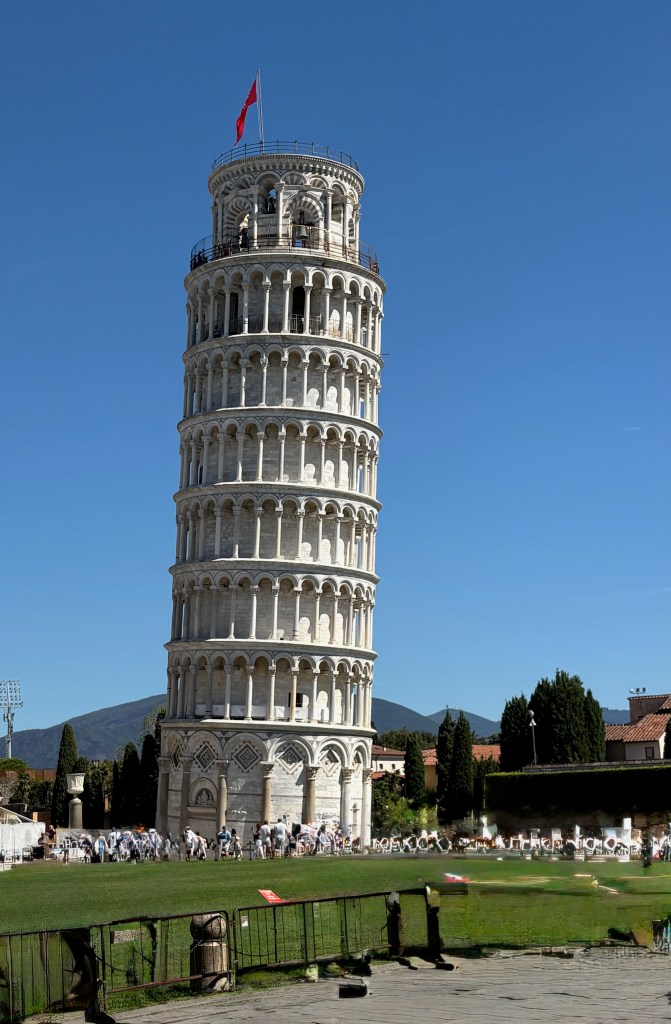
The tower began to lean during construction in the 12th century, due to soft ground which could not properly support the structure’s weight. It worsened through the completion of construction in the 14th century. By 1990, the tilt had reached 5.5 degrees. The structure was stabilized by remedial work between 1993 and 2001, which reduced the tilt to 3.97 degrees.
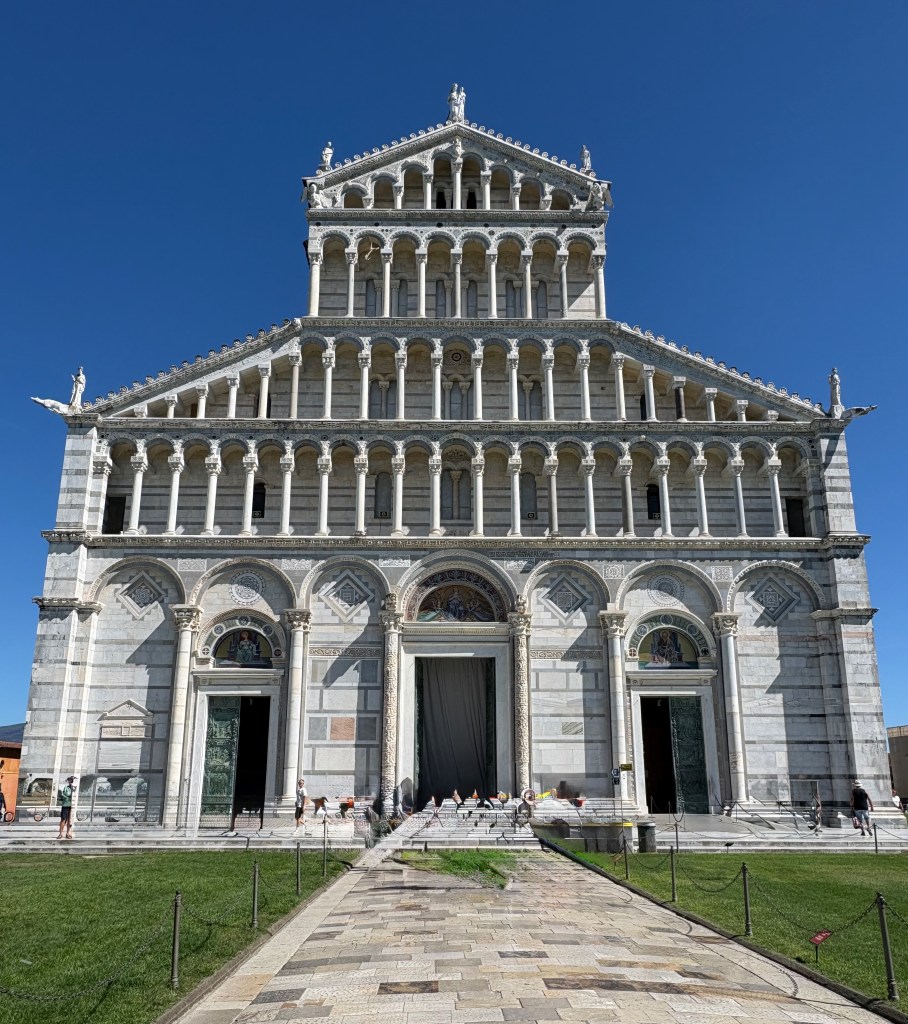
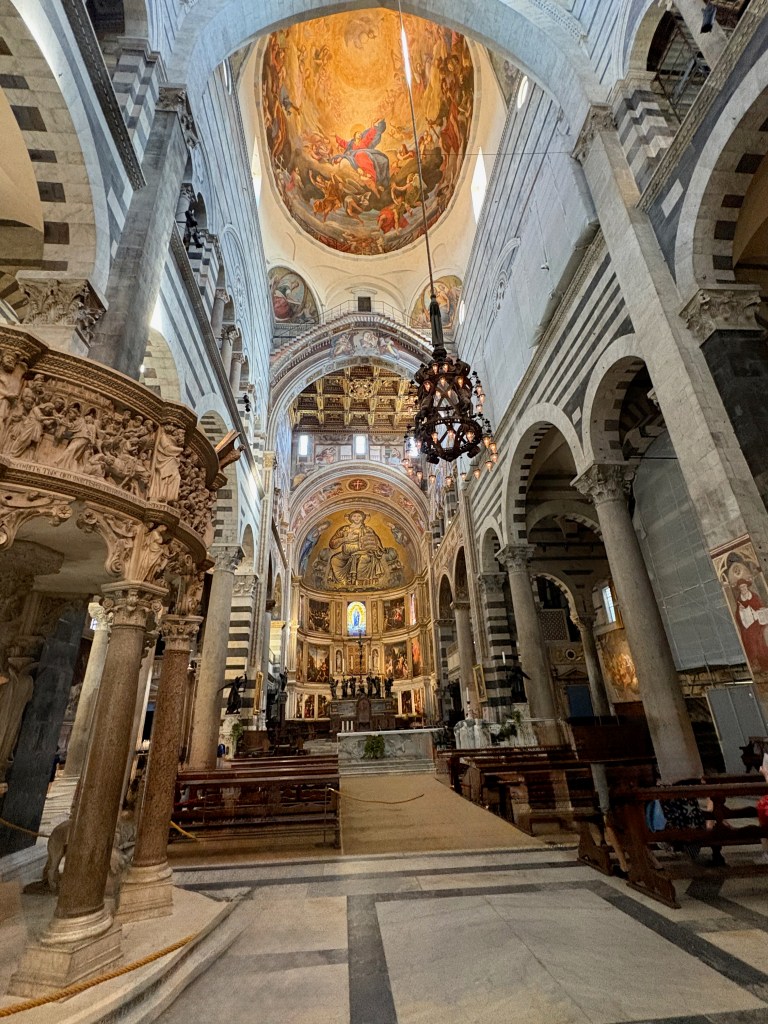
We had lunch at a cafe and toured the Baptistry and Cathedral.
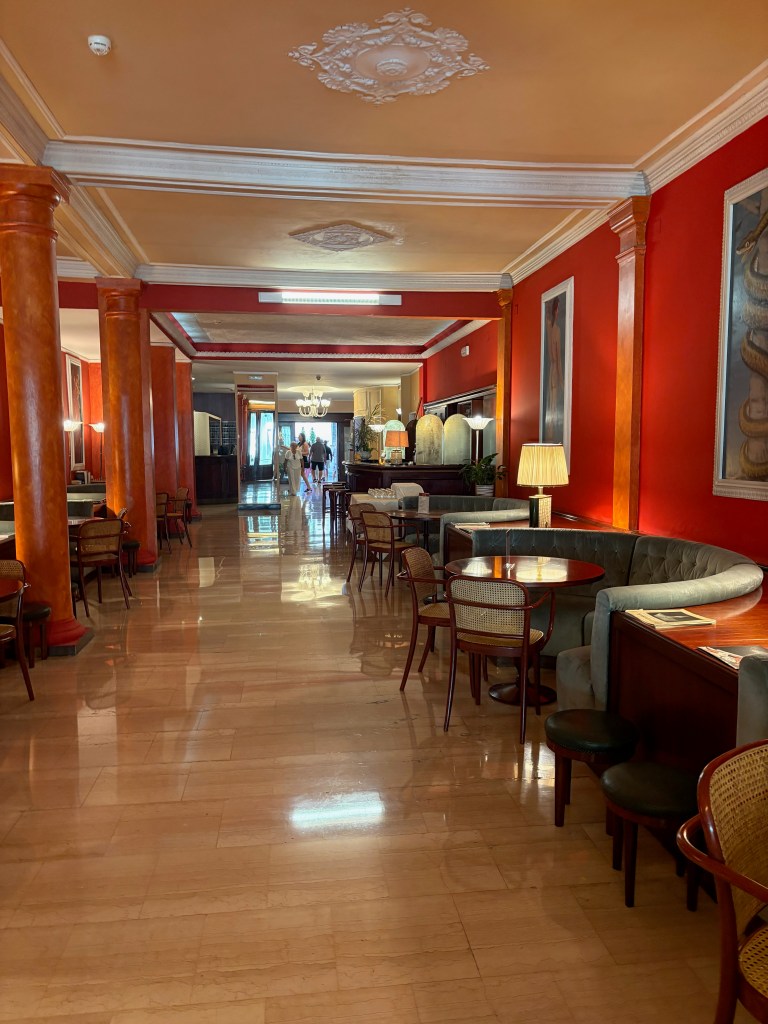
Our hotels have been OK but not amazing. Hotel Minerva Palace in Montecatini was a fine old building.
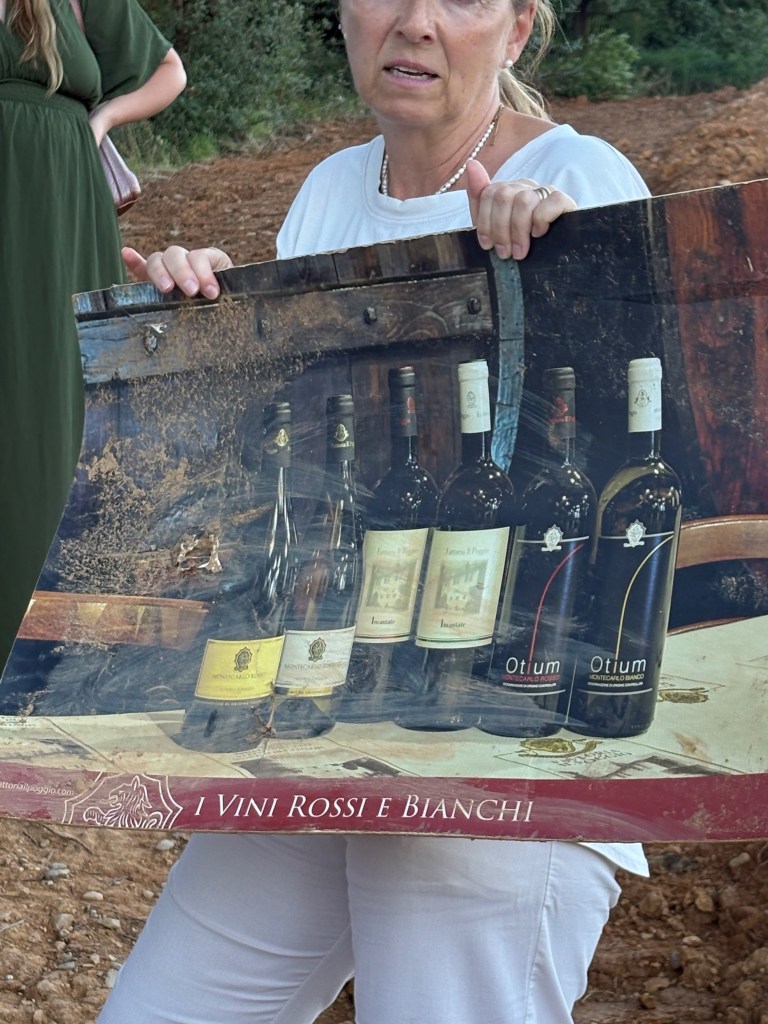
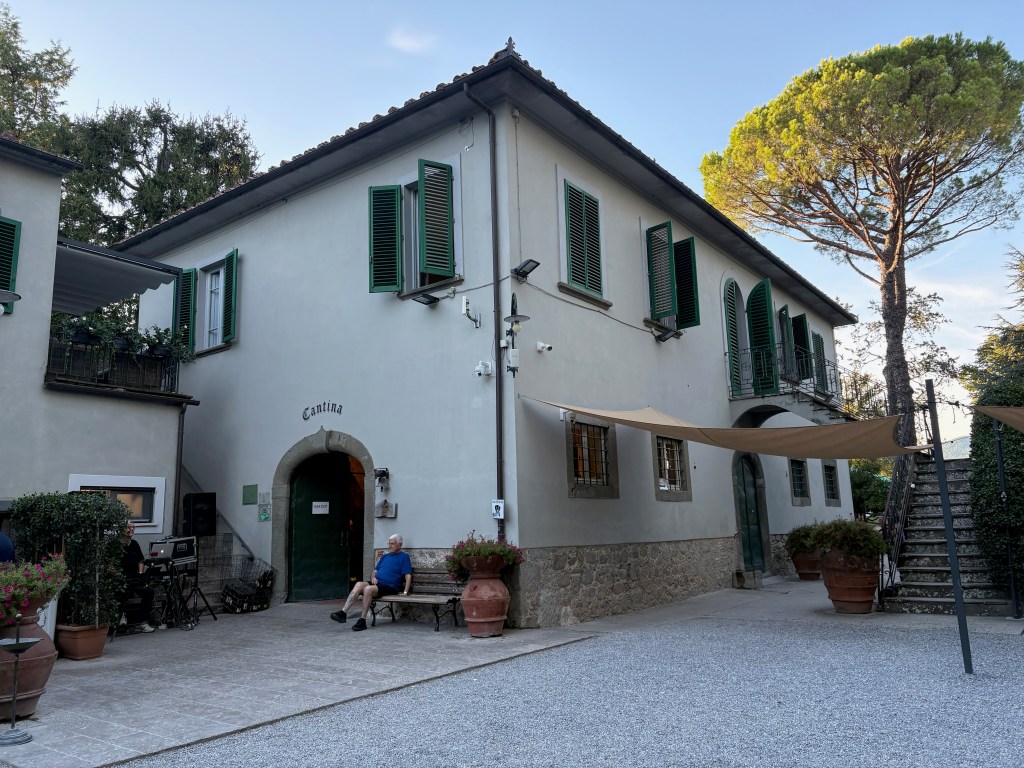
We took a scenic drive through the beautiful Tuscan countryside to a delightful regional family-owned and operated winery, olive oil-producer and restaurant set among the pines and cypress trees. We enjoyed a feast of gastronomic specialties, accompanied by song and music. And plenty of their wine!
September 14 Day 9 | Off to Renaissance Florence
We explored one of the world’s most cultural cities today – the former home of great masters and a testament to the ambitious legacy of the Medici family. We met in Santa Croce piazza and toured a gold factory/store and a leather factory/store. Although both were very expensive, they made some sales, including the famous FOPE 24 karat gold.
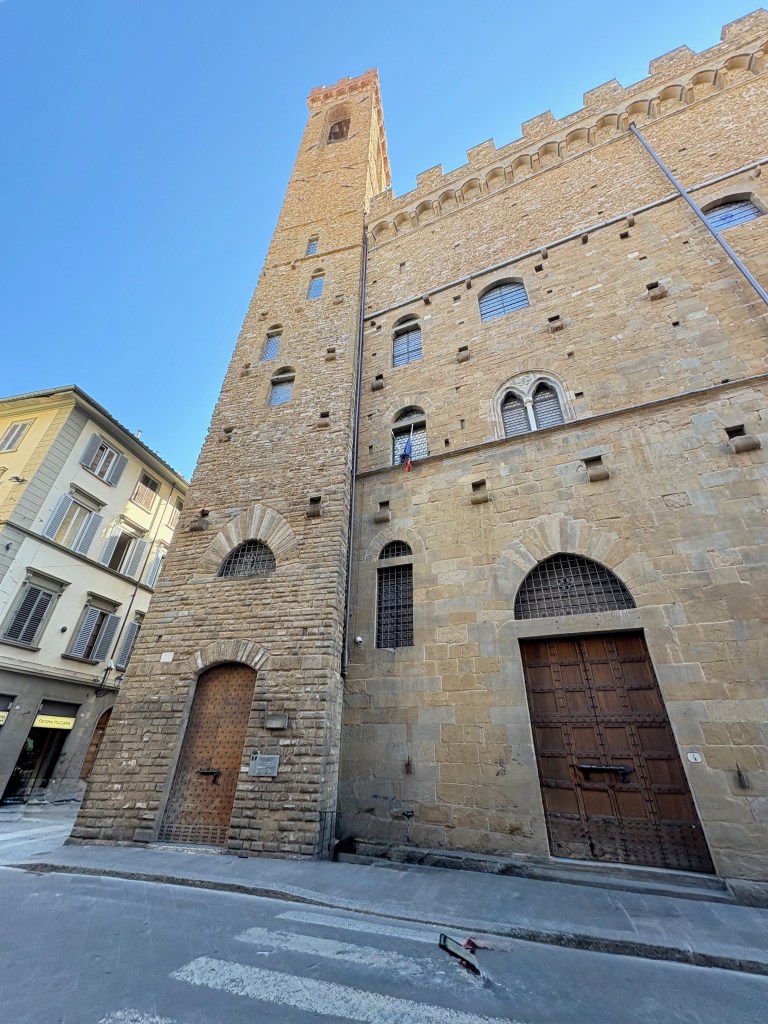
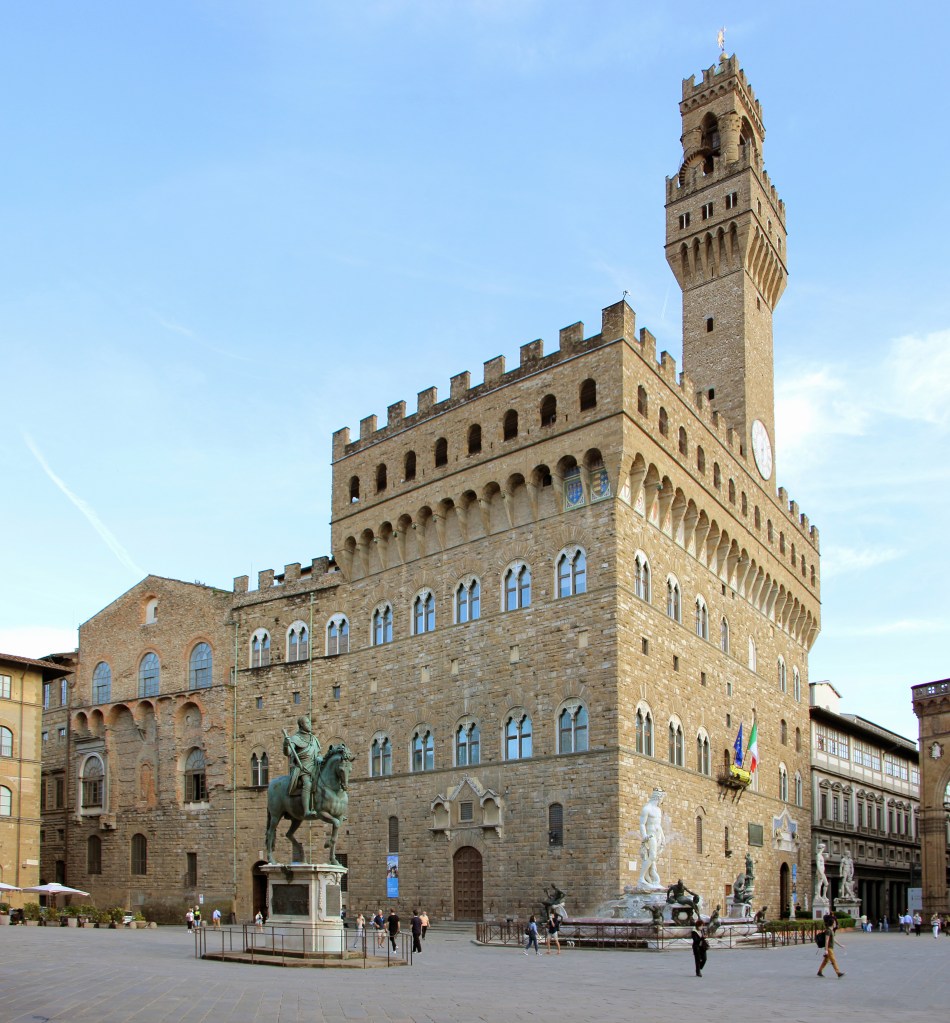
Our local guide shared all the sights, including views of the magnificent marble Duomo and Baptistery. We visited Piazza della Signoria, the heart of this flourishing city with its statues and stunning palazzi. She showed us how the locals would come to the small window of the winery and get their bottles filled up. This practice renewed during the COVID epidemic.
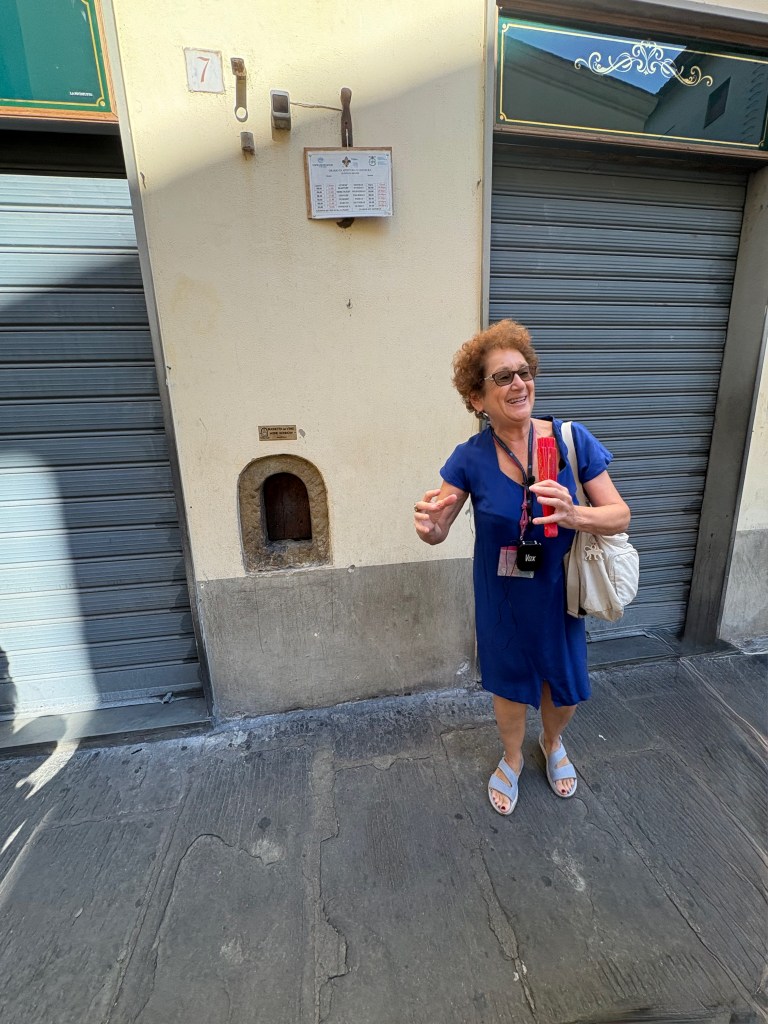
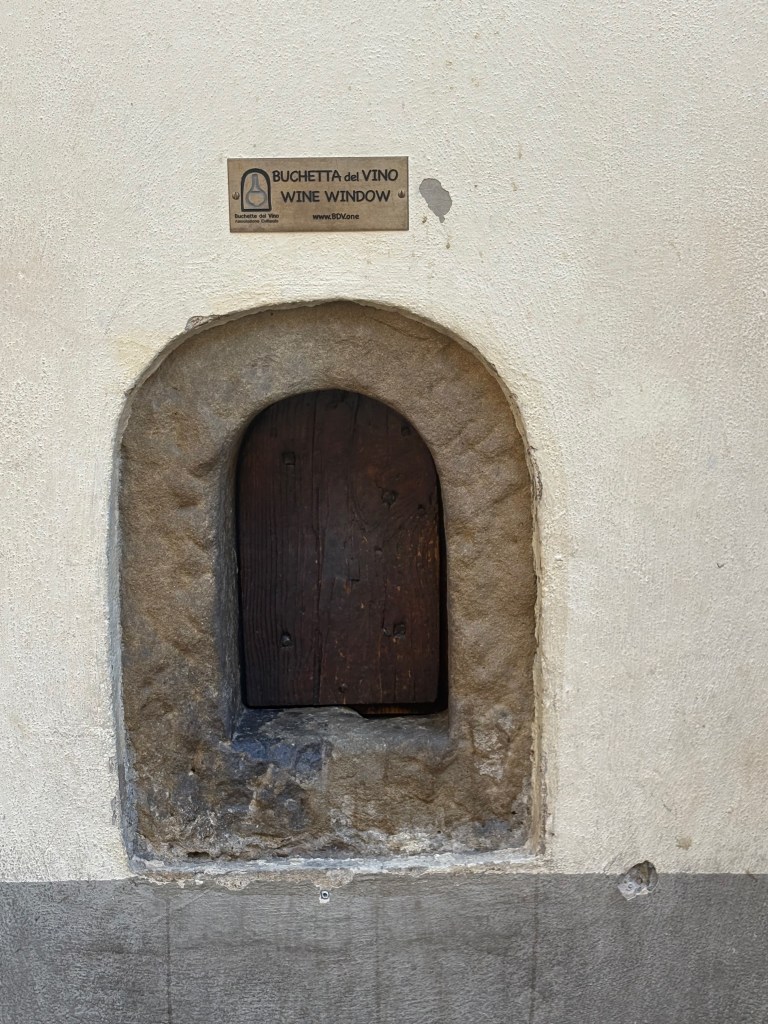
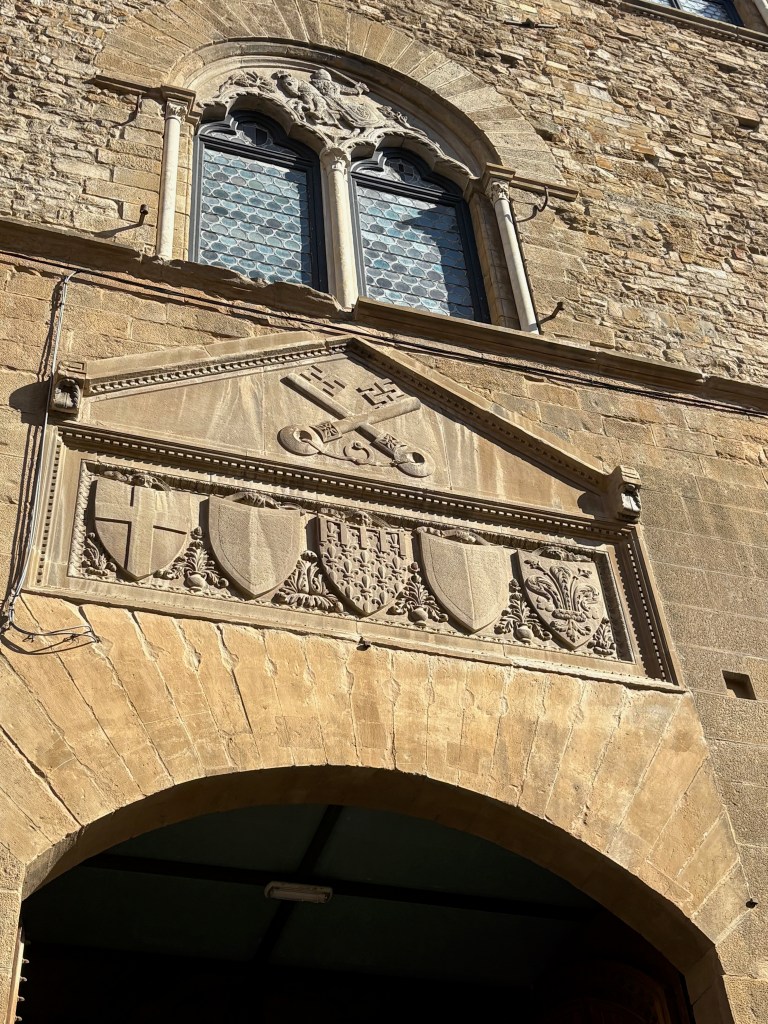
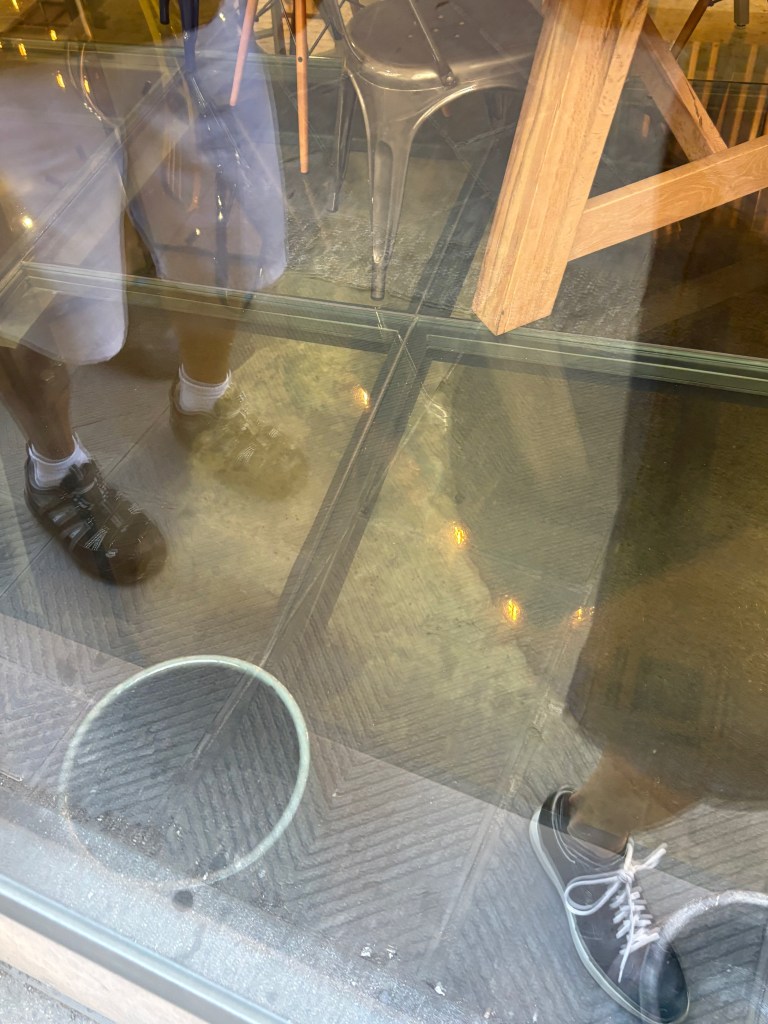
We continued our walk through the streets of Florence with our guide telling us stories and histories of the buildings. I don’t know if this photo makes any sense other than a photo of Bill’s and my shoes but it is an image of the Roman ruins seen through glass sections of the cafe’s floor.
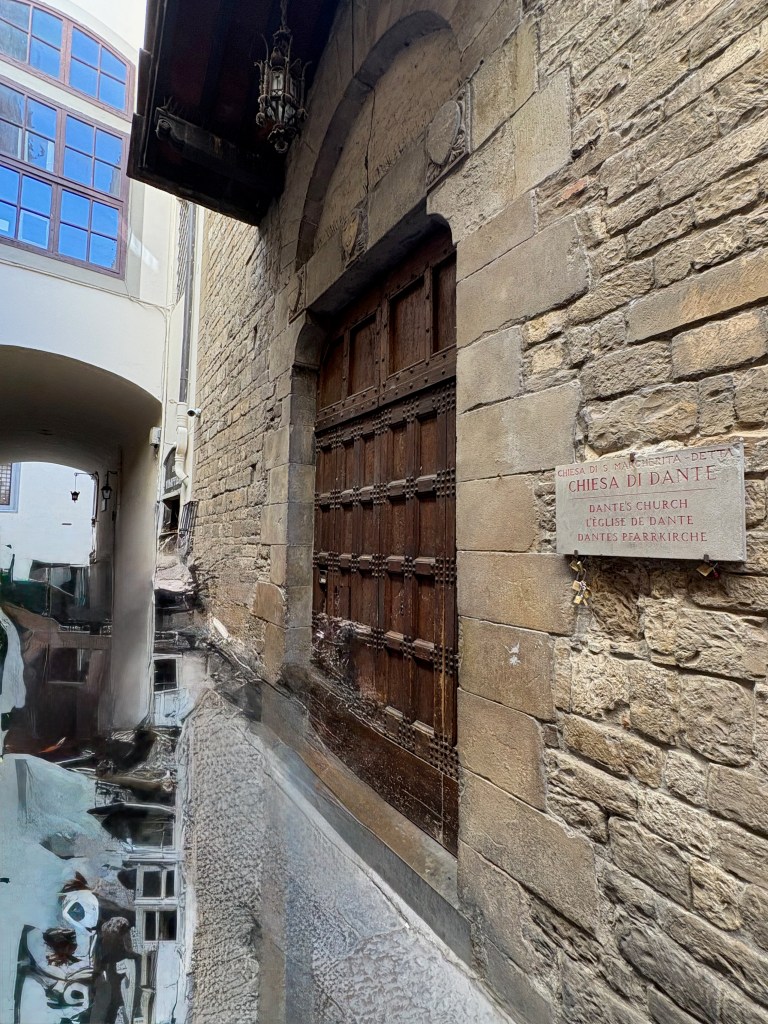
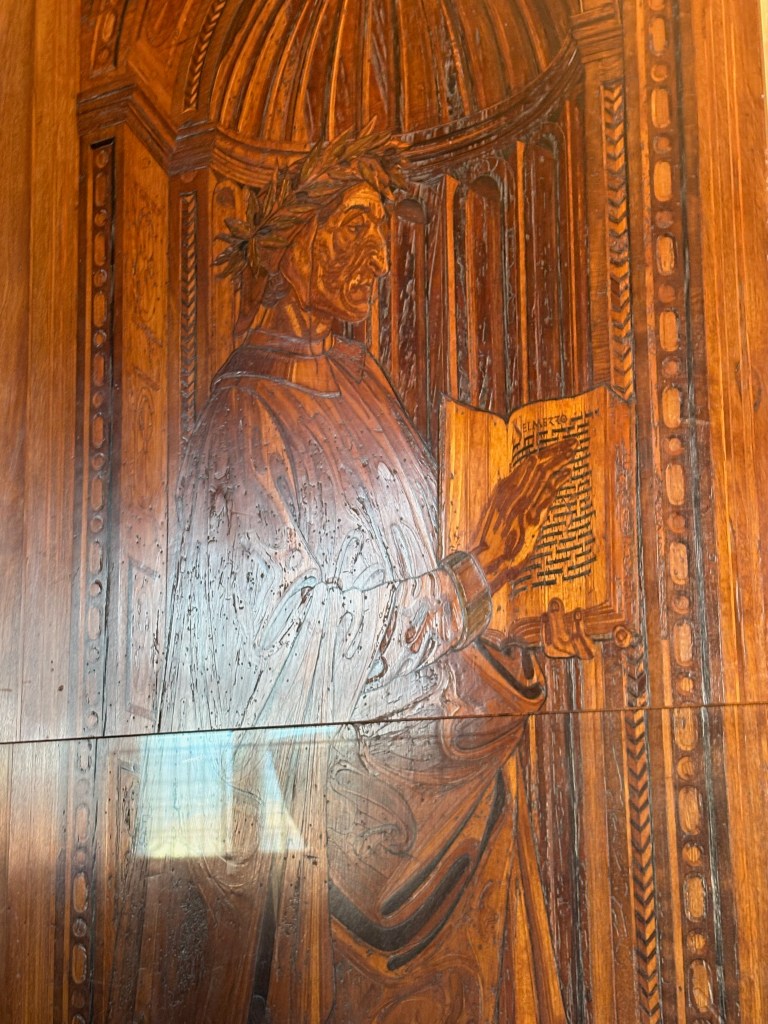
There were several locations where the famous son, Dante, lived; this was his church. The name refers both to the dedication to St Margarel of Antioch and to the Cerchi family, who held the patronage of this little church from 1353, at first together with the Donal and the Adiman families, and then in the 17th century on their own.
Recorded since 1032, the building was altered several timesin later centuries. Santa Margherita is also known as Dante’s Church, because it may have been here that the poet married Gemma Donati, and first clapped eyes on his beloved Beatrice Portian, whose family had their tombs here.
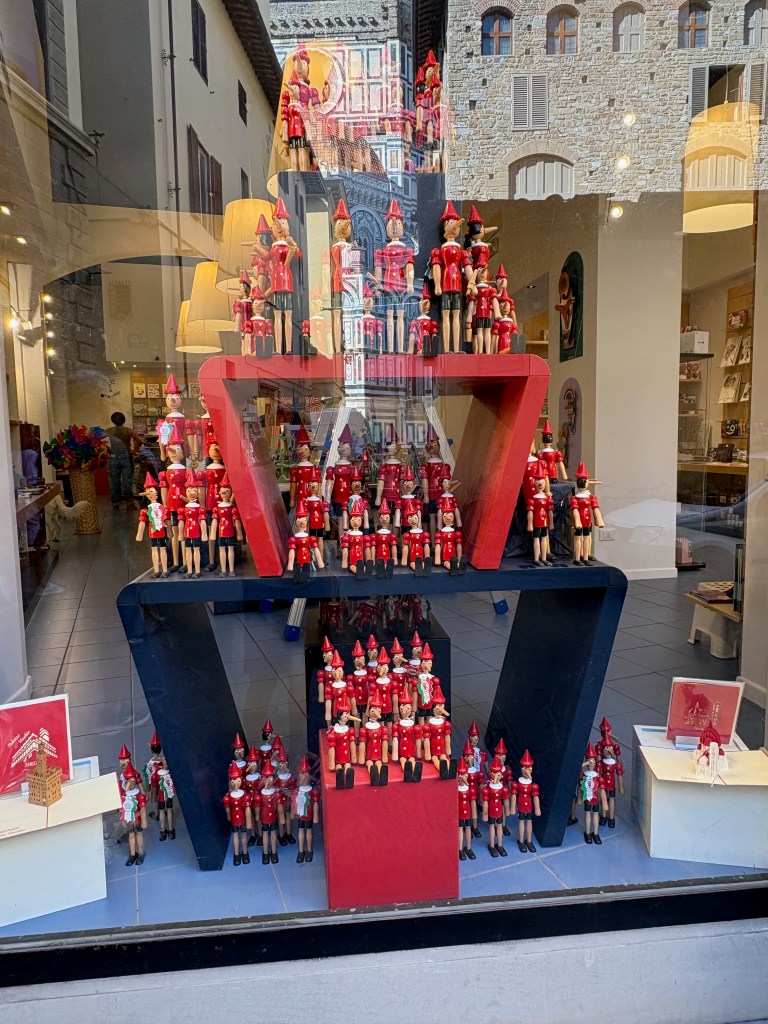
Pinocchio originated as a serialized children’s story written in 1881 by Italian author Carlo Collodi. He grew up near the Tuscan village of Collodi, which inspired his pen name. The story began in July 1881 as a serial called The Story of a Puppet in the Italian children’s magazine. Due to massive popularity, it was published as a complete novel titled ‘The Adventures of Pinocchio’ in 1883. Collodi’s original serial was much darker and functioned as a cautionary moral tale for the children of a newly unified Italy. Unlike the sweet character popularized later, the original Pinocchio was stubborn, ungrateful, and defiant toward his maker, Geppetto.
The Cathedral of Santa Maria del Fiore, commonly known as the Florence Duomo, is the iconic gothic cathedral of Florence, Italy, famous for Filippo Brunelleschi’s revolutionary massive brick dome. Located in la Piazza del Duomo, central Florence, Italy, construction began on September 8, 1296, under architect Arnolfo di Cambio and was consecrated on March 25, 1436. Designed by Brunelleschi, it is the largest masonry dome in the world, built with a brilliant double-shell self-supporting design without traditional scaffolding. The exterior is decorated with striking panels of green, white, and pink marble.
In the mid of the 14th century, Florentine artists put aside the Gothic style and incorporated the Roman style. The Gothic air of the cathedral was hidden behind the red marble of Siena, the white of Carrara and the green of Prato. The metalsmith Lorenzo Ghiberti and the sculptor Filippo Brunelleschi had the privilege of finishing the Cathedral of Florence.
Brunelleschi sculpted the statues for the dome and designed an innovative project to make the Florentine Cathedral the largest of its time. Brunelleschi started with the construction of the project by 1421, the polygonal base had already been completed while the dome was completed 15 years later. The red dome of the cathedral was then the largest in the world, 45 m in diameter and 100 m high and soon became the symbol of Florence.
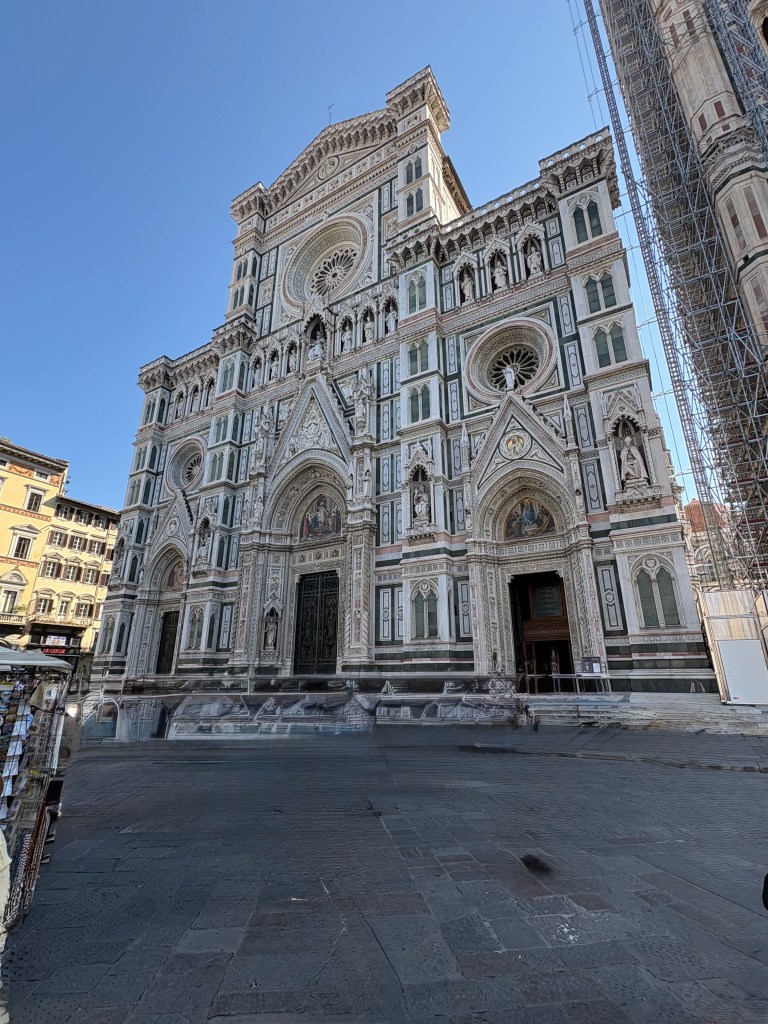
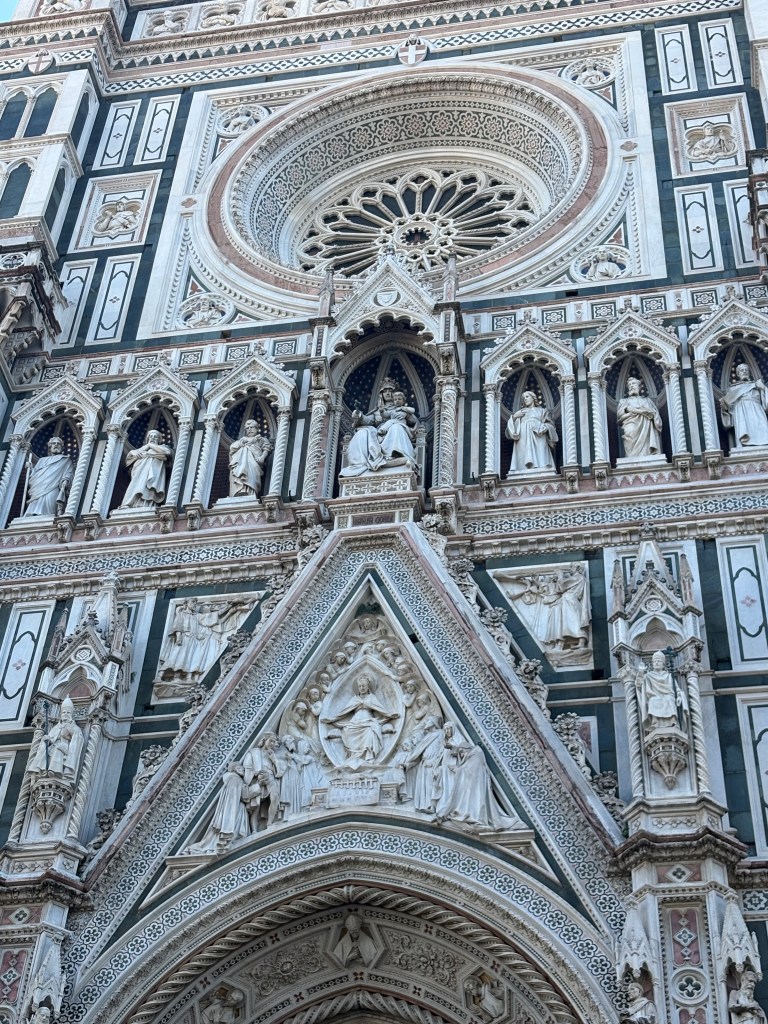
Emilio De Fabris (1808–1883) designed a new façade in 1871, began work in 1876 and completed it in 1887. This neo-gothic façade in white, green and red marble forms a harmonious entity with the cathedral, Giotto’s bell tower and the Baptistery.
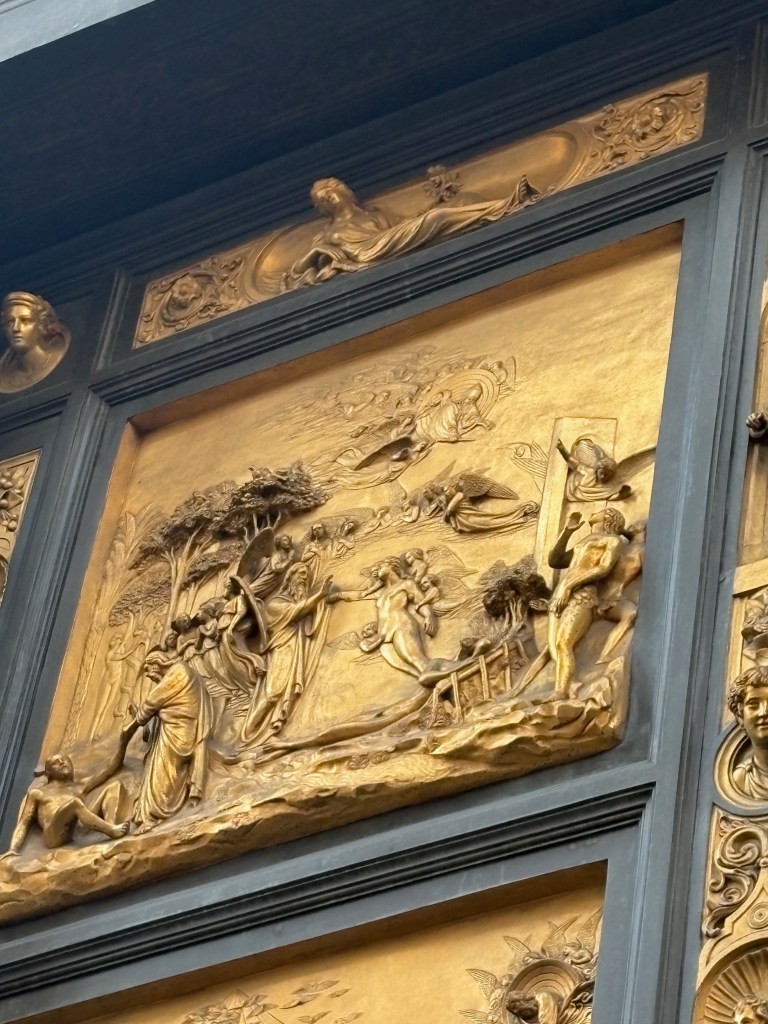
The Baptistery is renowned for the works of art with which it is adorned, including its mosaics and its three sets of bronze doors with relief sculptures. Andrea Pisano led the creation of the south doors, while Lorenzo Ghiberti led the workshops that sculpted the north and east doors. Michelangelo said the east doors were so beautiful that “they might fittingly stand at the gates of Paradise.”
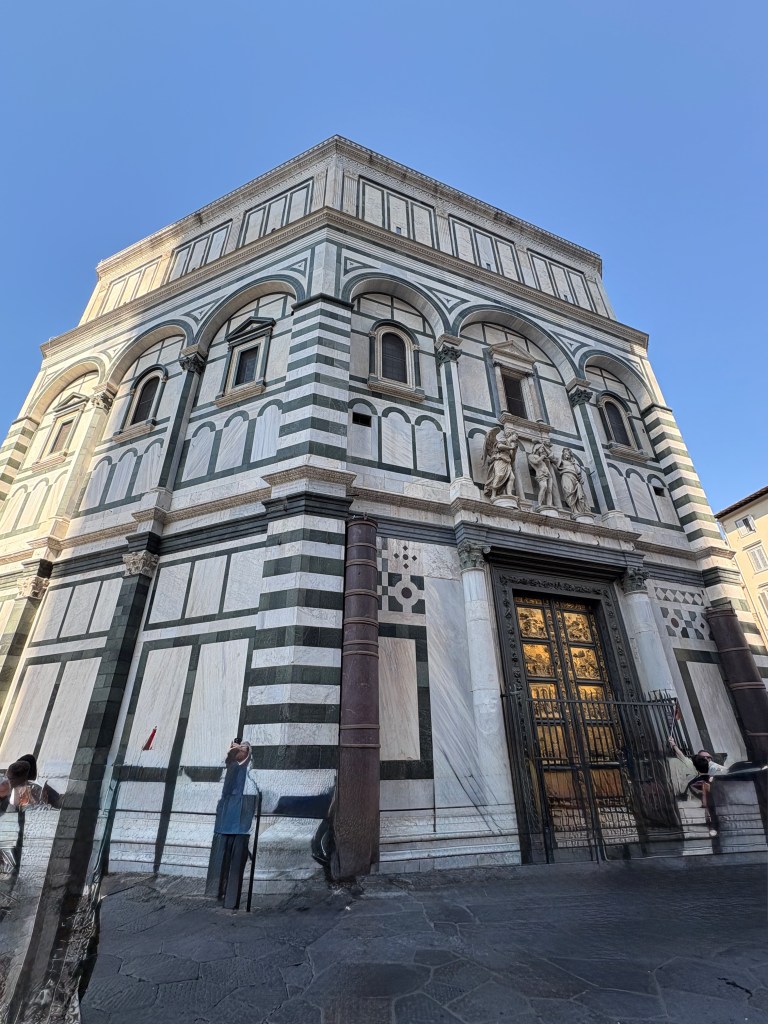
In the bronze doors, the stories depicted begin with the Creation of Adam and Eve and end with the meeting of King Solomon and the Queen of Sheba.
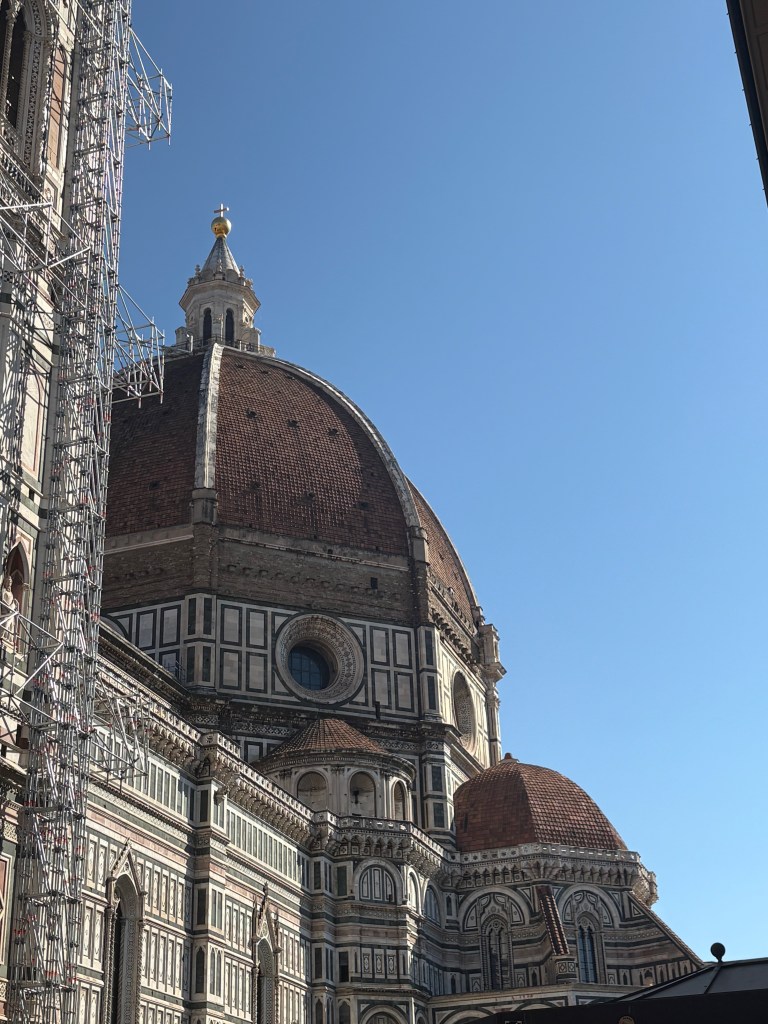
After a hundred years of construction and by the beginning of the 15th century, the structure was still missing its dome. The basic features of the dome had been designed by Arnolfo di Cambio in 1296. It called for an octagonal dome higher and wider than any that had ever been built, with no external buttresses to keep it from spreading and falling under its own weight.
The architect, Brunelleschi, employed a double shell, a form of construction with earlier precedents in Persian and Central Asian architecture. Both shells were built of brick, chosen for its light weight compared to stone and the ease of forming it in place, and raised with nothing supporting them from below during construction. Sandstone and marble were reserved for the tension chains, the ribs and the lantern.
The cathedral complex, in Piazza del Duomo, includes the Florence Baptistery and Giotto’s Campanile. These three buildings are part of the UNESCO World Heritage Site covering the historic centre of Florence.
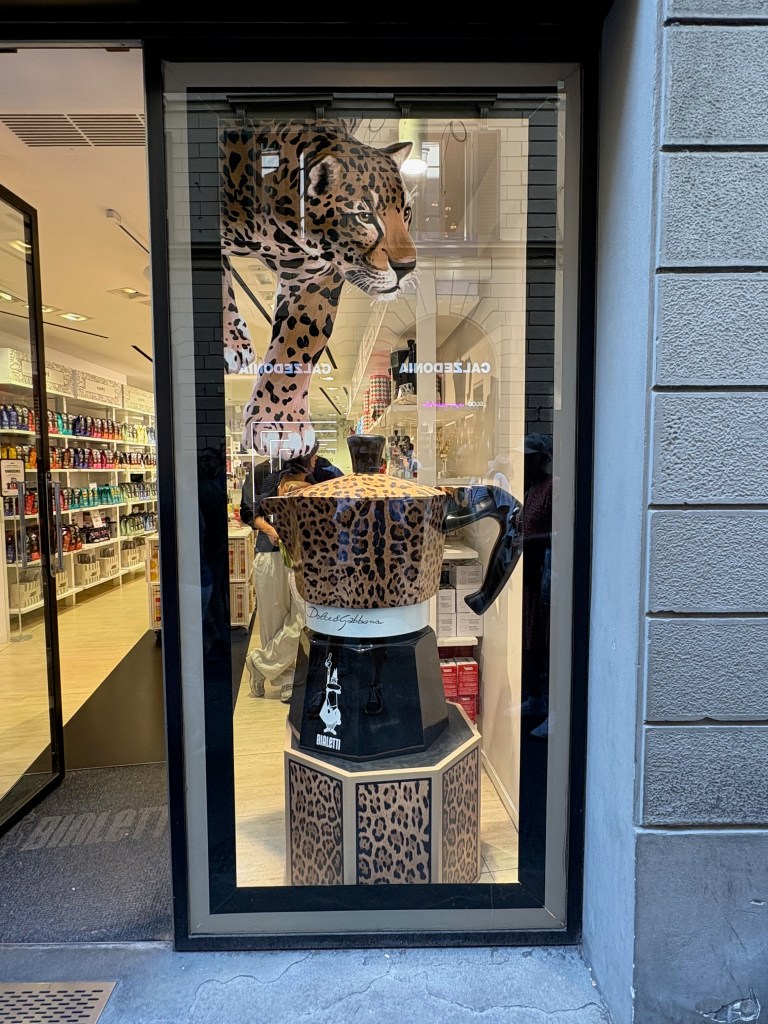
As we walked through a shopping district, this window display for a designer coffee maker was spectaular.
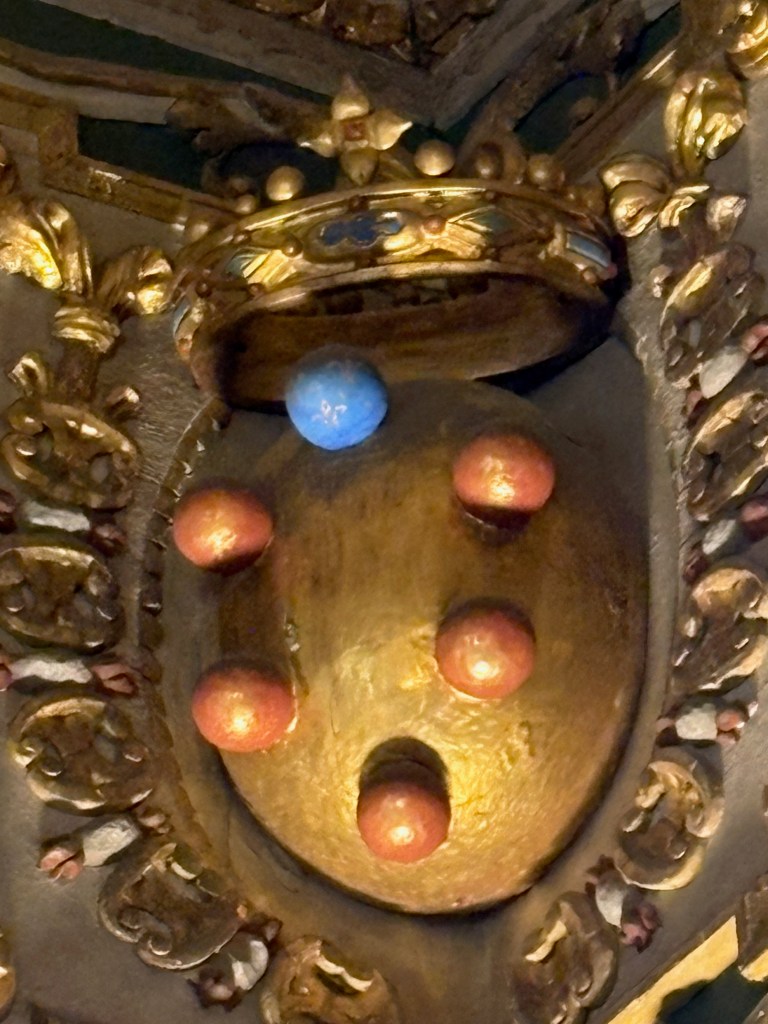
About the Medici’s: The House of Medici was a powerful Italian banking family and political dynasty that ruled Florence and Tuscany from the 15th through the 18th century. The family started as modest landowners in the Mugello region before moving to Florence to work in wool trading and commerce. The Medici Bank founded by Giovanni di Bicci de’ Medici in 1397 grew into the largest and most respected bank in 15th-century Europe. Giovanni’s son, Cosimo de Medici, took de facto control of Florence in 1434 by using his immense wealth to secure political influence. The family funded legendary artists and thinkers like Leonardo da Vinci, Michelangelo, and Botticelli, turning Florence into the heart of the Renaissance. They served as bankers to the Papacy and produced four Roman Catholic popes (including Leo X and Clement VII).
The Palazzo Medici Riccardi was built after the defeat of the Milanese and when Cosimo de Medici had great governmental power. As Pater Patriae, Cosimo was able to find ways around how to display wealth without displaying wealth through building materials and the idea of having the exterior of the building simpler and modest while the inside was more decorated. It was larger than other palazzi but its more modest design made it less noticeable.
Cosimo and his family moved into the new palace by 1458, moving from their old palace some 50 metres north, on the same street. He did not enjoy it for very long, dying in 1464. The palace remained the principal residence of the Medici family until the exile of Piero de Medici in 1494. Following their return to power the palace continued to be used by the Medici until 1540. The Palazzo Medici continued to be used as a residence for younger family members until, too austere for Baroque era tastes, the palace was sold to the Riccardi family in 1659. The Riccardi family sold the palace to the Tuscan state in 1814 and in 1874 the building became the seat of the provincial government of Florence.
We then started the guided tour of the Palazzo Medici Riccardi.
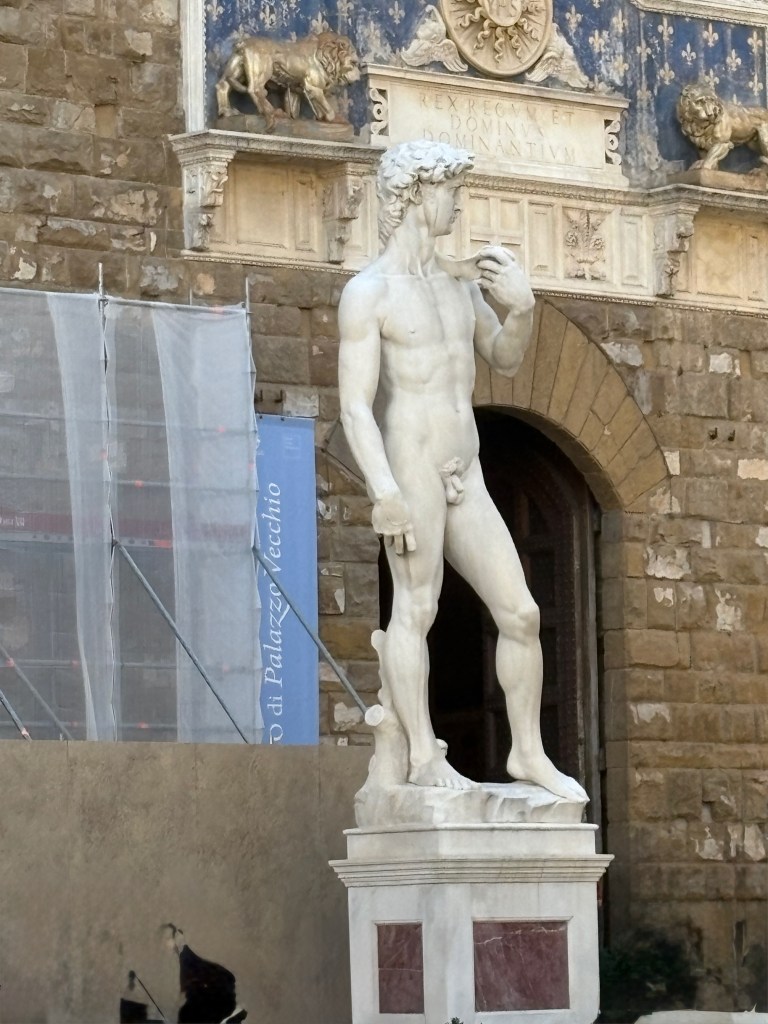
Since we arrived in Florence on a Monday (when most museums are closed), we could not visit The Uffizzi (very disappointed) where the David is located, here’s a copy!
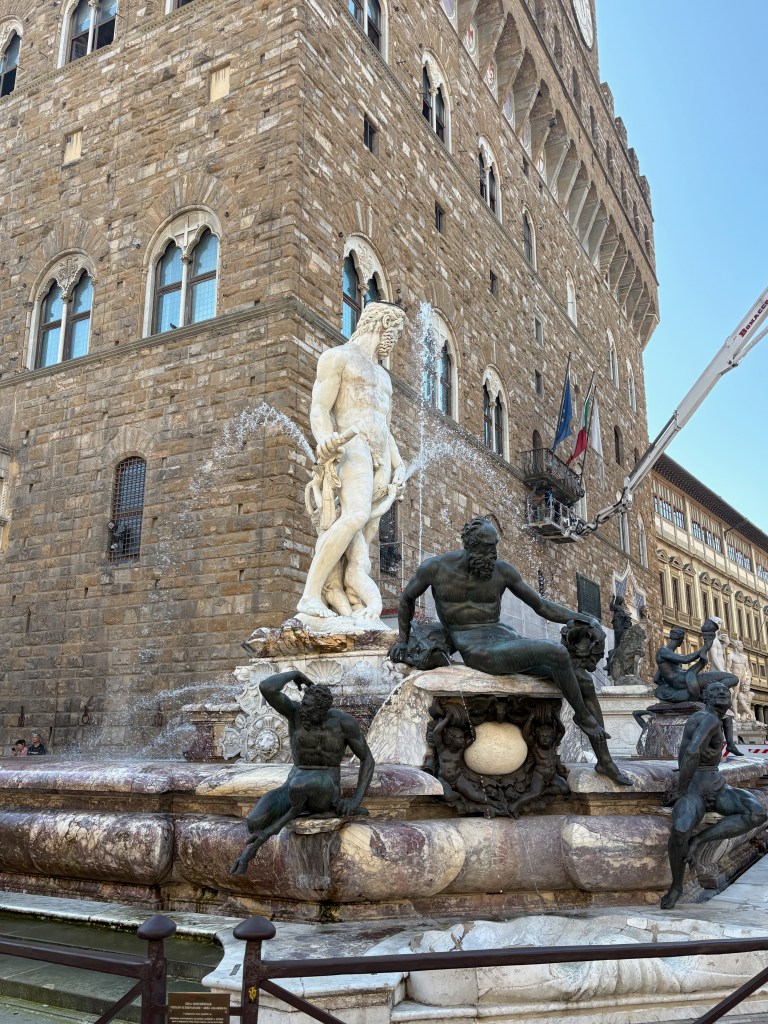
Also a stunning statue of Neptune.
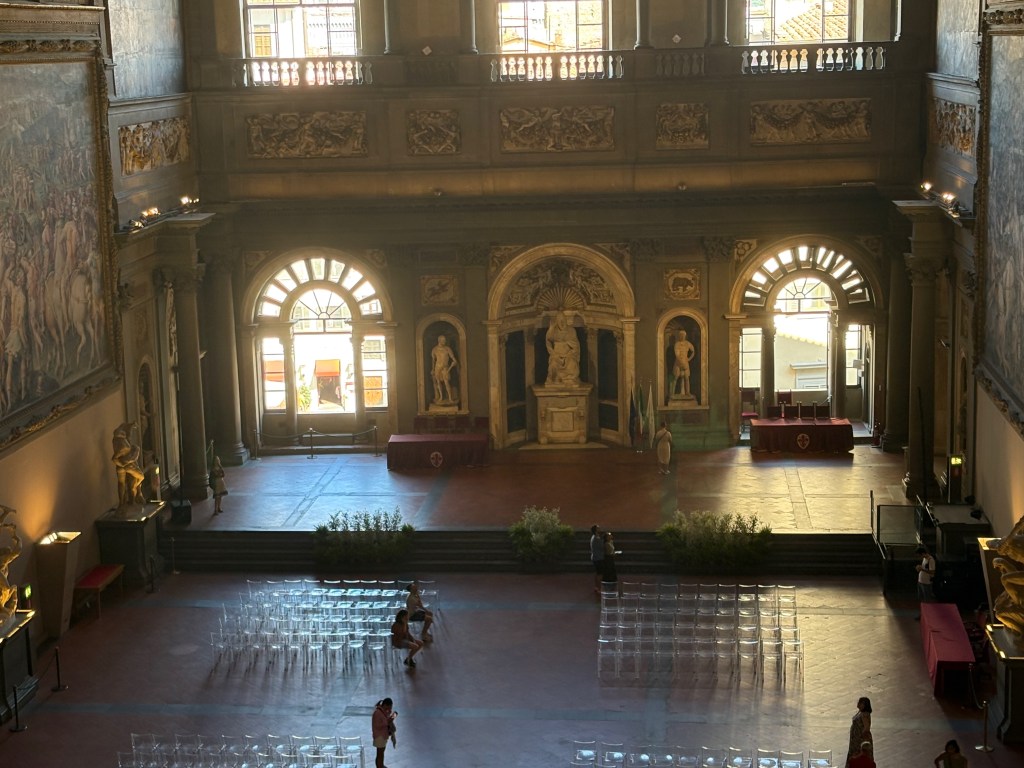
We started our visit to Palazzo Vecchio, marvelling at the legacy of the Medici as you visit Palazzo Vecchio, the symbol of Florence’s political power for over seven centuries. You’ll also visit rooms decorated with masterpieces by famous artists of the Renaissance, like Michelangelo and Donatello.
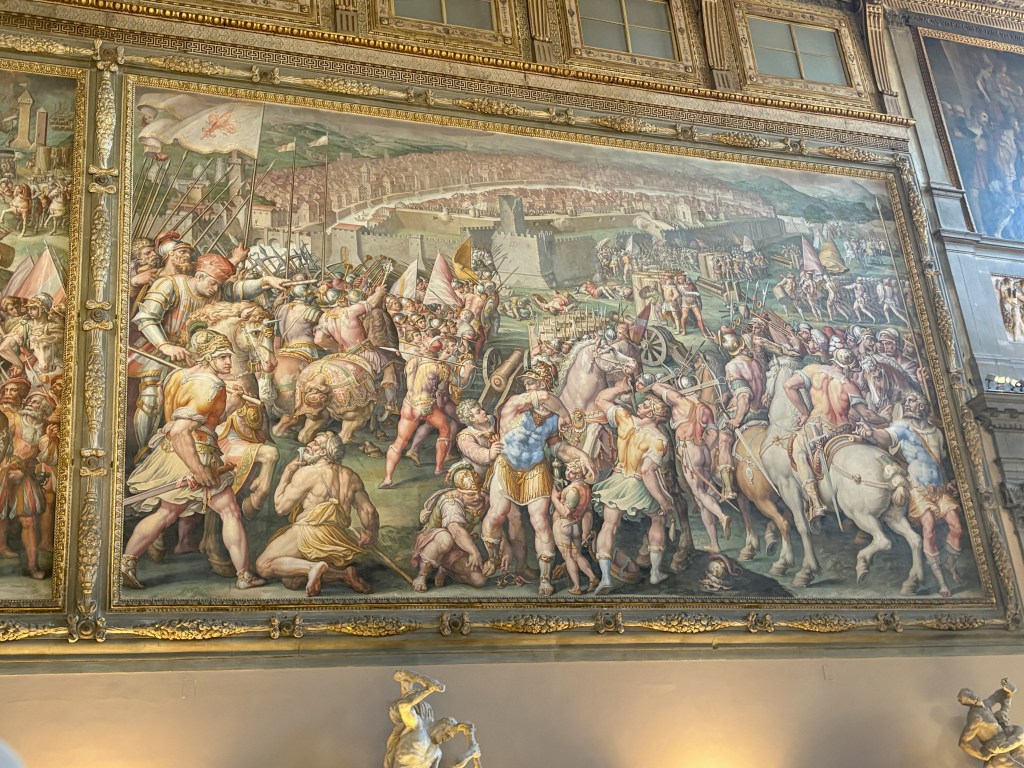
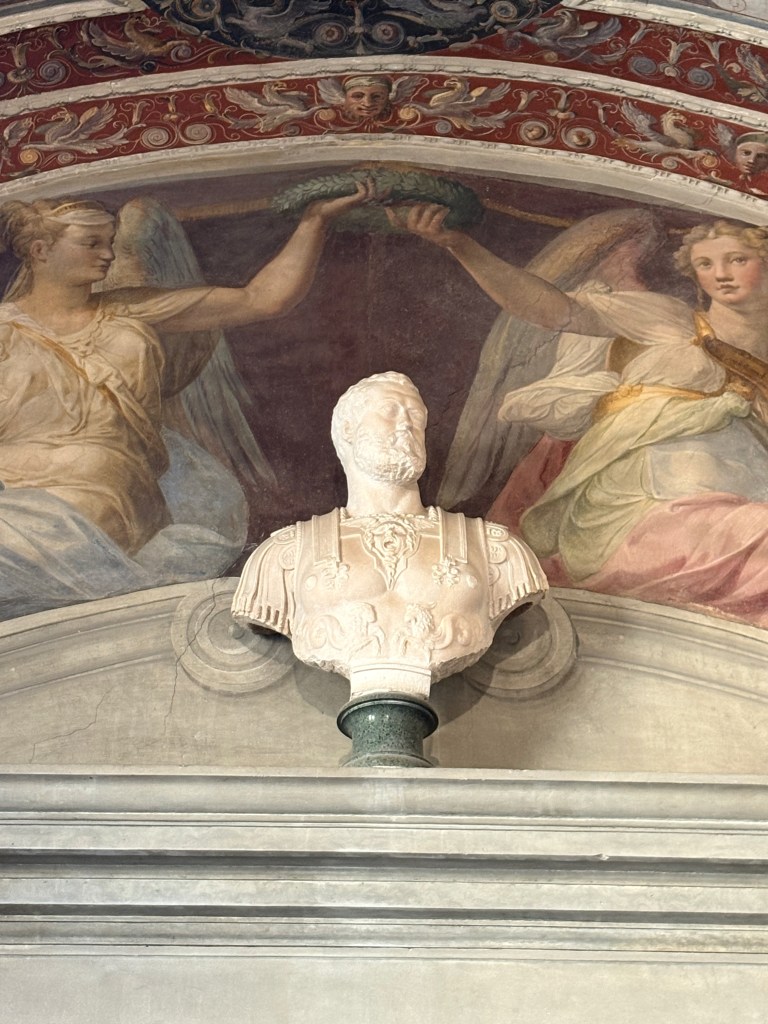
With our guide, we visited the magnificient ‘Hall of the Five Hundred’ dedicated to the Medici popes. The Salone dei Cinquecento is the largest and most imposing chamber in the Palazzo Vecchio. It measures approximately 52 meters (170 feet) in length, 23 meters (75 feet) in width, and 18 meters (59 feet) in height.
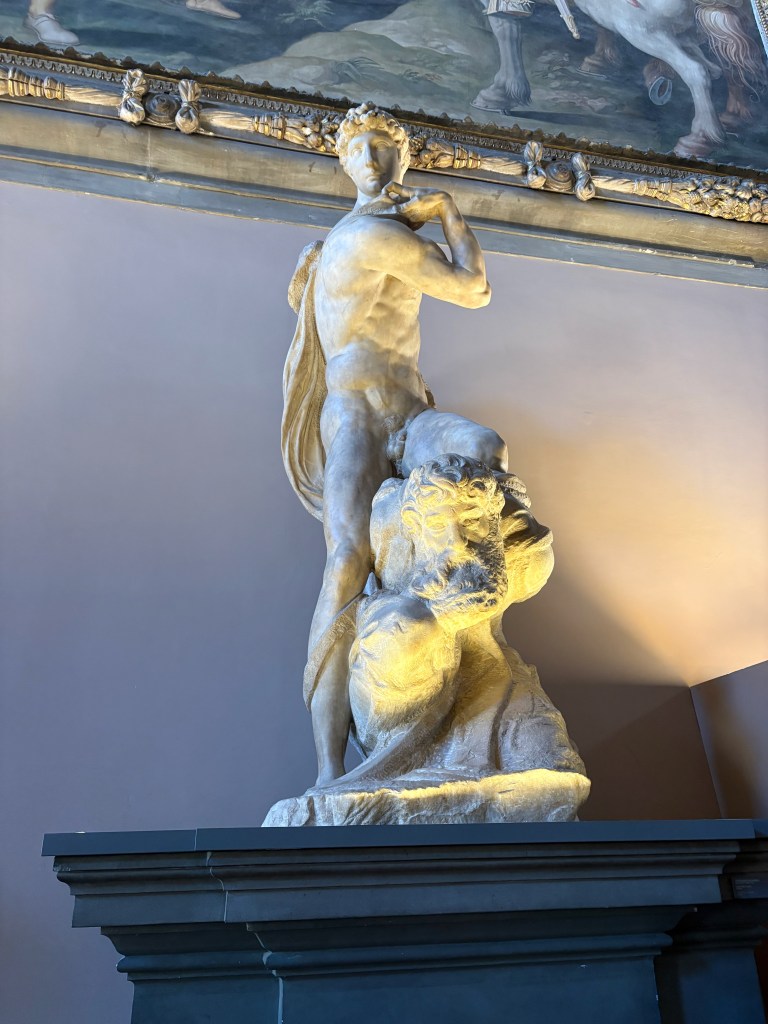
Michelangelo Buonarroti
1530-1534
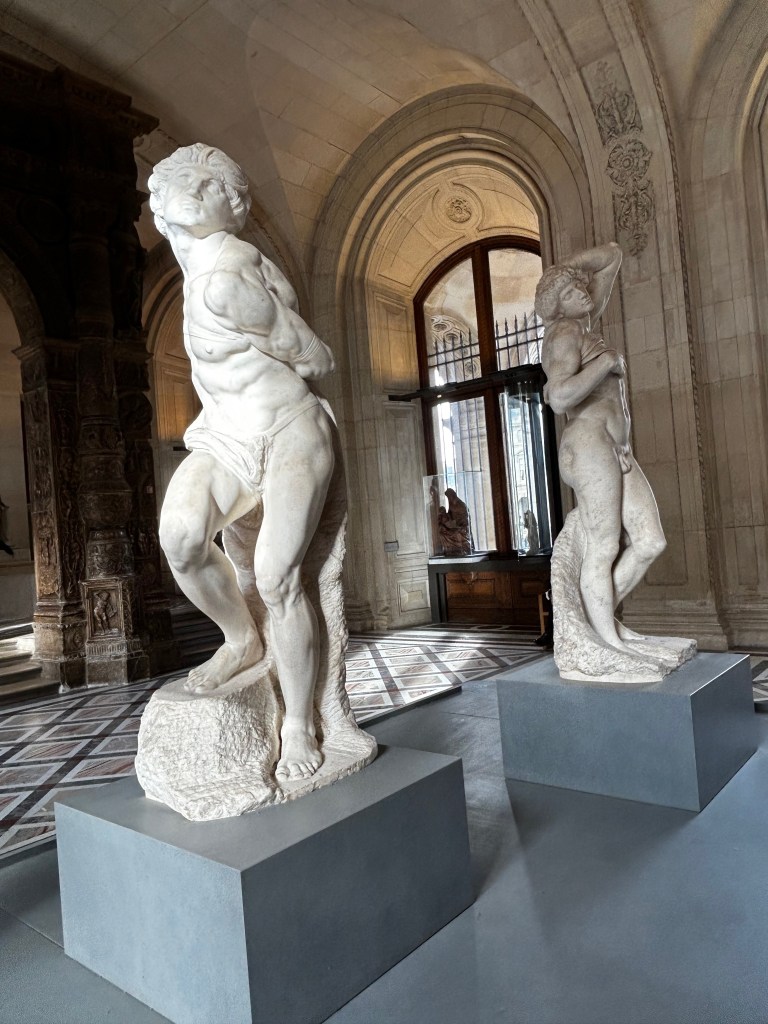
This is one of the unfinished statues (on permanent loan from the Museo Nazionale del Bargello (1921)) which Michelangelo carved for the tomb of Pope Julius II and which was still in his workshop in Florence when he died in 1564, because none of them was used in the final version of the tomb, in San Pietro in Vincoli in Rome.
Giorgio Vasari urged Michelangelo’s nephew to offer the statue to Duke Cosimo de Medici, planning to place it where it still stands today for Francesco I’s wedding with Joanna of Austria in 1565. Described in sources as “a Victory with a prisoner beneath it” the statue was set beneath the paintings of the Battle of Siena to celebrate Duke Cosimo’s conquest of that city.
On the walls are large and expansive frescoes that depict battles and military victories by Florence over Pisa and Siena.
The new apartments, designed after Cosimo I de Medici had the palace extended, were built under the direction of Battista del Tasso from 1551 to 1555, but were altered almost at once when Giorgio Vasari suggested raising their panelled ceilings. This marked the start of a long working relationship between Cosimo I and Giorgio Vasari who took Tasso’s place as court architect and artist, and proceeded to decorate almost all of the rooms with his assistants’ help in a mere three years.
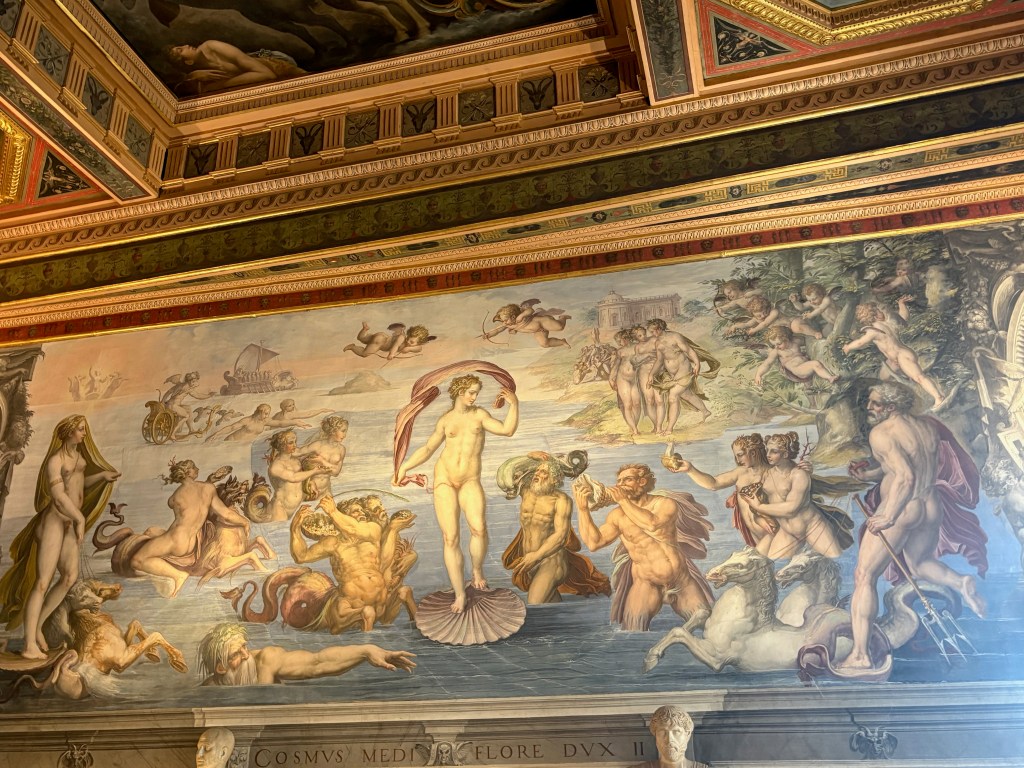
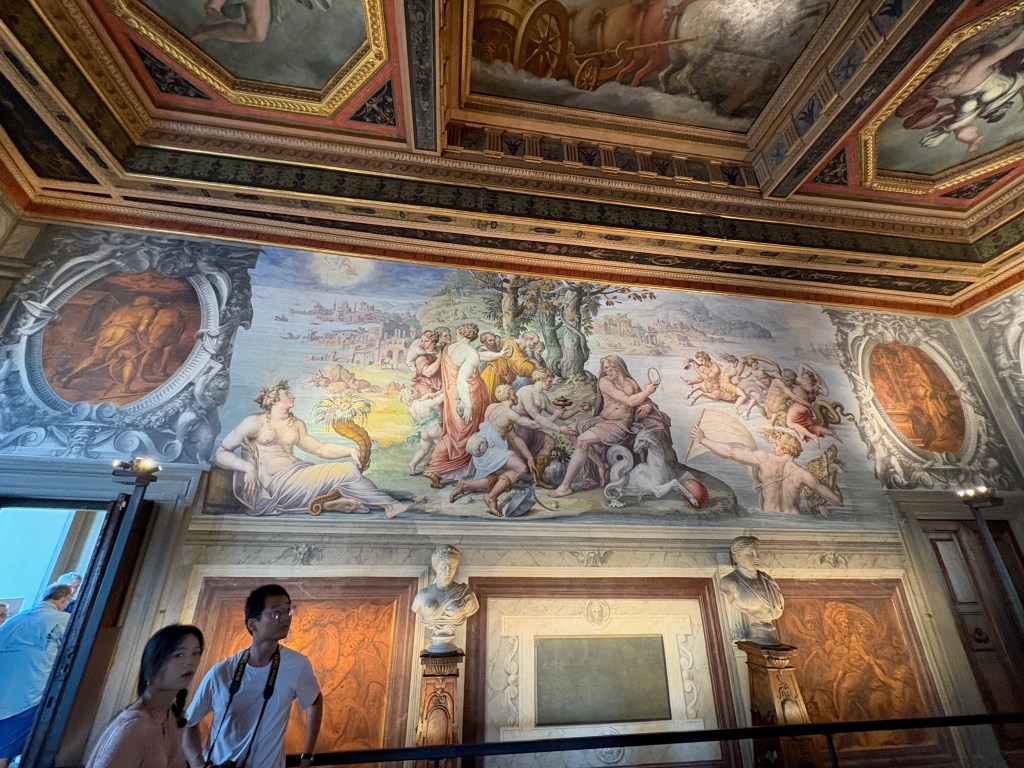
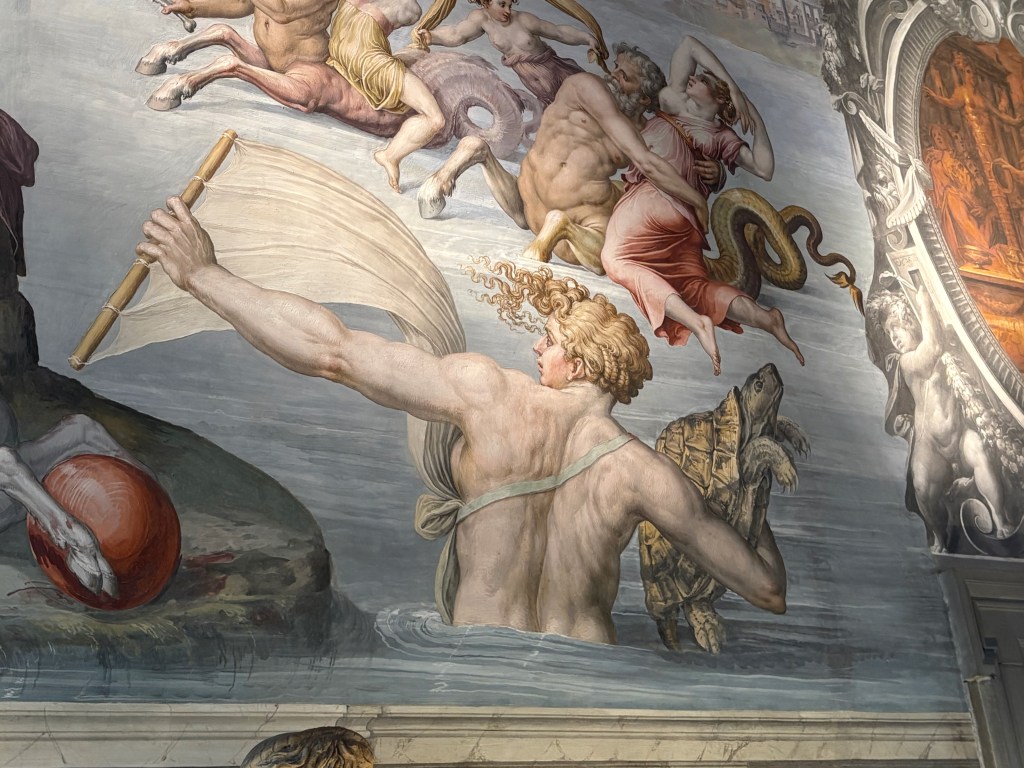
In the decoration of the Apartments of the Elements the paintings celebrate the genealogy of the “heavenly deities” as the beginning and end of all things.
The cycle begins in the room after which the apartments are named, with a depiction of the origins of the four elements – air, water, fire and earth –
which sprung from the seed of Uranus scattered by Saturn.
Each one of the rooms is dedicated to an illustrious member of the House of Medici. What the scholar who devised the iconography was aiming to achieve in placing one set of frescoes above the other, was to exalt the glory and virtue of the House of Medici, veritable “deities on earth”, by establishing a link between the dynasty’s rise to power and the origins of the “deities in heaven”.
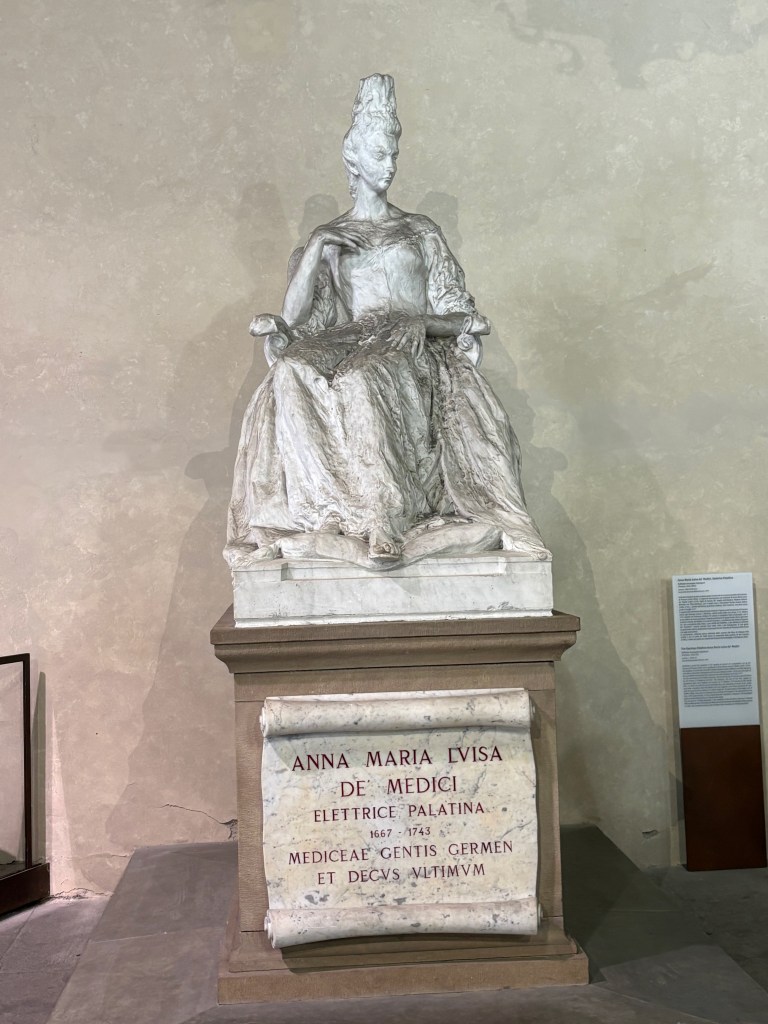
We headed back to Santa Croce square, had lunch in a cafe, bought a small white leather purse and red leather gloves and with the afternoon free, what else- visited a church (free on Monday).
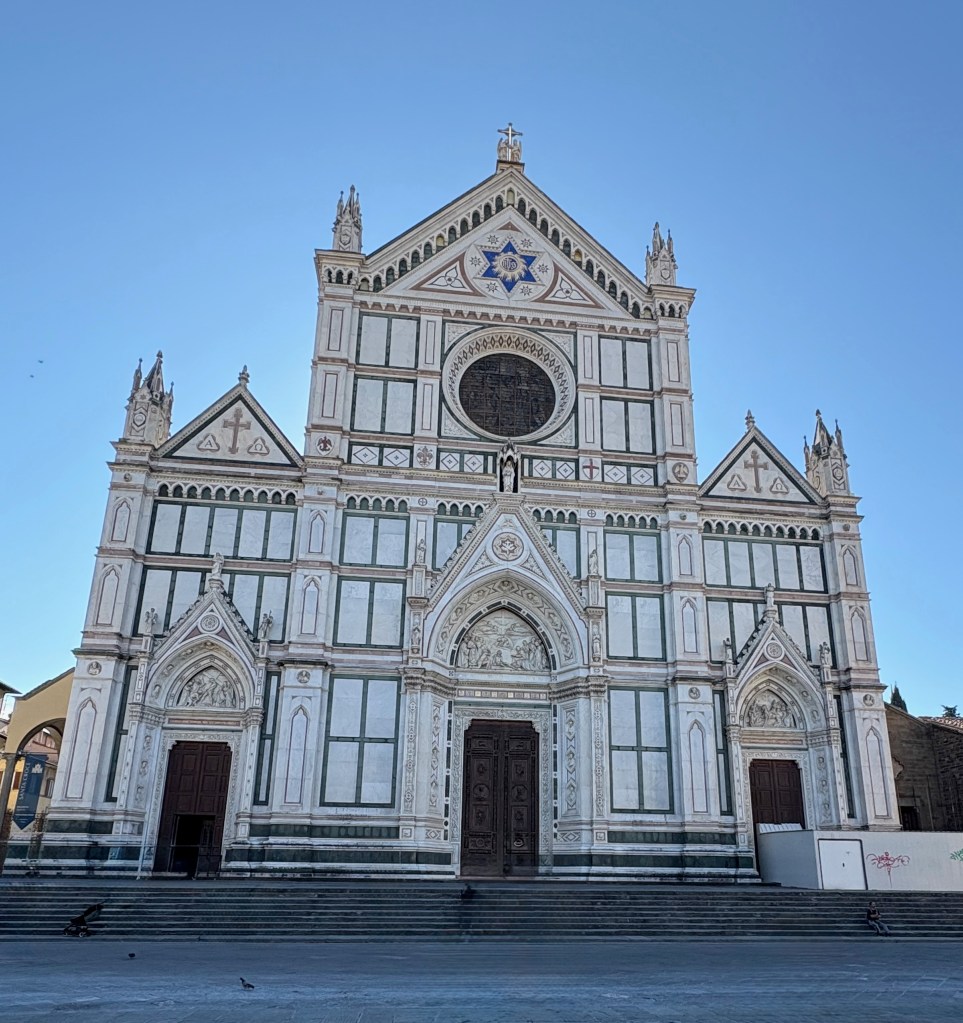
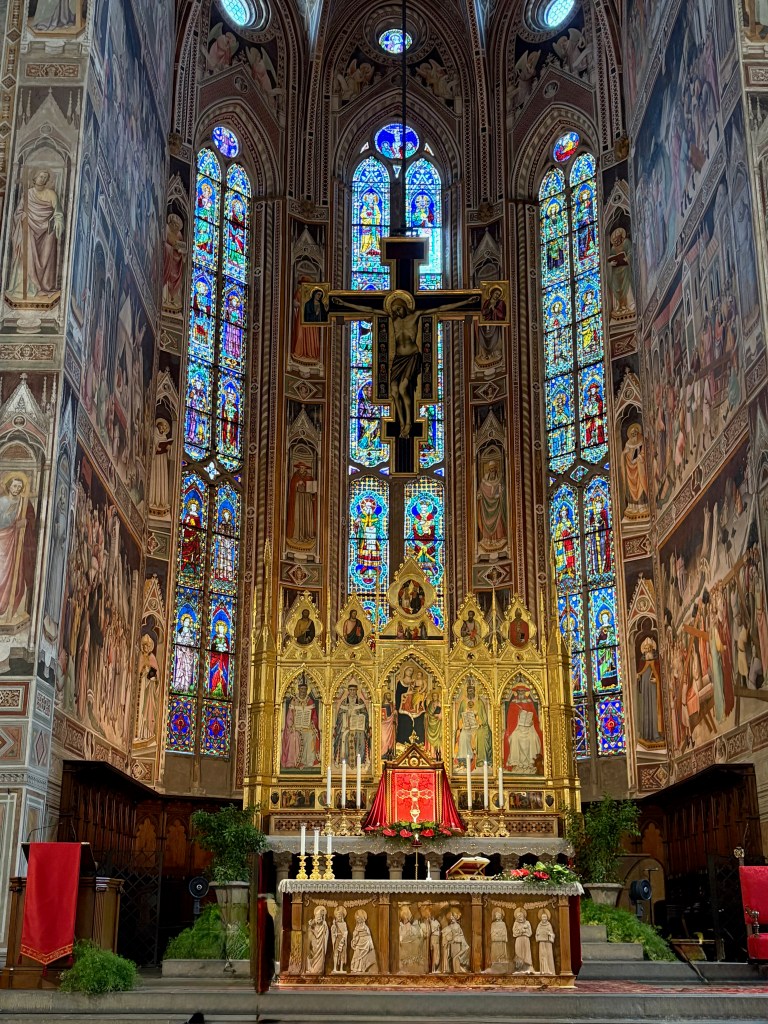
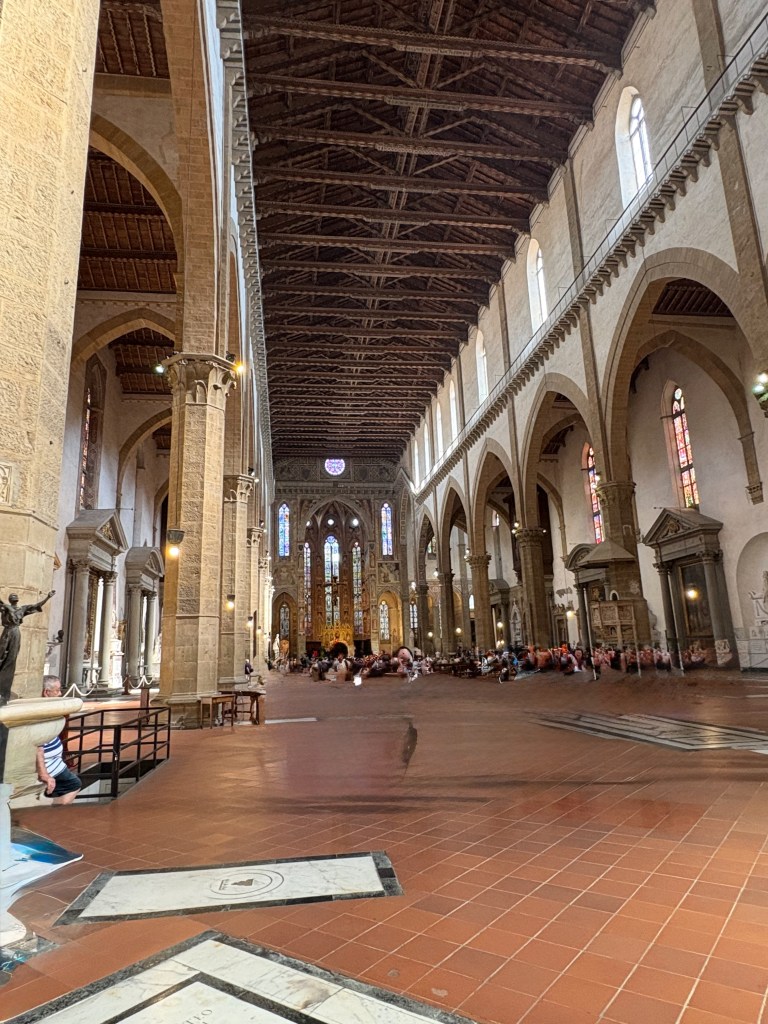
The Santa Croce is, as well as being the largest Franciscan church in the world, the real pantheon of Florence. Inside are housed nearly 300 tombs, including those of Michelangelo and Galileo. The Basilica di Santa Croce is the largest Franciscan church in the world. Measuring 377 ft (115 m) long and 124 ft (38 m) in width, it is the second biggest temple in Florence, exceeded only by the Cathedral.
The church was established in 1294 on the same site where a small chapel had previously been built to commemorate the death of Saint Francis of Assisi.
The sculptures and the paintings that decorate the walls of the church are highly valued. The Basilica’s chapels house various frescoes by remarkable artists like Giotto, Brunelleschi and Donatello. In the past there were hundreds of Franciscan friars but now there are a few.
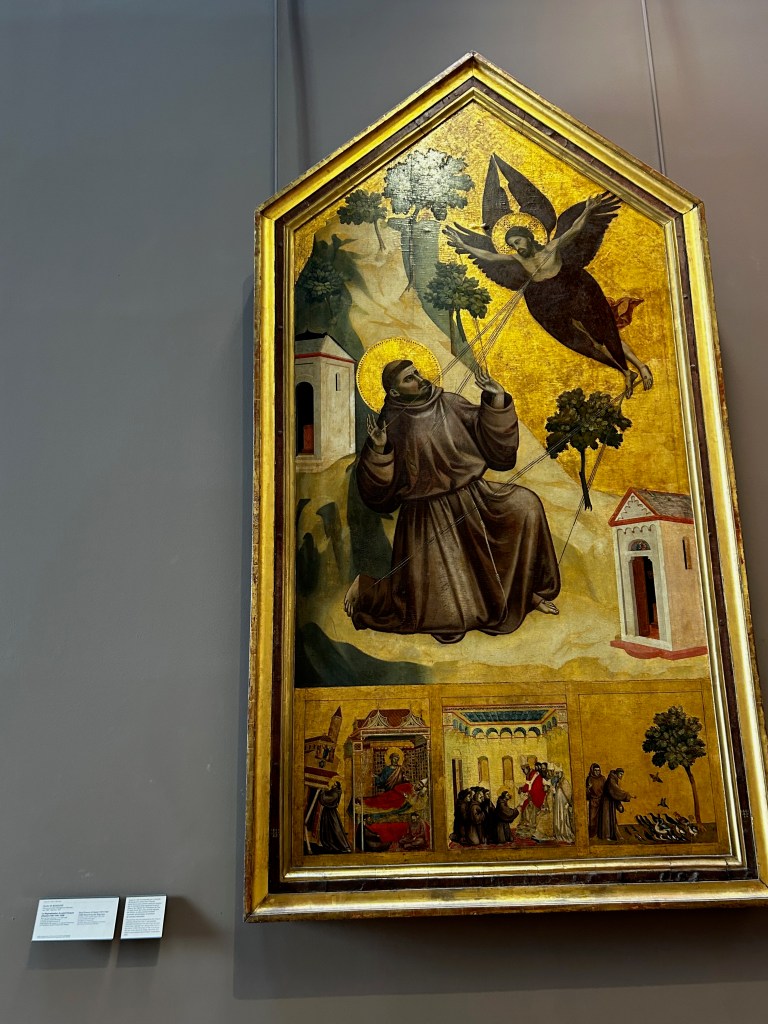
This panel is one of the most important works of art of the Florentine School, and the oldest among the paintings of Santa Croce. It depicts the most complete cycle of the life of Saint Francis, predating the frescoes in the Basilica of San Francesco d’Assisi. Its golden background is a clear influence of the Byzantine style on Medieval art.
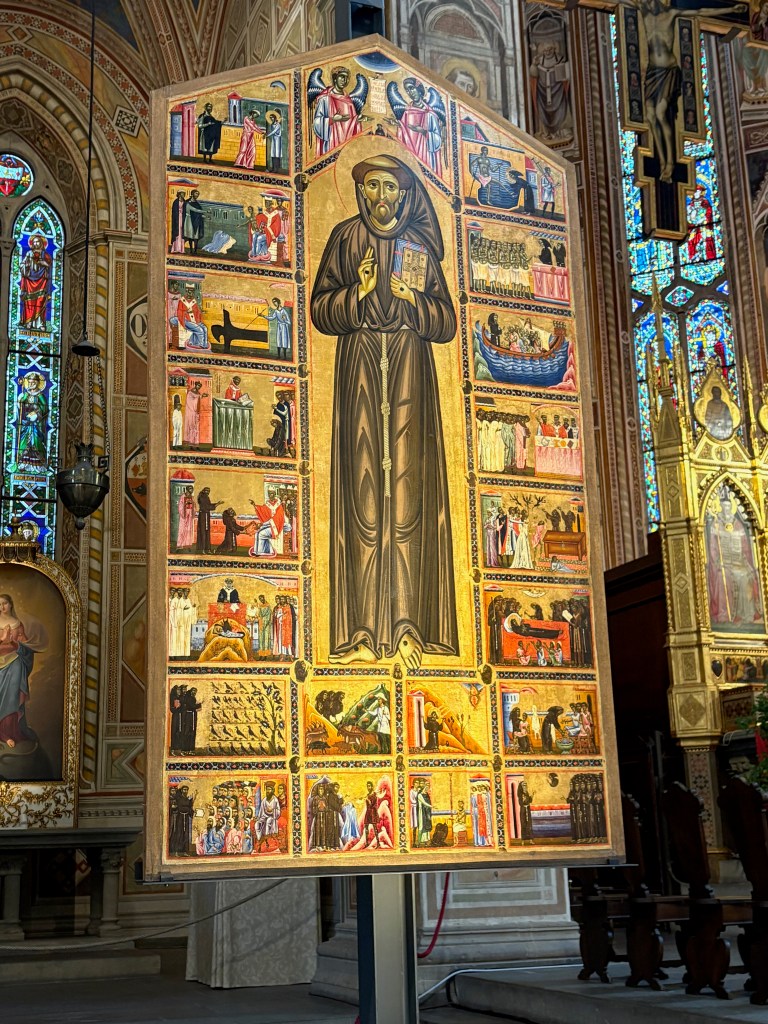
The Saint is portrayed at the centre in the act of blessing while holding a book in his left hand. He is surrounded by a frame that shows seventeen small busts of friars who probably represent the franciscan community of Santa Croce of the time. The scenes around the frame describe episodes from the life of the Saint.
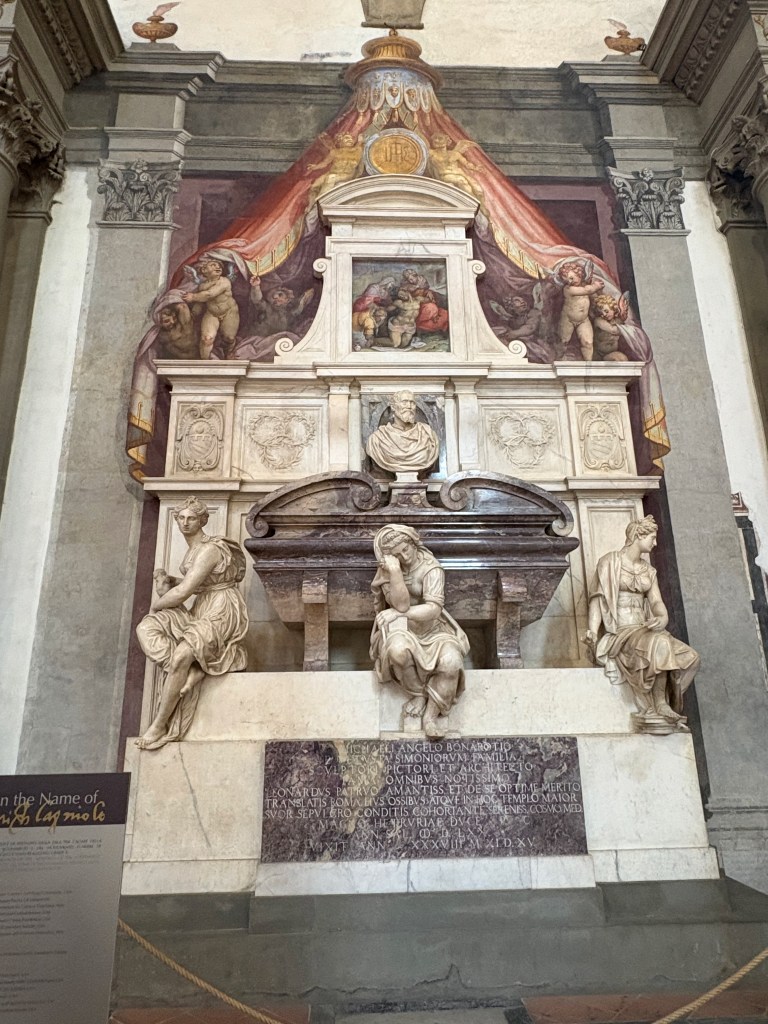
We were surprised to see the tombs of many famous sons of Florence, including Marconi, Dante and Michelangelo. Yes, Michelangelo is buried in the Basilica of Santa Croce in Florence, Italy. His tomb is in the right aisle as you enter the church. His friend and fellow artist Giorgio Vasari designed the grand monument. The tomb includes a bust of Michelangelo and three mourning statues representing Painting, Sculpture, and Architecture. After Michelangelo died in Rome in 1564 at age 88, his body was secretly smuggled back to Florence so he could rest in his home city.
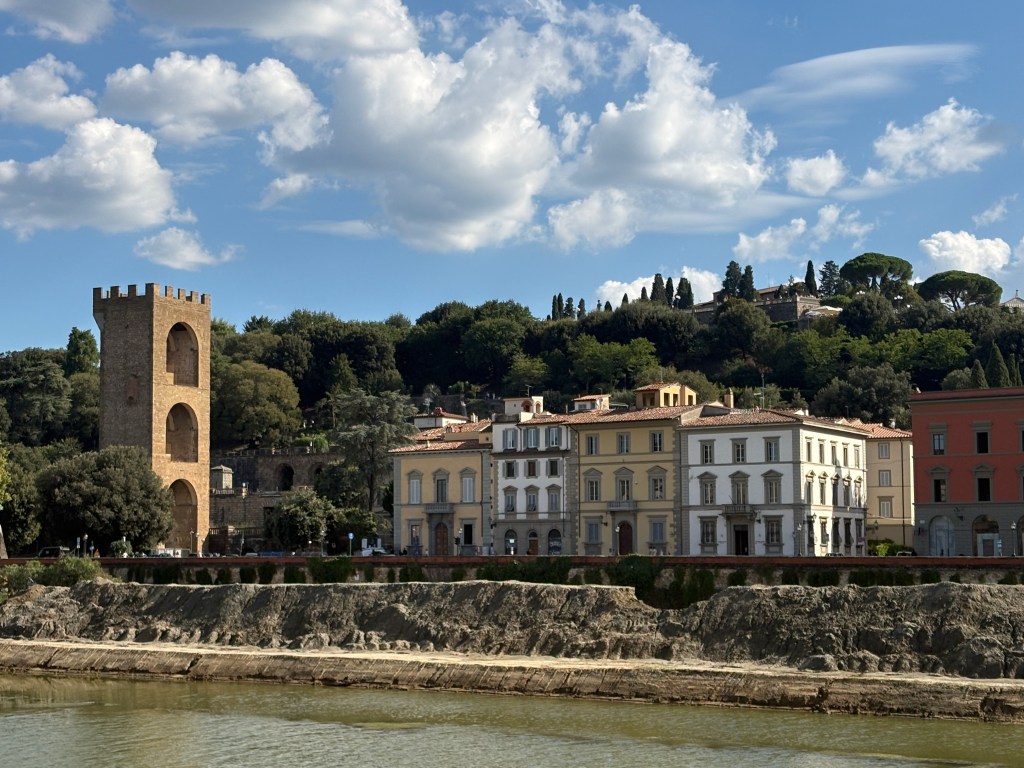
As we walked back to the bus, we walked along the river Arno.
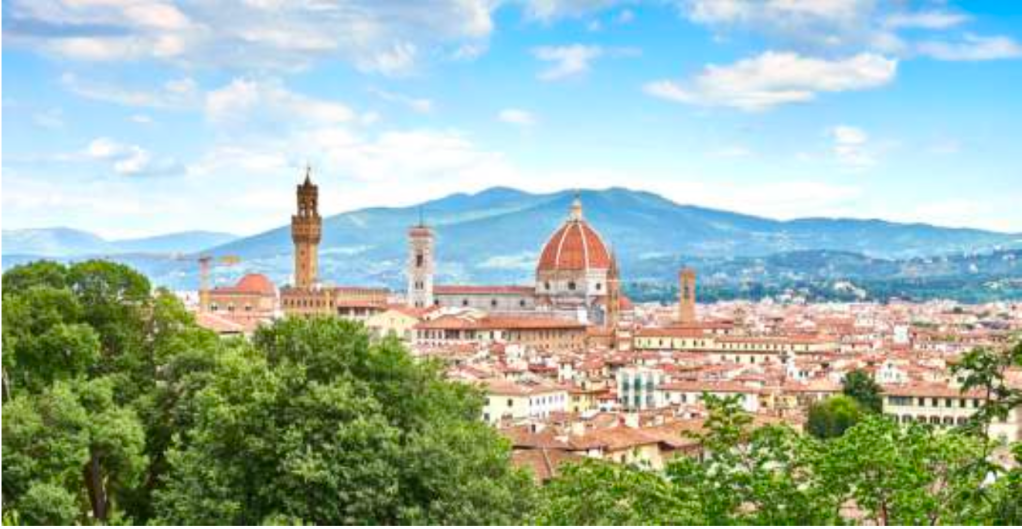
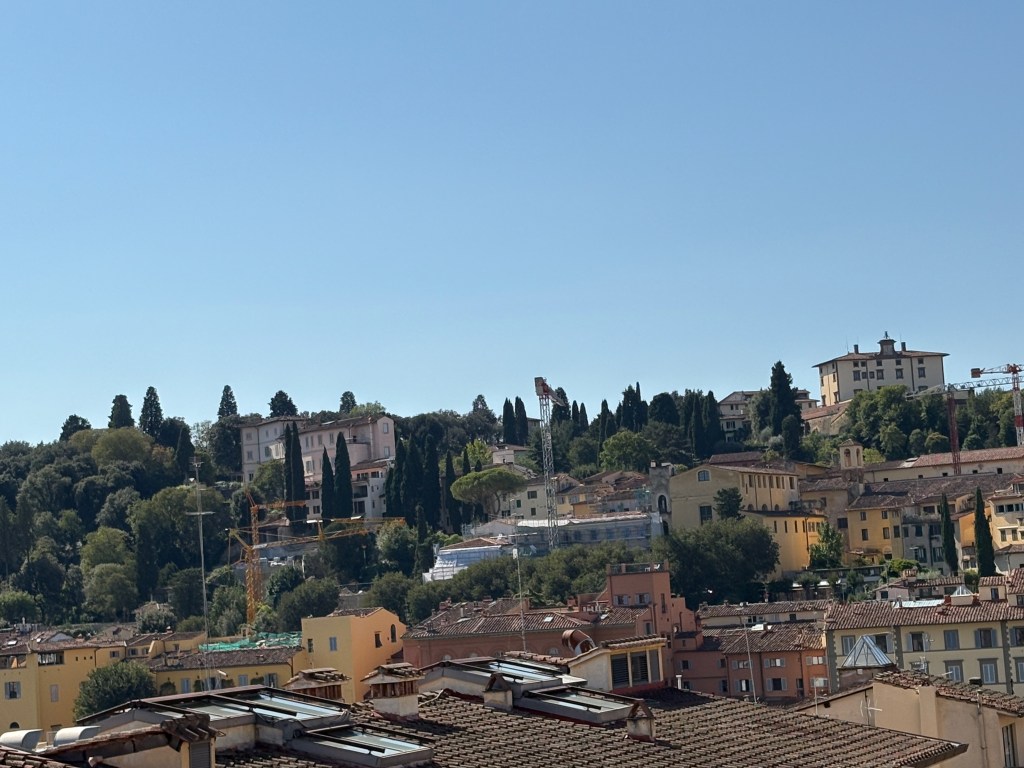
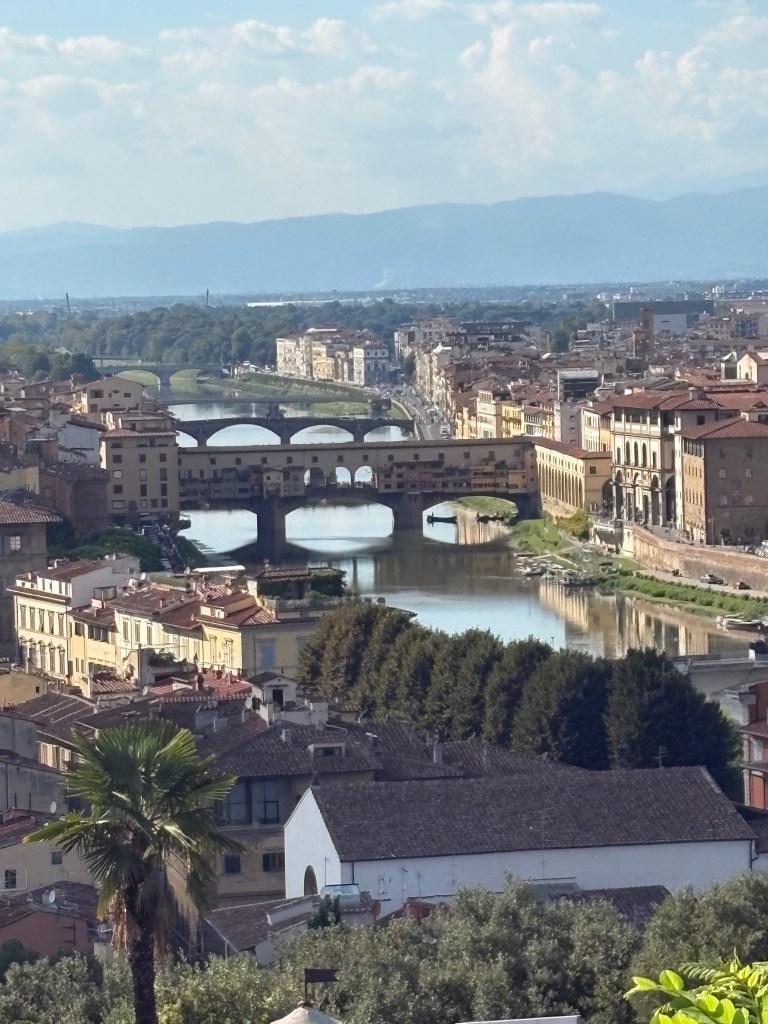
On the way out of Florence, we stopped at a viewpoint where we could see the panorama of this beautiful city before us.
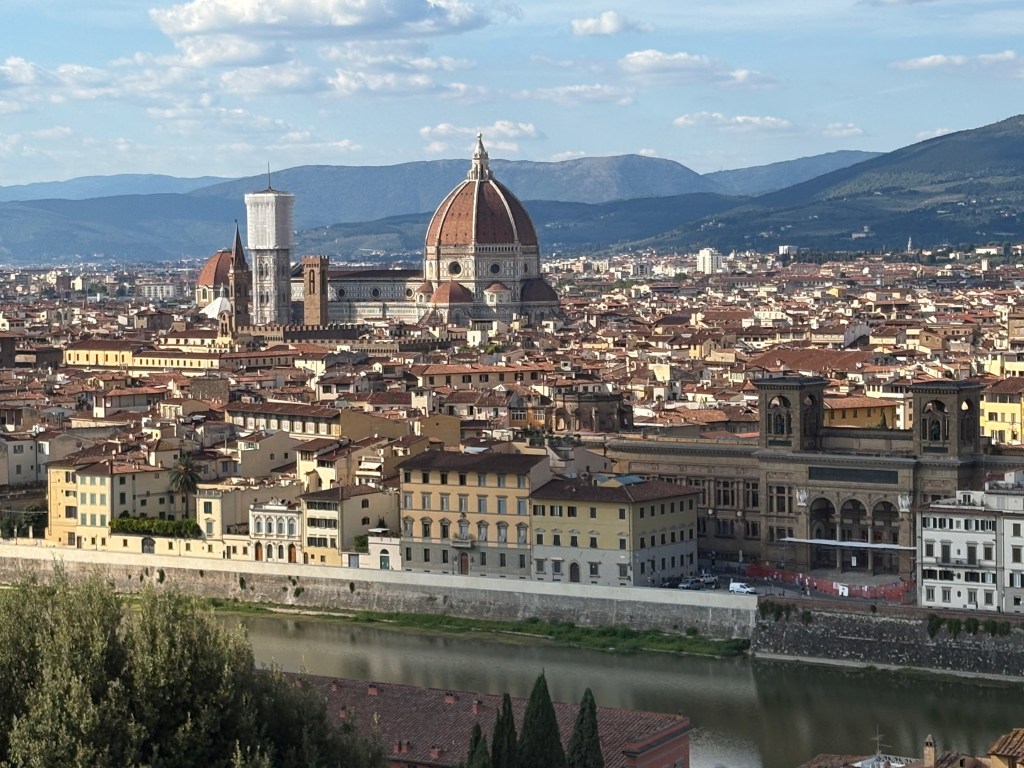
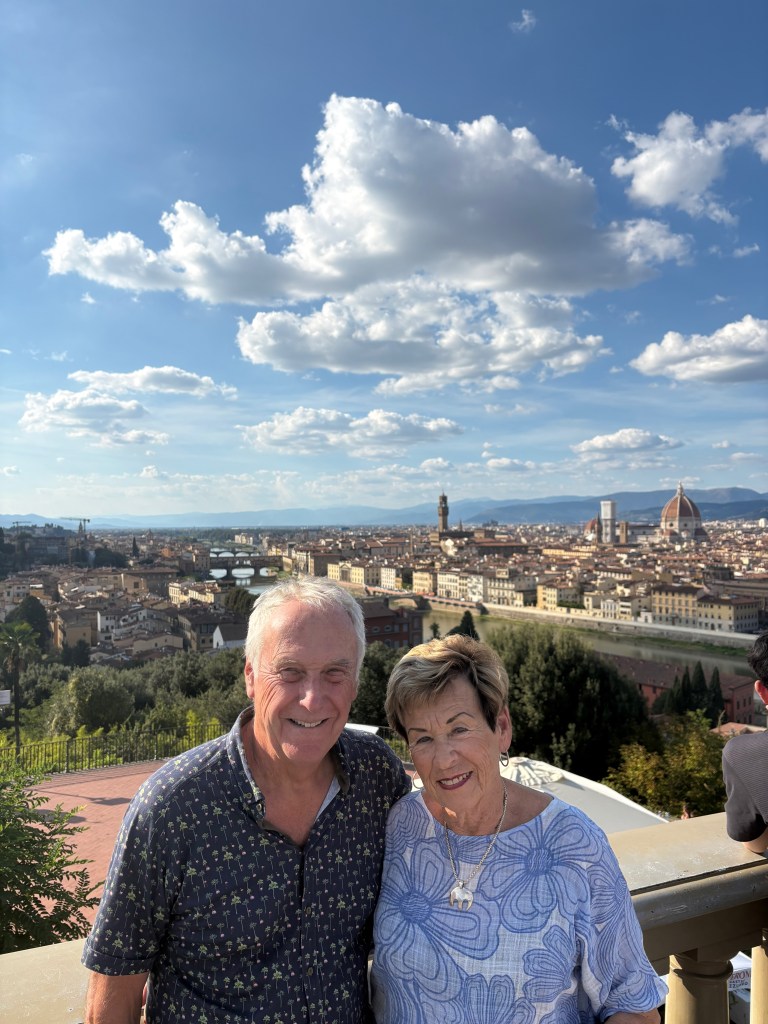
We arrived late in the day for our dinner at a local farm and winery.
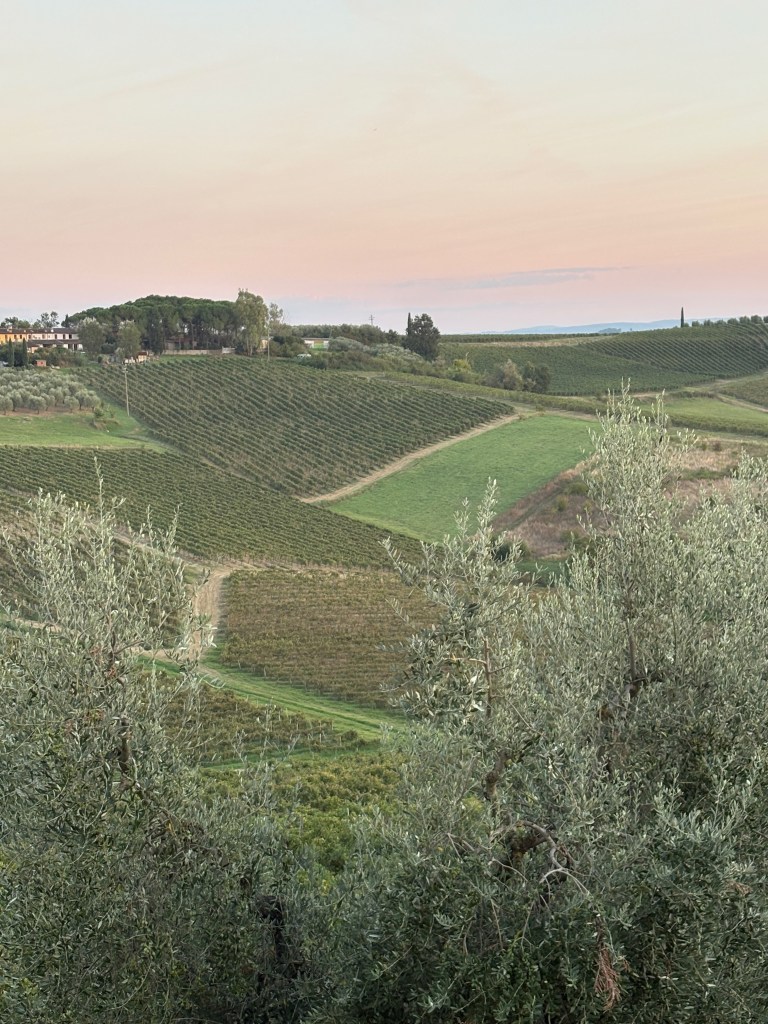
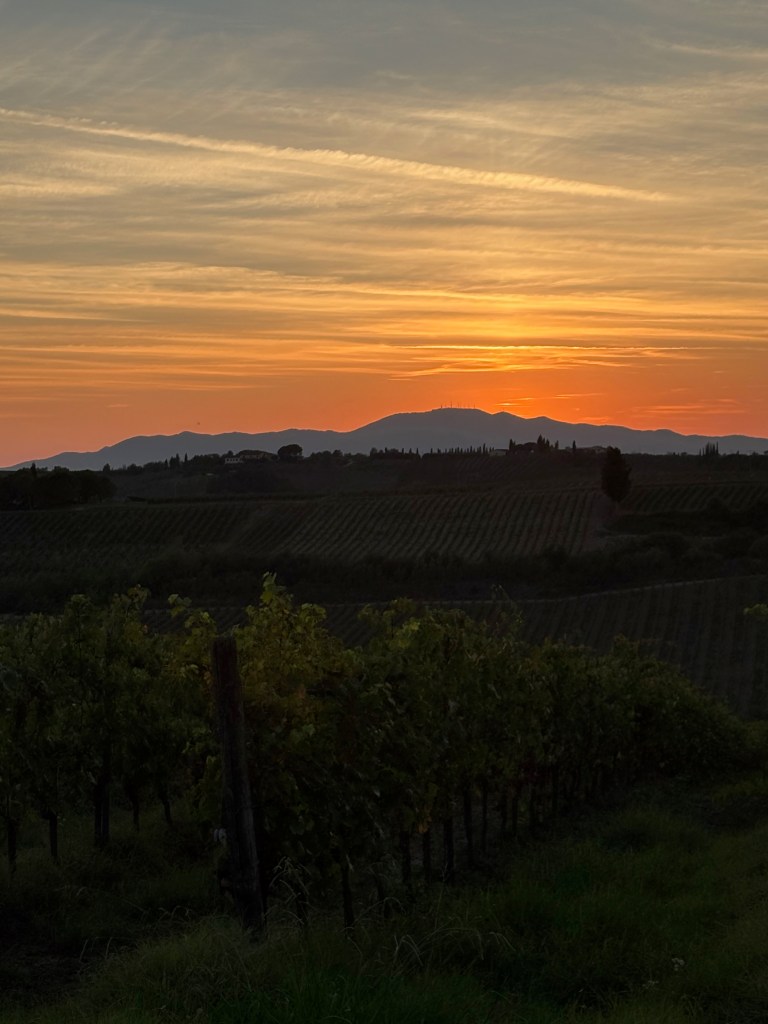
September 15 Day 10 | Venture to San Gimignano and Rome
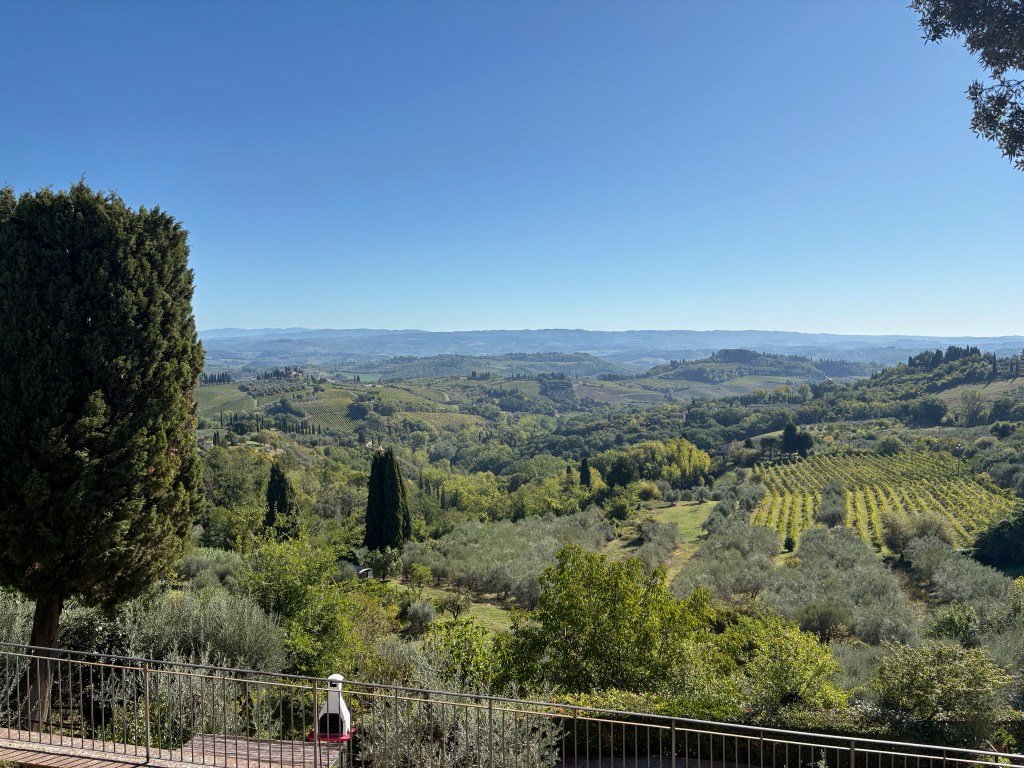
We arrived early to enjoy the medieval beauty of San Gimignano (before it got too busy with tourists), walking to the triangular Piazza della Cisterna, the hub of this historic town. While enjoying the extraordinary architecture of this hilltop ‘medieval Manhattan’ with all of its towers, we shopped for local products and enjoyed a gelato at a sidewalk cafe.
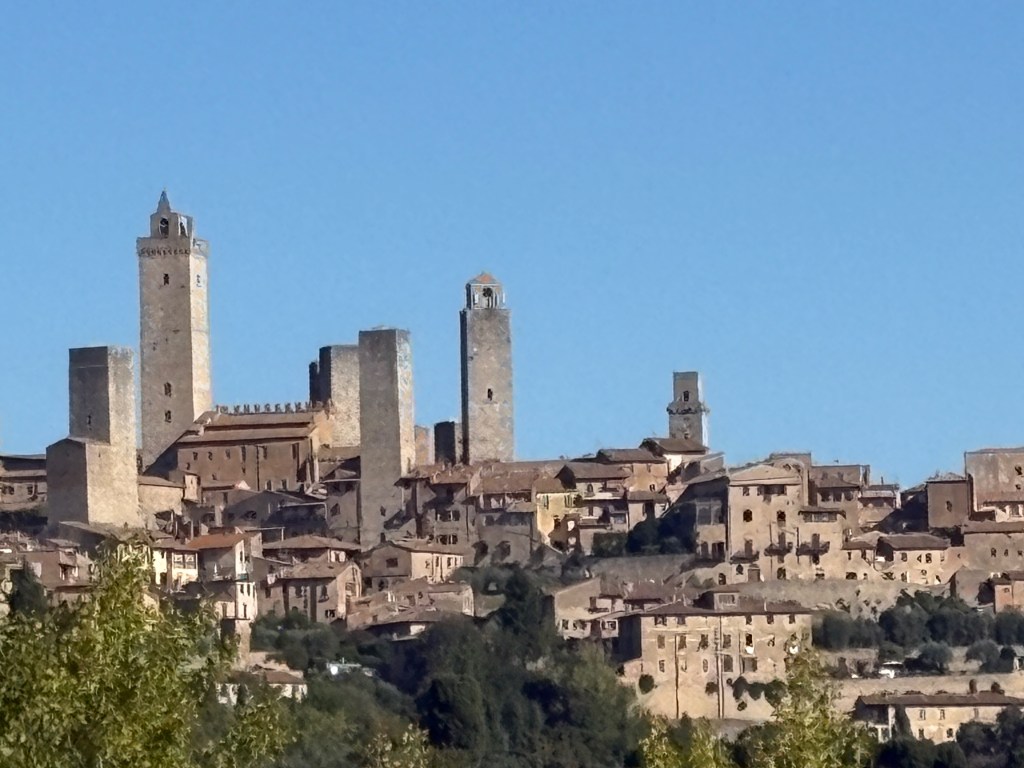
San Gimignano in Tuscany, Italy, is famous for its 14 surviving medieval stone towers built by rival noble families as symbols of wealth and power. Wealthy merchant families competed to build the tallest towers. Up to 72 towers once stood during the peak of the rivalry. Laws eventually banned private towers from exceeding the height of the civic town hall tower. The dense vertical skyline earned the town the famous nickname, The “Manhattan of the Middle Ages”.
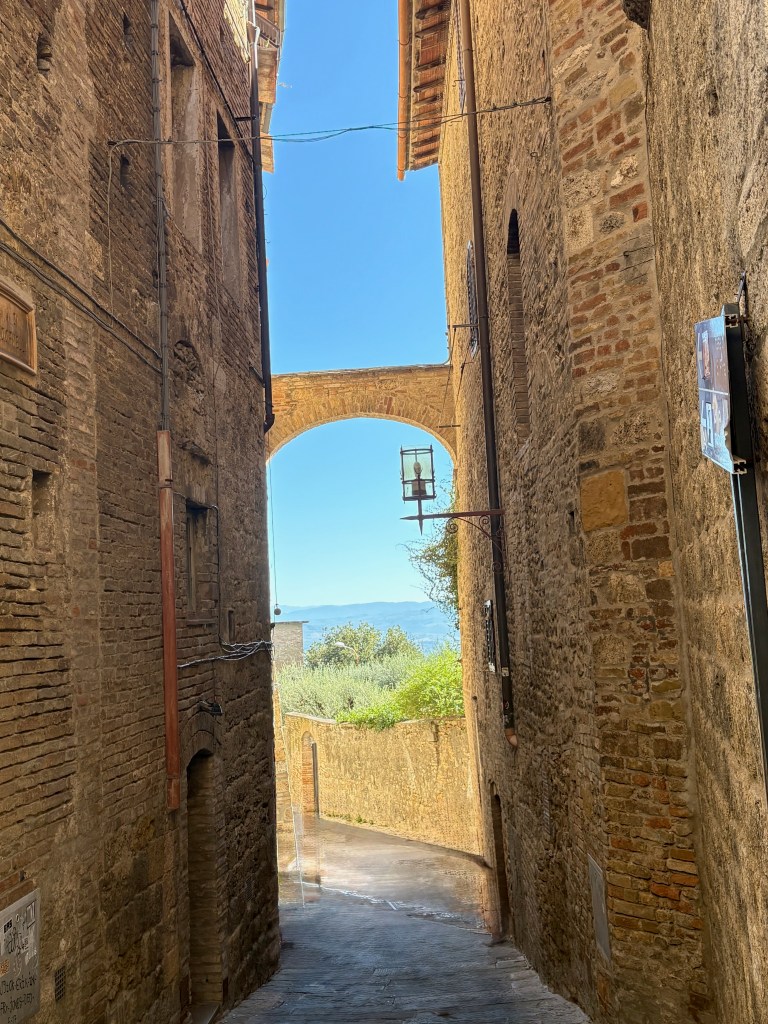
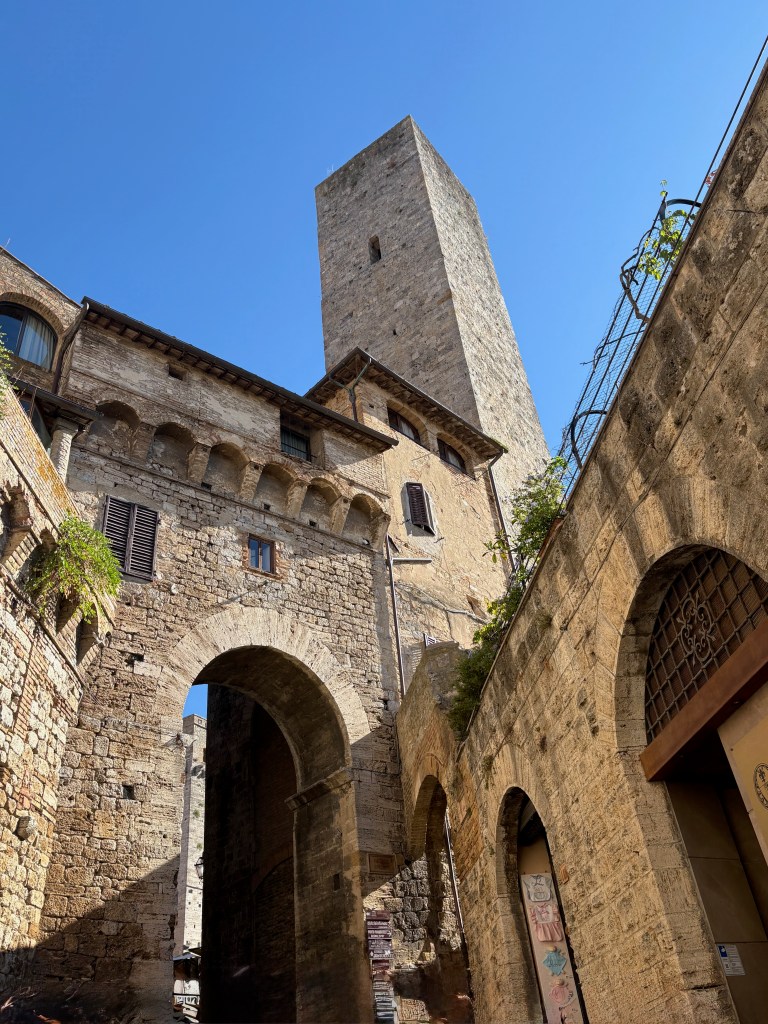
Founded as a small Etruscan village in the 3rd century BC, it was later occupied by the Romans. Named after Saint Geminiano (Bishop of Modena), who miraculously saved the town from Attila the Hun’s invading forces in the 5th century, it was first officially documented in 929 AD as a growing community under the jurisdiction of the Bishops of Volterra. In the Middle Ages, its strategic location along this major medieval pilgrim route to Rome brought immense wealth through trade, lodging, and commerce. It thrived on agricultural exports, particularly high-value saffron and prestigious Vernaccia wine and gained independence from Volterra in 1199, establishing its own self-governing commune.
The sign reads: Gelateria Dondoli The world’s most famous Gelato 2024. So, yes, we lined up at 10:30 in the morning for gelato and yes, it was delicious.
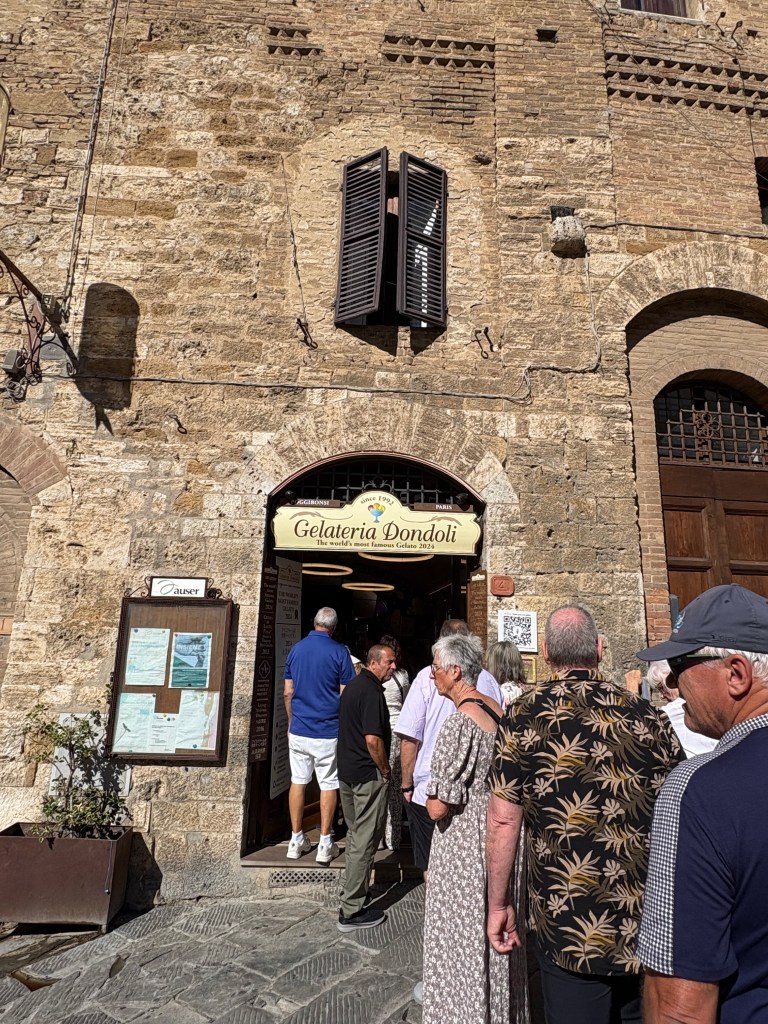
The world’s most famous Gelato 2024
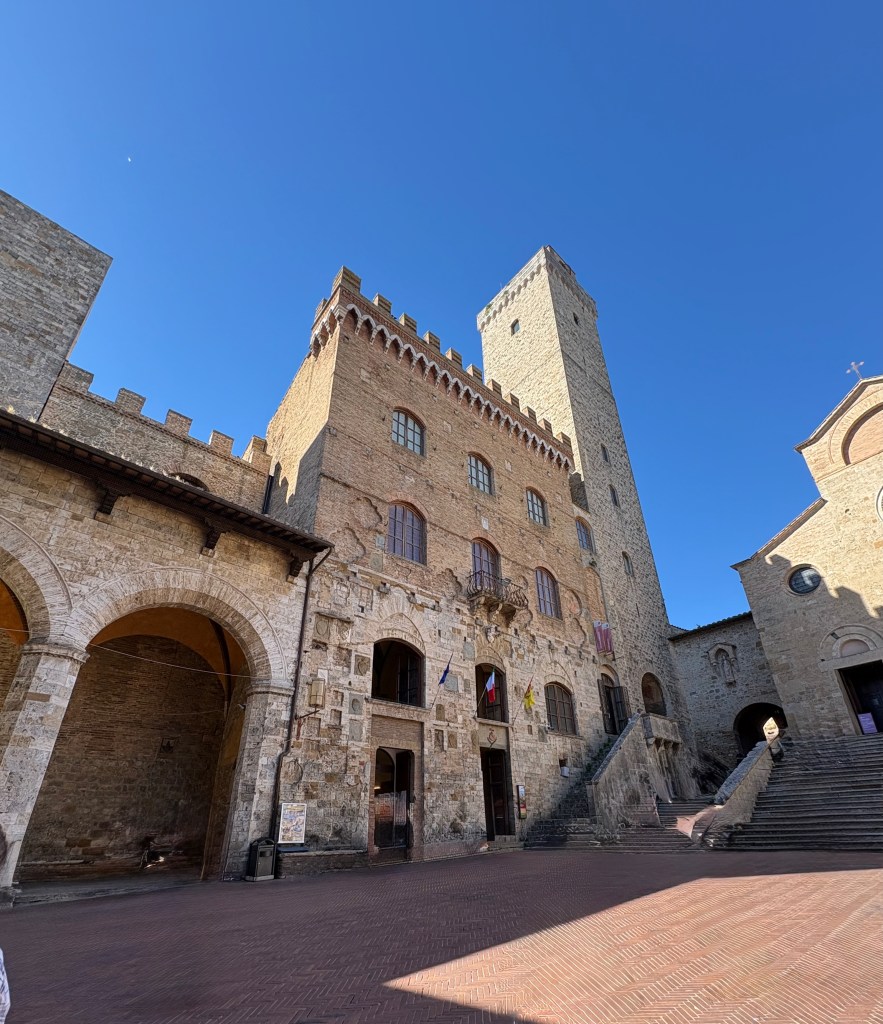
Several notable movies were filmed in San Gimignano, including Franco Zeffirelli’s semi-biographical Tea with Mussolini (1999). The vivid frescoes from the 1300’s featured in the movie. They are original and have not needed restoration.
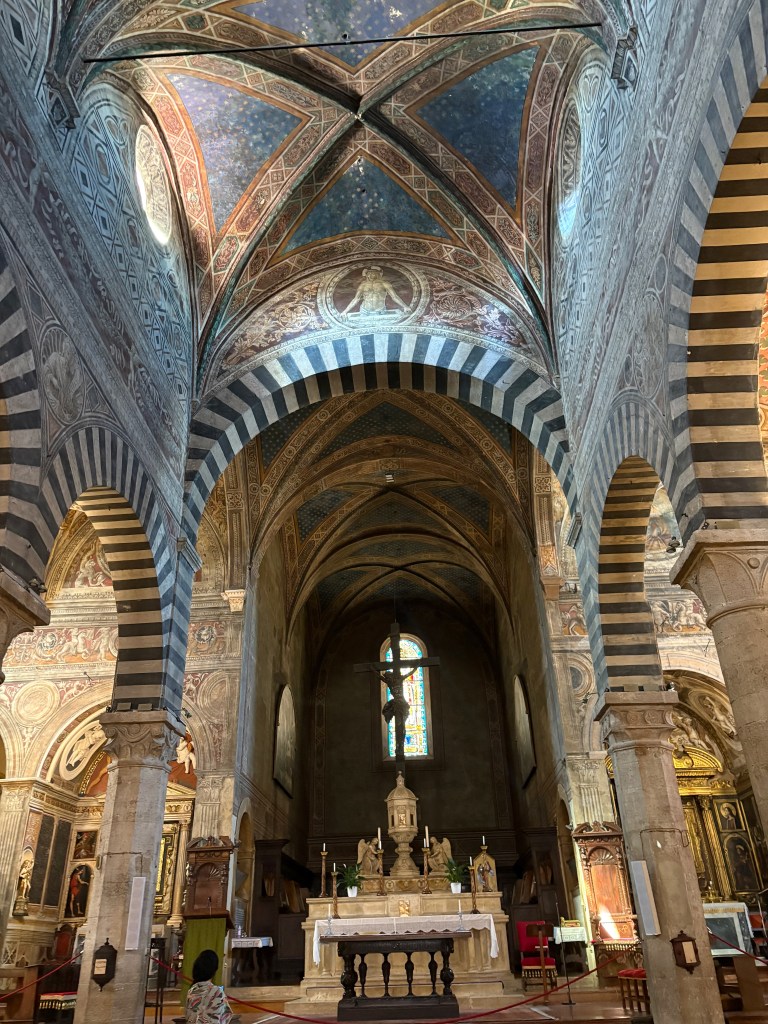
Duomo di San Gimignano, a collegiate church and minor basilica in San Gimignano contains important cycles of Renaissance frescoes by artists including Domenico Ghirlandaio, Benozzo Gozzoli, Taddeo di Bartolo, Lippo Memmi and Bartolo di Fredi. It falls within the UNESCO World Heritage Site of the “Historic Centre of San Gimignano”, with its frescoes being described by UNESCO as “works of outstanding beauty”. Internally, the building is in the shape of a Latin Cross, with central nave and an aisle on either side, divided by arcades of seven semi-circular Romanesque arches resting on columns with simplified Corinthianesque capitals.
Back in Rome. Our tour of the Sistine Chapel was timed for 5:00 pm and we arrived in Rome with perfect timing. We had a very good guide who whisked us through the crowds. We were not allowed to take photos inside so the interior ones are from the internet.
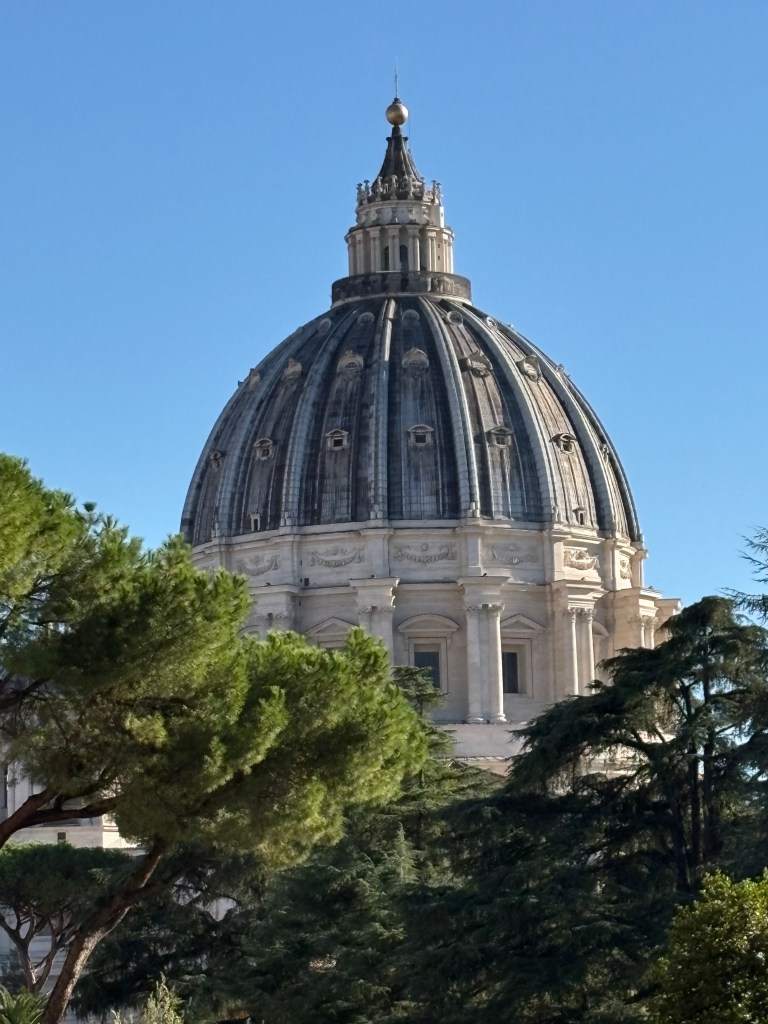
As we walked from the main entrance of the Vatican Museums toward the Sistine Chapel, we passed through several famous sequential rooms and corridors.
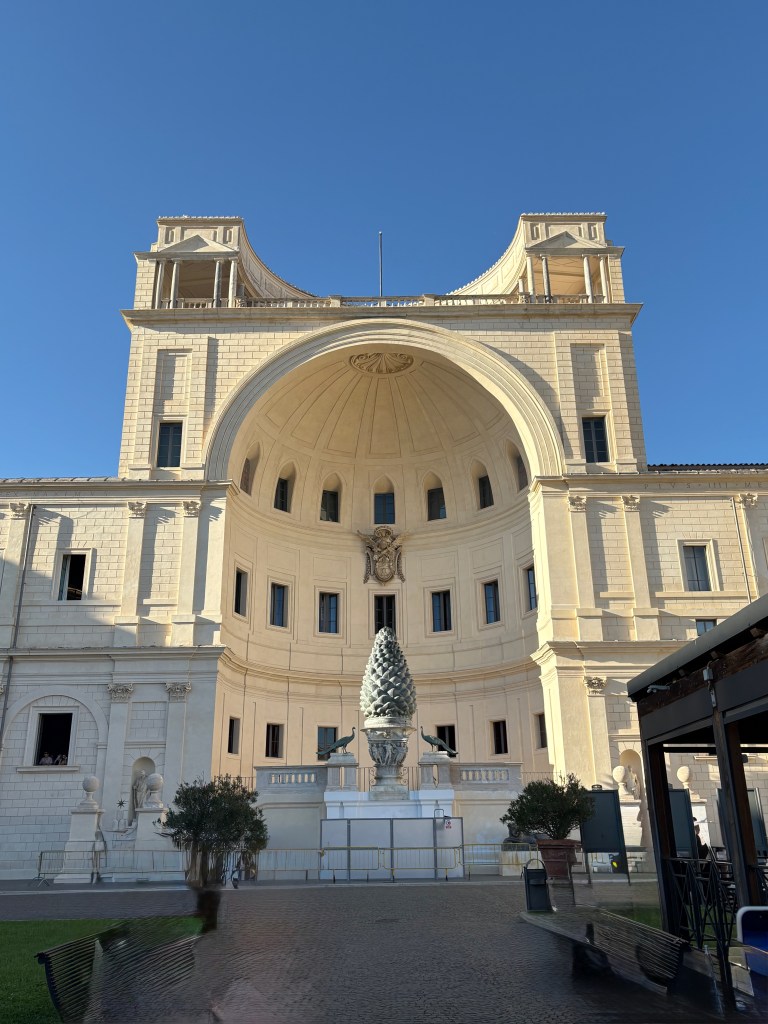
The Pinecone Courtyard: An open-air courtyard with a massive bronze pinecone sculpture. Its name is due to the huge bronze cone in the courtyard. The work, four meters high and two and a half wide, dates back to the second century and represents immortality and rebirth. It stands at the top of a double ramp staircase designed by Michelangelo.
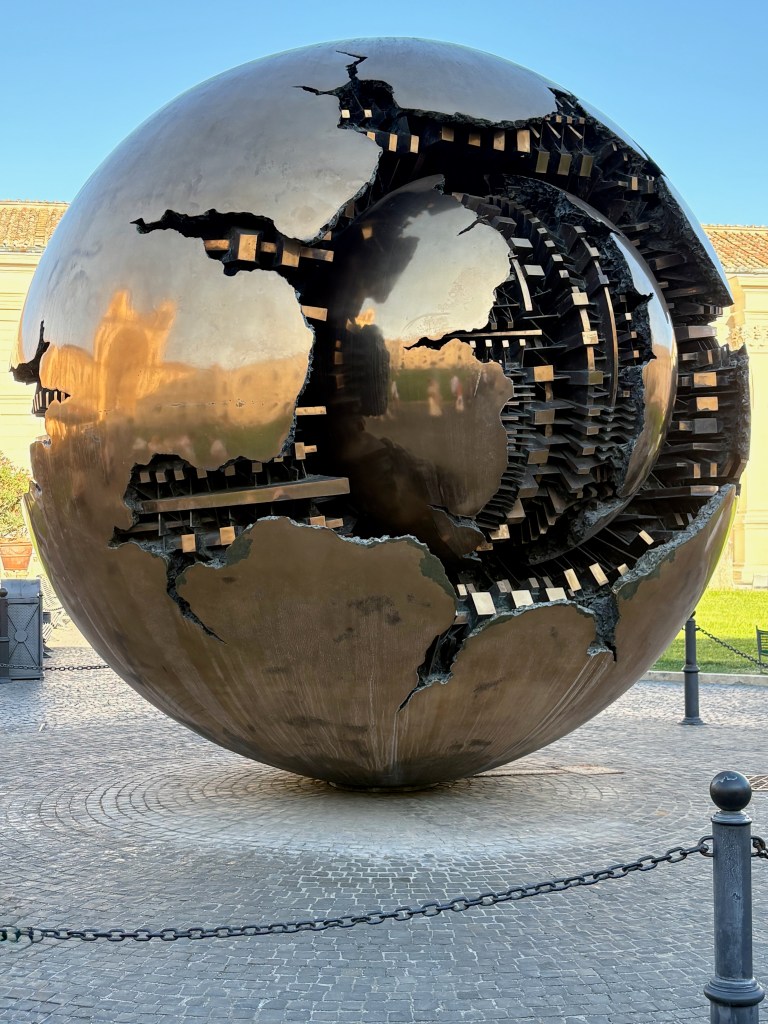
The other important sculpture in the courtyard is the “Sphere Within Sphere” by Italian sculptor Arnaldo Pomodoro. Also in bronze, it is circular and much more recent, having been made between 1979 and 1980 and donated to the Vatican Museums in 1990. Pomodoro’s circular sphere has a mechanism inside that slowly rotates with the wind.
We visited several rooms and courtyards in the Vatican Museum. This octagonal court used to be called the Cortile delle Statue and housed the original nucleus of ancient classical sculptures collected by the popes.
In ancient Greece, athletes would cover themselves with oil before training or participating in races. Here the young man is shown using a strigil, a kind of long, curved spoon, to scrape off the excess oil.
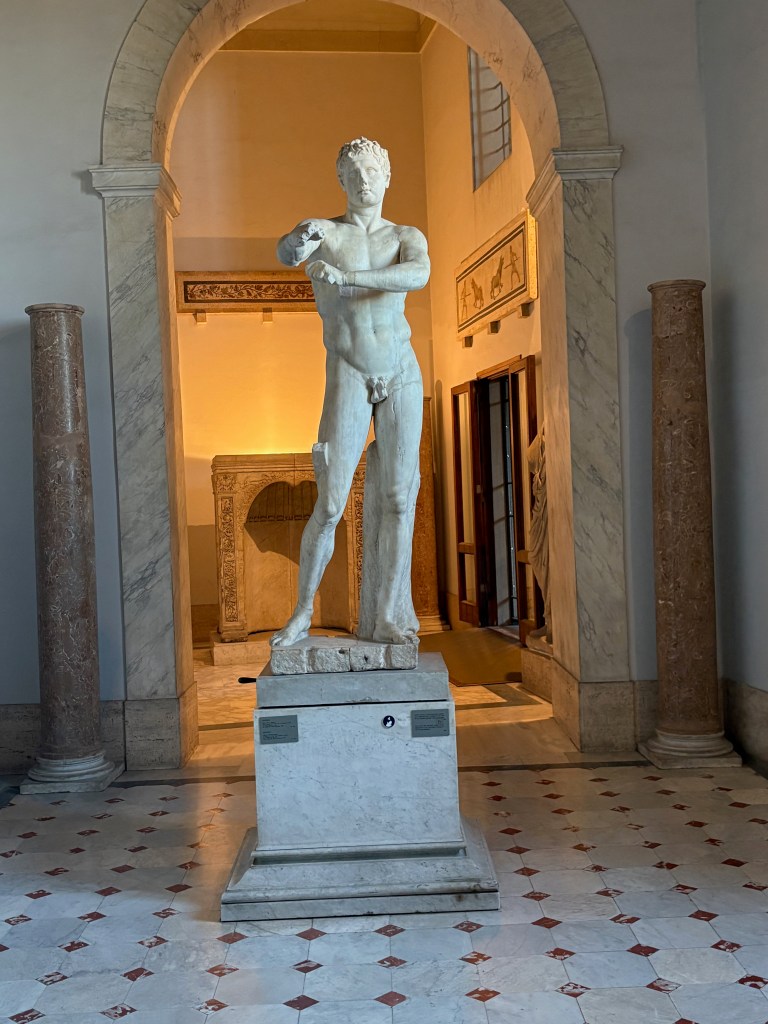
APOXYOMENOS
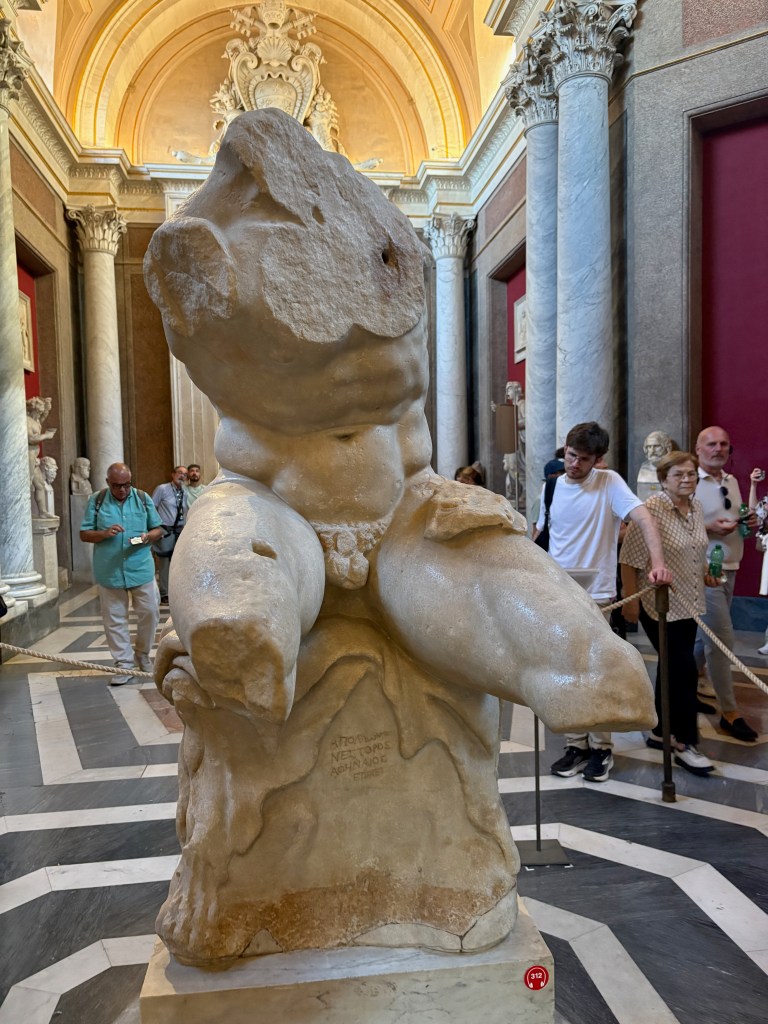
This celebrated marble torso, a fragment of a statue found in Rome at the end of the 15th century, came into the Vatican collections between 1530 and 1536. It has always been a piece of ancient sculpture most admired by artists, including Michelangelo, right down to the present day. The identity of the figure has been the subject of various interpretations through the centuries. The most favoured hypothesis presently identifies it as the Greek hero Ajax, son of Telamon, in the act of contemplating his suicide. The story is told how, during the Trojan Wars Ajax is enraged when Achilles’ armour is awarded to Odysseus and not himself, and kills himself. The iconography has been reconstructed thanks to various figurative signs: the head was leaning sadly towards the right hand which was gripping the sword with which the hero would take his own life. The sculpture dates from the 1st century B.C. and is signed by the Athenian sculptor Apollonios.
The Raphael Rooms are suite of four historic reception rooms in the Apostolic Palace. The series of tapestries known as the New School or the Life of Christ originally consisted of twelve tapestries , depicting episodes from the Life of Christ, based on drawings by Raphael’s pupils. The tapestries were woven in Brussels between 1524 and 1531 in the workshop of the renowned tapestry maker Pieter Van Aelst (c. 1450-1532-33), an expert weaver, who became the “tapestry maker to the Pope” after creating Raphael’s famous tapestries for the Sistine Chapel a few years earlier.
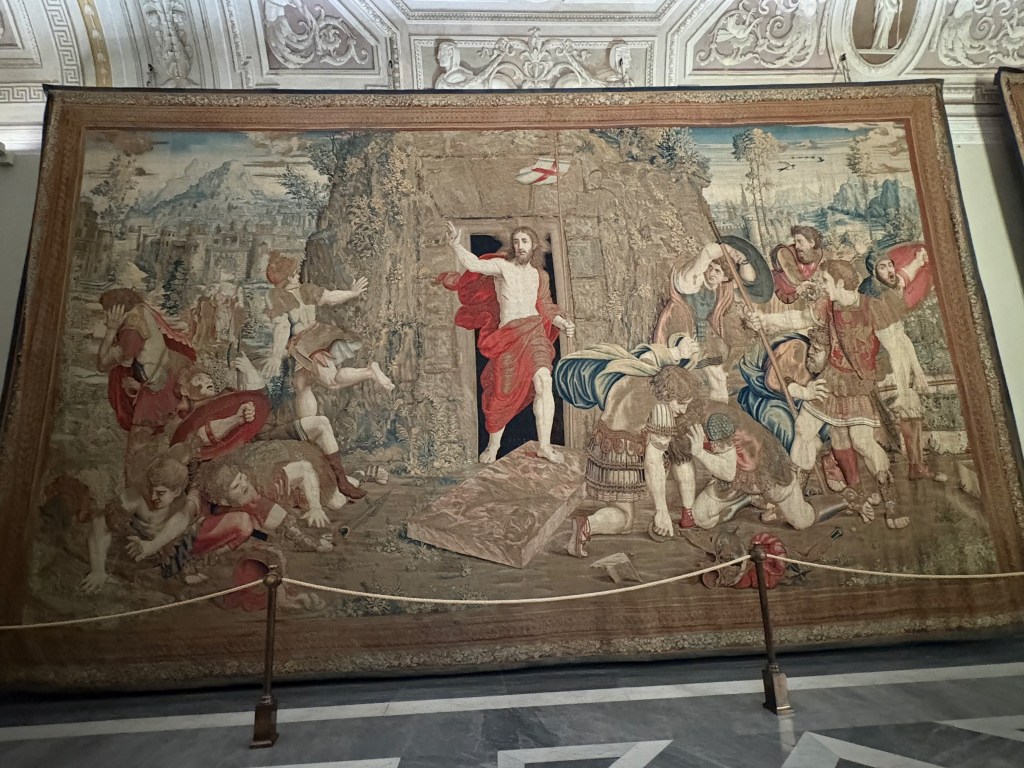
The scene represents the Resurrection of Christ, as he emerges from the tomb and frightens the Roman centurions.
About Michelangelo: Michelangelo di Lodovico Buonarroti Simoni (1475 – 1564) was an Italian sculptor, painter and architect considered to be one of the most influential artists to come out of the Renaissance period. He was born in Caprese near Arezzo in Tuscany and raised in Florence where he studied grammar under the Humanist Francesco da Urbin. At the age of 13, he became artist Domenico Ghirlandaio’s apprentice. Ghirlandaio had one of the largest workshops in Florence and in 1489 he recommended Michelangelo to Lorenzo de Medici after being asked for his two best pupils. From 1490 to 1492, he studied at the Medici’s Humanist Academy, founded on their Neoplatonic beliefs. However, after Lorenzo de Medici’s death in 1492, Michelangelo left and returned to his father’s home.
After stints in Venice and Bologna, he returned to Florence but didn’t receive any work from the Savonarola who had taken control of the city. He accepted an invitation by Cardinal Raffaele Riario to move to Rome in 1496 and wouldn’t return to Florence until 1499 when he was commissioned by the Guild of Wool to complete an unfinished carrara marble statue. It was here that Michelangelo created one of his most famous works, David, which was completed in 1504.
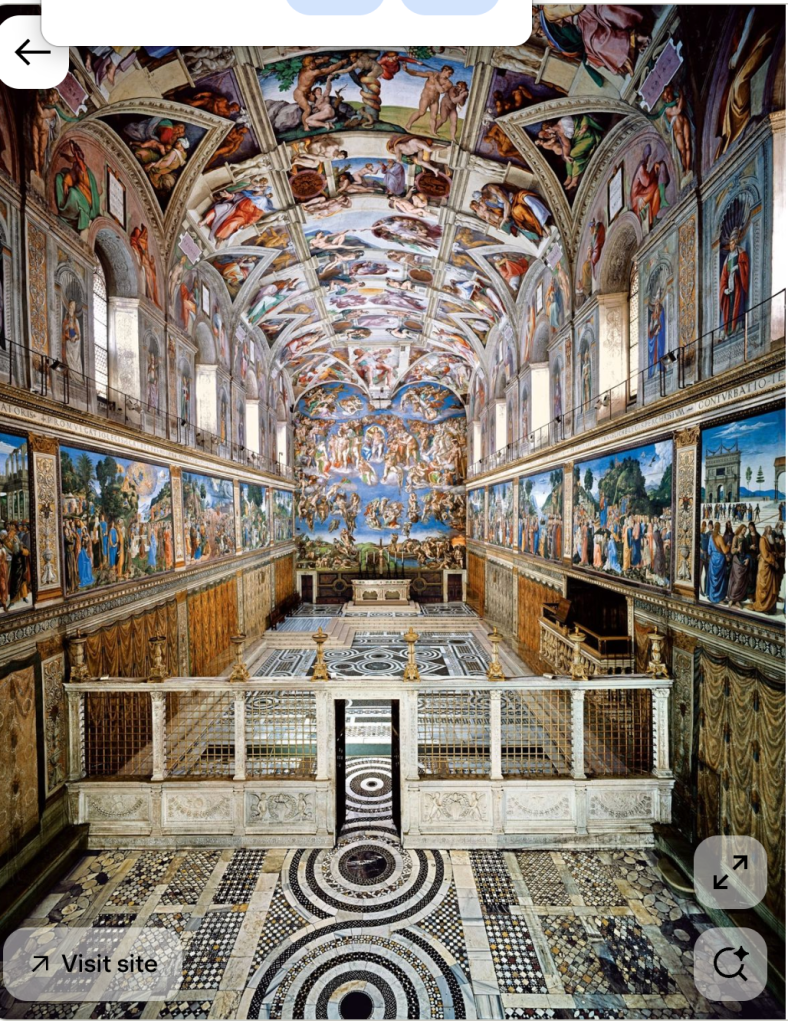
The Sistine Chapel is one of the greatest treasures of the Vatican City, of Rome, and of the world in general. It’s known as much for its decoration, as for being the temple in which popes are chosen and crowned.
The construction of the building was carried out between 1473 and 1481 during the mandate of Pope Sixtus IV, to whom it owes its current name. The architect responsible for the construction was Giovanni of Dolci and it’s the only work that he is remembered for.
The most striking thing about the Sistine Chapel is not its architecture, but the frescoes that completely cover the walls and the ceiling. Some of the most important artists who worked in the chapel are Botticelli, Perugino, Luca, and Michelangelo.
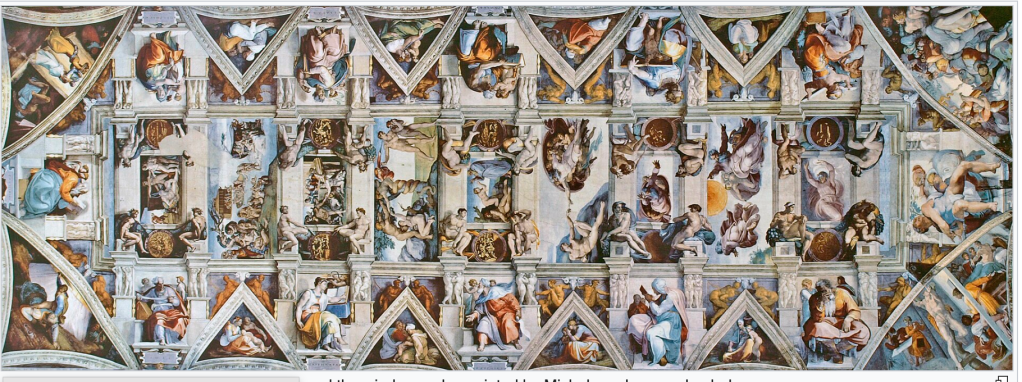
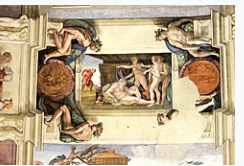
All of the frescoes on the ceiling of the Sistine Chapel are the work of Michelangelo, who spent four years painting the vault between 1508 and 1512 is one of the most renowned artworks of the High Renaissance. Central to the ceiling decoration are nine scenes from the Book of Genesis of which The Creation of Adam is the best known, the hands of God and Adam being reproduced in countless imitations. The complex design includes several sets of individual figures, both clothed and nude, which allowed Michelangelo to fully demonstrate his skill in creating a huge variety of poses for the human figure, and have provided an enormously influential pattern book of models for other artists ever since.
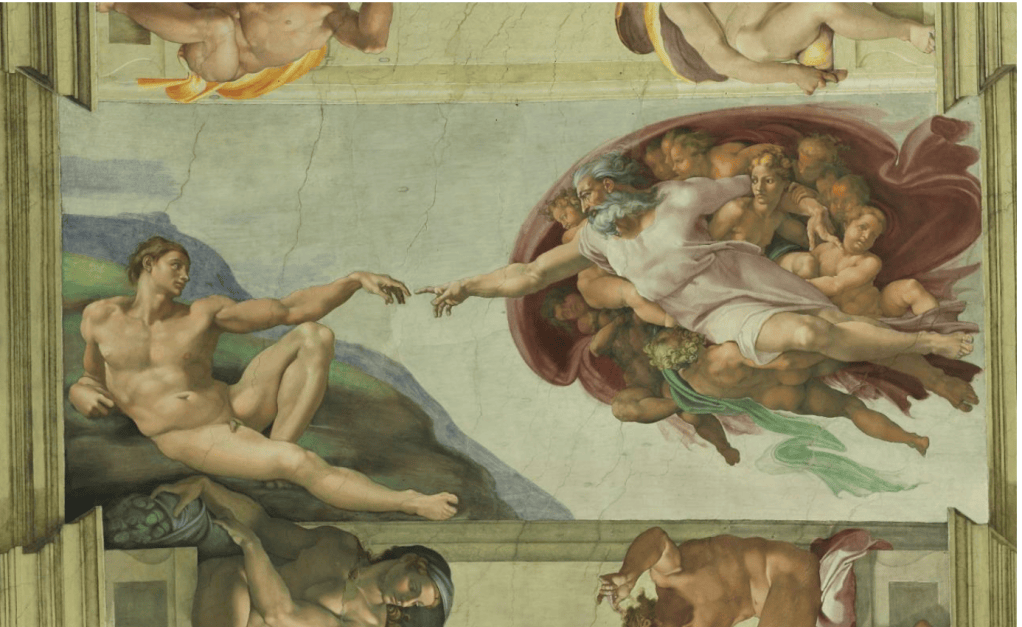
The Creation of Adam
Without any doubt, The Creation of Adam is the best-known image from the Sistine Chapel. It’s located in the central part of the vault and represents the story from Genesis in which God gives life to Adam.
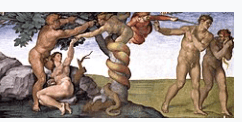
If there is one thing that stands out from among the images on the ceiling, it’s the nine stories from Genesis that occupy the central area: The scenes from the Drunkenness of Noah to the Separation of Light from Darkness are represented.
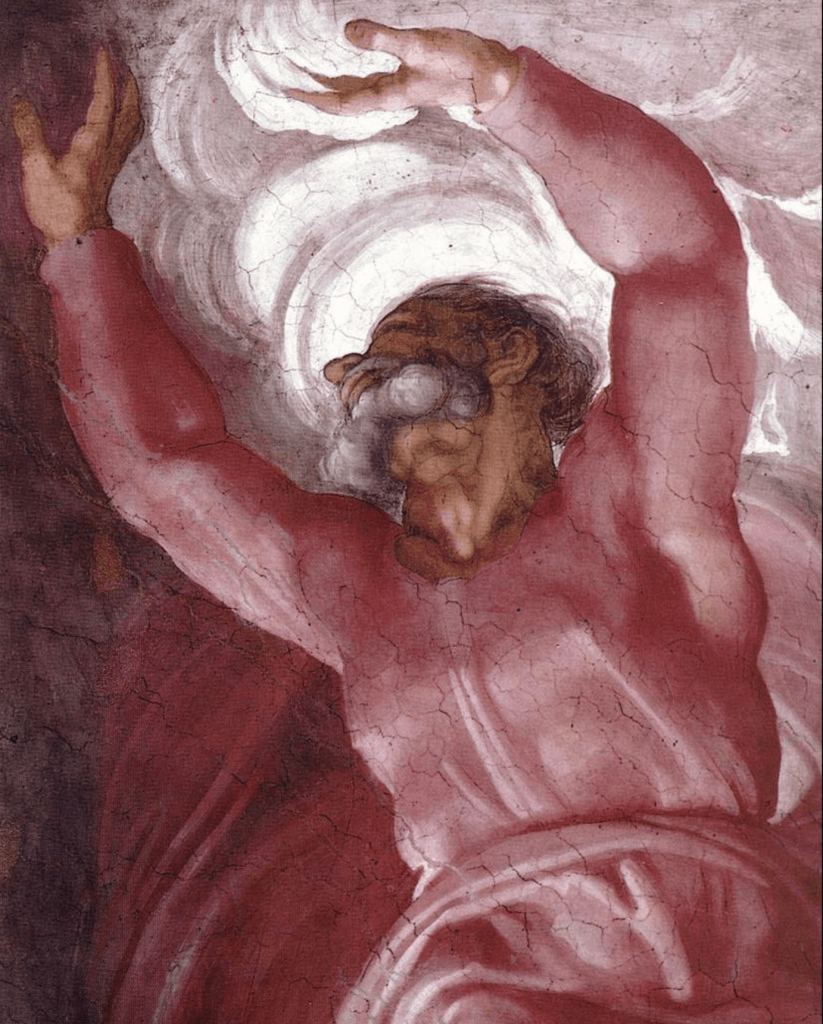
Detail of the figure of God, which was painted by Michelangelo in a single day and may represent Michelangelo himself, painting the ceiling.
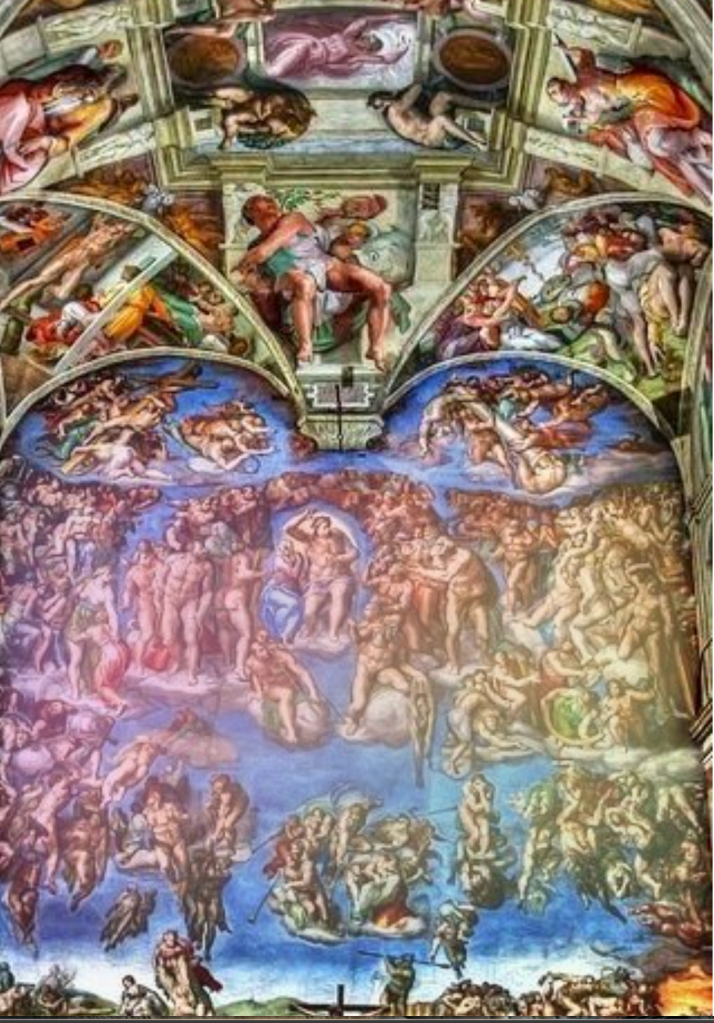
The Final Judgment
Located over the high altar and with some magnificent dimensions (13.7 by 12.2 meters), Michelangelo’s other masterpiece, The Final Judgment, is a monumental fresco covering the entire wall behind the altar, showing the second coming of Christ and the salvation or damnation of human souls.
Decorating the apse occupied five years of Michelangelo’s life, between 1536 and 1541. It was an assignment of Pope Paul III to cover the murals that existed to that point.
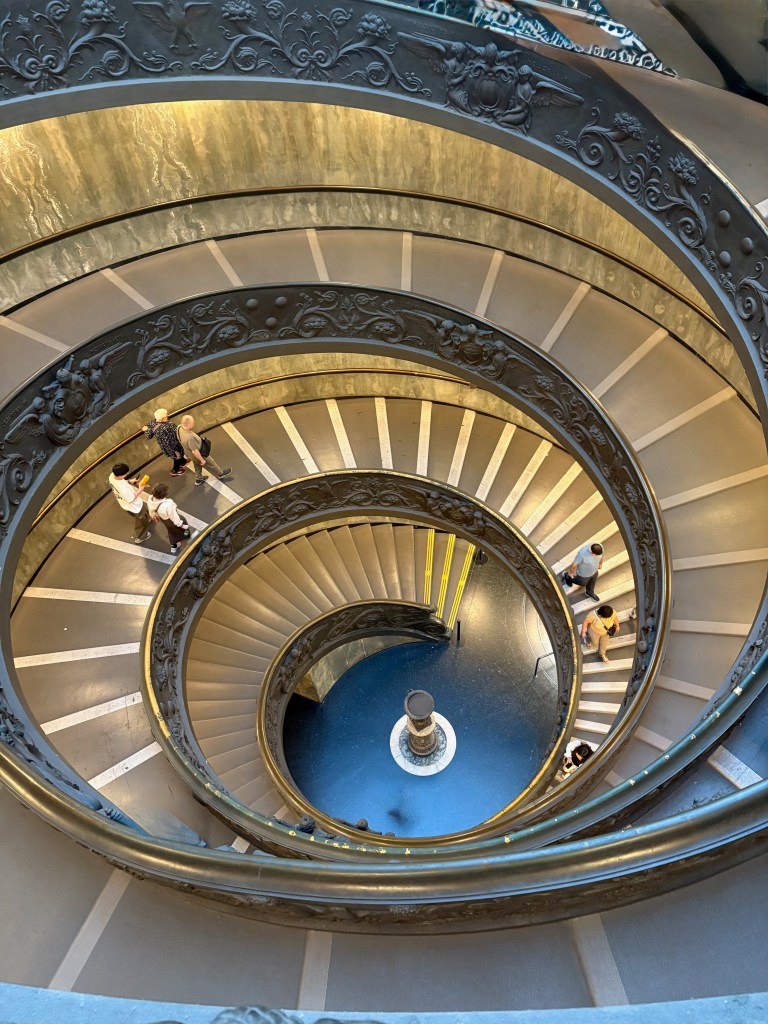
And our tour was over!
We had our final dinner with the group near the hotel and said our goodbye’s because we had a 7:30 am flight to Madrid and another to Alicante.
September 16 Day 11 | Arrivederci Rome
Reflections on Italy
- It was a very hectic schedule but we saw a great deal of the country and its treasures. On the bus, off the bus for 10 days, repeat. We wanted a introduction to Italy and we got it.
- It was a challenge for the restaurants to feed a group as large as ours-43 passengers, one driver and one travel director. The pasta was delicious but we had had enough by the time we left. We missed our vegetables! All the wine was wonderful!
- A tour is only as good as its guide and ours, Pamela, was terrific: organized, knowledgeable, funny and thoughtful.
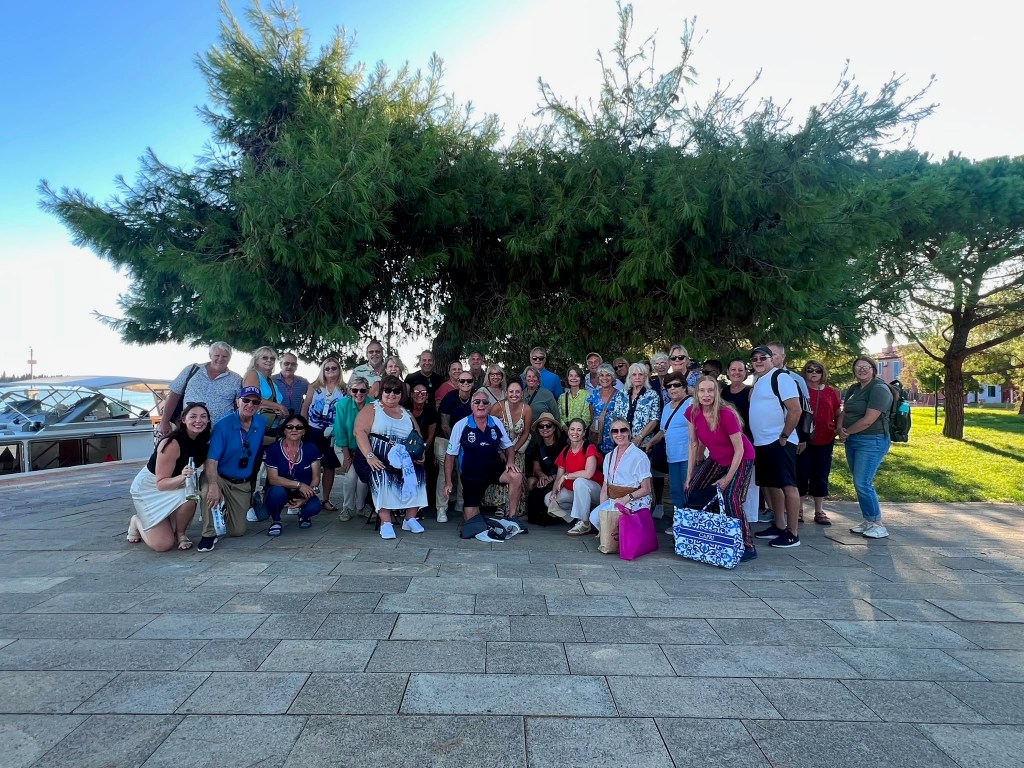
- Our fellow travellers, 5 from Australia, 2 from South Africa, 2 others (4 in total) from Canada, 32 from USA, were very cooperative, very good companions and fun to be with.
- All of the Italians that we met were friendly and helpful.
- One funny story: when I shared that I had bought red gloves in Florence, one woman asked me what I would do with them. She was from California!
- Bill contracted a nasty flu/cold at the end of the tour as did many others. Being in a tin can for 10 days, if one person gets sick so do others!
- We loved Florence! Might have to revisit.
- Don’t let thieves steal your wallet-it’s very upsetting and inconvenient!
Spain
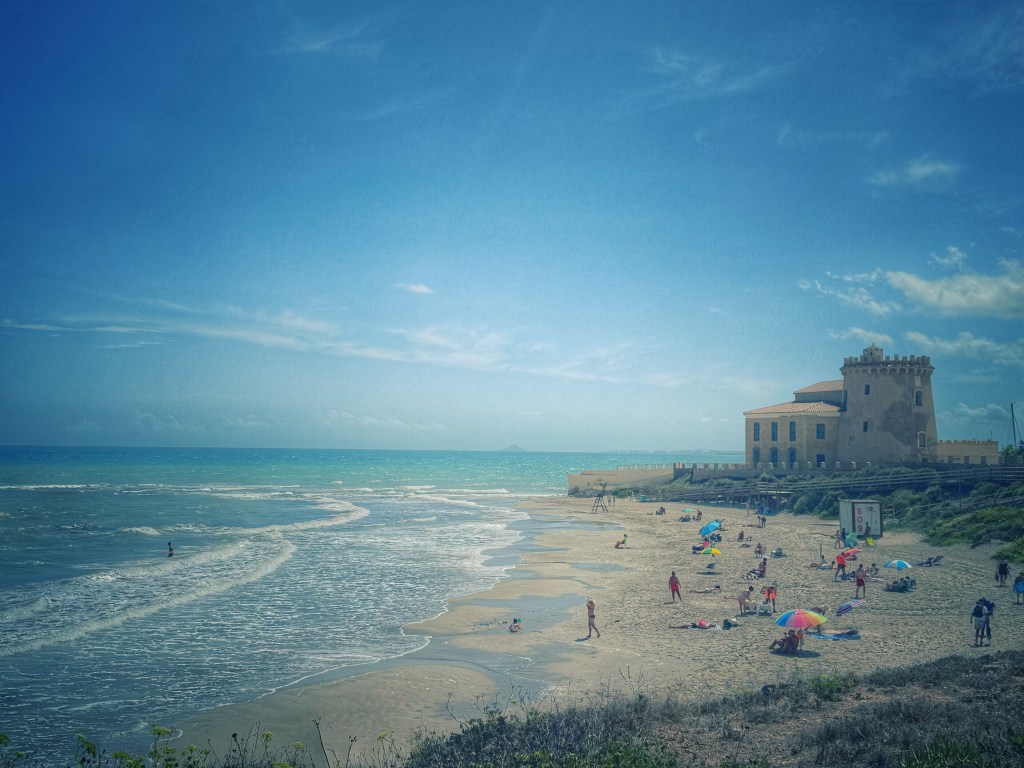
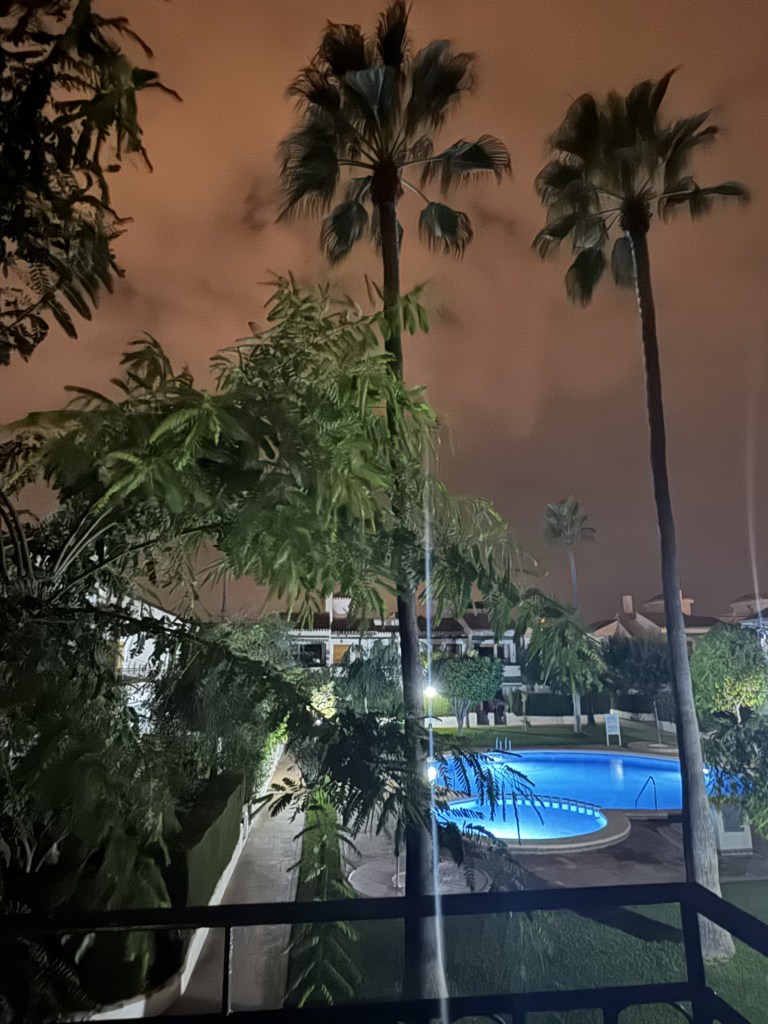
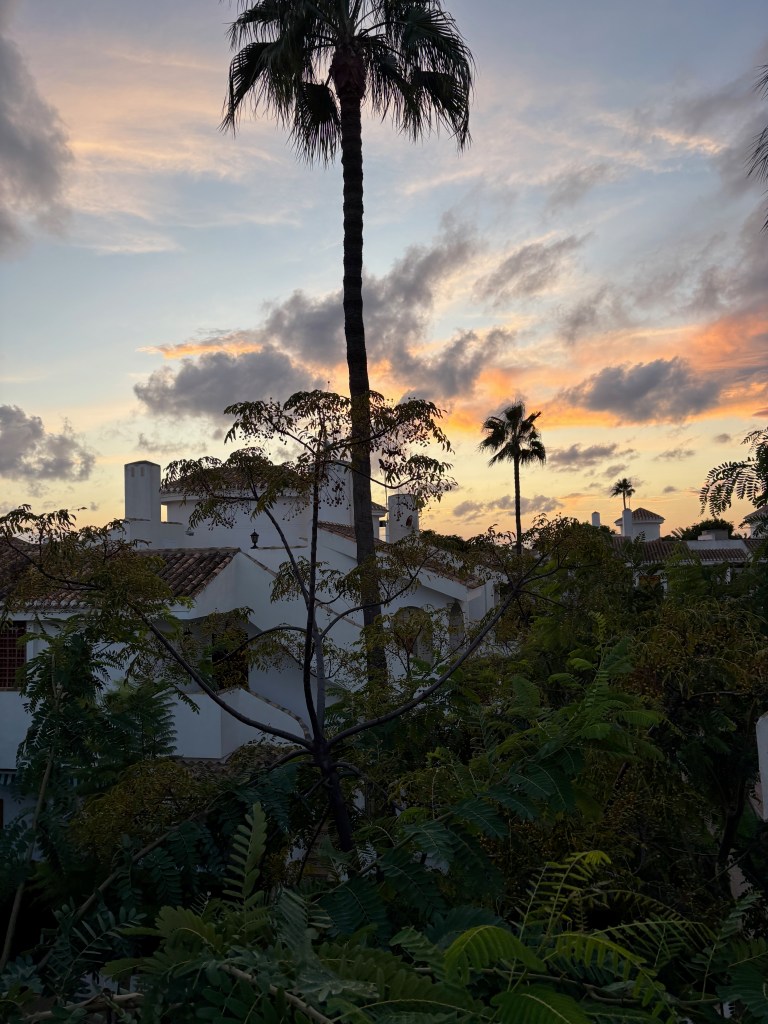
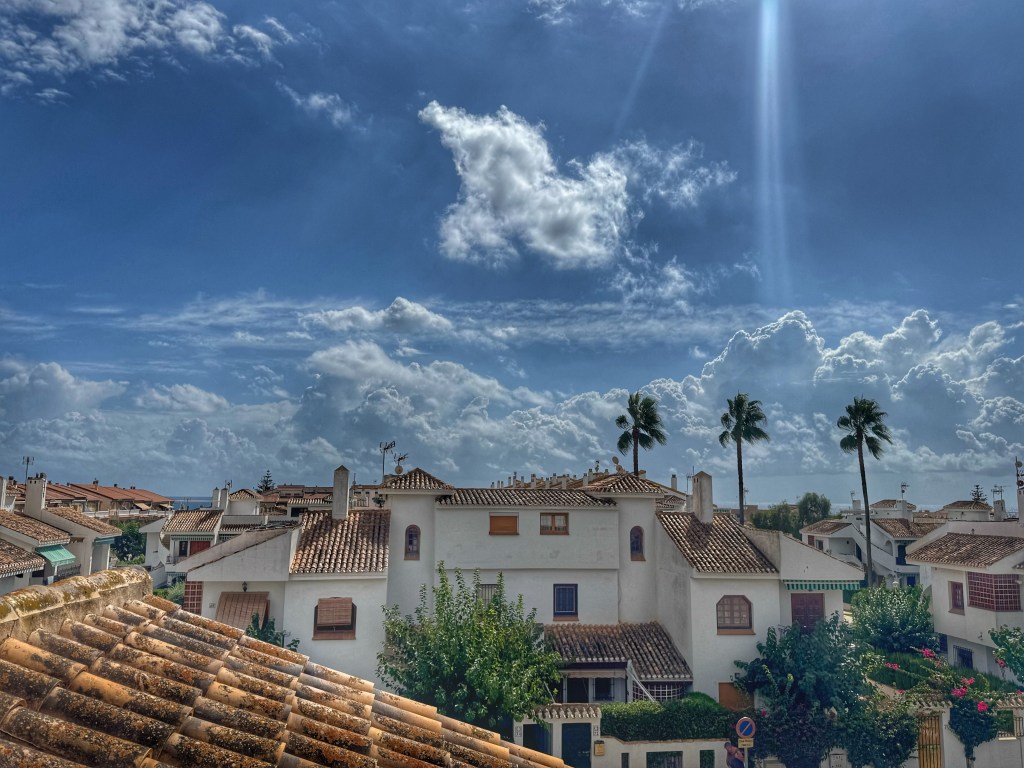
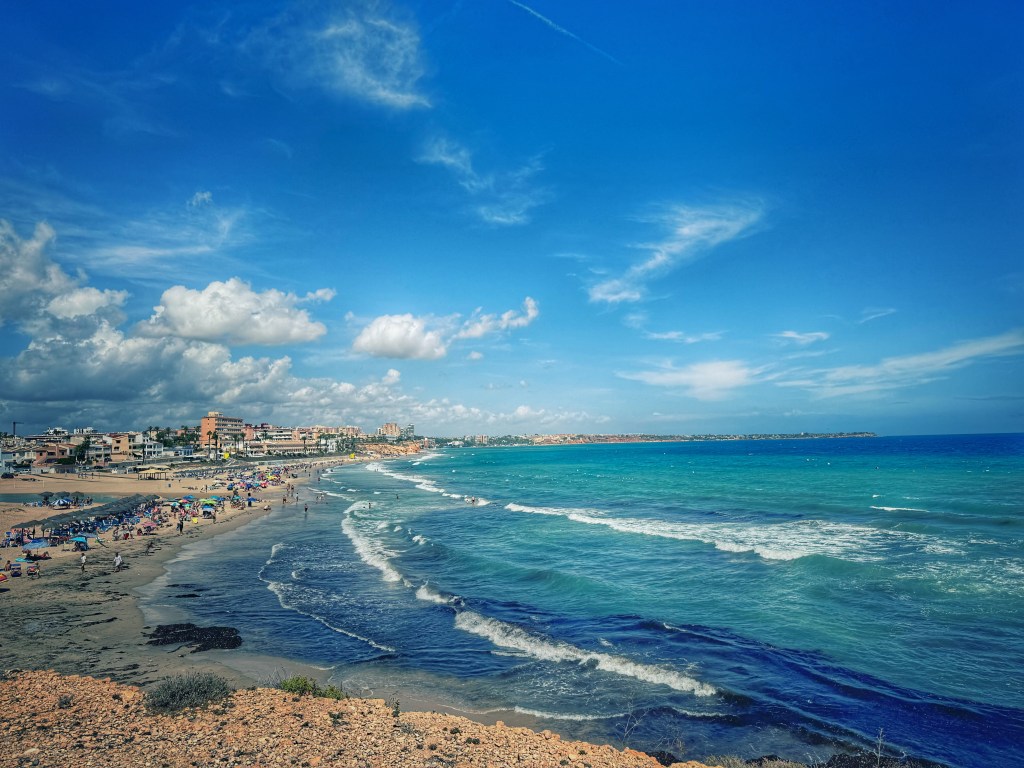
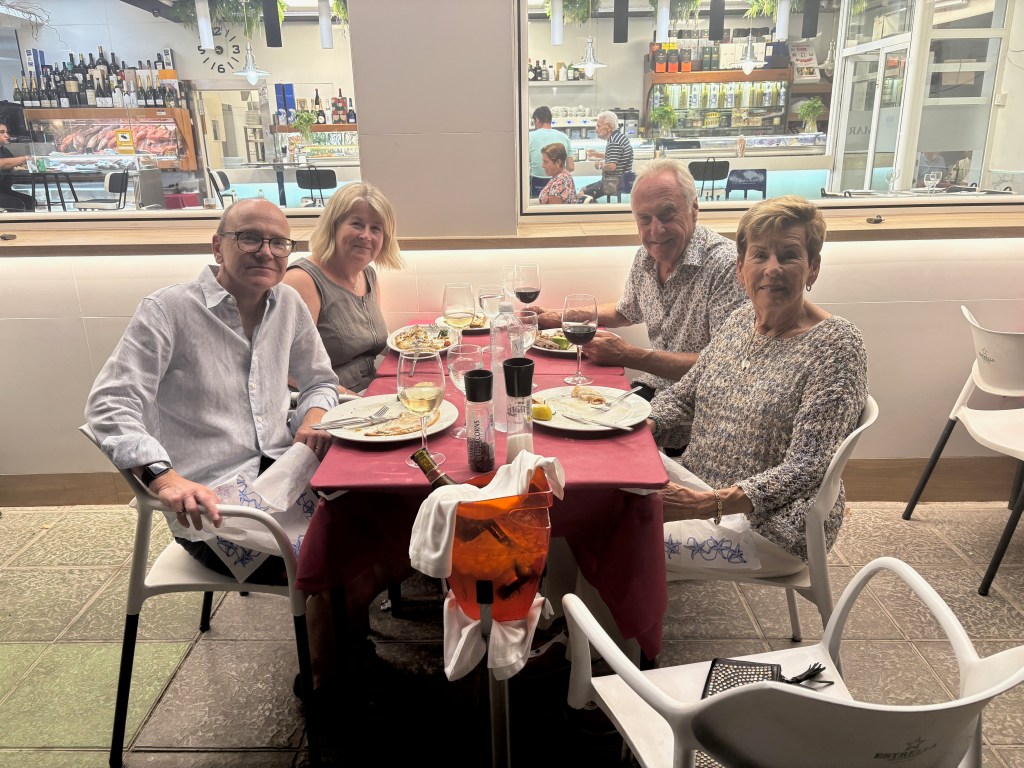
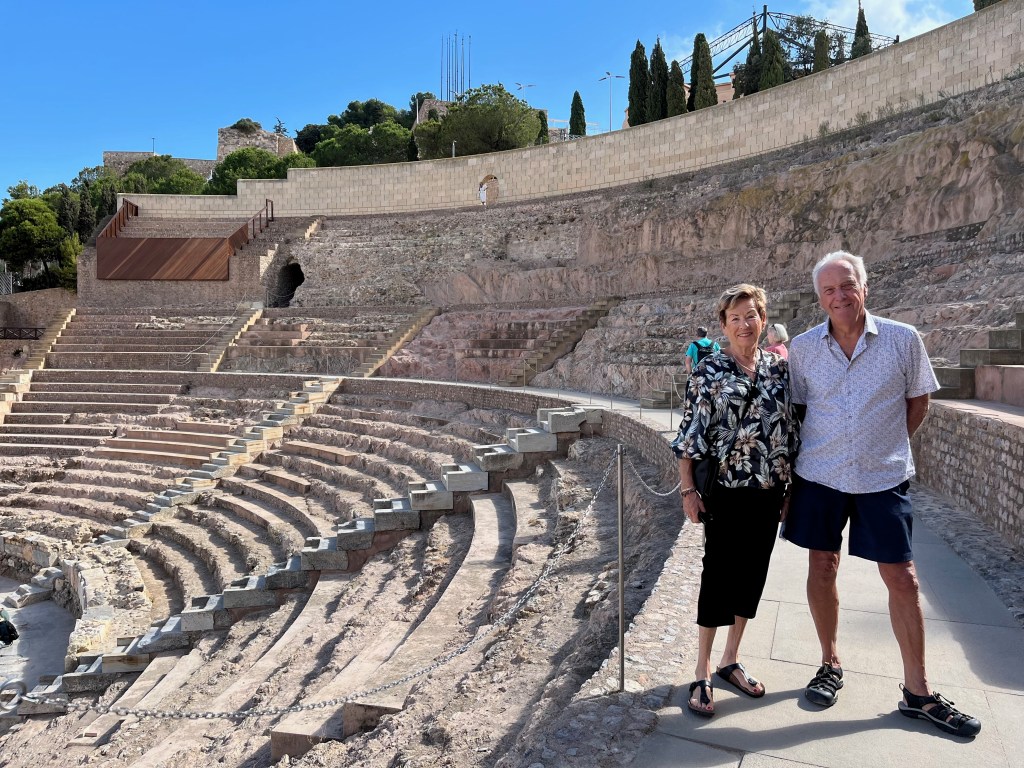
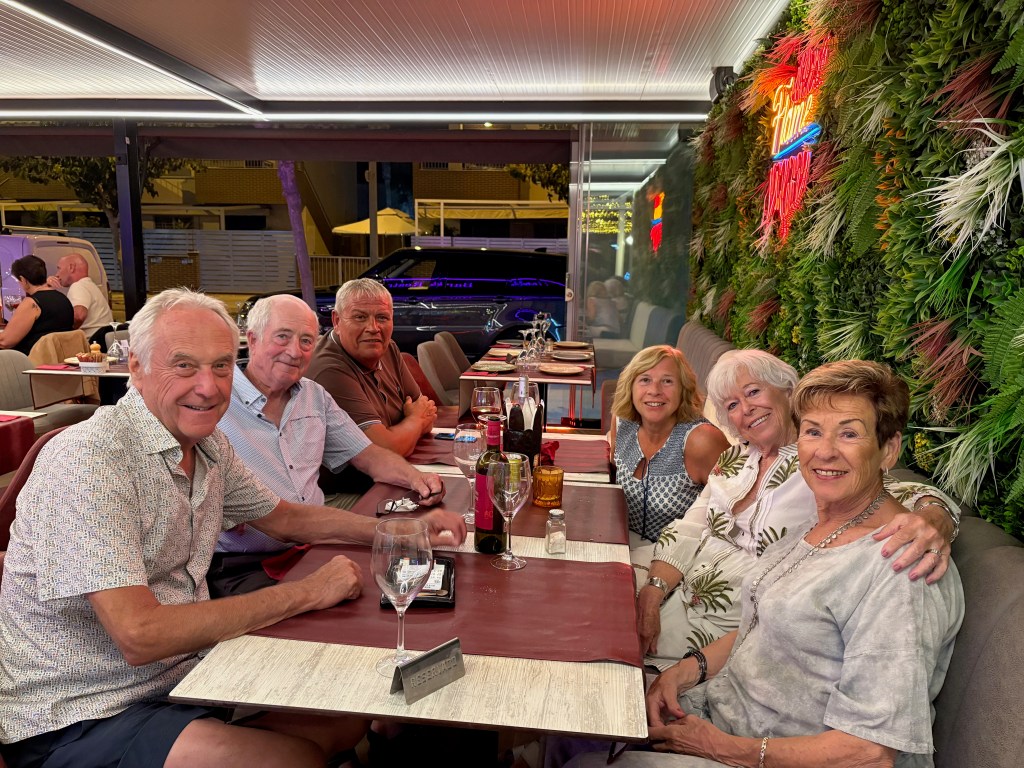
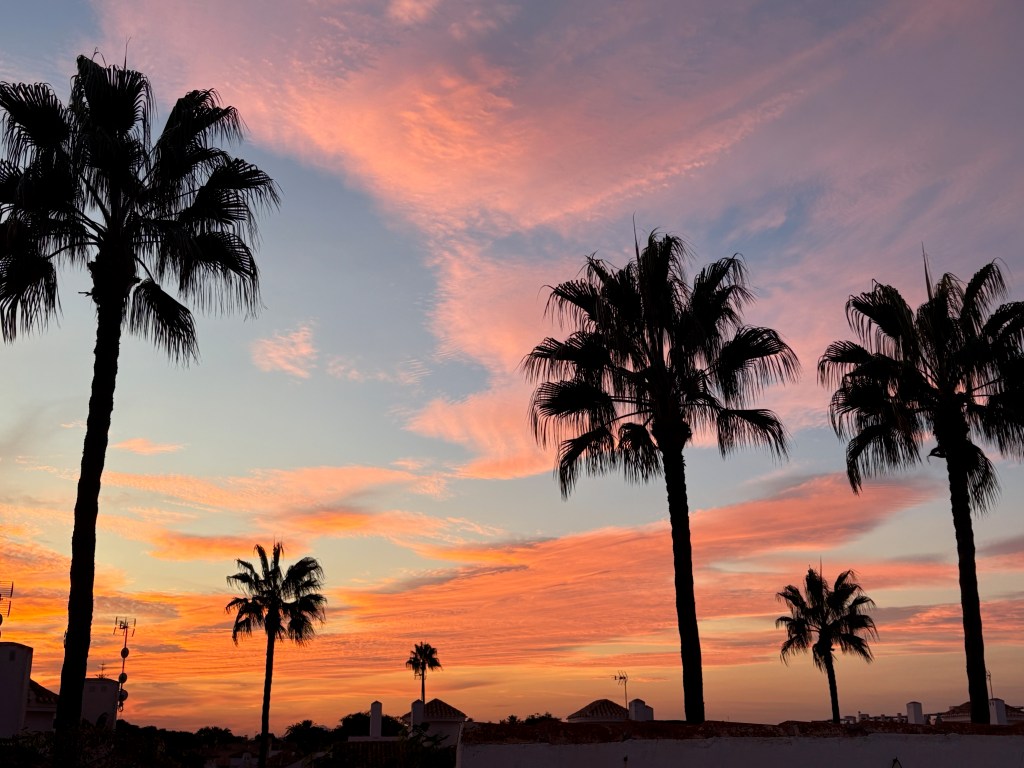
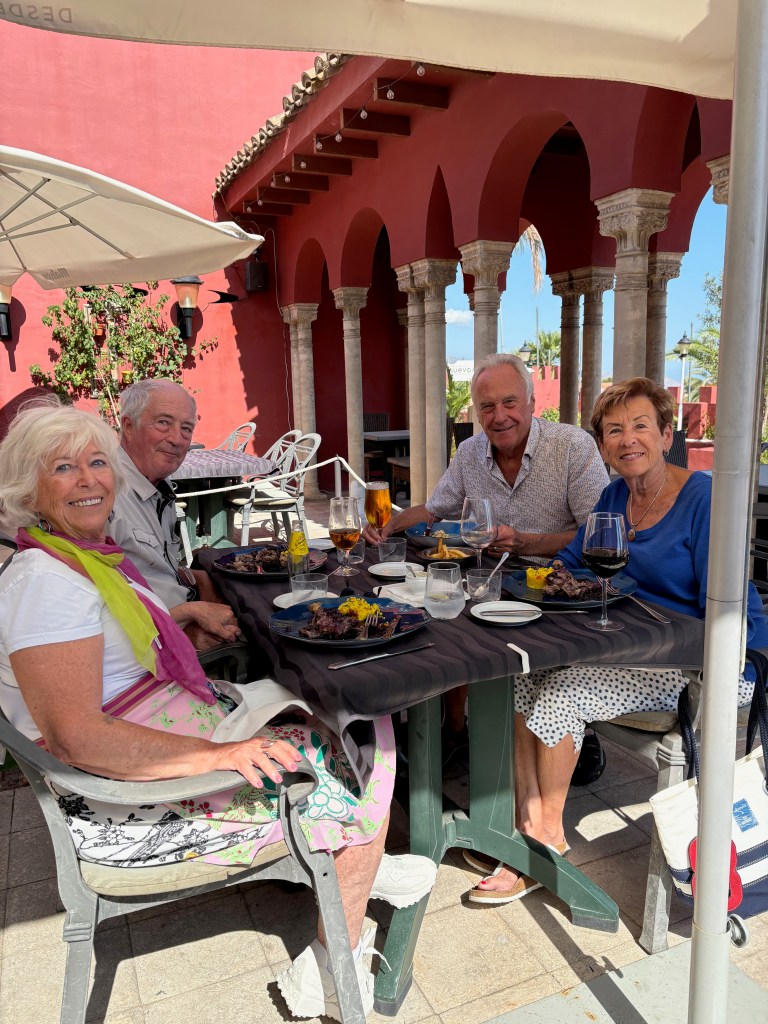
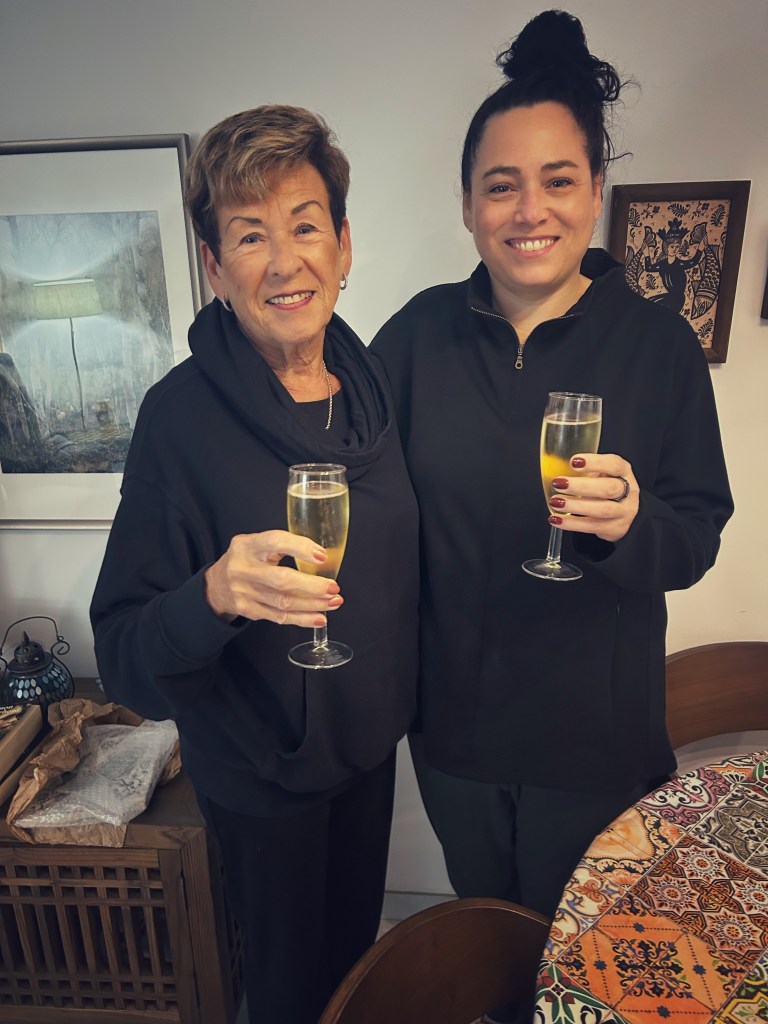
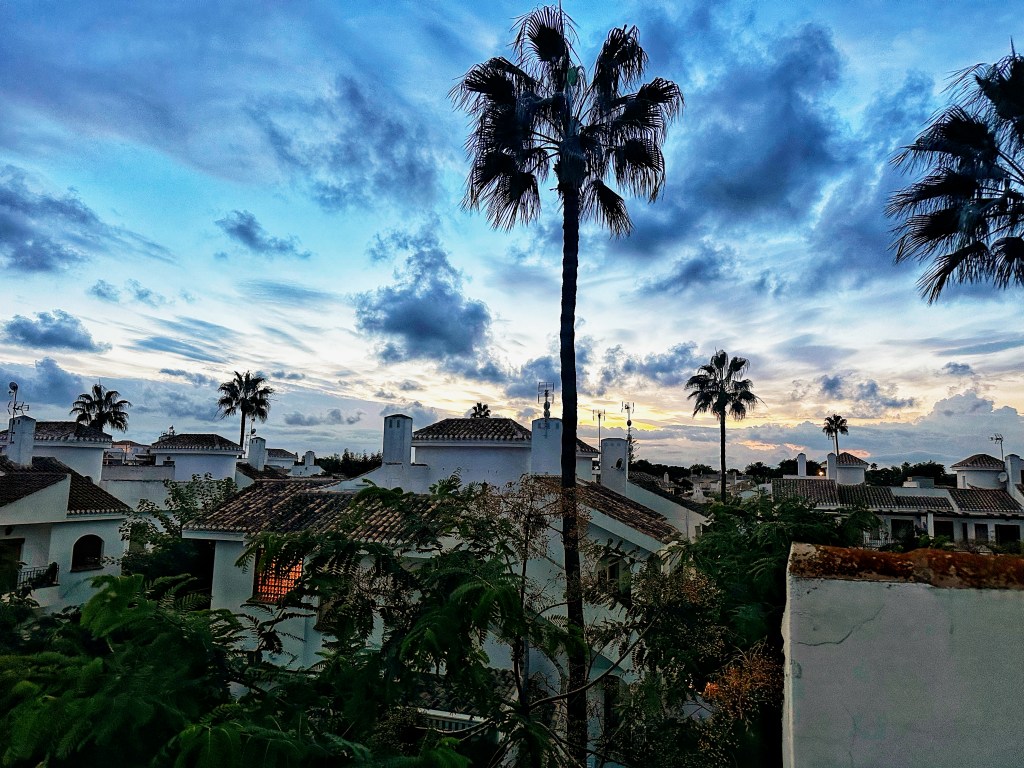
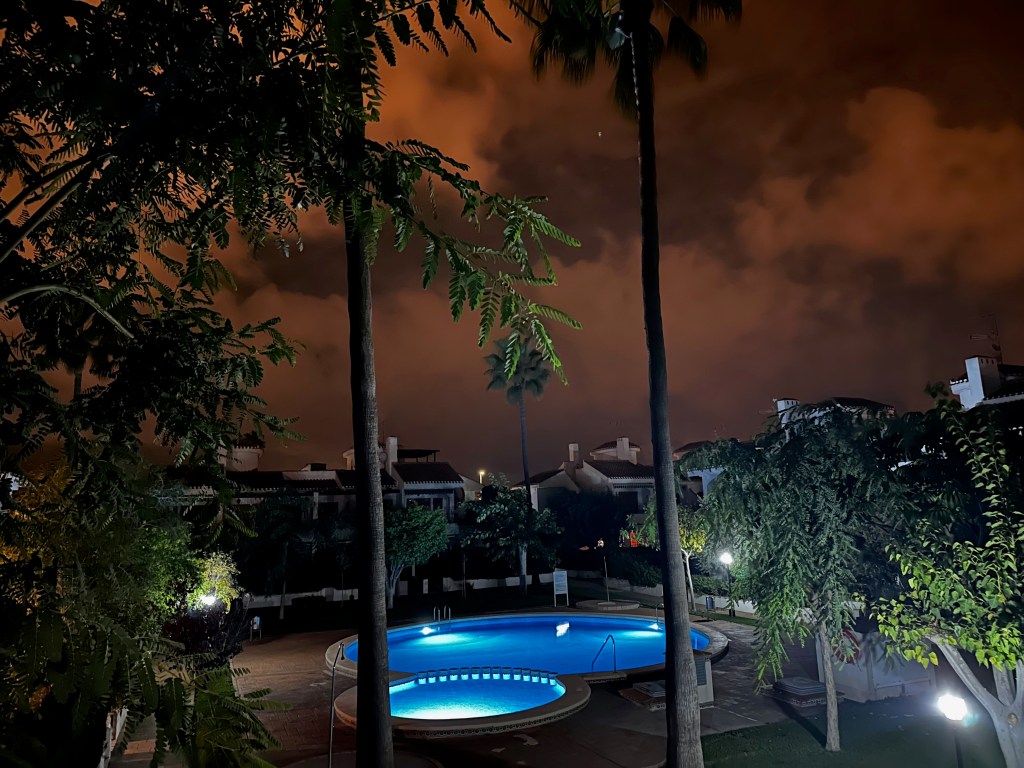
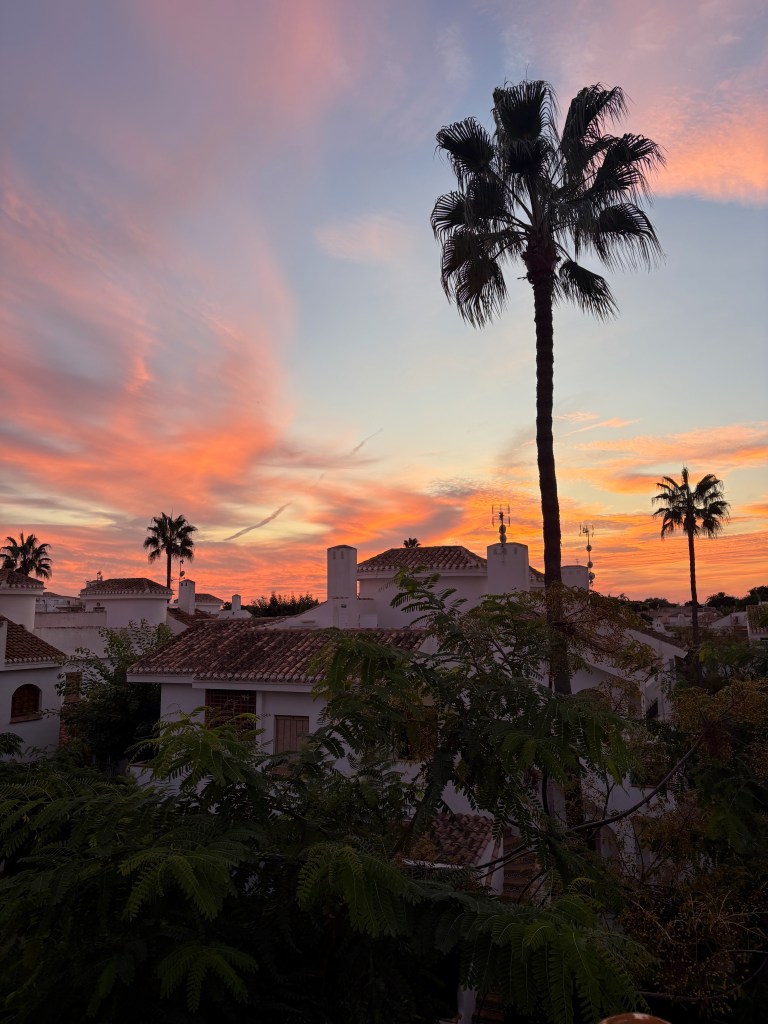
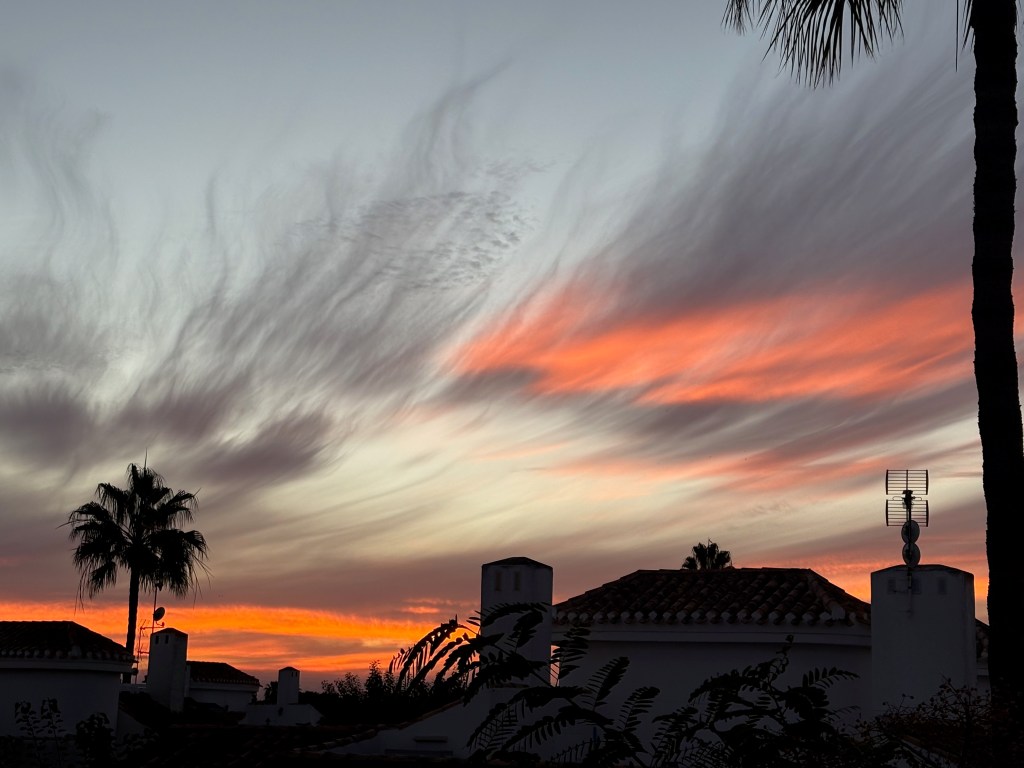
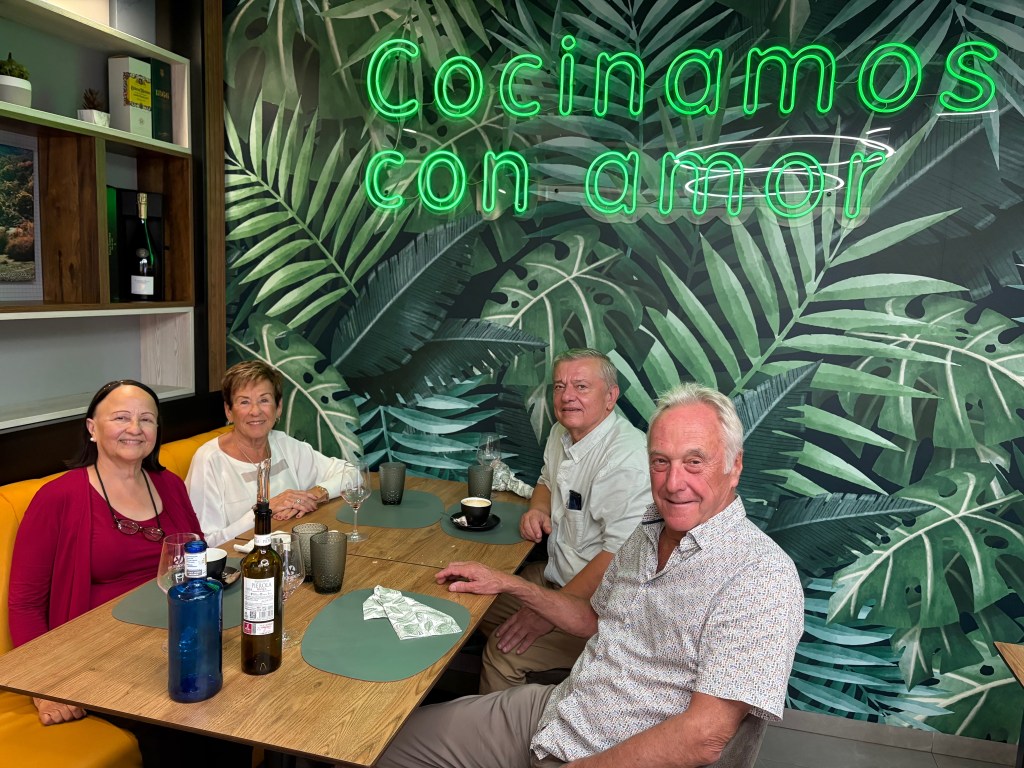
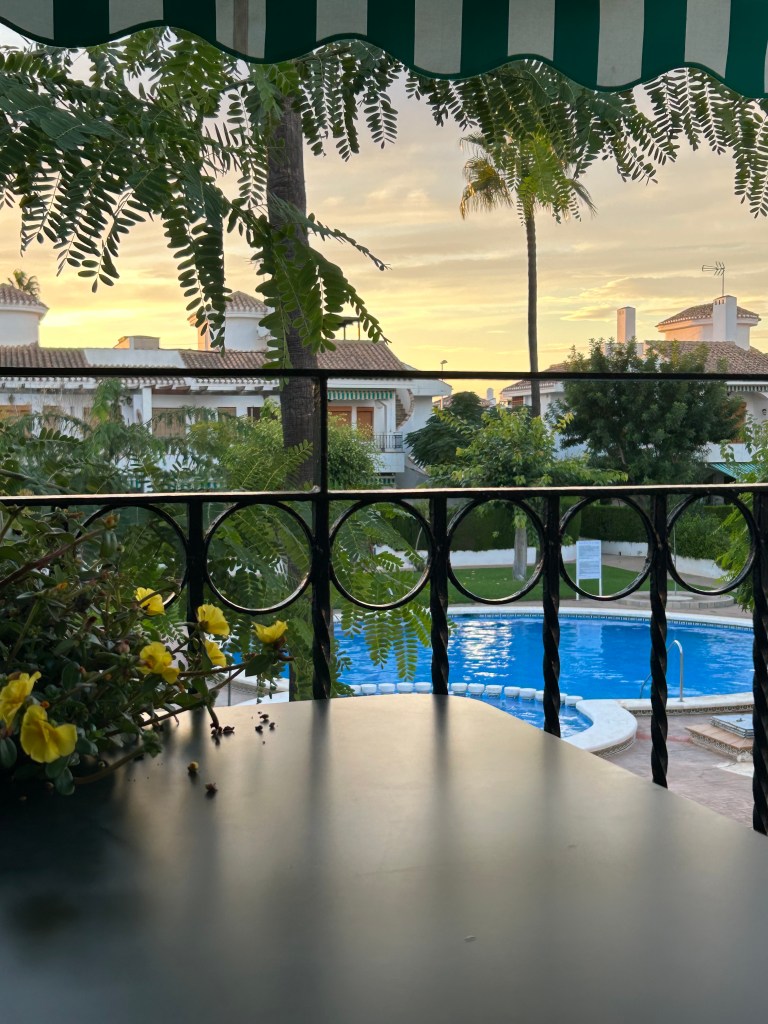
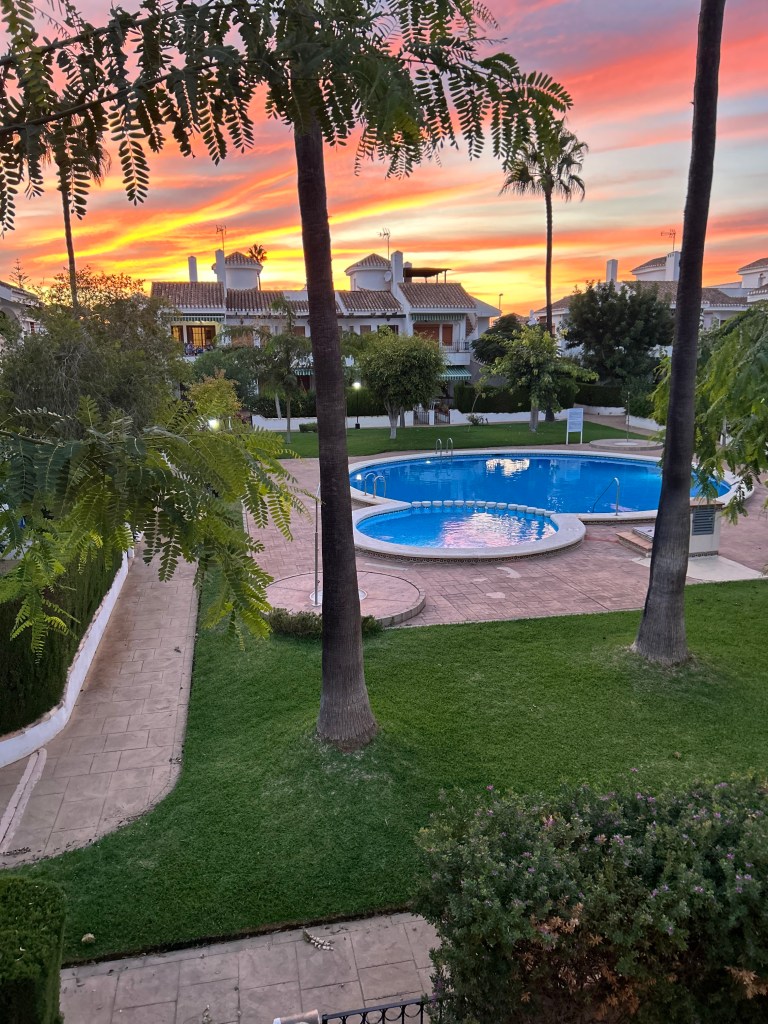
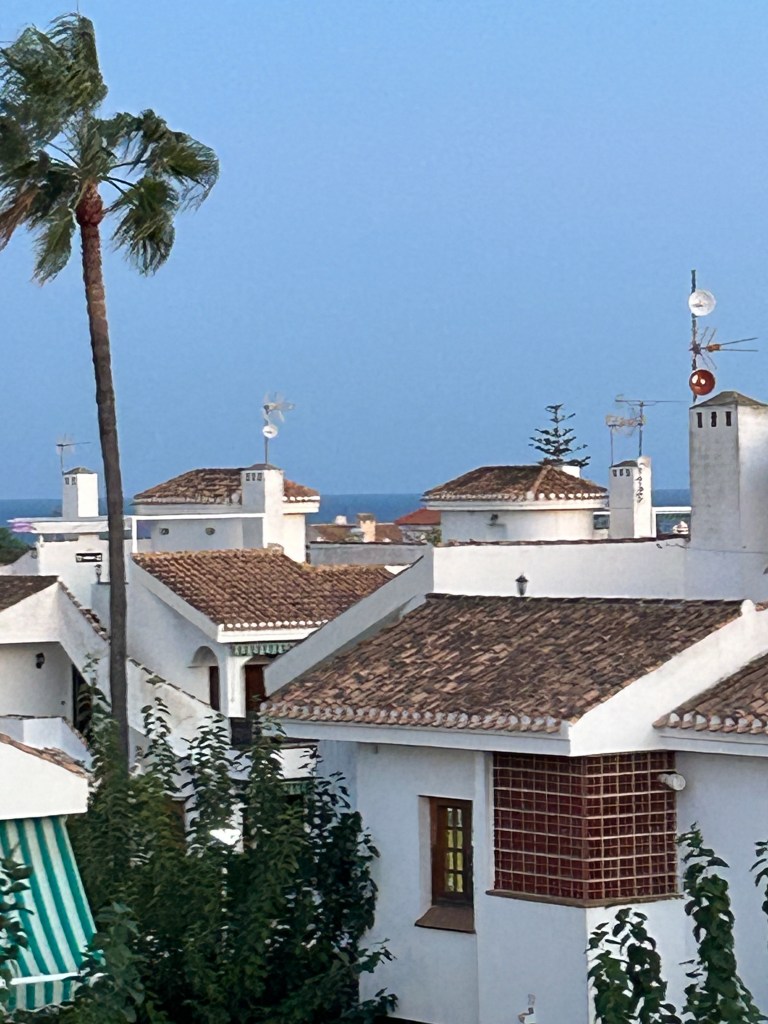
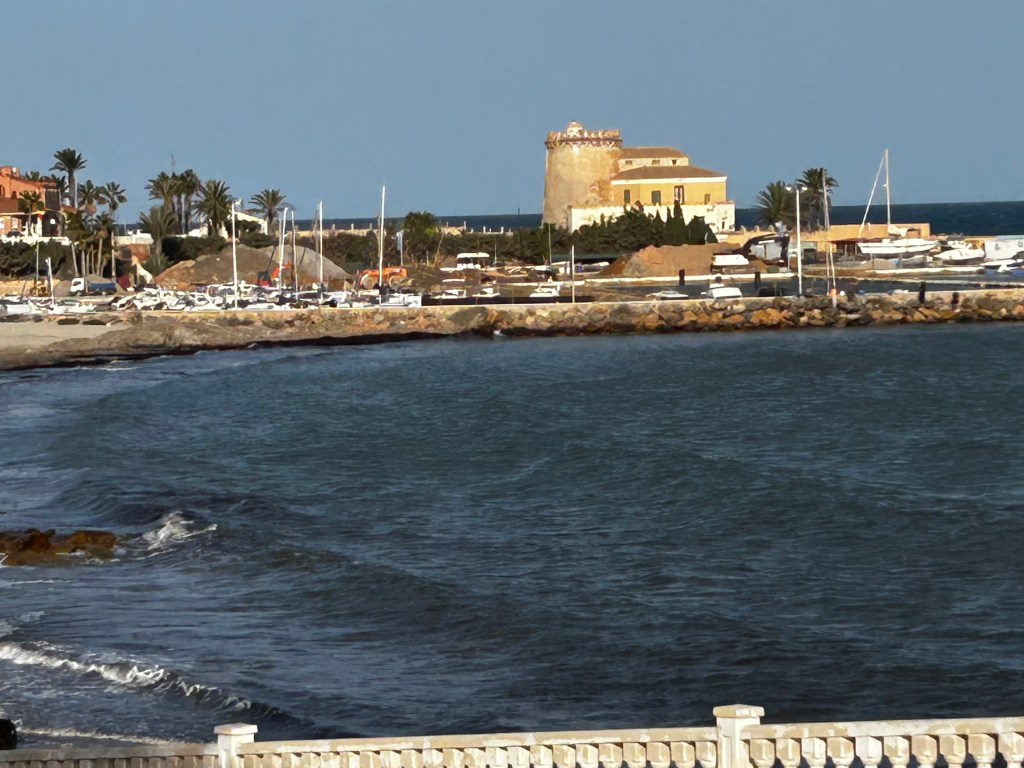
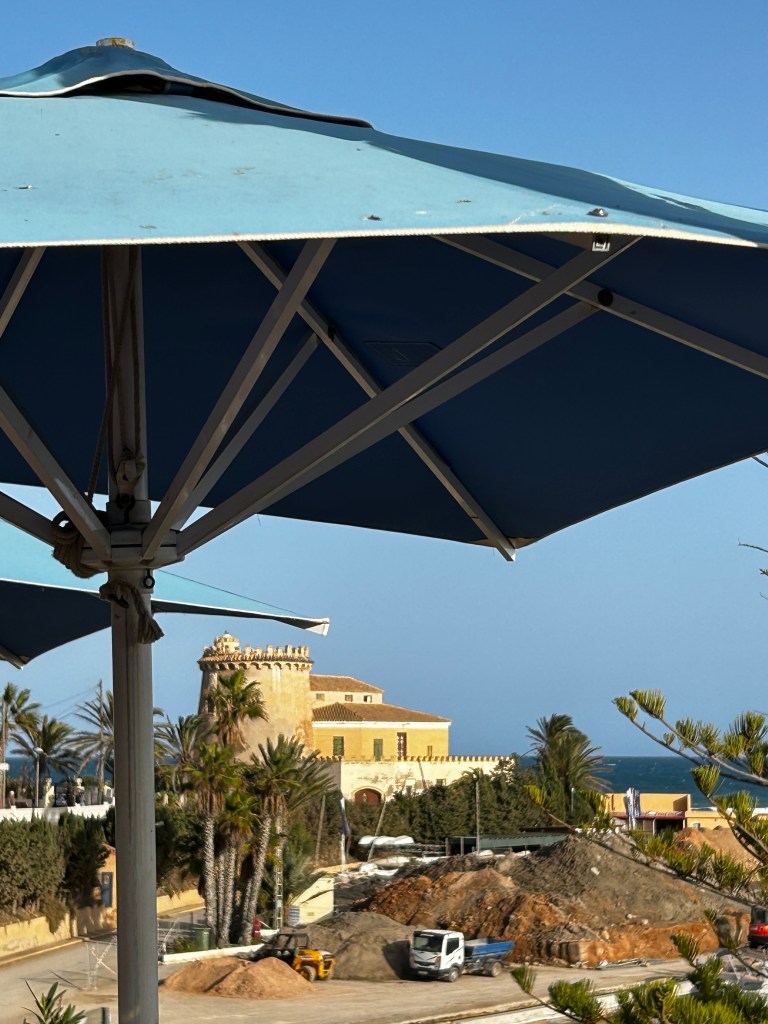
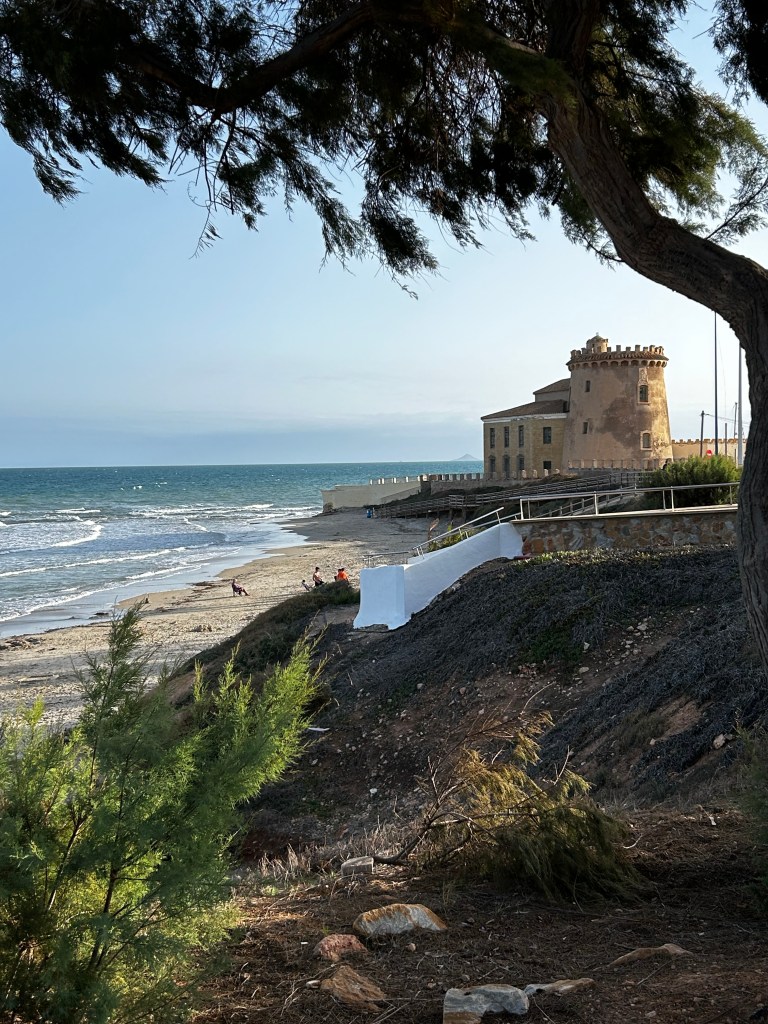
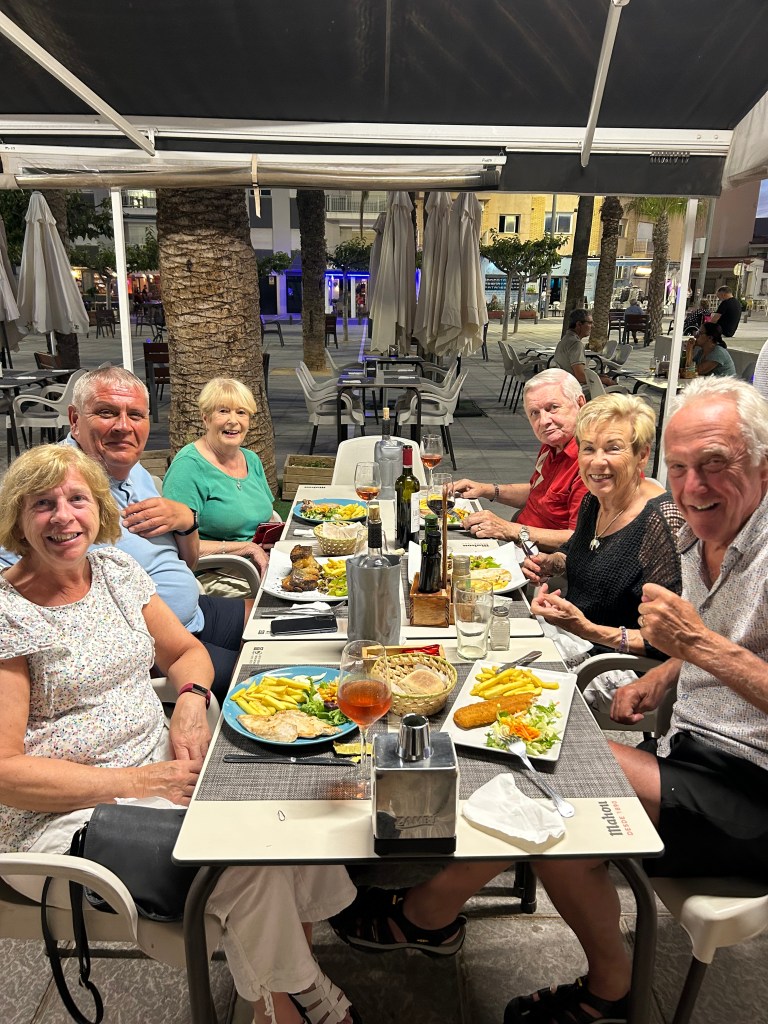
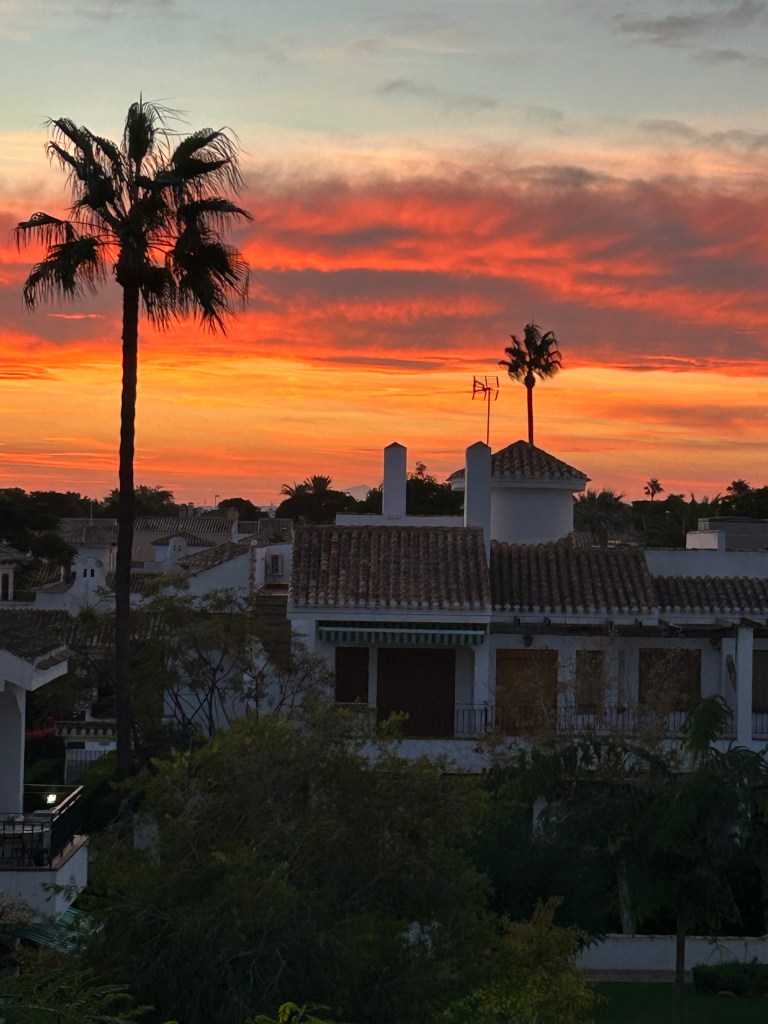
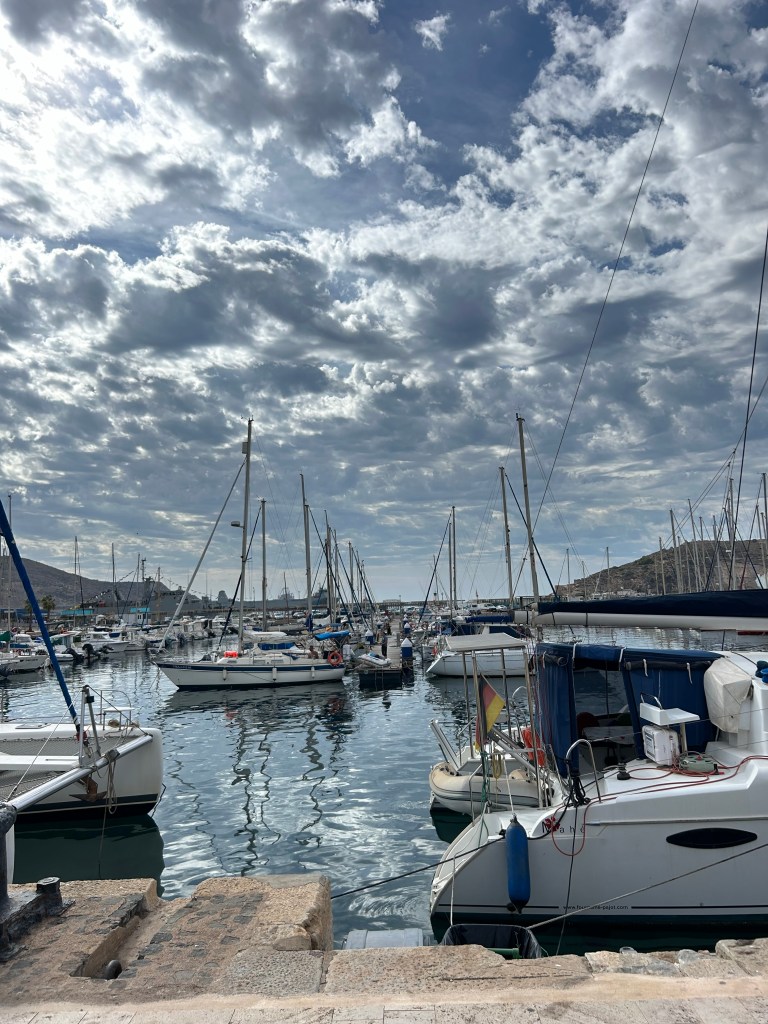
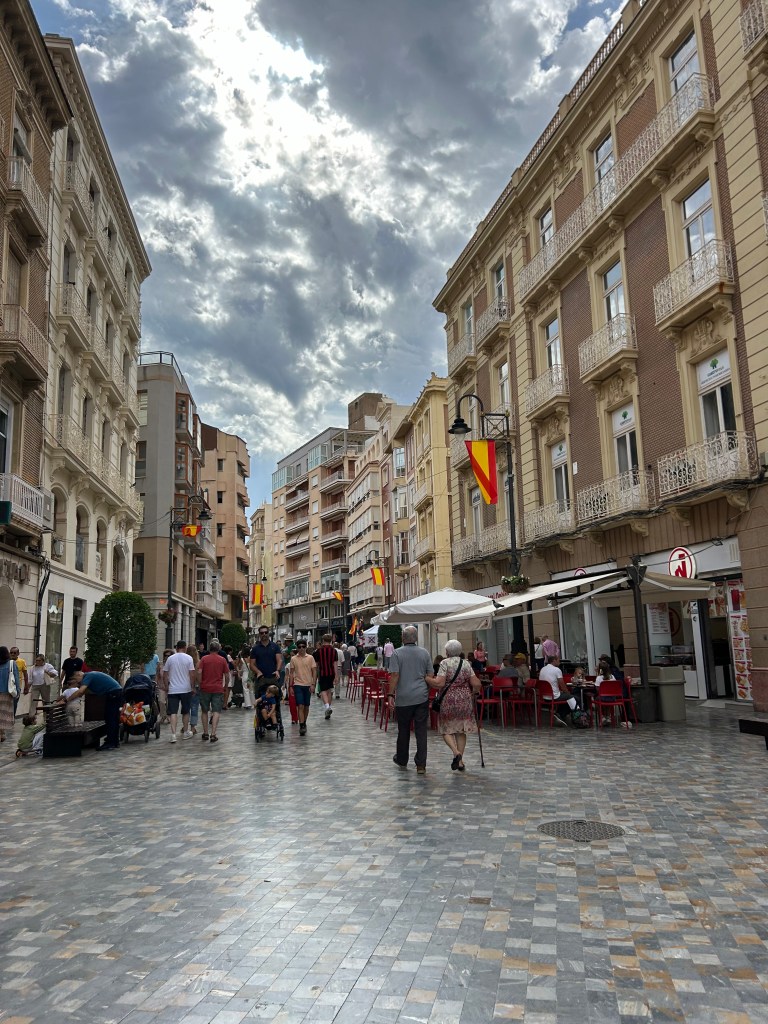
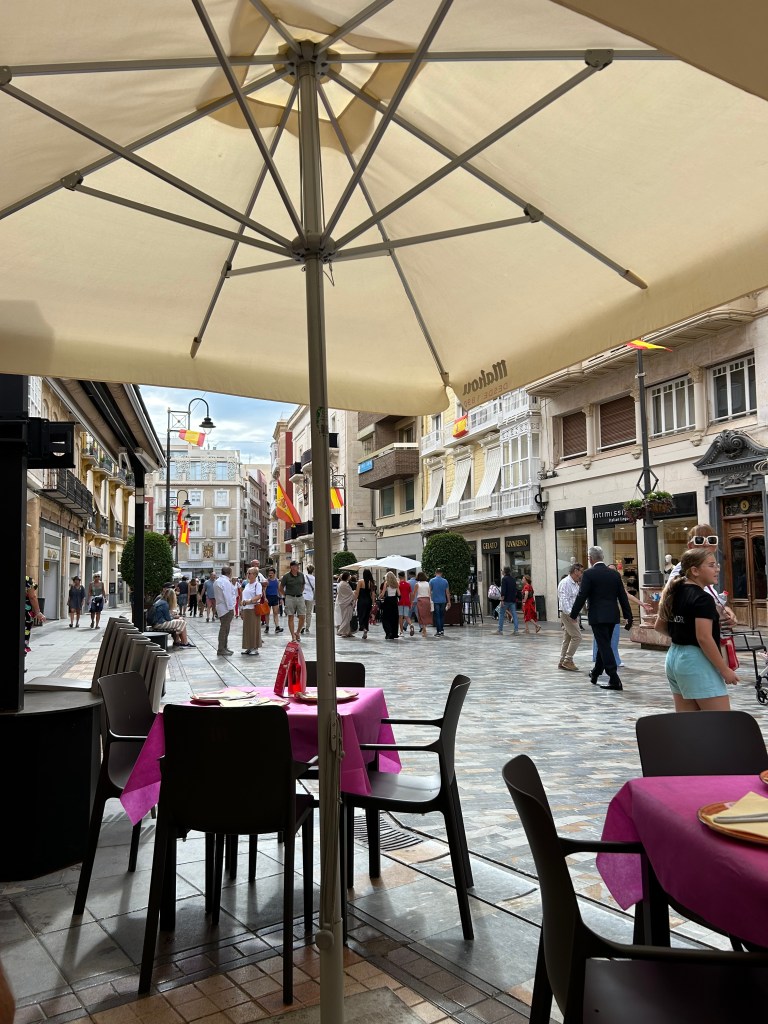
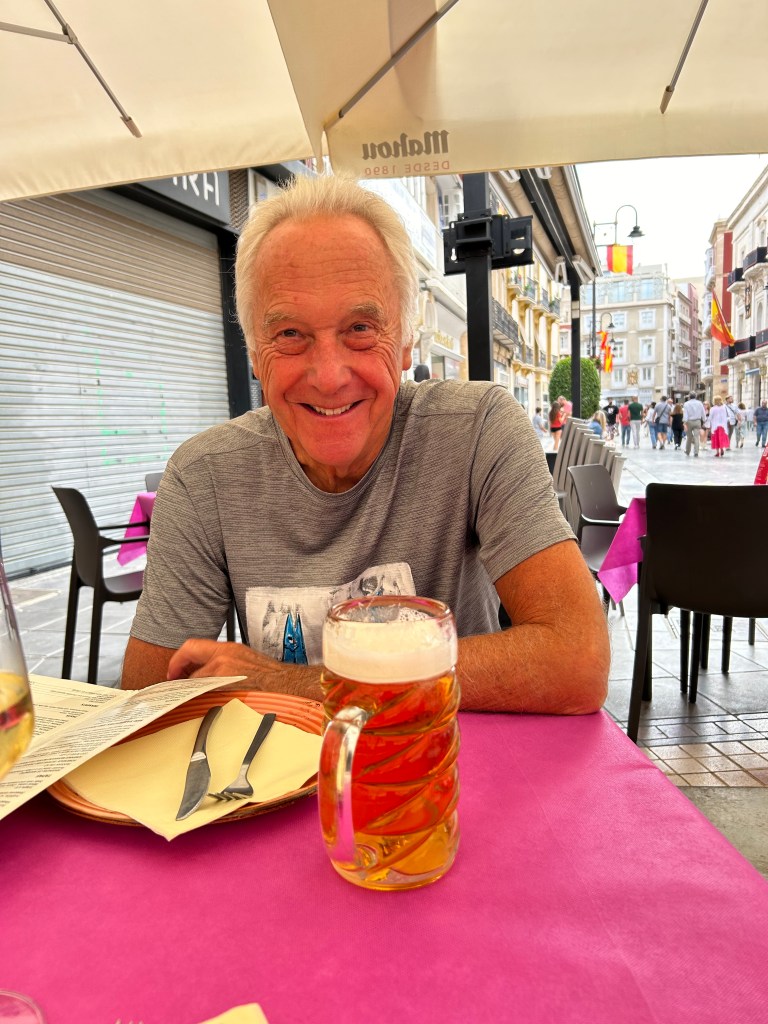
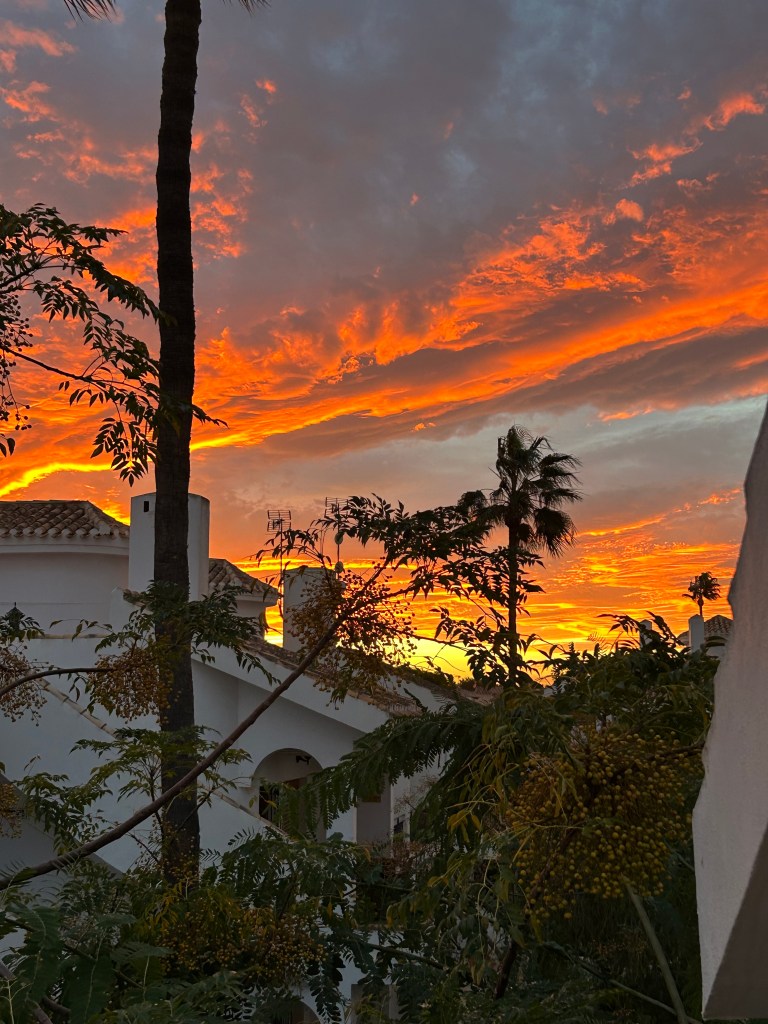
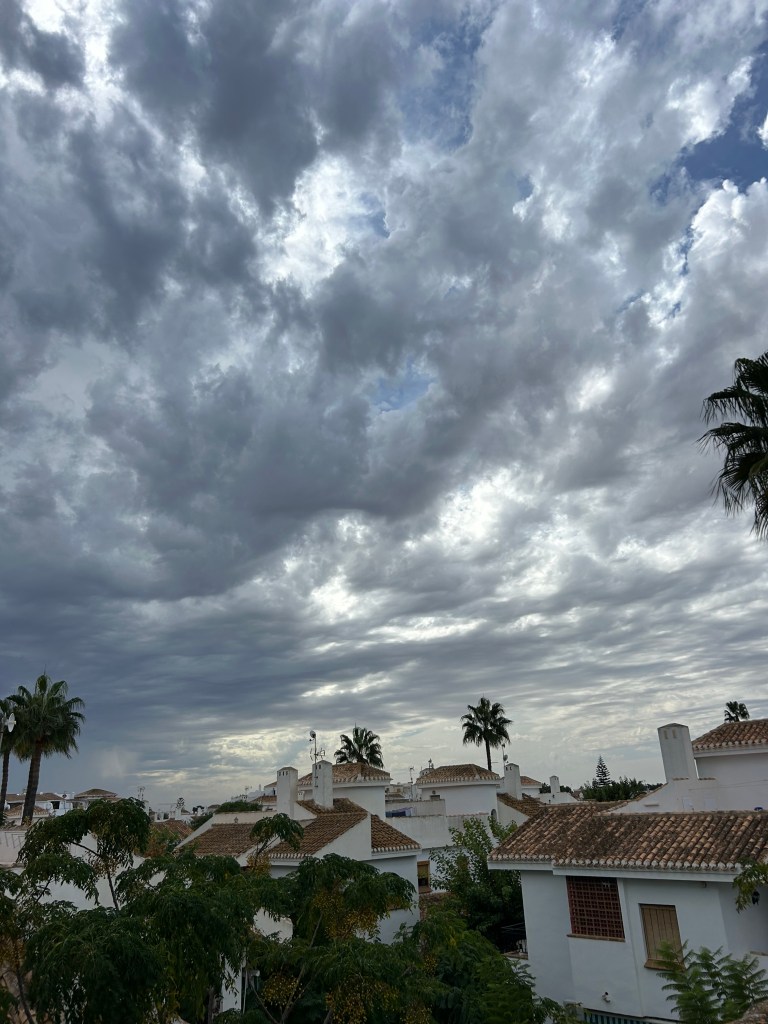
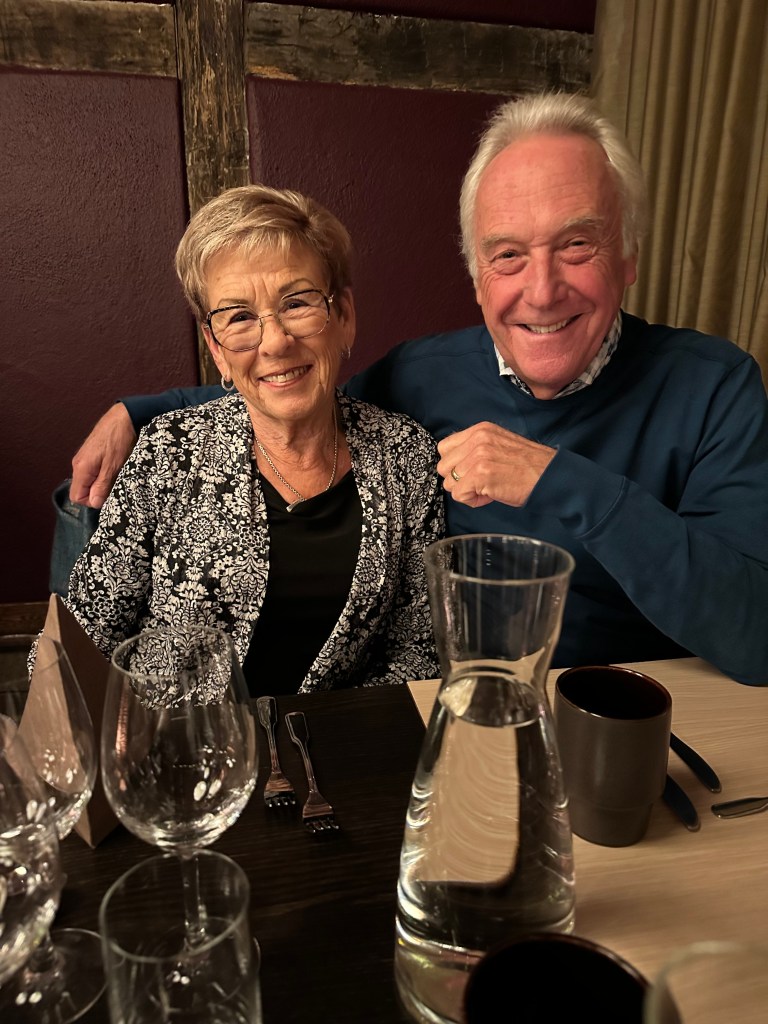
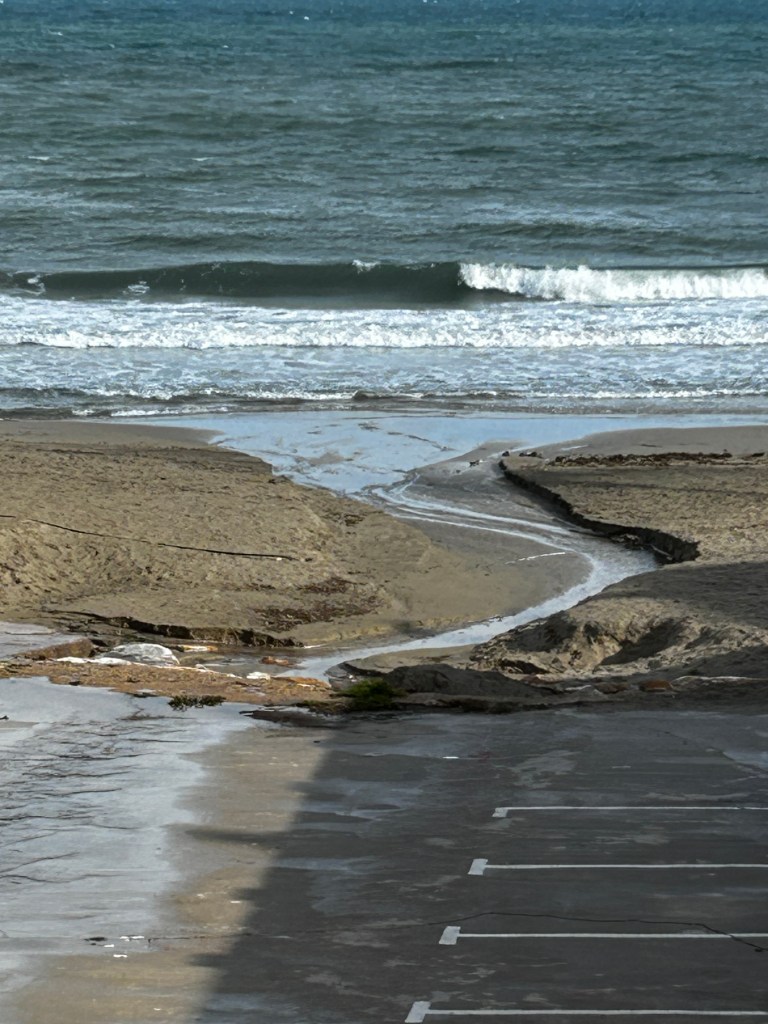
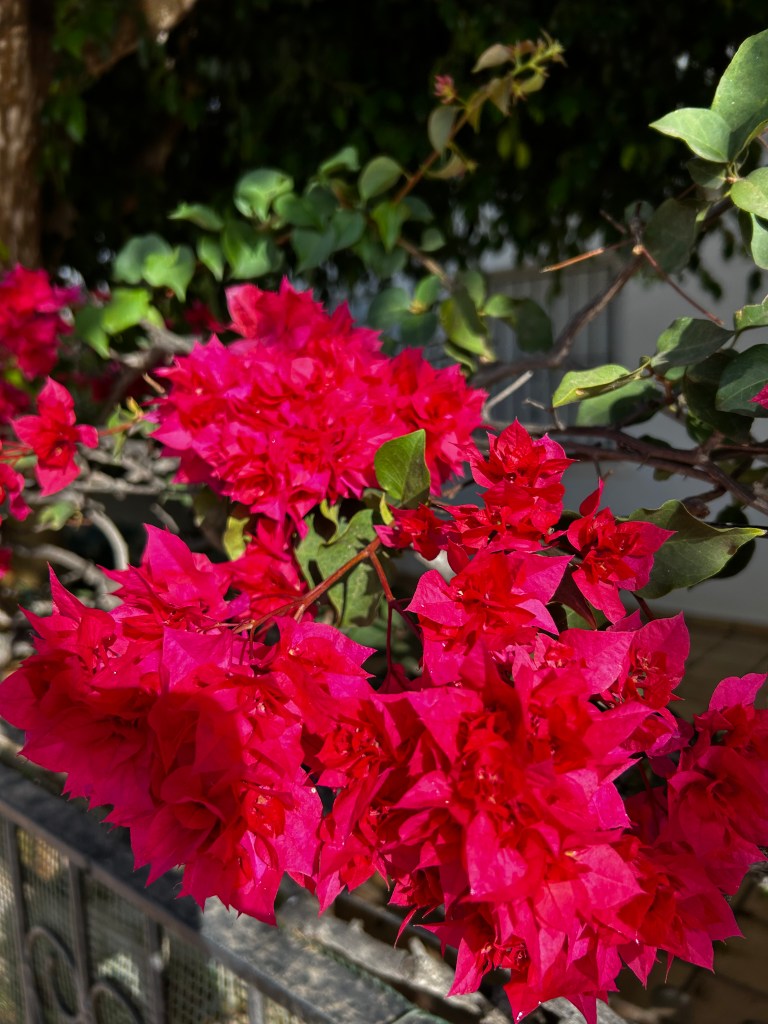
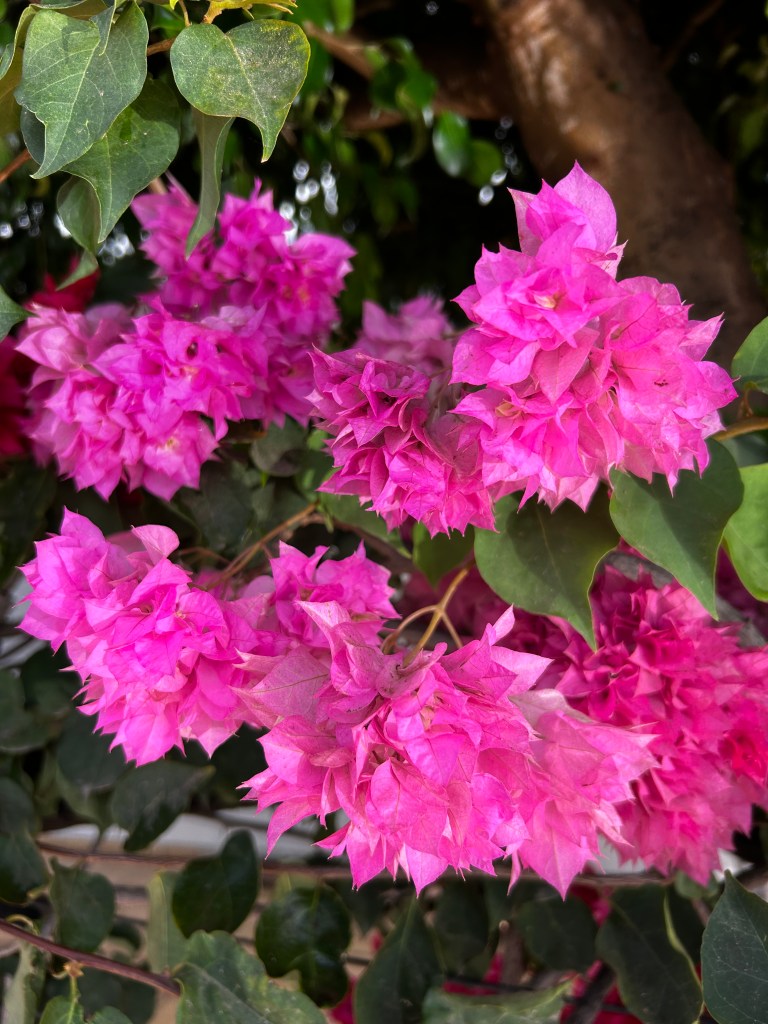
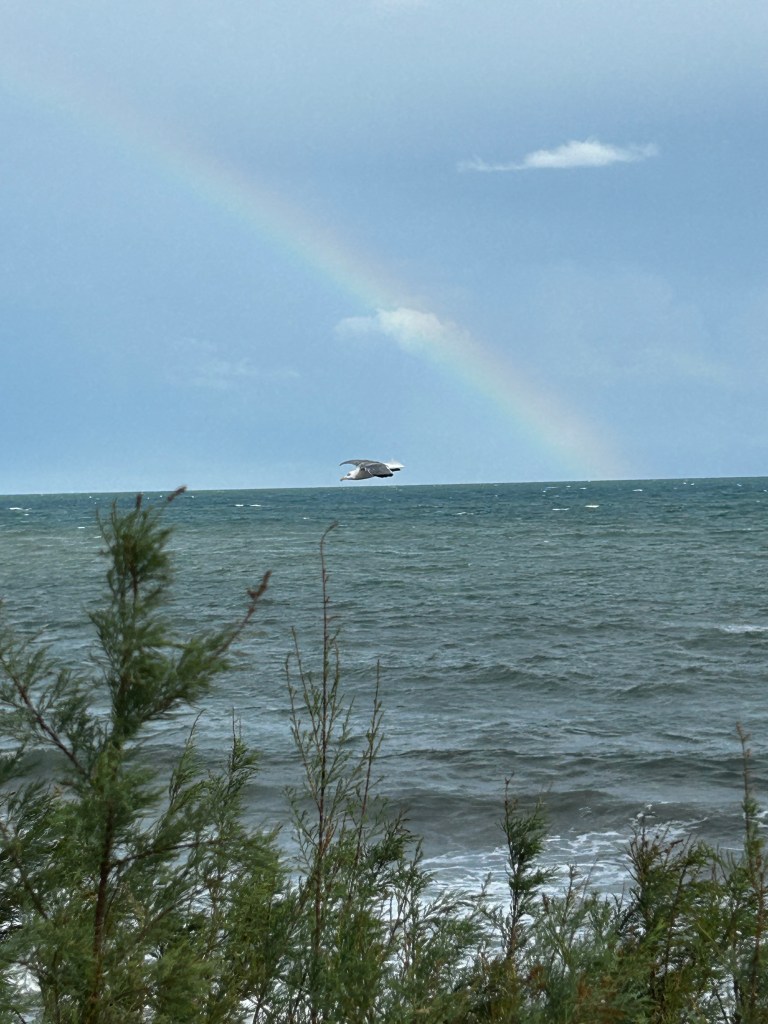
We arrived from Rome via Madrid and Alicante flights around 1:00 pm, picked up our rental car, got groceries in Pilar and arrived at the condo around 3:30. Shannon had been there the two weeks prior so it was ready for relaxing (with beer in the frig). The first photos are Shannon’s (SF).