In addition to our usual trek to Spain, we stopped on the way in Zurich and added a Craig Travel tour of Egypt. In order to avoid the tensions around air connections, we started last year staying for a few days in the connecting city since there are no direct flights to Alicante. Last year, we spent 5 days in Paris, France on the way over and 2 on the way back. This year, we stayed in Zurich for 3 days on the way over and 2 on the way back. We flew Air Canada from Toronto to Zurich on September 11-12 arriving at 10:00 in the morning, took the train into the city and walked to our Airbnb about 20 minutes away from central station.
Zurich
Zurich is the largest city in Switzerland and the capital of the canton of Zurich. It is in north-central Switzerland, at the northwestern tip of Lake Zurich. As of December 2024, the municipality had 448,664 inhabitants. Zurich is a hub for railways, roads, and air traffic. Both Zurich Airport and Zurich’s main railway station are the largest and busiest in the country. Iconic landmarks in Zurich include the Grossmünster, a Romanesque-style Protestant church, the Bahnhofstrasse, one of the world’s most exclusive shopping avenues, and Lake Zurich. As the largest city in Switzerland and a key hub since Roman times, Zurich has a rich history spanning over 2,000 years. It’s home to several historic sites like the Old Town (Altstadt), Lindenhof square, and Grossmünster. The Swiss National Museum in Zurich is the most visited cultural history museum in Switzerland. It presents the country’s history from prehistoric times to the present day. The city has a reputation for high living standards and cleanliness.
Evidence of early, sparse settlements in the area dates back more than 6,400 years, indicating human presence prior to the establishment of the town. Permanently settled for over 2,000 years, Zurich was eventually founded by the Romans, who called it Turicum. During the Middle Ages, Zurich gained the independent and privileged status of imperial immediacy and, in 1519, became a primary centre of the Protestant Reformation in Europe.
The official language of Zurich is German, but the main spoken language is Zurich German, the local variant of the Alemannic Swiss German dialect.
As one of Switzerland’s primary financial centres, Zurich is home to many financial institutions and banking companies. It is know for famous (and expensive) watches, chocolate, cheese, fondu. It is an expensive city because of a high average wage. Monaco has the highest millionaire density with a significant portion of its population being millionaires. Other cities with very high millionaire densities include Zurich, Singapore and Dublin, although their densities are lower than Monaco’s. New York City has the largest absolute number of millionaires, but a lower density compared to these smaller, highly concentrated areas.
Friday, September 12, 2025
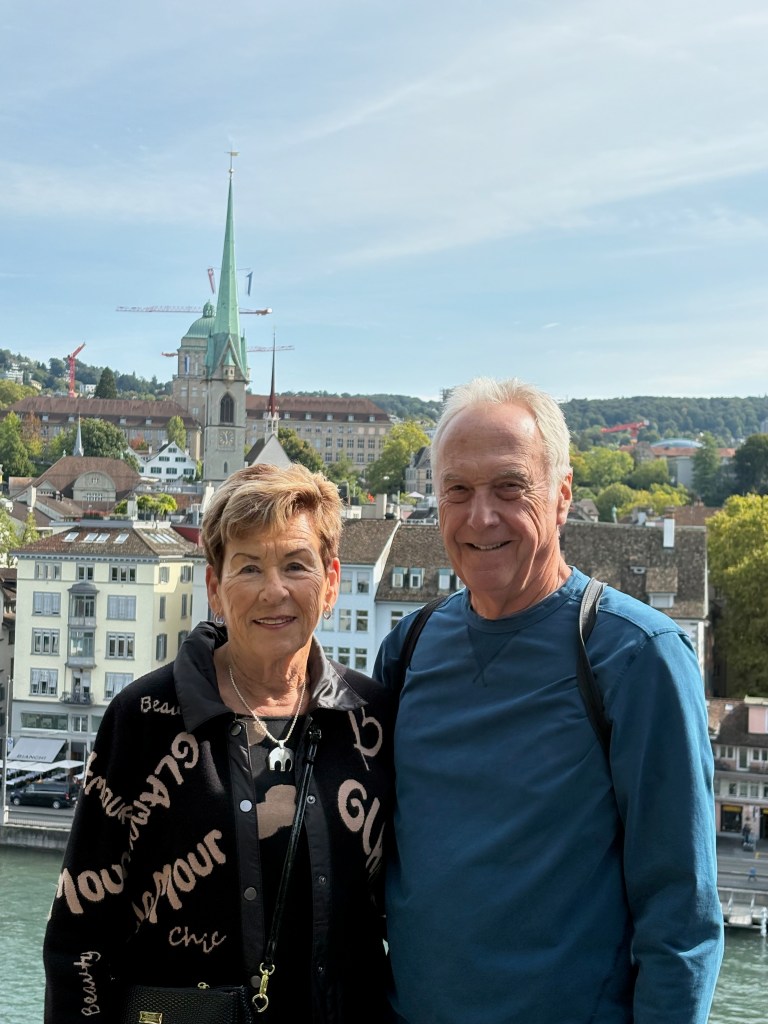
Fortunately we were able to get into our Airbnb early and had no difficulties. The building is not that lovely and the apartment was small but had a great view and great location.
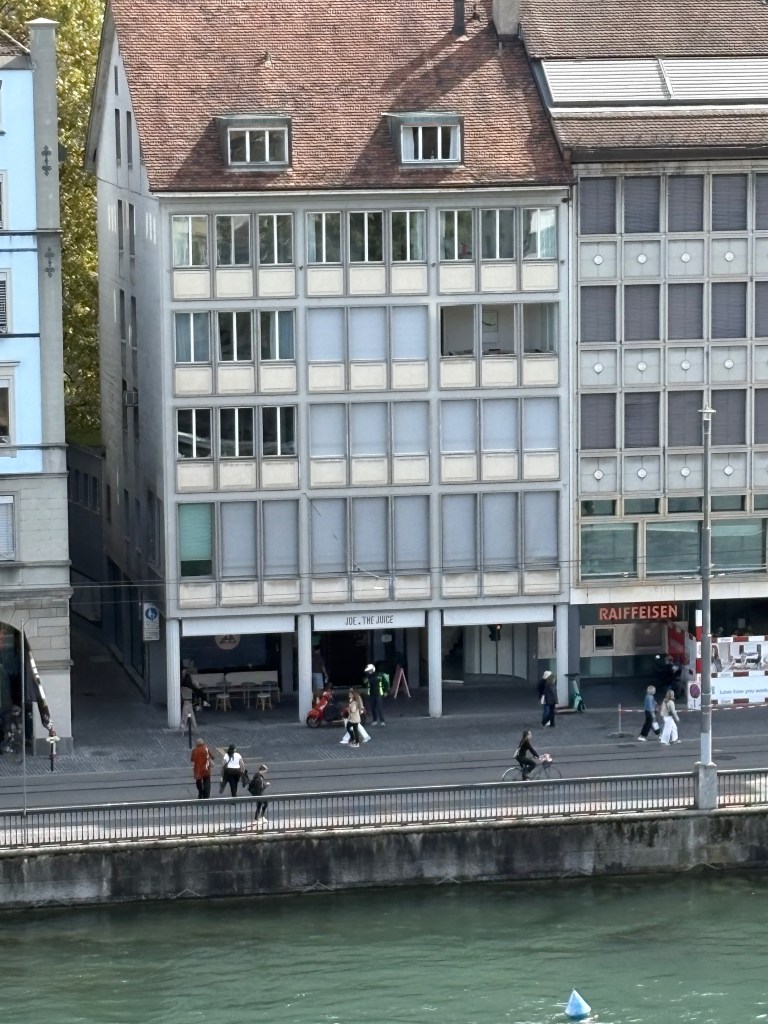
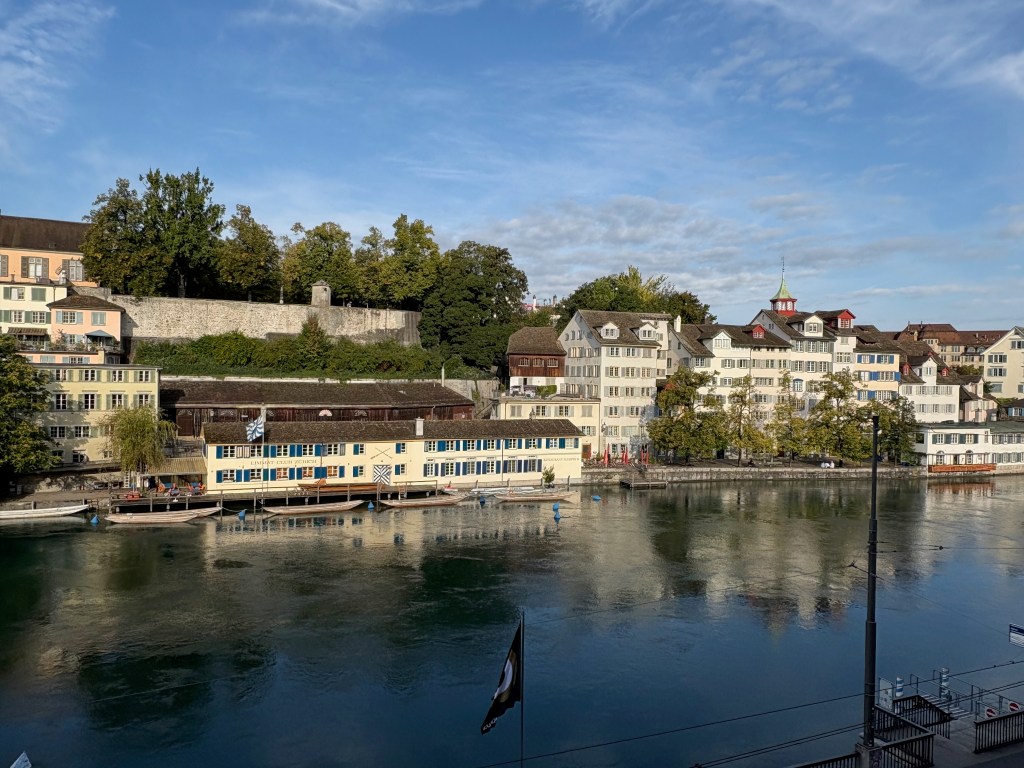
We had a nap and headed out to explore the area. You will notice that there are no highrises in the old town as there is a limit of building height of 30 metres.
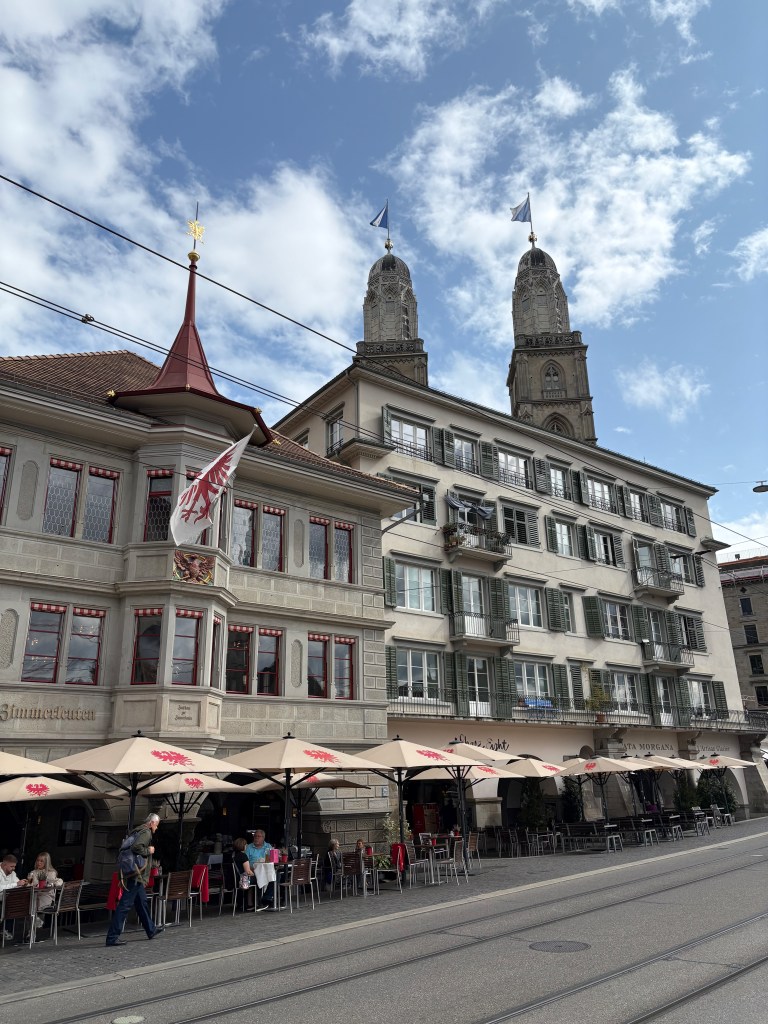
The Grossmünster (“great minster”; also called Salt and Pepper shakers) is a Romanesque-style Protestant church in Zurich, Switzerland. It is one of the four major churches in the city (the others being the Fraumünster, Predigerkirche, and St. Peterskirche). Its congregation forms part of the Evangelical Reformed Church of the Canton of Zurich. The core of the present building, near the banks of the Limmat, was constructed on the site of a Carolingian church, which was, according to legend, originally commissioned by Charlemagne. Construction of the present structure commenced around 1100 and it was inaugurated around 1220.
The Grossmünster was a monastery church, vying for precedence with the Fraumünster, across the Limmat, throughout the Middle Ages. According to legend, the Grossmünster was founded by Charlemagne, whose horse fell to its knees over the tombs of Felix, Regula, and Exuperantius, Zurich’s patron saints. The legend helps support a claim of seniority over the Fraumünster, which was founded by Louis the German, Charlemagne’s grandson. Archaeological evidence confirms the presence of a Roman burial ground at the site.

We walked the streets of the old town, stopped to have a few wings and a drink and had dinner at a restaurant in the space behind our building: soup and bruchetta. Needless to say, we were exhausted and went to bed early.
Saturday, September 13
We met our tour group at the Museum and walked to the ETH University (Swiss Federal Institute of Technology). ETH Zurich is a public university in Zurich, Switzerland. Founded in 1854, the university focuses primarily on science, technology, engineering, and mathematics and architecture. Our guide, Patricia, said that Albert Einstein taught here.

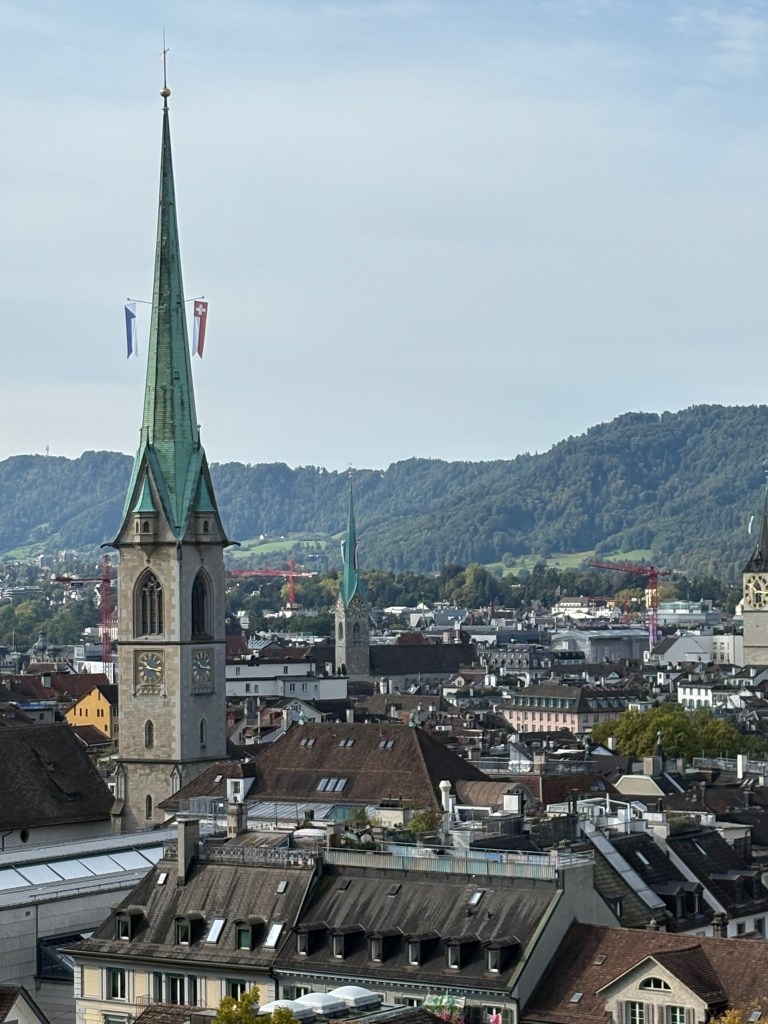
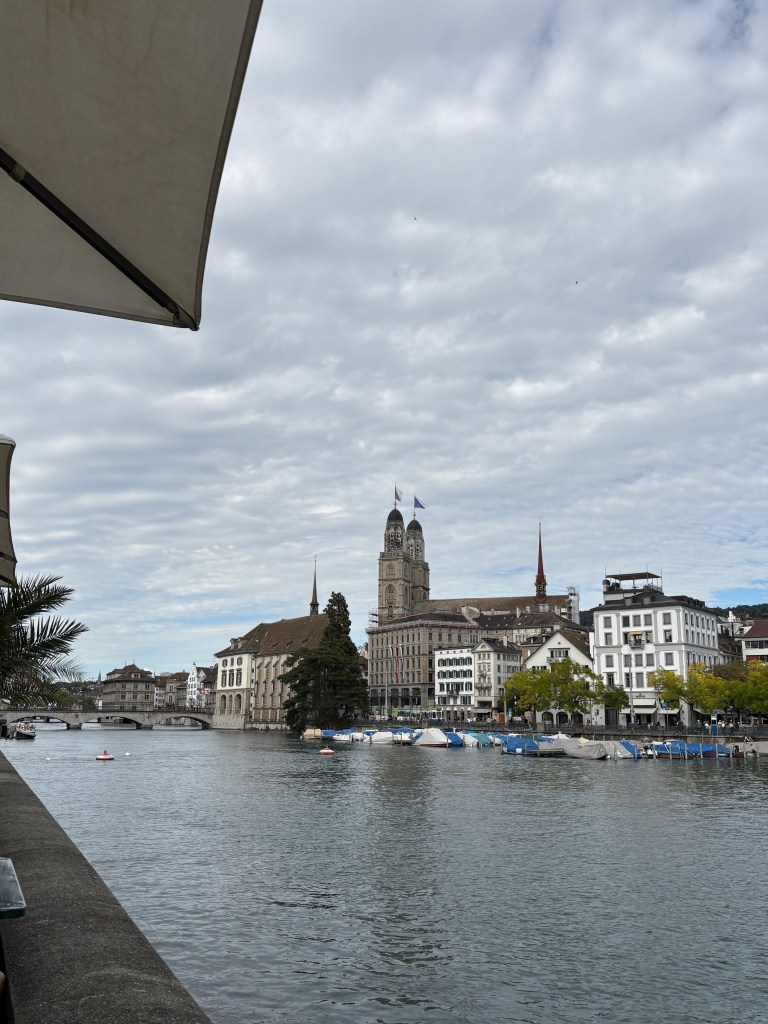
From this location, we had a stunning view of the old city.
Shelters


A shelter is a subterranean construction in the basement of a building. Shelters (also known colloquially as ‘air raid shelters’) serve to protect the population from armed conflicts, but may also offer protection from natural or human-made disasters. The majority of the population lives in buildings that include shelters of their own. If there is no shelter in an inhabited building, public shelters for the general population will be available in the vicinity. As a rule, in Switzerland there is ‘a shelter for every inhabitant’: Approximately nine million shelter places are available in about 370’000 private and public shelters to a coverage rate of more than 100 percent.
Shelters are constructed and equipped in a spartan manner to minimise costs, space requirements, and maintenance efforts. Owners must stock their shelters with the supplies needed for an extended stay. In case of a looming armed conflict in Switzerland or a neighbouring country, the population will be instructed to prepare to move into the shelters. Shelters must be in a state allowing them to be made operational and ready for use within five days.
A shelter may be used for everyday purposes, for example as a storage room, basement, workshop, playroom, or archive. Some have been used for university dorms.
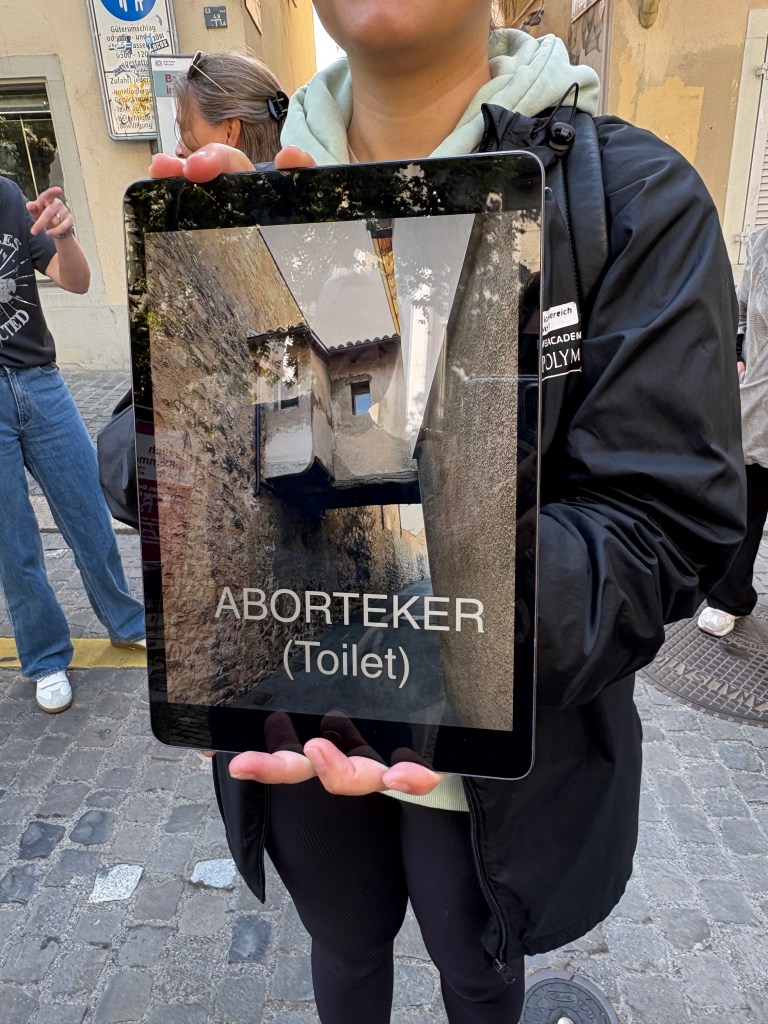
We continued our tour with our guide, Patricia, reminding us that there were no toilets in the Middle Ages and the balconies were used as toilets so you needed to be careful walking down the street as seen in her photo.
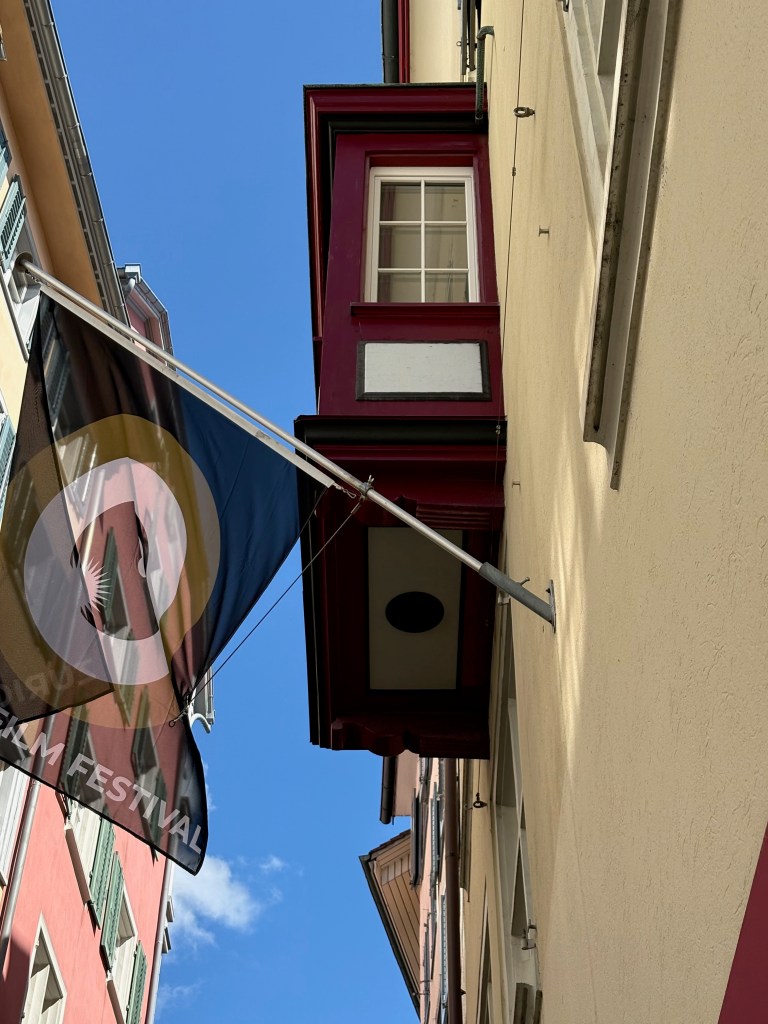
The water in Zurich is good and clean: however, many, including Patricia, buy bottled water. There are many fountains where you can fill up your bottle with municipal water.

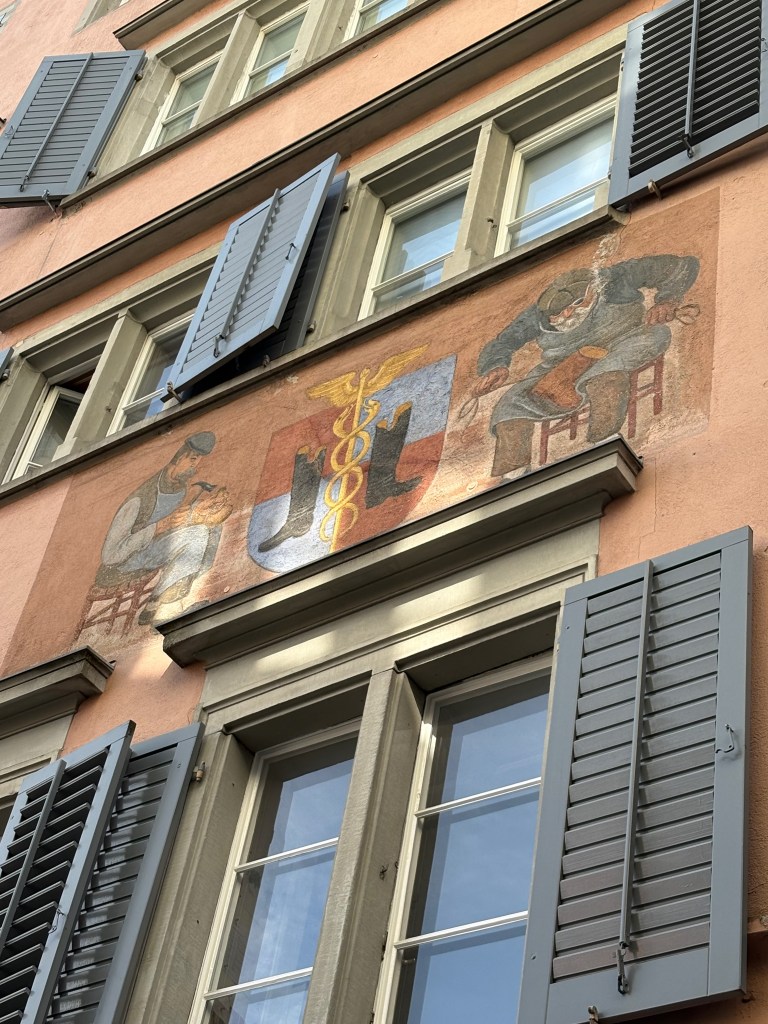
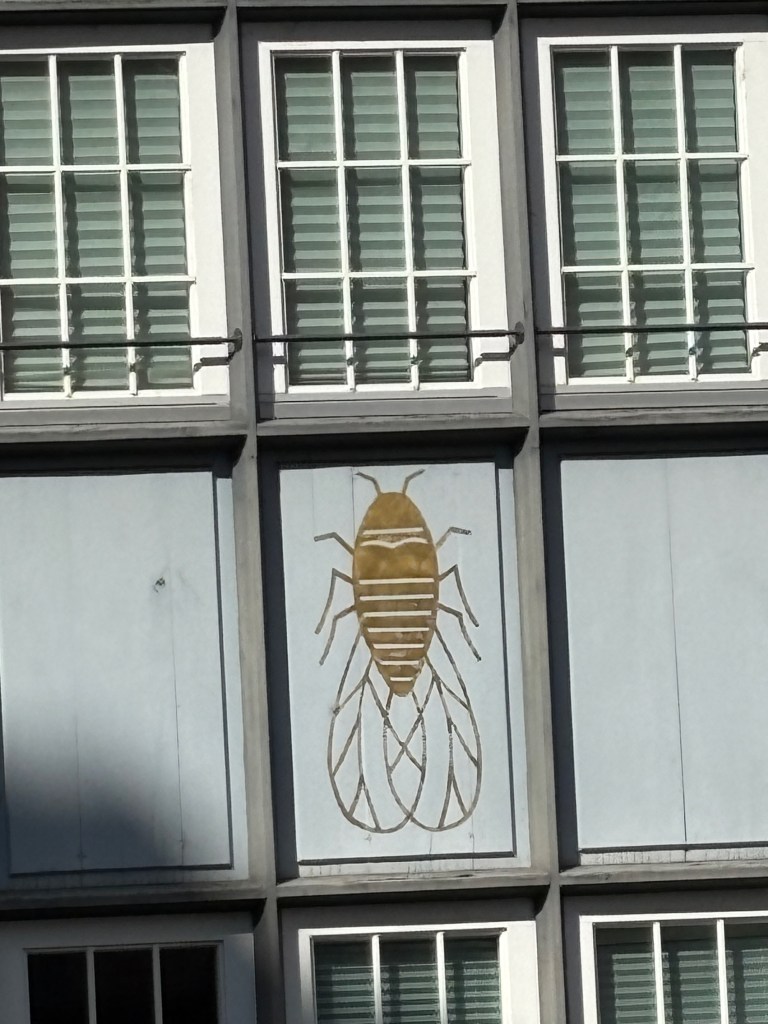
Because the locals were illiterate, many shopkeepers and tradesmen used paintings on buildings.
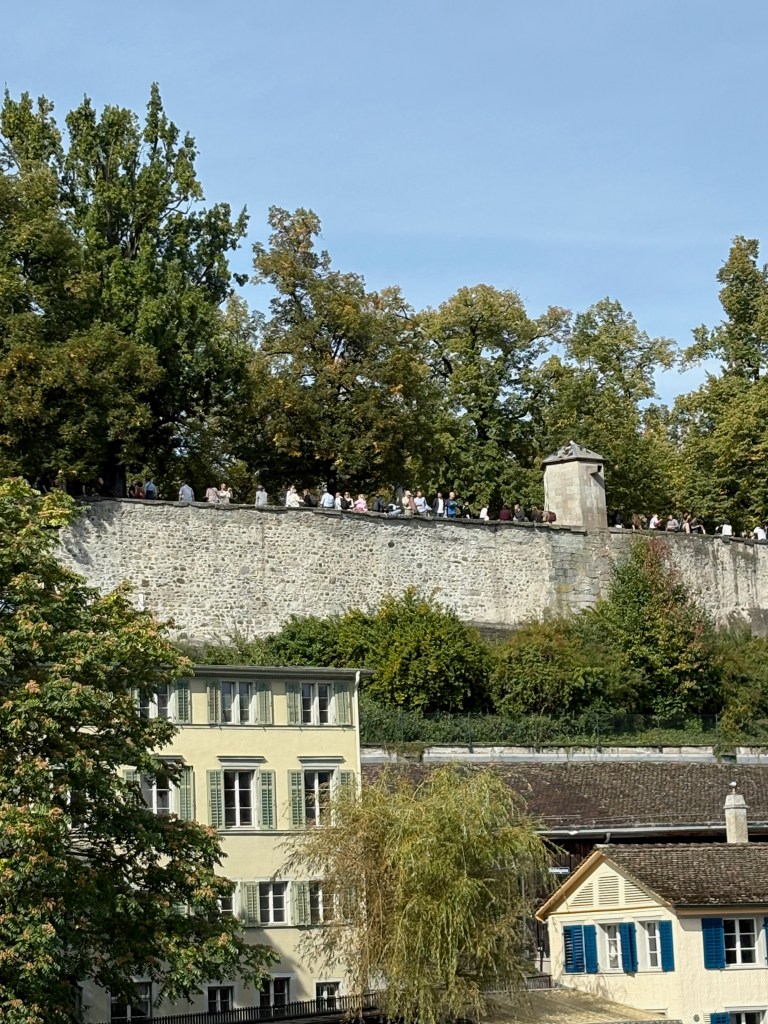
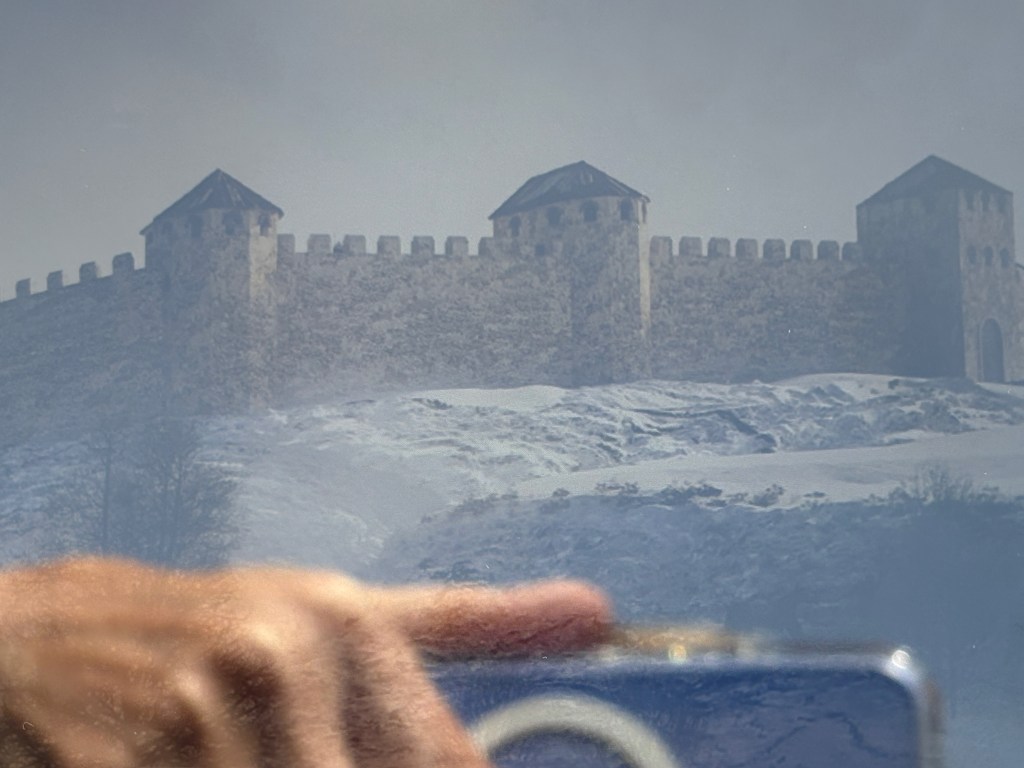
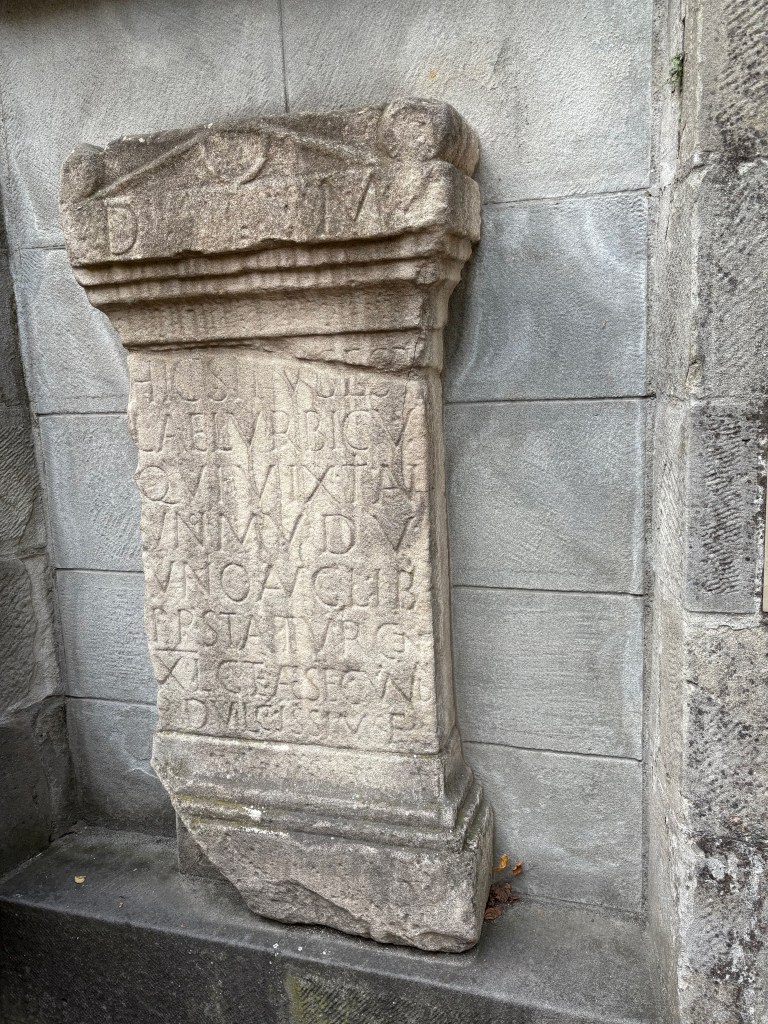
We visited Lindenhof, directly across the river from our airbnb, a lovely shaded park of Linden trees and location of a Roman military sight, called Turicum. Little remains except the wall with turret.


The day in downtown Zurich is punctuated by the chiming of clocks every quarter hour. And for 10-15 minutes several times on Sunday.
Zurich is the proud owner of the largest church clock in Europe
Situated right in the heart of the old town, a medieval church tower with Europe’s largest church clock is part of the St. Peter’s Church. The outer diameter of clock is 8.64 meters, the minute hand has 5.73 meters, and the hour hand 5.07 meters.
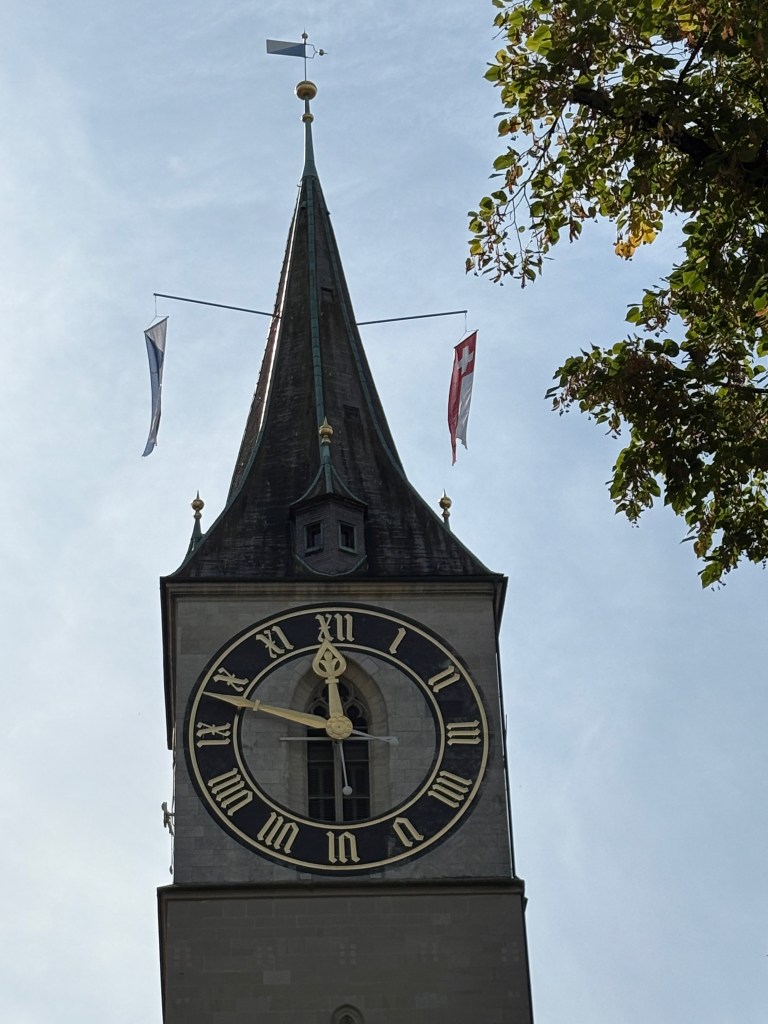
The tower was primarily used for fire police duties, and 1340 AD the first fire guard was set in duty. In the pre- and early Romanesque era, St. Peter had no church tower; the first three-storey tower was built in early 13th century. In 1450 the tower was increased to 64 metres (210 ft) (as of today) and a pitched (helmet) roof was attached.
Towards the end of the 13th century a mechanical church clock was installed ,then electric in 1873 and in 1996 it was replaced by a central computer system. The clock tower of St. Peter was for centuries Zürich’s ‘official local time’, and all public city clocks had to conform to it.
Boat Tour of Lake Zurich
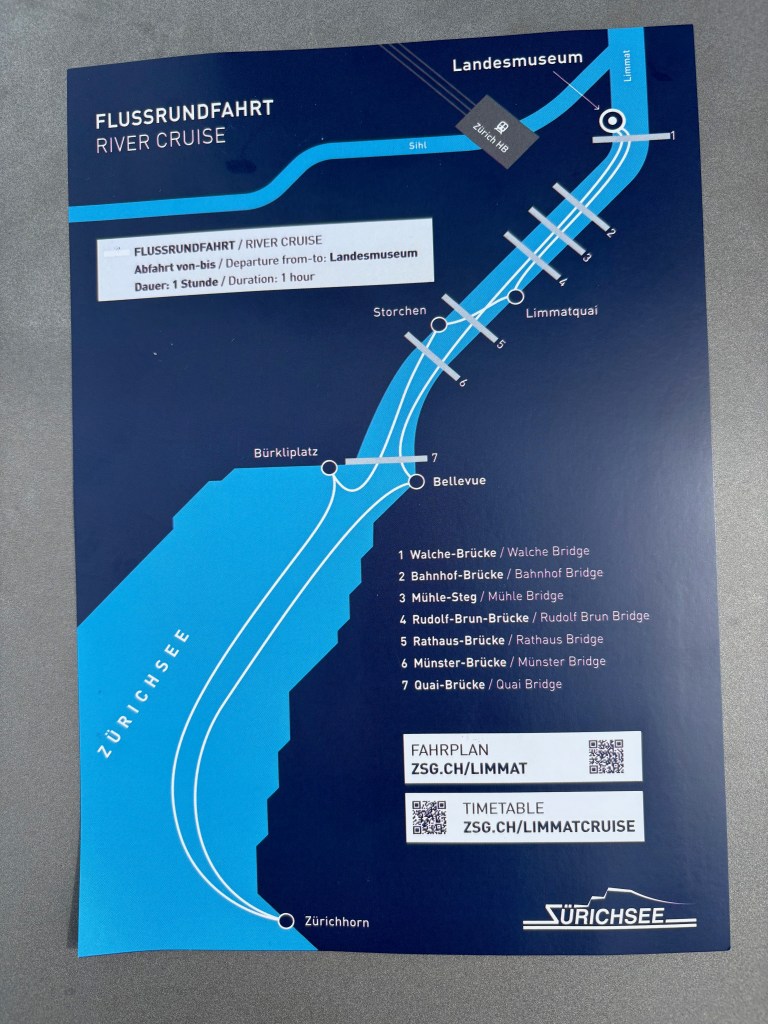
Part of the 6 hour tour was a boat ride on part of Lake Zurich. Lake Zurich is a large, glacial alpine lake extending southeast of the city. It’s a popular spot for boating, swimming, and picnicking, with beautiful views of the surrounding mountains.

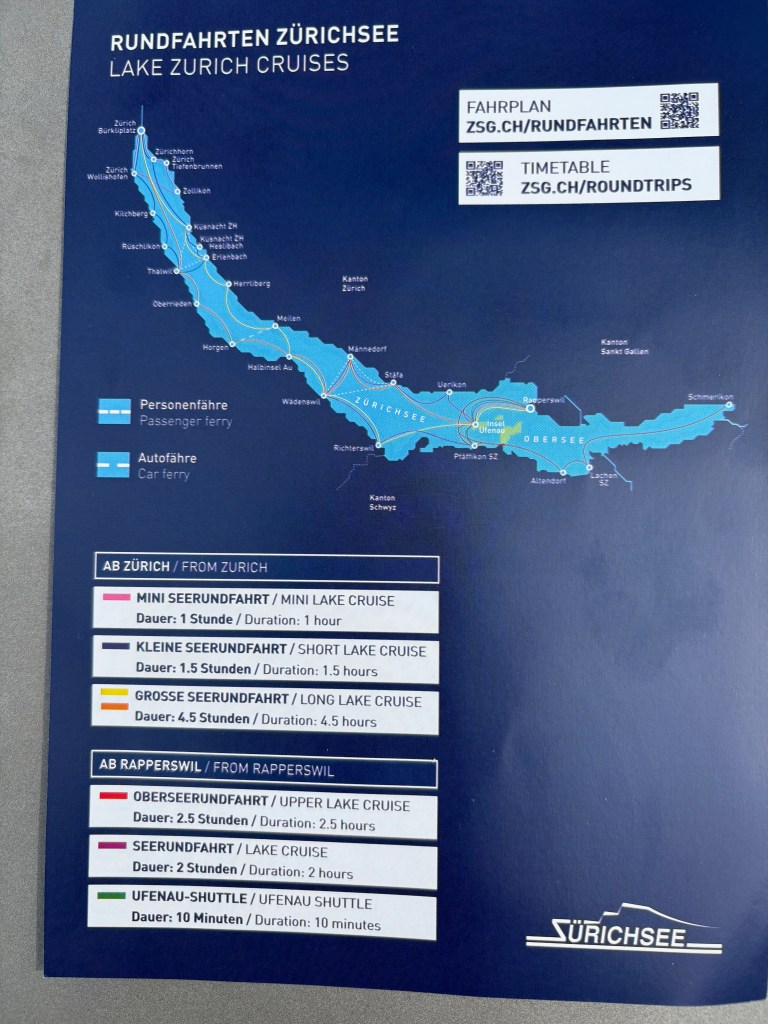
This shows the river cruise and Limmatquai is where we were positioned.
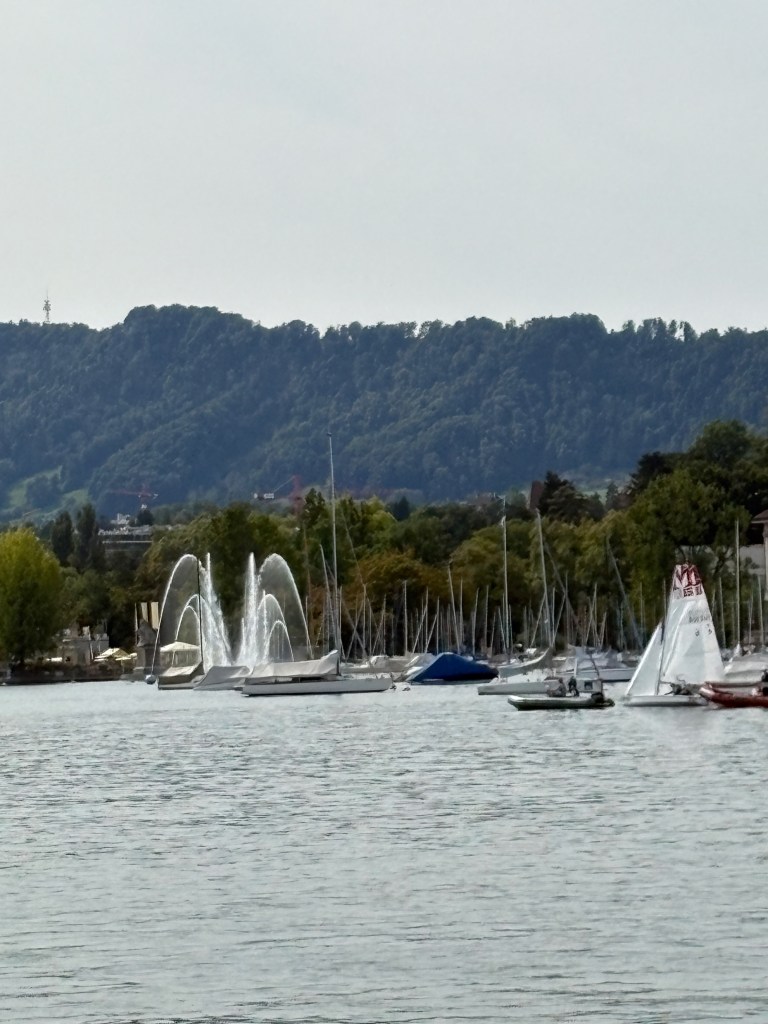
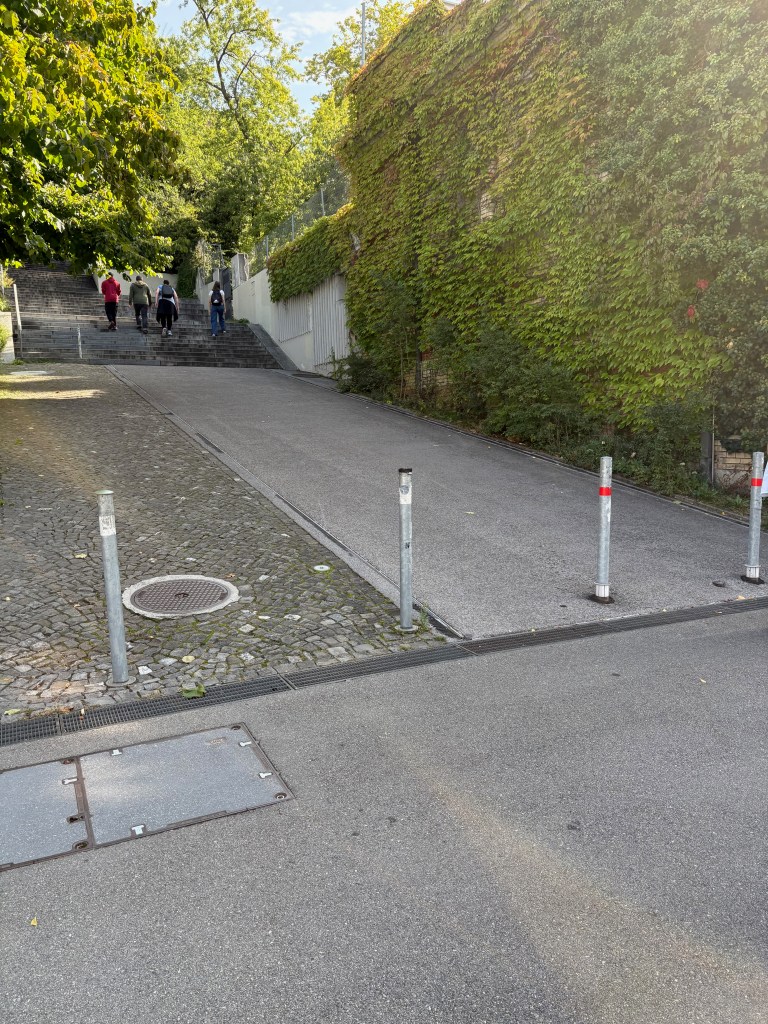
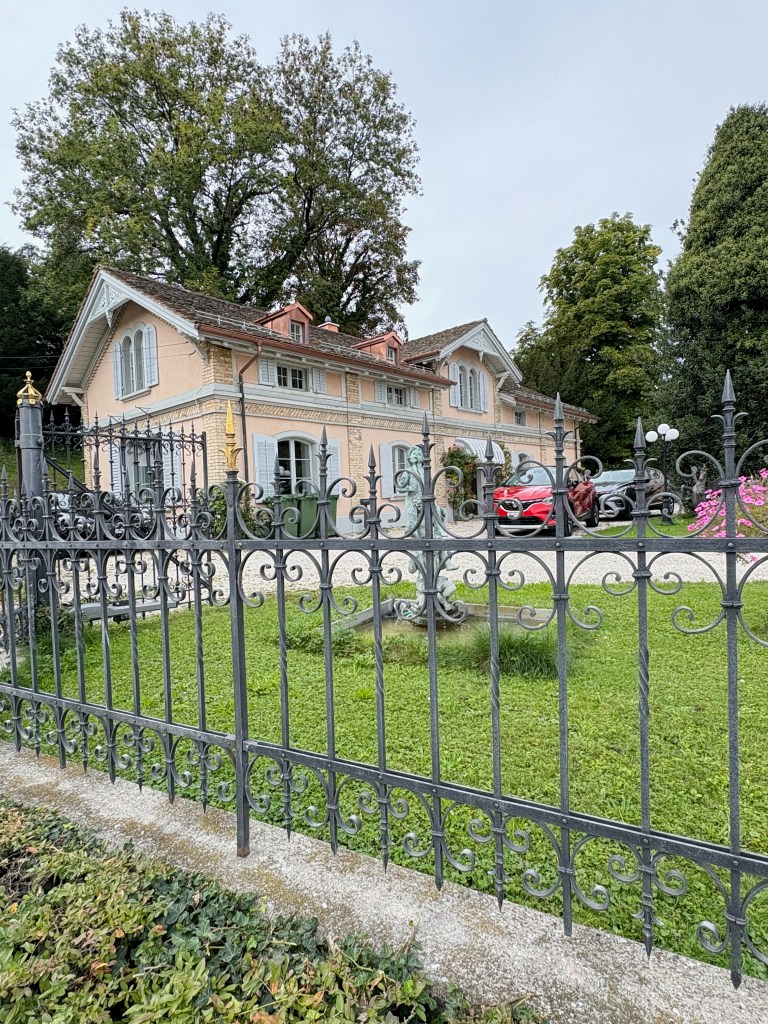
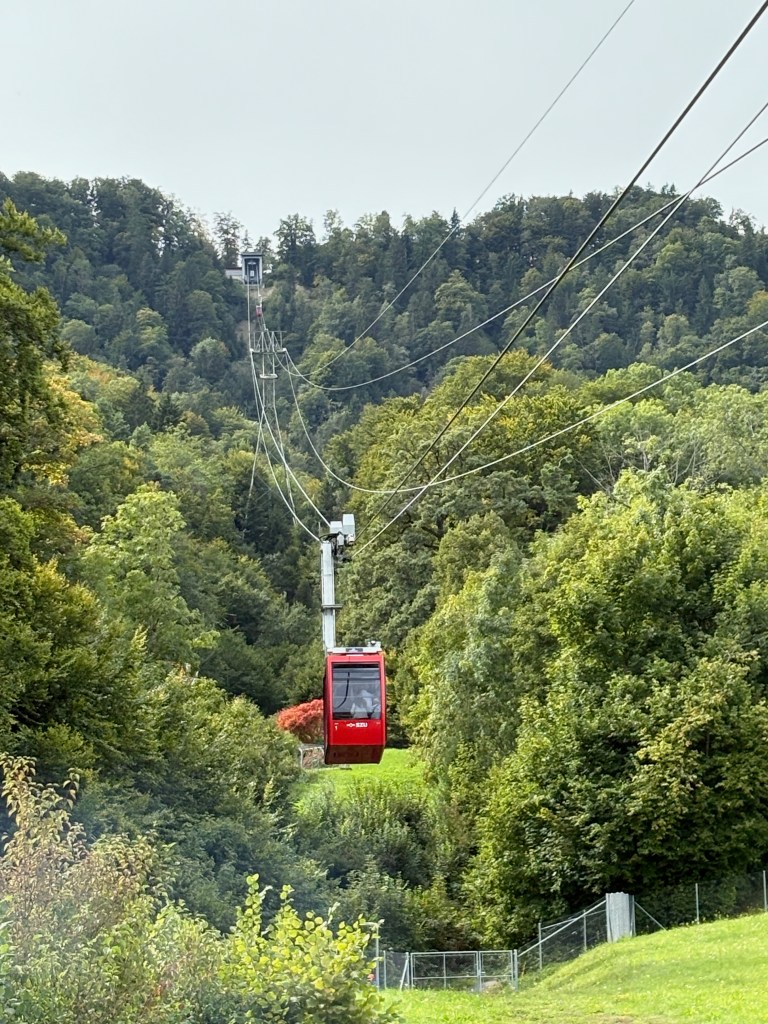
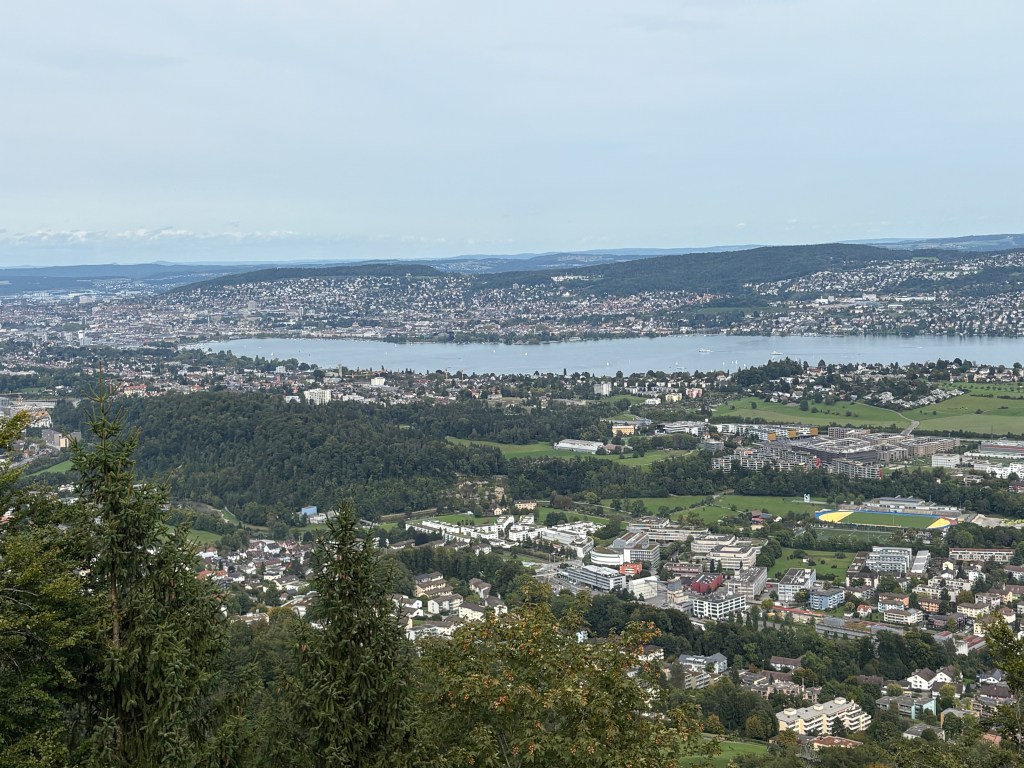
After several stops, we got off at Thalwil station, past this lovely house and walked up a very steep hill to the cable car.
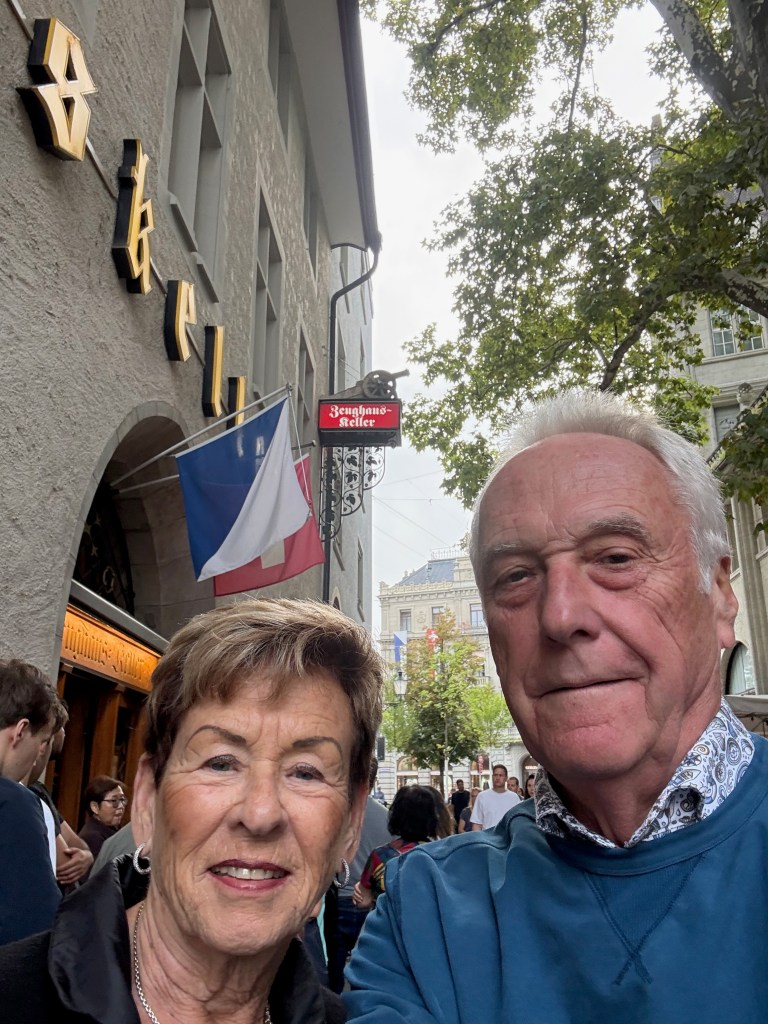
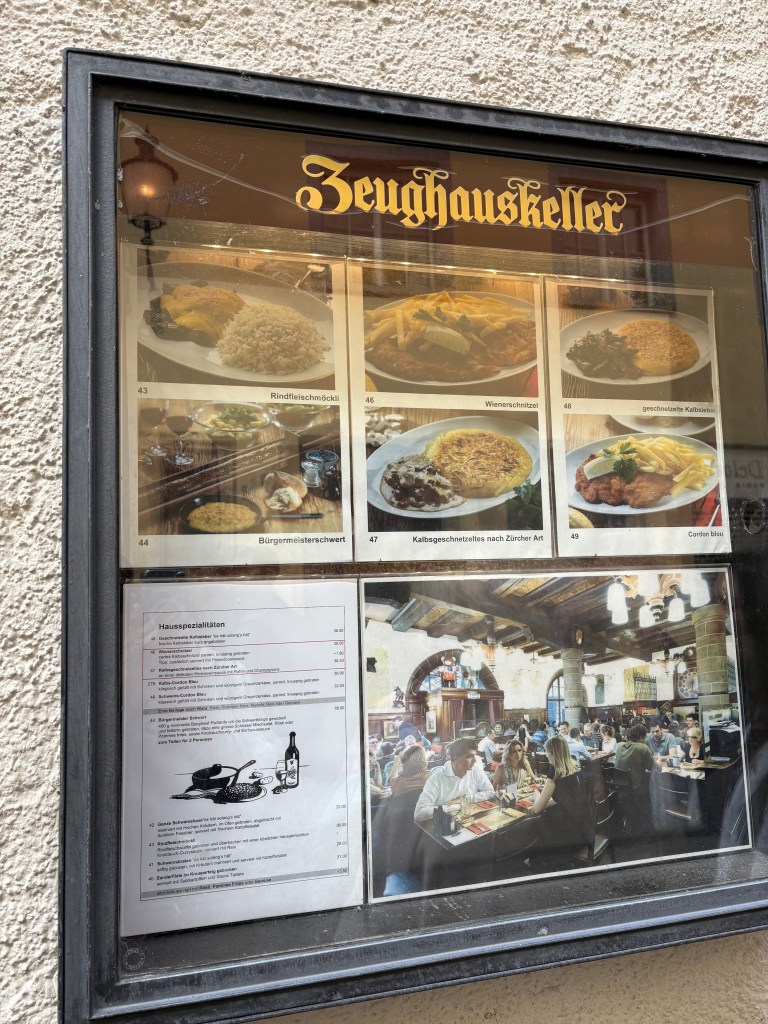
That evening we went for dinner at the Zeughauskeller, a restaurant recommended by Shannon’s friend, Claire. It was very busy and we sat with two young women from Taipei, Taiwan.
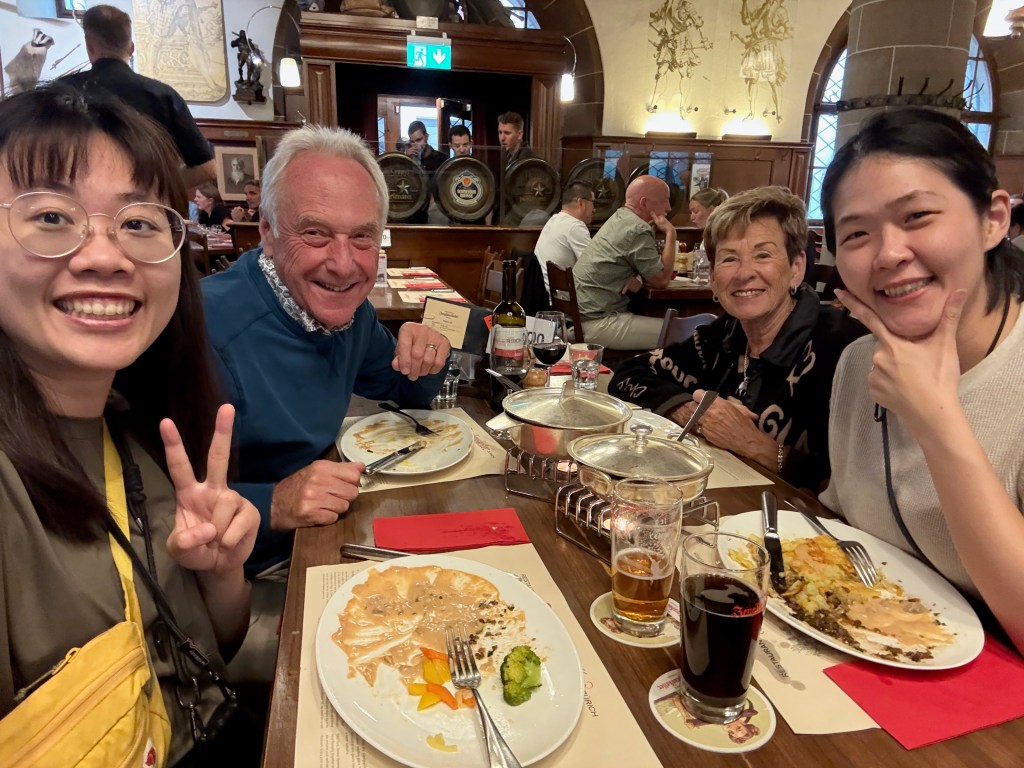
We enjoyed the Zurich-style ragout of veal and mushroom (Zurcher geschnetzeltes) with Rösti. Rösti is a traditional Swiss national dish of shredded and pan-fried potatoes, originally a breakfast food in the Canton of Bern that evolved into a versatile side dish or a main meal across Switzerland. It is a fried, crispy, golden-brown potato pancake.
Sunday, September 14
We had only enough coffee pods for one cup so Bill went below for two more coffees. They cost Can $18.90! Our plan was to walk the streets and visit places on the tour that interested us. As we walked the streets, we came on a small band playing near Fraumunster Church as part of a small group celebration.
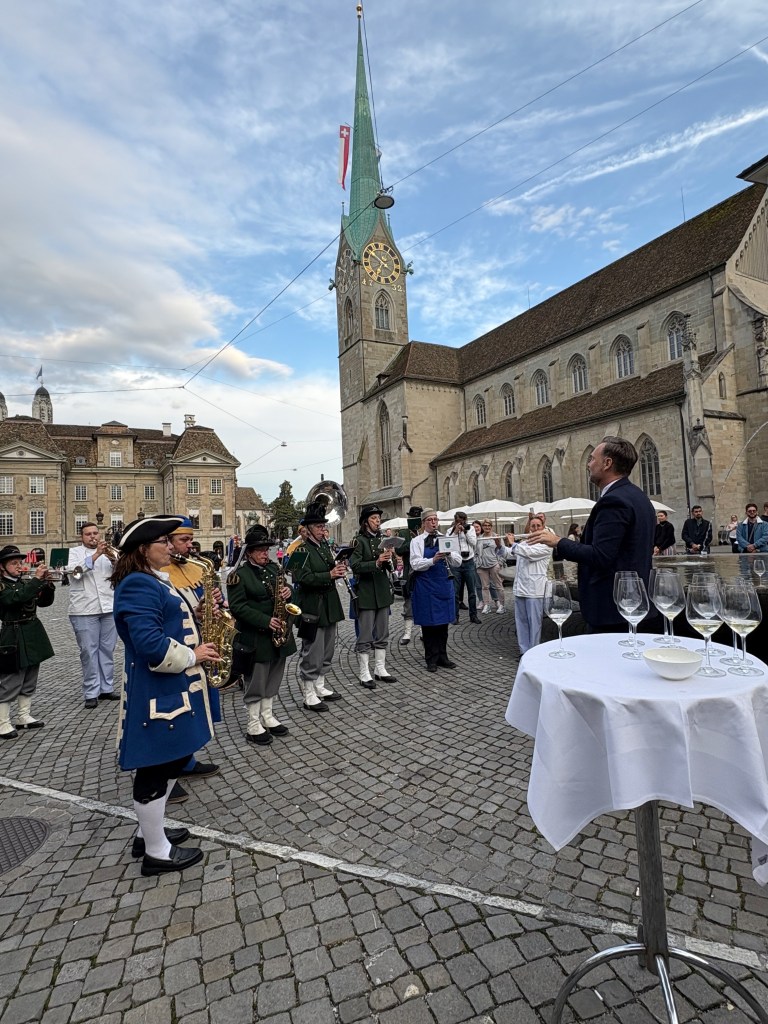
We walked the streets of the old town, window-shopping all the expensive shops: the many watch, clothing and jewellery shops which were closed on Sunday. The Bahnhofstrasse is one of the world’s most luxurious shopping streets, home to high-end boutiques, department stores, and watch shops.
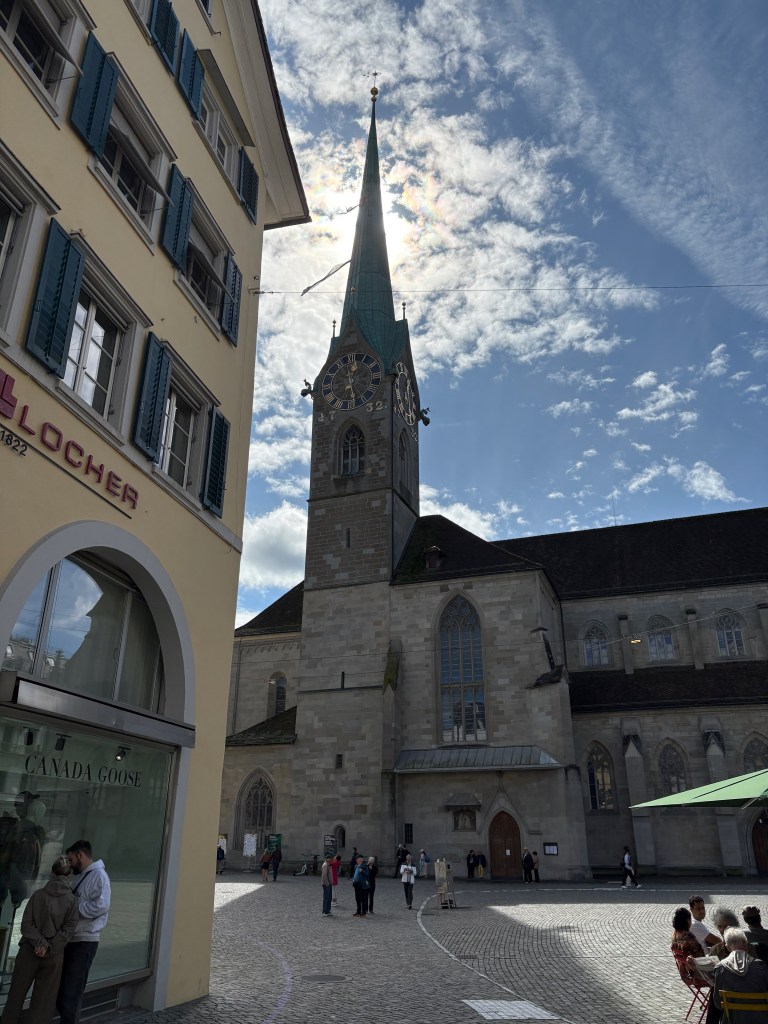
We entered the Fraumünster Abbey for a small fee, and found a lovely but fairly basic church to start (but we knew about the Chagall windows).
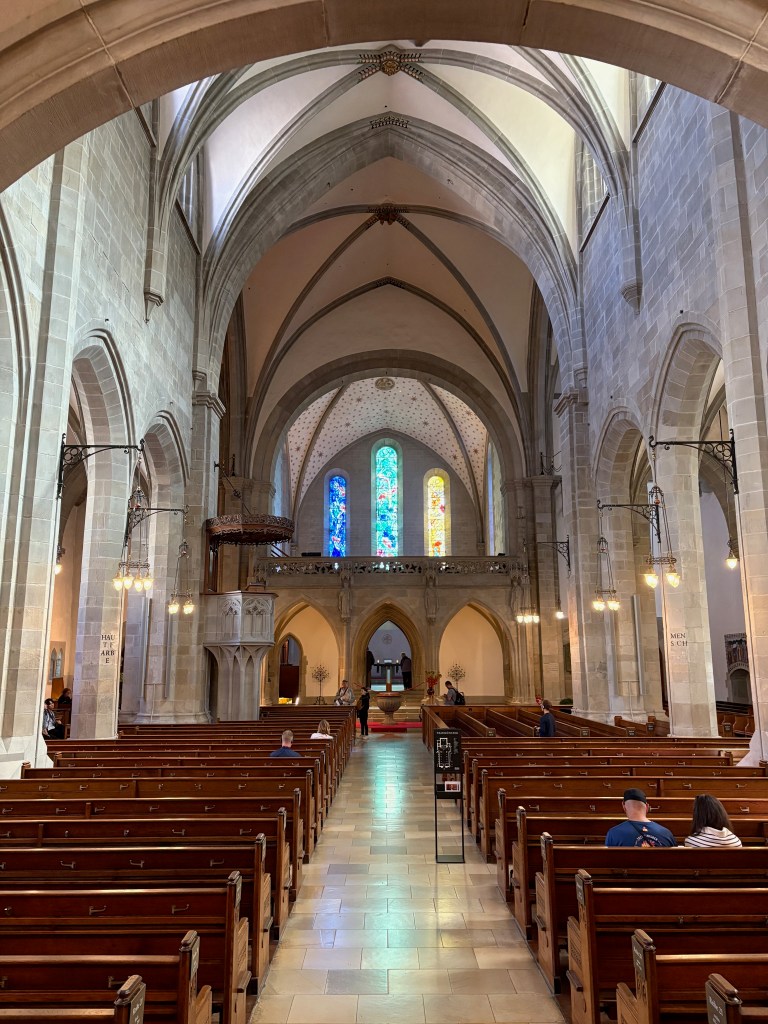
Then we found this three-part niche with lovely legend:
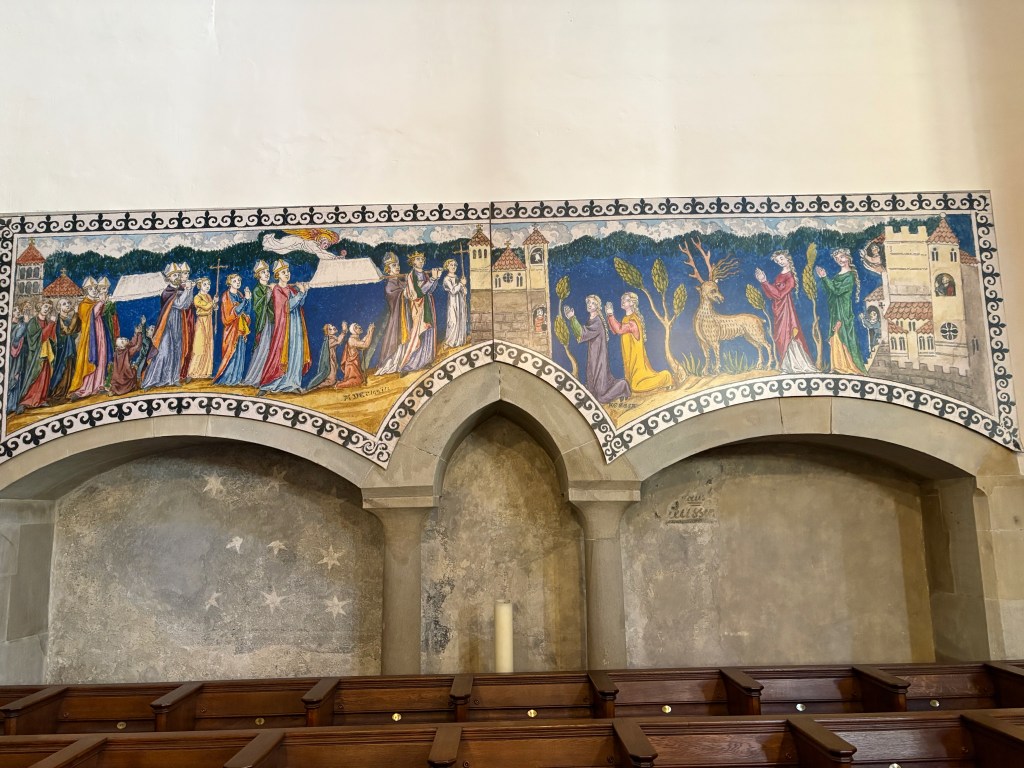
In 1272, in front of the three-part niche in the south wall of the transept, the bones of the daughters of King Louis the German, the two first abbesses Hildegard and Berta, were buried.
A fresco was painted above them around 1300, depicting the founding legend of the Fraumünster Abbey in the year 853. According to legend, the devout princesses Hildegard and Bertha followed a deer sent by God, carrying burning candles on its antlers. It led the sisters from their father’s castle to the place where Fraumünster was later to be built.
Then we came to the Marc Chagall’s windows. Marc Chagall (born in 1887 in Vitebsk, Belarus – died in 1985 in Saint-Paul-de-Vence, France) finished the multi-level, five-part cycle of windows for the choir of the Fraumünster in Zürich in 1970.
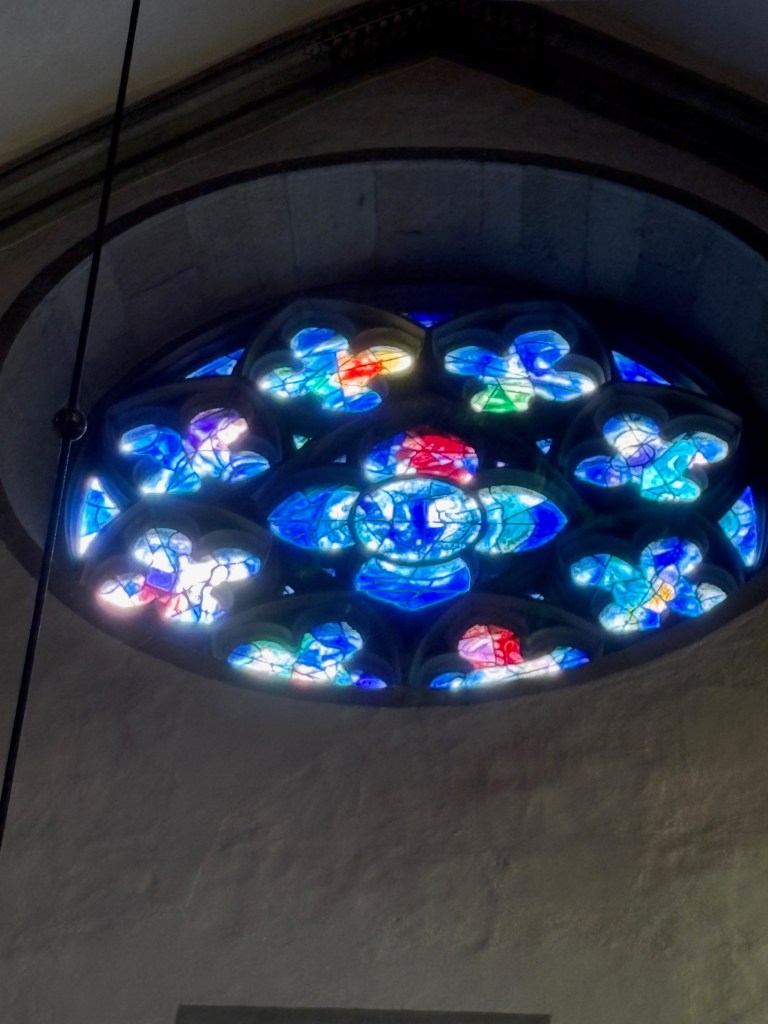
The rose window in the transept is added 8 years after the five windows. It depicts the Creation according to Genesis 1 and Genesis 6 to 9, while the center houses Noah’s Ark, symbolizing the salvation of creation. The windows are created in collaboration with the stained-glass manufacturer Charles Marq in Reims, France. Marc Chagall at 90 created another masterpiece, as a symbol of everlasting life and death,
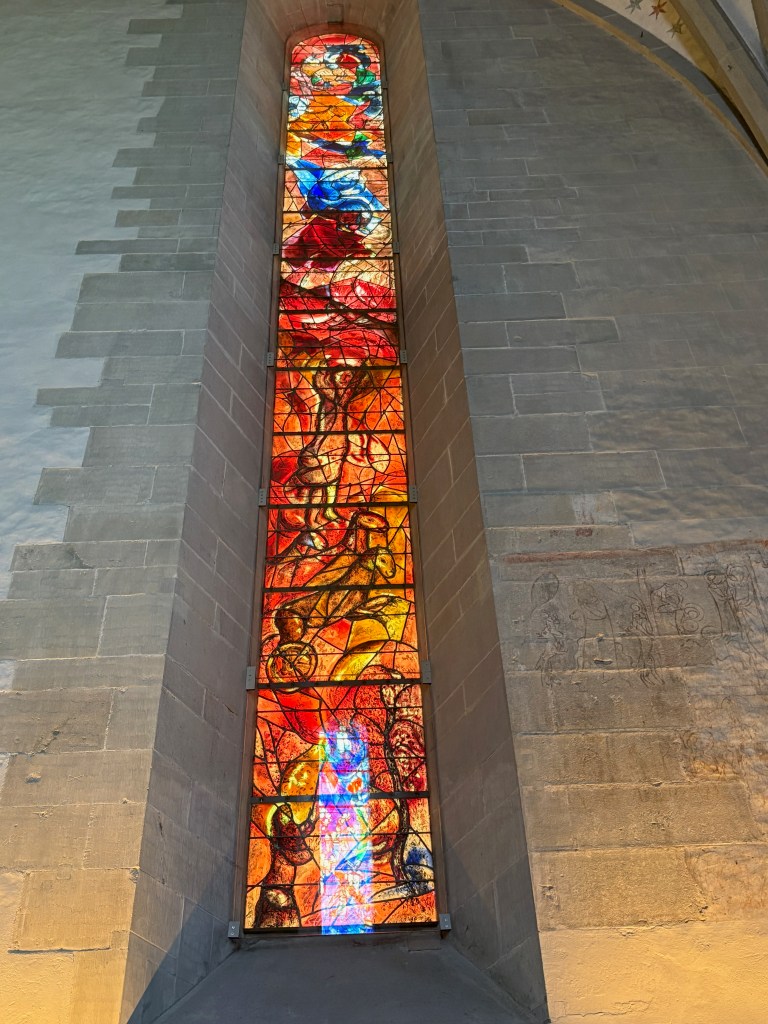
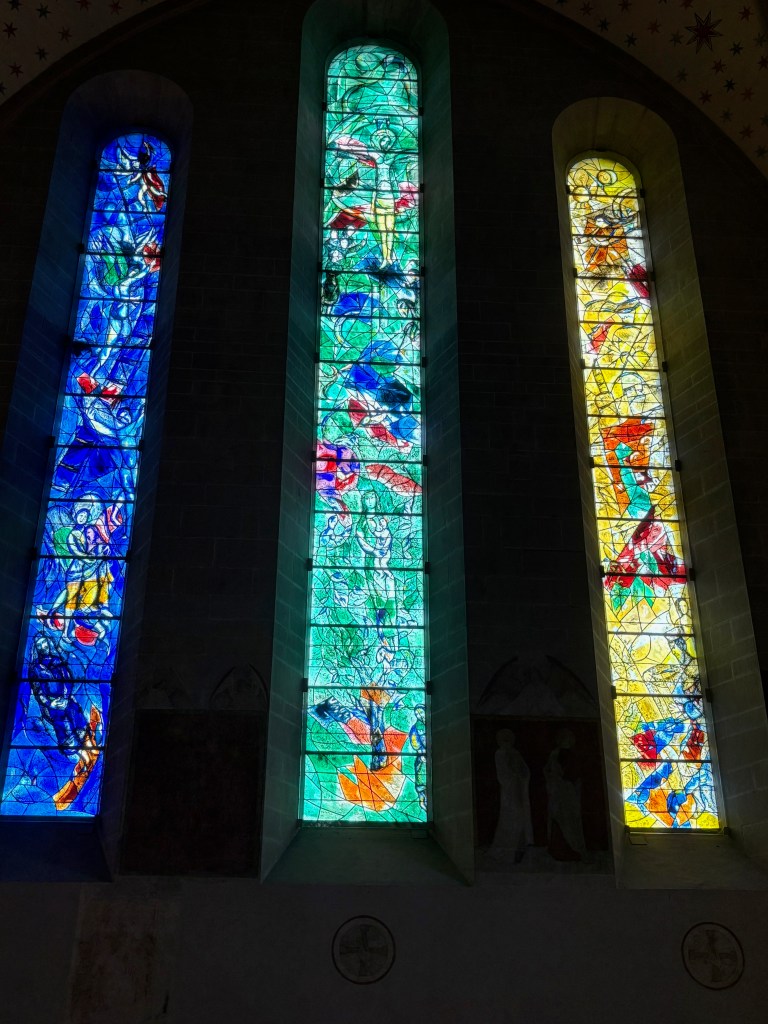
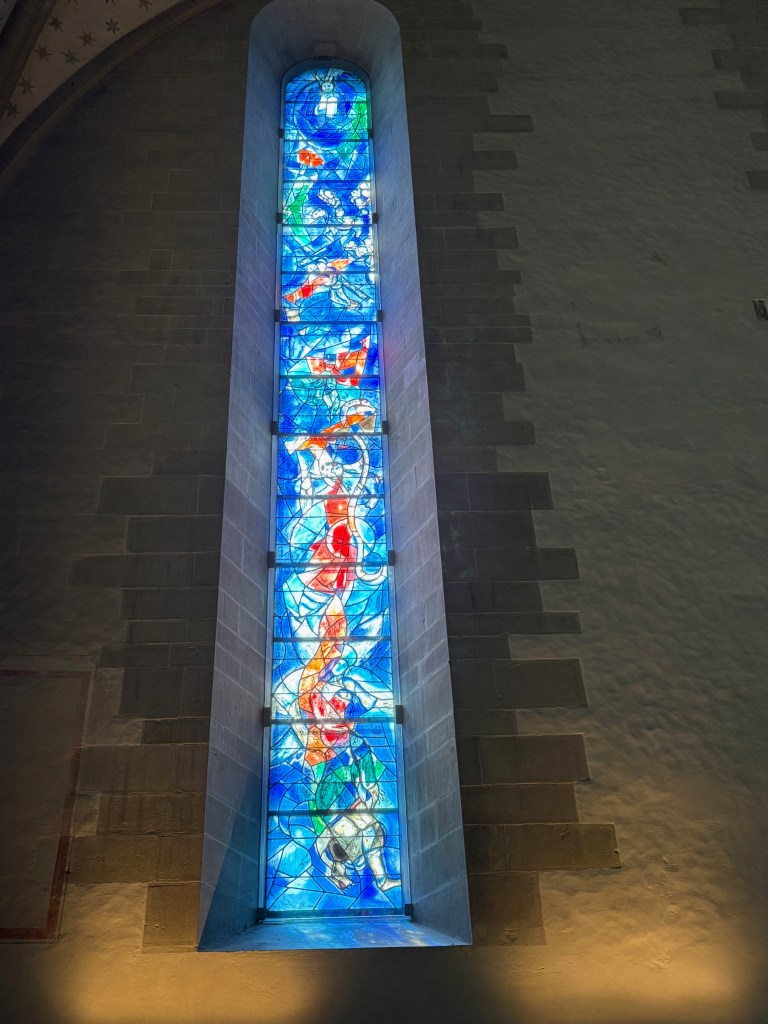
1 Window of the prophets
Elijah is being carried away in a fiery horse chariot to the sky, away from Elisha. The angel Cherub hovers in the middle. Above, Jeremiah is sitting immersed in thought in a blue gown.
In the round arch, the Creation is depicted.
2 Jacob window
Jacob hovers with eyes open and his hands folded on his lap. He dreams of the ladder leading to heaven, which makes up the upper part of the window. Jacob’s tussle with the angel is shown in between.
3Window of Christ
The life of Christ from birth to resurrection:
Joseph, the family tree of Jesse, the Lamb of God, Mary, Elisabeth, the life and parables of Jesus Christ and his crucifixion, among other aspects.
4 Window of Zion
An angel announces the beginning of the end of times. Below, the new Jerusalem descends from heaven. King David singing psalms and Bathsheba are shown at the bottom.
5 Window of the Commandments
Moses observes the disobedience and suffering of humanity. The middle part depicts absolute peace. Beneath, Isaiah is held by an angel.
He prepares to spread his message of peace to the world.
“He must have an angel in his head,” Pablo Picasso said of his fellow artist. The windows were inaugurated in the presence of the 83 -year-old in 1970.
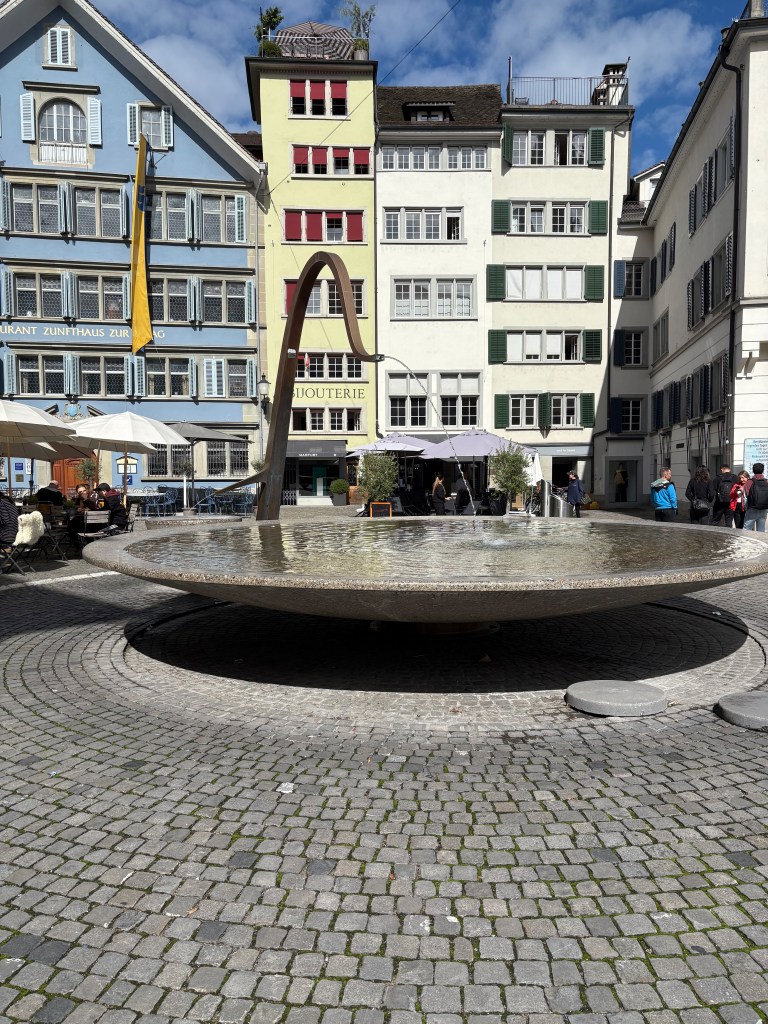
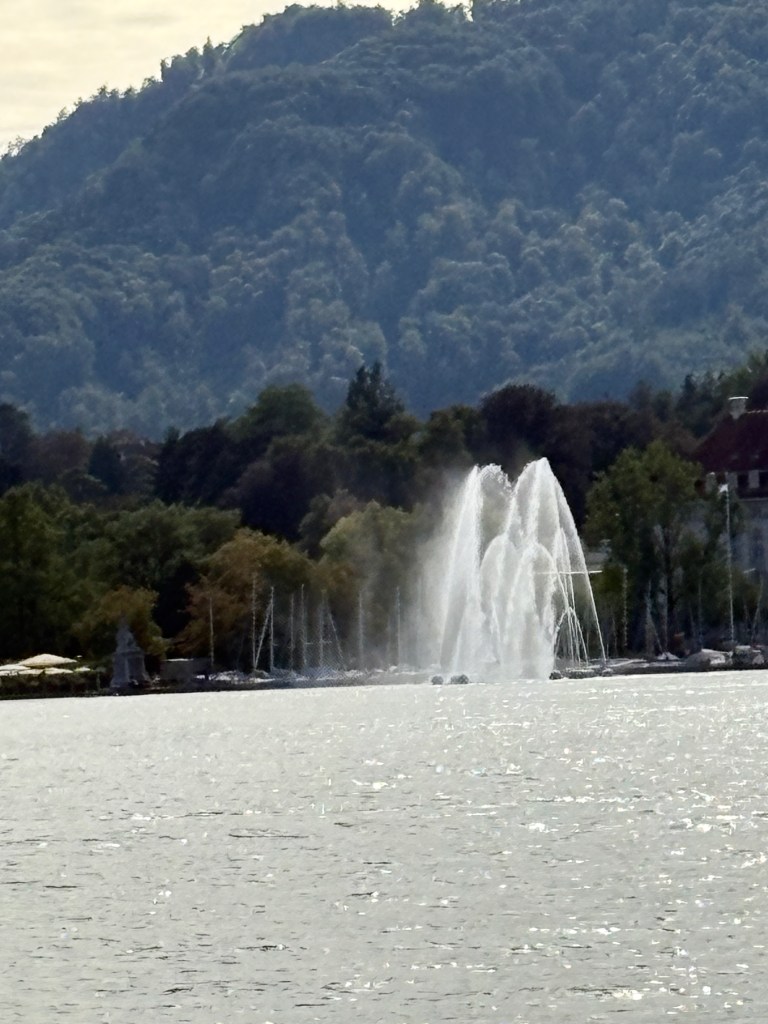
We walked down to Lake Zurich along the waterfront where families were enjoying the sunny day.
We had an early flight so we arranged for a taxi to take us to the airport at 5:00 am. Our Swissair flight was uneventful and we arrived at the condo around noon, bought some groceries and had a siesta.
Spain 2023
We did the usual things: beach, pool, sea, Rioja, Merluza, Mercadona. Plus, we enjoyed the company of local neighbours and sailing friends, Jo and Bruce.
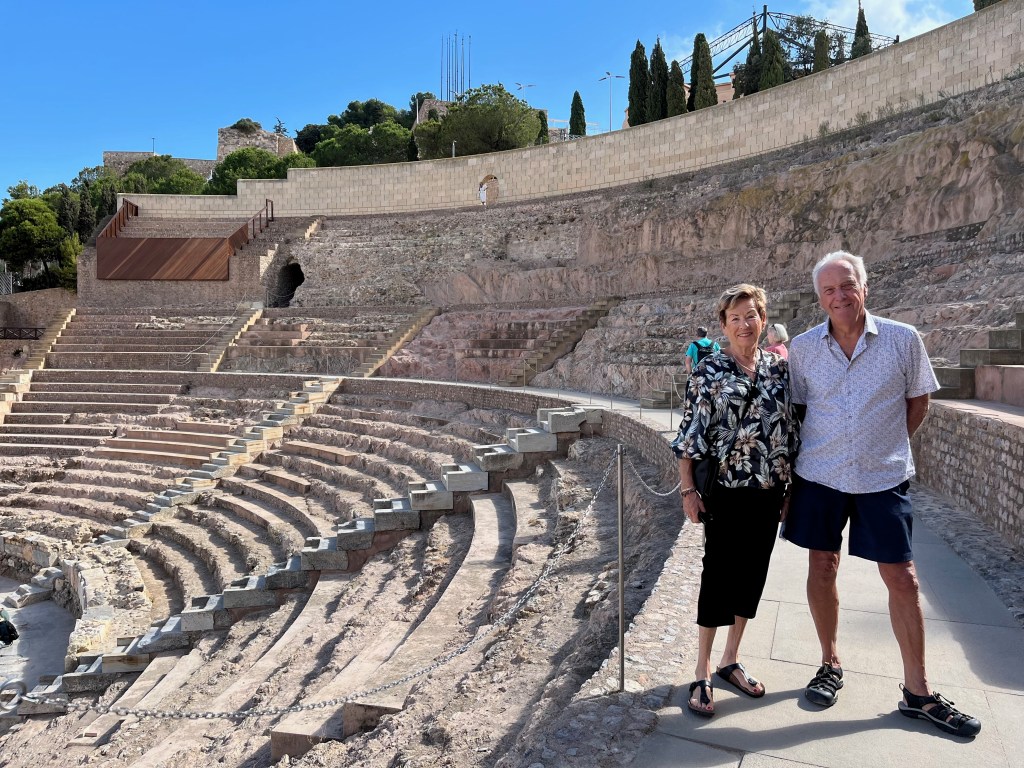
We visited Cartagena (we never tire of experiencing the amazing Roman amphitheatre), Guadalest and Alicante with Jo and Bruce.
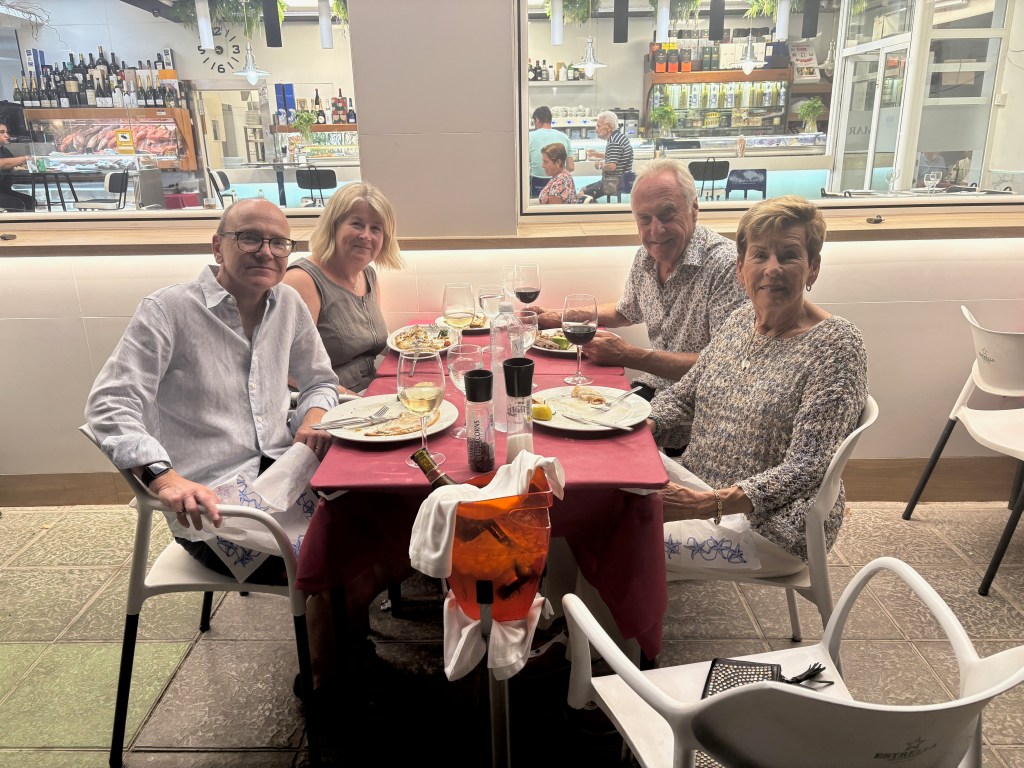
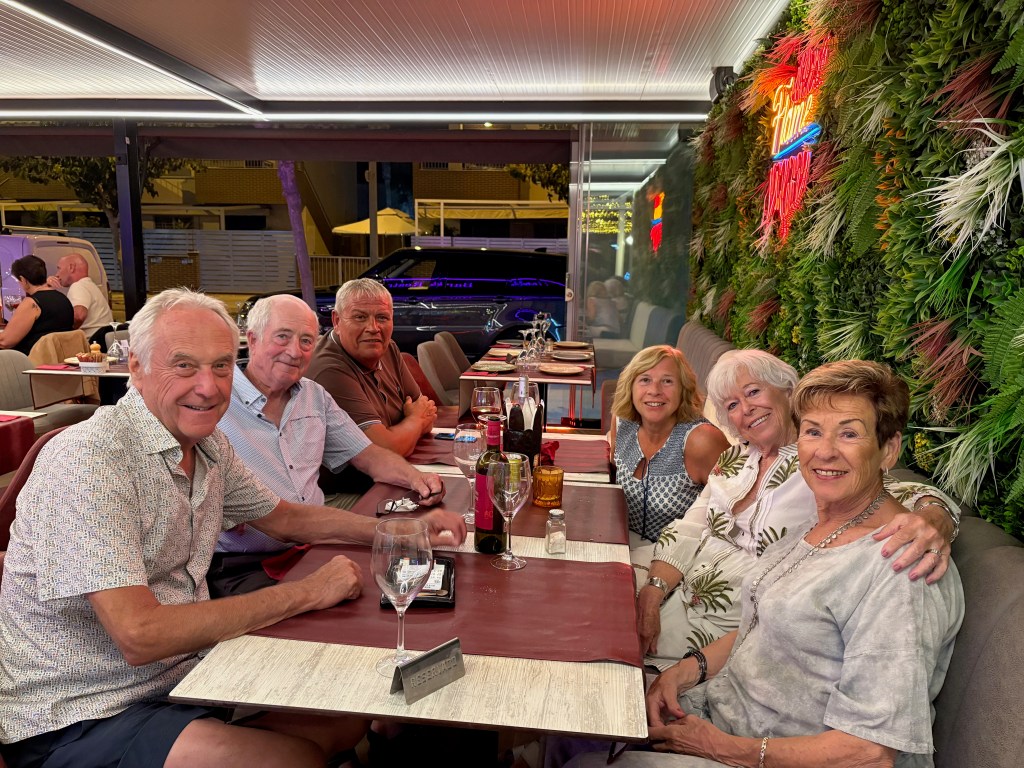
We had our first time at The Flame Restaurant in Nueva Plaza with our neighbours from Bristol, Andy and Jackie and Jo and Bruce. The food was very good.
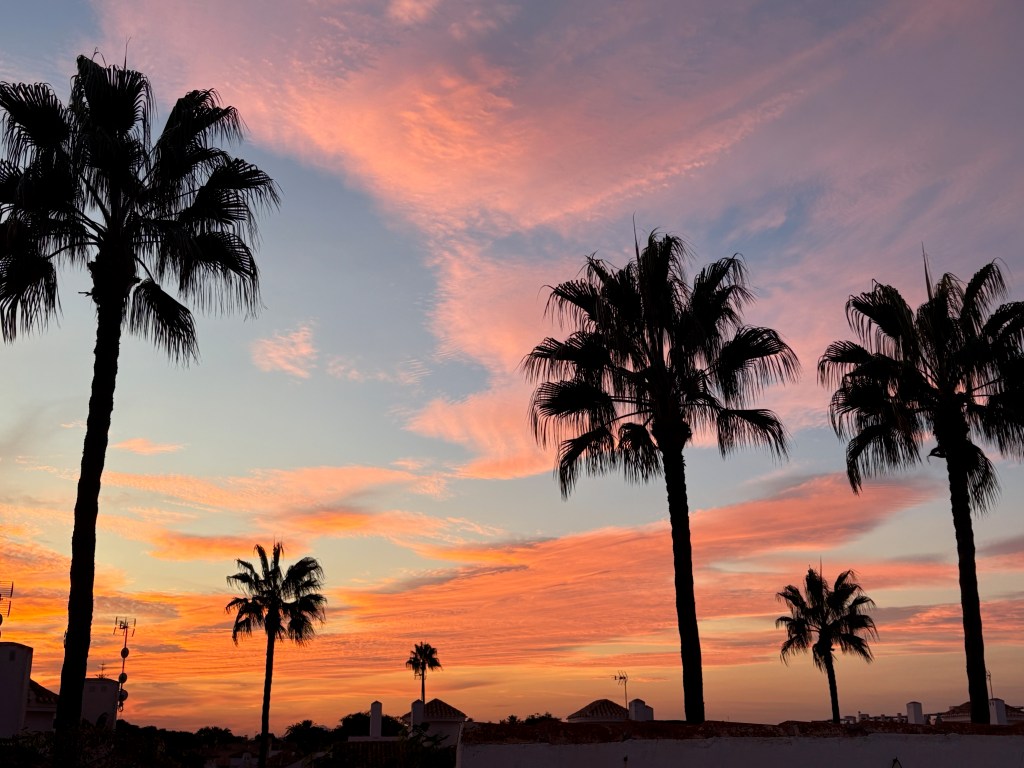
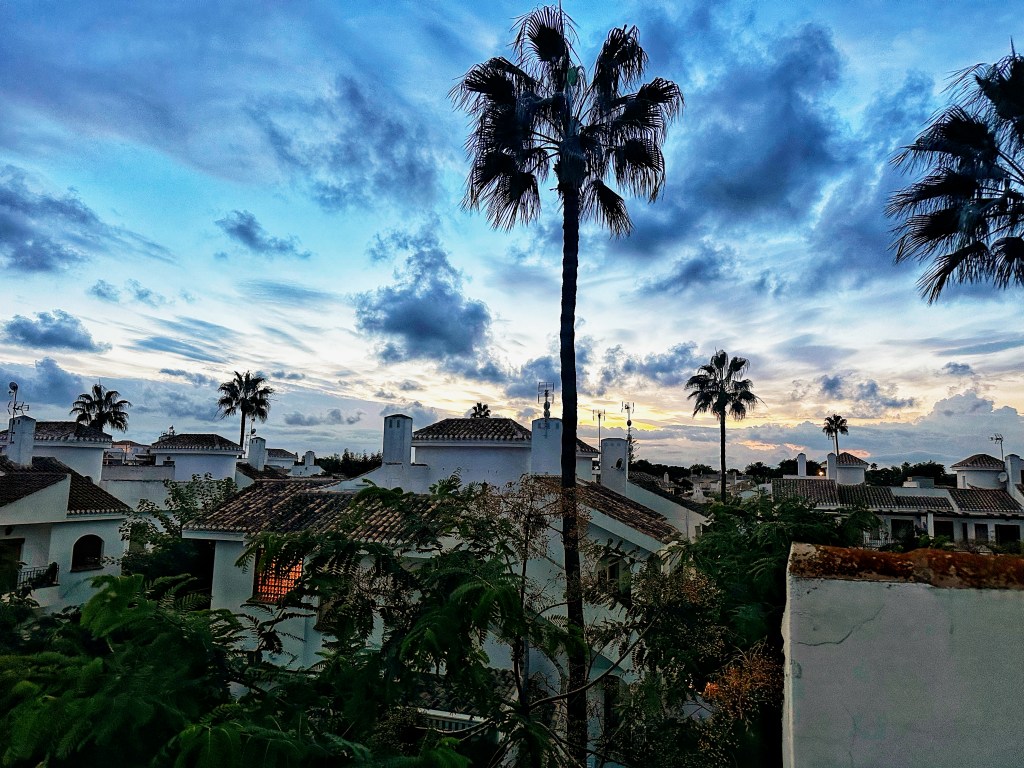
The sunsets are hard to beat.
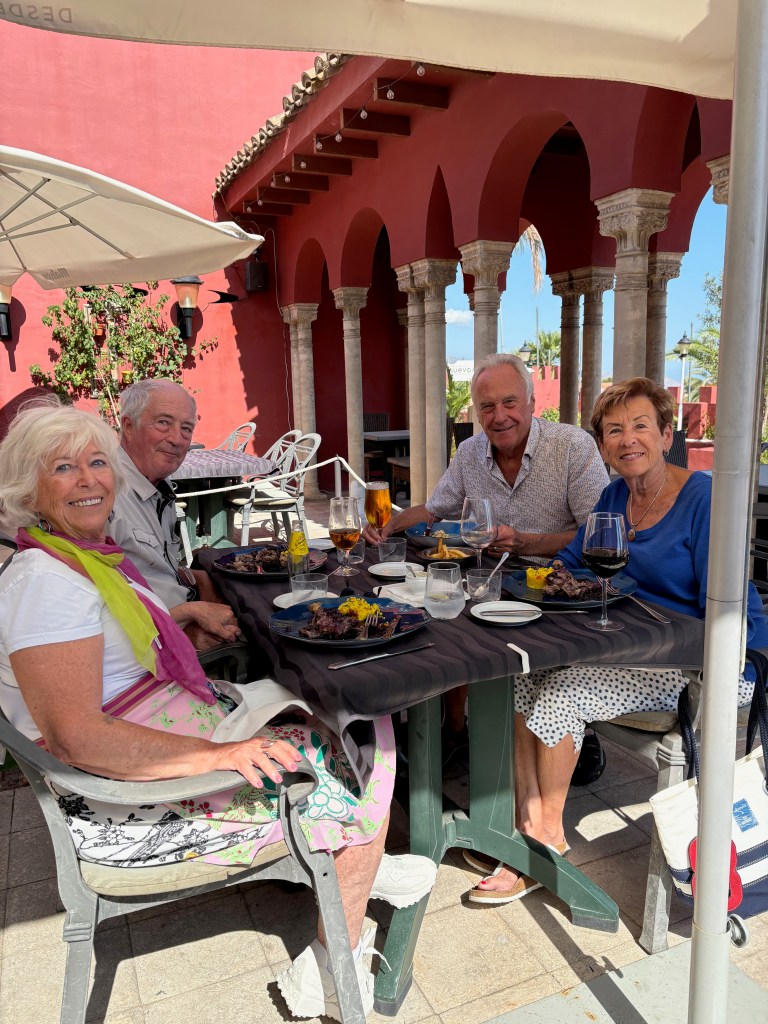
Guadalest is a challenging hike with its elevation but well worth it. We had a great Menu del Dia at Restaurante Nuevo Alcazar near Alicante on the way home.
Shannon came for 11 days and her friends, Tara and Jess stayed for 3 days after we left for Egypt.
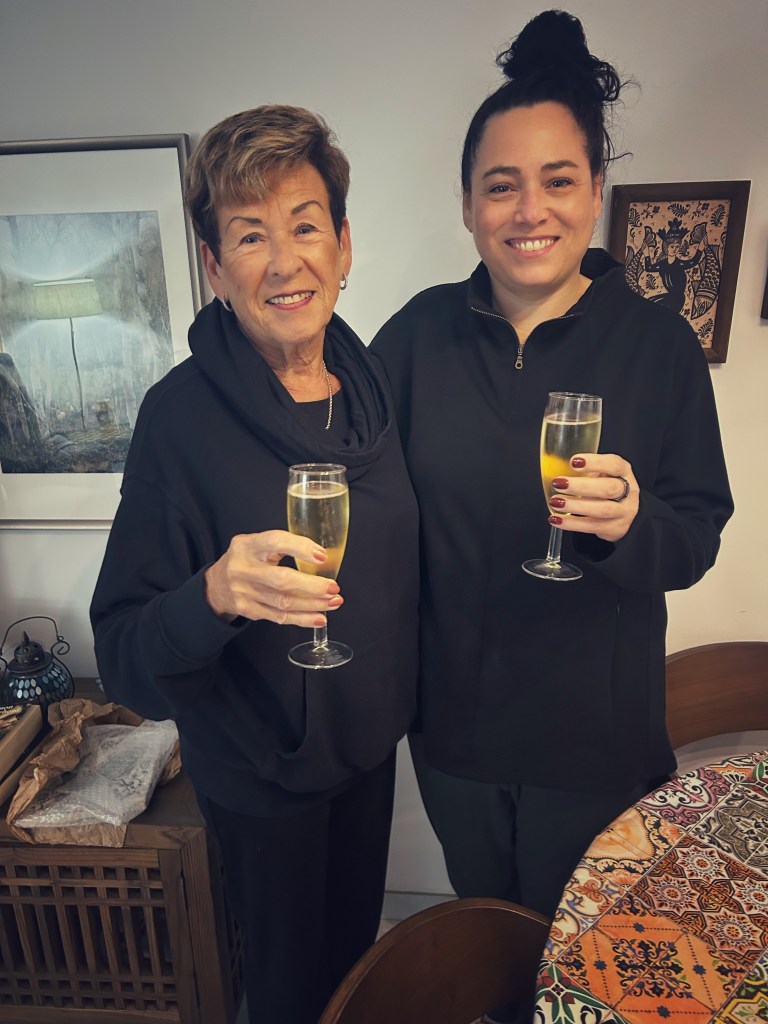
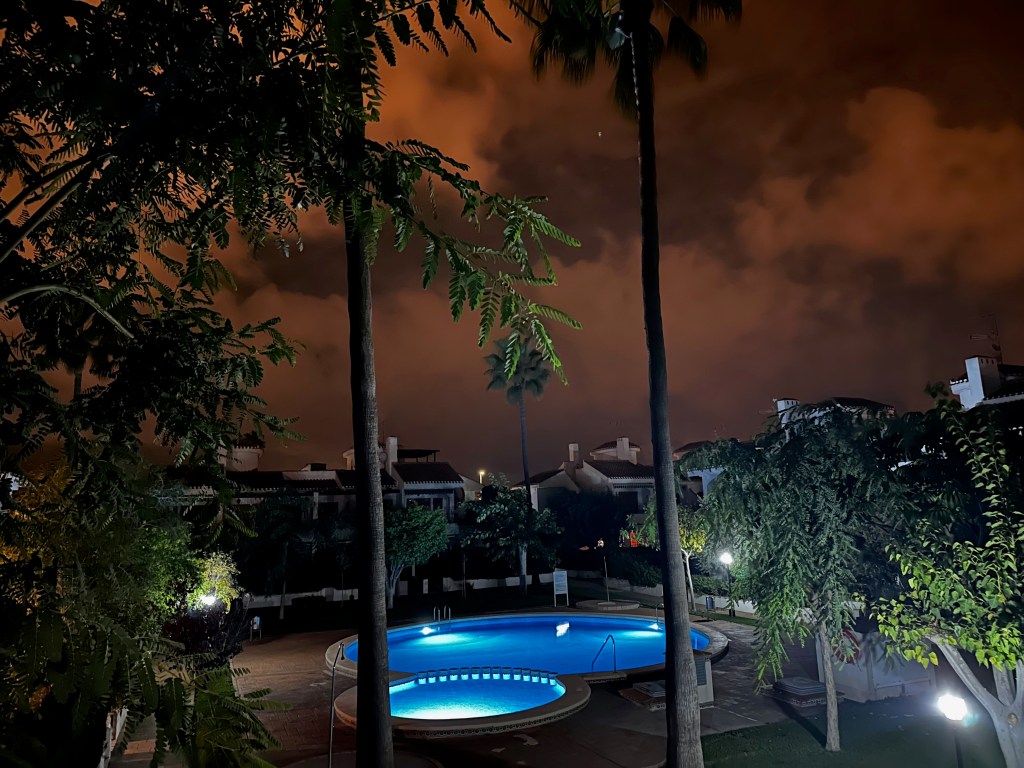
Two of Shannon’s photos of our special place.
EGYPT
Egypt October 15-28 (29): Craig Travel Tour plus one day in Alexandria
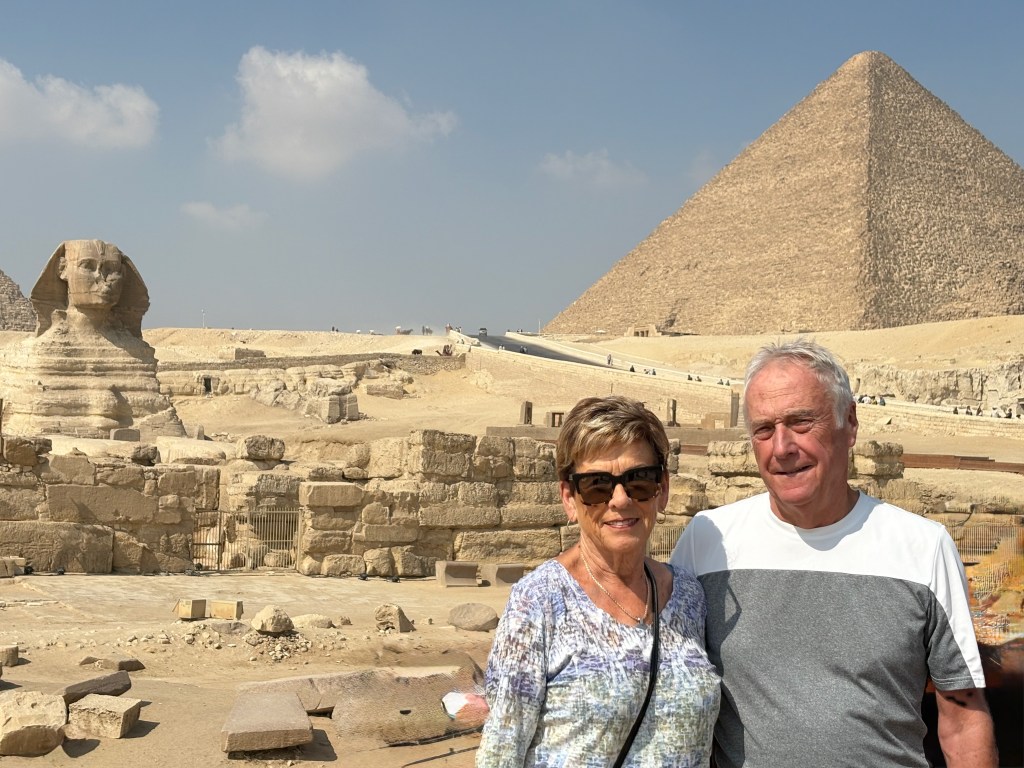
Egypt’s legendary civilization has left an indelible mark on the world, with its ancient wonders defying the sands of time. From the iconic Pyramids of Giza to the enigmatic Sphinx and the hidden tombs in the Valley of the Kings, each site revealed the ingenuity, beliefs, and complexity of this ancient world: all completely new to us.
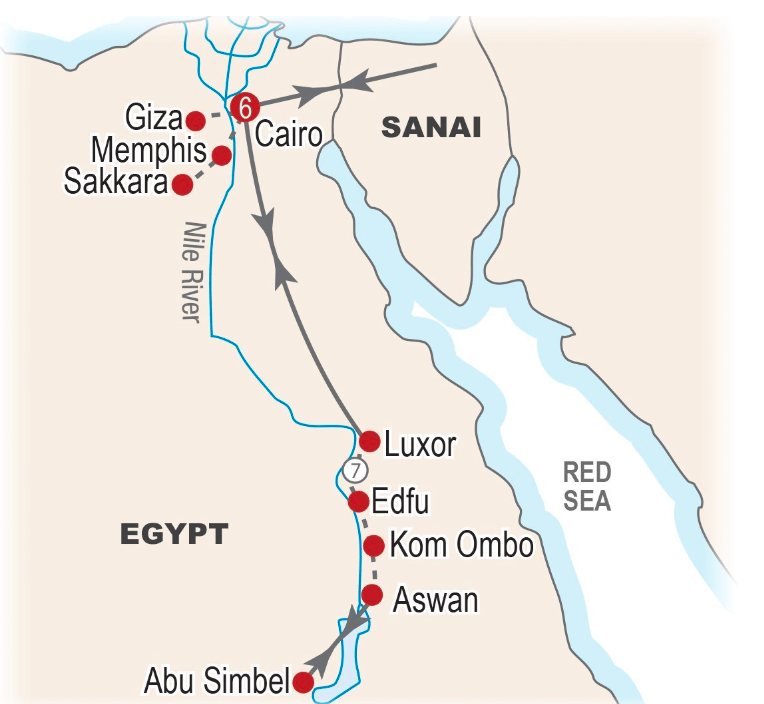
History of Ancient Egypt.
Ancient Egypt was a civilization that flourished along the Nile River for over 3,000 years, from about 3150 BC to 30 BC. Its history is typically divided into three main periods—the Old, Middle, and New Kingdoms—separated by intermediate periods of instability. The civilization was ruled by pharaohs and is renowned for its monumental architecture like the pyramids, advanced culture, and complex religious beliefs centred on the afterlife.
Key periods
Old Kingdom (c. 2685–2180 BC): Known as the “Age of the Pyramids,” this era saw the construction of monumental structures like the Great Pyramid of Giza.
Middle Kingdom (c. 2040–1670 BC): This period was marked by the unification of Egypt, an expanded army, and a booming economy.
New Kingdom (c. 1570–1080 BC): Considered a golden age, this was a time of great power, prosperity, and expansion, featuring famous pharaohs such as Tutankhamun and Ramses II.
Important aspects of Ancient Egypt
The Nile River: The civilization’s lifeblood, the Nile provided water, fertile soil from annual floods, and a crucial transportation route.
Pharaohs: The rulers of Egypt, who were considered divine intermediaries between the gods and people.
Religion and the Afterlife: A pantheon of gods was worshipped, and a strong belief in an afterlife led to practices like mummification and the burial of the dead with treasures in elaborate tombs.
Hieroglyphics: Ancient Egyptians developed a complex writing system using hieroglyphs, which were used to record history, religion, and daily life on papyrus and stone.
Journey Leader
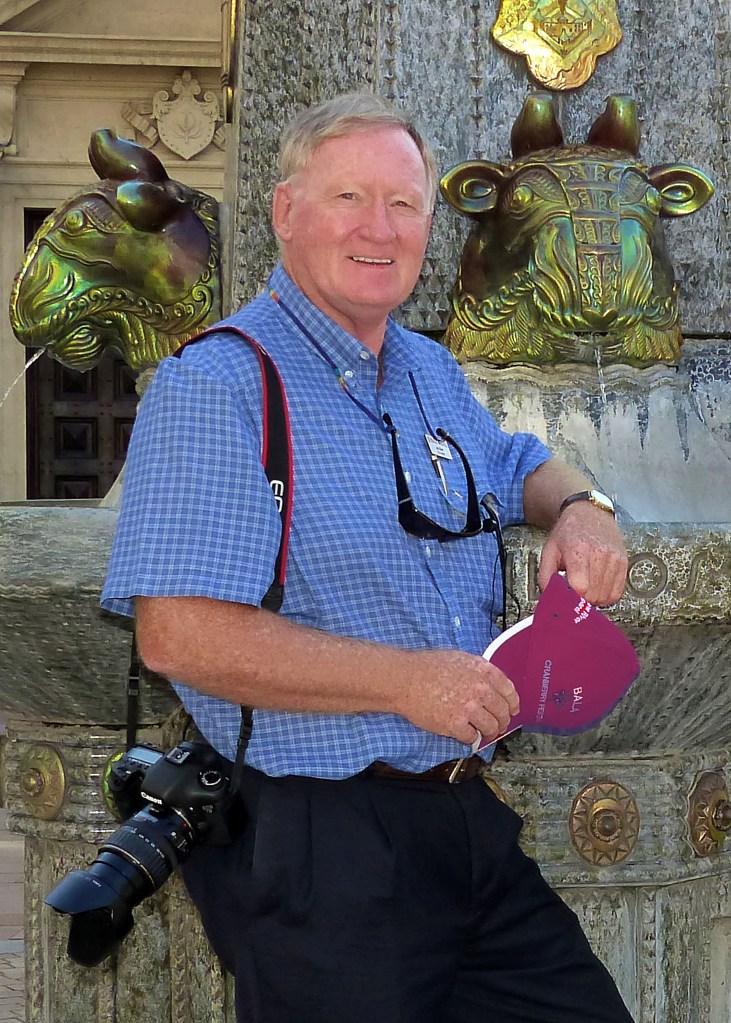
Award-winning photographer Jon Gurr led this tour. Over the past 40 years, Jon photographed scenery in over 80 countries and on all seven continents. His images have appeared in newspapers, magazines, and calendars in both the US and Canada. In addition to running a successful photography studio for nearly two decades, Jon served as a Professor of Photography at Humber College and as Principal of the Master School of Photography.
OCT 15, Wednesday CAIRO
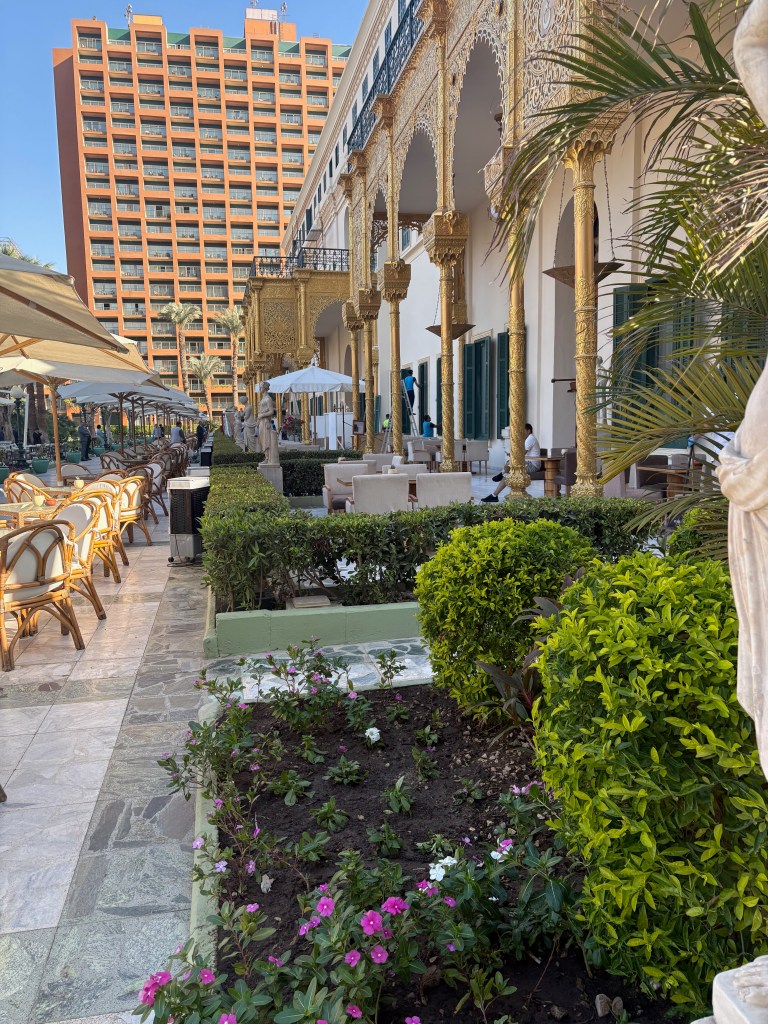
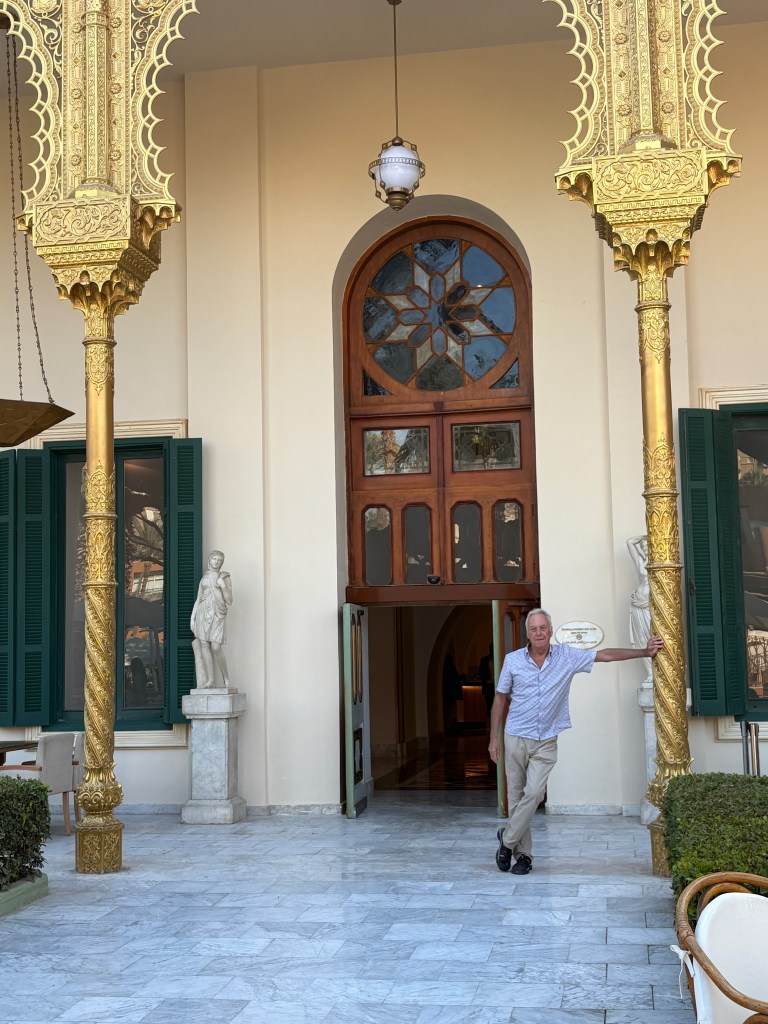
Upon arriving in Cairo from Alicante via Madrid this evening, we took a taxi to our hotel downtown Cairo: Cairo Marriott Hotel and Casino. It was late so we went straight to bed after informing Jon of our arrival. In the morning we took a few photos of the hotel, originally a palace, now owned by the government but run by Marriott Hotels and responsible for its maintenance. It was expanded to accommodate the dignitaries attending the reopening in 1889 of the Suez Canal. Our Nile-view room was listed as $US 1300!!!
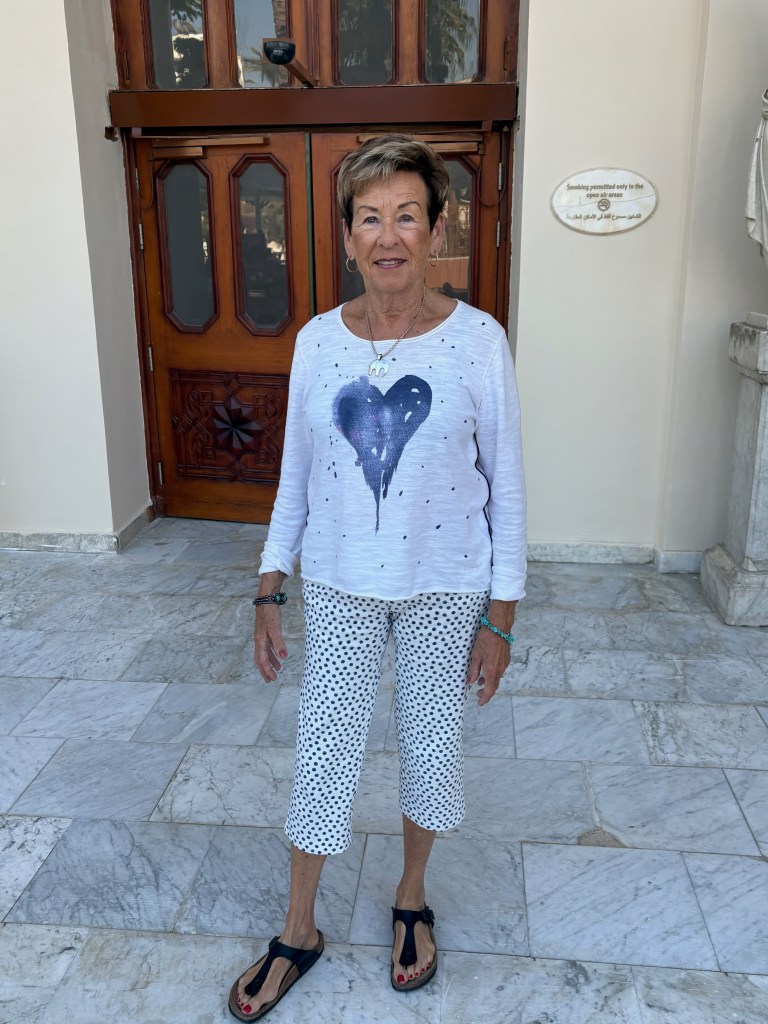
OCT 16, Thursday CAIRO
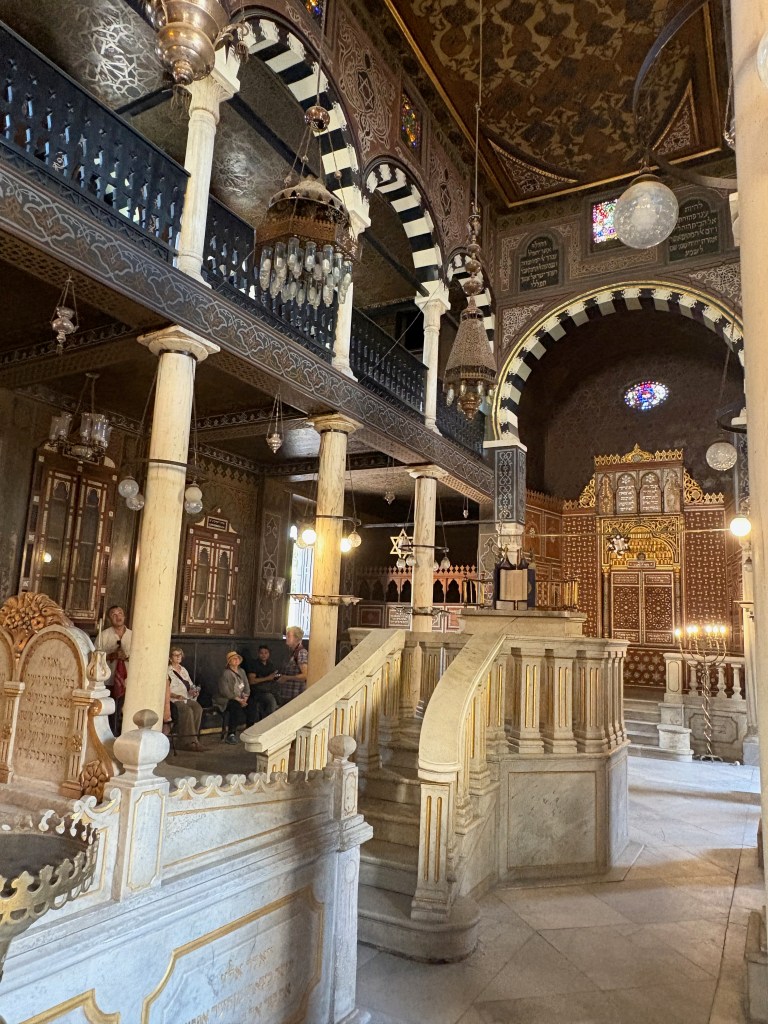
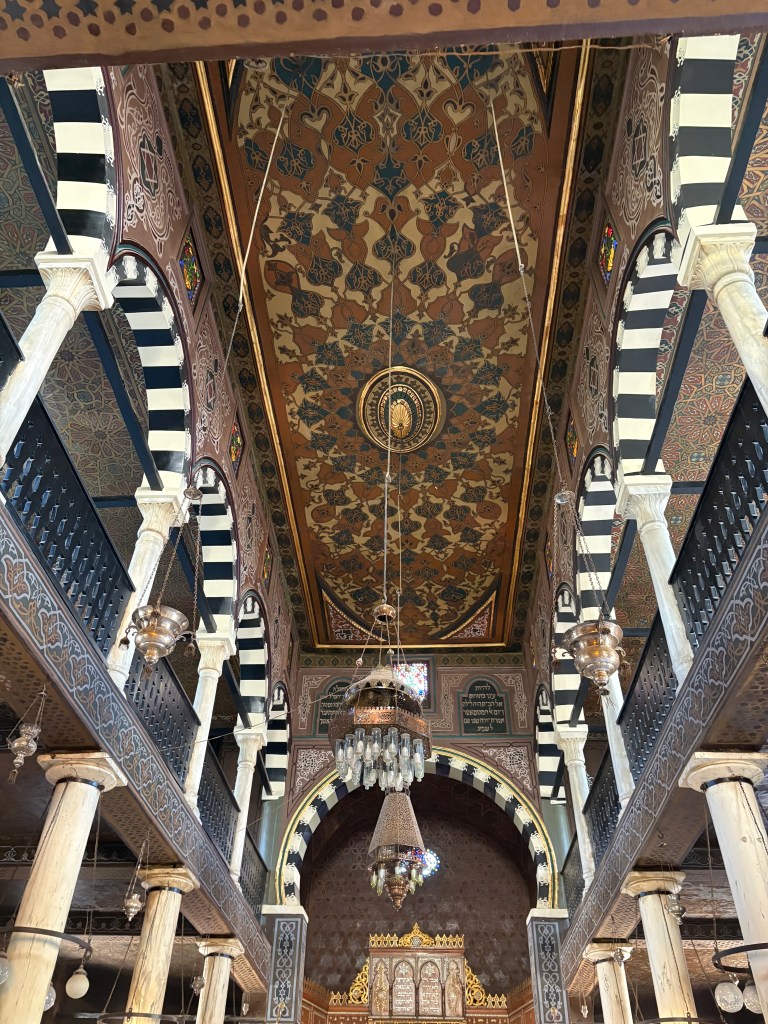
Our day started with visiting one of the oldest Synagogues in Egypt, Ben ‘Ezra Synagogue. Built in 12th century, and rebuilt during the late 19th century.
The synagogue’s plan, that of a typical Basilica, consists of three sections–three porticos with the central one being the largest. It contains two levels, the lower used by the men while the upper level is allocated to the women.
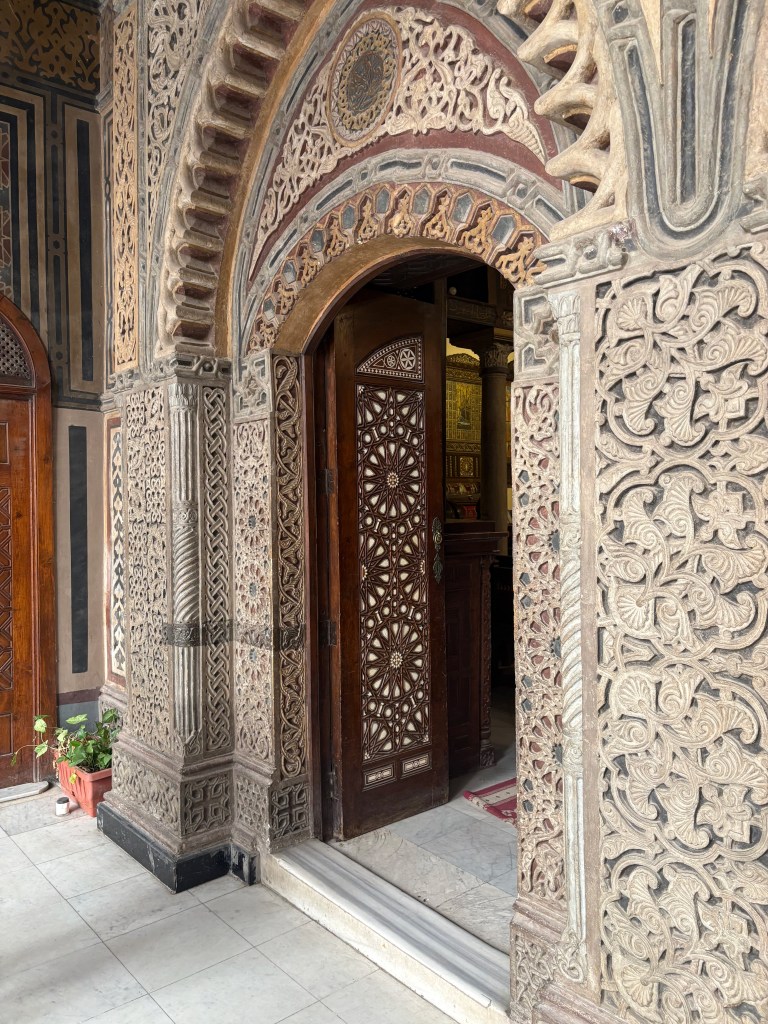
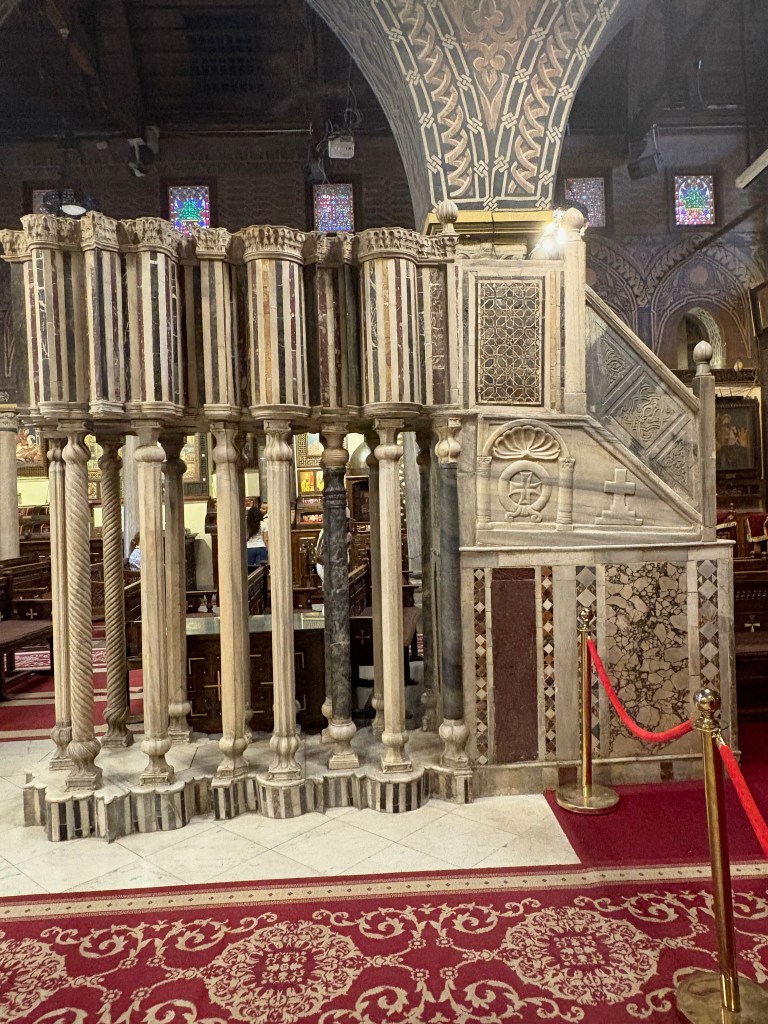
We explored two Coptic (Christian) Churches: Abu Serga Church, and the El Mouallaga (Hanging) Church.
Tradition holds that Abu Serga or Saints Sergius and Bacchus Church was built on the spot where the Holy Family (Joseph, Mary and the infant Jesus) rested at the end of their journey into Egypt.
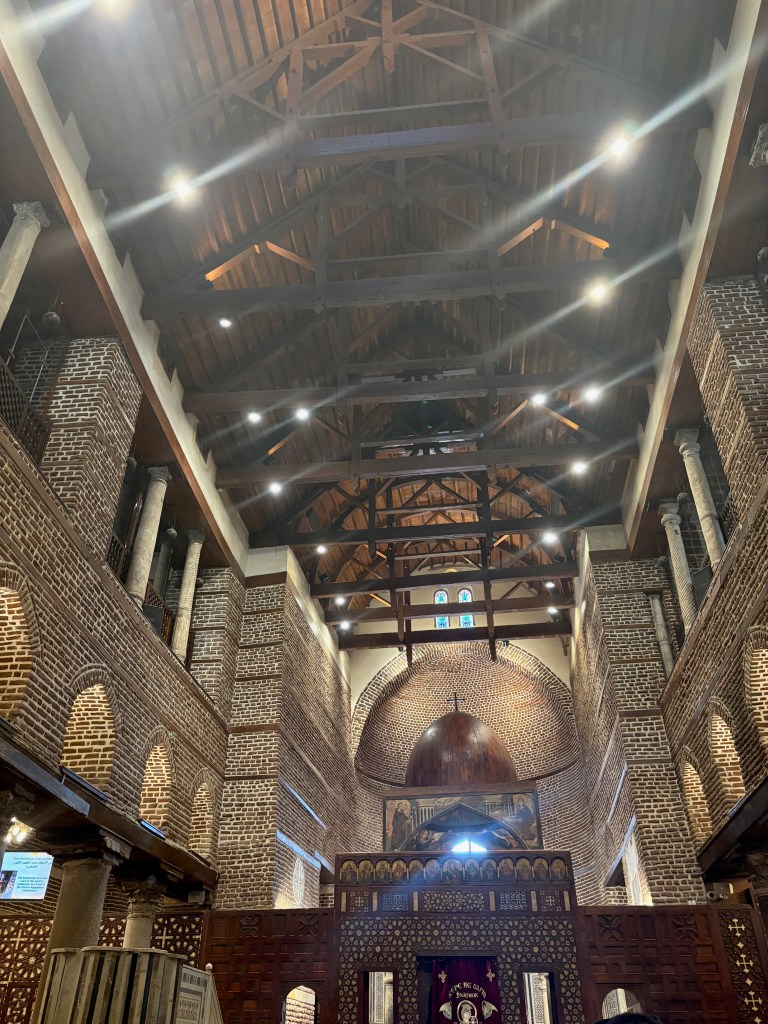
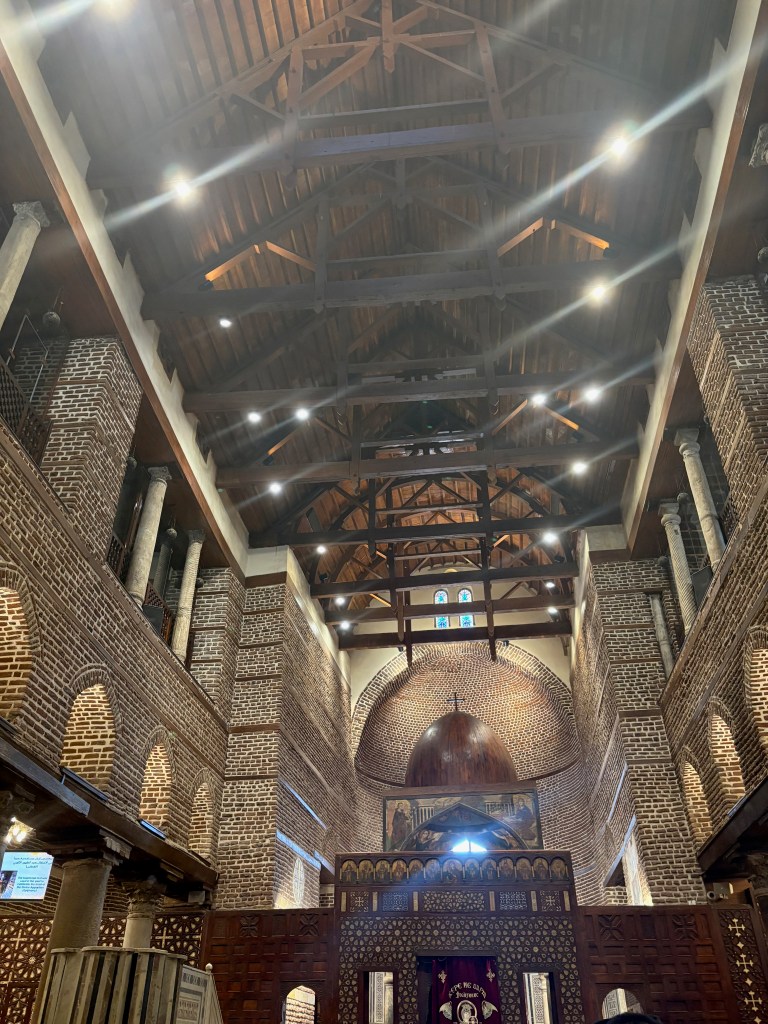
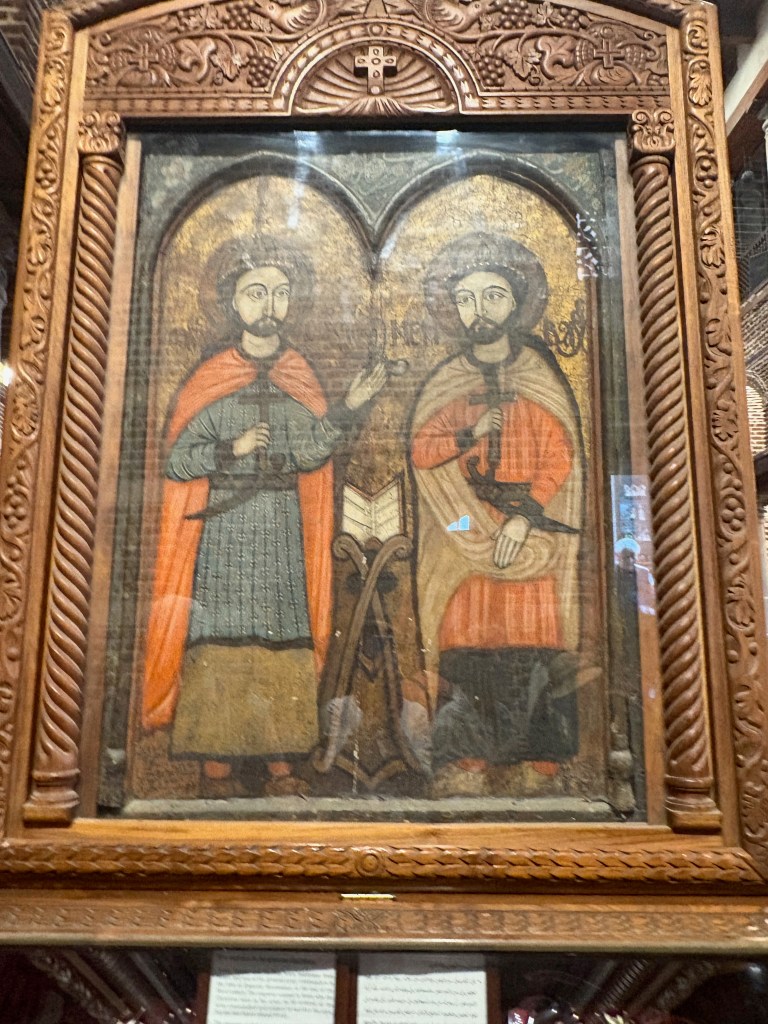
The church is dedicated to Sergius and Bacchus, who were soldier-saints martyred during the 4th century in Syria by the Roman Emperor Maximian.
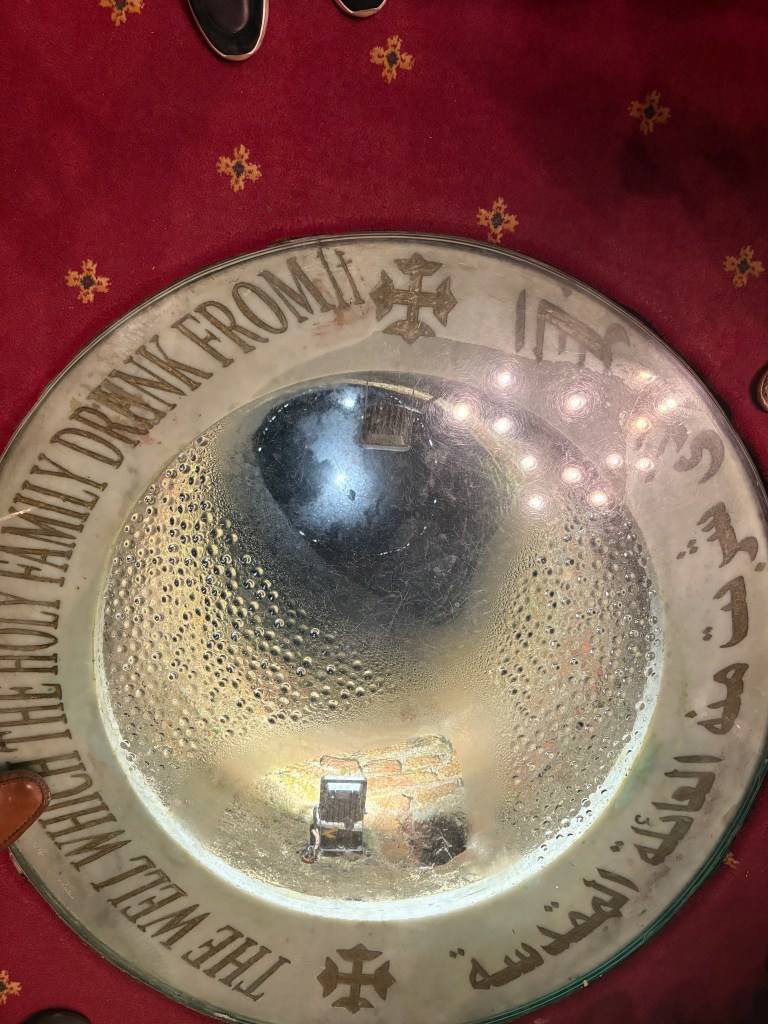
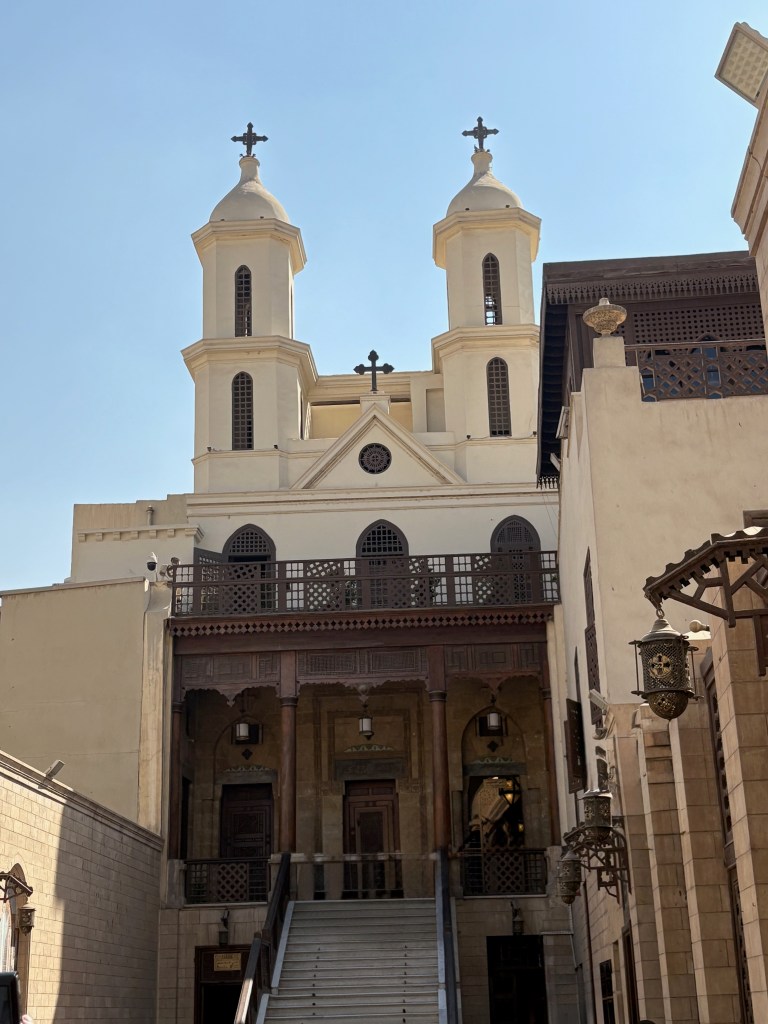
Then we visited the Hanging Church. The Hanging Church is also referred to as the Suspended Church or Al-Moallaqa. It is called the Hanging Church because it was built on the southern gate of the Roman Fortress. Logs of palm trees and layers of stones were constructed above the ruins of the Roman fortress to be used as a fundament.
In Islamic Cairo, we visited Saladin’s 12th-century Citadel. Sprawling over a limestone spur on the city’s eastern edge, the Citadel, started by Saladin in 1176 as a fortification against the Crusaders, was home to Egypt’s rulers for 700 years. Following the overthrow of Saladin’s dynasty, the Mamluks enlarged the complex, adding sumptuous palaces and harems. Under the Ottomans (1517–1798) the fortress expanded westward and a new main gate was added.
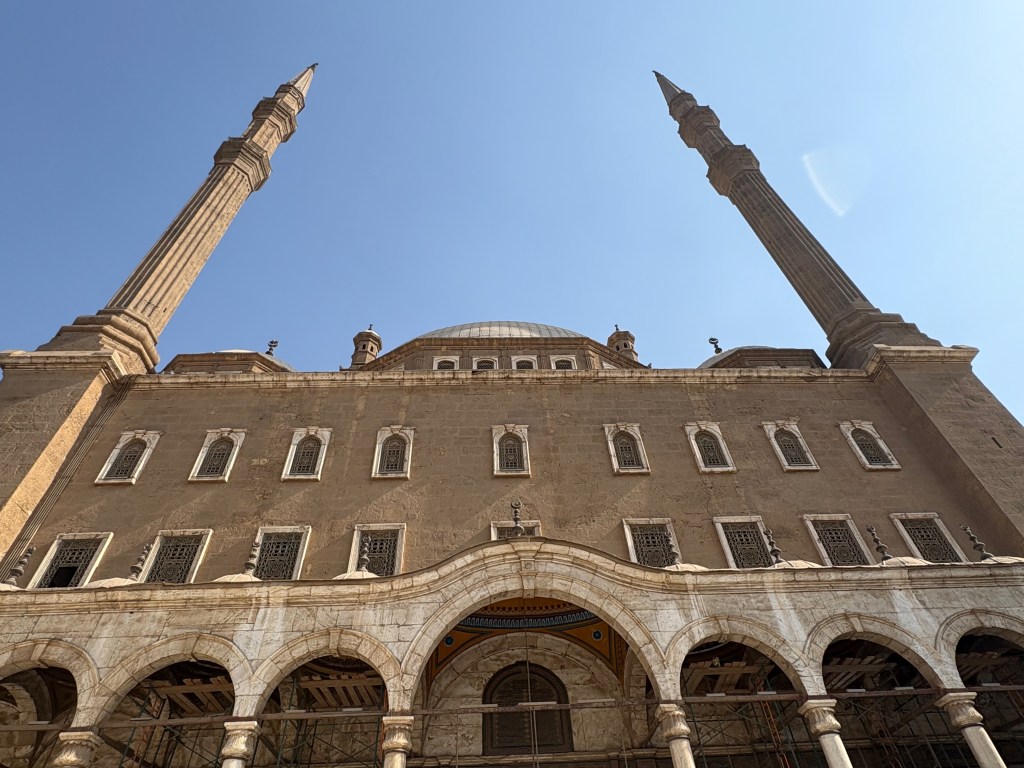
Mohammed Ali, known as the “father of modern Egypt”, who rose to power after the French drastically remodelled the Citadel, crowned the complex with the Ottoman-style mosque (1830-48), which intentionally resembles Hagia Sophia in Istanbul and dominates Cairo’s eastern skyline. Ali was a prolific builder responsible for many public works – and one of Egypt’s greatest sultans who saw his country grow as a political power. To get rid of his enemies, Muhammad Ali (an Albanian mercenary) invited the unruly Mamluk leaders to a banquet at the Citadel and had them all shot down.
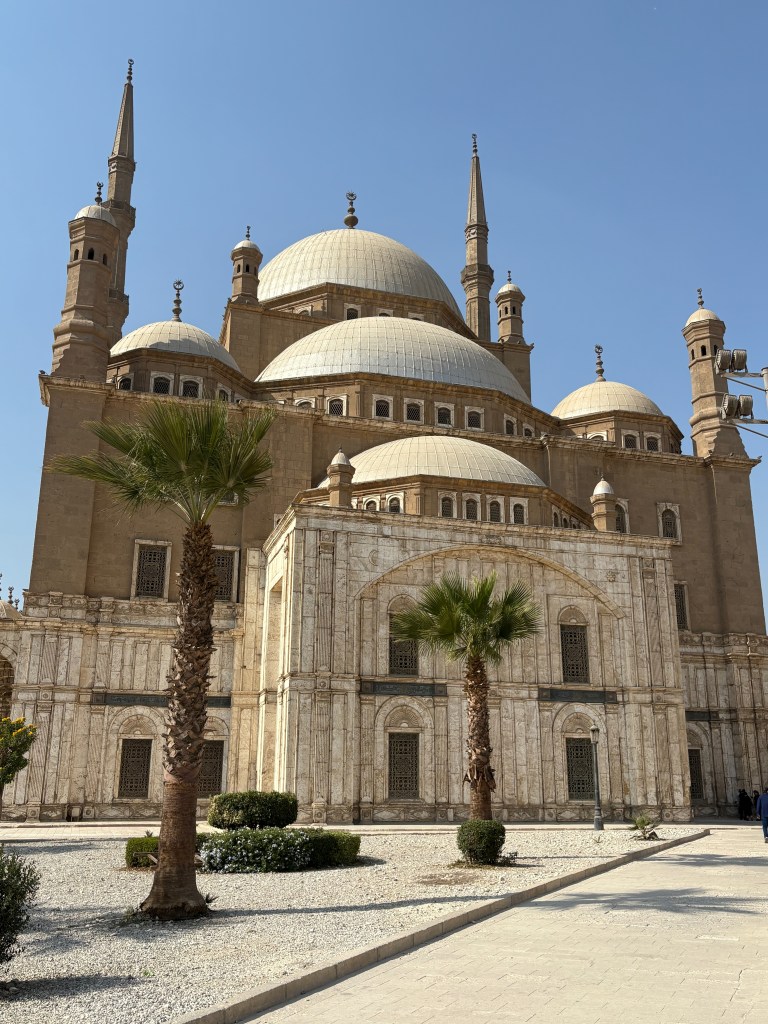
The interior is impressive. It is also known as The Alabaster Mosque as its interior and exterior walls are amazingly coated with alabaster. The inner courtyard is simple but magical as you step into a royal palace.
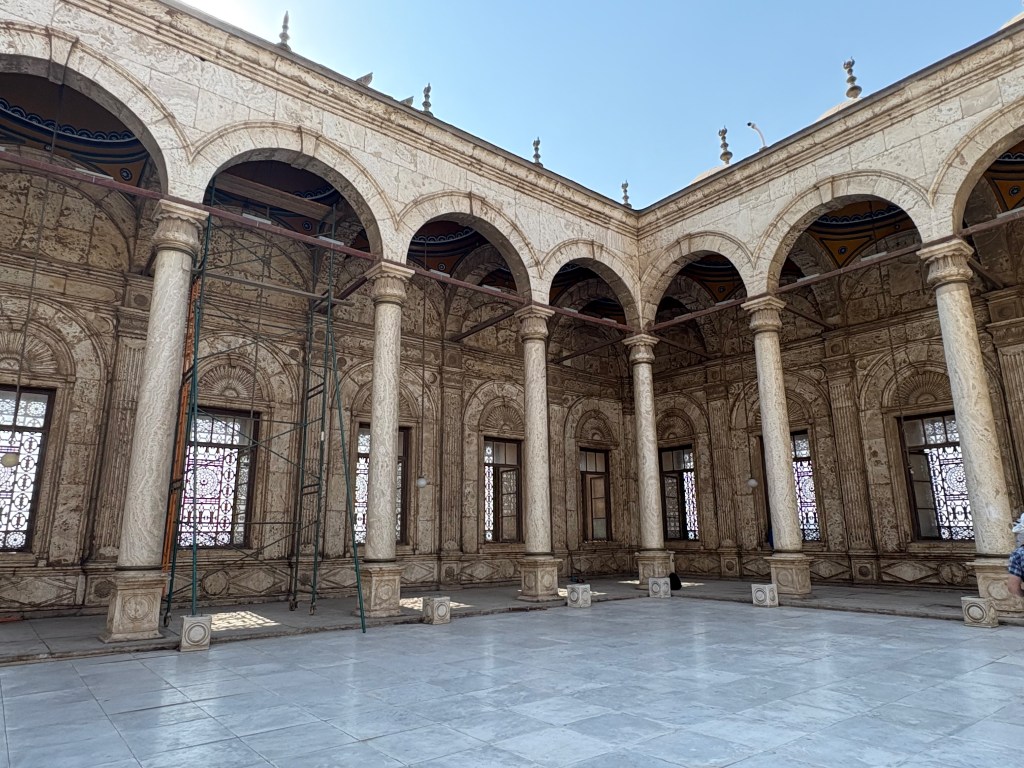
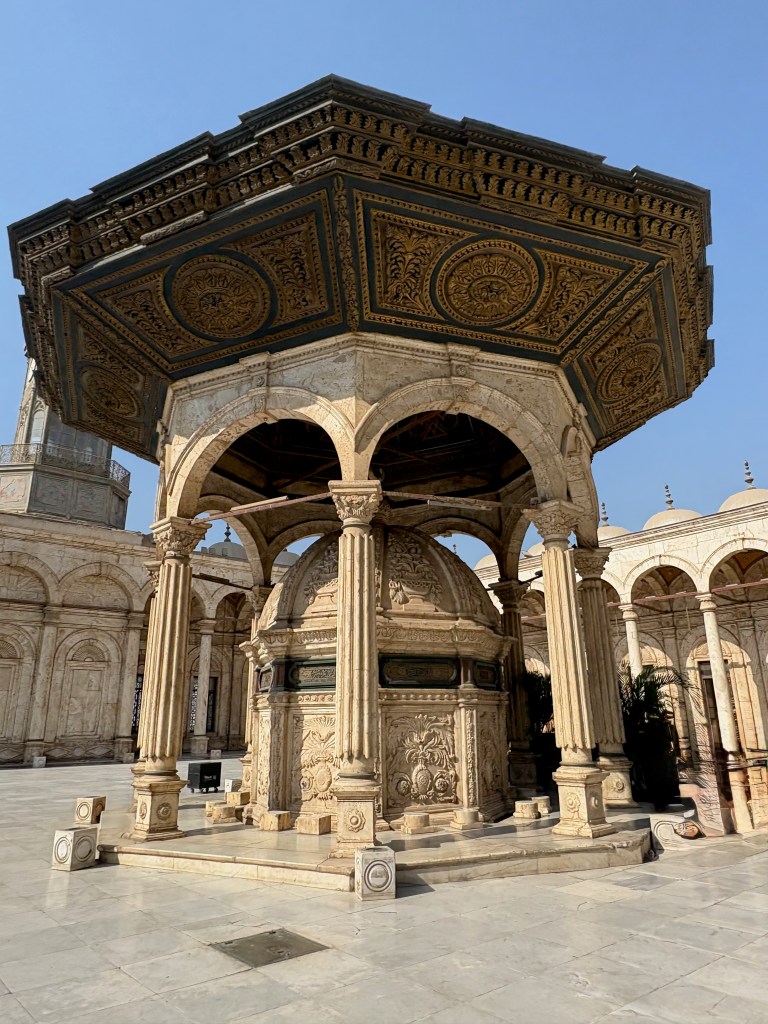
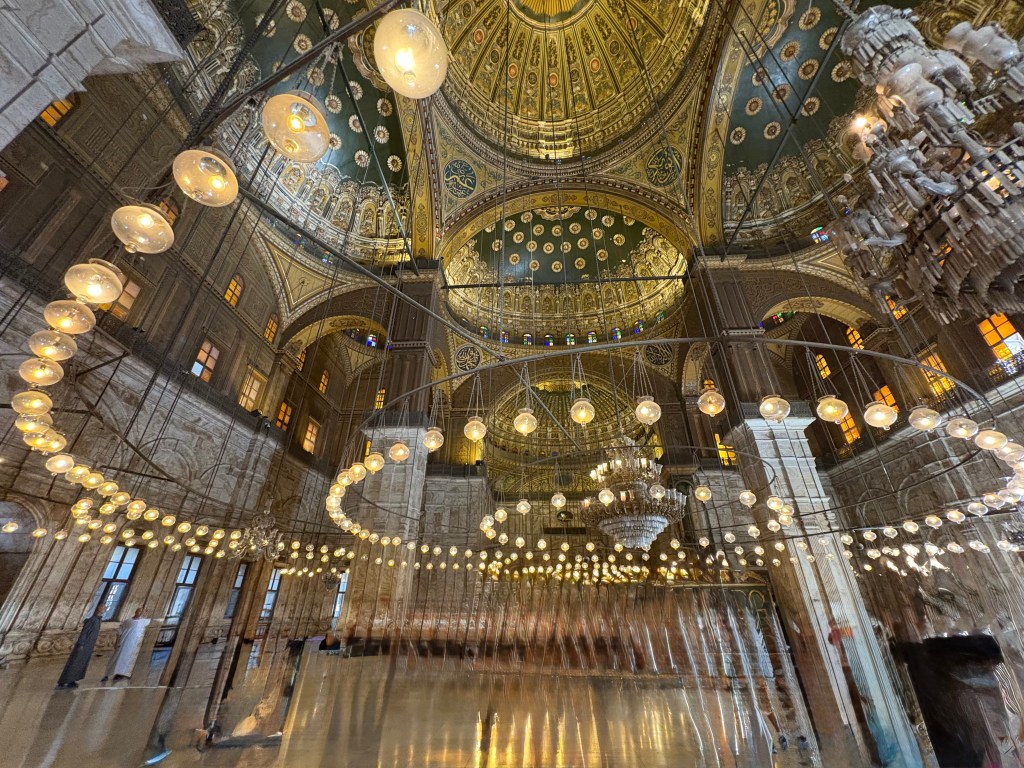
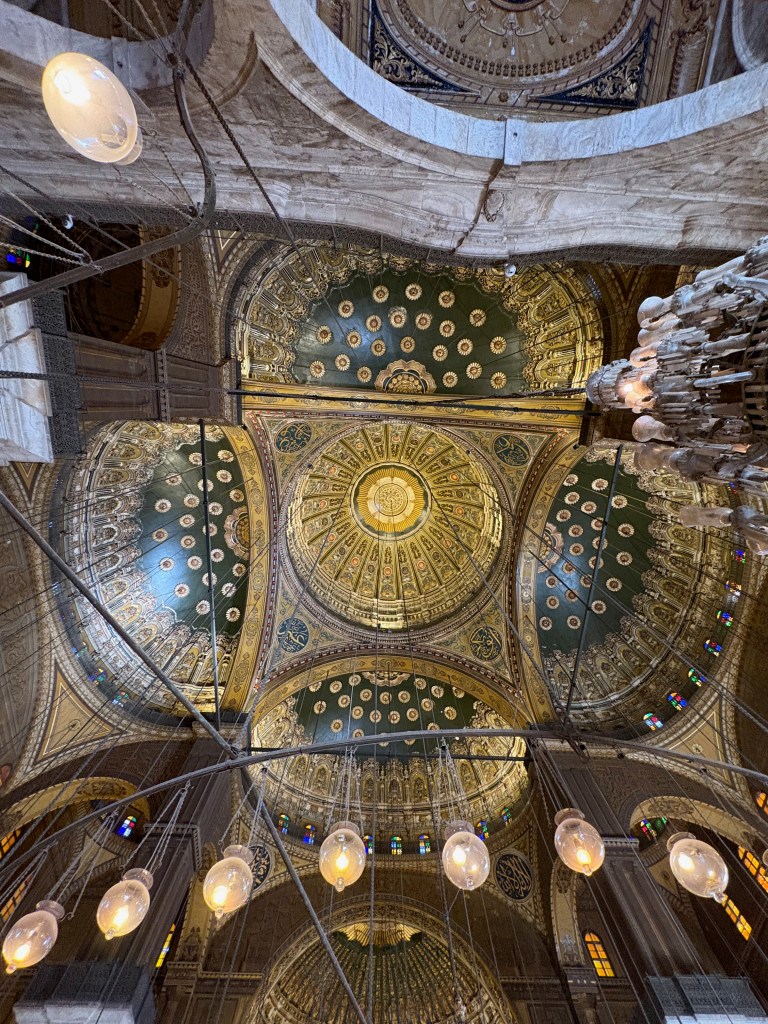
Inside the mosque, the high-relief carvings and gilding in a neo-Baroque style in the ceiling create an stunning and magical atmosphere. The domed ceiling with a central dome surrounded by four small semicircular domes also has 136 stained glass windows.The interior of the mosque is lavish with intricate alabaster walls, low-hanging lanterns, red carpets – and plenty of gold.
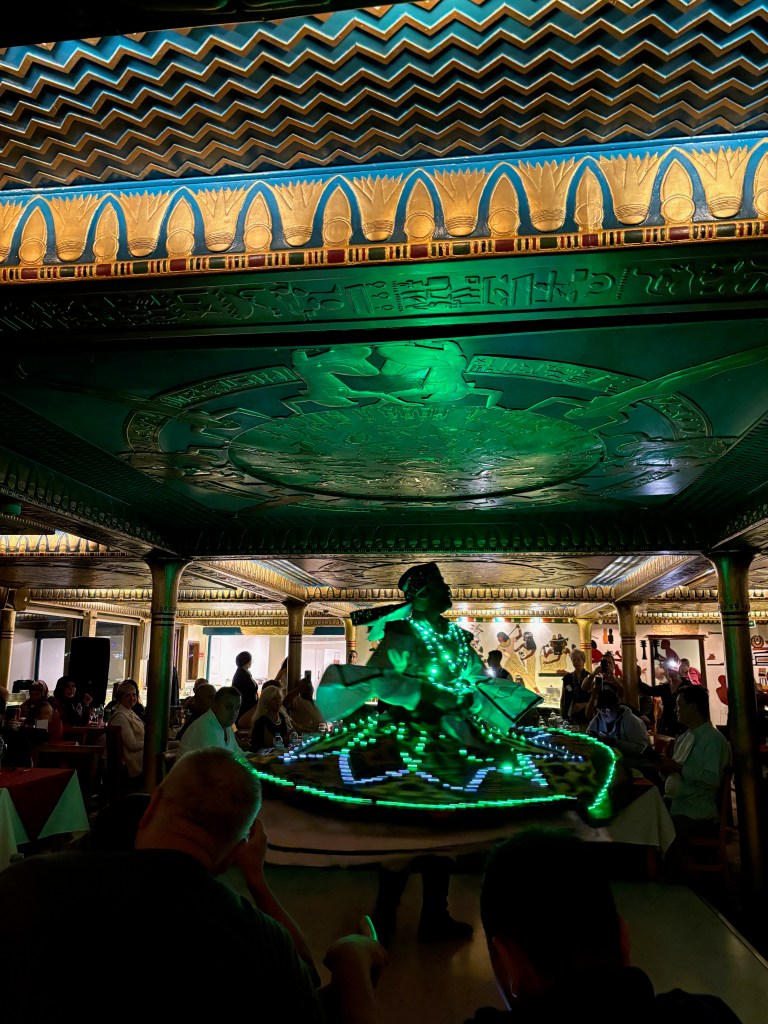
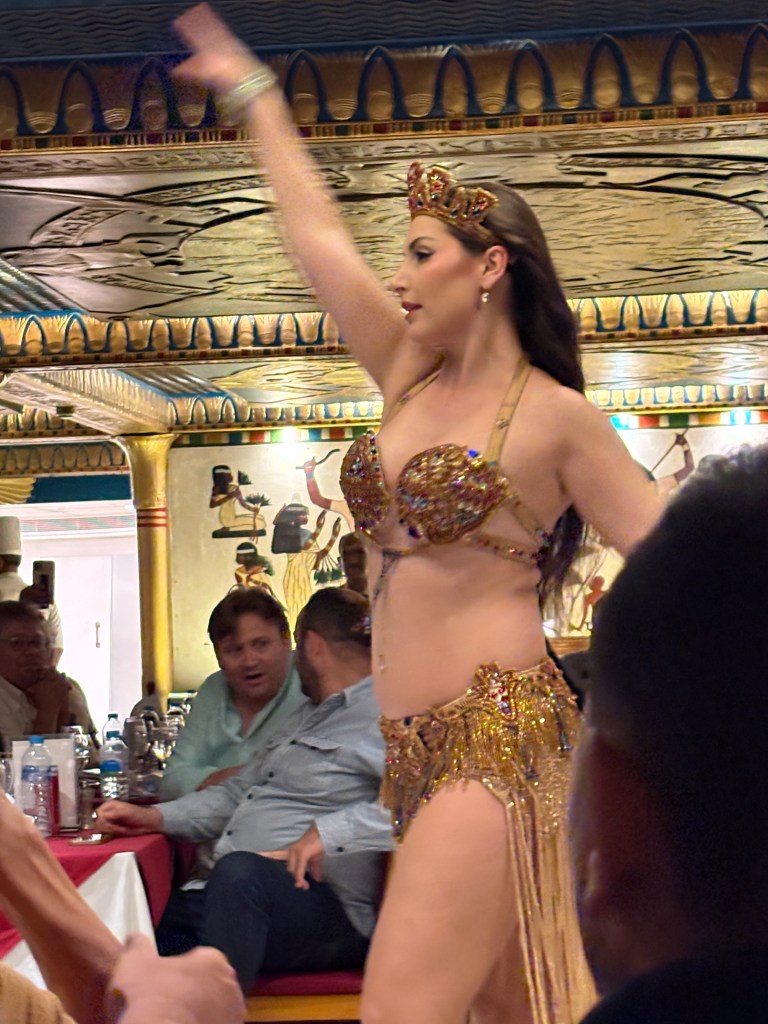
In the evening, we had a river cruise with loud and lively entertainment.
OCT 17, Friday CAIRO / MEMPHIS / SAKKARA
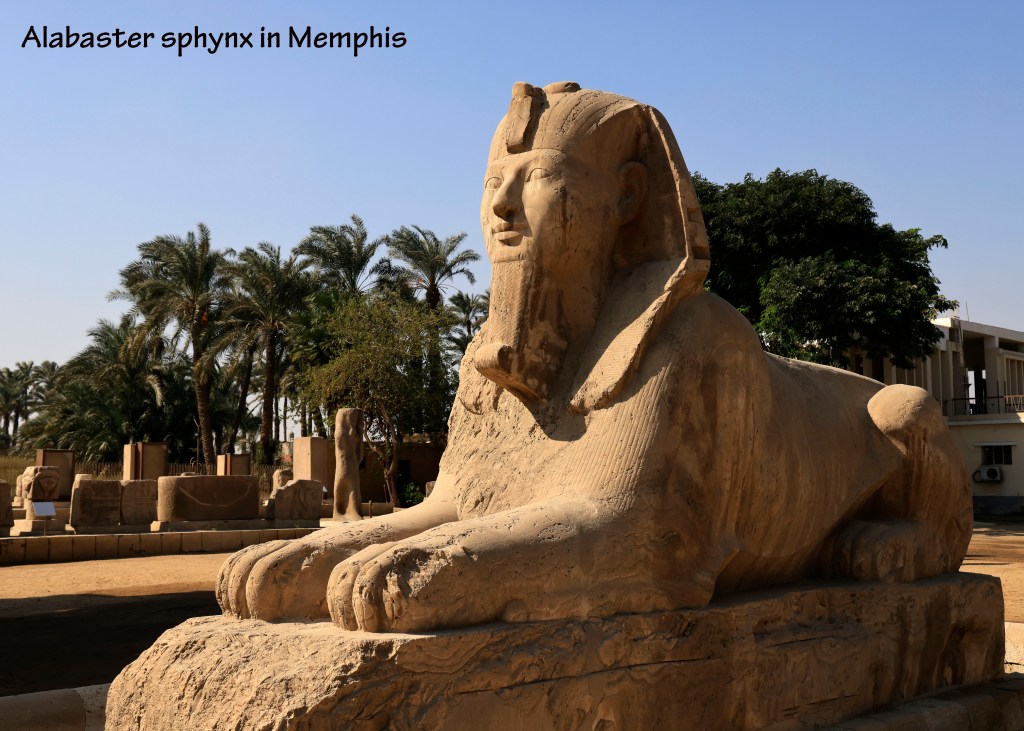
Sakkara, this UNESCO World Heritage site located 30 km south of Cairo, was the first capital of Egypt, founded by King Meni (Menes) who united Upper and Lower Egypt and served as the burial ground for the ancient city of Memphis, now in ruins.
Memphis was also the birthplace of Egypt as we know it today. The city’s strategic placement at the head of the Nile delta moved over time to follow the river’s changing course. Eventually, the head of the delta moved further north, leading to the creation of Egypt’s new Islamic capital of Fustat, ancestor of modern Cairo.
Just like modern Cairo, Memphis was once a cosmopolitan city with temples, settlements and palaces, some of which still remain. We owe many of these monuments to King Ramesses Il, a prolific builder.
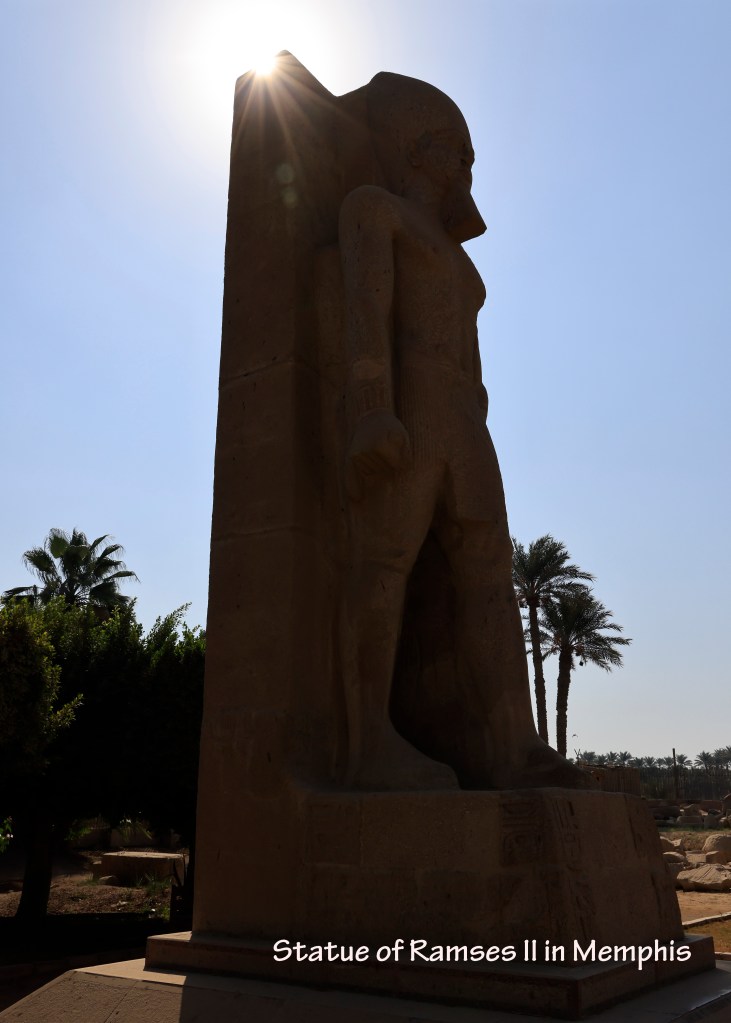
c. 1279 – 1213 BC (19th Dynasty)
Limestone (photo by Jon Gurr)
Ramesses Il is regarded as one of the greatest and most powerful pharaohs in Egyptian history. During his remarkable reign of around 66 years, he accomplished many things. Alongside having 90 children, he fought in multiple wars and even achieved one of the earliest peace treaties in world history.
He built extensively throughout Egypt, building cities, temples and monuments such as his administrative capital of Pi-Ramesses in the Nile Delta, the Abu Simbel temples in Nubia, and the Ptah Temple in Memphis.

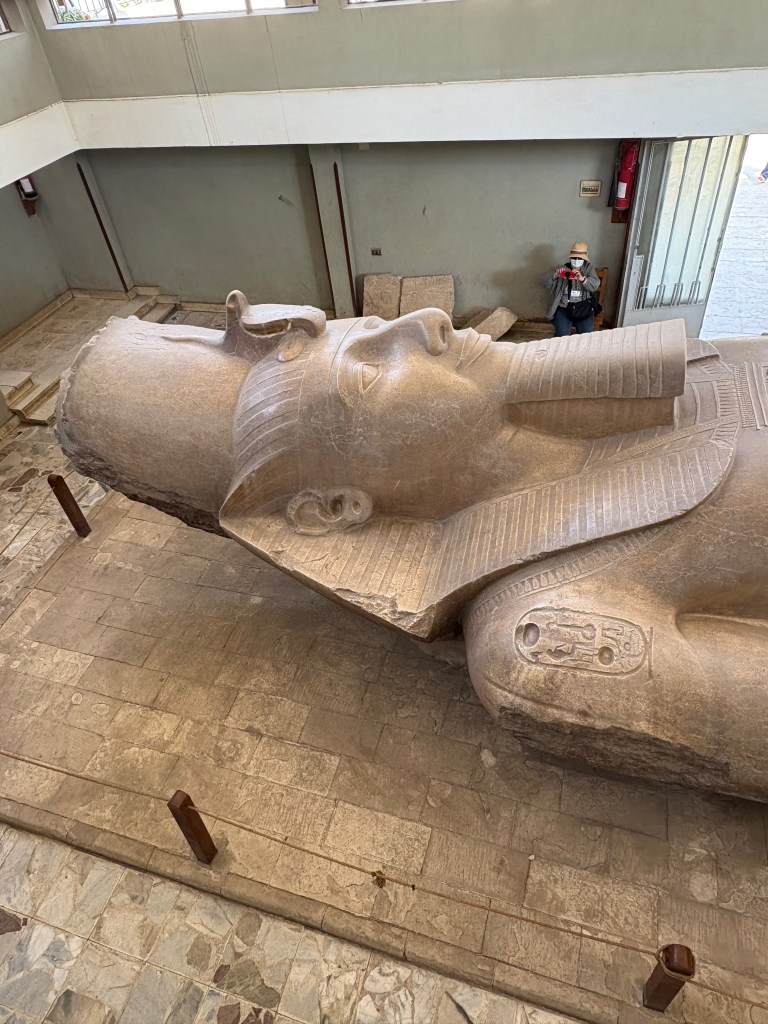
There are many symbols of royalty that adorn Ramesses lI: his Nemes (head dress), the double crown of Upper and Lower Egypt, his false beard and his kilt.
The female cobra on his head is there to protect the Pharaoh.
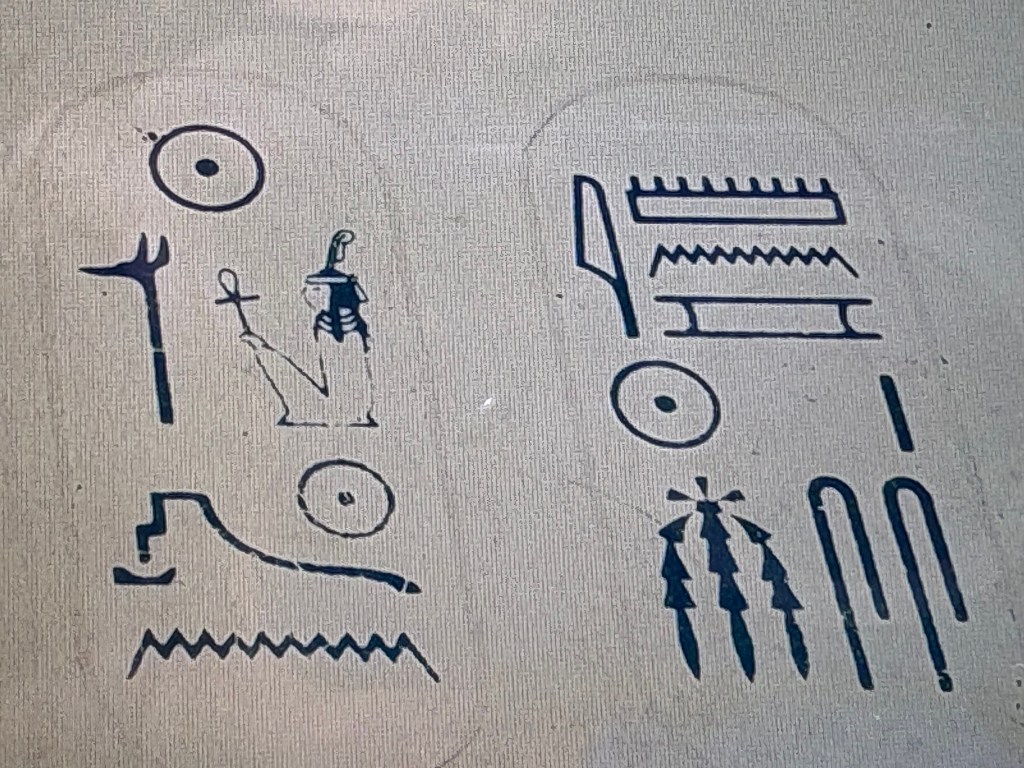
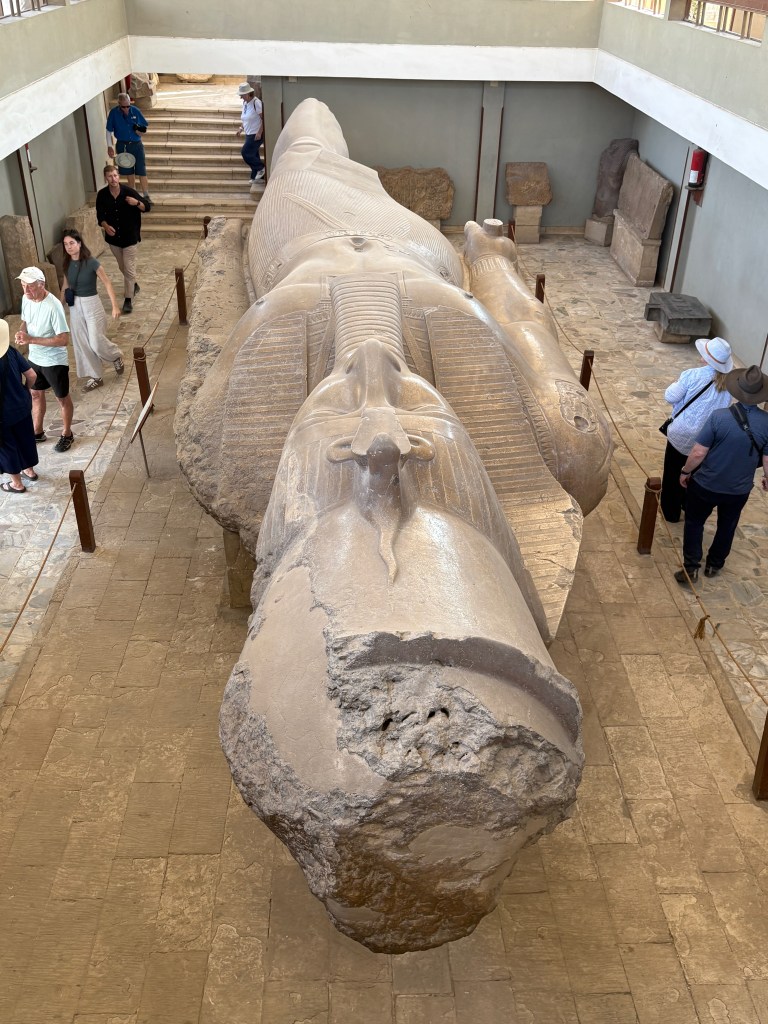
The Statue of King Ramses II, one of the master pieces of sculpture in ancient Egypt, carved from only one block of good limestone, has gone through several stages since it was discovered 1821 AD, then modified in 1887 AD, and its first building was built in 1902 and then the current building 1958.
Next stop: Djoser’s Step Pyramid Complex
A tour is only as good as the guide and we really got lucky. Here is Hassan explaining to the group about the Stepped Pyramid:
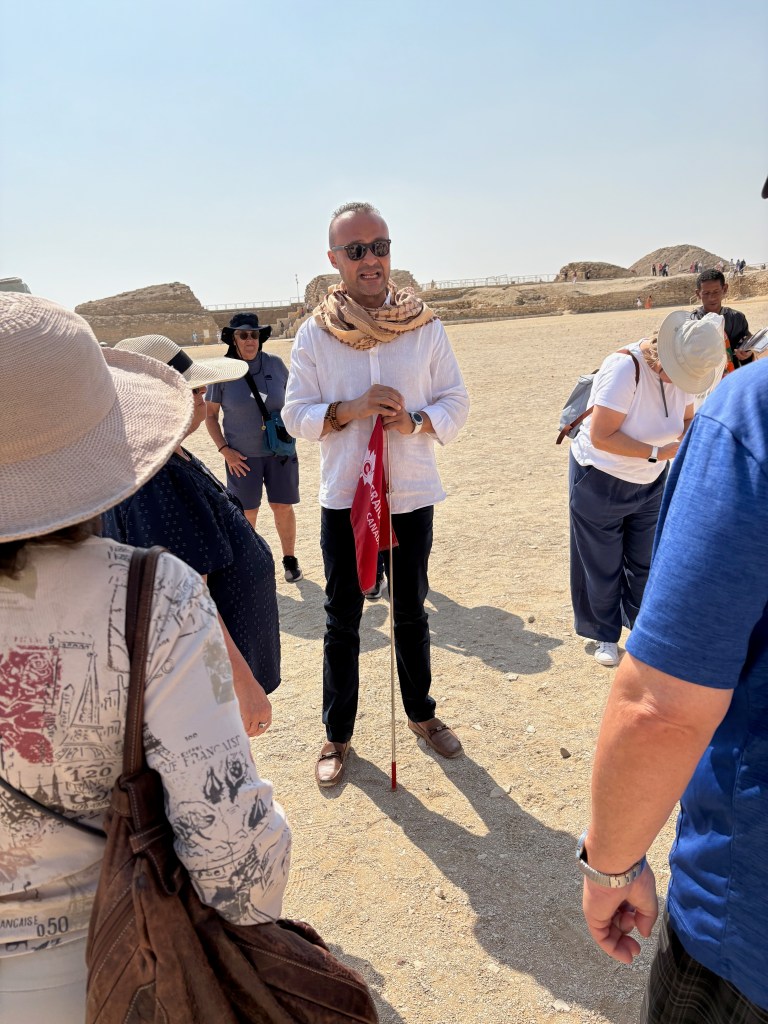
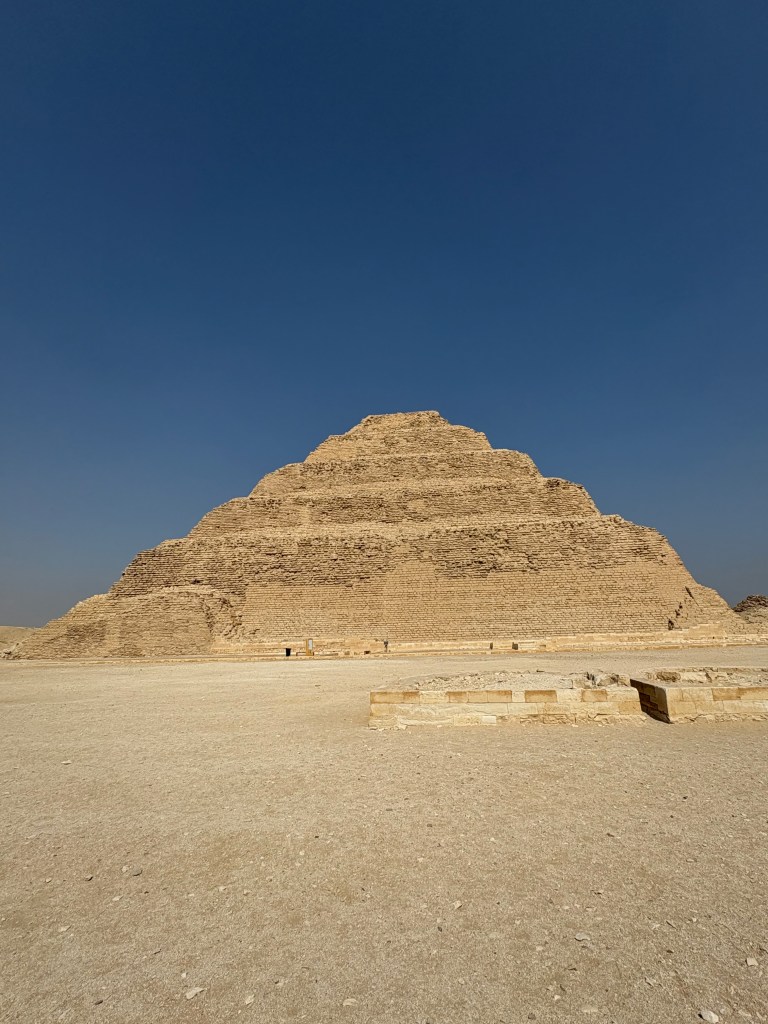
Built by Djoser, the first king of the Third Dynasty (around
2700 BC), The Step Pyramid is the first pyramid and the first large stone building in history. It was not built all at once, but in stages.
The Burial Chamber lies at the bottom of a shaft in the center of the pyramid at a depth of 28 m. There are several levels underneath the pyramid at depths up to 40 m.
The Step Pyramid is considered to be a giant stairway, which King Djoser would climb after being resurrected to join the sun god Ra in the sky.
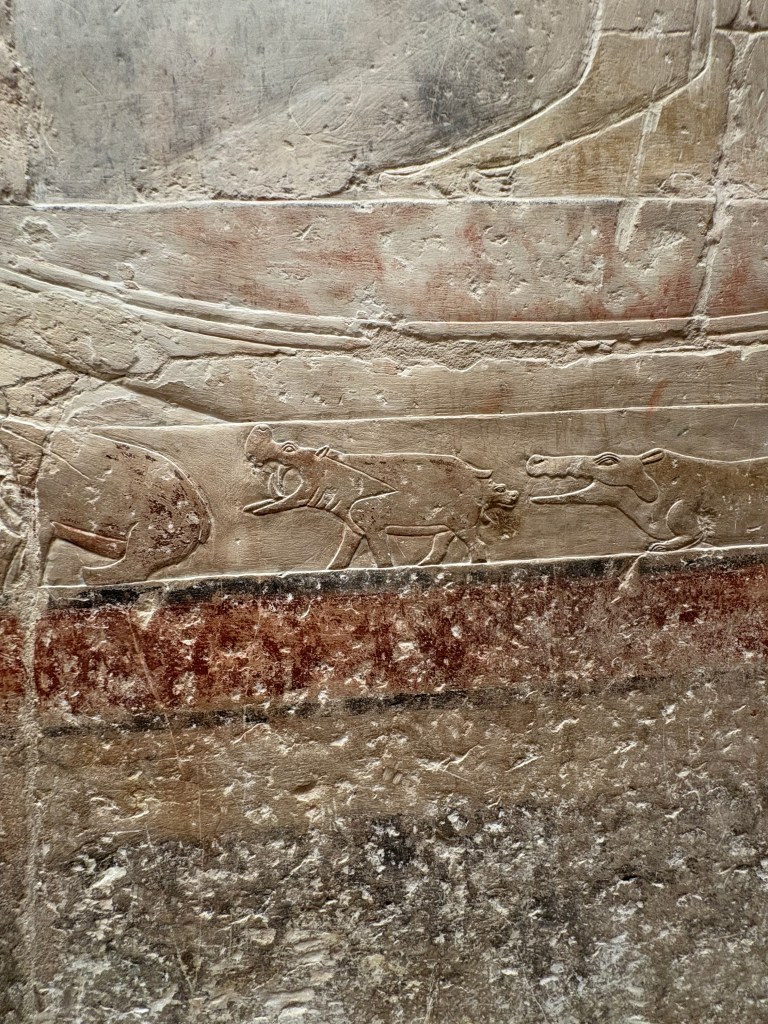
The tomb of Idut, probably the daughter of King Teti, the first king of the Sixth Dynasty, has walls decorated with beautiful inscriptions showing different scenes of everyday life, of hunting, fishing, farming and tax payments. There is also a rare scene representing the birth of a hippo ( in middle of carving).
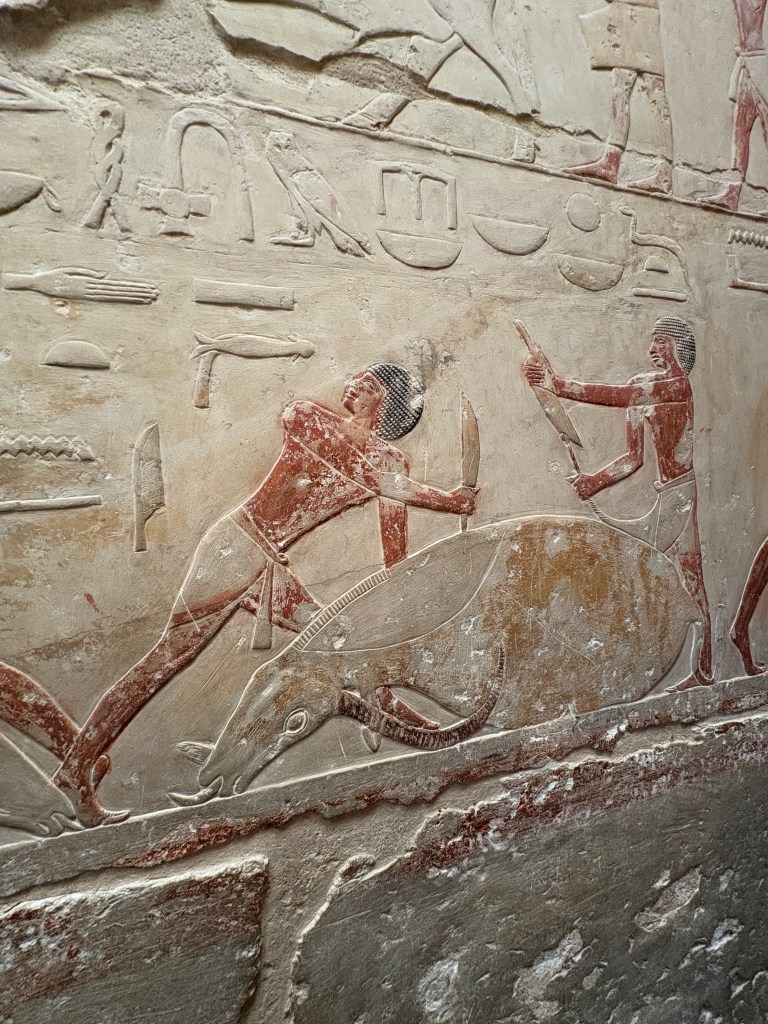
We had dinner at a traditional Egyption restaurant, Abou El Sid.

OCT 18, Saturday CAIRO / LUXOR
Early this morning, a brief flight takes us to Luxor, the site of ancient Thebes, the pharaohs’ capital from the 16th to 11th centuries B.C. We explore Egypt’s most impressive ancient site, Karnak Temple. We then embark on our Nile river cruise.
Karnak Temple dates from around 2055 BC to around 100 AD: a Cult temple dedicated to Amun, Mut and Khonsu and the largest religious building ever constructed., built over 2,000 years, covering about 200 acres (1.5 km by 0.8 km), and was a place of pilgrimage for nearly 2,000 years.
The Hypostyle hall, at 54,000 square feet (16,459 meters) and featuring 134 columns, is still the largest room of any religious building in the world. Besides the main sanctuary, there are several smaller temples and a vast sacred lake – 423 feet by 252 feet (129 by 77 meters).
The Egyptians believed that towards the end of the annual agricultural cycle the gods and the earth became exhausted and required a fresh input of energy from the chaotic energy of the cosmos.
To accomplish this magical regeneration, the Opet festival was held yearly at Karnak and Luxor. It lasted for twenty-seven days and was also a celebration of the link between pharaoh and the god Amun, the Egyptian god of the sun and air. The procession began at Karnak and ended at Luxor Temple, one and a half miles (2.4 kilometres) to the south.
At Luxor, Pharaoh and his priests entered the temple and ceremonies were performed to regenerate Amun, recreate the cosmos and transfer Amun’s power to Pharaoh. When he finally emerged from the temple sanctuary, the vast crowds cheered him and celebrated the guaranteed fertility of the earth and the expectation of abundant harvests.
The massive columns of Karnak with the messages carved into them were just amazing. They were recovered from the sand but the sand also provided a means to raise them and a base for the carvers to stand on to carve from the top down.
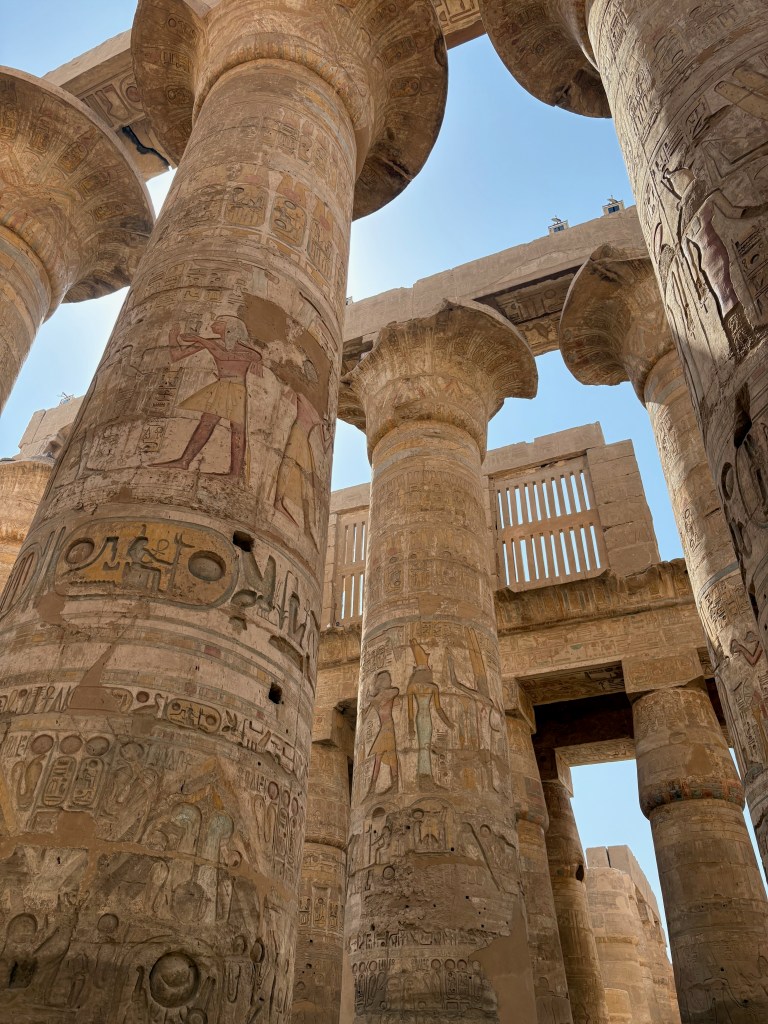
Amazingly, some of the carvings retained their colour.
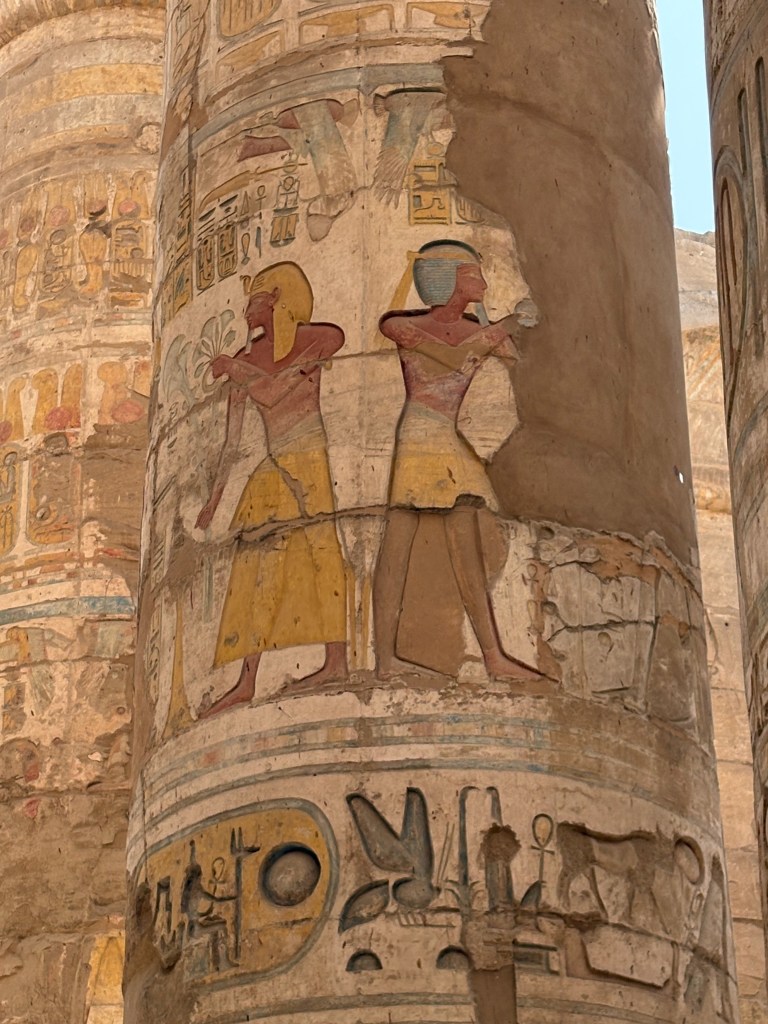
There are so many images in the carvings that I couldn’t retain them all. One was the bee.
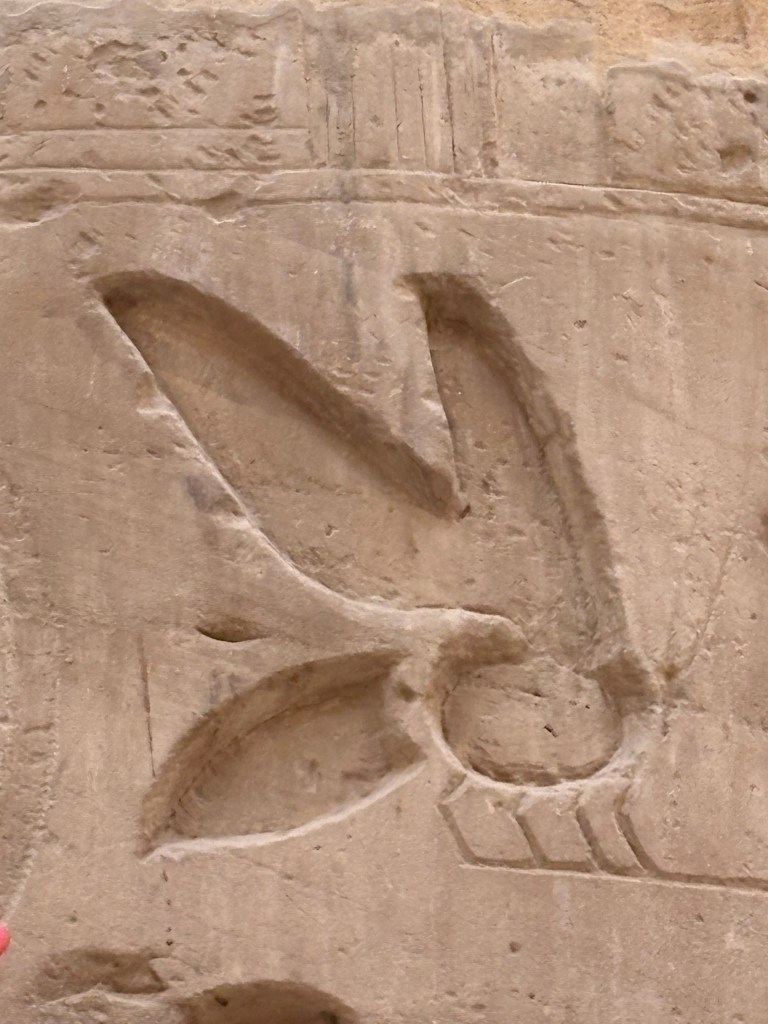
In ancient Egypt, the bee was a powerful symbol of royalty, the divine, and Lower Egypt. It was believed to be formed from the tears of the sun god Ra, and the bee hieroglyph was used in the title of the king of Upper and Lower Egypt, which paired it with the reed, the symbol for Upper Egypt.
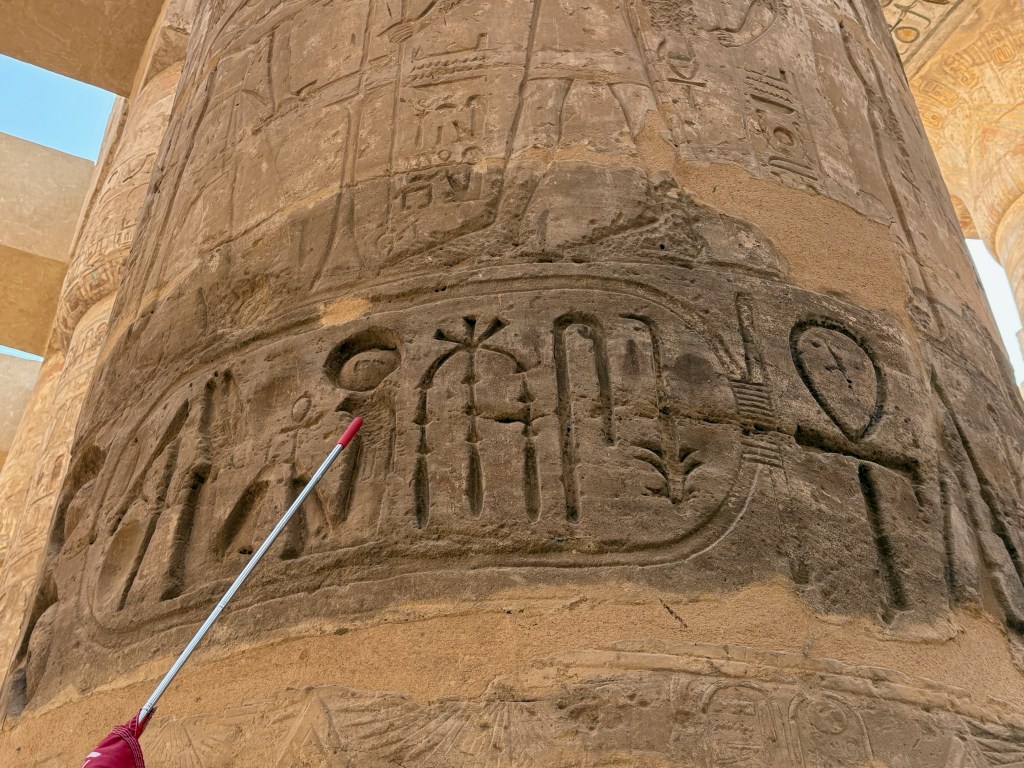
A cartouche is an ancient Egyptian hieroglyphic nameplate. It symbolizes protection from evil spirits. The ankh (on the right) is a very significant symbol in ancient Egypt. Its hieroglyphs, translated to English as “the key of life,” literally mean eternal life and have long been associated with rituals performed by priests or royalty meant for everlasting existence on Earth.
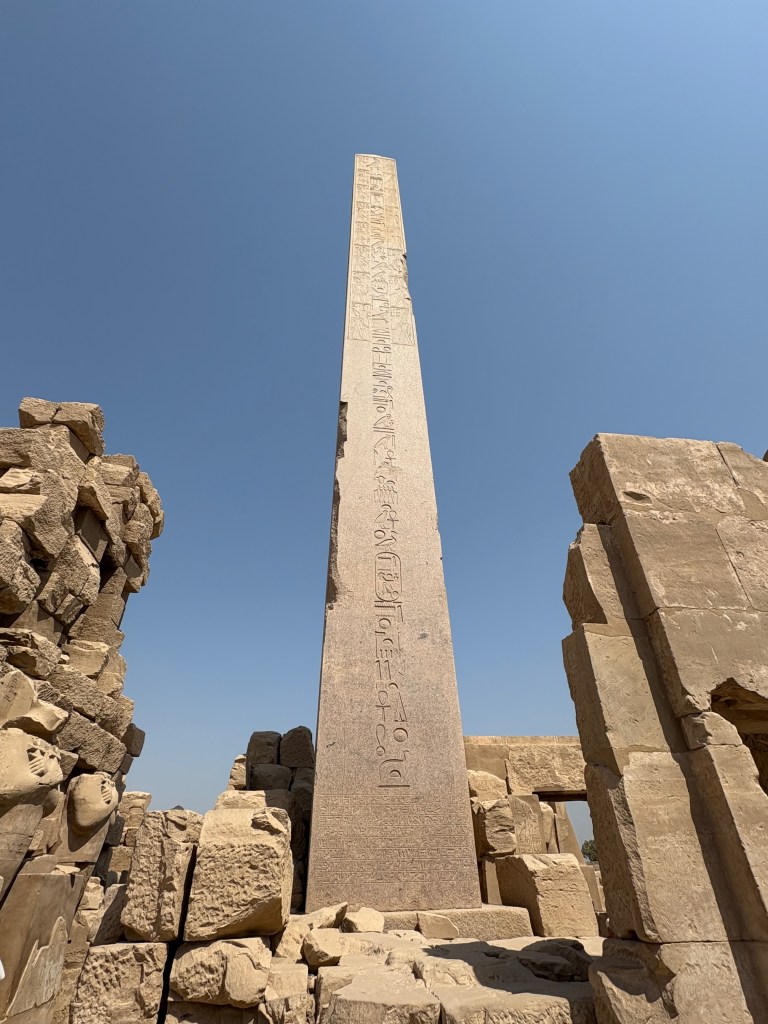
The Obelisk is a powerful and famous ancient Egyptian Symbol that represents creations, rebirth, unity, kingship, power, and achievement. The obelisk stands as an example of the concept of duality and balance. It is the most popular construction monument ever created that symbolizes Ra the sun god plus it was seen as the petrified ray of the Sundisk Aten.
River Cruise: We had never been on a river cruise and the veterans of many cruises in the group felt that it was not as impressive as others that they had been on. We had no basis for comparison so were quite satisfied.
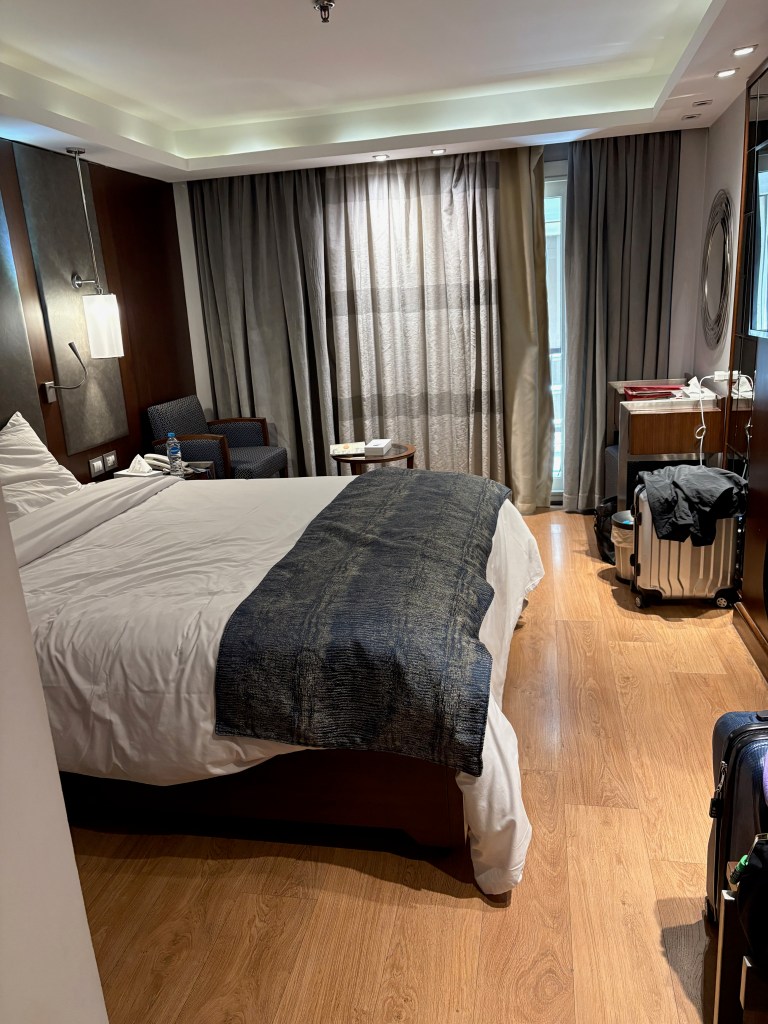
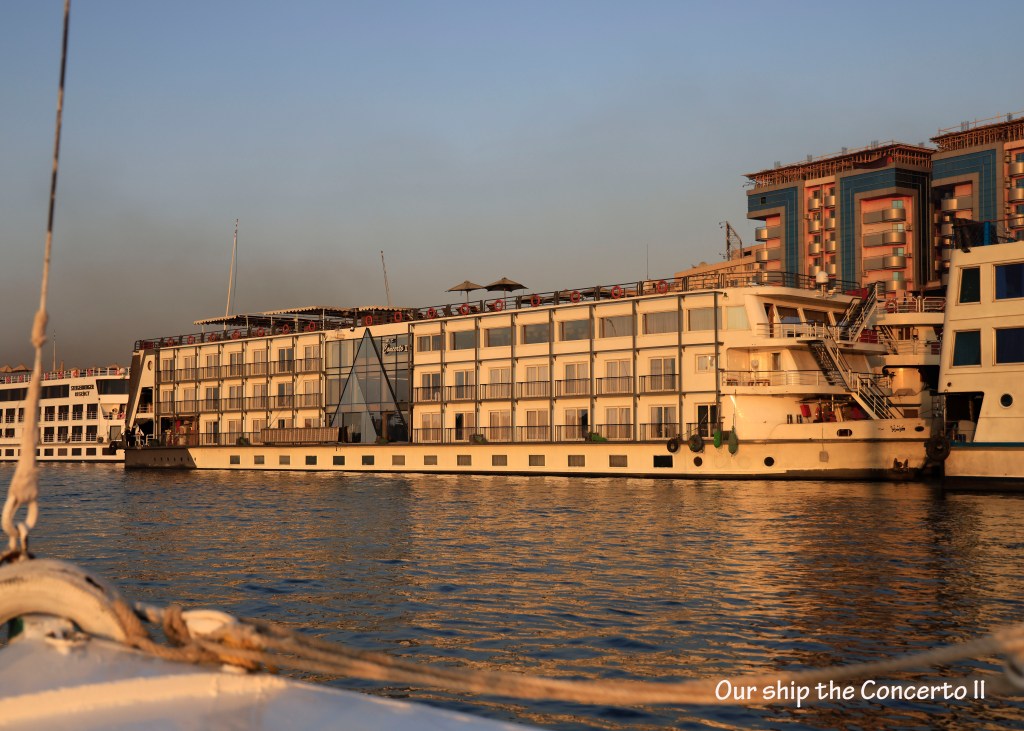
After checking into the Concerto II River Boat, we had lunch and headed for Luxor Temple. Luxor Temple was a major religious center in Thebes, which was once the capital of Ancient Egypt. Amenhotep III, Ramses II, Tutankhamun, and other pharaohs added new buildings to the complex over hundreds of years, contributing to its sprawling scale. Luxor Temple was known as “the place of the First Occasion,” where the god Amon was reborn during the pharaoh’s annual coronation reenactment (described above).
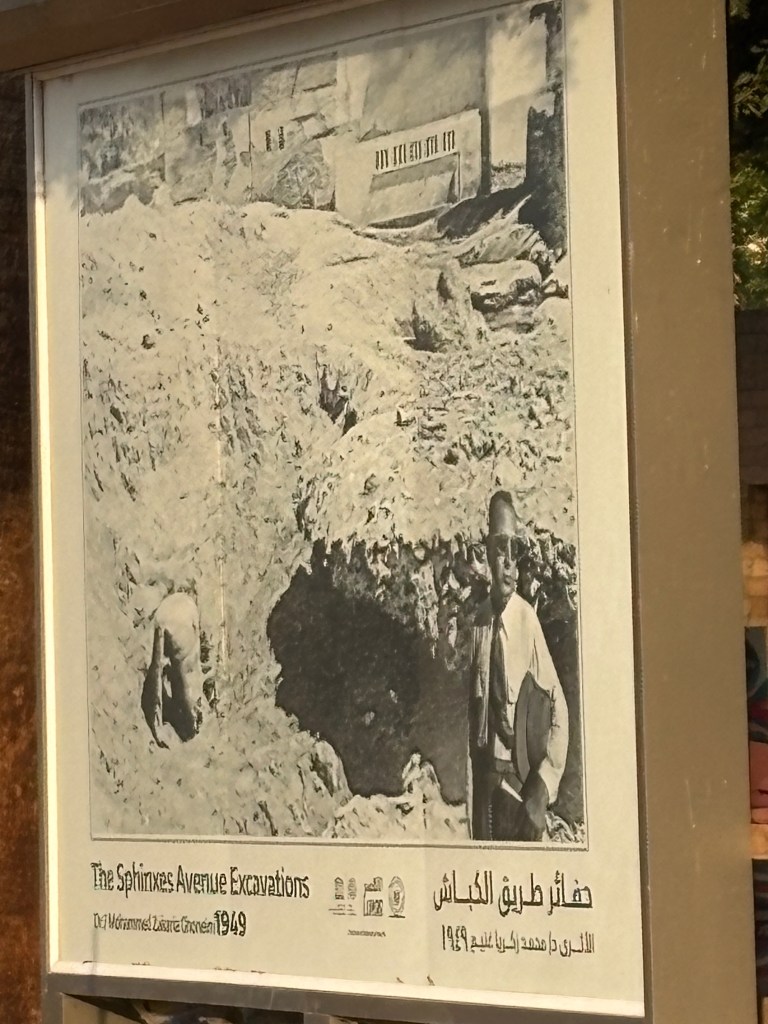
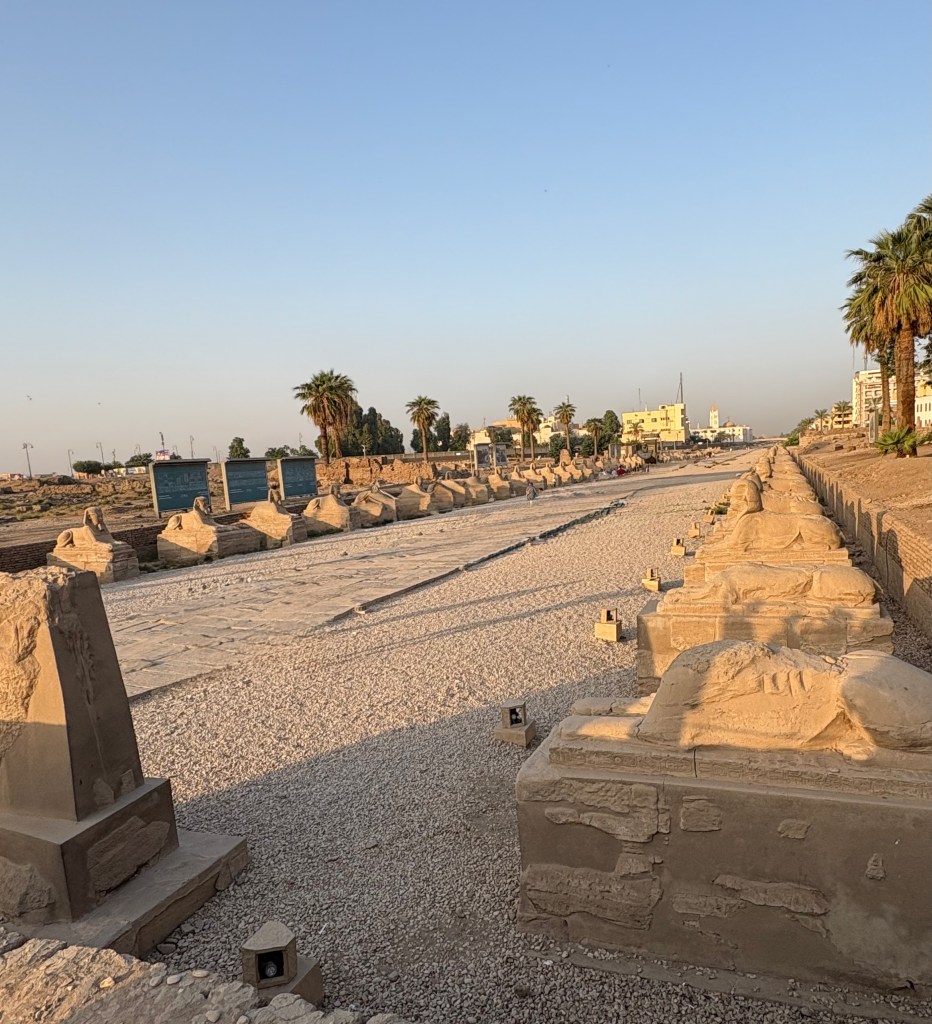
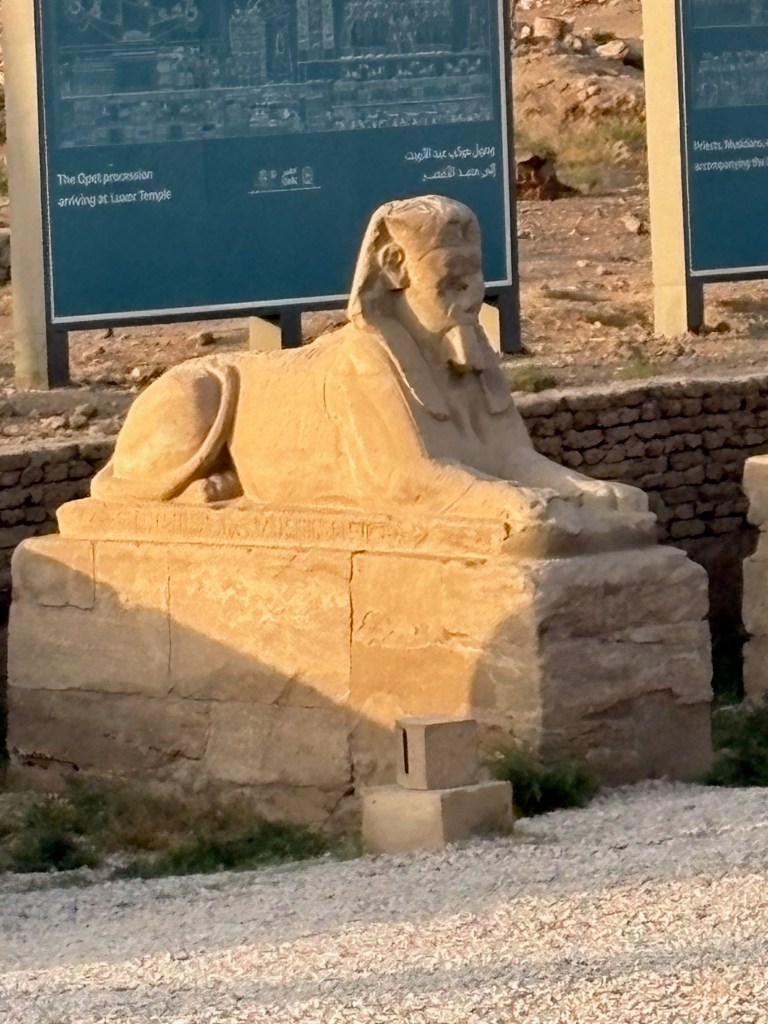
Before entering the temple, we viewed this Avenue of the Sphinxes that runs 2 kilometres between the temples and was under sand until 1949.
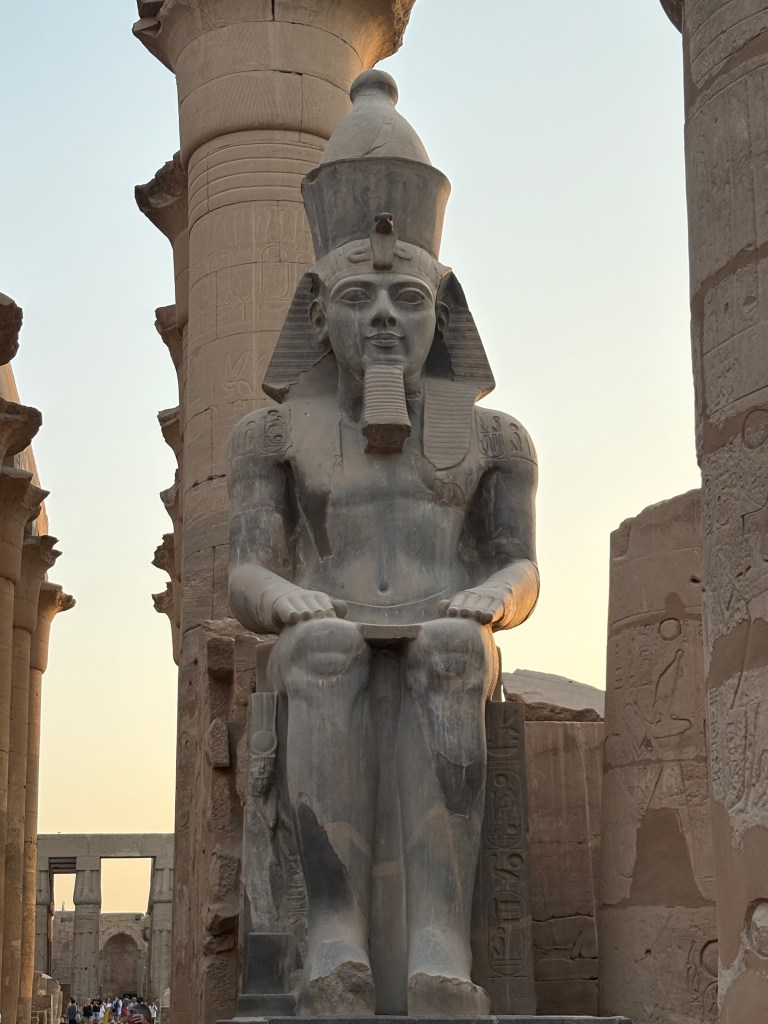
At Luxor Temple, we are greeted by two huge sculptures of Rameses II, always portrayed as young and perfect.
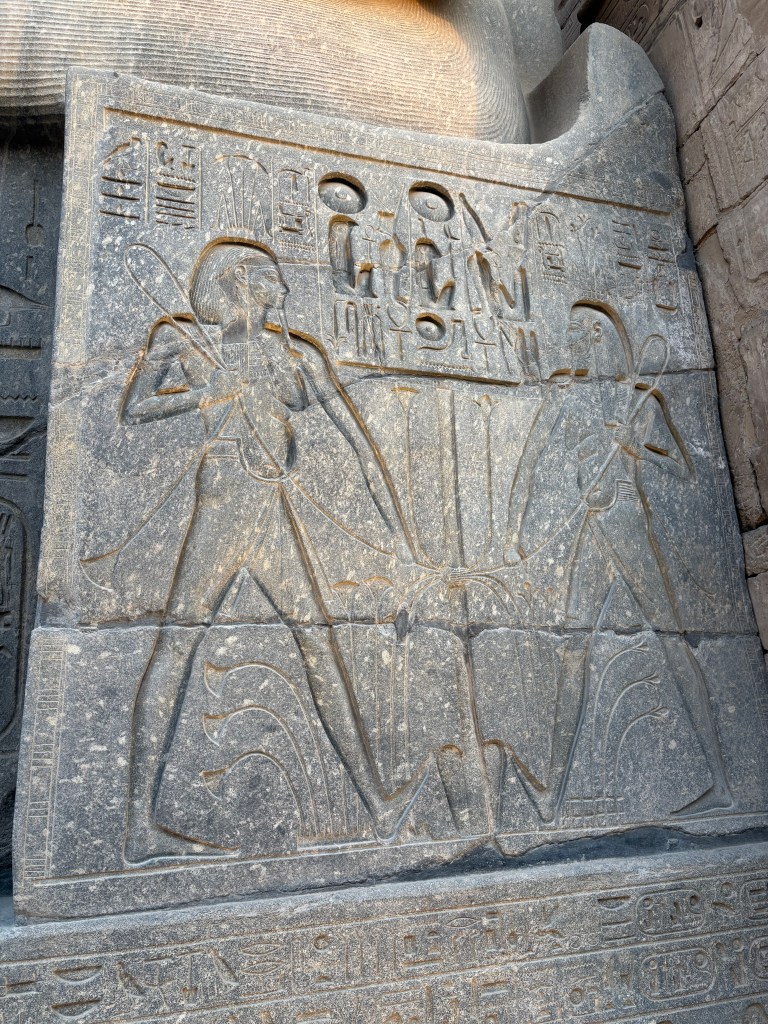
The Sema symbol on the side of Rameses II sculpture symbolizes the union of Upper and Lower Egypt and his domain over both.
Today, remains of this vast complex include the colossal Great Colonnade Hall, which is almost 61 meters (200 feet) long and features 28 columns measuring six meters (21 feet).
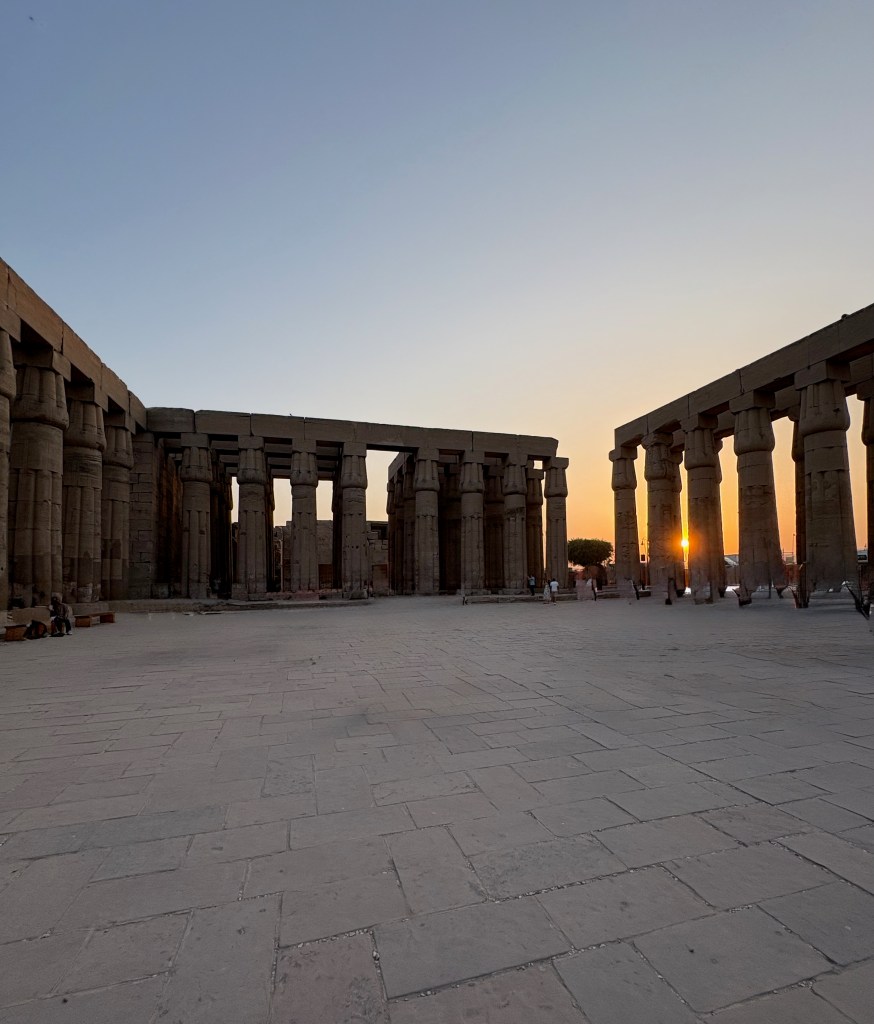
Together with other ancient sites in Thebes, Luxor Temple is listed as a UNESCO World Heritage site for its outstanding universal value.
Unfortunately, the heat got to me that day and I believe I suffered heat stroke: I was sick to my stomach and had diarrhea all night.
OCT 19, Sunday WEST BANK / NILE CRUISE / EDFU
So, I missed the hot air balloon ride that most of our group experienced and loved.
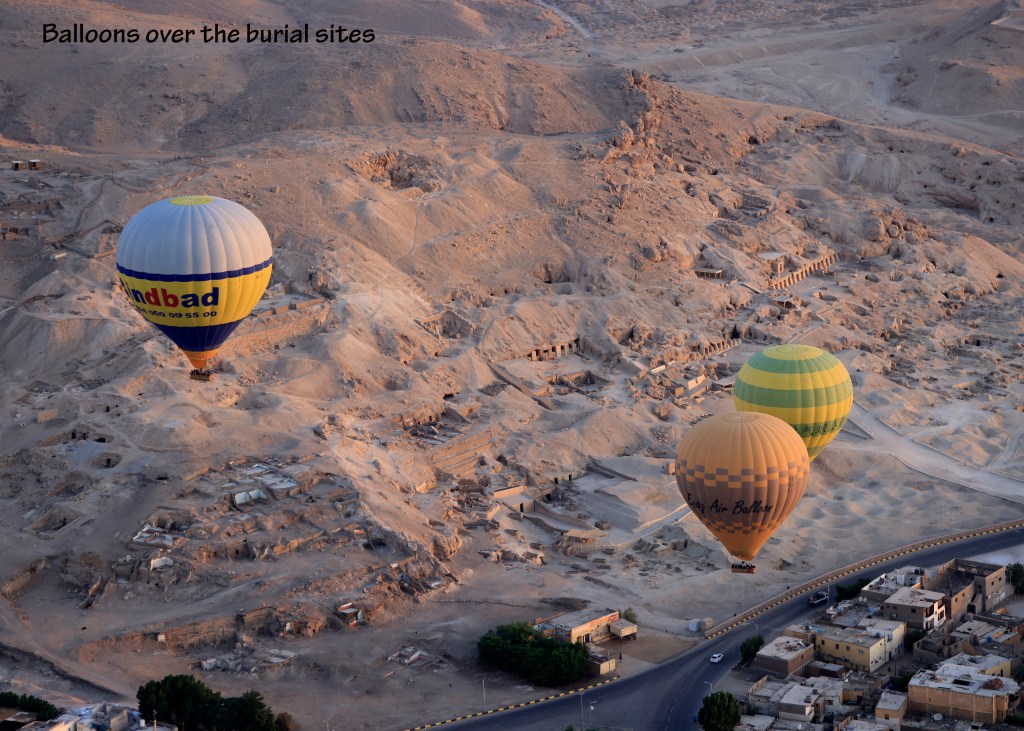
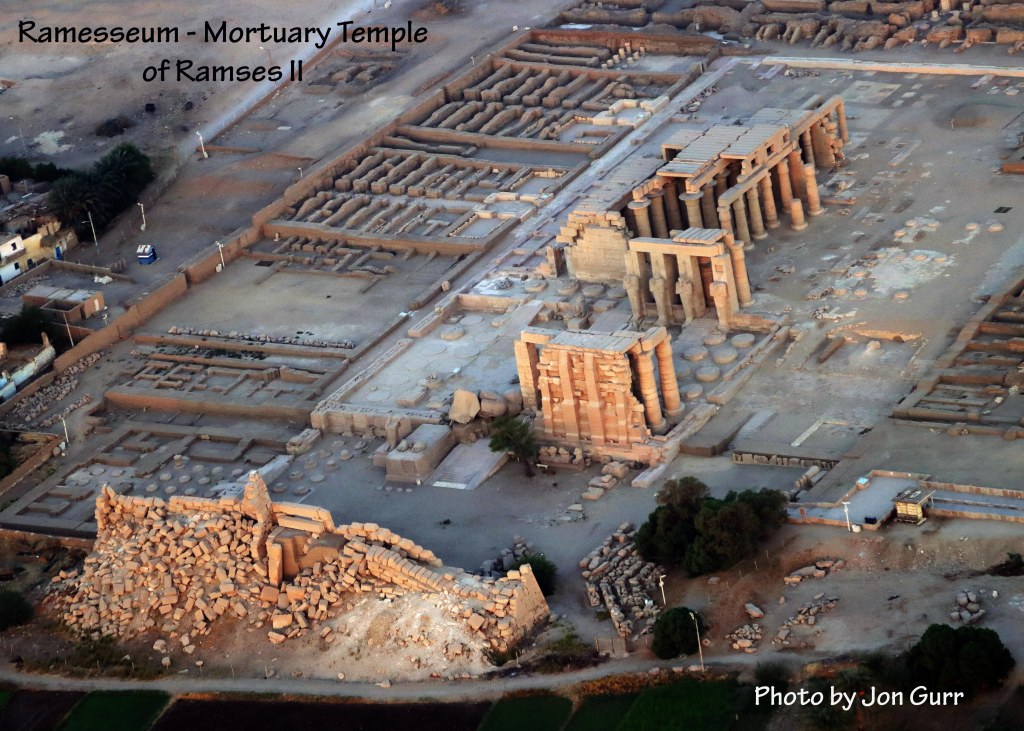
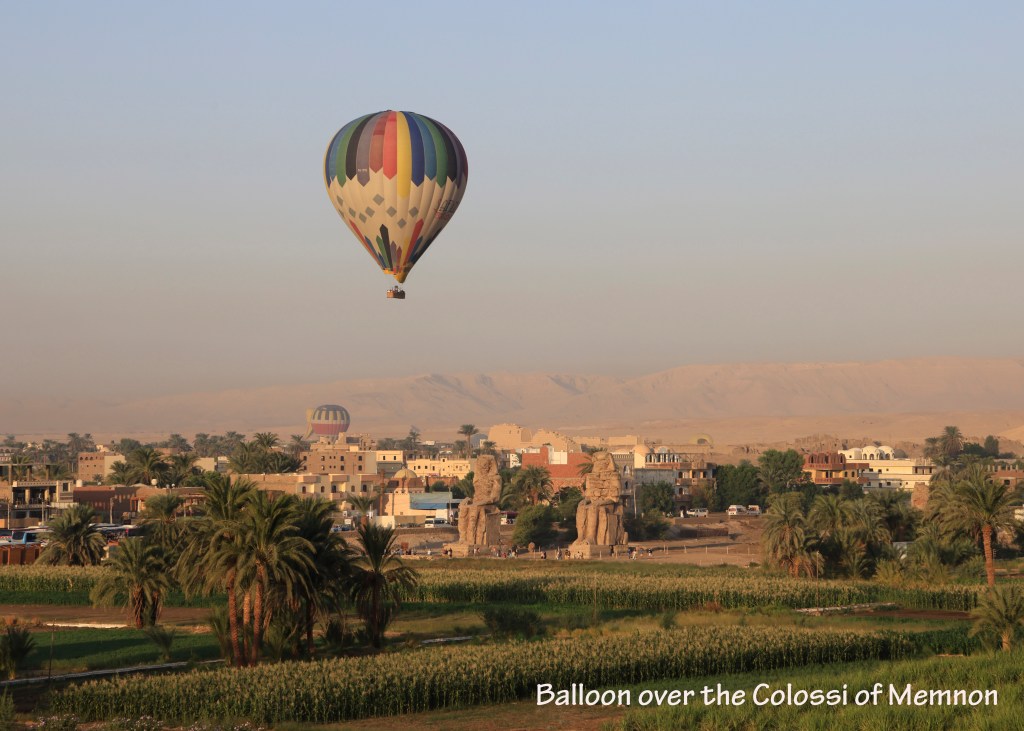
Temple of Hatshepsut (Hassam called her “hot chicken soup”)
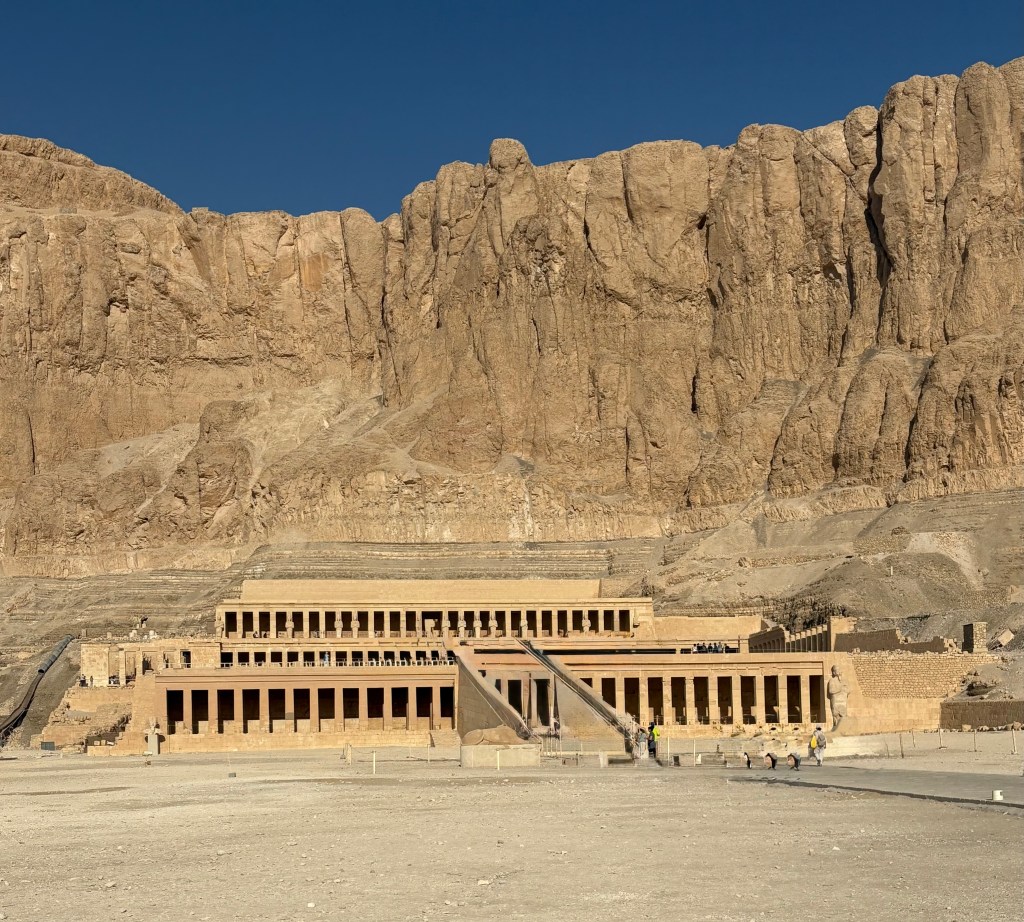
Queen Hatshepsut (1473-1458 BC) built her funerary temple on the west bank of the Nile River. This temple differs from other funerary temples in terms of design, as Hatshepsut built it in the form of large terraces, three terraces, each one above the other. It is characterized by columns that blend with the mountainside behind the temple and is partially carved into the rock.
The most important room of the temple is dedicated to the Holy of Holies, the god Amun-Ra, and is carved into the rock. The temple of Hatshepsut is extensively decorated with different reliefs depicting significant aspects of the queen’s life.
Valley of the Kings: Since Howard Carter opened King Tut’s tomb, the burial rites of ancient Thebes have fascinated the world. Several tombs, including the newly opened and beautifully decorated Tomb of King Seti I, were available for entering but we only visited the Seti I tomb. It is remarkable because of the quality of painted relief decoration.
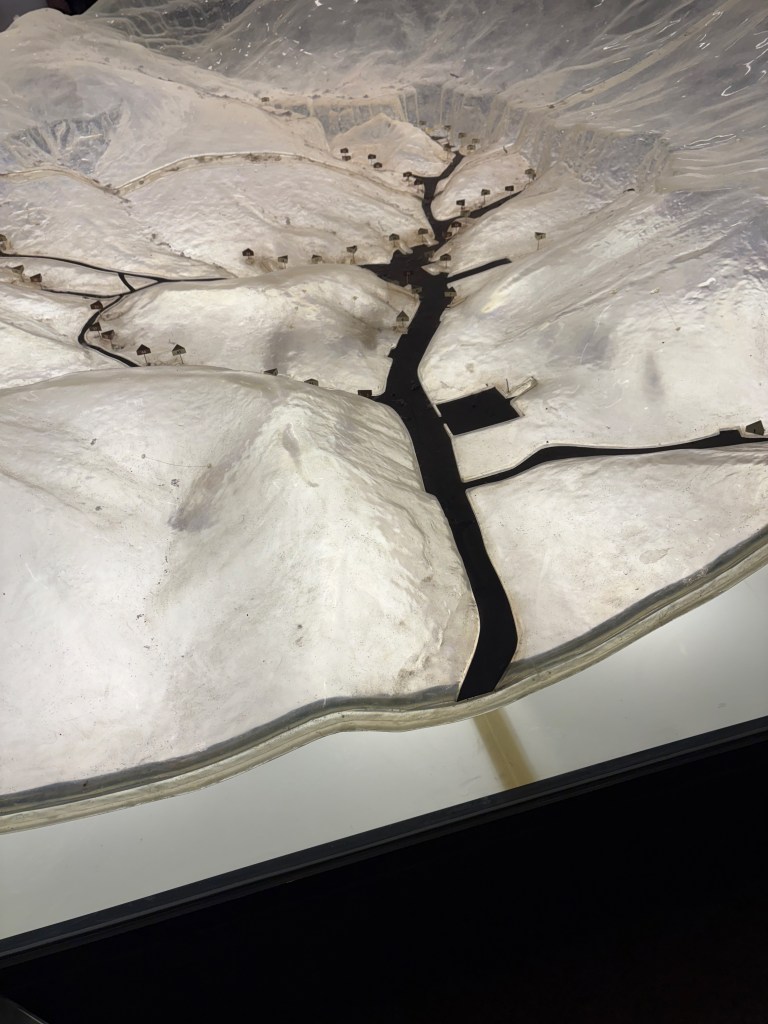
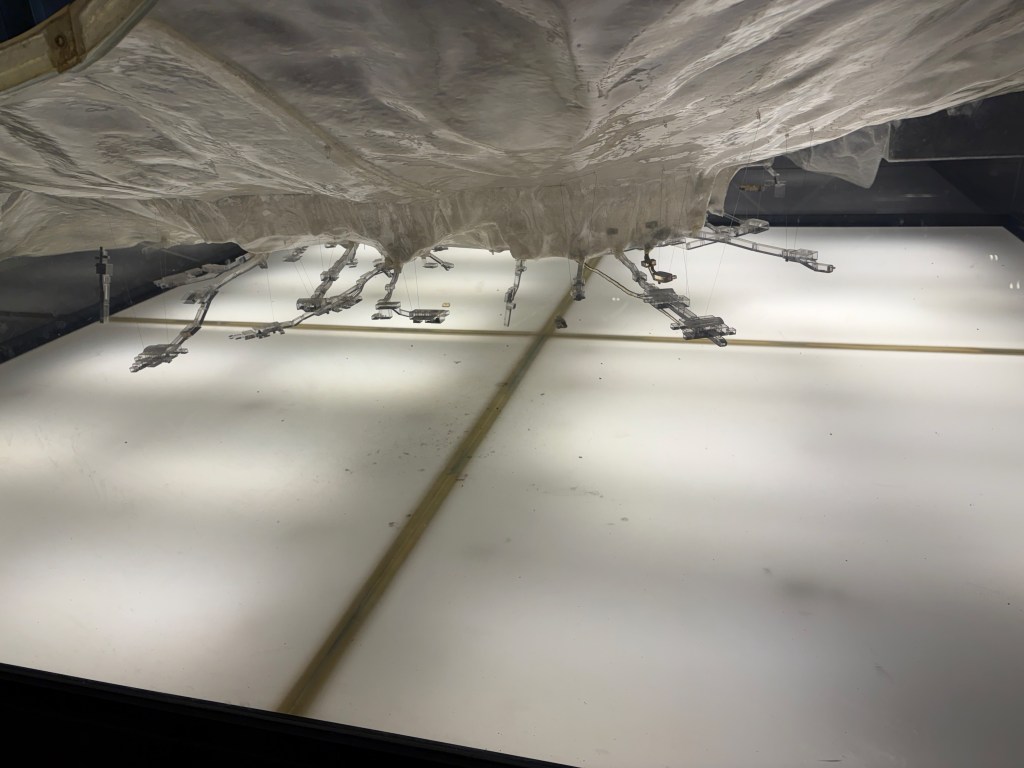
After a very long descent into the tomb of Seti I, we found stunning, colourful carvings on the walls and ceiling. Unfortunately, we couldn’t stay long as it was very hot.


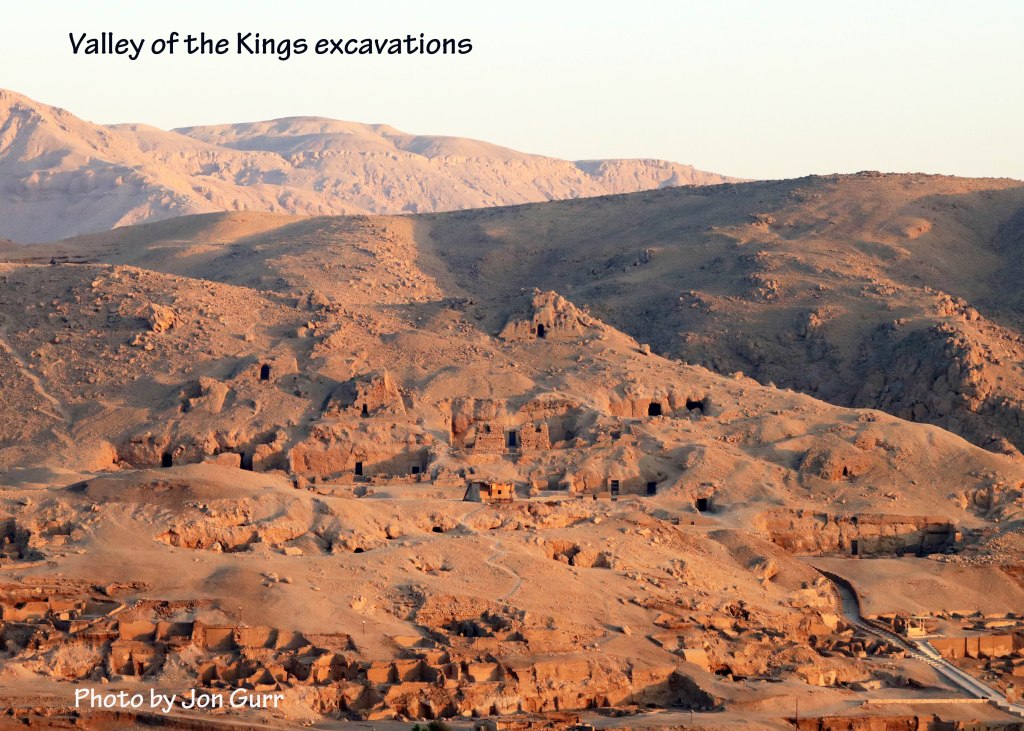
It goes without saying that all over Egypt, the excavations continue.
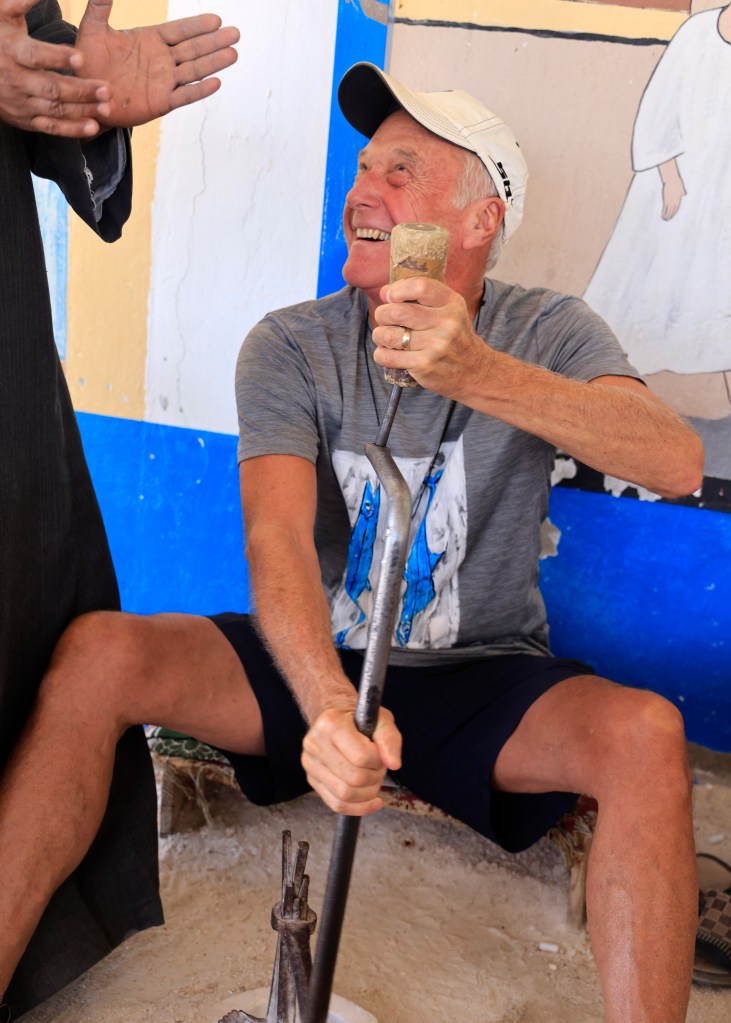
On the way back to the boat, we stopped at an alabaster factory. Bill was seconded to grind out a bowl.
As the boat moves up the Nile (it flows from south to the delta in the north), we see towns along the narrow strip of land that is irrigated.
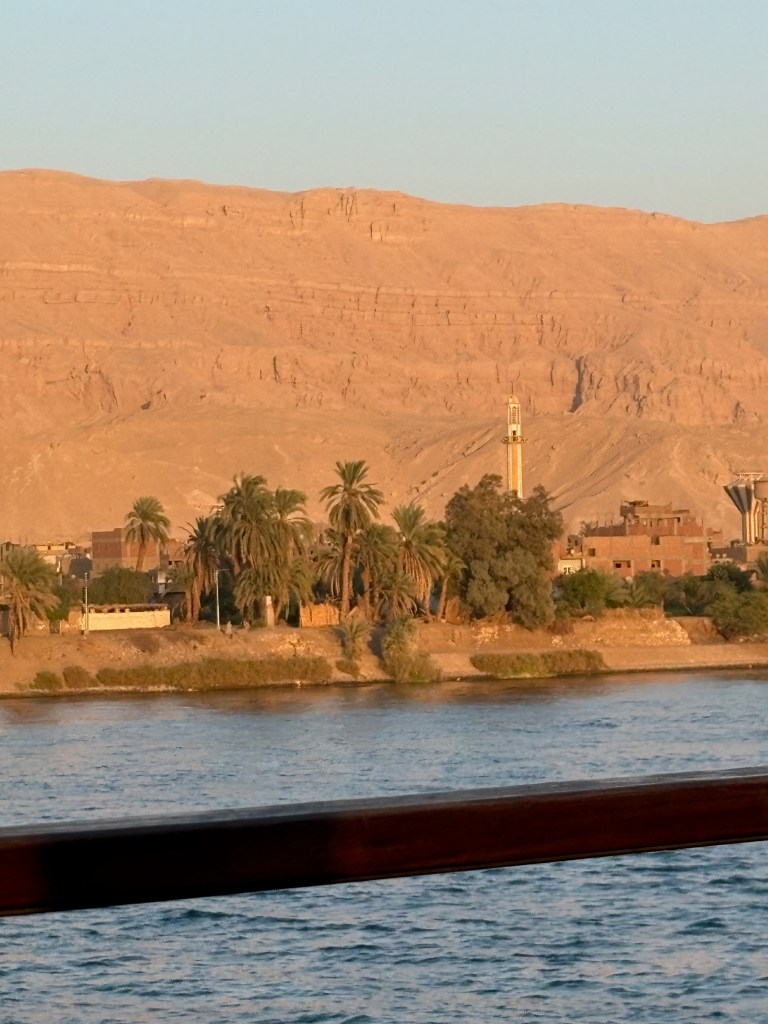
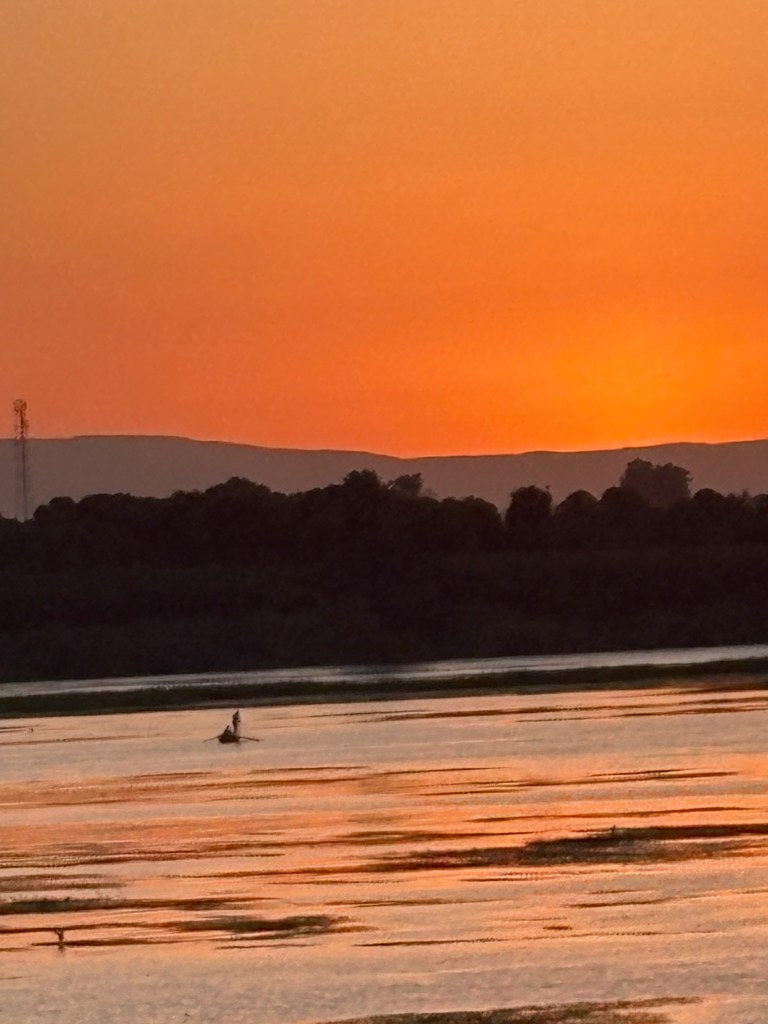
OCT 20, Monday EDFU / ASWAN
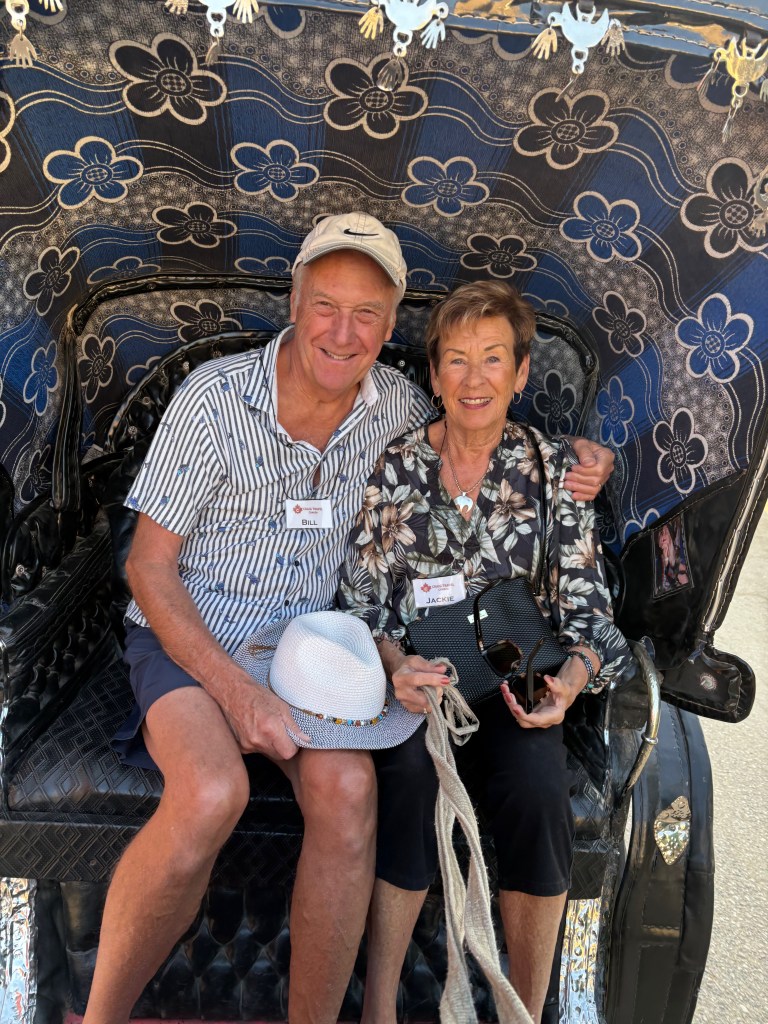
Another early morning shuffle through 3 rafted-together River boats as we take a horse-drawn carriage ride to the 2,000-year-old Ptolemaic Temple of Horus.

Edfu Temple
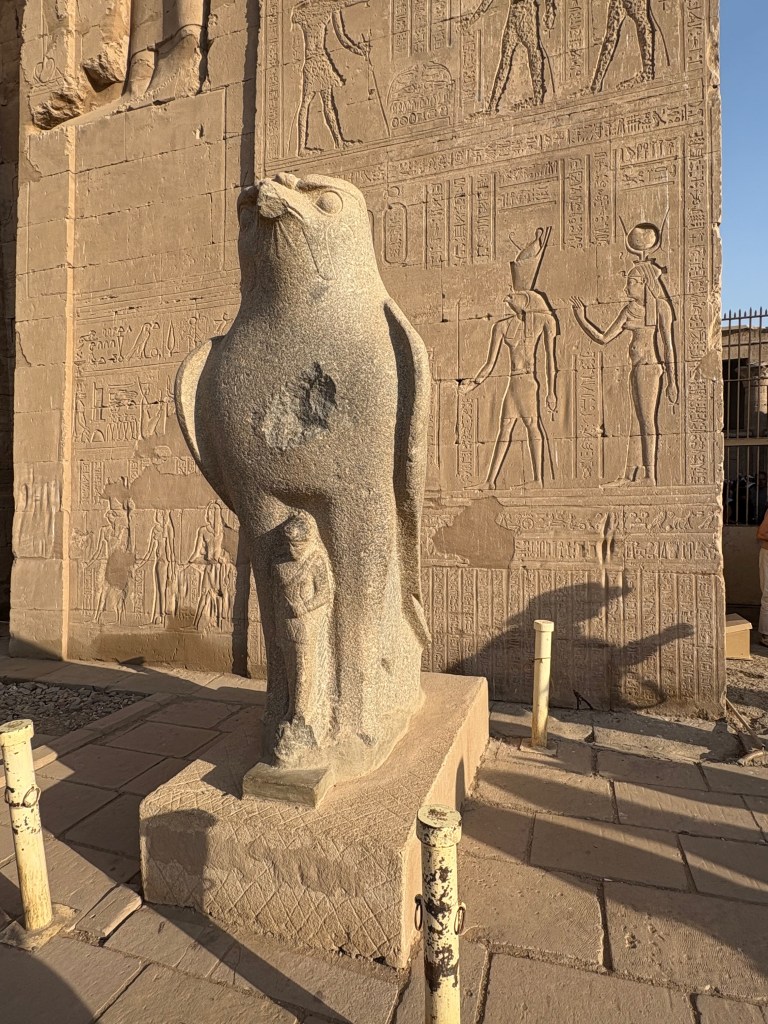
Edfu Temple, the second largest temple in Egypt after Karnak, is one of the most striking and complete of ancient Egyptian temples and is dedicated to the worship of the god Horus. Situated on the western bank of the Nile, its construction began during the reign of Ptolemy Ill in 237 BC, but was completed in the reign of Ptolemy XII in 57 BC, 180 years later.
The temple remained buried under layers of debris from various settlements for millennia, which is why its architectural and decorative elements have survived so well. In 1860 the French archaeologist Auguste Mariette uncovered and restored parts of the temple.
The temple is fronted by two massive pylons that bear scenes of Ptolemy XII conquering his enemies and worshipping deities.
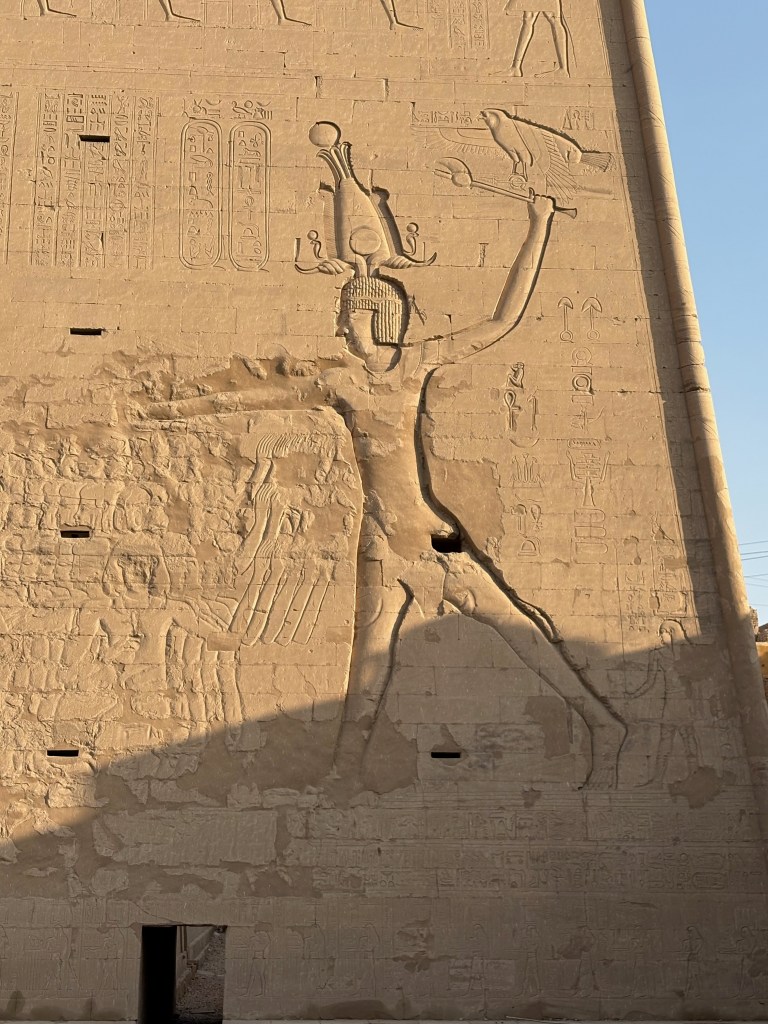
Two large granite statues of the falcon-god Horus stand before the pylons.
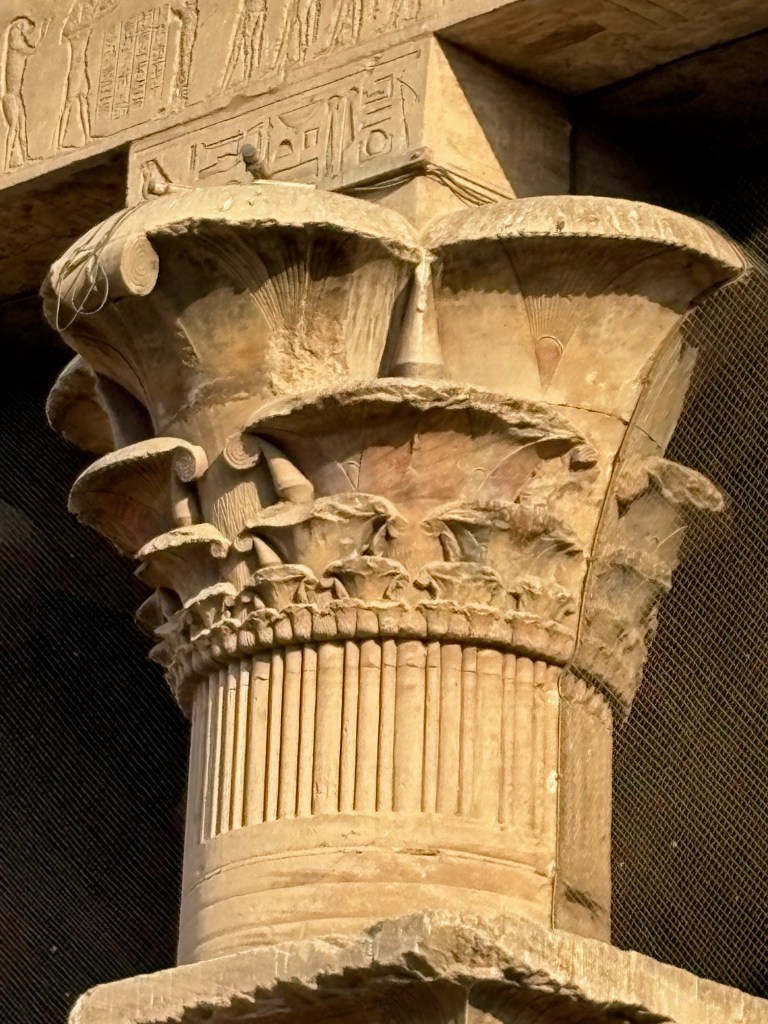
Once through the pylons you enter into a large Peristyle court lined with columns decorated with floral capitals.
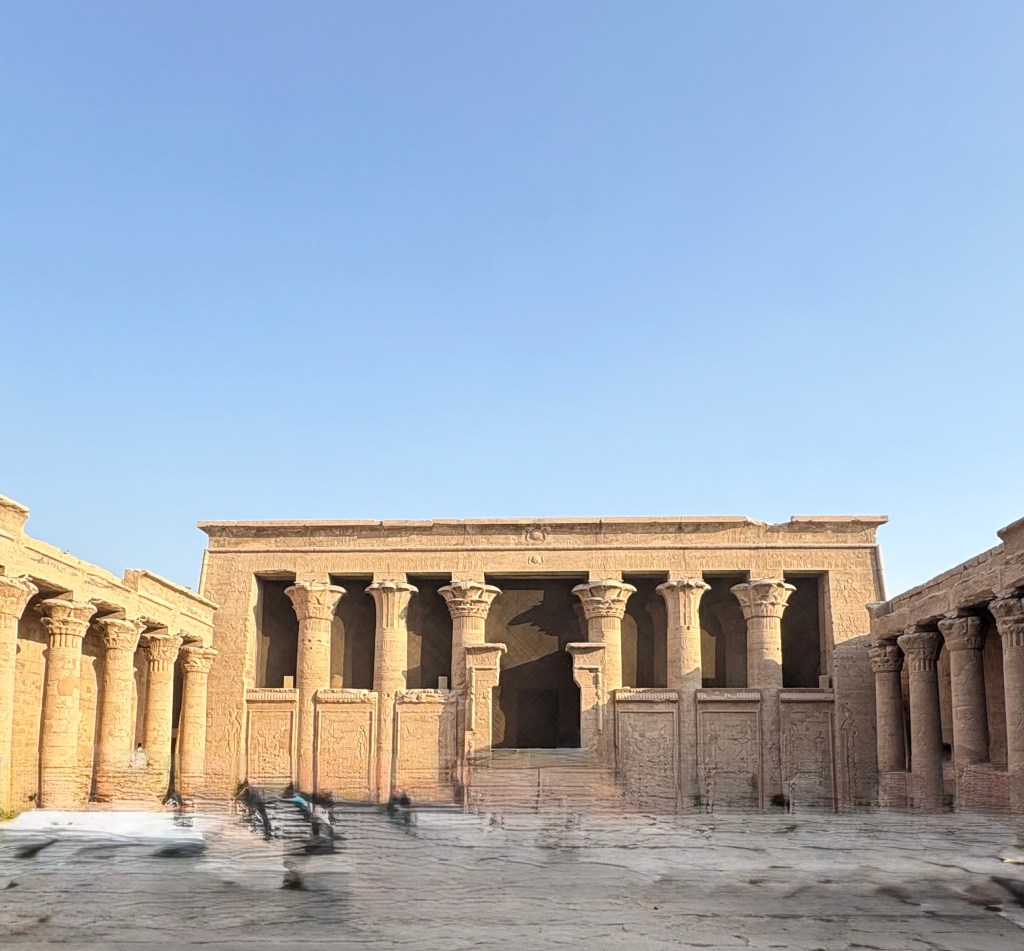
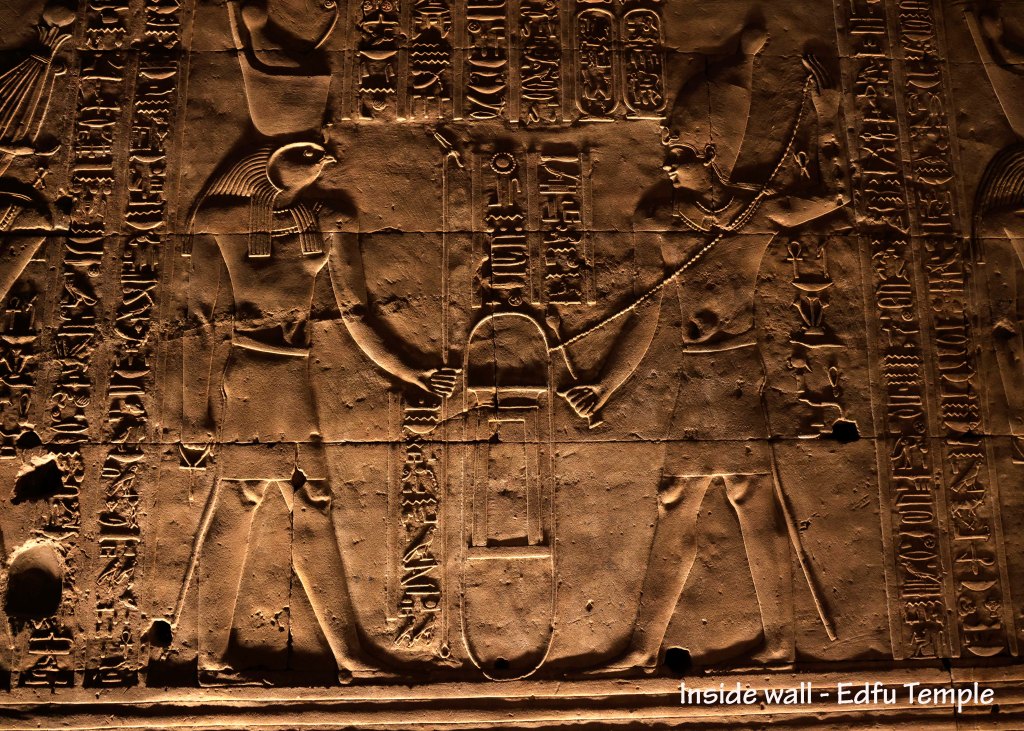
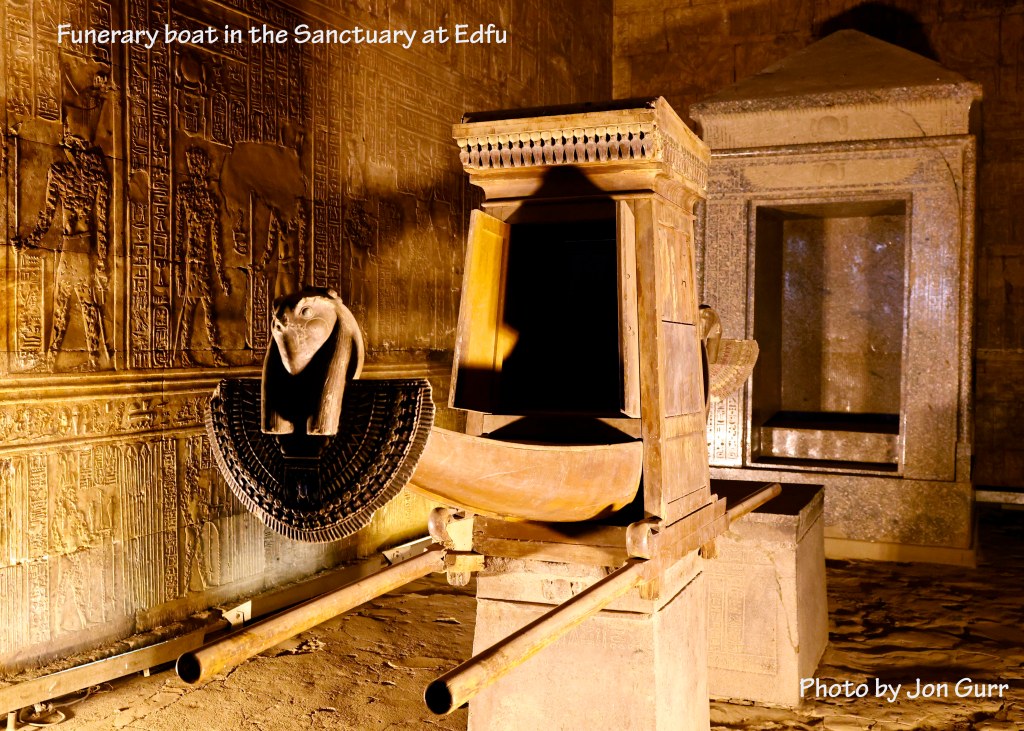
The sanctuary.
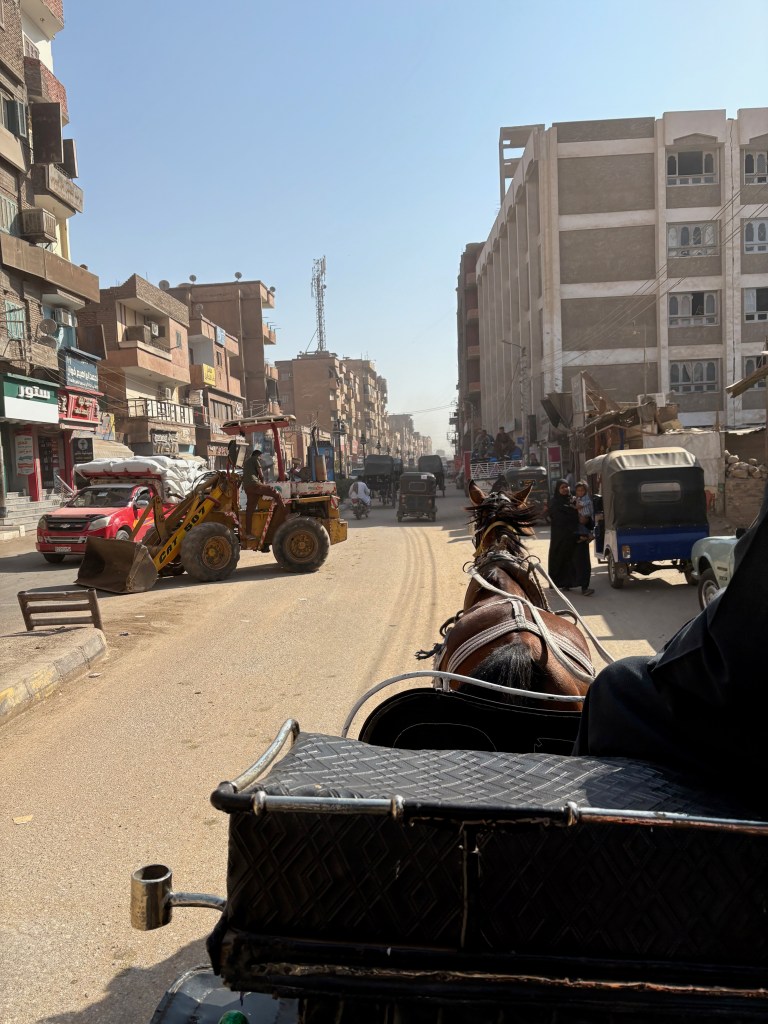
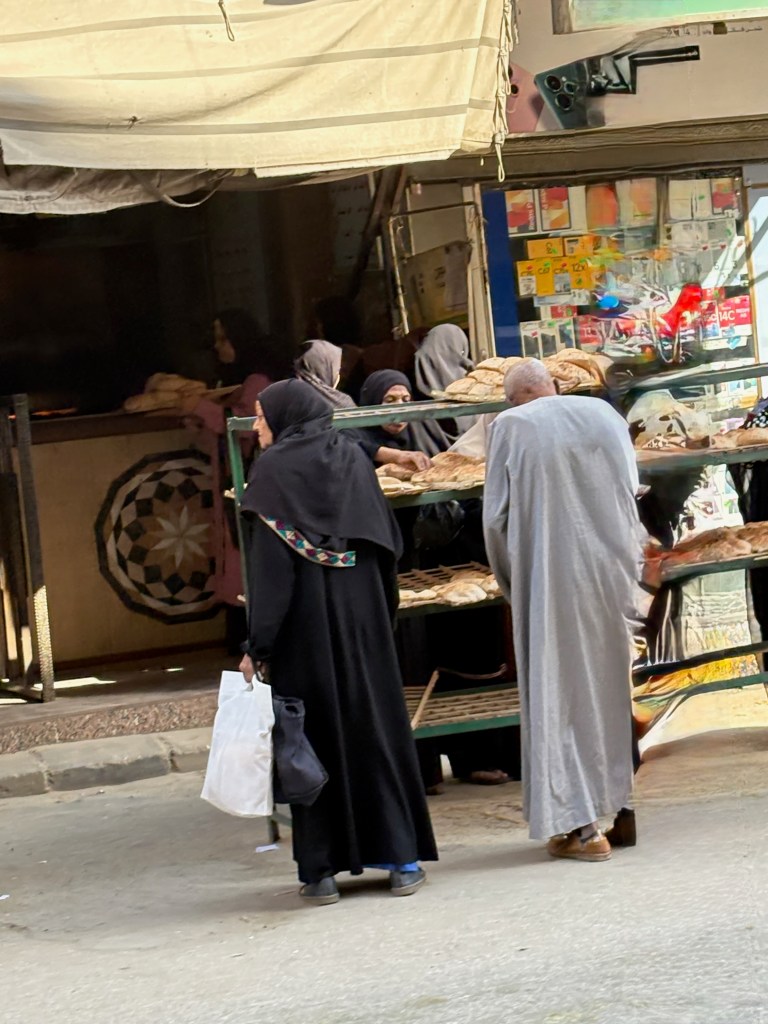
We returned to the boat by buggy carriage, passing people on the streets buying their bread and pita amidst the sand and dirt.
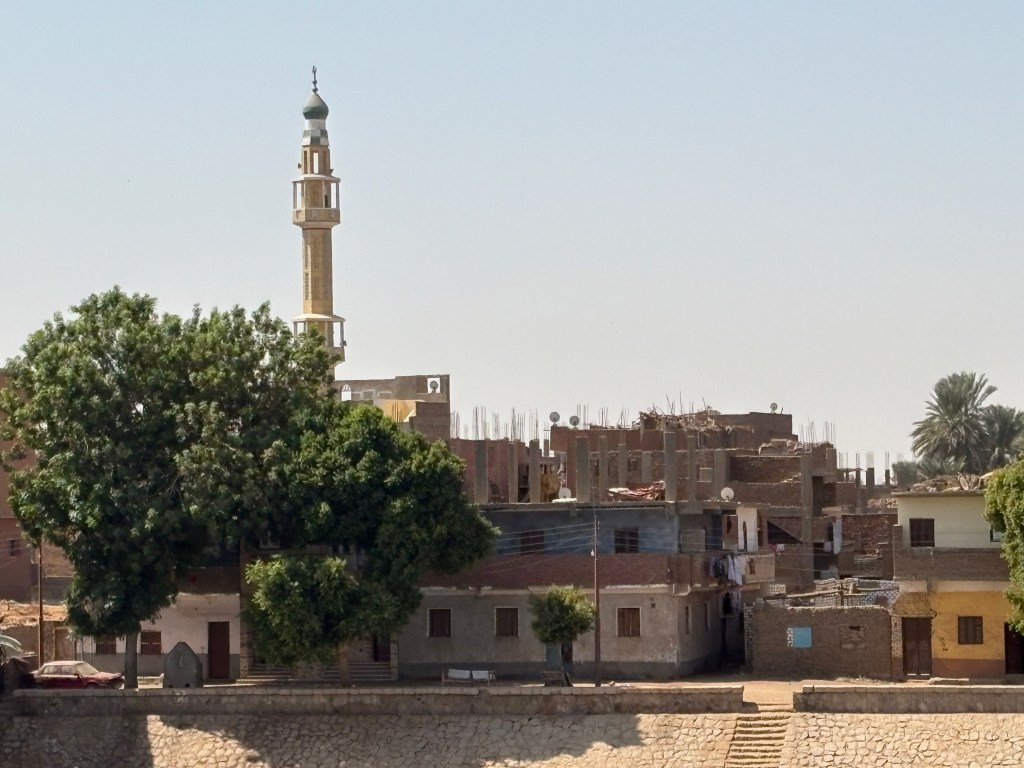
We went to the top deck to read and enjoy the countryside passing by the boat. The houses are not finished because once finished, they incur taxes. Also the wires on the top floor are intended for the next floor for the next generation of the family.
After lunch, we had a nap and then we enjoyed a cooking class, making lentil soup, couscous, falafel and chicken shwarma- all very good.
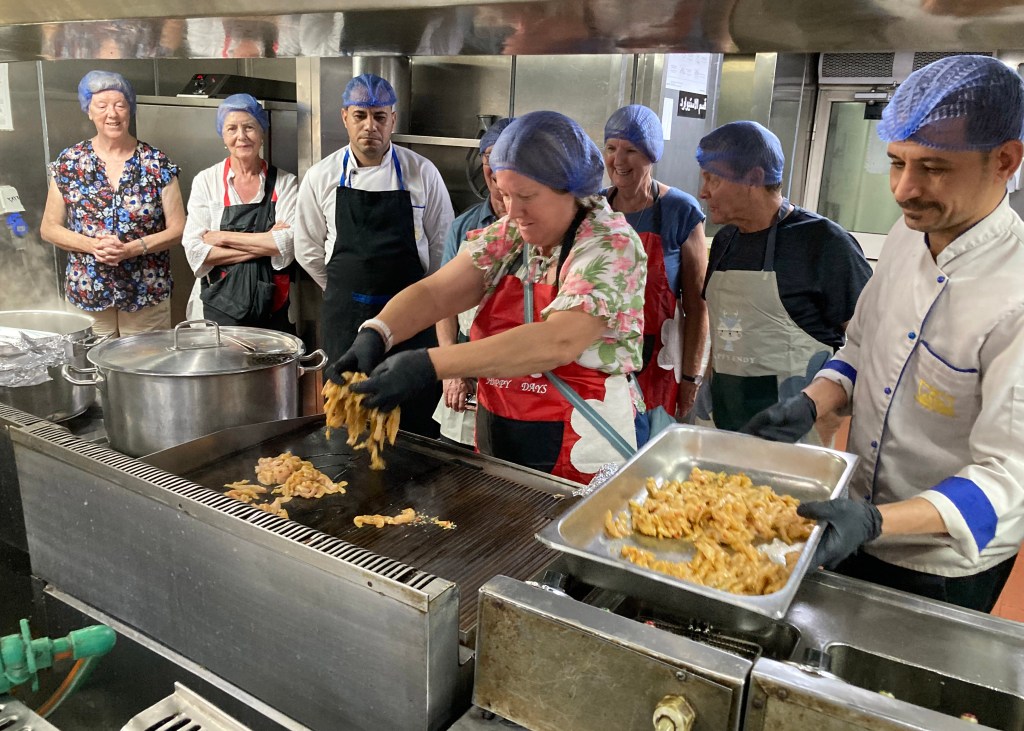
Jon shared some of his extensive knowledge of photography in an hour-long class with amazing examples.

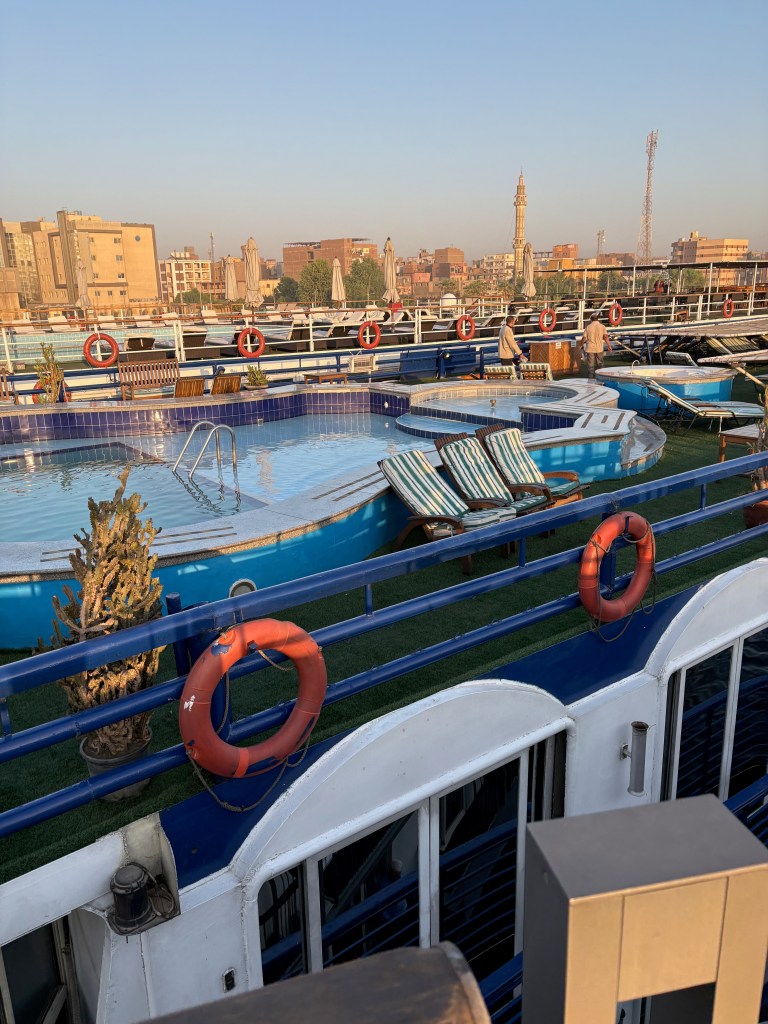
This photo shows how close the river boats are tied (rafted) to each other.
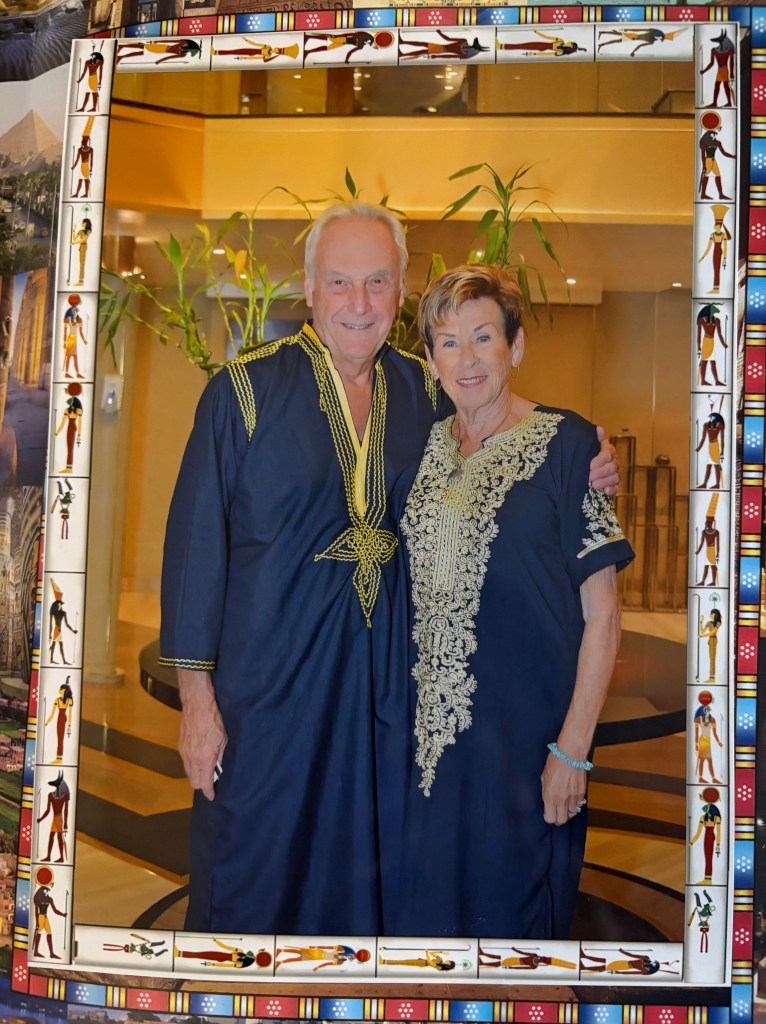
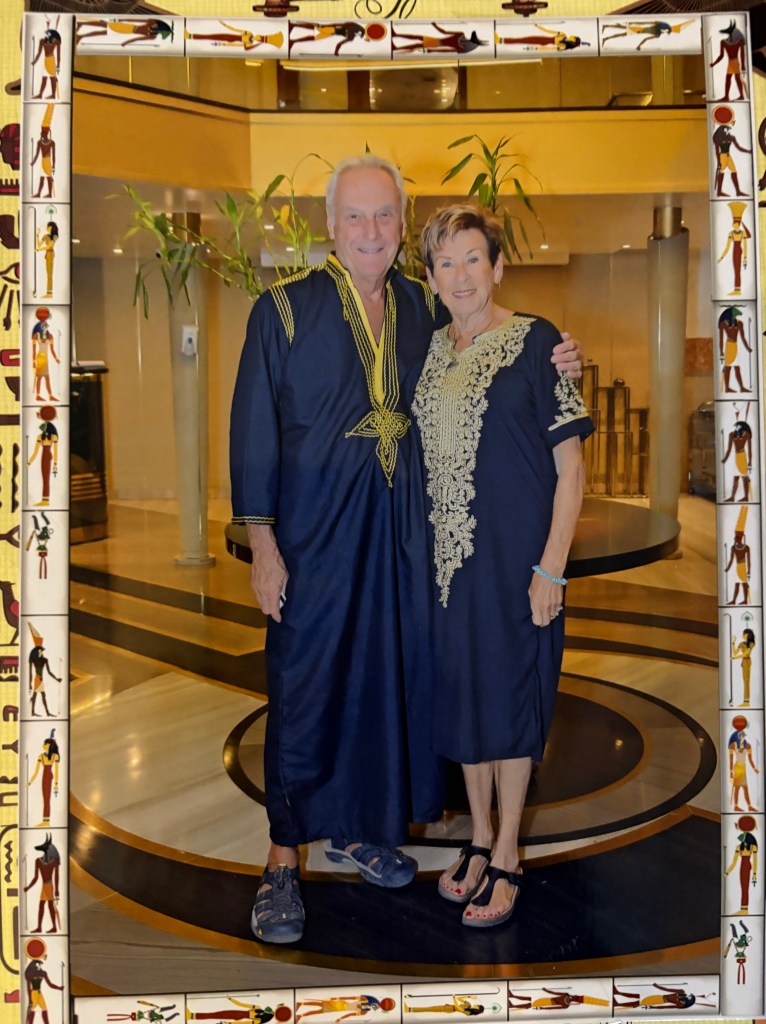
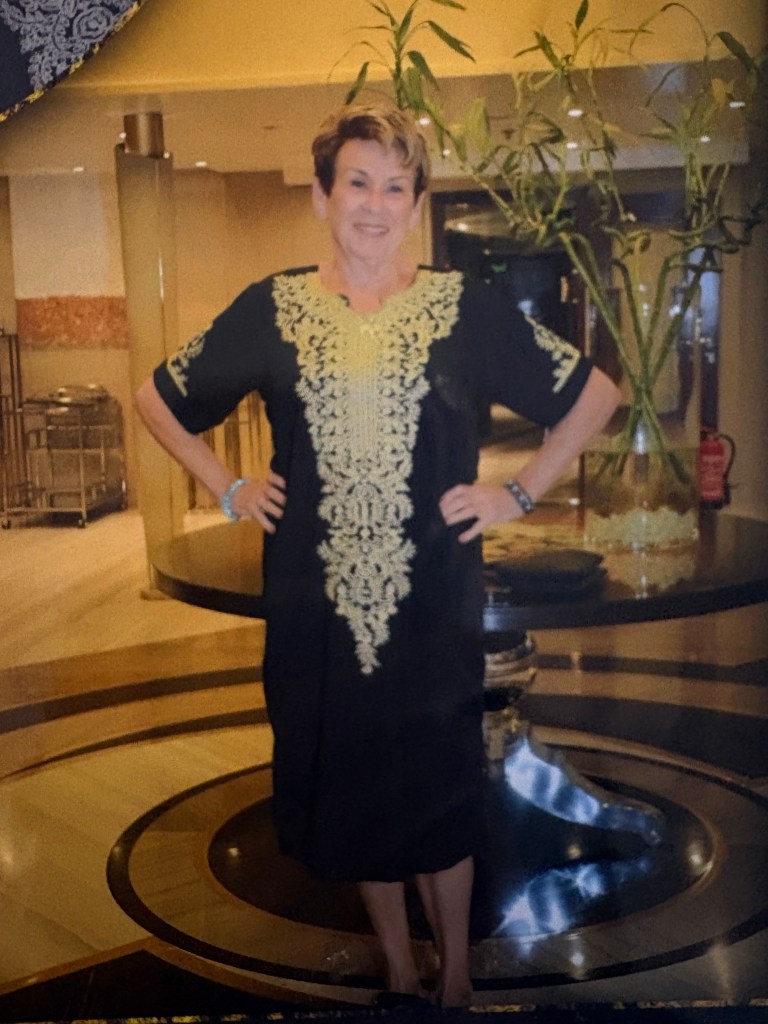
There was a Gallabiyah (a loose-fitting, traditional garment from Egypt. Today, it is the national clothing in Egypt. It comes in rich colour varieties) party where we had the option to dress-up in traditional garb. We decided to participate and bought the $US 10 costumes.
OCT 21, Tuesday ASWAN / ABU SIMBEL
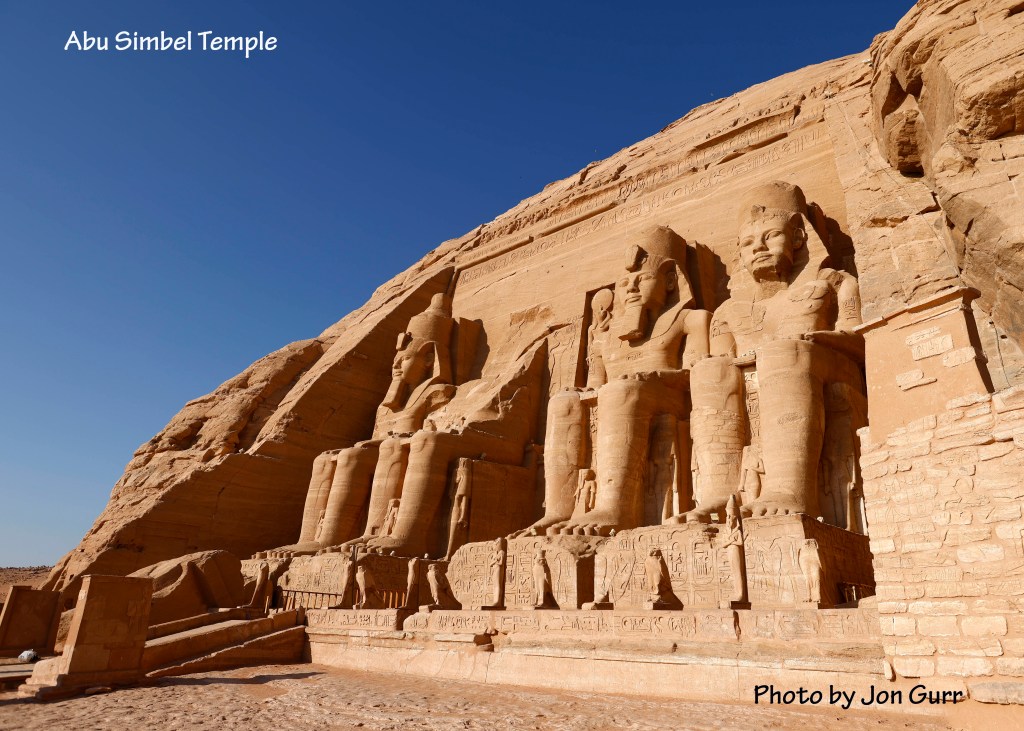
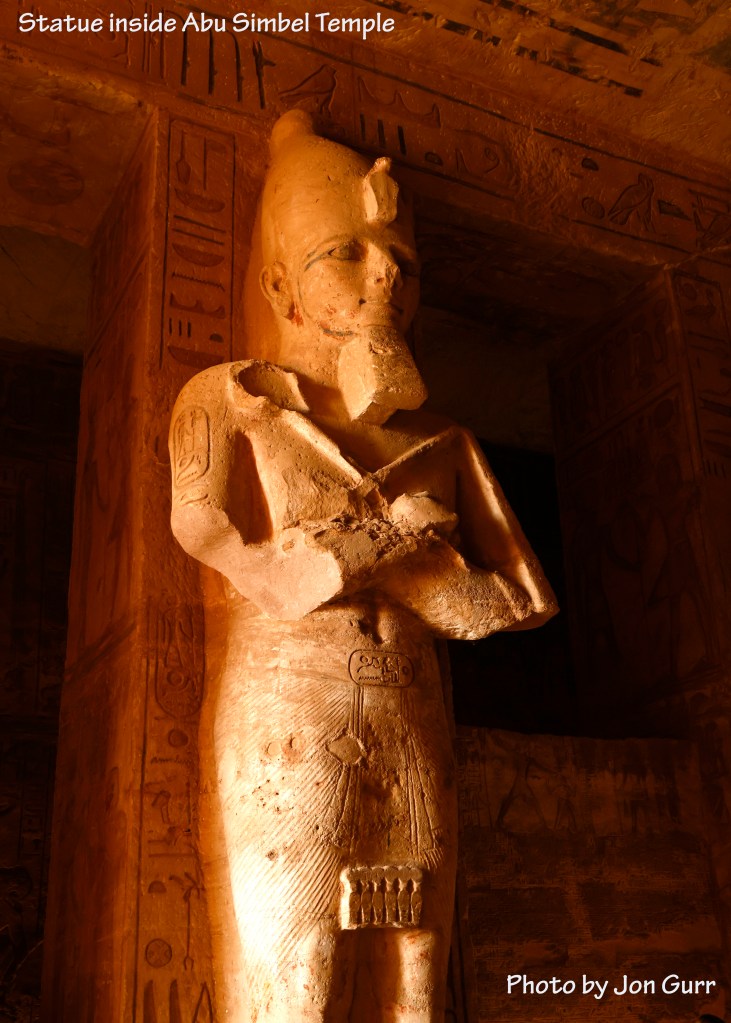
Bill flew with the group to Abu Simbel (I was still struggling with nausea and the thought of two flights, 40 degree temperatures and lots of dust was too much) to see the massive temples built by Ramesses II, one of Egypt’s greatest pharaohs.
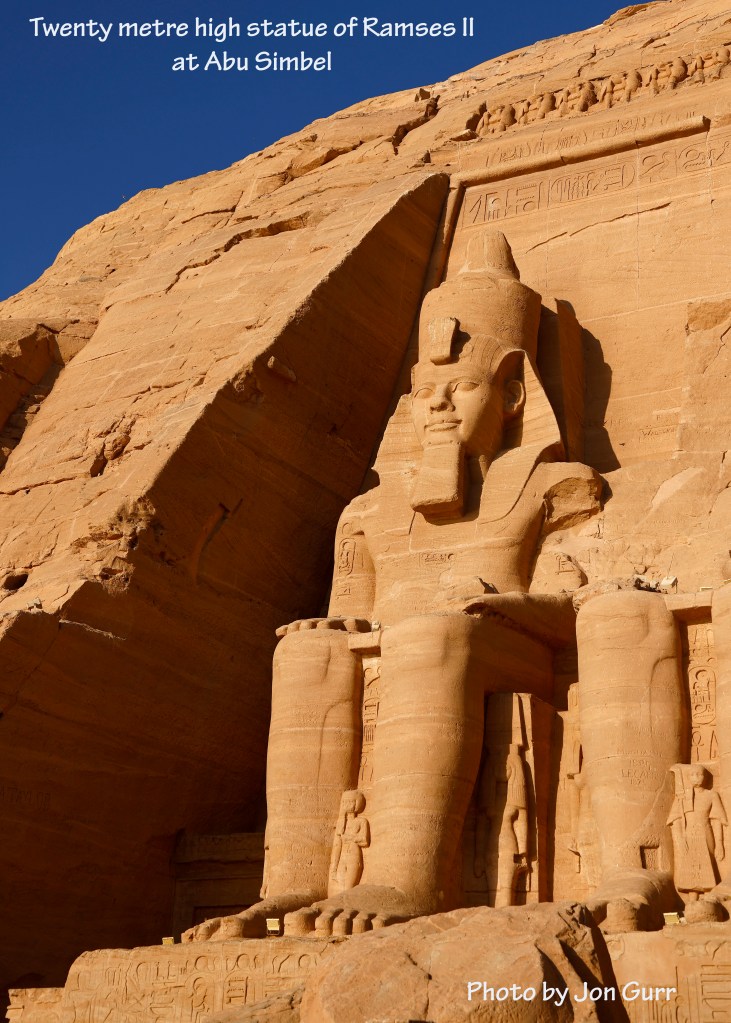
These rock-cut temples were relocated to avoid submersion due to the construction of the Aswan High Dam. They marked the southern boundary of the Egyptian Empire at the height of the New Kingdom’s power, showcasing the strength of Egypt’s rulers.
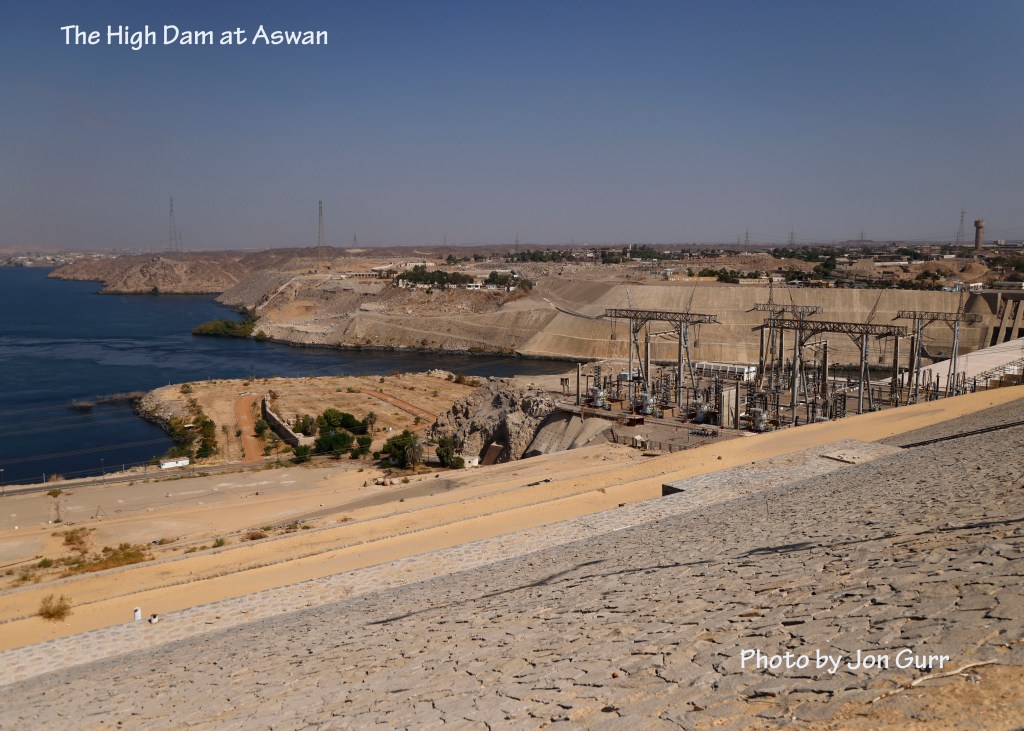
After the group returned to Aswan, we passed the British Dam and then visited the High Dam.
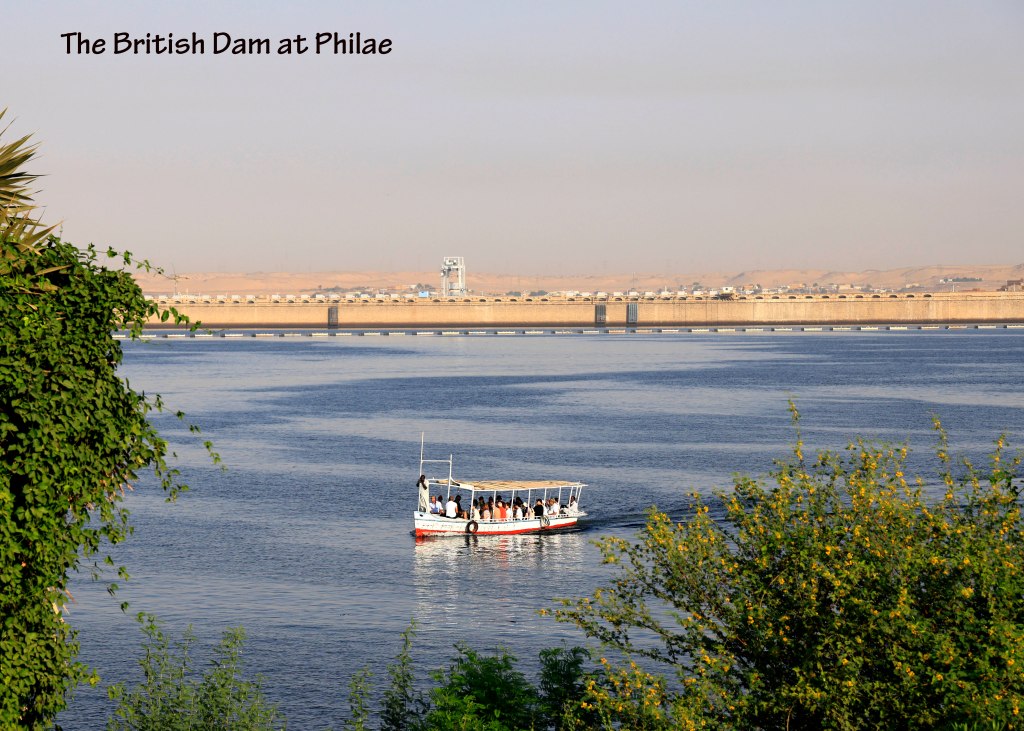
The High or Aswan Dam is one of the world’s largest embankment dams, which was built between 1960 and 1970 across the Nile in Aswan. It has resulted in protection from floods and droughts, an increase in agricultural production and employment, electricity production, and improved navigation that also benefits tourism. Like many other dams, it also had pernicious downstream effects. In this case, a rising water table damaged urban sewer systems, ancient monuments, and agricultural fields. A lack of rich sediment in the water drove high artificial fertilizer use and wiped out fish populations.
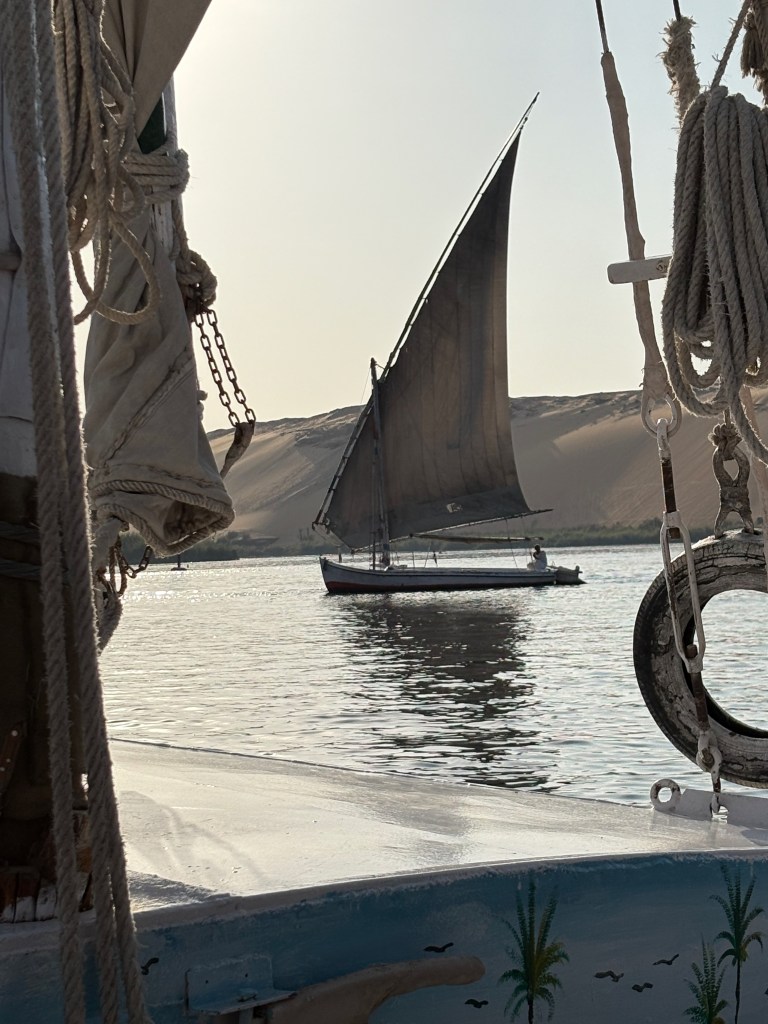
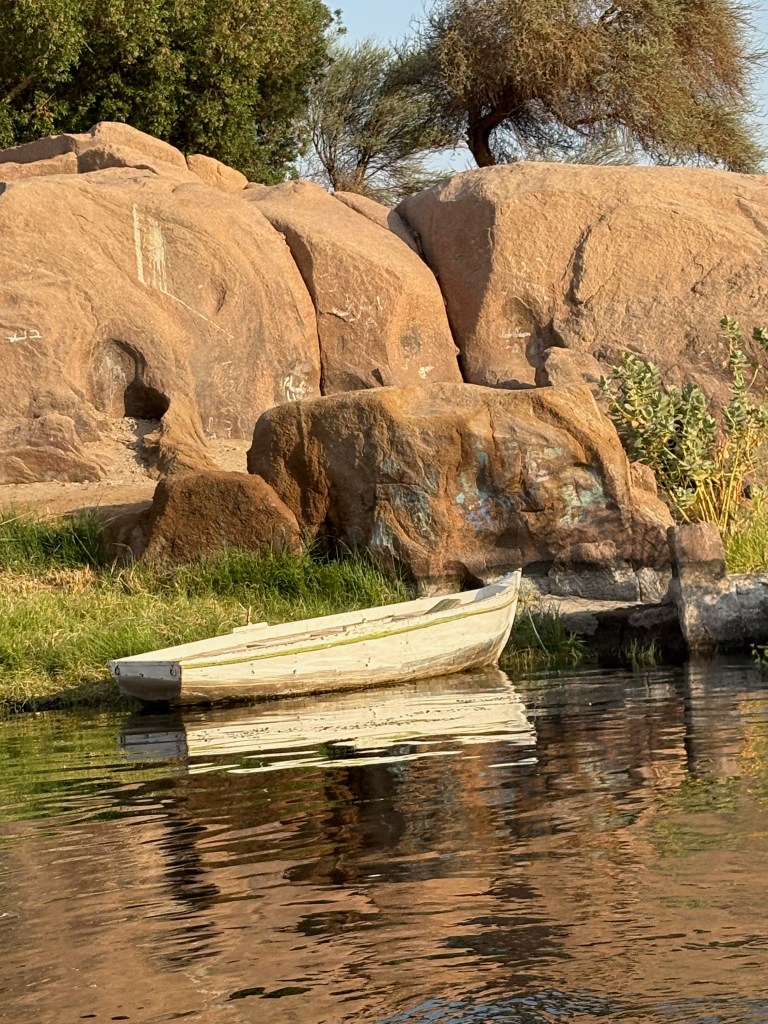
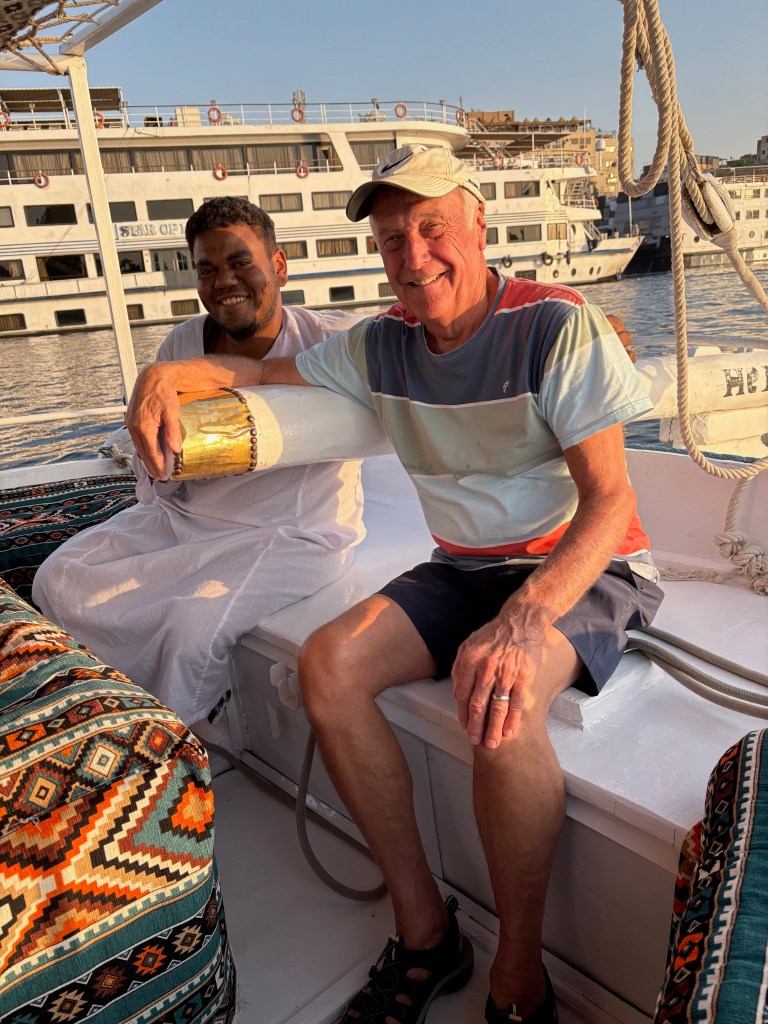
Late in the afternoon, we had a ride in a felucca to Elephantine Island.
OCT 22, Wednesday ASWAN, PHILAE TEMPLE
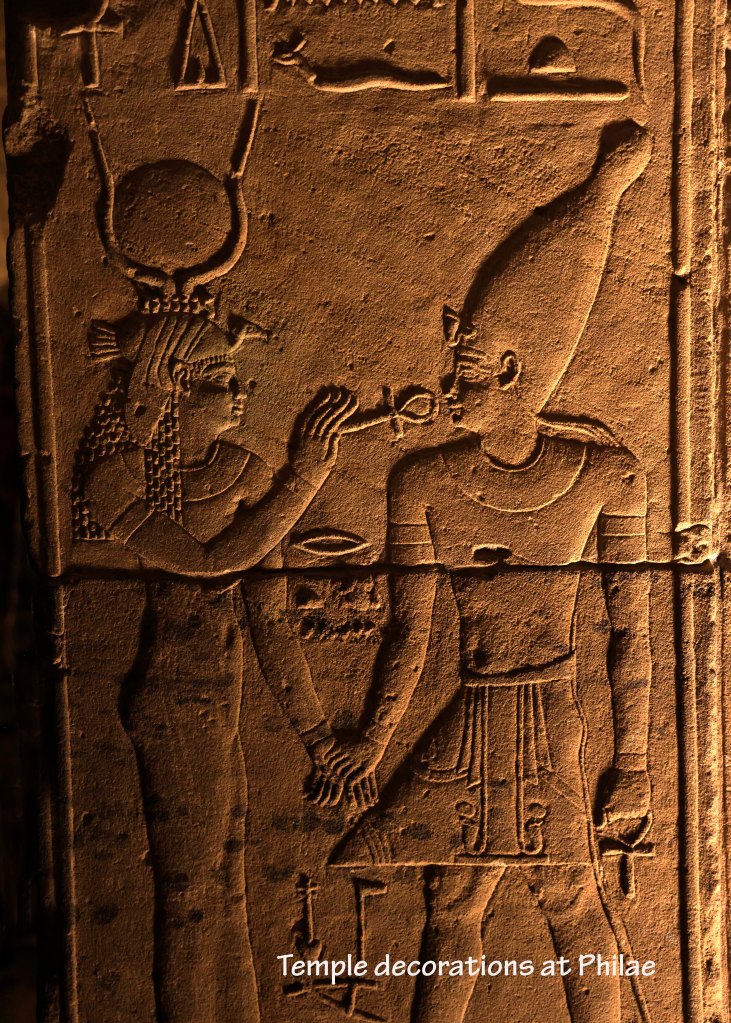
Today, we boarded a river taxi to reach Philae Temple dedicated to Imhotep. Imhotep was a high official during the 3rd Dynasty, who served King Djoser (c. 2686-2667 BC) and is credited with building Djoser’s step pyramid in Saqqara. By the Ptolemaic Period, Imhotep was worshipped as a god. The Greeks admired his reputation as a physician, leading them to identify him with Asclepius, who was their god of medicine. It is believed that Ptolemy V (204-180 BC) may have dedicated this temple to Imhotep as thanks for the birth of his son, the future Ptolemy VI.
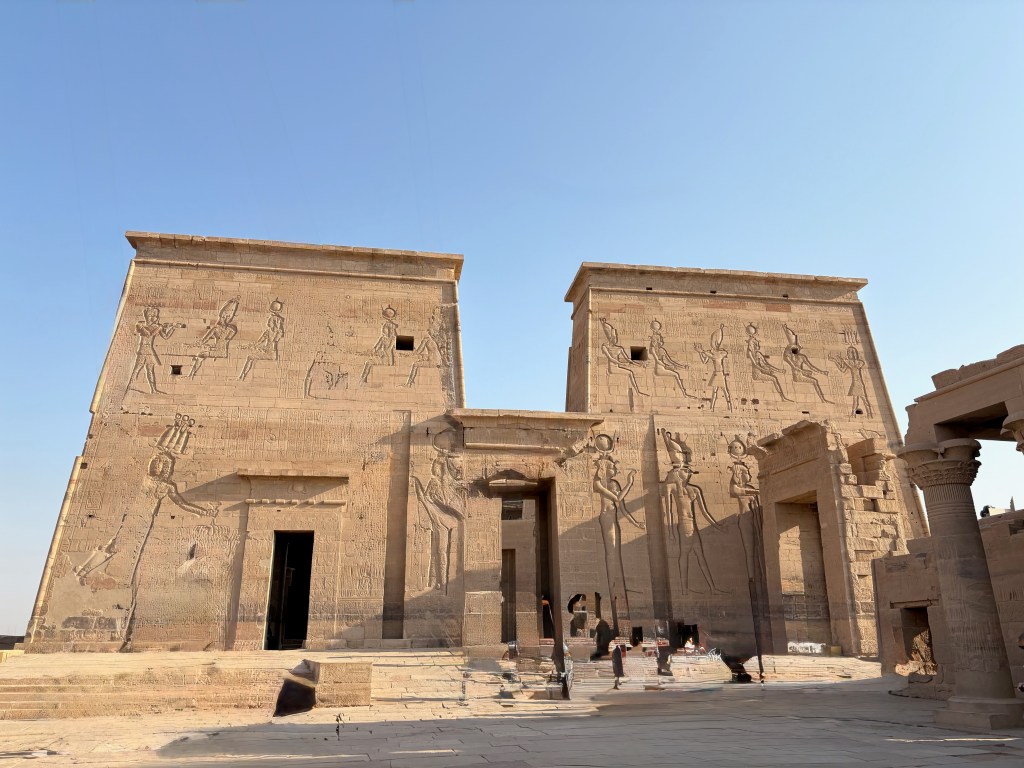
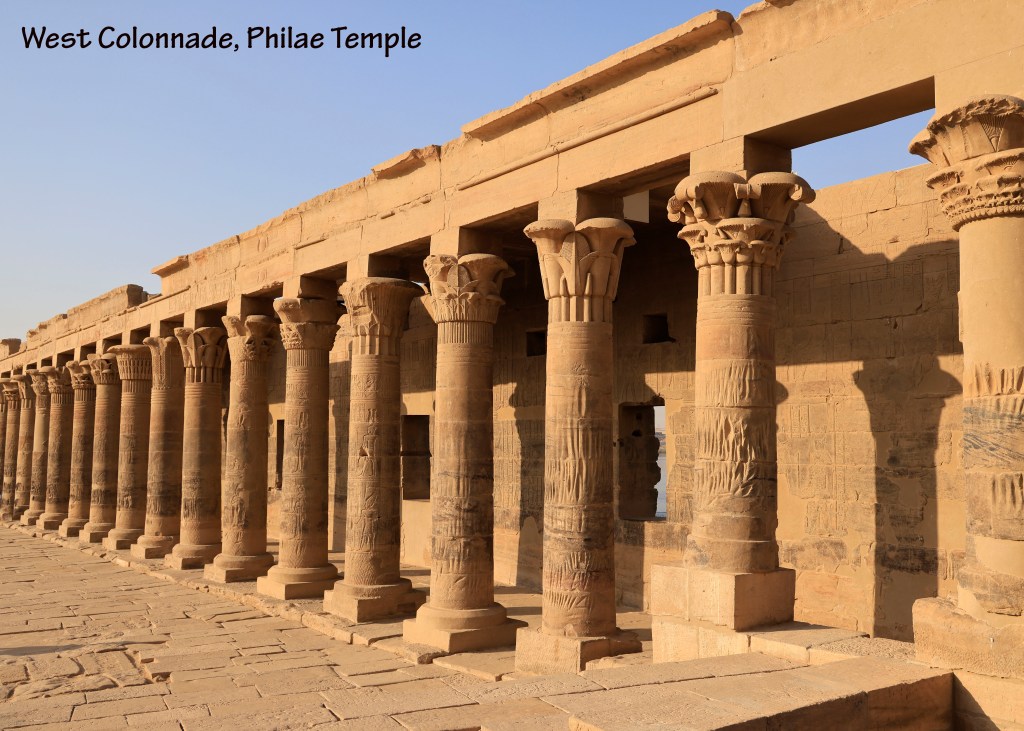
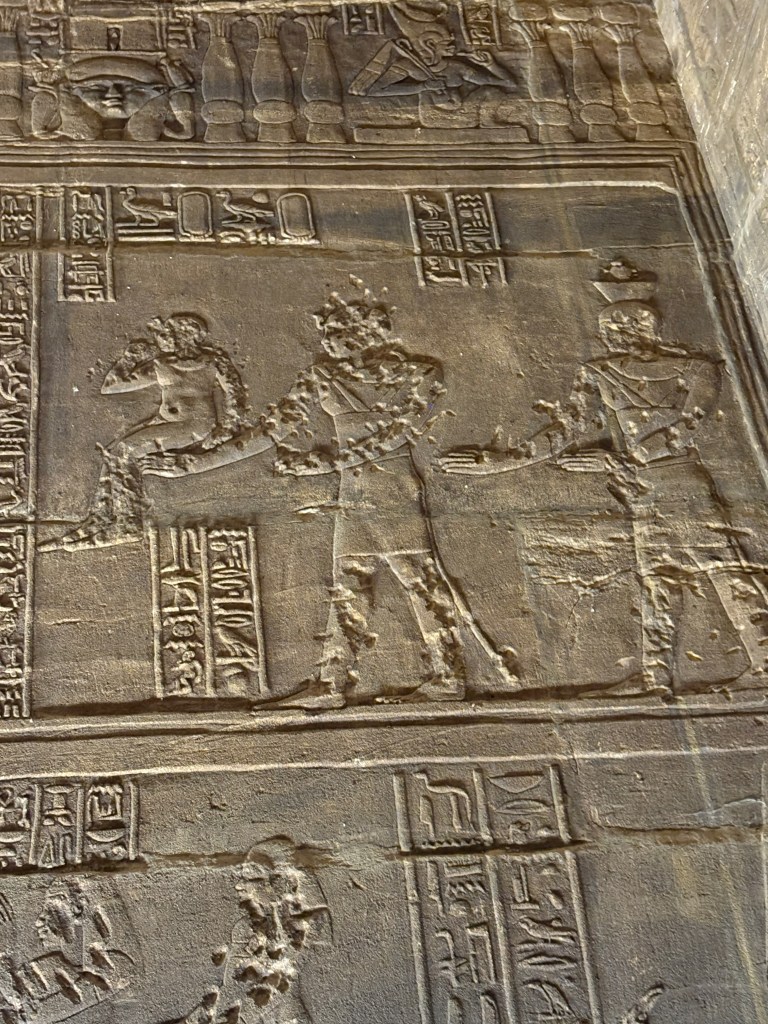
The Philae Temple was built by the last dynasty of ancient Egypt, the Ptolemaic. Built during the reign of Ptolemy II (Egypt’s Greco-Roman Period), the Temple of Isis at Philae is dedicated to Isis, Osiris, and Horus. The temple walls contain scenes from Egyptian mythology of Isis bringing Osiris back to life, giving birth to Horus, and mummifying Osiris after his death. The temple is one of the last places where ancient Egyptian religion survived after Christianity swept the shores in 550AD.
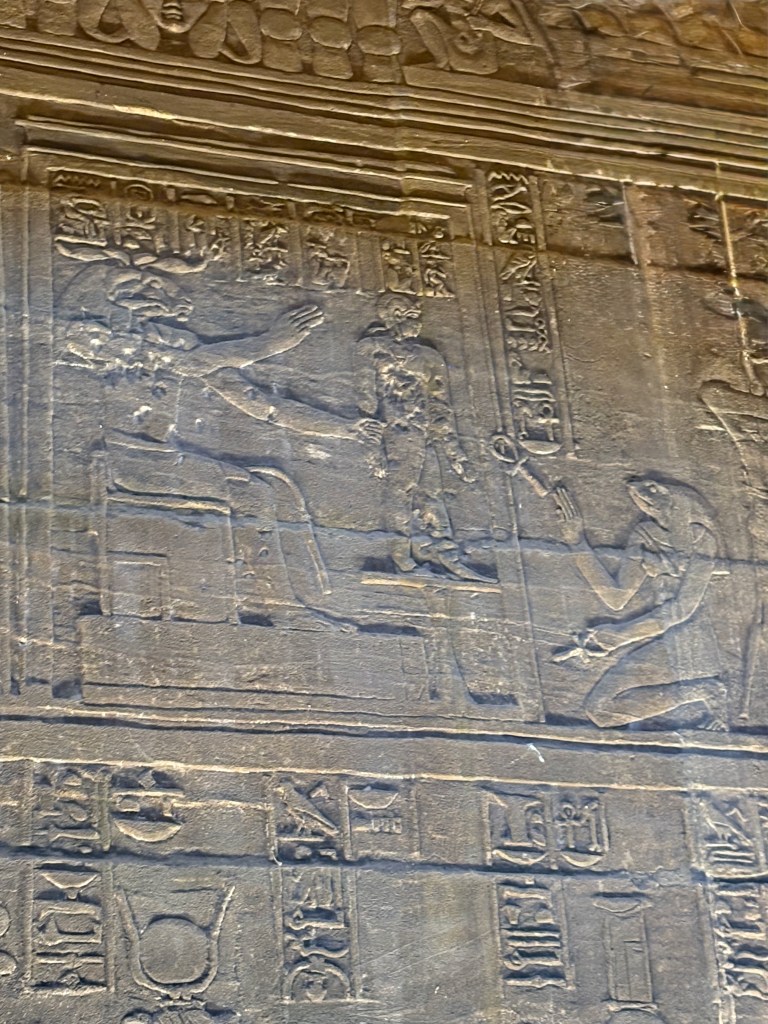
Note the images are partly chiselled out when later religions, like Christianity, took over.
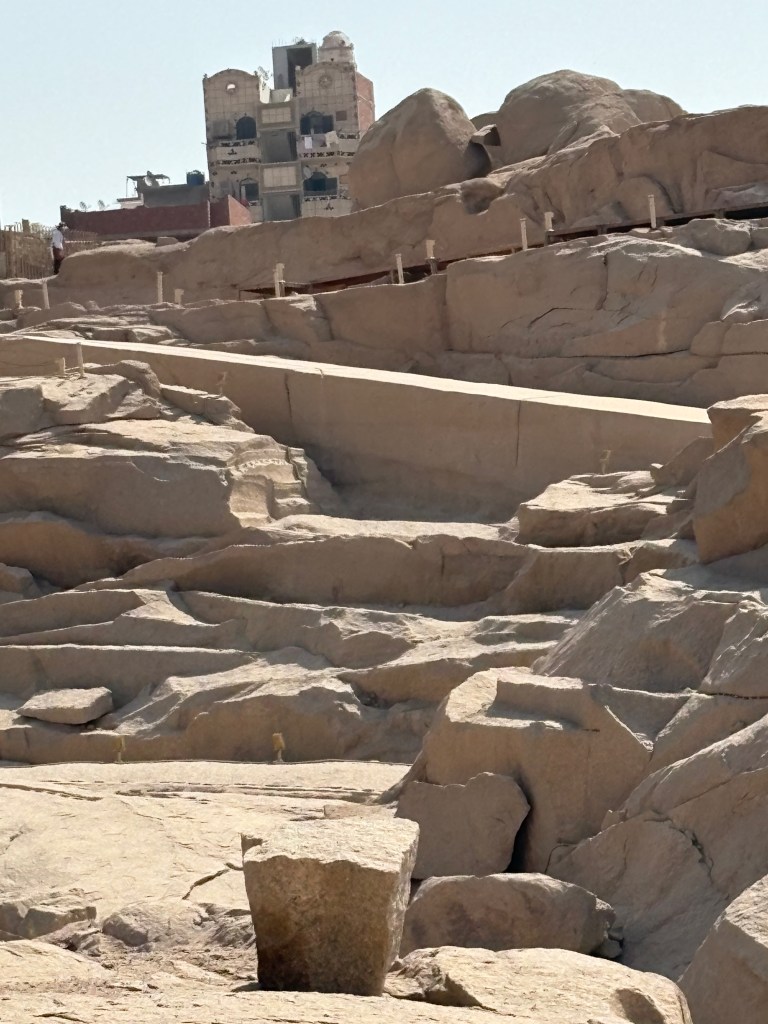
We visited Aswan’s quarry, home to the famous Unfinished Obelisk, a 41-metre-long slab of granite.

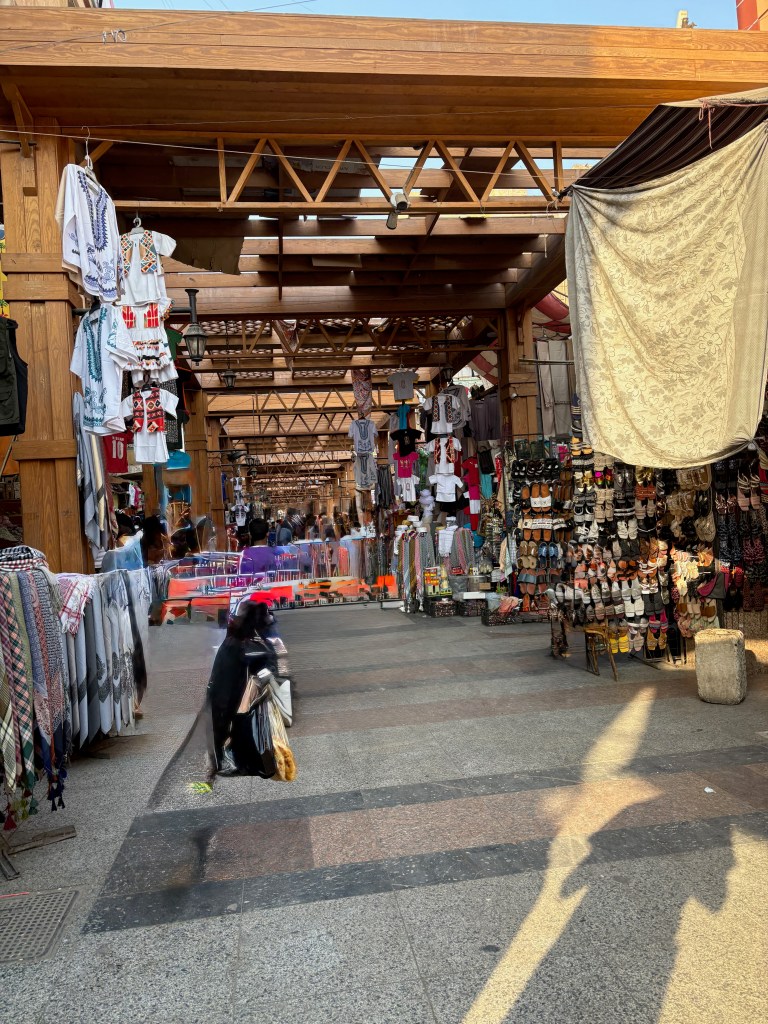
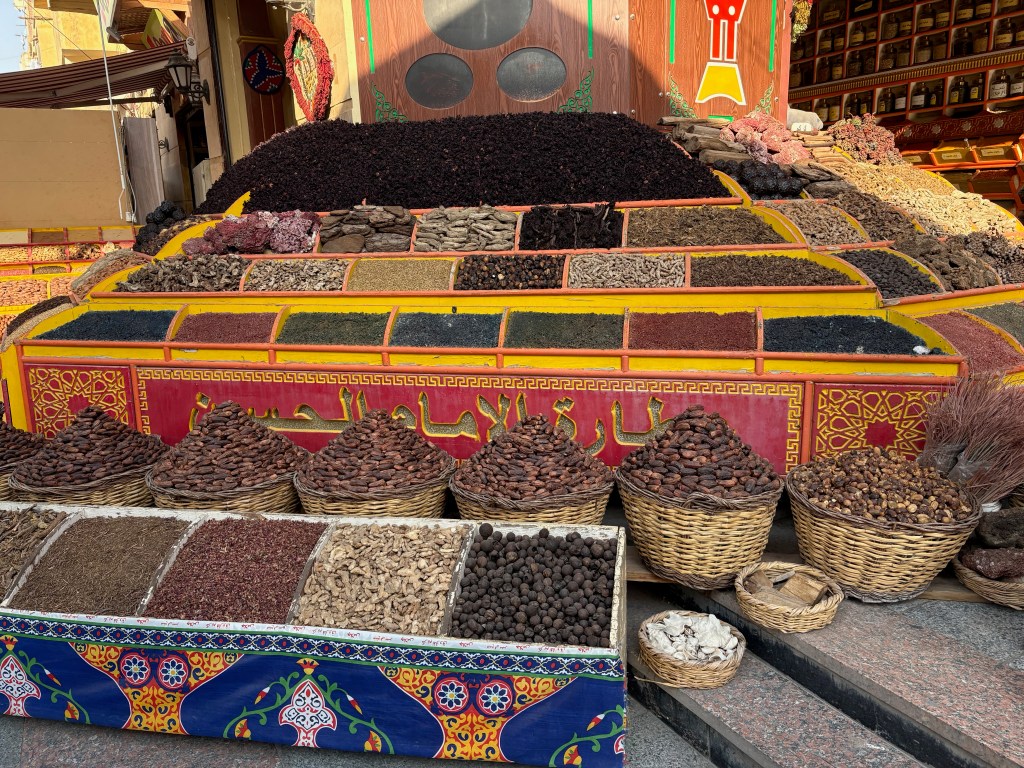
We finished off the afternoon with a visit to the market. The sellers were relentless in their promotion of goods, to the point of rudeness. We bought some spices from a very nice merchant: Cardamon, Cumin, Vanilla, Oregano, Cinnamon and hibiscus tea.
We were amazed at the number of River Boats on the Nile – over 350.
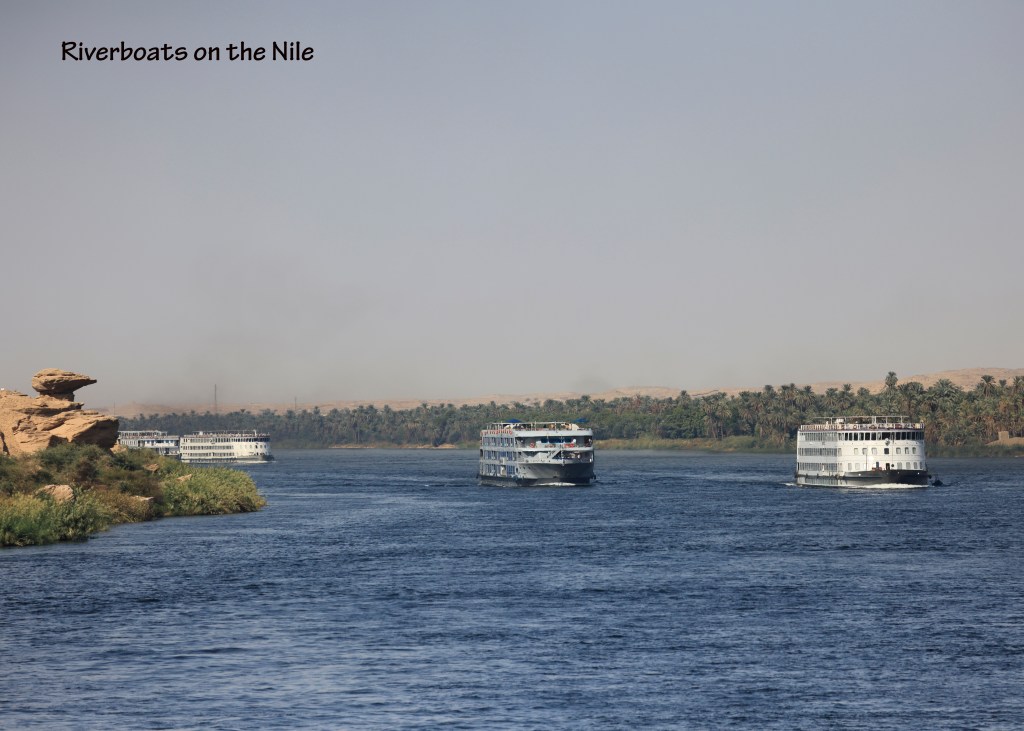
OCT 23, Thursday ASWAN / EDFU
We had a later start which was welcome. We took a boat to the Nubian village on Elephantine Island. We walked around the village with the chief as tour guide visiting an elementary school and the museum. There is electricity and running water on the island but life is basic and laidback.
The chief, King Jamaica, led our tour, pointing out the fresh cold water freely available.

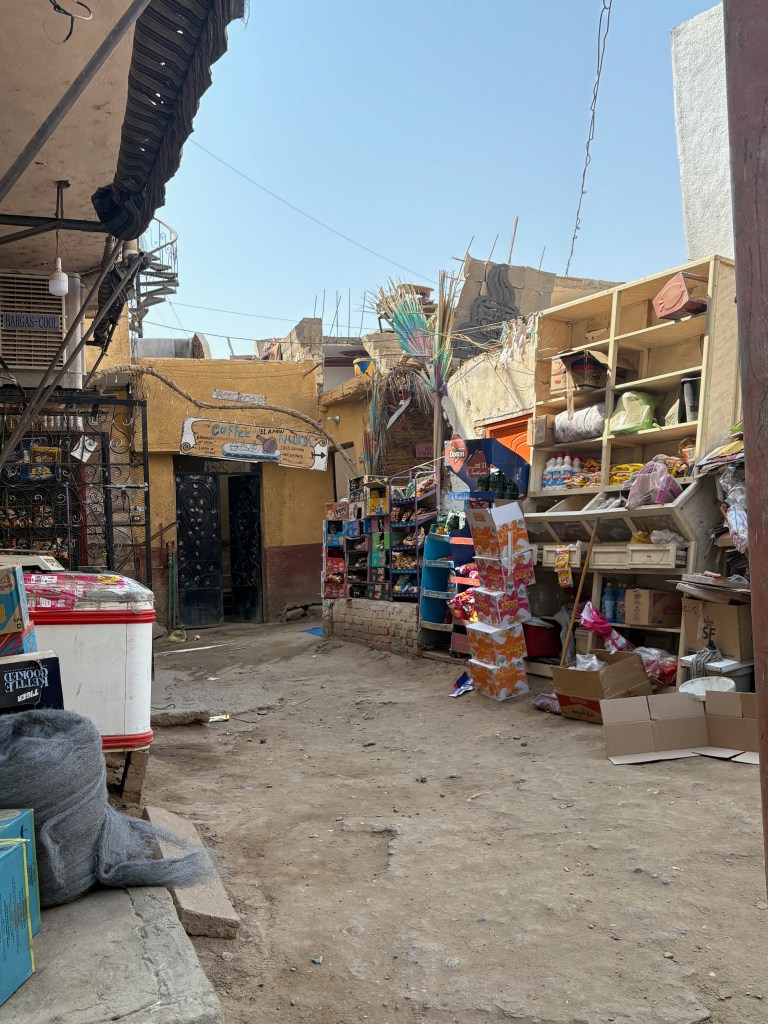
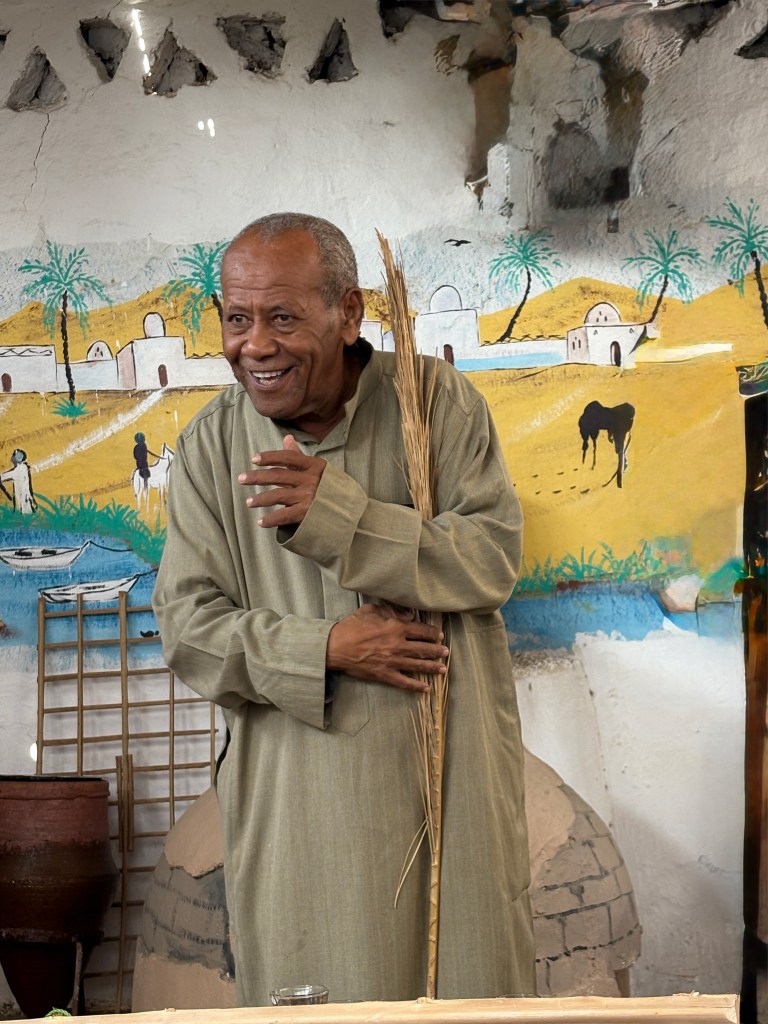
An elder gave us a lecture on the traditional Nubian way of life based on 3 elements: the Date Palm, the woman and the Nile. The Date Palm is the source of everything from building materials to alcohol. The Woman is the head and backbone of the family and keeps their way of life together. The Nile is the source of water, transportation and renewal of the land.
We visited a Nubian school.
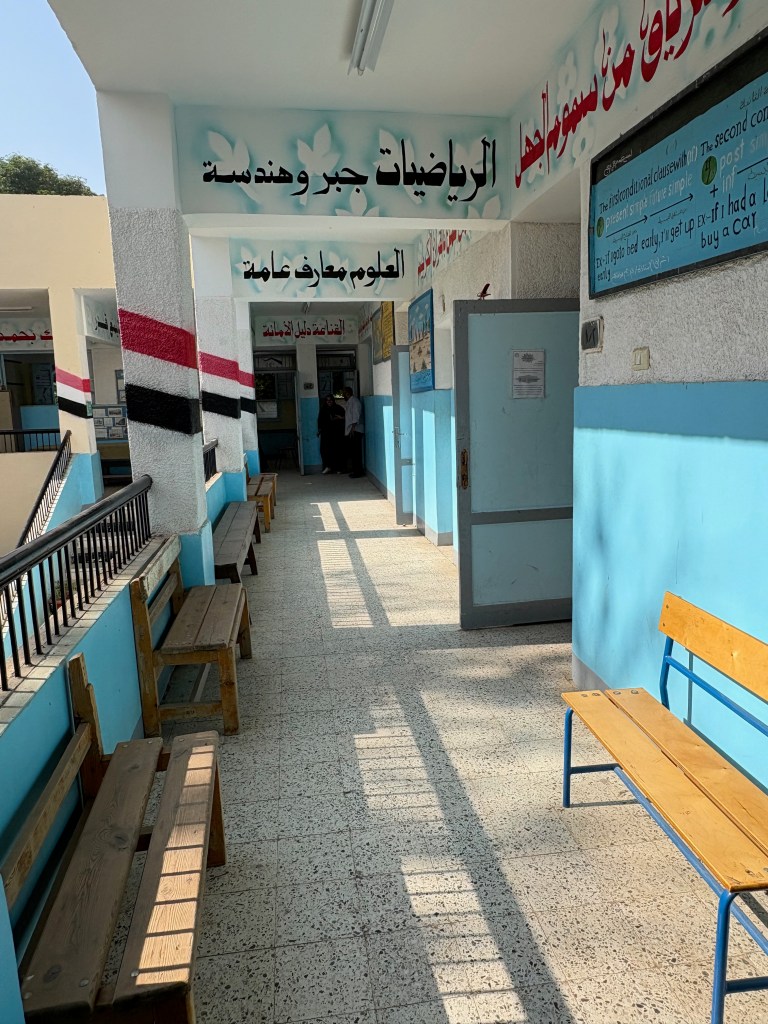
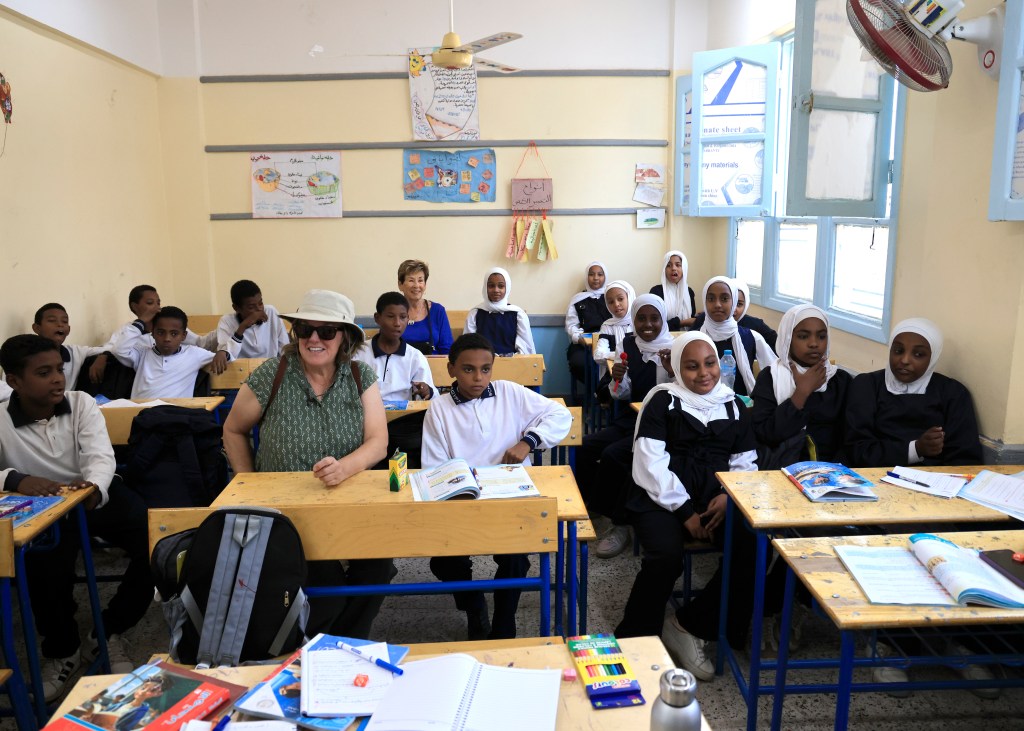
We visited two classrooms and learned a few Egyptian characters. The children were eager to talk to me and writing a note in their notebooks was a big hit.
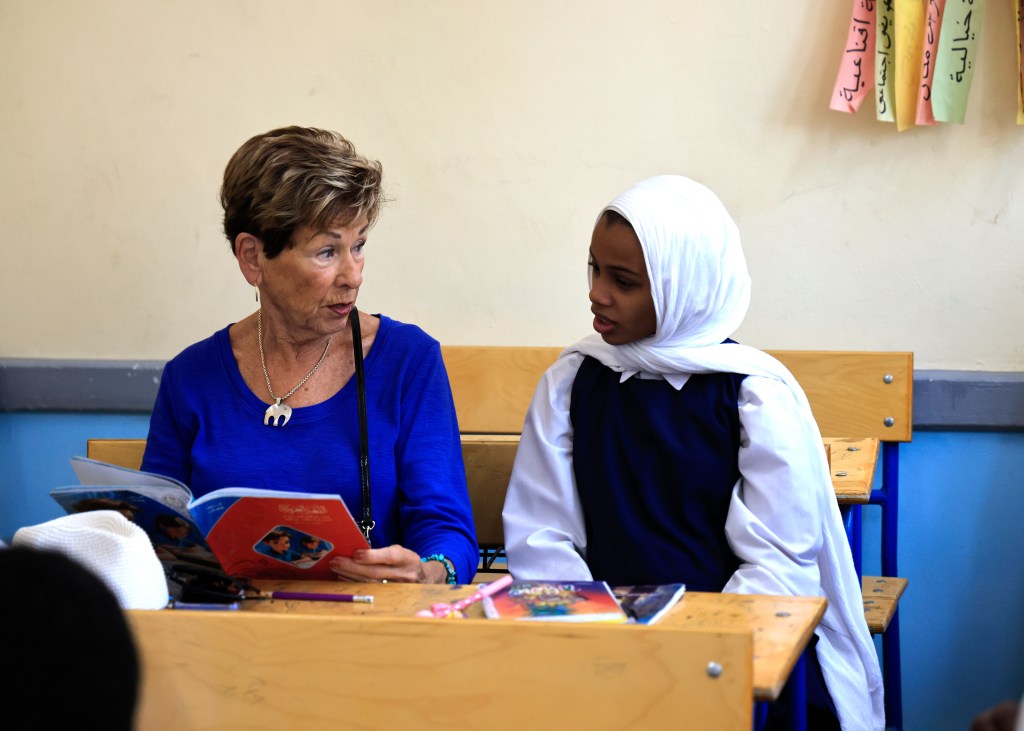
There were small numbers in the classrooms with a balance of girls and boys: education is highly valued by the families with a high percentage graduating high school but not so many going to university.
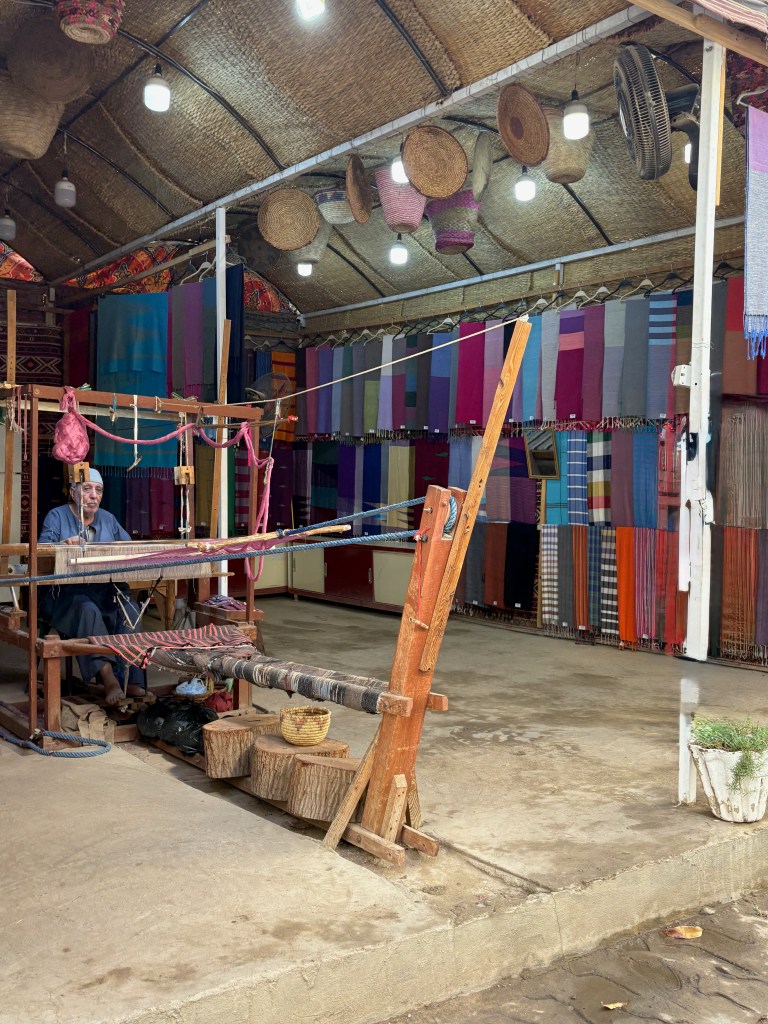
I purchased a hand made cotton and silk scarf in this Nubian shop.
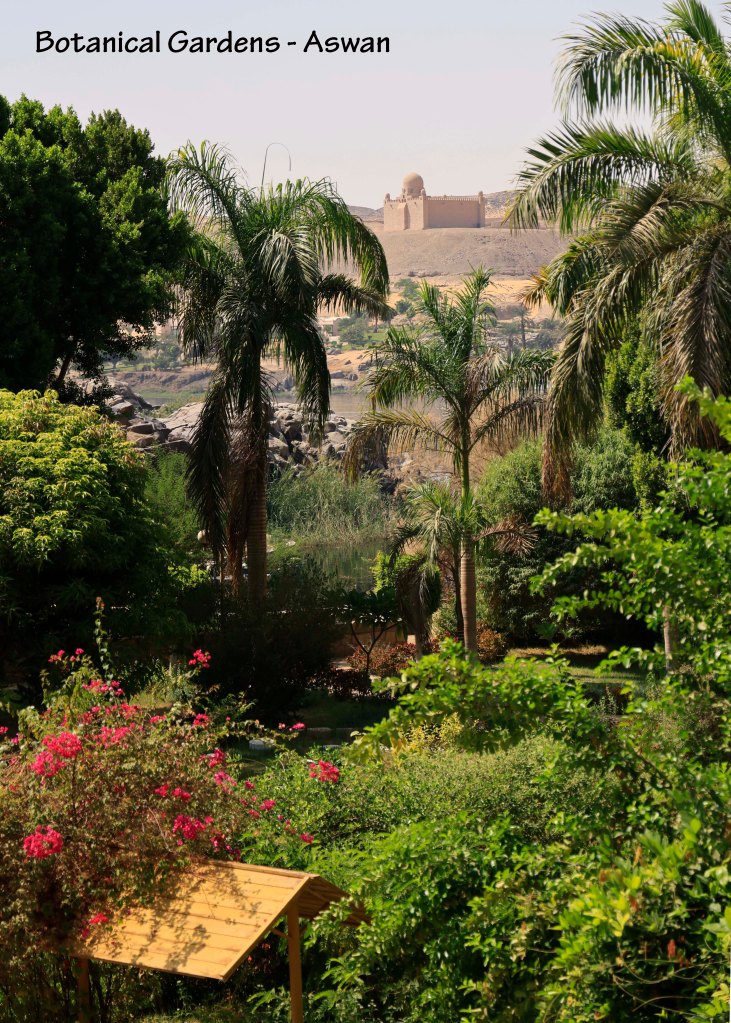
We had lunch on the river and visited Kitchener Island and its botanical Gardens.
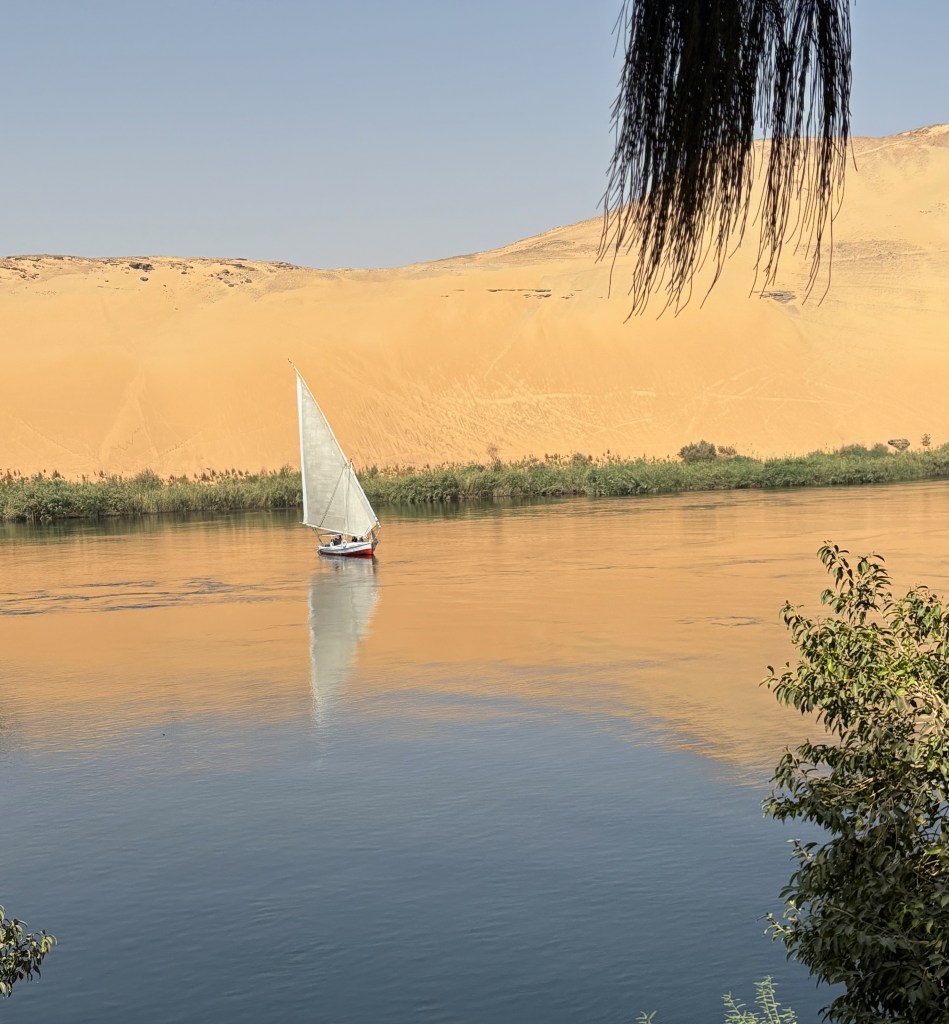
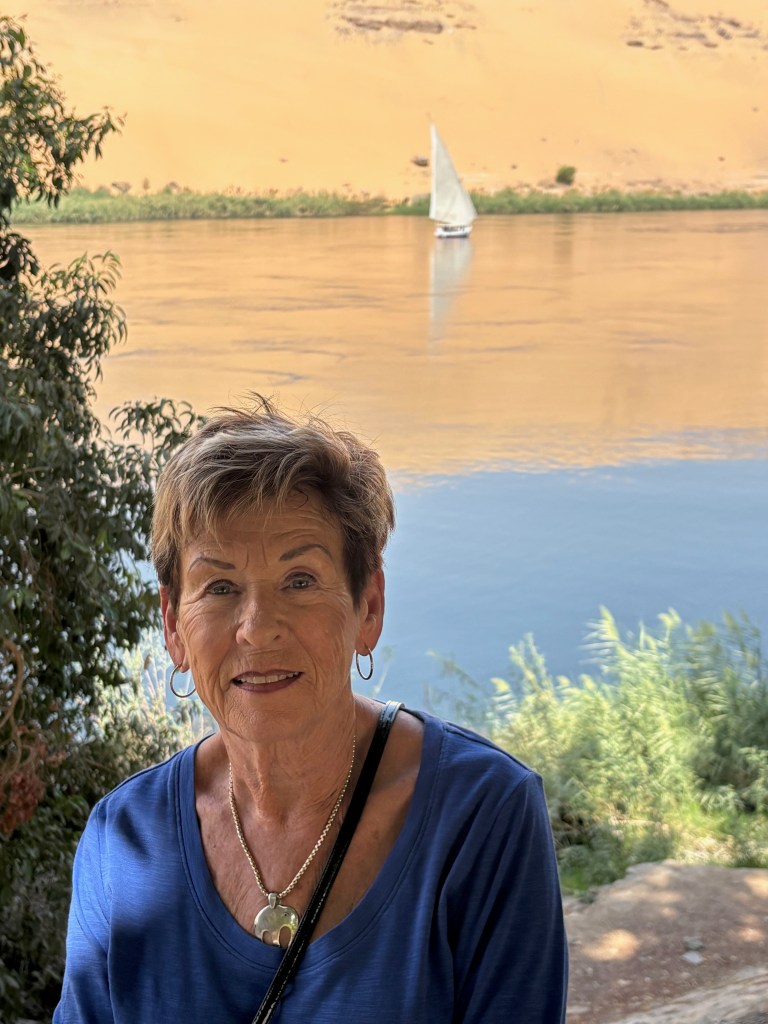

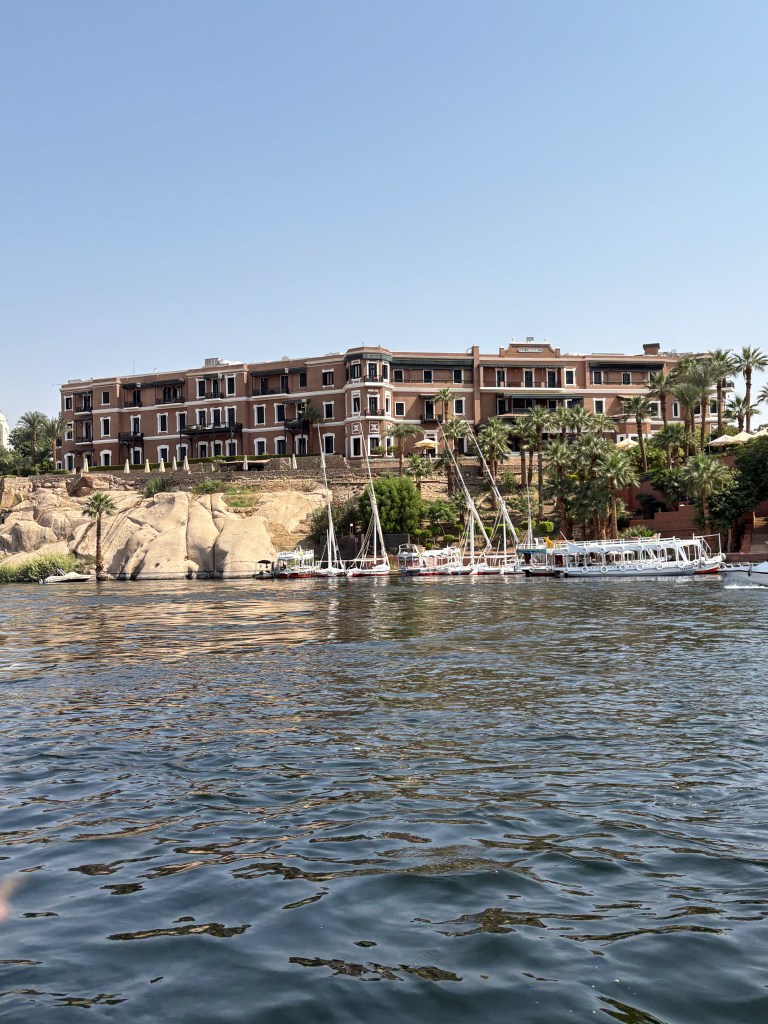
Our boat started our way back down the river to Luxor. We had a nap- Bill suffering from a cold.
OCT 24, Friday EDFU / LUXOR
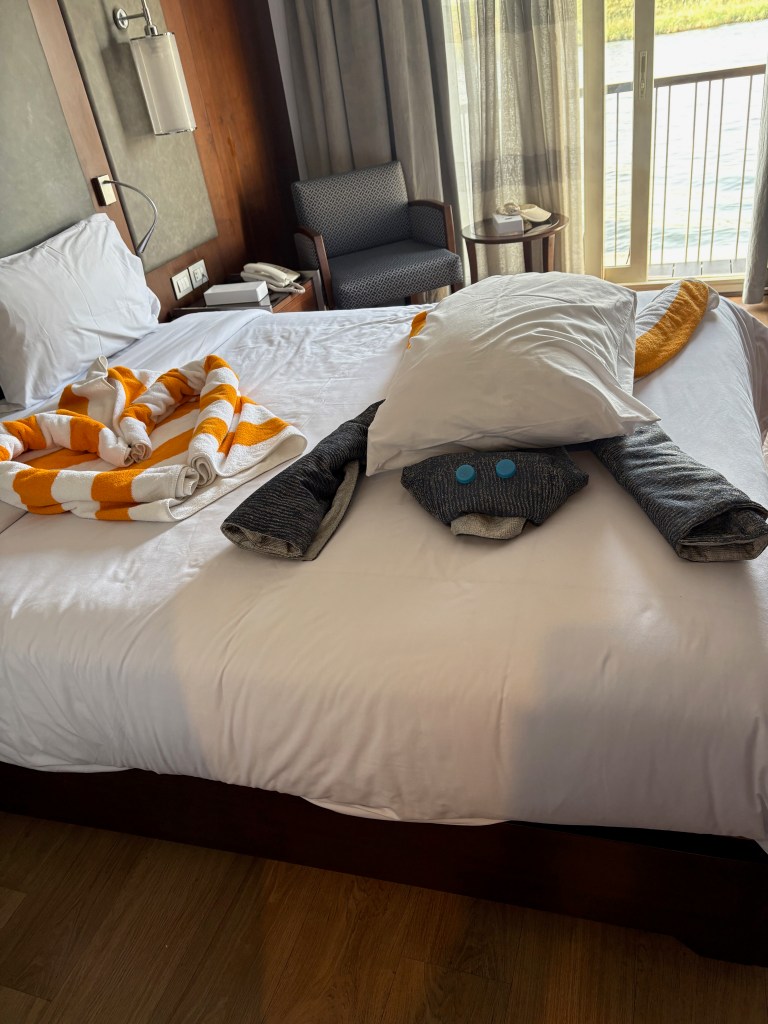
We often came back to our room to find some creative way of using the towels and pillows: a turtle?.
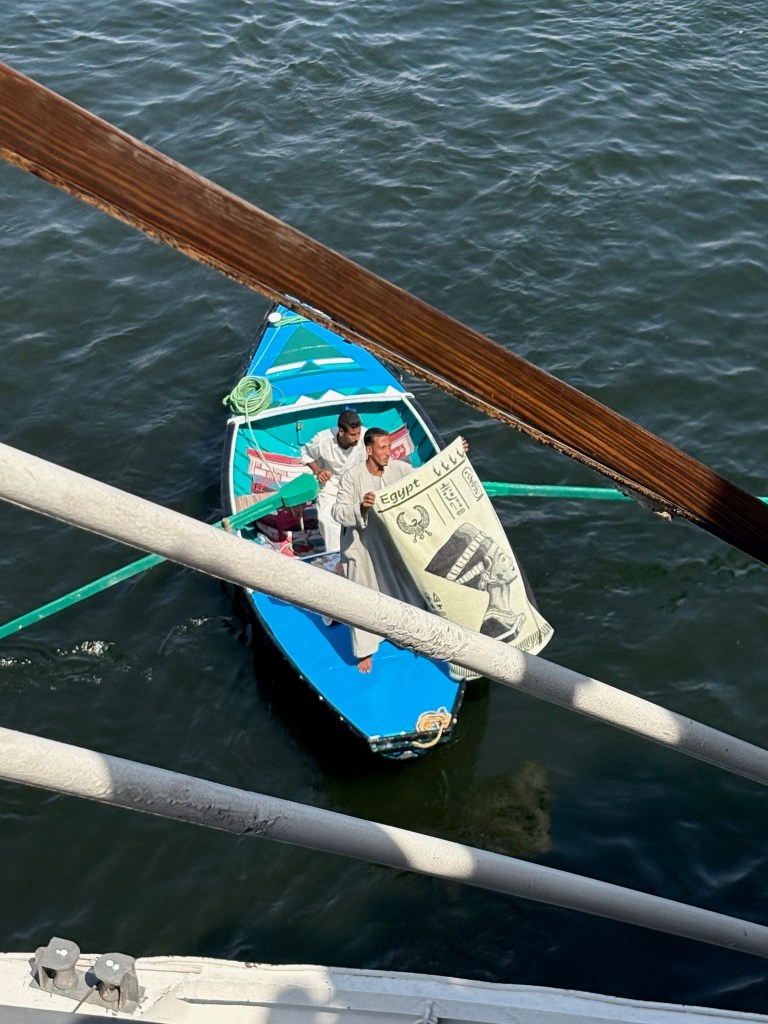
We got moving early to experience going through the locks and found out we were 3 hours from the lock but on the move.
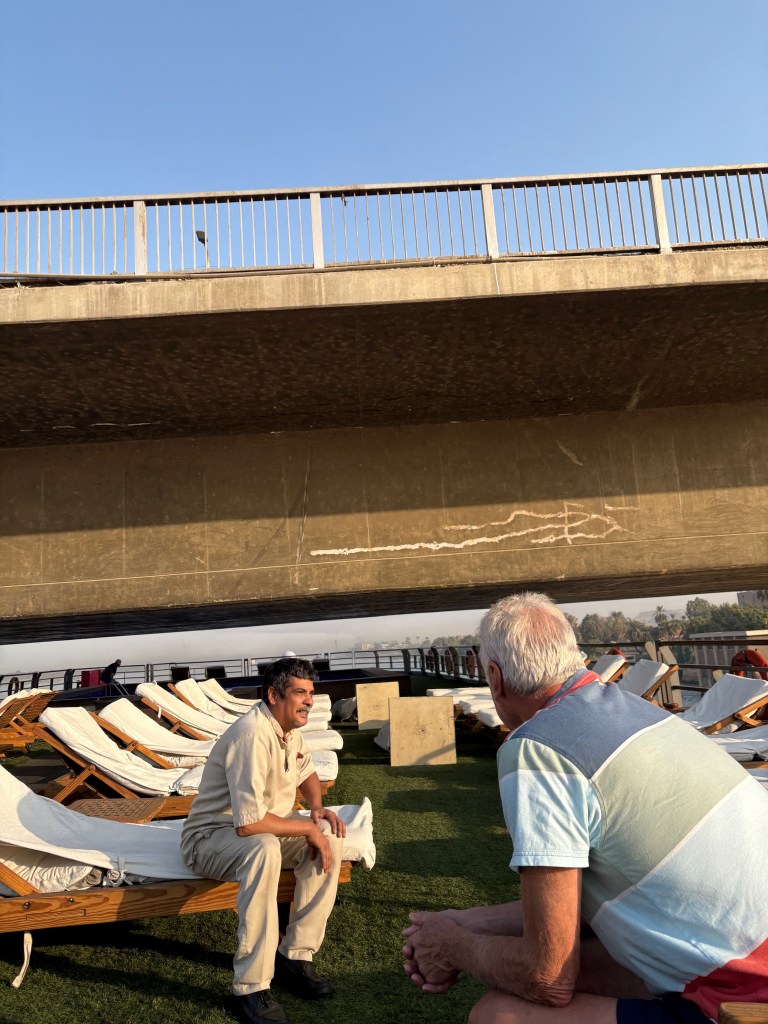
We went under a bridge that had about 6 feet above the boat and required the staff to lay down the umbrellas and remove and restore the canopies on the upper deck.
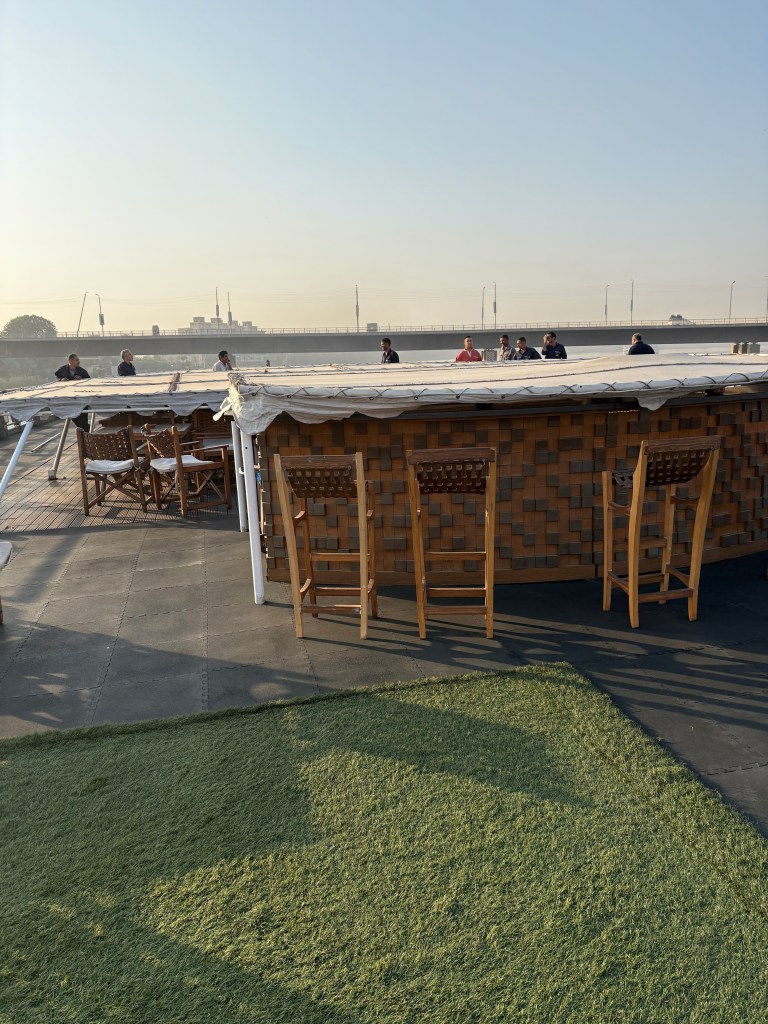
We had the day to pack and at leisure. We purchased the photos of us in costume, now reduced in price by half- $30 to 15 (1000 EP to 500). I washed my black top for wearing on the flight back home to Spain. Otherwise, the hand luggage packing seemed to work fine except that there was never a requirement of 7 kg on the internal flights and we could have had 10 kg each.
Also, we needed to bring more of our meds like antacids that might have helped my stomach to settle.
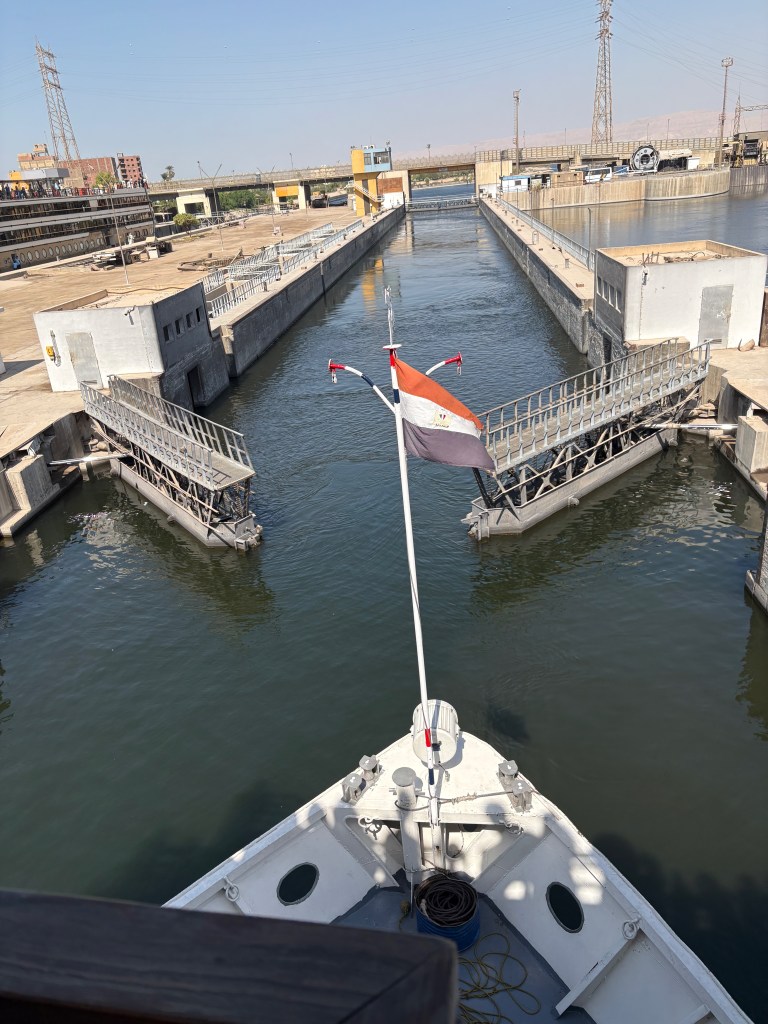
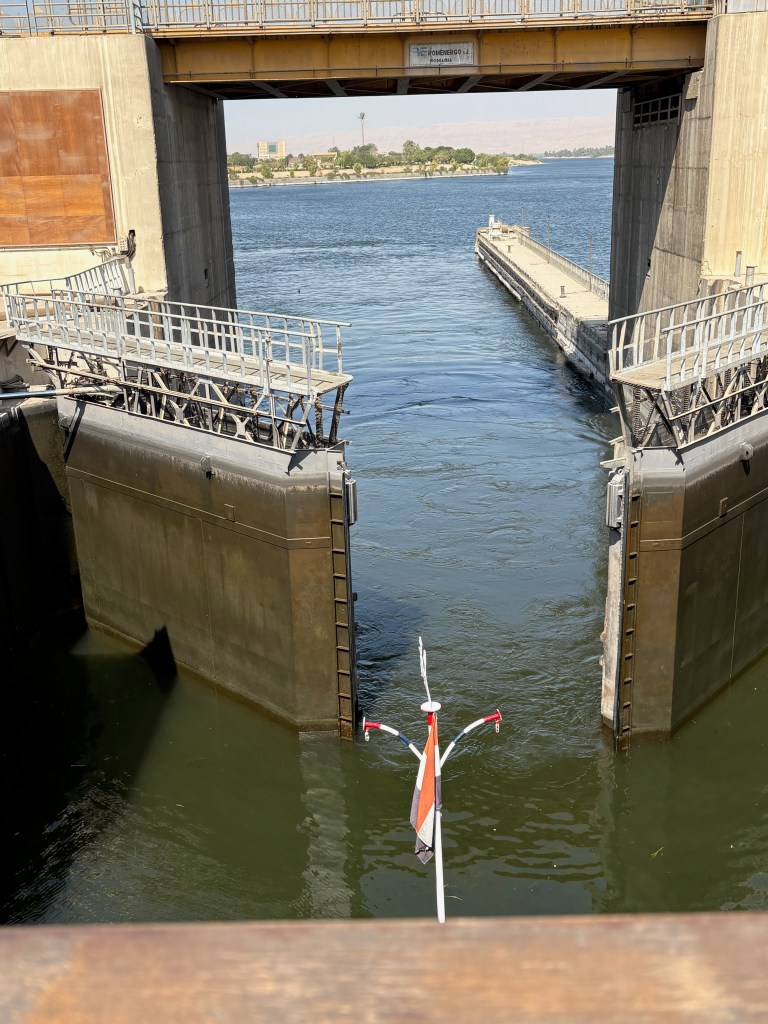
We entered the lock at noon, going down to a lower level, and it took over an hour with only two boats in the lock at a time. All the while the sellers pitched their wares.
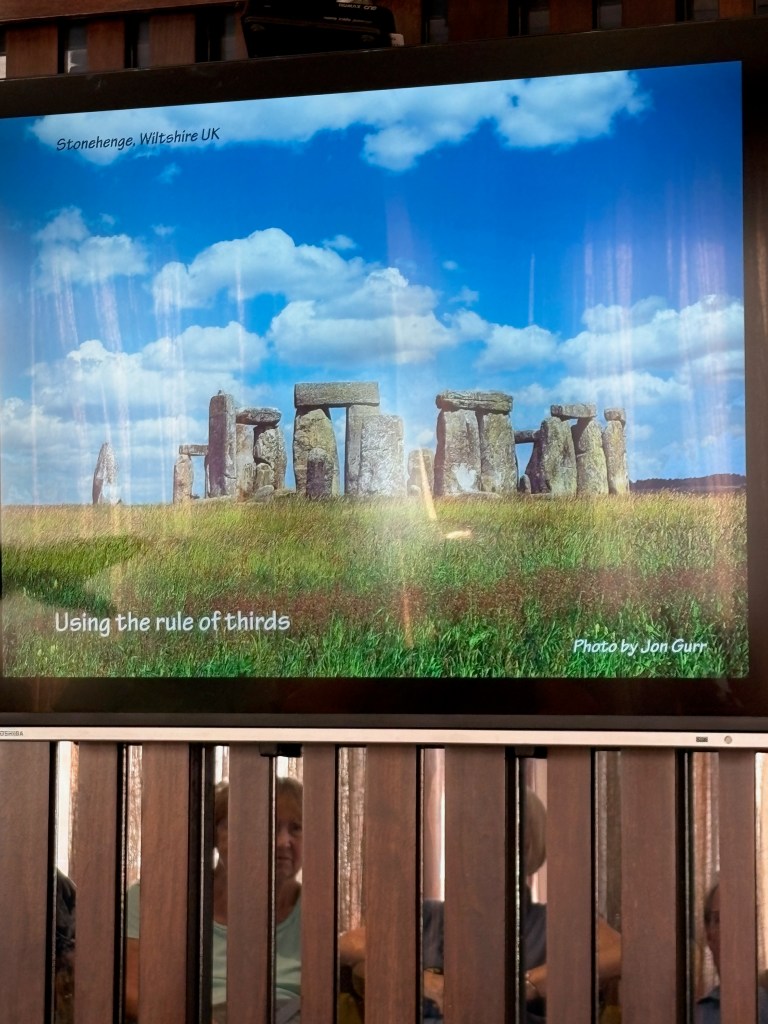
Jon gave another photography class, reinforcing some of the earlier concepts.
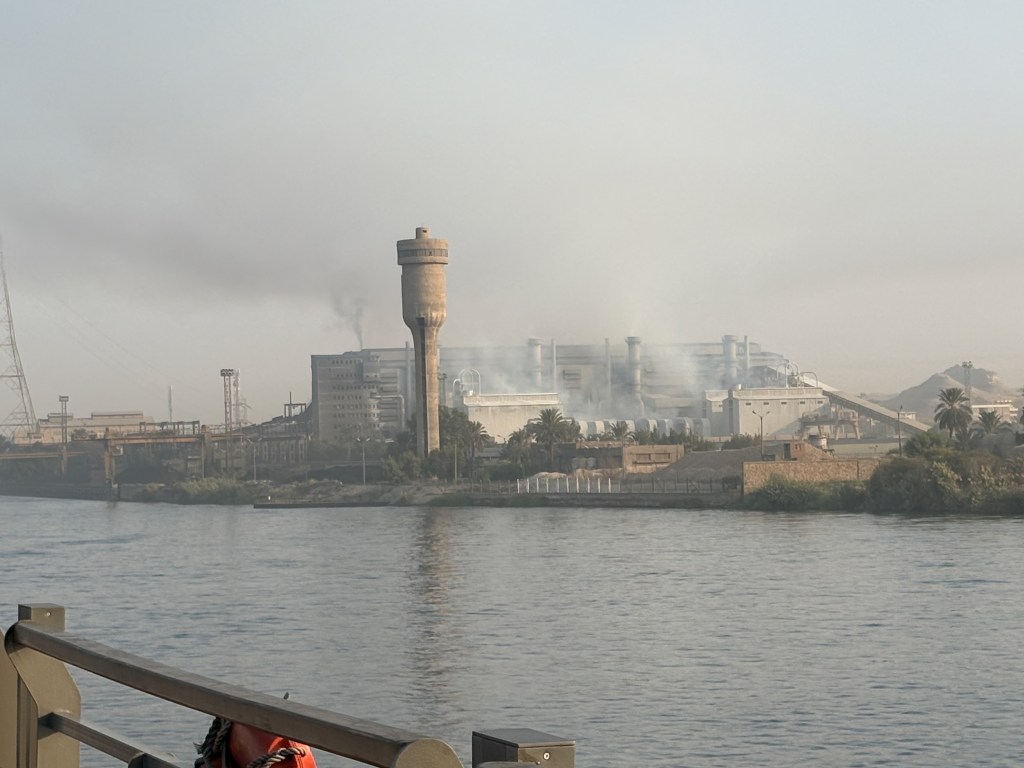
The air was often so polluted from the diesel fumes from the boats that we often had to go inside.
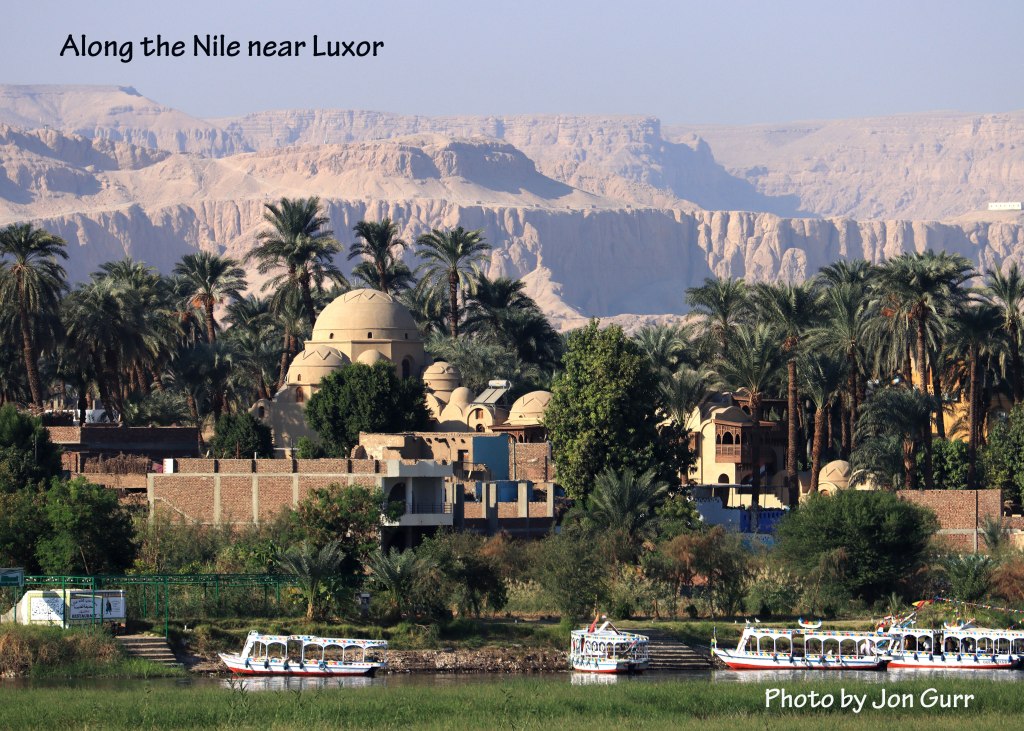
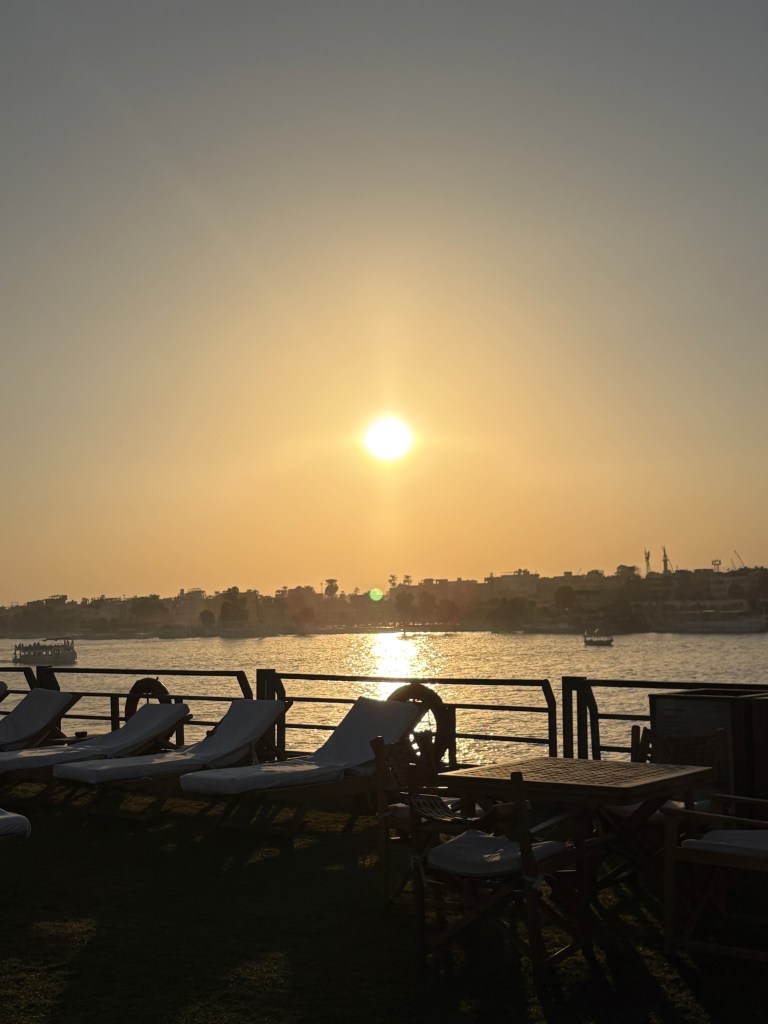
We spent the day cruising the Nile.

Watching life on the Nile from the River Boat.
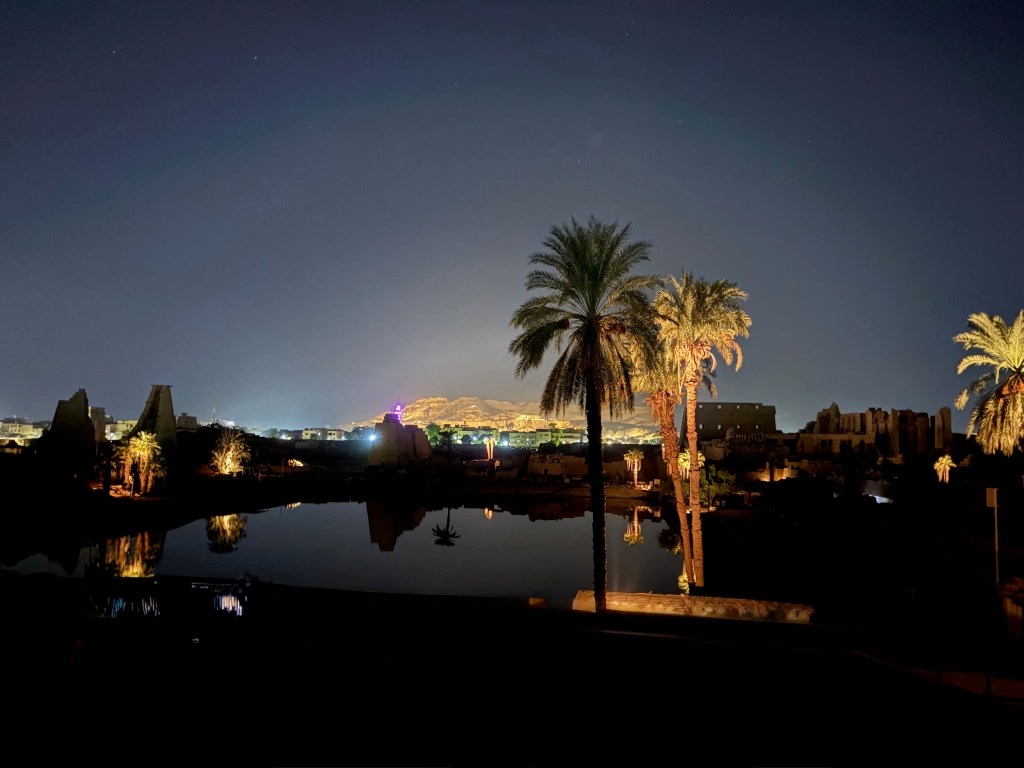
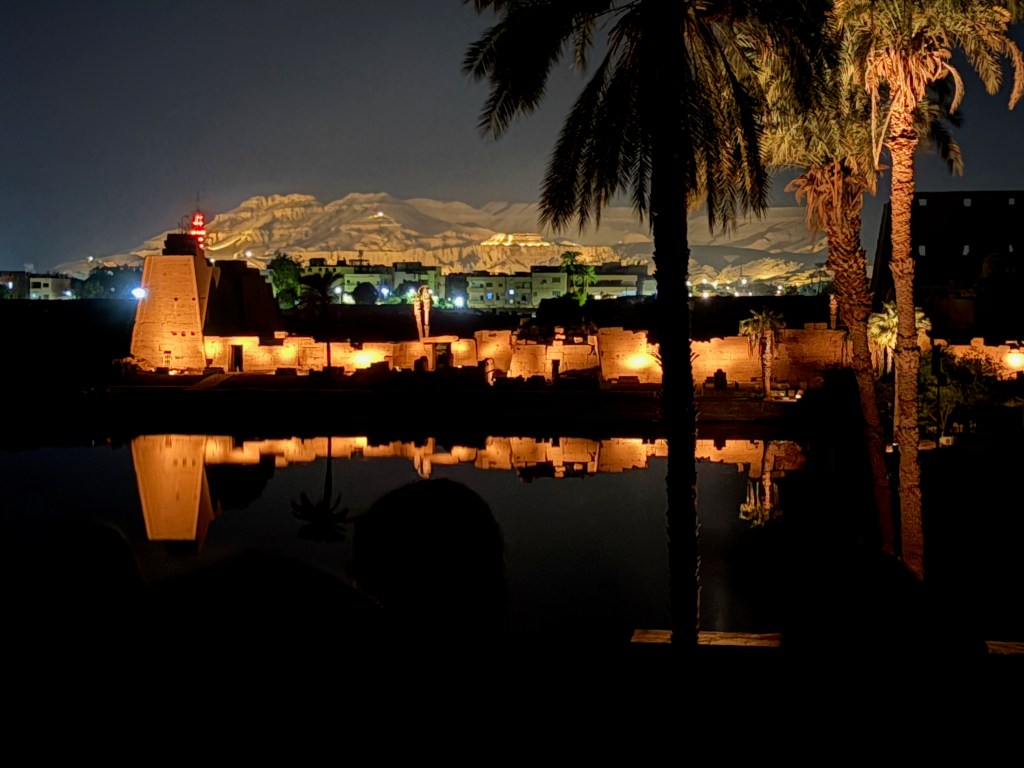
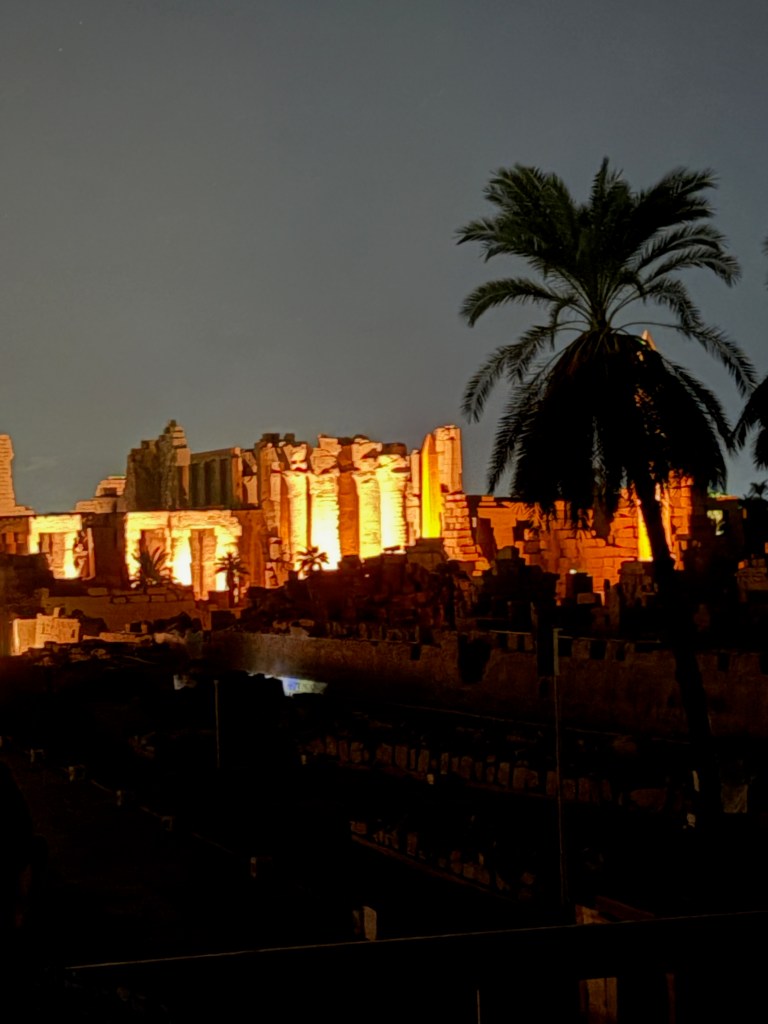
At 6:00, we returned to Karnak for a sound and light show. The narration was not very clear or impressive but the lights were.
We were offered a buggy ride back and were the only ones that took it. We had a lovely tour of Luxor, passing local markets and watched the city come alive in the coolness of the evening.
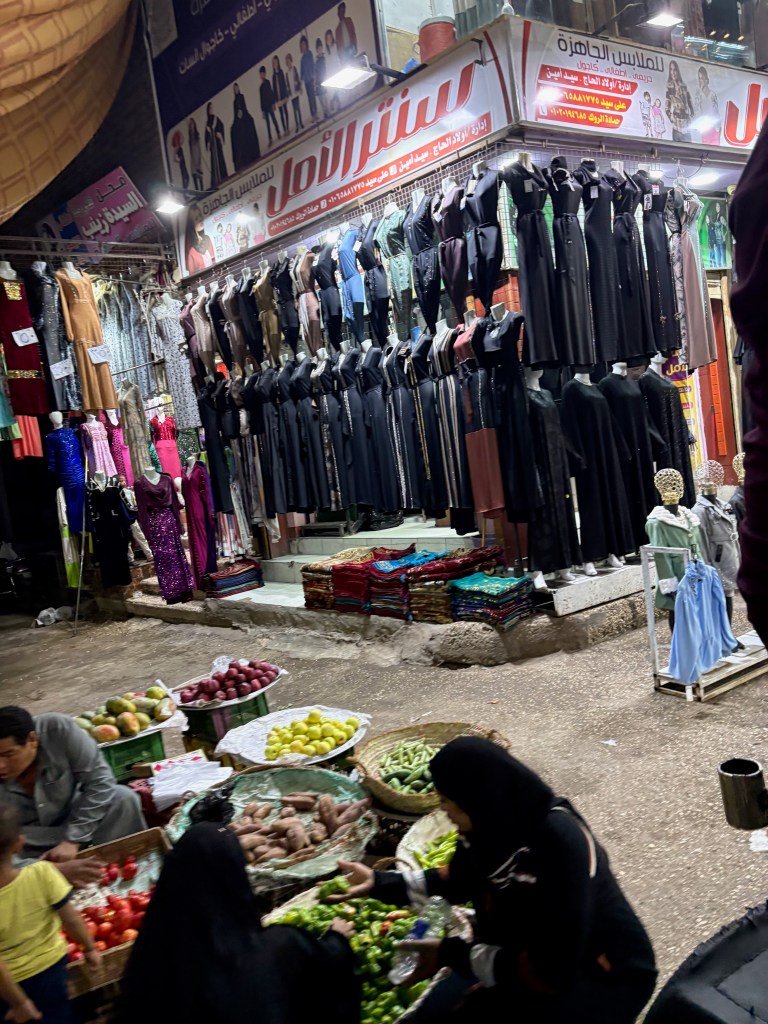
OCT 25, Saturday LUXOR / CAIRO
We had an early start leaving the boat at 6 for our flight to Cairo and experienced airport security with men and women in separate lines- guess what line was faster! We were upgraded to Business Class but sat in different rows. First stop in Cairo was the Egyptian Museum (the old one replaced now by the Great Egyptian Museum which opened Nov 1, 2025) before checking into the hotel. GEM was needed because the old museum was limited by old technology, including no A/C.
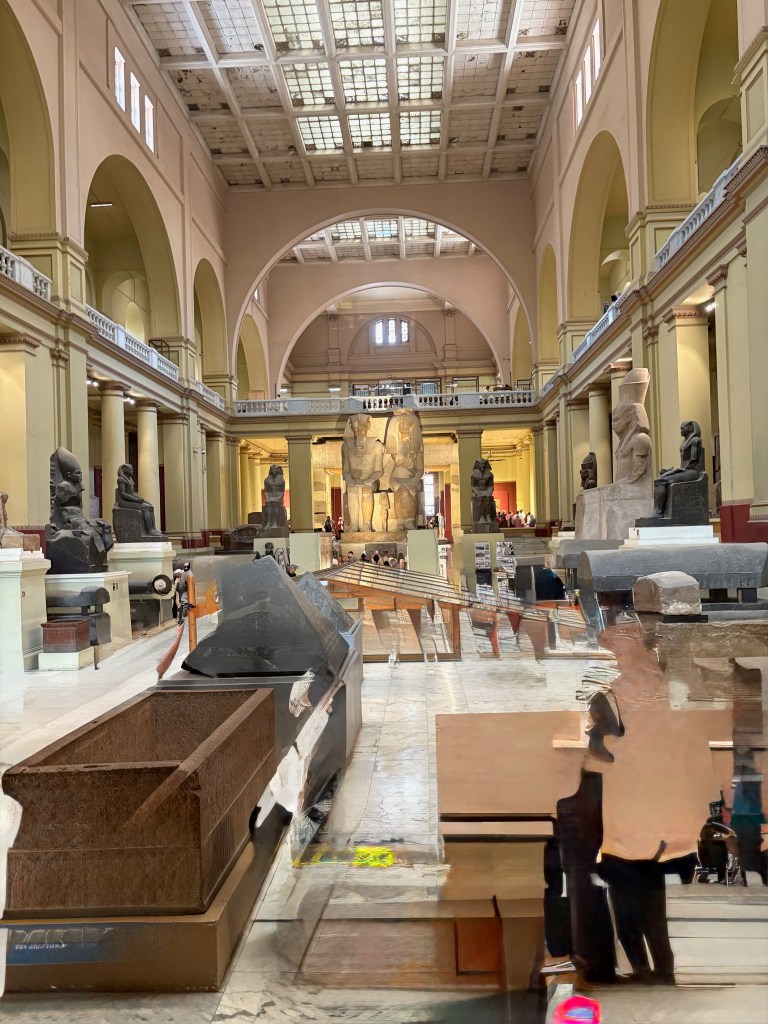
The Narmer Palette
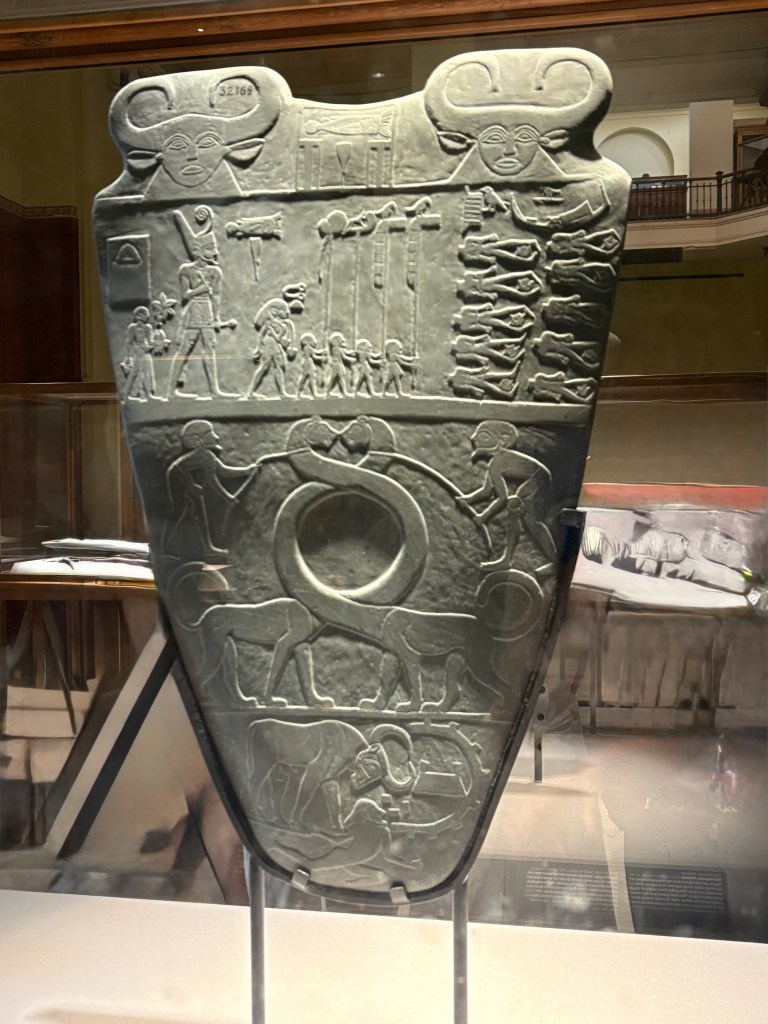
This is one of the earliest representations of an Egyptian ruler. King Narmer is shown in the symbolic act of unifying the Two Lands of Upper and Lower Egypt. His name is written in hieroglyphs on both sides of the palette. The king wears a red crown and processes towards two rows of decapitated bodies. The middle is framed by two mythical beasts controlled by men.
At the bottom, Narmer is shown as a wild bull breaking into a walled enclosure and trampling a figure. From the later Predynastic period, the king was portrayed as a bull or a lion to symbolise his power.
The palette was probably a ritual object made to be offered or used in temple ceremonies. Temple of Horus
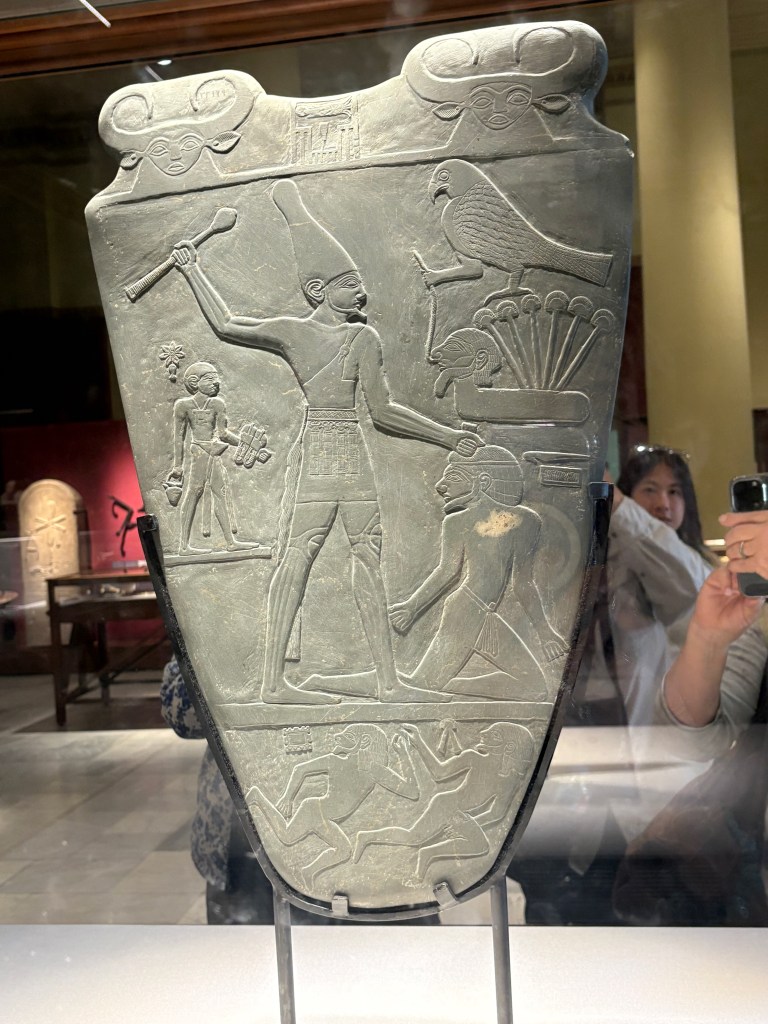
On this side, Narmer wears the white crown of Upper Egypt, and on the other he wears the red crown of Lower Egypt. Together they symbolise the unification of the Two Lands. Narmer strikes an enemy from the Delta, identified by the papyrus land sign above a human head. The sign is topped by the falcon-god Horus, associated with the king.
Towards Discovering Hieroglyphics
On September 27th, 1822, the French Egyptologist Jean-Francois Champollion made an official announcement that he had successfully decoded the ancient Egyptian language after ten years of tireless work. His breakthrough was confirmed in 1866 with the discovery of the “Decree of Canopus,” a lengthy bilingual inscription that validated Champollion’s entire system of decipherment.
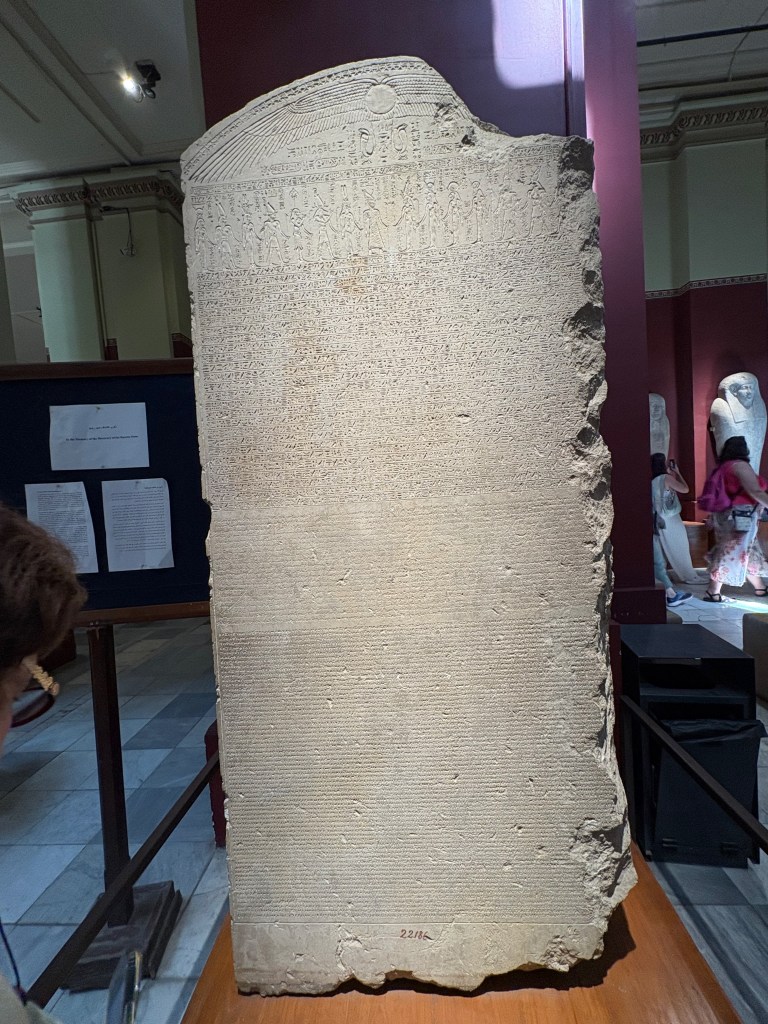
The Canopus Decree is part of a series of bilingual inscriptions inscribed in three scripts -hieroglyphs, demotic and Greek.
The most famous is the Rosetta Stone, which provided the key to deciphering hieroglyphs in 1822. This Canopus Decree records a great assembly of priests held at Canopus on 7 March 238 BC in honour of Pharaoh Ptolemy Ill Evergetes, his wife Queen Berenice I, and their daughter Princess Berenice. It discusses topics such as military campaigns, famine relief, Egyptian religion, and governmental organisation in Ptolemaic Egypt.
Statue of King Khafre
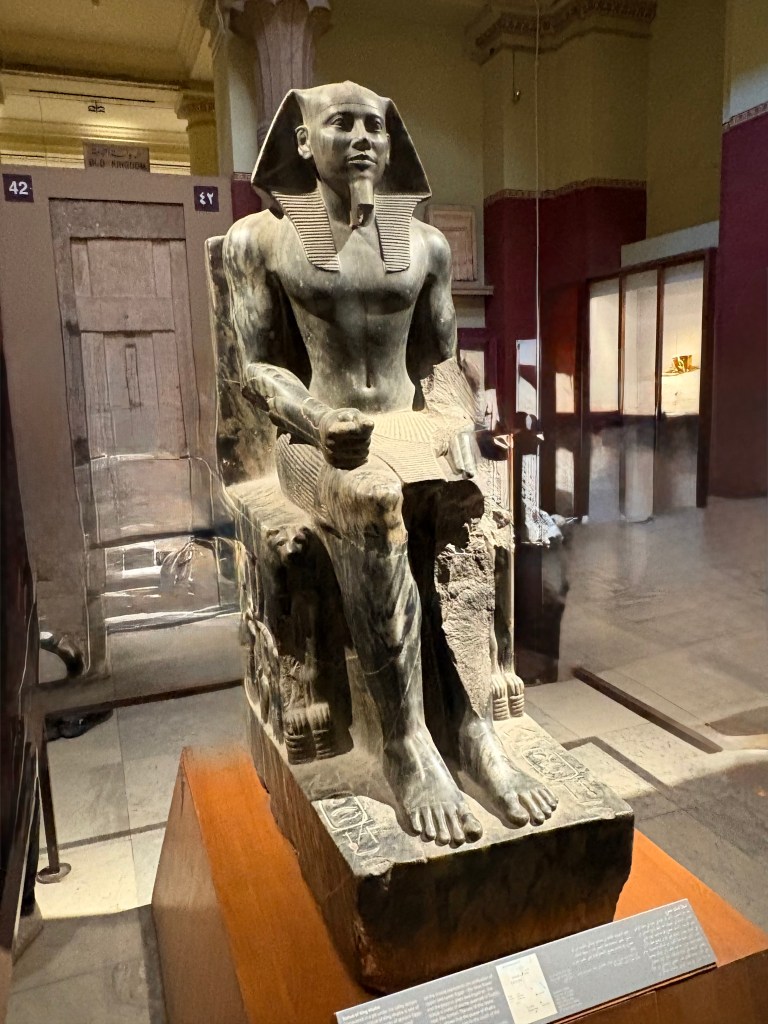
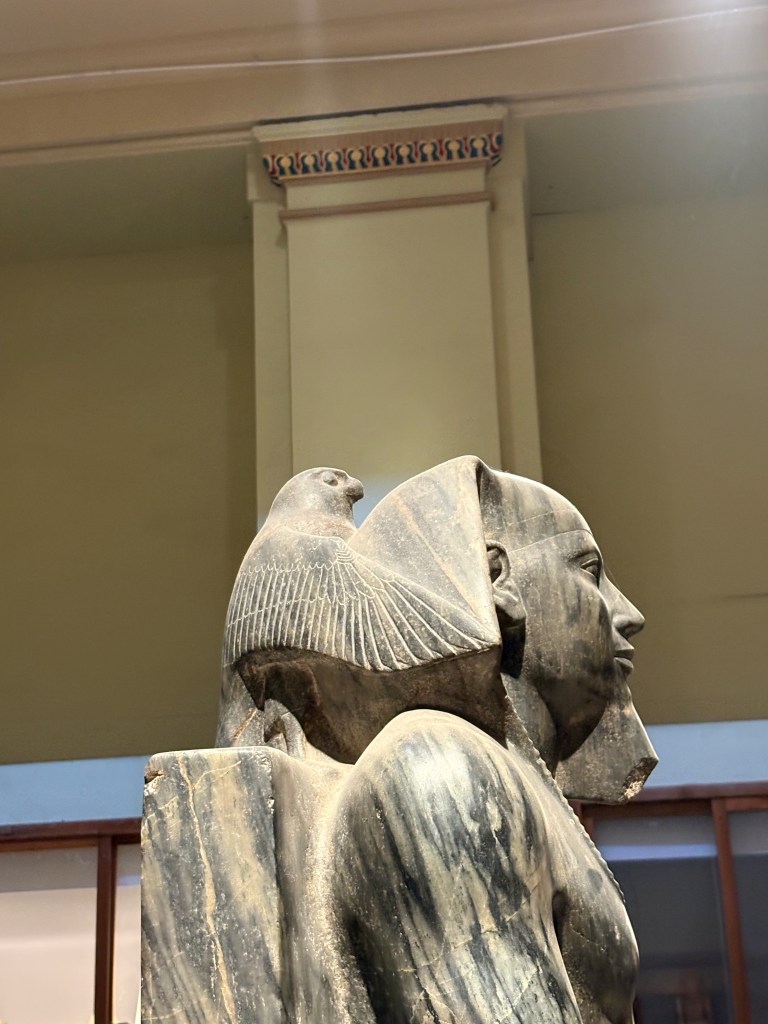
Discovered in a pit under his valley temple at Giza, this statue of King Khafre is one of the most iconic sculptures of ancient Egypt. Khafre was the builder of the second pyramid at Giza. The king, seated on the throne, wears the nemes with the cobra on his forehead – a symbol of royalty and protection. The falcon god Horus behind his head spreads his wings to protect him and legitimate his royal status.
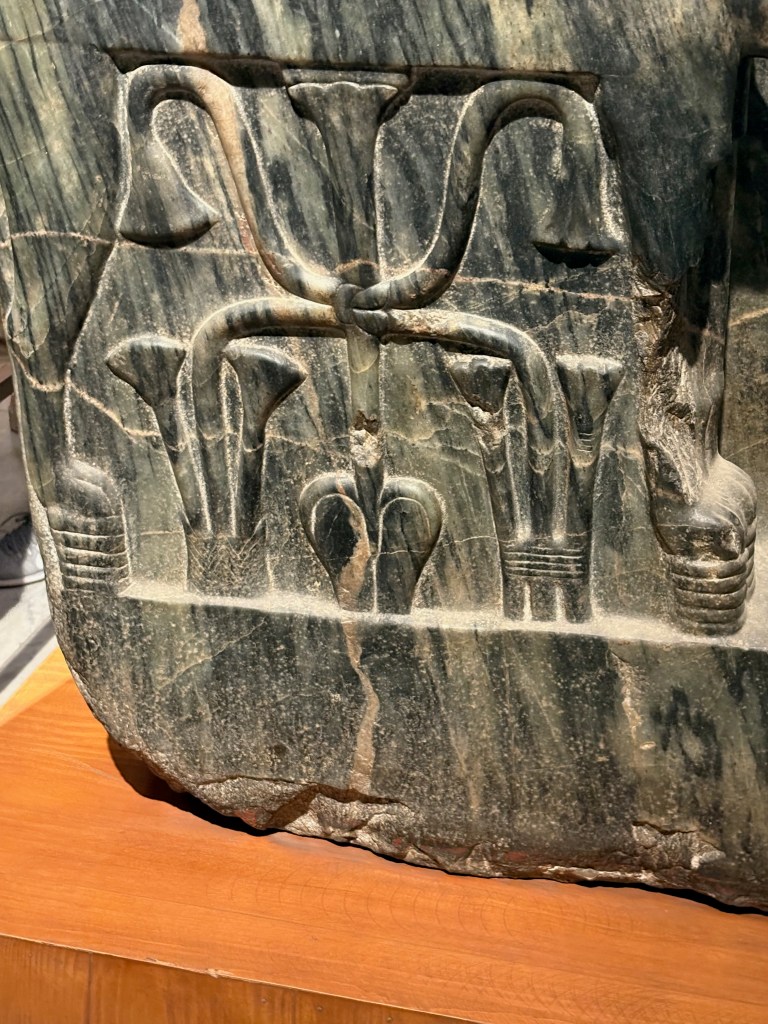
The symbol on the throne represents the unification of Upper and Lower Egypt – the lotus flower and the papyrus plant tied together. The statue is made of diorite quarried in Tushki, near Abu Simbel. The use of this stone clearly shows that the power of Khafre stretched all the way to the south of the country.
4th Dynasty (King Khafre), about 2520-2494 BC, Giza (valley temple of Khafre)
ANIMALS IN ANCIENT EGYPT
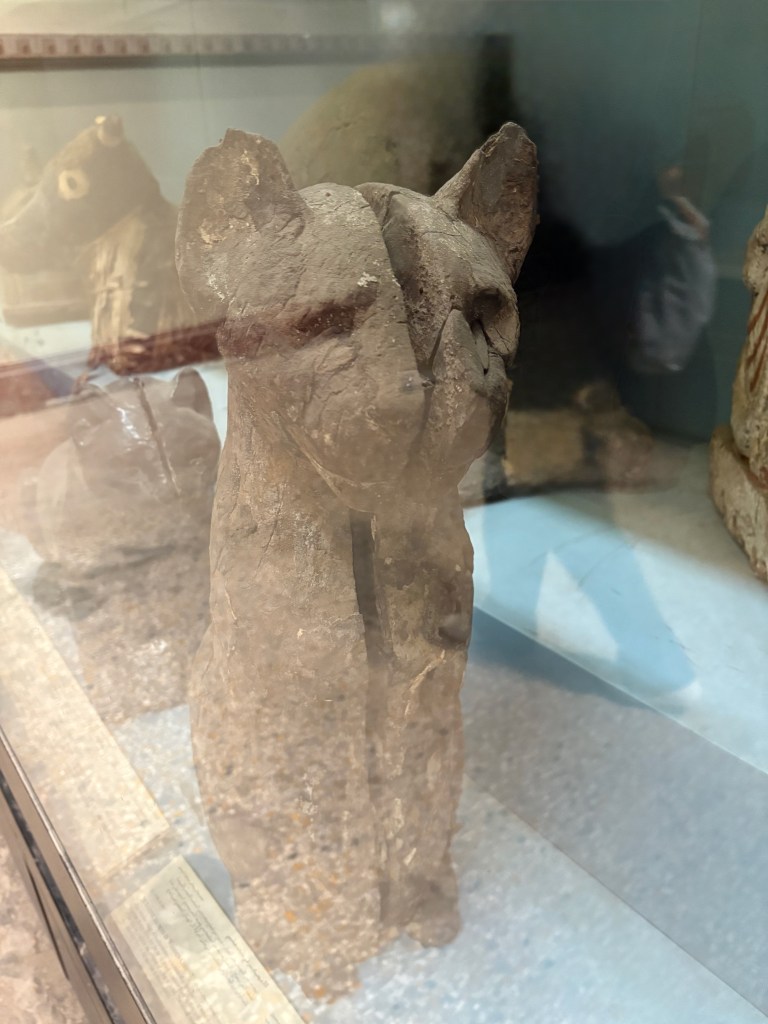
Animals were crucial to the daily welfare of the ancient Egyptians. They provided the Egyptians with food, companionship, clothing, the raw material to make tools and furniture, and inspiration for both religion and art.
Mummies: Just to review about mummies. The Egyptians sought to preserve their dead through mummification so that the soul could inhabit the body eternally.
Mummification techniques changed over time, but ideal mummification involved removing the internal organs (lungs, liver, intestines, and stomach), and often the brain, to prevent decomposition of the body. Over a period of 70 days, the body was desiccated with natron (a mixture of salt and baking soda found in the Wadi Natrun), anointed with oils, herbs, and resins, and wrapped in bandages, interspersed with amulets.
By studying mummies, we learn about the ancient Egyptians’ diet, diseases, funerary beliefs, economy, and scientific and medical knowledge.
The New Kingdom royal mummies are amongst the finest mummies ever made. Although most of the tombs in the Valley of the Kings were robbed, many of their mummies survived because priests moved them to a tomb hidden high in the nearby cliffs of Deir el-Bahari in the 10th century BC. Thieves discovered the tomb in the late 19th century AD and started selling objects from it. In 1881, the Antiquities Service found the thieves, rescued the mummies, their coffins, and funerary objects, and brought them to Cairo, where they were displayed and studied.
Hassam took us to an excellent example of a tomb with mummies: Treasures of Yuya & Thuya. We were able to see them and photograph them unlike in the Museum of Antiquities.
Treasures of Yuya & Thuya.
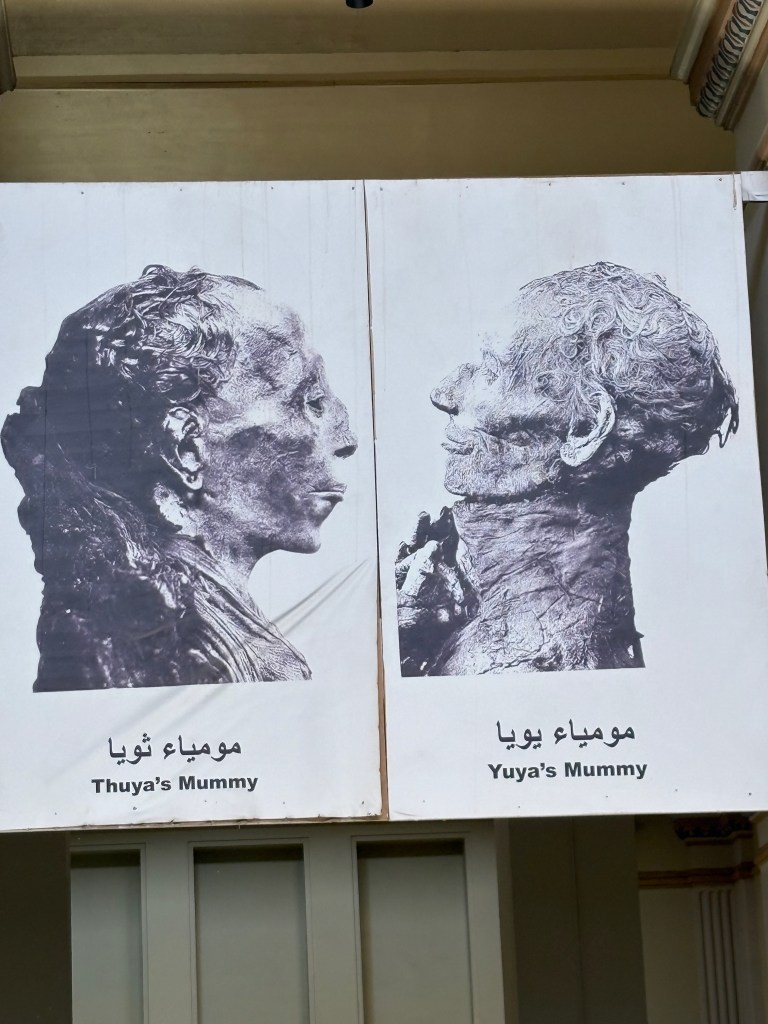
The bodies of Yuya and Thuya were found in their coffins. Their bodies were in very good condition and were very well preserved due to the high quality of mummification.
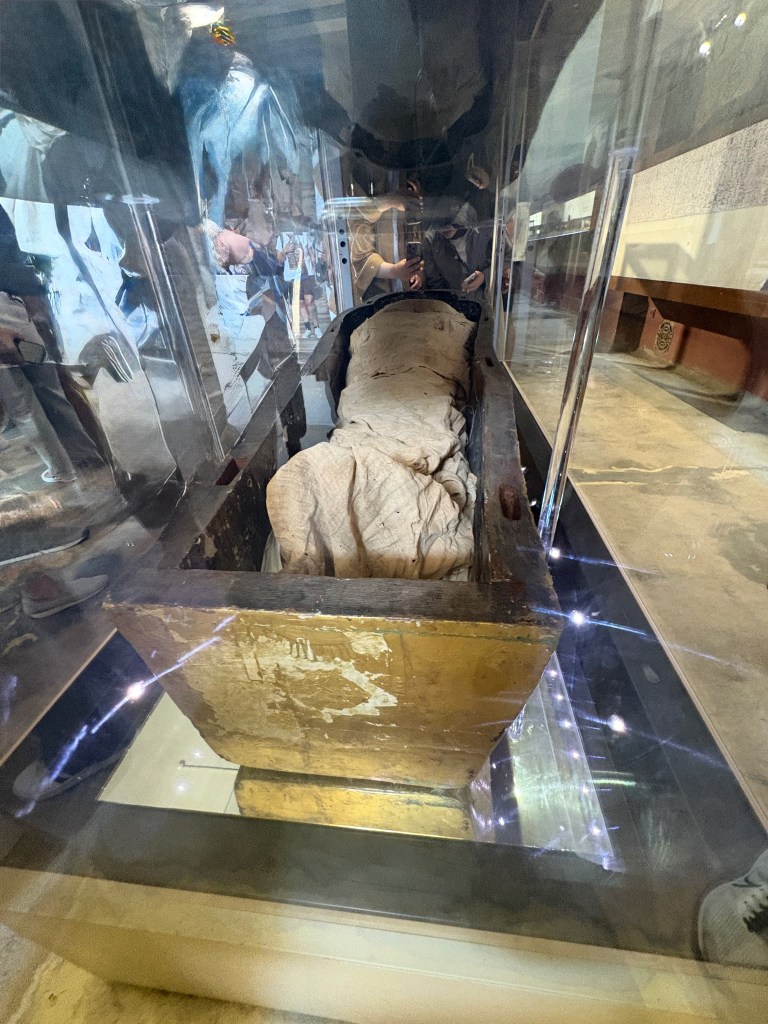
On the 17th of December, 1904, the seasonal excavations in the Valley of the Kings began. They were carried out by the Egyptian Department of Antiquities and sponsored by the American lawyer Theodore Davis. The work moved northward where two tombs had previously been discovered.
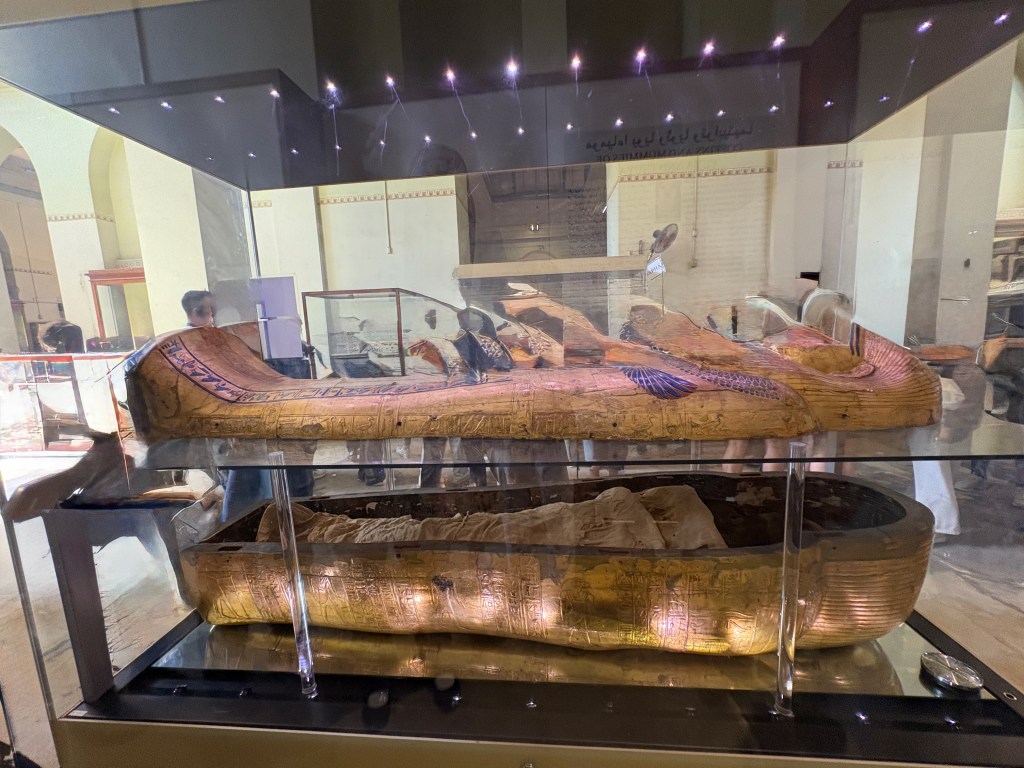
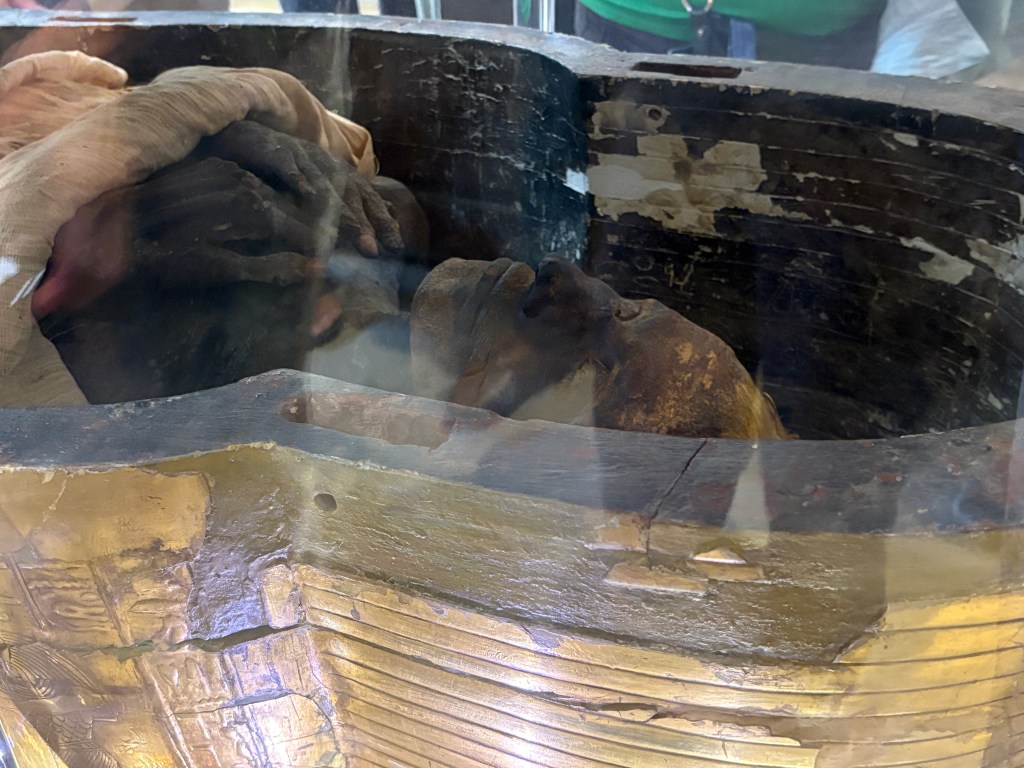
The tomb had, however, been robbed through a hole in the corner of the wall, and the contents of the tomb, especially the coffins, had been disturbed to a great extent. The robbers seem to have ransacked the tomb shortly after it had been sealed, and subsequently to have covered up the hole through which they had entered.
Yuya was a high-ranking soldier: he commanded the regiment of royal war chariots. He also held important positions at court as ‘Master of the Horse’, and his title of ‘father-of-the-god’ may have referred specifically to his role as the king’s father-in-law.
His wife Thuya was a ‘lover’ of the gods Amun and Min, and she used the title of ‘Royal Mother of the Great Wife of Pharaoh’.
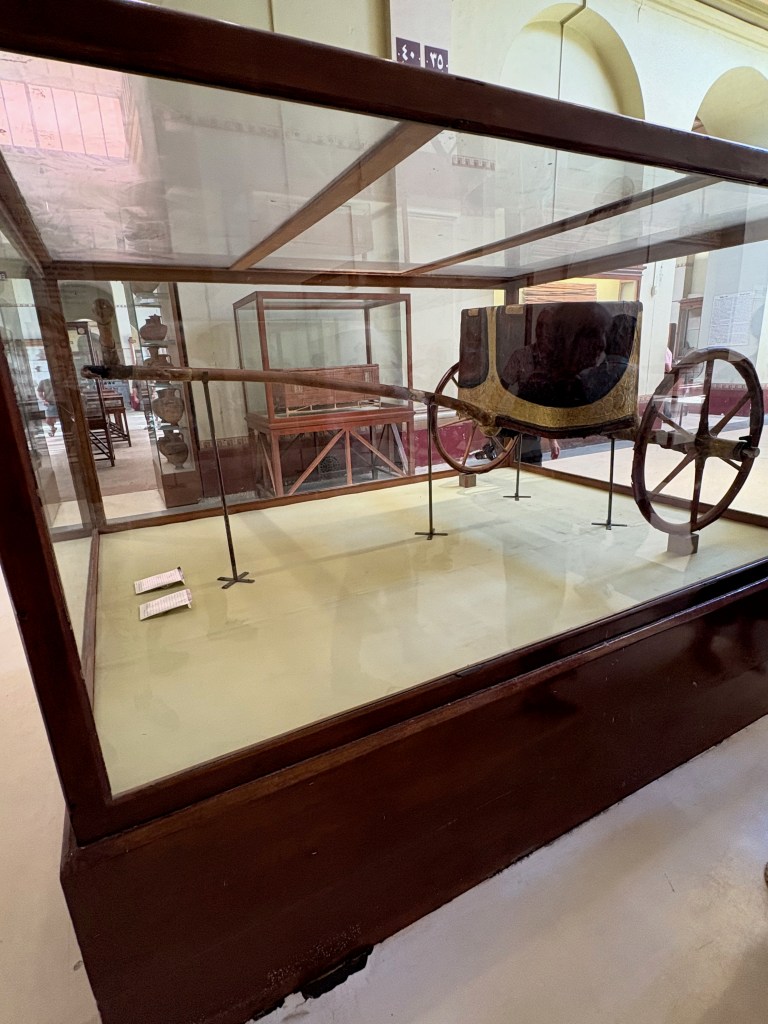
The objects from the tomb included objects used in daily life, such as the chariot of Yuya and Thuya, and wonderful furniture including beds, chairs, and gilded wooden boxes inlaid with faience, ivory and ebony.
Pharoah Psusennes
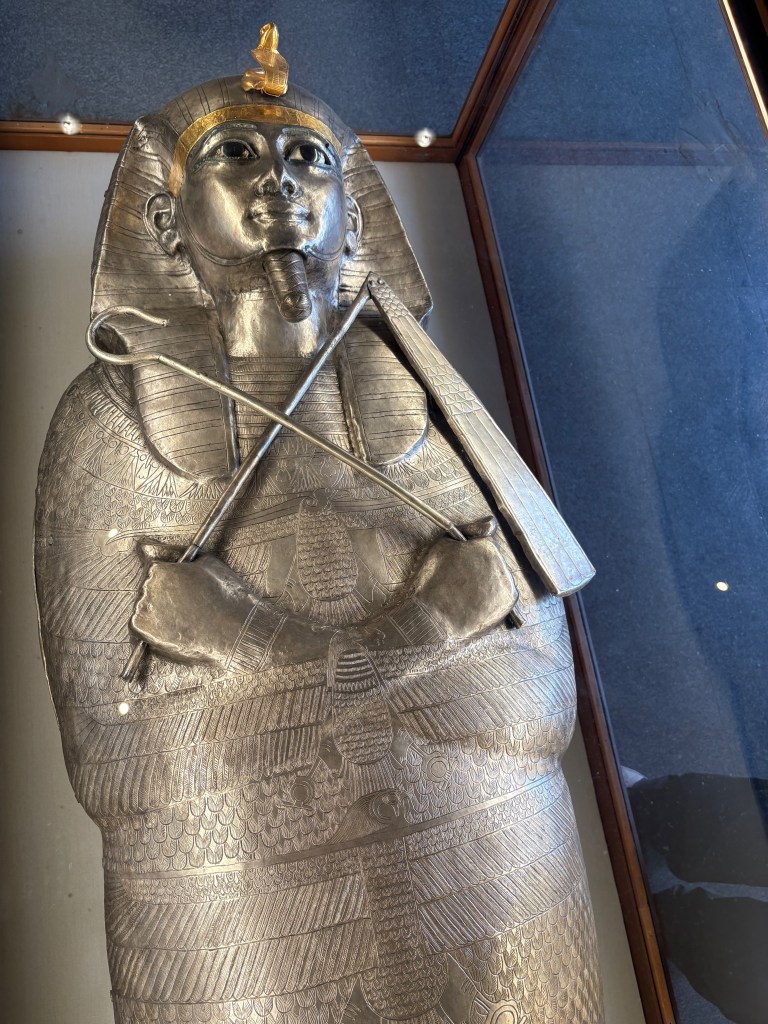
The exceptional funerary goods from the royal tombs of Tanis are comparable only to the treasures of Tutankhamun, found eighteen years earlier at Thebes.
In 1940, the sepulchre of Pharoah Psusennes I revealed spectacular treasures, many still intact. 350 years separate Psusennes I and Tutankhamun, the famous young ruler of the New Kingdom (18th Dynasty). Psusennes reigned from 1039 to 991 BC at the beginning of the Third Intermediate Period founding the 21st Dynasty’s new capital at Tanis.
Despite its modest dimensions, Psusennes I’s tomb held an extraordinary collection of valuable objects. Only items able to withstand the humidity of the Delta have survived, including stone and silver sarcophagi, the golden mummy mask and sheath, precious jewellery and tableware, weapons and shabtis (small mummy figurines.
We had a great view from our Cairo Marriott Hotel room.
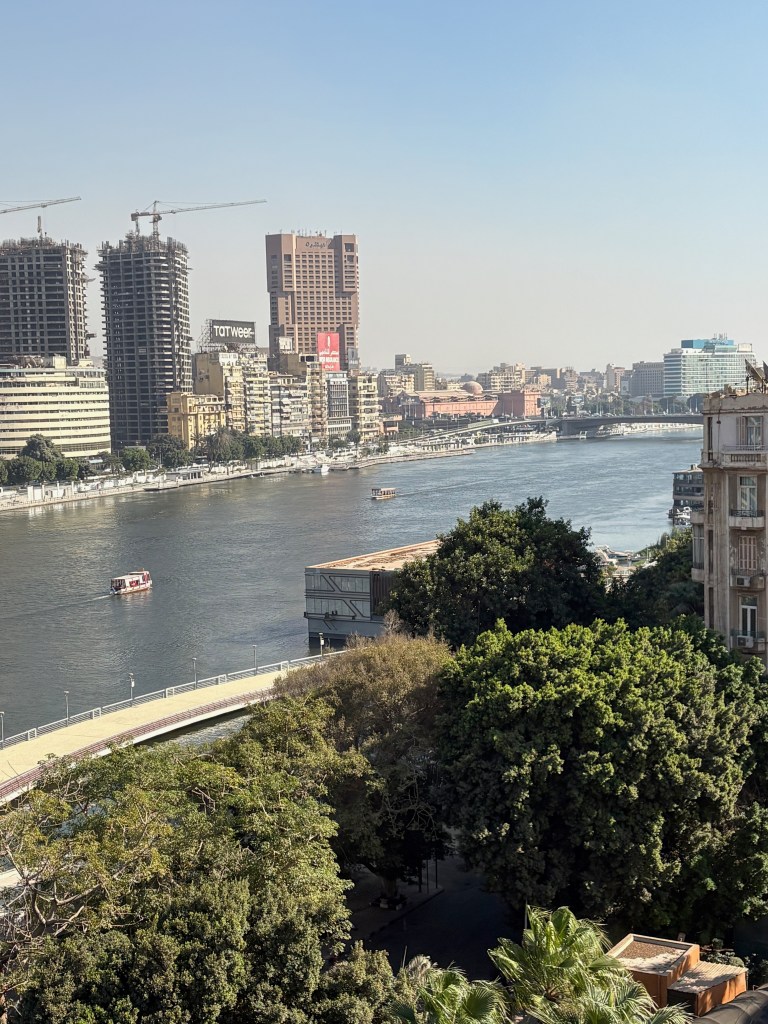
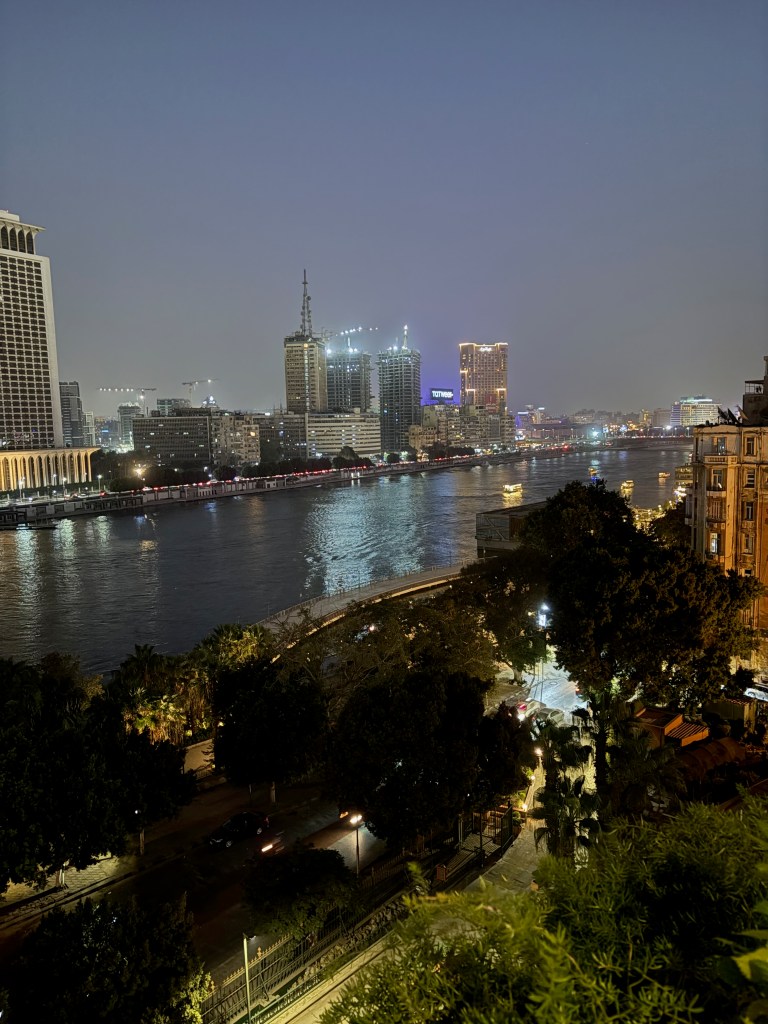
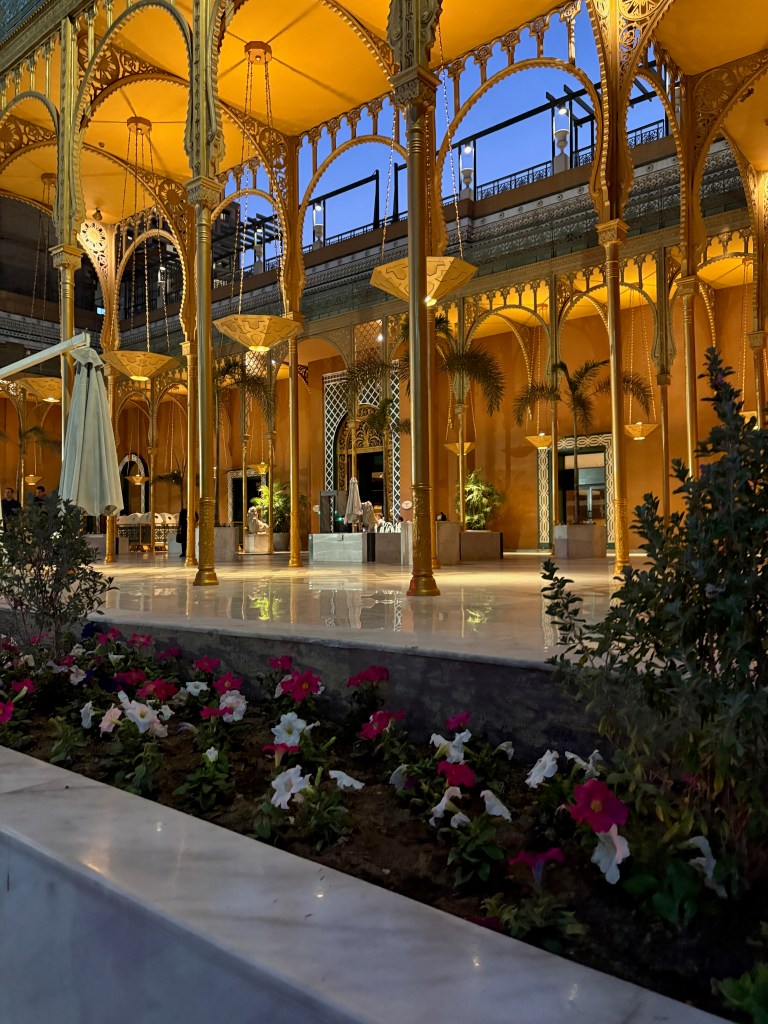
Sat night we had a delicious dinner in a Marriott private room – lovely old Moroccan- themed decor: vegetable soup, lightly sauced spaghetti, chicken and vegetables in a rich gravy, fruit sorbet for dessert with a reasonably good bottle of Egyptian red wine ($45).
OCT 26, Sunday CAIRO / GIZA
We arrived at the Pyramids of Giza and were fortunate that the bus was allowed to enter the grounds (thanks to Hassan’s negotiation skills and money in palms). We learned some background from Hassan and from the displays in the new information centre.
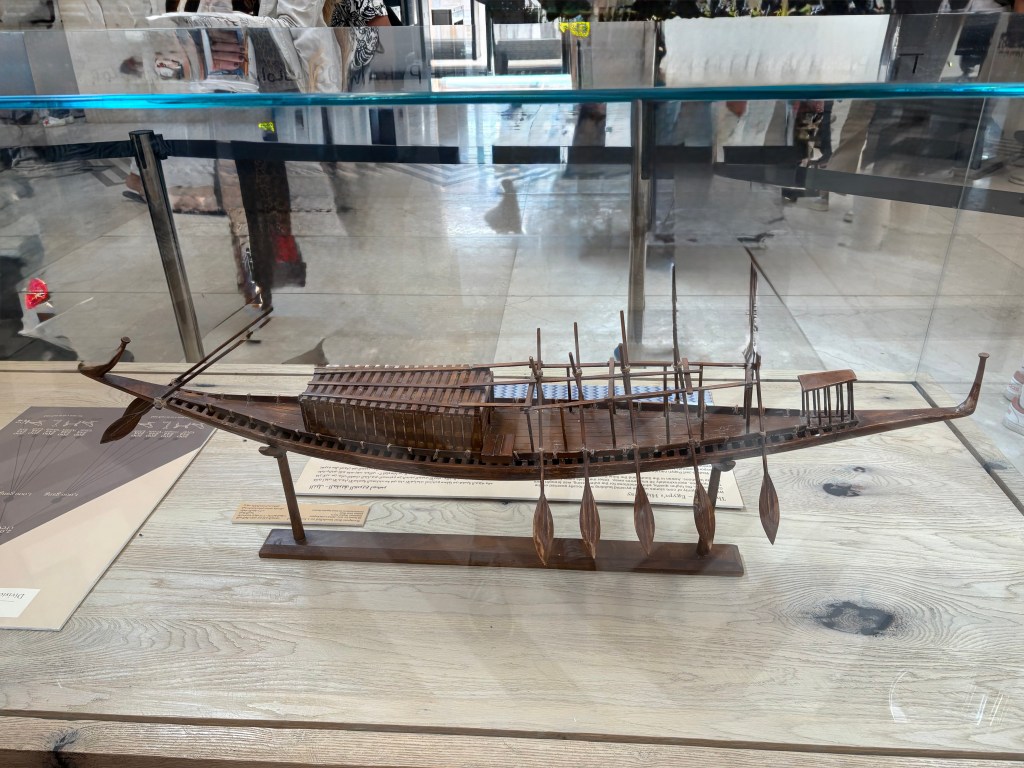
The ancient Egyptians believed that the sky was the home of the gods, who traveled through it in boats similar to how the Egyptians themselves moved through the Nile. At the center of this celestial plane was the sun god Ra, who was thought to have been born every morning at sunrise, traveled across the sky in his Solar Boat throughout the day, and died every night at sunset.
Within the Old Kingdom, the king was considered an embodiment of the god Ra, sent down to earth to rule over the people of Egypt. Upon the king’s death, it was believed that his soul needed to rise to the sky and reunite with Ra, then reach the horizon to enter the afterlife. To make this journey, the king would need a unique form of transportation: the Solar Boat.
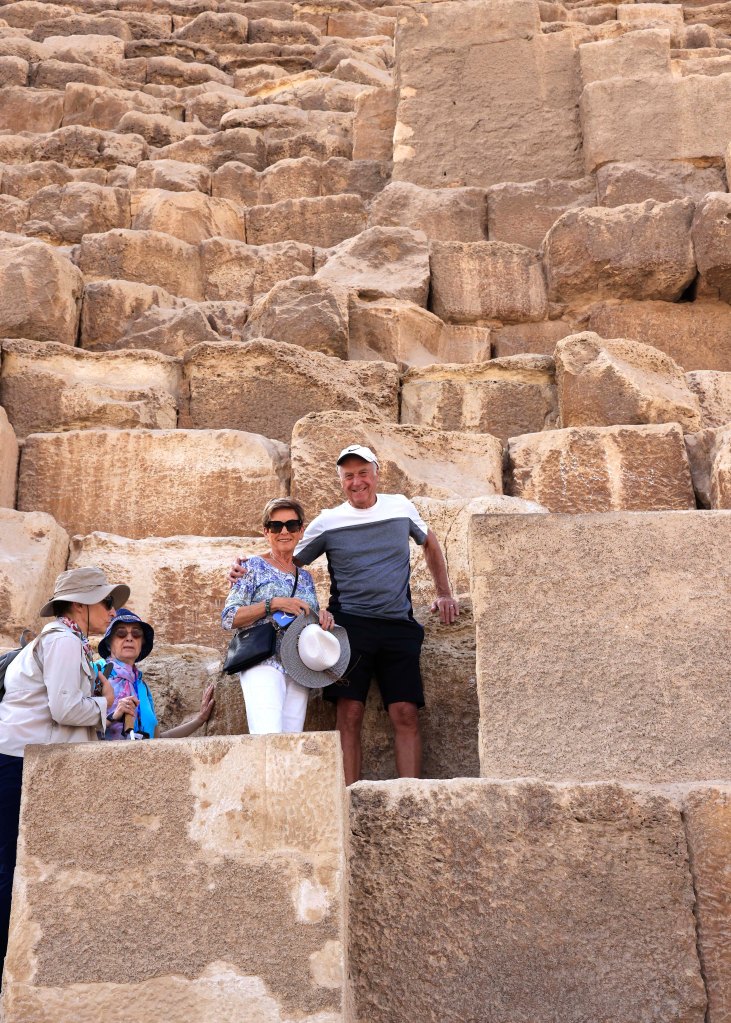
Pyramid of Khufu First Pyramid of Giza
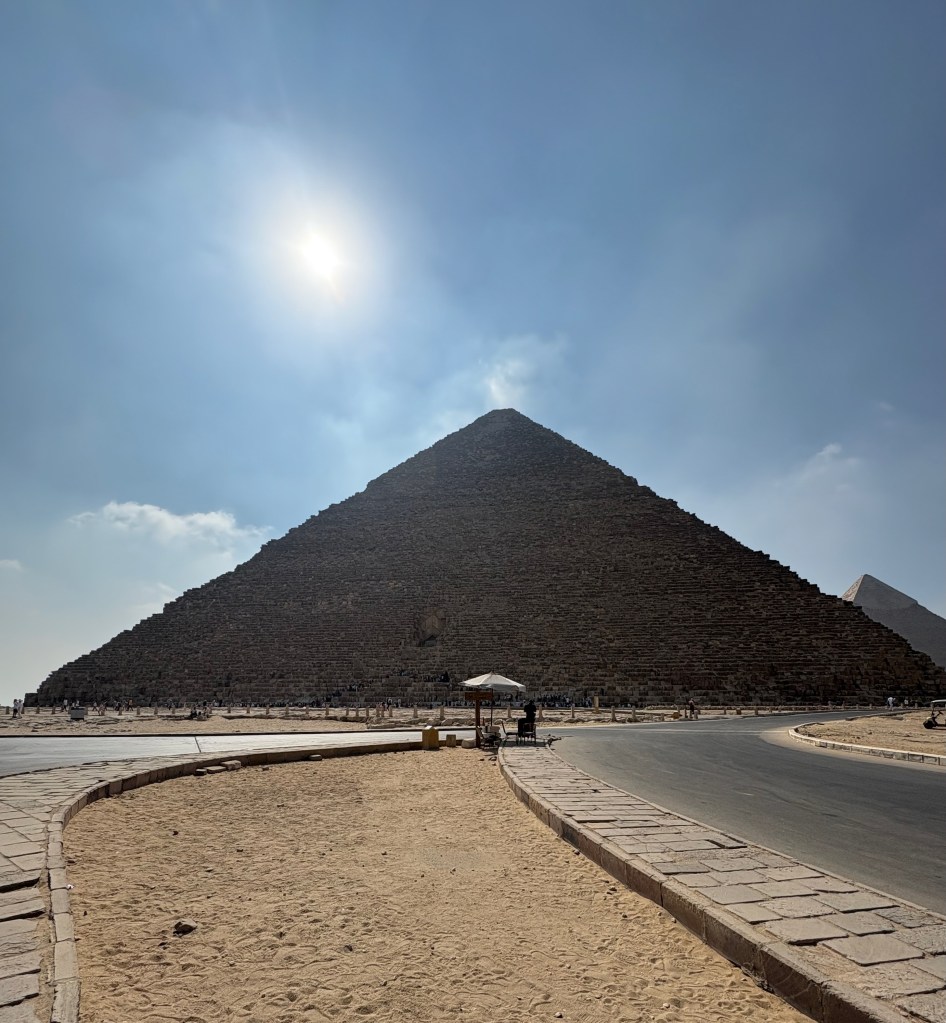
The Great Pyramid of Giza, tomb of King Khufu. A marvel of ancient Egyptian technology. Its 2 million limestone blocks stood as the tallest structure in the world for 3,800 years, reaching an original height of 146.5 m. It tells a story of delicate teamwork, detailed project and resource management, and a commitment to create an eternal resting place fit for a god.
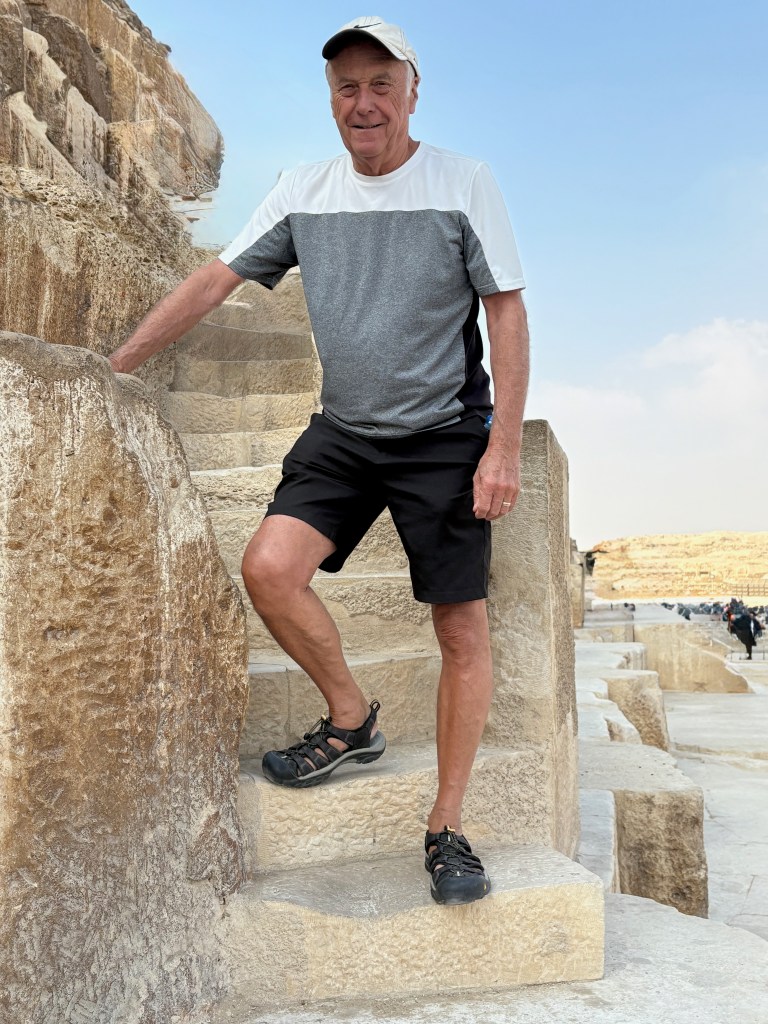
Khufu set a tone of grandeur and luxury as the first king of the 4h Dynasty to build his tomb on the Giza Plateau. This tone would be replicated by his son Khafre and grandson Menkaure who built the other two pyramids.
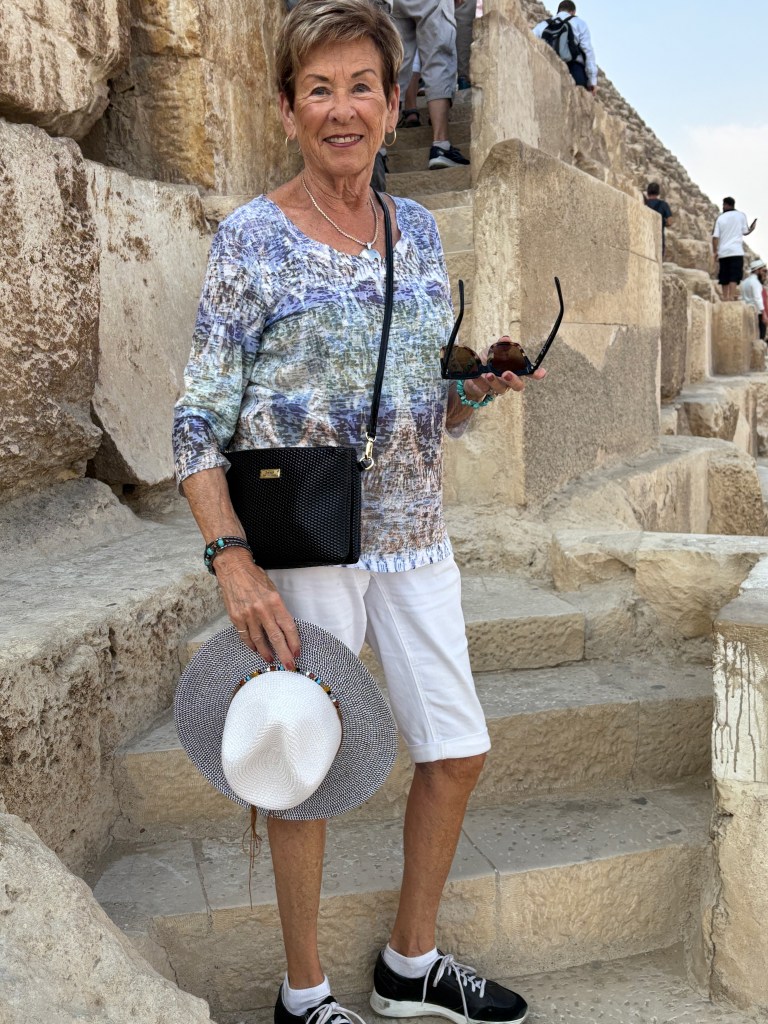
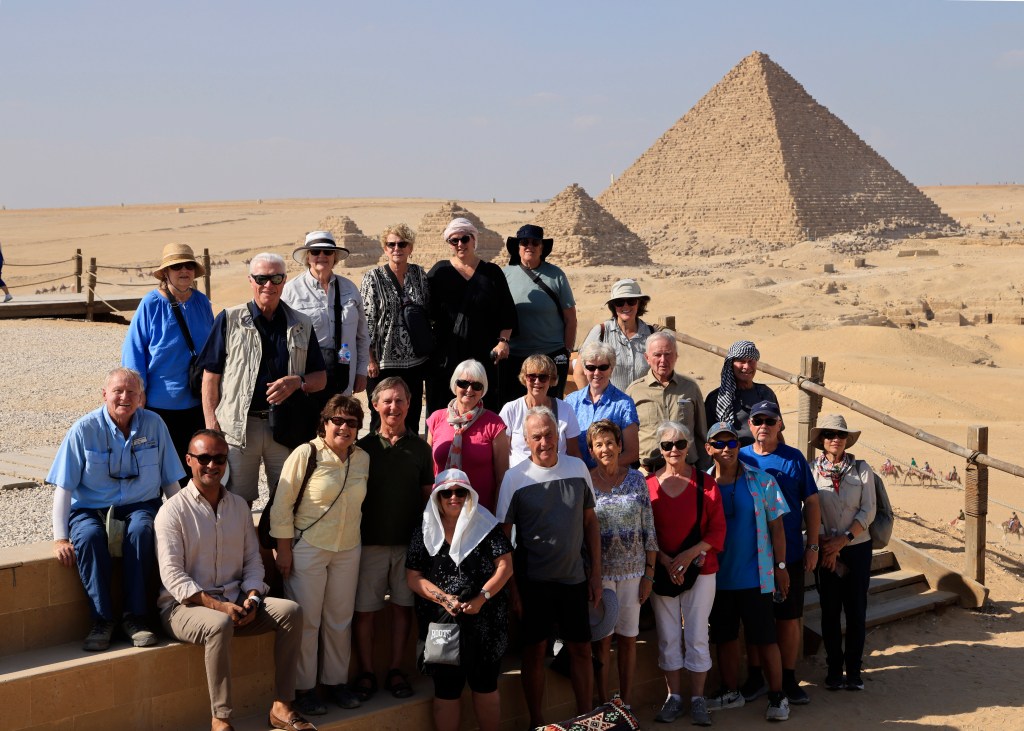
We passed the second largest pyramid and walked around and climbed the steps of the big pyramid aware of the size of the stones that had to be lifted to build the pyramid. We felt the stones that are smooth and warm.
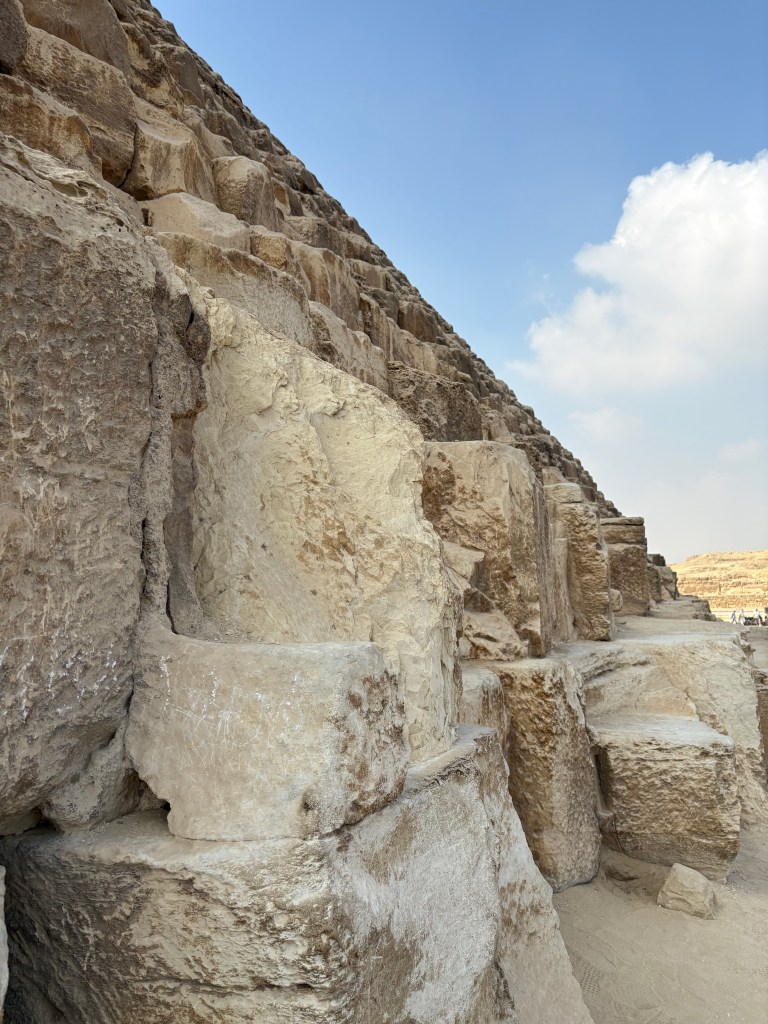
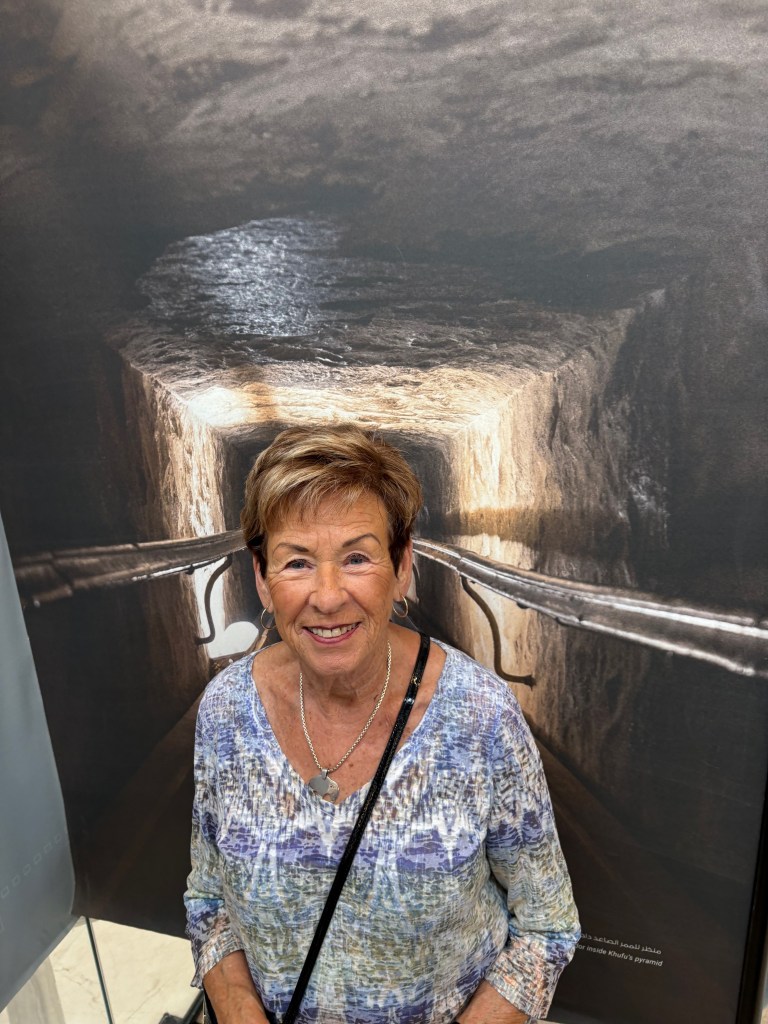
It was likely covered in gold originally. Not long after it was built, it was looted by Egyptians. There was a tunnel inside the pyramid but it was long, low and hot so we didn’t go down it.
The Queen’s Pyramids located at the southern side of the Pyramid of Menkaure
Mortuary temple.
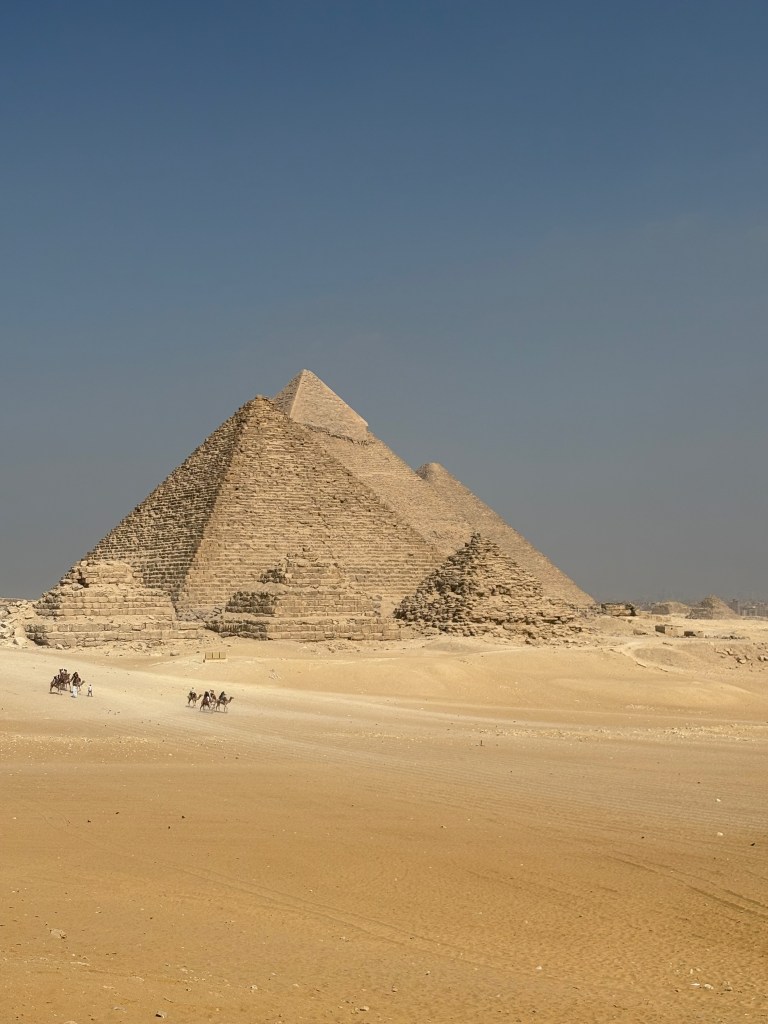
The Giza Plateau served as an extensive burial ground for the royal family and high officials who were buried near their beloved king. The Eastern and Western cemeteries consisted of large networks of rectangular superstructure tombs called Mastabas, named after the Arabic word for bench, which were intended for this purpose.
King Khufu and King Menkaure chose to honour the women of their royal family by each building three subsidiary pyramids for their queens. On the other hand, King Khafre decided to create a cemetery of rock-cut tombs for his family members.
Khufu’s three Queen’s Pyramids are located to the east of his Great Pyramid and were likely intended to be exactly 1/5th of the size of Khufu’s. In reality, these pyramids were built on sloping ground and did not have the same precision as the pyramids of the kings. Two of these pyramids are said to belong to Queen Meritites, wife and sister of Khufu, and Queen Henutsen, secondary wife and half-sister of Khufu. The third is thought to belong to Khufu’s daughter.
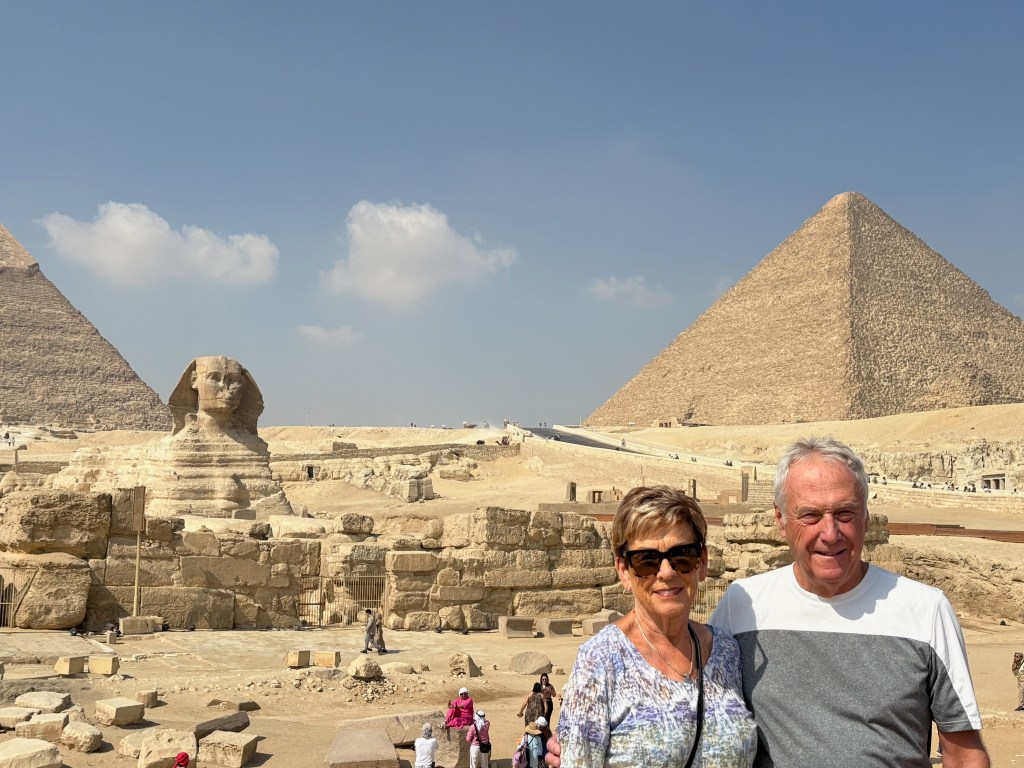
We then visited the Sphinx, the enigmatic Sphinx – this massive lion-bodied, human-headed sculpture. The smashing of the face was performed by locals who feared the influence of the Sphinx.
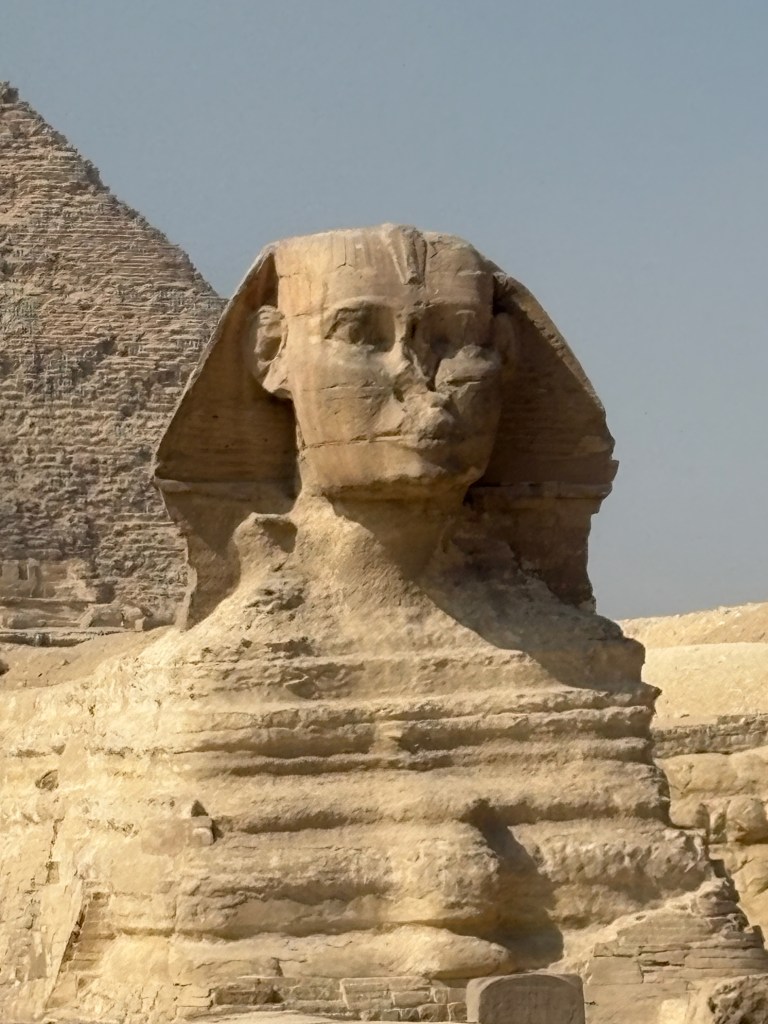
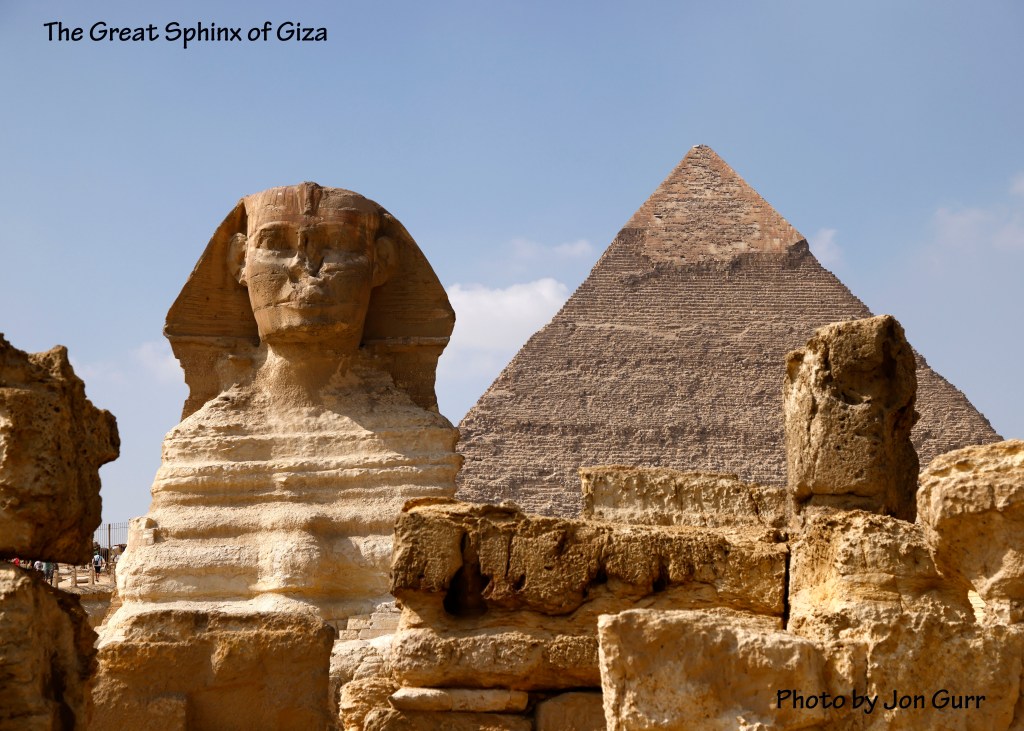
This area had been flooded by Nile and the land has been reengineered to prevent the flood again.
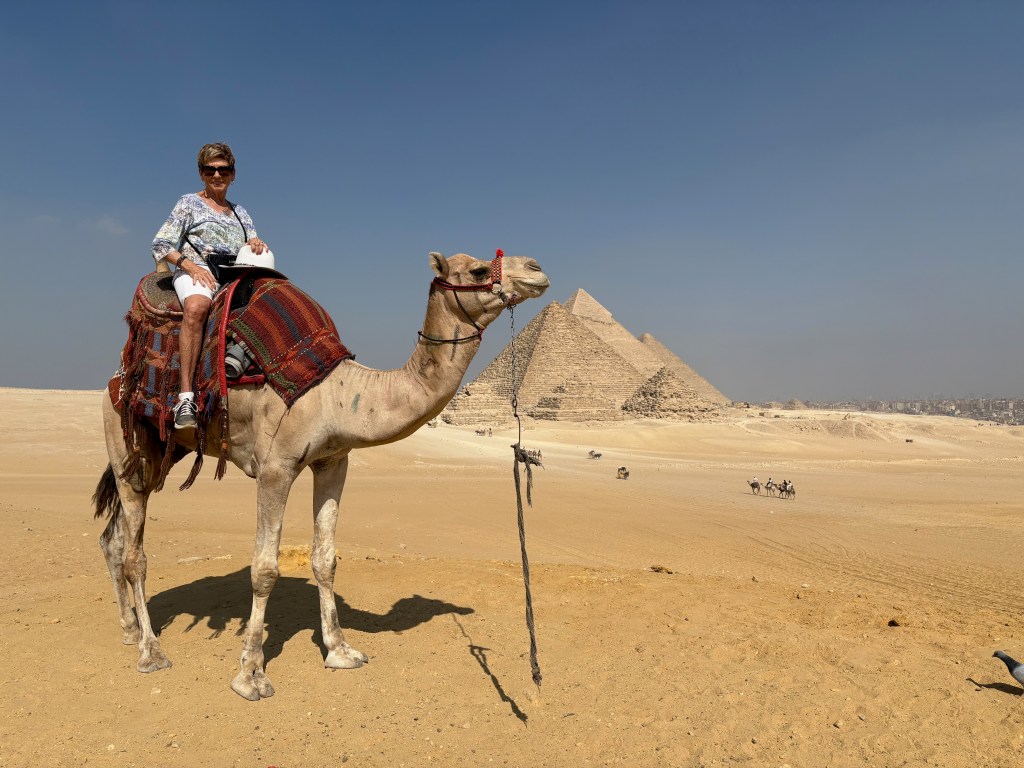
I took the opportunity to take in the breathtaking views of the Pyramids while on the back of a camel (approx. $15 USD).
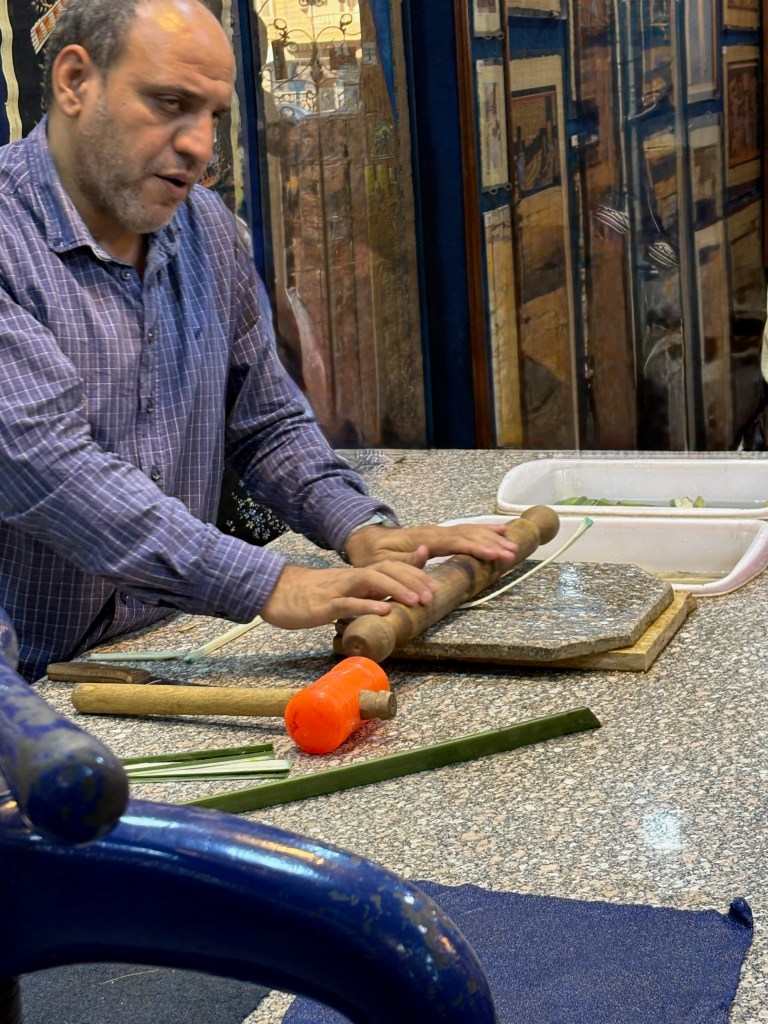
Near the end of the day, we visited a papyrus shop.
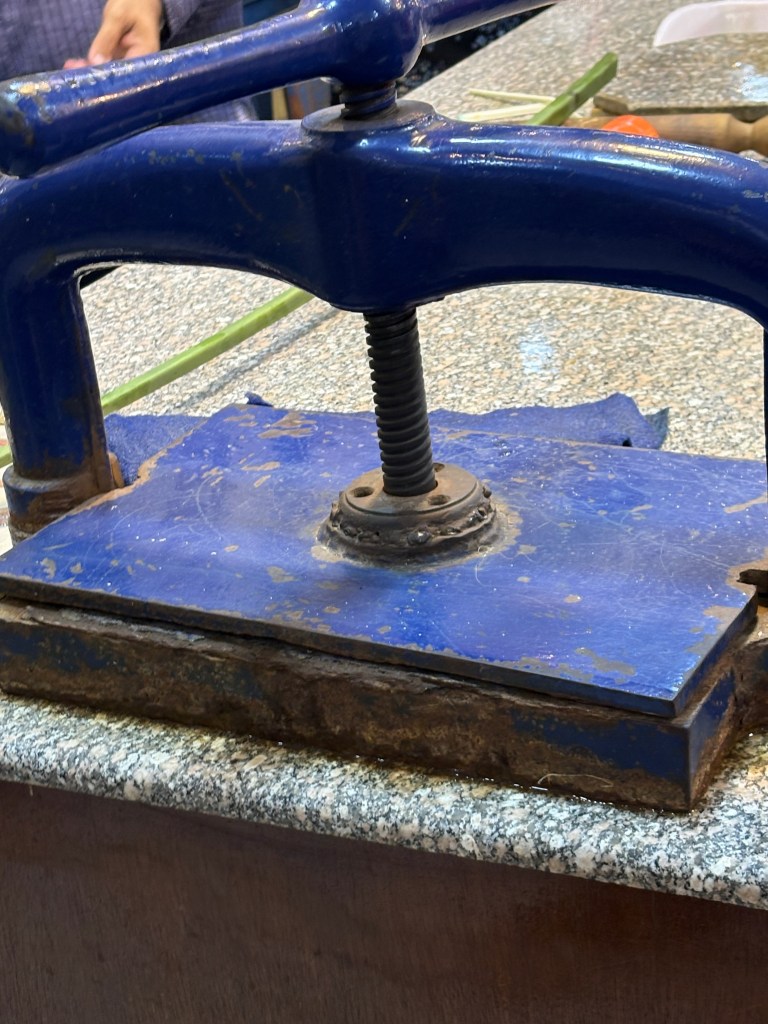

On the way back to the Marriott, Bill told an “Omar” joke:

We went to Le Pacha, an Italian Restaurant on the water for dinner.
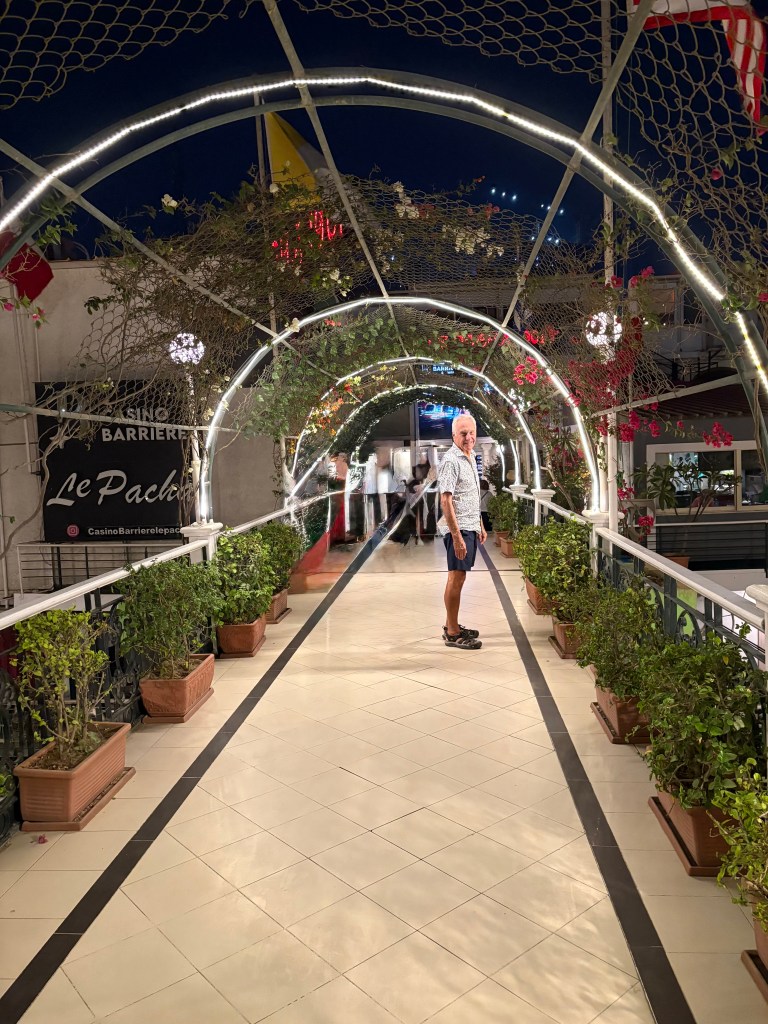
OCT 27, Monday CAIRO
In 1979 the city was officially registered as a UNESCO World Heritage site thanks to its historical and architectural significance that is represented to this day in its urban fabric which preserves monuments, markets, and old streets.
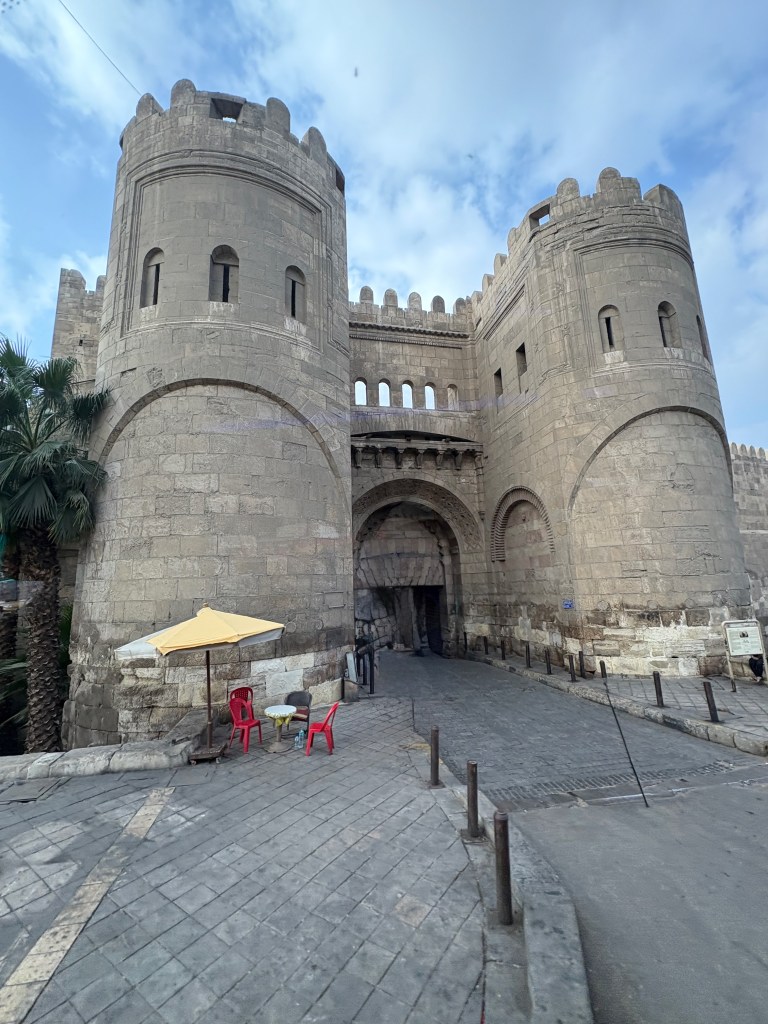
Hassan led us through the early morning streets of Cairo, pointing out significant buildings – Al-Muizz li-Din Allah Street is considered the largest open-air museum of Islamic monuments in the world.
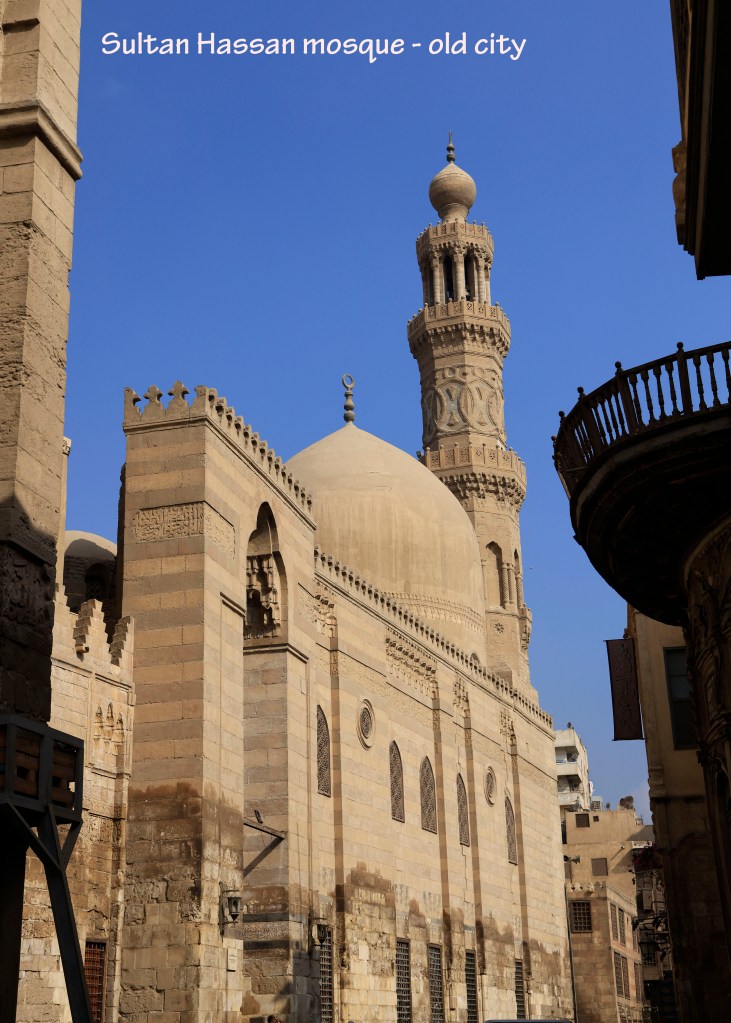
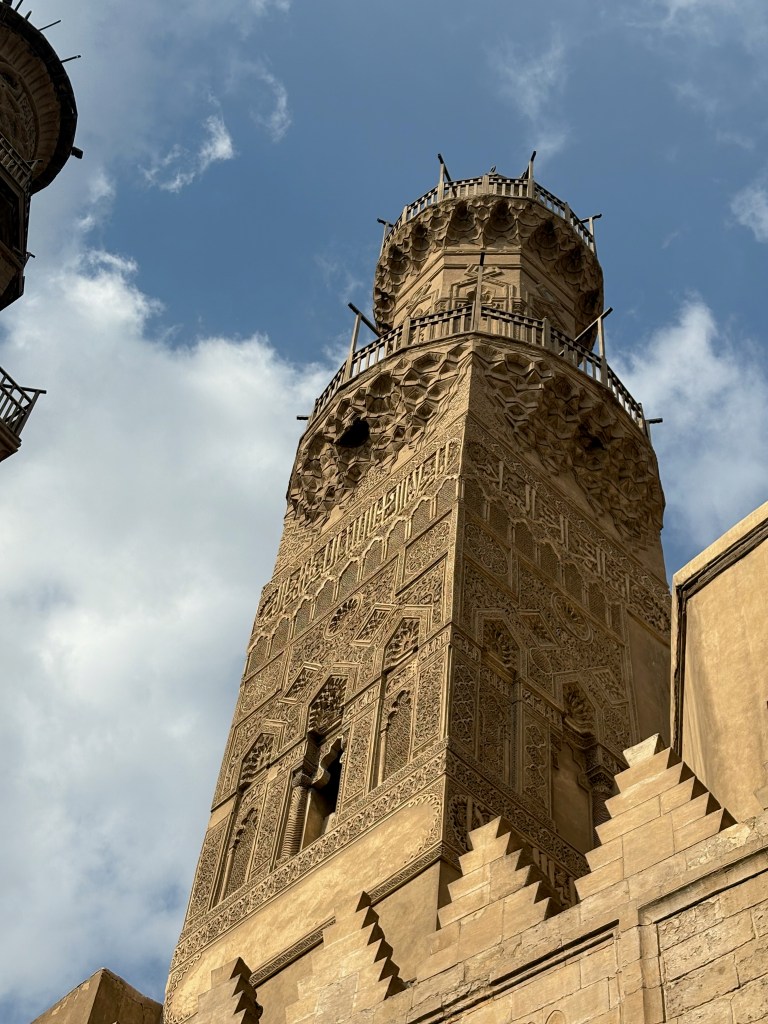
We arrived at the Khan El Khalili Bazaar where we walked around and Hassan had coffee and smoked a Shisha, a flavoured (apple, strawberry) tobacco.

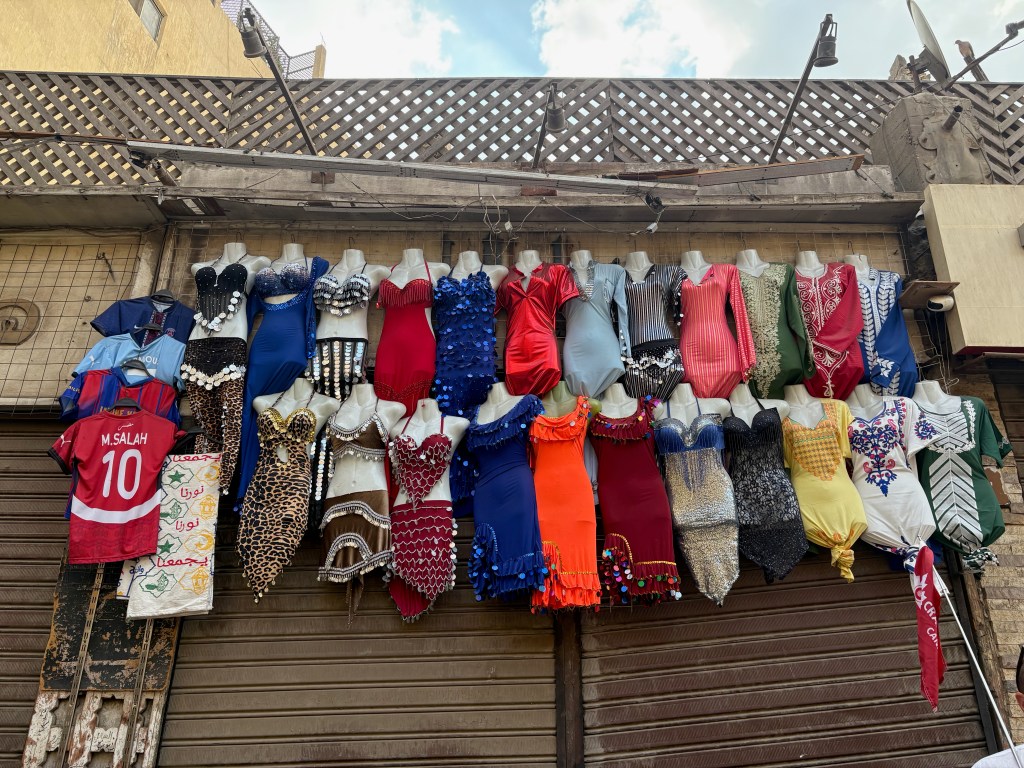
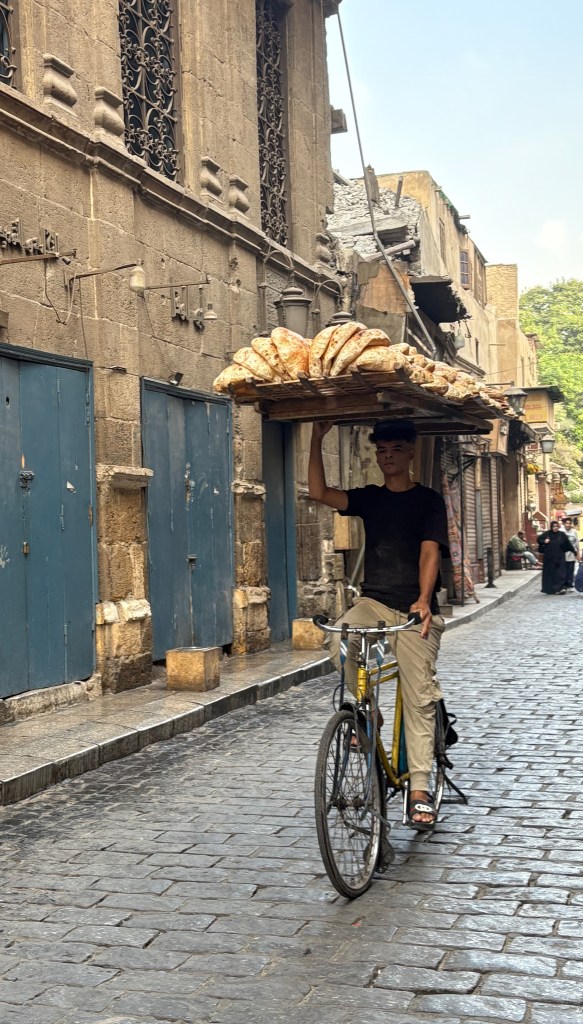

Next stop the new Museum of Civilization.
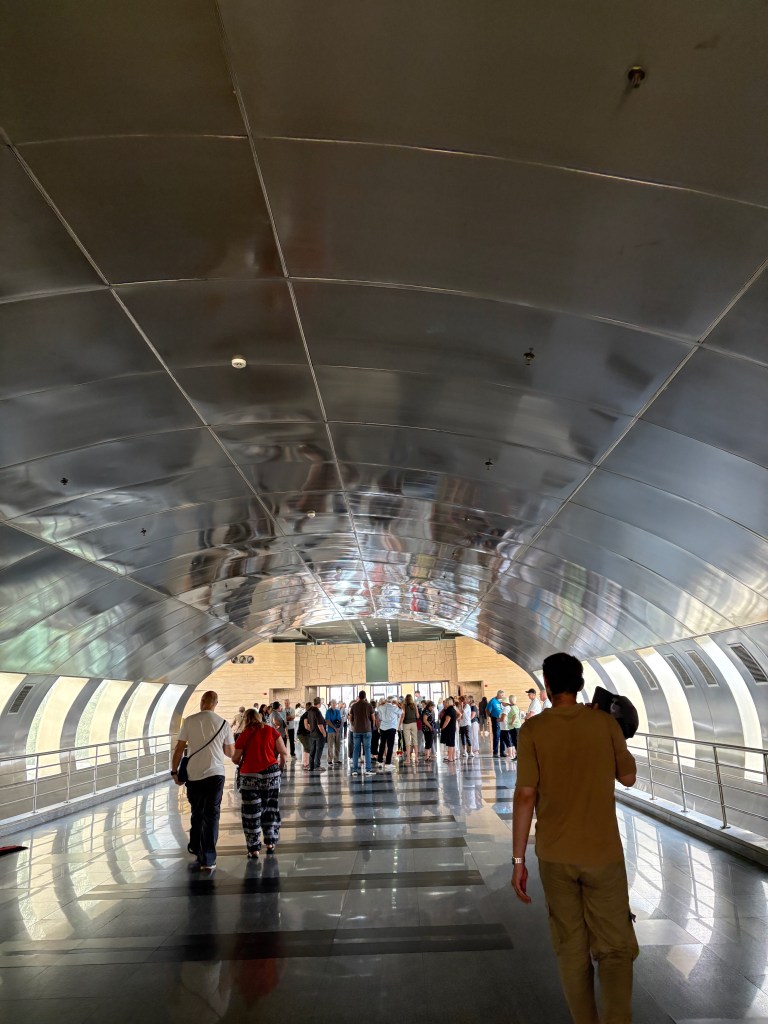
Hassan guided us through the Museum of Civilization. We walked through the ages in this beautiful 4-year old, modern museum.
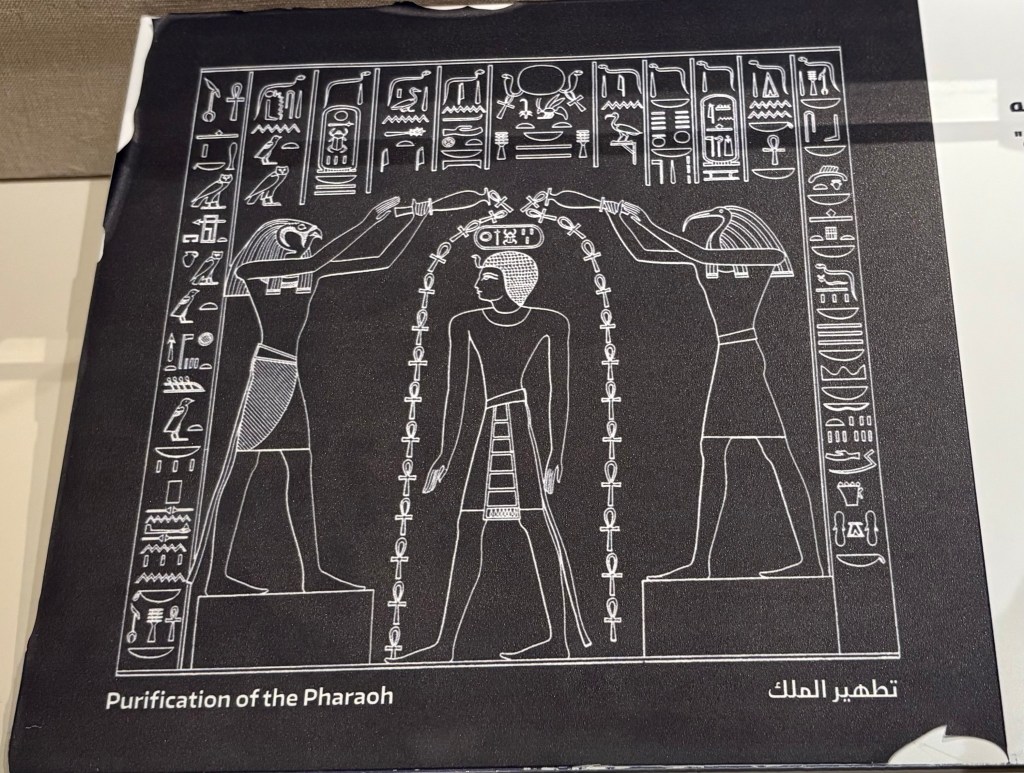
Purification with water
Upon his arrival from the other world, the sun god purifies himself in eastern horizon before his shining in Heaven, where the four-gods “Horus”, the Lord of the North, “Seth”, the Lord of the South, “Dewen-anwy”, the Lord of the East, and
“Thoth”, the Lord of the West, pour the water of life and power over him from the four corners of the universe.
This rare statue depicts king Amenhotep Il, assimilated with the sun god in his shining in the moment of his purification on the horizon New Kingdom, 18th Dynasty (1550 – 1295 BC) / Valley of the Kings – Thebes / Alabaster
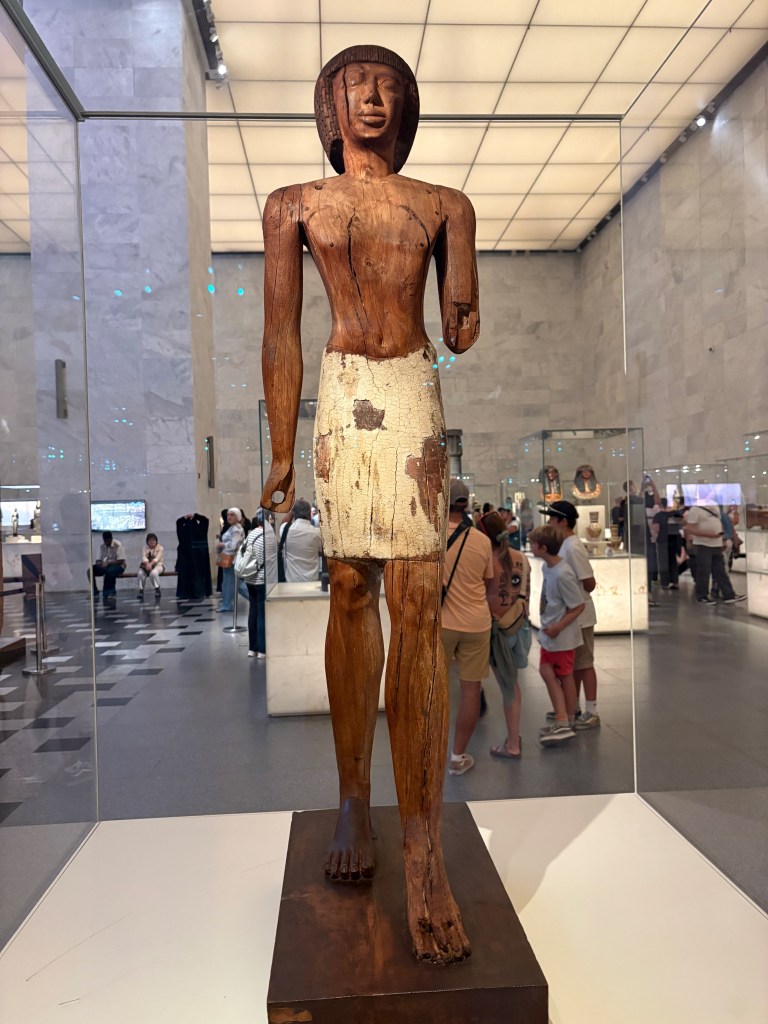
The Wooden statues from ancient Egypt are rare due to the perishable nature of the material. Most depict men, identifiable by variations in wigs and clothing that reflect their roles and status. This statue shows a young man with calm facial features, short hair, and a knee-length kilt. His left leg steps forward-a traditional pose symbolizing vitality and movement in ancient Egyptian art.
Wooden Statue of a Man, 6* Dynasty (c. 2323-2150 B.C.)
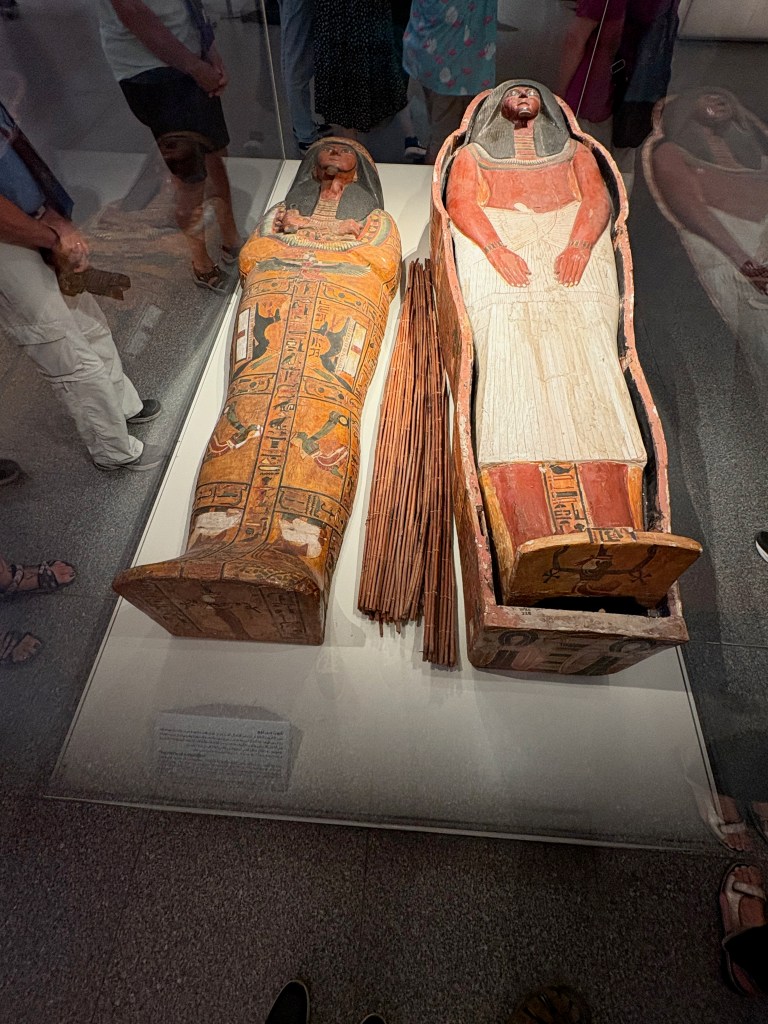
The inner coffin of Sennedjem is made in anthropoid form, where his mummy was placed inside. The inner cover depicts Sennedjem in in his worldly clothes as he wears a long kilt of white linen. The coffin is decorated with funerary scenes of the protective goddesses from the Book of the Dead, while Sennedjem receiving provisions from the Tree Goddess. His tomb was discovered in 1886 by French Egyptologist Gaston Maspero. And it was fully intact with a collection of funerary furniture, figurines and splendid paintings.
New Kingdom, 19*h Dynasty (1295 – 1186 BC) / Thebes / Wood
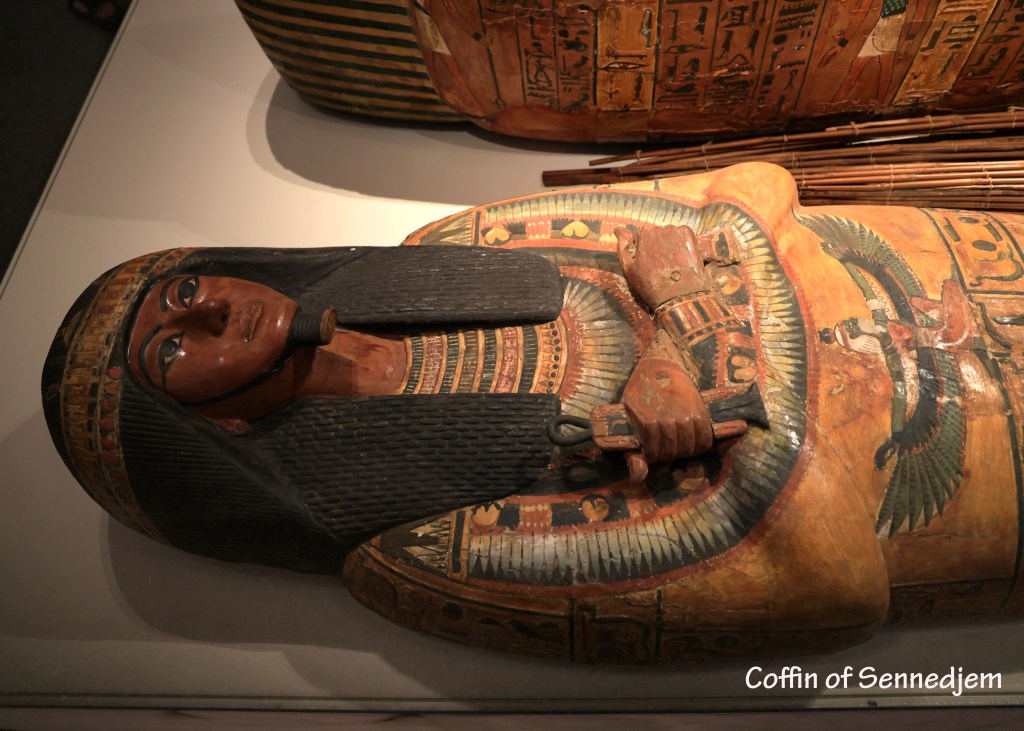
This collection from the tomb of Sennedjem, an artisan who decorated the royal tombs of the pharaohs, features a splendid coffin and funerary masks along with brilliantly painted furniture.
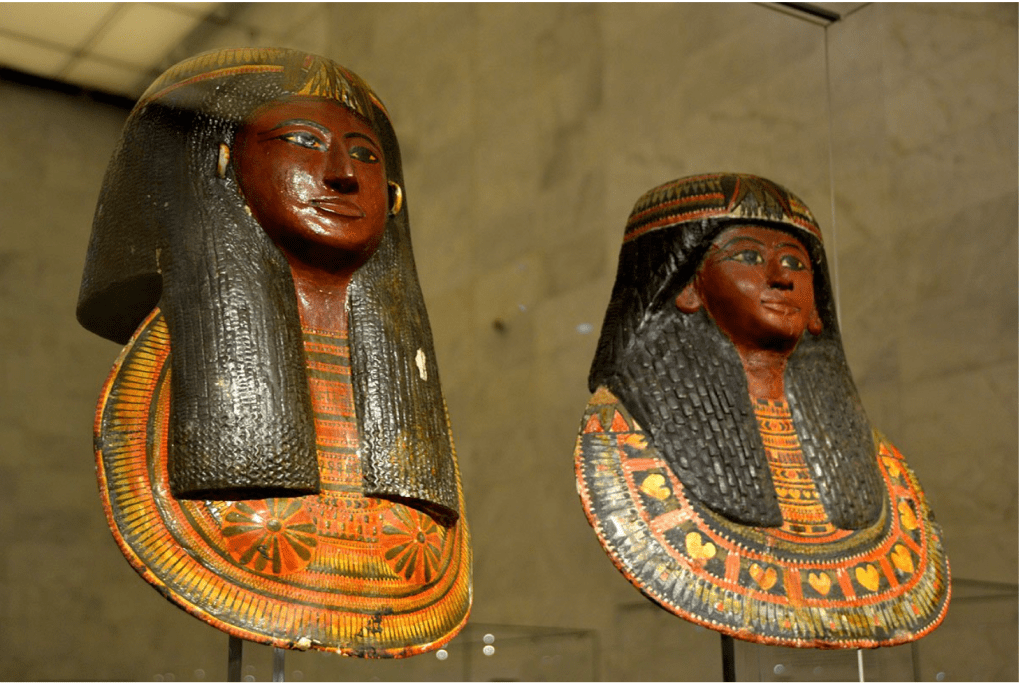
The objects were discovered in Sennedjem’s tomb in Deir-el-Medina, near modern-day Luxor, a village that was home to the ancient Egyptian craftsmen who decorated the royal tombs in the nearby Valley of the Kings. Sennedjem designed his own tomb and was buried there during the reign of King Ramses II.
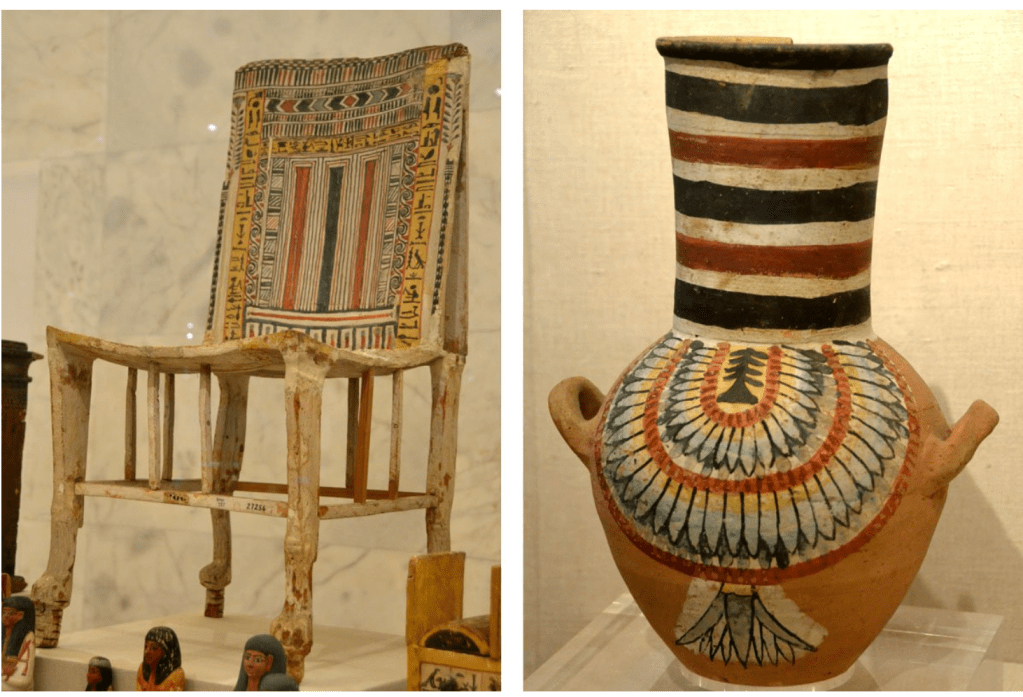
The funerary furniture includes a painted chair that Sennedjem actually used in his lifetime.
The sarcophagi were paraded through the streets of Cairo on their way to the museum. No photographs were allowed: we saw the sarcophagi and mummies of all the major pharaohs. It was a bit disturbing to examine the 4000/3500 year old mummies- dark and wizened to their bones, some still with hair, wrapped but hands, feet and neck and heads exposed: they’re were not reborn and are still very much dead.
Lunch at Citadel View Restaurant

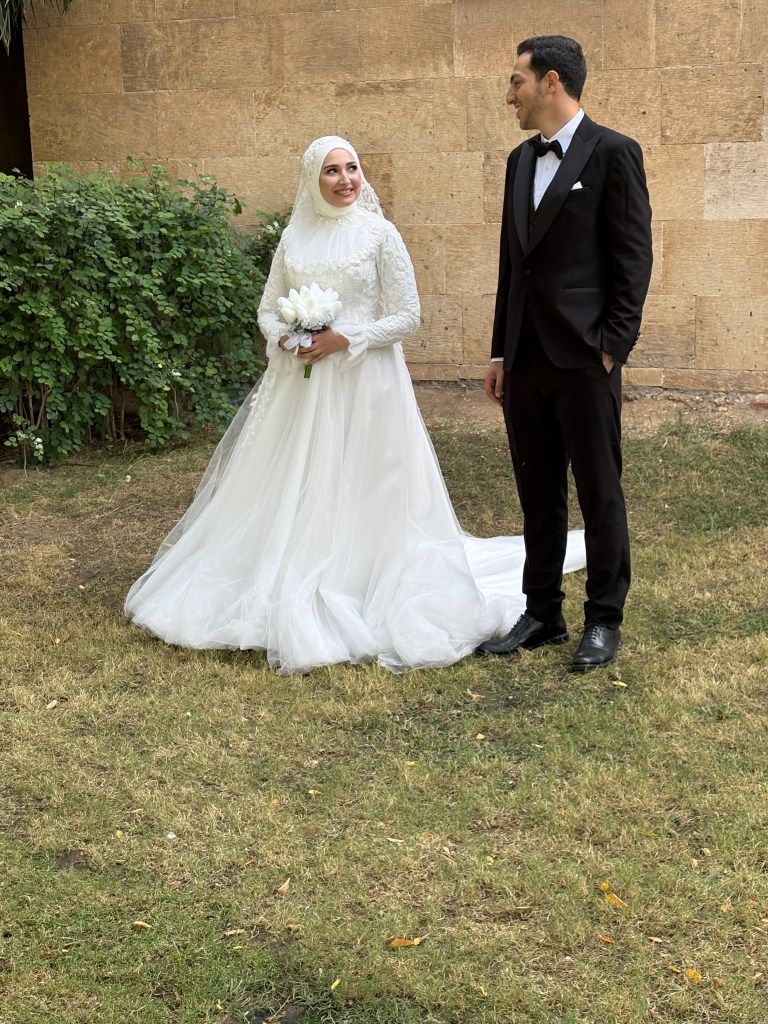
We had lunch at The Citadel View Restaurant in the gardens built by Agi Khan out of a garbage dump including Ayyubid City Walls, built by Salah El Din between 1176 and 1183 AD. In Al Azhar Park, located in old Cairo, with its lush gardens and panoramic city views, a wedding was underway while we were there.
The lunch was served on small brass portable bbq grill like an hibachi. The chicken, beef and vegetables were delicious.

We needed $ EGD 13000 (US$ 277) plus money for tips for the tour to Alexandria the next day so I had to take out 4 lots of 4000 EGP to get it.
The day was capped off with a Farewell Dinner. We said our goodbyes to Hassan, Jon and the group.
This evening, we will have a special farewell dinner at our hotel. Jon thanked Hassan for being a great guide and all of us for our excellent behaviour as a group. I thanked both ot them on behalf of the group.
Modern Cairo and Egypt
Hassam provided a plethora of information. He, himself, was involved in the 2011 Egyptian Revolution, also widely known as the January 25 Revolution (or the “Day of Anger”/”Friday of Rage”). It was a series of mass protests that led to the resignation of President Hosni Mubarak, who had ruled for nearly 30 years. This event was part of the broader regional movement known as the Arab Spring. He said that the country has still not recovered from the revolution and its causes.
However, things appear to be booming with cranes and construction everywhere. In Cairo, there are 10 square kilometres in the centre of the city of cemetery ghetto filled with poverty, drugs, and unhealthy living; currently, there is a massive, often-contested plan to move tombs and bodies to another location and rebuild the area.
Driving in Cairo is absolutely crazy: there are lines on the road but no one observes them. Our bus drivers were amazing!
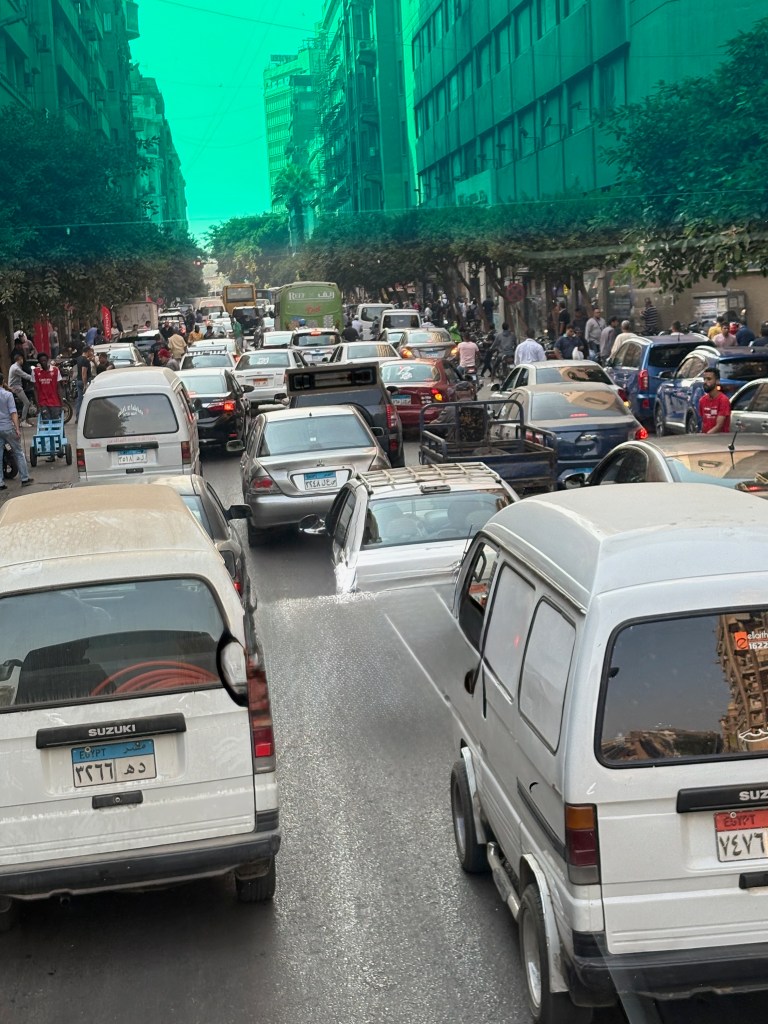
A vast assortment of wares are available right on the sidewalks.
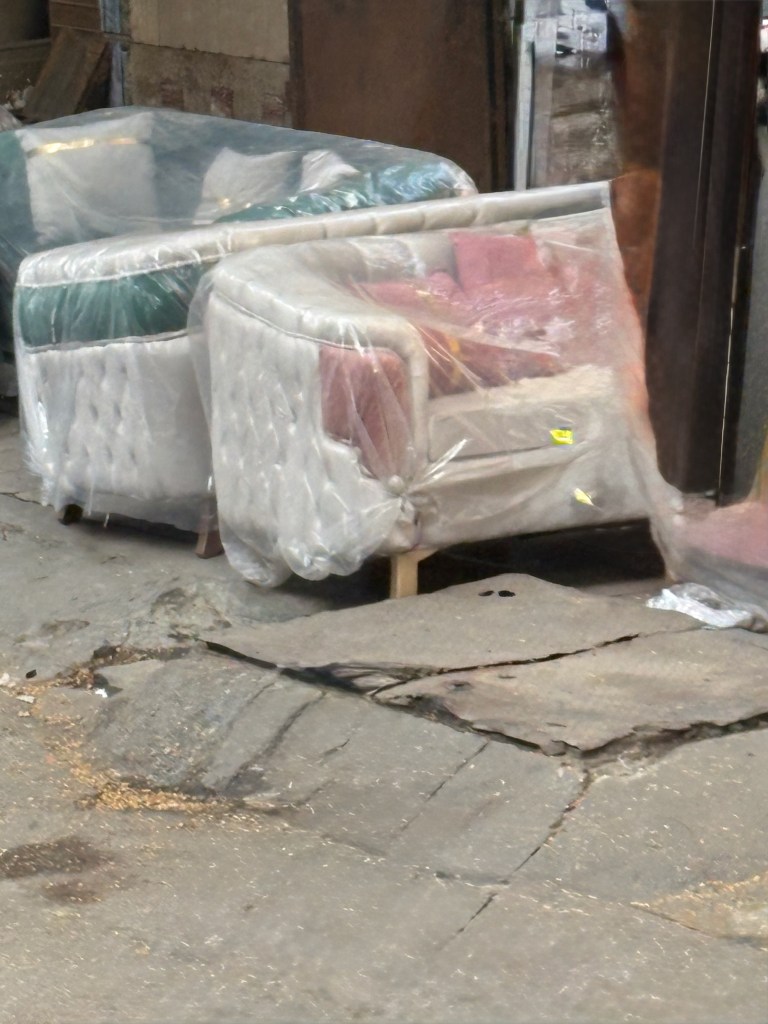
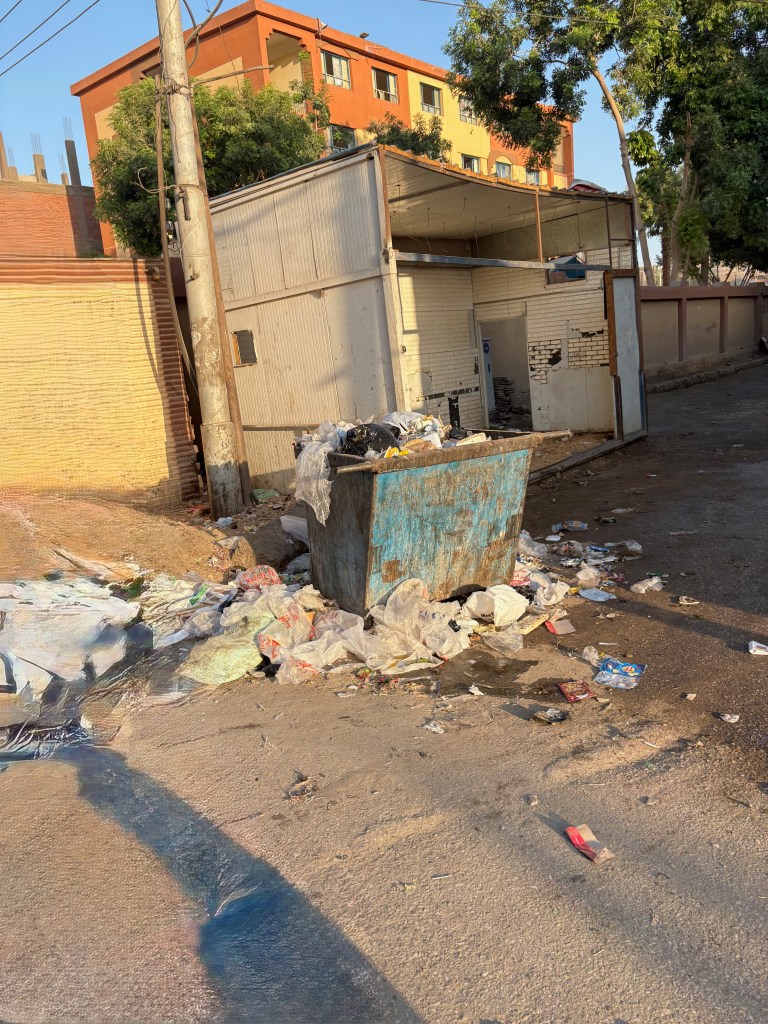
There is garbage evident on the streets as well as rubble, dirt and dust.
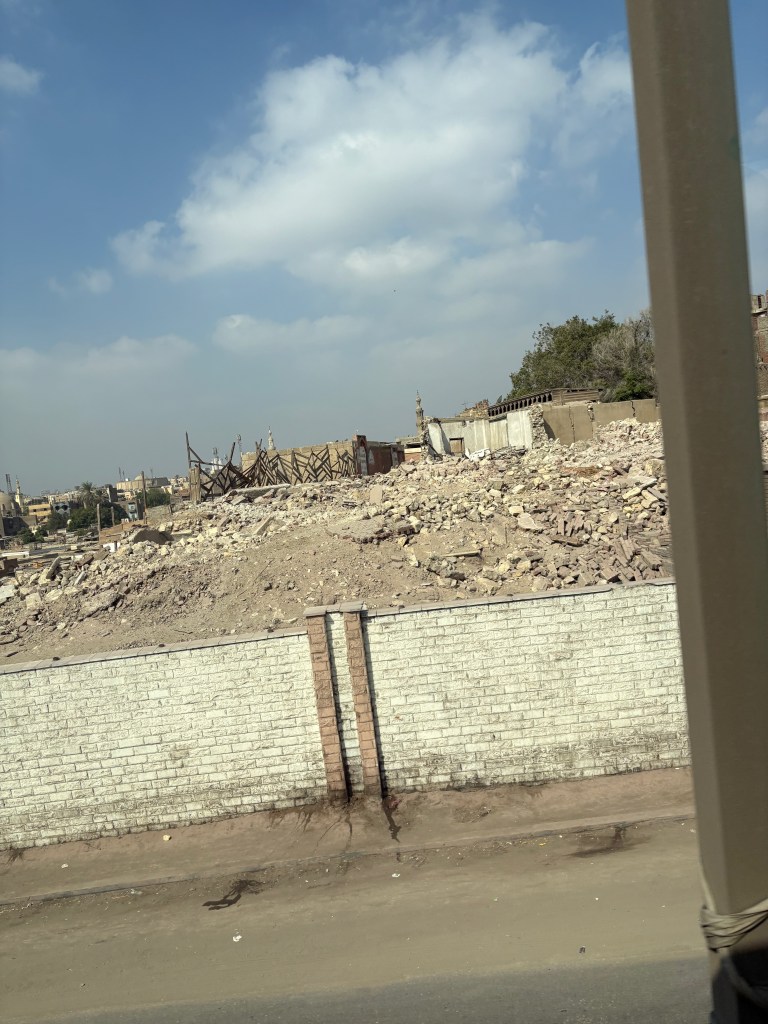
OCT 28, Tuesday Trip to Alexandria
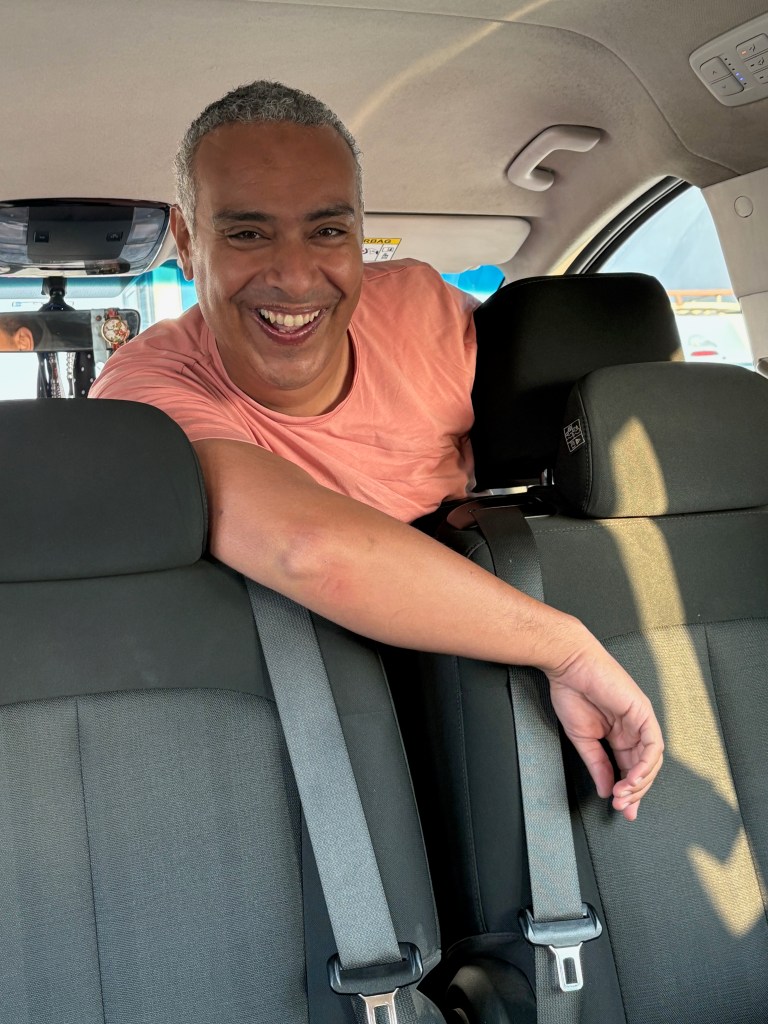
Our plan was to visit the new Great Egyptian Museum but it was closed for the official opening on November 1. So, we asked Hassam to recommend a tour of Alexandria and he contacted his cousin, Karim,
Alexander the Great founded the city in 332 bce after the start of his Persian campaign; it was to be the capital of his new Egyptian dominion and a naval base that would control the Mediterranean.
After Alexander left Egypt his viceroy, Cleomenes, continued the creation of Alexandria. With the breakup of the empire upon Alexander’s death in 323 bce, control of the city passed to his viceroy, Ptolemy I Soter, who founded the dynasty that took his name
It was at Alexandria that Cleopatra, the last of the Ptolemies, courted Julius Caesar and claimed to have borne him a son. Her attempts at restoring the fortunes of the Ptolemaic dynasty, however, were thwarted by Caesar’s assassination and her unsuccessful support of Mark Antony against Caesar’s great-nephew Octavian. In 30 bce Octavian (later the emperor Augustus) formally brought Alexandria and Egypt under Roman rule. The city held the key to the Egyptian granary on which Rome increasingly came to rely.
There is massive building going on since corruption of Mubarak government and uprising. We travelled my taxi on new road to Alexandria with 5 car lanes one way and a separate one for trucks. There was evidence of agriculture under irrigation as it rains in the north filling wells and new towns all along highway.
Alexandria is a Mediterranean port city in Egypt. During the Hellenistic period, it was home to a lighthouse ranking among the Seven Wonders of the Ancient World as well as a storied library. Today the library is reincarnated in the disc-shaped, ultramodern Bibliotheca Alexandrina. Honking: the cacophony of honking horns is part of driving: some of it is aggressive but also saying, “I’m here or have a pleasant day”. There are many narrow streets crammed with cars, buses, carts and horses, TikTok’s, and black and yellow taxis.
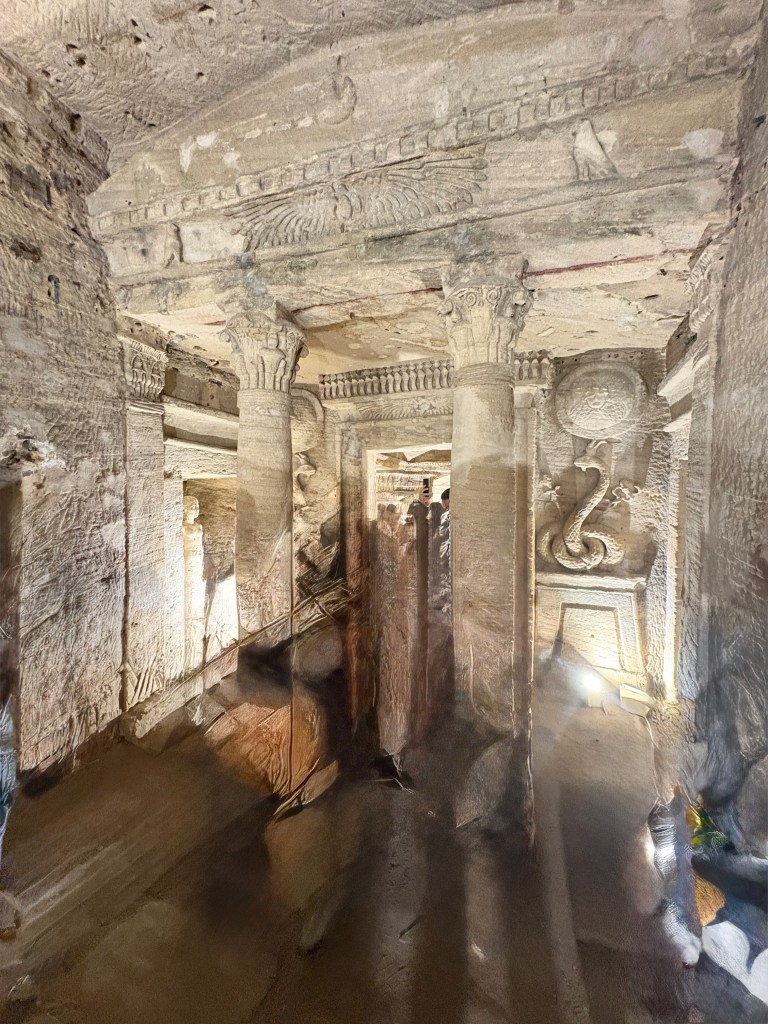
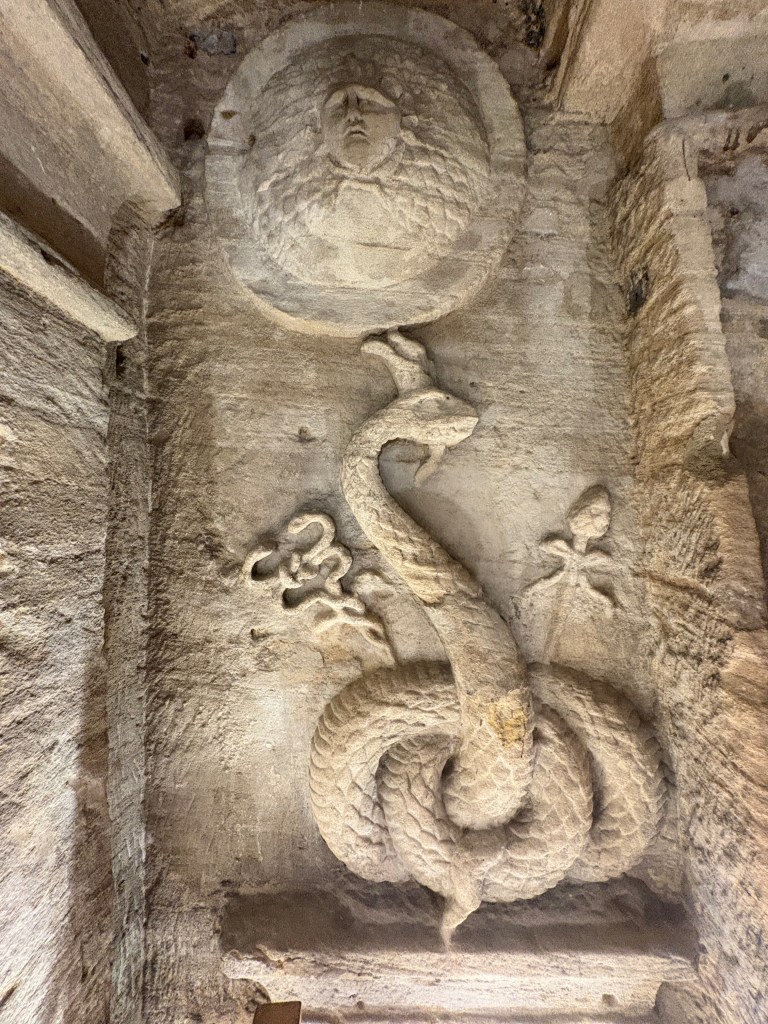
Our first stop was the Catacombs of Kom el-Shuqafa. First discovered in 1900, these subterranean structures were carved out of bedrock and used when Egypt was part of the Rom Empire, with construction and use thought to have begun at the end of the 1st century AD; and then added to and enlarged up until the 4th century AD. They may never have been used mysteriously; though they found some horse bones but had no idea why or when; all carved out of bedrock.

The Roman Theatre

A unique group of 22 lecture halls from the 5th through 7th centuries AD stretches along a monumental, colonnaded portico traversing the site from north to south. The auditoria that have been excavated so far are all of different size, yet they share a similar orientation and layout. Stone benches are the most important interior furnishing. They are present in all of the halls, lining the walls in two or three rows. Tiered seats could hold from 20 to 30 students, sitting on alternate steps.
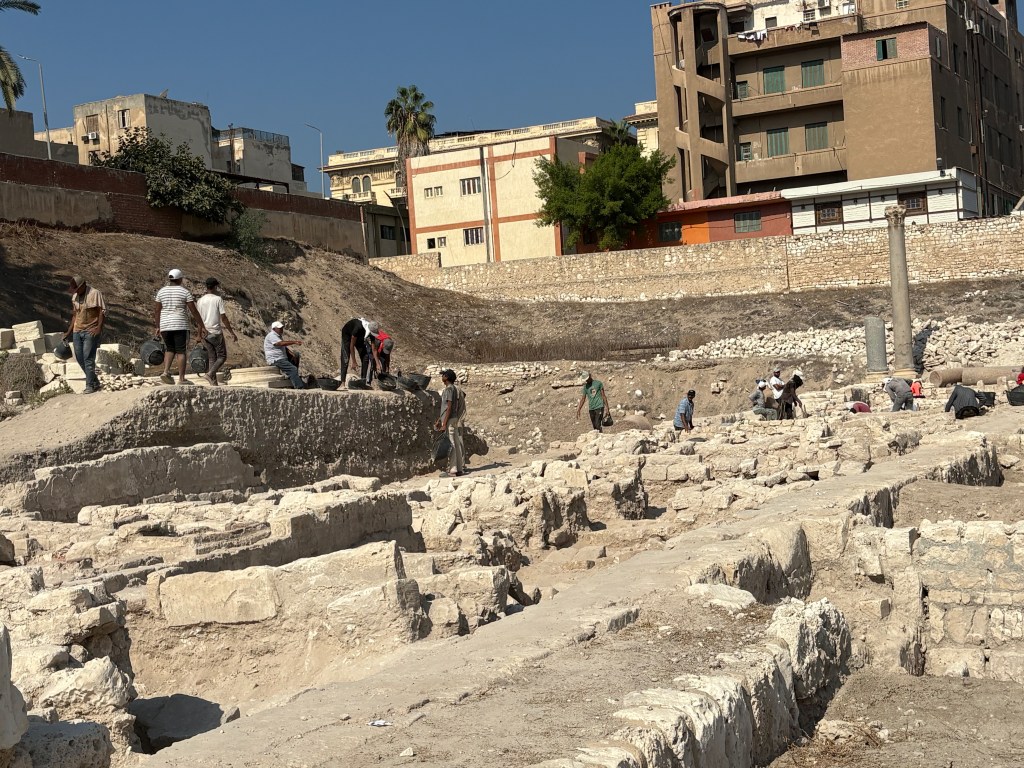
The complex is unparalleled anywhere in the Mediterranean world. Taking into consideration the scale of our complex and its location in the urban space, one can assume that these auditoria best reflected the role of Alexandria as a leading centre of learning and education in late Antiquity.

The large Late Roman bath of the late 4th century – early 7th century AD is a major architectural feature in the area. The central part of the building, which was built of red brick, contained a series of heated rooms typical of bathing establishments of the period.

VILLA OF THE BIRDS
Most of the villa’s mosaics were laid during the reign of Hadrian (AD 117-138) when Alexandria enjoyed period of prosperity. The villa was destroyed by fire in the late third century. Later about the AD 450-550, houses, storerooms and workshops were built over the ruins.
Among the Roman houses in Alexandria, the Villa of the Birds is the best example of a wealthy urban villa. In the second century, the bird panels and and the dining room’s opus sectile mosaics were laid. Opus sectile was a favorite carpet style in Alexandrian homes.
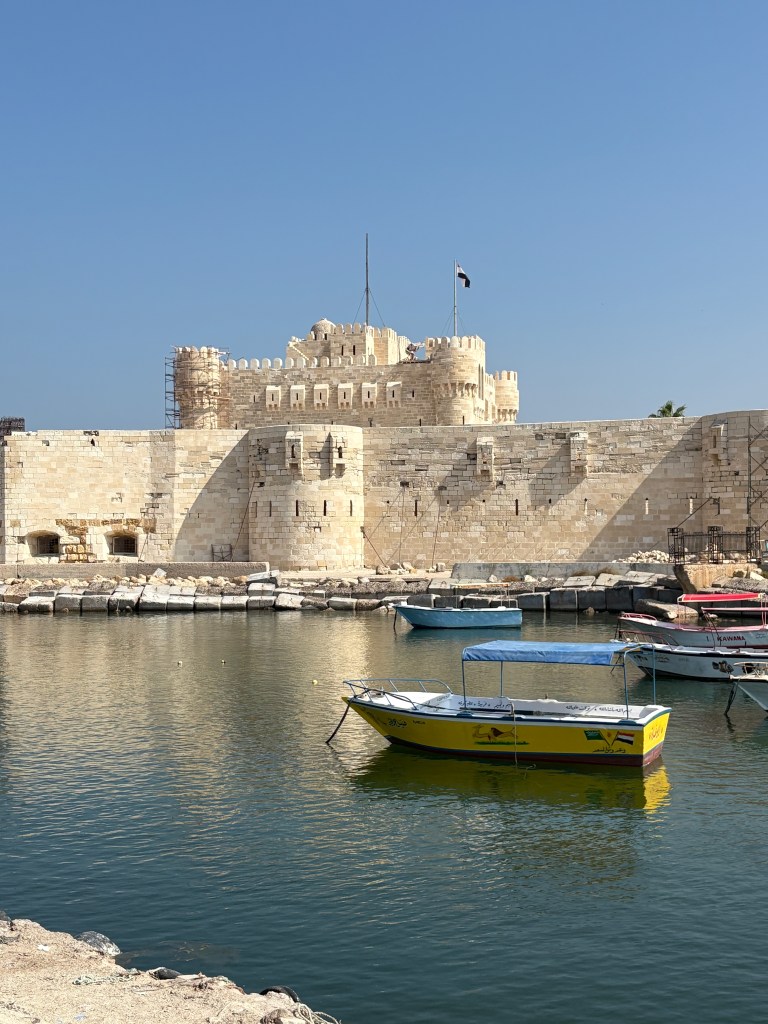
Citadel of Qaitbay.
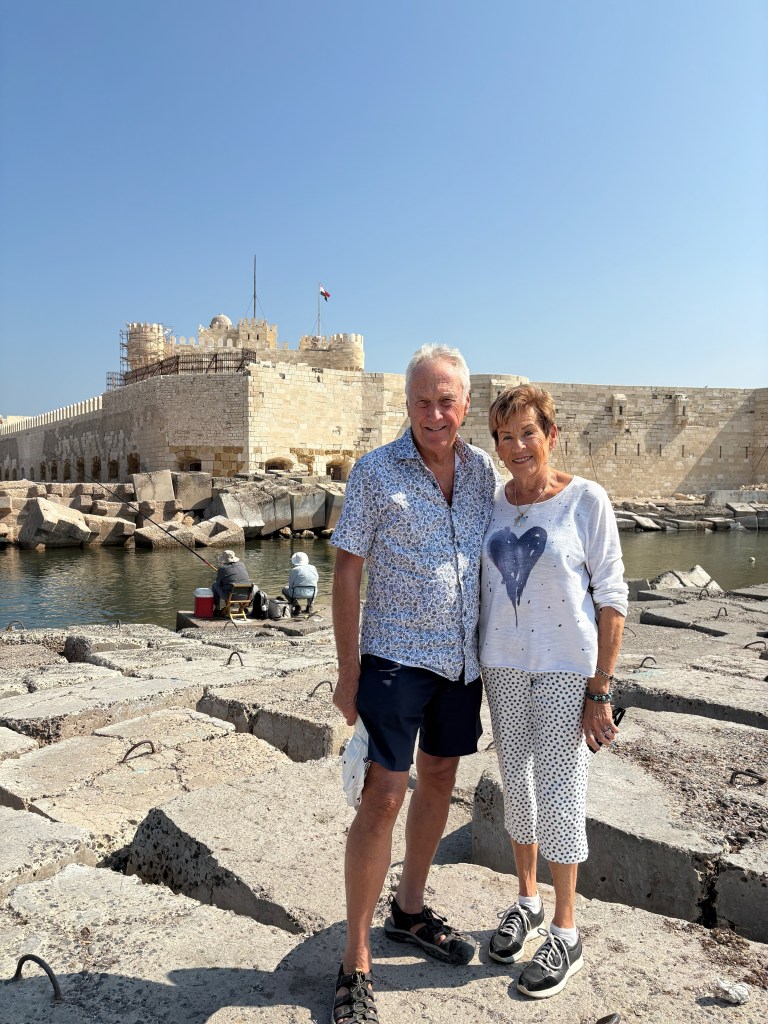
Resembling an imposing castle fortress, this citadel was built in the 1480s by Sultan Qaitbey on the site of the Pharos Lighthouse, to protect the city from the crusaders who used to attack the city by sea. The fortifications are extensive in order to protect the limestone structure.
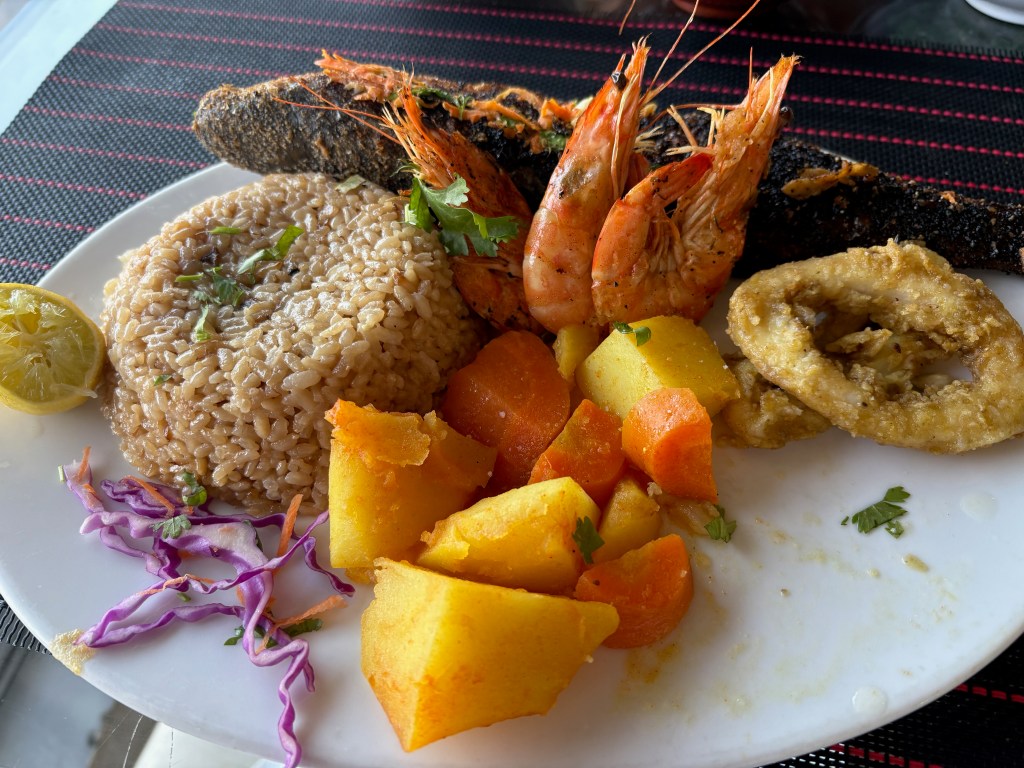
We had a very good lunch with a view of the harbour.
BIBLIOTHECA -ALEXANDRINA
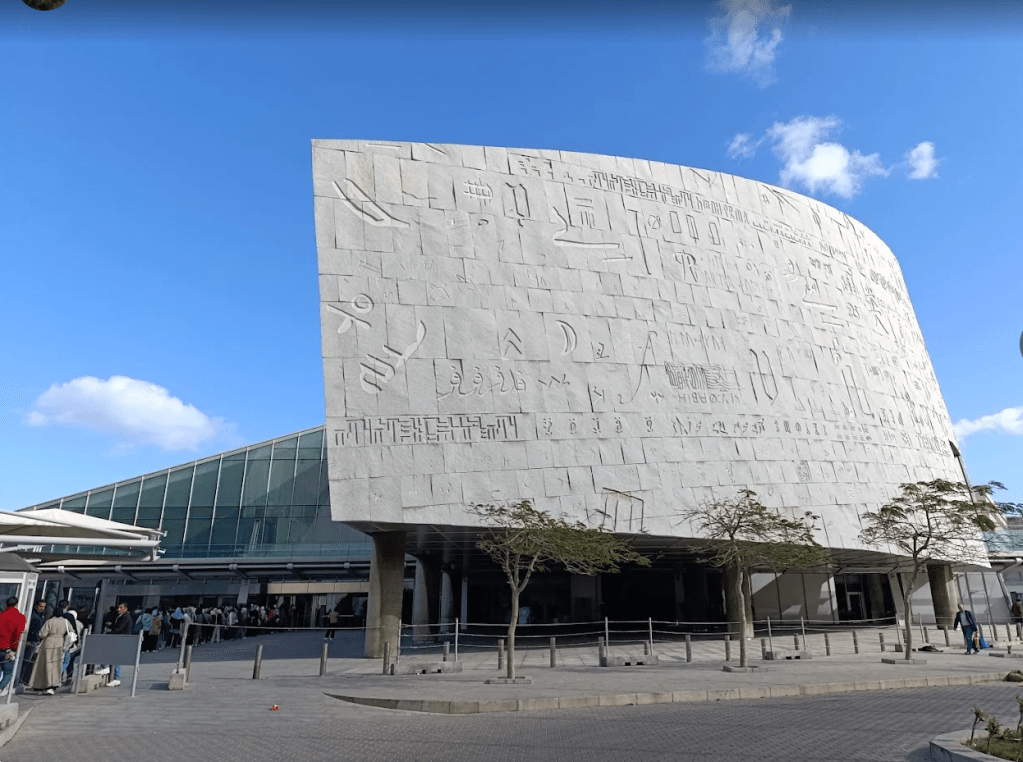
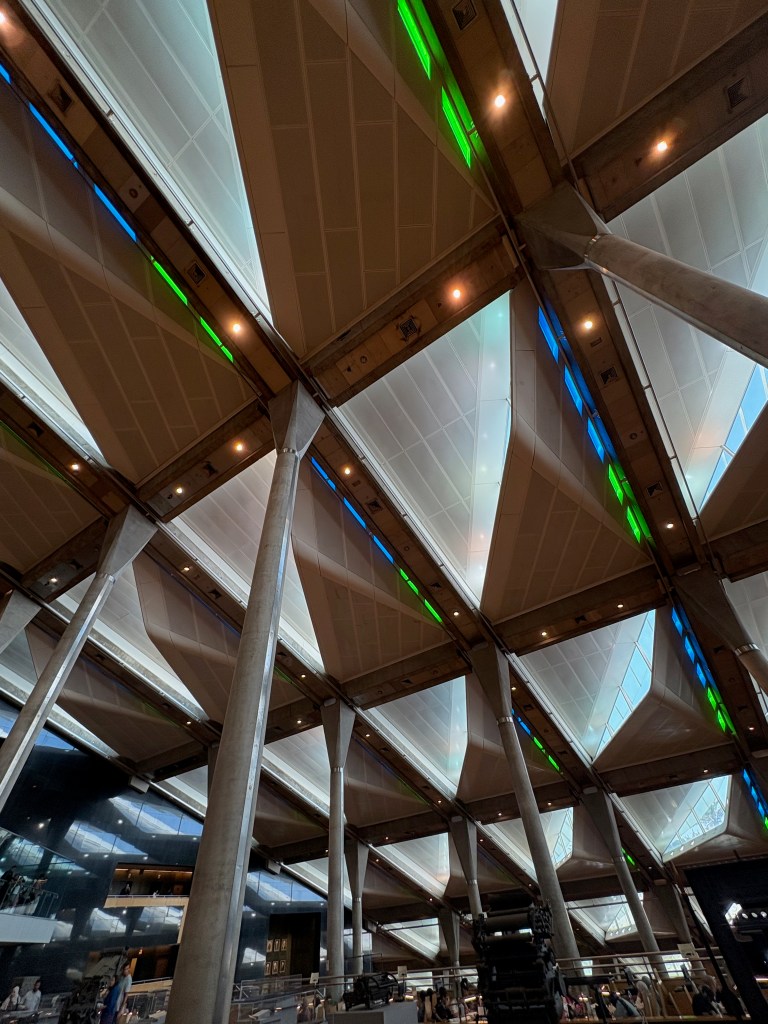
Located near the site of the ancient library of Alexandria, this modern version, built in 2002, is an eleven-story, cylindrical-shaped building that houses more than eight million books. Its architecture – a giant sun disk – presides over the waterfront Corniche, while inside, a huge reading room can hold eight million volumes.
Thoughts about Egypt
- The dust, dirt and heat was more overwhelming than expected.
- The ancient sites were stunning.
- There seem to be huge gaps between the very rich and very poor.
- There is an excitement and energy about the country that is infectious – it is an up-and-comer.
- There is much building going on: new roads, cranes, new high-rise buildings, new museums.
- The market sellers were obnoxious.
- Without our fabulous guides, Hassam and Jon, it would have been much less enjoyable.
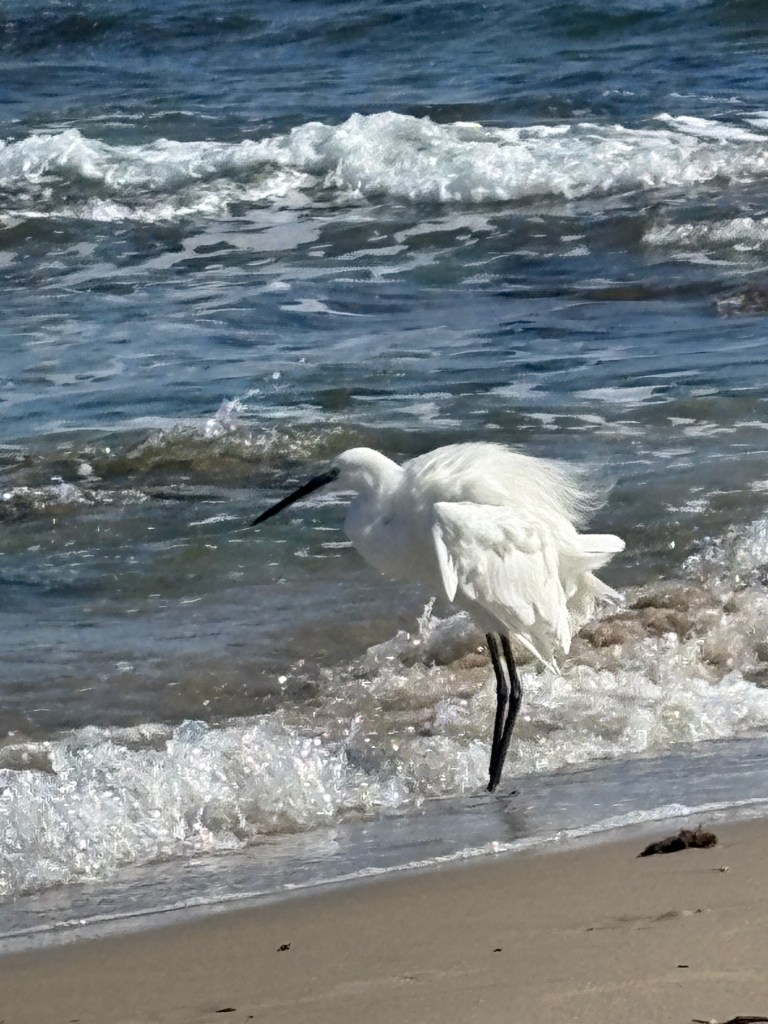
Spain
After we returned from Egypt, the warm weather continued into November and we were at the beach and swimming in the sea into the middle of the month. With some visits from our egrets.
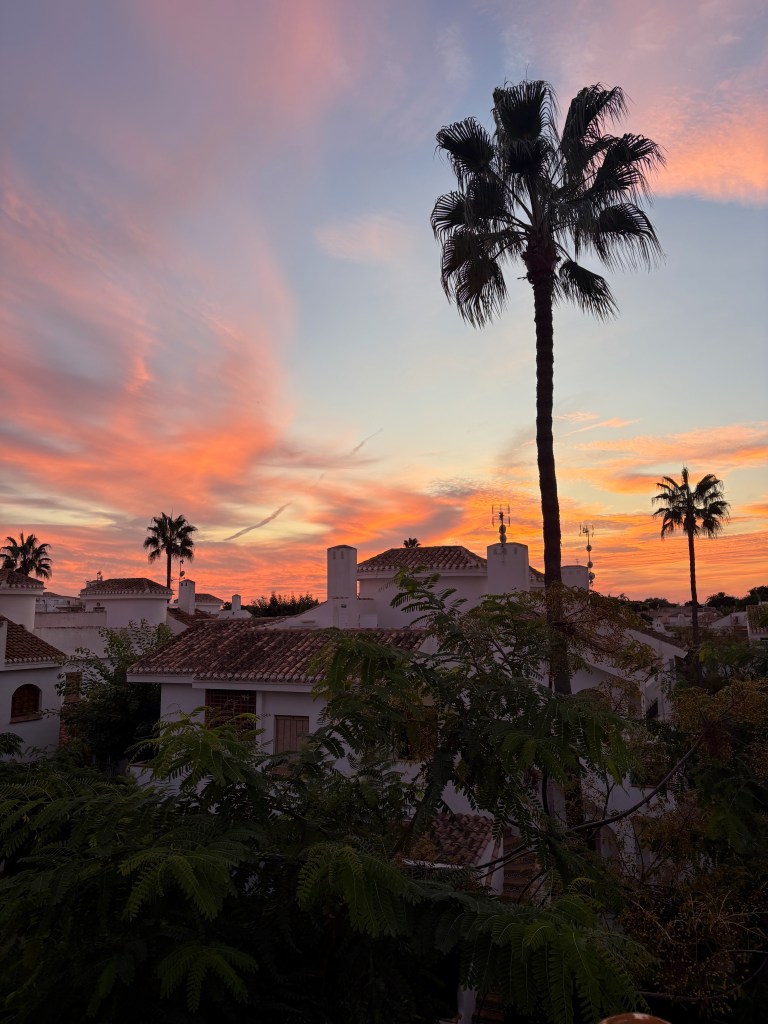
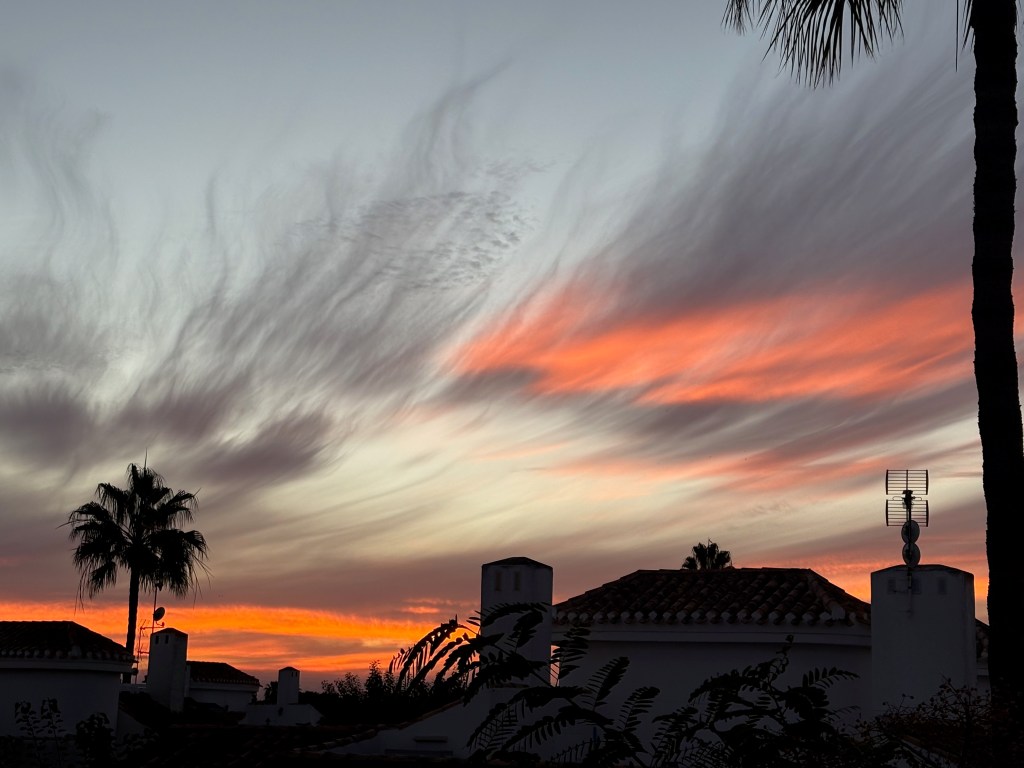
And the beautiful sunsets.
We had dinner with Vic and Pat, Val’s brother and sister-in-law, at Trokadero in Pilar -excellent We reminisced about past times together and with Val.
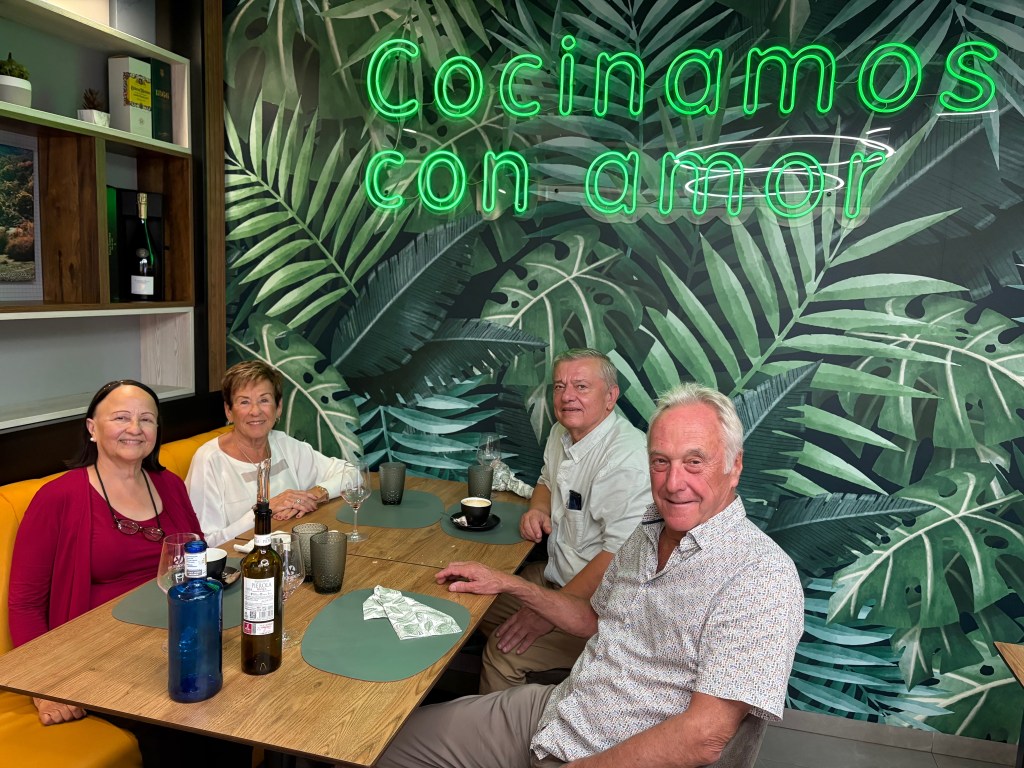
The last week was cooler and a blessing because we were busy cleaning, packing and wrapping. The windows and doors will be replaced during the winter and the dust will fly. Fortunately, we will miss it!

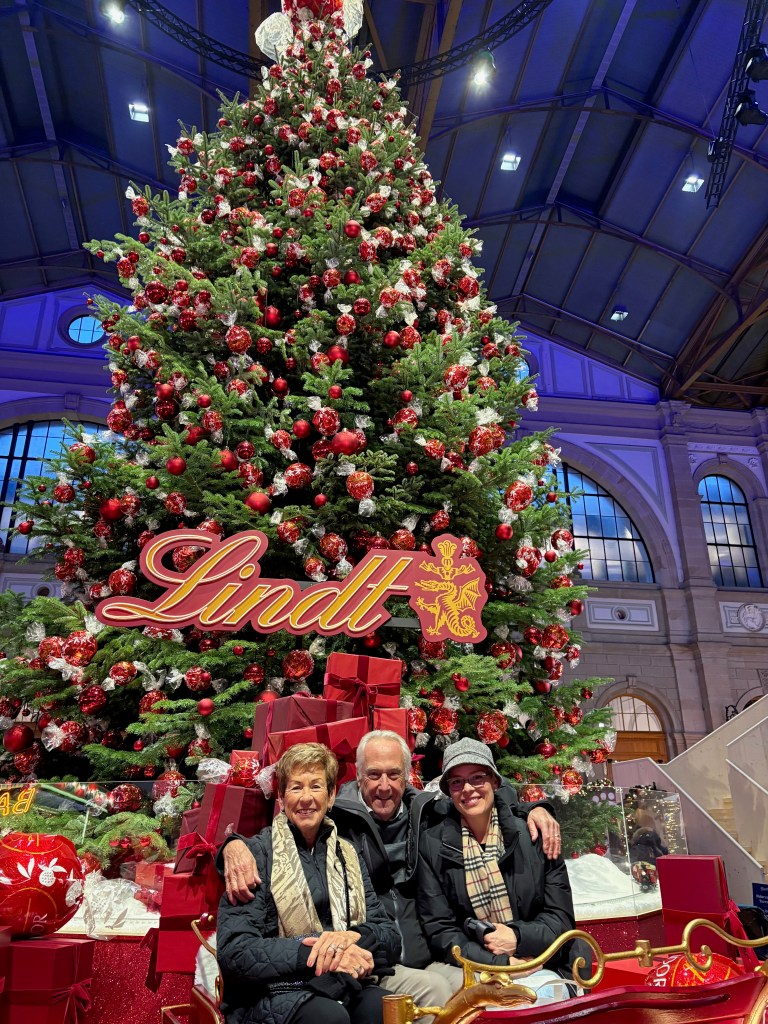
On our return to Canada, we stopped in Zurich. We arrived after 11:00 pm and took a very expensive taxi to the airbnb. Monday was a cold and wet day and the museum was closed so we read in the apartment, had a nice lunch and met Paola who had signed on for our AC flight back to Toronto . We visited the Christmas Market in the train station and went for dinner.
 Site Title